


Abstract
The use of plastics for food packaging is ubiquitous because of their easy processability, low cost, and excellent resistance to water, oil, and grease penetration. Paper treated with per- and poly-fluoroalkyl substances (PFASs) using a conventional paper manufacturing process has also achieved similar functionalities. However, due to the health and environmental concerns of the above two packaging materials, food packaging industries are now open to more options. Cellulose nanomaterials (CNs), such as cellulose nanofibrils (CNFs) and cellulose nanocrystals (CNCs), are ideal alternatives. CNFs have excellent mechanical strength and gas barrier properties, but they have high hydrophilicity because of their semi-crystalline structure and surface hydroxyl groups, which decrease their properties in contact with moisture or high humidity. On the other hand, CNCs are less chemically reactive to water due to their crystalline structure, but films prepared with only CNCs are brittle. To tackle these limitations, this research studied films prepared by blending CNF and CNC suspensions at various ratios. The aim was to prepare standalone grease-resistant films and/or coating materials for food packaging applications. The properties of the films were characterized by mechanical tests, contact angle analysis, grease resistance tests, and atomic force microscopy (AFM) analysis. Films prepared with 100% CNF showed better tensile properties compared to CNF/CNC composite films, but showed high affinity to water and thickness-dependent wetting. All the prepared films passed the grease resistance test with a Kit rating of 12.
1. Introduction
The food packaging industry is expanding exponentially and holds the largest share (85%) of the overall packaging market [1]. Food processing industries choose packaging materials considering the barrier properties (water, oil, and gas barrier), heat seal ability, processability, strength, printability, and cost-effectiveness [2]. In 2015, paper and paperboard production covered 31% of the total packaging market in the world. Paper-based materials have been predominantly used for the food industries where paper contacts directly with food products during packaging. Additionally, industries use paper-based materials for transportation and storage purposes [3]. These packaging materials help us enjoy our food as they restrict oil or grease from penetrating and reaching our fingers. Foods containing oil or grease are commonly handled in paper-based boxes or flexible thin paper possessing grease resistance. For the benefits of food safety and easy processability, grease-resistant paper-based packaging is essential for food handling in our daily life.
Unlike regular paper products, most grease-resistant food packaging paper products are coated with potentially harmful chemicals, which are persistent in the environment and pose a significant threat to human health [4,5]. Paper containing per- and poly-fluoroalkyl substances (PFASs) is the most common and dominates the current market because it effectively establishes resistance to grease, oil, and water [6]. PFASs are commonly used as paper coating material to achieve the desired grease resistance [7,8]. However, the major challenge of using PFASs is being potentially toxic to health when the paper packaging closely interacts with food. Under this circumstance, the fluorochemical can migrate into our food during consumption [9,10,11]. PFASs were identified to be responsible for thyroid-related diseases, kidney diseases, developmental toxicity, immunotoxicity, metabolic disruption, and cancer. Furthermore, PFASs are highly persistent when disposed into the environment with the packaging, which causes significant negative impacts on the whole ecosystem [12].
In this regard, US manufacturers of these kinds of paper products agreed with the US Environmental Protection Agency (EPA) to avoid using long-chain PFASs containing eight carbon chains and above, as these have been identified as the most persistent in nature [11,13]. On the other hand, shorter-chain PFASs containing six carbons or less, which do not have the same persistency and potential toxicity compared to longer-chain fluorochemicals, have been agreed to be used [14]. Regardless of the fact that long-chain PFASs are not being used in the US, they are still being used in other countries around the world [13]. However, due to the uncertainty of future regulations, industry and academia are interested in PFASs-free grease-resistant paper products.
PFASs or plastic-free grease resistant paper products could be obtained by blocking or minimizing the pores in the paper structure through a high degree of pulp refining or by making the paper surface dense with acid treatment, such as in the case of glassine and parchmentized paper [7,15]. However, extensive refining is energy- and time-consuming, and bestows pulp a slow water drainage rate, resulting in high energy demand in the drying section. It has been reported that the refining energy required for making glassine paper is approximately five times higher than for making copy paper [16]. Therefore, using coating material to impart the grease-resistant surface to a piece of regular paper is an economically viable option compared to manufacturing glassine paper. It has been reported that the energy consumed to dry a coating layer is one-third of the energy it takes to refine pulp to manufacture uncoated glassine paper [16].
Recently, non-toxic, sustainable, and renewable cellulose nanomaterials (CNs), i.e., cellulose nanofibrils (CNFs) and cellulose nanocrystals (CNCs), extractable abundantly from plant biomass, have been investigated as the barrier materials for packaging applications [17]. CNFs have a diameter of 10 to 100 nm and a length of several microns (spaghetti-like shape), while CNCs are rigid nanomaterials having a diameter of 5 to 20 nm and a length of 100 to 200 nm (rice-like form) [18,19]. CNs possess extraordinary mechanical properties; for instance, CNFs have a tensile strength of 7.5–7.7 GPa and Young’s modulus of approximately 100 GPa, whereas CNCs have a tensile strength of approximately 10 GPa and Young’s modulus of approximately 110–130 GPa. CNs also have biodegradability, tunable surface chemistry, excellent chemical resistance ability, and renewability [20,21,22,23,24]. They can form robust and highly dense films due to their nanometer-scale size and excellent mechanical properties, which is the basis for considering them as the sustainable barrier materials for packaging applications. CNCs can be packed more densely than CNFs, but the films tend to be more brittle [25].
Four types of barrier performance are commonly studied for CN films in packaging: oxygen barrier, oil/grease barrier, and water barrier in vapor and liquid forms [26]. Food packaging materials are expected to show considerable resistance to oil and grease. CNCs have recently been used in a grease-resistance formulation with sodium montmorillonite (MMT) and soy protein [27]. It was reported that paper coated with only CNCs failed Kit rating 1, while the paper coated with a mixture of CNCs, MMT, soy protein, and alkyl ketene dimer (AKD) passed Kit rating 6. It was reported by Hubbe et al. [26] that, to achieve good oil/grease barrier properties, CNFs played roles in the coating process as a stabilizer, pore-filler, thickener, and binder, and concluded that placing CNFs onto the porous surface of paper basically seals most of the pores of the paper. In another study, interestingly, it was demonstrated that CNF films prepared for oxygen barrier performance tend to provide excellent oil/grease resistance [28]. In a review, Hubbe et al. [26] suggested that the high cohesive energy density provided by the large network of hydrogen bonding within a pure CN film might be required to achieve effective resistance against oxygen and oils.
More recent studies have contributed to the performance of grease barriers derived from nanocellulose. For instance, Mazega et al. have described aqueous nanocellulose coatings that consist of other components such as illite, sodium alginate, and/or poly (vinyl alcohol), achieving oil repellence of up to 11 Kit; a multifunctional formulation consisting of nanocellulose, size agents, minerals, and PVA showed a Kit rating of 12 [29]. Baral et al. developed CNC-based paper coatings with collagen hydroly-sate and glycerin, and found that all paper samples that underwent coating passed the hot oil test and showed the highest Kit rating [30]. These studies show that high oil repellence is achievable if nanocellulose is combined with other components to form composite coatings. However, in the present work, pure films made from blends of CNF and CNC only are investigated in order to demonstrate the effect of the ratio between CNF/CNC on mechanical properties, surface properties, and grease resistance without the presence of a polymer, mineral, protein, plasticizer, or hydrophobizing agent. Another recent review article also stresses the importance of coating and composite film preparation for sustainable food packaging from nanocellulose [31].
Despite being a promising alternative to replace potentially toxic and non-biodegradable compounds, CN has certain limitations that hold back its uses in many cases. One of the primary limiting factors is having cracks/pinholes of CN films/coating materials. It was reported that even a highly dense cellulosic film with extensive internal hydrogen bonding networks could be expected to give poor barrier performance if it has pinholes or cracks. For instance, it was reported that four layers of starch-polyvinyl alcohol were necessary to cover glassine paper to avoid any effects of pinholes or cracks [32]. Theoretically, a higher crystallinity is desirable to achieve good barrier properties for the CN films [33]. However, high crystallinity results in brittleness in the film. Due to the higher crystallinity and packing density in CNCs compared to CNFs, films prepared with only CNCs are brittle and difficult to handle [34]. To address this issue, complex recipes with other ingredients, such as sorbitol [35] and soy protein [27], were introduced to decrease the brittle behavior of the CN films or coating.
Another concern with CNFs for packaging applications is their hydrophilicity due to their semi-crystalline structure and the presence of surface hydroxyl groups. It was reported that at higher relative humidities, the barrier properties of CNF films become suppressed [36]. Note that CNC-containing composites show less sensitivity to humidity when compared to CNFs [37].
Therefore, in this study we developed a simple and sustainable grease barrier formulation using only CNs. Unlike previous barrier studies that have mostly involved multiple layer structures or the incorporation of other ingredients like mineral filler, protein, size, plasticizer, chemical and thermal modifications, the current study involves the use of a minimal two-component system comprising of commercial CNF and CNC only. Such a design is aimed at highlighting the role of nanocellulose structure and blending ratios without any interference from any additional ingredient, while keeping an easy process of preparation. In this particular case, the research gap identified is not on the use of nanocellulose as an oil/grease barrier, since that has been achieved already, but on whether a direct physical blend of CNF, which is flexible and forms a network with CNC, can be achieved while maintaining grease resistance and mechanical control. Since moisture content has the potential to plasticize and swell hydrophilic cellulose systems, which would change the barrier properties, moisture content is another practical parameter that needs to be considered in packaging foods. The current data set directly tests the wetting behavior of liquid water at 50% RH; high-humidity grease barrier performance was not tested. The standalone barrier films passed the grease resistance test with a Kit rating of 12. Such an additive-free approach was specifically chosen in the scope of previous studies in a thesis where water-soluble polyethylene oxide (PEO), used as a coating material, was added to CNF-based materials in order to improve film performance [38]. It was demonstrated that PEO formed hydrogen bonds with CNF and altered the pore size distribution of CNF films [38], which might be considered beneficial in terms of grease resistance. In light of such results, the current manuscript addresses a related question: to what extent grease resistance and film properties can be controlled through CNF/CNC physical mixing without using an additional polymeric plasticizer/additive.
2. Materials and Methods
The CNF suspension (3 wt.%) was purchased from the Process Development Center (PDC) at the University of Maine (Orono, ME, USA). The CNC suspension (6 wt.%) was purchased from CelluForce Inc. (Montreal, QC, Canada). The suspensions of CNF and CNC were diluted using deionized (DI) water to prepare the 1 wt.% suspensions. During the dilution process, a homogenizer (IKA T25 digital Ultra-Turrax, IKA works Inc., Wilmington, NC, USA) was used to disperse the CNF or CNC in the suspension at 3000 revolutions per minute (rpm) for 3 min, followed by stirring overnight using a magnetic stirrer for 12 h at room temperature condition (22 °C, 50% RH). Parafilm was used to cover the beaker top to prevent water evaporation during the stirring process. Commercial paper products, including parchment paper sheets (Reynolds Kitchens, Lake Forest, IL, USA), copy paper (Worklife Brands LLC, Framingham, MA, USA), pan liner from unbleached paper (LO10U, DIXIE, Wichita, KS, USA), and FDA-approved butcher paper (5PGK9, Grainger, Lake Forest, IL, USA), were purchased for this research.
Particle size distribution test
The particle size measurements of CNF and CNC were carried out using dynamic light scattering (DLS) technology with a LitesizerTM 500 (Anton Paar, Ashland, VA, USA). Suspensions of CNF and CNC at 0.01 wt.% were prepared for the particle size analysis. The instrument uses a 40 mW semiconductor laser operating system at a wavelength of 658 nm. The light scattering was detected at 90° by backscattering technology. Results were presented as an average value of five experiments for each sample. Each CNF and CNC suspension was measured using ten independent DLS samples that were averaged.
Standalone CNF/CNC composite film preparation process
Standalone films were prepared by mixing CNFs and CNCs at 1 wt.% concentration according to the formulation design shown in Table 1. The aqueous CNF and CNC suspensions were mixed using a high-speed homogenizer at 3000 rpm for 5 min. The mixture was then stirred for 12 h at 750 rpm at room temperature to remove the air bubbles using a magnetic stirrer. Afterward, the suspensions were cast on a 120 mm × 120 mm polystyrene petri dish and allowed to dry at room temperature for seven days to reach equilibrium with room conditions. For each film preparation, 60 g of suspension was used consistently. After drying, the films were cut into strips with dimensions of 25.4 mm width and 101.6 mm length with a lab film cutter according to the ASTM standards D828 for mechanical property characterization except the films prepared with 100% CNC, as the films were too brittle to handle. All the commercial paper products were cut into strips with the same dimensions for characterization.
Table 1.
Suspension formulation design for CN-based films.
Characterization of films
Mechanical properties
The mechanical properties, including tensile strength (TS), strain at break, tensile energy absorption (TEA), and Young’s modulus, of all the prepared films and commercial paper products were tested using a Mark-10 motorized force test stand ESM750S (Copiague, NY, USA) accompanied with a 500 N load cell at 22 °C and 50% RH. The initial grip distance was 25.4 mm, and the grip separation rate used was 7 mm/min. Ten replicates of each sample cutting from ten independently prepared films were measured to report the film properties. The thicknesses of each specimen and the commercial product were measured for ten replicates using a digital micrometer screw gauge (model 293-831-30, Mitutoyo, Kawasaki, Kanagawa, Japan). The mechanical properties of all the tested samples, including TS, strain at break, TEA, and Young’s modulus, are reported according to the ASTM standard D828. All the test samples were conditioned for 24 h at 22 °C and 50% relative humidity. The statistical analysis was carried out using analysis of variance (one-way ANOVA). If there was a significant treatment effect, Tukey’s honestly significant difference (HSD) test was conducted for pair-wise comparison of the means. Results are presented as means ± standard deviation. Significant difference (p < 0.05) is indicated by different letters above the bar, whereas same letters indicate no significant difference between the groups. The letters A, B, C, D, and E represent the significant levels in statistical analysis. The values with different letters were significantly different. Throughout the whole paper, the letters will carry the same meaning as mentioned.
Contact angle measurement
The water contact angle of all the films was measured by using a contact angle goniometer (Ossila Contact Angle Goniometer, Sheffield, UK) at room temperature with 50% RH. The contact angle determines the wetting degree between a liquid and a solid. High contact angle (>90°) represents hydrophobicity and vice versa. During contact angle measurement, the appropriate size of the film was bonded to the top of a glass slide using double-sided tape. For each test sample, contact angle measurements were performed an average of ten times at different locations. The contact angle changes of water droplets on the film surface were captured with time. The contact angle data were extracted at 0.5, 1, 2, 3, 4, and 5 min, counting from when the water droplet contacted the film surface. The procedure of water contact angle measurement followed that in the literature [25].
A separate set of experiments was performed to understand the effect of film thicknesses on surface properties using contact angle analysis. Films were prepared using 100% CNFs at 0.1 wt.% concentration at different gram weights. Films were prepared with 80 g, 60 g, and 20 g of CNF solution by following the same procedure used to make other films. Another batch of films was prepared with 60 g, 40 g, and 20 g CNC solution using 100% CNCs at 0.1 wt.% concentration. After drying, the thickness of the prepared films was measured using digital slide calipers. The contact angles were measured from 30 s to 5 min after the probing liquid (water) touched the film surface.
Atomic Force Microscopy (AFM)
A Bruker Dimension Icon AFM (Bruker Nano Inc., Santa Barbara, CA, USA) was employed in this work. The ScanAsyst mode was employed to investigate the morphology of the film surfaces. ScanAsyst-Air probes were used. The nominal probe spring constant and radius were 0.4 N/m and 2 nm, respectively. The probes were calibrated by the thermal tune method before use. Five random areas (2 μm × 2 μm) were imaged on each surface. The data were processed with the software NanoScope Analysis 2.0 (Bruker) and height images were generated.
Grease resistance test
A grease resistance test (the Kit test) was performed by following the TAPPI test Method T559 cm-12 to test the degree of repellency of the films against oil and greasy substances. This test uses a series of 12 solutions with different ratios of castor oil to the mixture of toluene and n-heptane. The aggressiveness of the test solutions increases with the increasing content of n-heptane and decreasing content of castor oil. A drop of a chosen Kit solution was placed on a film at a height of about 13 mm above the film using an eye-dropper. A piece of kraft paperboard in brown color was placed under the film to observe the penetration of the solution. After 15 s, the droplet was removed from the film, and any darkening of the underlying paperboard resulted in the “failure” of the test. The test continued until the highest Kit number was obtained and reported as the Kit number of the film.
3. Results and Discussion
3.1. Particle Size Distribution
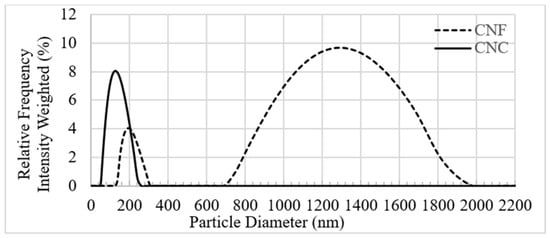
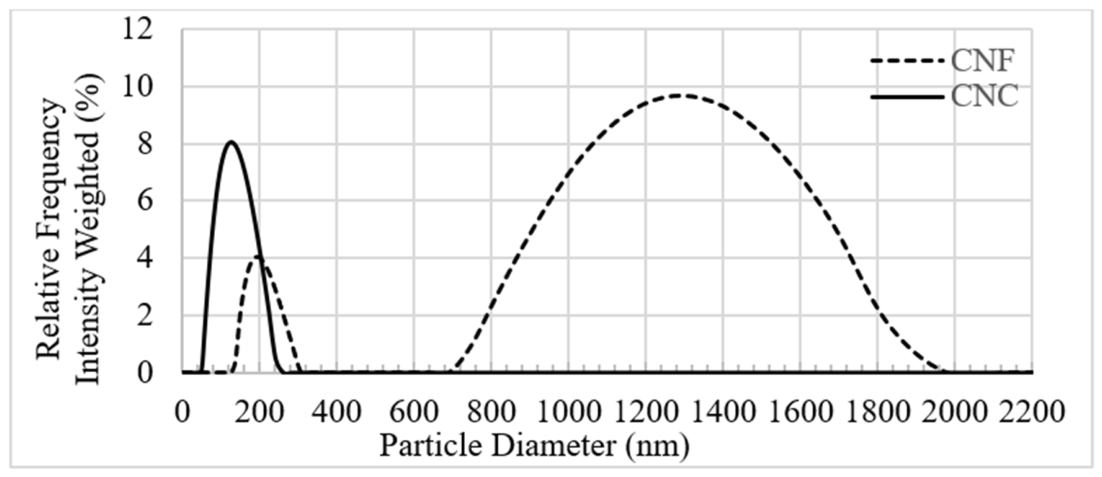
The particle size distributions, as measured by DLS, of CNF and CNC are shown in Figure 1. The CNFs are mechanically extracted fibrous materials with a large aspect ratio, while the CNCs are chemically extracted needle-like materials. The CNC showed a single peak at around 100 nm (from 47.6 to 260 nm), while the CNF showed two peaks at around 200 nm (from 126 to 300 nm) and 1300 nm (from 690 to 2000 nm). The minimum particle sizes of the CNC and CNF particles in the suspensions were around 47 nm and 126 nm.
Figure 1.
Particle size distribution of CNF and CNC suspensions.
3.2. Mechanical Properties
Mechanical properties of CNF/CNC composite films
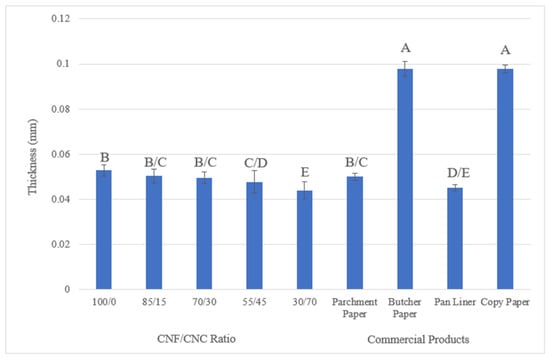
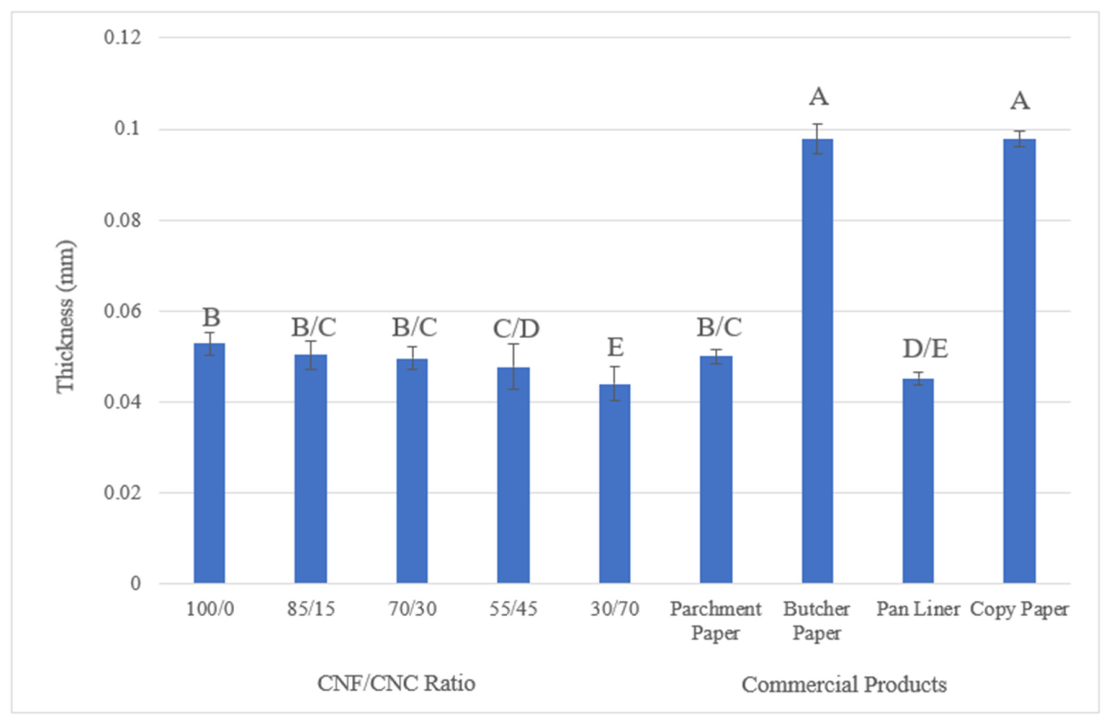
Several commercial paper products, namely, parchment paper, butcher paper, pan liner, and copy paper, were tested as control samples to compare with the CNF/CNC composite films. The thicknesses were measured for all the CNF/CNC composite films and commercial papers (Figure 2). Parchment paper had a thickness of 0.05 (±0.01) mm, similar to the pure CNF films with a thickness of 0.052 (±0.02) mm. Parchment paper is a traditional grease-resistant paper that does not contain fluorochemicals. Therefore, in this section, the mechanical properties of parchment paper were treated as the benchmarks compared with the CNF/CNC composite films, and were further compared with other commercial paper products.
Figure 2.
The thicknesses of the CNF/CNC composite films and commercial paper products. The letters A, B, C, D, and E represent the significant levels in statistical analysis.
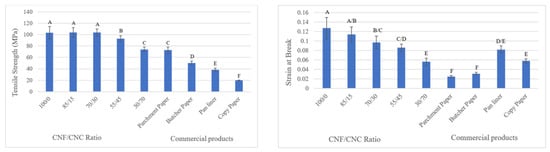
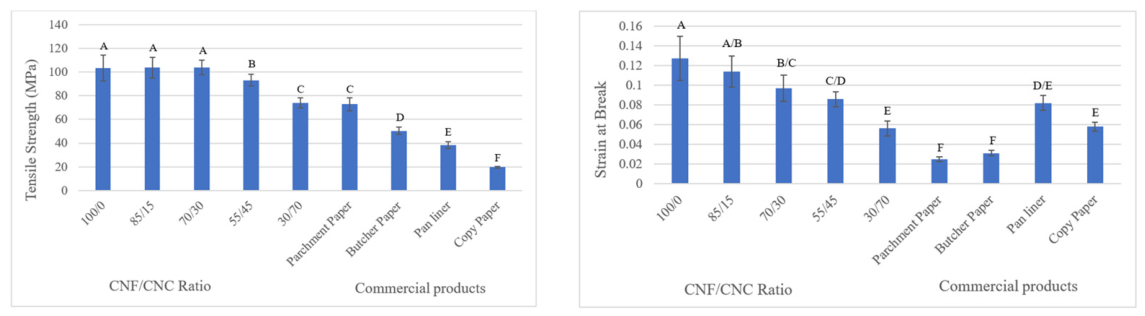
TS values and the strain at break values for all the CNF/CNC composite films and commercial paper products are shown in Figure 3. The TS values of the CNF/CNC composite films with up to 30 wt.% CNC were not significantly different from the 100 wt.% CNF films. As the weight ratio of CNC in the composite film increased to 45 and 70%, the TS significantly decreased. The TS value of the 100 wt.% CNF film was 103 ± 11.0 MPa, which was nearly 39.8% higher than that of the film containing the highest CNC loading (70 wt.%), which is 73.9 ± 4.3 MPa. The TS value of 100% CNF film was 41.4% higher than that of parchment paper (72.8 ± 5.5 MPa). The composite film with 45 wt.% of CNC showed a higher TS value than the parchment paper, while the 70 wt.% of the CNC-loaded film showed a similar TS value to the parchment paper. The TS value of parchment paper was much higher than those of butcher paper, pan liner, and copy paper, which had TS values of 50.7 ± 3.2 MPa, 38.6 ± 2.8 MPa, and 19.7 ± 0.7 MPa, respectively. Similarly, the 100 wt.% CNF film exhibited the greatest strain at break (12.7% ± 0.02), which was more than twice that of the highest CNC-loaded film (5.6% ± 0.03). According to Wang [25], the lower the crystallinity of the cellulose-based film material, the greater the strain at break. As mentioned earlier, CNC is a more crystalline polymer compared to CNF; therefore, films prepared with a higher CNC loading level result in lower TS and strain at break. In addition, the strain at break value of 100% CNF films was four times higher than that of the parchment paper (2.5%). The CNF/CNC composite films at the CNF/CNC ratios of 85/15, 70/30, 55/45, and 30/70 showed strain at break values of 11.4 ± 0.01, 9.7 ± 0.01, 8.5 ± 0.07, and 5.6% ± 0.07, respectively. The strains at break for these films were all greater than that of parchment paper. Furthermore, the strain at break value of the parchment paper was similar to that of the butcher paper (3.1% ± 0.02) but lower than those of pan liner (5.8% ± 0.07) and copy paper (5.8% ± 0.01).
Figure 3.
Tensile strength and strain at break of CNF/CNC-based films and commercial products. The letters A, B, C, D, E and F represent the significant levels in statistical analysis.
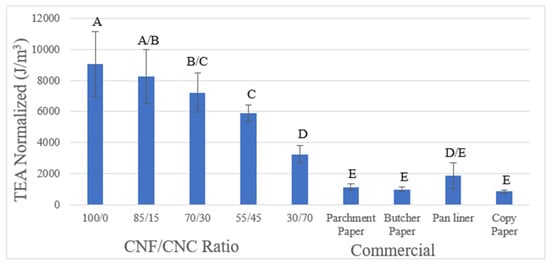
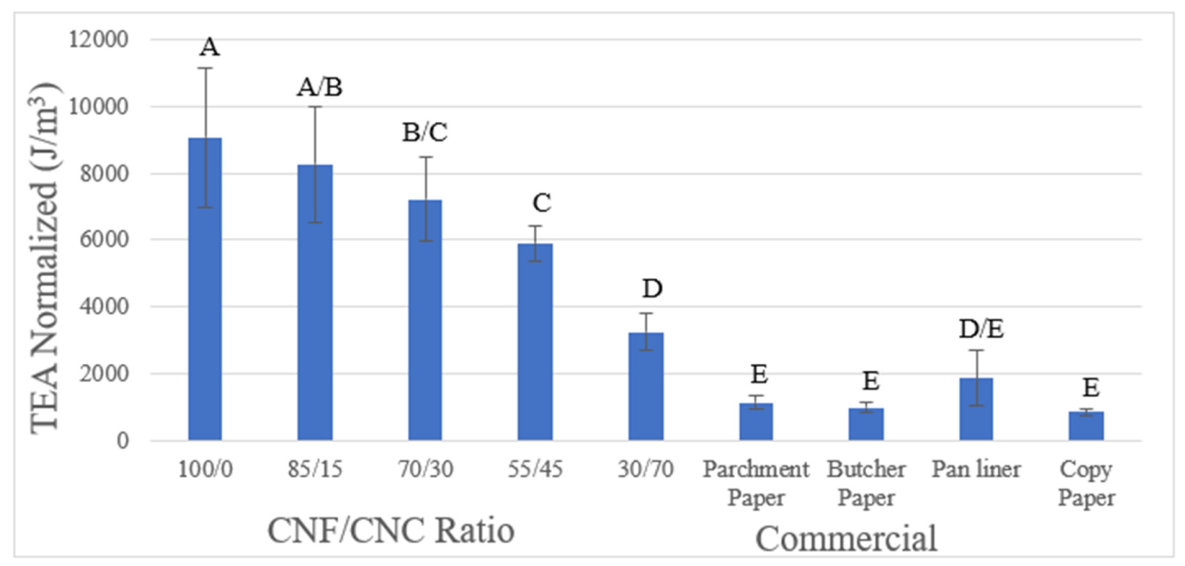
A similar trend was observed for the TEA values shown in Figure 4. The films prepared with 100 wt.% of CNF had a TEA value of 9060 J/m3 (±2076.8), which is more than double that of the highest CNC-loaded film (3260 ± 571.8 J/m3) and around nine times higher than the parchment paper (1143.3 ± 205 J/m3). The TEA value of the parchment paper was not significantly different from that of the pan liner, butcher paper, and copy paper, which had TEA values of 1143.3 ± 834, 993.1 ± 152.7, and 863.1 ± 98.7 J/m3, respectively.
Figure 4.
TEA of CNF/CNC-based films and commercial products. The letters A, B, C, D, and E represent the significant levels in statistical analysis.
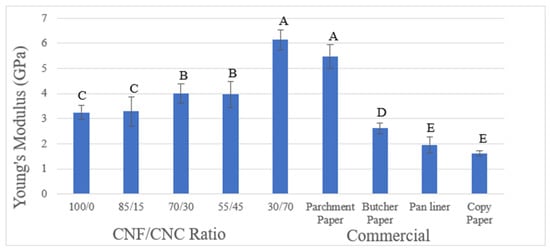
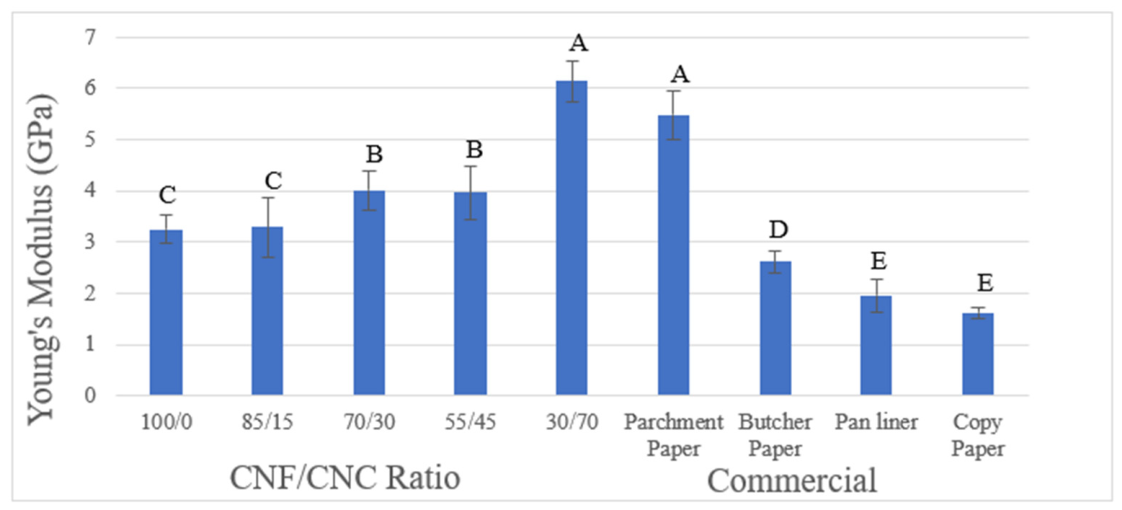
The addition of CNC increased the film’s stiffness, which can be demonstrated by the changes in Young’s modulus of the films shown in Figure 5. The film with 70 wt.% of CNC had a Young’s modulus of 6.13 ± 0.39 GPa, much higher than that of the 100 wt.% CNF film (3.24 ± 0.28 GPa). This is probably caused by the higher loading level of CNC, which has a higher degree of crystallinity and densification of the film [39]. The densification of the composite film with 70 wt.% CNC can also be demonstrated from the slightly reduced thicknesses of such films, as shown in Figure 2. The pure CNF film had a thickness of 0.053 mm, while the composite film with 70 wt.% of CNC had a thickness of 0.044 (±0.03) mm. The Young’s modulus value of parchment paper was 5.47 GPa, which is not significantly different from that of the 70 wt.% CNC-loaded film but much higher than those of the rest of the CNF/CNC composite films. In addition, the Young’s modulus value of parchment paper was higher than those of butcher paper, pan liner, and copy paper, which had values of 2.6 ± 0.22 GPa, 1.95 ± 0.31 GPa, and 1.62 ± 0.11 GPa, respectively.
Figure 5.
Young’s modulus of CNF/CNC-based films and commercial products. The letters A, B, C, D, and E represent the significant levels in statistical analysis.
Overall, the 100% CNF film showed higher TS and TEA values and lower Young’s modulus values compared to the highest CNC-loaded film and all the other commercial products, including parchment paper. Surprisingly, all the CNF/CNC composite films showed higher flexibility (higher strain at break values) than parchment paper. Flexibility is one of the more important criteria for food packaging applications, since the packaging material needs to be folded in a certain pattern. All the CNF/CNC composite films with CNC content up to 45 wt.% showed lower Young’s modulus values than that of parchment paper. The Young’s modulus value of the film with the CNF/CNC ratio of 30/70 was similar to that of the parchment paper (Figure 5).
3.3. Atomic Force Microscopy (AFM)
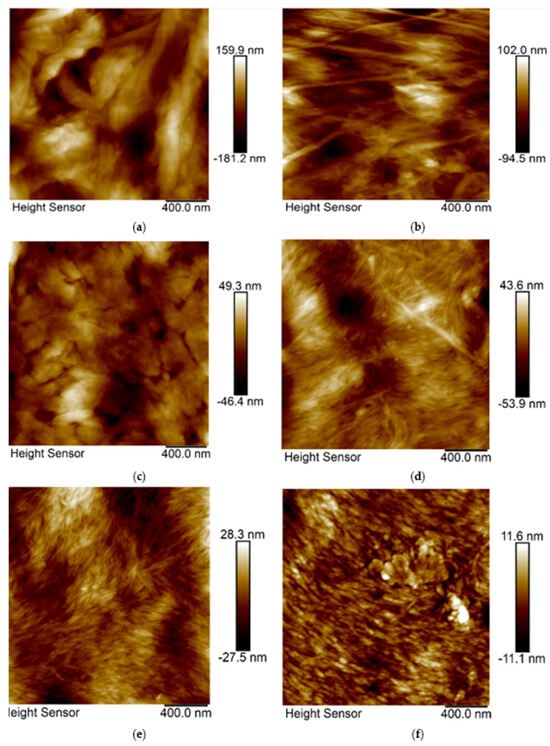
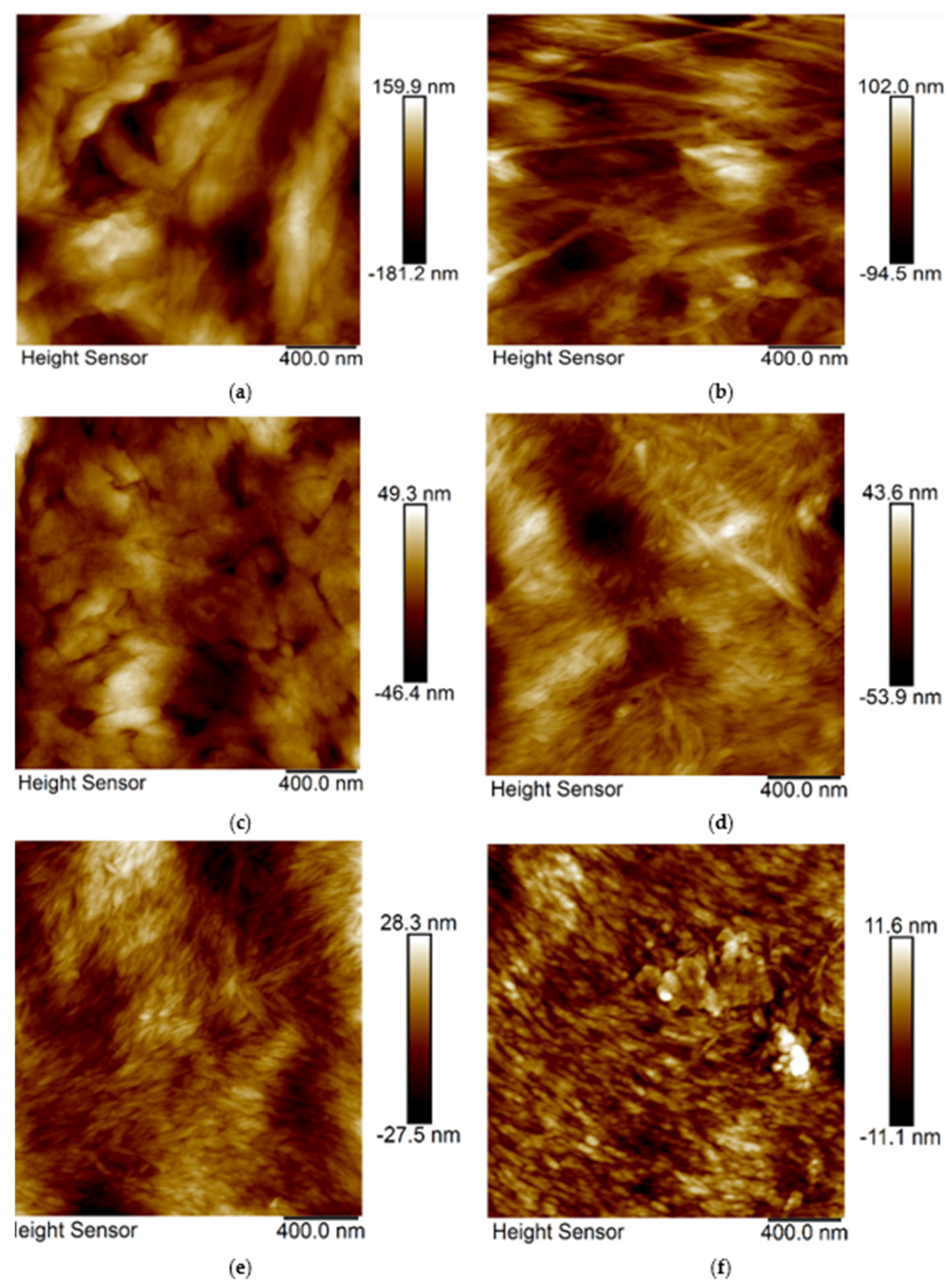
The surface morphologies of the CNF/CNC composite films with weight ratios of 100/0, 85/15, 70/30, 55/45, 30/70, and 0/100 are shown in Figure 6. It was observed that the 100% CNC film sample exhibited a short needle-like/rod-like structure, and the particles were distributed evenly on the surface. In contrast, the 100% CNF film sample showed the distribution of a fibrous network structure with larger pores, which showed in darker areas. The AFM micrographs confirmed that the 100% CNC film had lower surface roughness, and the surface was smoother and more compact in comparison to the 100% CNF film surface. The difference in contrasts in the images indicates different heights. Notably, as the CNC content increased in CNF/CNC films, the surface appeared progressively smoother and more homogenous. The average roughness values (expressed in Ra) for the 100% CNF and 100% CNC films were 40.14 ± 6.24 nm and 2.67 ± 0.36 nm, respectively. The above numerical endpoints further support the AFM observations that the surface rich in CNCs is smoother than the surface rich in CNFs. One thing to consider is that while AFM provides data about surface topography and roughness, it does not provide information about the porosity of the film. As such, any conclusions regarding the porosity of the film are based on the surface topography. There are no roughness data for the CNF/CNC film compositions, and no further roughness comparison could be done.
Figure 6.
The AFM height diagrams of CNF/CNC composite films on sensors at weight ratios of 100/0 (a), 85/15 (b), 70/30 (c), 55/45 (d), 30/70 (e), and 0/100 (f).
3.4. Contact Angles Measurement
The apparent contact angles (CAs) of water versus time for the CNF/CNC films and commercial papers are plotted in Figure 7. Contact angles were obtained from 0.5 min to 5 min. Both CNF/CNC films and copy paper had lower water apparent contact angles than those of parchment paper, pan liner, and butcher paper. At 0.5 min, the apparent CA of the 100% CNF film was 36.5° (±11.9), whereas at 5 min, it was 22.7° (±2.9). In the case of the 100% CNC film, it was 49.8° at 0.5 min and reduced to 41.2° after 5 min. However, for the porous and hygroscopic cellulose films, it would be incorrect to assume that the time dependence of the contact angle provides information about the surface hydrophobicity. The apparent CA can be changing in real-time because of liquid spreading, capillary penetration into surface and inner pores, absorption, the swelling of the cellulose network, and water-induced modifications on the surface. Therefore, the difference in the time dependence of the wetting behavior between the CNC film and the CNF one is considered as a slower apparent wetting response rather than a higher hydrophobicity or stability of CNC.
Figure 7.
Contact angle of water on commercial paper products and CNF/CNC composite films.
The discrepancy between the CNF- and CNC-rich films could be attributed to several interrelated structural factors. First, CNC consists of a higher percentage of crystalline material, while the AFM analysis reveals that CNF surfaces are rougher and more porous, while CNC-rich surfaces are smooth and denser. These parameters may affect such processes as spreading, capillary filling, absorption, and droplet shape evolution. Thus, crystallinity and porosity could be regarded as potential factors affecting the rate of the wetting process; however, the current experiment on the dynamic contact angle does not differentiate between their contributions separately.
The reason behind such a phenomenon could be the chemical component of CNC. As we discussed earlier, CNC contains a higher degree of the crystalline region of cellulose, which is less sensitive to water than the amorphous region that can absorb water. Another possible reason could be the porous structure of the CNF film, which accelerated the water’s passage through the pores and its interaction with the fibers, resulting in a rapid CAs decrease.
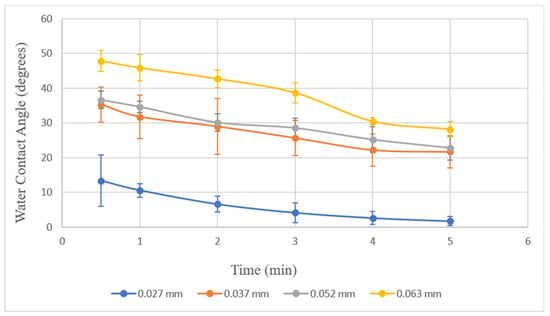
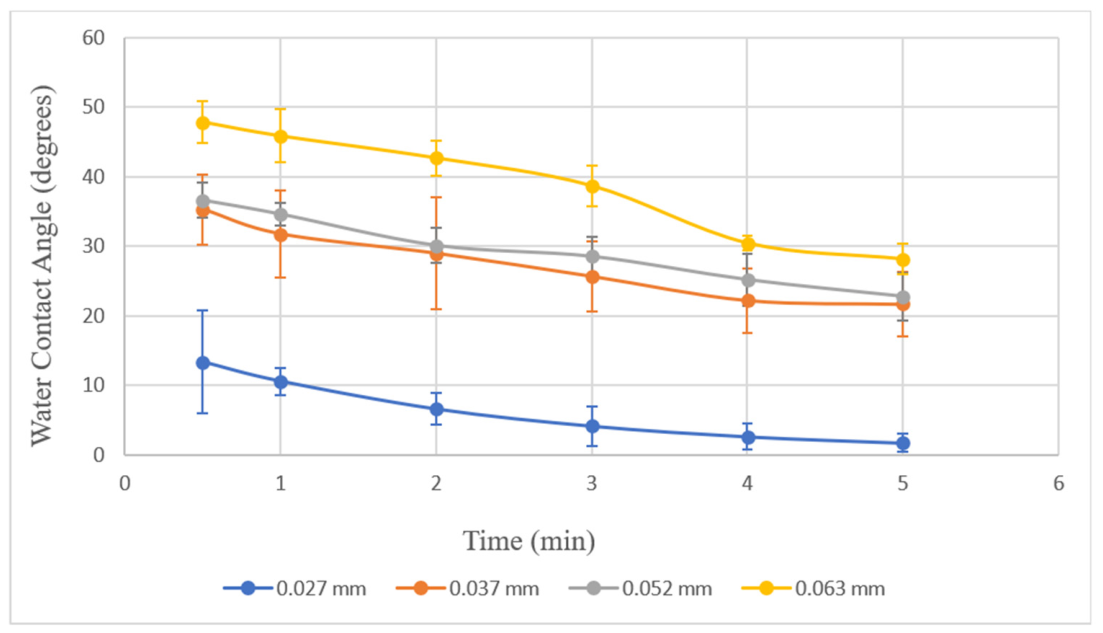
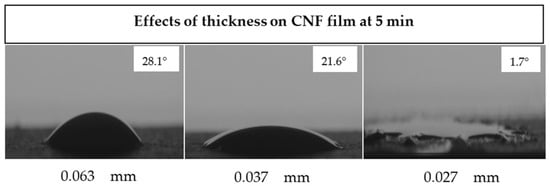
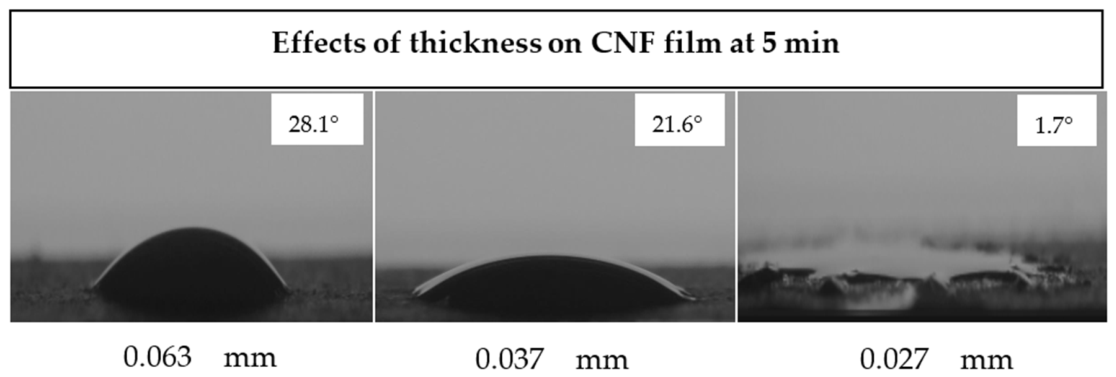
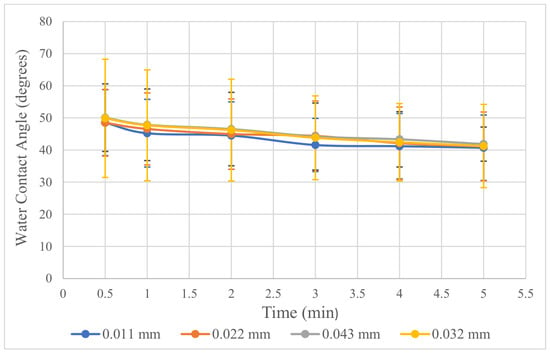
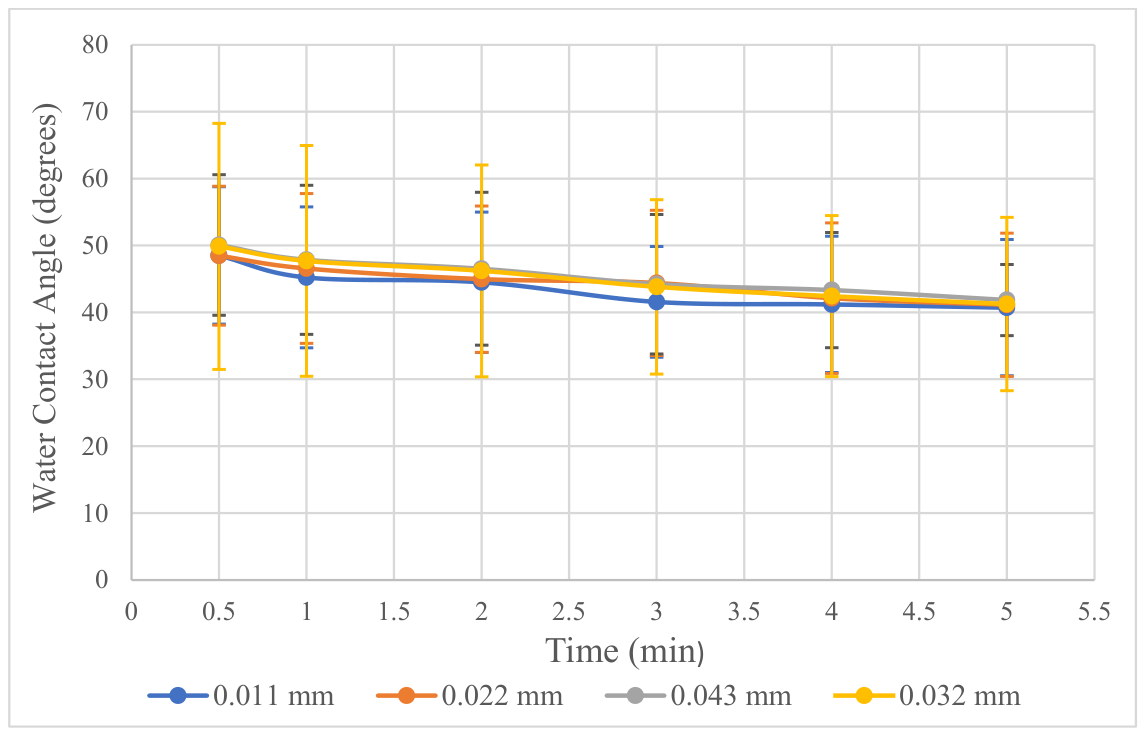
Another set of experiments was carried out to understand the effect of the film thickness on water CA. The effects of different thicknesses of the pure CNF and CNC films on water contact angles as a function of time are shown in Figure 8 and Figure 9. The CNF films were prepared with the final thicknesses of 0.027 (±0.03) mm, 0.037 (±0.03) mm, 0.052 (±0.02) mm, and 0.063 (±0.03) mm. The water contact angle on the CNF film surface increased as the film thickness increased, which indicates that the CNF film showed less wettability with increasing film thickness. The CNF film at 0.063 mm thickness has a CA of 47.8° at 30 s, which decreased to 28.1° at 5 min. Films prepared at 0.052 mm and 0.037 mm thickness showed similar CAs at 36.5° at 30 s, then reduced to around 21.6°. However, the lowest thickness of the CNF film (0.027 mm) showed a decrease in CAs from 13.4° to 1.7°. The water can quickly penetrate through the CNF film at 0.027 mm. On the other hand, the water CAs of pure CNC films prepared at 0.032 (±0.01) mm, 0.043 (±0.01) mm, 0.022 (±0.02) mm, and 0.011 (±0.01) mm thicknesses did not change significantly as a function of time (Figure 9). Even with a much smaller thickness (the thinnest CNC film with a thickness of 0.011 mm), the water contact angle of the pure CNC film only changed from 34.5° at 30 s to 30.7° at 5 min.
Figure 8.
Effects of CNF film thickness on water contact angle.
Figure 9.
The effect of CNC film thickness on water contact angle.
The contact angle measurements therefore characterize time-dependent surface wetting only. They do not by themselves demonstrate a water barrier; establishing water barrier performance would require direct transport or sorption measurements, such as water vapor transmission/permeability or moisture uptake.
Mechanistically, the thickness dependence observed for CNF is consistent with a transport-controlled wetting response rather than a change in cellulose surface chemistry. The AFM results show a comparatively rough, porous fibrillar CNF surface; in the thinnest CNF film, a water droplet has a shorter through-thickness transport path and can more rapidly access connected voids and hydrophilic hydroxyl-rich fibril surfaces. Increasing film thickness lengthens this pathway and increases the amount of hydrogen-bonded network that must be wetted before rapid penetration occurs, producing a higher apparent contact angle over the five-minute observation window. By contrast, the much smoother and more compact CNC-rich morphology provides fewer large surface voids, which is consistent with its smaller time-dependent contact angle change. This interpretation is supported by the present AFM and wetting trends, but direct pore-size, sorption, and through-thickness permeability measurements would be needed to distinguish absorption, capillary penetration, and roughness contributions quantitatively.
3.5. Oil and Grease Resistance
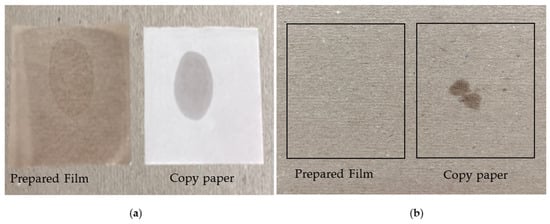
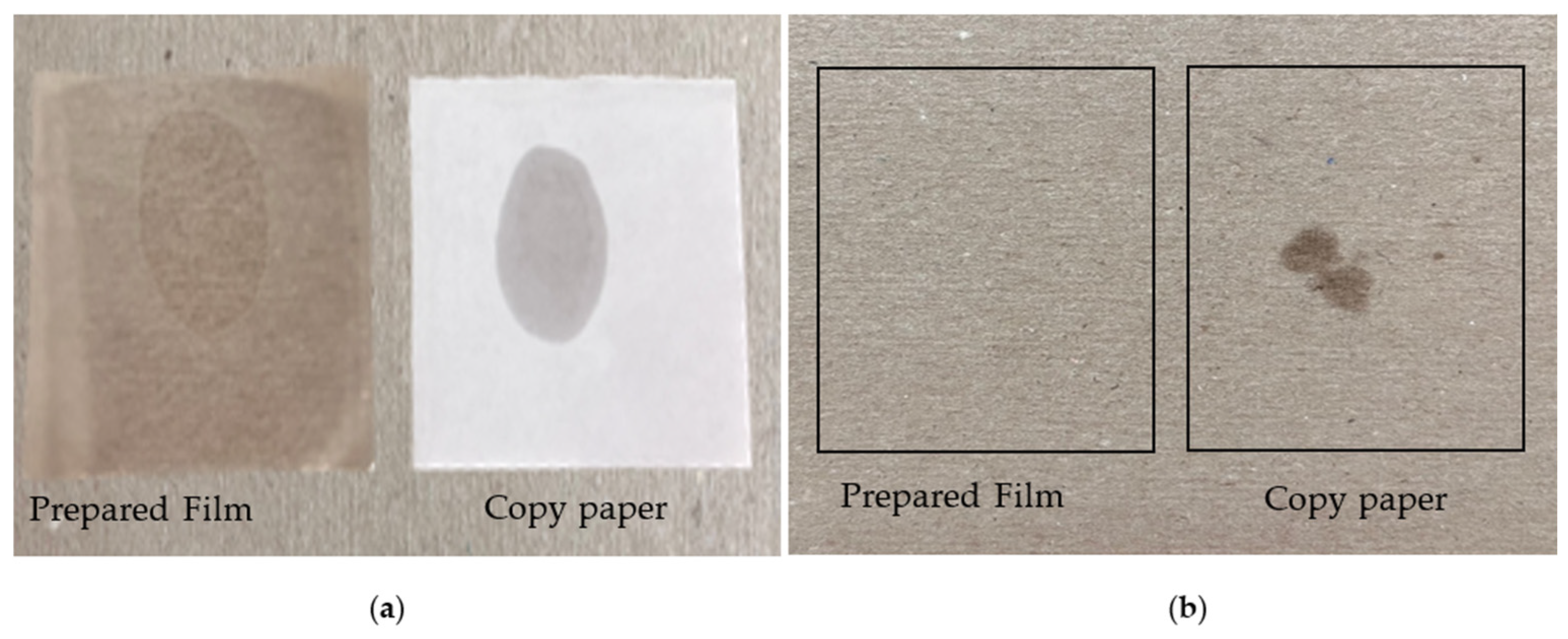
Our major goal was to prepare oil- and grease-resistant films for food packaging applications. Therefore, oil- and grease-resistance tests played an important role. An example of a “pass” and or “fail” of a Kit test is shown in Figure 10. Kit solution 12 was used in this experiment. At first, the prepared film specimens were cut into desirable sizes and placed on top of a paperboard surface. Next, a drop of Kit test 12 solution was placed on top of the film surface. All the prepared films, including CNF/CNC films and films prepared at different thicknesses, showed a “pass” with Kit test 12 by leaving no penetration mark underneath the paper surface after treating the paper with oil/solvents with a Kit solution rating 12. This indicates that no penetration of oil occurred through prepared films. However, the copy paper showed a “fail” result. A dark surface was observed after placing one drop of Kit solution 12 on the surface of copy paper, thus indicating oil penetration through copy paper. However, all the other commercial paper products “passed” with Kit solution 12.
Figure 10.
Oil and grease resistance test: (a) before kit test and (b) after kit test.
The current study has been mainly aimed at studying the grease resistance of CNF/CNC films under normal lab conditions, with all films having reached a maximum Kit value of 12. Further research could be done to investigate the performances of these films following conditioning at higher relative humidity. This is because nanocellulose is hydrophilic, and the results from such research could give more information about the influence of environmental moisture on grease barrier performance. The combination of Kit value, moisture absorption and water vapor barrier performance at varying relative humidities would help in developing CNF/CNC films for food packaging applications.
The structure–property interpretation of the Kit 12 performance comes from an analysis of the grease test data in light of the AFM and mechanical data. CNF produces a continuous and entangled fibrillar network, ensuring film continuity, but increasing CNC causes the film to become more and more smooth and dense, eliminating any visible pores. Consequently, the composite films combine both properties of CNF in providing continuity and CNC in providing densification, thus preventing any channels for the non-polar Kit fluids to pass through the film pores, as we discussed earlier. It should be noted that Kit 12 performance was reached by all studied ratios of CNF/CNC, and the data do not support any claim that the particular blend is the optimal choice for grease resistance.
Our major goal was to prepare oil- and grease-resistant films for food packaging applications. Thus, the oil and grease resistance testing was a key part of the film performance assessment. This was tested using the standard Kit test (TAPPI T559). Twelve solutions of increasing aggressiveness (Kit 1 being the least aggressive and Kit 12 the most aggressive, based on mixtures of castor oil, toluene and n-heptane) were used to determine the film’s resistance to oil and grease penetration. Figure 10 shows examples of Kit test results of the “pass” and “fail” types. All specimens were cut to desirable sizes and conditioned at standard laboratory conditions (23 ± 1 °C, 50 ± 2% RH) before testing. Each film specimen was placed on a clean, flat, dark-colored paperboard surface during the test to facilitate the detection of any staining. A drop of Kit solution 12 (the most aggressive, and highest solution of the series) was placed on top of the film surface and left in contact for about 15 s, after which it was rapidly removed with absorbent tissue. The underlying paperboard surface was then examined for any darkening, wetting, penetration or visible staining; the presence of a stain was considered a failure, and the absence of a visible stain was considered a pass. All the films prepared, including the CNF/CNC films and the films of different thickness, passed Kit test 12. There was no visible mark of penetration on the paperboard surface underneath the films, which meant no oil penetrated through the films. For comparison, tests with copy paper did not pass, because a distinct dark stain on the paperboard surface was visible after the application of Kit solution 12, confirming oil penetration through the paper (Figure 10). However, all other commercial paper products that come into close contact with food were tested and passed Kit solution 12. The performance of kit 12 is comparable to the highest grease resistance attained in the case of a multipurpose coating based on nanocellulose–minerals–polymers, as described by Mazega et al. [29], as well as the highest Kit value obtained for CNC–collagen hydrolysate–glycerin-coated paper, as reported by Baral et al. [30]. The main difference is that here, we have CNF/CNC films in their pure form without the use of any additives, plasticizers, binders or chemical modifications, highlighting the effectiveness of a two-component nanocellulose system for grease barrier applications.
Novelty and Practical Significance
The technical novelty of this work is explicitly formulation-based and not chemical; CNF and CNC from commercial sources are mixed together with no plasticizer, binder, hydro-phobizing agent, mineral filler, or chemical modification. What makes this simple two-component system unique is that it maintains grease resistance against Kit-12 grease across the whole range of mixtures while permitting the composition-dependent optimization of tensile response, rigidity, surface nanostructure, and time-dependent wettability by water. Thus, the data obtained provide the basis for the structure–property relationship of additive-free CNF/CNC films. The work should be considered as a proof-of-principle study and not as a complete demonstration of functional performance under food packaging conditions; high-RH grease testing is required for that claim.
4. Conclusions
This research analyzed the physical and mechanical properties of CNF/CNC-based films for grease-resistant food packaging applications. The pure CNF film showed better tensile strength, strain at break, and tensile energy absorption compared to films loaded with the highest (70 wt.%) CNC, which showed better Young’s modulus. AFM images show that the surface of CNC film was smoother compared to CNF film, and with the increasing addition of CNC loading level into the CNF matrix, the film surface became smoother. The water CAs of CNF films increased with increasing film thickness. In contrast, the CNC films at different thicknesses did not show any significant change in CAs as a function of time. Regarding grease resistance, all CNF/CNC films and films prepared at different thicknesses passed the grease resistance test with a Kit rating of 12. These results indicate a straightforward additive-free CNF/CNC baseline where the blend ratio controls the mechanical and wetting behavior without compromising the maximum Kit value observed under the experimental conditions. Nevertheless, the grease resistance of the material after high humidity conditioning was not assessed, and this issue needs to be taken into account prior to drawing conclusions about its practical performance in humid food packaging applications. Future studies will be able to take this idea one step further by assessing grease resistance after high-RH conditioning and correlating it with Kit test results, as well as results on moisture uptake and water vapor permeation.
Author Contributions
Conceptualization, Y.P.; methodology, Y.P. and S.R.; software, S.R. and Y.P.; validation, S.R. and Y.P.; formal analysis, S.R. and S.L.; resources, Y.P. and S.R.; data curation, S.R. and Y.P.; writing—original draft preparation, S.R.; writing—review and editing, Y.P.; visualization, S.R.; supervision, Y.P.; project administration, Y.P.; funding acquisition, Y.P. All authors have read and agreed to the published version of the manuscript.
Funding
This work was supported by the Downed Timber Research program funded by USDA Forest Service Southern Research Station. Additional support from the USDA National Institute of Food and Agriculture, McIntire Stennis project ALAZ00079 is also appreciated.
Institutional Review Board Statement
Not applicable.
Informed Consent Statement
Not applicable.
Data Availability Statement
Data are available based on reasonable request.
Conflicts of Interest
The authors declare no conflicts of interest.
References
- Huang, J.; Ma, X.; Yang, G.A.D. Introduction to Nanocellulose. In Nanocellulose: From Fundamentals to Advanced Materials; Huang, J., Dufresne, A., Lin, N., Eds.; Wiley-VCH Verlag GmbH & Co. KGaA: Weinheim, Germany, 2019; pp. 1–15. [Google Scholar]
- Deshwal, G.K.; Panjagari, N.R.; Alam, T. An overview of paper and paper based food packaging materials: Health safety and environmental concerns. J. Food Sci. Technol. 2019, 56, 4391–4403. [Google Scholar] [CrossRef] [Scilit] [PubMed]
- Khwaldia, K.; Arab-Tehrany, E.; Desobry, S. Biopolymer coatings on paper packaging materials. Compr. Rev. Food Sci. Food Saf. 2010, 9, 82–91. [Google Scholar] [CrossRef] [Scilit] [PubMed]
- Azeredo, H.M.C.; Rosa, M.F.; Mattoso, L.H.C. Nanocellulose in bio-based food packaging applications. Ind. Crops Prod. 2017, 97, 664–671. [Google Scholar] [CrossRef] [Scilit]
- Mudumbi, J.B.N.; Ntwampe, S.K.O.; Matsha, T.; Mekuto, L.; Itoba-Tombo, E.F. Recent developments in polyfluoroalkyl compounds research: A focus on human/environmental health impact, suggested substitutes and removal strategies. Environ. Monit. Assess. 2017, 189, 402. [Google Scholar] [CrossRef] [Scilit] [PubMed]
- Tyagi, P.; Lucia, L.A.; Hubbe, M.A.; Pal, L. Nanocellulose-based multilayer barrier coatings for gas, oil, and grease resistance. Carbohydr. Polym. 2019, 206, 281–288. [Google Scholar] [CrossRef] [Scilit] [PubMed]
- Giatti, R. New fluorochemicals for greaseproof papers. Pap. Technol. 1996, 37, 49–54. [Google Scholar]
- Stolpe, E. Greaseproof paper as a barrier material in packaging. Investig. Y Téc. Del. Pap. 1996, 128, 415–426. [Google Scholar]
- Begley, T.H.; Hsu, W.; Noonan, G.; Diachenko, G. Migration of fluorochemical paper additives from food-contact paper into foods and food simulants. Food Addit. Contam. 2008, 25, 384–390. [Google Scholar] [CrossRef] [Scilit] [PubMed]
- Birnbaum, L.S.; Grandjean, P. Alternatives to PFASs: Perspectives on the Science. Environ. Health Perspect. 2015, 123, A104–A105. [Google Scholar] [CrossRef] [Scilit] [PubMed]
- Blum, A.; Balan, S.A.; Scheringer, M.; Trier, X.; Goldenman, G.; Cousins, I.T.; Diamond, M.; Fletcher, T.; Higgins, C.; Lindeman, A.E.; et al. The Madrid Statement on Poly- and Perfluoroalkyl Substances (PFASs). Environ. Health Perspect. 2015, 123, A107–A111. [Google Scholar] [CrossRef] [Scilit] [PubMed]
- Geyer, R.; Jambeck, J.R.; Law, K.L. Production, use, and fate of all plastics ever made. Sci. Adv. 2017, 3, e1700782. [Google Scholar] [CrossRef] [Scilit] [PubMed]
- Schaider, L.A.; Balan, S.A.; Blum, A.; Andrews, D.Q.; Strynar, M.J.; Dickinson, M.E.; Lunderberg, D.M.; Lang, J.R.; Peaslee, G.F. Fluorinated compounds in U.S. fast food packaging. Environ. Sci. Technol. Lett. 2017, 4, 105–111. [Google Scholar] [CrossRef] [Scilit] [PubMed]
- Rice, P.A. C6-perfluorinated compounds: The new greaseproofing agents in food packaging. Curr. Environ. Health Rep. 2015, 2, 33–40. [Google Scholar] [CrossRef] [Scilit] [PubMed]
- Mayer, F.F. Technical intelligence—Vegetable parchment—Papyrene. Am. J. Sci. Arts 1860, 86, 278. [Google Scholar]
- Kjellgren, H.; Engström, G. The relationship between energy requirement and barrier properties in the production of greaseproof paper. TAPPI J. 2005, 4, 7–11. [Google Scholar]
- Choi, Y.; Simonsen, J. Cellulose nanocrystal-filled carboxymethyl cellulose nanocomposites. J. Nanosci. Nanotechnol. 2006, 6, 633–639. [Google Scholar] [CrossRef] [Scilit] [PubMed]
- Vergara-Figueroa, J.; Erazo, O.; Pesenti, H.; Valenzuela, P.; Fernández-Pérez, A.; Gacitúa, W. Development of thin films from thermomechanical pulp nanofibers of radiata pine (Pinus radiata D. Don) for applications in bio-based nanocomposites. Fibers 2022, 11, 1. [Google Scholar] [CrossRef] [Scilit]
- Biswas, S.K.; Yang, X.; Yano, H.; Shams, M.I. Bionanofiber-reinforced transparent nanocomposites for future applications. In Applications of Multifunctional Nanomaterials; Sabu, T., Nandakumar, K., Ann, R.A., Eds.; Elsevier: Amsterdam, The Netherlands, 2023; Chapter 15; pp. 297–325. [Google Scholar]
- Chen, C.; Hu, L. Nanocellulose toward Advanced Energy Storage Devices: Structure and Electrochemistry. Acc. Chem. Res. 2018, 51, 3154–3165. [Google Scholar] [CrossRef] [Scilit] [PubMed]
- Chen, W.; Yu, H.; Lee, S.-Y.; Wei, T.; Li, J.; Fan, Z. Nanocellulose: A promising nanomaterial for advanced electrochemical energy storage. Chem. Soc. Rev. 2018, 47, 2837–2872. [Google Scholar] [CrossRef] [Scilit] [PubMed]
- Moon, R.J.; Martini, A.; Nairn, J.; Simonsen, J.; Youngblood, J. Cellulose nanomaterials review: Structure, properties and nanocomposites. Chem. Soc. Rev. 2011, 40, 3941–3944. [Google Scholar] [CrossRef] [Scilit] [PubMed]
- Shojaeiarani, J.; Bajwa, D.S.; Chanda, S. Cellulose nanocrystal based composites: A review. Compos. Part C Open Access 2021, 5, 100164. [Google Scholar] [CrossRef] [Scilit]
- Thomas, B.; Raj, M.C.; Athira, K.B.; Rubiah, M.H.; Joy, J.; Moores, A.; Drisko, G.L.; Sanchez, C. Nanocellulose, a versatile green platform: From biosources to materials and their applications. Chem. Rev. 2018, 118, 11575–11625. [Google Scholar] [CrossRef] [Scilit] [PubMed]
- Wang, L.; Chen, C.; Wang, J.; Gardner, D.J.; Tajvidi, M. Cellulose nanofibrils versus cellulose nanocrystals: Comparison of performance in flexible multilayer films for packaging applications. Food Packag. Shelf Life 2020, 23, 100464. [Google Scholar] [CrossRef] [Scilit]
- Hubbe, M.A.; Ferrer, A.; Tyagi, P.; Yin, Y.; Salas, C.; Pal, L.; Rojas, O.J. Nanocellulose in thin films, coatings, and plies for packaging applications: A review. BioResources 2017, 12, 2143–2233. [Google Scholar] [CrossRef] [Scilit]
- Tyagi, P.; Hubbe, M.A.; Lucia, L.; Pal, L. High performance nanocellulose-based composite coatings for oil and grease resistance. Cellulose 2018, 25, 3377–3391. [Google Scholar] [CrossRef] [Scilit]
- Kisonen, V.; Prakobna, K.; Xu, C.; Salminen, A.; Mikkonen, K.S.; Valtakari, D.; Eklund, P.; Seppälä, J.; Tenkanen, M.; Willför, S. Composite films of nanofibrillated cellulose and O-acetyl galactoglucomannan (GGM) coated with succinic esters of GGM showing potential as barrier material in food packaging. J. Mater. Sci. 2015, 50, 3189–3199. [Google Scholar] [CrossRef] [Scilit]
- Mazega, A.; Tarrés, Q.; Aguado, R.; Pèlach, M.À.; Mutjé, P.; Ferreira, P.J.T.; Delgado-Aguilar, M. Improving the Barrier Properties of Paper to Moisture, Air, and Grease with Nanocellulose-Based Coating Suspensions. Nanomaterials 2022, 12, 3675. [Google Scholar] [CrossRef] [Scilit] [PubMed]
- Baral, A.; Kerjee, N.R.; Jashi, N.A.; Emon, M.I.H.; Basak, M.; Rahman, M.M.; Rahman, A.F.M.M.; Rahman, M.M.; Pal, L.; Shahruzzaman, M.; et al. Recovery of cellulose nanocrystal from mixed office wastepaper and the development of bio-based coating matrixes with enhanced water, gas, oil, and grease resistances for packaging. RSC Adv. 2025, 15, 13188–13198. [Google Scholar] [CrossRef] [Scilit] [PubMed]
- Shi, B.; Wu, D.; Lin, Y.; Xu, X.; Xie, S.; Zhao, G.; Wang, Y. Advances in Nanocellulose-Based Composites for Sustainable Food Packaging. BioResources 2025, 20, 7983–8001. [Google Scholar] [CrossRef] [Scilit]
- Javed, A.; Ullsten, H.; Järnström, L. Effects on oxygen-barrier properties of pretreating paperboard with a starch-poly(vinyl alcohol) blend before polyethylene extrusion. Packag. Technol. Sci. 2017, 30, 399–410. [Google Scholar] [CrossRef] [Scilit]
- Kjellgren, H.; Gällstedt, M.; Engström, G.; Järnström, L. Barrier and surface properties of chitosan-coated greaseproof paper. Carbohydr. Polym. 2006, 65, 453–460. [Google Scholar] [CrossRef] [Scilit]
- Fernández-Santos, J.; Valls, C.; Cusola, O.; Roncero, M.B. Composites of cellulose nanocrystals in combination with either cellulose nanofibril or carboxymethylcellulose as functional packaging films. Int. J. Biol. Macromol. 2022, 211, 218–229. [Google Scholar] [CrossRef] [Scilit] [PubMed]
- Bardet, R.; Reverdy, C.; Belgacem, N.; Leirset, I.; Syverud, K.; Bardet, M.; Bras, J. Substitution of nanoclay in high gas barrier films of cellulose nanofibrils with cellulose nanocrystals and thermal treatment. Cellulose 2015, 22, 1227–1241. [Google Scholar] [CrossRef] [Scilit]
- Miettinen, A.; Chinga-Carrasco, G.; Kataja, M. Three-dimensional microstructural properties of nanofibrillated cellulose films. Int. J. Mol. Sci. 2014, 15, 6423–6440. [Google Scholar] [CrossRef] [Scilit] [PubMed]
- Nair, S.S.; Zhu, J.; Deng, Y.; Ragauskas, A.J. High performance green barriers based on nanocellulose. Sustain. Chem. Process. 2014, 2, 23. [Google Scholar] [CrossRef] [Scilit]
- Rahman, S. Cellulose Nanomaterial-Based Films for Grease-Resistance Food Packaging Application. Master’s Thesis, Auburn University, Auburn, AL, USA, 2023. Available online: https://etd.auburn.edu/handle/10415/8736 (accessed on 1 November 2026).
- Leppänen, I.; Hokkanen, A.; Österberg, M.; Vähä-Nissi, M.; Harlin, A.; Orelma, H. Hybrid films from cellulose nanomaterials—Properties and defined optical patterns. Cellulose 2022, 29, 8551–8567. [Google Scholar] [CrossRef] [Scilit]

Disclaimer/Publisher’s Note: The statements, opinions and data contained in all publications are solely those of the individual author(s) and contributor(s) and not of MDPI and/or the editor(s). MDPI and/or the editor(s) disclaim responsibility for any injury to people or property resulting from any ideas, methods, instructions or products referred to in the content. |
© 2026 by the authors. Licensee MDPI, Basel, Switzerland. This article is an open access article distributed under the terms and conditions of the Creative Commons Attribution (CC BY) license.