


Abstract
Why do transient changes in processing sometimes influence perceived truth, whereas similar processing experiences have little or even opposite effects? We propose a theoretical framework specifying when prediction-error-related changes in processing may become epistemically relevant to the evaluation of information, with particular implications for misinformation. The framework distinguishes between the occurrence of a prediction error and its use as a cue for judgment. We propose that temporal alignment with target evaluation acts as a gating condition: a processing signal is more likely to contribute to perceived truth when it occurs while the target information is being evaluated and can therefore be attributed to that target. Temporal alignment does not, however, determine the direction of its epistemic effect. Once subjectively accessible, the processing experience is interpreted through attributional and affective appraisal processes. Unexpected facilitation or coherence may be positively appraised and increase subjective plausibility, whereas processing difficulty, incoherence, conflict with prior knowledge, or source-related suspicion may be negatively appraised and decrease it. The framework therefore predicts both plausibility-enhancing and plausibility-reducing consequences of prediction error. By integrating predictive processing, processing fluency, metacognitive inference, and affective appraisal, we propose that temporal alignment constrains whether a transient processing signal enters an epistemic judgment, whereas attribution and appraisal contribute to determining how that signal is interpreted. This account generates testable predictions concerning when processing experiences should increase, decrease, or fail to influence the perceived truth of misinformation and invites direct empirical tests capable of corroborating, refining, or falsifying the temporal-alignment hypothesis.
1. Introduction
Why do people sometimes accept false or misleading information as true? Research on misinformation has identified multiple determinants of perceived truth, including cognitive biases, motivated reasoning, analytic thinking, and emotion (French et al., 2025; Pennycook & Rand, 2019, 2021; Ross et al., 2021; Sharma et al., 2023; Thaler, 2024). Processing fluency—the subjective experience associated with the dynamics of information processing—has also been identified as an important cue in truth judgments. Information that is processed fluently is generally judged as more familiar, plausible, and truthful, and repeated exposure can increase perceived truth even when the information is false (Alter & Oppenheimer, 2009; Dechêne et al., 2010; Reber & Schwarz, 1999; Unkelbach et al., 2019).
Importantly, however, the relation between processing experience and perceived truth is not uniform. Recent findings indicate substantial variability in fluency-based truth effects, particularly when fluency is manipulated perceptually rather than through repetition or conceptual familiarity (Aktepe & Heck, 2025; Derksen et al., 2026; Vogel et al., 2020). Discrepant fluency can increase subjective truth (Hansen et al., 2008), but the informational value of perceptual fluency also depends on context and judgment dimension (Silva et al., 2017; Vogel et al., 2020). Thus, a change in processing dynamics is not sufficient, by itself, to determine whether processing experience will influence a truth judgment or even the direction of that influence. This variability raises a central theoretical question: under what conditions does a transient processing experience become epistemically relevant to the information currently being evaluated?
One important development in the fluency literature has been the distinction between absolute and relative fluency. Whereas absolute fluency refers to processing ease itself, relative fluency concerns the discrepancy between expected and experienced processing (Whittlesea & Leboe, 2003). From this perspective, processing experience becomes informative because it departs from what was predicted, and its influence on judgment depends partly on how that discrepancy is attributed. This conception is compatible with predictive-processing approaches, according to which cognition continuously generates predictions and responds to discrepancies between predicted and incoming information (Clark, 2013; Friston, 2009, 2010). Such discrepancies may initially modify attentional and processing dynamics without becoming subjectively accessible (Brouillet & Friston, 2023).
These observations suggest that the occurrence of a prediction error and its use as epistemic evidence should be distinguished. We propose that temporal alignment with target evaluation acts as a gating condition. When a prediction-error-related change in processing occurs while the target information is being evaluated, the resulting processing experience may become available for attribution to that target. When the discrepancy occurs before the target becomes the object of judgment, or is associated with another processing episode, it may still influence attention or subsequent processing without directly contributing to the epistemic evaluation of the target.
Temporal alignment, however, does not determine the direction of the resulting judgment. Surprise and unexpected processing are not intrinsically positive or negative; their affective consequences depend on appraisal and context (Miceli & Castelfranchi, 2015; Neta & Kim, 2023; Ortony, 2022; Topolinski & Strack, 2015). Once subjectively accessible, an unexpected processing experience may therefore acquire different epistemic meanings. Unexpected facilitation or coherence may be positively appraised and increase subjective plausibility, whereas difficulty, incoherence, conflict with prior knowledge, or source-related suspicion may be negatively appraised and decrease it.
The present framework is therefore not intended as a general theory of belief formation, nor to replace established accounts of misinformation based on repetition, familiarity, source information, or analytic processing. Rather, it addresses a more specific question: when does a transient processing signal become epistemically relevant to a truth judgment, and what determines the direction of its influence? We propose that temporal alignment constrains whether a prediction-error-related processing signal can enter the current epistemic judgment, whereas attribution and affective appraisal contribute to determining how that signal is interpreted. Applied to misinformation, this framework generates testable predictions concerning when processing experiences should increase, decrease, or fail to influence perceived truth. A central aim of this Viewpoint is therefore to encourage experiments specifically designed to challenge these predictions and to determine the conditions under which the temporal-alignment hypothesis should be retained, refined, or rejected.
2. Core Theoretical Contribution
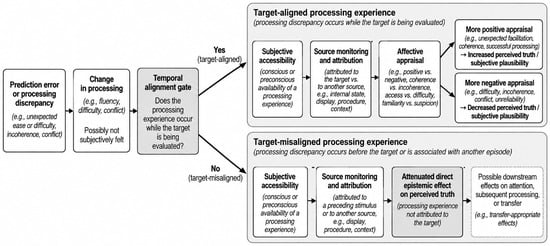
The central proposal is that the occurrence of a prediction error should be distinguished from its epistemic use. A discrepancy between expected and experienced processing may alter ongoing cognitive dynamics without necessarily influencing the perceived truth of the stimulus subsequently judged. We propose (Figure 1) that temporal alignment with target evaluation gates the availability of a prediction-error-related processing signal for epistemic judgment. When such a signal becomes subjectively accessible and is attributable to the target, affective appraisal contributes to determining its epistemic meaning: it may provide subjective evidence either for or against the target’s plausibility. Thus, temporal alignment constrains whether a processing signal can contribute to the current epistemic judgment, whereas attribution and appraisal contribute to determining how it is interpreted.
Figure 1.
From prediction error to perceived truth: the role of temporal alignment, source attribution, and affective appraisal. Note. A prediction error or processing discrepancy (e.g., unexpected ease or difficulty, incoherence, conflict) generates a change in processing, which may or may not be subjectively experienced. When this processing experience occurs while the target information is being evaluated (target-aligned), it can become subjectively accessible, attributed to the target, and appraised. Its affective interpretation may then contribute either to an increase or a decrease in perceived truth or subjective plausibility. When the processing experience is associated with a preceding stimulus or another processing episode (target-misaligned), it is typically attributed to a different source, and its direct epistemic effect on the target is expected to be attenuated, although it may still influence attention, subsequent processing, or transfer through downstream effects.
3. Fluency and Prediction Error
Fluency is typically defined as the subjective experience associated with ease in cognitive processing (Alter & Oppenheimer, 2009; Reber & Schwarz, 1999). However, this general definition encompasses distinct aspects of processing that are important for the present framework. Processing may be facilitated without this facilitation necessarily becoming subjectively accessible, and subjective fluency may depend on how current processing relates to prior expectations.
Whittlesea and Leboe (2003) distinguished between absolute and relative fluency. Absolute fluency refers to the experienced ease of current processing, whereas relative fluency arises from a discrepancy between expected and experienced processing. Thus, the same level of processing ease may acquire different subjective significance depending on what was expected. When processing unfolds more easily than anticipated, the discrepancy itself can generate surprise and become informative for subsequent judgment. The consequences of fluency therefore depend not simply on processing ease but on the interpretation and attribution of unexpected processing.
A related distinction concerns objective and subjective fluency. Reber et al. (2004) distinguished objective processing facilitation from subjective fluency, which includes a phenomenal component—the experienced feeling associated with processing. More recently, the distinction between unfelt and felt fluency has emphasized that changes in processing dynamics need not initially be phenomenologically accessible (Brouillet & Friston, 2023; Yoo et al., 2024). In the present framework, unfelt fluency refers to a change in processing and attentional dynamics triggered by a discrepancy between expected and actual processing, before that change is available as an explicit subjective cue. Felt fluency, by contrast, refers to the processing experience once it becomes subjectively accessible and can potentially be used in judgment.
From a predictive-processing perspective, discrepancies between expected and incoming states generate prediction errors that can modify ongoing processing and attentional allocation (Clark, 2013; Friston, 2009, 2010). Brouillet and Friston (2023) proposed that relative fluency can be understood as an initially unfelt consequence of such discrepancy: prediction error first reorganizes attentional dynamics rather than immediately producing an explicit judgment or feeling. Subjective experience is therefore not assumed to be the prediction error itself, but a possible downstream consequence when the resulting change in processing becomes accessible to higher-order evaluation.
The present proposal introduces an additional constraint. A processing discrepancy can modify ongoing cognition without necessarily becoming epistemically relevant to the stimulus subsequently judged. When the resulting change in processing is temporally aligned with evaluation of the target, it may become subjectively accessible and available for attribution to that target. When it occurs before the target becomes the object of evaluation, or is attributable to another processing episode, it may still redirect attention or alter subsequent processing, but its direct contribution to the perceived truth of the target should be attenuated.
Accordingly, prediction error, unfelt fluency, felt fluency, and epistemic judgment should not be treated as interchangeable constructs or as necessary successive stages. Prediction error refers to a discrepancy signal; unfelt fluency to the associated change in processing and attentional dynamics before subjective access; felt fluency to the processing experience once subjectively accessible; and epistemic judgment to the interpretation of that experience in relation to the target. The transition from one level to another is conditional rather than automatic.
4. Temporal Alignment
The central proposal of the present framework is that the epistemic influence of a processing signal depends not only on its occurrence but also on its temporal relation to target evaluation. We refer to this relation as temporal alignment. Temporal alignment refers to when a prediction-error-related change in processing occurs relative to the evaluation of a target, whereas source attribution concerns what the resulting experience is taken to originate from. A discrepancy can occur during target evaluation without necessarily being attributed to the target: for example, difficulty experienced while reading a statement may be attributed either to the statement or to a temporary display disturbance. Thus, temporal alignment provides an opportunity for target-related attribution but does not guarantee it. It is therefore not proposed as a general condition for belief formation, but as a condition governing whether a transient processing signal can become relevant to the epistemic judgment currently being formed.
The critical contrast is between target-aligned and target-misaligned processing experiences. A processing signal is target-aligned when the discrepancy between expected and experienced processing occurs while the target is the object of evaluation. Under these conditions, the processing change can become subjectively accessible and potentially be interpreted as information about the target. By contrast, a signal is target-misaligned when the discrepancy occurs before the target becomes the object of evaluation, or when it can be attributed to another stimulus or processing episode. Such a signal may nevertheless modify attentional allocation or subsequent processing, as proposed for unfelt fluency (Brouillet & Friston, 2023). Recent evidence further suggests that the effects of a prior processing discrepancy can transfer to a subsequent task when the discrepancy is functionally appropriate to that task (Lebre et al., 2026). Such transfer-appropriate effects show that temporal misalignment does not imply cognitive ineffectiveness: a prior discrepancy may influence subsequent processing without necessarily becoming direct epistemic evidence about the subsequently evaluated target.
Temporal alignment is therefore proposed as a gating condition rather than as an additional source of epistemic evidence. Alignment does not make information more credible by itself. Instead, it constrains whether a transient processing experience is available for attribution to the information currently being judged. Thus, when target-aligned, a processing signal may enter the metacognitive inference underlying perceived truth; when target-misaligned, its direct epistemic influence should be reduced, even though downstream effects on attention or processing may remain.
Importantly, temporal proximity and temporal alignment are not equivalent. A discrepancy may occur immediately before a target and nevertheless be misaligned if it belongs to a preceding stimulus or processing episode. Conversely, a processing change that unfolds during evaluation may remain target-aligned insofar as it can be attributed to the information being judged. The theoretically relevant relation is therefore not merely the elapsed time between discrepancy and response, but the temporal coupling between the processing experience and the epistemic evaluation of a particular target.
This formulation generates a falsifiable prediction. Holding the nature and magnitude of the processing discrepancy constant, a discrepancy occurring during target evaluation should be more likely to influence perceived truth than the same discrepancy occurring before the target becomes the object of judgment or being attributable to another source. Importantly, this prediction concerns whether the processing signal contributes to judgment, not the direction of its effect. Temporal alignment does not predict an increase in perceived truth. Once a signal becomes relevant to the current judgment, its direction of influence depends on attribution and affective appraisal.
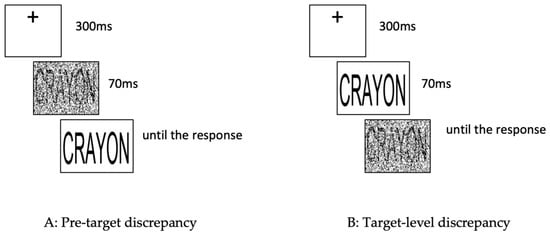
An illustrative temporal manipulation has been reported in two recognition-memory experiments by Vanborren et al. (2026). The perceptual interference was identical across conditions; only its temporal position differed. Discrepant information influenced recognition judgments when it was presented during target processing, but not when it preceded target presentation (Figure 2). This pattern is consistent with the relevance of target-aligned processing discrepancies, while not establishing that temporal alignment operates independently of source attribution. Furthermore, these findings concern recognition judgments rather than perceived truth, so their generalization to misinformation evaluation remains an empirical question.
Figure 2.
Temporal placement of discrepant information in the recognition paradigm of Vanborren et al. (2026). (A) Pre-target discrepancy: a 70 ms degraded stimulus precedes the target. (B) Target-level discrepancy: a clear 70 ms stimulus precedes the degraded target. Each trial begins with a 300 ms fixation; the final display remains until response. The manipulation contrasts the timing of discrepant information relative to target processing.
5. Affective Appraisal
Temporal alignment determines whether a processing signal can become relevant to ongoing evaluation, but it does not determine the epistemic meaning of that signal. A second process is therefore required to explain why an accessible processing experience may increase perceived truth in some circumstances but decrease it in others. We propose that this direction depends on affective appraisal.
Appraisal theories propose that affective responses arise from evaluations of events in relation to expectations, goals, and situational meaning (Arnold, 1960; Lazarus, 1990; Moors, 2017; Scherer, 2009). From this perspective, the detection of an unexpected processing event does not specify its affective value by itself. Surprise is particularly relevant because it arises from violated expectations and rapidly increases attentional salience (Silvia, 2008). However, its valence remains debated. Some accounts emphasize the negative character of surprise because unexpected events interrupt ongoing processing and create uncertainty (Miceli & Castelfranchi, 2015; Topolinski & Strack, 2015), whereas other approaches suggest that its affective value depends on the subsequent interpretation of the unexpected event (Neta & Kim, 2023; Ortony, 2022).
The present framework adopts the latter, context-dependent interpretation. This view is also compatible with predictive accounts of emotion, in which affective experience emerges from the inferential interpretation of bodily and contextual signals rather than from prediction error alone (Seth & Friston, 2016). We propose that a prediction-error-related processing experience does not carry a fixed positive or negative epistemic value. Rather, its affective meaning depends on how the experience is appraised in relation to the current target, prior expectations, existing knowledge, goals, contextual information, and its attributed source. Prediction error signals that something differs from expectation; appraisal contributes to determining what that difference means for the individual.
When an unexpected processing experience is interpreted as facilitation, coherence, or successful processing, its appraisal may be positive. If that experience is also attributed to the target, it may constitute subjective evidence that the information is plausible or trustworthy, thereby increasing perceived truth. The critical factor is therefore not processing ease alone but the interpretation of the unexpected processing experience. An unexpectedly successful processing episode may acquire positive epistemic value even when the proposition being evaluated is objectively false.
The opposite pathway is equally important. When an aligned processing discrepancy is experienced or interpreted as difficulty, incoherence, conflict with prior knowledge, threat, or evidence of source unreliability, its appraisal may be negative. Under these conditions, the processing signal may constitute subjective evidence against the target and reduce its perceived plausibility. Thus, the framework predicts neither a uniformly positive effect of fluency nor a uniformly negative effect of prediction error. The epistemic consequence of unexpected processing depends on the meaning assigned to the resulting subjective experience.
6. Metacognitive Inference
Cognitive processing is accompanied by subjective experiences that can serve as cues for judgment. In the memory literature, Jacoby and colleagues showed that experiences such as familiarity can arise from inferences based on processing cues, particularly fluency (Jacoby & Dallas, 1981; Kelley & Jacoby, 1990, 1998). Importantly, such experiences do not provide direct access to the processes that produced them. Because fluency is phenomenologically transparent to its causes (Metzinger, 2003), its informational value depends on how the experience is attributed and interpreted (Schwarz, 2018).
This attributional character of subjective experience provides the link between processing dynamics and epistemic judgment in the present framework. A felt change in processing does not constitute evidence for truth in itself. Rather, when it occurs during evaluation and is attributed to the target, it can become a metacognitive cue from which the individual infers something about the information being evaluated. Its epistemic significance therefore depends both on its availability at the time of judgment and on the meaning assigned to it.
A positively appraised experience—for example, unexpected facilitation or coherence—may consequently be used as subjective evidence supporting the plausibility of the target. Conversely, an experience appraised as difficulty, incoherence, conflict, or unreliability may provide subjective evidence against it. In both cases, the processing experience functions as a cue within a metacognitive inference rather than as a direct determinant of belief.
We therefore propose that the immediate outcome of this inferential process is best characterized as subjective plausibility or perceived truth, rather than belief itself. Such an evaluation may contribute to subsequent belief formation or revision, but the two should not be treated as equivalent. The present framework thus addresses a specific stage of epistemic evaluation: how a transient processing experience can acquire informational value for judging whether a proposition appears plausible or true.
Although closely related, subjective plausibility and perceived truth are not strictly interchangeable. Subjective plausibility refers to the extent to which a proposition appears reasonable or compatible with existing knowledge and expectations, whereas perceived truth refers more directly to the subjective judgment that a proposition is true. The present framework applies to both forms of epistemic evaluation insofar as processing experiences may contribute to their formation. However, it does not assume that these judgments are identical or necessarily influenced to the same extent by processing discrepancies.
7. Misinformation
Misinformation provides a particularly relevant context in which to examine the epistemic use of processing experiences. When evaluating information whose truth cannot be directly established, individuals may rely on multiple imperfect cues to assess its plausibility. Processing fluency constitutes one such cue: information that is easier to process or has been encountered previously is often judged as more truthful, although the magnitude and reliability of fluency-based truth effects vary across conditions (Dechêne et al., 2010; Unkelbach et al., 2019).
The present framework proposes that part of this variability may arise because a change in processing does not automatically become evidence about the truth of the information being evaluated. For a prediction-error-related processing experience to contribute directly to perceived truth, it should first become relevant to the ongoing evaluation. Temporal alignment is proposed to provide this gating condition: when the processing discrepancy occurs while the target information is being evaluated, the resulting experience can be attributed to that information and potentially used as a metacognitive cue. When the discrepancy is associated with a preceding stimulus or processing episode, it may still affect subsequent processing, but its direct epistemic relevance to the target should be reduced.
Crucially, temporal alignment does not imply that surprising or unexpectedly processed misinformation will be judged as true. Once a processing experience becomes relevant to the target, its epistemic direction depends on attribution and affective appraisal. Unexpected facilitation or coherence that is positively appraised and attributed to the target may increase its subjective plausibility, even when the information is objectively false. Conversely, processing difficulty, incoherence, conflict with prior knowledge, or suspicion concerning the source may receive a negative appraisal and decrease perceived truth. The same general class of processing signals can therefore contribute either to the acceptance or to the rejection of misinformation.
This proposal is intended to complement, rather than replace, established explanations of misinformation and truth judgment. Repetition and familiarity accounts explain why previous exposure can increase perceived truth (Dechêne et al., 2010; Unkelbach et al., 2019). The present framework addresses a different question: under what temporal and experiential conditions can a momentary processing signal become epistemically relevant to the information currently being evaluated? Its immediate predicted consequence is a change in subjective plausibility or perceived truth, which may subsequently contribute to belief formation or revision.
8. Predictions and Experimental Paradigms
The present framework generates several experimentally testable predictions concerning when a processing discrepancy should become epistemically relevant and how its influence should be expressed. Importantly, these predictions concern primarily subjective plausibility or perceived truth, rather than enduring belief, and distinguish the availability of a processing signal from the direction of its epistemic interpretation.
First, temporal alignment can be tested by manipulating the relation between a processing discrepancy and target evaluation. Holding the nature and magnitude of the discrepancy constant, a discrepancy occurring while the target is being evaluated should exert a stronger direct influence on perceived truth than the same discrepancy occurring during a preceding processing episode. Critically, the prediction is not that a prior discrepancy should have no effect. Prior discrepancies may alter subsequent attentional or processing dynamics and may transfer when functionally appropriate to the subsequent task (Lebre et al., 2026). The specific temporal-alignment prediction is that their direct epistemic influence on the target should be reduced when the processing experience cannot readily be attributed to that target.
This hypothesis should also be distinguished from the more general claim that timing matters. For example, the timing of externally provided corrective information affects subsequent truth judgments, with corrections presented after exposure sometimes producing better later discrimination than corrections presented before or during exposure (Brashier et al., 2021). Such findings concern the temporal organization of external epistemic information. The present hypothesis instead concerns the temporal coupling between an internally generated processing signal and evaluation of the target to which that signal may be attributed.
Second, affective appraisal should determine the direction rather than merely the magnitude of the effect. If an aligned processing discrepancy is experienced as unexpected facilitation, coherence, or successful processing and is attributed to the target, more positive appraisal should be associated with increased subjective plausibility. Conversely, when the discrepancy is experienced as difficulty, incoherence, conflict, or unreliability, more negative appraisal should be associated with reduced subjective plausibility. Thus, the critical prediction is not simply that affect mediates a positive relationship between prediction error and perceived truth, but that appraisal should differentiate plausibility-enhancing from plausibility-reducing pathways.
Third, attribution provides a direct test of whether an aligned processing experience is treated as information about the target. If the same processing discrepancy is attributed experimentally either to the target or to an external source—for example, characteristics of the display or experimental procedure—its effect on perceived truth should be stronger when attributed to the target and attenuated when attributed externally. This prediction follows from the proposal that subjective processing experiences acquire epistemic value through metacognitive inference rather than acting directly on judgment.
Finally, the strongest test of the framework would manipulate temporal alignment and appraisal independently within the same experimental paradigm. Such a design would test the central functional distinction proposed here: temporal alignment should primarily determine whether the processing signal contributes to the epistemic judgment, whereas appraisal should determine the direction of that contribution. An aligned discrepancy should therefore be capable of either increasing or decreasing perceived truth depending on its appraisal, whereas a comparable but target-misaligned discrepancy should show a weaker direct effect. Evidence that appraisal determines the direction of judgment independently of temporal alignment, or that target-misaligned discrepancies influence perceived truth as strongly and systematically as target-aligned discrepancies, would challenge the proposed framework.
A concrete test would orthogonally manipulate discrepancy timing (before vs. during target evaluation) and attributed source (target-related vs. external display-related), while holding the perceptual discrepancy constant. Affective appraisal should be assessed independently of truth judgments, for example through separate ratings of pleasantness/unpleasantness or coherence/incoherence of the processing experience, ideally on distinct trials to reduce measurement reactivity. A complementary manipulation could vary contextual interpretations of the experience without changing the discrepancy itself. The dependent measure would be perceived truth of the statement. A temporal-alignment effect persisting when source attribution is controlled would support a distinct gating contribution; an effect fully accounted for by source attribution would challenge that claim. The sign of any effect should be examined in relation to independently assessed appraisal, rather than inferred from the truth judgment itself.
9. Discussion
The present Viewpoint proposes a framework for understanding when transient changes in processing may become epistemically relevant to the evaluation of information. Its central claim is deliberately narrower than a general account of belief formation. Prediction errors and processing fluency are not assumed to determine belief directly. Instead, we propose that temporal alignment constrains whether a prediction-error-related processing signal can become relevant to the target currently being evaluated, whereas attribution and affective appraisal contribute to determining how that signal is interpreted. The immediate outcome is therefore better characterized as a change in subjective plausibility or perceived truth, which may subsequently contribute to belief formation or revision.
This distinction may help account for some of the variability observed in the relation between fluency and truth judgments. A target-aligned processing experience may increase perceived truth when it is attributed to the target and positively appraised as unexpected facilitation, coherence, or successful processing. The same general class of signals may instead reduce perceived truth when interpreted as difficulty, incoherence, conflict, or unreliability. Conversely, a target-misaligned discrepancy may still affect attention or subsequent processing, including through transfer-appropriate effects, without necessarily providing direct epistemic evidence about the subsequently evaluated target (Lebre et al., 2026). Temporal alignment should therefore be distinguished both from the persistence of a processing effect over time and from the more general observation that timing can influence truth judgments (Brashier et al., 2021).
The framework is intended to complement rather than replace established explanations of truth judgment and misinformation. Repetition and illusory-truth accounts explain how prior exposure and familiarity can increase perceived truth (Dechêne et al., 2010; Unkelbach et al., 2019). Source-monitoring approaches address how mental experiences and information are attributed to their origins (Mitchell & Johnson, 2000), whereas analytic-thinking accounts emphasize the contribution of reflective reasoning to discriminating true from false or misleading information (Ross et al., 2021). The present proposal addresses a complementary question: under what temporal and experiential conditions does a momentary processing signal acquire epistemic relevance to the judgment currently being formed?
Several limitations follow directly from this proposal. First, the complete sequence linking prediction error, temporal alignment, subjective accessibility, appraisal, metacognitive inference, and perceived truth has not, to our knowledge, been demonstrated within a single experimental paradigm. The framework should therefore be regarded as an integrative hypothesis rather than an established causal mechanism. Second, temporal alignment has not been systematically manipulated across the existing fluency–truth literature. Consequently, the present account cannot be inferred from an overall fluency effect, nor can existing heterogeneity be taken as evidence for temporal alignment. Third, the boundaries between temporal alignment, subjective accessibility, attribution, and appraisal require experimental separation. Their theoretical distinction will be meaningful only if they can be independently manipulated or measured.
These limitations also explain why a quantitative synthesis of existing fluency–truth findings cannot presently constitute a direct test of the temporal-alignment hypothesis. Meta-analytic evidence can establish whether repetition or fluency is associated, on average, with changes in perceived truth, but the critical variable proposed here—the temporal relation between the processing discrepancy and evaluation of the target—has not been consistently manipulated or reported in a way that permits reliable coding across studies. Temporal alignment should therefore be treated as a prospective moderator whose explanatory value must be established experimentally rather than inferred retrospectively from heterogeneous findings.
Applied to misinformation, the framework suggests that susceptibility cannot be inferred simply from whether information is processed fluently or generates surprise. A processing experience becomes a candidate epistemic cue only under conditions that allow it to be related to the target, and its influence may favor either acceptance or rejection depending on attribution and appraisal. This bidirectionality is particularly important because it predicts not only circumstances in which processing dynamics may increase the plausibility of false information, but also circumstances in which those same dynamics may facilitate its rejection.
Ultimately, the value of the present framework depends not on its capacity to accommodate existing findings retrospectively, but on whether its distinctive predictions survive direct experimental tests. In particular, the proposed dissociation between temporal alignment and appraisal should be challenged by designs that independently manipulate when a processing discrepancy occurs and how the resulting experience is interpreted. Evidence that target-misaligned discrepancies exert direct epistemic effects comparable to target-aligned discrepancies, or that appraisal fails to modulate the direction of these effects, would require revision or rejection of the present account. One ambition of this Viewpoint is therefore to stimulate precisely such attempts at falsification.
Funding
This research received no external funding.
Data Availability Statement
No new data were created or analyzed in this study. Data sharing is not applicable to this article.
Conflicts of Interest
The author declares no conflict of interest.
References
- Aktepe, S. C., & Heck, D. W. (2025). Revisiting the effect of discrepant perceptual fluency on truth judgments. Journal of Experimental Social Psychology, 120, 104774. [Google Scholar] [CrossRef] [Scilit]
- Alter, A. L., & Oppenheimer, D. M. (2009). Uniting the tribes of fluency to form a metacognitive nation. Personality and Social Psychology Review, 13(3), 219–235. [Google Scholar] [CrossRef] [Scilit] [PubMed]
- Arnold, M. B. (1960). Emotion and personality. Columbia University Press. [Google Scholar]
- Brashier, N. M., Pennycook, G., Berinsky, A. J., & Rand, D. G. (2021). Timing matters when correcting fake news. Proceedings of the National Academy of Sciences, 118(5), e2020043118. [Google Scholar] [CrossRef] [Scilit] [PubMed]
- Brouillet, D., & Friston, K. (2023). Relative fluency (unfelt vs felt) in active inference. Consciousness and Cognition, 115, 103579. [Google Scholar] [CrossRef] [Scilit] [PubMed]
- Clark, A. (2013). Whatever next? Predictive brains, situated agents, and the future of cognitive science. Behavioral and Brain Sciences, 36(3), 181–204. [Google Scholar] [CrossRef] [Scilit] [PubMed]
- Dechêne, A., Stahl, C., Hansen, J., & Wänke, M. (2010). The truth about the truth: A meta-analytic review of the truth effect. Personality and Social Psychology Review, 14(2), 238–257. [Google Scholar] [CrossRef] [Scilit] [PubMed]
- Derksen, D. G., Connolly, D. A., & Bernstein, D. M. (2026). Testing the fluency account for truth judgments. Journal of Experimental Psychology: Learning, Memory, and Cognition, 52(4), 643–655. [Google Scholar] [CrossRef] [Scilit] [PubMed]
- French, A. M., Storey, V. C., & Wallace, L. (2025). The impact of cognitive biases on the believability of fake news. European Journal of Information Systems, 34(1), 72–93. [Google Scholar] [CrossRef] [Scilit]
- Friston, K. (2009). The free-energy principle: A rough guide to the brain? Trends in Cognitive Sciences, 13(7), 293–301. [Google Scholar] [CrossRef] [Scilit] [PubMed]
- Friston, K. (2010). The free-energy principle: A unified brain theory? Nature Reviews Neuroscience, 11(2), 127–138. [Google Scholar] [CrossRef] [Scilit] [PubMed]
- Hansen, J., Dechêne, A., & Wänke, M. (2008). Discrepant fluency increases subjective truth. Journal of Experimental Social Psychology, 44(3), 687–691. [Google Scholar] [CrossRef] [Scilit]
- Jacoby, L. L., & Dallas, M. (1981). On the relationship between autobiographical memory and perceptual learning. Journal of Experimental Psychology: General, 110(3), 306–340. [Google Scholar] [CrossRef] [PubMed]
- Kelley, C. M., & Jacoby, L. L. (1990). The construction of subjective experience: Memory attributions. Mind & Language, 5(1), 49–68. [Google Scholar] [CrossRef] [Scilit]
- Kelley, C. M., & Jacoby, L. L. (1998). Subjective reports and process dissociation: Fluency, knowing, and feeling. Acta Psychologica, 98(2–3), 127–140. [Google Scholar] [CrossRef] [Scilit]
- Lazarus, R. S. (1990). Theory-based stress measurement. Psychological Inquiry, 1(1), 3–13. [Google Scholar] [CrossRef] [Scilit] [PubMed]
- Lebre, B., Vanborren, H., Brouillet, T., & Brouillet, D. (2026). When discrepancy transfers: Effects of prior processing discrepancy on subsequent perceptual and lexical decisions (a copy may be requested from: d.brouillet@yahoo.fr).
- Metzinger, T. (2003). Phenomenal transparency and cognitive self-reference. Phenomenology and the Cognitive Sciences, 2, 353–393. [Google Scholar] [CrossRef] [Scilit]
- Miceli, M., & Castelfranchi, C. (2015). Expectancy and emotion. Oxford University Press. [Google Scholar]
- Mitchell, K. J., & Johnson, M. K. (2000). Source monitoring: Attributing mental experiences. In E. Tulving, & F. I. M. Craik (Eds.), The Oxford handbook of memory (pp. 179–196). Oxford University Press. [Google Scholar] [CrossRef] [Scilit]
- Moors, A. (2017). Appraisal theory of emotion. In V. Zeigler-Hill, & T. K. Shackelford (Eds.), Encyclopedia of personality and individual differences (pp. 1–9). Springer. [Google Scholar] [CrossRef] [Scilit]
- Neta, M., & Kim, J. (2023). Surprise as an emotion: A response to Ortony. Perspectives on Psychological Science, 18(4), 854–862. [Google Scholar] [CrossRef] [Scilit] [PubMed]
- Ortony, A. (2022). Are all “basic emotions” emotions? A problem for the (basic) emotions construct. Perspectives on Psychological Science, 17(1), 41–61. [Google Scholar] [CrossRef] [Scilit] [PubMed]
- Pennycook, G., & Rand, D. G. (2019). Lazy, not biased: Susceptibility to partisan fake news is better explained by lack of reasoning. Cognition, 188, 39–50. [Google Scholar] [CrossRef] [Scilit] [PubMed]
- Pennycook, G., & Rand, D. G. (2021). The psychology of fake news. Trends in Cognitive Sciences, 25(5), 388–402. [Google Scholar] [CrossRef] [Scilit] [PubMed]
- Reber, R., & Schwarz, N. (1999). Effects of perceptual fluency on judgments of truth. Consciousness and Cognition, 8(3), 338–342. [Google Scholar] [CrossRef] [Scilit] [PubMed]
- Reber, R., Wurtz, P., & Zimmermann, T. D. (2004). Exploring “fringe” consciousness: The subjective experience of perceptual fluency. Consciousness and Cognition, 13(1), 47–60. [Google Scholar] [CrossRef] [Scilit] [PubMed]
- Ross, R. M., Rand, D. G., & Pennycook, G. (2021). Beyond “fake news”: Analytic thinking and the detection of false and hyperpartisan news headlines. Judgment and Decision Making, 16(2), 484–504. [Google Scholar] [CrossRef] [Scilit]
- Scherer, K. R. (2009). The dynamic architecture of emotion: Evidence for the component process model. Cognition and Emotion, 23(7), 1307–1351. [Google Scholar] [CrossRef] [Scilit]
- Schwarz, N. (2018). Of fluency, beauty, and truth: Inferences from metacognitive experiences. In J. Proust, & M. Fortier (Eds.), Metacognitive diversity: An interdisciplinary approach (pp. 25–46). Oxford University Press. [Google Scholar]
- Seth, A. K., & Friston, K. J. (2016). Active interoceptive inference and the emotional brain. Philosophical Transactions of the Royal Society B: Biological Sciences, 371(1708), 20160007. [Google Scholar] [CrossRef] [Scilit] [PubMed]
- Sharma, P. R., Wade, K. A., & Jobson, L. (2023). A systematic review of the relationship between emotion and susceptibility to misinformation. Memory, 31(1), 1–21. [Google Scholar] [CrossRef] [Scilit] [PubMed]
- Silva, R. R., Garcia-Marques, T., & Reber, R. (2017). The informative value of type of repetition: Perceptual and conceptual fluency influences on judgments of truth. Consciousness and Cognition, 51, 53–67. [Google Scholar] [CrossRef] [Scilit] [PubMed]
- Silvia, P. J. (2008). Interest—The curious emotion. Current Directions in Psychological Science, 17(1), 57–60. [Google Scholar] [CrossRef] [Scilit]
- Thaler, M. (2024). The fake news effect: Experimentally identifying motivated reasoning using trust in news. American Economic Journal: Microeconomics, 16(2), 1–38. [Google Scholar] [CrossRef] [Scilit]
- Topolinski, S., & Strack, F. (2015). Corrugator activity confirms immediate negative affect in surprise. Frontiers in Psychology, 6, 134. [Google Scholar] [CrossRef] [Scilit] [PubMed]
- Unkelbach, C., Koch, A., Silva, R. R., & Garcia-Marques, T. (2019). Truth by repetition: Explanations and implications. Current Directions in Psychological Science, 28(3), 247–253. [Google Scholar] [CrossRef] [Scilit]
- Vanborren, H., Pezet, E., Lebre, B., & Brouillet, D. (2026). Relative fluency produces familiarity only when discrepancy information is available during target processing (a copy may be requested from: d.brouillet@yahoo.fr).
- Vogel, T., Silva, R. R., Thomas, A., & Wänke, M. (2020). Truth is in the mind, but beauty is in the eye: Fluency effects are moderated by a match between fluency source and judgment dimension. Journal of Experimental Psychology: General, 149(8), 1587–1596. [Google Scholar] [CrossRef] [Scilit] [PubMed]
- Whittlesea, B. W. A., & Leboe, J. P. (2003). Two fluency heuristics (and how to tell them apart). Journal of Memory and Language, 49(1), 62–79. [Google Scholar] [CrossRef] [Scilit]
- Yoo, J., Jasko, K., & Winkielman, P. (2024). Fluency, prediction and motivation: How processing dynamics, expectations and epistemic goals shape aesthetic judgements. Philosophical Transactions of the Royal Society B: Biological Sciences, 379(1895), 20230326. [Google Scholar] [CrossRef] [Scilit] [PubMed]
Disclaimer/Publisher’s Note: The statements, opinions and data contained in all publications are solely those of the individual author(s) and contributor(s) and not of MDPI and/or the editor(s). MDPI and/or the editor(s) disclaim responsibility for any injury to people or property resulting from any ideas, methods, instructions or products referred to in the content. |
© 2026 by the author. Licensee MDPI, Basel, Switzerland. This article is an open access article distributed under the terms and conditions of the Creative Commons Attribution (CC BY) license.