


Abstract
Chronic diseases rank among the major challenges for global public health, and interactions between environmental exposures, biological susceptibility, and developmental processes increasingly shape their severity. Evidence indicates that exposure to air pollutants, heavy metals, pesticides, microplastics, and endocrine-disrupting chemicals can promote oxidative stress, chronic inflammation, mitochondrial dysfunction, endocrine dysregulation, and epigenetic alterations, particularly during critical developmental periods. Through mechanisms consistent with the Developmental Origins of Health and Disease (DOHaD) framework, these disruptions can contribute to long-term susceptibility to cardiovascular, metabolic, respiratory, neurodegenerative, and neoplastic diseases. In this context, nanotechnology offers emerging opportunities for prevention, early detection, monitoring, targeted therapy, and environmental remediation. Nanobiosensors and nanoscale diagnostic platforms can enable the sensitive detection of molecular and epigenetic biomarkers, while nanotechnology-based drug delivery systems can improve therapeutic targeting and controlled release. Concurrently, nanomaterials, magnetic nanocomposites, photocatalytic systems, and green nanotechnologies demonstrate potential to remove or transform environmental contaminants and reduce human exposure. However, the translational maturity of these applications varies substantially, ranging from clinically approved nanomedicines to predominantly preclinical and laboratory-scale approaches, underscoring the need for rigorous safety assessments, regulatory frameworks, and validation under real-world conditions. Overall, integrating nanotechnology with environmental health, epigenetic research, sustainability, and the One Health approach may offer a multidisciplinary pathway toward earlier interventions, reduced exposure, and the prevention of chronic diseases, while simultaneously promoting human, animal, and environmental health.
1. Introduction
Non-communicable chronic diseases (NCDs) are currently among the leading causes of mortality worldwide, accounting for a significant proportion of global healthcare expenditures and a reduction in the population’s quality of life. NCDs represent a growing public health concern, particularly in developing countries undergoing rapid urbanization and industrialization [1,2].
Traditionally, the etiology of chronic diseases has been associated with genetic predisposition and lifestyle-related factors, such as unhealthy diet, smoking, excessive alcohol consumption, physical inactivity, and stress. However, growing scientific evidence demonstrates that environmental exposures play a central role in the pathogenesis and progression of these diseases. Prolonged exposure to air pollutants, heavy metals, pesticides, microplastics, and endocrine-disrupting compounds (EDCs) can alter cellular homeostasis and metabolic pathways [3,4,5].
Recent studies demonstrate that many of the biological effects resulting from environmental exposures are mediated by epigenetic mechanisms and alterations in endocrine signalling. These modifications may occur during critical periods of development, influencing the biological programming of the organism and increasing susceptibility to chronic diseases throughout life, as proposed by the Developmental Origins of Health and Disease (DoHaD) theory [6,7,8,9]. The increasing complexity of environmental health challenges requires innovative scientific approaches capable of preventing and integrating diagnosis, monitoring, and therapy. In this context, nanotechnology emerges as a transformative field with applications in medicine, toxicology, biotechnology, and environmental sciences. Nanostructured materials exhibit unique physicochemical properties, including high surface area, enhanced reactivity, and tunable biological interactions, thereby enabling the development of advanced therapeutic and diagnostic systems [10,11,12].
Non-communicable diseases (NCDs) represent one of the greatest global health challenges, accounting for at least 43 million deaths in 2021, equivalent to approximately 75% of all non-pandemic-related deaths worldwide [13]. Cardiovascular diseases were responsible for at least 19 million deaths, followed by cancers (10 million), chronic respiratory diseases (4 million), and diabetes (more than 2 million, including diabetes-related kidney disease) [14]. Importantly, approximately 18 million people died from NCDs before the age of 70, with 82% of these premature deaths occurring in low- and middle-income countries [15]. Although NCDs are influenced by genetic, physiological, behavioral, and socioeconomic determinants, increasing evidence indicates that environmental factors, including air pollution, heavy metals, pesticides, endocrine-disrupting chemicals, and persistent organic pollutants, can contribute to disease susceptibility through molecular, inflammatory, oxidative, and epigenetic mechanisms [16]. This complex interaction between environmental exposures and human biology highlights the need for preventive strategies that can identify early biological alterations, monitor exposures, and reduce environmental risks before irreversible disease manifestations occur.
The environmental determinants of chronic disease present several interconnected challenges for public health. Human populations are continuously exposed to complex mixtures of air pollutants, heavy metals, pesticides, endocrine-disrupting chemicals, persistent organic pollutants, and emerging contaminants, often at low concentrations and over prolonged periods. These exposures may occur simultaneously and during critical developmental windows, making it difficult to establish exposure–response relationships and to identify early biological alterations before clinical disease becomes apparent. In addition, environmental contaminants can interact with genetic, metabolic, endocrine, inflammatory, and epigenetic pathways, generating heterogeneous responses that vary with exposure level, duration, developmental stage, and individual susceptibility [3,4,5,6,7,8,9]. Therefore, conventional approaches that rely solely on measuring environmental contaminants or clinical outcomes may be insufficient to capture the dynamic transitions among environmental exposure, molecular alterations, and disease susceptibility.
These challenges create a need for integrated approaches that connect environmental exposure assessment with molecular biomarker detection, longitudinal monitoring, early diagnosis, and, ultimately, preventive intervention. In this context, nanotechnology offers a versatile platform because nanostructured materials can be engineered for highly sensitive sensing, biomarker detection, imaging, targeted delivery, and environmental remediation [10,11,12,17,18,19].
Nanotechnology-based strategies include targeted drug delivery systems, nanoencapsulation of bioactive compounds, nanosensors for biomarker detection, and nanomaterials for environmental remediation. These technologies are promising for improving therapeutic efficacy, reducing adverse effects, and enabling early disease detection. Furthermore, they may contribute to the prevention of chronic diseases, as they are potential tools for environmental pollution monitoring [17,18,19].
Green nanotechnology has emerged as an innovative and sustainable approach focused on developing nanomaterials and nanosystems through environmentally safe methods, employing biogenic synthesis with plant extracts, microorganisms, and bee products to produce nanoparticles. Unlike conventional methods, which are often associated with toxic solvents and high energy consumption, green nanotechnology seeks to minimize environmental impacts and promote cleaner, more sustainable processes. In this context, their applications have demonstrated great potential for the monitoring and treatment of chronic diseases, particularly through nanomedicine, where they reduce adverse effects and enhance therapeutic efficacy. Furthermore, green nanomaterials have been employed in the remediation of environmental pollutants, thereby reducing human exposure to contaminants associated with the development of diseases [20,21,22,23,24,25,26,27].
This perspective is directly aligned with the United Nations Sustainable Development Goals (SDGs), particularly those related to Good Health and Well-Being (SDG 3), Clean Water and Sanitation (SDG 6), Responsible Consumption and Production (SDG 12), and Climate Action (SDG 13) [20,28,29,30,31,32]. Furthermore, the integration of green nanotechnology with the One Health concept reinforces the understanding that human health depends on the balance among the environment, animals, and ecosystems. The rising incidence of chronic diseases linked to environmental pollution, climate change, and the degradation of natural resources underscores the need for interdisciplinary strategies that integrate scientific innovation, sustainability, and public health prevention. Thus, green nanotechnology represents an important scientific frontier for developing more ethical, sustainable, and integrated therapeutic and environmental solutions that address contemporary global demands [33,34].
Thus, this review aims to discuss the relationship between environmental exposures and chronic diseases, emphasizing the mechanisms of endocrine disruption, epigenetic alterations, and developmental programming, and argues that these processes play a significant role in the origin of chronic diseases, highlighting nanotechnology as a promising tool for diagnosis, therapeutic intervention, and environmental remediation within a One Health perspective.
2. Methodology
2.1. Study Design
A narrative literature review of an interdisciplinary nature was conducted with the aim of integrating knowledge related to nanotechnology, nanomedicine, environmental pollution, and their potential impacts on human, animal, and environmental health. The narrative approach was adopted due to the breadth and multidisciplinary nature of the topics involved, allowing for the critical integration of contributions from different fields of knowledge and the development of a discussion focused on the interface between the environment, health, and strategies for prevention, diagnosis, monitoring, and intervention. Initially, the literature was broadly explored based on the different topics and relationships identified throughout the development of the discussion. As the main thematic axes were defined, targeted literature searches were conducted to complement, deepen, and update the scientific foundation of the manuscript. Thus, the search strategy was not designed as a previously established systematic protocol, but rather as a progressive process of identifying and integrating evidence, consistent with the narrative nature of the review.
2.2. Search Strategy and Thematic Axes
PubMed, provided by the National Center for Biotechnology Information (NCBI), and Google Scholar databases were consulted. The searches were progressively refined throughout the development of the narrative review, using controlled descriptors from the Medical Subject Headings (MeSH) and free-text terms employed in the title and abstract fields (Title/Abstract).
The search terms were organized according to the main thematic axes developed in the manuscript, including: (i) environmental pollutants and health effects; (ii) Developmental Origins of Health and Disease (DoHaD); (iii) maternal-fetal exposure and epigenetic alterations; (iv) the association between environmental pollution, epigenetics, and biological aging; (v) green nanotechnology and chronic non-communicable diseases; (vi) nanotoxicology and epigenetics; (vii) new integrative approaches in environmental health; (viii) the global burden of non-communicable diseases (NCDs); (ix) nanotechnology for early diagnosis, monitoring, and biomarker detection; (x) nanotoxicology and nanomaterial safety; and (xi) therapeutic applications and nanotechnology-based drug delivery systems.
For the investigation of the effects of heavy metals on health, terms such as “Metals, Heavy”, “Lead”, “Mercury”, “Arsenic”, “Health Status”, and “health consequences” were employed. For the investigation of environmental contaminants and epigenetic mechanisms, terms such as “Environmental Pollutants”, “Epigenomics”, “epigenetic mechanisms”, “Epigenome-Wide Association Study (EWAS)”, “epigenetic clock”, and “DNA methylation age” were used, combined with terms related to heavy metals, air pollution, endocrine disruptors, bisphenol A (BPA), and plasticizers.
For the investigation of the Developmental Origins of Health and Disease, the terms “Developmental Origins of Health and Disease” and “DoHaD” were used. To understand molecular pathways and their responses to environmental exposures, the terms “oxidative stress”, “inflammation”, “cell signaling”, “DNA methylation”, “histone modification”, and “non-coding RNA” were used. To investigate the relationship between nanotechnology and chronic non-communicable diseases, terms related to “nanotechnology”, “green nanotechnology”, “chronic disease”, and “non-communicable diseases” were employed. For the nanotoxicology approach, the terms “nanotoxicology”, “nanomaterials”, “epigenetics”, “environmental health”, and “nanomedicine” were used. For therapeutic applications and nanotechnology-based drug delivery systems, terms such as “drug delivery”, “nanocarriers”, “nanoparticle drug delivery”, “targeted drug delivery”, “controlled release”, “targeted therapy”, and “nanomedicine” were employed.
For nanotechnology-based diagnostic strategies, terms such as “nanodiagnostics”, “nano-diagnostics”, “biosensors”, “nanobiosensors”, “early diagnosis”, “early detection”, “disease detection”, “biomarker detection”, and “molecular diagnosis” were employed.
Additionally, searches were conducted on emerging approaches in environmental health, including “exposomics”, “precision environmental health”, “One Health”, and “digital twins”, combined with terms related to diagnosis, monitoring, therapy, and environmental health.
2.3. Scope and Selection of References
The initial literature search was conducted in April 2026 and was subsequently updated throughout the review process, with the final search conducted on 15 August 2026. Publications were restricted to those available in English or Portuguese, with English-language publications comprising most of the selected literature. Screening and study selection were independently performed by both authors.
Publications from the past 20 years were considered, with studies published within the last 5 years being prioritized, to reconcile the consolidation of the conceptual and historical foundations of the topics addressed with the incorporation of recent evidence. During the development of the review, more than 200 potentially relevant publications were identified. The selection of references for inclusion in the manuscript was based on their relevance to the objectives and thematic axes of the review. Studies that provided a relevant contribution to the foundation of the concepts addressed, the understanding of the mechanisms discussed, or the development of the proposed critical argument were prioritized.
When different publications presented similar information, studies considered more relevant, recent, or comprehensive for discussion were prioritized. Additional references were incorporated when necessary to complement concepts or further clarify mechanisms.
2.4. Inclusion and Exclusion Criteria
Publications presenting information directly related to at least one of the thematic axes of the review were included, including environmental pollution and health, exposure to contaminants, epigenetic mechanisms, DoHaD, chronic non-communicable diseases, nanotechnology, nanomedicine, green nanotechnology, nanotoxicology, and integrative environmental health strategies. Publications with no direct relevance to the objectives of the review, studies whose information was considered insufficient or redundant for the proposed discussion, and works that did not contribute to the understanding of the mechanisms, relationships, or strategies addressed in the manuscript were excluded. Selection was not based exclusively on the methodological design of the studies, as the narrative nature of the review allowed for the integration of different types of articles according to their relevance to each thematic axis.
2.5. Analysis and Synthesis of Evidence
The selected references were qualitatively analyzed and organized according to the main conceptual axes of the review. The findings were integrated through narrative synthesis and critical interpretation, seeking to establish relationships between environmental exposure, molecular and epigenetic alterations, the development of chronic diseases, environmental health, and the potential applications of nanotechnology and nanomedicine, in addition to fostering critical consideration of nanotoxicology. The analysis aimed to integrate different lines of evidence and identify convergences, mechanistic relationships, gaps, and application perspectives, without performing a meta-analysis or quantitative synthesis. The interpretation of the findings considered the nature and context of the available evidence, avoiding causal inferences when these were not adequately supported by the studies analyzed. It is emphasized that the integration of these different axes is still relatively recent in the literature. In this context, further studies are needed to deepen the understanding of nature and relevance of these interconnections, contributing to the consideration of climatic, environmental, and public health factors in an integrated manner in view of the increasing complexity of contemporary challenges.
3. Environmental Exposures and the Development of Non-Communicable Chronic Diseases (NCDs)
Environmental contaminants have increasingly been associated with the onset and progression of chronic diseases. Rapid industrial expansion, urbanisation, intensive agriculture, and inadequate waste management have increased human exposure to toxic compounds that can affect biological systems over prolonged periods. Among the major environmental pollutants, atmospheric particulate matter (PM2.5 and PM10) is strongly associated with respiratory and cardiovascular diseases. These particles can penetrate deeply into pulmonary tissues and reach systemic circulation, inducing oxidative stress, endothelial dysfunction, and inflammatory responses. Prolonged exposure has been associated with hypertension, atherosclerosis, asthma, chronic obstructive pulmonary disease (COPD), and an increased risk of stroke [3,35,36].
Heavy metals such as lead, cadmium, mercury, and arsenic also represent major toxicological concerns. These substances accumulate in tissues and organs, interfering with enzymatic activity, mitochondrial function, and DNA repair mechanisms [37,38]. Exposure to these metals may contribute to neurological disorders, renal dysfunction, endocrine imbalance, and carcinogenesis. Studies on contamination by these metals demonstrate direct links to the development of chronic diseases [39].
Pesticides and endocrine-disrupting compounds (EDCs), including bisphenol A (BPA), phthalates, and dioxins, have received considerable attention due to their ability to interfere with hormonal signalling pathways. These compounds are associated with reproductive disorders, obesity, diabetes mellitus, thyroid dysfunction, and developmental abnormalities. Furthermore, many environmental contaminants exhibit bioaccumulative and persistent characteristics, thereby amplifying their long-term ecological and health impacts [40,41,42].
Another emerging concern involves microplastics and nanoplastics, which have been detected in water, food, air, and even human tissues. Their small size facilitates cellular uptake and interaction with biological membranes, potentially triggering inflammatory processes, oxidative damage, and immunological alterations [5,43].
In addition to direct cellular damage, various environmental contaminants can interfere with regulatory mechanisms that modify gene expression and metabolic homeostasis. Among these mechanisms, endocrine and epigenetic alterations have received increasing attention due to their involvement in the development of chronic diseases [44,45,46].
4. Endocrine-Disrupting Compounds (EDCs): Environmental Exposures Associated with Epigenetic Reprogramming and Chronic Non-Communicable Diseases (NCDs)
Potentially harmful chemicals found in environmental pollutants, pesticides, everyday consumer products, such as cleaning agents, and food can directly influence human metabolism. Endocrine-disrupting compounds (EDCs) are substances that interfere with the normal function of the endocrine system, altering the synthesis, secretion, transport, and metabolism of hormones [47]. These harmful compounds can act by mimicking, blocking, or modifying hormonal signals, triggering alterations in cell signalling pathways and gene expression, thereby compromising the organism’s metabolic and physiological homeostasis [48].
Endocrine-disrupting chemicals (EDCs) have been associated with an increased risk of various chronic non-communicable diseases, including obesity, type 2 diabetes mellitus, thyroid disorders, reproductive health disorders, and various types of cancer [49], as well as neurodevelopmental disorders [50]. Human exposure to these compounds occurs primarily through dietary intake, dermal contact, and inhalation, making them a growing concern for global public health [49].
Generally, NCDs are considered multifactorial diseases. Multifactorial diseases result from complex interactions among genetics, the environment, and an individual’s lifestyle [51]. Epigenetics encompasses modifications and processes that regulate gene expression, including mechanisms such as DNA methylation. These alterations can be influenced by environmental factors, whether within the cellular environment or the organism. Although they do not alter the genotype sequence, they can modify the phenotype by regulating gene activation or inactivation, as well as the frequency and intensity of gene expression, thereby potentially contributing to disease development [52]. DNA methylation signifies the transcriptional silencing of a specific gene. Conversely, demethylation indicates that gene expressions will occur. The study of DNA methylation is an important area of research for understanding the biological machinery that triggers the development of various diseases [53]. Thus, epigenetics emerges as a factor contributing to the development of complex multifactorial diseases.
Exposure to endocrine-disrupting chemicals during pregnancy warrants special attention, as this period represents a window of heightened biological sensitivity for fetal development. Many endocrine-disrupting chemicals can induce epigenetic alterations, including changes in DNA methylation patterns, histone modifications, and the expression of non-coding RNAs [54].
Epigenetic alterations have been associated with the development of various diseases, including neurodegenerative diseases, cancers, metabolic diseases, and neurodevelopmental disorders [55]. Furthermore, evidence suggests that certain epigenetic modifications can be transmitted to subsequent generations, a phenomenon known as transgenerational epigenetic inheritance [56,57].
The ability of EDCs to modify epigenetic patterns has also been considered a key biological mechanism linking environmental exposures to the development of chronic non-communicable diseases. These alterations can persist even after exposure ceases, influencing metabolic, inflammatory, and endocrine processes implicated in the pathophysiology of various diseases [58].
Omics sciences enable the integrated analysis of genes, proteins, metabolites, and epigenetic modifications, providing a comprehensive view of the biological mechanisms regulating cellular function. In this context, high-throughput approaches, such as transcriptomics, epigenomics, proteomics, and metabolomics, have significantly expanded our understanding of how toxic agents affect biological systems, enabling the identification of molecular alterations that disrupt cellular pathways, compromise tissue homeostasis, and contribute to disease development and progression [59].
The convergence of omics sciences and nanotechnology has driven the development of nanostructured platforms with theranostic potential, capable of integrating biomarker identification, monitoring of molecular alterations, and targeted therapeutic intervention in biological pathways associated with environmental exposures and chronic non-communicable diseases [60].
Among current biological biomarkers, DNA methylation, also known as the epigenetic clock, is considered in the literature to be the most relevant for determining biological age. It is worth noting that chronological age indicates the number of years an individual has lived. In contrast, biological age may be equal to, lower than, or higher than chronological age, depending on the individual’s bodily functioning [61]. Thus, the epigenetic clock emerges as a relevant tool for investigating the cumulative biological effects of pollutant exposures and their potential link to increased disease vulnerability. Consequently, further studies are needed to integrate environmental exposures, epigenetic markers, and public health, thereby improving understanding of the interconnections between the environment and disease susceptibility.
The Epigenome-Wide Association Study (EWAS) is an approach that examines the genome for epigenetic alterations, primarily methylation patterns, and investigates the association between environmental factors and epigenetic modifications within the organism [62]. These analyses can identify epigenetic marks associated with exposure to pollutants and other stressors, contributing to an understanding of the relationship between exposures and diseases [63]. However, these associations in isolation do not establish causality or determine disease development, requiring complementary approaches to these relationships.
In this review, we will specifically address reproductive health and neurodevelopmental disorders associated with epigenetic reprogramming resulting from environmental exposures.
4.1. Epigenetic Reprogramming Mediated by Multiple Environmental Factors
Key factors associated with the occurrence of epigenetic changes include dietary habits and patterns, exposure to environmental pollutants, smoking, the use of certain medications with adverse effects, and the presence of diseases, particularly when such exposures or conditions occur during critical periods of development, such as childhood [64].
Lead exposure can occur through inhalation of pollutants and ingestion of contaminated water, food, dust, and materials, as well as through contact with certain toys, costume jewellery, batteries, traditional medicines, and cosmetics. Once absorbed, lead circulates in the blood and can accumulate primarily in adipose and bone tissues; it can also cross the placenta, posing a risk to fetal development. As a systemic toxicant, it can affect multiple organs and, even at low concentrations, is associated with genome-wide changes in DNA methylation, highlighting its potential for epigenetic interference [53].
In artisanal mining areas in Nigeria, extreme levels of lead contamination were identified in soil and water, with exposure also occurring through contaminated food. This situation was linked to severe health impacts, including high levels of exposure among children, fatalities during the Zamfara outbreak, and renal, haematological, thyroid, and cardiovascular abnormalities, as well as potential carcinogenic effects. Occupational exposure was also high among workers in sectors such as battery handling, mechanics, and auto-body repair. These findings highlight significant regulatory gaps, including insufficient oversight, the lack of centralized monitoring of blood lead levels, and inadequate protection for informal workers [65].
In addition to lead, cadmium is also considered one of the most prevalent health-damaging environmental pollutants today. While cadmium can alter epigenetic mechanisms, including DNA methylation at specific CpG sites and gene expression, epidemiological evidence also indicates that high blood lead concentrations are associated with reduced DNA methylation in LINE-1 elements. In contrast, elevated blood cadmium levels are linked to methylation changes at specific CpG sites [66].
Exposure to air pollution, including particulate matter (PM), is associated with alterations in DNA methylation in lung and blood cells. Following inhalation, fine and ultrafine particles can induce inflammation, oxidative stress, and the production of reactive oxygen species (ROS), which interfere with DNA methylation and demethylation mechanisms. Reduced activity of enzymes such as DNA methyltransferases and decreased availability of methyl group donors can contribute to genome-wide epigenetic alterations. These findings highlight a potential molecular interface through which air pollution can influence biological processes and, consequently, human health [44].
At the cellular level, exposure to air pollution, particularly PM2.5, can trigger oxidative stress, inflammatory responses, DNA damage and fragmentation, and apoptotic cell death, and impair mitochondrial, endocrine, and metabolic processes. These mechanisms may also be involved in epigenetic modifications, including changes in epigenetic age and chromatin organization resulting from the modulation of histone deacetylase activity. Furthermore, exposure to PM2.5 during early developmental stages can alter gene expression patterns, suggesting that air pollution may induce persistent molecular changes that increase susceptibility to complex diseases [67].
Therefore, human exposure to chemical pollutants is widespread in modern society and may pose health risks. Since exposure occurs via multiple pathways, assessing it solely through environmental prevention measures is limited in scope. In this context, human biomonitoring is a valuable tool for quantifying chemical concentrations within the body and reflecting integrated exposure from the environment, the workplace, diet, and consumer products [68]. However, many countries still lack this technology. Thus, from a global health perspective, there is a clear need for biomonitoring across all countries to enable targeted research to statistically understand the factors most likely to induce epigenetic changes in individuals and to develop treatment and intervention strategies.
Epigenetic Changes Due to Multiple Environmental Factors Cause Reproductive Health and Neurodevelopmental Disorders
Consuming vegetables grown in contaminated areas represents a significant source of exposure to heavy metals, which can accumulate in the body and cross the placenta, thereby compromising fetal development. These elements can alter hypothalamic-pituitary-gonadal axis activity and endocrine regulation, affecting the development and function of the female reproductive system. Exposures occurring particularly during critical prenatal and neonatal stages have been linked to alterations in ovarian formation and function, menstrual cycle irregularities, reduced fertility, premature ovarian failure, polycystic ovary syndrome, and a potential increase in the incidence of uterine fibroids. Evidence from human studies and animal models thus indicates that environmental metals and other endocrine-disrupting chemicals can compromise reproductive health. However, gaps remain regarding the underlying mechanisms and the extent of these effects in humans [69].
Fetuses, infants, and children are more vulnerable to exposome-related epigenetic changes due to the intense cell proliferation and the growth and development processes occurring during these periods. Evidence indicates, for example, that epigenetic mechanisms may play a role in the relationship between folic acid availability and the prevention of neural tube defects. Furthermore, recent multi-omics studies have identified over 900 associations between exposome components and markers of biological responses potentially relevant to child health [70].
Furthermore, ambient ultrafine particles with diameters of less than 0.18 μm can alter epigenetic marks, including those associated with non-coding RNAs, that have been linked to neurodevelopmental disorders [67].
Lead exposure occurs predominantly through inhalation of contaminated dust and consumption of water and food containing the metal, affecting fetuses and children particularly severely due to lead’s ability to cross the blood–brain barrier. This underscores the importance of prioritizing the protection of these vulnerable groups within the context of healthcare practices and scientific research. Prenatal exposure has been linked to hematopoietic alterations, impaired neurodevelopment, and cognitive deficits. Additionally, epidemiological evidence points to a dose-dependent inverse association between maternal lead concentrations and global DNA methylation levels in transposable elements, specifically LINE-1 and Alu, reinforcing lead’s potential to induce epigenetic changes [71].
Clinical trials suggest that lifestyle changes, particularly regular physical activity, may help reduce or reverse epigenetic ageing and are associated with increased relative telomere length. These benefits may stem from reduced oxidative stress, anti-inflammatory effects, and the promotion of brain plasticity, indicating that modifiable behaviors can minimize adverse health effects associated with exposure to environmental contaminants. However, further studies employing objective, quantitative methods are needed to determine the influence of physical activity on biological ageing with greater precision [72].
Studies suggest that maternal exposure to particulate matter (PM), particularly during early pregnancy, can interfere with molecular pathways involved in fetal development and associated with autism spectrum disorder (ASD). Environmental exposures during the prenatal and postnatal periods can alter epigenetic mechanisms, including DNA methylation and histone acetylation, with potential repercussions for gene expression and processes fundamental to neurodevelopment. Evidence from human and animal studies indicates that these modifications may play a role in the interplay between environmental and genetic factors linked to ASD and other neurodevelopmental disorders. However, further studies are needed to determine more precisely which maternal and environmental exposures are associated with these epigenetic changes and how they may influence the development of ASD [73].
However, the social determinants of health encompass non-medical factors, such as socioeconomic conditions, family and community contexts, behaviors, and environmental characteristics, that directly influence health throughout the lifespan. Social disadvantage can involve exposure to degraded environments, pollution, and contaminants, as well as reduced access to healthy food, healthcare services, and green spaces, alongside lower social cohesion. Chronic stress resulting from inequality and social vulnerability can trigger neuroendocrine, immunological, and vascular responses, contributing to the development and progression of chronic diseases. These effects are particularly significant when exposure occurs during childhood, a period when social adversity can leave lasting biological changes that influence development, health, and well-being in adulthood [74].
Recognizing the vital role of researchers, healthcare professionals, policymakers, and stakeholders in shaping public health, it is essential to understand that epigenetic modulations are mediated throughout an individual’s life by various factors, some of which can be mitigated and others not, ranging from an inability to resolve issues related to environmental pollution to a scarcity of resources, which can be limiting due to socioeconomic factors. Thus, further studies are needed to develop green technologies for the diagnosis and treatment of chronic non-communicable diseases, technologies that are increasingly accessible to the entire population.
5. Developmental Origins of Health and Disease (DOHaD)
Pregnancy is a period of intense metabolic demand, during which an adequate nutrient supply is essential for fetal development and maternal health. In this context, the mother’s nutritional status and dietary habits play a decisive role in programming offspring development, influencing their health through metabolic and epigenetic mechanisms [75]. Pregnant women experiencing malnutrition, exacerbated by exposure to environmental contaminants, are more likely to have children whose cellular programming is geared toward the development of diseases [76].
During these critical periods of development, the coordinated regulation of gene expression drives the formation and maturation of tissues and organs. The Developmental Origins of Health and Disease (DOHaD) theory proposes that environmental exposures during critical developmental periods, such as pregnancy and early childhood, can influence health throughout the lifespan [77]. This process is largely mediated by epigenetic mechanisms that modulate gene expression in response to factors such as nutrition, environmental pollutants, pesticides, heavy metals, and physiological stress [78]. The recognition of how these factors impact long-term health can deepen it is understanding of disease risk and inform it is efforts in healthcare and research.
DOHaD suggests that exposures occurring during the first 1000 days of life can modify DNA methylation patterns and, consequently, influence susceptibility to diseases in adulthood. From this perspective, research has examined the association between exposures during pregnancy and early childhood, changes in epigenetic ageing, and the development of conditions such as asthma and allergic diseases. Changes in DNA methylation identified in umbilical cord blood have also been linked to intrauterine factors, including high maternal BMI, air pollution exposure, and maternal smoking [79].
Persistent organic pollutants (POPs) are a class of environmental contaminants that persist for long periods in ecosystems and biological tissues. Exposure during pregnancy, which can alter endocrine signalling and epigenetic mechanisms involved in fetal programming, highlights the potential repercussions for offspring development and lifelong health, underscoring the importance of understanding these effects [80].
Various environmental contaminants have been linked to molecular alterations that can interfere with developmental programming. Among them, exposure to PM2.5 promotes the activation of pathways related to amino acid transport, cellular respiration, and cell adhesion, while reducing the activity of genes involved in vascular development and organogenesis [81]. Similarly, residues of pesticides, chemical fertilizers, and heavy metals that accumulate in animal-derived foods represent significant pathways for human exposure to environmental contaminants. These contaminants can bio accumulate along the food chain and enter the human body through the consumption of contaminated food. Evidence indicates that chronic exposure to these compounds is associated with metabolic, inflammatory, and epigenetic alterations that can impair normal physiological development and increase the risk of chronic diseases throughout life, with potential transgenerational effects when germ cells are affected [82].
Gestational exposure to bisphenols and phthalates has been associated with maternal complications and adverse fetal developmental outcomes, including pre-eclampsia, preterm birth, alterations in birth weight, and sex-specific effects on development and neurodevelopment. Epigenome-wide association studies (EWAS) indicate that prenatal exposure to these endocrine-disrupting chemicals is linked to changes in DNA methylation at CpG sites, some of which are associated with epigenetic age. A study involving 224 mother-infant pairs from the Canadian Alberta Pregnancy Outcomes and Nutrition (APrON) cohort found that pairs, higher maternal BPA concentrations during the second trimester were associated with increased epigenetic age in female infants. In contrast, higher concentrations of phthalate metabolites were linked to lower epigenetic age in this group. These results suggest that alterations in epigenetic ageing resulting from prenatal chemical exposures may be detectable as early as the first months of life [83].
Tetrabromobisphenol A (TBBPA), a widely used flame retardant, is associated with adverse effects on the female reproductive system. Evidence indicates that exposure to this compound can increase oxidative stress, reduce ATP availability, impair oocyte maturation, and trigger inflammatory processes in the uterus and placenta through various molecular mechanisms. TBBPA can also alter epigenetic processes, including DNA methylation of the IDO1 gene, thereby impairing maternal-fetal immune tolerance and potentially increasing the risk of miscarriage. Furthermore, it can interfere with hormonal signalling and mechanisms related to cell proliferation, promoting processes involved in endometrial cancer. Thus, evidence suggests that TBBPA may compromise fertility and reproductive health through oxidative stress, inflammation, epigenetic alterations, and tumorigenesis. However, further studies are needed to determine its effects on human fertility [84].
Furthermore, available evidence suggests that epigenetic modifications in genes that regulate the kynurenine (KYN) pathway may play a significant role in regulating inflammation during fetal development. The KYN metabolic pathway constitutes the primary route of tryptophan degradation, producing various metabolites with neuroprotective or neurotoxic effects and participating in the regulation of immune responses, inflammation, and oxidative stress. During pregnancy, this pathway plays important roles in the placenta and in regulating the maternal-fetal immune response, and inflammatory processes and environmental exposures can influence it. Its dysregulation has been associated with pregnancy complications, such as pre-eclampsia, fetal growth restriction, and neurodevelopmental disorders, as well as with alterations in maternal microbiota and epigenetic mechanisms that can interfere with KYN activity, thereby affecting fetal metabolism and potentially contributing to conditions such as adult-onset obesity [85].
Given the multifactorial nature of disease development within the DoHaD framework, there is a clear need for further “omics” studies to establish standardized protocols, widely disseminated across diverse populations, to prevent the development of non-communicable chronic diseases in future generations. In this context, prevention through guidance and therapeutic redirection is a relevant public health intervention, particularly because these biological alterations can persist for long periods before clinical disease onset, thereby hindering early detection and limiting opportunities for preventive action. Furthermore, many biomarkers associated with environmental exposures and epigenetic programming exhibit high molecular complexity and inter-individual variability, posing challenges for conventional diagnostic methods.
6. Nanotechnology in Diagnosis and Monitoring
In light of these challenges, nanotechnology has emerged as a promising platform for developing diagnostic systems capable of detecting molecular biomarkers at extremely low concentrations. The physicochemical properties of nanomaterials enhance analytical sensitivity and facilitate the early monitoring of alterations associated with environmental exposures and chronic diseases. Nanomaterials such as inorganic nanoparticles, quantum dots, graphene, magnetic nanoparticles, and carbon nanotubes exhibit unique optical, electrical, and magnetic properties that enhance the performance of nanosensors [86,87,88].
Nanobiosensors can detect biomarkers at extremely low concentrations, enabling early diagnosis of chronic diseases before the onset of severe clinical symptoms. In oncology, nanosensors can detect tumour biomarkers, circulating tumour cells, and genetic mutations with greater sensitivity than conventional methods [87,89,90]. Similarly, in cardiovascular diseases, nanotechnology-based platforms enable detection of inflammatory mediators, cardiac enzymes, and oxidative stress biomarkers [88,91,92,93,94].
Wearable nanosensors also represent a growing field in personalized medicine. These devices can continuously monitor physiological parameters such as glucose levels, blood pressure, sweat composition, and inflammatory biomarkers in real time, thereby contributing to preventive strategies and individualised therapeutic monitoring [91,95,96].
In environmental health, nanotechnology supports the development of portable systems for detecting pollutants and toxic compounds. Nanosensors capable of detecting heavy metals, pesticides, pathogenic microorganisms, and volatile organic compounds provide important tools for environmental surveillance and risk assessment [97,98,99,100,101].
The synergistic integration of nanotechnology with artificial intelligence and digital health platforms represents a major advancement in biomedical sciences, enabling innovative strategies for predictive diagnostics, epidemiological surveillance, and precision medicine. This multidisciplinary approach enables the integrated analysis of complex data, contributing to more accurate, individualized, and efficient clinical decision-making [21,99,102,103].
7. Nanotechnologies Applied to Non-Communicable Chronic Diseases (NCDs)
In addition to enabling the early detection of biomarkers associated with environmental exposures and epigenetic alterations, nanotechnology has expanded the therapeutic possibilities for chronic diseases. Given that processes such as persistent inflammation, oxidative stress, mitochondrial dysfunction, and epigenetic dysregulation play central roles in the pathophysiology of these diseases, nanostructured systems have been developed to deliver therapeutic compounds to specific targets, thereby enhancing treatment efficacy and reducing adverse effects. One of the most promising applications of nanotechnology lies in targeted drug delivery systems. Conventional drugs often exhibit low bioavailability, rapid degradation, dose-dependent systemic toxicity or require prolonged administration and nonspecific distribution. Nanocarriers overcome many of these limitations by enabling the controlled and localized release of therapeutic agents [104,105,106].
Liposomes, polymeric nanoparticles, dendrimers, nanocapsules, and metallic nanoparticles are among the nanosystems most extensively investigated for biomedical applications. The development and functionalization of these systems are strongly based on the principles of supramolecular chemistry, particularly non-covalent interactions such as hydrogen bonding, electrostatic interactions, van der Waals forces, and hydrophobic interactions, which govern self-assembly and molecular recognition. These characteristics enable the encapsulation and controlled release of therapeutic agents, protecting them from chemical and enzymatic degradation while improving their pharmacokinetic and pharmacodynamic profiles, thereby enhancing therapeutic efficacy and reducing adverse effects [107,108,109].
In cancer therapy, various nanoparticulate systems, including PEGylated liposomes, PLGA polymeric nanoparticles, dendrimers, gold nanoparticles, and mesoporous silica nanoparticles, enable the selective accumulation of therapeutic agents in tumour tissues via passive and active targeting, thereby reducing adverse effects on healthy cells. The surface functionalization of these nanoparticles with specific ligands, such as antibodies, peptides, and aptamers, enables recognition of receptors overexpressed in cancer cells, thereby increasing therapeutic precision and improving the efficacy of antineoplastic treatment [110,111,112,113,114].
Nanotechnology has also emerged as a promising strategy for the controlled delivery of antioxidants, anti-inflammatory compounds, nucleic acids, and various naturally derived bioactive substances. The incorporation of these compounds into nanostructured systems, protects them from chemical and enzymatic degradation, enhances their solubility, prolongs their circulation time, and optimizes their bioavailability and tissue distribution. In this context, the nanoencapsulation of phytochemicals, such as curcumin, resveratrol, quercetin, and phenolic compounds derived from propolis, has shown promising results by enhancing their antioxidant, anti-inflammatory, and cytoprotective properties [93,94,95,96,97,98,99,100,101,102,103,104,105,106,107,108,109,110,111,112,113,114,115,116,117,118].
Furthermore, surface functionalization of nanocarriers can facilitate targeted delivery to specific tissues or cell populations, potentially improving therapeutic efficacy while limiting off-target effects. These features may broaden the applicability of nanotechnology-enabled delivery systems for the prevention and management of diseases associated with oxidative stress and chronic inflammation, including cancer, cardiovascular diseases, neurodegenerative diseases, and metabolic disorders [119,120].
Furthermore, nanomedicine plays an important role in regenerative medicine and tissue engineering. Nanostructured scaffolds mimic the architecture of the extracellular matrix, promoting cell adhesion, proliferation, and tissue regeneration [121,122].
Table 1 provides an overview of the main nanotechnologies employed in the diagnosis and treatment of chronic diseases, highlighting the diversity of nanomaterials and their multiple biomedical applications. Different nanostructured systems, including liposomes, polymeric nanoparticles, metallic nanoparticles, nanogels, and nanoemulsions, have been developed to overcome limitations associated with conventional therapies, such as low bioavailability, nonspecific distribution, and a high incidence of adverse effects [123,124]. In addition to enabling the controlled and targeted delivery of therapeutic agents, these platforms can be used for early biomarker detection, bioimaging, and monitoring disease progression. The versatility of these systems enables their use across various chronic diseases, including cancer, cardiovascular diseases, neurodegenerative diseases, diabetes mellitus, and inflammatory diseases, contributing to the development of more effective, safer, and personalized therapeutic strategies. Thus, nanotechnology emerges as a fundamental tool for advancing precision medicine, expanding the prospects for diagnosing, preventing, and treating chronic diseases of major clinical and socioeconomic relevance [125].
Despite these advances, concerns related to nanotoxicology remain essential. The interaction between nanoparticles and biological systems depends on factors such as size, morphology, surface charge, concentration, and duration of exposure. Therefore, rigorous safety assessments and regulatory frameworks are necessary to ensure the responsible and sustainable application of nanotechnology [126].
Table 1.
Nanotechnology-based approaches for the diagnosis and treatment of chronic diseases and their development stage.
8. Nanotechnologies for Environmental Remediation and Chronic Disease Prevention
Beyond biomedical applications, nanotechnology has emerged as a strategic tool for environmental remediation, offering innovative solutions to reduce exposure to pollutants and reduce impacts of contamination in terrestrial and aquatic ecosystems. Owing to their unique physicochemical properties, such as high surface area, high reactivity, functionalization capability, and distinctive catalytic properties, nanomaterials exhibit great potential to adsorb, degrade, transform, or neutralize a wide range of contaminants present in water, soil, and air [10,27,28,156].
Various nanostructured systems have been developed for environmental applications, including nanostructured adsorbents, photocatalytic nanoparticles, magnetic nanocomposites, nanofunctionalized membranes, and hybrid nanomaterials, as shown in Table 2. These systems have demonstrated high efficiency in the removal of heavy metals, such as lead (Pb), cadmium (Cd), mercury (Hg), and arsenic (As), as well as synthetic dyes, pharmaceutical residues, pesticides, polycyclic aromatic hydrocarbons, and pathogenic microorganisms present in contaminated environments [157,158,159,160].
Among the most extensively investigated nanomaterials are titanium dioxide (TiO2) nanoparticles, which are widely employed in heterogeneous photocatalytic processes. Under ultraviolet or visible radiation, these materials can generate reactive oxygen species, such as hydroxyl radicals (•OH) and superoxide anions (O2•−), thereby promoting the degradation of persistent organic compounds and the mineralisation of various pollutants. Similarly, zinc oxide (ZnO) nanoparticles and TiO2-based nanocomposites have been developed to enhance photocatalytic efficiency and improve the stability of decontamination processes [161,162,163].
Graphene-based materials, including graphene oxide (GO) and reduced graphene oxide (rGO), have also attracted considerable attention owing to their high specific surface area, abundance of functional groups, and remarkable adsorption capacity. These materials exhibit high affinity for metal ions, pesticides, dyes, and emerging contaminants, making them promising candidates for water purification systems and industrial wastewater treatment [28,164].
Iron oxide (Fe3O4) magnetic nanoparticles constitute another class of materials of great environmental interest. In addition to exhibiting a high capacity for contaminant adsorption, these nanomaterials can be readily recovered from the environment using external magnetic fields, thereby enabling the reuse of adsorbents and reducing remediation operational costs. This characteristic makes magnetic nanocomposites particularly attractive for large-scale applications [165,166].
In recent years, particular attention has been directed toward the removal of emerging contaminants, including residues of antibiotics, hormones, pharmaceuticals, microplastics, and per- and polyfluoroalkyl substances (PFAS), commonly referred to as “forever chemicals.” The high environmental persistence of these compounds and their potential ecotoxicological and human health effects have driven the development of multifunctional nanomaterials capable of simultaneously promoting adsorption, catalytic degradation, and environmental monitoring [167,168].
Concurrently, nanotechnology has contributed to the development of highly sensitive and selective environmental nanosensors capable of detecting contaminants at extremely low concentrations. Biosensors based on metallic nanoparticles, quantum dots, and carbon-based materials enable real-time monitoring of water, soil, and air quality, facilitating the detection of contaminants even before an environmental disaster occurs [98].
The integration of nanotechnology, sustainability, and environmental remediation is directly aligned with the United Nations Sustainable Development Goals (SDGs), particularly SDG 3 (Good Health and Well-Being), SDG 6 (Clean Water and Sanitation), SDG 11 (Sustainable Cities and Communities), SDG 12 (Responsible Consumption and Production), SDG 13 (Climate Action), SDG 14 (Life Below Water), and SDG 15 (Life on Land). Thus, nanotechnologies for environmental applications constitute an important tool for addressing global challenges related to pollution, water scarcity, and ecosystem preservation, contributing to the development of more sustainable and resilient models of development [20,23].
Table 2.
Nanotechnology applications in environmental remediation, their development scale, and contribution to the Sustainable Development Goals.
In this context, green nanotechnology has emerged as an innovative and sustainable approach based on environmentally friendly synthesis methods that employ biological systems, such as plants, fungi, algae, yeasts, and bacteria, as reducing and stabilizing agents. The biogenic synthesis of nanoparticles significantly reduces the use of toxic solvents, hazardous reagents, and high energy demands, thereby promoting safer, more economically viable processes aligned with the principles of Green Chemistry and the Circular Economy [27,32].
In addition to minimizing the environmental impacts of nanomaterial production, biogenic nanoparticles often exhibit greater biocompatibility, lower toxicity, and additional functional properties, thereby expanding their potential applications in environmental decontamination and remediation.
9. Nanotechnology, Environmental Health, and the One Health Concept: Toward an Integrated Paradigm of Health and Sustainability
The One Health concept is increasingly understood as an umbrella framework rather than a single, uniform scientific paradigm. It encompasses diverse theoretical perspectives, methodological approaches, governance arrangements, and practical applications that recognize the interdependence of human, animal, and environmental health. In the context of environmentally associated non-communicable diseases (NCDs), its relevance lies in expanding the analytical focus beyond individual-level risk factors to include the ecological, occupational, agricultural, food, and socioeconomic contexts in which environmental exposures arise and are distributed [179]. Accordingly, One Health provides a conceptual framework for connecting environmental contamination, biological responses, disease susceptibility, ecosystem integrity, and population health without assuming that these relationships are necessarily causal or that they can be addressed through a single methodological approach [39,46].
Within this review, three complementary dimensions of One Health are particularly relevant. The theoretical dimension provides an integrative perspective in which chronic diseases are considered in relation to interconnected environmental, biological, and social determinants. This perspective complements the Developmental Origins of Health and Disease (DoHaD) framework by connecting individual developmental susceptibility and epigenetic programming to the broader environmental systems in which exposures occur [180]. The methodological dimension involves integrating approaches from environmental sciences, epidemiology, toxicology, molecular biology, veterinary sciences, biotechnology, and public health. Environmental monitoring, exposomics, biomarker analysis, epigenetic profiling, longitudinal surveillance, and integrated risk assessment can therefore be considered complementary approaches for investigating complex exposure–health relationships. The practical dimension concerns the translation of this integrated knowledge into prevention, monitoring, diagnosis, treatment, environmental remediation, and public health interventions [33,181].
Nanotechnology can contribute to these dimensions by providing technological tools that operate at the interface between human and environmental health. At the human health level, nanostructured systems enable highly sensitive biomarker detection, early diagnosis, precision medicine, targeted drug delivery, and controlled therapeutic release [182]. At the environmental level, nanosensors can facilitate the detection of contaminants, while engineered and biogenic nanomaterials can contribute to the remediation of polluted water, soil, and air. Green nanotechnology further extends this perspective by incorporating more sustainable synthesis strategies based on biological systems and by seeking to reduce the environmental impacts associated with nanomaterial production. These applications are particularly relevant to One Health because they address not only the consequences of environmental exposure but also opportunities for exposure prevention and environmental risk reduction [183], that contributes to the development of more sustainable production processes aligned with the principles of Green Chemistry and Circular Economy.
Importantly, the One Health framework also requires that technological interventions be evaluated across interconnected health domains. The application of nanomaterials may benefit human health while simultaneously introducing potential environmental or ecological risks [184]. Nanotoxicology, environmental persistence, bioaccumulation, effects on non-target organisms, regulatory requirements, and equitable access should therefore be incorporated into the assessment of nano-enabled interventions. In this sense, the One Health contribution is not simply to promote nanotechnology as a solution, but to provide a broader framework for evaluating whether technological innovations can simultaneously improve human health, reduce environmental risks, and remain ecologically and socially sustainable [185].
The convergence of nanotechnology, environmental health, and sustainability enables the development of preventive strategies that reduce environmental risk factors associated with chronic diseases. In this context, prevention is no longer focused exclusively on the individual but also incorporates ecosystem quality, food safety, access to clean water, pollution reduction, and biodiversity conservation as fundamental components in promoting public health.
However, despite the enormous potential of these technologies, their large-scale implementation requires careful evaluation of the potential ecotoxicological impacts and risks associated with chronic exposure to nanomaterials. Issues related to nanotoxicology, bioaccumulation, environmental persistence, and effects on non-target organisms still require further investigation. In addition, ethical, regulatory, and socioeconomic aspects, including equitable access to technological innovations and the fair distribution of their benefits, must be considered to ensure the responsible and sustainable application of nanotechnology [186,187,188].
Figure 1 illustrates the integrated framework linking environmental exposures to chronic diseases and the potential contributions of nanotechnology from a One Health perspective. Environmental exposures can trigger biological mechanisms and epigenetic changes, particularly during critical windows of susceptibility, contributing to the development of chronic diseases over the course of life. Nanotechnology offers complementary strategies for early detection and monitoring (nanobiosensing), targeted prevention and treatment (nanomedicine), and environmental remediation (environmental and green nanotechnology).
Figure 1.
Integrated framework linking environmental exposures to chronic diseases and the potential contributions of nanotechnology within a One Health perspective (produced with ChatGPT version GPT-5.6 Luna).
Thus, the integration of the One Health principles, nanotechnology, and the Sustainable Development Goals (SDGs) represents a new scientific paradigm for the twenty-first century, in which the promotion of human health depends directly on environmental preservation and the development of innovative, safe, and sustainable technologies. This integrated approach transcends the traditional disease-treatment model by proposing a systemic perspective grounded in prevention, the reduction in exposure to risk factors, and the development of more resilient and healthier ecosystems for present and future generations [31].
In this context, One Health should be understood not as a single methodological paradigm, but as an umbrella framework that facilitates the integration of complementary theoretical, methodological, and practical approaches to address the interconnected determinants of human, animal, and environmental health.
10. Conclusions
The evidence synthesized in this review supports a multifactorial framework in which environmental exposures interact with genetic susceptibility, developmental stage, and biological regulatory mechanisms to influence the risk of non-communicable chronic diseases (NCDs). Air pollutants, heavy metals, pesticides, endocrine-disrupting chemicals, microplastics, and other environmental contaminants have been associated with oxidative stress, chronic inflammation, mitochondrial dysfunction, endocrine disruption, and epigenetic alterations. These mechanisms provide biological possible associations for the relationship between environmental exposures and chronic disease. They are particularly relevant during sensitive developmental windows that the Developmental Origins of Health and Disease (DoHaD) paradigm addresses. However, the available evidence should be interpreted cautiously. A substantial proportion of the literature is based on observational studies, experimental models, or mechanistic investigations, and associations do not necessarily establish causality. The complexity of real-world exposure, including simultaneous exposure to multiple contaminants, differences in dose and duration, developmental timing, individual susceptibility, and residual confounding, makes it difficult to attribute specific chronic disease outcomes to a single environmental factor. Therefore, future studies integrating longitudinal cohorts, exposomic approaches, molecular biomarkers, and mechanistic validation will be essential to construct causal inference.
An important consequence of environmentally mediated biological alterations is that disease development may begin long before clinically detectable manifestations occur. Epigenetic modifications, metabolic alterations, oxidative stress, and inflammatory signalling may represent intermediate biological events linking environmental exposure to increased disease susceptibility.
However, many of these alterations remain difficult to detect routinely and may vary according to tissue, exposure history, developmental stage, and context of disease. In this scenario, nanotechnology offers an important opportunity to bridge the gap between early biological changes and clinical diagnosis. Nanobiosensors, nanoscale biomarker-detection platforms, wearable nanosensors, and other nano-enabled diagnostic systems may improve analytical sensitivity and enable more localized or continuous monitoring of biological and environmental parameters. Similarly, nanoengineered drug-delivery systems may improve bioavailability, stability, targeting, and controlled release of therapeutic compounds, potentially reducing systemic exposure and adverse effects. Nevertheless, most reported applications remain at different stages of preclinical or translational development, and their clinical effectiveness, long-term safety, scalability, cost-effectiveness, and integration into healthcare systems require further validation.
The environmental dimension is equally important because nanotechnology should not be viewed exclusively as a therapeutic or diagnostic tool. Green nanotechnology and nano-enabled environmental remediation may help reduce exposure at the source by detecting and removing contaminants from water, soil, and air. This broader perspective is consistent with the One Health framework, in which human health is intrinsically connected to animal health, ecosystem integrity, food safety, and environmental quality. However, this indirect relationship should not be interpreted as evidence of individual EDC exposure, and direct environmental measurements of specific contaminants remain necessary for exposure assessment. Likewise, the implementation of nanotechnology within a One Health framework requires attention to nanotoxicology, environmental persistence, bioaccumulation, effects on non-target organisms, regulatory requirements, and equitable access to emerging technologies [186,187,188].
Taken together, the evidence reviewed here suggests that addressing the global burden of NCDs requires a shift from a predominantly treatment-oriented paradigm toward an integrated model encompassing prevention, early detection, environmental risk reduction, and precision intervention. The central conceptual connection proposed in this review links environmental exposures to biological and epigenetic alterations, increased susceptibility to chronic disease, challenges in early detection, and the emerging potential of nanotechnology provides a framework for integrating environmental health with preventive nanomedicine. Nanotechnology may contribute simultaneously to biomarker detection, disease monitoring, targeted drug delivery, sustainable nanomaterial development, and environmental remediation, but its promise should be balanced against the limitations and uncertainties of the current evidence base. Future research should therefore prioritize longitudinal and mechanistically informed studies, standardized exposure assessment, validation of nano-enabled diagnostic and therapeutic platforms, and interdisciplinary collaboration across nanomedicine, toxicology, environmental sciences, epidemiology, molecular biology, and public health. From a One Health perspective, such integration may support strategies that not only improve the prevention, diagnosis, and treatment of NCDs but also reduce environmental risks and promote healthier, more resilient ecosystems.
Author Contributions
Conceptualization, P.S.T.G. and B.P.B.; methodology, P.S.T.G. and B.P.B.; investigation, P.S.T.G. and B.P.B.; resources, P.S.T.G. and B.P.B.; writing—original draft preparation, P.S.T.G. and B.P.B.; writing—review and editing, P.S.T.G. and B.P.B.; funding acquisition, B.P.B. All authors have read and agreed to the published version of the manuscript.
Funding
The authors acknowledge the Fundação Carlos Chagas Filho de Amparo à Pesquisa do Estado do Rio de Janeiro—FAPERJ for providing the funds for this work (E-26/200.245/2023).
Institutional Review Board Statement
Not applicable.
Informed Consent Statement
Not applicable.
Data Availability Statement
No new data were created or analyzed in this study. Data sharing is not applicable to this article.
Acknowledgments
The authors acknowledge the Conselho Nacional de Desenvolvimento Científico e Tecnológico (CNPq, Brazil) for its support through the Scientific Initiation scholarship (CNPq-Af) During the preparation of this manuscript, the authors used ChatGPT Go (OpenAI) for grammatical revision, production of Figure 1, refinement of scientific writing, and text organization and Scispace to generate graphical abstract figure. The authors reviewed and edited all AI-generated content and assumed full responsibility for the content of this publication.
Conflicts of Interest
The authors declare no conflicts of interest.
References
- Hacker, K. The Burden of Chronic Disease. Mayo Clin. Proc. Innov. Qual. Outcomes 2024, 8, 112–119, Correction in Mayo Clin. Proc. Innov. Qual. Outcomes 2025, 9, 100588. [Google Scholar] [CrossRef] [Scilit] [PubMed]
- Kangas, T.; Milis, S.-L.; Vanthomme, K.; Vandenheede, H. The Social Determinants of Health-Related Quality of Life among People with Chronic Disease: A Systematic Literature Review. Qual. Life Res. 2025, 34, 2501–2511. [Google Scholar] [CrossRef] [Scilit] [PubMed]
- Petropoulou, P.; Artopoulou, I.; Kalemikerakis, I.; Govina, O. Environment and Public Health: Air Pollution and Chronic Diseases. Environ. Sci. Proc. 2023, 26, 118. [Google Scholar] [CrossRef] [Scilit]
- Greenwood-Hickman, M.A.; Walker, R.L.; Idu, A.E.; Bellettiere, J.; Wing, D.; McCurry, S.M.; Crane, P.K.; Larson, E.B.; Rosenberg, D.E.; LaCroix, A.Z. Current and Historic Patterns of Chronic Disease Burden Are Associated with Physical Activity and Sedentary Behavior in Older Adults: An Observational Study. BMC Public Health 2025, 25, 1032. [Google Scholar] [CrossRef] [Scilit] [PubMed]
- Singh, M.; Gupta, S.; Pal, J.K.; Sharma, N.K. Beyond Classic Carcinogens: Micro- and Nanoplastics (MNPs) as Pervasive Factors in Cancer Risk. Int. J. Environ. Med. 2026, 1, 8. [Google Scholar] [CrossRef] [Scilit]
- Figueiredo, A.E.B.; Ceccon, R.F.; Figueiredo, J.H.C. Chronic Non-Communicable Diseases and Their Implications for the Lives of Dependent Elderly People. Ciênc. Saúde Coletiva 2021, 26, 77–88. [Google Scholar] [CrossRef] [Scilit] [PubMed]
- Baroutis, D.; Katsianou, E.; Koukoumpanis, K.; Fragiskos, I.; Sindos, N.; Sindos, M.; Daskalakis, G. Endocrine Disruptors and Gynecological Malignancies. Diagnostics 2026, 16, 2116. [Google Scholar] [CrossRef] [Scilit] [PubMed]
- Rani, B.U.; Vasantharekha, R.; Santosh, W.; Swarnalingam, T.; Barathi, S. Endocrine-Disrupting Chemicals and the Effects of Distorted Epigenetics on Preeclampsia: A Systematic Review. Cells 2025, 14, 493. [Google Scholar] [CrossRef] [Scilit] [PubMed]
- Harmancıoğlu, B.; Kabaran, S. Maternal High Fat Diets: Impacts on Offspring Obesity and Epigenetic Hypothalamic Programming. Front. Genet. 2023, 14, 1158089. [Google Scholar] [CrossRef] [Scilit] [PubMed]
- Backx, B.P. Nanoscale Diagnosis and Therapy: Nanotheranostics as an Advance in Nanotechnology. J. Nanotechnol. Nanomater. 2025, 6, 28–42. [Google Scholar] [CrossRef] [Scilit]
- Cui, M.; Zhu, M.; Tang, D.; Cao, Z.; Xiao, H.; Shang, K. Nanotheranostics with Radionuclides for Cancer Diagnosis and Therapy. Adv. Funct. Mater. 2025, 35, 2423445. [Google Scholar] [CrossRef] [Scilit]
- Neelam; Mallik, S.; Neethu, K.M.; Moitra, P. Chronic Respiratory Diseases: Use of Quantum Particles as Nanotheranostic Agents. WIREs Nanomed. Nanobiotechnol. 2025, 17, e70036. [Google Scholar] [CrossRef] [Scilit] [PubMed]
- Asiimwe, J.B.; Nuwabaine, L.; Namulema, A.; Sserwanja, Q.; Kawuki, J.; Nambozi, G. Prevalence and Associated Factors of Non-Communicable Diseases among Men: A Cross-Sectional Analysis of Kenya Demographic and Health Survey 2022 Data. PLoS ONE 2026, 21, e0327266. [Google Scholar] [CrossRef] [Scilit] [PubMed]
- Noncommunicable Diseases. Available online: https://www.who.int/news-room/fact-sheets/detail/noncommunicable-diseases (accessed on 20 August 2026).
- Al-Maghaireh, D.; Al Nsour, A.; Alsaqer, K.; Kawafha, M.; Ireifij, A.; Farraj, R.; Abu Hashish, S.; Abu Fanouneh, S. A Qualitative Study of Patient Experiences in Non-Communicable Disease Management Within Jordan’s Healthy Community Clinics Program. J. Multidiscip. Healthc. 2025, 18, 7089–7101. [Google Scholar] [CrossRef] [Scilit] [PubMed]
- Elazzuzi, H.; Atasayan, O.; Arık Taşyıkan, H.; Agus, S.; Buyukkale, G.; Sandal, S.; Atasoy Aydin, A.; Daglioglu, N.; Yilmaz, B. Persistent and Non-Persistent Organic Pollutants in Human Breast Milk Samples, Association with Lifestyle and Socio-Demographic Factors, and Their Genotoxic Effects on Mammary Epithelial Cells. Expo. Health 2026, 18, 50. [Google Scholar] [CrossRef] [Scilit]
- Hasan, Z.; Fatima, A.; Shahzad, T.; Abbas, S.; Ghazal, T.M.; Al-Sakhnini, M.M.; Khan, M.A.; Ahmed, A. Nanomedicine: Treatment of Chronic Disease Using Gold Nano Thermo Robot (GNTR) Empowered with Nanotechnology Approaches. IEEE Access 2024, 12, 8552–8584. [Google Scholar] [CrossRef] [Scilit]
- Formoso, I.; Shegokar, R.; Zielinska, A.; Silva, A.M.; Souto, E.B. Applications of Nanotechnology in Chronic Diseases and Tissue Regeneration. In Nanotechnology and Regenerative Medicine; Elsevier: Amsterdam, The Netherlands, 2023; pp. 507–527. [Google Scholar] [CrossRef] [Scilit]
- Tu, J.; Flynn, C.D.; Yeom, J.; Wu, Z.; Kelley, S.O.; Gao, W. Wearable Biomolecular Sensing Nanotechnologies in Chronic Disease Management. Nat. Nanotechnol. 2025, 20, 1388–1404. [Google Scholar] [CrossRef] [Scilit] [PubMed]
- Antunes Filho, S.; Pizzorno Backx, B.; Foguel, D. Green Nanotechnology in Phytosynthesis and Its Efficiency in Inhibiting Bacterial Biofilm Formation: Implications for Medicine. Biofouling 2024, 40, 645–659. [Google Scholar] [CrossRef] [Scilit] [PubMed]
- Antunes Filho, S.; Almeida, C.M.; Romanos, M.T.V.; Pizzorno Backx, B.; Regina Bonelli, R. Green Synthesis of Silver Nanoparticles for Functional Cotton Fabrics: Antimicrobial Efficacy against Multidrug-Resistant Bacteria and Cytotoxicity Evaluation. Artif. Cells Nanomed. Biotechnol. 2025, 53, 153–165. [Google Scholar] [CrossRef] [Scilit] [PubMed]
- Ghulam, A.N.; Dos Santos, O.A.L.; Hazeem, L.; Pizzorno Backx, B.; Bououdina, M.; Bellucci, S. Graphene Oxide (GO) Materials—Applications and Toxicity on Living Organisms and Environment. J. Funct. Biomater. 2022, 13, 77. [Google Scholar] [CrossRef] [Scilit] [PubMed]
- Backx, B.P. Potential Role of Nanotechnology in the Treatment of Influenza and Hepatitis Viruses. In Nanotechnological Applications in Virology; Elsevier: Amsterdam, The Netherlands, 2022; pp. 195–218. [Google Scholar] [CrossRef] [Scilit]
- Dos Santos, O.A.L.; Pizzorno Backx, B.; Abumousa, R.A.; Bououdina, M. Environmental Implications Associated with the Development of Nanotechnology: From Synthesis to Disposal. Nanomaterials 2022, 12, 4319. [Google Scholar] [CrossRef] [Scilit] [PubMed]
- Li, X.; Peng, X.; Zoulikha, M.; Boafo, G.F.; Magar, K.T.; Ju, Y.; He, W. Multifunctional Nanoparticle-Mediated Combining Therapy for Human Diseases. Signal Transduct. Target. Ther. 2024, 9, 1. [Google Scholar] [CrossRef] [Scilit] [PubMed]
- Sharma, N.; Gupta, P.C.; Pathak, K. Green Nanotechnology for the Management of Chronic Obstructive Pulmonary Disease: Concept, Principle, Prospectives and Challenges. In Nanotechnology-Based Innovations in Chronic Obstructive Pulmonary Disease (COPD) Treatment and Management; Elsevier: Amsterdam, The Netherlands, 2026; pp. 411–441. [Google Scholar] [CrossRef] [Scilit]
- Siddiqui, M.A.; Saidurrahman, M.; Usmani, A. Role of Medicinal Plant-Derived Nanoparticles Against Chronic Diseases. In Medicinal Plants and Their Nanoparticles: A Double Blade Sword Against Human Diseases; Kuca, K., Peter, L., Kimta, N., Eds.; Springer Nature: Cham, Switzerland, 2025; pp. 391–418. [Google Scholar] [CrossRef] [Scilit]
- Elzein, B. Nano Revolution: “Tiny Tech, Big Impact: How Nanotechnology Is Driving SDGs Progress”. Heliyon 2024, 10, e31393. [Google Scholar] [CrossRef] [Scilit] [PubMed]
- Kumar, A.; Tyagi, P.K.; Tyagi, S.; Ghorbanpour, M. Integrating Green Nanotechnology with Sustainable Development Goals: A Pathway to Sustainable Innovation. Discov. Sustain. 2024, 5, 364. [Google Scholar] [CrossRef] [Scilit]
- Aithal, S.; Aithal, P.S. Green Nanotechnology Innovations to Realize UN Sustainable Development Goals 2030. Int. J. Appl. Eng. Manag. Lett. (IJAEML) 2021, 5, 96–105. [Google Scholar] [CrossRef] [Scilit]
- Khan, A.; Ashiq, B.; Qadri, T.A.; Khattak, W.A.; Anas, M.; Khan, R.A.; Abbas, S.; Shinwari, Z.K.; Maaza, M. Nanotechnology Solutions For Advancing Sustainable Development Goals (SDGs): Integrating Nanomaterials For Global Sustainability. BioNanoScience 2025, 15, 590. [Google Scholar] [CrossRef] [Scilit]
- Desai, A.; Ghosh, S.; Sankaranarayanan, S.; Bhatia, D.; Yadav, A.K. A One Health Nanotechnology Approach to Address Antimicrobial Resistance: State-of-the-Art and Strategic Outlook. Mater. Adv. 2025, 6, 6612–6647. [Google Scholar] [CrossRef] [Scilit]
- Kanagaraj Muthu-Pandian, C. Seaweed-Derived Nanomaterials: A Green Nanotechnology Approach toward One Health–Oriented Medical Solutions. Algal Res. 2026, 95, 104628. [Google Scholar] [CrossRef] [Scilit]
- Senanayake, D.; Munaweera, I. Antimicrobial Nanomaterials at the Nanoscale: Design Principles, Mechanisms, and Global Challenges. Nanoscale Adv. 2026, 8, 2844–2864. [Google Scholar] [CrossRef] [Scilit] [PubMed]
- Zheng, S.; Yang, Y.; Wen, C.; Liu, W.; Cao, L.; Feng, X.; Chen, J.; Wang, H.; Tang, Y.; Tian, L.; et al. Effects of Environmental Contaminants in Water Resources on Nonalcoholic Fatty Liver Disease. Environ. Int. 2021, 154, 106555. [Google Scholar] [CrossRef] [Scilit] [PubMed]
- Zhang, Y.; Gao, Y.; Liu, Q.S.; Zhou, Q.; Jiang, G. Chemical Contaminants in Blood and Their Implications in Chronic Diseases. J. Hazard. Mater. 2024, 466, 133511. [Google Scholar] [CrossRef] [Scilit] [PubMed]
- Mishra, M.; Nichols, L.; Dave, A.A.; Pittman, E.H.; Cheek, J.P.; Caroland, A.J.V.; Lotwala, P.; Drummond, J.; Bridges, C.C. Molecular Mechanisms of Cellular Injury and Role of Toxic Heavy Metals in Chronic Kidney Disease. Int. J. Mol. Sci. 2022, 23, 11105. [Google Scholar] [CrossRef] [Scilit] [PubMed]
- Tsai, H.-J.; Hung, C.-H.; Wang, C.-W.; Tu, H.-P.; Li, C.-H.; Tsai, C.-C.; Lin, W.-Y.; Chen, S.-C.; Kuo, C.-H. Associations among Heavy Metals and Proteinuria and Chronic Kidney Disease. Diagnostics 2021, 11, 282. [Google Scholar] [CrossRef] [Scilit] [PubMed]
- Yu, S.; Wang, X.; Zhang, R.; Chen, R.; Ma, L. A Review on the Potential Risks and Mechanisms of Heavy Metal Exposure to Chronic Obstructive Pulmonary Disease. Biochem. Biophys. Res. Commun. 2023, 684, 149124. [Google Scholar] [CrossRef] [Scilit] [PubMed]
- Parent, A.-S.; Damdimopoulou, P.; Johansson, H.K.L.; Bouftas, N.; Draskau, M.K.; Franssen, D.; Fudvoye, J.; van Duursen, M.; Svingen, T. Endocrine-Disrupting Chemicals and Female Reproductive Health: A Growing Concern. Nat. Rev. Endocrinol. 2025, 21, 593–607. [Google Scholar] [CrossRef] [Scilit] [PubMed]
- Stein, T.P. Does Bisphenol A (BPA) Exposure Cause Human Diseases? Biomedicines 2024, 12, 2678. [Google Scholar] [CrossRef] [Scilit] [PubMed]
- Miranda, R.A.; Silva, B.S.; de Moura, E.G.; Lisboa, P.C. Pesticides as Endocrine Disruptors: Programming for Obesity and Diabetes. Endocrine 2023, 79, 437–447. [Google Scholar] [CrossRef] [Scilit] [PubMed]
- Aimo, A.; Panichella, G.; Tommasi, E.; Revuelta-López, E.; Berastegui, E.; Bayes-Genis, A. The Effects of Microplastics and Nanoplastics on Cardiovascular Disease: Mechanisms and Perspectives. Nat. Rev. Cardiol. 2026. [Google Scholar] [CrossRef] [Scilit] [PubMed]
- Wu, H.; Eckhardt, C.M.; Baccarelli, A.A. Molecular Mechanisms of Environmental Exposures and Human Disease. Nat. Rev. Genet. 2023, 24, 332–344. [Google Scholar] [CrossRef] [Scilit] [PubMed]
- Cheng, X.; Li, Y.; Chen, L.; Jiang, C.; Peng, S.; Yao, P.; Tang, Y. Excess Iron Accumulation Mediated Senescence in Diabetic Kidney Injury. J. Biochem. Mol. Toxicol. 2024, 38, e23683. [Google Scholar] [CrossRef] [Scilit] [PubMed]
- Horne, S.; Vera, M.D.; Nagavelli, L.R.; Sayeed, V.A.; Heckman, L.; Johnson, D.; Berger, D.; Yip, Y.Y.; Krahn, C.L.; Sizukusa, L.O.; et al. Regulatory Experiences with Root Causes and Risk Factors for Nitrosamine Impurities in Pharmaceuticals. J. Pharm. Sci. 2023, 112, 1166–1182. [Google Scholar] [CrossRef] [Scilit] [PubMed]
- Singh, D.D. Epigenetic Mechanisms of Endocrine-Disrupting Chemicals in Breast Cancer and Their Impact on Dietary Intake. J. Xenobiotics 2024, 15, 1. [Google Scholar] [CrossRef] [Scilit] [PubMed]
- Potiris, A.; Daponte, N.; Moustakli, E.; Zikopoulos, A.; Kokkosi, E.; Arkouli, N.; Anagnostaki, I.; Vogiatzoglou, A.L.; Tzeli, M.; Sarella, A.; et al. Prenatal Dietary Exposure to Endocrine Disruptors and Its Lasting Impact on Offspring Health. Toxics 2025, 13, 864. [Google Scholar] [CrossRef] [Scilit] [PubMed]
- Amon, M.; Kek, T.; Klun, I.V. Endocrine Disrupting Chemicals and Obesity Prevention: Scoping Review. J. Health Popul. Nutr. 2024, 43, 138. [Google Scholar] [CrossRef] [Scilit] [PubMed]
- Sánchez, R.M.; Bermeo Losada, J.F.; Marín Martínez, J.A. The Research Landscape Concerning Environmental Factors in Neurodevelopmental Disorders: Endocrine Disrupters and Pesticides—A Review. Front. Neuroendocrinol. 2024, 73, 101132. [Google Scholar] [CrossRef] [Scilit] [PubMed]
- Maj, M.C.; Upadhya, S. Perspective Chapter: Multifactorial Disorders–Understanding the Risks of Inheritance. In Advances and Trends in Population Genetics Studies; IntechOpen: London, UK, 2025. [Google Scholar] [CrossRef] [Scilit]
- Peña, C.J. Epigenetic Regulation of Brain Development, Plasticity, and Response to Early-Life Stress. Neuropsychopharmacology 2026, 51, 5–15. [Google Scholar] [CrossRef] [Scilit] [PubMed]
- Shiek, S.S.; Mani, M.S.; Kabekkodu, S.P.; Dsouza, H.S. Health repercussions of environmental exposure to lead: Methylation perspective. Toxicology 2021, 461, 152927. [Google Scholar] [CrossRef] [Scilit] [PubMed]
- Akanbi, C.A.; Rotimi, D.E.; Ojo, A.B.; Ojo, O.A. Endocrine-Disrupting Chemicals (EDCs) and Epigenetic Regulation in Embryonic Development: Mechanisms, Impacts, and Emerging Trends. Toxicol. Rep. 2025, 14, 101885. [Google Scholar] [CrossRef] [Scilit] [PubMed]
- Farsetti, A.; Illi, B.; Gaetano, C. How Epigenetics Impacts on Human Diseases. Eur. J. Intern. Med. 2023, 114, 15–22. [Google Scholar] [CrossRef] [Scilit] [PubMed]
- Takahashi, Y.; Morales Valencia, M.; Yu, Y.; Ouchi, Y.; Takahashi, K.; Shokhirev, M.N.; Lande, K.; Williams, A.E.; Fresia, C.; Kurita, M.; et al. Transgenerational Inheritance of Acquired Epigenetic Signatures at CpG Islands in Mice. Cell 2023, 186, 715–731.e19. [Google Scholar] [CrossRef] [Scilit] [PubMed]
- Graceli, J.B.; Nian, M. Editorial: Transgenerational Effects of Endocrine Disrupting Chemicals: Unraveling Hormonal and Health Impacts across Generations. Front. Endocrinol. 2026, 17, 1878580. [Google Scholar] [CrossRef] [Scilit] [PubMed]
- Chakraborty, S.; Coe, S.T.; Anand, S.; Faheem, M.; Wang, X.; Bhandari, R.K. PFOS Caused Fertility Defects and Disrupted Spermatogenic Gene Networks in Medaka with a Transgenerational History of Ancestral BPA Exposure. Environ. Res. 2025, 282, 122056. [Google Scholar] [CrossRef] [Scilit] [PubMed]
- Kumar, R.; Fu, T.; Kuntala, P.K.; Miao, B.; Fu, S.; Li, D.; TaRGET II Consortium; Tyson, F.L.; Bartolomei, M.S.; Walker, C.L.; et al. ToxiTaRGET: A Multi-Omics Database for Toxicant-Responsive Molecular Targets. Nat. Commun. 2026, 17, 6948. [Google Scholar] [CrossRef] [Scilit] [PubMed]
- Hoseini, Z.S.; Rezaee, Z.; Derakhshani, A.; Zhang, S.; Sh Tehrani, S.; Taleb, M.; Ghanbari, H. Nanoparticles and Their Impact on Epigenetic Mechanisms: Insights and Implications. Adv. Ther. 2025, 8, 2500006. [Google Scholar] [CrossRef] [Scilit]
- Duan, R.; Fu, Q.; Sun, Y.; Li, Q. Epigenetic Clock: A Promising Biomarker and Practical Tool in Aging. Ageing Res. Rev. 2022, 81, 101743. [Google Scholar] [CrossRef] [Scilit] [PubMed]
- Campagna, M.P.; Xavier, A.; Lechner-Scott, J.; Maltby, V.; Scott, R.J.; Butzkueven, H.; Jokubaitis, V.G.; Lea, R.A. Epigenome-Wide Association Studies: Current Knowledge, Strategies and Recommendations. Clin. Epigenet. 2021, 13, 214. [Google Scholar] [CrossRef] [Scilit] [PubMed]
- Bakulski, K.M.; Blostein, F.; London, S.J. Linking Prenatal Environmental Exposures to Lifetime Health with Epigenome-Wide Association Studies: State-of-the-Science Review and Future Recommendations. Environ. Health Perspect. 2023, 131, 126001. [Google Scholar] [CrossRef] [Scilit] [PubMed]
- Alshaya, D.S. Genetic and Epigenetic Factors Associated with Depression: An Updated Overview. Saudi J. Biol. Sci. 2022, 29, 103311. [Google Scholar] [CrossRef] [Scilit] [PubMed]
- Madaki, P.D.; Frazzoli, C.; Ibibama, J.O.; Tengbeh, A.S.; Orisakwe, O.E. Environmental Burden of Lead and Public Health Issues in Nigeria: A Systematic Review of Emerging Evidence. Biol. Trace Elem. Res. 2026, 204, 7103–7120. [Google Scholar] [CrossRef] [Scilit] [PubMed]
- Ryoo, S.-W.; Choi, B.-Y.; Son, S.-Y.; Lee, J.-H.; Min, J.-Y.; Min, K.-B. Lead and Cadmium Exposure Was Associated with Faster Epigenetic Aging in a Representative Sample of Adults Aged 50 and Older in the United States. Chemosphere 2025, 374, 144194. [Google Scholar] [CrossRef] [Scilit] [PubMed]
- Mukherjee, S.; Dasgupta, S.; Mishra, P.K.; Chaudhury, K. Air Pollution-Induced Epigenetic Changes: Disease Development and a Possible Link with Hypersensitivity Pneumonitis. Environ. Sci. Pollut. Res. Int. 2021, 28, 55981–56002. [Google Scholar] [CrossRef] [Scilit] [PubMed]
- Gilles, L.; Govarts, E.; Rodriguez Martin, L.; Andersson, A.-M.; Appenzeller, B.M.R.; Barbone, F.; Castaño, A.; Coertjens, D.; Den Hond, E.; Dzhedzheia, V.; et al. Harmonization of Human Biomonitoring Studies in Europe: Characteristics of the HBM4EU-Aligned Studies Participants. Int. J. Environ. Res. Public Health 2022, 19, 6787. [Google Scholar] [CrossRef] [Scilit] [PubMed]
- Dutta, S.; Gorain, B.; Choudhury, H.; Roychoudhury, S.; Sengupta, P. Environmental and Occupational Exposure of Metals and Female Reproductive Health. Environ. Sci. Pollut. Res. 2022, 29, 62067–62092. [Google Scholar] [CrossRef] [Scilit] [PubMed]
- Klibaner-Schiff, E.; Simonin, E.M.; Akdis, C.A.; Cheong, A.; Johnson, M.M.; Karagas, M.R.; Kirsh, S.; Kline, O.; Mazumdar, M.; Oken, E.; et al. Environmental Exposures Influence Multigenerational Epigenetic Transmission. Clin. Epigenet. 2024, 16, 145. [Google Scholar] [CrossRef] [Scilit] [PubMed]
- Kurita, H.; Ohuchi, K.; Inden, M. Effects of Environmental Non-Essential Toxic Heavy Metals on Epigenetics During Development. Toxics 2025, 13, 167. [Google Scholar] [CrossRef] [Scilit] [PubMed]
- Shi, W.; Fang, J.; Ren, H.; Sun, P.; Liu, J.; Deng, F.; Zhang, S.; Wang, Q.; Wang, J.; Tong, S.; et al. Association between Exposure to Chemical Mixtures and Epigenetic Ageing Biomarkers: Modifying Effects of Thyroid Hormones and Physical Activity. J. Hazard. Mater. 2024, 469, 134009. [Google Scholar] [CrossRef] [Scilit] [PubMed]
- Balachandar, V.; Mahalaxmi, I.; Neethu, R.; Arul, N.; Abhilash, V.G. New Insights into Epigenetics as an Influencer: An Associative Study between Maternal Prenatal Factors in Autism Spectrum Disorder (ASD). Neurol. Perspect. 2022, 2, 78–86, Correction in Neurol. Perspect. 2024, 4, 100165. [Google Scholar] [CrossRef] [Scilit]
- Ray, M.; Wallace, M.K.; Grayson, S.C.; Cummings, M.H.; Davis, J.A.; Scott, J.; Belcher, S.M.; Davis, T.S.; Conley, Y.P. Epigenomic Links Between Social Determinants of Health and Symptoms: A Scoping Review. Biol. Res. Nurs. 2023, 25, 404–416. [Google Scholar] [CrossRef] [Scilit] [PubMed]
- Scarpato, E.; Nucci, D.; Veronese, N.; Volpe, M.; Maggi, S.; Onder, G.; Silano, M.; Zanetti, M.; Lisso, F.; Maiorino, M.I.; et al. Efficacy of Mediterranean Diet in Pregnancy: A Systematic Review and Meta-Analysis Featured in the Italian National Guidelines “La Dieta Mediterranea”. Nutrition 2026, 148, 113129. [Google Scholar] [CrossRef] [Scilit] [PubMed]
- Alum, E.; Aloh, H.; Obasi, D.; Okoroh, P.; Aniokete, U.; Emeruwa, A. Maternal Nutrition, Toxicants, and Epigenetic Programming of Obesity Across Generations. Diabetes Metab. Syndr. Obes. 2025, 18, 4873–4911. [Google Scholar] [CrossRef] [Scilit] [PubMed]
- Tricotteaux-Zarqaoui, S.; Lahimer, M.; Abou Diwan, M.; Corona, A.; Candela, P.; Cabry, R.; Bach, V.; Khorsi-Cauet, H.; Benkhalifa, M. Endocrine Disruptor Chemicals Exposure and Female Fertility Declining: From Pathophysiology to Epigenetic Risks. Front. Public Health 2024, 12, 1466967. [Google Scholar] [CrossRef] [Scilit] [PubMed]
- Tohi, M.; Bay, J.L.; Tu’akoi, S.; Vickers, M.H. The Developmental Origins of Health and Disease: Adolescence as a Critical Lifecourse Period to Break the Transgenerational Cycle of NCDs—A Narrative Review. Int. J. Environ. Res. Public Health 2022, 19, 6024. [Google Scholar] [CrossRef] [Scilit] [PubMed]
- Vasileva, D.; Greenwood, C.M.T.; Daley, D. A Review of the Epigenetic Clock: Emerging Biomarkers for Asthma and Allergic Disease. Genes 2023, 14, 1724. [Google Scholar] [CrossRef] [Scilit] [PubMed]
- Jaskulak, M.; Zimowska, M.; Rolbiecka, M.; Zorena, K. Understanding the Role of Endocrine Disrupting Chemicals as Environmental Obesogens in the Obesity Epidemic: A Comprehensive Overview of Epidemiological Studies between 2014 and 2024. Ecotoxicol. Environ. Saf. 2025, 299, 118401. [Google Scholar] [CrossRef] [Scilit] [PubMed]
- Lapehn, S.; Paquette, A.G. The Placental Epigenome as a Molecular Link Between Prenatal Exposures and Fetal Health Outcomes Through the DOHaD Hypothesis. Curr. Environ. Health Rep. 2022, 9, 490–501. [Google Scholar] [CrossRef] [Scilit] [PubMed]
- Grados, L.; Pérot, M.; Barbezier, N.; Delayre-Orthez, C.; Bach, V.; Fumery, M.; Anton, P.M.; Gay-Quéheillard, J. How Advanced Are We on the Consequences of Oral Exposure to Food Contaminants on the Occurrence of Chronic Non Communicable Diseases? Chemosphere 2022, 303, 135260. [Google Scholar] [CrossRef] [Scilit] [PubMed]
- England-Mason, G.; Merrill, S.M.; Liu, J.; Martin, J.W.; MacDonald, A.M.; Kinniburgh, D.W.; Gladish, N.; MacIsaac, J.L.; Giesbrecht, G.F.; Letourneau, N.; et al. Sex-Specific Associations between Prenatal Exposure to Bisphenols and Phthalates and Infant Epigenetic Age Acceleration. Epigenomes 2024, 8, 31. [Google Scholar] [CrossRef] [Scilit] [PubMed]
- Liao, Y.; Wang, Y.; Lin, Y.; Xiao, Y.; Mohan, M.; Jaman, R.; Dong, H.; Zhu, J.; Li, X.; Zhang, C.; et al. Molecular Mechanisms of Tetrabromobisphenol A (TBBPA) Toxicity: Insights from Various Biological Systems. Ecotoxicol. Environ. Saf. 2024, 288, 117418. [Google Scholar] [CrossRef] [Scilit] [PubMed]
- Gharipour, M.; Craig, J.M.; Stephenson, G. Epigenetic Programming of Obesity in Early Life through Modulation of the Kynurenine Pathway. Int. J. Obes. 2025, 49, 49–53. [Google Scholar] [CrossRef] [Scilit] [PubMed]
- Khazaei, M.; Hosseini, M.S.; Haghighi, A.M.; Misaghi, M. Nanosensors and Their Applications in Early Diagnosis of Cancer. Sens. Bio-Sens. Res. 2023, 41, 100569. [Google Scholar] [CrossRef] [Scilit]
- Soleimani Samarkhazan, H.; Khaksari, M.N.; Mirzazadeh, A.; Siavashi, M.; Pilehvari, N.; Mohammadi, M.H. Nanosensors in Leukemia Management: Pioneering Real-Time Biomarker Detection for Precision Oncology. Nano Sel. 2025, 6, e70039. [Google Scholar] [CrossRef] [Scilit]
- Ghorbian, M.; Ghobaei-Arani, M.; Babaei, M.R.; Ghorbian, S. Nanotechnology and Nanosensors in Personalized Healthcare: A Comprehensive Review. Sens. Bio-Sens. Res. 2025, 47, 100740. [Google Scholar] [CrossRef] [Scilit]
- Gupta, B.; Malviya, R.; Srivastava, S.; Ahmad, I.; Rab, S.O.; Singh, D.P. 3D Printed Nanosensors for Cancer Diagnosis: Advances and Future Perspective. Curr. Pharm. Des. 2024, 30, 2993–3008. [Google Scholar] [CrossRef] [Scilit] [PubMed]
- Zhou, D.; Zhang, Z.; Pan, L.; Wang, Y.; Yang, J.; Gao, Y.; Song, Y. Sucrose-Powered Liposome Nanosensors for Urinary Glucometer-Based Monitoring of Cancer. Angew. Chem. Int. Ed. 2024, 63, e202404493. [Google Scholar] [CrossRef] [Scilit] [PubMed]
- Suryaprabha, T.; Choi, C.; Wu, Y.; Liu, L.; Hwang, B. Smart Wearable and Implantable Biosensors for Continuous Health Monitoring: Materials, Biocompatibility, and AI Integration. npj Flex. Electron. 2026, 10, 46. [Google Scholar] [CrossRef] [Scilit]
- Darwish, M.A.; Abd-Elaziem, W.; Elsheikh, A.; Zayed, A.A. Advancements in Nanomaterials for Nanosensors: A Comprehensive Review. Nanoscale Adv. 2024, 6, 4015–4046. [Google Scholar] [CrossRef] [Scilit] [PubMed]
- Tang, X.; Zhu, Y.; Guan, W.; Zhou, W.; Wei, P. Advances in Nanosensors for Cardiovascular Disease Detection. Life Sci. 2022, 305, 120733. [Google Scholar] [CrossRef] [Scilit] [PubMed]
- Ray Chowdhury, S.; Ghosh, S.; Rahaman, M.; Dutta, S. Advancing Precision Medicine with Nanosensor: Emerging Technologies for Early Diagnosis of Heart Disease. Curr. Nanomed. 2025, 15, 546–560. [Google Scholar] [CrossRef] [Scilit]
- Sharma, A.; Badea, M.; Tiwari, S.; Marty, J.L. Wearable Biosensors: An Alternative and Practical Approach in Healthcare and Disease Monitoring. Molecules 2021, 26, 748. [Google Scholar] [CrossRef] [Scilit] [PubMed]
- Nguyen, T.T.-H.; Nguyen, C.M.; Huynh, M.A.; Vu, H.H.; Nguyen, T.-K.; Nguyen, N.-T. Field Effect Transistor Based Wearable Biosensors for Healthcare Monitoring. J. Nanobiotechnol. 2023, 21, 411. [Google Scholar] [CrossRef] [Scilit] [PubMed]
- Çimen, D.; Bereli, N.; Denizli, A. Advanced Plasmonic Nanosensors for Monitoring of Environmental Pollutants. Curr. Anal. Chem. 2023, 19, 2–17. [Google Scholar] [CrossRef] [Scilit]
- Dave, R.; Pandey, K.; Jain, S.; Kshtriya, V.; Sengupta, P.; Kumar Verma, S.; Gour, N.; Bhatia, D. Functionalized Nanomaterials for Detecting Environmental Pollutants. ChemistrySelect 2024, 9, e202402477. [Google Scholar] [CrossRef] [Scilit]
- Inobeme, A.; Adetunji, C.O.; Ajai, A.I.; Inobeme, J.; Mathew, J.T.; Obar, A.; Maliki, M.; Nwakife, N.; Eziukwu, C. Chemical Nanosensors for Monitoring Environmental Pollution. In Advanced Application of Nanotechnology to Industrial Wastewater; Shah, M.P., Ed.; Springer Nature: Singapore, 2023; pp. 93–103. ISBN 978-981-99-3292-4. [Google Scholar]
- Çaktü Güler, K.; Göktürk, I.; Yılmaz, F.; Araz, A.; Denizli, A. Plasmonic Nanosensors for Environmental Pollutants Sensing: Recent Advances and Perspectives. Essent. Chem. 2024, 1, 1–19. [Google Scholar] [CrossRef] [Scilit]
- Palaniyandi, T.; B, K.; Prabhakaran, P.; Viswanathan, S.; Rahaman Abdul Wahab, M.; Natarajan, S.; Kumar Kaliya Moorthy, S.; Kumarasamy, S. Nanosensors for the Diagnosis and Therapy of Neurodegenerative Disorders and Inflammatory Bowel Disease. Acta Histochem. 2023, 125, 151997. [Google Scholar] [CrossRef] [Scilit] [PubMed]
- Hassan, S.A.H.; Almaliki, M.N.S.; Hussein, Z.A.; Albehadili, H.M.; Rabeea Banoon, S.; Abboodi, A.; AlSaady, M. Development of Nanotechnology by Artificial Intelligence: A Comprehensive Review. J. Nanostructures 2023, 13, 915–932. [Google Scholar] [CrossRef]
- Shukla, S.; Patil, S.D.; Pravin, G.; Shukla, S.K.; Khetrapal, R. Nano Precision Agriculture Integrating Nanotechnology, Smart Sensors, and AI for Sustainable and Efficient Farming. Plant Nano Biol. 2026, 16, 100283. [Google Scholar] [CrossRef] [Scilit]
- Almohmadi, N.H.S.; Tiwari, A.; Chaudhary, T.; Ekta; Sindhu, R.K.; Babu, M.A.; Yassen, A.S.A.; Alexiou, A.; Papadakis, M.; Batiha, G.E.-S. Nanocarrier-Based Drug Delivery Systems: A Way to Effective Diabetes Management. BioNanoScience 2025, 15, 281. [Google Scholar] [CrossRef] [Scilit]
- Ashique, S.; Afzal, O.; Yasmin, S.; Hussain, A.; Altamimi, M.A.; Webster, T.J.; Altamimi, A.S.A. Strategic Nanocarriers to Control Neurodegenerative Disorders: Concept, Challenges, and Future Perspective. Int. J. Pharm. 2023, 633, 122614. [Google Scholar] [CrossRef] [Scilit] [PubMed]
- Liu, X.; Chen, R.; Wu, F.; Yu, B.; Zhou, G.; Hu, S.; Zhang, H.; Wang, P.; Xu, B.; Zhuang, L. Advanced Sensing and Delivery Technologies for Nose-to-Brain Administration: From Nanocarriers to Sensor-Integrated Organ-on-Chips. Sensors 2026, 26, 2523. [Google Scholar] [CrossRef] [Scilit] [PubMed]
- Zakharova, L.Y.; Maganova, F.I.; Sinyashin, K.O.; Gaynanova, G.A.; Mirgorodskaya, A.B.; Vasilieva, E.A.; Sinyashin, O.G. Supramolecular Strategy for the Design of Nanocarriers for Drugs and Natural Bioactives: Current State of the Art (A Review). Russ. J. Gen. Chem. 2023, 93, 1867–1899, Correction in Russ. J. Gen. Chem. 2023, 93, 3272. [Google Scholar] [CrossRef] [Scilit]
- Cheng, X.; Yan, H.; Pang, S.; Ya, M.; Qiu, F.; Qin, P.; Zeng, C.; Lu, Y. Liposomes as Multifunctional Nano-Carriers for Medicinal Natural Products. Front. Chem. 2022, 10, 963004. [Google Scholar] [CrossRef] [Scilit] [PubMed]
- Azimizonuzi, H.; Ghayourvahdat, A.; Ahmed, M.H.; Kareem, R.A.; Zrzor, A.J.; Mansoor, A.S.; Athab, Z.H.; Kalavi, S. A State-of-the-Art Review of the Recent Advances of Theranostic Liposome Hybrid Nanoparticles in Cancer Treatment and Diagnosis. Cancer Cell Int. 2025, 25, 26. [Google Scholar] [CrossRef] [Scilit] [PubMed]
- Peer, D.; Karp, J.M.; Hong, S.; Farokhzad, O.C.; Margalit, R.; Langer, R. Nanocarriers as an Emerging Platform for Cancer Therapy. Nat. Nanotechnol. 2007, 2, 751–760. [Google Scholar] [CrossRef] [Scilit] [PubMed]
- Li, T.; Zhou, Y.; Chen, Y.; Zou, L. Stage-Adaptive Nanotherapeutic Design for Blood–Brain Barrier Navigation in Ischemic Stroke. Int. J. Pharm. 2026, 699, 127020. [Google Scholar] [CrossRef] [Scilit] [PubMed]
- Sargazi, S.; Laraib, U.; Er, S.; Rahdar, A.; Hassanisaadi, M.; Zafar, M.N.; Díez-Pascual, A.M.; Bilal, M. Application of Green Gold Nanoparticles in Cancer Therapy and Diagnosis. Nanomaterials 2022, 12, 1102. [Google Scholar] [CrossRef] [Scilit] [PubMed]
- Hristova-Panusheva, K.; Xenodochidis, C.; Georgieva, M.; Krasteva, N. Nanoparticle-Mediated Drug Delivery Systems for Precision Targeting in Oncology. Pharmaceuticals 2024, 17, 677. [Google Scholar] [CrossRef] [Scilit] [PubMed]
- Gavas, S.; Quazi, S.; Karpiński, T.M. Nanoparticles for Cancer Therapy: Current Progress and Challenges. Nanoscale Res. Lett. 2021, 16, 173. [Google Scholar] [CrossRef] [Scilit] [PubMed]
- Liakopoulou, A.; Letsiou, S.; Avgoustakis, K.; Patrinos, G.P.; Lamari, F.N.; Hatziantoniou, S. Curcumin-Loaded Lipid Nanocarriers: A Targeted Approach for Combating Oxidative Stress in Skin Applications. Pharmaceutics 2025, 17, 144. [Google Scholar] [CrossRef] [Scilit] [PubMed]
- Abdel-Mageed, H.M.; AbuelEzz, N.Z.; Ali, A.A.; Abdelaziz, A.E.; Nada, D.; Abdelraouf, S.M.; Fouad, S.A.; Bishr, A.; Radwan, R.A. Newly Designed Curcumin-Loaded Hybrid Nanoparticles: A Multifunctional Strategy for Combating Oxidative Stress, Inflammation, and Infections to Accelerate Wound Healing and Tissue Regeneration. BMC Biotechnol. 2025, 25, 49. [Google Scholar] [CrossRef] [Scilit] [PubMed]
- Emil, A.B.; Hassan, N.H.; Ibrahim, S.; Hassanen, E.I.; Eldin, Z.E.; Ali, S.E. Propolis Extract Nanoparticles Alleviate Diabetes-Induced Reproductive Dysfunction in Male Rats: Antidiabetic, Antioxidant, and Steroidogenesis Modulatory Role. Sci. Rep. 2024, 14, 30607. [Google Scholar] [CrossRef] [Scilit] [PubMed]
- Bahari, H.; Shahraki Jazinaki, M.; Aliakbarian, M.; Rashidmayvan, M.; Golafrouz, H.; Rahnama, I.; Khodashahi, R.; Malekahmadi, M. Propolis Supplementation on Inflammatory and Oxidative Stress Biomarkers in Adults: A Systematic Review and Meta-Analysis of Randomized Controlled Trials. Front. Nutr. 2025, 12, 1542184. [Google Scholar] [CrossRef] [Scilit] [PubMed]
- Xenodochidis, C.; Hristova-Panusheva, K.; Kamenska, T.; Santhosh, P.B.; Petrov, T.; Stoychev, L.; Genova, J.; Krasteva, N. Graphene Oxide Nanoparticles for Photothermal Treatment of Hepatocellular Carcinoma Using Low-Intensity Femtosecond Laser Irradiation. Molecules 2024, 29, 5650. [Google Scholar] [CrossRef] [Scilit] [PubMed]
- Liu, R.; Luo, C.; Pang, Z.; Zhang, J.; Ruan, S.; Wu, M.; Wang, L.; Sun, T.; Li, N.; Han, L.; et al. Advances of Nanoparticles as Drug Delivery Systems for Disease Diagnosis and Treatment. Chin. Chem. Lett. 2023, 34, 107518. [Google Scholar] [CrossRef] [Scilit]
- Zhang, S.; Lou, X.; Liu, L.; Yang, Y. The Creation of DNA Origami-Based Supramolecular Nanostructures for Cancer Therapy. Adv. Healthc. Mater. 2023, 12, 2301066. [Google Scholar] [CrossRef] [Scilit] [PubMed]
- Sun, W.; Gregory, D.A.; Zhao, X. Designed Peptide Amphiphiles as Scaffolds for Tissue Engineering. Adv. Colloid Interface Sci. 2023, 314, 102866. [Google Scholar] [CrossRef] [Scilit] [PubMed]
- Ranjbar, R.; Zarenezhad, E.; Abdollahi, A.; Nasrizadeh, M.; Firooziyan, S.; Namdar, N.; Osanloo, M. Nanoemulsion and Nanogel Containing Cuminum Cyminum L Essential Oil: Antioxidant, Anticancer, Antibacterial, and Antilarval Properties. J. Trop. Med. 2023, 2023, 5075581. [Google Scholar] [CrossRef] [Scilit] [PubMed]
- Natesan, V.; Kim, S.-J. The Trend of Organic Based Nanoparticles in the Treatment of Diabetes and Its Perspectives. Biomol. Ther. 2023, 31, 16–26. [Google Scholar] [CrossRef] [Scilit] [PubMed]
- Alghamdi, M.A.; Fallica, A.N.; Virzì, N.; Kesharwani, P.; Pittalà, V.; Greish, K. The Promise of Nanotechnology in Personalized Medicine. J. Pers. Med. 2022, 12, 673. [Google Scholar] [CrossRef] [Scilit] [PubMed]
- Ahmad, A.; Imran, M.; Sharma, N. Precision Nanotoxicology in Drug Development: Current Trends and Challenges in Safety and Toxicity Implications of Customized Multifunctional Nanocarriers for Drug-Delivery Applications. Pharmaceutics 2022, 14, 2463. [Google Scholar] [CrossRef] [Scilit] [PubMed]
- Gabizon, A.A.; Gabizon-Peretz, S.; Modaresahmadi, S.; La-Beck, N.M. Thirty Years from FDA Approval of Pegylated Liposomal Doxorubicin (Doxil/Caelyx): An Updated Analysis and Future Perspective. BMJ Oncol. 2025, 4, e000573. [Google Scholar] [CrossRef] [Scilit] [PubMed]
- Zemánková, A.; Iemtsev, A.; Dinh, M.; Zumaya, A.L.V.; Pavlíčková, V.S.; Rimpelová, S.; Vokatá, B.; Hassouna, F.; Fulem, M. Design of Paclitaxel-Loaded PLGA Nanoparticles Assisted by Compatibility Modeling. Int. J. Pharm. 2025, 682, 125985. [Google Scholar] [CrossRef] [Scilit] [PubMed]
- Lockwood, Z.A.; Jirousek, M.R.; Basilion, J.P.; Burda, C. Redefining Cancer Photodynamic Therapy with Gold Nanoparticles. Photochem. Photobiol. 2025, 101, 1120–1138. [Google Scholar] [CrossRef] [Scilit] [PubMed]
- Ashrafizadeh, M.; Saebfar, H.; Gholami, M.H.; Hushmandi, K.; Zabolian, A.; Bikarannejad, P.; Hashemi, M.; Daneshi, S.; Mirzaei, S.; Sharifi, E.; et al. Doxorubicin-Loaded Graphene Oxide Nanocomposites in Cancer Medicine: Stimuli-Responsive Carriers, Co-Delivery and Suppressing Resistance. Expert Opin. Drug Deliv. 2022, 19, 355–382. [Google Scholar] [CrossRef] [Scilit] [PubMed]
- Maheshwari, S.; Singh, A.; Verma, A.; Shariq, M.; Akhtar, J.; Alsaidan, O.A.; Prajapati, B.G. Superparamagnetic Iron Oxide Nanoparticles (SPIONs) in Targeting Brain Tumors: Advances and Challenges. Med. Oncol. 2025, 42, 338. [Google Scholar] [CrossRef] [Scilit] [PubMed]
- Segers, F.M.E.; Ruder, A.V.; Westra, M.M.; Lammers, T.; Dadfar, S.M.; Roemhild, K.; Lam, T.S.; Kooi, M.E.; Cleutjens, K.B.J.M.; Verheyen, F.K.; et al. Magnetic Resonance Imaging Contrast-Enhancement with Superparamagnetic Iron Oxide Nanoparticles Amplifies Macrophage Foam Cell Apoptosis in Human and Murine Atherosclerosis. Cardiovasc. Res. 2023, 118, 3346–3359. [Google Scholar] [CrossRef] [Scilit] [PubMed]
- Hoseini, Z.S.; Rezayat, S.M.; Rahdar, A.; Pandey, S.; Jaafari, M.R. Multifunctional Nanocarriers for Prednisolone Delivery: A New Frontier in Cancer and Inflammation Therapy. BioNanoScience 2025, 16, 33. [Google Scholar] [CrossRef] [Scilit]
- Sharma, N.; Chauhan, V.; Singh, S.; Kumar, P.; Verma, S.; Gupta, S.; Kishore, L.; Wani, S.N. A Spotlight on PLGA-Based Nanoparticles: Pioneering a New Era in the Therapeutics of Cardiovascular Disorders. Curr. Pharm. Des. 2025, 31, 3267–3284. [Google Scholar] [CrossRef] [Scilit] [PubMed]
- Ebrahimi, S.; Alivirdiloo, V.; Hajiabbasi, M.; Masoumi, S.; Mohammadi, M.; Hosseini, S.; Gargari, S.O.; Mobed, A. Cardiac Troponin I Biosensors: Innovations in Real-Time Diagnosis of Cardiovascular Diseases. Anal. Sci. Adv. 2025, 6, e70009. [Google Scholar] [CrossRef] [Scilit] [PubMed]
- Santander Plantamura, Y.A.; Allo, M.; Riedel, J.; Fuentes, P.; Riesco, A.S.; Bernabeu, E.; Garcés, M.; Evelson, P.; Gorzalczany, S.; Carranza, A.; et al. Development of a New Micellar Formulation of Carvedilol and Curcumin to Enhance Blood Pressure Reduction in a Spontaneously Hypertensive Rat Model. Naunyn-Schmiedeberg’s Arch. Pharmacol. 2025, 398, 4165–4177. [Google Scholar] [CrossRef] [Scilit] [PubMed]
- Khairnar, P.; Singh, A.; Ahirwar, K.; Shukla, R. ApoE3 Anchored Liposomal Delivery of Rivastigmine for Brain Delivery: Formulation, Characterization, and In Vivo Pharmacokinetic Evaluation. AAPS PharmSciTech 2023, 24, 223. [Google Scholar] [CrossRef] [Scilit] [PubMed]
- Igartúa, D.E.; González-Lizárraga, F.; Martinez, C.S.; Alonso, S.D.V.; Ávila, C.L.; Chehín, R.; Chiaramoni, N.S.; Prieto, M.J. PAMAM Dendrimers of Generation 4.5 Loaded with Curcumin Interfere with α-Synuclein Aggregation. OpenNano 2023, 11, 100140. [Google Scholar] [CrossRef] [Scilit]
- Zahariev, N.; Boyuklieva, R.; Penkov, D.; Lukova, P.; Katsarov, P. Functionalized Magnetic Nanoparticles: Can They Revolutionize the Treatment of Neurodegenerative Disorders? Materials 2025, 18, 4302. [Google Scholar] [CrossRef] [Scilit] [PubMed]
- Hasan, I.; Guo, B.; Zhang, J.; Chang, C. Advances in Antioxidant Nanomedicines for Imaging and Therapy of Alzheimer’s Disease. Antioxid. Redox Signal. 2024, 40, 863–888. [Google Scholar] [CrossRef] [Scilit] [PubMed]
- Rajamanickam, G.; Manju, S.L. Formulation and Characterization of Chitosan Nanoparticles Loaded with Neuroprotective Flavonoid from Phyllanthus Niruri Linn. Macromol. Res. 2023, 31, 13–24. [Google Scholar] [CrossRef] [Scilit]
- Mohanty, A.R.; Ravikumar, A.; Peppas, N.A. Recent Advances in Glucose-Responsive Insulin Delivery Systems: Novel Hydrogels and Future Applications. Regen. Biomater. 2022, 9, rbac056. [Google Scholar] [CrossRef] [Scilit] [PubMed]
- Alfatama, M.; Choukaife, H.; Alkhatib, H.; Al Rahal, O.; Zin, N.Z.M. A Comprehensive Review of Oral Chitosan Drug Delivery Systems: Applications for Oral Insulin Delivery. Nanotechnol. Rev. 2024, 13, 20230205. [Google Scholar] [CrossRef] [Scilit]
- Singh, K.; Maurya, K.K.; Malviya, M. Recent Progress on Nanomaterial-Based Electrochemical Sensors for Glucose Detection in Human Body Fluids. Microchim. Acta 2025, 192, 110. [Google Scholar] [CrossRef] [Scilit] [PubMed]
- Foudah, A.I.; Ayman Salkini, M.; Alqarni, M.H.; Alam, A. Preparation and Evaluation of Antidiabetic Activity of Mangiferin-Loaded Solid Lipid Nanoparticles. Saudi J. Biol. Sci. 2024, 31, 103946. [Google Scholar] [CrossRef] [Scilit] [PubMed]
- Ataei, M.; Gumpricht, E.; Kesharwani, P.; Jamialahmadi, T.; Sahebkar, A. Recent Advances in Curcumin-Based Nanoformulations in Diabetes. J. Drug Target. 2023, 31, 671–684. [Google Scholar] [CrossRef] [Scilit] [PubMed]
- Fu, C.; Hu, T.; Zhao, X.; Zhang, M.; Pan, T.; Huang, Y.; Zhang, J.; Zhu, L.; Chen, G. Kidney Targeting Liposomes Loaded with the Antioxidant Pinocembrin for Treatment of Acute Kidney Injury. ACS Appl. Mater. Interfaces 2026, 18, 3527–3538. [Google Scholar] [CrossRef] [Scilit] [PubMed]
- Palacio, J.; Monsalve, Y.; Villa-Pulgarin, J.A.; Contreras Ramirez, K.V.; Chica, C.E.N.; Sierra, L.; López, B.L. Preparation and Evaluation of PLGA-PEG/Gusperimus Nanoparticles as a Controlled Delivery Anti-Inflammatory Drug. J. Drug Deliv. Sci. Technol. 2022, 77, 103889. [Google Scholar] [CrossRef] [Scilit]
- Seddigh, A.; Salmasi, Z.; Kalalinia, F.; Marouzi, S.; Hashemi, M. A Review on the Treatment and Diagnosis of Systemic Lupus Erythematosus Using Nanoparticle Systems. J. Pharm. Innov. 2025, 20, 49. [Google Scholar] [CrossRef] [Scilit]
- Saputra, E.; B, M.R.; Wardana, F.; Syahriani, S.; Hidayat, T. Gold Nanoparticles-Based Sensors for Colorimetric Detection of Creatinine: A Critical Review. Anal. Bioanal. Chem. Res. 2026, 13, 315–330. [Google Scholar] [CrossRef]
- Kim, Y.G.; Lee, Y.; Lee, N.; Soh, M.; Kim, D.; Hyeon, T. Ceria-Based Therapeutic Antioxidants for Biomedical Applications. Adv. Mater. 2024, 36, 2210819. [Google Scholar] [CrossRef] [Scilit] [PubMed]
- Liu, J.; Liu, Z.; Pang, Y.; Zhou, H. The Interaction between Nanoparticles and Immune System: Application in the Treatment of Inflammatory Diseases. J. Nanobiotechnol. 2022, 20, 127. [Google Scholar] [CrossRef] [Scilit] [PubMed]
- Yu, D.; Park, J.; Kim, T.; Choi, C.; Yuk, S.A.; Kim, H. Nanotechnology-Enabled Delivery of Phytochemicals: From Formulation Strategies to Therapeutic Translation. J. Phytomed. 2026, 1, 4. [Google Scholar] [CrossRef] [Scilit]
- Yadav, S.; Bhatia, M.; Sinha, A.; Pramanik, A.; Rajput, P.; Jayaraman, S.; Pal, A.K.; Chaubey, K.K.; Singh, U.; Bachheti, R.K.; et al. Treatment of Liver and Gastric Cancer Using Nanoemulsion. In Current Trends in Green Nano-Emulsions: Food, Agriculture and Biomedical Sectors; Husen, A., Bachheti, R.K., Bachheti, A., Eds.; Springer Nature: Singapore, 2023; pp. 181–195. [Google Scholar] [CrossRef] [Scilit] [PubMed]
- Hadrick, K.; Kumar, P.P.P.; Kim, T. Nanoceria as Next-Generation Immunotherapeutics: Applications in Chronic Inflammation, Cancer, and Tissue Repair. J. Nanotheranostics 2025, 6, 28. [Google Scholar] [CrossRef] [Scilit] [PubMed]
- Pereira, B.M.P.; Backx, B.P. Nanotechnology in Water Treatment: An Optimistic Perspective for the Near Future. J. Nanotechnol. Nanomater. 2021, 2, 51–56. [Google Scholar] [CrossRef] [Scilit]
- Inobeme, A.; Mathew, J.T.; Adetunji, C.O.; Ajai, A.I.; Inobeme, J.; Maliki, M.; Okonkwo, S.; Adekoya, M.A.; Bamigboye, M.O.; Jacob, J.O.; et al. Recent Advances in Nanotechnology for Remediation of Heavy Metals. Environ. Monit. Assess. 2022, 195, 111. [Google Scholar] [CrossRef] [Scilit] [PubMed]
- Ahmad, B.; Zaid, A.; Zulfiqar, F.; Bovand, F.; Dar, T.A. Nanotechnology: A Novel and Sustainable Approach towards Heavy Metal Stress Alleviation in Plants. Nanotechnol. Environ. Eng. 2023, 8, 27–40. [Google Scholar] [CrossRef] [Scilit]
- Roy, A.; Sharma, A.; Yadav, S.; Jule, L.T.; Krishnaraj, R. Nanomaterials for Remediation of Environmental Pollutants. Bioinorg. Chem. Appl. 2021, 2021, 1764647. [Google Scholar] [CrossRef] [Scilit] [PubMed]
- Vonnie, J.M.; Rovina, K.; Mariah, A.M.A.; Erna, K.H.; Felicia, W.X.L.; Aqilah, M.N.N. Trends in Nanotechnology Techniques for Detecting Heavy Metals in Food and Contaminated Water: A Review. Int. J. Environ. Sci. Technol. 2023, 20, 8041–8072. [Google Scholar] [CrossRef] [Scilit]
- Shah, M.P. (Ed.) Microbial Degradation and Detoxification of Pollutants; Sustainable Water and Wastewater Treatment; De Gruyter: Berlin, Germany, 2023; ISBN 978-3-11-074362-3. [Google Scholar]
- Kumar, S.; Chanana, A. TiO2 Based Nanomaterial: Synthesis, Structure, Photocatalytic Properties, and Removal of Dyes from Wastewater. Korean J. Chem. Eng. 2023, 40, 1822–1838. [Google Scholar] [CrossRef] [Scilit]
- Ahmed, S.; Ara, G.; Susan, M.A.B.H. Green Nanomaterials for Photocatalytic Degradation of Toxic Organic Compounds. Curr. Pharm. Biotechnol. 2023, 24, 118–144. [Google Scholar] [CrossRef] [Scilit] [PubMed]
- Purabgola, A.; Mayilswamy, N.; Kandasubramanian, B. Graphene-Based TiO2 Composites for Photocatalysis & Environmental Remediation: Synthesis and Progress. Environ. Sci. Pollut. Res. 2022, 29, 32305–32325. [Google Scholar] [CrossRef] [Scilit] [PubMed]
- Silva, J.M.P.; Neto, N.F.A.; Lima, A.B.; Correa, M.; Bomio, M.R.D.; Motta, F.V. Investigating Adsorption/Photocatalysis of Organic Contaminants by Fe3O4–GO, Fe3O4–C3N4, and Fe3O4–GO-C3N4 Heterojunctions. Chem. Inorg. Mater. 2023, 1, 100014. [Google Scholar] [CrossRef] [Scilit]
- Mohammed, H.A.; Eddine, L.S.; Hasan, G.G.; Meneceur, S.; Salmi, C.; Abdullah, J.A.A.; Abdullah, M.M.S.; Menaa, F. Efficient Removal of Heavy Metals, Dyes, and Contaminants from Industrial Wastewater Using Chitosan-Coated Fe3O4 Nanocomposites: Biosynthesis, Characterizations, and Performance Evaluation. Biomass Conv. Bioref. 2024, 14, 30719–30734. [Google Scholar] [CrossRef] [Scilit]
- Calvillo Solís, J.J.; Yin, S.; Galicia, M.; Ersan, M.S.; Westerhoff, P.; Villagrán, D. “Forever Chemicals” Detection: A Selective Nano-Enabled Electrochemical Sensing Approach for Perfluorooctanoic Acid (PFOA). Chem. Eng. J. 2024, 491, 151821. [Google Scholar] [CrossRef] [Scilit]
- Oluwaniyi, O.I.; Omowami, O.A. Occupational Exposures to Physical and Chemical Hazards: Implications for Worker Health and Safety. Comm. Phys. Sci. 2026, 13, 599–613. [Google Scholar] [CrossRef] [Scilit]
- Hernández-Zanoletty, A.; Cabezuelo, O.; París-Reche, A.; Oller, I.; Polo-López, M.I.; Agüera, A.; Plaza, P.; Marín, M.L.; Boscá, F.; Malato, S. Assessment of New Immobilized Photocatalysts Based on TiO2 for Wastewater Decontamination. J. Environ. Chem. Eng. 2023, 11, 111291. [Google Scholar] [CrossRef] [Scilit]
- Gorgolis, G.; Tunioli, F.; Paterakis, G.; Melucci, M.; Koutroumanis, N.; Sygellou, L.; Bafqi, M.S.S.; Saner Okan, B.; Galiotis, C. Enhanced Removal of Emerging Contaminants from Tap Water by Developing Graphene Oxide and Nanoplatelet Hybrid Aerogels. RSC Adv. 2024, 14, 34504–34514. [Google Scholar] [CrossRef] [Scilit] [PubMed]
- He, T.; Sun, J.; Deng, L.; Ming, J.; Hu, C. Recycling Fe and Improving Organic Pollutant Removal via in Situ Forming Magnetic Core-Shell Fe3O4@CaFe-LDH in Fe(II)-Catalyzed Oxidative Wastewater Treatment. J. Environ. Sci. 2025, 147, 523–537. [Google Scholar] [CrossRef] [Scilit] [PubMed]
- Asghar, F.; Murtaza, B.; Shakoor, B.; Iqbal, N.; Shafique, M.; Murtaza, R.; Butler, I.S. Properties, Assembly and Characterization of Carbon Nanotubes: Their Application in Water Purification, Environmental Pollution Control and Biomedicines—A Comprehensive Review. Carbon Lett. 2023, 33, 275–306. [Google Scholar] [CrossRef] [Scilit]
- Nikić, J.; Watson, M.; Tubić, A.; Šolić, M.; Agbaba, J. Recent Trends in the Application of Magnetic Nanocomposites for Heavy Metals Removal from Water: A Review. Sep. Sci. Technol. 2024, 59, 293–331. [Google Scholar] [CrossRef] [Scilit]
- Rahman, R.O.A.; El-Kamash, A.M.; Hung, Y.-T. Applications of Nano-Zeolite in Wastewater Treatment: An Overview. Water 2022, 14, 137. [Google Scholar] [CrossRef] [Scilit]
- Bestawy, E.E.; Showman, M.; Fahmy, Y.D. New Approach for Drinking Water Disinfection and Purification Using Silver Nano Particles/Activated Carbon Composite. Appl. Water Sci. 2026, 16, 136. [Google Scholar] [CrossRef] [Scilit]
- Tatagar, A.M.; Moodi, J.I.; Abbar, J.C.; Phaniband, M.A. Photocatalytic Activity and Anti-Microbial Application of Synthesized Zinc Oxide Nanoparticles (ZnO Nps) towards Remediation of Hospital Waste Water (HWW). Mater. Today Proc. 2022, 49, 699–702. [Google Scholar] [CrossRef] [Scilit]
- Karataş, Y.; Türkten, N. A Novel Study on the Synthesis, Characterization, And Photocatalytic Activity of CeO2 Nanoparticles. Kahramanmaraş Sütçü İmam Üniversitesi Mühendis. Bilim. Derg. 2024, 27, 190–198. [Google Scholar] [CrossRef] [Scilit]
- Rathod, S.; Preetam, S.; Pandey, C.; Bera, S.P. Exploring Synthesis and Applications of Green Nanoparticles and the Role of Nanotechnology in Wastewater Treatment. Biotechnol. Rep. 2024, 41, e00830. [Google Scholar] [CrossRef] [Scilit] [PubMed]
- Pitt, S.J.; Gunn, A. The One Health Concept. Br. J. BioMed. Sci. 2024, 81, 12366. [Google Scholar] [CrossRef] [Scilit] [PubMed]
- Mataragka, A. Beyond Infections: The Growing Crisis of Chronic Disease in Animals. Risk Anal. 2025, 45, 4796–4803. [Google Scholar] [CrossRef] [Scilit] [PubMed]
- Moulton, C.; Baroni, A.; Tasciotti, E. Micro- and Nanoplastics Exposure Across the Lifespan: One Health Implications for Aging and Longevity. J. Xenobiotics 2026, 16, 52. [Google Scholar] [CrossRef] [Scilit] [PubMed]
- Dos Santos, M.S.; Antunes Filho, S.; Backx, B.P. Bionanotechnology in Agriculture: A One Health Approach. Life 2023, 13, 509. [Google Scholar] [CrossRef] [Scilit] [PubMed]
- Mudenda, S.; Hakayuwa, C.M.; Lubanga, A.F.; Kasanga, M.; Daka, V.; Salachi, K.I.; Mwaba, M.; Chileshe, C.; Champo, M.; Kamayani, M.; et al. Global Antimicrobial Stewardship, Surveillance, and Infection Prevention and Control Programs: Leveraging One Health, Nanotechnology, and Artificial Intelligence to Combat Antimicrobial Resistance in a Climate-Impacted World. Pharmacol. Pharm. 2025, 16, 197–291. [Google Scholar] [CrossRef]
- Carranza, N.N.E.; Mendoza, A.G.Z.; Gutiérrez, F.M.F. Nanotechnology Applications in Human and Animal Health. In Natural Alternatives and Nanotechnology Applied to the One Health Approach: Bridging Ecology, Technology, and Medicine for Sustainable Solutions; Heya, M.S., Ed.; Springer Nature: Cham, Switzerland, 2025; pp. 145–161. ISBN 978-3-032-03675-9. [Google Scholar]
- Tran, L.; Treglia, M.; Coppeta, L.; Ferrari, C.; Pallocci, M.; Campagnolo, L.; De Miranda Junior, L.C.; Piccoli, B.; Gaskin, S.; Cortes Fernandes, F.; et al. Nanomaterials and Security in Occupational and Forensic Medicine: Insights from Nanotoxicology. Front. Toxicol. 2024, 6, 1476398. [Google Scholar] [CrossRef] [Scilit] [PubMed]
- Miteu, G.D.; Emmanuel, A.A.; Addeh, I.; Ojeokun, O.; Olayinka, T.; Godwin, J.S.; Adeyemo, O.I.; Benneth, E.O. Nanoscience and Technology as a Pivot for Sustainable Agriculture and Its One Health Approach Awareness. Sci. One Health 2023, 2, 100020. [Google Scholar] [CrossRef] [Scilit] [PubMed]
- Ma, X.; Tian, Y.; Yang, R.; Wang, H.; Allahou, L.W.; Chang, J.; Williams, G.; Knowles, J.C.; Poma, A. Nanotechnology in Healthcare, and Its Safety and Environmental Risks. J. Nanobiotechnol. 2024, 22, 715. [Google Scholar] [CrossRef] [Scilit] [PubMed]
- Abderrahmani, A.; Boukherroub, R.; Purnama, I. Nanotechnology for Sustainable Agriculture, Environment, and Human Wellbeing. E3S Web Conf. 2025, 678, 08002. [Google Scholar] [CrossRef] [Scilit]
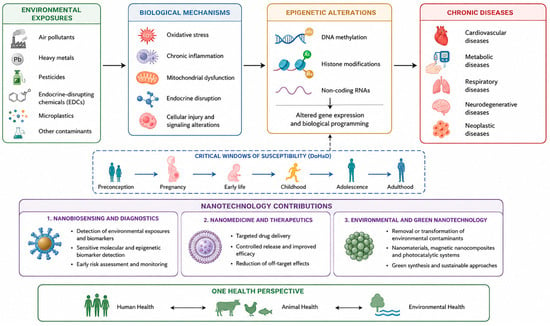
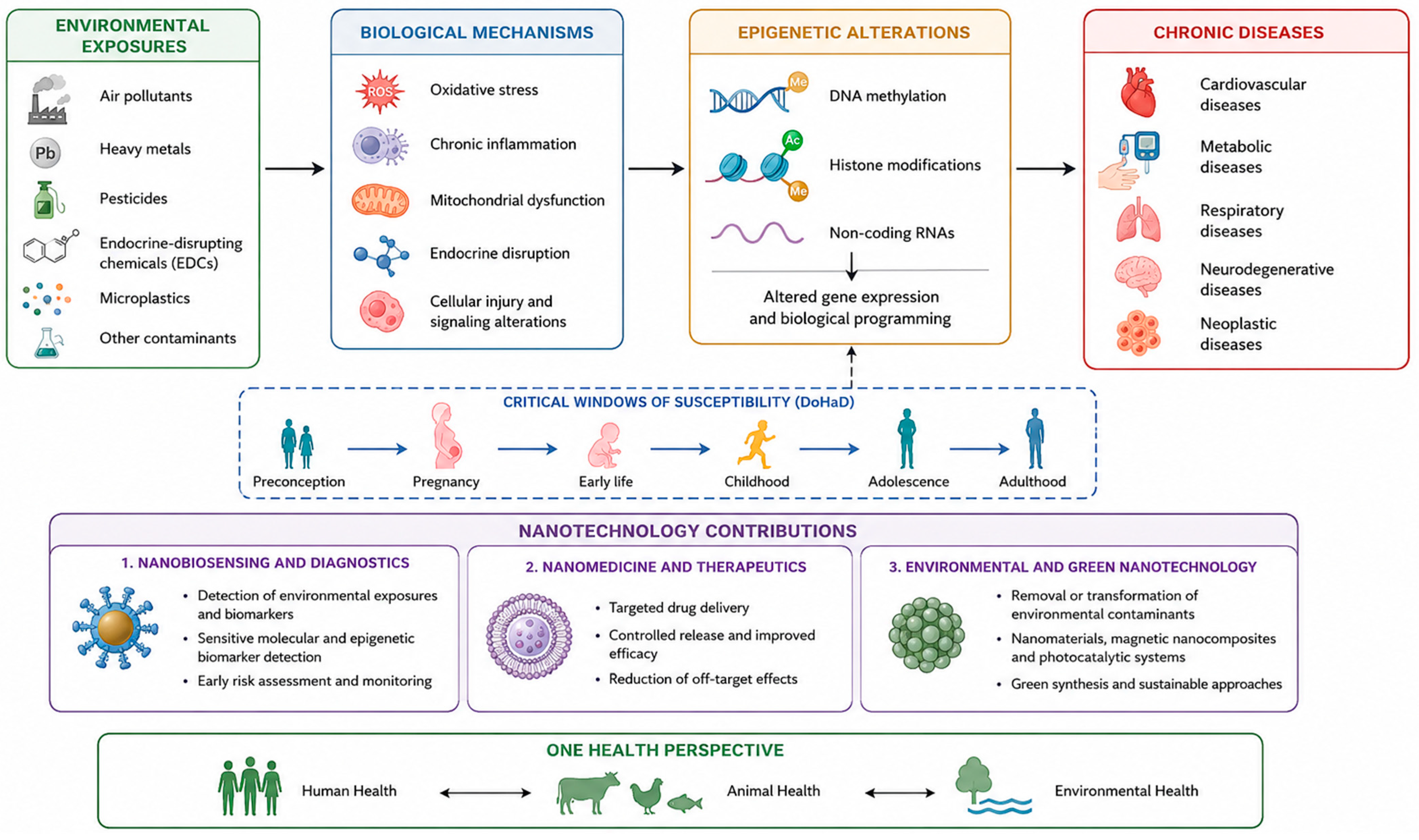
Disclaimer/Publisher’s Note: The statements, opinions and data contained in all publications are solely those of the individual author(s) and contributor(s) and not of MDPI and/or the editor(s). MDPI and/or the editor(s) disclaim responsibility for any injury to people or property resulting from any ideas, methods, instructions or products referred to in the content. |
© 2026 by the authors. Licensee MDPI, Basel, Switzerland. This article is an open access article distributed under the terms and conditions of the Creative Commons Attribution (CC BY) license.