


Abstract
Sustainability reporting is moving from voluntary narrative disclosure toward regulated, evidence-based and externally assured corporate reporting, creating an assurance problem that artificial intelligence (AI) is expected to help address. Because AI is embedded in accounting and audit workflows, its outputs increasingly shape how assurance evidence is located, tested and evaluated. This conceptual article develops an assurance-specific framework answering three questions: for which sustainability-assurance procedures AI creates analytical value, which risks arise when AI influences assurance work, and which decision rights and controls should govern that influence. Integrating assurance standards, accounting and auditing research, AI-governance frameworks and behavioural studies, it finds AI adds value in five domains—evidence extraction, criteria mapping, anomaly and greenwashing screening, external-data triangulation, and documentation support—but only under defined base rates, error costs and source traceability. It identifies the risks limiting reliance: data, source fidelity, explainability, bias, calibration, preparer gaming, and auditor overreliance. The Responsible AI-Assisted Sustainability Assurance Framework sets graded reliance ceilings, non-delegable decisions, calibrated decision gates, anti-gaming safeguards and ex-post metrics, permitting clerical assistance, analytical recommendation and constrained agentic execution while prohibiting autonomous decisions on materiality, evidence sufficiency and conclusions. Illustrated in Europe, it generalises through ISSA 5000 as a testable model.
1. Introduction
Corporate reporting is entering a stage in which sustainability information is no longer treated merely as a voluntary narrative supplement to financial statements. The Corporate Sustainability Reporting Directive (CSRD) embeds sustainability information within the regulated corporate-reporting system and introduces assurance requirements, while the European Sustainability Reporting Standards (ESRS) require structured disclosures on governance, strategy, impacts, risks and opportunities, and metrics and targets [1,2]. International Standard on Sustainability Assurance (ISSA) 5000, General Requirements for Sustainability Assurance Engagements, extends this assurance orientation beyond a single jurisdiction by providing a profession-agnostic standard for assurance engagements over sustainability information prepared under suitable criteria [3].
This transformation changes the information problem facing accounting systems and assurance providers. Sustainability information includes greenhouse-gas emissions, energy use, water, waste, biodiversity, workforce indicators, human-rights processes, value-chain data, transition plans and forward-looking targets. Such information is often heterogeneous, partly qualitative, estimated, externally sourced and methodologically uncertain. Its credibility therefore depends not only on the presence of disclosure, but also on reporting boundaries, calculation methods, internal controls, traceability and the ability of a practitioner to obtain sufficient appropriate evidence.
Research on sustainability assurance has established that demand for assurance is shaped by credibility incentives, institutional settings and reporting quality [4,5,6]. It also shows that practitioners face difficulties when sustainability reports contain selective disclosures, unclear boundaries and weak methodological explanations [7]. The problem is reinforced by the gap between broad narrative claims and evidence-ready disclosure: quantified, time-specific and traceable information is generally more decision-useful than unsupported statements [8,9]. Recent professional guidance accordingly emphasises integrated governance and internal control over sustainability information as a prerequisite for assurance readiness [10,11].
AI may help assurance providers process this information environment. Machine learning, natural-language processing, anomaly detection and generative AI can locate disclosures, compare documents, classify evidence, identify unusual patterns and support working-paper preparation. These possibilities build on a longer development from big-data accounting and audit analytics toward AI-supported procedures [12,13,14,15,16,17]. Recent accounting research further demonstrates that machine learning can improve information processing and estimation, while also requiring explicit choices about labels, thresholds and implementation objectives [18]. Generative AI can reduce information-processing frictions, but its effects depend on how users incorporate its outputs into decisions [19].
The assurance relevance of AI is therefore not exhausted by the statement that technology should remain ‘human-in-the-loop’. That proposition is already reflected in contemporary governance principles and in the EU Artificial Intelligence Act [20,21]. The difficult questions concern the admissible degree of reliance, which decisions must remain non-delegable, how anomaly thresholds should be calibrated, how false positives and false negatives affect audit effort, how predictable detection routines may be strategically gamed, and how an auditor’s own incentives may lead to concealed over-delegation. Public regulatory outreach also suggests that audit firms currently concentrate generative-AI use on less complex or repetitive tasks and continue to treat higher-judgement applications cautiously [22].
The existing literature is fragmented across four domains that are rarely connected: sustainability assurance [4,5,6,7], AI in accounting and auditing [12,13,14,15,16,17,18,19], AI governance and algorithm auditing [23,24,25,26,27], and fraud and monitoring incentives [28,29]. Existing governance frameworks identify principles such as transparency, accountability and human oversight, but they do not specify an assurance-specific reliance ceiling or the evidential status of AI-generated signals. Traditional audit-risk models, in turn, do not explicitly address model error, prompt and tool logs, strategic adaptation to automated tests, or constrained agentic systems. The principal gap is therefore operational: how should AI-generated outputs be admitted, challenged, documented and evaluated within a sustainability assurance engagement?
In response to this gap, the aim of this article is to develop an assurance-specific conceptual framework that governs how AI-generated outputs are admitted, challenged, documented and evaluated in a sustainability assurance engagement—specifically, where AI can add analytical value, which technical and behavioural risks limit its use, and how reliance, decision rights, controls and outcome metrics should be designed. The article addresses three research questions:
- RQ1. For which sustainability-assurance procedures can AI create credible analytical value, and under what data and calibration conditions?
- RQ2. Which technical, evidential, confidentiality, incentive and accountability risks arise when AI influences ESG assurance work?
- RQ3. Which decision rights, reliance ceilings, controls and evaluation metrics should structure responsible AI-assisted sustainability assurance?
The article uses an integrative conceptual design rather than an empirical test or a systematic literature review, and this choice is made deliberately rather than by default. The phenomenon under study—AI-mediated sustainability assurance—does not yet exist at a scale that would support representative field data, so a premature empirical test would measure isolated tools rather than the assurance architecture that is actually in question. A systematic review, in turn, would map the literature that is presently split across four disciplines and would therefore reproduce that fragmentation instead of resolving it. An integrative conceptual design is appropriate precisely because the required contribution is synthetic: it must connect assurance standards, accounting and auditing evidence, AI-governance rules and fraud-incentive theory into a single decision structure and then express that structure as contestable design choices that later empirical work can test. The conceptual contribution therefore lies not in proposing a framework as such, but in specifying it at the level of individual procedures, reliance limits and non-delegable decisions, so that each choice can be challenged, adopted differently or falsified.
Methodologically, the framework was built in four steps—decomposing the assurance process, mapping AI capabilities to specific procedures, stress-testing each capability against technical and incentive risks, and synthesising the results into reliance levels, decision gates, controls and outcome metrics—and every proposed element was screened by a five-question design-logic test, as set out in Section 3.
Table 1 summarises the principal regulatory and professional instruments that inform the proposed framework. The analysis also draws on the Public Company Accounting Oversight Board (PCAOB) staff update on generative artificial intelligence (GenAI) [22] and the National Institute of Standards and Technology (NIST) Artificial Intelligence Risk Management Framework (AI RMF), specifically its Generative Artificial Intelligence Profile (NIST AI 600-1) [23]. These instruments are not listed only as background: the CSRD and ESRS define the reporting object and the criteria against which AI-assisted procedures are tested (RQ1); ISSA 5000 and its implementation guidance supply the assurance obligations to which any AI use must remain subordinate (RQ1, RQ3); and the EU AI Act, the NIST AI RMF and the PCAOB material provide the governance floor and the risk vocabulary drawn on in RQ2 and RQ3. The framework developed in Section 3, Section 4, Section 5 and Section 6 takes its decision rights and control anchors directly from these instruments, and the ‘Domain’ column of Table 1 distinguishes sustainability-reporting instruments from the assurance standard and from AI-governance and oversight instruments.
Table 1.
Regulatory and professional context for AI-assisted sustainability assurance.
The remainder of the article is organised as follows. Section 2 establishes the reporting-quality and assurance foundations. Section 3 explains the conceptual research design. Section 4 develops the use cases and their decision limits. Section 5 analyses technical and incentive risks, including strategic gaming and agentic AI. Section 6 presents the framework, control mapping and evaluation metrics. Section 7 discusses theoretical contributions and practical implications, and Section 8 concludes with limitations and future research directions.
2. Conceptual and Regulatory Foundations
This section establishes the conceptual and regulatory foundations on which the framework is built, and it is organised to serve the three research questions rather than to survey the field exhaustively. Section 2.1 and Section 2.2 characterise the reporting-quality and evidence problem that makes assurance—and therefore AI support—necessary (RQ1); Section 2.3 links this problem to accounting-systems and internal-control discipline, which determines whether AI outputs can be traced to evidence (RQ1, RQ2); and Section 2.4 reviews AI capabilities and their limits in accounting and auditing, moving from analytics to constrained agency, which frames the reliance and risk analysis (RQ2, RQ3). The regulatory instruments summarised in Table 1 are treated throughout as the normative baseline against which engagement-level reliance is later calibrated.
2.1. Reporting Quality, Greenwashing and the Need for Assurance
The movement from voluntary ESG communication to assurance-oriented sustainability reporting is partly a response to weaknesses in reporting quality. Sustainability disclosure can improve transparency, but it can also serve symbolic or legitimising purposes when positive claims are selective, weakly bounded or unsupported [7,8,9]. The mere existence of a report therefore does not establish substantive accountability.
Assurance risk increases when information cannot be linked to a clear reporting period, organisational boundary, calculation method or evidence source. The problem is not confined to deliberate greenwashing. It also includes inconsistent definitions, unstable consolidation perimeters, undocumented estimates, incomplete value-chain information and poor connectivity between sustainability and financial reporting. These weaknesses make it difficult to distinguish a true change in performance from a change in scope, data source or methodology.
ISSA 5000 responds to this environment by requiring practitioners to understand the sustainability information, applicable criteria, reporting process and system of internal control, to identify risks of material misstatement and to design procedures that obtain sufficient appropriate evidence [3,11]. AI may support these activities, but it cannot repair a weak evidential foundation merely by processing it faster.
2.2. From Disclosed Information to Evidence-Ready ESG Information
Evidence-ready ESG information is sustainability information that can be tested, traced, recalculated and evaluated against suitable criteria [3,10,11]. It is not created by disclosure alone. It emerges from a chain that connects data ownership, source systems, methodologies, approvals, controls and reporting outputs. This chain is particularly important for forward-looking and value-chain information, where estimates may be unavoidable but their assumptions and limitations must be transparent.
The progression from voluntary disclosure to digitally structured reporting increases assurance potential but also changes the nature of failure. Narrative reports are vulnerable to selectivity and vagueness; framework-based reports may remain methodologically heterogeneous; regulated reports require robust systems and controls; and digitally tagged reports add the risk that inaccurate or poorly classified information is reproduced at scale. Digitalisation therefore improves accessibility, but not automatically reliability. Table 2 summarises the evolution of sustainability information from voluntary narrative disclosure to digitally structured reporting and identifies the principal assurance problem associated with each stage.
Table 2.
Evolution of sustainability information and the associated assurance problem.
As sustainability reporting becomes more assurance-oriented, the quality of disclosed information must be evaluated not only in terms of completeness and relevance, but also in terms of its evidential characteristics. Table 3 distinguishes weak forms of ESG information from evidence-ready forms and explains their relevance for assurance procedures. The characteristics in Table 3 are not introduced ad hoc: they operationalise the evidential properties that assurance standards and prior reporting-quality research treat as preconditions for testability—quantification and time specificity, boundary clarity, methodological transparency, traceability, comparability and criteria alignment—drawing on ISSA 5000 and its implementation guidance and on studies of disclosure quality and legitimacy [3,7,8,9,10,11].
Table 3.
Characteristics of evidence-ready ESG information.
2.3. Accounting Systems, Internal Control and Digital Reporting
Although sustainability reporting is often described as non-financial reporting, credible assurance requires accounting-like discipline. Systems must capture, classify, aggregate, validate and document ESG data. Carbon accounting requires defined organisational boundaries, emission sources, calculation methods and factors. Workforce reporting requires stable definitions and reliable human-resources data. Value-chain reporting requires source evaluation, estimation policies and transparent limitations.
The accounting system provides useful analogues: reporting classifications, consolidation perimeters, policies and estimates, responsibility centres, audit trails, periodisation and control testing. Recent professional guidance emphasises that sustainability information should be integrated into governance and control systems rather than assembled only at the end of the reporting period [10]. This is also the point at which AI governance and sustainability-data governance intersect: an AI system can only produce reviewable outputs when both the data lineage and the model or tool lineage are documented.
Machine-readable reporting creates an additional bridge. Structured tagging can support automated extraction, comparison and completeness testing. Yet a tagged error is still an error. The key transition to AI-assisted assurance is therefore not from paper to algorithm, but from weakly governed disclosure to a controlled information environment in which automated procedures can be traced back to evidence.
2.4. AI in Accounting and Auditing: From Analytics to Constrained Agency
AI in accounting includes machine learning, natural-language processing, expert systems, anomaly detection, robotic process automation and generative models. These technologies extend prior developments in big-data accounting and audit analytics by enabling classification, prediction, text analysis, document retrieval and pattern recognition across large datasets [12,13,14,15,16,17].
Bertomeu argues that machine learning improves accounting only when the prediction objective, labels, features and implementation environment are specified [18]. This observation is critical for assurance. An anomaly model does not discover ‘misstatement’ in the abstract; it identifies observations that differ from a learned or specified pattern. Whether that difference is relevant depends on the reporting boundary, materiality, expected base rate and cost of investigation. Similarly, a generative model can summarise a report, but the assurance value of the summary depends on source fidelity and omission risk.
The emergence of agentic systems adds a further distinction. An AI workflow may merely assist a practitioner, recommend actions, or autonomously select and execute tools within a defined environment. Agentic architecture can improve repeatability and coverage, but it also increases the risk that errors propagate across several steps before human review. The relevant design question is therefore not simply whether a human is present, but where the human can intervene, which actions require prior approval, and which decisions cannot be delegated.
3. Conceptual Research Design and Framework Development
3.1. Scope and Source Domains
This study adopts an integrative conceptual research design, a recognised approach for synthesising fragmented and fast-moving literature studies into a coherent model when the phenomenon is still too new for representative empirical testing. It does not claim to be an exhaustive systematic review, and it does not offer empirical evidence of framework effectiveness. That distinction is deliberate rather than a limitation: instead of aiming for exhaustive coverage or a reproducible search protocol, the design purposively selects authoritative and peer-reviewed sources that bear directly on the three research questions and integrates them into an assurance-specific decision architecture. Peer-reviewed research is therefore used analytically—to establish mechanisms, limits and testable claims—rather than catalogued for coverage. The remainder of this section states the source domains and their purpose (Section 3.1), the analytical procedure and how it was applied (Section 3.2), and the boundary conditions that delimit the resulting framework (Section 3.3).
Four source domains were used, each selected for a specific role in answering the research questions. The first domain is the body of sustainability-reporting and assurance requirements—principally the CSRD [1], the ESRS [2], ISSA 5000 [3] and its implementation guidance [11], together with ISA 500 on audit evidence [30]. These define the reporting object, the suitable criteria and the assurance obligations against which AI-assisted procedures must be evaluated, and they supply the non-delegable-decision logic used in RQ1 and RQ3. The second domain is accounting and auditing research on analytics, machine learning, professional judgement and reliance on automated tools [12,13,14,15,16,17,18,19,31]; it establishes what AI can and cannot do at the level of a procedure and how practitioners behave when they use it, informing RQ1 and RQ2. The third domain is AI-governance and the algorithm-audit literature, including the EU AI Act [21], the NIST AI RMF [23] and end-to-end accountability frameworks [24,25,26,27]; it supplies the lifecycle risk vocabulary and the governance floor used in RQ2 and RQ3. The fourth domain is research on fraud dynamics and monitoring incentives [28,29], which is necessary to analyse strategic adaptation by preparers and possible shirking by auditors, and which underpins the incentive analysis in RQ2 and RQ3. Only sources available through July 2026 were considered; this cut-off is material because the governing instruments—notably ISSA 5000 and the EU AI Act—were finalised very recently. The temporal boundary therefore fixes the specific version of each standard used in the subsequent provision-level mapping.
3.2. Analytical Procedure
The analysis then proceeded in four stages, applied to the sustainability-assurance engagement as the unit of analysis. In the first stage, the assurance process was decomposed into its constituent activities—evidence generation, analytical procedures, risk assessment, professional decisions, documentation and reporting—so that AI could be examined procedure by procedure rather than as a single technology. In the second stage, specific AI capabilities (retrieval and extraction, classification and mapping, anomaly and outlier detection, external triangulation, and generative drafting) were mapped onto those activities, producing the use domains in Section 4 and Table 4. In the third stage, each mapped capability was stress-tested against five risk families—technical error, evidential status, confidentiality, incentive and accountability—yielding the risk taxonomy developed in Section 5. In the fourth stage, the resulting requirements were synthesised into the layered framework presented in Section 6, comprising reliance levels, non-delegable decision gates, provision-level control anchors and ex-post outcome metrics. Each stage thus feeds a specific component of the framework: RQ1 is addressed by stages one and two, RQ2 by stage three, and RQ3 by stage four.
Table 4.
AI use domains, practical examples and admissible evidential status.
To keep the framework operational rather than a restatement of broad principles, every proposed element—each use domain, reliance level, control and metric—was screened by a five-question design-logic test: What information enters the AI procedure? What output is generated? How can the output fail? Who is authorised to rely on it? What evidence documents the use and the response? These five questions were chosen because together they trace an AI output through the whole assurance chain, from input to accountability, and each maps to a research question: the first two operationalise where AI adds value (RQ1); the third operationalises the risk analysis (RQ2); and the last two operationalise decision rights and documentation (RQ3). An element that could not answer all five questions was reformulated or excluded. This test is the mechanism that converts the general logics of Section 6.1 into the specific, contestable choices tabulated in Section 4, Section 5 and Section 6.
3.3. Boundary Conditions
The framework governs the use of AI by an assurance provider; it does not constitute an audit of the AI system itself. It also does not assume that every AI tool used in sustainability assurance is classified as a high-risk system under the EU AI Act. Formal legal classification and engagement risk are distinct. A tool may fall outside a statutory high-risk category yet still require stringent controls because its output influences a material assurance judgement.
The framework is technology-neutral and applicable to limited- and reasonable-assurance engagements, subject to proportionate work effort. It is primarily illustrated through the European reporting environment, but the core logic is generalisable because ISSA 5000 is global and NIST and algorithm-audit frameworks provide cross-jurisdictional governance principles. These boundary conditions are part of the research design, not caveats appended to it: they fix the unit of analysis (the assurance provider’s use of AI, not an audit of the AI system), the legal assumption (engagement risk is treated as distinct from statutory AI-risk classification) and the scope of generalisation (technology-neutral and standard-anchored), and they therefore determine which claims the framework can and cannot support.
4. AI-Assisted Sustainability Assurance: Use Cases and Decision Limits
4.1. Evidence Ingestion, Extraction and Location
The lowest-risk and currently most mature use of AI is the organisation of information. Natural-language processing and generative tools can locate sustainability disclosures, identify references to policies and metrics, extract tables, classify documents and link report statements to source files. These procedures can reduce search costs and expand coverage across annual reports, sustainability reports, policies, internal datasets and supplier documents [20,22].
The output is not sufficient appropriate assurance evidence on its own. It is initially an index or retrieval aid whose reliability depends on completeness testing and source linkage. A defensible procedure records the document population, extraction rules, excluded formats, confidence thresholds and unresolved items. After source validation and professional evaluation, the output may form part of the evidential record, but the practitioner remains responsible for determining whether the relevant population has been captured [3,11].
4.2. Criteria Mapping, Completeness and Consistency Testing
AI can map disclosed text and metrics to ESRS or other criteria and flag potentially missing datapoints. It can also compare terminology, units, baselines and boundaries across report sections. This use is valuable where disclosure requirements are dispersed and cross-references are numerous [2,20].
A mapping result is a classification, not a compliance conclusion. False negatives may hide a disclosure located in an unexpected section, while false positives may treat promotional language as satisfaction of a reporting requirement. Mapping models therefore require validated taxonomies, document-level source links and human review of material items [3,11,20].
4.3. Anomaly Detection and Greenwashing-Risk Screening
An anomaly is an observation that deviates from an expected pattern, peer relationship, time-series behaviour, internal rule or cross-document relationship. In sustainability assurance, numerical anomalies include abrupt changes in energy intensity, implausible emission ratios, discontinuities around reporting boundaries and repeated values inconsistent with operational data. Documentary anomalies include conflicting units, inconsistent scope descriptions, unexplained restatements and a mismatch between strong narrative claims and stagnant or deteriorating metrics.
Depending on the data structure and the assurance objective, illustrative techniques may include rule-based validation for unit and boundary inconsistencies; control charts or change-point detection for time-series breaks; isolation forests, autoencoders or other multivariate outlier models for unusual combinations of ESG metrics; and semantic-similarity or natural-language-inference models for cross-document inconsistencies [17,18,20]. These techniques identify observations for investigation; they do not independently establish misstatement, intent or greenwashing.
The assurance value of anomaly detection depends on calibration. Where the base rate of material misstatement is low, even a technically accurate model may generate many false positives. The practitioner must therefore define the population, threshold, expected base rate, investigation capacity and relative cost of false positives and false negatives. A false positive consumes audit effort and can bias attention; a false negative may leave a material misstatement undetected. Bertomeu’s implementation analysis is directly relevant because model performance cannot be separated from the accounting objective and the decision rule [18].
AI is unlikely to add much value to the detection of an obviously vague sustainability claim. Its comparative advantage lies in distributed patterns that are difficult for a human reviewer to integrate across hundreds of pages, multiple periods and external datasets. Examples include a transition narrative that is inconsistent with capital-expenditure patterns, a claimed reduction that results from boundary changes, repeated boilerplate that masks unchanged controls, or selective disclosure of favourable intensity metrics without the corresponding denominator. Such signals identify greenwashing risk; they do not prove greenwashing.
4.4. External-Data Triangulation and Continuous Monitoring
AI can compare corporate disclosures with regulatory filings, emissions registries, energy data, incident reports, satellite or geospatial information and prior-period reports [20,23]. External triangulation can reveal inconsistencies and support risk assessment, but the external source must itself be evaluated for authority, coverage, timeliness and methodological compatibility.
Continuous monitoring extends this logic by applying pre-approved tests during the reporting period. It can provide earlier risk signals and reduce end-of-period surprises. However, a continuously generated alert is not continuous assurance. Each alert requires a defined response, escalation rule and closure record. Materiality and the sufficiency of evidence remain engagement-level professional decisions [3,11].
4.5. Documentation Support and Assistance to Assurance Conclusions
Generative AI can draft working-paper summaries, organise evidence references and prepare preliminary descriptions of procedures. This can improve consistency and reduce administrative effort [22,31], but generated text must be reconciled to the underlying file. Prompts, source materials, outputs, edits and approvals should be retained when they are relevant to the engagement record [3,11,30].
AI may also assemble a structured summary of findings for the engagement team. It should not formulate the final assurance conclusion autonomously. The evaluation of materiality, the sufficiency and appropriateness of evidence, the response to contradictory evidence and the final assurance conclusion and report are non-delegable professional decisions [3,11]. Table 4 synthesises the principal AI use domains discussed in Section 4.1, Section 4.2, Section 4.3, Section 4.4 and Section 4.5, illustrating the corresponding procedures, the evidential status of AI outputs, the permitted degree of reliance and the required human response. The five use domains of Section 4.1, Section 4.2, Section 4.3, Section 4.4 and Section 4.5 are disaggregated in Table 4 into seven procedure-level entries, because two domains contain two distinct procedures each: anomaly detection and greenwashing-risk screening are shown separately (both discussed in Section 4.3), as are documentation support and assistance to the assurance conclusion (both discussed in Section 4.5). The rows therefore correspond one-to-one to the procedures analysed in the text.
5. Technical, Behavioural and Incentive Risks
This section answers RQ2 by identifying the technical, evidential, confidentiality, incentive and accountability risks that arise when AI influences ESG assurance work, and it maps each risk family onto the subsections that follow. Technical risks—incomplete or mis-bounded input populations, model or prompt instability, weak explainability and bias—are addressed in Section 5.1. Evidential risks, which concern whether an output can function as assurance evidence rather than merely as a statistically accurate signal, span Section 5.1 and Section 5.2, where base rates and error costs govern how detection output may be relied upon. Confidentiality and incentive risks are treated together in Section 5.3 and Section 5.4: the exposure of detection logic invites strategic gaming by preparers (Section 5.3), while auditor overreliance and the protection of client data raise parallel questions about what may safely be disclosed or delegated (Section 5.3 and Section 5.4). Section 5.5 then examines agentic AI as an alternative architecture whose admissibility turns on these same five risk families. Together, the analysis identifies eight risk categories, each defined by its failure mechanisms, consequences and required controls.
5.1. Data, Source-Fidelity, Explainability and Bias Risks
AI can increase the volume of analysis while reducing the transparency of how a result was produced. The principal technical risks begin with incomplete or incorrectly bounded input populations, model or prompt instability, hallucinated or unsupported text, weak explainability and bias. Black-box access is insufficient where the practitioner cannot inspect relevant inputs, outputs, limitations and validation evidence [23,24]. Bias can arise from training data, language, industry representation or the practitioner’s own selection of examples [32].
The evidential problem is distinct from model accuracy. An output may be accurate in a statistical sense yet unsuitable as assurance evidence because the source population is incomplete, the reporting criteria are mis-specified or the result cannot be reproduced. Conversely, a low-confidence signal may still be useful for risk assessment if it is treated as a prompt for further procedures rather than as a conclusion.
5.2. Base Rates, False Positives and False Negatives
Automated detection requires explicit attention to base rates and error costs. If material misstatement is rare, a large proportion of alerts may be false positives even when sensitivity and specificity appear strong. Excessive alerts can create automation fatigue and lead practitioners to dismiss genuinely important exceptions. A high threshold may reduce false positives but increase false negatives.
The framework therefore requires engagement-specific calibration rather than a universal anomaly score. The calibration record should state the target condition, population, threshold, validation sample, expected base rate, acceptable error trade-off and escalation rule. Where reliable historical labels do not exist, the model should be used for exploratory risk identification rather than probabilistic claims about misstatement.
5.3. Detection-Logic Exposure and Strategic Gaming by Preparers
A predictable automated audit can change preparer behaviour. Fraud and monitoring research shows that agents learn about detection environments and may adapt the scale or form of misreporting [28,29]. An assurance system that repeatedly applies public and stable thresholds may therefore invite boundary management, metric substitution or manipulation just below a detection limit.
This creates a tension between explainability and test secrecy. Governance, criteria, accountability and the nature of controls should be transparent. Exact alert thresholds, test combinations, challenge cases and model-update triggers need not be disclosed to the preparer when disclosure would reduce audit effectiveness. The appropriate approach is controlled confidentiality: the engagement file documents the logic and validation for internal and quality-review purposes, while access to sensitive detection parameters is restricted.
5.4. Auditor Overreliance, Client-Data Confidentiality and Accountability
Human oversight is not automatically effective. Auditors may over-trust a sophisticated output, anchor on an AI risk score or use generated documentation to imitate work that was not substantively performed. Experimental evidence shows that the manner in which auditors interact with AI affects reliance [31]. The risk is therefore not only that AI replaces judgement, but that the practitioner privately delegates an inadmissible share of work while retaining formal responsibility.
Controls must discipline human effort as well as model behaviour. Required measures include minimum non-automated procedures for material areas, evidence of challenge and follow-up, review of prompt and activity logs, partner approval of reliance level, independent quality review for high-impact uses and clear consequences for undocumented or prohibited delegation. Accountability remains personal and organisational; the presence of a human name on the report is not enough if the engagement record cannot demonstrate human work.
Client-data confidentiality and cybersecurity are distinct from the controlled confidentiality of audit logic discussed above. Sustainability files may contain employee, supplier, location and commercially sensitive information. Such data should be processed only in approved environments, using data minimisation, access controls, retention limits and incident procedures. These safeguards address leakage, legal exposure and model contamination; they do not require disclosure of sensitive test thresholds to preparers [21,23,33].
5.5. Agentic AI as an Alternative Architecture
Agentic systems can select tools, retrieve information and execute multi-step workflows under instructions [34]. Their advocates can reasonably argue that explicit instructions and machine logs may be more repeatable than unstructured human processing. The relevant alternative is a human-on-the-loop architecture in which practitioners design procedures, review exceptions and improve instructions rather than manually performing every intermediate task.
This article does not reject agentic execution. It rejects autonomous professional conclusion. Constrained agents may perform pre-approved retrieval, reconciliation and testing tasks within defined permissions, with tamper-evident and auditable logs, stop conditions and checkpoints. They should not independently set materiality, alter the audit scope, decide that contradictory evidence is resolved, determine evidence sufficiency or issue the assurance conclusion. This distinction creates a more realistic framework than a generic requirement that a human must simply remain ‘in the loop’. Table 5 synthesises the principal risks associated with AI-assisted sustainability assurance by linking each risk category to its underlying failure mechanism, potential consequences and corresponding controls. It treats detection-logic exposure and client-data confidentiality as separate risk categories because they arise through different mechanisms and require distinct safeguards. The eight rows of Table 5 expand the five risk discussions of Section 5.1, Section 5.2, Section 5.3, Section 5.4 and Section 5.5 into distinct categories: Section 5.1 covers data-and-boundary, source-fidelity, explainability and bias risks (four rows); Section 5.2 covers base-rate and threshold risk; Section 5.3 covers detection-logic exposure and strategic gaming; Section 5.4 covers overreliance-and-shirking, client-data confidentiality and accountability risks; and the constrained-agentic architecture of Section 5.5 is what the controls in the final column presuppose.
Table 5.
Risk categories, failure mechanisms and required controls.
6. Responsible AI-Assisted Sustainability Assurance Framework
6.1. Theoretical Foundation, Originality and Design Propositions
The Responsible AI-Assisted Sustainability Assurance Framework combines three theoretical logics. The first is assurance logic: evidence must be relevant and reliable, risks must be assessed, procedures must respond to those risks, and conclusions remain the practitioner’s responsibility [3,30,35]. The second is AI-governance logic: risk must be managed across the lifecycle through documentation, testing, oversight and accountability [20,21,23,25,26,27]. The third is incentive logic: both preparers and monitors respond strategically to detection systems [28,29].
The framework is not presented as superior to all existing audit-risk models. Rather, it extends them for AI-mediated sustainability assurance. Its incremental contribution consists of six operational propositions: (1) AI-generated outputs should not be treated as sufficient appropriate evidence on their own but may form part of the evidential record following source validation, calibration, professional evaluation and documentation; (2) admissible reliance is determined by the procedure’s consequence, not only by the tool’s legal classification; (3) materiality, evidence sufficiency, resolution of contradictory evidence and final conclusions are non-delegable; (4) anomaly models require base-rate and error-cost calibration; (5) governance must address preparer gaming and auditor shirking; and (6) effectiveness must be evaluated through outcome metrics rather than the amount of AI used. Propositions (2) and (3) carry the framework’s principal novelty—consequence-based reliance and an explicit set of non-delegable decisions—whereas (1), (5) and (6) formalise and make auditable practices that are widely endorsed but rarely specified; the value of the latter lies in converting them into observable requirements. For proposition (6), for instance, effectiveness is not measured generically but through specific outcomes such as the false-positive and false-negative rates of anomaly procedures, the proportion of AI outputs carrying valid source links, alert-closure time, and subsequent ESG restatement or correction rates, as discussed in Section 6.5.
These propositions make the framework disputable. A firm may choose a higher or lower reliance ceiling, but it must correctly identify the affected decision and justify the control environment. A regulator may permit constrained agentic procedures, but it must specify the documentation and quality-review conditions. The framework therefore converts general principles into choices that can be observed and tested.
6.2. Structure and Interaction of the Framework
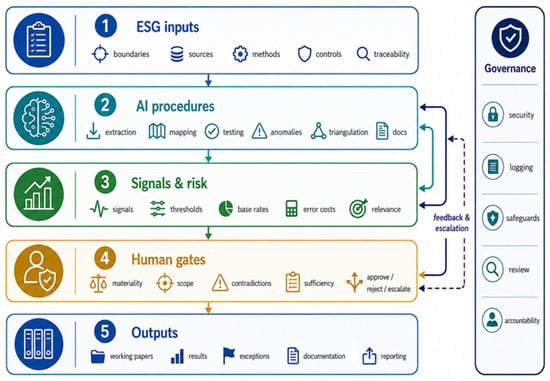
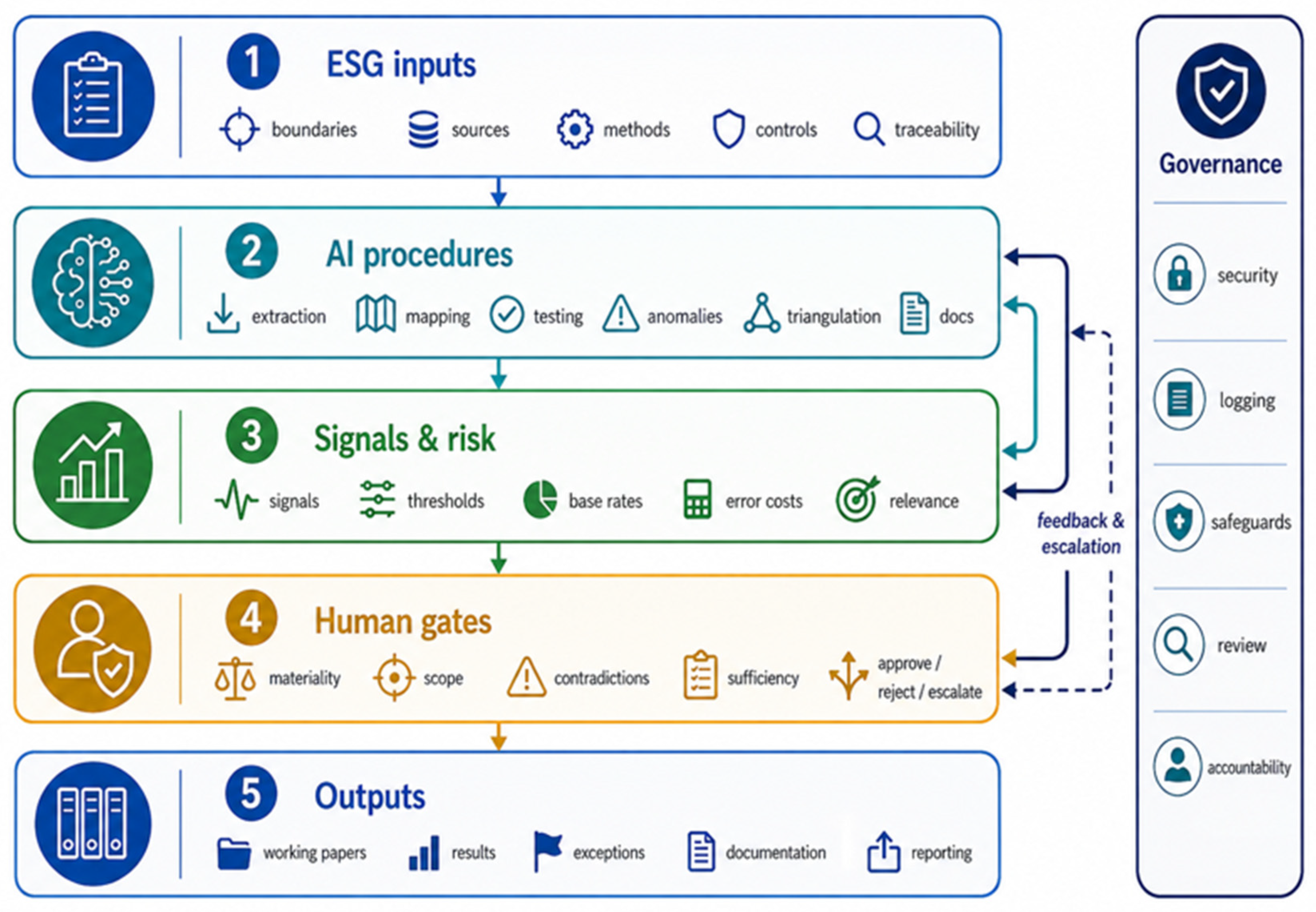
Figure 1 presents five connected layers. The first layer contains evidence-ready ESG inputs. The second contains AI-assisted procedures. The third converts outputs into calibrated signals and assurance-risk assessments. The fourth contains non-delegable human decision gates. The fifth produces documented procedures, findings and assurance outputs. Governance is cross-cutting rather than a final step, because access security, logging, anti-gaming safeguards, quality review and accountability must operate throughout the workflow.
Figure 1.
Responsible AI-Assisted Sustainability Assurance Framework with reliance controls and non-delegable decision gates.
Read from top to bottom, Figure 1 shows the path an item of ESG information follows through the framework: from evidence-ready inputs (Layer 1), through AI-assisted procedures (Layer 2) and the conversion of their outputs into calibrated signals and assurance-risk assessments (Layer 3), to the non-delegable human decision gates (Layer 4) that must be cleared before any documented assurance output is produced (Layer 5). Governance is represented as a band spanning all five layers rather than as a terminal step, signifying that access security, logging, anti-gaming safeguards, quality review and accountability operate continuously throughout the workflow. The return paths from the decision gates to earlier layers depict the feedback and escalation described below: an output that is rejected, recalibrated or found to require further evidence is sent back rather than passed forward. The figure is deliberately monochrome and schematic; its purpose is to display the decision architecture and the reliance boundaries, while the operational details are presented in the sections that follow.
The layers interact through feedback and escalation. An AI-generated anomaly is not passed directly to the report. It is first calibrated and assessed for relevance, then investigated through source evidence and, where necessary, additional procedures. The practitioner may reject the signal, revise the model or threshold, expand testing or treat the exception as an unresolved limitation. This feedback loop is important because AI-assisted assurance is not a linear production process.
The framework deliberately separates human decision gates from general ‘human oversight’. Oversight can be passive; a decision gate requires an identified practitioner to approve, reject or escalate a material output. The engagement file must show the decision, the evidence considered and the reason.
6.3. Reliance Levels and Non-Delegable Decisions
Responsible AI-assisted assurance requires differentiated levels of reliance that reflect the authority granted to the AI system, the significance of its outputs and the degree of required human control. These levels range from clerical assistance to constrained agentic execution, while autonomous professional decision-making remains prohibited. Table 6 presents the five reliance levels, their permitted applications, corresponding human controls and admissibility status.
Table 6.
Reliance levels and decision rights.
The EU AI Act classification of a system informs the legal control baseline, but it does not determine these reliance levels. The framework can impose L2 or L3 controls on a system that is not legally classified as high-risk when its output could materially redirect assurance work. Conversely, legal compliance does not make autonomous reliance acceptable for non-delegable decisions.
6.4. Regulatory Mapping and Operational Controls
Operationalising the proposed framework requires a clear connection between engagement-level controls, assurance requirements and applicable AI-governance obligations. This connection must remain sufficiently precise to identify the professional or regulatory basis of each control without implying that existing standards prescribe specific AI tools or techniques. Table 7 therefore maps the proposed controls at provision level, identifies the relevant ISSA 5000 paragraphs and includes AI Act, NIST and privacy anchors only where they are applicable. The engagement-specific reliance limits developed in this article may nevertheless be stricter than the applicable legal baseline.
Table 7.
Operational control matrix and regulatory or professional anchors.
The mapping is provision-level but remains principle-based. The cited ISSA 5000 paragraphs identify the assurance obligations that underpin each operational control; they do not imply that ISSA 5000 prescribes specific AI tools, models or prompt-validation techniques. Similarly, the cited AI Act provisions apply only where the relevant system falls within their statutory scope and do not determine whether an AI-generated output constitutes sufficient appropriate assurance evidence. The matrix connects AI governance with assurance requirements without conflating legal compliance, model performance and evidential sufficiency.
6.5. Ex-Post Evaluation and Empirical Validation
The effectiveness of the framework should not be measured by the volume of ESG disclosure or the number of automated procedures. The relevant question is whether AI-assisted assurance becomes more accurate, truthful, timely, reviewable and decision-useful without weakening independence or professional scepticism.
Empirical validation can proceed through complementary designs. Field case studies can examine implementation, control failures and organisational change. Design-science research can build and iteratively evaluate tool-supported procedures. Experiments can test auditor reliance, challenge behaviour, disclosure of model confidence and the effect of review requirements. Archival research can examine whether AI-assisted engagements are associated with fewer restatements, stronger assurance reports or more timely correction of ESG data. Stakeholder studies can assess whether users understand and trust AI-assisted assurance reports. Table 8 translates these validation approaches into specific evaluation dimensions, illustrative metrics and corresponding research designs.
Table 8.
Evaluation metrics and research designs for framework validation.
To make this agenda concrete, we identify observable consequences that future work could track. Adoption itself is best measured not as the mere presence of AI but as the depth of reliance actually exercised—the distribution of engagements across reliance levels L0–L3, the share of procedures performed at L2–L3, and the frequency of documented human overrides at decision gates. Assurance-quality consequences can be proxied by outcomes already recorded in practice: subsequent restatements or corrections of ESG metrics, assurance qualifications or modifications, regulator findings, and post-assurance greenwashing allegations or controversies. Effort and behavioural consequences can be observed through engagement metadata—alert-closure times, additional procedures triggered by AI signals, and the ratio of AI-flagged to human-confirmed exceptions. A tractable research agenda would begin with (i) retrospective file studies linking the reliance level applied to detected-exception outcomes, (ii) matched-engagement comparisons of AI-assisted and traditional engagements on restatement and timeliness measures, and (iii) preparer-side studies of whether disclosure practices shift around known automated tests. These paths convert the framework from a normative proposal into a set of falsifiable empirical predictions.
6.6. Illustrative Application: A Scope 3 Reduction Claim
To show how the framework operates end to end, consider a reporting entity that claims a material year-on-year reduction in Scope 3 (value-chain) greenhouse-gas emissions accompanied by a favourable transition-plan narrative. At Layer 1, the practitioner establishes whether the Scope 3 data are evidence-ready: defined category coverage, a stable organisational and value-chain boundary, documented estimation methods and emission factors, and traceable source records (Table 3). At Layer 2, AI is used at L1–L2 to extract every Scope 3 disclosure and link it to source files, to map the disclosures to the relevant ESRS E1 datapoints, and to run anomaly and cross-document tests—for example, comparing the claimed reduction against reported category coverage, any shift from spend-based to activity- or supplier-specific methods, and the capital-expenditure and procurement narrative. At Layer 3, the resulting signals are calibrated: a reduction that coincides with a narrowed boundary or a change of emission-factor method is flagged as a boundary- or method-driven change rather than a genuine performance improvement, and the base rate of such artefacts governs the alert threshold (Section 5.2 and Section 6.4). At Layer 4, the non-delegable decisions remain with the practitioner: whether the reduction is material, whether the evidence is sufficient and appropriate, how any contradiction between the narrative and the emissions and capital-expenditure data is resolved, and what the assurance conclusion is (Table 6, level L4, prohibited). Throughout, cross-cutting governance records the prompts, tool versions, thresholds and overrides, and anti-gaming safeguards restrict disclosure of the exact tests to the preparer. The action points the framework produces for this engagement are therefore specific: reconcile the emissions population to the boundary, recompute under a constant method, corroborate the transition narrative against capital-expenditure evidence, document the reliance level applied to each step, and obtain partner approval before relying on any AI-generated signal to support the conclusion.
7. Theoretical Contributions and Practical Implications
7.1. Theoretical Contributions
The first contribution is to sustainability-assurance research. The article moves from broad claims that AI can improve verification to a procedure-level account of evidential status. It distinguishes retrieval aids, analytical signals and constrained agentic execution from professional conclusions.
The second contribution is to AI-governance research. The framework introduces assurance-specific reliance ceilings and non-delegable decision gates. It also shows that governance must address not only model properties, but the incentives of the preparer and the auditor.
The third contribution is to audit-risk theory. The framework extends traditional risk assessment by incorporating base rates, false-positive and false-negative costs, model and prompt lineage, strategic gaming and ex-post evaluation. It does not replace established assurance standards; it specifies how their evidence and judgement requirements apply when AI mediates the procedure.
Taken together, these contributions position the framework within, rather than beside, existing theory. It treats an AI output not as a new kind of evidence but as information whose evidential status is contingent on source validation, calibration and professional evaluation, thereby extending the audit-evidence concept of ISA 500 and ISSA 5000 to machine-generated inputs [3,30]. It reframes ‘human oversight’ from a static principle into a graduated structure of decision rights, giving analytical content to a term that AI-governance instruments leave largely undefined [21,23]. And by importing fraud- and monitoring-incentive theory into an assurance-technology framework [28,29], it makes explicit that the reliability of AI-assisted assurance is jointly determined by model properties and by the strategic behaviour of preparers and auditors—an interaction that the audit-risk and AI-governance bodies of literature have not previously modelled together. The framework’s originality therefore lies less in any single proposition than in the integration of three bodies of literature into one testable decision structure.
7.2. Implications for Accounting Systems and Reporting Entities
Reporting entities should treat assurance readiness as a year-round systems issue. ESG data ownership, boundary rules, calculation methods, evidence retention and internal control should be integrated with financial-reporting governance. AI can improve validation and exception reporting, but weak source systems will be amplified rather than repaired.
Entities should also anticipate that assurance providers may triangulate narrative claims, operational metrics and external information. This increases the importance of reconciling public statements to internal decision processes and documenting legitimate methodological changes.
7.3. Implications for Auditors and Assurance Providers
Firms should approve AI use by procedure and reliance level, not only by software product. Methodology should specify permitted tasks, data environments, validation, documentation, escalation and review. High-impact procedures require expertise in sustainability criteria, audit evidence and model risk.
The framework also implies a new quality-management question: can the engagement file demonstrate actual professional challenge? Reviews should examine activity logs, overrides, follow-up procedures and the consistency between AI-generated risk signals and the work performed.
7.4. Implications for Regulators, Standard Setters and Education
Regulators and standard setters should clarify that AI-generated outputs should not be treated as sufficient appropriate evidence on their own and that legal AI-risk classifications do not substitute for engagement-level judgement. Following source validation, reliability assessment and professional evaluation, such outputs may form part of the evidential record. Guidance should address tool approval, source fidelity, model changes, agentic workflows, confidentiality, documentation and responsibility for failures.
Although the article is illustrated through the EU environment, the framework is transferable. ISSA 5000 supplies a global assurance basis, while NIST and algorithm-audit frameworks provide alternative governance anchors. Jurisdictions can therefore adapt the control mapping to local law without changing the core decision-rights logic.
Professional education should combine sustainability reporting, assurance methodology, accounting information systems, data governance, model evaluation and behavioural risks of automation. Practitioners need to understand not only how to use an AI tool, but how to challenge it and document why reliance was justified.
8. Conclusions
This article examined how AI can support sustainability assurance, which risks arise when machine outputs influence assurance work, and how those risks can be governed. AI can expand document coverage, accelerate evidence location, support criteria mapping, identify inconsistencies, generate risk signals, triangulate external data and assist documentation. These uses are potentially valuable because sustainability information is dispersed, heterogeneous and methodologically complex.
The central conclusion is more specific than a general human-in-the-loop principle. AI reliance should be limited by the consequence of the procedure. Clerical assistance, analytical recommendation and constrained agentic execution can be admitted under progressively stronger controls. Materiality, the sufficiency of evidence, the resolution of contradictory evidence, the final assurance conclusion and sign-off remain non-delegable. AI-generated outputs should not be treated as sufficient appropriate assurance evidence on their own. Following source validation, calibration, professional evaluation and documentation, they may form part of the evidential record.
The article also identifies risks that are insufficiently addressed by purely technical governance. Preparers may strategically adapt to predictable tests, while auditors may over-rely on AI or use generated documentation to conceal insufficient work. Responsible assurance therefore requires anti-gaming safeguards, controlled confidentiality of sensitive test logic, minimum human procedures, quality review and accountability for prohibited delegation.
The study is conceptual and has limitations. It does not test a specific model, software platform or engagement, and it does not establish that the proposed framework improves assurance quality. The regulatory mapping is primarily European, although the framework is designed for wider application. Costs, firm size and proportionality also require further study.
Future research should test the framework through field cases, experiments, design-science projects and archival outcomes. Priority questions include how reliance ceilings affect auditor judgement, whether agentic procedures improve repeatability without weakening scepticism, how base-rate information changes investigation choices, how preparers respond to automated tests, and whether AI-assisted assurance improves the truthfulness and usefulness of sustainability communication. The framework should therefore be treated as a testable design for responsible augmentation, not as a claim that automation is inherently superior.
Author Contributions
Conceptualization, R.K.-H. and V.G.; methodology, R.K.-H.; validation, R.K.-H. and V.G.; formal analysis, R.K.-H.; investigation, R.K.-H. and V.G.; writing—original draft preparation, R.K.-H. and V.G.; writing—review and editing, R.K.-H. and V.G.; visualization, R.K.-H.; supervision, R.K.-H. and V.G.; project administration, V.G. All authors have read and agreed to the published version of the manuscript.
Funding
This research received no external funding.
Institutional Review Board Statement
Not applicable.
Informed Consent Statement
Not applicable.
Data Availability Statement
The original contributions presented in this study are included in the article. Further inquiries can be directed to the corresponding author.
Acknowledgments
During the preparation of this manuscript, the authors used OpenAI ChatGPT (GPT-5) for language refinement, structural editing and the development of the illustrative framework figure. The authors reviewed and edited all outputs and take full responsibility for the content of the publication.
Conflicts of Interest
The authors declare no conflicts of interest.
References
- European Parliament and Council of the European Union. Directive (EU) 2022/2464 of 14 December 2022 as regards corporate sustainability reporting. Off. J. Eur. Union 2022, L 322, 15–80. [Google Scholar]
- European Commission. Commission Delegated Regulation (EU) 2023/2772 of 31 July 2023 as regards sustainability reporting standards. Off. J. Eur. Union 2023. [Google Scholar]
- International Auditing and Assurance Standards Board. International Standard on Sustainability Assurance 5000, General Requirements for Sustainability Assurance Engagements, Including Conforming and Consequential Amendments to Other IAASB Standards Arising from ISSA 5000; IAASB: New York, NY, USA, 2024; Available online: https://www.iaasb.org/publications/international-standard-sustainability-assurance-5000-general-requirements-sustainability-assurance (accessed on 1 August 2026).
- Simnett, R.; Vanstraelen, A.; Chua, W.F. Assurance on Sustainability Reports: An International Comparison. Account. Rev. 2009, 84, 937–967. [Google Scholar] [CrossRef] [Scilit]
- Cohen, J.R.; Simnett, R. CSR and Assurance Services: A Research Agenda. Audit. J. Pract. Theory 2015, 34, 59–74. [Google Scholar] [CrossRef] [Scilit]
- Farooq, M.B.; de Villiers, C. The Market for Sustainability Assurance Services: A Comprehensive Literature Review and Future Avenues for Research. Pac. Account. Rev. 2017, 29, 79–106. [Google Scholar] [CrossRef] [Scilit]
- Boiral, O.; Heras-Saizarbitoria, I.; Brotherton, M.-C. Assessing and Improving the Quality of Sustainability Reports: The Auditors’ Perspective. J. Bus. Ethics 2019, 155, 703–721. [Google Scholar] [CrossRef] [Scilit]
- Hummel, K.; Schlick, C. The Relationship between Sustainability Performance and Sustainability Disclosure: Reconciling Voluntary Disclosure Theory and Legitimacy Theory. J. Account. Public Policy 2016, 35, 455–476. [Google Scholar] [CrossRef] [Scilit]
- Deegan, C. Introduction: The Legitimising Effect of Social and Environmental Disclosures—A Theoretical Foundation. Account. Audit. Account. J. 2002, 15, 282–311. [Google Scholar] [CrossRef] [Scilit]
- International Federation of Accountants. Building Trust in Sustainability Reporting and Preparing for Assurance: Governance and Controls for Sustainability Information; IFAC: New York, NY, USA, 2024; Available online: https://www.ifac.org/publications/building-trust-sustainability-reporting-and-preparing-assurance-governance-and-controls (accessed on 1 August 2026).
- International Auditing and Assurance Standards Board. ISSA 5000 Implementation Guide; IAASB: New York, NY, USA, 2025; Available online: https://www.iaasb.org/publications/issa-5000-implementation-guide (accessed on 1 August 2026).
- Vasarhelyi, M.A.; Kogan, A.; Tuttle, B.M. Big Data in Accounting: An Overview. Account. Horiz. 2015, 29, 381–396. [Google Scholar] [CrossRef] [Scilit]
- Appelbaum, D.; Kogan, A.; Vasarhelyi, M.A. Big Data and Analytics in the Modern Audit Engagement: Research Needs. Audit. J. Pract. Theory 2017, 36, 1–27. [Google Scholar] [CrossRef] [Scilit]
- Kokina, J.; Davenport, T.H. The Emergence of Artificial Intelligence: How Automation Is Changing Auditing. J. Emerg. Technol. Account. 2017, 14, 115–122. [Google Scholar] [CrossRef] [Scilit]
- Issa, H.; Sun, T.; Vasarhelyi, M.A. Research Ideas for Artificial Intelligence in Auditing: The Formalization of Audit and Workforce Supplementation. J. Emerg. Technol. Account. 2016, 13, 1–20. [Google Scholar] [CrossRef] [Scilit]
- Brown-Liburd, H.; Issa, H.; Lombardi, D. Behavioral Implications of Big Data’s Impact on Audit Judgment and Decision Making and Future Research Directions. Account. Horiz. 2015, 29, 451–468. [Google Scholar] [CrossRef] [Scilit]
- Gepp, A.; Linnenluecke, M.K.; O’Neill, T.J.; Smith, T. Big Data Techniques in Auditing Research and Practice: Current Trends and Future Opportunities. J. Account. Lit. 2018, 40, 102–115. [Google Scholar] [CrossRef] [Scilit]
- Bertomeu, J. Machine Learning Improves Accounting: Discussion, Implementation and Research Opportunities. Rev. Account. Stud. 2020, 25, 1135–1155. [Google Scholar] [CrossRef] [Scilit]
- Bertomeu, J.; Lin, Y.; Liu, Y.; Ni, Z. The Impact of Generative AI on Information Processing: Evidence from the Ban of ChatGPT in Italy. J. Account. Econ. 2025, 80, 101782. [Google Scholar] [CrossRef] [Scilit]
- Li, N.; Kim, M.; Dai, J.; Vasarhelyi, M.A. Using Artificial Intelligence in ESG Assurance. J. Emerg. Technol. Account. 2024, 21, 83–99. [Google Scholar] [CrossRef] [Scilit]
- European Parliament and Council of the European Union. Regulation (EU) 2024/1689 of 13 June 2024 laying down harmonised rules on artificial intelligence. Off. J. Eur. Union 2024. [Google Scholar]
- Public Company Accounting Oversight Board. Staff Update on Outreach Activities Related to the Integration of Generative Artificial Intelligence in Audits and Financial Reporting; PCAOB: Washington, DC, USA, 2024; Available online: https://pcaobus.org/documents/generative-ai-spotlight.pdf (accessed on 1 August 2026).
- Autio, C.; Schwartz, R.; Dunietz, J.; Jain, S.; Stanley, M.; Tabassi, E.; Hall, P.; Roberts, K. Artificial Intelligence Risk Management Framework: Generative Artificial Intelligence Profile; NIST AI 600-1; National Institute of Standards and Technology (NIST): Gaithersburg, MD, USA, 2024. Available online: https://nvlpubs.nist.gov/nistpubs/ai/NIST.AI.600-1.pdf (accessed on 1 August 2026). [CrossRef] [Scilit]
- Casper, S.; Ezell, C.; Siegmann, C.; Kolt, N.; Curtis, T.L.; Bucknall, B.; Haupt, A.; Wei, K.; Scheurer, J.; Hobbhahn, M.; et al. Black-Box Access Is Insufficient for Rigorous AI Audits. In Proceedings of the 2024 ACM Conference on Fairness, Accountability, and Transparency, Rio de Janeiro, Brazil, 3–6 June 2024; pp. 2254–2272. [Google Scholar] [CrossRef] [Scilit]
- Raji, I.D.; Smart, A.; White, R.N.; Mitchell, M.; Gebru, T.; Hutchinson, B.; Smith-Loud, J.; Theron, D.; Barnes, P. Closing the AI Accountability Gap: Defining an End-to-End Framework for Internal Algorithmic Auditing. In Proceedings of the 2020 Conference on Fairness, Accountability, and Transparency, Barcelona, Spain, 27–30 January 2020; pp. 33–44. [Google Scholar] [CrossRef] [Scilit]
- Lam, K.; Lange, B.; Blili-Hamelin, B.; Davidovic, J.; Brown, S.; Hasan, A. A Framework for Assurance Audits of Algorithmic Systems. In Proceedings of the 2024 ACM Conference on Fairness, Accountability, and Transparency, Rio de Janeiro, Brazil, 3–6 June 2024; pp. 1078–1092. [Google Scholar] [CrossRef] [Scilit]
- Mokander, J. Auditing of AI: Legal, Ethical and Technical Approaches. Digit. Soc. 2023, 2, 49. [Google Scholar] [CrossRef] [Scilit]
- Cheynel, E.; Cianciaruso, D.; Zhou, F.S. Fraud Power Laws. J. Account. Res. 2024, 62, 833–876. [Google Scholar] [CrossRef] [Scilit]
- Cheynel, E.; Zhou, F.S. Auditor Tenure and Misreporting: Evidence from a Dynamic Oligopoly Game. Manag. Sci. 2024, 70, 5557–5585. [Google Scholar] [CrossRef] [Scilit]
- International Auditing and Assurance Standards Board. International Standard on Auditing 500, Audit Evidence; IAASB: New York, NY, USA, 2009. [Google Scholar]
- Commerford, B.P.; Eilifsen, A.; Hatfield, R.C.; Holmstrom, K.M.; Kinserdal, F. Control Issues: How Providing Input Affects Auditors’ Reliance on Artificial Intelligence. Contemp. Account. Res. 2024, 41, 2134–2162. [Google Scholar] [CrossRef] [Scilit]
- Murikah, W.; Nthenge, J.K.; Musyoka, F.M. Bias and Ethics of AI Systems Applied in Auditing—A Systematic Review. Sci. Afr. 2024, 25, e02281. [Google Scholar] [CrossRef] [Scilit]
- European Parliament and Council of the European Union. Regulation (EU) 2016/679 of 27 April 2016 on the protection of natural persons with regard to the processing of personal data and on the free movement of such data. Off. J. Eur. Union 2016, L 119, 1–88. [Google Scholar]
- Anthropic. Building Effective Agents. Published 19 December 2024. Available online: https://www.anthropic.com/engineering/building-effective-agents (accessed on 1 August 2026).
- International Auditing and Assurance Standards Board. International Standard on Auditing 315 (Revised 2019), Identifying and Assessing the Risks of Material Misstatement; IAASB: New York, NY, USA, 2019. [Google Scholar]
- International Auditing and Assurance Standards Board. International Standard on Auditing 240 (Revised), The Auditor’s Responsibilities Relating to Fraud in an Audit of Financial Statements; IAASB: New York, NY, USA, 2025. [Google Scholar]

Disclaimer/Publisher’s Note: The statements, opinions and data contained in all publications are solely those of the individual author(s) and contributor(s) and not of MDPI and/or the editor(s). MDPI and/or the editor(s) disclaim responsibility for any injury to people or property resulting from any ideas, methods, instructions or products referred to in the content. |
© 2026 by the authors. Licensee MDPI, Basel, Switzerland. This article is an open access article distributed under the terms and conditions of the Creative Commons Attribution (CC BY) license.