


Abstract
Artificial intelligence (AI) is transforming the accounting function, but evidence from emerging economies still leaves a central question unresolved: whether the profession’s traditional strengths are sufficient to support this technological transition. This study examines this issue in Peru, where digital reform has advanced rapidly, but professional adaptation remains uneven. Using survey data from 424 accounting professionals and academics, a Covariance-Based Structural Equation Modeling (CB-SEM) approach was employed to test the relationships between Sustainability, Professional Challenges, IFAC Ethics, and AI Orientation. The construct previously described as AI adaptation is now defined more cautiously as AI Orientation, because its indicators capture a broad perceptual orientation toward AI, including perceived challenge, workflow impact, curricular integration, substitution concerns, and routine use, rather than verified adoption behavior. The results confirmed the strength of the traditional professional sequence: Sustainability significantly predicted Professional Challenges (β = 0.637; p < 0.001), and Professional Challenges strongly predicted adherence to IFAC Ethics (β = 0.972; p < 0.001). However, the direct path from Sustainability to IFAC Ethics was not significant (β = 0.200; p = 0.096). Regarding technological integration, the model revealed a structural disconnect. While Sustainability showed a weak direct effect on AI Orientation (β = 0.279; p = 0.045), neither Professional Challenges (β = 0.160; p = 0.510) nor IFAC Ethics (β = 0.037; p = 0.810) significantly predicted AI Orientation. These findings indicate that while the ethical and adaptive core of the Peruvian accounting profession remains highly resilient under pressure, its connection to AI is still fragmented, with algorithmic tools often perceived as external technological systems rather than integrated accounting competencies.
1. Introduction
Artificial intelligence has begun to reconfigure the accounting function, moving from periodic recordkeeping toward continuous, data-intensive assurance. Generative AI and edge AI already support full-population testing, faster evidence capture, and new ways to write and structure audit documentation [1]. Interview evidence from large public accounting firms shows that basic AI is now common in many audit tasks, while advanced machine learning applications remain constrained by governance and deployment barriers [2]. This transformation reshapes the audit production function: the bottleneck moves away from manual sampling and inspection and toward data access, model controls, and exception judgment [3].
A growing research agenda presents AI not as a single tool, but as an ecosystem that transforms accounting work through automation, scale, and new information flows [4]. Empirical studies also show that the adoption of AI at the customer level can alter audit economics, consistent with changes in information asymmetry and perceived reporting quality [5]. Bibliometric syntheses in auditing confirm that the literature’s center of gravity has shifted toward AI-enabled analytics, risk assessment, and governance issues, rather than simple digitization claims [6]. These advances raise a practical question for the profession: what makes AI feel “accounting-native” rather than an alien system added to the workflow?
Professional bodies have responded to technological disruption by strengthening ethical and competency frameworks aimed at preserving professional judgment, independence and public trust, as accounting work becomes more automated, data-intensive and dependent on algorithmic tools and decision-making aids [7]. While these technologies can improve efficiency and analytical reach, they also create risks of over-dependence, opacity, and weakened skepticism, meaning that competence, due care, and accountability must be reinterpreted in digitally mediated environments [8]. These pressures are further intensified in sustainability assurance, where heterogeneous non-financial data, still-evolving measurement criteria, and exposure to greenwashing increase the risks of commercialism, threats of familiarity, consultancy-related conflicts, and symbolic rather than substantive assurance [9]. In this context, the recent ethical and independent sustainability-related initiatives of the IESBA and the IAASB’s ISSA 5000 can be understood as part of a broader effort to build a more coherent global architecture that ensures credible sustainability across topics, frameworks, and practitioners [10]. The empirical audit literature often assumes that stronger ethical foundations and clearer guidance should reduce AI risk and facilitate adoption, as they translate uncertainty into enforceable safeguards [2]. However, the work on the auditability of AI warns that ethics alone do not make Black Box systems auditable; auditability depends on explainability, governance standards, and the preparation of the professional [3].
Emerging economies pose a greater challenge, as digital reform and skills development do not advance at the same pace [11]. In Latin America, recent evidence no longer supports the idea of a smooth transition to digital maturity. Instead, the region shows an uneven pattern, determined by infrastructure, human capital, business use of digital tools, and digital governance capacity [12]. Systematic regional research comes to a similar conclusion: digital inclusion has expanded, but digital literacy remains uneven across territories and social groups, directly affecting how professionals learn, interpret, and apply technology in practice. Recent regional evidence also shows that adoption gaps persist even after access improves, as businesses and citizens still face technological, economic, informational, and behavioral barriers, such as weak connectivity, limited interoperability, low digital capabilities, and habit-based resilience [13]. Under these conditions, rapid digitalization tends to reinforce compliance with procedures more quickly than critical technological competence, leaving professionals digitally connected but not necessarily prepared for more advanced systems such as AI [14].
The Peruvian evidence fits this regional pattern. Public sector research shows that digital skills and digital literacy play an important role in technology adoption and institutional modernization [15]. However, studies conducted in Peruvian universities continue to report significant gaps in digital skills and a persistent demand for training. More importantly, the specific evidence on AI in Peru suggests that adoption depends less on an abstract normative agreement than on concrete conditions that facilitate it. Among university professors, enabling conditions, attitudes, and actual AI literacy are more closely tied to use and implementation than ethics alone. A larger Latin American study comes to a similar result: students adopt generative AI primarily when they perceive clear utility and compatibility with existing routines, not simply because the technology is available or publicly supported [16]. This is the regional problem that matters for accounting: the problem is not a simple resistance to innovation, but the coexistence of digital expansion with incomplete algorithmic literacy and uneven institutional support [17].
In recent years, the literature has shown that artificial intelligence and digitalization are reshaping the accounting profession, shifting some routine work towards automated systems and pushing the accountant towards more analytical, supervisory, and strategic advisory functions [18,19,20]. Likewise, different studies argue that the willingness to adopt AI in accounting depends on technological readiness, digital competence, perceived usefulness, and ease of use, rather than on a general acceptance of the Innovation. [21,22,23,24]. In the field of training, it has been noted that students and future accountants recognize the potential of AI, but still have gaps in confidence, competencies, and curricular adequacy to effectively integrate it into professional practice [25,26]. In parallel, research on accounting ethics shows that ethics training is still considered a pillar of the profession, although its incorporation into higher education and continuing professional development is heterogeneous [27,28]. However, recent studies also warn that AI adoption introduces black box risks, algorithmic bias, loss of professional skepticism, data privacy, and tensions in professional autonomy, so ethical commitment, by itself, does not guarantee effective readiness to work with AI [29,30,31].
Despite these advances, an important knowledge gap persists: empirical evidence continues to be mainly concentrated in Asian and European contexts, or in samples of students rather than practicing professionals, while in Peru, studies on the sustainable use of AI have been developed mainly in other fields, such as university teaching, and not specifically in the accounting profession [32]. Consequently, it is not yet clear whether variables traditionally valued in the accounting professional identity, such as sustainability, professional challenges, and ethical orientation, translate into a coherent orientation toward artificial intelligence in an emerging economy such as Peru. Faced with this gap, the objective of this research is to analyze, in a sample of accounting professionals and academics in Peru, the relationships between sustainability, professional challenges, IFAC-based ethics, and AI Orientation through CB-SEM, in order to determine whether these traditional professional dimensions strengthen orientation toward AI or, on the contrary, reveal a technological disconnection.
The remainder of the article is organized as follows. Section 2 describes the research design, sample definition, measurement instrument, conceptual model, hypotheses, and CB-SEM analytical procedure. Section 3 reports the sample scope, measurement-model diagnostics, discriminant validity evidence, model fit, explanatory power, and hypothesis tests. Section 4 discusses the results in relation to professional resilience, construct validity, and the limits of AI integration in the Peruvian accounting context. Section 5 and Section 6 present conclusions, practical implications, limitations, and future research directions.
2. Materials and Methods
2.1. Research and Sample Design
This study used a quantitative, non-experimental, cross-sectional, and correlational design to examine how accountants in Peru perceive sustainability, career challenges, IFAC-based ethics, and the adoption of artificial intelligence. A cross-sectional study is appropriate when the objective is to estimate patterned associations between latent constructs at a single point in time rather than to establish temporal causality. This design is common in information systems, management, and psychometric research because it allows efficient access to professional respondents and conforms to multivariate models that estimate interrelated perceptions and attitudes. At the same time, current methodological work recommends making it clear that evidence from same-wave surveys supports directional associations, not definitive causal statements, and that researchers should report design limitations with full transparency.
Sampling was non-probabilistic and based on convenience, but the analytical dataset was constructed using strict inclusion criteria. Since the participation survey was voluntary, this non-random sampling procedure introduces the potential for self-selection bias. In survey-based research, self-selection bias occurs when individuals who choose to participate differ systematically from those who do not, often because they possess stronger opinions, higher engagement, or specific characteristics related to the topic [33]. Consequently, while convenience sampling provides efficient access to a targeted professional population, it inherently limits the representativeness of the sample and the generalizability of the findings to the broader population of all Peruvian accountants [34]. Eligible respondents were accounting professionals or accounting academics working or teaching in Peru, including public accountants, auditors, tax and reporting practitioners, independent consultants, employees in firms or organizations, public-sector accounting personnel, and university faculty in accounting-related areas. Membership in a professional body was not used as an eligibility requirement because the survey was designed to capture professional and academic perceptions across the broader accounting field rather than only among licensed association members. The original survey database was revised to retain only respondents located in Peru, thus creating a common regulatory and technological framework for all responses. Accounting work in Peru is shaped by a shared digital tax environment, including SUNAT’s electronic invoicing system and related compliance routines, making country-specific filtering methodologically defensible for a perception-based structural model. After data cleansing, the final effective sample was N = 424. This size is adequate for CB-SEM under common sample-size recommendations for models with multiple latent constructs and observable indicators.
2.2. Collection of Instruments and Data
Empirical data were collected using a structured self-administered questionnaire composed of 16 items. The instrument was designed to measure four latent concepts that frame the study: Sustainability, Professional Challenges, IFAC Ethics, and AI Orientation. The last label replaces the earlier terminology of “AI adaptation/readiness/adoption” because the AI indicators do not measure actual implementation behavior alone; rather, they combine perceptions of AI as a professional challenge, its workflow impact, its curricular relevance, possible human-substitution concerns, and routine application. A five-point Likert scale was used to capture the intensity of respondents’ perceptions, with anchors ranging from 1 = Strongly Disagree/Not at all clear to 5 = Strongly agree/Very clear. This response format is widely used in perception-based research because it allows for an orderly and comparable measurement of attitudes, judgments, and evaluative positions among latent variables. Likert scales are also suitable for psychometric modeling when the aim is to estimate reflective constructs from multiple indicators [2]. The complete instrument is presented in the Supplementary Materials, while its theoretical structure is summarized in Table 1.
Table 1.
Construct definitions and a measurement model.
Before its distribution to the final sample in Peru, the questionnaire was subjected to a content validation process carried out by three experts with academic and professional experience in accounting. Their review focused on semantic clarity, conceptual coherence, and the adequacy of each item to its intended construct. This step helped ensure that the wording was understandable and aligned with the analytical purpose of the study. Data collection was conducted digitally, under conditions of complete anonymity, and access to the questionnaire was only granted after participants gave informed consent. This procedure follows standard ethical expectations for non-clinical survey-based research, especially in online data collection environments where confidentiality, voluntary participation, and transparency in the use of responses must be ensured from the outset. Because the study relied on a single survey instrument and self-reported measures, it is susceptible to common method bias (CMB), which can artificially inflate or deflate the observed relationships between constructs [35]. To mitigate this concern procedurally, the questionnaire was designed to protect respondent anonymity and reduce evaluation apprehension, which are recommended ex ante strategies to minimize method variance [36]. Additionally, statistical procedures were considered to assess the presence of CMB post hoc. While Harman’s single-factor test is frequently used, recent methodological literature warns of its limitations in reliably detecting method variance [37]. Therefore, while procedural remedies were prioritized during data collection, the potential implications of unmeasured common method variance are explicitly acknowledged as a boundary condition of the structural estimates.
2.3. Data Analysis Procedure
The conceptual model was specified before estimation and translated the research questions into six directional hypotheses. The model assumes that sustainability-related demands first shape perceived professional challenges, that these challenges activate IFAC-based ethical orientation, and that the same traditional professional dimensions may or may not extend toward AI Orientation. Accordingly, H1 proposed that Sustainability positively affects Professional Challenges. H2 proposed that Sustainability positively affects IFAC Ethics. H3 proposed that Professional Challenges positively affect IFAC Ethics. H4 proposed that Sustainability positively affects AI Orientation. H5 proposed that Professional Challenges positively affect AI Orientation. H6 proposed that IFAC Ethics positively affects AI Orientation. This ordering clarifies the theoretical sequence tested in the structural model and aligns the hypotheses with the results tables.
Covariance-Based Structural Equation Modeling (CB-SEM) was selected because the purpose of the study is to test a theoretically specified system of relationships among latent variables while also evaluating global model fit. Unlike variance-based approaches such as PLS-SEM, CB-SEM allows the researcher to assess whether the proposed covariance structure is sufficiently consistent with the observed data through fit indices such as χ2/DoF, CFI, TLI, and RMSEA. Therefore, all references to PLS-SEM in the previous version have been removed or reframed, and the title, abstract, methods, results, tables, and discussion now refer consistently to CB-SEM.
The analysis followed the two-step procedure recommended in the current CB-SEM guidelines. In the first stage, the measurement model was evaluated using indicator diagnostics, Cronbach’s alpha, composite reliability, average variance extracted (AVE), and discriminant validity. HTMT was retained as a conservative diagnostic for discriminant validity, but the revised manuscript interprets high HTMT values more cautiously, rather than treating conceptual relatedness as sufficient justification. In the second stage, the structural model was evaluated by examining global fit, standardized path coefficients, significance levels and explanatory power for endogenous constructs. A critical step in the measurement model specification was the theoretical justification of the constructs as reflective rather than formative. Following established decision rules for construct specification [38,39], the four constructs (Sustainability, Professional Challenges, IFAC Ethics, and AI Orientation) were modeled as reflective because their indicators are conceptualized as manifestations of an underlying latent trait rather than defining characteristics that cause the construct. In a reflective model, causality flows from the latent construct to the indicators, meaning that a change in the underlying trait should systematically alter all its indicators, which are expected to covary [40]. This specification is theoretically appropriate for capturing perceptual and attitudinal dimensions, where the latent psychological orientation drives the responses to the survey items. Consequently, CB-SEM, which is inherently designed to estimate common-factor reflective models through covariance matrices, is the appropriate analytical framework for this study.
2.4. Criteria for Evaluating Structural and Measurement Models
The data analysis followed a two-phase approach aligned with established CB-SEM practice. First, the measurement model was evaluated using indicator-level diagnostics and construct-level reliability/validity evidence: (i) item contribution coefficients were inspected as an empirical check of the contribution of the indicators; (ii) internal consistency was assessed using Cronbach’s alpha and composite reliability (CR), with CR > 0.70 as the typical adequacy threshold; (iii) convergent validity was assessed through AVE, with AVE > 0.50 indicating that a construct explains more than half of the variance of its indicators; and (iv) discriminant validity was assessed using the Fornell–Larcker and HTMT criteria, since HTMT was developed to detect discriminant validity issues that older criteria may overlook. Secondly, the structural model was estimated by reporting standardized path coefficients (β), p-values, global fit indices, and R2/SMC values for endogenous constructs. This reporting strategy is consistent with a CB-SEM design because it combines measurement quality, discriminant validity, global fit, and theoretically ordered path testing.
3. Results
3.1. Sample Profile and Scope of Inference
The final analytical sample consisted of 424 accounting professionals and academics from Peru. For this revised version, the section title has been interpreted as a sample-scope profile rather than as a full demographic profile, because the anonymized analytical file retained for SEM estimation included the professional/jurisdictional inclusion criteria but did not retain disaggregated demographic variables such as age, gender, years of experience, organizational sector, job position, or professional-body membership. Therefore, the results should be interpreted as perception-based evidence from a broad Peruvian accounting sample, not as evidence stratified by demographic or organizational subgroups. This limitation is now stated explicitly because such variables could plausibly explain differences in sustainability, ESG exposure, and AI perceptions, especially between small private firms and large or publicly accountable organizations.
3.2. Evaluation of the Measurement Model
As detailed in Table 2, the measurement model met the construct-level criteria of internal consistency and convergent validity. In the context of CB-SEM, values above 0.70 are commonly used as adequacy thresholds for Cronbach’s alpha and Composite Reliability (CR), while AVE values above 0.50 are interpreted as evidence that a latent construct explains more than half of the variance of its indicators. Cronbach’s alpha ranged from 0.749 (AI Orientation) to 0.908 (IFAC Ethics), while Composite Reliability ranged from 0.879 to 0.976. AVE values ranged from 0.570 (Sustainability) to 0.887 (Professional Challenges).
Table 2.
Measurement Model: Convergent Reliability and Validity.
The revised manuscript also reports item-level diagnostics in Table 3 to improve transparency and to clarify that the AI construct is empirically more heterogeneous than the traditional professional constructs.
Table 3.
Indicator-level measurement diagnostics are reported for transparency.
Discriminant validity was assessed using the heterotrait–monotrait ratio (HTMT), and the revised version corrects the discrepancy between the narrative and the table. The full pairwise assessment indicates that the AI Orientation construct is empirically distinguishable from Sustainability, Professional Challenges, and IFAC Ethics, with HTMT values below 0.60 in those comparisons (Table 4). However, two relationships within the traditional professional core require caution: Sustainability–Professional Challenges (HTMT = 0.851) and Professional Challenges–IFAC Ethics (HTMT = 0.908). These values suggest conceptual proximity and possible empirical overlap, especially between Professional Challenges and IFAC Ethics. Rather than dismissing this issue, the revised interpretation treats these constructs as closely connected but theoretically distinguishable dimensions of the same professional-resilience sequence. The high HTMT values also justify a more cautious interpretation of the accepted paths H1 and H3 and motivate future robustness checks using rival measurement specifications or second-order professional-core models.
Table 4.
Evaluation of discriminant validity using HTMT.
3.3. Evaluation of the Structural Model
Before proceeding with hypothesis testing, the overall goodness of fit of the CB-SEM model was evaluated. As detailed in Table 5, the model yielded χ2 = 257.756 with 113 degrees of freedom, producing a normed statistic (χ2/DoF) of 2.28, which is below the commonly used upper reference value of 3.0. The Comparative Fit Index (CFI) reached 0.916, exceeding the minimum acceptable threshold of 0.90, while the Tucker–Lewis Index (TLI = 0.899) was just below the conventional 0.90 reference point. The RMSEA value was 0.0937, indicating marginal rather than strong absolute fit. Taken together, these indicators support cautious interpretation of the structural paths: the model is empirically usable for theory testing, but its fit is not sufficiently strong to support overgeneralized claims beyond the Peruvian sample and the constructs measured in this study.
Table 5.
Structural Model Fit Indices (CB-SEM).
After evaluating the global fit of the structural model, its explanatory capacity for endogenous constructs was assessed using the coefficient of determination (R2), frequently reported in CB-SEM as squared multiple correlations (SMC). As Table 6 illustrates, the model demonstrates moderate explanatory capacity for Professional Challenges (R2 = 0.579) and IFAC Ethics (R2 = 0.693). In contrast, AI Orientation shows weaker explanatory power (R2 = 0.262). These metrics support the interpretation of technological disconnection: the traditional training and ethical sequence explains professional resilience more effectively than it explains orientation toward AI.
Table 6.
Explanatory power.
Table 7 presents the analysis of the structural trajectories and the hypothesis testing of the CB-SEM model. The results strongly validate the traditional professional development sequence but reveal significant gaps in technological integration. Specifically, Sustainability exerts a positive and highly significant effect on Professional Challenges (H1: β = 0.637, p < 0.001). The direct effect of Sustainability on IFAC Ethics was not statistically significant (H2: β = 0.200, p = 0.096). In turn, Professional Challenges strongly reinforce IFAC Ethics (H3: β = 0.972, p < 0.001), although this path must be interpreted alongside the high HTMT value reported for these two constructs.
Table 7.
Hypothesis testing.
Regarding technological integration, the hypothesized trajectories expose a critical break. Sustainability shows a weak but statistically significant direct effect on AI Orientation (H4: β = 0.279, p = 0.045). Conversely, the traditional professional sequence fails to establish a meaningful predictive relationship with the AI construct. Neither Professional Challenges (H5: β = 0.160, p = 0.510) nor IFAC Ethics (H6: β = 0.037, p = 0.810) has a significant effect on AI Orientation. Consequently, hypotheses H1, H3 and H4 are accepted, while H2, H5 and H6 are rejected. This pattern empirically supports the technological-disconnection argument: although the accounting profession is internally consistent in its response to sustainability-related demands, professional challenges, and ethics, AI remains only weakly connected to that core sequence.
3.4. Visual Synthesis of the Empirical Model
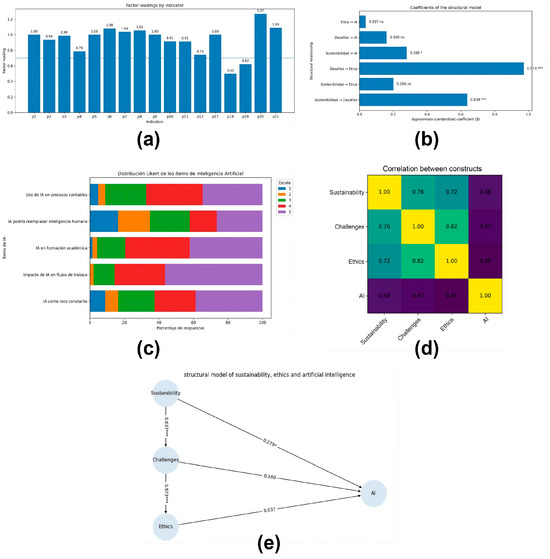
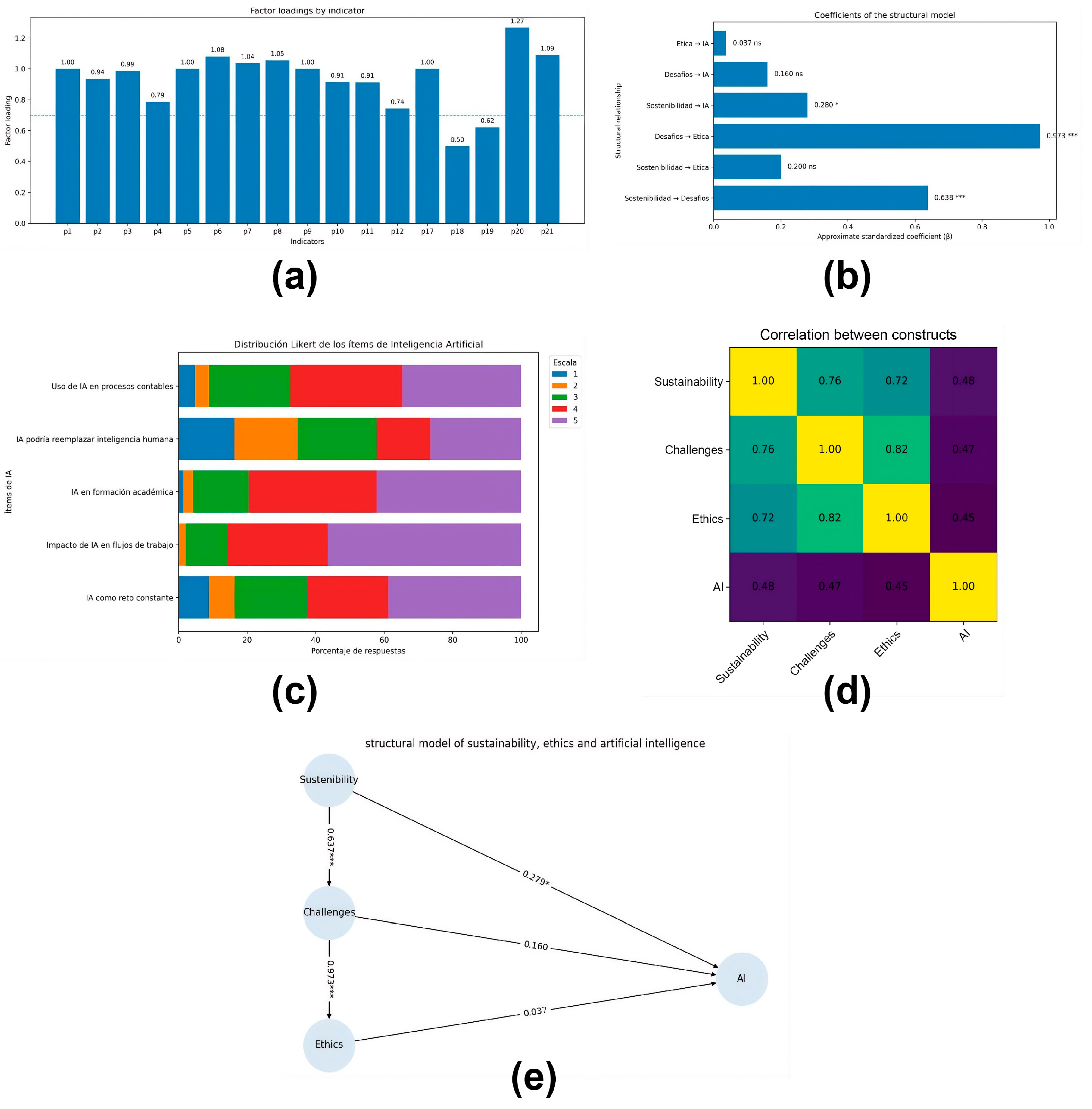
Figure 1 provides an integrated visual summary of the empirical model and should be read as a single analytical sequence rather than as isolated panels. Figure 1a reports indicator-level diagnostics and shows that the traditional constructs are generally represented by stronger and more uniform item contributions, while AI Orientation contains more heterogeneous indicators. This supports the revised terminology: the AI construct is not interpreted as observed adoption behavior but as a broad perceptual orientation toward AI. In practical terms, the figure shows that subsequent structural findings do not arise only from weak construct-level reliability, but from the way constructs relate to each other within the model.
Figure 1.
Visual synthesis of the empirical model: indicator diagnostics, structural relationships, construct correlations, and distribution of AI Orientation perceptions among accounting professionals in Peru. (a) Factor loadings by indicator; (b) Structural model coefficients; (c) Likert distribution of AI items; (d) Correlation between constructs; and (e) Path diagram of the structural model. Note: * p < 0.05, *** p < 0.001, ns = not significant.
The central result appears in Figure 1b. The structural trajectory diagram shows a clear sequence from Sustainability to Professional Challenges and from Professional Challenges to IFAC Ethics, with visibly stronger coefficients than those directed at AI Orientation. This contrast is not accidental. The traditional professional sequence appears internally coherent and empirically consolidated, while the paths to AI Orientation are weak and do not show the same explanatory force. Visually, the model presents a profession that still organizes its adaptation around sustainability concerns, professional demands, and ethical positioning, while AI remains outside that core sequence.
This interpretation is reinforced by the correlation heatmap and the divergent bar graph for AI-related items. The heatmap confirms stronger associations among Sustainability, Professional Challenges, and IFAC Ethics, while AI Orientation appears comparatively more distant. The distribution of AI responses points to polarization, uncertainty, and a lack of consensus in the practical evaluation of AI tools. Some respondents express agreement on the role of AI in accounting work, while others remain divided, especially on substitution, training, and day-to-day implementation. Together, the panels portray a profession that has developed a strong ethical and sustainable response to change but continues to treat AI as a more external and unstable domain.
4. Discussion
4.1. The Resilience of the Traditional Professional Triad
A common assumption in technology-adoption literature is that ethical maturity and improvements in professional competence should help professionals govern AI adoption. This assumption is most plausible in settings where AI is already embedded in workflows and where the question is no longer whether to adopt, but how to govern. In these environments, ethical discourse evolves alongside implementation. Studies consistently frame AI ethics as an operational layer concerned with bias, transparency, accountability, and privacy precisely because AI is already used [41]. Similarly, the sociotechnical literature shows that AI can reshape organizational authority, work, and decision-making structures [42].
The Peruvian evidence examined here suggests a more uneven pathway that may also be relevant to other emerging-economy contexts, although the present data do not justify generalization to all such countries. In Peru, AI does not yet appear to be fully internalized in professional accounting practice. Adoption is plausibly conditioned by infrastructure, regulation, organizational size, digital literacy, and institutional guidance. Legal and governance studies note that developing countries often face difficulties in creating stable frameworks for accountability, explainability, and ethical application [43]. Comparative evidence also suggests that while advanced economies increasingly debate big ethical risks (Table 8), many emerging contexts still struggle with basic conditions such as infrastructure, regulation, and capacity building [44]. Our findings are consistent with this second pattern, but they should be read primarily as evidence from the Peruvian accounting setting.
Table 8.
Detailed contrast of empirical findings.
4.2. The Sequential Resilience of the Traditional Professional Core
The structural model reveals a nuanced institutional mechanism within the Peruvian accounting profession. Rather than a general alignment of all traditional values, the data show a sequential chain of professional resilience [45]. The robust effect of Sustainability on Professional Challenges (H1) and the strong path from Professional Challenges to IFAC Ethics (H3) indicate that the profession appears to reinforce its normative core when facing market and sustainability pressures. However, the high HTMT value between Professional Challenges and IFAC Ethics requires cautious interpretation: the relationship is theoretically meaningful, but the two constructs are also empirically close.
Crucially, the rejection of the direct path from Sustainability to Ethics (H2) implies that ethical activation does not occur in a vacuum. Peruvian accountants do not fall back on the IFAC Code of Ethics simply due to abstract environmental or sustainability concerns. Instead, ethics function as an institutional defense mechanism that is only triggered when these new sustainability demands translate into concrete, perceived professional challenges [46]. Peru reinforces this mechanism because its fiscal and reporting infrastructure requires disciplined documentation and traceability in routine accounting work, which drives professionals towards the guarantee of competence and procedural caution [47]. Recent studies in accounting describe digital transformation as an external shock that transforms an entire organizational field, creating strong incentives for accountants to seek stability through accepted professional workforces. This is also consistent with qualitative evidence framing digitization risks in accounting as ethical decision issues that require structured judgment rather than ad hoc technological enthusiasm [48]. In that context, ethics functions less as a separate attitudinal domain and more as the control logic of the profession, which helps explain why ethical orientation is most strongly cemented after respondents recognize the challenges and not before [49].
This triad can also be understood as an institutional defense response that has been observed in various jurisdictions when professions face reputational threats, new regulations, or changes in the insurance market. Research on professional identity crises in accounting shows that disruptive change can trigger boundary work, where practitioners actively reassert what distinguishes them from adjacent technical roles, especially when outsiders present the new technology as a substitute for judgment. Formal standard-setting activity has also advanced in parallel: sustainability assurance is being professionalized through new global standards of assurance and ethics, strengthening the incentive to interpret emerging demands from the perspective of independence, due care, and public interest responsibilities [9]. The same institutional pattern appears in the guidelines that frame sustainability assurance as an area that requires structured procedures and competition controls comparable to established assurance commitments [50].
In digitized professional environments, research on institutional change argues that organizations often first adopt legitimizing practices and then experiment with new tools within those constraints. The Peruvian evidence fits into this sequence: respondents seem to consolidate the normative core of the profession when facing perceived challenges, positioning ethics as a stabilizer before AI becomes a shared professional competence [51].
4.3. The Great AI Disconnect: A Technological Blind Spot
While the profession’s traditional core remains resilient, its interaction with technological integration exposes a structural fracture. The rejection of hypotheses H5 and H6 supports the “technological disconnection” argument. Neither the perception of heightened professional challenges nor stronger adherence to IFAC Ethics translates into a stronger AI Orientation.
This lack of structural support can be interpreted as evidence of an algorithmic-literacy and translation gap [52]. While accountants rely on ethical frameworks to manage traditional audit and reporting risks, they may lack the socio-technical mechanisms needed to apply these same principles to cloud data processing, model opacity, algorithmic bias, and generative AI outputs [53]. The IFAC/IESBA ethical framework remains symbolically important, but it is not yet behaviorally connected to AI because practitioners may not perceive a clear method for applying ethics to data-governance tasks [54]. In this sense, AI is perceived less as an internalized accounting competence than as an external technological domain [55].
Interestingly, the model showed a weak but statistically significant direct link from Sustainability to AI Orientation (H4). This isolated connection suggests that the volume and complexity of data required for sustainability and ESG-related reporting may encourage a pragmatic recognition of AI’s utility [9]. However, ESG exposure is unlikely to be homogeneous across all organizations: small private firms, large companies, public institutions, and publicly accountable entities face different reporting pressures. Because the present dataset does not retain organizational-size or sectoral variables, this interpretation is necessarily cautious and should be tested in future subgroup analyses.
4.4. Theoretical and Practical Implications
Theoretically, the Peruvian case contributes to research on technological adoption in accounting by showing that regulatory alignment and ethical orientation do not necessarily translate into AI Orientation when the technology is perceived as exogenous to the accounting field. Institutional theory in accounting information systems research emphasizes that technology adoption is often explained by legitimacy dynamics and institutional pressures rather than by individual preferences alone. Recent research on AI in accounting argues that generative AI has broadened the research agenda and shifted attention from whether AI exists to how AI reshapes domains of work [4]. The Peruvian model therefore supports a refinement of adoption arguments: in an emerging economy with advanced digitalization of compliance, internal professional constructs can strongly coalesce while AI remains weakly connected to the professional core.
For universities, the evidence implies a practical priority for curriculum redesign, but the implication should be read directly from the empirical pattern: ethics and professional challenges are strongly connected, whereas AI Orientation is weakly connected to both. Programs should therefore avoid treating AI only as generic computer-skills content and should instead integrate AI cases into auditing, forensic accounting, tax compliance, and professional judgment courses. The objective is not simply to teach tools, but to make ethical standards actionable through repeated exercises on evidence evaluation, bias, traceability, confidentiality, and model limitations [56].
For regulators and professional bodies, the Peruvian results indicate that guidance should connect ethical principles with concrete AI practices in tax, reporting, and assurance. Peru’s e-invoicing reforms show that standardized digital reporting infrastructure can diffuse and transform business behavior [47]. Evidence from audit practice also indicates that practitioners call for clearer AI guidelines to manage explainability, privacy, bias, and over-dependency risks [2]. Therefore, practical guidance from professional bodies and tax authorities could define minimum documentation, confidentiality safeguards, audit-trail expectations, and acceptable-use rules for AI and generative tools in tax and assurance work.
5. Conclusions
This study examined whether selected professional dimensions of accounting—sustainability, market challenges, and IFAC-based ethics—facilitate a stronger orientation toward Artificial Intelligence (AI) in an emerging economy. By applying a Covariance-Based Structural Equation Modeling (CB-SEM) approach to a sample of 424 accounting professionals and academics in Peru, this research assessed whether established normative and professional frameworks can support the transition toward algorithmic workflows.
The empirical evidence confirms that the profession’s traditional core remains resilient, yet sequential. The perception of sustainability-related demands significantly heightens awareness of professional challenges, which in turn acts as a powerful catalyst for reinforcing adherence to IFAC ethics. The lack of a direct relationship between sustainability and ethics suggests that the Peruvian accounting profession activates its deontological framework mainly when market competencies are perceived to be under pressure. This conclusion is interpreted cautiously because the HTMT diagnostics indicate close empirical proximity between some traditional professional constructs.
However, when evaluating technological integration, the findings expose a structural fracture characterized in this study as technological disconnection. Neither heightened professional challenges nor strong ethical commitments translate into AI Orientation. The traditional professional dimensions fail to predict AI Orientation, indicating that practitioners may still perceive AI as an external technological domain rather than as a core accounting competence. Although sustainability exhibits a weak but significant direct link to AI Orientation—possibly driven by data-intensive sustainability and ESG reporting—the overall integration remains fragmented and requires more specific institutional, educational, and organizational mechanisms.
These findings carry practical implications that follow directly from the empirical pattern. Universities should embed AI into auditing, forensic accounting, tax compliance, and professional-judgment courses rather than confining it to isolated technology modules. Future accountants need structured opportunities to apply professional skepticism to algorithmic bias, data traceability, confidentiality, and model opacity. Regulatory bodies and tax administrations, including SUNAT, should also move beyond generic innovation statements and provide concrete guidance on the acceptable use of AI and generative models in tax compliance, reporting, and audit procedures. Without such socio-technical translation mechanisms, the accounting profession may maintain a strong ethical core while its technological development remains weakly connected to that core.
6. Limitations
Although this study provides useful empirical evidence, several limitations must be acknowledged to contextualize the findings and guide future research. First, the cross-sectional design restricts the ability to establish strict temporal causality between the traditional professional sequence and AI Orientation. While the directional hypotheses are grounded in institutional theory, future research should employ longitudinal panel designs to track whether the technological disconnection narrows as younger, digitally native cohorts enter the profession.
Second, the sample is geographically delimited to accounting professionals and academics in Peru. Although this provides valuable insights into an emerging economy with specific digital tax compliance infrastructures, it limits statistical generalization to other institutional environments. In addition, the anonymized analytical file did not retain demographic and organizational variables such as gender, age, years of experience, professional-body membership, education level, role, sector, organizational size or exposure to ESG reporting. These variables could plausibly shape AI and sustainability perceptions and should be incorporated in future studies.
Third, relying on a single self-reported instrument introduces the potential for common method bias, despite the procedural precautions taken during data collection. Although anonymity and psychological separation were employed to reduce method variance, the lack of an objective marker variable or multiple data sources means that some structural coefficients may retain method-induced inflation. Furthermore, the non-random, voluntary nature of the sampling limits the generalizability of the findings, as self-selection bias may have led to an overrepresentation of professionals with specific technological interests or stronger institutional engagement. Fourth, the AI Orientation construct combines several facets—challenge, workflow impact, curricular integration, substitution concern, and routine application—rather than separating actual adoption, perceived usefulness, anxiety, and readiness. Future researchers are encouraged to test rival measurement models, including multidimensional AI constructs or second-order professional-core specifications. Finally, the study should be replicated over a 5- to 10-year period because AI regulation, sustainability reporting, ESG practices, professional ethics, and accounting education may evolve substantially over that horizon.
Supplementary Materials
The following supporting information can be downloaded at: https://www.mdpi.com/article/10.3390/accountaudit2030011/s1. Table S1: Construct definitions and measurement items.
Author Contributions
Conceptualization, R.C.-M.; methodology, R.C.-M., A.A.-C., F.Q.-P., L.R.-P. and C.C.-R.; software, R.C.-M. and F.Q.-P.; validation, A.O.-F., A.A.-C., L.R.-P., J.T.-M. and D.A.-G.; formal analysis, R.C.-M., A.O.-F., F.Q.-P. and R.P.-M.; investigation, M.A.-G., M.R.M.A. and D.A.-G.; resources, R.C.-M.; data curation, R.C.-M., A.A.-C., M.A.-G. and C.C.-R.; writing—original draft preparation, R.C.-M., A.O.-F., L.R.-P., R.P.-M. and M.R.M.A.; writing—review and editing, R.C.-M., M.A.-G., M.R.M.A., J.T.-M., D.A.-G. and C.C.-R.; visualization, R.C.-M., R.P.-M. and J.T.-M.; supervision, R.C.-M.; project administration, R.C.-M. All authors have read and agreed to the published version of the manuscript.
Funding
This research did not receive external funding.
Institutional Review Board Statement
Ethical review and approval were waived for this study due to in the Peruvian context, research involving human subjects is primarily governed by the Regulation of Clinical Trials (Supreme Decree No. 021-2017-SA), which focuses on clinical interventions. For observational, social, and behavioral studies that do not involve physical or psychological risks, the reference standard is the National Code of Scientific Integrity issued by CONCYTEC (National Council for Science, Technology, and Technological Innovation), updated in 2024. Our study is classified as ‘Minimal Risk’ (or no risk), as it consists exclusively of anonymous questionnaires administered to adult professionals, without collecting sensitive or personally identifiable data. According to international standards and Peruvian regulatory practice, such studies do not require formal approval from an Institutional Research Ethics Committee (CIEI), provided that anonymity and informed consent are guaranteed. Consent was obtained digitally prior to participation.
Informed Consent Statement
Informed consent was obtained from all subjects involved in the study.
Data Availability Statement
The anonymized survey data and analysis materials used in this SEM study are available from the corresponding author upon reasonable request, subject to the confidentiality conditions communicated to participants. This study did not use Scopus bibliometric data.
Conflicts of Interest
The authors declare no conflicts of interest.
Abbreviations
The following abbreviations are used in this manuscript:
| AI | Artificial intelligence |
| BDA | Big Data Analytics |
| BMI | Business Model Innovation |
| CE | Circular Economy |
| CSR | Corporate Social Responsibility |
| DC | Dynamic Capabilities |
| DT | Digital Transformation |
| ESG | Environmental, Social, and Governance |
| HPWS | High-Performance Work System(s) |
| HRM | Human Resource Management |
| IS | Information Systems |
| IT | Information Technology |
| IWB | Innovative Work Behavior |
| LLR | Log-Likelihood Ratio |
| MCP | Multiple Country Publications |
| MCS | Management Control Systems |
| NFR | Non-Financial Reporting |
| SCP | Single Country Publications |
| SCS | Sustainability Control Systems |
| TAM | Technology Acceptance Model |
| TL | Transformational Leadership |
| TPB | Theory of Planned Behavior |
| AIO | Artificial Intelligence Orientation |
References
- Lin, T.L.J.; Maginnis, J. Generative AI and Edge AI in Auditing: Insights from Academia and Practice. Curr. Issues Audit. 2025, A1–A10. [Google Scholar]
- Kokina, J.; Blanchette, S.; Davenport, T.H.; Pachamanova, D. Challenges and opportunities for artificial intelligence in auditing: Evidence from the field. Int. J. Account. Inf. Syst. 2025, 56, 100734. [Google Scholar] [CrossRef] [Scilit]
- Li, Y.; Goel, S. Artificial intelligence auditability and auditor readiness for auditing artificial intelligence systems. Int. J. Account. Inf. Syst. 2025, 56, 100739. [Google Scholar] [CrossRef] [Scilit]
- Stratopoulos, T.C.; Wang, V.X. Artificial intelligence and accounting research: A framework and agenda. Int. J. Account. Inf. Syst. 2025, 56, 100760. [Google Scholar] [CrossRef] [Scilit]
- Lai, J. Artificial intelligence applications and audit fees: An empirical study. Int. Rev. Econ. Financ. 2025, 103, 104421. [Google Scholar] [CrossRef] [Scilit]
- Binh, N.T. Transforming Auditing in the AI Era: A Comprehensive Review. Information 2025, 16, 400. [Google Scholar] [CrossRef] [Scilit]
- Gunz, S.; Thorne, L. Thematic Symposium: The Impact of Technology on Ethics, Professionalism and Judgement in Accounting. J. Bus. Ethics 2020, 167, 153–155. [Google Scholar] [CrossRef] [Scilit]
- Li, X. Behavioral challenges to professional skepticism in auditors’ data analytics journey. Maandbl. Voor Account. En. Bedrijfsecon. 2022, 96, 45–54. [Google Scholar] [CrossRef] [Scilit]
- Boiral, O.; Heras-Saizarbitoria, I.; Brotherton, M.; Bernard, J. Ethical Issues in the Assurance of Sustainability Reports: Perspectives from Assurance Providers. J. Bus. Ethics 2019, 159, 1111–1125. [Google Scholar]
- Hay, D.; Harding, N.; Botica Redmayne, N.; Khan, J.; Singh, H.; Sultana, N.; You, J. Comments on recent International Ethics Standards Board for Accountants Exposure Drafts regarding sustainability assurance and the use of external experts. Account. Financ. 2024, 64, 4197–4216. [Google Scholar] [CrossRef] [Scilit]
- Lingan, A.; Mónica, A.; Tejada Estrada, G.C.; Pérez-Arboleda, P.A.; Aparicio-Ballena, J.A. Economía digital y transformación empresarial en mercados emergentes. Rev. Venez. Gerenc. 2025, 30, 1793–1807. [Google Scholar] [CrossRef] [Scilit]
- Galvez, D.P.C.; Revinova, S. Assessing Digital Technology Development in Latin American Countries: Challenges, Drivers, and Future Directions. Digital 2025, 5, 20. [Google Scholar] [CrossRef] [Scilit]
- Azevedo, V.; Flores, S.A.G.; Vlaicu, R.; Moreno, A.M.Z. Beyond Cash: The Digital Payments Revolution in Latin America and the Caribbean; Inter-American Development Bank: Washington, DC, USA, 2025. [Google Scholar]
- Reeves-Huapaya, E.S.; Quispe-Berríos, H.; Saravia-Parra, L.; Chambilla-Baylón, J.R.; Rucoba-del Castillo, L.R.; Vásquez-Dorado, J.E.; Oscco-Solorzano, R.; Jaime-Andia, M. Exploring inclusion and digital literacy in Latin America as a means for social change: A systematic literature review. Soc. Sci. Humanit. Open 2025, 12, 102219. [Google Scholar] [CrossRef] [Scilit]
- Espina-Romero, L. Digital Transformation of the State: A Multivariable Model Applied to the Public Sector in Lima, Peru. Adm. Sci. 2025, 15, 365. [Google Scholar] [CrossRef] [Scilit]
- Bernuy, J.B.V.; Nolasco-Mamani, M.; Rodríguez, N.V.; Quelopana, R.G.; Valdivia, A.M.; Vidaurre, S.E. Relative Advantage and Compatibility as Drivers of ChatGPT Adoption in Latin American Higher Education: A PLS SEM Study Towards Sustainable Digital Education. Sustainability 2025, 17, 8329. [Google Scholar] [CrossRef] [Scilit]
- Aldhi, I.F.; Suhariadi, F.; Rahmawati, E.; Supriharyanti, E.; Hardaningtyas, D.; Sugiarti, R.; Abbas, A. Bridging Digital Gaps in Smart City Governance: The Mediating Role of Managerial Digital Readiness and the Moderating Role of Digital Leadership. Smart Cities 2025, 8, 117. [Google Scholar] [CrossRef] [Scilit]
- Kotowska, B.; Sikorska, M. Accounting profession transformation in the wake of digitalization—Survey results in Poland. Sci. Pap. Silesian Univ. Technol. Organ. Manag. Ser. 2023, 2023, 147–165. [Google Scholar]
- Leitner-Hanetseder, S.; Lehner, O.; Eisl, C.; Forstenlechner, C. A profession in transition: Actors, tasks and roles in AI-based accounting. J. Appl. Account. Res. 2021, 22, 539–556. [Google Scholar] [CrossRef] [Scilit]
- Deliu, D.; Olariu, A.-M. The Role of Artificial Intelligence and Big Data Analytics in Shaping the Future of Professions in Industry 6.0: Perspectives from an Emerging Market. Electronics 2024, 13, 4983. [Google Scholar] [CrossRef] [Scilit]
- Anh, N.T.M.; Hoa, L.T.K.; Thao, L.P.; Nhi, D.A.; Long, N.T.; Truc, N.T.; Xuan, V.N. The Effect of Technology Readiness on Adopting Artificial Intelligence in Accounting and Auditing in Vietnam. J. Risk Financ. Manag. 2024, 17, 27. [Google Scholar] [CrossRef] [Scilit]
- Sudaryanto, M.R.; Hendrawan, M.A.; Andrian, T. The Effect of Technology Readiness, Digital Competence, Perceived Usefulness, and Ease of Use on Accounting Students Artificial Intelligence Technology Adoption. E3S Web Conf. 2023, 388, 04055. [Google Scholar] [CrossRef] [Scilit]
- Taib, A.; Awang, Y.; Shuhidan, S.M.; Rashid, N.; Hasan, M.S. Digitalization in Accounting: Technology Knowledge and Readiness of Future Accountants. Univers. J. Account. Financ. 2022, 10, 348–357. [Google Scholar] [CrossRef] [Scilit]
- Krishnanraw, J.; Ismail, K.; Ismail, K. Behavioural Intention to use Artificial Intelligence (AI) among Accounting Students: Evaluating the Effect of Technology Readiness. Manag. Account. Rev. 2025, 24, 465–493. [Google Scholar] [CrossRef] [Scilit]
- Andani, G.; Lindrianasari, L.; Oktavia, R.; Septiyanti, R. Indonesian Accounting Students’ Self-Confidence to Adopt Artificial Intelligence (AI). J. Akunt. Dan. Keuang. Indones. 2022, 19, 24–45. [Google Scholar] [CrossRef] [Scilit]
- Tandiono, R. The Impact of Artificial Intelligence on Accounting Education: A Review of Literature. E3S Web Conf. 2023, 426, 02016. [Google Scholar] [CrossRef] [Scilit]
- Robinson, C.; Raymond, J.E.; Jan, L.W. The Current State of Ethics Education in Accounting Programs. Glob. J. Account. Financ. 2020, 4, 111. [Google Scholar] [CrossRef] [Scilit]
- Eaton, T.; Hazel, M.; Pyzoha, J.; Zhang, J. How Do the Accounting Profession and Higher Education Currently Approach Ethics Training? Issues Account. Educ. 2025, 40, 47–64. [Google Scholar] [CrossRef] [Scilit]
- Adelakun, B.O.; Majekodunmi, T.G.; Akintoye, O.S. AI and ethical accounting: Navigating challenges and opportunities. Int. J. Adv. Econ. 2024, 6, 224–241. [Google Scholar] [CrossRef] [Scilit]
- Nordiansyah, M.; Arifuddin, A.; Mediaty, M. Artificial Intelligence (AI) on Accountant Behavior and Ethical Decision Making: Systematic Review on Behavioral Accounting Research. Econ. Bus. Account. Soc. Rev. 2025, 4, 151–168. [Google Scholar] [CrossRef] [Scilit]
- Fülöp, M.; Ionescu, C.; Măgdaș, N.; Ștefan, M.-C.; Topor, D. Digital Transformation of the Accounting Profession at the Intersection of Artificial Intelligence and Ethics. Economics 2025, 19, 20250155. [Google Scholar] [CrossRef] [Scilit]
- Acosta-Enriquez, B.G.; Reyes-Perez, M.D.; Huamani Jordan, O.; Carreño Saucedo, L.; Padilla-Caballero, J.E.; Fernández-Altamirano, A.E.; García Yovera, A.J.; Briceño-Hernandez, R.N.; Alarcón Bustíos, J.M. Exploring the Determinants of the Sustainable Use of Artificial Intelligence in Peruvian University Teachers: A Structural Equation Modeling Analysis. Sustainability 2025, 17, 2834. [Google Scholar] [CrossRef] [Scilit]
- Bethlehem, J. Selection bias in web surveys. Int. Stat. Rev. 2010, 78, 161–188. [Google Scholar] [CrossRef] [Scilit]
- Oswald, L.M.; Wand, G.S.; Zhu, S.; Selby, V. Volunteerism and self-selection bias in human positron emission tomography neuroimaging research. Brain Imaging Behav. 2013, 7, 163–176. [Google Scholar] [PubMed]
- Podsakoff, P.M.; MacKenzie, S.B.; Lee, J.Y.; Podsakoff, N.P. Common method biases in behavioral research: A critical review of the literature and recommended remedies. J. Appl. Psychol. 2003, 88, 879–903. [Google Scholar] [CrossRef] [Scilit] [PubMed]
- Podsakoff, P.M.; Podsakoff, N.P.; Williams, L.J.; Huang, J.C. Common method bias: It’s bad, it’s complex, it’s widespread, and it’s not easy to fix. Annu. Rev. Organ. Psychol. Organ. Behav. 2024, 11, 401–430. [Google Scholar] [CrossRef] [Scilit]
- Aguirre-Urreta, M.I.; Hu, J. Detecting common method bias: Performance of the Harman’s single-factor test. ACM SIGMIS Database 2019, 50, 45–70. [Google Scholar] [CrossRef] [Scilit]
- Jarvis, C.B.; MacKenzie, S.B.; Podsakoff, P.M. A critical review of construct indicators and measurement model misspecification in marketing and consumer research. J. Consum Res. 2003, 30, 199–218. [Google Scholar] [CrossRef] [Scilit]
- Coltman, T.; Devinney, T.M.; Midgley, D.F.; Venaik, S. Formative versus reflective measurement models: Two applications of formative measurement. J. Bus. Res. 2008, 61, 1250–1262. [Google Scholar] [CrossRef] [Scilit]
- Diamantopoulos, A.; Winklhofer, H.M. Index construction with formative indicators: An alternative to scale development. J. Mark. Res. 2001, 38, 269–277. [Google Scholar] [CrossRef] [Scilit]
- Syukrina, U.; Nugraha, I. Artificial Intelligence Risk Identification: Challenges, Impacts, and Mitigation Strategies. Int. J. Electr. Comput. Biomed. Eng. 2025, 3, 377–410. [Google Scholar] [CrossRef] [Scilit]
- Selgas-Cors, M. Sociotechnical Transformation: A Systematic Review on the Impact of Artificial Intelligence on Society and Organizations. FinTech Sustain. Innov. 2025, 1–16. [Google Scholar] [CrossRef] [Scilit]
- Hakimi, M.; Zarinkhail, S.; Sahnosh, F.A. Artificial Intelligence and Legal Reform in Developing Countries: Advancing Ethical, Rights-Based, and Accountable Digital Governance. J. Ilm. Telsinas Elektro Sipil Dan. Tek. Inf. 2025, 8, 127–144. [Google Scholar] [CrossRef] [Scilit]
- Oyeyemi, B.B.; Ifedayo, A.M.; MosopeoluwaAwodola. Ethical Challenges in AI-Powered Supply Chains: A U.S.-Nigeria Policy Perspective. Int. J. Appl. Res. Soc. Sci. 2025, 7, 367–388. [Google Scholar] [CrossRef] [Scilit]
- Boukli, A.; Kotsakis, A. Transversal harm and zemiology: Reconsidering green criminology and mineral extractivism in Cerro de Pasco, Peru. Crit. Criminol. 2023, 31, 1113–1136. [Google Scholar] [CrossRef] [Scilit]
- Branicki, L.; Brammer, S.; Linnenluecke, M.; Houghton, D. Accounting for resilience: The role of the accounting professions in promoting resilience. Account. Bus. Res. 2023, 53, 508–536. [Google Scholar] [CrossRef] [Scilit]
- Bellon, M.; Dabla-Norris, E.; Khalid, S. Technology and tax compliance spillovers: Evidence from a VAT e-invoicing reform in Peru. J. Econ. Behav. Organ. 2023, 212, 756–777. [Google Scholar] [CrossRef] [Scilit]
- Tiron-Tudor, A.; Rodgers, W.; Deliu, D. The accounting profession in the Twilight Zone: Navigating digitalisation’s sided challenges through ethical pathways for decision-making. Account. Audit. Account. J. 2025, 38, 990–1018. [Google Scholar]
- Tomo, A. ‘Angry accountants’: Making sense of professional identity crisis on online communities. Crit. Perspect. Account. 2023, 95, 102483. [Google Scholar] [CrossRef] [Scilit]
- IAASB. A Global Sustainability Assurance Standard Designed to Strengthen the Credibility of Sustainability Disclosures. Understanding the International Standard on Sustainability Assurance 5000. 2025. Available online: https://www.iaasb.org/focus-areas/understanding-international-standard-sustainability-assurance-5000 (accessed on 15 February 2026).
- Abhishek, N.; Suraj, N.; Rahiman, H.U.; Nawaz, N.; Kodikal, R.; Kulal, A.; Raj, K. Digital transformation in accounting: Elevating effectiveness across accounting, auditing, reporting and regulatory compliance. J. Account. Organ. Change 2024, 22, 579–607. [Google Scholar] [CrossRef] [Scilit]
- Imjai, N.; Yordudom, T.; Yaacob, Z.; Saad, N.H.M.; Aujirapongpan, S. Impact of AI literacy and adaptability on financial analyst skills among prospective Thai accountants: The role of critical thinking. Technol. Forecast. Soc. Change 2025, 210, 123889. [Google Scholar]
- Murikah, W.; Nthenge, J.K.; Musyoka, F.M. Bias and ethics of AI systems applied in auditing—A systematic review. Sci. Afr. 2024, 25, e02281. [Google Scholar]
- Cheong, B.C. Transparency and accountability in AI systems: Safeguarding wellbeing in the age of algorithmic decision-making. Front. Hum. Dyn. 2024, 6, 1421273. [Google Scholar] [CrossRef] [Scilit]
- Tiron-Tudor, A.; Labaditis (Cordos), A.; Deliu, D. Future-Ready Digital Skills in the AI Era: Bridging Market Demands and Student Expectations in the Accounting Profession. Technol. Forecast. Soc. Change 2025, 215, 124105. [Google Scholar] [CrossRef] [Scilit]
- Bagozzi, R.P. Introduction to special issue on causal modeling. J. Mark. Res. 1982, 19, 403. [Google Scholar] [CrossRef] [Scilit]

Disclaimer/Publisher’s Note: The statements, opinions and data contained in all publications are solely those of the individual author(s) and contributor(s) and not of MDPI and/or the editor(s). MDPI and/or the editor(s) disclaim responsibility for any injury to people or property resulting from any ideas, methods, instructions or products referred to in the content. |
© 2026 by the authors. Licensee MDPI, Basel, Switzerland. This article is an open access article distributed under the terms and conditions of the Creative Commons Attribution (CC BY) license.