


Abstract
A laboratory Hertz-like gravitational wave communication system (“gravity radio”) is proposed using coherent optical-stress sources in high-Q optical fiber ring-resonator arrays. Hyperentangled photon pairs and coincident tunneling events provide timing, phase, and correlations, while the gravitational source is the local, conserved field-plus-medium stress-energy tensor generated by phase-locked coherent optical fields. Because the electromagnetic stress tensor is quadratic in the fields, the source can contain both sum-frequency and difference-frequency components. The latter is emphasized because it relaxes the localization, phase-stability, and receiver-transduction requirements. The directed coherent transverse-traceless stress amplitude and receiver equivalent strain noise are derived for a meter-scale transfer test.
Keywords:
gravitational waves; coherent optical stress; Maxwell stress-energy tensor; retarded stress-energy source; transverse-traceless projection; optical fiber ring resonators; evanescent photon tunneling; hyperentangled photon pairs; difference-frequency generation; parametric transducer; Sagnac-effect controls; gravitational-wave communication 1. Introduction
The direct detection of gravitational waves has established gravitational radiation as an experimentally accessible physical field rather than merely a formal prediction of general relativity [1]. Most confirmed gravitational-wave sources are astrophysical, but the possibility of producing, modulating, or detecting gravitational radiation in a controlled laboratory setting has been discussed since the early resonant-bar and dynamic-gravity-gradient proposals of Weber and Forward [2,3]. Electromagnetic systems are especially natural candidates for such laboratory studies because electromagnetic fields carry energy, momentum, and stress, and therefore contribute to the source term in Einstein’s field equation. The most widely known electromagnetic-to-gravitational conversion mechanism is the Gertsenshtein effect, in which electromagnetic and gravitational waves mix in an external magnetic field [4]. Modern work on high-frequency gravitational waves has extended this discussion to MHz–GHz detection concepts, including microwave and superconducting cavity receivers [5,6].
The present paper considers a different but related question: whether a controlled quantum-optical and coherent-optical source can be used to formulate a Hertz-like gravitational-wave communication experiment. Single-photon tunneling experiments have measured group delays associated with evanescent optical barriers [7,8]. In the present treatment, such delays are not interpreted as traversal times or as superluminal transport of energy, momentum, information, or stress-energy; this causal interpretation is consistent with analyses of stored-energy lifetimes in photonic tunneling [9]. Evanescent couplers and fiber-ring resonators are used here because they provide localized optical fields, resonant enhancement, and controlled phase relationships.
Ring resonators are important across wave physics, not only in optics. Magnonic ring structures have been developed for reconfigurable lateral spin-wave transport, mode filtering, and lateral or vertical coupling between waveguides [10,11]. These developments provide useful context for the general role of ring geometries in confinement, coupling, and coherent wave control, although the source considered in the present paper is specifically the optical field-plus-medium stress-energy tensor.
In the following proposal, hyperentangled photon pairs provide timing, path, polarization, and phase correlations that help prepare two local optical-stress regions with a controlled mutual phase. The dominant source is a phase-locked coherent optical field, or a pair of such fields, whose Maxwell stress contains a controlled Fourier component. This distinction is essential because gravitational radiation is sourced by the time-dependent transverse-traceless part of the local, conserved stress-energy tensor.
Because the electromagnetic stress tensor is quadratic in the fields, two coherent optical modes can produce stress components at both the sum frequency and the difference frequency. The optical sum-frequency channel is useful as a compact theoretical limiting case, but it imposes nanoscale localization and optical-period phase stability. For a Hertz-like transmitter–receiver experiment, we therefore also develop the difference-frequency stress channel. This channel permits larger active source volumes, more realistic phase control, and a receiver that can be modeled as a narrowband parametric transducer rather than as an ordinary mechanical antenna oscillating at an optical carrier frequency.
The goal of this paper is to formulate a semiclassical source-and-receiver system: a phase-locked optical-stress transmitter produces a gravitational-wave carrier through a localized, time-varying transverse-traceless stress distribution, while an ultra-narrowband receiver searches for a transmitter-correlated output. The key contribution of this paper is that we arrive at conditional threshold parameters within an idealized model and identify source-array coherence, localization, receiver-noise, and systematic-rejection requirements. We do not claim that these parameters have been achieved. Detailed numerical validation is reserved for subsequent work.
2. Photon Tunneling
Evanescent coupling regions can be treated as solutions of Maxwell’s equations in a dielectric geometry. Experiments on photonic tunneling measure phase or group delays in the transmitted waveform [7]; these delays are not used here to define a mechanical traversal velocity. In particular, no superluminal transport of energy, momentum, information, or stress-energy is assumed [9]. The correlated photon-pair preparation and phase locking are used to phase reference two localized evanescent source regions in the ring-resonator apparatus. The energy density and stress required for the gravitational source are supplied primarily by coherent optical fields. Hence, the gravitational source is constructed only from the local, causal, conserved stress-energy distribution of the optical fields and material apparatus.
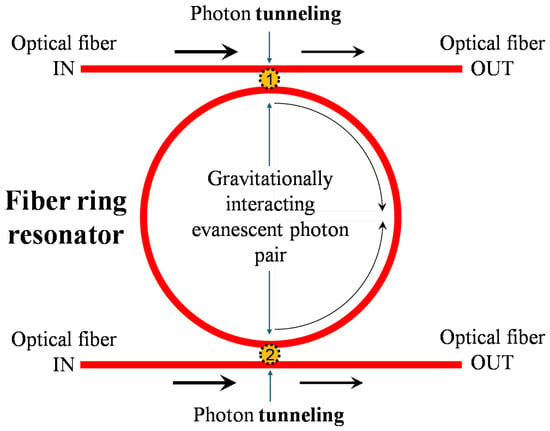
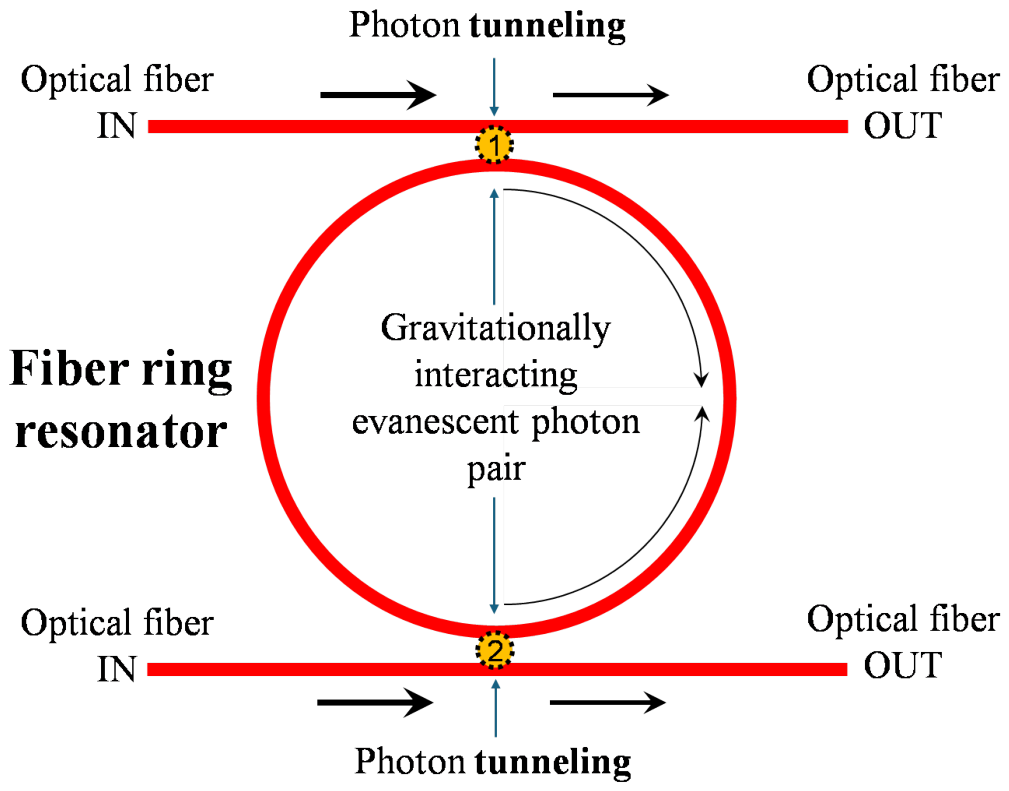
Figure 1 depicts two evanescent optical source regions. A scalar component of a monochromatic guided optical mode obeys a Helmholtz equation obtained from Maxwell’s equations,
where x is normal to the coupling interface, is the refractive-index profile, and is the real propagation constant along the guide. In an evanescent region, ; writing , with , gives the decaying field profile . This is a spatial mode profile, not a Newtonian particle trajectory. The gravitationally relevant quantities are the local electromagnetic and material stresses supported in the evanescent coupling region.
Figure 1.
Fiber ring resonator in a circular configuration. The black arrows indicate the directions of optical propagation and circulation, whereas the blue arrows indicate the evanescent coupling/tunneling directions at source regions 1 and 2. The two orange regions denote localized evanescent optical-stress regions that can be phase referenced by hyperentangled photon pairs, product-state photons, or classical optical phase locking. In the threshold design developed below, coherent optical pulses provide the dominant Maxwell stress, while quantum correlations are used as timing and phase-control resources. Because the two source regions are driven coherently, their emitted gravitational-wave amplitudes can interfere in analogy with a two-slit interference experiment: along directions for which the retarded phases from points 1 and 2 are equal, the amplitudes add constructively, producing a central-maximum direction of enhanced radiation.
Note that the circular fiber geometry shares with a Sagnac interferometer the ability to support counter-propagating optical modes. A conventional Sagnac interferometer, however, measures a nonreciprocal phase shift produced by rotation of the loop. For a loop of area A, the leading vacuum expression is
where is the angular rotation rate and is the optical wavelength [12]. The present proposal does not use rotation-induced phase accumulation as its source mechanism. Instead, it imposes a controlled relative phase between localized optical-stress regions at the selected sum or difference frequency. Residual Sagnac phase is therefore a possible systematic background rather than the desired signal. An experiment would be performed on a stationary platform and would include reversal of circulation direction, reversal of loop orientation, and independent rotation monitoring so that any response proportional to can be separated from a transmitter-coded, retarded stress-energy response.
3. Hyperentangled Photon Pairs and Coherent Optical Stress
Hyperentangled photon-pair sources can correlate several degrees of freedom of a photon pair at once, including polarization, spatial mode, path, and frequency-time structure [13,14,15]. In the present proposal, these correlations are used as phase-, timing-, and path-control resources for preparing two local optical-stress regions in the apparatus with a well-defined mutual phase. For two coherent optical modes with angular frequencies and , the electric field may be written schematically as
Because the electromagnetic stress tensor is quadratic in the fields, the cross term contains both
These two channels impose very different source requirements. In the sum-frequency channel, remains of optical order, so the corresponding gravitational wavelength is also of optical scale. The active stress distribution must then be localized and phase controlled on correspondingly short spatial and temporal scales. In the difference-frequency channel, by contrast, is the optical beat frequency and can be many orders of magnitude smaller than either carrier frequency. The optical fields may therefore remain at optical frequencies while the relevant time-dependent Maxwell stress varies at a substantially lower frequency.
The Hertz-like design developed below uses the difference-frequency channel. Because can be much smaller than either optical carrier frequency, the associated gravitational wavelength can be much larger than the optical wavelength. This relaxes the localization, array-phasing, and receiver-transduction requirements relative to the optical sum-frequency channel. A specific difference-frequency design point is introduced later in the quantitative source analysis.
4. Wave Functions for Entangled Evanescent Photon Pairs
The spatial, polarization, path, and frequency–time degrees of freedom of the two-photon state are distinct, but they need not be statistically independent. In the simplified case in which the spatial and polarization degrees of freedom are prepared independently, the total two-photon wavefunction [16] may be written in the separable form
Here and denote the spatial arguments of the two-photon wavefunction, while and denote polarization or helicity variables. Because photons are bosons, the complete two-photon wavefunction must be symmetric under the simultaneous exchange
A polarization- or helicity-entangled antisymmetric state may be written as
where R and L denote right- and left-circular polarization, respectively. Retaining the determinant notation of the two-mode construction, this state may be represented compactly as
If the polarization factor is antisymmetric under exchange, then the corresponding spatial factor must also be antisymmetric so that their product is symmetric under the full exchange in Equation (6). Thus, one may write
where and label two optical modes associated with the two evanescent coupling regions. A local evanescent mode may be represented schematically as
where is the real propagation constant parallel to the guide or interface, is the transverse coordinate, and is the evanescent decay constant. Combining Equations (8) and (9), the total two-photon wavefunction may be written in the determinant-like form
Each factor in Equation (11) is antisymmetric, so their product is symmetric under simultaneous exchange of all photon labels, as required for a bosonic state. The entangled state produces correlated detector outcomes in the two spatially separated optical channels. A measurement in the joint spatial-mode and polarization basis may project the state onto either of the complementary outcomes
where the first and second entries denote detections in optical modes and , respectively. Thus, detection of right-circular polarization in one mode is correlated with detection of left-circular polarization in the other. These are correlated measurement outcomes of the joint two-photon state. The associated quantum-state update is not interpreted as an energy–momentum current, a physical disturbance propagating between the two locations, or a velocity entering the gravitational-radiation calculation.
6. Gravitational Radiation Power Formula from the Retarded Strain Field
The gravitational-radiation calculation is formulated entirely in terms of the local, conserved stress-energy tensor of the electromagnetic field, dielectric medium, couplers, and mechanical support structure. Spatial coordinates below label the distribution of field and material energy-momentum rather than photon position operators. The calculation starts from the retarded linearized Einstein equation. For the present optical system the source is the total local stress-energy tensor,
The total source must satisfy local conservation, , since the electromagnetic field alone can exchange momentum and energy with matter in a dielectric fiber or coupler. In vacuum, the Maxwell part is often written as [17]
with . In the fiber apparatus, this expression is best regarded as the vacuum limiting form of the field-stress contribution; a complete source contains the medium response as well.
Let the observation point be , with R much larger than the size of the apparatus. The radiation-zone approximation requires , but it does not require , where is the characteristic spatial extent of the complete source apparatus, and is the gravitational wavelength of the selected Fourier component. Keeping the retarded phase across the source gives
The transverse-traceless (TT) projection is applied only after this retarded integral is formed. Define
Then
This equation is the finite-size replacement for the quadrupole reduction. It includes the phase delay between different parts of the ring, couplers, and support structure. The gravitational-wave energy flux in the radiation zone is
where the overdot denotes differentiation with respect to the observer time t. The corresponding total radiated power is
Equations (20) and (22) are the desired finite-source radiation formula. They remain valid when the source size is comparable to, or larger than, the gravitational wavelength, provided the weak-field and radiation-zone assumptions remain valid. For a single monochromatic source component, take
The retarded spatial Fourier transform seen in direction is
The TT wave amplitude is then
Substitution into the flux formula gives the angular power distribution
Equivalently, the repeated indices mean that this expression is the squared norm of the TT-projected retarded source. The total power in this Fourier component is
For a discrete set of harmonics one sums Equation (27) over positive frequencies. For a broadband pulse one uses the corresponding Fourier integral with the same retarded phase factor. The long-wavelength quadrupole formula appears only as a limiting case. If , the phase factor in Equation (24) can be expanded:
Using local stress-energy conservation and discarding surface terms for a localized source gives the standard identity
For a harmonic source this becomes
where the trace-free quadrupole is
After the angular integration, Equation (26) therefore reduces to Einstein’s quadrupole formula [18,19]
For a harmonic source, the familiar sixth-power frequency dependence follows only after the retarded phase has been approximated as uniform across the source and the integrated stress has been replaced by the second time derivative of the quadrupole moment. It is therefore a consequence of the long-wavelength approximation rather than a fundamental assumption of the finite-source calculation.
To illustrate the electromagnetic contribution, consider the vacuum-form instantaneous field-energy density
Its contribution to the trace-free quadrupole moment in the long-wavelength limit is
In the fiber apparatus, Equation (34) represents only the electromagnetic field contribution; the complete source also includes the dielectric medium, couplers, and mechanical support through . The coordinates label points in the field-energy and stress distribution and are not photon position operators. The compact quadrupole approximation is no longer sufficient when . Finite-size, interference, and phase-matching effects must instead be evaluated from the retarded source transform , using the actual spatial distribution and relative phases of the total local stress-energy source.
7. Localized Two-Point Coherent Optical-Stress Source
The preceding section gives the long-wavelength quadrupole approximation and also states the more general retarded stress-energy formulation. The source model used in this section is a localized two-point coherent optical-stress channel: two phase-locked evanescent source regions, located at the two orange regions of Figure 1, provide localized oscillatory components of the total stress-energy tensor. The radiating amplitude is obtained by applying the transverse-traceless projection to the retarded spatial integral of the local stress at the selected Fourier frequency . For two coherent optical modes with angular frequencies and , the quadratic Maxwell stress contains the sum- and difference-frequency components defined in Equation (4).
The threshold Hertz-like design uses
This frequency is the beat-frequency component of the local optical stress tensor. It is not the angular speed of an optical packet moving around a centimeter-scale ring. Let the two localized active regions be centered at
and assume that the two source regions are driven with a controlled relative phase at . For a harmonic stress component, we write
In the point-source idealization, we have
where
is the integrated complex stress amplitude of source region s. The amplitudes therefore include the electromagnetic, medium, coupler, and support reactions required by . The role of the coincidence or phase-locking condition is to control the phases of the local stress amplitudes, , where the phase is an experimentally controlled preparation phase. For a chosen radiation direction , coherent addition requires the retarded phase condition
where m is an integer. This is the two-point version of phased-array addition in the retarded stress-energy formula. If the phase condition is not satisfied, the two localized source amplitudes partially cancel in that direction.
Thus, a pair of coincident tunneling events or phase-locked coherent pulses contributes to gravitational radiation only to the extent that it produces a nonzero, time-dependent, transverse-traceless component of the total local stress-energy tensor at . The retarded radiation amplitude in direction is obtained from the Fourier component of the total stress-energy tensor,
For two identical, in-phase source regions, , Equation (41) gives
Along the central axis of the ring, , so the two localized in-phase sources add constructively in amplitude. For a larger phased array, this same expression generalizes to a retarded array sum. The coherent enhancement should be interpreted as a directed amplitude enhancement toward the receiver, not automatically as an enhancement of the angularly integrated total power. The corresponding retarded stress-energy power formula is
We define a characteristic TT-projected stress scale for one source region in a representative radiation direction by
A compact estimate for one elementary two-point cell is then
where is a dimensionless factor accounting for the angular integration and two-source geometry, and is the finite-size localization factor of each active region.
This expression is written directly in terms of the stress tensor, so it contains rather than the dependence of the compact quadrupole formula. If an individual source cell satisfies , the cell may also be described by the local quadrupole identity. The full array, however, is still treated by the retarded phased-array sum because its spatial extent need not be small compared with the gravitational wavelength.
For two co-propagating optical modes with nearby carrier frequencies, the spatial wave number of the difference-frequency stress component is
The point-source approximation for each cell requires Equivalently,
Using and gives , while the corresponding free-space one-radian scale is
This sub-millimeter localization estimate assumes co-propagating or otherwise phase-matched optical modes. For counterpropagating optical carriers, the spatial wave number of the difference-frequency stress can instead be of optical order, and the same localization advantage does not follow. Under the co-propagating, phase-matched assumption, the difference-frequency stress channel relaxes the source-localization requirement from tens of nanometers to sub-millimeter dimensions.
A larger source array may contain many elementary two-point cells whose directed retarded phases are precompensated toward a selected receiver direction. We define the effective directed transverse-traceless stress amplitude of the array by
where is the number of phase-locked elementary two-point cells, describes optical phase and timing coherence, and describes retarded array phasing toward the receiver. The value of required for detection is not fixed by the source model alone. It is determined later from the transmitter–receiver transfer criterion, the propagation distance, and the assumed receiver sensitivity. The localized-source analysis therefore reduces the transmitter array to the effective directed stress amplitude . The following section uses this source amplitude to determine the retarded strain at the receiver and to formulate the corresponding narrowband transfer-function and coherence criteria.
8. Hertz-like Transfer-Function Criterion and Transducer Receiver
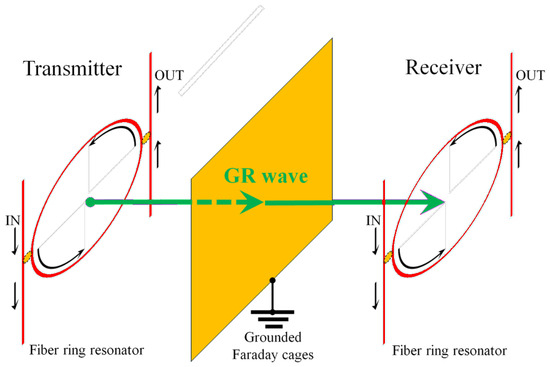
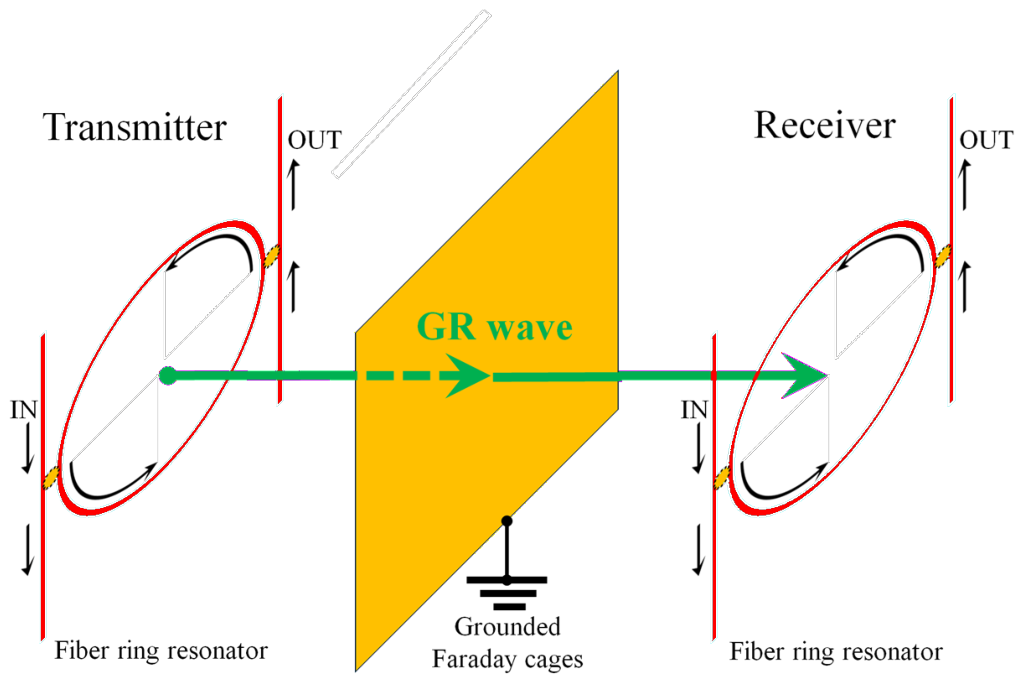
Figure 2 illustrates the Hertz-like transmitter–receiver configuration and the use of grounded Faraday cages to suppress ordinary electromagnetic coupling.
Figure 2.
Hertz-like experiment with circular loop antenna configurations of optical fiber ring resonators: the left resonator array is the transmitter and the right resonator array is the receiver. Grounded Faraday cages can strongly suppress ordinary electromagnetic leakage, but a gravitational interpretation requires the phase-delay, distance-scaling, polarization, orientation-null, and cross-talk rejection tests described in the text. In the revised threshold design, the receiver is treated as a parametric transducer that converts a gravitationally driven perturbation into an optical, microwave, or electronic readout signal.
The following is a carrier-transfer experiment. Let denote a known transmitter modulation applied to the optical-stress source, such as a small amplitude modulation, a phase-coded narrowband modulation, or a lock-in reference waveform. The source calculation above identifies the carrier of the threshold localized stress channel as
For the illustrative difference-frequency design point,
This is a beat-frequency gravitational-wave channel generated by the local Maxwell stress, not the angular speed of an optical packet moving around a centimeter-scale ring and not the optical sum-frequency channel. A minimal receiver model may be written in terms of a generalized transducer coordinate ,
with strain-to-output transfer function
On resonance,
This should be interpreted as an effective narrowband parametric transducer model. The receiver need not be an ordinary macroscopic mechanical antenna; it may instead convert the gravitationally driven perturbation into a cavity-frequency shift, phase modulation, microwave sideband, or other lock-in readout variable. Equivalently, the receiver output may be written as
or in the frequency domain,
The measured transfer-function estimator and magnitude-squared coherence are
A positive Hertz-like result would be a transmitter-correlated spectral component satisfying
with the predicted polarization dependence, distance scaling, and reversal under receiver-orientation changes. For a nearly monochromatic gravitational wave at distance D, the radiation-zone relation between flux and strain is
The following radiation-zone estimates assume , , and , up to geometry-dependent factors of order unity. If these conditions are not satisfied for the complete transmitter array, the full near-zone retarded field must be evaluated instead of the asymptotic expression. For the directed stress amplitude defined in Equation (49), the corresponding source strain scale is
The associated isotropic-equivalent gravitational-wave power scale at is
For a receiver output normalized to strain, uncorrelated additive noise gives
For uncorrelated receiver noise,
The equivalent strain noise is related to the transducer readout noise by
Here and denote one-sided noise spectral densities evaluated at angular frequency , with their numerical values normalized per unit ordinary frequency and therefore quoted in per-hertz units. For a threshold narrowband transducer design point,
one obtains . At , with and , one obtains
The receiver would therefore be an ultra-narrowband beat-frequency transducer, but not an optical-frequency mechanical antenna. To evaluate the transfer criterion at this receiver sensitivity, consider the illustrative array-level source amplitude . One illustrative allocation of this effective directed stress amplitude is
which gives . These quantities are conditional design parameters for the complete coherent optical-stress array. They should not be interpreted as properties of a single ring resonator or as energy supplied by the entangled photon pairs themselves. Also, the physical packing geometry and total spatial extent of an array containing elementary cells have not been specified in the present threshold model. Consequently, application of the radiation-zone strain estimate requires a future array design that satisfies the far-zone conditions stated above. For this illustrative source design, Equation (60) gives
With and , the carrier-transfer signal-to-noise parameter is
A high value of alone does not identify the channel as gravitational, because electromagnetic leakage, mechanical vibration, thermal modulation, ground loops, scattered light, and electronic pickup can also produce source-correlated receiver signals. The gravitational identification requires the null and scaling tests
together with the transverse-traceless antenna pattern, receiver-orientation dependence, strong suppression in TT-null configurations, and no corresponding coherence in electromagnetic leakage monitors, accelerometers, microphones, thermal probes, scattered-light monitors, or electronic loads. A useful rejection figure of merit is
where the null configuration may be obtained by receiver rotation, TT-projection null orientation, transmitter phase scrambling, loss of two-point phase locking, or replacement of the receiver by an electronic dummy load. A gravitational interpretation requires both and . Within the idealized source and receiver models, these parameter choices define a threshold for obtaining a detectable transmitter-correlated transfer function. They do not represent an experimentally demonstrated source strength or receiver sensitivity.
9. Planned Numerical Validation
The analytical threshold model does not by itself establish the viability of the proposed apparatus. Detailed simulations will be performed in subsequent work. The planned program includes: full-wave electromagnetic modeling of the ring modes and evanescent couplers; calculation of the locally conserved field-plus-medium stress-energy tensor, including coupler and support reactions; retarded transverse-traceless radiation and phased-array form factors; receiver transfer functions and quantum, thermal, mechanical, and electronic noise; and systematic-background studies involving electromagnetic leakage, Sagnac phase, vibration, acoustic coupling, thermal modulation, and scattered light. Component-level simulations will be validated separately before they are combined into an end-to-end transmitter–receiver model. No simulation result is claimed in the present paper.
10. Conclusions
We have formulated the proposed apparatus as a conditional threshold problem for a Hertz-like gravitational-wave transfer measurement. The gravitational source is the retarded transverse-traceless component of the total local stress-energy tensor of the optical fields, dielectric medium, couplers, and mechanical support structure.
The proposed experiment treats localized, phase-locked coherent optical stresses as candidate high-frequency gravitational sources within the retarded linearized Einstein equation. Hyperentangled photon pairs provide timing, phase, path, polarization, and nonclassical-correlation resources, whereas the dominant source amplitude is supplied by coherent optical fields. The source array is characterized by the effective directed transverse-traceless stress amplitude , and the receiver is characterized by its equivalent strain-noise amplitude.
Because the Maxwell stress tensor is quadratic in the optical fields, it contains Fourier components at both the sum and difference frequencies of two coherent optical modes. The difference-frequency channel is emphasized for the meter-scale Hertz-like experiment because it permits sub-millimeter-scale, phase-matched source cells and a beat-frequency parametric receiver. This avoids the nanometer-scale localization and optical-frequency transduction requirements associated with the sum-frequency channel.
For the illustrative threshold values and , the idealized model predicts a nonzero transmitter-correlated transfer function and high magnitude-squared coherence . At the illustrative design point , , and , the model gives , , and . These values define a formal positive carrier-transfer threshold within the idealized source and receiver models. They should not be interpreted as experimentally demonstrated source strengths, receiver sensitivities, or validated performance predictions.
A high transmitter–receiver coherence would not by itself establish a gravitational channel. A gravitational interpretation would additionally require the predicted propagation phase and distance scaling, the transverse-traceless antenna pattern, receiver-orientation nulls, transmitter phase-scrambling nulls, and strong rejection of electromagnetic leakage, acoustic pickup, mechanical vibration, thermal modulation, scattered light, ground loops, and electronic cross-talk. Only a signal that survives these controls with the predicted gravitational dependence could be interpreted as evidence for a Hertz-like gravitational-wave transfer process.
The remaining question is whether the required coherent optical-stress array and ultra-narrowband transducer receiver can be physically realized. The present work identifies conditional source and receiver thresholds and provides the local, conserved, retarded stress-energy framework needed to evaluate them. Full-wave electromagnetic, material-response, retarded-radiation, receiver-noise, and systematic-background simulations will be carried out and reported in a later study before experimental implementation is assessed. A successful result would motivate subsequent development of laboratory gravitational-wave transfer and communication concepts.
Lastly, if the Hertz-like gravitational wave communication device were to be successful, then communication via gravitational waves would be possible in a manner similar to communication via electromagnetic radio waves. The result would be a “gravity radio”. The new gravitational wave communications channels would obviate satellite communications, since communication directly through the Earth would be possible because gravitational waves pass transparently through the Earth. Also, a new form of GPS could be established without the use of satellites.
Author Contributions
Conceptualization, R.Y.C., N.I. and J.S.; methodology, R.Y.C., N.I. and J.S.; formal analysis, R.Y.C., N.I. and J.S.; investigation, R.Y.C., N.I. and J.S.; writing—original draft preparation, R.Y.C., N.I. and J.S.; writing—review and editing, R.Y.C., N.I. and J.S. All authors have read and agreed to the published version of the manuscript.
Funding
The authors gratefully acknowledge support from Texas Space LLC and Juan Feria.
Data Availability Statement
The original contributions presented in this study are included in the article. Further inquiries can be directed to the corresponding author.
Conflicts of Interest
The authors declare no conflicts of interest.
References
- Abbott, B.P.; Abbott, R.; Abbott, T.D.; Abernathy, M.R.; Acernese, F.; Ackley, K.; Adams, C.; Adams, T.; Addesso, P.; Adhikari, R.X.; et al. Observation of Gravitational Waves from a Binary Black Hole Merger. Phys. Rev. Lett. 2016, 116, 061102. [Google Scholar] [CrossRef] [Scilit]
- Weber, J. Detection and Generation of Gravitational Waves. Phys. Rev. 1960, 117, 306–313. [Google Scholar] [CrossRef] [Scilit]
- Forward, R.L.; Miller, L.R. Generation and Detection of Dynamic Gravitational-Gradient Fields. J. Appl. Phys. 1967, 38, 512–518. [Google Scholar] [CrossRef] [Scilit]
- Gertsenshtein, M.E. Wave Resonance of Light and Gravitational Waves. Sov. Phys. JETP 1962, 14, 84–85, Translated from Zh. Eksp. Teor. Fiz. 1961, 41, 113–114.. [Google Scholar]
- Aggarwal, N.; Aguiar, O.D.; Bauswein, A.; Cella, G.; Clesse, S.; Cruise, A.M.; Domcke, V.; Figueroa, D.G.; Geraci, A.; Goryachev, M.; et al. Challenges and Opportunities of Gravitational-Wave Searches at MHz to GHz Frequencies. Living Rev. Relativ. 2021, 24, 4. [Google Scholar] [CrossRef] [Scilit]
- Berlin, A.; Blas, D.; D’Agnolo, R.T.; Ellis, S.A.R.; Harnik, R.; Kahn, Y.; Schütte-Engel, J. Detecting High-Frequency Gravitational Waves with Microwave Cavities. Phys. Rev. D 2022, 105, 116011. [Google Scholar] [CrossRef] [Scilit]
- Steinberg, A.M.; Kwiat, P.G.; Chiao, R.Y. Measurement of the Single-Photon Tunneling Time. Phys. Rev. Lett. 1993, 71, 708–711. [Google Scholar] [CrossRef] [Scilit]
- Chiao, R.Y.; Steinberg, A.M. Tunneling Times and Superluminality. In Progress in Optics; Wolf, E., Ed.; Elsevier: Amsterdam, The Netherlands, 1997; Volume 37, pp. 345–405. [Google Scholar] [CrossRef] [Scilit]
- Winful, H.G. Tunneling Time, the Hartman Effect, and Superluminality: A Proposed Resolution of an Old Paradox. Phys. Rep. 2006, 436, 1–69. [Google Scholar] [CrossRef] [Scilit]
- Odintsov, S.A.; Beginin, E.N.; Sadovnikov, A.V. Reconfigurable Lateral Spin-Wave Transport in a Ring Magnonic Microwaveguide. JETP Lett. 2019, 110, 430–435. [Google Scholar] [CrossRef] [Scilit]
- Odintsov, S.A.; Sheshukova, S.E.; Nikitov, S.A.; Sadovnikov, A.V. Lateral and Vertical Spin-Wave Transport in a Multimode Magnonic Ring Coupler. Phys. Rev. Appl. 2024, 22, 014042. [Google Scholar] [CrossRef] [Scilit]
- Post, E.J. Sagnac Effect. Rev. Mod. Phys. 1967, 39, 475–493. [Google Scholar] [CrossRef] [Scilit]
- Barreiro, J.T.; Langford, N.K.; Peters, N.A.; Kwiat, P.G. Generation of Hyperentangled Photon Pairs. Phys. Rev. Lett. 2005, 95, 260501. [Google Scholar] [CrossRef] [Scilit]
- Yadav, V.K.; Venkataraman, V.; Ghosh, J. High-Brightness Fiber-Coupled Source of Polarization-Entangled Photon Pairs Spanning the Telecom C- and L-Bands. Opt. Laser Technol. 2024, 175, 110774. [Google Scholar] [CrossRef] [Scilit]
- Pang, Y.; Castro, J.E.; Steiner, T.J.; Duan, L.; Tagliavacche, N.; Borghi, M.; Thiel, L.; Lewis, N.; Bowers, J.E.; Liscidini, M.; et al. Versatile Chip-Scale Platform for High-Rate Entanglement Generation Using an AlGaAs Microresonator Array. PRX Quantum 2025, 6, 010338. [Google Scholar] [CrossRef] [Scilit]
- Smith, B.J.; Raymer, M.G. Photon Wave Functions, Wave-Packet Quantization of Light, and Coherence Theory. New J. Phys. 2007, 9, 414. [Google Scholar] [CrossRef] [Scilit]
- Jackson, J.D. Classical Electrodynamics, 3rd ed.; John Wiley & Sons: New York, NY, USA, 1999. [Google Scholar]
- Einstein, A. Über Gravitationswellen. Sitzungsber. Preuss. Akad. Wiss. Berl. (Math. Phys.) 1918, 8, 154–167. [Google Scholar]
- Weinberg, S. Gravitation and Cosmology: Principles and Applications of the General Theory of Relativity; John Wiley & Sons: New York, NY, USA, 1972; Chapter 10. [Google Scholar]
Disclaimer/Publisher’s Note: The statements, opinions and data contained in all publications are solely those of the individual author(s) and contributor(s) and not of MDPI and/or the editor(s). MDPI and/or the editor(s) disclaim responsibility for any injury to people or property resulting from any ideas, methods, instructions or products referred to in the content. |
© 2026 by the authors. Licensee MDPI, Basel, Switzerland. This article is an open access article distributed under the terms and conditions of the Creative Commons Attribution (CC BY) license.