


Abstract
We detail a procedure to transform the current empirical stage in the study of complex systems into a predictive phenomenological one. Our approach starts with the statistical-mechanical Landau-Ginzburg equation for dissipative processes, such as kinetics of phase change. Then, it imposes discrete time evolution to explicit back feeding, and adopts a power-law driving force to incorporate the onset of chaos, or, alternatively, criticality, the guiding principles of complexity. One obtains, in closed analytical form, a nonlinear renormalization-group (RG) fixed-point map descriptive of any of the three known (one-dimensional) transitions to or out of chaos. Furthermore, its Lyapunov function is shown to be the thermodynamic potential in q-statistics, because the regular or multifractal attractors at the transitions to chaos impose a severe impediment to access the system’s built-in configurations, leaving only a subset of vanishing measure available. To test the pertinence of our approach, we refer to the following complex systems issues: (i) Basic questions, such as demonstration of paradigms equivalence, illustration of self-organization, thermodynamic viewpoint of diversity, biological or other. (ii) Derivation of empirical laws, e.g., ranked data distributions (Zipf law), biological regularities (Kleiber law), river and cosmological structures (Hack law). (iii) Complex systems methods, for example, evolutionary game theory, self-similar networks, central-limit theorem questions. (iv) Condensed-matter physics complex problems (and their analogs in other disciplines), like, critical fluctuations (catastrophes), glass formation (traffic jams), localization transition (foraging, collective motion).
1. Introduction
Ordinary equilibrium statistical mechanics, as founded by Ludwig Boltzmann and Joshua Willard Gibbs [1], stands out as a branch of physics that had not encountered a limit of validity and the need for an appropriately modified formalism to extend its realm to new territories. We address this issue together with the understanding of the causes of the breakdown.
In relation to the above we make reference to the concept of fractality [2] and the physical origins for its manifestation in natural phenomena. Not only the impressive similarities in digital renderings, but also the basic causes for their appearances. Additionally, we reflect on the usual time-lapse that takes place between developing a concept, say, within mathematics and its properly-founded use within physics.
Furthermore, we contemplate the current stage of complexity science, that we conceive, as many others, to transit trough an initial empirical stage awaiting its transformation into the next, phenomenological, stage, where there appear predictive universal laws as well as new understanding. In relation to this, we consider placing firmer on the ground the paradigms that have guided complex systems research over the past years: onset of chaos [3] and criticality [4].
With regards to the breakdown of ordinary equilibrium statistical mechanics we analyze the effect that would have a very significant, immense, impediment to a system composed of many degrees of freedom to access its otherwise natural configurations. We recognize [5,6] that this limit of validity can only be reached when the remaining subset of available configurations is of measure zero with respect to the original unhindered set. And we keep in mind that a bona fide example of this circumstance occurs when an ensemble of trajectories falls into a transition to chaos attractor in a dissipative nonlinear dynamical system, such as in any of the well-known iterative low-dimensional nonlinear maps. The dynamics within these attractors becomes nonergodic and nonmixing with respect to the unrestrained original set [5,6].
We advance the conclusion that the statistical–mechanical formalism befitting to function beyond the referred limit of validity is that already known as q-statistical mechanics [7,8]. Concisely, this is the formalism that results when the ordinary exponential function and its inverse function, the ordinary logarithm, are replaced by the q-deformed exponential and logarithmic functions in the traditional formalism [7,8]. As we detail below, this replacement follows a jammed or congested limit as employed, for example, in the so-called replica trick [9]. With reference to the dynamical properties of the mentioned dissipative nonlinear iterative maps, the q-exponential and q-logarithmic functions have been proved [6] to occur in all analytical or accurate numerical descriptions of the dominant properties at the transitions to chaos. That is, the properties governed by the renormalization group (RG) fixed-point maps for all the routes to chaos in low-dimensional (actually one-dimensional) maps [10].
In connection with the passage, or conversion, of the nature of the science of complex systems from empirical to phenomenological, we single out the following approach that we have already explored, proven reliable and verified [6,8,11,12,13]. We have taken as the starting point, within statistical mechanics, the Landau-Ginzburg kinetic equation (that we use here in a simplified modern form [6]), a 1st-order differential equation for dissipative systems used with success in the description of processes of phase change in many-particle fluids, such as nucleation (see, for example, Ref. 23 in [6]). The function to be determined is, for instance, the fluid density as a function of spatial position and time. The driving force of this equation is the functional derivative of a generalized thermodynamic potential, which is the Lyapunov function [14] associated with this rate equation. In order to make this equation pertinent for the study of complex systems we have introduced two assumptions: (i) Give the driving force a power-law form to express it in accord with the complex system paradigms, either onset of chaos or criticality. And (ii) introduce discrete time to establish cause and effect explicitly as an essential general property. With these two assumptions, the Landau–Ginzburg equation transforms straightforwardly into a local expression of the RG fixed-point map for the transitions to chaos, while the Lyapunov function acquires the q-statistical–mechanical expression for the entropy or that for the relevant q-generalized thermodynamic potential [6].
The corroboration of the validity of our approach for the phenomenological study of complex systems, with quantitative predictions and added comprehension, is supported by a collection of studies [6,8,11,12,13] that we describe briefly below in the last and longer Section. This collection is grouped into convenient categories as itemized in the abstract. Finally, we discuss this perspective.
2. What Causes a Breakdown of the Traditional Boltzmann-Gibbs Equilibrium Statistical Mechanics?
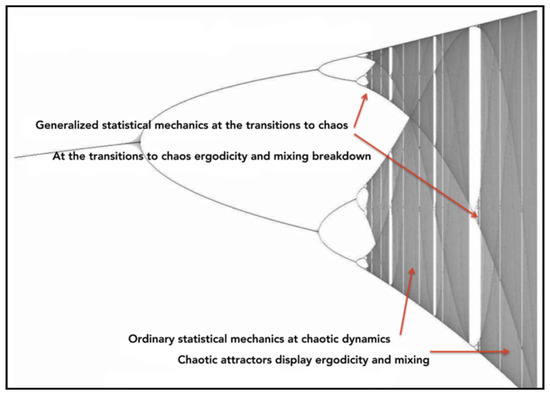
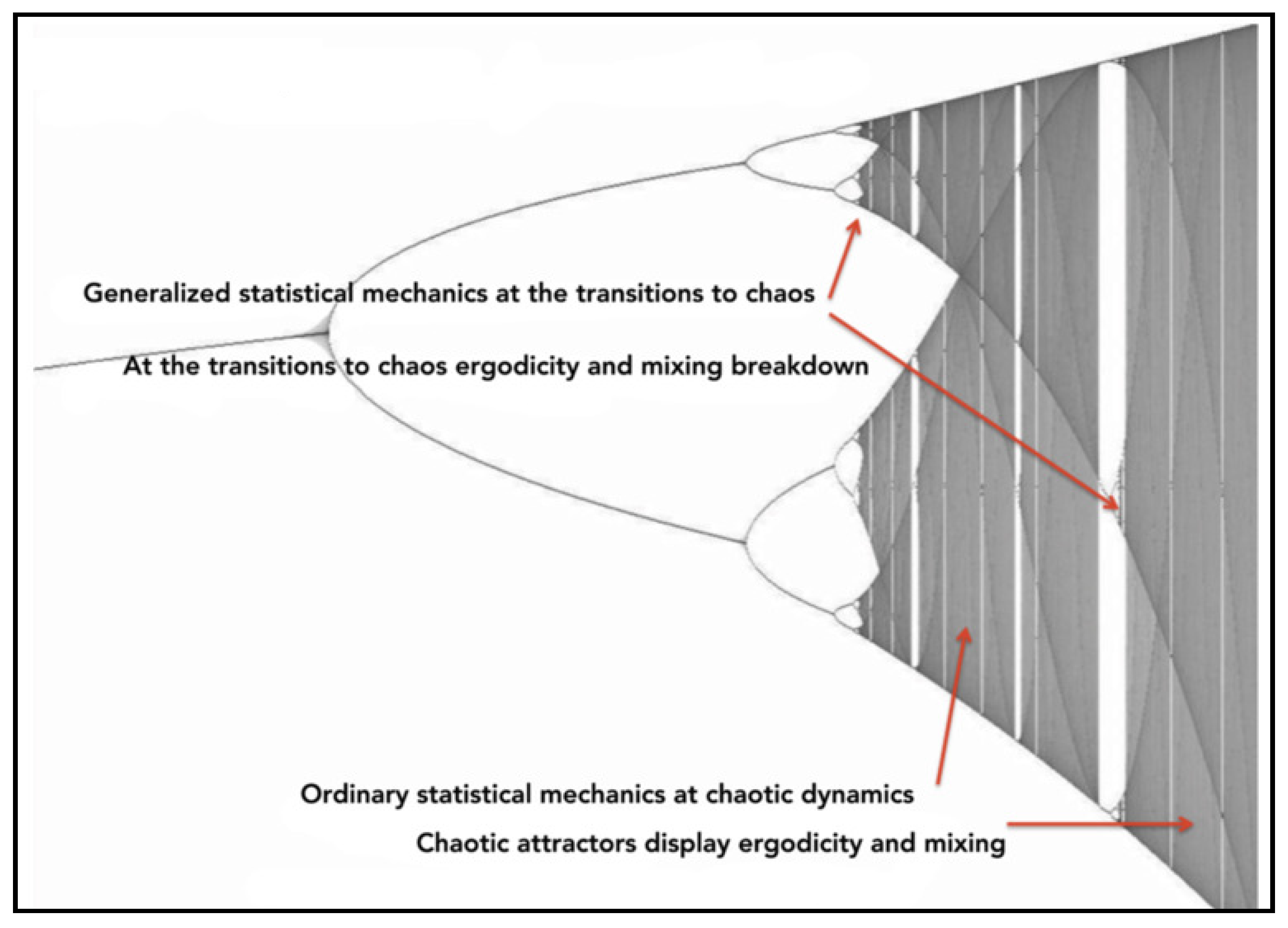
The known expressions for the probability distributions and partition functions of equilibrium statistical mechanics may no longer be valid when systems composed of many degrees of freedom undergo processes that bring about a major obstruction to their otherwise natural configurations. Likewise, for the thermodynamic potentials that result from them. Leaving access to only a much reduced subset of configurations is observed, for example, in the approach to a glassy state, where molecules become caged by their neighbors and can mostly only rattle. In the nonlinear map representation of such processes, this happens at the transitions out of chaos, see [6,8,11,12,13] and references therein. When the behavior remains chaotic, there is insufficient impediment, and traditional statistical mechanics remains valid. Ergodicity and mixing remain present in ensembles of trajectories evolving within chaotic attractors [15]. See Figure 1.
Figure 1.
The familiar bifurcation diagram of the logistic map. The phenomenological models built to study complex system problems of all kinds involve the transitions to chaos in this or similar bifurcation diagrams. At these borderlines q-generalized statistical mechanics has been shown to take place [6,8,11,12,13].
The probability distributions of ordinary equilibrium statistical mechanics are exponentially decaying functions. Prototypical cases are the Boltzmann distribution [16] and the Maxwell–Boltzmann distribution of particle velocities [17]. As a balance to this, the expressions that link the partition functions to the extensive thermodynamic potentials are made through the inverse function, the ordinary logarithmic function. To our knowledge, the mathematical effect on the traditional formalism, particularly on these two leading-role functions, caused by drastically eliminating (deleting) sets of numbers in their dense domains of definition has not received much consideration.
Physically, this action represents a severe impediment (or blockade) placed on the statistical–mechanical system to access its otherwise normal set of configurations. An extreme case would be to reduce the set of accessible configurations to a subset of vanishing measure with respect to the original one. An upfront and straightforward exploration of this mathematical operation is to consider two well-known limit expressions for the ordinary exponential and logarithmic functions:
and
Now, we assume that the demolition (or elimination of vast numbers) of the real number domains of these functions impede the progress of the above limits up to a given finite value of n, . We arrive immediately at the definitions of the q-deformed exponential
and logarithmic
functions, respectively. These are the functions, inverse to each other, in q-statistics, with index q for the canonical distribution function and index for the entropy [8].
The limit stoppage applied to Equations (1) and (2) has been employed with success in studies of glassy dynamics and related problems, known as the replica trick [9]. In these applications, the full limit is finally performed after serving its purpose, but here we consider its permanent quality, where the value taken by for each particular case provides physical insight into the complex system under consideration.
We have repeatedly identified the expressions Equations (3) and (4) in the quantitative results of our nonlinear dynamical models for complex system phenomena that operate at the transitions to chaos in dissipative low-dimensional maps [6,8,11,12,13]. The attractors at the onset of chaos (made up of finite or multifractal sets of positions) in these maps capture trajectories originating from their entire domains of definition and end up evolving only in the subset of positions that form these attractors.
With respect to the above we have introduced the concept of contraction dimension Q [5], that relates the probability distribution function for the original unrestricted set of positions (that represent configurations in the modeled system) to the distribution function of the remaining set of available positions (again representing model system configurations). This is
or
where , or otherwise. The index Q corresponds to the entropy expression whereas the index q belongs to the probability distribution expression [5]. Also, notice that is an (unnormalized) escort distribution [15] of .
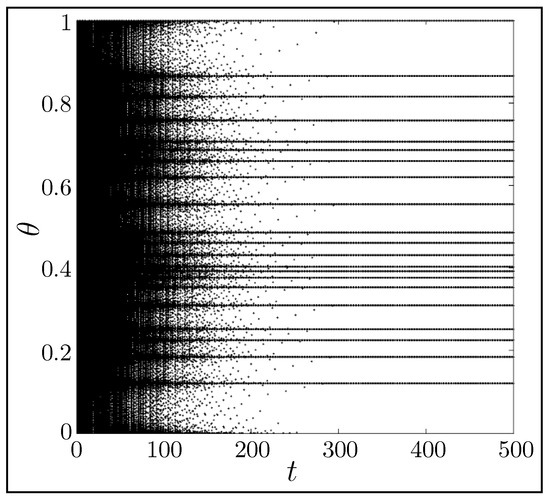
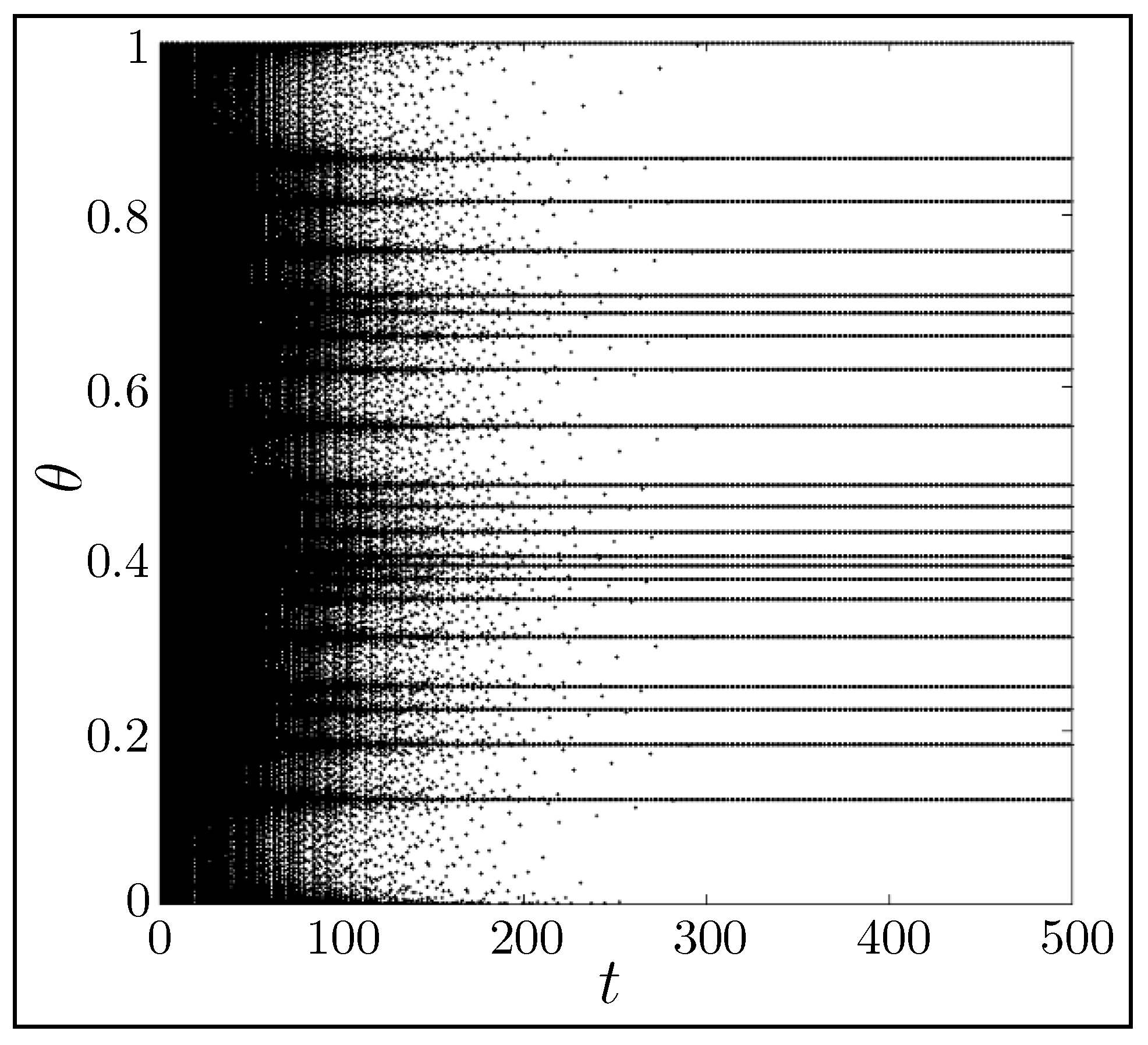
To reiterate, for the case we consider mostly here, transitions to chaos in dissipative one-dimensional maps, the evolution dynamics of an ensemble of trajectories initiated at a full interval of initial positions covering the dense real number domain of the map with a distribution ends up at a finite or multifractal attractor set with distribution . The contraction dimension Q is determined by the attractor under consideration and also, as we give details further below, provides valuable information on the complex system model that employs that attractor. See Figure 2. Incidentally, this concept clarifies an apparent conflict with the employment of the maximum entropy principle derivation for the q-entropy expression [18]. In the application of this procedure it was deemed to be necessary to use the escort distribution (in various fashions [19]) instead of the distribution itself for evaluating averages. This conflict is solved by noticing that a meaningful Lagrange multiplier for an average made with can be seen to be an average made with the (still not normalized) escort distribution [5,6].
Figure 2.
Formation of gaps along iteration time t in the dynamics towards a critical circle map periodic attractor along the golden ratio route to chaos (with period given by the Fibonacci number ). An ensemble of trajectories (black points) was given a uniform distribution of initial positions that evolves into a final distribution . A graphical illustration of the contraction dimension Q described in the text. Our complex system models based on the nonlinear dynamics at the transitions to chaos make use of the contraction dimension Q.
3. A Phenomenological Procedure for the Study of Complex Systems
The starting point of our theoretical formalism to study complex systems is the well-known Landau–Ginzburg dissipative nonlinear kinetic equation [20]. This equation is, within statistical physics, a phenomenological nonlinear differential equation applicable to dissipative processes in macroscopic systems, that in modern form and written in the prototypical language for fluids is
where is the density at spatial position and time t, U is here a constant factor, and is a generalized free energy. In this case is the grand potential free energy for a uniform system of density at temperature T and chemical potential with replaced by a generic nonuniform function . The generalized free energy is also the Lyapunov function [14] that evolves monotonically as a function of time t along the solution of Equation (7). The Landau-Ginzburg equation in the form given by Equation (7) has been used, for example, to describe the kinetics of phase change processes as nucleation, spinodal decomposition and interface motion (see, for example, Ref. 23 in [6]). The form given above to Equation (7) can be adapted to other condensed matter phenomena, magnetic, superconducting, etc. Studies on the first-principle’s derivation of kinetic or rate equations, such as the Landau–Ginzburg equation, can be found, for example, in Refs. [21,22].
We introduce two modifications to Equation (7), two basic assumptions implemented to obtain the general framework of the phenomenological approach we put forward to research complex systems. The first one is to consider time t a discrete quantity. The purpose of this is to express explicitly the action of back feeding, to highlight cause and effect along processes, and to distinguish, as it turns out, between different time scales. This modification transforms the differential equation into a nonlinear iteration map, and converts a statistical physics topic into a nonlinear dynamical one. Also, it has the quality of enriching considerably the possible solutions of the rate Equation (7), a general virtue of the transit from differential to difference equations. The second assumption is to assign a specific form to the driving force of Equation (7), the functional derivative of the Lyapunov function . We choose this derivative to be a power law. This choice is compatible with the two paradigms that have pervaded research in complex systems: Onset of chaos [3] and criticality [4]. With these two assumptions Equation (7) becomes the nonlinear iterated map
where we have replaced the fluid density by the trajectory position (and the sign of the factor, ). The map in Equation (8) is the local version of the RG fixed-point map that satisfies the scaling property
An analytical closed-form solution of Equation (9) where the first two terms of its series expansion reproduces Equation (8) was obtained long ago by Hu and Rudnick [23]. This is (writing the original expression in [23] in terms of the q-exponential function)
and corresponds to the simplest route to (or out of) chaos, that via the tangent bifurcation [24], and which when perturbed into chaos exhibits intermittency. Furthermore, all the trajectories generated by in Equation (10) can be written as [5,6]
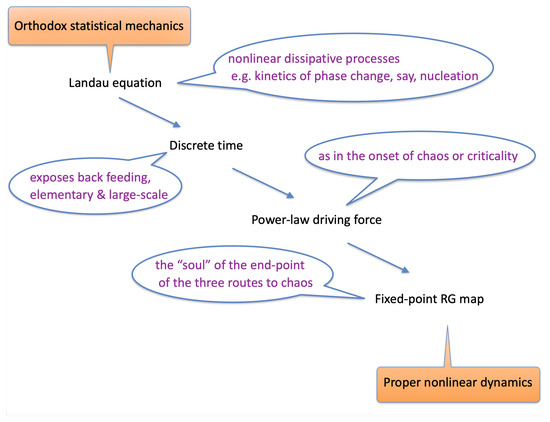
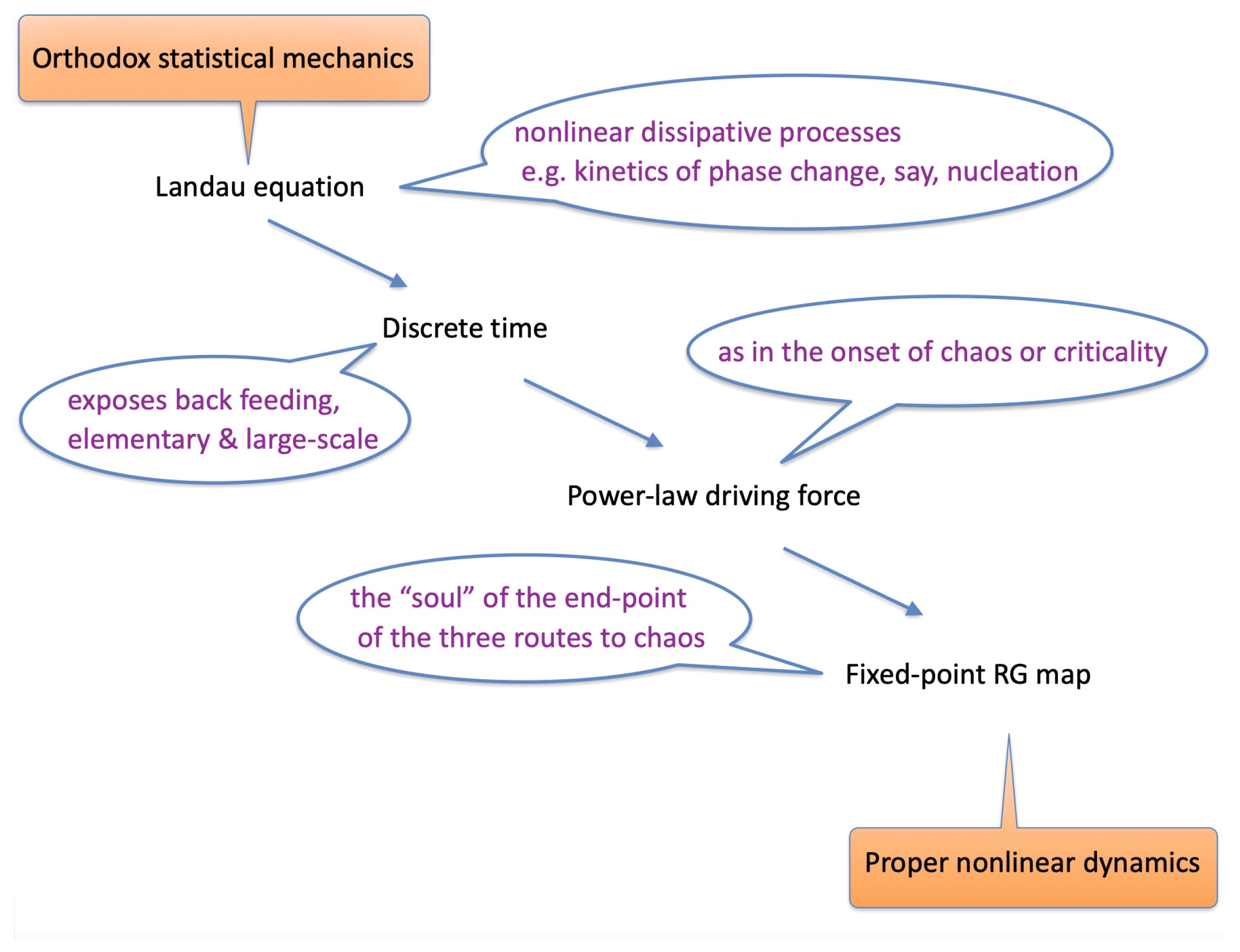
Until recently, the RG fixed-point maps , or their trajectories, for the other two kinds of transitions to chaos were not known in closed analytical form, only numerically via approximations of their power series representations [10]. We have now shown [6] that the trajectories of the RG fixed-point maps for the period-doubling and the quasi-periodic routes to chaos can also be obtained analytically in a closed form equivalent to the q-exponential expression Equation (11) for the intermittency route. As we explain in [6], this requires specific sets of iteration time changes of variable. As mentioned, the dynamical properties at the transitions to chaos are governed by the RG fixed-point maps for all maps that exhibit routes to chaos [10]. As a summary see Figure 3.
Figure 3.
Schematic representation of the procedure to link the Landau–Ginzburg kinetic equation with the renormalization group (RG) fixed-point maps for the transitions to chaos in one-dimensional dissipative nonlinear iteration maps. Our models to study complex systems are based on, and rely on the universal properties of, these RG fixed-point maps.
A final important comment is that the Lyapunov function associated with the discrete Landau–Ginzburg equation with a power-law driving force, Equation (8), acquires the form [6]
where . The Lyapunov function in Equation (12) can be identified with the Tsallis entropy [7]
for a uniform distribution [6]. In the applications of this formalism to specific problems of complex systems sometimes there is often reference to a process, but this is not always necessarily the case [11,12]. Also the iteration time t variable can play a different role for different model applications, like rank, size, etc., and likewise for the trajectory positions [11,12].
4. The Singular Dynamical Behavior at the Transitions to Chaos
So far we have presented a modified version of the Landau–Ginzburg kinetic equation, a difference equation with solutions equivalent to those of the RG fixed-point maps . These are the maps that provide the universal dynamical properties at the transitions to chaos in low-dimensional nonlinear dissipative systems. It remains to be described how the maps, and the properties that originate from them, together with appropriate physical modeling, have the capacity to reproduce quantitatively complex system phenomena. And perhaps too ambitiously, to obtain understanding on major complex system issues. But first we refer to the singular dynamical properties within the attractors at the transitions to chaos as well as those of trajectories evolving towards these attractors. As illustrated, these properties differ radically from those of chaotic attractors. And this underlines the difference of building up a general nonlinear-dynamical formalism for complex systems based expressly on the transitions to chaos or merely on chaos.
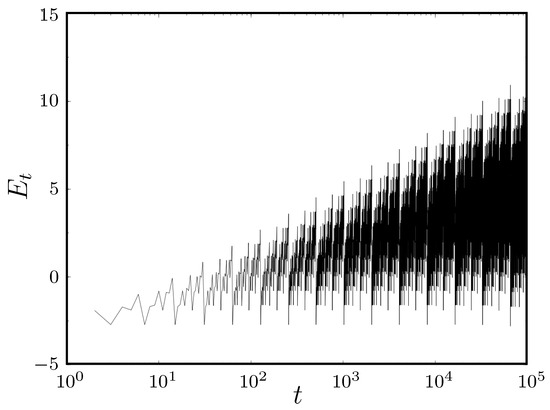
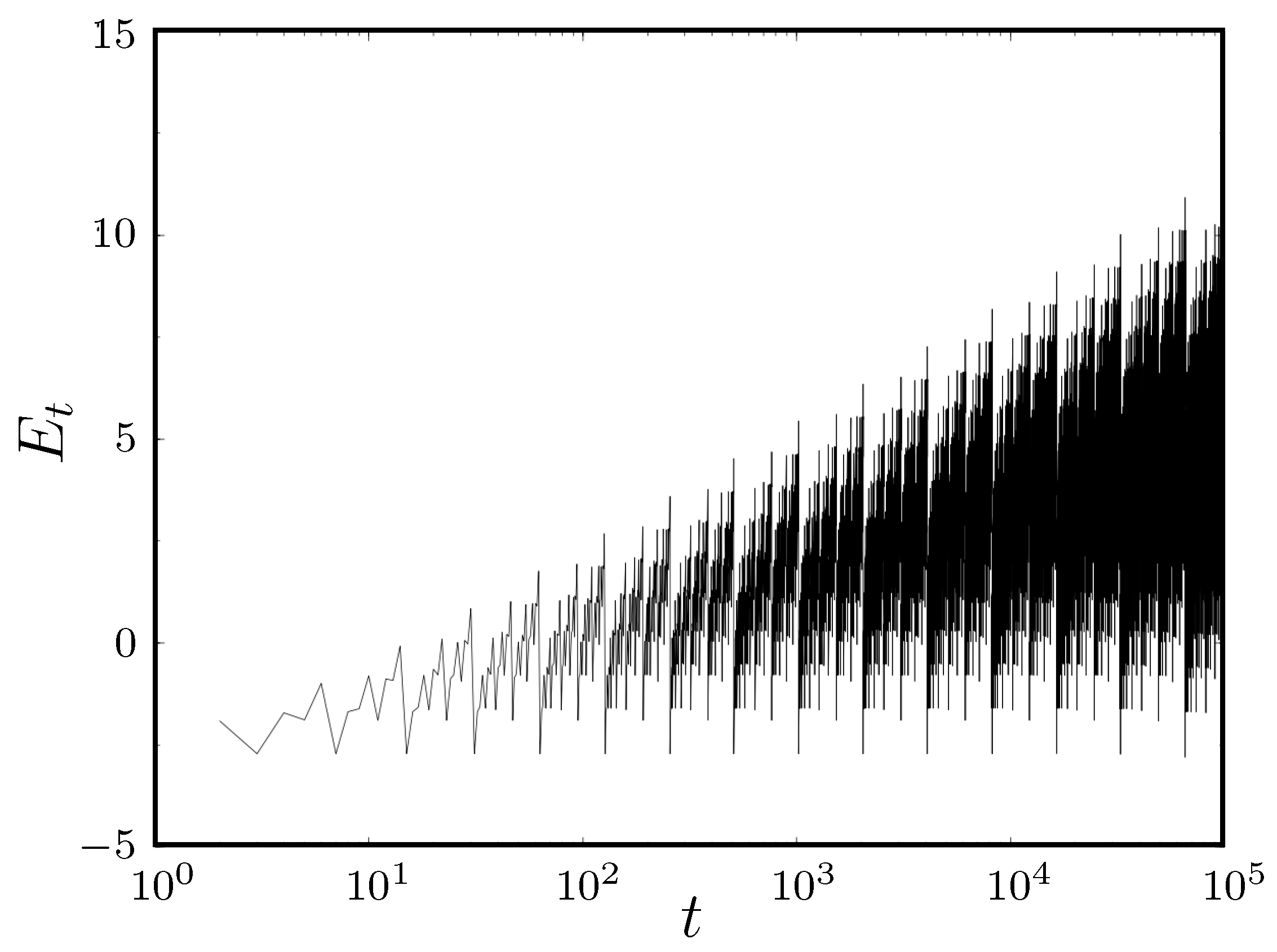
It is known that the Lyapunov exponent (for one dimensional maps) vanishes at the transitions to chaos [10], but it is less known the bizarre dynamical comportment behind this nullification. The Lyapunov exponent is defined as the ratio where the expansion rate is defined as the logarithm of the sensitivity to initial conditions . Normally, the sensitivity approaches an exponential function as t increases (decaying for periodic attractors and diverging for chaotic ones). However, at the transitions to chaos the ‘refuses’ to approach any function, and instead increases its fluctuation patterns as t increases. In Figure 4 we show the behavior of the expansion rate at the period-doubling transition to chaos in the logistic map.
Figure 4.
The expansion rate at the period-doubling transition to chaos in the logistic map. The ordinary Lyapunov exponent vanishes at this transition in spite of the power-law growth of the fluctuations. This divergent behavior imprints its properties in complex system models based on this borderline as opposed to those built on fully chaotic dynamics. With reproduction permission from [12].
Behind the vanishing of the ordinary Lyapunov exponent and the odd comportment of the expansion rate at the transitions to chaos we have revealed the existence of infinite families, spectra, of q-generalized Lyapunov exponents associated with q-exponential sensitivity to initial conditions spectra. The q-Lyapunov exponent spectra is linked to a q-entropy rate of change spectra [8], just as it is the case of the single Pesin identity (between a single number ordinary Lyapunov exponent and a single number ordinary entropy rate) for chaotic attractors [10,15].
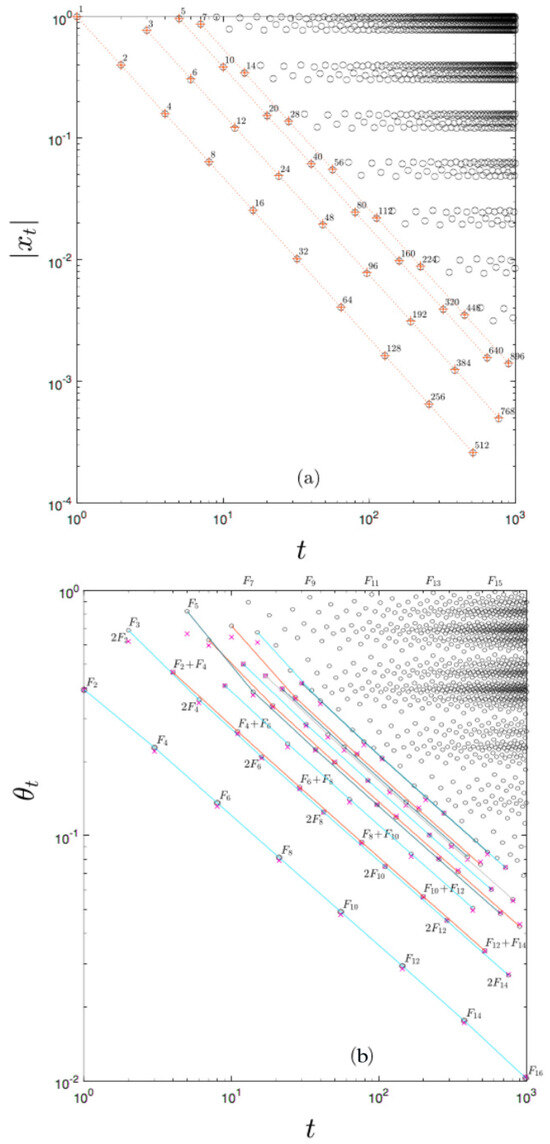
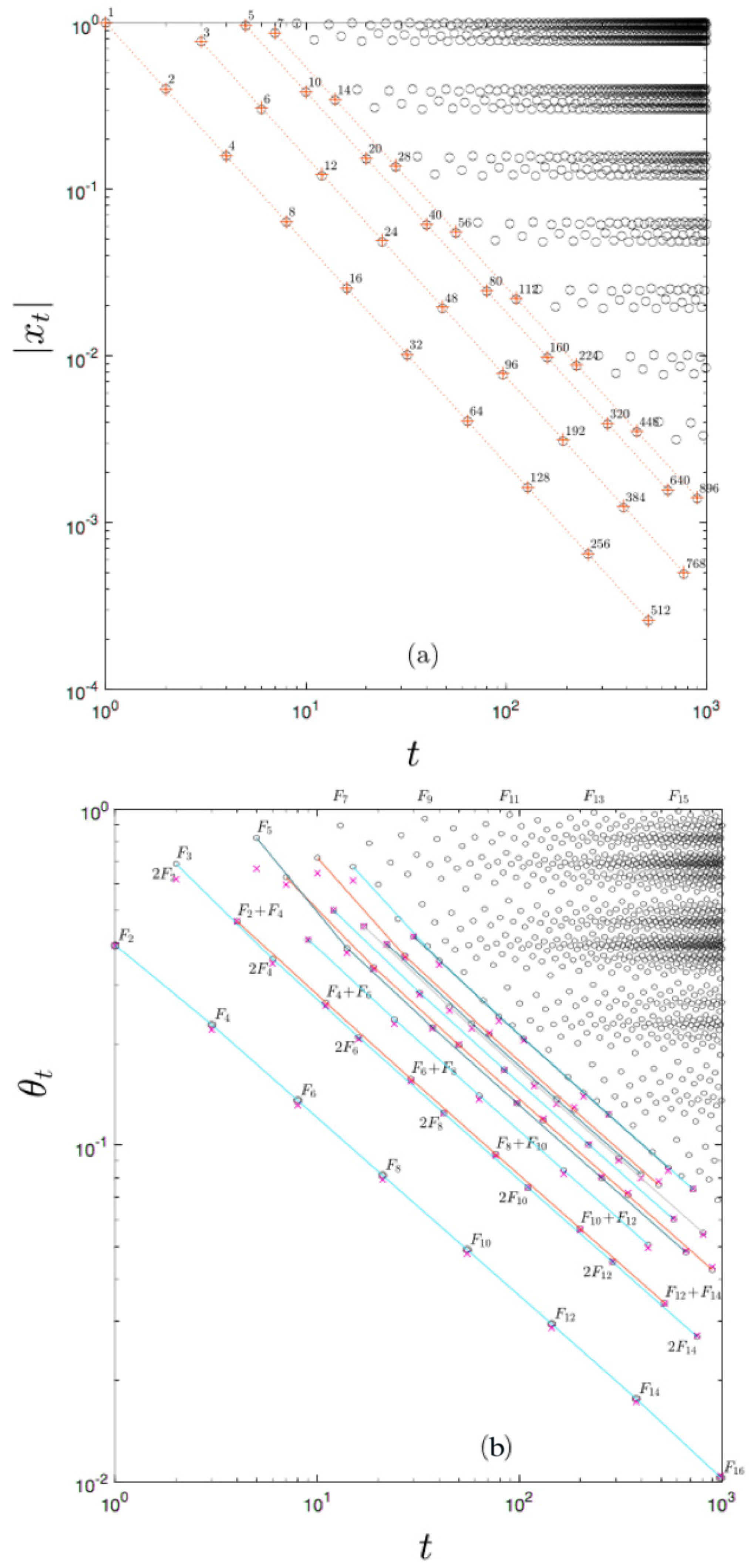
Related to this, the trajectories within the multifractal attractors at the transitions to chaos via the period doubling or the quasiperiodic routes [10] exhibit interwoven power-law position subsequences [8]. A scaling property that we have made use of in the modeling of several complex system problems [6,8,11,12]. In Figure 5 we show these trajectories in logarithmic scales. We single out and name Master trajectories within the transition-to-chaos attractors those that have as initial positions the extrema or saddle-points of the maps, as all other trajectories within those attractors are obtained by simple shifts (in logarithmic scales) of initial positions. As it can be observed in these two Figure 5 panels there are well-defined families of subsequences of positions that appear diagonally aligned in logarithmic scales and therefore obey power-law scaling. We have shown that these trajectory sets of position subsequences are actually, rigorously, q-exponential functions (see, for example, Ref. 32 in [6]).
Figure 5.
Master trajectories inside multifractal attractors at transitions to chaos (open circles are positions). (a) Via the period-doubling route (numbers are iteration times). (b) Via the golden mean quasiperiodic route (labels are Fibonnacci number iteration times). The Master trajectories recapitulate in time t the periodic attractor routes to chaos observed along control parameter incremental values (in the bifurcation diagrams such as that in Figure 1). These recapitulations play a basic role in complex system models [6,8,11,12].
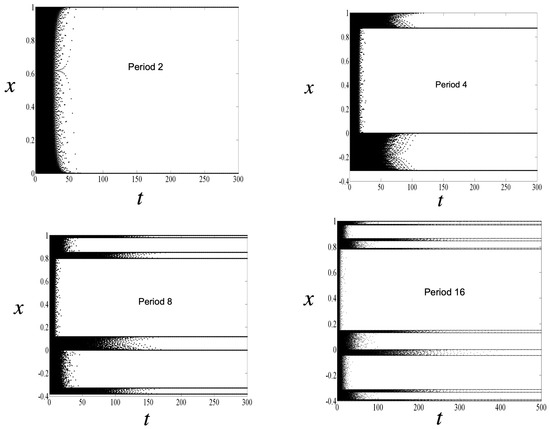
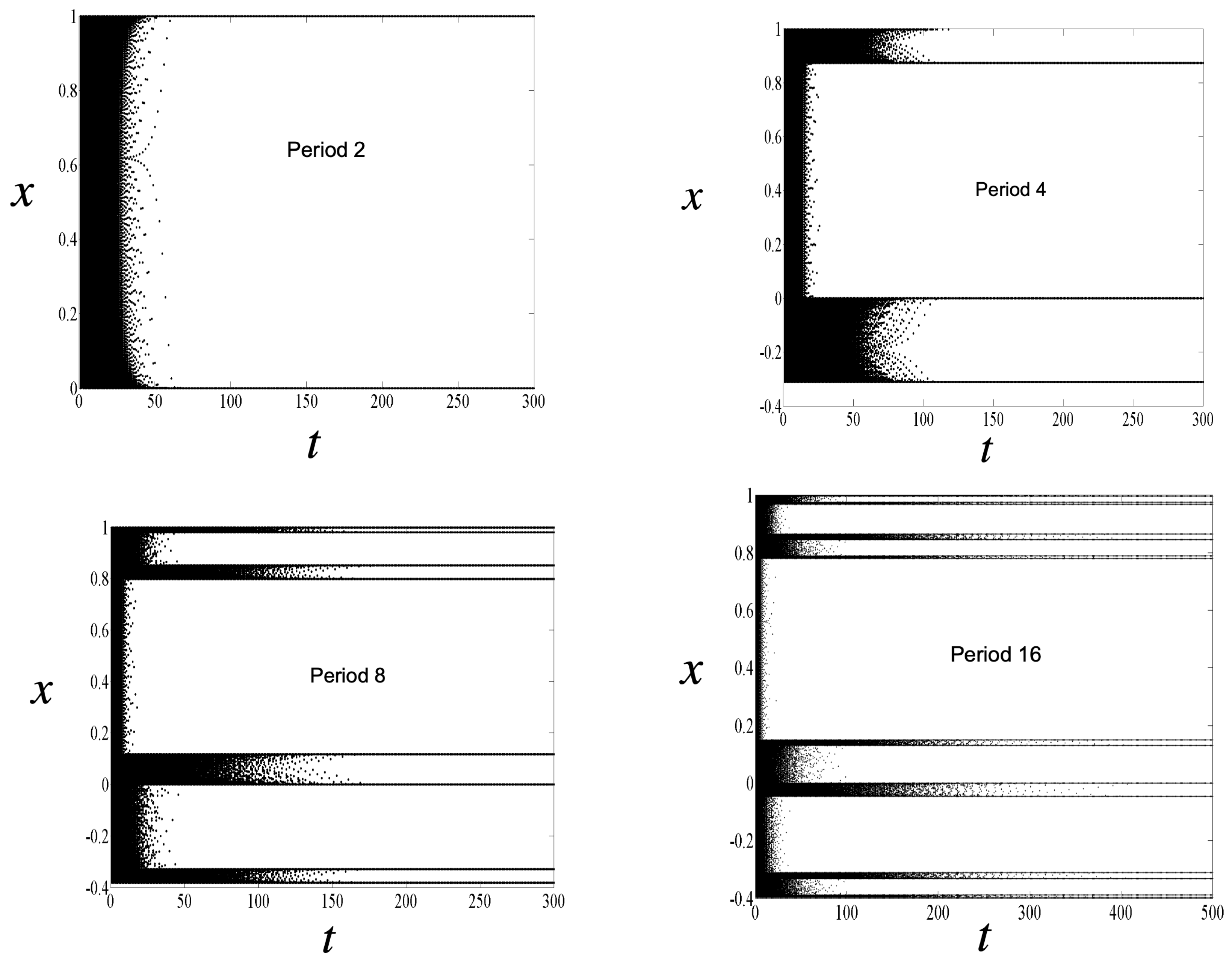
Another subject of the dynamics of low-dimensional nonlinear iteration maps that had not received sufficient attention is that of trajectories initiated outside attractors. The detailed inspection on this issue revealed significant properties (see, for example, Ref. 36 in [6]) that have turned out to be of value for central discussion points about complex systems. Notably for self-organization and central limit theorem questions [6,12]. The manner by which ensembles of trajectories approach attractors, particularly those at the period-doubling route to chaos, is one of increasing complexity (see Refs. 48–50 in [12]). As shown in Figure 6 the ensembles proceed via sequential formation of sets of gaps, at each stage a larger subset of narrower gaps. The complementary sets of intervals containing trajectories evolve similarly. Remarkably, the widths of these sets are related to the lengths of intervals called diameters [10] that measure distances between neighboring trajectory positions in the dynamics inside attractors. But even most remarkably, the sum of the lengths of these subsets of intervals at each stage of time evolution take the form of a q-statistical–mechanical (canonical) partition function [6,8,11,12].
Figure 6.
Sequential formation of subsets of gaps in the dynamics of ensembles of trajectories (black dots) evolving towards superstable attractors in the logistic map, . The panels show the sequential formation of a multifractal set with an infinite number of gaps. This multifractal has been shown to precisely mirror another one (without gaps) formed via sequential formation of partitions, see Ref. 54 in [12]. For the latter case, the entropy reduction due to partitioning is compensated by creation of entropy made of partition configurations (Ref. 54 in [12]). Partitioning constitutes a model for self-organization (Ref. 54 in [12]).
The mathematically simplest transition to chaos is that of the tangent bifurcation [10], also known as saddle-node bifurcation, fold bifurcation, or limit point bifurcation [24]. The attractors at these transitions to chaos are formed by finite sets of positions, possibly, as in most descriptions, only one. These attractors appear repeatedly in the logistic map, as can be seen at the initiation of each of the so-called windows of periodicity in its bifurcation diagram [10], shown in Figure 1. The positions at the tangent bifurcation have a dual attractor/repeller nature. Trajectories approaching from the left of a point of tangency show a power-law approach, while those placed at the right of tangency positions experience faster than exponential get away. As noted, the RG fixed-point map for the tangent bifurcation was determined in closed analytical form by Hu and Rudnick [23] and later recognized to be expressible in terms of the q-exponential function, as already shown in Equation (10) together with its trajectories in Equation (11).
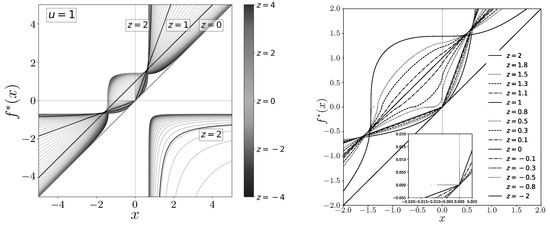
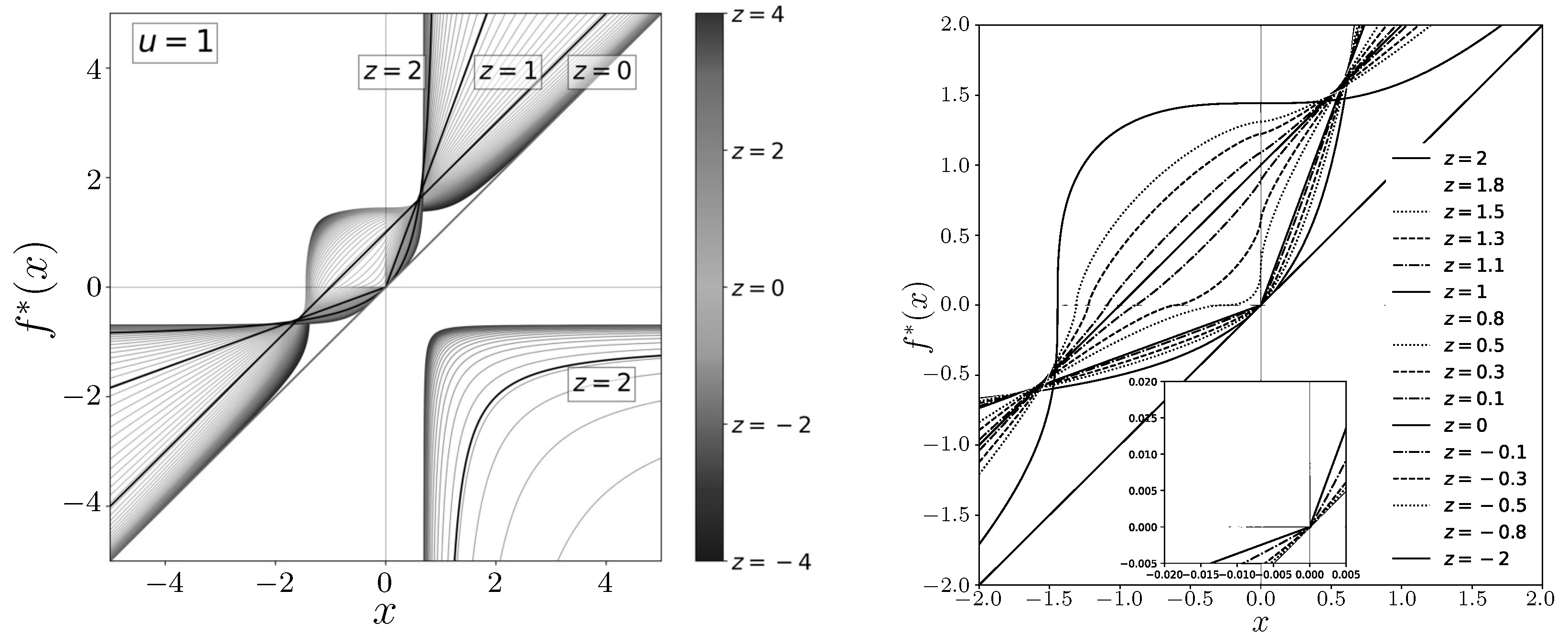
It is worth mentioning here that new features of this map appear when its nonlinearity, q in Equation (8), is varied. For the map has two branches, one is tangent with the identity function and the other at the right of the divergence location . If is perturbed away from tangency, trajectories will exhibit intermittency, a nonlinear phenomenon we have employed in previous descriptions about complex systems. But what is new is that when tangency transforms into a cusp; the cusp is made of straight lines when the nonlinearity reaches , and consequently, the trajectories either decay exponentially (x < 0) or grow exponentially (x > 0). Below , the cusp separates from the identity line and becomes rounded as q diminishes. The next limit case is , where the curvature of the map vanishes and trajectories grow linearly with time. As , the curvature of the map changes sign, as is shown in Figure 7. We have made use of these features to study known empirical scaling laws (allometric laws) obeyed by complex systems [25].
Figure 7.
Tangent bifurcation renormalization group fixed-point map for different values of its nonlinearity and (left). Amplified detail (right). Several complex system models have been constructed based on this specific map, with applications, for instance, to rank distributions, critical fluctuations and localization (with [12]), and to allometric laws (with [25]).
For early numerical evidence of q-exponential behavior at the period-doubling transition to chaos see Refs. [26,27]. For initial numerical indications of the q-Pesin identity see Refs. [28,29]. For first numerical observations of q-exponential conduct at the golden mean transition to chaos in the circle map see Ref. [30].
5. Test of the Appropriateness and Applicability of the Approach for the Phenomenological Study of Complex Systems
We start by mentioning three broad discussion points to corroborate if the statistical–mechanical nonlinear-dynamical approach does indeed make direct and explicit connections with basic notions, guiding concepts and core issues on complex systems research. These are:
1. Paradigms, demonstration and equivalence. Over the past years we have been guided by two paradigms in the study of complexity: Edge or onset of chaos [3] and criticality, including self-organized criticality [4]. The aim in this case was to provide in a very concrete way a corroboration of these principles. We considered two infinite families of attractors common to all quadratic maps, the so-called superstable cycles and band-splitting point cascades of attractors that share as their accumulation point the period-doubling transition to chaos [10]. Then determined the probability distributions of ensembles of trajectories for these attractors via the Frobenius-Perron equation to obtain their (Shannon) entropies. We found that these collections of trajectories for these families of attractors put together obey a thermodynamic equation of state containing a critical point (with all its attributes) at the transition to chaos attractor [6,12]. That is, the assignation of an entropy to each element in these two families of attractors spanning the entire bifurcation diagram behaves as a familiar thermodynamical equation of state where the control parameter takes the role, say, of the temperature. Their common limit, the transition to chaos plays the part of a critical point [6,12].
2. Self-organization, including self-organized-criticality. This is arguably the most prevalent complex system enigma, observed in nature but sensed to run against the laws of thermodynamics. Our aim was to design a simple model that could be ‘run’ like a computer program and observe a modest instance of self-organization. The period-doubling cascade into chaos provided one answer. We considered partitioning sequentially in halves a statistical–mechanical system made of many degrees of freedom until each small compartment contained only one degree of freedom and therefore the overall partitioned system would have vanishing entropy. But in parallel the configurations of the increasing number of partitions generates new entropy contributions. In the infinite number limit the partitions form a multifractal with no gaps, that in turn was shown to be equivalent to a multifractal with gaps, which approximates that formed by an ensemble of trajectories en route to the period-doubling transition to chaos, see Figure 6, Refs. [6,12] and relevant references therein. And consequently, the new partition configurations were shown to be described by the partition functions mentioned in the previous Section regarding the approach of trajectory ensembles towards the period-doubling cascade attractors [6,12]. The conclusion found was that marginal stability is reached at the transition to chaos as a balance of initial configurations lost and new partition configurations gained [6,12]. The critical point equivalence with the period-doubling transition to chaos described in the previous point makes contact with the concepts of self-organized criticality [31]. This is so, particularly because the dynamics at this transition recapitulates the cascade of period duplications. That is, there is no tuning parameter since the control parameter value is fixed at the transition to chaos.
3. Diversity, biological or other, a thermodynamic viewpoint. Diversity is a quality that characterizes complex systems, typically in biology and ecology topics, but also in many others, as in human areas: languages, cultures, and social, economic, urban structures, etc. Our aim here is to build a general procedure based on a nonlinear dynamical backbone or scaffolding. A concrete example of such framework is provided by the period-doubling cascade and its final multifractal set at the transition to chaos: An ideal ‘Tree of Life’ blueprint from which more realistic models can be further elaborated. The main rigorous nonlinear dynamical property of this multifractal attractor is the already mentioned generalized q-Pesin identity that equates the q-Lyapunov exponent with the q-entropy rate at this transition to chaos [8,12]. In reality, not a single identity, but a spectrum of identities [8,12]. A solid bridge from this theoretical result and complex system problems that involve diversity is provided by a working quantitative definition of diversity: Hill’s diversity measure [32]. A simple inspection shows that is equal to the q-entropy rate [8,12]. The identification of the relationship between the diversity and the time-extensive sets the basis for a thermodynamic approach in this subject.
Now, to emphasize the transit from empirical to phenomenological stages in the study of complex systems, we choose to exhibit how our statistical–mechanical nonlinear-dynamical theoretical procedure provides quantitative agreements together with understanding of well-known empirical laws and regularities found in complex systems. We pick out:
4. Zipf law and other rank distributions. We converted a stochastic approach to determine rank distributions into a nonlinear-dynamical one based on the tangent bifurcation [11,12,25]. The procedure establishes universality classes among these distributions according to their associated values of the q-statistical index. We obtain very accurate quantitative real data agreements, not only for the power-law segment present in many of these distributions, but also for small and large rank. The procedure also distinguishes clearly between magnitude-rank and frequency-rank distributions by showing that they are functional inverses of each other (given by q-exponential and q-logarithmic function expressions, respectively). When the power-law segments reached asymptotically by these functions share the same exponent value . Moreover, the ubiquitous Zipf law, with , is placed at a borderline that separates two regimes, surprisingly expressed by the prime numbers. This borderline divides those Number Theory sets for which their series of reciprocals converges from those sets with series divergence. We also reproduce earthquake data at the borderline but with logarithmic corrections, as is the case for marginal critical exponents at dimensional boundaries (see Ref. 19 in [25]).
5. Kleiber law and other biological regularities. To extend our studies of rank distributions to other empirical laws we considered the field of allometry [33]. Allometric data often follows power-law scaling growth, not only but traditionally in biology. We explored new behaviors associated with the tangent bifurcation and found previously unknown regimes for its associated RG fixed-point map as we described in the previous Section and shown in Figure 7. To start with, we picked up the renowned case of Kleiber’s law that displays the sustainability of the vegetal and animal kingdoms. This law indicates that the metabolism rates of organisms of many species for both kingdoms follow the same power-law exponent value with increasing size over several orders of magnitude [34]. Similarly to the case of Zipf law we reproduced metabolism data by means of trajectories of the RG fixed-point map for the tangent bifurcation. Trajectories given by analytical closed forms expressed in terms of the inverse to each other q-exponential and q-logarithmic functions. In this case these functions display the same exponent value of when (vegetable kingdom) for the q-exponential and when (animal kingdom) for the Q-logarithm. The reasoned physical meaning for the vegetable kingdom q-index is ‘rich gets richer’ (associated with preferential attachment networks growth) while that for the animal kingdom is ‘effortless motion’ (as in critical points where the free energy (quadratic) curvature term vanishes) [25].
6. Hack law in river, cosmological, and other structures. We have determined all instances for which the q-exponential and the Q-logarithm functions display asymptotically the same power-law exponent value z for large argument x [25]. The result of this calculation are two real-number curves in space: one for decaying and the other for diverging power laws, see Figure 1 in [25]. We have already commented on the important case of our reproduction of Zipf law, which corresponds to and . And explains why magnitude and frequency data obey the same power law, and as a consequence many studies on the subject do not distinguish between the two categories. Another case is Kleiber law addressed in the previous item, where , and . Yet another candidate law to satisfy the family of exponents is Hack law [35]. This law applies to river structures where the length of river reaches is dependent on their channel cross profile area. A study of this law for river structures [36] employed directed networks [37] to estimate Hack law exponent to be close to . We suggested [25] this empirical law to be another case of shared power law exponent given by , and . Perhaps similarly cosmological large scale structures (filaments) [38] fulfill the same requisites as river structures. There are many other observed instances of these common power-law exponents in geophysical, urban and other fields.
Next, we would like to examine whether the different working approaches and methods applied to the study complex systems relate, or more specifically, become embedded into our statistical–mechanical nonlinear-dynamical formalism. We have
7. Game theory. Evolutionary dynamics. What was done in this case was similar to the general procedure already described to transform the Landau–Ginzburg equation into the local expression for the RG fixed-point maps . But instead of the Landau–Ginzburg equation the starting expression was the replicator equation for well-mixed games [11,12]. The specific choice made was that for two-strategy symmetric games, that encompass the prisoner dilemma, hawk-dove, harmony and stag hunt games with cooperation and defection strategies [12]. The outcome is a cubic map, with quadratic and linear terms, and with two control parameters that display a rich two-dimensional bifurcation diagram with periodic and chaotic attractors connected by different routes to chaos [12]. In nonlinear-dynamical language the nature of attractors expanded considerably with respect the simplest: period one, Nash equilibrium in game theory language [11,12]. The Lyapunov function associated with the replicator map contains novel information in thermodynamic terms for evolutionary game theory.
8. Self-similar and scale invariant network approach. Interest in assessing the virtues and flaws of a novel algorithm for converting time series into networks prompted us to consider the trajectories generated by the classical logistic and circle maps as time series and transform them into graphs. The visibility algorithm, in its horizontal version [11,12] led to a rich and positive collection of results [11,12]. The algorithm succeeded in capturing known properties and revealing new ones [11,12]. Of particular interest are the self-similar network viewpoints of the trajectories at the transitions to chaos. And perhaps more relevant, the association between network RG transformations and entropy, where RG fixed points are entropy extrema (see Ref. 80 in [12]) as well as a network version of the q-Pesin identity [11,12]. Perhaps the most interesting feature of the Horizontal Visibility Algorithm is that it is not bi-univocal as many time series convert into one network. It has the property of ‘distillation’, extracting the essence of sets of trajectories. It transforms multifractal sets of trajectory positions, like those at a transition to chaos in Figure 5, into fractal sets of network degrees. The opposite operation, transforming networks into sets of trajectories has an enrichment quality like that described above for evolutionary dynamics.
9. Central-limit theorem (CLT) questions. Most applications of the ordinary central limit theorem, and its long-tail distribution generalization, to the study of complex systems involve stochastic processes. However the CLT applies too to deterministic chaotic attractors. We have studied [8,11,12], as others [39,40], its presence in the chaotic regime of the logistic map with interest in resolving and understanding its nature at the period-doubling transition to chaos. We determined the process of development of the normal distribution, both, by summing up positions of a single trajectory and those of ensembles of them [8,11,12]. As the transition out of chaos is approached the normal distribution experiences a crossover, in the renormalization group sense, into a stationary distribution given by a multifractal function at the period-doubling transition to chaos. Interestingly, this novel stationary distribution displays recapitulation. That is, the distribution is built via an infinite number of stages, each stage being the stationary distribution for a periodic super-stable attractor of period [8,11,12]. The period-doubling cascade is recapitulated at its accumulation point. The picture that emerges in renormalization group language, where the transformation is the sum of consecutive positions, is that the normal distribution is the accessible trivial fixed point whereas the fractal stationary distribution is the all-important non-trivial fixed point, just as it is the case in critical phenomena, see Ref. 21 in [12].
Finally, we look at complex system instances within the physics of condensed matter, those hard-to-solve problems that have created wide spread scrutiny. The purpose being verification of the applicability of our statistical-mechanical nonlinear-dynamical methodology to these cases. But also, we put forward other topics outside traditional physics where these examples find robust analogies. We select
10. Critical Fluctuations. Catastrophes. Fluctuations at critical points are optimal structures to study with our methodology. Through its use, the shape, size, and time evolution of the dominant critical fluctuation can be determined [11,12]. The dominant fluctuation is a large long-lived object obtained via the saddle-point approximation, as is usual in statistical mechanics. The simplest tractable case that leads to analytical results is a one-dimensional system of spins or particles interacting via long range forces that displays the classical critical isotherm exponent , see [11,12] and relevant references therein. The results follow from the laminar episode trajectories of intermittent dynamics generated by the tangent bifurcation map in Equation (10) when it is marginally perturbed off tangency. There are two types of time evolution that end with the collapse of the dominant fluctuation, shrinkage until disappearance, or growth until a sharp instability is reached, see [11,12] and relevant references therein. In the infinite-size limit, the dominant fluctuation acquires a simple q-exponential shape with [11,12]. Earlier and original studies along these lines can be viewed in [41,42], where a similar dominant fluctuation approach was employed without the use of , and where results were obtained numerically for larger dimensions. These studies may find application for early warnings and tipping points for catastrophic events in complex systems that obey the guiding principle of criticality, and modeled to evolve similar to the laminar episodes of intermittency.
11. Glassy dynamics. Traffic issues. The modification of the bifurcation diagram of the logistic map with the addition of noise was studied long ago [43]. It was found then that the effect of noise is to create a bifurcation gap, that consists of the elimination of periodic attractors with periods larger than as well as of chaotic-band attractors with number of bands larger than , the value of N is a decreasing function of the noise amplitude [43]. At least the main transition to chaos persists as the ordinary Lyapunov exponent still vanishes as it changes sign at the gap [43]. We determined the dynamics of the logistic map at these noise-perturbed transition to chaos (where the corresponding map—with added noise—applies and rules) and found that the Master trajectory (shown in the top panel of Figure 5 in the absence of noise) recapitulates the bifurcation gap but this time as a function of iteration time t [6,8,11,12]. This recapitulation appears as a crossover at a time from noiseless () to random () behavior, is a decreasing function of [6,8,11,12]. Surprisingly, this property leads to a robust analogy with glassy dynamics that reproduces the so-called power-law relaxations separated by a plateau, the aging scaling features, diffusion arrest, etc. [6,8,11,12]. The analogy is better envisaged considering that the noise amplitude plays the role of temperature in a real process of glass formation. These studies may find applications for traffic behaviors, vehicular or other, as these issues have been linked to glassy dynamics [44,45].
12. Localization transitions. Synchronization and collective behavior. Yet another firm analogy turned out for the case of the localization transition in condensed matter physics, that in which an insulator converts into a conductor. A tractable model for this phenomenon (electron wave media passing through an arrangement of scatterers) led to a recursion formula for the size of the system experiencing this transition, see Ref. 17 in [12]. The recursion formula expression was shown to be mathematically equivalent to a nonlinear map undergoing tangent bifurcations [6,8,11,12]. There, size corresponds to iteration time, insulator to periodic attractor, conductor to an incipient kind of chaotic attractor, localization length to the reciprocal of the Lyapunov exponent, etc. [6,8,11,12]. More importantly, the collective conduct of electrons was found to be described by the q-expressions derived from the RG fixed-point map for this type of transition to chaos [6,8,11,12]. Furthermore, the entire problem is applicable to other localization phenomena, of light, of sound, or other instances of wave scattering. And it also opens a novel path for the modeling of collective motion in complex systems, since the mathematical equivalence runs parallel and makes contact with that for the synchronization, for instance, of arrays of oscillators [6,8,11,12]. A chorus of cicadas, for instance?
Note added. The two last items 11 and 12 follow the actual way we arrived at the nonlinear dynamical descriptions of glassy dynamics and localization. However, the same results can be recovered by following instead the general procedure presented in Section 2.
6. Discussion
To conclude, we provide a few informal discussion points. First, the main point of interest for selecting the dozen examples presented in the previous section on the manifestation of the transitions to chaos in complex systems is the following: To exhibit how diverse issues and problems of different kinds, disconnected at first sight, adopt explanations about different concerns based on a common theoretical formalism or approach. To test the power of the approach we considered observable phenomena that had been already theoretically investigated, as well as empirical laws awaiting definite formal derivation. On the other hand, we chose to examine methodologies already in use to study complex systems in terms of the proposed formalism. Additionally, we also considered broad principles, apparent paradoxes and main properties of complex systems.
The lack of a general theoretical formalism at a phenomenological level, with predictive power and provider of understanding, reflects a need in the complexity field evident already for some time to many colleagues. There exist large sets of available real data associated with many different complex systems in various disciplines. In contrast, there is absence of comprehensive laws other than a few of empirical origin. The attempts for advancing the understanding of general patterns of behavior have been based on a range of methodologies that imply different mechanisms, while universal principles have remained basically as guiding paradigms, such as the ‘edge of chaos’ or ‘criticality’.
Our phenomenological theory rests heavily on the renormalizationn group fixed-point maps at the transitions to (or out of) chaos. So, how can a map with only one variable describe macroscopic systems with many degrees of freedom? For the natural phenomena we studied, the variable x in these nonlinear maps already represents a thermodynamic variable of a macroscopic system (like density or energy). The properties obtained correspond to the evolution of a thermodynamic quantity in processes undergone by systems composed of large numbers of degrees of freedom; just as the usual Landau–Ginzburg equation does for macroscopic processes observed in ordinary condensed matter systems.
About the reason for the occurrence of a limit of validity of traditional statistical mechanics we provided a basic cause: obstruction to access the majority of possible configurations, perhaps the most prominent statistical–mechanical feature of complex systems. In relation to this we presented too, in elementary terms, the effect of stoppage before mathematical limits are attained, and in this manner connect with the Tsallis generalization of statistical mechanics or q-deformed statistical mechanics. The dissipative nonlinear dynamical representation of complex systems at the transitions to chaos is particularly suitable to incorporate this circumstance as their unique attractors perform the obstruction and provide the stoppage of limits.
All proposed scientific advances permeate our community when actual evidence and understanding is provided. This is particularly true for the physical sciences for which eventually available formal proofs and verifiable quantitative predictions are requested. The most interesting episodes are perhaps those where definite answers are not obvious and a saga develops before solutions appear from unexpected places. Places that often were first developed, in say, mathematical themes, with other motivations in mind, or in other cases only recently established.
Funding
This research was funded by Universidad Nacional Autónoma de México, grant number IN106625-PAPIIT-DGAPA-UNAM.
Institutional Review Board Statement
Not applicable.
Informed Consent Statement
Not applicable.
Data Availability Statement
No new data were created or analyzed in this study. Data sharing is not applicable to this article.
Conflicts of Interest
The author declares no conflicts of interest.
References
- Statistical Mechanics, Wikipedia. Available online: https://en.wikipedia.org/wiki/Statistical_mechanics (accessed on 20 December 2025).
- Mandelbrot, B. The Fractal Geometry of Nature; W. H. Freeman and Co.: New York, NY, USA, 1982; ISBN 0-7167-1186-9. [Google Scholar]
- Waldrop, M.M. Complexity: The Emerging Science at the Edge of Order and Chaos; Simon and Schuster: New York, NY, USA, 1993; p. 380. [Google Scholar]
- Bak, P.; Paczuski, M. Complexity, contingency, and criticality. Proc. Natl. Acad. Sci. USA 1995, 92, 6689–6696. [Google Scholar] [CrossRef] [Scilit]
- Yalcin, G.C.; Velarde, C.; Robledo, A. Entropies for severely contracted configuration space. Heliyon 2015, 1, e00045. [Google Scholar] [CrossRef] [Scilit]
- Robledo, A.; Velarde, C. How, Why and When Tsallis Statistical Mechanics Provides Precise Descriptions of Natural Phenomena. Entropy 2022, 24, 1761. [Google Scholar] [CrossRef] [Scilit] [PubMed]
- Tsallis, C. Introduction to Nonextensive Statistical Mechanics. Approaching a Complex World; Springer: New York, NY, USA, 2009. [Google Scholar] [CrossRef] [Scilit]
- Robledo, A. Generalized statistical mechanics at the onset of chaos. Entropy 2013, 15, 5178–5222. [Google Scholar] [CrossRef] [Scilit]
- Replica Trick. Available online: https://en.wikipedia.org/wiki/Replica_trick (accessed on 20 December 2025).
- Schuster, H. Deterministic Chaos. An Introduction, 2nd ed.; VCH Publishers: Weinheim, Germany, 1988. [Google Scholar]
- Velarde, C.; Robledo, A. Manifestations of the onset of chaos in condensed matter and complex systems. Eur. Phys. J. Spec. Top. 2018, 227, 645–660. [Google Scholar] [CrossRef] [Scilit]
- Robledo, A.; Camacho-Vidales, L.J. A Zodiac of Studies on Complex Systems. Supl. Rev. Mex. Física 2020, 1, 32–53. [Google Scholar] [CrossRef] [Scilit]
- Robledo, A. Exploring transitions to chaos in complex systems. Res. Outreach 2023, 137, 74. [Google Scholar] [CrossRef] [Scilit]
- Lyapunov Function. Available online: https://en.wikipedia.org/wiki/Lyapunov_function (accessed on 9 October 2022).
- Beck, C.; Schlogl, F. Thermodynamics of Chaotic Systems; Cambridge University Press: Cambridge, UK, 1993. [Google Scholar]
- Boltzmann Distribution. Available online: https://en.wikipedia.org/wiki/Boltzmann_distribution (accessed on 20 December 2025).
- Maxwell-Boltzmann Distribution. Available online: https://en.wikipedia.org/wiki/Maxwell%E2%80%93Boltzmann_distribution (accessed on 20 December 2025).
- Curado, E.; Tsallis, C. Generalized statistical mechanics: Connection with thermodynamics. J. Phys. A Math. Gen. 1991, 24, L69. [Google Scholar] [CrossRef] [Scilit]
- Ferri, G.L.; Martínez, S.; Plastino, A. Equivalence of the four versions of Tsallis’s statistics. J. Stat. Mech. 2005, 97, P04009. [Google Scholar] [CrossRef] [Scilit]
- Ginzburg, V.; Landau, L. On the Theory of superconductivity. Zh. Eksp. Their. Fiz. 1950, 20, 1064. [Google Scholar]
- Metiu, H.; Kitahara, K.; Ross, J. Fluctuation Phenomena Studies in Statistical Mechanics; Montroll, E.W., Lebowitz, J.L., Eds.; North-Holland: Amsterdam, The Netherlands, 1979; Volume VII. [Google Scholar]
- Metiu, H.; Kitahara, K.; Ross, J. A derivation and comparison of two equations (Landau-Ginzburg and Cahn) for the kinetics of phase transitions. J. Chem. Phys. 1976, 65, 303. [Google Scholar] [CrossRef] [Scilit]
- Hu, B.; Rudnick, J. Exact solutions to the Feigenbaum renormalization-group equations for intermittency. Phys. Rev. Lett. 1982, 48, 1645–1648. [Google Scholar] [CrossRef] [Scilit]
- Saddle-Node Bifurcation. Available online: https://en.wikipedia.org/wiki/Saddle-node_bifurcation (accessed on 20 December 2025).
- Camacho-Vidales, L.J.; Robledo, A. A Nonlinear Dynamical View of Kleiber’s Law on the Metabolism of Plants and Animals. Entropy 2024, 26, 32. [Google Scholar] [CrossRef] [Scilit]
- Tsallis, C.; Plastino, A.; Zheng, W. Power-law sensitivity to initial conditions—New entropic representation. Chaos Solitons Fractals 1997, 8, 885. [Google Scholar] [CrossRef] [Scilit]
- Costa, U.M.S.; Lyra, M.L.; Plastino, A.R.; Tsallis, C. Power-law sensitivity to initial conditions within a logisticlike family of maps: Fractality and nonextensivity. Phys. Rev. E 1997, 56, 245–250. [Google Scholar] [CrossRef] [Scilit]
- Latora, V.; Baranger, M.; Rapisarda, A.; Tsallis, C. The rate of entropy increase at the edge of chaos. Phys. Lett. A 2000, 273, 97. [Google Scholar] [CrossRef] [Scilit]
- Tirnakli, C.; Ananos, G.; Tsallis, C. Generalization of the Kolmogorov-Sinai entropy: Logistic-like and generalized cosine maps at the chaos threshold. Phys. Lett. A 2001, 289, 51–58. [Google Scholar] [CrossRef] [Scilit]
- Tirnakli, U.; Tsallis, C.; Lyra, M. Circular-like maps: Sensitivity to the initial conditions, multifractality and nonextensivity. Eur. Phys. J. B 1999, 11, 309–315. [Google Scholar] [CrossRef] [Scilit]
- Jensen, H. Self-Organized Criticality; Cambridge University Press: Cambridge, UK, 1998. [Google Scholar]
- Hill, M. Diversity and Evenness: A Unifying Notation and Its Consequences. Ecology 1973, 54, 427–432. [Google Scholar] [CrossRef] [Scilit]
- Allometry. Available online: https://en.wikipedia.org/wiki/Allometry (accessed on 20 December 2025).
- Kleiber’s Law. Available online: https://en.wikipedia.org/wiki/Kleiber%27s_law (accessed on 20 December 2025).
- Hack’s Law. Available online: https://en.wikipedia.org/wiki/Hack%27s_law (accessed on 20 December 2025).
- Rinaldo, A.; Rigon, R.; Banavar, J.; Maritan, A.; Rodriguez-Iturbe, I. Evolution and selection of river networks: Statics, dynamics, and complexity. Proc. Natl. Acad. Sci. USA 2014, 111, 2417–2424. [Google Scholar] [CrossRef] [Scilit]
- Directed Graph. Available online: https://en.wikipedia.org/wiki/Directed_graph (accessed on 20 December 2025).
- Krzewinal, L.G.; Saslaw, W.C. Minimal spanning tree statistics for the analysis of large-scale structure. Mont. Not. R. Astron. Soc. 1996, 278, 869–876. [Google Scholar] [CrossRef] [Scilit]
- Tirnakli, U.; Beck, C.; Tsallis, C. Central limit behavior of deterministic dynamical systems. Phys. Rev. E 2007, 75, 040106. [Google Scholar] [CrossRef] [Scilit] [PubMed]
- Tirnakli, U.; Tsallis, C.; Beck, C. Closer look at time averages of the logistic map at the edge of chaos. Phys. Rev. E 2009, 79, 056209. [Google Scholar] [CrossRef] [Scilit] [PubMed]
- Antoniou, N.G.; Contoyiannis, Y.F.; Diakonos, F.K.; Papadopoulos, C.G. Fractals at T = Tc due to Instantonlike Configurations. Phys. Rev. Lett. 1998, 81, 4289. [Google Scholar] [CrossRef] [Scilit]
- Contoyiannis, Y.; Diakonos, F. Criticality and intermittency in the order parameter space. Phys. Lett. A 2000, 268, 286–292. [Google Scholar] [CrossRef] [Scilit]
- Crutchfield, J.P.; Farmer, J.D.; Huberman, B.A. Fluctuations and simple chaotic dynamics. Phys. Rep. 1982, 92, 45. [Google Scholar] [CrossRef] [Scilit]
- Li, T. Nonlinear dynamics of traffic jams. Phys. D Nonlinear Phenom. 2005, 207, 41–51. [Google Scholar] [CrossRef] [Scilit]
- de Wijn, A.; Miedema, D.; Nienhuis, B.; Schall, P. Criticality in dynamic arrest: Correspondence between glasses and traffic. Phys. Rev. Lett. 2012, 109, 228001. [Google Scholar] [CrossRef] [Scilit]
Disclaimer/Publisher’s Note: The statements, opinions and data contained in all publications are solely those of the individual author(s) and contributor(s) and not of MDPI and/or the editor(s). MDPI and/or the editor(s) disclaim responsibility for any injury to people or property resulting from any ideas, methods, instructions or products referred to in the content. |
© 2026 by the author. Licensee MDPI, Basel, Switzerland. This article is an open access article distributed under the terms and conditions of the Creative Commons Attribution (CC BY) license.