


Abstract
Health systems face dual imperatives: delivering high-quality, person-centred care while responding to the climate crisis. In the UK, the National Health Service (NHS) contributes substantially to greenhouse gas emissions, driving commitments to Net Zero and sustainable practice. Medical education has a role in preparing graduates to consider environmental sustainability in clinical decision-making, including prescribing. This study aimed to classify and describe the topics represented in undergraduate primary care quality improvement (QI) projects and examine their alignment with sustainability, prescribing, and person-centred care priorities within the NHS. We analysed 500 primary care QI project titles from the Agents of Change (AoC) curriculum using a rule-based, multi-label classification framework comprising four categories: sustainability, prescribing, patient monitoring, safety and care processes, and regulations and audit. Descriptive statistics summarised the distribution of topics, while descriptive content analysis was used to examine titles that did not map to the predefined categories. Of the 500 titles, 46 were classified as relating to sustainability, 260 to prescribing, 404 to patient monitoring, safety and care processes, and 202 to regulations and audit; 27 titles could not be mapped to the predefined categories. As titles could be assigned to more than one category, these counts represent overlapping topic classifications. Analysis of unmapped titles identified themes relating to workflow optimisation, patient engagement, clinical communication, social prescribing, and access to care. These findings describe the range of topics represented in ScotGEM primary care QI projects, including those relevant to sustainability, prescribing, and person-centred care. The Agents of Change curriculum provides opportunities for students to develop systems thinking, quality improvement skills, and leadership through engagement with real-world healthcare challenges. However, as this study analysed project titles rather than full project reports or outcome data, it cannot determine whether the projects resulted in measurable changes in clinical practice, patient outcomes, or environmental impact. Further evaluation using project reports and outcome data would help assess these effects.
1. Introduction
Healthcare systems globally must deliver person-centred, high-quality care while mitigating and adapting to climate change. In the United Kingdom, the NHS contributes an estimated 4–5% of the national carbon footprint and ~40% of public sector emissions [1]. In Scotland, policy frameworks—NHS Scotland Climate Emergency and Sustainability Strategy 2022–2026 and Realistic Medicine—call for environmentally responsible care and professional leadership [2,3].
As climate change increases heat-related illness, vector-borne disease, and exacerbations of chronic conditions, medical curricula must cultivate “planetary health” competencies: climate literacy, systems thinking, sustainable clinical practice, and stewardship in prescribing [4,5,6,7]. The Scottish Graduate Entry Medicine (ScotGEM) MBChB, jointly delivered by the Universities of St Andrews and Dundee with NHS partners [8], integrates a dedicated Agents of Change (AoC) strand to develop leadership, improvement capability, and environmental stewardship.
Previous publications have described sustainability curricula and the ScotGEM programme itself; however, little is known about the types of clinical improvement activities students undertake when sustainability principles are embedded within routine quality improvement work. This study addresses that gap by analysing the topics represented within a large portfolio of undergraduate primary care projects.
Here we describe how AoC operationalises Green Health principles in medical education, with specific emphasis on sustainable prescribing and deprescribing. We outline the pedagogical approach; present a categorisation of primary care QI project titles; and provide an illustrative example of student-led sustainability initiatives, including work on low-carbon prescribing and more sustainable healthcare delivery.
1.1. Environmental Sustainability and Healthcare
Healthcare contributes ~4.4% of global net CO2 emissions and pollution is implicated in ~9 million deaths annually [9], while pharmaceuticals contribute between 13% and 55% of healthcare-related greenhouse gas emissions and approximately 25% of NHS emissions [10]. In Scotland approximately 4.5 million pressurised metered-dose inhalers (pMDIs) were prescribed in 2020–21, illustrating one area of high environmental impact [11].
Efforts to reduce this footprint are increasingly seen as essential to ensuring the long-term viability of the NHS [2]. The Scottish Government has committed NHS Scotland to achieving net-zero emissions by 2040 [11]. Key strategies include sustainable care pathways, Realistic Medicine, energy efficiency, digital transformation, and most relevantly for clinical practice, sustainable prescribing and waste reduction [12].
Rising climate-related health risks and pharmaceutical pollution (including antimicrobial residues and endocrine disruptors) intensify ecological and public health threats, including antimicrobial resistance (AMR) [13,14]. Additionally, effluents arising from pharmaceutical manufacturing and clinical use further compromise wildlife health and exacerbate the broader AMR crisis [15].
1.2. Green Health in Practice and Sustainable Prescribing
Green Health links environmental responsibility with individual and population health and aligns closely with Realistic Medicine’s person-centred, value-based, approach [2,3]. Embedding environmental considerations into everyday clinical practice, particularly prescribing, requires behavioural change across multiple levels, including guideline development, clinical decision-making, and patient engagement [14].
Reducing pharmaceutical-related environmental harms begins with avoiding unnecessary prescriptions, aligning with broader public health aims of prevention and health promotion. Nonpharmaceutical options, including social prescribing and community-based or greenspace interventions, can improve patient wellbeing while reducing medication use. When medicines are indicated, rational prescribing, appropriate drug choice, dose, and duration can address issues of overprescription, polypharmacy, and prolonged treatment. Clinicians also play a key role in ensuring safe medication use and correct disposal to minimise environmental impact [14]. While many drivers for change are rooted in improving patient outcomes, incorporating environmental considerations introduces additional complexity.
Within AoC placements, students identify opportunities for safer, low-carbon prescribing. These include deprescribing, reviewing polypharmacy, switching to low-carbon alternatives where clinically appropriate, and supporting sustainable inhaler choices. This work draws on the Scottish Government polypharmacy guidance [16] and Royal Pharmaceutical Society’s (RPS) sustainability recommendations [17], which is summarised in Supplementary File S1.
The RPS emphasises regular medication reviews and appropriate deprescribing to reduce unnecessary medicine use and waste, alongside selecting medicines with lower environmental impacts where clinical efficacy is equivalent and optimising medicines use to minimise adverse effects and pharmaceutical waste [17]. These recommendations highlight the role of pharmacy professionals in integrating patient safety, medicines optimisation and environmental sustainability into prescribing practice [18,19], providing an important policy context for the green health content included in this study.
The aim of this study is to classify and describe the topics in undergraduate primary care QI projects and to examine the extent to which these topics align with sustainability, prescribing, and person-centred care priorities within the NHS.
Objectives: To (1) classify primary care QI projects according to predefined categories, including sustainability, prescribing, patient-centred outcomes/checks, and regulation/audit; (2) quantify the representation of sustainability and prescribing within these activities; (3) identify recurring and emerging themes within documented project topics that are relevant to sustainable and person-centred clinical practice; and (4) to describe the characteristics of prescribing-related projects, including those focused on inhalers, and consider their potential relevance to NHS sustainability priorities.
2. Materials and Methods
2.1. Curriculum Design: Operationalising the Agents of Change Vision
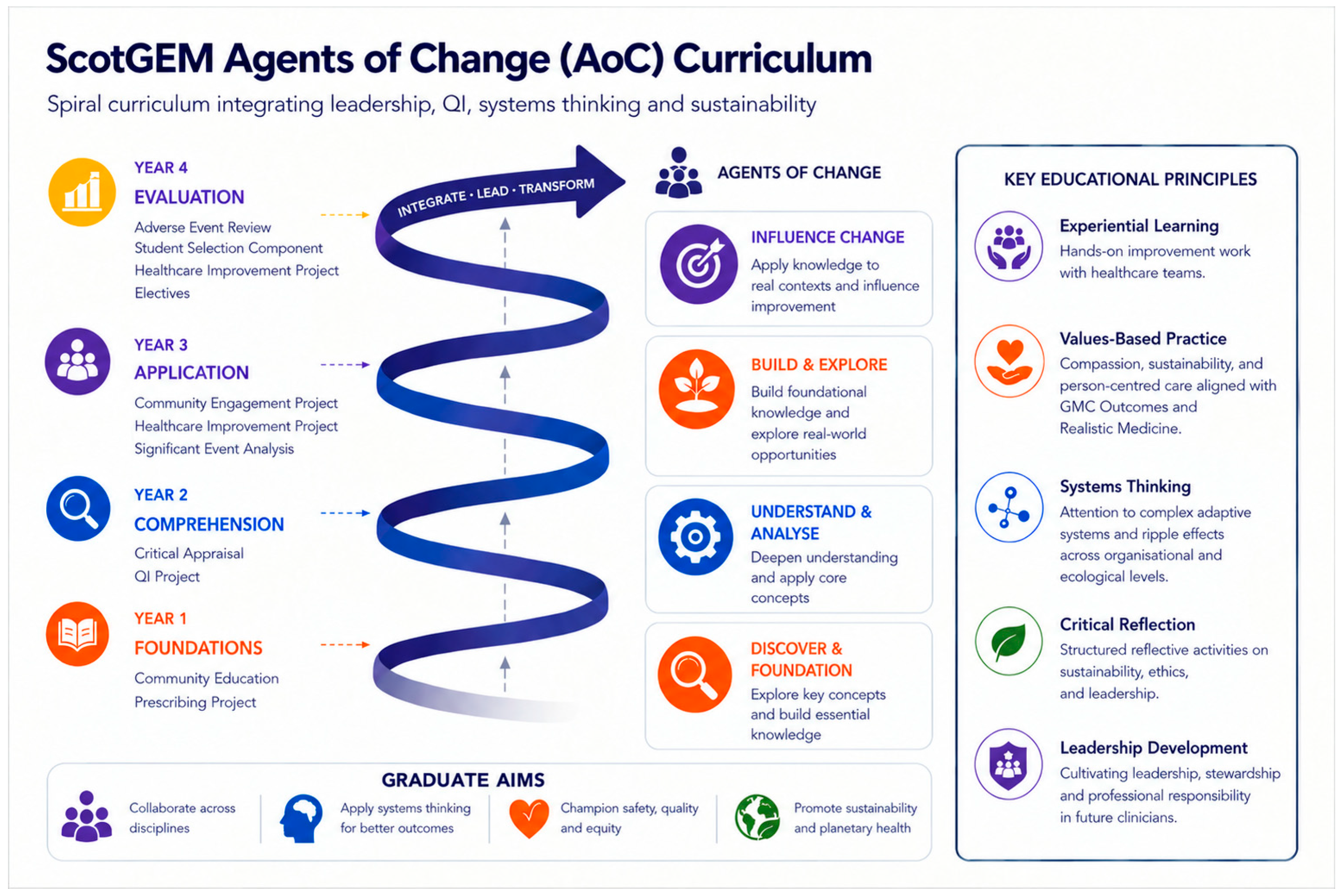
AoC is integrated across four years of the ScotGEM curriculum (Figure 1). It develops capabilities in leadership, QI, systems thinking, and environmental sustainability through project-based learning in clinical settings, structured reflection, and real-world inquiry. Key educational principles include:
Figure 1.
The ScotGEM Agents of Change (AoC) spiral curriculum. AoC is integrated across four years to develop capabilities in leadership, quality improvement (QI) systems thinking and environmental sustainability. ChatGPT (OpenAI free version) was used to assist with the visual refinement of the educational infographic; the authors reviewed and approved the final figure.
- Experiential Learning: Hands-on improvement work with healthcare teams [20].
- Values-Based Practice: Compassion, sustainability, and person-centred care aligned with GMC Outcomes and Realistic Medicine [3,6].
- Systems Thinking: Attention to complex adaptive systems and ripple effects across organisational and ecological levels [21,22].
- Critical Reflection: Structured reflective activities on sustainability, ethics, and leadership [23].
2.2. Study Context and Objective
This study sought to organise a heterogeneous set of healthcare improvement (QI) project titles from primary care into a pragmatic, four category framework to (i) quantify the distribution of projects across strategic domains and (ii) identify residual themes not captured by the framework. Because only titles (and not abstracts or full proposals) were available, we employed a conservative, rule-based text classification approach augmented by targeted expert feedback to iteratively improve recall for relevant categories [23].
2.3. Data Source and Eligibility
We analysed an Excel file containing 500 project titles spanning clinical and service improvement topics. This dataset includes all routinely collected and assessed project titles from quality improvement (QI) projects undertaken by undergraduate students from the inception of the programme in September 2018 until June 2025. Students work alongside their supervisors to design the project and provide the final title for coursework submission, which constitutes the data used in this study. All rows within the spreadsheet were considered in scope. To ensure data integrity, the titles were screened for duplicate nomenclature using Microsoft Excel. This screening identified 11 entries with identical phrasing across 5 unique titles (one title repeated three times, and four titles repeated twice). A manual audit confirmed that these records represented independent projects completed by different students rather than data entry errors; therefore, all 500 records were retained in their original order for final analysis.
2.4. Categorisation Framework
To categorise the dataset (n = 500), the researcher performed multi-label classification across four distinct categories. Each project title was assigned a binary value (1 for presence, 0 for absence) for every category, allowing for null, single, or multiple category assignments per title.
- Category 1 (Sustainability): Keywords related to environmental initiatives (e.g., waste, recycling, carbon footprint, inhaler disposal, green projects).
- Category 2 (Prescribing): Expanded to include any mention of prescribing activity, medication names, or drug classes (e.g., antidepressants, opioids, DMARDs, anticoagulants, inhalers).
- Category 3 (Patient monitoring and safety processes): Broadened to capture routine monitoring and safety processes (e.g., review, monitoring, follow-up, recall, risk assessment, BP/BMI checks, PSA, HbA1c), as well as patient engagement and anticipatory care.
- Category 4 (Regulations/audit): Keywords indicating compliance or audit activity (e.g., audit, adherence, guideline, protocol, NICE, SIGN).
Project titles (n = 500) were categorised using a structured coding framework (Supplementary File S3). To assess the reliability of the framework, a random sample of 75 project titles (15% of the dataset) was selected using a random number generator in Microsoft Excel and independently coded by a second reviewer. Each title was assessed against all four categories, generating 300 title-by-category coding decisions (75 titles × 4 categories).
Inter-rater agreement was assessed on the two reviewers’ independent coding, prior to discussion or refinement of the framework, and was calculated as the proportion of coding decisions for which both reviewers assigned the same classification. Across the 300 coding decisions, overall agreement was 92.3% (277/300). Cohen’s κ was calculated separately for each category from the 2 × 2 table of the two reviewers’ binary assignments across the 75 titles, with 95% confidence intervals derived from the asymptotic standard error. Category-specific agreement and κ were 96.0% (72/75; κ = 0.78, 95% CI 0.54 to 1.00) for Sustainability, 97.3% (73/75; κ = 0.95, 0.87 to 1.00) for Prescribing, 88.0% (66/75; κ = 0.63, 0.42 to 0.85) for Patient Monitoring, Safety and Care Processes, and 88.0% (66/75; κ = 0.75, 0.60 to 0.90) for Regulations and Audit. Raw agreement counts are provided in Table 1. Agreement was highest for Prescribing and Sustainability and lowest for Patient Monitoring, Safety and Care Processes and Regulations and Audit.
Table 1.
Pre-consensus agreement between the two reviewers for the 75 randomly sampled, independently double-coded project titles.
Comparison of coding between the two reviewers identified areas of disagreement primarily at the boundaries between the Prescribing and Patient Monitoring, Safety and Care Processes categories, and in determining whether projects should also be assigned to the Regulations and Audit category. Discrepancies were reviewed and resolved through discussion, resulting in minor refinements to the coding definitions to improve clarity and consistency. These refinements primarily clarified the inclusion of medication-specific projects within the Prescribing category and routine review, recall, and monitoring activities within the Patient Monitoring, Safety and Care Processes category. The refined coding framework was subsequently applied to the full dataset. The final coding framework is provided in Supplementary File S3. The reliability statistics in Table 1 therefore relate to the initial framework, before refinement; reliability of the refined framework was not formally reassessed.
The categorised dataset was exported as a CSV file. Summary statistics generated included:
- Total number of projects per category.
- Proportion of projects mapped to multiple categories.
- Number of unmapped projects.
2.5. Use of Generative Artificial Intelligence
ChatGPT (OpenAI free version) was used to assist with the visual refinement of an existing educational infographic used as Figure 1. This use was limited to improving the infographic’s visual presentation for teaching purposes. Generative AI was not used for data collection, classification of project titles, statistical analysis, or interpretation of the study findings. The authors reviewed the final figure and take full responsibility for its accuracy and content.
3. Results
3.1. Dataset Characteristics and Category Mapping
Findings
A total of 500 project titles were eligible and coded using a predefined, multi-label classification framework comprising four descriptive content categories: Category 1—Sustainability (environment), Category 2—Refining prescribing, Category 3—Patient-centred checks/outcomes (extended safety), and Category 4—Regulations/audit. The categories were not mutually exclusive, allowing individual titles to be assigned to more than one category where relevant. An additional unmapped group was used for titles that did not meet the predefined coding criteria for any of the four categories; this was not considered a fifth category domain.
Category Mapping Total titles: 500
- Category 1—Sustainability (environment): 46;
- Category 2—Prescribing: 260;
- Category 3—Patient monitoring and safety processes (extended safety): 404;
- Category 4—Regulations/audit: 202;
- Unmapped (no category): 27.
Interpretation: The high counts for Categories 2 and 3 reflect strong emphases on prescribing safety, monitoring, and outcomes within primary care QI. Sustainability was salient but less frequently explicit at the title level, which is expected given mixed project scopes and the conservative, title-only classification. Across the entire dataset (n = 500 titles), n = 183 received one category label, n = 290 received multiple category labels (n = 141 received two labels, n = 149 received three labels), and n = 27 received no category label and were therefore classified as unmapped. The total number of category assignments consequently exceeds the number of titles because of the multi-label coding approach.
3.2. Secondary Analysis of Unmapped Projects
Titles not assigned to any category were reviewed to identify emerging themes outside the original framework. A descriptive content analysis was conducted using keyword-based clustering. Representative examples were documented for each theme. Reviewer 1 reviewed the 27 unmapped titles and assigned them to emergent themes to capture patterns not represented in the original categorisation framework. The emergent themes identified from the 27 unmapped titles, along with representative examples, are presented in Table 2.
Table 2.
Themes identified from content analysis of responses not mapped to existing categories (n = 27).
3.2.1. Scope and Reach
- Over 80 General Practices have participated in these projects to date and represent where the students have conducted their experiential learning placements in General Practice in NHS Scotland. The supervision of the projects was undertaken by clinicians in these placements along with academic staff from the University of St Andrews and the University of Dundee. The participating NHS Health Boards were NHS Fife, Tayside, Dumfries & Galloway and the Highlands.
- In a wider context, 2184 AoC activities have been completed since 2018; 500 of which are improvement projects (included here) and 260 of these have been identified as being prescribing-related.
- Project topic types have been identified as potentially improving quality and promoting sustainable prescribing. 17 projects have focused explicitly on inhaler reviews (5 NHS Fife; 10 NHS Highland; 2 in NHS Dumfries & Galloway).
- Topics included switching from higher-carbon pMDIs to DPIs, rationalising PPI use, and reviewing long-term opioid prescribing.
- Projects were supported by local clinical mentors and informed by NHS prescribing data and national clinical guidelines [16,24].
3.2.2. Illustrative Case Study Example—A Student Publication
A series of student-led quality improvement projects undertaken within the ScotGEM graduate-entry medical programme demonstrate how sustainability can be embedded into healthcare improvement. Working in partnership with general practices and local communities, students identified opportunities to reduce the environmental impact of healthcare while maintaining or improving quality of care. Using established quality improvement methodologies, projects focused on areas such as reducing waste, supporting low-carbon prescribing, and introducing more sustainable models of service delivery.
Several projects reported positive outcomes, including reductions in healthcare waste, decreased use of high-carbon respiratory treatments, and increased use of remote consultation approaches that reduced travel for patients. Many of these initiatives were delivered in rural settings, highlighting how medical students can act as catalysts for change within their host organisations. This portfolio of projects illustrates the potential of student-led quality improvement to advance both environmental sustainability and patient-centred care [25].
4. Discussion
4.1. Impact and Evaluation
This study demonstrates that undergraduate quality improvement activities frequently address topics related to prescribing safety, patient-centred care, and sustainability. Title-level analysis identified substantial representation of prescribing, monitoring, and audit-focused projects, while sustainability-related themes were present both explicitly and implicitly across project topics. Although these findings suggest alignment between the Agents of Change (AoC) curriculum and national priorities for sustainable healthcare, the present analysis cannot determine whether projects resulted in measurable improvements in clinical outcomes, environmental impact, or prescribing practice. Rather, the findings indicate that students were regularly exposed to, and engaged with, issues relevant to sustainable and person-centred healthcare within primary care settings
These small-scale innovations reflect national priorities and may contribute to a broader culture shift towards sustainability in primary care [3].
Using a Triple Bottom Line (TBL) perspective, which considers environmental, social, and economic impacts, provides a useful framework for teaching sustainable prescribing decisions. In practice, this approach can help students understand how rational prescribing and shared decision-making may support improved health, reduced environmental harm, and more efficient use of resources. Embedding TBL into routine NHS prescribing strategies may help integrate planetary health considerations while maintaining patient safety and treatment efficacy.
4.2. The Role of Generalist Clinical Mentors (GCMs)
A key strength of the AoC model is the role of Generalist Clinical Mentors (GCMs), who act as both clinical supervisors and educational facilitators. GCMs provide continuity across placements and support students to identify, design, and implement QI projects within real-world primary care settings. This longitudinal mentorship enables students to engage more deeply with prescribing practice and sustainability, while ensuring projects remain clinically relevant and feasible within busy healthcare environments. Importantly, GCMs help bridge the gap between educational objectives and service delivery, helping distribute the workload of supervising QI activities, making it more sustainable for practices with limited capacity.
By guiding students through prescribing decisions, data interpretation, and stakeholder engagement, they provide opportunities for students to engage with concepts associated with systems thinking, leadership, and improvement science. While the curriculum is intentionally designed to foster these capabilities, the current study did not formally evaluate students’ competence development in these domains.
4.3. Learning Through Real-World Systems and Practice
To adapt to changes in the healthcare landscape, there is a growing emphasis on delivering undergraduate education in primary care to develop generalist, person-centred and whole-system skills, and to prepare students for the complex needs of an ageing, multi-morbid population [26]. Increasing exposure to primary care can also enhance students’ interest in general practice careers [27].
AoC is well aligned with national and international expectations for contemporary medical education. It reflects GMC Outcomes for Graduates and the Medical Schools Council’s consensus on education for sustainable healthcare [6,7], as well as RCGP competency frameworks addressing population and planetary health [28]. Internationally, calls from the WHO for climate-literate health professionals further reinforce the need for this approach [29,30]. In Scotland, Realistic Medicine provides a complementary framework, linking personalised, evidence-based care with environmental stewardship within a value-based healthcare system [3].
4.4. Challenges and Future Directions
Despite growing expectations for quality improvement (QI) in general practice—through professional appraisal, GP training requirements, and national or local initiatives—many practices struggle to find the time and resources to engage fully in this work. Sustainability is increasingly recognised as a parallel priority, reflected in the RCGP’s planetary health agenda and the inclusion of planetary health competencies in GP training [31], yet rising patient demand and clinical complexity limit meaningful engagement. In this context, student prescribing projects can add value to practice-level QI and sustainability efforts, but their success depends on substantial educational input, coordination, and supervision.
Understanding these ongoing resource requirements is essential for the sustainability of the ScotGEM AoC strand and similar curricular innovations. Embedding QI and sustainability within a crowded curriculum requires structured planning, continued advocacy, faculty development [12], and sustained relationships with host practices [23]. Demonstrating long-term impact will also depend on longitudinal evaluation—such as tracking prescribing indicators, inhaler returns, and relevant patient outcomes—supported by improved data infrastructure and iterative follow-up cycles.
Future evaluation should move beyond project topic classification to assess educational, clinical, and environmental outcomes. Longitudinal studies could examine whether participation in AoC activities influences prescribing behaviours, sustainability-related competencies, systems-thinking capabilities, or engagement in quality improvement after graduation. Similarly, where feasible, projects should be linked to measurable service outcomes, such as prescribing indicators, inhaler returns, medication-related safety measures, or patient-reported outcomes. Such work would provide a stronger evidence base regarding the sustained impact of embedding sustainability within undergraduate medical education.
4.5. Limitations
Several limitations should be considered when interpreting these findings. The analysis was based primarily on project titles rather than project reports, implementation data, or outcome measures. Consequently, project content may have been incompletely represented, and sustainability-related activities embedded within project methods or outcomes may not have been captured. The rule-based classification approach may have resulted in misclassification of some titles despite satisfactory inter-rater agreement.
In total, 15% (n = 75) of titles were validated to produce a robust subset; however, these are still restricted to titles only. This may under-represent sustainability content embedded in methods or aims; rule-based classification can misclassify polysemous terms; and short project timeframes constrain detection of environmental outcome changes.
As a single-programme study conducted within ScotGEM, the findings may not be generalisable to other settings. The absence of a comparator limits conclusions about how project patterns differ from other medical programmes. Finally, no longitudinal educational, clinical, or environmental outcomes were available, preventing assessment of sustained impact.
5. Conclusions
The ScotGEM programme provides a compelling example of how undergraduate medical education can integrate environmental sustainability alongside high-quality, person-centred care through structured quality improvement activities.
Through the innovative Agents of Change (AoC) strand, students are supported to develop as leaders and advocates for change, aligned with Scotland’s health priorities and wider climate goals. The project titles analysed in this study covered a broad range of topics, including person-centred care, quality improvement, prescribing, population health, and environmental sustainability. These findings suggest that green health and sustainability are being integrated within real-world clinical learning opportunities.
While clinical and cost-effectiveness remain central to patient care, incorporating environmental and social sustainability through a triple bottom line approach offers a more complete assessment of healthcare impact [31]. The distribution of project titles highlights the representation of sustainability-related topics across diverse areas of healthcare. Although this study did not evaluate project outcomes or educational impact, it highlights how sustainability can be embedded within undergraduate quality improvement activity and identifies an area for future evaluation of student learning, service improvement, and environmental outcomes.
By embedding green health within real-world clinical learning, the AoC strand is designed to foster a professional identity in which care for patients and care for the planet are inseparable—an essential foundation for leadership in an uncertain healthcare future.
6. Ethical and Governance Considerations
No patient-level data were used in the title analysis; only project titles were processed. The study did not involve human subjects research, identifiable information, or access to project reports and would generally be considered exempt from formal ethical review. All findings are reported at an aggregate level. Following discussion with the University’s governance team, it was determined that formal ethical approval was not required for this item of scholarship.
The illustrative case study presented in Section 3.2.2 was not part of the dataset analysed in this study. It is included solely to provide contextual insight into the types of sustainability-focused projects identified through the title analysis and is based on information already available in the published literature. No additional project data, participant information, or unpublished materials were obtained or analysed as part of this research.
As the study did not collect, access, or process personal data, ethical approval was not required. Under UK and EU data protection law, the secondary use of data for academic research is treated as a use compatible with the original purpose for collection. UK GDPR Article 5(1)(b) provides that further processing for archiving in the public interest, scientific or historical research purposes, or statistical purposes shall, in accordance with Article 89(1), not be considered incompatible with the original purposes of data collection.
Supplementary Materials
The following supporting information can be downloaded at: https://www.mdpi.com/article/10.3390/greenhealth2040028/s1, Supplementary File S1: Table S1 Royal Pharmaceutical Society recommendations to support sustainable prescribing [18,19]; Supplementary File S2: Detailed mapping descriptors; Supplementary File S3: Final Coding Codebook-General Coding Rules.
Author Contributions
Conceptualization, A.F. and F.S.; methodology, A.F., A.O. and J.I.; data curation, A.F. and A.O.; writing—original draft preparation, A.F., J.I., Z.M., E.K., J.S., A.O. and F.S.; writing—review and editing, A.F. All authors have read and agreed to the published version of the manuscript.
Funding
This research received no external funding.
Institutional Review Board Statement
Not applicable.
Informed Consent Statement
Not applicable.
Data Availability Statement
The data presented in this study are available from the corresponding author on reasonable request, subject to institutional requirements and applicable restrictions on data sharing.
Acknowledgments
We wish to acknowledge the support and commitment our NHS partners provide in delivering the Agents of Change curriculum. The authors have reviewed and edited the output and take full responsibility for the content of this publication. During the preparation of this manuscript, the authors used ChatGPT (OpenAI free version) to assist with the visual refinement of an existing educational infographic for teaching purposes, which was included as Figure 1. The authors have reviewed and approved the final output and take full responsibility for the content of this publication.
Conflicts of Interest
The authors declare no conflicts of interest.
Abbreviations
The following abbreviations are used in this manuscript:
| AoC | Agents of Change |
| AMR | antimicrobial resistance |
| NHS | National Health Service |
| pMDIs | pressurised metered-dose inhalers |
| QI | Quality Improvement |
| GCMs | Generalist Clinical Mentors |
| RCGP | Royal College of General Practitioners |
| ScotGEM | Scottish Graduate Entry Medicine |
| TBL | Triple Bottom Line |
References
- Tennison, I.; Roschnik, S.; Ashby, B.; Boyd, R.; Hamilton, I.; Oreszczyn, T.; Owen, A.; Romanello, M.; Ruyssevelt, P.; Sherman, J.D.; et al. Health Care’s Response to Climate Change: A Carbon Footprint Assessment of the NHS in England. Lancet Planet. Health 2021, 5, e84–e92. [Google Scholar] [CrossRef] [Scilit] [PubMed]
- Scottish Government. NHS Scotland Climate Emergency and Sustainability Strategy 2022–2026. Available online: https://www.gov.scot/publications/nhs-scotland-climate-emergency-sustainability-strategy-2022-2026/ (accessed on 12 November 2025).
- Scottish Government. Practising Realistic Medicine: Chief Medical Officer for Scotland Annual Report 2020–2021. Available online: https://www.gov.scot/publications/practising-realistic-medicine/ (accessed on 9 July 2025).
- Wellbery, C.; Sheffield, P.; Timmireddy, K.; Sarfaty, M.; Teherani, A.; Fallar, R. It’s Time for Medical Schools to Introduce Climate Change Into Their Curricula. Acad. Med. 2018, 93, 1774–1777. [Google Scholar] [CrossRef] [Scilit] [PubMed]
- Maxwell, J.; Blashki, G. Teaching About Climate Change in Medical Education: An Opportunity. J. Public Health Res. 2016, 5, 673. [Google Scholar] [CrossRef] [Scilit] [PubMed]
- General Medical Council. Outcomes for Graduates 2018. Available online: https://www.gmc-uk.org/-/media/documents/outcomes-for-graduates-a4-6_pdf-78952372.pdf (accessed on 10 July 2025).
- Tun, S.; Martin, T. Education for Sustainable Healthcare: A Curriculum for the UK. Available online: https://www.medschools.ac.uk/wp-content/uploads/2025/04/Education-for-sustainable-healthcare-A-curriculum-for-the-UK.pdf (accessed on 7 May 2025).
- Graham, F.; Dowell, J.; Flynn, A.; Gupta, S.; MacFarlane, A.; O’Malley, A.; Scully, R.; Sullivan, F.M.; Thompson, L.S.J.; Alexander, K. Development and Innovation in a New Distributed Medical Programme: Scottish Graduate Entry Medicine (ScotGEM). Front. Med. 2025, 12, 1586851. [Google Scholar] [CrossRef] [Scilit] [PubMed]
- Rajagopalan, S.; Landrigan, P.J. Pollution and the Heart. N. Engl. J. Med. 2021, 385, 1881–1892. [Google Scholar] [CrossRef] [Scilit] [PubMed]
- Booth, A. Carbon Footprint Modelling of National Health Systems: Opportunities, Challenges and Recommendations. Int. J. Health Plan. Manag. 2022, 37, 1885–1893. [Google Scholar] [CrossRef] [Scilit] [PubMed]
- Scottish Government. Annual NHS Scotland Climate Emergency & Sustainability Report 2024. Available online: https://www.gov.scot/publications/annual-nhs-scotland-climate-emergency-sustainability-report-2024/pages/1/ (accessed on 30 June 2026).
- National Health Service England; NHS Improvement. Delivering a ‘Net Zero’ National Health Service. Available online: https://www.england.nhs.uk/greenernhs/publication/delivering-a-net-zero-national-health-service/ (accessed on 30 June 2026).
- Romanello, M.; Walawender, M.; Hsu, S.-C.; Moskeland, A.; Palmeiro-Silva, Y.; Scamman, D.; Smallcombe, J.W.; Abdullah, S.; Ades, M.; Al-Maruf, A.; et al. The 2025 Report of the Lancet Countdown on Health and Climate Change: Climate Change Action Offers a Lifeline. Lancet 2025, 406, 2804–2857, Erratum in Lancet 2025, 406, 2756. [Google Scholar] [CrossRef] [Scilit] [PubMed]
- Booth, A.; Shaw, S.E. Addressing the Environmental Impact of Pharmaceuticals: A Call to Action. Br. J. Hosp. Med. 2025, 86, 1–8. [Google Scholar] [CrossRef] [Scilit] [PubMed]
- One Health Breakthrough Partnership. SEPA Publication on Data Visualisation Tool—Pharmaceuticals in the Water Environment. Available online: https://ohbp.org/2023/02/17/sepa-publication-on-data-visualisation-tool-pharmaceuticals-in-the-water-environment/ (accessed on 30 June 2026).
- Scottish Royal Colleges and Scottish Government. Polypharmacy Guidance: Realistic Prescribing, 3rd ed.; Scottish Government: Scotland, UK, 2018. Available online: https://www.therapeutics.scot.nhs.uk/wp-content/uploads/2018/09/Polypharmacy-Guidance-2018.pdf (accessed on 8 June 2025).
- Royal Pharmaceutical Society. Sustainability Policies. Available online: https://www.rcpharm.org/campaigns/sustainability-policies/ (accessed on 20 September 2025).
- Lavan, A.H.; Gallagher, P. Predicting Risk of Adverse Drug Reactions in Older Adults. Ther. Adv. Drug Saf. 2016, 7, 11–22. [Google Scholar] [CrossRef] [Scilit] [PubMed]
- General Medical Council. Good Medical Practice: Working with Colleagues and Systems for Improvement. Available online: https://www.gmc-uk.org/professional-standards/the-professional-standards/good-medical-practice (accessed on 12 May 2026).
- Kumagai, A.K.; Lypson, M.L. Beyond Cultural Competence: Critical Consciousness, Social Justice, and Multicultural Education. Acad. Med. 2009, 84, 782–787. [Google Scholar] [CrossRef] [Scilit] [PubMed]
- Borghi, J.; Ismail, S.; Hollway, J.; Kim, R.E.; Sturmberg, J.; Brown, G.; Mechler, R.; Volmink, H.; Spicer, N.; Chalabi, Z.; et al. Viewing the Global Health System as a Complex Adaptive System—Implications for Research and Practice. F1000Research 2022, 11, 1147. [Google Scholar] [CrossRef] [Scilit] [PubMed]
- Brown, B.; Holt-Macey, S.; Martin, B.; Skau, K.; Vogt, E.M. Developing the Reflective Practitioner: What, So What, Now What. Curr. Pharm. Teach. Learn. 2015, 7, 705–715. [Google Scholar] [CrossRef] [Scilit]
- Krippendorff, K. Content Analysis. In International Encyclopaedia of Communication; Barnouw, E., Gerbner, G., Schramm, W., Worth, T.L., Gross, L., Eds.; Oxford University Press: New York, NY, USA, 1989; Volume 1, pp. 403–407. [Google Scholar]
- Right Decision Service. National Therapeutic Indicators. Available online: https://rightdecisions.scot.nhs.uk/antidepressants-quality-prescribing-a-guide-for-improvement/data/national-therapeutic-indicators-ntis/ (accessed on 31 July 2025).
- Scriven, A.; ScotGEM Students. Sustainability in Practice: ScotGEM (Scottish Graduate Entry Medicine) Students’ Quality Improvement Projects in Primary Care—Reducing the Environmental Impact of Health Care. Rural Remote Health 2023, 23, 8137. [Google Scholar] [CrossRef] [Scilit] [PubMed]
- Guthrie, B.; Thompson, A.; Dumbreck, S.; Flynn, A.; Alderson, P.; Nairn, M.; Treweek, S.; Payne, K. Better guidelines for better care: Accounting for multimorbidity in clinical guidelines—Structured examination of exemplar guidelines and health economic modelling. Health Serv. Deliv. Res. 2017, 5, 1–150. [Google Scholar] [CrossRef] [Scilit] [PubMed]
- McElhinney, Z.; Graham, F. Generalist Clinical Mentors: Innovation in Undergraduate Medical Education. Med. Educ. 2026, 60, 191–192. [Google Scholar] [CrossRef] [Scilit] [PubMed]
- Royal College of General Practitioners. GP Capabilities and Progression Point Descriptors. Available online: https://www.rcgp.org.uk/getmedia/7a73a213-59d3-464f-9ce1-a1c59dffd7e0/GP-Capabilities-and-Progression-Point-Descriptors.pdf (accessed on 14 March 2026).
- World Health Organization. COP26 Special Report on Climate Change and Health: The Health Argument for Climate Action. Available online: https://www.who.int/publications/i/item/9789240036727 (accessed on 4 September 2025).
- Burale, H.; Fisher, D.; Tzortziou-Brown, V. Towards Greener Prescribing in General Practice. Available online: https://www.rcgp.org.uk/getmedia/f50d3afc-5fe0-4ac7-aa3f-9b3821e00312/RCGP-towards-greener-prescribing-in-general-practice.pdf (accessed on 30 October 2025).
- Kemple, T. How to be a triple bottom line general practice: Working for profit, the people, and the planet. Br. J. Gen. Pract. 2023, 73, 73. [Google Scholar] [CrossRef] [Scilit] [PubMed]

Disclaimer/Publisher’s Note: The statements, opinions and data contained in all publications are solely those of the individual author(s) and contributor(s) and not of MDPI and/or the editor(s). MDPI and/or the editor(s) disclaim responsibility for any injury to people or property resulting from any ideas, methods, instructions or products referred to in the content. |
© 2026 by the authors. Licensee MDPI, Basel, Switzerland. This article is an open access article distributed under the terms and conditions of the Creative Commons Attribution (CC BY) license.