


Simple Summary
Conservation efforts depend on accurate information to justify their implementation. Historical numbers and distribution often are used to promote conservation needs, but such information seldom is questioned. Historical information must be vetted and, if not questioned, can lead to the vilification of scientists or affect the credibility of conservation advocates. Such is the case with bighorn sheep, for which the historical estimates of numbers and distribution—and densities associated with those parameters—have not been scrutinized carefully since being derived near the beginning of the 20th Century.
Abstract
There is little question that the distribution and numbers of large mammals have been altered by human activities. In North America, native ungulates have declined substantially since the mid-1800s. There is no baseline, however, against which to measure the magnitude of changes aside from anecdotal accounts or published information derived from a single location at a single point in time and extrapolated to derive a continent-wide population estimate. One example is bighorn sheep (Ovis canadensis), which were estimated to number from 1.5 to 2.0 million individuals in 1850. The literature is replete with references to those numbers, yet the derivation of that ‘estimate’ has not been formally questioned; bighorn sheep, which are endemic to North America, currently number approximately 85,000 individuals. We combined basic math and logic to develop a simple model of population density at differing scales and examined results reductio ad absurdum to question the estimate of 1.5 million bighorn sheep and the magnitude of the hypothesized decline that followed. We evaluated the plausibility of bighorn sheep population densities that must have existed at four spatial scales if there were ≥1.5 million individuals and argue that such numbers likely never existed. Continued use of 1.5 million bighorn sheep as a baseline against which to assess the magnitude of anthropogenic impacts is unwise, inappropriate, and apt to become problematic in the context of the conservation of habitat, populations, or restoration to historical ranges. Credibility matters in science, management, and conservation.
1. Introduction
Ecological baselines are of great interest and are potentially of tremendous value to scientists or resource managers attempting to evaluate or understand the effects of anthropogenic perturbations on species or habitats [1,2,3], especially their role in extinction processes [4]. Multiple disciplines are capable of providing insights into historical ecology or earlier environmental conditions and can be combined to shed light on perplexing questions [5,6], among which are “Why did a particular organism become extinct?” [4] or “How many of a particular taxon existed before being affected by human actions?” One such enigma is the number of bighorn sheep (Ovis canadensis; Figure 1) that occupied North America circa 1850 but prior to the presumed losses that occurred thereafter.
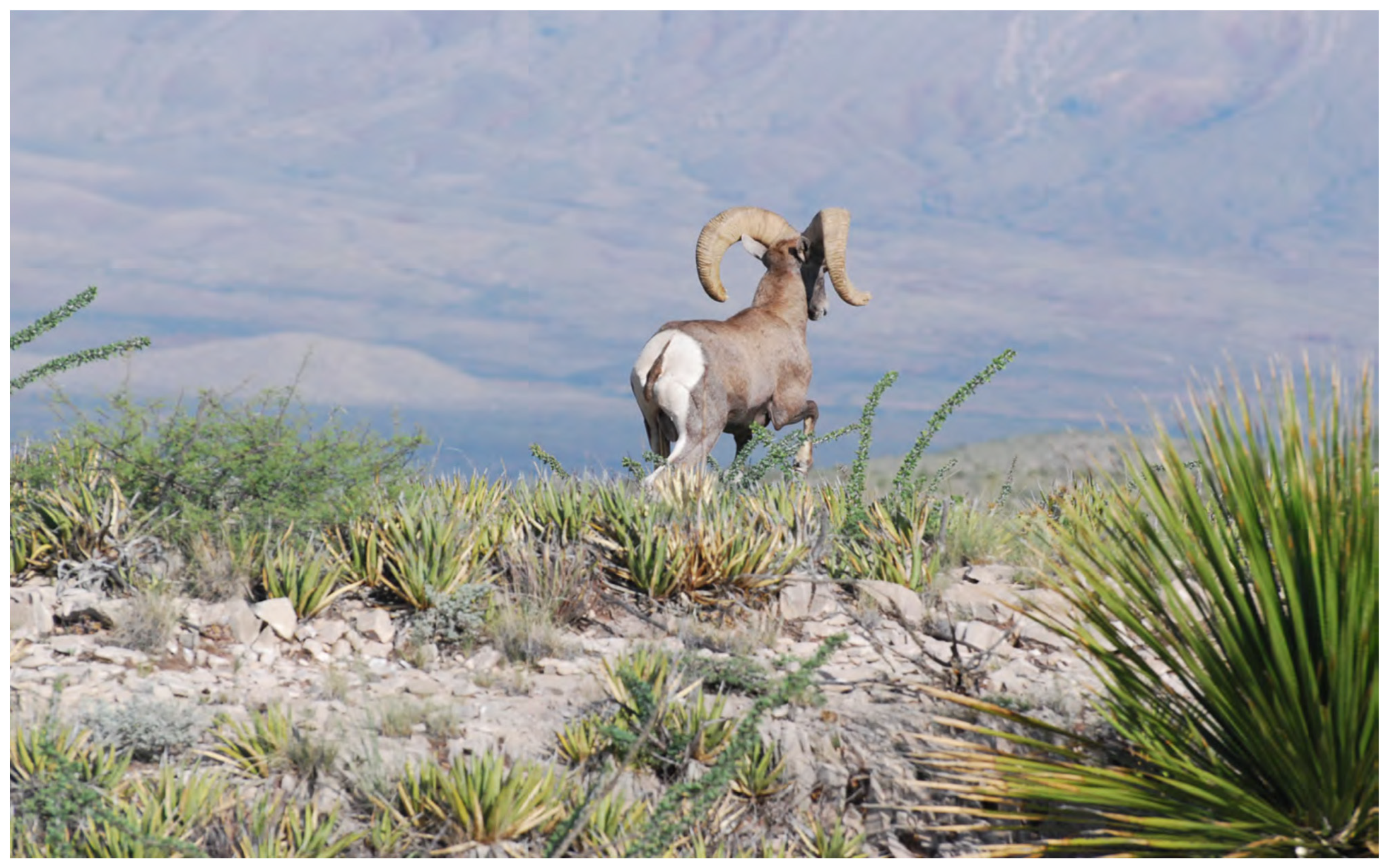
Figure 1.
Bighorn sheep (Ovis canadensis) are the most recognizable and iconic mountain ungulates inhabiting North America. Photo is courtesy of Michael T. Pittman and used with permission.
Although wildlife populations in North America had been affected profoundly by indigenous peoples for thousands of years [7] and more recently by the arrival of Spanish explorers and their accompanying livestock [8,9,10], it was the extension of the railroads, passage of the Homestead Act in 1862, and the resulting westward human expansion that brought about the greatest effects on native species and their habitats [11], including bighorn sheep. It was nearly 100 years ago that Seton [12] estimated that from 1,500,000 to 2,000,000 bighorn sheep inhabited North America circa 1850. Since then, few have questioned those numbers, and only Welles [13] has shed any light on the methods used to arrive at that conclusion. In the absence of checks and balances, investigators cannot assure information is meaningful or has been presented accurately [14], stimulating our review of this process.
The number of individuals comprising a population is among the most basic of demographic data, and effective wildlife management is hindered without reliable information on population size, dynamics, or movements of the animals concerned [15]. Thus, the questions, “How many of them are there?” and “How many of them were there?” are directly relevant to conserving extant populations and to restoring endangered—or other special-status—species [16]. Answers to these questions vary with spatial scale and can involve a multitude of factors, including contractions in distribution, extinctions, numbers of populations, population size, colonization and extinction rates, and others [17].
Among extant populations, the best we can hope for is a census (i.e., the total number of individuals comprising a population), but biologists generally are pleased with estimates of high precision. A highly precise estimate, however, is not necessarily synonymous with an accurate estimate [18], and high levels of precision may not be necessary for management or restoration purposes [19,20]. A census is possible, however, only when the population or taxon of interest is so small in number and its distribution so well understood that investigators can be confident that every individual can be tallied. Indeed, the total number of individuals comprising an extant taxon could be determined by counting and summing the number of individuals comprising every subpopulation of a particular taxon at a specific time. With few exceptions [21,22,23], including the Endangered California condor (Gymnogyps californianus) and Sierra Nevada bighorn sheep (O. c. sierrae), complete enumerations are unlikely. Further, in the absence of marking and accounting for every individual, investigators cannot be certain of the number of animals present in a specific area at any given time [24]. The widespread geographic range of bighorn sheep (Figure 2) precludes any opportunity to do so.
Deriving an estimate of the number of a particular taxon that existed long before the present is a virtual impossibility, and Ernest Thompson Seton [12] was among the first to do so. Several of his population estimates are still considered credible, and he further presented information on distributional ranges and reconstructed original ranges for several North American species. Seton did not have the benefits available to modern investigators, but his pioneering efforts warrant continued recognition. It was without equivocation, however, that Seton [12] asserted, “… it is very safe to assume [emphasis added] the primitive number [of bighorn sheep] at between 1,500,000 and 2,000,000”, but he did not associate a specific date with that proclamation. He emphasized, however, that “Over this immense area of 2,000,000 square miles, wherever mountainous [emphasis added], the Bighorn (sic) was plentifully distributed as late as 1870” [12]. A number seemingly consistent with the unverified ‘facts’ about bighorn sheep was provided by Grinnell [25].
Thirty years later, Buechner [26] clearly credited Seton [12] with the statement that between 1.5 and 2.0 million bighorn sheep occupied North America near the beginning of the 19th Century and that the principal reduction in numbers occurred in the latter one-half of that century. Although likely unintended, those numbers have become—and remain—firmly established in the literature, but with Buechner [26] in lieu of Seton [12] most often cited as the source. Buechner [26] continues to be referenced as the authority substantiating a massive decline in the number of bighorn sheep since 1850, as evidenced by many others [27,28,29,30,31,32,33,34,35,36,37,38,39,40,41].
Shortly after the publication of Buechner [26], Welles [13] raised questions about the methods used by Seton [12] to derive his population estimate, and further questioned why Buechner had accepted that ‘estimate’ without scrutiny. We first became aware of that critique more than 40 years ago, but have never encountered either the mention of or a citation of Welles [13] in the literature. Neither have we come across any other reference questioning the methods described by Seton [12] who wrote
“Some idea of the primitive number of Sheep (sic) may be formed from the population in Glacier National Park. In 1916, I spent some weeks camping in the Park (sic), and after using all sources of information, calculated that the 2500 square miles of the Park (sic) contained not less than 1500 Sheep (sic). In the official Report (sic) this estimate of mine was raised to 2000, or about 1 Sheep (sic) to the square mile of this possible territory”.
“The Park (sic) is far from ideal range. It contains very little true Sheep (sic) pasture of the kind that they sought a hundred years ago. One can travel about a whole month, as I proved in 1916, and never see a Sheep (sic). In the Big Horn Basin, judging by Lewis and Clark’s accounts, and those of later travelers, Sheep (sic) may have been ten times as numerous [emphasis added] as the above Park estimate. Offsetting this, however, is the sparse population of the arid desert regions.”
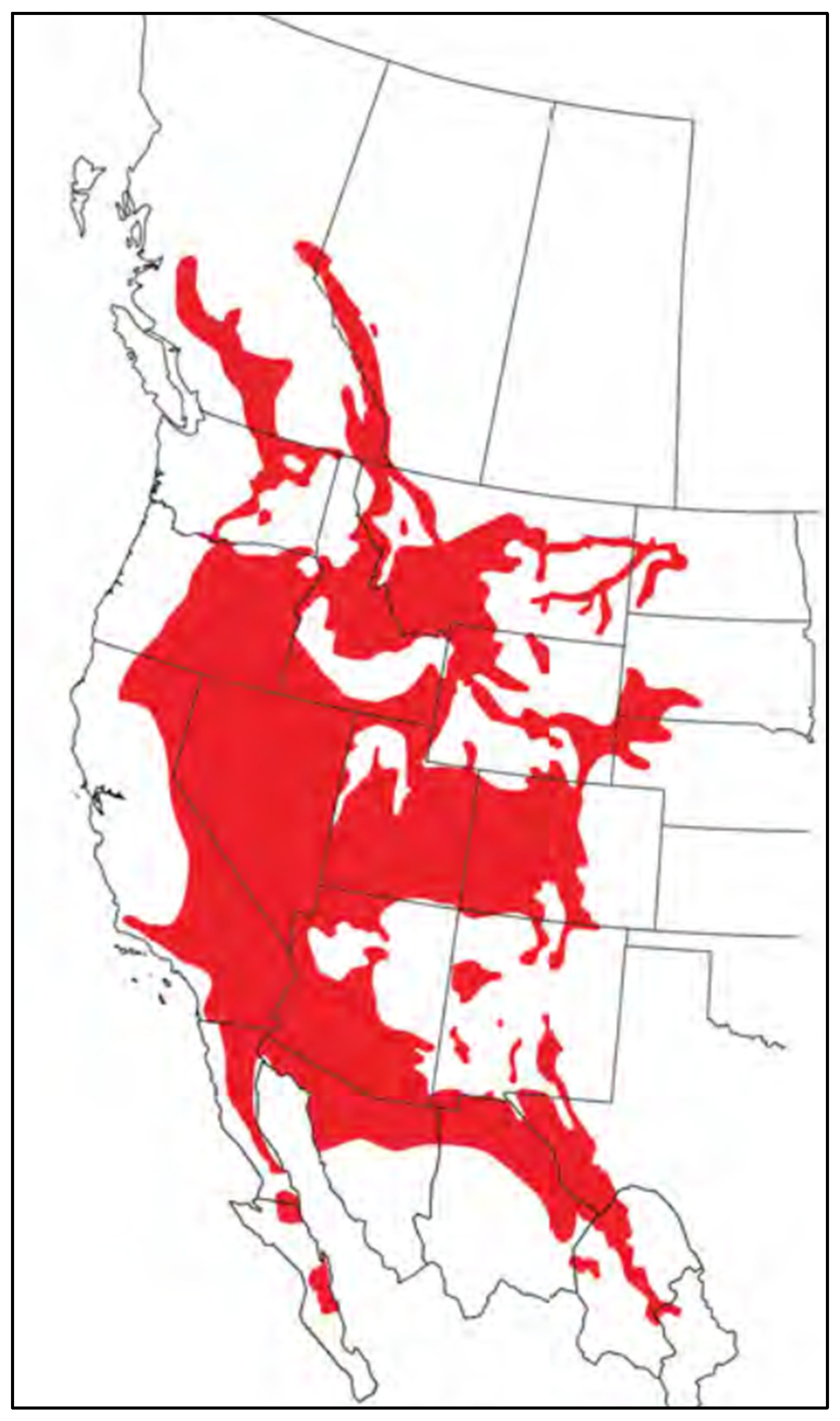
Figure 2.
The hypothesized distribution of bighorn sheep (Ovis canadensis) in western North America circa 1850 included parts of two Canadian Provinces, 15 of the conterminous Unites States, and seven states in Mexico. Adapted from [42].
From this description, Seton concluded that the number of bighorn sheep that occupied North America circa 1850 was between 1.5 and 2.0 million individuals [12]. These numbers were accepted widely but without scrutiny, and since 1960 have been attributed almost universally—albeit erroneously—to Buechner who wrote, “Judging from former distribution and published records referring to abundance given in the sections to follow on past and present status, it seems that Seton’s (1929:535) estimate [emphasis added] of one and one-half to two million individuals for the whole species, including populations in Canada, United States, and Mexico, is entirely possible as a pristine level of abundance” [12,26].
Despite the cautions raised [43], and in the absence of any critical evaluation, Bandy concluded that, “… only 1% of their pristine numbers [of bighorn sheep] have survived 100 years of ‘progress’ in North America” [44]. Shortly thereafter, Manville stated unequivocally that, “Buechner (1960) [26] concurs [emphasis added] with Seton’s [12] estimate of 1,500,000 to 2,000,000 bighorn sheep on the continent [of North America] early in the nineteenth century” [29]. Wagner further suggested the number of 1.5 million bighorn sheep was an overly conservative estimate [45].
Since then, the authors of countless scientific papers, chapters, agency reports, ‘gray’ literature, newspaper articles, popular articles, theses, and dissertations have cited Seton [12] or Buechner [26] as evidence of massive population declines of bighorn sheep. Now considered tertiary sources, many of the same authors continue to be cited as further documentation in efforts to emphasize conservation strategies. Opponents of such efforts, however, have not yet questioned the origin of the potentially spurious numbers [12], the use of the secondary source [26], or the abundant tertiary sources that are cited to substantiate the magnitude of the decline.
A continuing failure to question the validity of Seton’s ‘estimate’ [12] has the potential to be used to vilify dedicated scientists and ultimately could have serious consequences for conservation [46]. Indeed, a population decline of 99% based on a potentially flawed baseline begs the question of scientific credibility and thereby becomes a compelling reason for questioning current land-management recommendations [47]. The credibility of any decline that relies on Seton’s estimate [12] as a baseline should not remain unquestioned; in the absence of scrutiny by concerned scientists, the unsubstantiated magnitude of the decline provides fodder that can be used to undermine recommendations on behalf of bighorn sheep conservation.
We are in no better position than was Seton [12] to derive an estimate of the number of bighorn sheep present in North America circa 1850, and it is not our intent to disparage his earlier effort or to produce a more plausible historical estimate. Instead, we examine the distribution of bighorn sheep at four different scales and calculate the population densities that must have existed in North America if ≥1.5 million bighorn sheep had occupied the continent prior to substantial declines in distribution and numbers. Our objectives are to (1) explore the weaknesses in the methods used to derive Seton’s estimate of the number of bighorn sheep occupying North America circa 1850; (2) examine the population densities that must have existed at several spatial scales; (3) question the plausibility of those densities; (4) emphasize the ramifications of using potentially questionable information to support recommendations for conservation; and (5) encourage additional investigators having access to sophisticated software and mapping technologies to further explore the question the number of bighorn sheep that once occupied North America and perhaps derive a more plausible estimate.
2. Methods
To reach his conclusion, Seton calculated a density of 1 bighorn sheep for every square mile (i.e., 0.39 individuals/km2) of Glacier National Park, whether it was occupied by bighorn sheep, and then extrapolated that density—while maintaining it as a constant—throughout the geographic range of the species [12]. He considered that area to be 2,000,000 square miles (5,180,000 km2), assumed that density to be homogenous across the geographic range, and extrapolated it to a continent-wide scale (i.e., all bighorn sheep inhabiting Canada, the United States, and Mexico combined), thereby concluding that up to 2 million bighorn sheep occupied the continent circa 1850 [12].
We used a similar approach and assumed a homogeneous density (0.39 individuals/km2) of bighorn sheep at each of the spatial levels we considered. We explored changes in density at those scales, assuming that the continent-wide number of bighorn sheep remained constant at each, and evaluated those results in the context of Seton’s population estimate. We considered 1.5 million bighorn sheep to be the most reasonable ‘estimate’ to question; if the calculations indicated 1,500,000 bighorn sheep was implausible, consideration of a population numbering up to 2 million bighorn sheep would not be necessary.
We conducted an extensive literature review to evaluate the historic distribution and concomitant population densities of bighorn sheep, and to obtain similar information for contemporary populations. We also relied on multiple, readily available electronic sources to obtain land surface areas of continental Canada, the conterminous United States, and Mexico. We used the same type of sources to obtain land surface areas of the 2 Canadian provinces, the 15 American states, and the 7 Mexican states inhabited by bighorn sheep [48,49] circa 1850, and to obtain land surface areas of local or political jurisdictions in each province or state (i.e., population census units [Alberta] or regional districts [British Columbia] in Canada; counties [USA]; or municipalities [Mexico]) that the literature indicated were inhabited by bighorn sheep at that time (Table 1).
Table 1.
Land surface areas of the intranational jurisdictions, the sum of the total land surface areas of the local jurisdictions that likely supported bighorn sheep within each intranational jurisdiction, and estimated populations in 1850 had 1.5 million bighorn sheep been distributed homogenously across each local jurisdiction, as done by Seton for the geographic range of the species [12]. The estimated current population of each intranational jurisdiction and the percentage of the population estimated in 1850 are included for comparative purposes only.
We used these metrics to derive estimates of population density at 4 different scales while assuming that 1,500,000 bighorn sheep were distributed evenly at each scale of inquiry. Thus, we calculated and compared densities of bighorn sheep that would have existed circa 1850 at (1) an international scale (i.e., the combined land areas of continental Canada, the continental United States, and the entirety of Mexico); (2) an intranational scale (i.e., the combined land areas of the 2 Canadian provinces, the 15 U.S. states, and the 7 Mexican states that are or were inhabited by bighorn sheep as generally agreed upon [48,49]; (3) solely within the 5,180,000 km2 considered to encompass the historic geographic range of bighorn sheep [12]; and (4) the combined land areas of the local jurisdictions within each province or state that likely were inhabited by bighorn sheep circa 1850. At this scale, we examined topographic or digital maps, additional internet sources, literature, or management plans, and relied on our professional judgement to assess whether or not suitable bighorn sheep habitat existed within the local jurisdiction of interest. If such were the case, we considered the total land area of each political jurisdiction to have been occupied habitat.
We combined simple math and logic to approximate the densities of bighorn sheep circa 1850 if the estimate of 1.5 million bighorn sheep [12] was plausible. We used an iterative approach based on the various spatial scales while holding constant the assumption that 1.5 million bighorn sheep had been present, and we considered 100% of the land surface area to be occupied at each level of analysis. We then used that information to construct a simple model of area-to-density relationships at these scales to visualize and validate our thinking [53] with a density-area sensitivity analysis and incorporated an approach termed reductio ad absurdum [reducing to absurdity] to question the estimate of 1.5 million bighorn sheep and the magnitude of the hypothesized decline that followed.
We used simple descriptive statistics and nonparametric tests to compare density estimates of free-ranging populations on 6 year-round ranges, 5 seasonal ranges, and in 7 enclosed populations. Represented among these were two (desert, Rocky Mountain) of the three putative clades of bighorn sheep [54], enabling further discussion of seasonal nutrient availability and its consequences for population density, neither of which were considered by Seton when making his calculations [12].
3. Results
Assuming 100% of the land area of North America was inhabited by 1,500,000 bighorn sheep distributed homogenously throughout mainland Canada (~7,670,000 km2), the conterminous United States (~7,685,000 km2), and Mexico (~1,944,000 km2), the mean population density would have been 0.0867 individuals/km2. Based on a simple, proportional relationship between the land areas of each of these countries, Canada, the United States, and Mexico would have been occupied by 44.3%, 44.4%, and 11.3%, respectively, of bighorn sheep at that time.
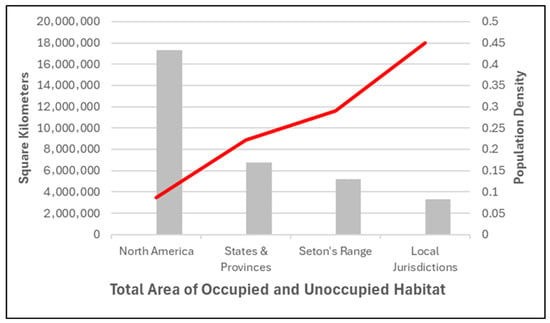
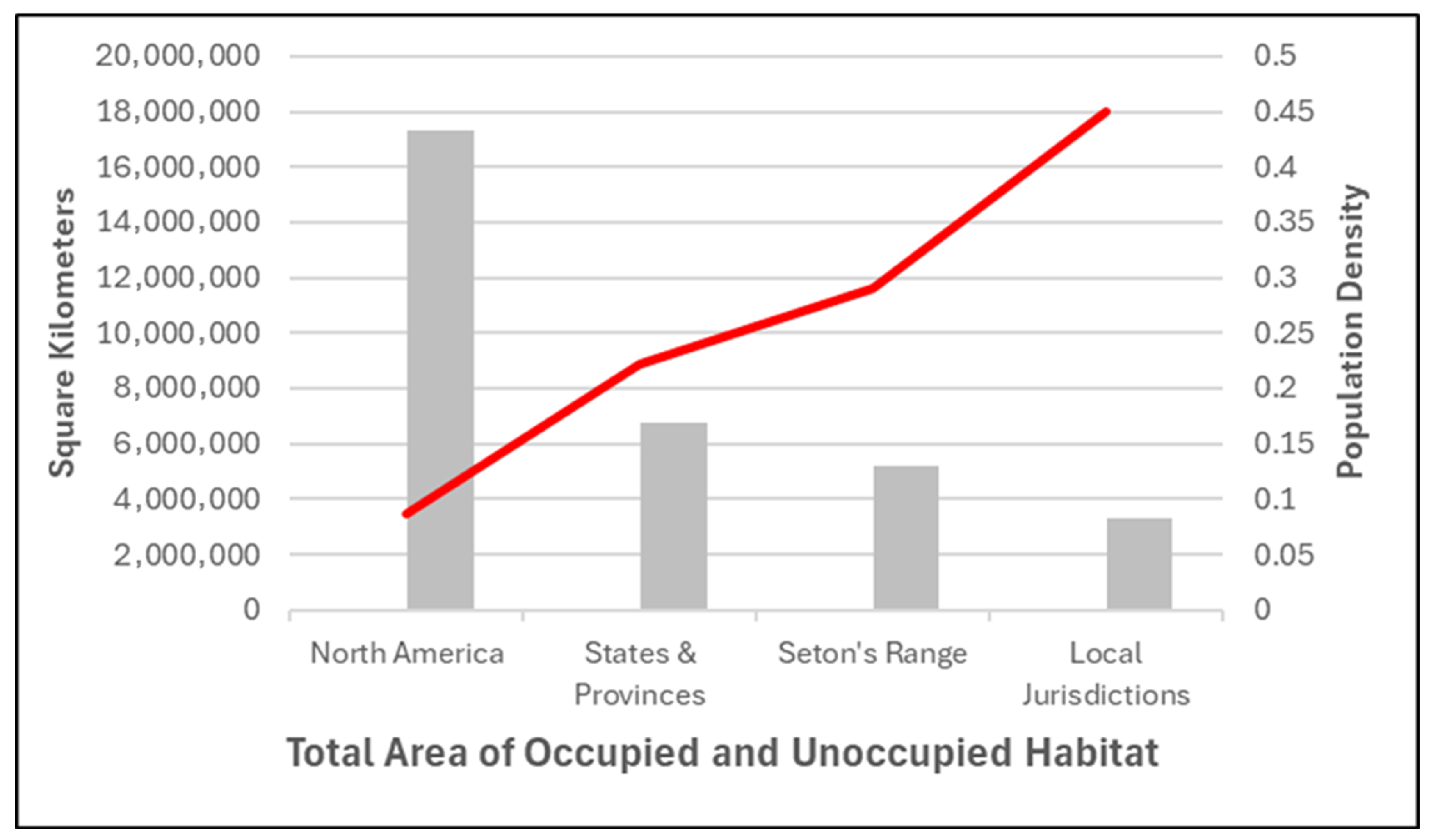
When the distribution of 1,500,000 bighorn sheep is considered directly from land area at continental, international, intranational, and local jurisdictional scales rather than from a proportional perspective, bighorn sheep would have occurred at mean densities of 0.0867/km2 at a continental scale, at 0.2224/km2 across the combined total land area of the provinces and states inhabited by bighorn sheep, at 0.2896/km2 across the geographic range of the species, and at 0.4500/km2 over the combined total land area of the local jurisdictions inhabited by bighorn sheep in Canada, the United States, and Mexico (Figure 3).
Figure 3.
A simple model of the relationship between land surface areas determined at various scales (vertical bars) and the population density (red line) associated with those land surface areas. Land surface areas at each scale include habitat that we assumed to have supported bighorn sheep in 1850 and the remaining area that would not have been occupied by bighorn sheep based on the current literature and our professional judgement (see Section 2). Note also that the total area of North America includes only the land areas of mainland Canada, the conterminous United States, and all of Mexico, the three countries that encompass the historical geographic distribution of bighorn sheep. Calculated population densities in this graphic are, at all scales, far lower than would have existed if based only on habitat permanently occupied within the geographic distribution of the species.
Population densities for free-ranging populations or those maintained in large enclosures were encountered infrequently in the literature. Nonetheless, we calculated additional densities using information contained in several additional references (Table 2). The contemporary mean density of free-ranging bighorn sheep on specific seasonal ranges ( = 3.050/km2) was greater (Ua = 25, z = −1.73, P1 = 0.042) than on year-round ranges ( = 0.998/km2), but seasonal differences were not considered when Seton derived his population estimate [12]. The mean density of free-ranging bighorn sheep on combined seasonal and annual ranges ( = 1.931/km2) naturally was far less (Ua = 75, z = −3.26, P1 < 0.001) than that of enclosed populations ( = 17.499/km2), some of which received supplemental feed (Table 2).
Table 2.
Densities of free-ranging bighorn sheep on seasonal ranges ( = 3.050 ± 1.28 [SE]/km2) was greater (Ua = 25, z = −1.73, P1 = 0.042) than on year-round ranges ( = 0.998 ± 0.37/km2) but was not a consideration when Seton derived his population estimate [12]. The density of free-ranging bighorn sheep for seasonal and annual ranges combined ( = 1.931 ± 0.066) was less (Ua = 75, z = −3.26, P1 < 0.001 than that of enclosed populations ( = 17.499 ± 8.67), some of which received supplemental feed. Data for populations restricted to islands were not included in the analyses and are presented only for comparative purposes. Population densities on annual, winter, or summer ranges are identified as A, W, or S, respectively.
4. Discussion
Bighorn sheep are among the world’s most recognizable large mammals, and healthy and viable populations persist in North America because of active and visionary management [79,80]. These mountain ungulates are among the most conservatively managed large mammals occupying the continent [81] and have benefitted from many successful efforts to restore them to landscapes from which they had been extirpated [82,83]. They continue to be burdened, however, with a seemingly infinite list of challenges [84], among which are habitat modification or habitat loss, pathogens associated with domestic livestock or exotic ungulates, and competition for resources with non-native herbivores [85,86,87,88].
Aside from Demarchi [89], only Welles has provided a rationale for viewing Seton’s population estimate with skepticism, but he did so in the absence of quantification [12]; hence, we offer the following. The area (Glacier National Park) wherefrom Seton derived his ‘estimate’ of up to 2.0 million bighorn sheep encompassed an expansive region in the Rocky Mountains that included habitats not occupied by that species [12]; similarly, he extrapolated his calculations to an international geographic distribution that included vast landscapes not occupied by those specialized ungulates. To his credit, however, Buechner later acknowledged [26] that, “… the number [of 1,500,000 to 2,000,000 bighorn sheep] cannot be accepted as an absolute value [but] it does provide a credible background [emphasis added] against which to compare current status”. That phrase, however, has been overlooked by others who continue to use Seton’s estimate [12] as a baseline.
Ongoing efforts to conserve populations of bighorn sheep, or to restore them to suitable areas, are dependent on support from advocacy groups, and the efficacy of those efforts is dependent on the ‘facts’ used to bolster arguments in favor of such management actions. Indeed, the management and conservation of wildlife is most apt to be successful if it resonates with and is supported by the public [90]. Further, the “… objectives of applied science, including wildlife management, entail providing data-based conclusions that assist decision-makers and, ultimately, steer policies or actions towards desirable conservation outcomes. Selectively focusing on a singular aspect … using inappropriate metrics or scales to bolster arguments falls short of those objectives” [91]. Thus, it is essential that reliable information is used to establish baselines against which changes are compared if subsequent shifts are to be considered meaningful. Credibility matters!
Some authors previously have questioned Seton’s conclusion [82], albeit in the absence of a rationale for doing so. For example, Wishart raised the issue in the context of the distribution and abundance of undisturbed populations of bighorn sheep and argued—in the absence of any evidence to the contrary—that the total number of O. canadensis in North America never approached 1.5 million [92]. Similarly, Demarchi disputed the number of 1.5 million bighorn sheep—which he erroneously attributed to Buechner—and postulated that it was perhaps 10-times too high because bighorn sheep occupy a fairly narrow habitat niche, but he offered no further explanation [89]. Valdez specifically questioned Seton’s [12] estimate and suggested the total number of wild sheep (O. canadensis and O. dalli combined) inhabiting North America never exceeded 500,000 but did so absent further justification [52]. Others acknowledged that Seton’s estimate likely was too high, but also noted also that, “… bighorn sheep may well have been the most common big game animal in mountainous regions [emphasis added] [of North America]” [93] and several additional investigators have emphasized the absence of reliable historical population estimates, but speculated that the number of wild sheep inhabiting North America circa 1850 was likely in the hundreds of thousands [39,77], again in the absence of supporting evidence. Recently, it was emphasized that the number of bighorn sheep thought historically to have inhabited North America remains unsubstantiated [94].
Our results are consistent with the notion that bighorn sheep could not have occurred at densities allowing 1,500,000 bighorn sheep to have occupied the landscape circa 1850. Indeed, the density that would have existed across every local jurisdiction having any probability of being inhabited by bighorn sheep would have been 0.45 individuals/km2 (Figure 3). On average, these local jurisdictions represent approximately 50% of the land area of all states and provinces inhabited by bighorn sheep circa 1850 ( = 53.9% ± 28.5% [SD]; range 6–100%), but the calculated density does not reflect the abundance of potential bighorn sheep habitat within each local jurisdiction that could have been occupied; only the potential presence of suitable habitat is reflected in those calculations. When combined with the narrow habitat niche of bighorn sheep [88,89] and the naturally fragmented distribution of bighorn sheep on the landscape [95], these limitations indicate bighorn sheep must have occurred at far greater densities in occupied habitat circa 1850 than currently is the case. Some free-ranging populations for which density estimates were readily available are greater than 0.45/km2; they represent, however, population densities in discrete regions of occupied habitat (Table 2). In contrast, our calculated density for local jurisdictions is based on the entire land area of all jurisdictions that, in our professional judgement, likely contained at least some suitable habitat (Table 2, Figure 2).
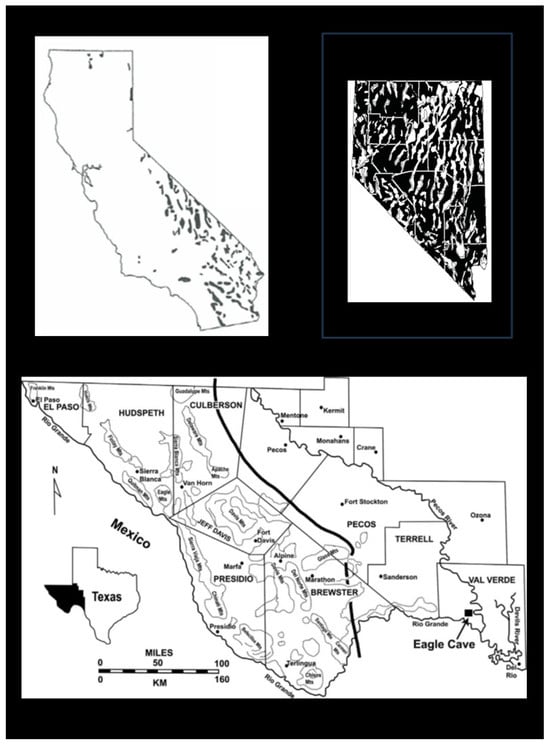
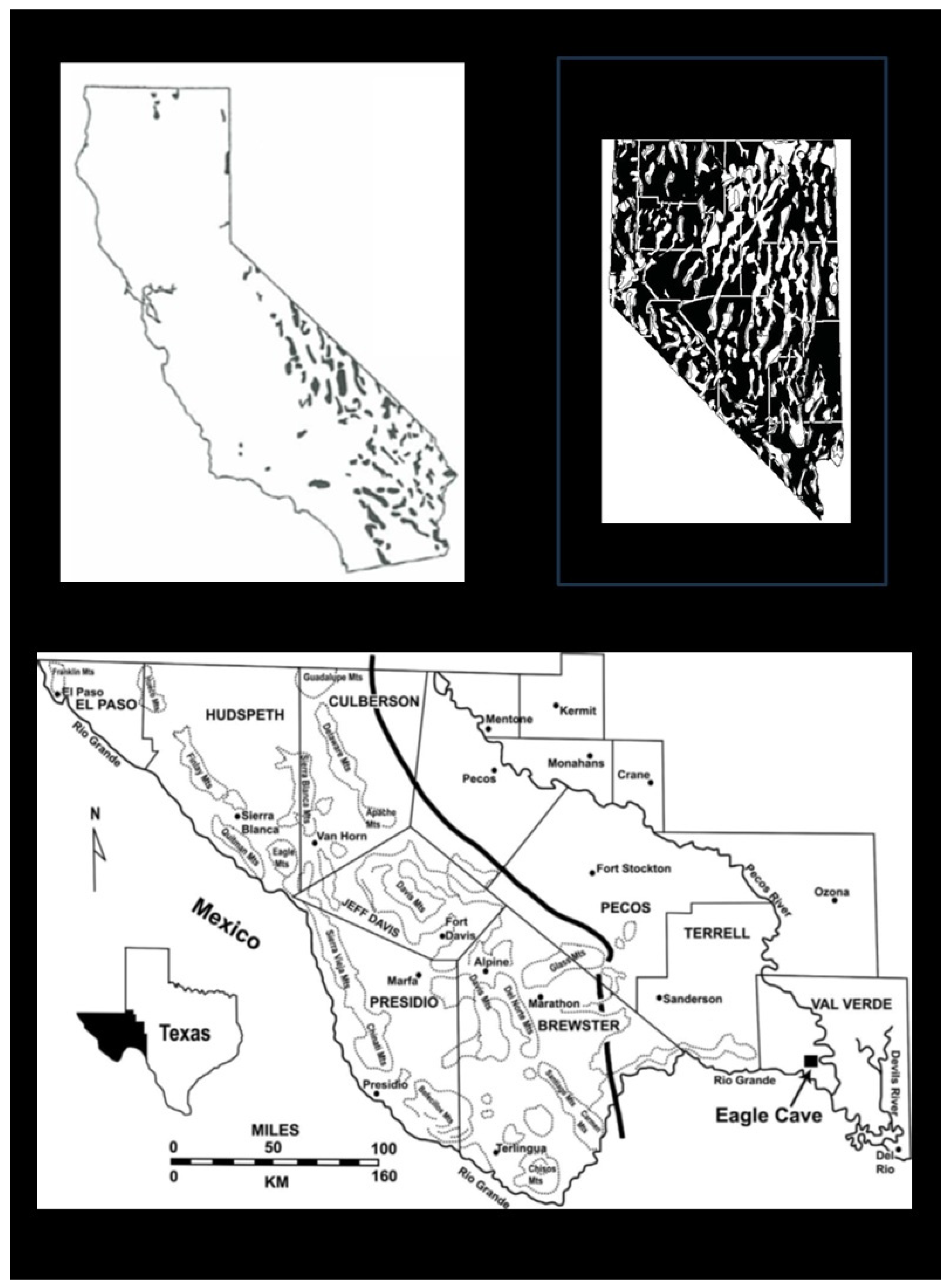
Bighorn sheep indeed occupy a narrow habitat niche [82,83,88,93,96,97,98,99]. As a result, these specialized ungulates exhibit a noncontiguous or naturally fragmented distribution (Figure 4) across the landscape that is defined largely by mountain ranges or other topographic features and results in rather isolated populations [95,100,101,102,103]. Despite being habitat specialists, Seton considered the population density he developed for Glacier National Park to be universally applicable and extrapolated that density to every square kilometer across the known range of O. canadensis, whether occupied by bighorn sheep or not [12]. That density was later ascribed to the entire continent of North America [26], potentially creating further uncertainty about its plausibility.
Figure 4.
Examples of the discontinuous distribution of bighorn sheep (Ovis canadensis) in the conterminous United States. Black polygons represent the historical distribution of bighorn sheep in California (upper left panel), white polygons represent the historical distribution of bighorn sheep in Nevada (upper right panel), and the contour lines define the mountain ranges that were occupied by bighorn sheep in Texas (lower panel), United States of America. Areas between the occupied polygons in each map represent the unoccupied matrix of uninhabited areas between or among the occupied areas. Each figure is based on the best available information and is included specifically to emphasize the discontinuous distribution of suitable habitat across broad areas within the geographic range of bighorn sheep. Images of California, Nevada, and Texas were adapted from previously published material [102,104,105].
In addition to a naturally fragmented distribution, bighorn sheep—and ungulates in general—possess life-history traits that make them more susceptible than other mammals to environmental perturbation, extirpation, or even extinction [106,107]; among these are slow-paced life histories and large body size [108], both of which previously had been ignored [12,26]. In part, these traits make them especially sensitive to variation in nutrient availability on a per capita basis. Ecological carrying capacity (K; the maximum number of individuals a defined area can support indefinitely when limited by nutrients, water, amount of suitable habitat, and predation or disease [109,110,111]) and Nutritional Carrying Capacity (NCC; the upper limit established on population growth that occurs when resource competition affects survival and reproduction [109]) both change with availability of forage [19,20,99,112] and each of them is affected by, or has an effect on, population density. Nutrient availability affects body condition of animals through integration with other inputs and outputs [113] but K or NCC determines the number of animals any defined area can support under a given set of conditions [114].
The amount of nutrients available to individuals comprising a population is further affected by additional factors (e.g., weather, fire history, predation risk, behavioral characteristics) and, ultimately, by population density in the context of those factors. Seton recognized that the density of bighorn sheep in potentially less productive regions, such as deserts, might be lower than that for Glacier National Park, but noted also that lower densities in such areas might offset that calculated for the Park [12]. Not considered, however, was how K or NCC is affected by the size of the geographic area under consideration, and the resulting proportion of suitable (i.e., occupiable) habitat occurring therein. Large or vast regions are, indeed, apt to contain greater proportions of unsuitable or otherwise unoccupied habitat than those that are smaller in size [59].
Our results emphasize how changes in spatial scale affect estimates of population density (Figure 3) and point further to the importance of nutritional underpinnings to behavior, habitat use, and ultimately to the demographic characteristics of large herbivores [99,115,116]. Resource limitation in the context of population density was not considered previously [12] but should have been: Seton failed to acknowledge that the habitat occupied by bighorn sheep in North America was not the same as the total geographic range of the species. Although he acknowledged that areas of lesser primary productivity likely would support fewer bighorn sheep than those of greater primary productivity, Seton failed to recognize that a vast portion of its geographic range did not represent suitable habitat [12].
Our analyses clearly indicate that bighorn sheep must have existed at highly improbable densities if earlier authors [12,26]—and those that continue to cite them as reliable sources—had thought more critically about the method used to derive the estimated historical population. Even some of the populations occupying the most productive habitats would have been of lower density than those we calculated for local jurisdictions within the geographic distribution of the species. Moreover, the area of occupied habitat within each local jurisdiction in almost all instances would have been far less than the total area of each such jurisdiction [59], further exacerbating the density given the assumption that all suitable habitat then was occupied. For instance, information from an intensively studied population of desert bighorn sheep occurring at Old Dad Mountain, San Bernardino Co., California [58,117] yielded a potential density of up to 2.02 individuals/km2 (365 individuals/181 km2) when concentrated on female ranges during sexual aggregation, but a density of only 0.11 bighorn sheep/km2 (365 individuals/3330 km2) across the contiguous geographic area available to the population as a whole and that clearly included vast areas of unsuitable habitat that were not permanently occupied [58,117]. Albeit derived from a single population, this example clearly illustrates the problematic nature of extrapolating the number of bighorn sheep derived within a single area or at one location across the entire geographic distribution of the species; the situation was exacerbated further in Seton’s time, because he could not have known the actual distribution of bighorn sheep within their geographic range.
5. Conclusions
The goal of conservation management is to prevent species extinctions and involves a variety of strategies [4], many of which have been employed successfully on behalf of bighorn sheep. Among those methods are habitat enhancements, reducing competition, management of pathogens, maintaining metapopulation function, and the restoration of bighorn sheep to suitable habitat within the historic geographic range of the species [82,118]. These efforts have been undertaken largely without any knowledge of what the population sizes or densities historically had been and yet continue to be cited [12,26] as documentation that at least 1.5 million bighorn sheep occupied North America during the 1800s, absenting any consideration of the consequences for programs to conserve or protect bighorn sheep and their habitat.
We have presented compelling evidence that the densities of bighorn sheep that would have existed had 1.5 million bighorn sheep inhabited North America during prior times and before the massive westward expansion must be scrutinized in the context of nutritional requirements, behavior, and habitat selection. Despite the conclusion [26] that “Ample evidence exists to support Ernest Thompson Seton’s estimate of 1,500,000 to 2,000,000 bighorn sheep on the North American continent at the beginning of the nineteenth century,” we argue that 1.5 million bighorn sheep cannot be considered a meaningful baseline against which to compare current numbers. The continued use of the values derived by Seton and popularized by Buechner [12,26] as evidence of the magnitude of the decline in bighorn sheep jeopardizes the credibility of scientists and others supporting conservation efforts while at the same time lending credence to the arguments of those objecting to contemporary management strategies [46,119,120].
Students of historical ecology in general, and bighorn sheep in particular, must at this point arrive at their own conclusions regarding the validity of the numbers posited earlier [12], simply because some things that count cannot be counted [121]. Despite this reality, concerned parties should not depend on unverified information to support strategies that minimize the potential for pathogen transfer, reduce competition with domestic livestock, or restore populations through translocation, and we owe a debt of gratitude to Welles, who more than 60 years ago asked “What constitutes a reliable observation?” [13].
Hopefully, our work will encourage additional investigators to further question the number of bighorn sheep that historically occupied North America and provide additional insight into shifts in the distribution and magnitude of population declines that have occurred since 1850. Doing so will entail a far greater understanding of the historical distribution of occupied habitat than currently is available and will be facilitated as new technologies such as remote sensing, findings, and concepts continue to advance, as has been the case in many disciplines [122]. Further insight and additional details resulting from these advances surely will be in the best interest of conserving bighorn sheep, because reliable interpretations are requisite for ecological understandings and use in management [106,123]. In conservation, credibility matters.
Author Contributions
Conceptualization, V.C.B. and S.A.H.; methodology, V.C.B. and S.A.H.; formal analysis, V.C.B.; resources, V.C.B. and S.A.H.; writing—original draft preparation, V.C.B. and S.A.H.; writing—review and editing, V.C.B.; S.A.H. passed away prior to completion of the manuscript and V.C.B. accepts full responsibility for any errors or omissions in the published version. All authors have read and agreed to the published version of the manuscript.
Funding
This research received no external funding.
Institutional Review Board Statement
Not applicable.
Informed Consent Statement
Not applicable.
Data Availability Statement
No new data were created or analyzed in this study.
Acknowledgments
We thank our many colleagues for participating in productive discussions and contributing numerous helpful comments on earlier drafts of this paper. R. T. Bowyer and three anonymous reviewers provided additional insights and editorial expertise that resulted in further improvements to the manuscript. This is Professional Paper 164 from the Eastern Sierra Center for Applied Population Ecology.
Conflicts of Interest
Stephen A. Holl was a biological consultant prior to his death. He provided his expertise, services, advice, and recommendations to federal, state, or local agencies, and to conservation organizations in exchange for remuneration. The remaining author declares that the research was conducted in the absence of any commercial or financial relationships that could be construed as a potential conflict of interest.
References
- Willis, K.J.; Birks, J.B. What is natural? The need for a long-term perspective in biological conservation. Science 2006, 314, 1261–1265. [Google Scholar] [CrossRef] [Scilit]
- Jackson, S.T.; Hobbs, R.J. Ecological restoration in the light of ecological history. Science 2009, 325, 567–569. [Google Scholar] [CrossRef] [Scilit] [PubMed]
- Rick, T.C.; Lockwood, R. Integrating paleobiology, archeology, and history to inform biological conservation. Conserv. Biol. 2012, 27, 45–54. [Google Scholar] [CrossRef] [Scilit] [PubMed]
- Gould, J.; Callen, A.; Beranek, C. Managing natural extinctions. Wild 2025, 2, 39. [Google Scholar] [CrossRef] [Scilit]
- Lyman, R.L. Paleozoology in the service of conservation biology. Evol. Anthropol. 2006, 15, 11–19. [Google Scholar] [CrossRef] [Scilit]
- Szabo, P. Why history matters in ecology: An interdisciplinary perspective. Environ. Conserv. 2010, 37, 380–387. [Google Scholar] [CrossRef] [Scilit]
- Kay, C.; Simmons, R.T. Wilderness and Political Ecology; University of Utah Press: Salt Lake City, UT, USA, 2002. [Google Scholar]
- Bolton, H.E. Anza’s California Expeditions. Volume IV. Font’s Complete Diary of the Second Anza Expedition; University of California Press: Berkeley, CA, USA, 1930. [Google Scholar]
- Tinker, B. Mexican Wilderness and Wildlife; University of Texas Press: Austin, TX, USA, 1978. [Google Scholar]
- Bleich, V.C. Mountain sheep in California: Perspectives on the past and prospects for the future. In Proceedings of the Northern Wild Sheep Goat Council Proceedings, Online, 15–18 June 2006; Volume 15, pp. 1–13. [Google Scholar]
- Jensen, W.F.; Bleich, V.C.; Whittaker, D.G. Historical trends in black-tailed deer, mule deer, and their habitats. In Ecology and Management of Black-Tailed and Mule Deer of North America; Heffelfinger, J.R., Krausman, P.R., Eds.; CRC Press: Boca Raton, FL, USA, 2023; pp. 25–42. [Google Scholar]
- Seton, E.T. Lives of Game Animals. Volume III—Part II. Hoofed Animals; Doubleday, Doran and Company: Garden City, NY, USA, 1929. [Google Scholar]
- Welles, R.E. What makes a valid observation? Some elementary examples. Desert Bighorn Counc. Trans. 1962, 6, 29–40. [Google Scholar]
- Bowyer, R.T. Sexual Segregation in Ungulates: Ecology, Behavior, and Conservation; Johns Hopkins University Press: Baltimore, MD, USA, 2022. [Google Scholar]
- Norton-Griffiths, M. Counting Animals, 2nd ed.; African Wildlife Leadership Foundation: Nairobi, Kenya, 1978. [Google Scholar]
- Crabtree, R.; Conner, M.; Treves, A. Misleading biases in methods for estimating wolf abundance using spatial models. Acad. Biol. 2025, 3. [Google Scholar] [CrossRef] [Scilit]
- Dale, V.H.; Beyeler, S.C. Challenges in the development and use of ecological indicators. Ecol. Indic. 2001, 1, 3–10. [Google Scholar] [CrossRef] [Scilit]
- Pierce, B.L.; Lopez, R.R.; Silvy, N.J. Estimating animal abundance. In The Wildlife Techniques Manual, 7th ed.; Silvy, N.J., Ed.; Johns Hopkins University Press: Baltimore, MD, USA, 2012; pp. 284–310. [Google Scholar]
- Bowyer, R.T.; Stewart, K.M.; Bleich, V.C.; Whiting, J.C.; Monteith, K.L.; Blum, M.E.; LaSharr, T.N. Metrics of harvest for ungulate populations: Misconceptions, lurking variables, and prudent management. Alces 2020, 56, 15–38. [Google Scholar]
- Bleich, V.C.; Lutz, D.W.; Blum, M.E.; Glass, D.M.; Torres, S.G.; Whiting, J.C. Mountain sheep survey methods. In Mountain sheep in North America; Krausman, P.R., Jex, B.A., Eds.; CRC Press: Boca Raton, FL, USA, 2026; pp. 233–257. [Google Scholar]
- Wehausen, J.D. Effects of mountain lion predation on bighorn sheep in the Sierra Nevada and Granite Mountains of California. Wildl. Soc. Bull. 1996, 24, 471–479. [Google Scholar]
- National Park Service. World California Condor Update—2022 Population Status. U.S. Department of the Interior; National Park Service: Washington, DC, USA, 2022. Available online: https://www.nps.gov/articles/000/caco-world-2022.htm (accessed on 1 December 2025).
- Blanche, A.; Conover, M.R.; Frey, S.N. Foraging site selection of California Condors in the Utah-Arizona population. J. Raptor Res. 2025, 60, jrr258. Available online: https://rapt.kglmeridian.com/view/journals/rapt/aop/article-10.3356-jrr258/article-10.3356-jrr258.xml (accessed on 1 December 2025). [CrossRef] [Scilit]
- Pierce, B.M.; Bleich, V.C. Enumerating mountain lions: A comparison of two indices. Calif. Fish. Game 2014, 100, 527–537. [Google Scholar]
- Grinnell, G.B. Mountain sheep. J. Mammal. 1928, 9, 1–9. [Google Scholar] [CrossRef] [Scilit]
- Buechner, H.K. The bighorn sheep in the United States—Its past, present and future. Wildl. Monogr. 1960, 3–174. [Google Scholar]
- Hickey, B. Bighorns—History teaches bitter lessons, but the signs point toward a sweeter future. Ida. Wildl. 1978, 1, 2–6. [Google Scholar]
- Houk, R. Battling forces that beleaguer the desert bighorn. Conserv. News 1979, 44, 8–10. [Google Scholar]
- Manville, R.H. The origin and relationships of American wild sheep. In The Desert Bighorn—Its Life History, Ecology, and Management; Monson, G., Sumner, L., Eds.; University of Arizona Press: Tucson, AZ, USA, 1980; pp. 1–6. [Google Scholar]
- Hansen, M.C. Desert bighorn sheep: Another view. Wildl. Soc. Bull. 1982, 10, 133–140. [Google Scholar]
- Cooperrider, A.R. The desert bighorn. In Audubon Wildlife Report 1985; DiSilvestro, R.L., Ed.; National Audubon Society: New York, NY, USA, 1986; pp. 473–485. [Google Scholar]
- Krausman, P.R.; Leopold, B.D.; Seegmiller, R.F.; Torres, S.G. Relationships between desert bighorn sheep and habitat in Arizona. Wildl. Monogr. 1989, 3–66. [Google Scholar]
- Luikart, G.; Allendorf, F.W. Mitochondrial-DNA variation and genetic-population structure in Rocky Mountain bighorn sheep (Ovis canadensis canadensis). J. Mammal. 1996, 77, 109–123. [Google Scholar] [CrossRef] [Scilit]
- McClintock, B.T. The Mark-Resight Method: An Application to Bighorn Sheep in Colorado and a Simulation Study Evaluating Estimators. Master’s Thesis, Colorado State University, Fort Collins, CO, USA, 2004. [Google Scholar]
- Lomax, B. Tracking the Bighorns; Where Do the Elusive Mountain Climbers Go? Smithsonian Magazine. 2008. Available online: http://www.smithsonianmag.com/science-nature/tracking-the-bighorns-20258170/?no-ist (accessed on 16 March 2016).
- Malmberg, J. The Effects of Disease, Stress, and Distribution on Bighorn Sheep Restoration in Nebraska. Master’s Thesis, Chadron State College, Chadron, NE, USA, 2008. [Google Scholar]
- Carpenter, T.E.; Coggins, V.L.; McCarthy, C.; O’Brien, C.S.; O’Brien, J.M.; Schommer, T.J. A spatial risk assessment of bighorn sheep extirpation by grazing domestic sheep on public lands. Prev. Vet. Med. 2014, 114, 3–10. [Google Scholar] [CrossRef] [Scilit]
- Parr, B.L. Population Parameters of a Bighorn Sheep Herd Inhabiting the Elk Mountain Region of South Dakota and Wyoming. Master’s Thesis, South Dakota State University, Brookings, SD, USA, 2016. [Google Scholar]
- Wild Sheep Foundation. Separation is Part of the Solution; Wild Sheep Foundation: Bozeman, MT, USA, 2017; Available online: http://www.wildsheepfoundation.org (accessed on 26 April 2017).
- Donovan, V.M.; Dwinnell, S.P.H.; Beck, J.L.; Roberts, C.P.; Clapp, J.G.; Hiatt, G.S.; Monteith, K.L.; Twidwell, D. Fire-driven landscape heterogeneity shapes habitat selection of bighorn sheep. J. Mammal. 2021, 102, 757–771. [Google Scholar] [CrossRef] [Scilit]
- Donovan, V.M.; Roberts, C.P.; Wonkka, C.L.; Beck, J.L.; Popp, J.N.; Allen, C.R.; Twidwell, D. Range-wide monitoring of population trends for Rocky Mountain bighorn sheep. Biol. Conserv. 2020, 248, 108639. [Google Scholar] [CrossRef] [Scilit]
- Lutz, D.W.; Hernandez, F.; Bruning, D.L. Range-wide status of mountain sheep. In Mountain sheep in North America; Krausman, P.R., Jex, B.A., Eds.; CRC Press: Boca Raton, FL, USA, 2026; pp. 47–54. [Google Scholar]
- Delury, D.B. On the assumptions underlying estimates of mobile populations. In Statistics and Mathematics in Biology; Kempthorne, O., Ed.; Iowa State College: Ames, IA, USA, 1954; pp. 287–293. [Google Scholar]
- Bandy, P.J. The paradox of the bighorn sheep. North. Wild Sheep Counc. Proc. 1970, 1, 1–4. [Google Scholar]
- Wagner, F.H. Livestock grazing and the live-stock industry. In Wildlife and America; Brokaw, H.P., Ed.; U.S. Government Printing Office: Washington, DC, USA, 1978; pp. 121–145. [Google Scholar]
- Rominger, E.M.; Bleich, V.C.; Goldstein, E.J. Bighorn sheep, mountain lions, and the ethics of conservation. Conserv. Biol. 2006, 20, 1041. [Google Scholar] [CrossRef] [Scilit] [PubMed]
- Wild Sheep Initiative. Recommendations for Domestic Sheep and Goat Management in Wild Sheep Habitat; Western Association of Fish and Wildlife Agencies: Boise, ID, USA, 2025. [Google Scholar]
- Russo, J.P. The Desert Bighorn Sheep in Arizona: A Research and Management Study; Arizona Game and Fish Department: Phoenix, AZ, USA, 1956. [Google Scholar]
- Hall, E.R. Mammals of North America, 2nd ed.; Wiley Interscience: New York, NY, USA, 1981; Volume II. [Google Scholar]
- Government of Alberta. Pneumonia and Bighorn Sheep. 2025. Available online: https://www.alberta.ca/pneumonia-and-bighorn-sheep (accessed on 22 December 2025).
- Romero-Figueroa, G.; Ruiz-Mondragón, E.d.J.; Shahriary, E.; Yee-Romero, C.; Guevara-Carrizales, A.A.; Paredes-Montesinos, R.; Corrales-Sauceda, J.M.; Guerrero-Cárdenas, I.; Valdez, R. Population and conservation status of bighorn sheep in the state of Baja California, Mexico. Animals 2024, 14, 504. [Google Scholar] [CrossRef] [Scilit]
- Valdez, R. Wild Sheep and Wild Sheep Hunters of the New World; Wild Sheep and Goat International: Mesilla, NM, USA, 1988. [Google Scholar]
- Kokko, H. Modelling for Field Biologists and Other Interesting People; Cambridge University Press: Cambridge, UK, 2007. [Google Scholar]
- Buchalski, M.R.; Sacks, B.N.; Gille, D.A.; Penedo, M.C.T.; Ernest, H.B.; Morrison, S.A.; Boyce, W.M. Phylogeographic and population genetic structure of bighorn sheep (Ovis canadensis) in North American deserts. J. Mammal. 2016, 97, 823–838. [Google Scholar] [CrossRef] [Scilit]
- Medellin, R.; Manterola, C.; Valde, Z.M.; Hewitt, D.; Doan-Crider, D.; Fulbright, T. History, ecology and conservation of pronghorn antelope, big horn sheep and black bear in Mexico. In Biodiversity, Ecosystems and Conservation in Northern Mexico; Catron, J., Ceballos, G., Felger, R., Eds.; Oxford University Press: Oxford, UK, 2005; pp. 387–404. [Google Scholar]
- McLaughlin, J. FWP: Mountain Lions Decimated Wild Horse Island Sheep Herd. 2022. Available online: https://leaderadvertiser.com/news/2022/mar/10/mountain-lions-likely-trimmed-island-sheep-herd-lo/ (accessed on 23 December 2025).
- Roman-Valdez, R.; Gonzalez-Saldivar, F.; Cantu-Ayala, C.; Kawas-Garza, J.; Uvalle-Sauceda, J.; Marmolejo-Moncivais, J.; Castillon, E.E. Population structure of Ovis canadensis weemsi Goldman, 1937 in the El Carmen Island, Southern Baja California. Rev. Mex. De Cienc. For. 2016, 7, 69–83. [Google Scholar]
- Bleich, V.C.; Bowyer, R.T.; Wehausen, J.D. Sexual segregation in mountain sheep: Resources or predation? Wildl. Monogr. 1997, 3–50. [Google Scholar]
- Holl, S.A.; Bleich, V.C. San Gabriel Mountain Sheep: Biological and Management Considerations; USDA Forest Service, San Bernardino National Forest: San Bernardino, CA, USA, 1983. [Google Scholar]
- McWhirter, D.; Beauvais, G.P. Wyoming Species Account: Bighorn Sheep Ovis canadensis; Wyoming Game and Fish Department, Cheyenne, Wyoming and Wyoming Natural Diversity Data Base: Laramie, WY, USA, 2016. Available online: https://wgfd.wyo.gov/wildlive/bighorn-sheep (accessed on 8 July 2017).
- Wiedmann, B.P.; Bleich, V.C.; Penner, C.E. North Dakota Bighorn Sheep Management Plan (2024–2034); Federal Aid in Wildlife Restoration Project Report A-290; North Dakota Game and Fish Department: Bismarck, ND, USA, 2024. [Google Scholar]
- Cunningham, S.C.; Ohmart, R.D. Aspects of the ecology of desert bighorn sheep in Carrizo Canyon, California. Desert Bighorn Counc. Trans. 1986, 30, 14–19. [Google Scholar]
- Turner, J.C. Water, Energy and Electrolyte Balance in the Desert Bighorn Sheep, Ovis canadensis. Ph.D. Dissertation, University of California, Riverside, CA, USA, 1973. [Google Scholar]
- DeForge, J.R.; Scott, J.E. Ecological investigations into high lamb mortality. Desert Bighorn Counc. Trans. 1982, 26, 65–76. [Google Scholar]
- DeForge, J.R. Population estimate of peninsular desert bighorn sheep in the Santa Rosa Mountains, California. Desert Bighorn Counc. Trans. 1984, 18, 44–45. [Google Scholar]
- Ruhl, C.Q.; Cain, J.W., III; Abadi, F.; Hennig, J.D. Estimating abundance of desert bighorn sheep with double-observer sightability modeling with residual heterogeneity. J. Wildl. Manag. 2025, 89, e70050. [Google Scholar] [CrossRef] [Scilit]
- Oehler, M.W.; Bowyer, R.T.; Bleich, V.C. Home ranges of mountain sheep: Effects of precipitation in a desert ecosystem. Mammalia 2003, 67, 385–402. [Google Scholar] [CrossRef] [Scilit]
- Batter, T.; Piecora, K. Bighorn Sheep Management in New Mexico; New Mexico Department of Game and Fish: Santa Fe, NM, USA, 2025. [Google Scholar]
- Fairbanks, W.S.; Bailey, J.A.; Cook, R.S. Habitat use by a low-elevation, semicaptive bighorn sheep population. J. Wildl. Manag. 1987, 51, 912–915. [Google Scholar] [CrossRef] [Scilit]
- McCutchen, H.E. Desert bighorn restoration at Zion National Park, Utah. Desert Bighorn Counc. Trans. 1975, 19, 19–27. [Google Scholar]
- McCutchen, H.E. Status of the Zion desert bighorn introduction project—1978. Desert Bighorn Counc. Trans. 1979, 23, 81. [Google Scholar]
- Blaisdell, J.A. Progress report—Lava Beds bighorn reestablishment. Desert Bighorn Counc. Trans. 1972, 16, 84–87. [Google Scholar]
- Jessup, D.A.; de Jesus, S.R.; Clark, W.E.; Bleich, V.C. Evolution of ungulate capture techniques in California. Calif. Fish. Game 2014, 100, 491–526. [Google Scholar]
- Espinosa, T.A.; Sandoval, A.V.; Valdez, R. Progress report: CEMEX desert bighorn sheep reestablishment program. Desert Bighorn Counc. Trans. 2002, 46, 4–5. [Google Scholar]
- Zine, M.J.; Krausman, P.R. Behavior of captive mountain sheep in a Mojave Desert environment. Southwest. Nat. 2000, 45, 184–195. [Google Scholar] [CrossRef] [Scilit]
- Morgart, J.R. Desert Bighorn Sheep Forage Relationships in the Virgin Mountains, Arizona. Ph.D. Dissertation, University of Arizona, Tucson, AZ, USA, 1990. [Google Scholar]
- Brewer, C.; Hurley, K.; Alt, K.; Thornton, G. World’s Record! Available online: https://www.boone-crockett.org/new-bc-worlds-record-bighorn-sheep (accessed on 10 December 2025).
- Kautz, D.R. Range and Wildlife Resources of Wild Horse Island, Flathead Lake, Montana. Master’s Thesis, University of Montana, Missoula, MT, USA, 1978. [Google Scholar]
- Tsukamoto, G. Bighorn sheep: Desert cliffhanger. In Restoring America’s Wildlife 1937–1987; Kallman, H., Ed.; U.S. Department of the Interior, Fish and Wildlife Service: Washington, DC, USA, 1987; pp. 161–175. [Google Scholar]
- Krausman, P.R.; Bleich, V.C. Conservation and management of ungulates in North America. Int. J. Environ. Stud. 2013, 70, 372–382. [Google Scholar] [CrossRef] [Scilit]
- Monteith, K.L.; Long, R.A.; Bleich, V.C.; Heffelfinger, J.R.; Krausman, P.R.; Bowyer, R.T. Size of horn-like structures in trophy ungulates: Effects of climate, culture, or harvest? Wildl. Monogr. 2013, 183, 1–28. [Google Scholar] [CrossRef] [Scilit]
- Whiting, J.C.; Bleich, V.C.; Bowyer, R.T.; Epps, C.W. Restoration of bighorn sheep: History, successes, and remaining conservation issues. Front. Ecol. Evol. 2023, 11, 1083350. [Google Scholar] [CrossRef] [Scilit]
- Whiting, J.C.; Bleich, V.C.; Bowyer, R.T.; Manlove, K.; White, K. Bighorn sheep and mountain goats. In Rangeland Wildlife and Conservation; McNew, L.B., Dahlgren, D.K., Beck, J.L., Eds.; Springer Nature: Cham, Switzerland, 2023; pp. 759–790. [Google Scholar]
- Hurley, K.P. Foreword. In Mountain Sheep in North America; Krausman, P.R., Jex, B.A., Eds.; CRC Press: Boca Raton, FL, USA, 2026; pp. x–xii. [Google Scholar]
- Bleich, V.C. Perceived threats to mountain sheep: Levels of concordance among states, provinces, and territories. Desert Bighorn Counc. Trans. 2009, 50, 32–39. [Google Scholar]
- Brewer, C.E.; Bleich, V.C.; Foster, J.A.; Hosch-Hebdon, T.; McWhirter, D.E.; Rominger, E.M.; Wagner, M.W.; Wiedmann, B.P. Bighorn Sheep: Conservation Challenges and Management Strategies for the 21st Century; Western Association of Fish and Wildlife Agencies: Cheyenne, WY, USA, 2014. [Google Scholar]
- Thomas, L.F.; Clontz, D.; Nunex, C.M.; Dittmar, R.O.; Hernandez, F.; Rech, R.R.; Cook, W.E. Evaluating the transmission dynamics and host competency of aoudad (Ammotragus lervia) experimentally infected with Mycoplasma ovipneumoniae and leukotoxigenic Pasteurellaceae. PLoS ONE 2024, 19, e0294853. [Google Scholar] [CrossRef] [Scilit]
- Whiting, J.C.; Bleich, V.C.; Smith, T. Competition among mountain sheep and other ungulates. In Mountain sheep in North America; Krausman, P.R., Jex, B.A., Eds.; CRC Press: Boca Raton, FL, USA, 2026; pp. 175–190. [Google Scholar]
- Demarchi, R.A. Canada’s mountain sheep—Their present status and future prospects. In Canada’s Threatened Species and Habitats. Proceedings of the Symposium on Canada’s Threatened Species and Habitats; Mosquin, T., Suchal, C., Eds.; Canadian National Federation and World Wildlife Fund: Ottawa, ON, Canada, 1977; pp. 46–50. [Google Scholar]
- Jakopak, R.P.; Western, J.; Monteith, K.L. Embracing complexity and context to improve science communication. J. Wildl. Manag. 2021, 85, 1309–1320. [Google Scholar] [CrossRef] [Scilit]
- Mitchell, C.D.; Bleich, V.C.; Bowyer, R.T.; Heffelfinger, J.R.; Stewart, K.M.; White, P.A. A call for more nuanced dialogues about trophy hunting. J. Wildl. Manag. 2021, 85, 418–422. [Google Scholar] [CrossRef] [Scilit]
- Wishart, W. Bighorn sheep. In Big Game of North America: Ecology and Management; Schmidt, J.L., Gilbert, D.L., Eds.; Stackpole Books: Harrisburg, PA, USA, 1978; pp. 161–171. [Google Scholar]
- Toweill, D.E.; Geist, V. Return of Royalty: Wild Sheep of North America; Foundation for North American Wild Sheep and Boone and Crockett Club: Missoula, MT, USA, 1999. [Google Scholar]
- Hurley, K.P. It’s all about the numbers! Wild Sheep 2021, 9, 20. [Google Scholar]
- Bleich, V.C.; Wehausen, J.D.; Holl, S.A. Desert-dwelling mountain sheep: Conservation implications of a naturally fragmented distribution. Conserv. Biol. 1990, 4, 383–390. [Google Scholar] [CrossRef] [Scilit]
- Krausman, P.R.; Sandoval, A.V.; Etchberger, R.C. Natural history of desert bighorn sheep. In Mountain Sheep of North America; Valdez, R., Krausman, P.R., Eds.; University of Arizona Press: Tucson, AZ, USA, 1999; pp. 139–191. [Google Scholar]
- Demarchi, R.A.; Hartwig, C.L.; Demarchi, D.A. Status of the California Bighorn Sheep in British Columbia; Wildlife Bulletin B-98; Ministry of Environment, Lands and Parks Wildlife Branch: Victoria, BC, Canada, 2000. [Google Scholar]
- Krausman, P.R.; Bowyer, R.T. Mountain sheep (Ovis canadensis and O. dalli). In Wild Mammals of North America—Biology, Management, and Conservation, 2nd ed.; Feldhamer, G.A., Thompson, B.C., Chapman, J.A., Eds.; Johns Hopkins University Press: Baltimore, MD, USA, 2003; pp. 1095–1115. [Google Scholar]
- Rankins, S.T.; Stephenson, T.R.; Monteith, K.L. Sociality modulates nutritional carrying capacity of an endangered species. Front. Ecol. Evol. 2024, 12, 1417970. [Google Scholar] [CrossRef] [Scilit]
- McQuivey, R.P. The Desert Bighorn Sheep of Nevada; Biological Bulletin 6:1–81; Nevada Department of Fish and Game: Reno, NV, USA, 1978. [Google Scholar]
- Schwartz, O.A.; Bleich, V.C.; Holl, S.A. Genetics and the conservation of mountain sheep Ovis canadensis nelsoni. Biol. Conserv. 1986, 37, 179–190. [Google Scholar] [CrossRef] [Scilit]
- Bleich, V.C.; Wehausen, J.D.; Ramey, R.R., II; Rechel, J.L. Metapopulation theory and mountain sheep: Implications for conservation. In Metapopulations and Wildlife Conservation; McCullough, D.R., Ed.; Island Press: Covelo, CA, USA, 1996; pp. 353–373. [Google Scholar]
- Epps, C.W.; Wehausen, J.D.; Bleich, V.C.; Torres, S.G.; Brashares, J.S. Optimizing dispersal and corridor models using landscape genetics. J. Appl. Ecol. 2007, 44, 714–724. [Google Scholar] [CrossRef] [Scilit]
- Nevada Division of Wildlife. Nevada Division of Wildlife’s Bighorn Sheep Management Plan; Nevada Division of Wildlife: Reno, NV, USA, 2001. [Google Scholar]
- Mead, J.I.; Koenig, C.W.; Black, S.L.; Jurgens, C.J. Late Pleistocene bighorn sheep dung from Eagle Cave, Lower Pecos River, Texas. Southwest. Nat. 2020, 65, 152–160. [Google Scholar] [CrossRef] [Scilit]
- Cardillo, M.; Jones, K.E.; Bielby, J.; Bininda-Emonds, O.R.; Sechrest, W.; Orme, C.D.; Purvis, A. Multiple causes of high extinction risk in large mammal species. Science 2005, 309, 1239–1241. [Google Scholar] [CrossRef] [Scilit]
- Bowyer, R.T.; Boyce, M.S.; Goheen, J.R.; Rachlow, J.L. Conservation of the world’s mammals: Status, protected areas, community efforts, and hunting. J. Mammal. 2019, 100, 923–941. [Google Scholar] [CrossRef] [Scilit]
- Bowyer, R.T.; Bleich, V.C.; Krausman, P.R.; Gaillard, J.-M. Editorial: Advances in ungulate ecology. Front. Ecol. Evol. 2021, 9, 675265. [Google Scholar] [CrossRef] [Scilit]
- McCullough, D.R. The George Reserve Deer Herd: Population Ecology of a k-Selected Species; University of Michigan Press: Ann Arbor, MI, USA, 1979. [Google Scholar]
- Macnab, J. Carrying-capacity and related slippery shibboleths. Wildl. Soc. Bull. 1985, 13, 403–410. [Google Scholar]
- Kie, J.G.; Bowyer, R.T.; Stewart, K.M. Ungulates in western forests: Habitat relationships, population dynamics, and ecosystem processes. In Mammal Community Dynamics: Management and Conservation in the Coniferous Forests of Western North America; Zabel, C., Anthony, R.G., Eds.; Cambridge University Press: New York, NY, USA, 2003; pp. 296–340. [Google Scholar]
- Monteith, K.L.; Bleich, V.C.; Stephenson, T.R.; Pierce, B.M.; Conner, M.M.; Kie, J.G.; Bowyer, R.T. Life-history characteristics of mule deer: Effects of nutrition in a variable environment. Wildl. Monogr. 2014, 186, 1–62. [Google Scholar] [CrossRef] [Scilit]
- Parker, K.L.; Barboza, P.S.; Gillingham, M.P. Nutrition integrates environmental responses of ungulates. Funct. Ecol. 2009, 23, 57–69. [Google Scholar] [CrossRef] [Scilit]
- Monteith, K.L.; LaSharr, T.N.; Bishop, C.J.; Stephenson, T.R.; Stewart, K.M.; Shipley, L.A. Digestive physiology and nutrition. In Ecology and Management of Black-Tailed and Mule Deer of North America; Heffelfinger, J.R., Krausman, P.R., Eds.; CRC Press: Boca Raton, FL, USA, 2023; pp. 71–94. [Google Scholar]
- Smiley, R.A.; Wagler, B.L.; LaSharr, T.N.; Denryter, K.A.; Stephenson, T.R.; Courtemanch, A.B.; Mong, T.W.; Lutz, D.; McWhirter, D.; Briemeyer, D.; et al. Heterogeneity in risk-sensitive allocation of somatic reserves in a long-lived mammal. Ecosphere 2022, 13, e4161. [Google Scholar] [CrossRef] [Scilit]
- DeCesare, N.J.; Peterson, C.J.; Newby, J.R. Nutrition, predation, and parasitism as drivers of moose population dynamics in Montana. Wildl. Monogr. 2025, 221, e700028. [Google Scholar] [CrossRef] [Scilit]
- Bleich, V.C.; Whiting, J.C.; Kie, J.G.; Bowyer, R.T. Roads, routes, and rams: Does sexual segregation contribute to anthropogenic risk in a desert-dwelling ungulate? Wildl. Res. 2016, 43, 380–388. [Google Scholar] [CrossRef] [Scilit]
- Krausman, P.R.; Jex, B.A. (Eds.) Mountain Sheep in North America; CRC Press: Boca Raton, FL, USA, 2026. [Google Scholar]
- Hoffman, N. Sheep v. Sheep: A Legal Battle Over Hells Canyon Grazing could Determine the Future of Wild Sheep and Sheep Ranching Across the West. High Country News 3551 October 2007. 2007. Available online: https://www.hcn.org/issues/issue-355/sheep-v-sheep/ (accessed on 13 December 2025).
- Orwick, P. ASI’s Bighorn/Domestic Sheep: Fact vs. Fiction; American Sheep Industry Association: Englewood, CO, USA, 2025. [Google Scholar]
- Cameron, W.B. Informal Sociology, a Casual Introduction to Sociological Thinking; Random House: New York, NY, USA, 1963. [Google Scholar]
- Carey, A.R.; Cary, G.J.; Cremona, T.; Davies, H.F.; Murphy, B.P.; Banks, S.C. Spatial Metrics in fire Ecology: Seeking Consistency Amidst Complexity. Biol. Rev. 2026. early view. [Google Scholar] [CrossRef] [Scilit]
- Wisdom, M.J.; Nielson, R.M.; Rowland, M.M.; Proffitt, K.M. Modeling landscape use for ungulates: Forgotten tenets of ecology, management, and inference. Front. Ecol. Evol. 2021, 8, 211. [Google Scholar] [CrossRef] [Scilit]

Disclaimer/Publisher’s Note: The statements, opinions and data contained in all publications are solely those of the individual author(s) and contributor(s) and not of MDPI and/or the editor(s). MDPI and/or the editor(s) disclaim responsibility for any injury to people or property resulting from any ideas, methods, instructions or products referred to in the content. |
© 2026 by the authors. Licensee MDPI, Basel, Switzerland. This article is an open access article distributed under the terms and conditions of the Creative Commons Attribution (CC BY) license.