


Abstract
While personality inventories and neurocognitive assessments are increasingly used in tandem to profile elite athletes, it is unclear whether these tools measure overlapping or distinct psychological constructs. To analyze this overlap, this study examined associations between Five-Factor Model (FFM) personality traits and neurocognitive performance (S2 Cognition) in 136 NCAA Division I student athletes representing seven sports who had completed both the NEO Personality Inventory-3 and S2 Cognition tests. Regression models were used to fit 17 neurocognitive outcomes, with FFM traits entered simultaneously and sport included as a covariate. Omnibus tests and trait coefficients were evaluated using false discovery rate correction, with secondary multivariate and exploratory facet-level analyses. While minor nominal associations emerged between specific traits and outcomes, such as conscientiousness and distraction control, none survived correction for multiple comparisons. Overall, FFM traits were not significantly associated with neurocognitive performance after accounting for sport. Therefore, this analysis shows a limited construct overlap and discriminant validity between the personality traits and neurocognitive performance, which highlights the need for practitioners to use multidimensional models of athlete assessment using non-redundant tests.
1. Introduction
Athletic performance emerges from the interaction of numerous physical, psychological, cognitive, and environmental factors. Historically, the evaluation of athletes has focused primarily on physical attributes that can be readily observed and quantified, such as strength, speed, power, and endurance. Measures of athletic potential have often been defined by these characteristics, particularly in sports where performance outcomes are directly tied to physiological capacity (i.e., “stopwatch” sports). However, in many athletic contexts, especially those requiring rapid perception, decision-making, adaptation, and execution in dynamic environments, physical ability alone is logically insufficient to fully explain differences in athletic performance.
Increasing attention has been directed toward the psychological and neurocognitive characteristics that may contribute to athletic success (Scharfen & Memmert, 2019; Shuai et al., 2023; Vaughan & Edwards, 2020). Advances in assessment technology have enabled these domains to be measured with greater fidelity, objectivity, and validity than previously possible. Personality inventories provide insight into individuals’ behavioral tendencies, patterns of thinking and feeling, self-perception, and interpersonal functioning (Allen et al., 2013). Neurocognitive assessments evaluate processes such as perception, attention, information processing, decision-making, and response execution (Kalén et al., 2021). Together, personality inventories and neurocognitive assessments enhance the understanding of an athlete beyond traditional physical metrics.
Despite growing interest in both psychological and neurocognitive assessment, these domains have largely been studied independently even though both combine to describe the individual psychology of athletes, including overlapping mechanisms that influence how athletes perceive, interpret, and respond to their environments. The extent to which personality characteristics and neurocognitive abilities represent distinct constructs in relation to dimensions of human performance remains poorly understood. Clarifying the relationship between these domains may improve the interpretation of assessment results and contribute to a more integrated understanding of athlete evaluation and development (Vaughan & Edwards, 2020).
Research outside of athlete populations has found relationships between FFM and executive function, which has a large role in the ability to plan, organize, and act on goal-directed behavior (Verburgh et al., 2014). However, when investigating these relationships in athletes, previous work has shown conflicting results in regard to the influence of personality on athletes’ cognitive performance. Vaughan and Edwards found that executive functioning was positively associated with openness and conscientiousness, and negatively associated with neuroticism. Notably, several of these relationships differed by athletic expertise (Vaughan & Edwards, 2020). However, another study found inconsistent relationships between personality traits and executive functions in elite soccer players (Spielmann et al., 2023). These findings suggest that relationships between personality and cognition in athletes are likely small and do not reflect convergence between personality and neurocognitive ability.
Given the distinct theoretical mechanisms underlying dispositional personality traits and neurocognitive capacity, we hypothesized that Five-Factor Model (FFM) traits and neurocognitive performance would exhibit limited construct overlap, serving as independent and non-redundant dimensions of athlete functioning. To test this hypothesis, we examined the relationship between personality traits and neurocognitive characteristics in a total of 136 NCAA Division I student athletes representing seven sports.
2. Materials and Methods
2.1. Participants & Design
This study used an athlete-level cross-sectional association design to examine relationships between personality traits and neurocognitive performance. The sample consisted of Division I collegiate student athletes who had completed both a personality assessment and a neurocognitive testing battery. Both assessments were administered within an applied high-performance sport environment by trained sport psychology staff following standardized institutional protocols. Data were drawn from institutional databases containing processed personality (NEO) and neurocognitive (S2 Cognition) assessment results, yielding a sample of 136 student athletes. Sports represented in the sample included women’s lacrosse (n = 38), women’s volleyball (n = 20), softball (n = 19), women’s tennis (n = 8), baseball (n = 30), men’s tennis (n = 10), and American football (n = 11).
2.2. Personality Assessment
Personality characteristics were assessed using the NEO Personality Inventory-3 (NEO-PI-3; McCrae et al., 2005), a validated self-report measure based on the Five-Factor Model (FFM) of personality. The FFM is the most extensively studied and empirically supported model of normative personality structure in both psychological and sport research, and conceptualizes personality across five broad domains: Neuroticism, Extraversion, Openness to Experience, Agreeableness, and Conscientiousness. The NEO-PI-3 was developed to assess these domains and their associated facet-level traits and has demonstrated strong reliability, validity, and cross-cultural applicability across diverse populations, including college-aged individuals. The instrument has been widely utilized in athlete populations and has served as the primary assessment tool in numerous investigations examining the relationship between personality characteristics, athletic performance, well-being, motivation, coping, and talent development (Shuai et al., 2023; Zell & Lesick, 2022). Consistent with established scoring procedures, domain and facet scores were calculated and used for subsequent analyses.
2.3. Neurocognitive Assessment
Neurocognitive characteristics were assessed using the S2 Cognition platform (S2 Cognition, Nashville, TN, USA), a computerized assessment designed to evaluate individual differences in information processing and decision-making performance. Neurocognitive abilities, also known as cognitive–perceptual abilities, are rooted in the broader fields of cognitive and perceptual psychology, and encompass the processes by which individuals identify, perceive, process, and interpret information to guide goal-directed action. Within sport, these abilities are believed to contribute to an athlete’s capacity to rapidly attend to relevant environmental cues, ignore distractions, process information efficiently, and execute effective decisions under dynamic conditions.
The S2 assessment consists of a battery of validated tasks designed to measure sport-relevant neurocognitive constructs, including visual processing speed, reaction time, attentional control, decision-making, impulse control, spatial memory, and perceptual tracking (Table 1). These domains have been associated with expertise and performance across a variety of athletic populations and represent key components of information-processing capacity in sport (Wylie et al., 2018). Previous research has demonstrated acceptable reliability and construct validity of S2 measures, supporting their application in athlete evaluation, talent identification, and performance research. Additionally, available S2 test–retest data indicate that S2 scores remain consistent across repeated assessments separated by approximately 8–12 months (S2 Cognition, 2023). Composite and task-specific scores were used for subsequent analyses. Since S2 assessments are sport-specific, not all athletes completed every neurocognitive task.
Table 1.
S2 assessment domain definitions.
2.4. Statistical Analysis
The unit of analysis for this study was a single matched observation per athlete, consisting of one personality assessment and one neurocognitive assessment. Since S2 Cognition uses sport-specific testing batteries, not all athletes completed every neurocognitive task, resulting in varying sample sizes across outcomes. To account for these sport-specific differences, complete-case analysis was applied on a model-by-model basis for each neurocognitive outcome. The temporal gap between assessments varied across athletes (median = 172 days) and was treated as contextual information rather than a variable of interest, consistent with the study’s focus on trait-level associations rather than longitudinal prediction. Analyses were conducted in R version 4.6.1.
2.4.1. Confirmatory Analyses
Primary analyses were conducted using multiple linear regression models, fit separately for each neurocognitive outcome. Each model included the five personality traits entered simultaneously, including Neuroticism, Extraversion, Openness, Agreeableness, and Conscientiousness, with sport included as a fixed-effect covariate. Two levels of inference were evaluated, namely (1) outcome-level tests—omnibus tests of the FFM block beyond sport, and (2) coefficient-level tests—individual trait associations within each model. To control for multiple comparisons, false discovery rate (FDR) correction was applied across all outcome- and coefficient-level tests. Regression assumptions were evaluated using tests of residual normality and homoscedasticity, variance inflation factors, and influence diagnostics. Two-sided 95% confidence intervals were reported for regression coefficient and outcome-level effect sizes.
2.4.2. Secondary Multivariate Analysis
A secondary analysis was conducted using multivariate analysis of variance (MANOVA) to evaluate whether personality traits were associated with a multivariate profile of neurocognitive performance. Since S2 Cognition is sport-specific with varying test batteries used across different sports, we utilized a high-coverage subset of variables, including S2 Overall, Perception Speed, Instinctive Learning, Impulse Control and Distraction Control. The MANOVA compared a reduced model that included sport only, and a full model including sport and the FFM. FDR was not applied across the MANOVA as it was a single prespecified secondary test. Pillai’s trace was used as the test statistic. The MANOVA used complete cases across all included variables, resulting in 111 athletes. Missing observations were not imputed.
2.4.3. Exploratory Analyses
Exploratory analyses were conducted using facet-level personality variables. Separate regression models were fit for each facet–outcome combination, controlling for sport. False discovery rate (FDR) correction was applied across the full exploratory model series.
2.4.4. Sensitivity Power Analysis
Because the sample sizes varied across neurocognitive outcomes, a sensitivity analysis was conducted for each confirmatory regression model, and the analysis did not assume a common sample size across all outcomes. The minimum effect for the five-trait FFM block was estimated at 80% power at ɑ = 0.05. Minimum detectable effects were reported as Cohen’s f2 and partial R2. Because the primary results were evaluated using FDR correction, these calculations represent the sensitivity before multiple-comparison correction. Confidence intervals were also reported for the estimated regression coefficients and outcome-level effect sizes.
3. Results
Seventeen neurocognitive outcomes had sufficient coverage data across the sport-specific tests to estimate the confirmatory regression models (Table 2). However, several variables, such as speed balance, accuracy balance, and risk tendencies, remained sparsely populated and should be interpreted with caution.
Table 2.
Model results of the confirmatory analysis.
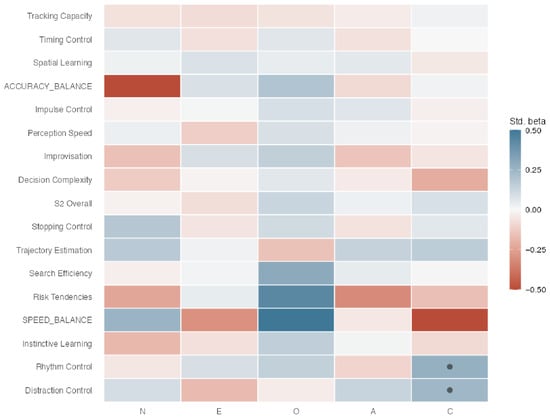
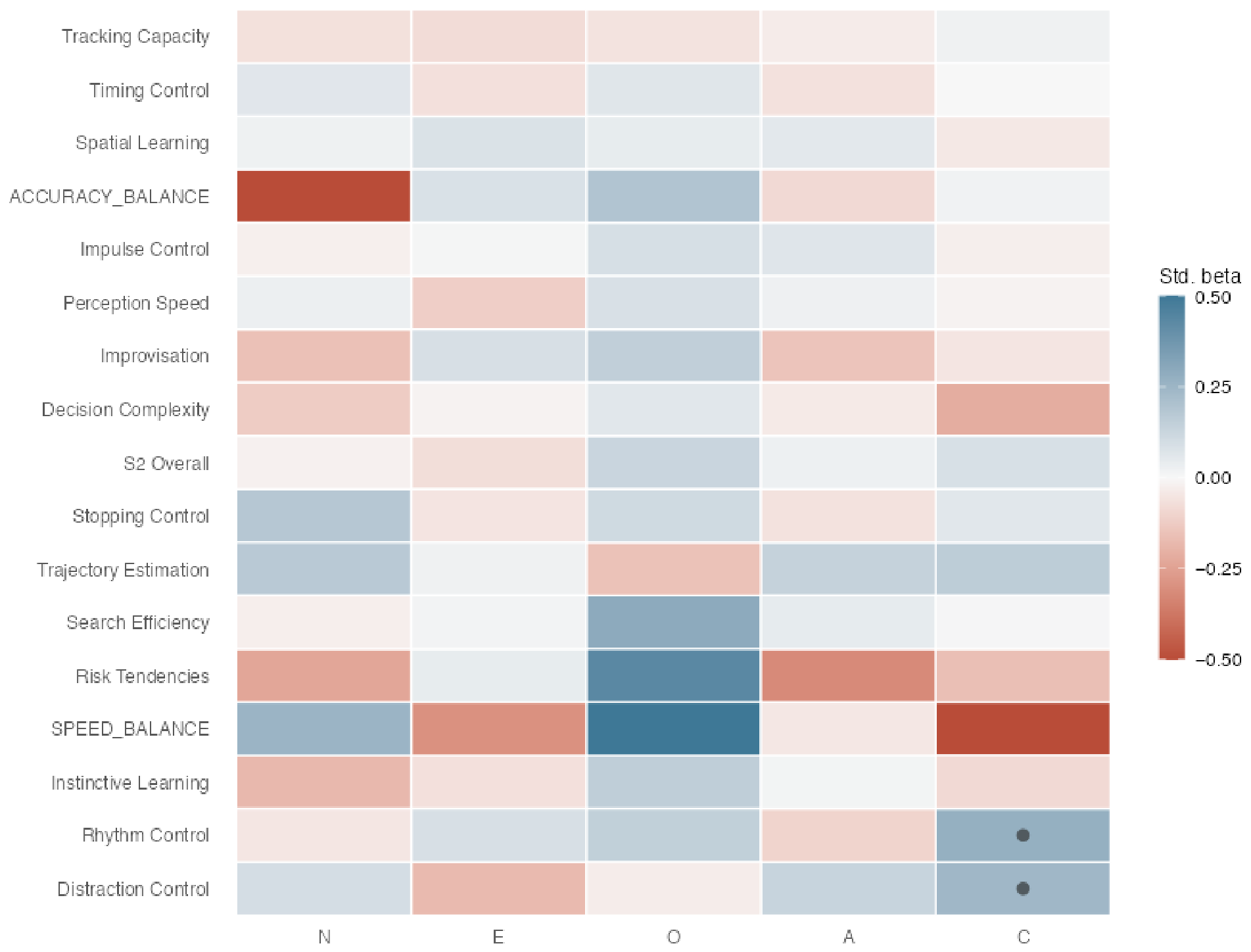
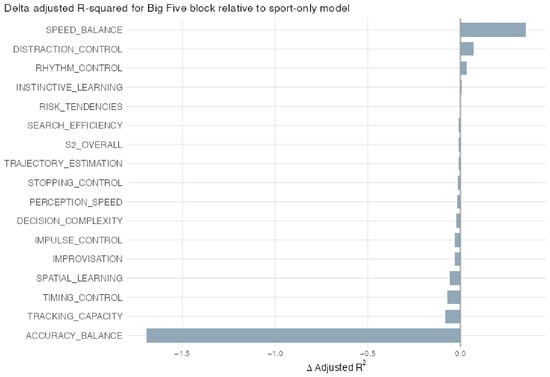
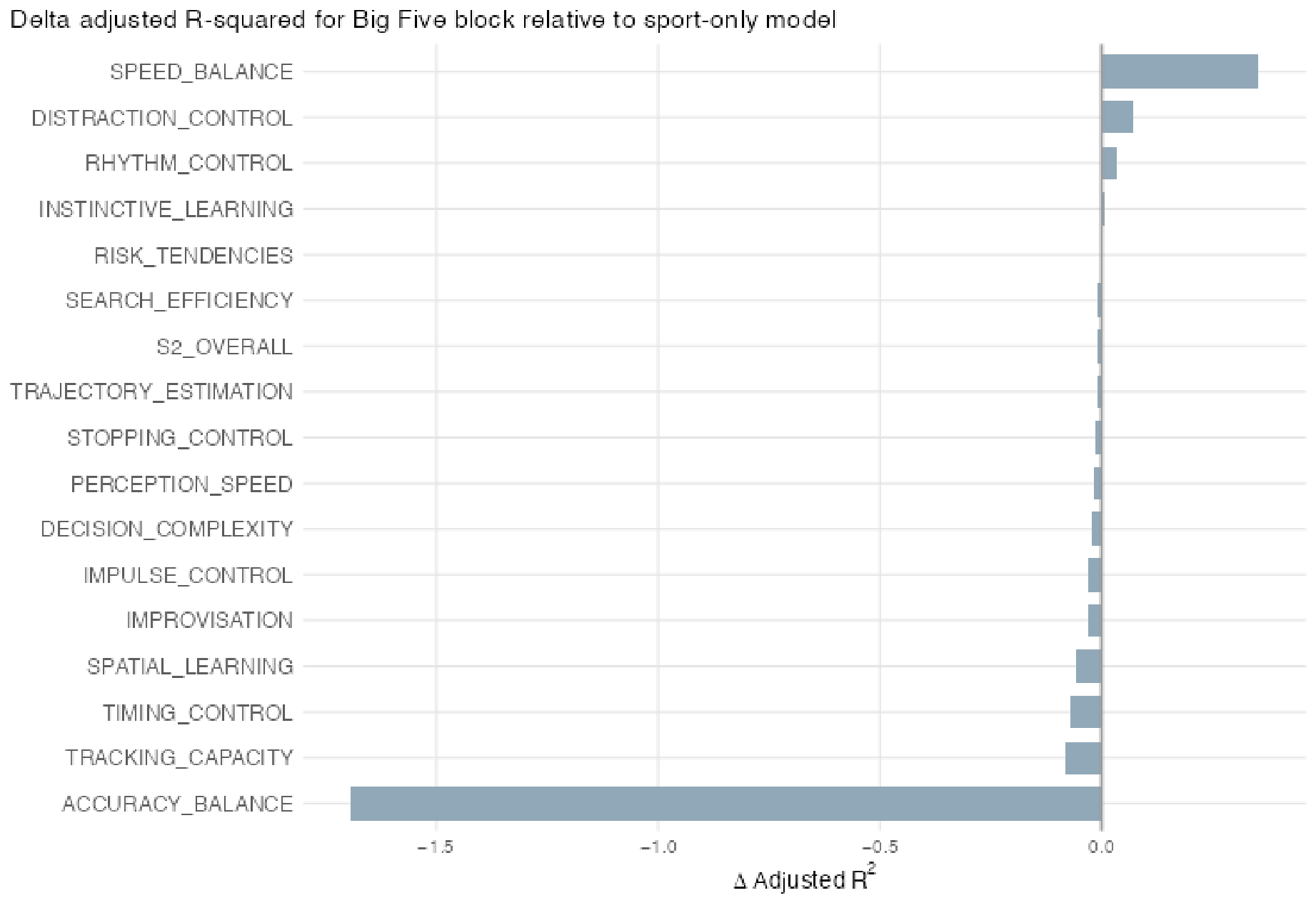
Across the seventeen modeled outcomes (Table 2, Figure 1 and Figure 2), no outcome demonstrated a significant overall association with the FFM personality traits after FDR correction. The strongest outcome-level association observed was for distraction control (F = 2.98, p = 0.014), although this effect did not meet the corrected significance threshold (q = 0.24). All remaining outcome-level tests demonstrated weaker evidence of association (p > 0.219; q > 0.42).
Figure 1.
Confirmatory FFM associations across S2 outcomes. Cells show standardized coefficients from the models adjusted for sport; dots mark p < 0.05.
Figure 2.
Incremental variance explained by FFM.
At the individual predictor level, no personality trait was significantly associated with any neurocognitive outcome following FDR correction (Table 3). The strongest nominal association was observed between conscientiousness and distraction control (β = 0.025, p = 0.006), but this relationship did not survive correction for multiple testing (q = 0.483). Other nominal associations were small in magnitude and inconsistent across outcomes.
Table 3.
Key results of the coefficient-level analyses.
To evaluate whether personality traits were associated with neurocognitive performance at a broader profile level, a MANOVA was conducted on the subset of outcomes with high data coverage. After accounting for sport, personality traits were not significantly associated with the overall neurocognitive performance profile (Pillai’s trace = 0.293; F(25, 495) = 1.23; p = 0.204).
Exploratory facet-level analyses across 510 models identified several nominal associations; however, none survived FDR correction. These findings should therefore be interpreted as hypothesis-generating only.
Statistical sensitivity varied substantially across outcomes. At 80% power and ɑ = 0.05, the minimum detectable effect was Cohen’s f2 = 0.103–0.125 for the larger sample sizes of 114–136. For sample sizes of 47–69, the minimum detectable effect was f2 = 0.217–0.328. For sample sizes of 22 or 9, sensitivity was limited f2 = 0.938–19.18.
4. Discussion
The purpose of this study was to examine the relationship between personality traits and neurocognitive performance in NCAA Division I student athletes. Personality and neurocognitive assessments are increasingly incorporated into athlete profiling, talent identification, and developmental programming, yet relatively little work has examined whether these tools capture overlapping or distinct information (Vaughan & Edwards, 2020). In particular, across outcome-level, coefficient-level, and multivariate analyses, there was little evidence that broad personality traits were meaningfully associated with neurocognitive performance. Although several nominal associations emerged, none survived correction for multiple comparisons. The findings support the use of broad personality traits and neurocognitive performance as independent sources of athlete variability and provide nonsubstantial overlap for athlete evaluation. That is, if broad personality traits and neurocognitive performance reflected the same underlying psychological capacities, more consistent associations would be expected across neurocognitive outcomes. Instead, the present findings suggest that these assessment domains provide largely nonredundant information about athlete functioning.
The distinction between these assessments is reasonable from a theoretical viewpoint. Personality traits reflect relatively enduring dispositions that influence how individuals tend to think, feel, behave, and interact with others and their environments. On the other hand, neurocognitive assessments are designed to evaluate information-processing capacity, including perception, attention, response inhibition, learning efficiency, decision-making, and response execution under standardized task demands. Although both domains may ultimately contribute to athletic performance, they appear to capture different levels of functioning. The limited convergence observed in the present study suggests that these domains should not be interpreted as interchangeable indicators of the same underlying athlete characteristic.
The present findings also help contextualize prior research examining the relationship between personality and neurocognitive functioning. Some theoretical models suggest that specific personality traits, particularly neuroticism and conscientiousness, may influence attention, inhibition, distractibility, or decision-making (Shuai et al., 2023; Suna & Saylik, 2026). For example, higher neuroticism may theoretically be associated with greater susceptibility to distraction or reduced attentional efficiency under stress, whereas higher conscientiousness may be associated with greater persistence, self-regulation, and task engagement. However, the empirical literature linking broad personality traits to neurocognitive performance has been mixed, and observed relationships are often modest, context-dependent, or specific to particular tasks (Anglim et al., 2022; Spielmann et al., 2023). The current findings extend this literature to a student-athlete population and suggest that broad FFM traits are not robust predictors of baseline neurocognitive performance when examined across multiple sport-relevant outcomes.
Importantly, the absence of significant associations should not be interpreted as evidence that personality is irrelevant to athlete performance. Personality traits may influence performance through pathways that are not captured by standardized neurocognitive testing. For example, personality may shape how athletes prepare, communicate, respond to coaching, manage stress, persist through adversity, regulate emotion, or function within team environments. Similarly, neurocognitive abilities may influence how athletes perceive the athletic environment, process information, inhibit premature responses, and make decisions in dynamic sport contexts. Both domains may be meaningful for performance, and the present findings suggest that they contribute unique information rather than reflecting a single shared construct.
From an applied perspective, these results support the use of both personality and neurocognitive assessments as complementary components of athlete evaluation. In practice, neurocognitive perceptual data lends itself to interdisciplinary collaboration to systematically reduce athletes’ risk of injury (Avedesian et al., 2022; Bertozzi et al., 2023), scaffold athlete development and learning, or direct tactical decision-making in consultation with coaching staffs. Similarly, utilizing FFM personality data, interdisciplinary sports performance units can better facilitate mental performance and leadership programming, foster improved communication skills, invite growth in self-awareness, and assist in personal development (Piepiora, 2021; Stanford et al., 2022).
These findings may also have implications for how assessment results are communicated to athletes, coaches, and performance staff. In applied settings, there are frequent efforts to collapse multiple assessment domains into a single global profile of athlete potential in order to simplify understanding and interpretation. The current results argue against an overly reductive interpretation. For example, a conscientious athlete is not necessarily a faster processor of sport-relevant information, and an athlete with strong neurocognitive performance is not necessarily more emotionally regulated, cooperative, or self-disciplined. Treating these domains as distinct may help practitioners avoid overinterpretation and support more precise, individualized recommendations for athlete selection and development.
Several limitations of this study should be considered. First, the athlete-level association design does not permit conclusions regarding whether personality traits influence neurocognitive performance, whether neurocognitive abilities influence personality expression, or whether both are influenced by other factors. Second, the sample included athletes from multiple sports, but the distribution across sports was uneven, and sport-specific testing batteries limited the availability of some neurocognitive outcomes. Although including athletes from sports with different cognitive demands increased sample diversity, it may have also introduced a source of variability. Additionally, due to the varying sport sample, some outcomes had small sample sizes which led to low statistical sensitivity and could only detect large or very large effects reliably. Third, the temporal gap between personality and neurocognitive assessments varied across athletes. Although this was considered acceptable given the trait-level focus of the study, future work may benefit from more tightly controlled assessment windows. Fourth, personality was assessed through self-report, whereas neurocognitive performance was assessed through task-based measures. This difference in measurement method may partly reinforce the distinction between domains, although it also reflects how these assessments are commonly used in applied sport settings and is aligned with best practices. Lastly, age, sex, years of sport experiences, and medical history may have an influence on the results. Due to the methodology of this study, these variables were not added as potential confounding variables, but these factors are important to consider.
Future research should continue examining the relationship between personality and neurocognitive functioning using larger samples, longitudinal tracking designs, and sport-specific performance outcomes. Particular attention should be given to whether personality traits moderate the expression of neurocognitive abilities under pressure, fatigue, uncertainty, or competitive stress within the context of sport. It is possible that personality is less related to baseline neurocognitive capacity and more relevant to how neurocognitive abilities are expressed in demanding performance environments. Future studies may also benefit from examining personality facets, psychological states, and contextual variables rather than relying exclusively on broad domain-level traits.
Since broad FFM personality traits were not meaningfully associated with neurocognitive performance in this sample of NCAA Division I student athletes, these findings support the distinction between personality and neurocognitive assessment domains and suggest that both may have value within comprehensive athlete evaluation and development systems.
5. Conclusions
Broad personality traits were not robustly associated with neurocognitive performance when accounting for sport and multiple comparisons. These findings are consistent with theoretical distinctions between dispositional personality characteristics and neurocognitive processing capacities, demonstrating their discriminant validity as largely independent dimensions of athlete functioning. From an applied perspective, this supports the use of separate, complementary assessment strategies when profiling athletes. The present findings reinforce the importance of distinguishing between personality traits and neurocognitive capacities in sport, highlighting the need for multidimensional models of athlete assessment without presuming substantial overlap between these domains.
Author Contributions
Conceptualization, J.B.R., J.P.W.; methodology, J.B.R., J.P.W.; formal analysis, J.P.W., J.R.L., A.N.P., J.D.H.; writing—original draft preparation, J.B.R., J.P.W.; writing—review and editing, J.B.R., C.M., J.R., H.B., A.N.P., J.P.H., J.D.H., J.P.W. All authors have read and agreed to the published version of the manuscript.
Funding
This research received no external funding.
Institutional Review Board Statement
The study was conducted in accordance with the Declaration of Helsinki, and approved by the Institutional Review Board of University of NotreDame (approval code 26-06-10186 and date of approval 22 June 2026).
Informed Consent Statement
Patient consent was waived due to the study being considered non-human subjects research due to using existing de-identified data.
Data Availability Statement
The data presented in this study are available on request from the corresponding author due to privacy.
Conflicts of Interest
The authors declare no conflicts of interest.
References
- Allen, M. S., Greenlees, I., & Jones, M. (2013). Personality in sport: A comprehensive review. International Review of Sport and Exercise Psychology, 6(1), 184–208. [Google Scholar] [CrossRef] [Scilit]
- Anglim, J., Dunlop, P. D., Wee, S., Horwood, S., Wood, J. K., & Marty, A. (2022). Personality and intelligence: A meta-analysis. Psychological Bulletin, 148(5–6), 301–336. [Google Scholar] [CrossRef] [Scilit]
- Avedesian, J. M., Forbes, W., Covassin, T., & Dufek, J. S. (2022). Influence of cognitive performance on musculoskeletal injury risk: A systematic review. The American Journal of Sports Medicine, 50(2), 554–562. [Google Scholar] [CrossRef] [Scilit] [PubMed]
- Baddeley, A. D., & Hitch, G. (1974). Working memory. Psychology of Learning and Motivation, 8, 47–89. [Google Scholar] [CrossRef] [Scilit]
- Bashore, T. R., Ally, B. A., van Wouwe, N. C., Neimat, J. C., van den Wildenberg, W. P. M., & Wylie, S. A. (2018). Exposing an “intangible” cognitive skill among collegiate football players: II. enhanced response impulse control. Frontiers in Psychology, 9, 1496. [Google Scholar] [CrossRef] [Scilit] [PubMed]
- Bertozzi, F., Fischer, P. D., Hutchison, K. A., Zago, M., Sforza, C., & Monfort, S. M. (2023). Associations between cognitive function and ACL injury-related biomechanics: A systematic review. Sports Health, 15(6), 855–866. [Google Scholar] [CrossRef] [Scilit] [PubMed]
- Hulleman, J. (2005). The mathematics of multiple object tracking: From proportions correct to number of objects tracked. Vision Research, 45, 2298–2309. [Google Scholar] [CrossRef] [Scilit] [PubMed]
- Jennings, J. R., van der Molen, M. W., van der Veen, F. M., & Debski, K. B. (2002). Influence of preparatory schema on the speed of responses to spatially compatible and incompatible stimuli. Psychophysiology, 39, 496–504. [Google Scholar] [CrossRef]
- Kalén, A., Bisagno, E., Musculus, L., Raab, M., Pérez-Ferreirós, A., Williams, A. M., Araújo, D., Lindwall, M., & Ivarsson, A. (2021). The role of domain-specific and domain-general cognitive functions and skills in sports performance: A meta-analysis. Psychological Bulletin, 147(12), 1290–1308. [Google Scholar] [CrossRef] [Scilit] [PubMed]
- Kihara, K., Kawahara, J. I., & Takeda, Y. (2010). Usability of liquid crystal displays for research in the temporal characteristics of perception and attention. Behavior Research Methods, 42, 1105–1113. [Google Scholar] [CrossRef] [Scilit] [PubMed]
- Logie, R. H., & Marchetti, C. (1991). Visuo-spatial working memory: Visual, spatial or central executive? In R. H. Logie, & M. Denis (Eds.), Mental images in human cognition (pp. 105–115). North-Holland. [Google Scholar]
- McCrae, R. R., Costa, P. T., Jr., & Martin, T. A. (2005). The NEO–PI–3: A More Readable Revised NEO Personality Inventory. Journal of Personality Assessment, 84(3), 261–270. [Google Scholar] [CrossRef] [Scilit] [PubMed]
- Piepiora, P. (2021). Assessment of personality traits influencing the performance of men in team sports in terms of the big five. Frontiers in Psychology, 12, 679724. [Google Scholar] [CrossRef] [Scilit] [PubMed]
- Proctor, R. W., van Zandt, T., Lu, C. H., & Weeks, D. J. (1993). Stimulus-response compatibility for moving stimuli: Perception of affordances or directional coding? Journal of Experimental Psychology, 19, 81–91. [Google Scholar] [CrossRef] [Scilit] [PubMed]
- Pylyshyn, Z. W., & Storm, R. W. (1988). Tracking multiple independent targets: Evidence for a parallel tracking mechanism. Spatial Vision, 3(3), 179–197. [Google Scholar] [CrossRef] [Scilit] [PubMed]
- Ridderinkhof, K. R., Wylie, S. A., van den Wildenberg, W. P. M., Bashore, T. R., & van der Molen, M. W. (2021). The arrow of time: Advancing insights into action control from the arrow version of the Eriksen flanker task. Attention, Perception, & Psychophysics, 83, 700–721. [Google Scholar] [CrossRef] [Scilit] [PubMed]
- S2 Cognition. (2023). S2 test-retest reliability analysis [White paper]. Available online: https://www.s2cognition.com/science-lab (accessed on 9 November 2026).
- Scharfen, H., & Memmert, D. (2019). Measurement of cognitive functions in experts and elite athletes: A meta-analytic review. Applied Cognitive Psychology, 33(5), 843–860. [Google Scholar] [CrossRef] [Scilit]
- Shuai, Y., Wang, S., Liu, X., Kueh, Y. C., & Kuan, G. (2023). The influence of the five-factor model of personality on performance in competitive sports: A review. Frontiers in Psychology, 14, 1284378. [Google Scholar] [CrossRef] [Scilit] [PubMed]
- Simon, J. R., & Rudell, A. P. (1967). Auditory S-R compatibility: The effect of an irrelevant cue on information processing. Journal of Applied Psychology, 51(3), 300–304. [Google Scholar] [CrossRef] [Scilit] [PubMed]
- Spielmann, J., Beavan, A., & Mayer, J. (2023). The relationship of personality and executive functions in high-level soccer athletes: Expertise- and gender-specific differences. Frontiers in Sports and Active Living, 5, 1130759. [Google Scholar] [CrossRef] [Scilit] [PubMed]
- Stanford, J. R., Healy, L. C., Sarkar, M., & Johnston, J. P. (2022). Interpersonal perceptions of personality traits in elite coach-athlete dyads. Psychology of Sport and Exercise, 60, 102154. [Google Scholar] [CrossRef] [Scilit]
- Stoffels, E. J. (1996). Uncertainty and processing routes in the selection of a response: An S-R compatibility study. Acta Psychologica, 94, 227–252. [Google Scholar] [CrossRef] [Scilit] [PubMed]
- Suna, M. N., & Saylik, R. (2026). The cognitive impact of neuroticism on executive functions: Differential effects on inhibition, switching, updating and dual-task. Personality and Individual Differences, 251, 113564. [Google Scholar] [CrossRef] [Scilit]
- Vaughan, R. S., & Edwards, E. J. (2020). Executive function and personality: The moderating role of athletic expertise. Personality and Individual Differences, 161, 109973. [Google Scholar] [CrossRef] [Scilit]
- Verburgh, L., Königs, M., Scherder, E. J., & Oosterlaan, J. (2014). Physical exercise and executive functions in preadolescent children, adolescents and young adults: A meta-analysis. British Journal of Sports Medicine, 48, 973–979. [Google Scholar] [CrossRef] [Scilit] [PubMed]
- Wylie, S. A., Ally, B. A., van Wouwe, N. C., Neimat, J. S., van den Wildenberg, W. P. M., & Bashore, T. R. (2019). Exposing an “intangible” cognitive skill among collegiate football players: III. enhanced reaction control to motion. Frontiers in Psychology, 1, 51. [Google Scholar] [CrossRef] [Scilit] [PubMed]
- Wylie, S. A., Bashore, T. R., Van Wouwe, N. C., Mason, E. J., John, K. D., Neimat, J. S., & Ally, B. A. (2018). Exposing an “intangible” cognitive skill among collegiate football players: Enhanced interference control. Frontiers in Psychology, 9, 49. [Google Scholar] [CrossRef] [Scilit] [PubMed]
- Zell, E., & Lesick, T. L. (2022). Big five personality traits and performance: A quantitative synthesis of 50+ meta-analyses. Journal of Personality, 90(4), 559–573. [Google Scholar] [CrossRef] [Scilit] [PubMed]

Disclaimer/Publisher’s Note: The statements, opinions and data contained in all publications are solely those of the individual author(s) and contributor(s) and not of MDPI and/or the editor(s). MDPI and/or the editor(s) disclaim responsibility for any injury to people or property resulting from any ideas, methods, instructions or products referred to in the content. |
© 2026 by the authors. Licensee MDPI, Basel, Switzerland. This article is an open access article distributed under the terms and conditions of the Creative Commons Attribution (CC BY) license.