


Abstract
This study used explainable Random Forest models to identify predictors of adolescents’ expected active political participation using ICCS 2022 data from 1487 students in Schleswig-Holstein, Germany. Three predictor specifications were examined to distinguish prediction based on variables conceptually close to the outcome from prediction based on more general civic characteristics. The Full Random Forest achieved the highest predictive accuracy (R2 = 0.426), with expected legal and electoral participation as the strongest predictors. Removing proximal participation measures reduced predictive accuracy but revealed a stable set of predictors. In the most restrictive model, citizenship self-efficacy, beliefs about missing conventional citizenship, and civic knowledge consistently ranked highest under both permutation importance and SHAP. Civic knowledge showed substantial predictive importance but a consistently negative association with the outcome, supported by the correlation (r = −0.139), SHAP dependence, and ALE analyses. Random Forest’s predictive advantage over benchmark models was modest and specification-dependent.
1. Introduction
Political participation is a fundamental component of democratic societies, enabling citizens to influence public decision-making, promote government accountability, and contribute to the functioning of democratic institutions (Galston, 2001; Verba et al., 1995). Because civic attitudes, democratic values, and participatory intentions begin to develop during adolescence, understanding the factors that shape young people’s expected political participation has become a major concern in civic education research and is therefore critical for both educational research and evidence-based policymaking (Amnå & Ekman, 2014; Deutsches Jugendinstitut, 2022; Torney-Purta et al., 2001). Schools play a central role in this process by fostering civic knowledge, political efficacy, democratic values, and opportunities for participation through formal instruction and everyday school experiences (Campbell, 2008; Kahne & Sporte, 2008). Consequently, a growing but still relatively limited body of research has examined how cognitive, attitudinal, behavioural, and school-related factors influence adolescents’ civic and political engagement. Existing evidence highlights the importance of civic knowledge, citizenship self-efficacy, democratic norms, civic learning experiences, classroom climate, and political discussion (Schulz et al., 2018, 2024a; Torney-Purta et al., 2001). The International Civic and Citizenship Education Study (ICCS), conducted by the International Association for the Evaluation of Educational Achievement (IEA), provides one of the most comprehensive international datasets for investigating these relationships by measuring students’ civic knowledge alongside a broad range of civic attitudes, beliefs, participation experiences, and expected forms of political engagement (Schulz et al., 2018, 2024b).
Despite the substantial body of research based on ICCS, previous studies have relied predominantly on conventional statistical approaches, such as regression, structural equation modelling, and multilevel modelling, which primarily estimate linear relationships and average effects among predictors (Hoskins et al., 2012; Schulz et al., 2018). However, political participation is a complex phenomenon shaped by interrelated cognitive, behavioural, attitudinal, and contextual factors that may interact in nonlinear ways. Machine learning approaches, particularly Random Forest, offer an important complementary perspective by accommodating nonlinear relationships, modelling complex interactions, and identifying the relative importance of numerous correlated predictors without imposing restrictive parametric assumptions (Breiman, 2001). Furthermore, recent advances in explainable artificial intelligence, including permutation-based variable importance, SHAP, and partial dependence plots, allow researchers to interpret machine learning models by quantifying predictor contributions and visualizing their relationships with the outcome (Friedman, 2001; Lundberg & Lee, 2017; Lundberg et al., 2020). Against this background, the present study applies an explainable Random Forest framework to ICCS 2022 data from the German federal state of Schleswig-Holstein to identify the most influential demographic, socio-economic, cognitive, attitudinal, behavioural, and school-related predictors of adolescents’ expected active political participation. By integrating machine learning with internationally validated civic education data, the study contributes both substantive evidence regarding the determinants of political participation and a methodological demonstration of how explainable artificial intelligence can advance civic education research.
1.1. Research Questions
This study is guided by the following research questions:
- To what extent can adolescents’ expected active political participation be predicted using a broad set of attitudinal, behavioral, socio-demographic, and cognitive variables from ICCS 2022?
- Which variables emerge as the most important predictors of expected political participation when using random forest models?
1.2. Theoretical Perspectives on Adolescents’ Political Participation
Several theoretical perspectives have been proposed to explain how political participation develops during adolescence. Among these, political socialization theory provides one of the most influential frameworks for understanding how young people acquire political beliefs, democratic values, civic identities, and participatory orientations through interactions with family members, peers, schools, and the broader social and political environment (Jennings & Niemi, 1974; Jennings & Stoker, 2004; Niemi & Hepburn, 1995). Although political participation has traditionally been examined among adults, contemporary scholarship increasingly recognizes adolescence as a formative developmental period during which civic identities, democratic values, political efficacy, and participatory intentions begin to emerge and stabilize (Amnå & Ekman, 2014; Flanagan & Levine, 2010). Experiences acquired during this period frequently shape patterns of civic and political engagement that persist in adulthood, making adolescence a critical stage for understanding democratic participation (Chan et al., 2014; Sherrod et al., 2010; Torney-Purta et al., 2001). Within the political socialization framework, schools occupy a particularly influential position because they provide structured opportunities for civic learning, political discussion, collaborative decision-making, and democratic participation. These experiences foster civic knowledge, political efficacy, democratic values, and a sense of civic responsibility, thereby encouraging future political engagement (Campbell, 2008; Kahne & Sporte, 2008; Torney-Purta et al., 2001).
More recently, motivational perspectives have complemented political socialization theory by emphasizing that adolescents’ political participation depends not only on what they know but also on whether they believe they can participate effectively and perceive participation as meaningful. Drawing on expectancy-value theory, Levy and Akiva (2019) argue that expected political participation is jointly shaped by adolescents’ beliefs about their ability to influence political processes (political efficacy) and the value or personal importance they attach to political issues (political interest). Their findings demonstrate that political interest is an even stronger predictor of expected political participation than political efficacy, while the combination of high political interest and high political efficacy produces the greatest likelihood of future political engagement. These findings reinforce the view that political participation is fundamentally a motivational process in which cognitive resources interact with psychological dispositions to shape participatory intentions.
Taken together, political socialization theory and motivational perspectives portray adolescents’ political participation as a multidimensional phenomenon emerging from the interaction of cognitive, motivational, behavioural, and contextual influences. Civic knowledge provides adolescents with an understanding of democratic institutions and political processes, whereas political efficacy, political interest, democratic values, and opportunities for civic engagement influence whether this knowledge is translated into participatory intentions and behaviours (Bandura, 1997; Galston, 2001; Hoskins et al., 2012; Levy & Akiva, 2019). Rather than being determined by any single factor, expected political participation develops through the dynamic interplay of individual characteristics and contextual experiences acquired across different social environments. This integrated theoretical perspective suggests that understanding adolescents’ expected political participation requires analytical approaches capable of simultaneously examining the relative contribution of multiple interconnected determinants, thereby providing the conceptual foundation for the present study.
1.3. Individual and School-Related Predictors of Political Participation
Building upon these theoretical perspectives, an extensive body of empirical research has examined the factors associated with adolescents’ civic and political participation. Rather than identifying a single dominant determinant, previous studies consistently suggest that political participation emerges through the interaction of multiple cognitive, psychological, behavioural, and school-related influences. Although evidence generally supports the contribution of each of these domains, empirical findings also reveal considerable variation in the strength of these relationships across countries, educational systems, and research designs, underscoring the multidimensional nature of adolescents’ political engagement.
Among the cognitive influences, civic knowledge has received the greatest empirical attention. International comparative studies have consistently shown that students with higher levels of civic knowledge report stronger intentions to engage in future political activities and demonstrate greater confidence in democratic participation. Using data from the IEA Civic Education Study across 28 countries, Torney-Purta et al. (2001) reported that civic knowledge was positively associated with adolescents’ expected political participation and democratic attitudes. Similarly, analysing data from ten countries participating in the IEA Civic Education Study, Schulz (2005) found that civic knowledge significantly predicted expected political activities, particularly among younger adolescents. More recently, findings from ICCS 2009, 2016, and 2022 have consistently confirmed that students with stronger civic knowledge tend to report higher levels of expected electoral participation, legal political participation, and civic engagement (Schulz et al., 2018, 2024b). Nevertheless, these findings also indicate that civic knowledge alone explains only part of the variation in political participation, suggesting that knowledge must operate alongside other individual and contextual characteristics before it is translated into civic action.
Research has therefore increasingly focused on psychological factors, particularly political efficacy and political interest. Political efficacy has consistently emerged as one of the strongest psychological predictors of civic engagement because it reflects adolescents’ confidence in their ability to understand political issues and influence political processes. Beaumont (2010) argued that political efficacy constitutes a central mechanism through which civic education promotes democratic participation, while Hope and Jagers (2014) demonstrated that higher sociopolitical efficacy was associated with greater civic and political engagement among African American adolescents. Similar conclusions have been reported using ICCS data. Analysing responses from 2601 Korean eighth-grade students participating in ICCS 2016, Myoung and Liou (2022) found that citizenship self-efficacy was the strongest predictor of expected electoral participation, exceeding the influence of several school-based political socialisation experiences. At the same time, recent research suggests that efficacy alone may not be sufficient to explain adolescents’ participatory intentions. Levy and Akiva (2019), analysing survey responses from 422 high-school students in the United States, found that political interest was a substantially stronger predictor of expected future political participation than either internal or external political efficacy after controlling for demographic characteristics. Moreover, they identified a significant interaction between political interest and internal political efficacy, indicating that adolescents who were both interested in politics and confident in their political competence expressed the highest expectations of future political participation. Collectively, these studies suggest that political participation is shaped not only by what adolescents know but also by whether they value political engagement and perceive themselves as capable of participating effectively.
Beyond cognitive and psychological characteristics, behavioural experiences have also been identified as important predictors of political participation. A growing body of research demonstrates that adolescents who frequently discuss political issues, participate in civic organisations, volunteer within their communities, or engage in democratic activities at school are more likely to expect future political participation. Campbell (2008) showed that students exposed to open classroom discussions about controversial political issues reported significantly higher levels of political engagement than their peers. Likewise, Kahne and Sporte (2008) found that authentic civic learning opportunities, including participation in community projects and school governance, substantially increased students’ commitment to future civic participation. Longitudinal evidence further supports these findings. Chan et al. (2014) demonstrated that civic engagement during adolescence was associated with higher educational attainment, greater civic involvement, and increased political participation in adulthood, suggesting that participatory experiences accumulated during adolescence have enduring developmental consequences.
The broader school environment represents an additional source of influence on adolescents’ political participation. Numerous studies have shown that open classroom climates, opportunities for democratic participation, supportive teacher-student relationships, and high-quality civic learning experiences contribute to stronger civic attitudes and participatory intentions. Using international comparative data, Schulz et al. (2018) reported that students attending schools characterised by open discussion climates and greater opportunities for civic participation expressed higher expectations of future political engagement. Similarly, Reichert (2016) demonstrated that democratic classroom experiences strengthened political efficacy and civic participation by encouraging students to discuss controversial issues, consider multiple perspectives, and engage in collective decision-making. Nevertheless, evidence also suggests that the influence of school experiences may differ across educational contexts. Using ICCS 2016 data from Korea, Myoung and Liou (2022) found that citizenship self-efficacy, rather than open classroom discussion or formal citizenship education, was the strongest predictor of expected electoral participation. They argued that the influence of school experiences on political participation may depend on broader social and cultural contexts, highlighting the importance of considering national differences when interpreting civic education outcomes. Taken together, these findings suggest that schools function not only as institutions that transmit civic knowledge but also as democratic learning environments in which adolescents develop the motivation, confidence, and practical experiences necessary for active citizenship.
Overall, the existing literature provides consistent evidence that adolescents’ expected political participation is influenced by a broad constellation of cognitive, psychological, behavioural, and school-related factors. However, despite this growing body of evidence, the relative importance of these predictors remains unclear. Most previous studies have examined a limited number of variables using conventional regression-based approaches, making it difficult to determine which factors exert the greatest influence when considered simultaneously. Moreover, because many of these predictors are conceptually and empirically interrelated, traditional linear models may not adequately capture the complex interactions and potential nonlinear relationships underlying adolescents’ political participation. Consequently, there remains a need for analytical approaches capable of evaluating a broad range of interconnected predictors within a single framework while identifying their relative contribution to adolescents’ expected political participation.
1.4. Explainable Machine Learning in Educational Research
The rapid growth of large-scale educational datasets has stimulated increasing interest in the application of machine learning methods in educational research. Unlike conventional statistical approaches, which primarily estimate predefined linear relationships and test theoretical hypotheses, machine learning algorithms are designed to maximize predictive performance by identifying complex patterns within high-dimensional data (Breiman, 2001; Shmueli, 2010). Consequently, they are particularly well suited to investigating educational phenomena shaped by numerous interacting cognitive, behavioural, psychological, and contextual factors. Over the past decade, machine learning has been successfully applied to predict a wide range of educational outcomes, including academic achievement, student dropout, school engagement, motivation, and well-being, frequently outperforming traditional regression-based approaches (Baker & Inventado, 2014; Kotsiantis, 2012; Romero & Ventura, 2020). Among these algorithms, Random Forest has emerged as one of the most widely adopted methods because of its robustness to multicollinearity, ability to model nonlinear relationships and complex interactions, and strong predictive accuracy without requiring researchers to specify functional forms in advance (Breiman, 2001; Hastie et al., 2009).
Despite these advantages, the application of machine learning to civic and citizenship education remains remarkably limited. Most studies examining adolescents’ political participation have relied on regression, structural equation modelling, or multilevel modelling, focusing primarily on average linear effects among relatively small sets of predictors (Hoskins et al., 2012; Levy & Akiva, 2019; Schulz et al., 2018). At the same time, advances in explainable artificial intelligence (XAI) have substantially improved the interpretability of machine learning models, addressing concerns that such approaches function as “black boxes” (Rudin, 2019). Techniques such as permutation-based variable importance identify the predictors that contribute most strongly to model performance, SHAP explains how individual variables influence individual predictions, and partial dependence plots reveal potentially nonlinear relationships while accounting for the influence of other variables (Friedman, 2001; Lundberg & Lee, 2017; Lundberg et al., 2020; Molnar, 2022). Consequently, integrating Random Forest with explainable artificial intelligence provides an appropriate framework for examining the complex interplay of demographic, socio-economic, cognitive, psychological, behavioural, and school-related factors underlying adolescents’ expected active political participation while identifying their relative importance within a single analytical model.
1.5. Research Gaps and the Present Study
Although previous research has identified a range of demographic, socio-economic, cognitive, psychological, behavioural, and school-related factors associated with adolescents’ political participation, their relative importance remains unclear because most studies have examined only a limited set of predictors using conventional regression-based approaches. Furthermore, the complex interrelationships and potential nonlinear associations among these factors have received limited attention, particularly within civic and citizenship education research. To address these gaps, the present study applies an explainable Random Forest framework to ICCS 2022 data from the German federal state of Schleswig-Holstein. By integrating permutation-based variable importance, SHAP, and partial dependence plots, the study identifies the most influential predictors of adolescents’ expected active political participation while demonstrating the value of explainable machine learning for advancing civic education research.
2. Materials and Methods
2.1. Data
This study used publicly available data from the ICCS 2022 assessment for the German federal state of Schleswig-Holstein (N = 1487; 764 boys, 678 girls, and 45 unspecified; M_age = 14.47 years, SD = 0.57, range = 12.58–17.08). It should be noted that, within Germany, only the states of North Rhine-Westphalia and Schleswig-Holstein participated in ICCS 2022; thus, the data are not nationally representative.
A total of 31 variables were included as predictors of students’ expected active political participation. These comprised demographic characteristics (age, gender), socio-economic background (national index of socio-economic status), and civic knowledge, as well as a broad set of attitudinal, behavioral, and school-related variables. Specifically, the predictors captured students’ attitudes toward environmental protection, immigrants, gender equality, and the role of religion in society; their beliefs about conventional, social movement-related, and globally oriented citizenship activities; their perceptions of threats to democracy and the global environment; and their levels of civic self-efficacy and trust in civic institutions.
In addition, the model incorporated indicators of students’ expected forms of participation (electoral, legal, illegal protest, environmental, and digital engagement), their civic learning experiences at school, and their involvement in school and community activities. School climate variables included perceptions of classroom discussion openness, student-teacher relations, student interactions, and opportunities for participation in school life. Finally, measures of political engagement outside school (e.g., discussion of social and political issues), critical views of the political system, satisfaction with the political system, and perceived influence in school decision-making were also included. The ICCS 2022 Technical Report indicates generally satisfactory internal consistency for the student questionnaire scales used in the present analysis in Schleswig-Holstein, supporting their reliability for the current analysis (Schulz et al., 2024b). The descriptive results are provided in supplementary Table S4.
2.2. Analytical Strategy
2.2.1. Model Specifications
Random Forest regression was used to predict students’ expected active political participation. To distinguish prediction based on measures that were conceptually close to the outcome from prediction based on more general civic predictors, three predictor specifications were estimated. The Full model contained 31 demographic, socioeconomic, cognitive, attitudinal, behavioral, and school-related predictors together with one civic-knowledge plausible value. The No-Proximal model excluded expected electoral participation, expected participation in legal political activities, expected participation in illegal protest activities, and expected participation in environmental protection activities. These measures represent participation intentions that overlap conceptually with expected active political participation.
The Antecedent-Only model was more restrictive. In addition to the four proximal participation-intention variables, it excluded engagement with political or social issues through digital media, participation in community groups, political or social discussion outside school, willingness to participate in school activities, and participation in civic activities at school. This specification therefore concentrated on cognitive, attitudinal, socioeconomic, and school-context variables that were more distal to the outcome. Comparing the three specifications made it possible to quantify how much predictive performance and predictor ranking depended on conceptually proximal participation measures.
2.2.2. School-Grouped Repeated Nested Cross-Validation
Students in ICCS are clustered within schools, so conventional random cross-validation at the student level could place students from the same school in both the training and validation data and thereby produce overly optimistic estimates of predictive performance. To prevent this form of information leakage, all cross-validation splits were made at the school level. Five-fold cross-validation was used to obtain an out-of-sample estimate of predictive performance while ensuring that model evaluation was based on data not used for model fitting. In each repetition of the outer five-fold procedure, the available schools were partitioned into five approximately balanced folds. Four folds were combined to form the training sample, and the fifth fold was held out as the validation sample. The model was fitted using only the four training folds and was then evaluated on students from schools in the held-out fold. The role of the validation fold was rotated across the five subsets, so that each fold served once as the validation set and four times as part of the training set. Consequently, every school contributed to validation once and to training four times within a repetition. The entire five-fold procedure was then repeated five times using new school allocations, yielding 25 outer validation assessments for each plausible value, predictor specification, and model.
Hyperparameter tuning was nested inside this outer procedure. Within each outer training sample, the training schools were partitioned again into three school-grouped inner folds. These inner folds were used only to select the Random Forest hyperparameters mtry, minimum terminal-node size, and sampling fraction. Random Forests used 300 trees during tuning and 800 trees after hyperparameter selection. The outer validation schools were not used for imputation, hyperparameter selection, or model fitting. Thus, the outer folds estimated generalization to unseen schools, whereas the inner folds were used only for model selection.
2.2.3. Plausible Values and Sampling Weights
Civic knowledge was represented using all five available plausible values. The complete analytical pipeline was run separately for each plausible value, with only one plausible value included in a model at a time. Scalar performance and permutation-importance estimates were then combined across the five analyses using Rubin’s rules (Rubin, 1987). The analyses used the total student weight in all the Random Forest analyses.
2.2.4. Missing Data
User-defined missing values were treated as missing during data import. Students were excluded from an analysis when the outcome, school identifier, corresponding civic-knowledge plausible value or student weight was missing. Missing predictor values were imputed separately within each cross-validation training sample. Numeric predictors were replaced by the training-sample median and gender by the training-sample mode. The training-derived values were then applied to the corresponding validation sample. This prevented information from the held-out schools from entering preprocessing.
2.2.5. Benchmark Models and Performance Measures
Random Forest performance was compared with ordinary linear regression and elastic-net regression using the same outer school-grouped validation folds. Elastic-net regularization was tuned within each outer training sample using school-grouped inner folds. Predictive performance was evaluated using root mean squared error (RMSE), mean absolute error (MAE), and out-of-sample R-squared (R2). Lower RMSE and MAE and higher R2 indicate better predictive performance. Repeat-level estimates were used to quantify resampling uncertainty and were then combined across the five plausible-value analyses.
2.2.6. Predictor Importance and Model Explanations
Random Forest predictor importance was evaluated in the held-out outer validation samples rather than on the training data. For each predictor, its values were permuted in the validation sample, predictions were recalculated, and importance was defined as the increase in validation-set mean squared error. Larger positive values indicate that disrupting a predictor produced a larger deterioration in out-of-sample prediction. Estimates were summarized across folds, repetitions, and plausible values with standard errors, 95% confidence intervals, and rank stability.
SHAP values were estimated for the final tuned Random Forest models using a model-agnostic Monte Carlo approximation. Up to 300 observations were explained against a background sample of up to 400 observations, using 100 Monte Carlo simulations and local-accuracy adjustment. Global SHAP importance was defined as the sampling-weighted mean absolute SHAP value. Because absolute SHAP values measure contribution magnitude rather than direction, SHAP dependence plots were used to examine whether higher predictor values tended to increase or decrease predicted participation. Elastic-net regression was implemented using the glmnet package (Friedman et al., 2010) in R (R Core Team, 2025) while Random Forest was estimated using the ranger package (Wright & Ziegler, 2017). In addition, SHAP values (Lundberg & Lee, 2017) were estimated using the fastshap package (Greenwell, 2026) to quantify the contribution of individual predictors to model predictions.
3. Results
3.1. Predictive Performance and Comparison with Benchmark Models
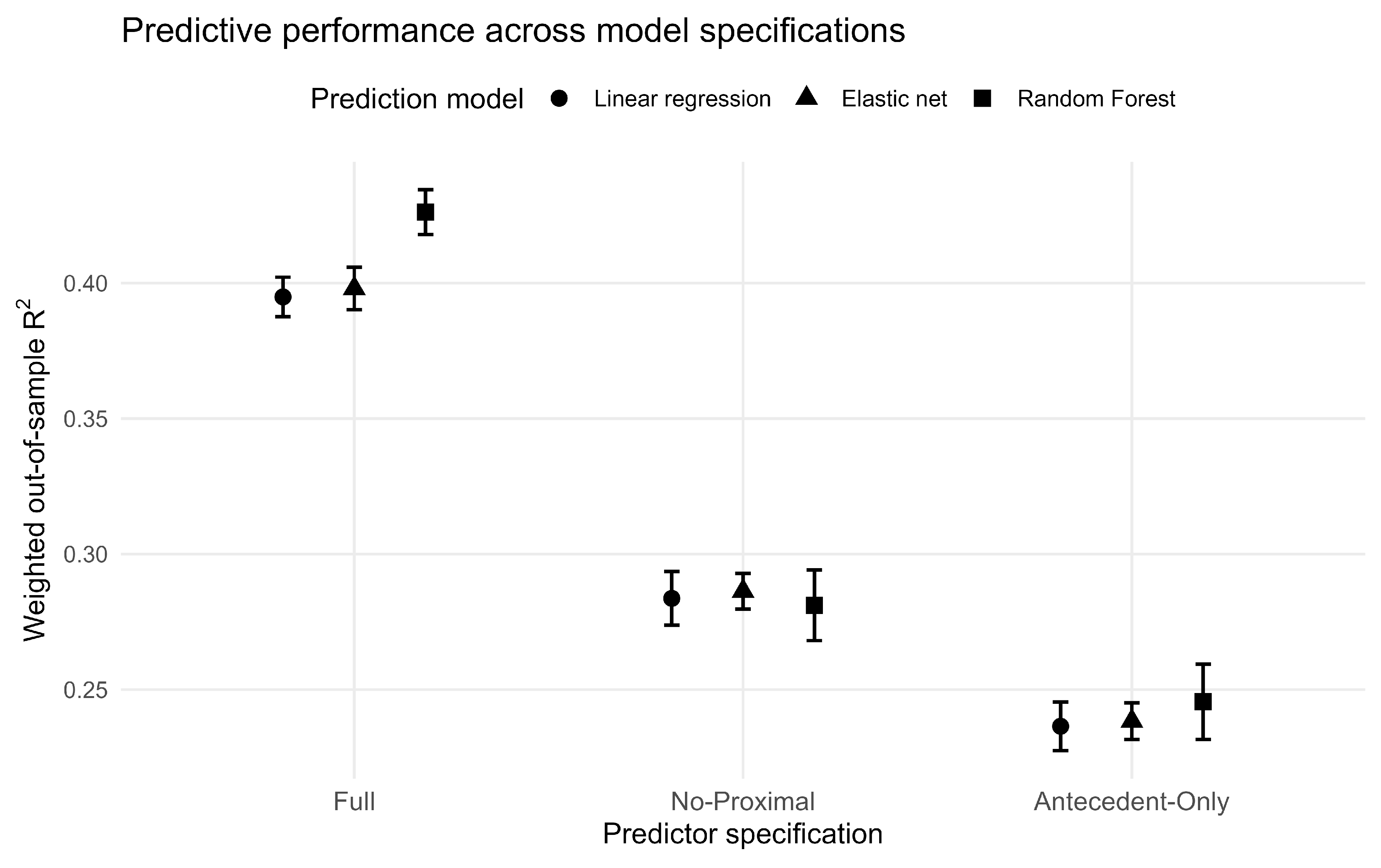
Table 1 presents predictive performance pooled across the five civic-knowledge plausible values. In the Full specification, Random Forest produced the best numerical performance, with an RMSE of 6.33, an MAE of 4.89, and an out-of-sample R2 of 0.426. Elastic net yielded an RMSE of 6.49 and an R2 of 0.398, while linear regression yielded an RMSE of 6.50 and an R2 of 0.395. Thus, when the complete predictor set was used, Random Forest provided modest improvement over the two simpler benchmarks.
Table 1.
Weighted Predictive Performance Pooled Across Five Civic-Knowledge Plausible Values.
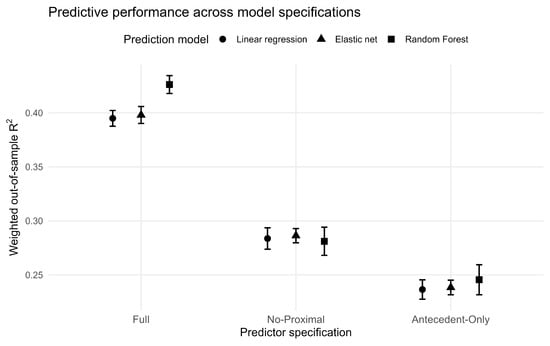
Removing the proximal participation-intention variables substantially reduced predictive performance. In the No-Proximal specification, Random Forest R2 declined to 0.281. Elastic net performed slightly better numerically in this specification (R2 = 0.286), while linear regression produced a similar R2 of 0.284. In the Antecedent-Only specification, Random Forest achieved an RMSE of 7.26 and an R2 of 0.246, compared with R2 values of 0.238 for elastic net and 0.236 for linear regression. The predictive advantage of Random Forest was therefore modest and specification-dependent. The marked reduction in performance from the Full model to the two restricted models also indicates that conceptually closer participation-intention variables accounted for a substantial portion of the Full model’s predictive accuracy. Figure 1 displays the findings graphically. Note that points show estimates combined across five civic-knowledge plausible values, and error bars show 95% confidence intervals.
Figure 1.
Predictive Performance Across Model Specifications.
3.2. Predictor Importance Across the Three Random Forest Specifications
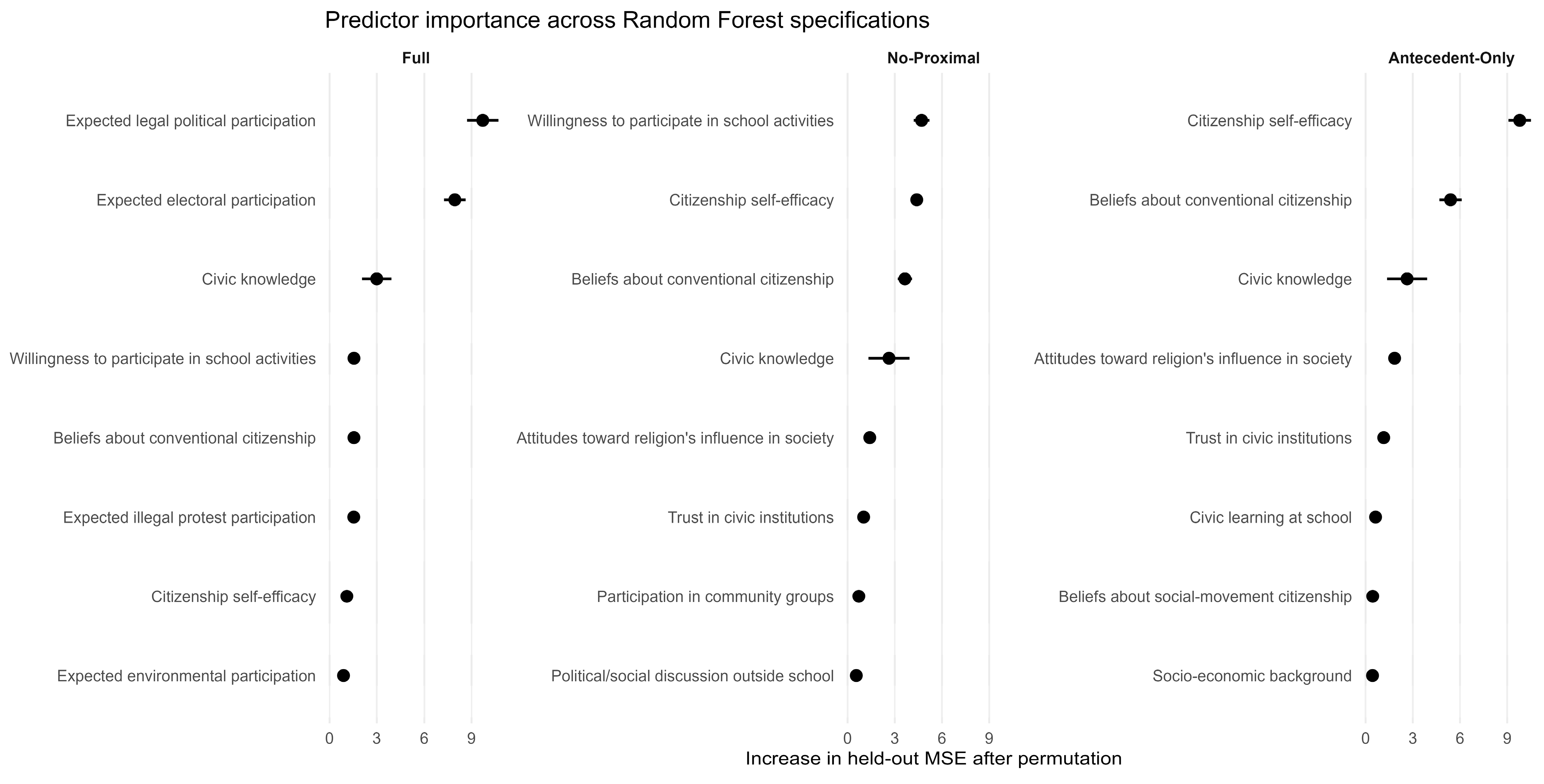
In the Full Random Forest, expected participation in legal political activities and expected electoral participation were the two strongest individual predictors (Table 2). Permuting expected legal participation increased held-out MSE by 9.71, 95% CI [8.71, 10.71], while permuting expected electoral participation increased held-out MSE by 7.94, 95% CI [7.25, 8.62]. Civic knowledge was the third strongest individual predictor, Delta MSE = 3.00, 95% CI [2.06, 3.93]. The dominance of legal and electoral participation indicates that much of the Full model’s prediction was carried by variables that were conceptually close to the outcome.
Table 2.
Held-Out Permutation Importance for the Weighted Full Random Forest.
Table 3 shows the results for the No-Proximal model. The ranking changed after the four proximal participation-intention variables were removed. In this model, willingness to participate in school activities became the strongest predictor, Delta MSE = 4.70, 95% CI [4.20, 5.20], followed by citizenship self-efficacy, Delta MSE = 4.40, beliefs about conventional citizenship, Delta MSE = 3.64, and civic knowledge, Delta MSE = 2.63. These first four positions were identical across all five plausible-value analyses.
Table 3.
Held-Out Permutation Importance for the Weighted No-Proximal Random Forest.
The Antecedent-Only model produced the clearest ranking of the more distant predictors. Table 4 shows that citizenship self-efficacy was the strongest predictor, Delta MSE = 9.80, 95% CI [9.08, 10.51], followed by beliefs about conventional citizenship, Delta MSE = 5.40, and civic knowledge, Delta MSE = 2.64. These three variables occupied the same first, second, and third positions in each of the five plausible-value analyses. Civic learning at school also became more prominent than in the Full model, ranking sixth in the Antecedent-Only specification.
Table 4.
Held-out Permutation Importance for the Antecedent-Only Setup.
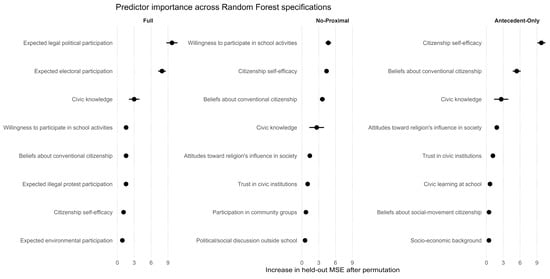
For a direct comparison of predictor importance across the three Random Forest specifications, Figure 2 displays the eight strongest predictors in each model based on held-out permutation importance.
Figure 2.
Predictor Importance Across Random Forest Specifications.
3.3. Correlations Among the Study Variables
The 496 unique weighted pairwise correlations among the 31 predictors and the outcome were generally small to moderate in magnitude. Correlations ranged from r = −0.267 to r = 0.624, with a mean signed correlation of 0.138 and a mean absolute correlation of 0.159. The strongest association was between expected environmental participation and expected legal political participation (r = 0.624), followed closely by the association between social-movement citizenship beliefs and global citizenship (r = 0.622). The strongest correlation involving expected active political participation was with expected legal political participation (r = 0.530). The largest negative correlation was between endorsement of gender equality and expected illegal protest participation (r = −0.267). No correlation exceeded |r| = 0.70, indicating that extremely high bivariate associations among the variables were not present. The complete weighted correlation matrix is presented in Supplementary Figure S1.
3.4. SHAP Importance and Dependence Patterns in the Antecedent-Only Model
Global SHAP importance broadly corroborated the held-out permutation-importance rankings. In the Full model, expected legal political participation had the largest average absolute SHAP value (1.63), followed by expected electoral participation (0.93) and civic knowledge (0.88). In the No-Proximal model, willingness to participate in school activities (1.08), beliefs about conventional citizenship (1.01), citizenship self-efficacy (0.98), and civic knowledge (0.80) were the leading predictors.
The Antecedent-Only results were especially consistent across the two importance methods. Citizenship self-efficacy ranked first under both held-out permutation importance and global SHAP importance, beliefs about conventional citizenship ranked second, and civic knowledge ranked third. Their mean absolute SHAP values were 1.487, 1.157, and 0.762, respectively (Table 5). This agreement indicates that the same three predictors were prominent both in terms of deterioration in held-out predictive accuracy when disrupted and in terms of average contribution magnitude within fitted predictions. Supplementary Tables S1–S3 provide additional evidence regarding the stability of predictor importance across model specifications and the convergence of the permutation-importance and SHAP results.
Table 5.
Global SHAP Importance in the Weighted Antecedent-Only Random Forest Across Five Civic-Knowledge Plausible Values.
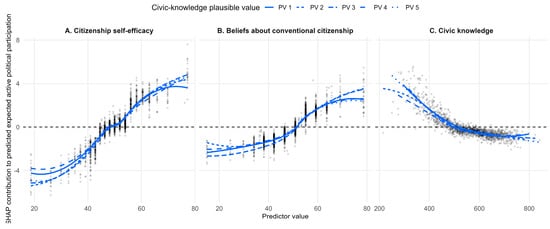
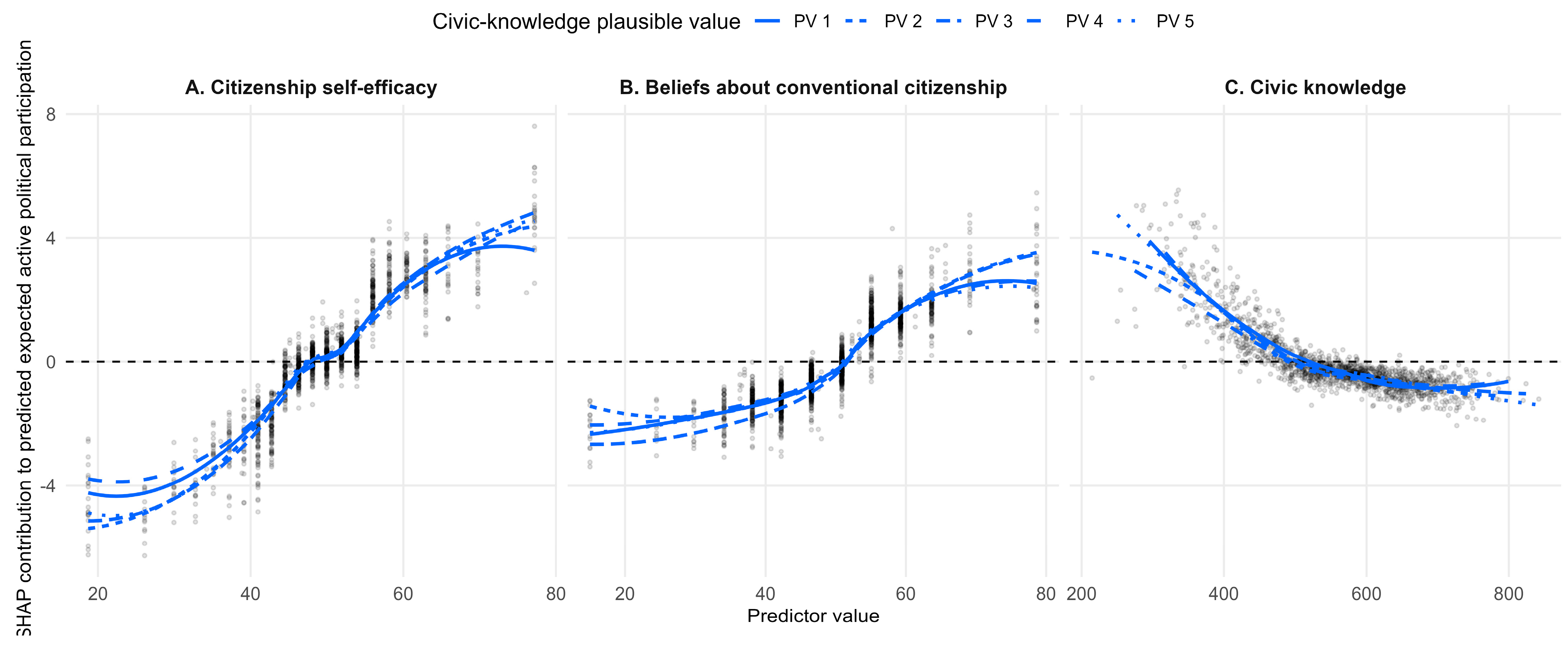
Figure 3 presents SHAP dependence plots for these three leading predictors in the Antecedent-Only setup. Each point represents an explained observation; the x-axis shows the observed predictor score, and the y-axis shows the SHAP contribution to predicted expected active political participation relative to the model baseline. Positive SHAP values raise the prediction and negative values lower it. The plots complement global mean absolute SHAP by displaying direction and functional form. The civic-knowledge panel shows a decreasing pattern.
Figure 3.
Civic-knowledge Plausible Value.
Unlike mean absolute SHAP values, which provide only magnitude, dependence plots show how a predictor’s observed values are associated with positive or negative contributions to the prediction. A SHAP value above zero indicates that the predictor value raises the model prediction relative to the model baseline for that observation, whereas a value below zero indicates that it lowers the prediction. Panels A and B therefore show the functional form associated with citizenship self-efficacy and conventional citizenship beliefs, the two strongest Antecedent-Only predictors. Panel C shows civic knowledge; its decreasing SHAP pattern indicates that higher civic-knowledge values increasingly contributed to lower predicted participation.
3.5. Civic Knowledge: Direction, Importance, and Robustness
Random Forest SHAP dependence plots consistently indicated a negative relationship between civic knowledge and expected active political participation. That is, higher civic-knowledge scores were associated with lower predicted expected active political participation. This model-based interpretation converges with the correlation result. Civic knowledge shows a consistent negative association with expected active political participation. The pooled weighted Pearson correlation is r = −0.139, 95% CI [−0.191, −0.086], and the corresponding unweighted correlation was r = −0.119, 95% CI [−0.172, −0.065]. Thus, the negative association was present before conditioning on the other predictors and was not created by including self-efficacy, citizenship beliefs, or the proximal participation variables in the Random Forest.
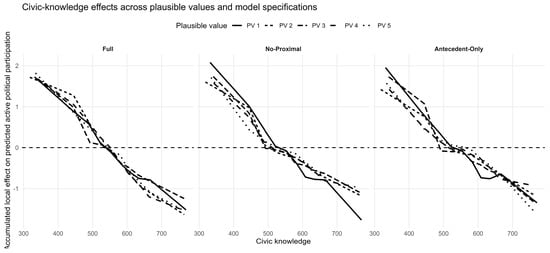
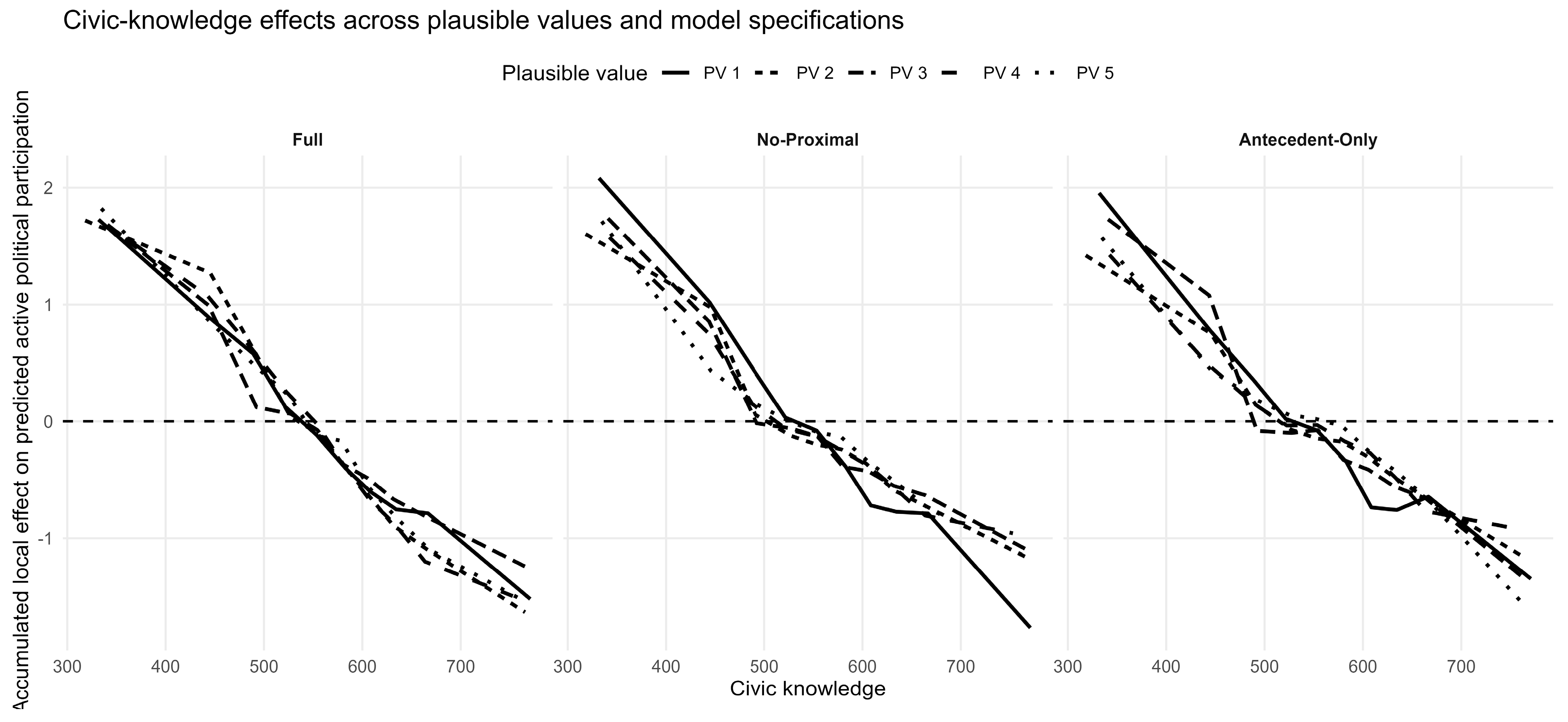
To further examine the robustness of this finding, accumulated local effects (ALE) plots for civic knowledge were examined across all five plausible values and the three Random Forest specifications. Figure 4 displays the results. The curves show the model-implied changes in predicted expected active political participation across levels of civic knowledge for each of the five plausible values in the Full, No-Proximal, and Antecedent-Only models. The zero line represents the centered average prediction. The ALE plots provide converging evidence of a negative predictive association between civic knowledge and expected active political participation, with a generally decreasing pattern observed across all three model specifications and the five plausible values.
Figure 4.
Civic-knowledge Effects across Plausible Values and Model Specifications.
4. Discussion
The present study examined adolescents’ expected active political participation using an explainable Random Forest framework applied to ICCS 2022 data from Schleswig-Holstein. The results show that conclusions about the strongest predictors depend importantly on whether variables conceptually close to the outcome are included. The Full model achieved the best predictive performance, but the two dominant predictors, i.e., expected legal and electoral participation, were themselves closely related forms of anticipated political behavior. When such variables were removed, predictive accuracy decreased but a more substantively informative set of predictors emerged.
This distinction between predictive accuracy and conceptual proximity is important. The Full Random Forest explained approximately 43% of out-of-sample variance, but its strong performance should not be interpreted as showing that more general civic characteristics alone account for this degree of variation. Expected legal and electoral participation contributed substantially to the Full model’s accuracy. When four proximal participation-intention variables were excluded, Random Forest R2 declined to 0.281, and it decreased further to 0.246 in the most restrictive specification. These changes indicate that a substantial portion of the Full model’s predictive accuracy was associated with constructs closely related to expected active political participation.
Once these proximal measures were removed, citizenship self-efficacy became particularly prominent. In the most restrictive model, it ranked first under both held-out permutation importance and global SHAP importance. This finding is consistent with Bandura’s (1997) theory of self-efficacy and with previous research showing that adolescents who feel capable of understanding and participating in civic affairs report stronger expectations of future engagement (Hope & Jagers, 2014; Myoung & Liou, 2022). Beliefs about conventional citizenship ranked second under both importance approaches. Thus, adolescents’ confidence in their civic capabilities and their beliefs about the importance of conventional civic responsibilities appear to provide substantial predictive information even after more direct participation measures are excluded. These findings are also consistent with motivational perspectives emphasizing both perceived competence and the value attached to political engagement (Levy & Akiva, 2019).
Participatory experiences within school also remained relevant. Willingness to participate in school activities became the strongest predictor in the No-Proximal model, supporting previous research that views schools as environments in which students acquire experience with participation, collective decision-making, and civic agency (Campbell, 2008; Kahne & Sporte, 2008; Reichert, 2016). However, because willingness to participate in school activities is itself behaviorally close to a participation outcome, it was excluded from the most restrictive specification. Its strong predictive importance should therefore be interpreted as evidence that participatory orientations across settings are closely connected, rather than as evidence that school participation causes later political engagement. Civic learning at school nevertheless retained predictive importance after these more direct participation measures were removed.
Civic knowledge produced one of the most notable findings. It remained highly important across all three specifications, ranking third in the Full model, fourth in the No-Proximal model, and third in the most restrictive model. It also ranked third in the corresponding SHAP analysis. This consistency indicates that civic knowledge provides meaningful predictive information even after variables closely related to political participation are removed. Importantly, however, predictive importance should be distinguished from association direction. Positive permutation-importance values indicate that disrupting civic knowledge reduces predictive accuracy, while mean absolute SHAP values indicate that civic knowledge materially contributes to fitted predictions. Neither measure implies a positive relationship with the outcome.
In fact, the direction of the civic-knowledge relationship was consistently negative. The pooled weighted Pearson correlation between civic knowledge and expected active political participation was r = −0.139. SHAP dependence plots similarly showed that higher civic-knowledge values contributed to lower predicted participation, while ALE plots displayed decreasing relationships across all three model specifications and all five plausible values. The agreement between the zero-order correlation and the model-based explanations is important because it indicates that the negative relationship was not created merely by conditioning on self-efficacy, citizenship beliefs, or the proximal participation measures.
This result contrasts with previous studies that have generally reported positive associations between civic knowledge and several forms of expected political participation (Schulz, 2005; Schulz et al., 2018; Torney-Purta et al., 2001). The reason for the discrepancy cannot be determined from the present data. Differences in the specific participation outcome, the Schleswig-Holstein context, or the relationship of civic knowledge with different types of participation may warrant further investigation. The possibility that the negative relationship represented an indirect effect through efficacy or democratic values is not supported by the current analysis because the negative association was already present at the bivariate level.
The converging correlation, SHAP, and ALE patterns therefore support the conclusion that higher civic knowledge was associated with lower expected active political participation in this sample. They do not, however, establish that greater civic knowledge causes lower participation. The data are cross-sectional, the outcome concerns expected rather than subsequently observed behavior, and neither correlations nor Random Forest explanation methods establish temporal precedence or eliminate unmeasured confounding. The finding should therefore be interpreted as a robust negative predictive association rather than as a causal effect or an indirect or mediated mechanism.
The comparison with benchmark models also qualifies the methodological conclusions. Random Forest performed best in the Full and most restrictive specifications, but its advantages over elastic-net and linear regression were modest. In the No-Proximal model, elastic net actually performed slightly better than Random Forest. Thus, the value of Random Forest in this study lies not in overwhelming predictive superiority but in its ability to accommodate complex relationships and, together with SHAP, permutation importance, and ALE, provide complementary views of predictor importance and functional form.
Several limitations remain. First, the cross-sectional design prevents causal interpretation and does not establish whether the identified predictors precede participation expectations. Second, the sample is restricted to Schleswig-Holstein and is not nationally representative of Germany. Replication in North Rhine-Westphalia and other ICCS countries would help establish whether the predictor rankings and the negative civic-knowledge association generalize across contexts.
The findings demonstrate the importance of separating predictive accuracy, predictor importance, association direction, and conceptual proximity. The Full model achieved the highest accuracy partly because it contained participation intentions closely related to the outcome. After these variables were removed, citizenship self-efficacy, conventional citizenship beliefs, and civic knowledge emerged as a stable core of predictors. Civic knowledge was especially distinctive because it combined substantial predictive importance with a consistently negative association, highlighting the need for future longitudinal and cross-national research to explain this unexpected pattern.
5. Conclusions
This study shows that adolescents’ expected active political participation is best understood by distinguishing predictive accuracy from conceptual proximity and association direction. The Full Random Forest achieved the highest predictive performance, but much of this advantage reflected the inclusion of participation-intention variables closely related to the outcome. When these variables were removed, citizenship self-efficacy, conventional citizenship beliefs, and civic knowledge emerged as the most stable predictors across permutation importance and SHAP analyses. Civic knowledge was especially notable because it remained highly predictive while showing a consistent negative association with expected active political participation across correlations, SHAP dependence, and ALE analyses. These findings highlight both the substantive complexity of adolescent political engagement and the value of explainable machine learning for identifying robust predictive patterns while avoiding causal overinterpretation.
Supplementary Materials
The following supporting information can be downloaded at https://www.mdpi.com/article/10.3390/psycholint8030058/s1, Figure S1: Weighted Pearson Correlations Among the 31 Predictors and Expected Active Political Participation; Table S1: Global SHAP Importance in the Weighted Full Random Forest Across Five Civic-Knowledge Plausible Values; Table S2: Global SHAP Importance in the Weighted No-Proximal Random Forest Across Five Civic-Knowledge Plausible Values; Table S3: Convergence of Held-Out Permutation Importance and Global SHAP Importance in the Antecedent-Only Model; Table S4: Descriptive Statistics and Characteristics of Variables Included in the Analysis.
Author Contributions
Conceptualization, P.B. and N.E.; methodology, P.B.; formal analysis, P.B.; writing—original draft preparation, N.E.; writing—review and editing, R.S. All authors have read and agreed to the published version of the manuscript.
Funding
This research received no external funding.
Institutional Review Board Statement
Ethics approval was not required for the present study because the authors conducted a secondary analysis of an existing, publicly available large-scale assessment dataset. The authors were not involved in the original data collection or recruitment of participants, and no interaction with or intervention involving human participants was undertaken as part of this study.
Informed Consent Statement
This is a secondary analysis based on publicly available data and therefore no informed consent was required.
Data Availability Statement
The data associated with this study can be downloaded from: https://www.iea.nl/data−tools/repository/iccs (accessed on 18 April 2026).
Acknowledgments
During the preparation of this manuscript, the authors used GPT-5.6 Luna for editing and improving the text. The authors have reviewed and edited the output and take full responsibility for the content of this publication.
Conflicts of Interest
The authors declare no conflicts of interest.
Abbreviations
The following abbreviations are used in this manuscript:
| ICCS | International Civic and Citizenship Study |
| IEA | International Association for the Evaluation of Educational Achievement |
| SHAP | Shapley Additive Explanations |
References
- Amnå, E., & Ekman, J. (2014). Standby citizens: Diverse faces of political passivity. European Political Science Review, 6(2), 261–281. [Google Scholar] [CrossRef] [Scilit]
- Baker, R. S., & Inventado, P. S. (2014). Educational data mining and learning analytics. In J. A. Larusson, & B. White (Eds.), Learning analytics: From research to practice (pp. 61–75). Springer. [Google Scholar]
- Bandura, A. (1997). Self-efficacy: The exercise of control. W. H. Freeman. [Google Scholar]
- Beaumont, E. (2010). Political agency and empowerment: Pathways for developing a sense of political efficacy in young adults. In L. R. Sherrod, J. Torney-Purta, & C. A. Flanagan (Eds.), Handbook of research on civic engagement in youth (pp. 525–558). Wiley. [Google Scholar]
- Breiman, L. (2001). Random forests. Machine Learning, 45(1), 5–32. [Google Scholar] [CrossRef] [Scilit]
- Campbell, D. E. (2008). Voice in the classroom: How an open classroom climate fosters political engagement among adolescents. Political Behavior, 30(4), 437–454. [Google Scholar] [CrossRef] [Scilit]
- Chan, W. Y., Ou, S. R., & Reynolds, A. J. (2014). Adolescent civic engagement and adult outcomes: An examination among urban racial minorities. Journal of Youth and Adolescence, 43(11), 1829–1843. [Google Scholar] [CrossRef] [Scilit] [PubMed]
- Deutsches Jugendinstitut. (2022). Youth participation and democracy in Europe (Working paper). Deutsches Jugendinstitut. Available online: https://www.dji.de/fileadmin/user_upload/aejp/Youth%2C%20Participation%20and%20Democracy%20in%20Europe.pdf (accessed on 7 September 2026).
- Flanagan, C., & Levine, P. (2010). Civic engagement and the transition to adulthood. The Future of Children, 20, 159–179. [Google Scholar] [CrossRef] [Scilit] [PubMed]
- Friedman, J. H. (2001). Greedy function approximation: A gradient boosting machine. The Annals of Statistics, 29(5), 1189–1232. [Google Scholar] [CrossRef] [Scilit]
- Friedman, J. H., Hastie, T., & Tibshirani, R. (2010). Regularization paths for generalized linear models via coordinate descent. Journal of Statistical Software, 33(1), 1–22. [Google Scholar] [CrossRef] [Scilit]
- Galston, W. A. (2001). Political knowledge, political engagement, and civic education. Annual Review of Political Science, 4(1), 217–234. [Google Scholar] [CrossRef] [Scilit]
- Greenwell, B. (2026). fastshap: Fast approximate shapley values. R package version 0.1.4. Available online: https://github.com/bgreenwell/fastshap (accessed on 20 July 2026).
- Hastie, T., Tibshirani, R., & Friedman, J. (2009). The elements of statistical learning: Data mining, inference, and prediction (2nd ed.). Springer. [Google Scholar]
- Hope, E. C., & Jagers, R. J. (2014). The role of sociopolitical attitudes and civic education in the civic engagement of black youth. Journal of Research on Adolescence, 24(3), 460–470. [Google Scholar] [CrossRef] [Scilit]
- Hoskins, B., Janmaat, J. G., & Villalba, E. (2012). Learning citizenship through social participation outside and inside school: An international, multilevel study of young people’s learning of citizenship. British Educational Research Journal, 38(3), 419–446. [Google Scholar] [CrossRef] [Scilit]
- Jennings, M. K., & Niemi, R. G. (1974). The political character of adolescence: The influence of families and schools. Princeton University Press. [Google Scholar]
- Jennings, M. K., & Stoker, L. (2004). Social trust and civic engagement across time and generations. Acta Politica, 39(4), 342–379. [Google Scholar] [CrossRef] [Scilit]
- Kahne, J. E., & Sporte, S. E. (2008). Developing citizens: The impact of civic learning opportunities on students’ commitment to civic participation. American Educational Research Journal, 45(3), 738–766. [Google Scholar] [CrossRef] [Scilit]
- Kotsiantis, S. B. (2012). Use of machine learning techniques for educational proposes: A decision support system for forecasting students’ grades. Artificial Intelligence Review, 37(4), 331–344. [Google Scholar] [CrossRef] [Scilit]
- Levy, B. L., & Akiva, T. (2019). Motivating political participation among youth: An analysis of factors related to adolescents’ political engagement. Political Psychology, 40(5), 1039–1055. [Google Scholar] [CrossRef] [Scilit]
- Lundberg, S. M., Erion, G., Chen, H., DeGrave, A., Prutkin, J. M., Nair, B., Katz, R., Himmelfarb, J., Bansal, N., & Lee, S.-I. (2020). From local explanations to global understanding with explainable AI for trees. Nature Machine Intelligence, 2(1), 56–76. [Google Scholar] [CrossRef] [Scilit] [PubMed]
- Lundberg, S. M., & Lee, S.-I. (2017). A unified approach to interpreting model predictions. In I. Guyon, U. V. Luxburg, S. Bengio, H. Wallach, R. Fergus, S. Vishwanathan, & R. Garnett (Eds.), Advances in neural information processing systems (Vol. 30, pp. 4765–4774). Curran Associates. [Google Scholar]
- Molnar, C. (2022). Interpretable machine learning (2nd ed.). Leanpub. [Google Scholar]
- Myoung, E., & Liou, P. Y. (2022). Adolescents’ political socialization at school, citizenship self-efficacy, and expected electoral participation. Journal of Youth and Adolescence, 51(7), 1305–1316. [Google Scholar] [CrossRef] [Scilit] [PubMed]
- Niemi, R. G., & Hepburn, M. A. (1995). The rebirth of political socialization. Perspectives on Political Science, 24(1), 7–16. [Google Scholar] [CrossRef] [Scilit]
- Reichert, F. (2016). How internal political efficacy translates political knowledge into political participation: Evidence from Germany. Europe’s Journal of Psychology, 12(2), 221. [Google Scholar] [CrossRef] [Scilit] [PubMed]
- Romero, C., & Ventura, S. (2020). Educational data mining and learning analytics: An updated survey. WIREs Data Mining and Knowledge Discovery, 10(3), e1355. [Google Scholar] [CrossRef] [Scilit]
- Rubin, D. B. (1987). Multiple imputation for nonresponse in surveys. John Wiley & Sons. [Google Scholar]
- Rudin, C. (2019). Stop explaining black box machine learning models for high stakes decisions and use interpretable models instead. Nature Machine Intelligence, 1(5), 206–215. [Google Scholar] [CrossRef] [Scilit] [PubMed]
- Schulz, W. (2005, September 8–10). Political efficacy and expected political participation among lower and upper secondary students: A comparative analysis with data from the IEA Civic Education Study. Paper presented at the European Consortium for Political Research General Conference, Budapest, Hungary. [Google Scholar]
- Schulz, W., Ainley, J., Fraillon, J., Losito, B., Agrusti, G., Damiani, V., & Friedman, T. (2024a). Introduction to the International Civic and Citizenship Education Study 2022. In Education for citizenship in times of global challenge: IEA International Civic and Citizenship Education Study 2022 international report (pp. 1–14). Springer Nature. [Google Scholar]
- Schulz, W., Ainley, J., Fraillon, J., Losito, B., Agrusti, G., & Friedman, T. (2018). Becoming citizens in a changing world: IEA International Civic and Citizenship Education Study 2016 international report. Springer. [Google Scholar]
- Schulz, W., Friedman, T., & Fraillon, J. (Eds.). (2024b). ICCS 2022 technical report. International Association for the Evaluation of Educational Achievement (IEA). [Google Scholar]
- Sherrod, L. R., Torney-Purta, J., & Flanagan, C. A. (Eds.). (2010). Handbook of research on civic engagement in youth. John Wiley & Sons. [Google Scholar]
- Shmueli, G. (2010). To explain or to predict? Statistical Science, 25(3), 289–310. [Google Scholar] [CrossRef] [Scilit]
- Torney-Purta, J., Lehmann, R., Oswald, H., & Schulz, W. (2001). Citizenship and education in twenty-eight countries: Civic knowledge and engagement at age fourteen. International Association for the Evaluation of Educational Achievement (IEA). [Google Scholar]
- Verba, S., Schlozman, K. L., & Brady, H. E. (1995). Voice and equality: Civic voluntarism in American politics. Harvard University Press. [Google Scholar]
- Wright, M. N., & Ziegler, A. (2017). ranger: A fast implementation of Random Forests for high dimensional data in C++ and R. Journal of Statistical Software, 77(1), 1–17. [Google Scholar] [CrossRef] [Scilit]

Disclaimer/Publisher’s Note: The statements, opinions and data contained in all publications are solely those of the individual author(s) and contributor(s) and not of MDPI and/or the editor(s). MDPI and/or the editor(s) disclaim responsibility for any injury to people or property resulting from any ideas, methods, instructions or products referred to in the content. |
© 2026 by the authors. Licensee MDPI, Basel, Switzerland. This article is an open access article distributed under the terms and conditions of the Creative Commons Attribution (CC BY) license.