1. Introduction
Social Networking Sites (SNSs) provide individuals with new avenues for relationship formation and maintenance by enabling them to construct personal profiles, connect and interact with others, and share information with self-selected audiences (
Boyd & Ellison, 2008). Their asynchronous nature further allows users to shape the content and tone of their communications—whether through posts, stories, or reels—thereby reinforcing selective self-presentation (
Attrill & Jalil, 2011). As a result, large amounts of personal data are continuously produced, uploaded, stored, and redistributed across these platforms.
The widespread adoption of SNSs has made them an integral part of everyday life, with many individuals maintaining multiple accounts across different platforms, each serving distinct purposes (
Brandtzæg, 2012). Over time, SNSs have become a central channel for cultivating and expanding personal online networks, owing to their immediacy, broad reach, and the social capital they enable (
Marriott & Buchanan, 2014). Their core design features explicitly aim to promote interpersonal connection by encouraging the disclosure of personal information (
Hallam & Zanella, 2017). In this sense, self-disclosure functions not merely as a behavioral option but as a prerequisite for meaningful participation in SNS environments.
Self-disclosure (the act of revealing personal information to others) has been extensively examined long before the emergence of SNSs (
Cozby, 1973;
Jourard, 1971;
Berg & Archer, 1980;
Berg & Derlega, 1987;
Greene et al., 2006). Yet the digitization of social interaction and the rapid expansion of SNSs have further increased its relevance (
Stutzman et al., 2013). SNSs provide a communication environment in which users tend to respond to others’ disclosures by revealing personal information of their own (
Berg & Derlega, 1987), while the online setting often encourages greater openness and emotional articulation (
Gibbs et al., 2006). As a result, intimate self-disclosure has become a widespread and defining practice among SNS users.
One of the most persistent debates in SNS research concerns the relationship between privacy and online disclosure. Prior studies have attempted to explain the continued sharing of personal information despite users’ privacy concerns, focusing on factors such as perceived risks, privacy awareness, perceived control, social influence, and psychological predispositions. Although these frameworks shed light on the contextual factors that influence disclosure, they do not fully account for the deeper motivational processes that lead individuals to share progressively more intimate and personally meaningful information.
To address this conceptual gap, the present study began by revisiting the theoretical foundations of disclosure research, with particular attention to the longstanding ambiguity between identity and Self. Much of the literature tends to conflate these concepts, interpreting the multiple roles and presentations individuals assume (both offline and online) as expressions of the Self. This conflation often leads to an overemphasis on strategic identity performance and obscures the possibility that self-disclosure may stem from intrinsic psychological needs rather than merely social interaction or impression management.
In refining this conceptual distinction, we examined the influence of self-esteem on self-presentation and reviewed how identity construction processes shape disclosure practices. We subsequently documented the multiple roles, identities, and self-concepts that individuals hold and project in their daily lives, with the objective of identifying the underlying psychological construct that may drive disclosure within SNSs, namely the True Self. This step enabled us to explore how the True Self becomes manifest in digital interaction and how its expression operates as a mechanism of self-verification.
Through this theoretical synthesis, the study examines whether SNS environments provide users with greater opportunities than offline contexts to express aspects of their True Self and whether this expanded potential for authentic expression encourages more personal and meaningful forms of disclosure. Within this framework, the True Self is considered equivalent to the Authentic Self.
The paper is structured as follows. The present section develops the theoretical framework and formulates the research hypotheses.
Section 2 describes the methodology.
Section 3 presents the empirical findings.
Section 4 discusses the findings in relation to the proposed hypotheses and the broader literature.
Section 5 presents the main conclusions of the study.
1.1. Related Work
1.1.1. Privacy Paradox and Self-Disclosure
Users willingly share substantial amounts of sensitive personal data (
Tufekci, 2008;
Gritzalis, 2004), despite being aware of and concerned about the risks that SNSs pose to their information privacy (
Pew Research Center, 2014;
Taddicken, 2014;
Quinn & Epstein, 2018;
Stone et al., 1983). The incongruity between online self-disclosure behavior and privacy concerns has been termed the privacy paradox (
Brown, 2001;
Norberg et al., 2007) and has been the focus of several studies (
Kokolakis, 2017). Few of them, however, have attempted to account for it (and often only from a unilateral perspective), while others have provided contradictory or incomplete explanations (
Dienlin & Trepte, 2015;
Lutz & Strathoff, 2014). This inconsistency stems from the fact that disclosure and control on SNSs are not as closely connected as they might appear.
According to
Christofides et al. (
2009), information disclosure and information control in SNSs should be understood as distinct behavioral processes rather than as opposite poles of a single continuum, since each is grounded in different psychological motivations. Their findings showed that participants were more willing to disclose personal information on Facebook than in face-to-face settings, indicating that disclosure practices vary substantially across communication contexts. As the authors further observed, SNS environments facilitate both voluntary and reciprocal forms of disclosure, creating conditions that differ significantly from offline interpersonal interaction.
The literature generally agrees that privacy concerns are not a reliable predictor of privacy behavior, as there is consistently a gap between individuals’ concerns about privacy and their actual privacy-related practices (
Acquisti & Gross, 2006;
Beresford et al., 2012;
Berendt et al., 2005;
Braunstein et al., 2011;
Brown, 2001;
Norberg et al., 2007;
Tufekci, 2008;
Zafeiropoulou, 2014;
Barth & de Jong, 2017;
Gerber et al., 2018).
Beyond privacy concerns, research has identified additional factors either directly associated with self-disclosure or mediating its relationship with privacy concerns. Four of these, discussed in the following subsections, collectively provide a meaningful interpretive framework for the study of personal information disclosure, as their explanatory power rests on universal rather than individualized factors—independent of personality type (A or B), social norms, or users’ interpretations of their presence on SNSs. Nevertheless, even these studies concentrate on the conditions that shape users’ disclosure behavior, rather than addressing the underlying need for self-disclosure itself.
1.1.2. Construal Level Theory
Hallam and Zanella (
2016,
2017) sought to account for the inconsistency between users’ extensive online self-disclosure and their simultaneously high levels of privacy concern by applying Construal Level Theory (CLT) within a behavioral decision-making model. According to CLT, the degree to which an event, object, or situation is removed from the self in the here and now—across temporal, spatial, social, or hypothetical dimensions—constitutes its psychological distance (
Liberman et al., 2002,
2007;
Kruglanski & Higgins, 2007;
Eyal et al., 2009). These distances both shape and are reflected in corresponding levels of mental construal: abstract, high-level construals are associated with distant events, whereas concrete, low-level construals pertain to events perceived as immediate (
Liberman et al., 2002;
Trope & Liberman, 2003;
Fiedler, 2007).
Within this framework,
Hallam and Zanella (
2016,
2017) demonstrated that social rewards tied to SNS engagement—such as likes and views—are psychologically proximal, perceived as real, immediate, and emotionally salient. As concrete, low-level constructs, they exert a strong positive influence on near-term disclosure behavior. In contrast, the possibility of a privacy breach is construed as temporally distant and hypothetically uncertain and thus functions as an abstract, high-level construct with a weaker motivational pull. Consequently, self-disclosure becomes a negotiated trade-off between two cognitively demanding evaluations: the immediate benefits of social visibility and validation versus the abstract risks associated with potential future privacy loss.
Importantly, Hallam and Zanella showed that privacy concerns do not directly inhibit disclosure. Although users are well aware of the threats associated with revealing personal information, their actions are more strongly shaped by the motivation to obtain short-term social rewards (
Mascheroni et al., 2015;
Ng, 2014). This tendency is amplified by two psychological factors: (a) users’ systematic overconfidence regarding distant-future outcomes framed in abstract terms and (b) the illusion of control they believe they exercise over the information they disclose. As a result, individuals often reveal considerable amounts of seemingly sensitive content, underestimating the importance of contextual factors that may affect their privacy in the future.
1.1.3. The Control Paradox
Perceived control is a central determinant of both risk perception and risk-taking behavior (
Harris, 1996;
Klein & Kunda, 1994;
Nordgren et al., 2007;
Slovic, 1987;
Weinstein, 1984). Prior research shows that when individuals experience a sense of control, they are more willing to engage in risky behaviors and simultaneously perceive those risks as less severe. This sense of control can obscure attention to risks beyond one’s actual sphere of influence, thereby narrowing risk awareness (
Brandimarte et al., 2013).
A similar pattern emerges in the context of online information disclosure. Individuals who disclose personal data are typically not indifferent to privacy; rather, they operate under an illusory sense of control that leads them to believe they can effectively manage the information they disclose (
Acquisti & Gross, 2006). This perceived control is anchored in the proximal act of choosing what to disclose and when, while neglecting the more distal dimensions of control—namely, how the disclosed information might later be accessed, interpreted, circulated, or exploited by others. As a result, individuals tend to underestimate external privacy risks and overestimate the efficacy of their own regulatory actions (
Acquisti & Gross, 2006;
Brandimarte et al., 2013), thereby reinforcing their inclination to disclose beyond levels warranted by accurate risk assessment.
Notably,
Brandimarte et al. (
2013) demonstrated that granting SNS users more granular and explicit privacy controls can paradoxically increase their willingness to share sensitive information with broader and potentially riskier audiences. When individuals are offered clear and direct decision-making power over what they publish and who can access it, the explicit perception of control reduces their psychological resistance to disclosure—even when objective risks rise. This dynamic illustrates that it is not the act of disclosure itself that drives privacy-related decision-making, but rather the perceived agency users believe they possess over that act.
1.1.4. Digital Nudging
Perceived control is strongly associated with the sense of safety and trustworthiness attributed to a digital platform (
Hui et al., 2007) as well as with users’ confidence in the provider (
Krasnova et al., 2010;
Masur & Scharkow, 2016;
Olivero & Lunt, 2004). When individuals perceive an SNS as secure and reliable, they tend to disclose more substantial and authentic identity-related information. For this reason, providers consistently highlight their commitment to privacy protection and frequently employ digital nudging strategies—subtle, choice-guiding design features that function as soft paternalistic tools intended to encourage disclosure (
Kroll & Stieglitz, 2019).
Digital nudging has been defined as “a subtle form of using design, information, and interaction elements to guide user behavior in digital environments, without restricting the individual’s freedom of choice” (
Meske & Potthoff, 2017). Although such mechanisms are often framed as safeguards that help users avoid unintended disclosures (
Z. Wang et al., 2014), they may paradoxically increase disclosure. Notifications that remind users of privacy settings or the visibility of their content are typically perceived as transparent and detailed communications from the provider (
Andrade et al., 2002;
Krasnova et al., 2010;
Y. Wang & Midha, 2012). By enhancing users’ perceived sense of control and reinforcing trust—or at least reducing distrust—these cues strengthen individuals’ willingness to share personal information.
At the same time, self-disclosure is shaped not only by platform design but also by social cues. Users frequently take their peers’ behavior as a reference point; observing friends sharing personal content encourages them to disclose more about themselves (
Joinson & Paine, 2012;
Utz & Krämer, 2009). Thus, perceived control, trust in the provider, and peer behavior jointly operate as reinforcing mechanisms that increase users’ propensity to disclose information within SNS environments.
1.1.5. The Lemming Effect
Users of SNSs frequently adopt collective patterns of behavior when they perceive that the number of individuals engaging in a particular action exceeds their personal behavioral threshold—a dynamic commonly described as the lemming effect (
Snyman et al., 2018). This phenomenon draws on
Granovetter’s (
1978) threshold theory, which posits that individuals hold internal thresholds determining the likelihood of participating in group behavior. These thresholds reflect implicit cost–benefit evaluations that are influenced by how many others are already engaging in the behavior.
In the domain of information security and personal data disclosure, this perspective indicates that individuals may follow disclosure patterns established by their peers, even in cases where such behaviors do not fully align with their own preferences or intentions. When the number of peers engaging in a particular disclosure practice exceeds an individual’s behavioral threshold, the effect of collective influence becomes more pronounced, reinforced by the fundamental human need for social connection and a sense of belonging (
Simões & Mirabile, 2014).
1.1.6. Conclusions
Users’ willingness to disclose personal information on SNSs appears to arise from a cognitively complex process shaped by the interplay of the factors discussed above. These factors primarily establish the conditions under which disclosure becomes possible; however, they do not in themselves explain the underlying motivation that drives this behavior (
Paspatis et al., 2023). In other words, existing research does not fully account for the objective users pursue when revealing personal information (
Schudy & Utikal, 2017). This gap points to the presence of an additional motivational construct—one that frames self-disclosure not merely as a behavioral choice but as a psychological need (
Berg & Derlega, 1987;
Bai et al., 2025). Recent work has begun to explore this possibility by examining the role of the True Self as a motivational driver of online disclosure (
Gavriilidou & Gritzalis, 2025). The question that arises, therefore, is: what does this need ultimately refer to?
1.2. Self-Presentation and Self-Esteem
Users of SNSs often associate the disclosure of personal information with sociability and the construction of their online identity (
Ng, 2014;
Utz et al., 2012). Self-disclosure becomes a means of establishing presence and avoiding social invisibility, leading individuals to shape their digital self-identity through continuous information sharing. This dynamic aligns with
Floridi’s (
2010) notion of “informational re-appropriation,” whereby users reclaim individuality through voluntary self-exposure, as well as
Wu’s (
2019) argument that disclosure helps individuals avoid becoming informationally indistinguishable.
This tendency remains evident despite users’ concerns about privacy. Individuals often perceive greater personal cost in restricting access to their information than in disclosing it, as such limitations may constrain opportunities for identity construction (
Christofides et al., 2009). Consequently, even users who express strong privacy concerns continue to reveal substantial amounts of personal information—a pattern central to the privacy paradox. Through these disclosures, aspects of identity enter the public sphere and become subject to social evaluation and comparison, shaping users’ sense of self-worth, competence, and belonging (
Nor et al., 2025;
Weber et al., 2025).
Given that SNS participation is closely tied to self-perception, numerous studies have examined the relationship between self-evaluation and everyday online behavior (
Mehdizadeh, 2010;
Kalpidou et al., 2011;
Vogel et al., 2014;
Papaioannou et al., 2021). Yet findings on online self-presentation remain mixed. A substantial body of research suggests that users often construct idealized versions of themselves by selectively shaping the personal information they present (
Manago et al., 2008;
Attrill & Jalil, 2011). Conversely, the limited anonymity of SNSs has been shown to constrain the range of possible projected identities, encouraging the expression of more genuine personality traits—a perspective consistent with the extended real-life hypothesis (
Back et al., 2010) and supported by psychological evidence on personality cues in online contexts (
Ambady & Skowronski, 2008;
Funder, 1999;
Hall & Bernieri, 2001;
Kenny, 1994;
Vazire & Gosling, 2004).
Within this broader framework, self-esteem emerges as a central psychological determinant. High self-esteem promotes authentic self-presentation and reduces strategic manipulation, whereas low self-concept clarity fosters fragmented or idealized portrayals across platforms (
Ranzini & Lutz, 2017;
Fullwood et al., 2020). As
Simões and Mirabile (
2014) observe, SNS use is driven by two fundamental needs: belonging and self-presentation. Users align with communal norms to maintain social connections (
O’Donnell, 2018) while simultaneously striving to present themselves favorably (
Marwick & Boyd, 2011) and receiving feedback that enhances self-esteem and emotional stability.
Despite these insights, much of the existing literature conflates the terms identity and self, often conceptualizing them as interchangeable when discussing disclosure practices. In our view, this conceptual conflation obscures the deeper psychological motive that drives individuals to disclose personal information. This observation guided our literature review toward a more focused examination of the Self—an inherently complex and foundational construct for understanding why users choose to reveal meaningful aspects of themselves in online environments.
1.3. Is Identity Equal to Self?
1.3.1. Identity Construction
Zhao et al. (
2008) demonstrated that in “nonymous” environments—platforms where online and offline identities are tightly integrated—individuals tend to show rather than tell who they are. Identity is thus constructed primarily through curated visual cues, interests, and interaction patterns rather than explicit self-descriptions. Impression management and audience-oriented presentation play a central role in shaping this process (
Hunt et al., 2014;
O’Donnell, 2018;
Papaioannou et al., 2020). From a narrative perspective, identity emerges not only from one’s own expressions but also from the interpretations and expectations of others, which users internalize as part of their evolving digital self-concept (
Sfard & Prusak, 2005). Identity therefore appears to be a socially negotiated, continuously updated construct rather than a fixed attribute.
The pressures of identity construction within SNSs increasingly encourage users to reveal more personal information.
Gross and Acquisti (
2005) describe large-scale networks as introducing a new form of intimacy in which visibility becomes tempting rather than threatening—a dynamic amplified by contemporary cultures of constant observation (
Bauman & Lyon, 2013). In this setting, disclosure serves as a primary mechanism for securing social recognition and stabilizing one’s online persona (
Papathanassopoulos et al., 2016). Nevertheless, questions remain about what individuals ultimately choose to present and why, a tension that reflects the longstanding conceptual conflation between Self and personal identity in the research literature.
1.3.2. Distinguishing Identity from Self
Psychological and sociological theory has long emphasized that the Self is multifaceted rather than singular. Classic frameworks distinguish different internal dimensions:
Jung et al.’s (
1953) contrast between persona and inner Self,
Goffman’s (
1959) model of self-presentation in everyday life,
Markus and Nurius’s (
1986) “possible selves,” and
Higgins’s (
1987) actual–ideal–ought Self. Despite their differences, these models converge on the idea that the Self is dynamic and shaped through ongoing experience.
Orsatti and Riemer (
2015) extend this understanding by defining identity as socially embedded, relational, and continually co-produced through participation in various contexts, while the Self provides the underlying sense of coherence through which individuals interpret their lived experience.
Within SNS environments, these distinctions become particularly salient. Platform affordances (visibility, persistence, connectivity, and nonymity) enable users to express dimensions of self-concept that may remain constrained offline (
Simões & Mirabile, 2014). In such contexts, identity is shaped dialogically: users craft profiles, respond to audience feedback, and adjust their presentations through ongoing impression management (
Hunt et al., 2014;
O’Donnell, 2018). This dynamic fosters identity expression that ranges from the strategic to the aspirational.
At the same time, the interplay between multiple identities and the inner Self becomes pronounced. While SNSs facilitate idealized self-presentations, consistent with the idealized virtual-identity hypothesis (
Manago et al., 2008), their limited anonymity and integration with offline networks also encourage the expression of more authentic traits (
Back et al., 2010). These platforms thus operate as social laboratories in which users explore alternative yet attainable versions of themselves—hoped-for possible selves (
Bronstein, 2014)—that align closely with
Rogers’s (
1951) notion of the True Self: an experiential core of authenticity that individuals seek to express when contextual conditions permit.
Taken together, these perspectives suggest that SNSs create an environment in which public, ideal, possible, and true versions of the Self intersect and interact. The platform’s imagined audience, its expressive tools, and the continuous negotiation of impressions all enable users to reveal selected aspects of their deeper inner experience. This provides a strong theoretical foundation for understanding why users disclose personal information online: such disclosure often extends beyond identity performance, reflecting a more fundamental psychological need to articulate elements of the True Self.
1.3.3. The True Self
The True Self, as conceptualized in contemporary research (
Bargh et al., 2002;
McKenna et al., 2002;
Hu et al., 2021;
Choi & Sung, 2018;
Whitty, 2008), constitutes a psychologically real and present dimension of the individual—distinct from both the ideal and possible selves—future-oriented or aspirational—and the actual Self, which reflects one’s socially enacted identity. It refers to attributes and dispositions that individuals genuinely possess but do not fully express in offline life, often because these qualities conflict with normative expectations or evoke fears of judgment and disapproval.
Rogers (
1951) argued that the True Self encompasses precisely those central characteristics that individuals wish others would recognize but hesitate to reveal, or that, even when expressed, fail to be acknowledged by significant others, with potentially adverse consequences for self-esteem and psychological well-being (
Seidman, 2014). In this sense, the True Self represents an underexpressed but deeply internal dimension of personhood that remains constrained in face-to-face interaction.
Rogers vividly illustrated the True Self as a prisoner “tapping out day after day a Morse Code message, ‘Does anyone hear me?’” (
Rogers, 1951, p. 136).
1.3.4. True Self in SNSs
The features of SNS communication (such as selective sharing, reduced social pressure, and the ability to formulate one’s messages without immediacy) make it easier to express aspects of the True Self that rarely surface in face-to-face interaction. Contemporary platforms, with tools like stories, reels, live video, and image-based posts, have become flexible spaces where individuals can present parts of themselves that feel difficult to reveal offline.
Research has consistently shown that users express True Self qualities more readily online than in direct interpersonal settings (
Bargh et al., 2002;
Tidwell & Walther, 2002;
McKenna & Bargh, 2000). People often disclose information in digital contexts that they would hesitate to share offline, including personal material they intentionally withhold from their closest relationships (
Bonebrake, 2002;
Cooper & Sportolari, 1997;
Bronstein, 2014). These patterns suggest that online communication lowers the interpersonal barriers that usually limit the expression of meaningful self-aspects.
Bargh et al. (
2002) also found that the True Self becomes more mentally accessible during online exchanges, which helps explain why users feel freer to express it, sometimes even to existing offline friends. Such expression strengthens relational ties and makes it easier to address sensitive or complex issues (
McKenna et al., 2005).
Acting in accordance with the True Self online also helps individuals align with their internal self-guides—the personal standards and goals that direct behavior (
Hu et al., 2021). When these are affirmed, psychological well-being improves, consistent with research showing that mismatches between one’s inner standards and outward behavior are linked to anxiety and emotional strain (
Higgins, 1987;
Debrosse et al., 2018). SNSs therefore offer a context in which individuals can maintain greater coherence between who they are internally and how they express themselves. Recent research has also emphasized that SNS environments may function as spaces where individuals articulate aspects of their True Self that remain less visible in offline contexts (
Gavriilidou & Gritzalis, 2025).
1.3.5. True Self and Verification
The expression of True Self qualities in SNSs is best understood through the lens of self-verification—the motivation to be perceived by others in ways consistent with one’s self-conception. Offline, this process is often limited by normative expectations and the anticipation of social evaluation, which constrains the recognition of personally meaningful aspects of the Self.
SNS environments provide more favorable conditions for such self-verification. When users disclose subjectively significant traits online and receive acknowledgment from others, these traits gain social validation and become more firmly integrated into the self-concept. The affordances of SNSs (selective visibility, asynchronous communication, and reduced interpersonal risk) facilitate the articulation of True Self elements that are rarely expressed in face-to-face settings.
Despite awareness of privacy risks, users often experience the psychological benefits of being recognized as outweighing potential risks. SNSs provide a context in which underexpressed qualities and relational capacities—often constrained offline by fear of judgment or misalignment with social norms (
Rogers, 1951)—can be selectively disclosed and validated. In this sense, online self-disclosure serves as a meaningful pathway toward greater self-coherence and affirmation.
1.4. Scope of the Research
Research on disclosure and privacy behaviors in SNSs is marked by conceptual inconsistencies, particularly regarding the terminology used to describe users’ different manifestations of selfhood. Scholars frequently conflate Self with identity, referring to “multiple selves” when in fact they describe variations in identity performance. In SNSs, individuals do not construct a new psychological Self; rather, they either enact a strategically curated identity—often aligned with contextual expectations—or disclose aspects of their True Self that remain inhibited in offline interaction. This terminological imprecision has contributed to contradictions in interpreting the motivations underlying online self-disclosure.
Much of the literature interprets online identity expression as a form of strategic self-presentation consistent with
Goffman’s (
1959) front-stage behavior. These curated identities, shaped by ideal, desired, or prescriptive self-representations, aim primarily to elicit favorable evaluation and are not necessarily indicative of deeply personal or psychologically central attributes. Yet, despite concerns about privacy, SNSs also operate as spaces of expressive freedom, where individuals voluntarily disclose personal information or internal reflections. This willingness often reflects the need for self-verification: the motivation to have significant aspects of oneself acknowledged by others in ways that align with one’s own self-perception.
A persistent limitation in the literature is the conflation of authentic self-presentation with actual behavior. This distinction is crucial, as authenticity derives from who individuals understand themselves to be (the True Self), not merely from what they do or how they are socially positioned (identity). Authenticity presupposes coherence between inner experience and outward expression, yet offline contexts frequently restrict such expression due to social norms, fear of judgment, or the absence of validating audiences. Nevertheless, the drive toward authentic expression persists, closely tied to the psychological need for self-verification and the desire to make personally significant aspects of the Self visible and socially meaningful.
Taking these conceptual limitations into account, this study argues that self-disclosure in SNSs often stems from the need to express and validate the True Self—an aspect of selfhood that offline life frequently constrains (
Kreling et al., 2022). This need is distinct from the desire to curate an identity through profile content; it reflects a deeper pursuit of authenticity and psychological congruence. SNSs thus serve not only as stages for social performance but also as potential spaces of self-actualization, enabling users to articulate elements of the Self that go beyond socially assigned roles. By disentangling the conflation of Self, identity, and True Self, the study provides a refined conceptual lens for interpreting the privacy paradox and clarifying the underlying motivational dynamics of online self-disclosure.
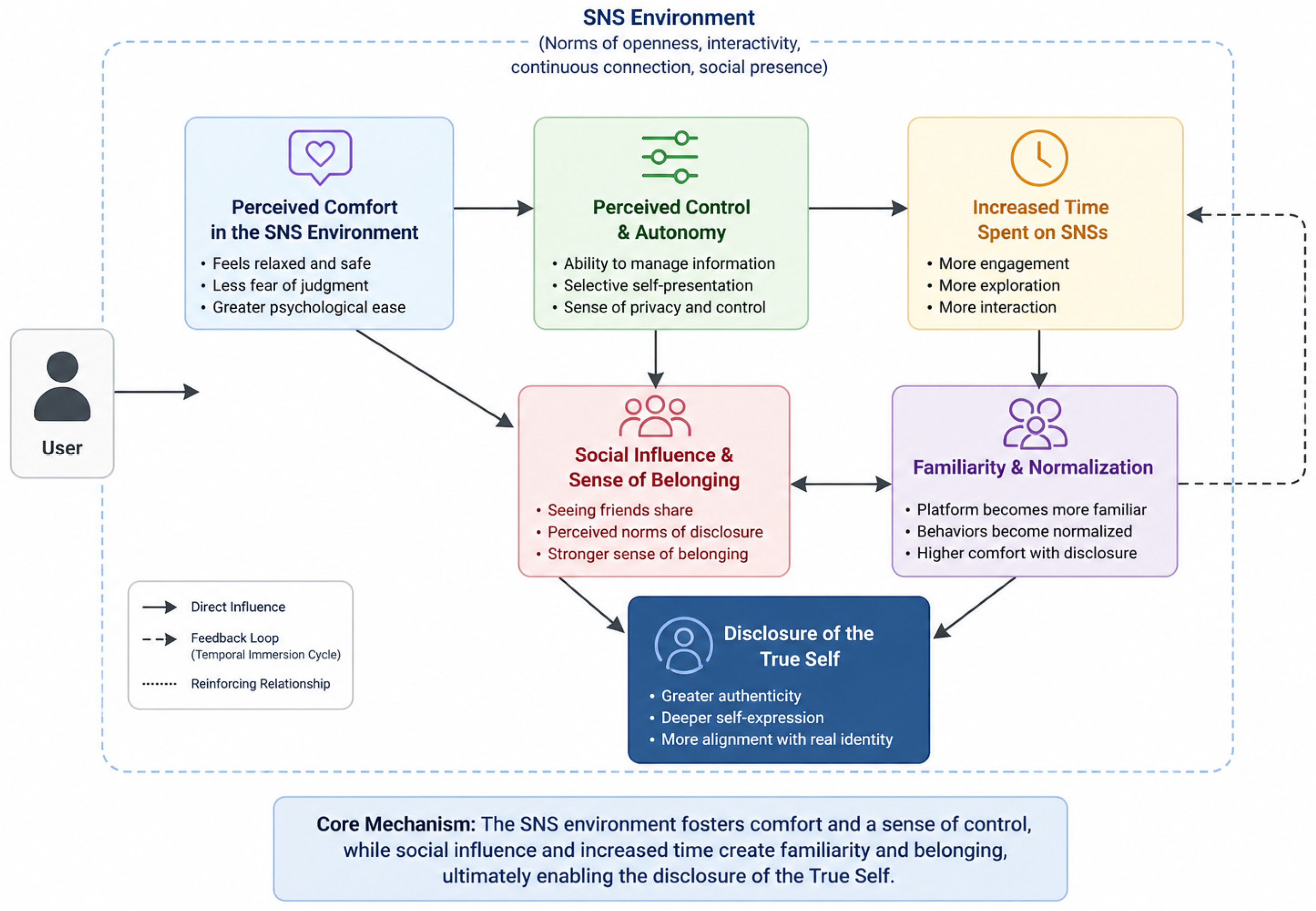
The conceptual relationships examined in the present study are summarized in
Figure 1, which illustrates the proposed dynamics through which temporal immersion, perceived control, and social influence shape the disclosure of the True Self in SNS environments.
On the basis of the theoretical considerations outlined above, four hypotheses are formulated regarding the conditions under which users disclose aspects of their True Self on SNSs.
Hypothesis 1. Higher levels of engagement on SNSs are positively associated with the disclosure of aspects of the True Self.
In offline life, individuals operate within social frames defined by the multiple identities they adopt, which often constrain their behavior. These frames may limit the expression of the True Self in face-to-face interactions due to concerns such as social judgment or situational restrictions. SNSs, however, provide conditions under which users may disclose information and aspects of their True Self in ways that are both representative of their inner dispositions and under their control.
Hypothesis 2. A higher perceived level of control over personal information disclosure on SNSs is associated with a greater willingness to disclose aspects of the True Self.
Unlike offline contexts, SNSs allow users to manage the content, audience, and timing of their disclosures. This perceived control may render disclosure more appealing and less risky, increasing the likelihood that individuals reveal personally authentic aspects of themselves online.
Hypothesis 3. Higher levels of peer disclosure on SNSs are associated with users’ own self-disclosure behavior.
Friends’ practices on SNSs set a reference point for what is considered acceptable or expected self-disclosure. In this way, peers function as social referents, shaping users’ perceptions of appropriate behavior and guiding their own willingness to disclose. Consequently, users may be more likely to reveal aspects of their True Self when their peers engage in similar forms of disclosure.
Hypothesis 4. More time spent on SNSs is associated with an increased likelihood of disclosing aspects of the True Self.
Increased time on SNS platforms fosters familiarity and comfort, enabling users to develop a perceived sense of safety when sharing personal information. This familiarity may increase the likelihood of disclosing aspects of the True Self over time.
2. Materials and Methods
2.1. Participants and Procedure
Data collection was conducted through structured interviews based on a questionnaire specifically designed for the purposes of this study. The sample consisted of 121 undergraduate, postgraduate, and doctoral students from various departments of the University of the Aegean and the University of Piraeus. Prior to scheduling interviews, participants were asked whether they owned at least one social media account; those who reported not using social media applications were excluded. To ensure consistency and comprehension, participants were provided with a clear definition of all key terms used in the questionnaire, as these were crucial for understanding the questions and ensuring the accuracy of responses. All interviews were conducted in Greek.
Prior to participation, all individuals were informed about the purpose and procedures of the study during course sessions across different departments. Students who expressed interest were subsequently invited to participate. Informed consent was obtained from all participants, who voluntarily agreed to take part in the research.
Participation was entirely voluntary, and no academic incentives, requirements, or obligations were associated with participation. It was explicitly clarified that participation or non-participation would have no impact on students’ academic standing.
All responses were collected anonymously, and participants were informed that they could withdraw from the study at any time without consequence.
2.2. Instrument and Measures
The structured interview consisted of three parts. The first part included four sections, each grounded in the literature review and addressing a distinct aspect of the research theme, namely self-disclosure in SNSs.
Section 1: Social Networking Sites as My Real World. This section contained 14 items examining what users project through their online activity and whether their True Self is revealed more strongly in SNSs through self-disclosure behaviors than in offline life. Two items in this section captured identity-oriented self-presentation (e.g., idealized self-presentation and role-based identity expression) in order to distinguish these forms conceptually from the disclosure of the True Self.
Section 2: Activity Control on Social Networking Sites and True Self. This section included 6 items exploring whether users’ perceived control over their disclosed information and their privacy concerns are systematically related—that is, whether disclosure occurs only when users feel in control of their information or whether privacy and control are not necessarily two ends of the same spectrum.
Section 3: Social Influence and True Self. This section comprised 6 items examining whether social influence operates as a threshold that encourages users to disclose more. It further explored whether the disclosure practices of peers establish social norms that guide users’ own willingness to reveal personal information.
Section 4: Privacy Breaches and True Self. This section included four items examining participants’ perceptions of potential privacy risks and their possible influence on self-disclosure behavior. Although these variables are not part of the focal analyses presented in this article, they informed the broader interpretive framework through which the dynamics of disclosure, perceived control, social influence, and SNS engagement were examined.
The second part of the interview examined SNS usage patterns. It included 15 items regarding the types of platforms participants use, the frequency of use, and the types of self-disclosure behaviors in which they engage.
The third part consisted of five demographic questions.
For the first part of the interview, participants rated the frequency with which they engaged in the specified behaviors using a 5-point Likert scale. In Section 1, the response anchors ranged from 1 = “Never” to 5 = “Always”, whereas in Sections 2, 3, and 4, the anchors ranged from 1 = “Strongly disagree” to 5 = “Strongly agree”. In the second part of the interview, participants indicated which SNSs they actively used and reported how frequently they engaged in the specified disclosure behaviors. Most demographic questions were open-ended.
The full set of questionnaire items used in the study is provided in
Appendix A.
For the purposes of the present analysis, only the items most directly corresponding to the conceptual dimensions examined in each hypothesis were selected for statistical analysis. The remaining items functioned as complementary contextual indicators and contributed to the broader interpretive framework of the study.
2.3. Statistical Analysis
To examine the relationships between the study variables, non-parametric statistical analyses were employed. Spearman’s rank-order correlation coefficient (Spearman’s rho) was used to assess associations between ordinal variables, including Likert-scale responses and time spent on SNSs. Differences between gender groups were examined using the Mann–Whitney U test.
Non-parametric methods were selected because the data were derived from ordinal Likert-scale measures and did not meet the assumptions of normality. Statistical significance was evaluated at the p < 0.05 level. All statistical analyses were performed using IBM SPSS Statistics version 23.
In addition, the internal consistency of the multi-item scales used in the study was assessed using Cronbach’s alpha as presented in
Table 1. The True Self Disclosure (SNSs as My Real World) scale demonstrated good internal consistency (α = 0.812), while the Activity Control and Privacy scale showed moderate internal consistency (α = 0.605). The Social Influence and True Self scale, consisting of two items, demonstrated acceptable reliability for a brief scale (α = 0.633). The Usage of SNSs scale also demonstrated good internal consistency (α = 0.799).
3. Results
3.1. Social Networking Sites as My Real World
Our findings regarding the disclosure of aspects of the True Self on SNSs, as presented in
Table 2, provide support for Hypotheses 1 and 4 and are consistent with prior research on self-verification theory (
Swann, 1983;
Swann & Read, 1981).
More specifically, users, regardless of age, report that there are moments when it feels easier or more convenient for them to express aspects of their True Self through their SNS activity. This finding aligns with the individual’s need to be perceived by others in a manner consistent with one’s self-perception. In this respect, SNSs appear to provide a medium through which aspects of the True Self may be articulated and acknowledged more readily than in offline contexts.
Social networking sites therefore appear to offer individuals an expressive environment that face-to-face interactions do not always facilitate—an expressive environment where users can project and communicate selected facets of their True Self, with an increased likelihood of being seen, understood, and validated by others.
Users tend to adopt a Mid-Point Response Style (MRS) (
Van Vaerenbergh & Thomas, 2013) in this section of the questionnaire. This response pattern is further supported by the qualitative data gathered during the interviews. Self-disclosure has long been viewed with ambivalence and is often associated with impulsive or imprudent behavior. Consequently, users may be reluctant to acknowledge that they disclose more on SNSs than in real life, as such an acknowledgment could be interpreted as confirming the stereotypical belief that users, when engaging in online disclosure, “know not what they do” (Luke 23:34). Nevertheless, users may also recognize the advantages that SNSs offer for personal expression.
At the same time, many respondents indicate that there are “sometimes” when they reveal more about their True Self through their SNS activity than in real life (Question 1), that their online behavior allows others to gain a better understanding of who they truly are (Question 4), or that their profile reflects aspects of themselves that they cannot easily express offline (Question 10). These responses reflect the distinct avenues SNSs provide—channels of self-expression that offline contexts do not always make possible.
With regard to gender, the data reveal no significant association between self-disclosure and gender.
Regarding the time users spend on SNSs, the findings indicate a positive correlation between time spent and key items related to the expression of the True Self—specifically, Questions 1, 2, 3, 4, 7, and 8. These questions represent the core items in the questionnaire for examining the expression of the True Self within SNS environments.
The existence of a positive correlation between responses to these questions and the time users spend on SNSs indicates that increased time spent on SNSs is associated with a greater likelihood of disclosing aspects of the True Self online.
As time spent on SNSs increases, users report greater familiarity with the online environment and a higher likelihood of disclosing personal aspects of themselves. This pattern suggests a reciprocal relationship between familiarity with SNS environments and self-disclosure behaviors.
In offline, face-to-face contexts, individuals may experience reduced control over how they are perceived. Consequently, they may be more inclined to share aspects of themselves on SNSs, where it is easier to articulate and present elements of the self that are more difficult to express in everyday interactions.
In general, the findings indicate no significant association between self-disclosure on SNSs and age.
An exception to this pattern was observed in Question A7 (“I have revealed things about myself on social media that I would not share as easily if I were talking to someone in real life”), where a weak but statistically significant negative correlation was found (r = −0.18, p = 0.04). This finding indicates that younger users are somewhat more likely to disclose information on SNSs that they would hesitate to share in face-to-face interactions, whereas older users appear to maintain a clearer boundary between online and offline self-expression. This pattern suggests that age may be associated not with the overall presence of True Self expression but with the explicitness of disclosure.
This effect appears only in A7, while the remaining items in the True Self section show no significant correlation with age.
3.2. Activity Control on Social Networking Sites and True Self
Our findings, as presented in
Table 3, are consistent with prior research discussed in the theoretical section and provide support for Hypothesis 2, according to which a higher perceived level of control over personal information disclosure on SNSs is associated with a greater willingness to disclose aspects of the True Self. Although the observed correlations are weak in magnitude, they are statistically significant, indicating that perceived control and disclosure operate as distinct but positively related processes. Users appear willing to disclose personal information even when they do not perceive full control over the disclosure process; however, stronger perceptions of control are associated with a greater willingness to disclose.
With regard to age, negative correlations were observed between variables B2 and B4, indicating that younger users report higher levels of agreement with these items. Moreover, time spent on SNSs was positively associated with B4 (r = 0.25, p = 0.004), suggesting that increased SNS engagement co-occurs with stronger perceptions of control in relation to disclosure. Although no causal interpretation can be inferred, this association indicates that greater SNS engagement is accompanied by stronger perceived control over disclosure-related behaviors.
Interestingly, this pattern does not extend to variable B5, which measures privacy concern. No significant correlations were observed between B5 and either age or time spent on SNSs, suggesting that privacy concern may function independently of perceived control in shaping disclosure behavior.
No significant gender differences were observed across the examined variables.
3.3. Social Influence and True Self
The results, as presented in
Table 4, are consistent with Hypothesis 3 and support the association between peer disclosure and users’ own self-disclosure. Time spent on SNSs is positively associated with users’ perceptions and patterns of self-disclosure. More specifically, higher time spent on SNSs is associated with stronger reported influence from peers’ disclosures. This pattern is reflected in the positive correlations between time spent on SNSs and variables C1 (r = 0.29,
p = 0.002) and C3 (r = 0.47,
p < 0.001).
These findings indicate that increased SNS engagement co-occurs with greater sensitivity to peer disclosure.
Friends’ disclosures are associated with users’ own self-disclosure behavior, suggesting that peer activity relates to how users report their disclosure practices.
Variable C3, which captures the internalization of social influence, shows a significant negative correlation with age (r = −0.23, p = 0.014). This result indicates that younger users report higher levels of peer influence in their self-disclosure practices compared to older users.
Our findings are also consistent with previous empirical research.
Berg and Derlega (
1987) observed that individuals often respond to others’ self-disclosure by reciprocating with revelations about themselves, while
Hallam and Zanella (
2017) noted that the creation and maintenance of social connections in SNSs are frequently mediated through the sharing of personal information.
No significant correlations were observed between peer influence variables and demographic variables such as gender or education.
This finding indicates that the association between peer influence and self-disclosure does not vary across these demographic groups.
In summary, the findings indicate that time spent on SNSs is positively associated with both peer influence and users’ self-disclosure practices, suggesting a relationship between these variables.
3.4. Usage of Social Networking Sites
The analysis of SNS usage patterns, as presented in
Table 5, showed that time spent on SNSs is positively associated with multiple forms of self-disclosure. The analysis revealed consistent and statistically significant positive correlations between time spent on SNSs and various disclosure behaviors, including sharing personal photographs, images from daily life, meaningful life events, recent experiences, and memories.
In terms of demographic variables,
Table 6 and
Table 7 show that neither gender nor educational level was significantly associated with the amount of time participants remained connected to SNSs. Instead, age emerged as the only factor associated with usage duration, displaying a moderate negative correlation: younger users tended to spend more time online, whereas older users reported more limited engagement.
These findings indicate that increased SNS use is associated with higher levels of self-disclosure across different types of content.
Users report sharing content related to their daily lives more frequently than personal photographs of themselves, indicating differences in the types of content disclosed. In contrast, items measuring aspects of the True Self show lower levels of reported disclosure, suggesting that such disclosures occur less frequently or less explicitly.
Overall, the findings indicate that time spent on SNSs is associated with both increased disclosure activity and variation in the type of content shared.
4. Discussion
Our research, which was based on a structured interview with 121 participants, provided support for all four of the proposed hypotheses.
Consistent with Hypothesis 1, scores in Section A were positively associated with the disclosure of the True Self in SNS interactions. Users reported that there are times when they disclose aspects of their True Self more easily through their online activity than through face-to-face communication and that SNS platforms may provide opportunities to express dimensions of themselves that are difficult to reveal in offline contexts. This observation is consistent with previous findings suggesting that SNS environments may facilitate the articulation of underexpressed aspects of the True Self (
Gavriilidou & Gritzalis, 2025). Taken together, these findings reinforce the view that SNSs function not merely as channels of communication but as contexts that enable the expression of otherwise inhibited dimensions of the self.
In accordance with Hypothesis 2, users’ disclosure behavior was positively associated with their perceived sense of control. The results also suggest that control and disclosure are not linearly related; users may disclose information regardless of whether they feel fully in control of the disclosure act. Rather than acting as a constraint, control appears to operate as a facilitating condition that supports disclosure by providing users with a sense of agency over how, when, and to whom information is revealed. More broadly, the findings indicate that the disclosure of aspects of the True Self may reflect a psychological motivation that is not strongly dependent on demographic factors such as gender or age. This distinction further suggests that control and privacy should not be treated as opposing ends of the same continuum but as conceptually distinct dimensions: control as a procedural mechanism governing how disclosure is managed and privacy as a boundary-setting orientation shaping when disclosure is considered acceptable. When users refrain from disclosing, opportunities to express meaningful personal qualities or experiences may remain limited, potentially constraining the expression of aspects of the True Self.
In line with Hypothesis 3, users’ friends appeared to influence their disclosure practices. This influence was reflected not only in users’ increased willingness to disclose in response to their friends’ own disclosures but also in the degree to which they aligned their expressive behavior with the prevailing norms within their peer network. This pattern is consistent with processes of social modeling, whereby the observation of others’ behavior provides implicit cues regarding what is appropriate or expected within a given communicative environment. Over time, such processes may contribute to the emergence of shared norms of disclosure, within which users calibrate their own expressive behavior. In this sense, peer influence may function not simply as external pressure but as a social context that normalizes and reinforces disclosure practices.
One of the most notable findings concerns the role of time spent on SNSs in relation to the examined relationships. Time appears to play an important role in shaping users’ perceptions of the SNS environment and their disclosure practices. As users spend more time online, SNS platforms may become increasingly integrated into their everyday social experience. This progressive familiarization suggests that SNSs may be experienced less as external communication tools and more as socially meaningful environments. Through the expression of personal experiences within these environments, users may reinforce the relevance of the platform in their daily lives and strengthen their engagement with it. This dynamic may be understood as a feedback loop, in which increased engagement fosters disclosure, and disclosure in turn reinforces users’ sense of presence and belonging within the platform. Over time, SNSs may become familiar and emotionally meaningful spaces in which users can articulate elements of themselves that may not be easily expressed offline.
Consistent with Hypothesis 4, increased time spent on SNSs was associated with stronger patterns related to the dynamics described in Hypotheses 1–3. In particular, greater time online was linked to more frequent identity-related disclosures (such as everyday-life content), while also contributing to the familiarity and contextual safety that may facilitate more selective expressions of the True Self. In this sense, time appears to be associated with both layers of expression—identity presentation and deeper self-disclosure—while shaping the balance between them. These findings suggest the presence of a layered disclosure process, in which more visible and socially oriented forms of sharing coexist with more selective and internally grounded expressions of the True Self.
5. Conclusions
Despite the fact that explicit definitions of the core concepts of True Self, Control, and SNS activity were provided and repeatedly emphasized throughout the interview, participants still appeared to experience difficulty distinguishing between projecting a persona in their SNS interactions and disclosing aspects of their True Self. This difficulty highlights the extent to which identity and the Self remain intertwined in online contexts.
Identities often function as social frameworks within which individuals operate, shaped by social expectations and interactional norms. Within this context, the disclosure of aspects of the True Self, although not always straightforward, appears to play an important role in users’ sense of authenticity and psychological expression.
The findings suggest that the disclosure of aspects of the True Self reflects a broadly shared motivational tendency that does not vary substantially across users’ age, gender, or educational level. Among the variables examined, time spent on SNSs emerged as the factor most consistently associated with disclosure-related behaviors. Time spent on SNSs appears to be related not only to the frequency of users’ disclosure practices but also to their perceptions of control over shared information and the degree to which they report being influenced by their friends’ disclosures.
As individuals spend more time using SNSs, they may increasingly choose to reveal aspects of their True Self within these environments as SNS platforms gradually become familiar spaces of interaction. This growing familiarity reflects the integration of SNSs into users’ everyday social experience, extending beyond their function as communication tools. In this sense, users may sometimes prefer online to offline disclosure because SNSs can provide conditions that facilitate the articulation—and potential social recognition—of elements of themselves that they consider meaningful for their sense of authenticity.
Two additional findings further illuminate users’ expressive tendencies: (a) the observed avoidance of extreme response categories (MLRS;
Hurley, 1998;
Moors, 2008) and (b) the tendency of younger participants to provide socially desirable responses (
Paulhus, 1991;
Fischer & Fick, 2009). These patterns suggest that social stereotypes and expectations may influence how individuals choose to present themselves in online environments.
Taken together, the findings support the view that self-disclosure in SNSs operates across multiple layers, ranging from identity-related sharing to more selective expressions of the True Self. Within this layered dynamic, disclosure functions not only as communication but also as a means through which individuals establish their presence and meaning within a shared social space. In this sense, and echoing Descartes, the dynamics observed in this study may be succinctly expressed as “I disclose, therefore I exist.”
Although the results cannot be generalized due to the relatively small and demographically specific sample, they provide useful insight into the dynamics of authentic self-expression in SNSs. Future research could extend this line of inquiry to larger and more heterogeneous populations, incorporating broader age ranges, varied educational backgrounds, and the additional dimension of professional context. Longitudinal designs may further illuminate how temporal immersion develops over time and how it relates to psychological comfort, peer dynamics, and disclosure patterns. Complementing interview data with behavioral evidence drawn from users’ actual platform activity may also reveal how authentic self-expression is negotiated in practice. Moreover, cross-platform comparisons could clarify the extent to which different design affordances support or inhibit the disclosure of the True Self, offering useful implications for user-centered and ethically informed platform design.
Beyond these directions, it is also important to acknowledge that digital environments are rapidly evolving, particularly with the integration of artificial intelligence. Generative AI systems such as ChatGPT increasingly mediate online interaction and may influence how identity, authenticity, and self-disclosure are articulated and perceived. Future research could therefore examine how AI-mediated communication environments reshape the dynamics of the True Self in digital spaces and further complicate the relationship between privacy, disclosure, and authenticity.
Author Contributions
Conceptualization, O.G. and S.G.; methodology, O.G. and S.G.; software, O.G.; validation, O.G.; formal analysis, O.G.; investigation, O.G.; resources, O.G.; data curation, O.G.; writing—original draft preparation, O.G.; writing—review and editing, O.G. and S.G.; visualization, O.G.; supervision, S.G. All authors have read and agreed to the published version of the manuscript.
Funding
This research received no external funding.
Institutional Review Board Statement
The study was conducted in accordance with the Declaration of Helsinki. Ethical review and approval were waived for this study in accordance with the University of the Aegean’s policy, as the research was conducted through fully anonymized questionnaires and voluntary interviews, without recording or processing personal data.
Informed Consent Statement
Informed consent was obtained from all subjects involved in the study.
Data Availability Statement
The data supporting the findings of this study are available from the corresponding authors upon reasonable request. The data are not publicly available due to privacy and ethical considerations related to participant confidentiality.
Acknowledgments
The authors would like to thank all participants who generously shared their time and experiences for the purposes of this research. The authors also wish to thank Evangelos Mennis for his valuable methodological insights and guidance regarding the structural organization and data analysis of the study.
Conflicts of Interest
The authors declare no conflicts of interest.
Abbreviations
The following abbreviations are used in this manuscript:
| SNS(s) | Social Networking Site(s) |
| CLT | Construal Level Theory |
Appendix A. Structured Interview Questionnaire
The following questionnaire was administered as part of the structured interview used in this study. The instrument was designed to examine the relationship between Social Networking Sites (SNSs) activity, perceived control over shared information, social influence, privacy perceptions, and the disclosure of the True Self.
Participants were informed that their responses would remain anonymous and that the data would be used exclusively for research purposes. The questionnaire required approximately ten minutes to complete.
For clarity, the following key concepts were defined for participants.
True Self: Personality characteristics and personal abilities that are central to an individual’s identity (who the person truly is) and contribute to their self-esteem. These are qualities that individuals may wish to express in real life but may feel unable or hesitant to reveal due to social or contextual constraints.
Control: The degree to which users perceive that they can regulate (a) the information included in their profile (e.g., personal data, posts, photographs, comments, messages) and (b) the audiences (friends or followers) who have access to that information.
Activity: Any form of interaction or content sharing on SNSs, including posts (e.g., photos, songs, announcements), comments, captions, stories, reactions (likes, emojis), and private messaging.
The questionnaire was originally administered in Greek. The English version is presented here for transparency and reproducibility.
Section A—Social Networking Sites as My Real World
Response scale:
1 = Never
2 = Rarely
3 = Sometimes
4 = Often
5 = Always
I reveal more aspects of my True Self through my activity on SNSs than in real life.
I reveal more aspects of my True Self to my friends through SNS activity than in real life.
I feel more comfortable sharing information about my True Self with my professional circle through SNS activity than in face-to-face interaction.
I express aspects of my personality on SNSs that I cannot express in real life.
Through my activity on SNSs, I provide a more complete picture of who I really am.
SNSs give me the opportunity to show others who I truly am.
I have revealed things about myself on SNSs that I would not easily reveal in real life.
My SNS profile reveals aspects of me that I do not have the opportunity to show in real life.
It would be easier for someone to understand who I am through my SNS activity than through my activity in real life.
I can express my True Self more accurately through SNS activity than through real-life interaction.
My SNS profile helps me show others more accurately how I see myself in the world.
The image I present on SNSs reflects part of my True Self.
I present an idealized image of myself on SNSs.
On SNSs, I present myself according to the different roles I have in everyday life (e.g., student, parent, employee).
Section B—Activity Control on Social Networking Sites and True Self
Response scale:
1 = Strongly disagree
2 = Disagree
3 = Neither agree nor disagree
4 = Partially agree
5 = Strongly agree
I prefer to share information about my True Self on SNSs rather than in real life so that I can have full control over what I present.
Since I can control what information I share and with whom, I feel safe revealing aspects of my True Self.
I can control the way I present myself on SNSs better than in offline life; therefore, I reveal many aspects of my True Self through my SNS activity.
If I did not have full control over the information I share on SNSs, I would not disclose so many personal aspects of my life.
I care about my privacy, so I reveal personal information on SNSs only when I can control who receives it.
Notifications from SNSs regarding privacy settings reassure me that, as long as I control my personal information, it is safe to disclose what I want.
Section C—Social Influence and True Self
Response scale:
1 = Strongly disagree
2 = Disagree
3 = Neither agree nor disagree
4 = Partially agree
5 = Strongly agree
When I see my friends sharing information about their True Self on SNSs, I feel it is safe for me to do the same.
My friends’ frequent use of SNSs influences me to use them more often as well.
I am influenced by what my friends disclose about their True Self on SNSs, which encourages me to disclose more aspects of my own True Self.
Notifications about my friends’ posts and comments increase my willingness to be active on SNSs.
I feel disconnected from others when I remain inactive on SNSs for a long time.
The fact that my social environment is active on SNSs encourages me to be active as well.
Section D—Privacy Breaches and True Self
Response scale:
1 = Strongly disagree
2 = Disagree
3 = Neither agree nor disagree
4 = Partially agree
5 = Strongly agree
The possibility of a breach of my SNS account would not prevent me from presenting my True Self through my SNS activity.
I do not believe that revealing my True Self on SNSs will lead to negative consequences in the future.
Revealing my True Self on SNSs has more positive than negative consequences.
The possibility of privacy violations on SNSs is too vague to prevent me from presenting who I really am online.
Section E—Social Networking Sites Usage
- 1.
On which of the following SNSs do you have an account?
Facebook–Instagram–Snapchat–Pinterest–TikTok
- 2.
Which of the following do you use regularly each week?
Rank:
1 = Daily
2 = Several times per week
3 = Once per week
Facebook–Instagram–Snapchat–Pinterest–TikTok
- 3–8.
Frequency of sharing personal content (photos, daily life events, emotional state, memories, etc.)
Scale:
Never
Once every three months
2–3 times per month
Once per week
Daily
- 9–12.
Frequency of sharing sensitive information (political views, religious beliefs, sexual orientation, relationships)
Scale:
Never
Sometimes
Often
- 13.
Privacy setting of your profile
Public/Friends/Selected friends
- 14.
Time spent on SNSs per day
Less than 1 h/1–3 h/More than 3 h
- 15.
Frequency of changing privacy settings
Never/When needed/At least once per year
Section F—Demographics
Gender
Male/Female/Other/Prefer not to answer
Age
(open response)
Education level
Undergraduate/Postgraduate/Doctoral
Faculty
(open response)
Department
(open response)
References
- Acquisti, A., & Gross, R. (2006). Imagined communities: Awareness, information sharing, and privacy on Facebook. In G. Danezis, & P. Golle (Eds.), Privacy enhancing technologies (Vol. 4258, pp. 36–58). Lecture Notes in Computer Science. Springer. [Google Scholar] [CrossRef]
- Ambady, N., & Skowronski, J. (2008). First impressions. Guilford Press. [Google Scholar]
- Andrade, E. B., Kaltcheva, V. D., & Weitz, B. A. (2002). Self-disclosure on the web: The impact of privacy policy, reward, and company reputation. Advances in Consumer Research, 29, 350–353. [Google Scholar]
- Attrill, A., & Jalil, R. (2011). Revealing only the superficial me: Exploring categorical self-disclosure online. Computers in Human Behavior, 27(5), 1634–1642. [Google Scholar] [CrossRef]
- Back, M. D., Stopfer, J. M., Vazire, S., Gaddis, S., Schmukle, S. C., Egloff, B., & Gosling, S. D. (2010). Facebook profiles reflect actual personality, not self-idealization. Psychological Science, 21(3), 372–374. [Google Scholar] [CrossRef]
- Bai, Q., Dan, Q., Choi, Y., & Luo, S. (2025). Why we disclose on social media? Towards a dual-pathway model. Behavioral Sciences, 15(4), 547. [Google Scholar] [CrossRef]
- Bargh, J. A., McKenna, K. Y. A., & Fitzsimons, G. M. (2002). Can you see the real me? Activation and expression of the “true self” on the internet. Journal of Social Issues, 58(1), 33–48. [Google Scholar] [CrossRef]
- Barth, S., & de Jong, M. D. T. (2017). The privacy paradox: Investigating discrepancies between expressed privacy concerns and actual online behavior—A systematic literature review. Telematics and Informatics, 34(7), 1038–1058. [Google Scholar] [CrossRef]
- Bauman, Z., & Lyon, D. (2013). Liquid surveillance: A conversation. Polity Press. [Google Scholar]
- Berendt, B., Günther, O., & Spiekermann, S. (2005). Privacy in e-commerce: Stated preferences vs. actual behavior. Communications of the ACM, 48(4), 101–106. [Google Scholar] [CrossRef]
- Beresford, A. R., Kübler, D., & Preibusch, S. (2012). Unwillingness to pay for privacy: A field experiment. Economics Letters, 117(1), 25–27. [Google Scholar] [CrossRef]
- Berg, J. H., & Archer, R. L. (1980). Disclosure or concern: A second look at liking for the norm breaker. Journal of Personality, 48(2), 245–257. [Google Scholar] [CrossRef]
- Berg, J. H., & Derlega, V. J. (1987). Themes in the study of self-disclosure. In V. J. Derlega, & J. H. Berg (Eds.), Self-disclosure: Theory, research, and therapy (pp. 1–8). Plenum Press. [Google Scholar] [CrossRef]
- Bonebrake, K. (2002). College students’ internet use, relationship formation, and personality correlates. CyberPsychology & Behavior, 5(6), 551–557. [Google Scholar] [CrossRef] [PubMed]
- Boyd, D., & Ellison, N. (2008). Social network sites: Definition, history, and scholarship. Journal of Computer-Mediated Communication, 13(1), 210–230. [Google Scholar] [CrossRef]
- Brandimarte, L., Acquisti, A., & Loewenstein, G. (2013). Misplaced confidences: Privacy and the control paradox. Social Psychological and Personality Science, 4(3), 340–347. [Google Scholar] [CrossRef]
- Brandtzæg, P. B. (2012). Social networking sites: Their users and social implications—A longitudinal study. Journal of Computer-Mediated Communication, 17(4), 467–488. [Google Scholar] [CrossRef]
- Braunstein, A., Granka, L., & Staddon, J. (2011). Indirect content privacy surveys: Measuring privacy without asking about it. In Proceedings of the seventh symposium on usable privacy and security (SOUPS′11), Pittsburgh, PA, USA, July 20–22 (Article 15, pp. 1–14). Association for Computing Machinery. [Google Scholar] [CrossRef]
- Bronstein, J. (2014). Creating possible selves: Information disclosure behaviour on social networks. Information Research, 19(1), 609. Available online: http://InformationR.net/ir/19-1/paper609.html (accessed on 7 March 2026).
- Brown, B. (2001). Studying the internet experience (HP Laboratories Technical Report HPL-49). Hewlett-Packard Laboratories.
- Choi, T. R., & Sung, Y. (2018). Instagram versus Snapchat: Self-expression and privacy concern on social media. Telematics and Informatics, 35(8), 2289–2298. [Google Scholar] [CrossRef]
- Christofides, E., Muise, A., & Desmarais, S. (2009). Information disclosure & control on Facebook: Are they two sides of the same coin or two different processes? CyberPsychology & Behavior, 12(3), 341–345. [Google Scholar] [CrossRef]
- Cooper, A., & Sportolari, L. (1997). Romance in cyberspace: Understanding online attraction. Journal of Sex Education & Therapy, 22(1), 7–14. [Google Scholar]
- Cozby, P. C. (1973). Self-disclosure: A literature review. Psychological Bulletin, 79(2), 73–91. [Google Scholar] [CrossRef]
- Debrosse, R., Rossignac-Milon, M., Taylor, D. M., & Destin, M. (2018). Can identity conflicts impede the success of ethnic minority students? Consequences of discrepancies between ethnic and ideal selves. Personality and Social Psychology Bulletin, 44(12), 1725–1738. [Google Scholar] [CrossRef] [PubMed]
- Dienlin, T., & Trepte, S. (2015). Is the privacy paradox a relic of the past? An in-depth analysis of privacy attitudes and privacy behaviors. European Journal of Social Psychology, 45(3), 285–297. [Google Scholar] [CrossRef]
- Eyal, T., Liberman, N., & Trope, Y. (2009). Psychological distance and consumer behavior: A construal level theory perspective. In M. Wänke (Ed.), Social psychology of consumer behavior (pp. 65–87). Psychology Press. [Google Scholar]
- Fiedler, K. (2007). Construal level theory as an integrative framework for behavioral decision-making research and consumer psychology. Journal of Consumer Psychology, 17(2), 101–106. [Google Scholar] [CrossRef]
- Fischer, R., & Fick, C. (2009). Social desirability and its relationship to self-reported values. Personality and Individual Differences, 47(5), 422–425. [Google Scholar] [CrossRef]
- Floridi, L. (2010). The philosophy of information: Ten years later. Metaphilosophy, 41(3), 402–419. [Google Scholar] [CrossRef]
- Fullwood, C., Wesson, C., Chen-Wilson, J., Keep, M., Asbury, T., & Wilsdon, L. (2020). Self-concept clarity and online self-presentation in adolescents. Cyberpsychology, Behavior, and Social Networking, 23(11), 737–742. [Google Scholar] [CrossRef]
- Funder, D. C. (1999). Personality judgment: A realistic approach to person perception. Academic Press. [Google Scholar]
- Gavriilidou, O., & Gritzalis, S. (2025). Unmasking the True Self on Social Networking Sites. Psychology International, 7(3), 79. [Google Scholar] [CrossRef]
- Gerber, N., Gerber, P., & Volkamer, M. (2018). Explaining the privacy paradox: A systematic review of literature investigating privacy attitude and behavior. Computers & Security, 77, 226–261. [Google Scholar] [CrossRef]
- Gibbs, J. L., Ellison, N. B., & Heino, R. D. (2006). Self-presentation in online personals: The role of anticipated future interaction, self-disclosure, and perceived success in internet dating. Communication Research, 33(2), 152–177. [Google Scholar] [CrossRef]
- Goffman, E. (1959). The presentation of self in everyday life. Doubleday. [Google Scholar]
- Granovetter, M. (1978). Threshold models of collective behavior. American Journal of Sociology, 83(6), 1420–1443. [Google Scholar] [CrossRef]
- Greene, K., Derlega, V. J., & Mathews, A. (2006). Self-disclosure in personal relationships. In A. L. Vangelisti, & D. Perlman (Eds.), The Cambridge handbook of personal relationships (pp. 409–427). Cambridge University Press. [Google Scholar]
- Gritzalis, S. (2004). Enhancing web privacy and anonymity in the digital era. Information Management and Computer Security, 12(3), 255–287. [Google Scholar] [CrossRef]
- Gross, R., & Acquisti, A. (2005, November 7). Information revelation and privacy in online social networks. 2005 ACM Workshop on Privacy in the Electronic Society (WPES’05) (pp. 71–80), Alexandria, VA, USA. [Google Scholar] [CrossRef]
- Hall, J. A., & Bernieri, F. J. (Eds.). (2001). Interpersonal sensitivity: Theory and measurement. Lawrence Erlbaum Associates. [Google Scholar]
- Hallam, C., & Zanella, G. (2016). Wearable device data and privacy: A study of perception and behavior. World Journal of Management, 7(1), 82–91. [Google Scholar] [CrossRef]
- Hallam, C., & Zanella, G. (2017). Online self-disclosure: The privacy paradox explained as a temporally discounted balance between concerns and rewards. Computers in Human Behavior, 68, 217–227. [Google Scholar] [CrossRef]
- Harris, M. B. (1996). Aggressive experiences and aggressiveness: Relationship to ethnicity, gender, and age. Journal of Applied Social Psychology, 26(10), 843–870. [Google Scholar] [CrossRef]
- Higgins, E. T. (1987). Self-discrepancy: A theory relating self and affect. Psychological Review, 94(3), 319–340. [Google Scholar] [CrossRef]
- Hu, C., Kumar, S., Huang, J., & Ratnavelu, K. (2021). The expression of the true self in the online world: A literature review. Behaviour & Information Technology, 40(3), 271–281. [Google Scholar] [CrossRef]
- Hui, K. L., Teo, H. H., & Lee, S. Y. T. (2007). The value of privacy assurance: An exploratory field experiment. MIS Quarterly, 31(1), 19–33. [Google Scholar] [CrossRef]
- Hunt, D. S., Lin, C. A., & Atkin, D. J. (2014). Photo-messaging: Adopter attributes, technology factors and use motives. Computers in Human Behavior, 40, 171–179. [Google Scholar] [CrossRef]
- Hurley, J. (1998). Measurement error and response styles in organizational survey research: Issues and implications. Journal of Management, 24(6), 915–934. [Google Scholar]
- Joinson, A. N., & Paine, C. B. (2012). Self-disclosure, privacy and the internet. In Y. Amichai-Hamburger (Ed.), The Oxford handbook of internet psychology (pp. 237–252). Oxford University Press. [Google Scholar] [CrossRef]
- Jourard, S. M. (1971). Self-disclosure: An experimental analysis of the transparent self. John Wiley. [Google Scholar]
- Jung, C. G., Read, H., Fordham, M., & Adler, G. (1953). The collected works of C. G. Jung. Pantheon Books. [Google Scholar]
- Kalpidou, M., Costin, D., & Morris, J. (2011). The relationship between Facebook and the well-being of undergraduate college students. Cyberpsychology, Behavior, and Social Networking, 14(4), 183–189. [Google Scholar] [CrossRef] [PubMed]
- Kenny, D. A. (1994). Interpersonal perception: A social relations analysis. Guilford Press. [Google Scholar]
- Klein, W. M., & Kunda, Z. (1994). Exaggerated self-assessments and the preference for controllable risks. Organizational Behavior and Human Decision Processes, 59(3), 410–427. [Google Scholar] [CrossRef]
- Kokolakis, S. (2017). Privacy attitudes and privacy behaviour: A review of current research on the privacy paradox phenomenon. Computers & Security, 64, 122–134. [Google Scholar] [CrossRef]
- Krasnova, H., Spiekermann, S., Koroleva, K., & Hildebrand, T. (2010). Online social networks: Why we disclose. Journal of Information Technology, 25(2), 109–125. [Google Scholar] [CrossRef]
- Kreling, R., Meier, A., & Reinecke, L. (2022). Feeling authentic on social media: Subjective authenticity across Instagram stories and posts. Social Media + Society, 8(1), 1–14. [Google Scholar] [CrossRef]
- Kroll, T., & Stieglitz, S. (2019). Digital nudging and privacy: Improving decisions about self-disclosure in social networks. Behaviour & Information Technology, 40(1), 1–19. [Google Scholar] [CrossRef]
- Kruglanski, A. W., & Higgins, E. T. (Eds.). (2007). Social psychology: Handbook of basic principles (2nd ed.). Guilford Press. [Google Scholar] [CrossRef]
- Liberman, N., Sagristano, M. D., & Trope, Y. (2002). The effect of temporal distance on level of mental construal. Journal of Experimental Social Psychology, 38(6), 523–534. [Google Scholar] [CrossRef]
- Liberman, N., Trope, Y., & Stephan, E. (2007). Psychological distance. In A. W. Kruglanski, & E. T. Higgins (Eds.), Social psychology: Handbook of basic principles (2nd ed., pp. 353–381). Guilford Press. [Google Scholar]
- Lutz, C., & Strathoff, P. (2014, April 15). Privacy concerns and online behavior: Not so paradoxical after all? Viewing the privacy paradox through different theoretical lenses. Available online: https://ssrn.com/abstract=2425132 (accessed on 5 March 2026).
- Manago, A. M., Graham, M. B., Greenfield, P. M., & Salimkhan, G. (2008). Self-presentation and gender on MySpace. Journal of Applied Developmental Psychology, 29(6), 446–458. [Google Scholar] [CrossRef]
- Markus, H., & Nurius, P. (1986). Possible selves. American Psychologist, 41(9), 954–969. [Google Scholar] [CrossRef]
- Marriott, T. C., & Buchanan, T. (2014). The true self online: Personality correlates of preference for self-expression online, and observer ratings of personality online and offline. Computers in Human Behavior, 32, 171–177. [Google Scholar] [CrossRef]
- Marwick, A. E., & Boyd, D. (2011). I tweet honestly, I tweet passionately: Twitter users, context collapse, and the imagined audience. New Media & Society, 13(1), 114–133. [Google Scholar] [CrossRef]
- Mascheroni, G., Vincent, J., & Jimenez, E. (2015). “Girls are addicted to likes so they post semi-naked selfies”: Peer mediation, normativity and the construction of identity online. Cyberpsychology: Journal of Psychosocial Research on Cyberspace, 9(1), 5. [Google Scholar] [CrossRef]
- Masur, P. K., & Scharkow, M. (2016). Disclosure management on social network sites: Individual privacy perceptions and user-directed privacy strategies. Social Media + Society, 2(1), 1–10. [Google Scholar] [CrossRef]
- McKenna, K. Y. A., & Bargh, J. A. (2000). Plan 9 from cyberspace: The implications of the Internet for personality and social psychology. Personality and Social Psychology Review, 4(1), 57–75. [Google Scholar] [CrossRef] [PubMed]
- McKenna, K. Y. A., Buffardi, L., & Seidman, G. (2005). Self-presentation to friends and strangers online. In K.-H. Renner, A. Schutz, & F. Machilek (Eds.), Internet and personality (pp. 53–74). Hogrefe & Huber. [Google Scholar]
- McKenna, K. Y. A., Green, A. S., & Gleason, M. E. J. (2002). Relationship formation on the internet: What’s the big attraction? Journal of Social Issues, 58(1), 9–31. [Google Scholar] [CrossRef]
- Mehdizadeh, S. (2010). Self-presentation 2.0: Narcissism and self-esteem on Facebook. Cyberpsychology, Behavior, and Social Networking, 13(4), 357–364. [Google Scholar] [CrossRef]
- Meske, C., & Potthoff, T. (2017, June 5–10). The DINU-model—A process model for the design of nudges. European Conference on Information Systems (ECIS 2017), Guimarães, Portugal. [Google Scholar]
- Moors, G. (2008). Exploring the effect of a middle response category on response style in attitude measurement. Quality & Quantity, 42(6), 779–794. [Google Scholar] [CrossRef]
- Ng, M. (2014). Consumer motivations to disclose information and participate in commercial activities on Facebook. Journal of Global Scholars of Marketing Science, 24(4), 365–383. [Google Scholar] [CrossRef]
- Nor, N. F. M., Iqbal, N., & Shaari, A. H. (2025). The role of false self-presentation and social comparison in excessive social media use. Behavioral Sciences, 15(5), 675. [Google Scholar] [CrossRef]
- Norberg, P. A., Horne, D. R., & Horne, D. A. (2007). The privacy paradox: Personal information disclosure intentions versus behaviors. Journal of Consumer Affairs, 41(1), 100–126. [Google Scholar] [CrossRef]
- Nordgren, L. F., van der Pligt, J., & van Harreveld, F. (2007). Evaluating Eve: Visceral states influence the evaluation of impulsive behavior. Journal of Personality and Social Psychology, 93(1), 75–84. [Google Scholar] [CrossRef]
- O’Donnell, N. (2018). Storied lives on Instagram: Factors associated with the need for personal-visual identity. Visual Communication Quarterly, 25(3), 131–142. [Google Scholar] [CrossRef]
- Olivero, N., & Lunt, P. (2004). Privacy versus willingness to disclose in e-commerce exchanges: The effect of risk awareness on the relative role of trust and control. Journal of Economic Psychology, 25(2), 243–262. [Google Scholar] [CrossRef]
- Orsatti, J., & Riemer, K. (2015, May 26–29). Identity-making: A multimodal approach for researching identity in social media. European Conference on Information Systems (ECIS 2015), Münster, Germany. [Google Scholar]
- Papaioannou, T., Tsohou, A., & Karyda, M. (2020). Shaping digital identities in social networks: Data elements and the role of privacy concerns. In S. Fischer-Hübner, C. Lambrinoudakis, & J. López (Eds.), ICT systems security and privacy protection (Vol. 11980, pp. 159–180). Lecture Notes in Computer Science. Springer. [Google Scholar] [CrossRef]
- Papaioannou, T., Tsohou, A., & Karyda, M. (2021). Forming digital identities in social networks: The role of privacy concerns and self-esteem. Information and Computer Security, 29(2), 240–262. [Google Scholar] [CrossRef]
- Papathanassopoulos, S., Athanasiadis, E., & Xenofontos, M. (2016). Athenian university students on Facebook and privacy: A fair “trade-off”? Social Media + Society, 2(3), 1–11. [Google Scholar] [CrossRef]
- Paspatis, I., Tsohou, A., & Kokolakis, S. (2023). How is privacy behavior formulated? A review of current research and synthesis of information privacy behavioral factors. Multimodal Technologies and Interaction, 7(8), 76. [Google Scholar] [CrossRef]
- Paulhus, D. L. (1991). Measurement and control of response bias. In J. P. Robinson, P. R. Shaver, & L. S. Wrightsman (Eds.), Measures of personality and social psychological attitudes (pp. 17–59). Academic Press. [Google Scholar]
- Pew Research Center. (2014). Public perceptions of privacy and security in the post-Snowden era. Pew Research Center. [Google Scholar]
- Quinn, K., & Epstein, D. (2018). #MyPrivacy: How users think about social media privacy. In Proceedings of the 9th international conference on social media and society (SMSociety’18), Copenhagen, Denmark, July 18–20 (pp. 360–364). Association for Computing Machinery. [Google Scholar] [CrossRef]
- Ranzini, G., & Lutz, C. (2017). Love at first swipe? Explaining Tinder self-presentation and motives. Mobile Media & Communication, 5(1), 80–101. [Google Scholar] [CrossRef]
- Rogers, C. R. (1951). Client-centered therapy. Houghton Mifflin. [Google Scholar]
- Schudy, S., & Utikal, V. (2017). “You must not know about me”—On the willingness to share personal data. Journal of Economic Behavior & Organization, 141, 1–13. [Google Scholar] [CrossRef]
- Seidman, G. (2014). Expressing the “true self” on Facebook. Computers in Human Behavior, 31, 367–372. [Google Scholar] [CrossRef]
- Sfard, A., & Prusak, A. (2005, July 10–15). Identity that makes a difference: Substantial learning as closing the gap between actual and designated identities. 29th Conference of the International Group for the Psychology of Mathematics Education, Melbourne, Australia. [Google Scholar]
- Simões, G. R., & Mirabile, R. (2014). The hollow user: The presence of identity constructed on Facebook. International Journal of Web Based Communities, 10(3), 344–359. [Google Scholar]
- Slovic, P. (1987). Perception of risk. Science, 236(4799), 280–285. [Google Scholar] [CrossRef]
- Snyman, D. P., Kruger, H., & Kearney, W. D. (2018). I shall, we shall, and all others will: Paradoxical information security behaviour. Information and Computer Security, 26(3), 290–305. [Google Scholar] [CrossRef]
- Stone, E. F., Gueutal, H. G., Gardner, D. G., & McClure, S. (1983). A field experiment comparing information-privacy values, beliefs, and attitudes across several types of organizations. Journal of Applied Psychology, 68(3), 459–468. [Google Scholar] [CrossRef]
- Stutzman, F., Gross, R., & Acquisti, A. (2013). Silent listeners: The evolution of privacy and disclosure on Facebook. Journal of Privacy and Confidentiality, 4(2), 7–41. [Google Scholar] [CrossRef]
- Swann, W. B., Jr. (1983). Self-verification: Bringing social reality into harmony with the self. In J. Suls, & A. G. Greenwald (Eds.), Psychological perspectives on the self (Vol. 2, pp. 33–66). Erlbaum. [Google Scholar]
- Swann, W. B., Jr., & Read, S. J. (1981). Self-verification processes: How we sustain our self-conceptions. Journal of Experimental Social Psychology, 17(4), 351–372. [Google Scholar] [CrossRef]
- Taddicken, M. (2014). The privacy paradox in the social web: The impact of privacy concerns, individual characteristics, and the perceived social relevance on different forms of self-disclosure. Journal of Computer-Mediated Communication, 19(2), 248–273. [Google Scholar] [CrossRef]
- Tidwell, L. C., & Walther, J. B. (2002). Computer-mediated communication effects on disclosure, impressions, and interpersonal evaluations: Getting to know one another a bit at a time. Human Communication Research, 28(3), 317–348. [Google Scholar] [CrossRef]
- Trope, Y., & Liberman, N. (2003). Temporal construal. Psychological Review, 110(3), 403–421. [Google Scholar] [CrossRef]
- Tufekci, Z. (2008). Can you see me now? Audience and disclosure regulation in online social network sites. Bulletin of Science, Technology & Society, 28(1), 20–36. [Google Scholar] [CrossRef]
- Utz, S., & Krämer, N. C. (2009). The privacy paradox on social network sites revisited: The role of individual characteristics and group norms. Cyberpsychology: Journal of Psychosocial Research on Cyberspace, 3(2), 2. Available online: https://cyberpsychology.eu/article/view/4223 (accessed on 5 March 2026).
- Utz, S., Tanis, M., & Vermeulen, I. (2012). It is all about being popular: The effects of need for popularity on social network site use. Cyberpsychology, Behavior, and Social Networking, 15(1), 37–42. [Google Scholar] [CrossRef]
- Van Vaerenbergh, Y., & Thomas, T. D. (2013). Response styles in survey research: A literature review of antecedents, consequences, and remedies. International Journal of Public Opinion Research, 25(2), 195–217. [Google Scholar] [CrossRef]
- Vazire, S., & Gosling, S. D. (2004). e-Perceptions: Personality impressions based on personal websites. Journal of Personality and Social Psychology, 87(1), 123–132. [Google Scholar] [CrossRef]
- Vogel, E. A., Rose, J. P., Roberts, L. R., & Eckles, K. (2014). Social comparison, social media, and self-esteem. Psychology of Popular Media Culture, 3(4), 206–222. [Google Scholar] [CrossRef]
- Wang, Y., & Midha, V. (2012). User self-disclosure on health social networks: A social exchange perspective (ICIS 2012, Article 99). Association for Information Systems. Available online: https://aisel.aisnet.org/icis2012/proceedings/ResearchInProgress/99 (accessed on 5 March 2026).
- Wang, Z., Wang, N., & Liang, H. (2014). Knowledge sharing, intellectual capital and firm performance. Management Decision, 52(2), 230–258. [Google Scholar] [CrossRef]
- Weber, S., Sadler, M., & Mengelcamp, C. (2025). Best version of yourself? TikToxic effects of That-Girl videos on mood, body satisfaction, dieting intentions, and self-discipline. Social Sciences, 14(8), 450. [Google Scholar] [CrossRef]
- Weinstein, N. D. (1984). Why it won’t happen to me: Perceptions of risk factors and susceptibility. Health Psychology, 3(5), 431–457. [Google Scholar] [CrossRef]
- Whitty, M. T. (2008). Revealing the “real” me, searching for the “actual” you: Presentations of self on an internet dating site. Computers in Human Behavior, 24(4), 1707–1723. [Google Scholar] [CrossRef]
- Wu, P. (2019). The privacy paradox in the context of online social networking: A self-identity perspective. Journal of the Association for Information Science and Technology, 70(3), 207–217. [Google Scholar] [CrossRef]
- Zafeiropoulou, A. M. (2014). A paradox of privacy: Unravelling the reasoning behind online location sharing [Doctoral dissertation, University of Southampton]. University of Southampton Repository. [Google Scholar]
- Zhao, S., Grasmuck, S., & Martin, J. (2008). Identity construction on Facebook: Digital empowerment in anchored relationships. Computers in Human Behavior, 24(5), 1816–1836. [Google Scholar] [CrossRef]
| Disclaimer/Publisher’s Note: The statements, opinions and data contained in all publications are solely those of the individual author(s) and contributor(s) and not of MDPI and/or the editor(s). MDPI and/or the editor(s) disclaim responsibility for any injury to people or property resulting from any ideas, methods, instructions or products referred to in the content. |