


Abstract
Self-harm represents a significant mental health concern during adolescence and is associated with various psychological risk factors. The present exploratory probe examines the mediating role of perceived social support in the relationship between self-esteem and self-harm among adolescents. The sample consisted of 155 adolescents aged 13 to 18 years (M = 16.35, SD = 1.73). Self-esteem was measured using the Rosenberg Self-Esteem Scale (RSES), self-harm was assessed using a modified version of the Self-Harm Inventory (SHI), and perceived social support was measured using the Multidimensional Scale of Perceived Social Support (MSPSS). Data were analyzed using correlation analysis, linear regression, and mediation. More than half of the participants (53.5%) reported repeated engagement in self-harming behavior. Self-esteem was significantly negatively associated with self-harm (ρ = −0.508, p < 0.001) and explained approximately 22% of the variance in self-harm. Mediation analysis indicated that perceived social support partially mediated the relationship between self-esteem and self-harm. Lower self-esteem was associated with lower perceived social support, which in turn predicted higher levels of self-harm. The indirect effect was significant (B = −0.31, 95% BootCI (−0.63, −0.09)). These findings highlight the protective role of perceived social support and suggest that strengthening adolescents’ self-esteem and social support networks may contribute to the prevention of self-harm.
1. Introduction
Self-harm represents a maladaptive and high-risk behavior that occurs predominantly during adolescence (Apicella et al., 2025). Although the conceptual definition of this phenomenon has not yet been fully stabilized, self-harm is most understood as behavior in which an individual deliberately and consciously inflicts harm upon themselves, typically accompanied by pain (either physical or psychological). Importantly, injury and pain constitute the primary motives of such behavior rather than incidental consequences, as is the case, for example, in tattooing or culturally conditioned initiation rituals (Demuthova, 2023). The risk associated with self-harm lies not only in its consequences for somatic health but also in its destructive effects on psychological functioning. Moreover, self-harm is closely linked to suicidal behavior (Poudel et al., 2022), which directly threatens the individual’s life. These risks, together with the potential impact of self-harm on the dynamically developing psyche during adolescence, have drawn considerable attention from researchers seeking to better understand this phenomenon.
Self-harm is a multietiologically determined behavior (Lim et al., 2021), with numerous factors contributing to its emergence and maintenance. Within the context of psychological characteristics, several personality traits (Rajhvajn Bulat et al., 2023; Peng et al., 2023) and temperament features (Demuthova & Rojkova, 2025; Osváth et al., 2024) have been identified as significant correlates, as well as characteristics such as perfectionism (Gyori & Balazs, 2021) or self-esteem (Forrester et al., 2017). Self-esteem refers to an affectively laden evaluation of the self; it is defined as a person’s subjective evaluation of their worth (Muris & Otgaar, 2023). This evaluation is shaped by how individuals perceive their abilities and characteristics across different domains, including intellectual capacity, work performance, social competence, and physical appearance. Importantly, self-esteem does not necessarily correspond to a person’s objective abilities or attributes; rather, it reflects how individuals think and feel about these aspects of themselves (Muris & Otgaar, 2023).
The relationship between self-esteem and self-harming behavior can be observed across several levels of psychological functioning. Adolescents who engage in self-harm tend to perceive themselves as less intelligent and less socially competent than their peers (Case et al., 2020). They also hold more critical views of their physical appearance (Ren et al., 2024) and exhibit elevated levels of self-criticism (Robillard et al., 2025). Beliefs about one’s own worthlessness, unattractiveness, or unacceptability may evoke feelings of self-disgust and even self-hatred, which in turn may promote self-destructive behaviors, including self-harm (Guan et al., 2024; Ren et al., 2024; Cheng et al., 2025). Empirical findings further suggest that individuals who engage in self-harm often pay less attention to caring for their own bodies and demonstrate a lower level of bodily protection (Cao et al., 2024). Self-harm may therefore represent not only an expression of a negative relationship toward oneself but also a means through which individuals symbolically confirm their negative beliefs about their own worth or appearance.
Low self-esteem may also indirectly contribute to the maintenance of self-harming behavior by reducing individuals’ willingness to seek social support and assistance. Adolescents who engage in self-harm, in part as a consequence of low self-esteem, frequently doubt that others genuinely care about them or feel affection toward them and may perceive themselves as a burden to those around them (Sorgi-Wilson et al., 2023). This cognitive orientation leads individuals with low self-esteem to selectively and highly sensitively perceive even subtle indications of negative reactions from others, while positive feedback is overlooked or its significance minimized (Demuthova, 2023). Such beliefs contribute to a reserved and defensive stance toward the social environment, which decreases the likelihood of positive social interactions and reinforces the perception that others are hostile or rejecting. It is therefore apparent that the quality and perceived availability of social relationships and social support play a significant role in the relationship between self-esteem and self-harm.
Social support encompasses emotional care, a sense of belonging within a community, feelings of being valued and appreciated, practical assistance, and access to information and guidance. It represents an important salutogenic resource that supports and promotes individuals’ mental health (Drageset, 2021). There are indications that this may also apply in the context of self-harm: in some studies, social support has been shown to correlate negatively with self-harm (Nemati et al., 2020) and functioned as a protective factor (Pan et al., 2026). However, it may be hypothesized that the potential protective role can only operate when adolescents utilize available support and perceive it as accessible. Individuals who engage in self-harm are more likely, for several reasons including low self-esteem, to fail to perceive social support as a coping strategy that could be employed in managing psychological distress. They may refrain from seeking support because they believe they are not entitled to it, do not deserve it, are unworthy of it, or that it will not be provided; alternatively, they may fear that accepting support would make them a burden to others. It is therefore possible that a low level of perceived social support mediates the relationship between low self-esteem and self-harm. The concept of perceived social support is thus theoretically and empirically highly relevant for understanding the mechanisms underlying self-harm and has been identified as an important mediator, for example, between negative life events and self-harm (Lin et al., 2025), depression and self-harm (Hu et al., 2025), and child maltreatment and self-harm (Calvo et al., 2024). Research examining the moderating effect of perceived social support on the relationship between self-esteem and self-harm, however, is lacking.
Existing research examining the relationship between self-esteem and self-harm has, in most cases, confirmed the presence of a negative correlational association between these variables (Richardson et al., 2024; Lei et al., 2024) or has identified differences in the level of self-esteem between individuals who engage in self-harm and those who do not (Liu et al., 2024). However, attempts to determine the direction of the interaction between self-esteem and self-harming behavior have yielded mixed findings. Some studies suggest that high self-esteem functions as a protective factor against self-harm (Huang et al., 2024), whereas others indicate that the occurrence of self-harm predicts lower self-esteem. In addition, bidirectional relationships between these variables have also been identified (Lei et al., 2024). Interpretations of these findings repeatedly emphasize that a number of additional factors—primarily socioenvironmental in nature (Zhang et al., 2025)—also influence this relationship and that further research in this area remains necessary. Within this context, perceived social support may represent a particularly important mediating factor, as it has been shown to exert protective effects against various forms of psychopathology.
The aim of the present exploratory probe was therefore to examine:
- (1)
- the level of self-esteem and perceived social support among adolescents who engage in self-harm and those who do not;
- (2)
- the nature of the relationship between self-harm and self-esteem in an adolescent population;
- (3)
- the predictive strength of self-esteem in relation to self-harm; and
- (4)
- the mediating effect of perceived social support on the influence of self-esteem on self-harm.
2. Materials and Methods
2.1. Participants and Procedure
The exploratory probe involved Slovak participants in adolescence. The inclusion criteria comprised an age between 13 and 18 years (NCBI, 2026), willingness to participate in the data collection (as indicated by informed consent), and, in the case of minors, informed consent provided by a legal guardian/parent. The final sample consisted of 155 pupils and students (M = 16.35; SD = 1.73), 55.5% (n = 86) were male, 41.9% (n = 65) were female, and four individuals (2.6%) identified as non-binary. Data were collected in public schools in Slovakia during the second half of 2025 using a convenience sampling method. Participants—and, in the case of minors, also their parents—were informed about the content and purpose of the data collection and agreed with informed consent. Participation was anonymous and voluntary. Both parents and respondents had the opportunity to withdraw at any time without any consequences. Data collection took place during school hours. To increase anonymity, the questionnaire battery was administered via an online platform. Given the sensitive nature of the topic, the questionnaire also included information and contact details for services where adolescents could seek help or obtain additional information if needed, including anonymous helplines.
The research project was approved under the grant scheme of the Slovak Research and Development Agency under the Ministry of Education, Research, Development and Youth of the Slovak Republic (Nr. APVV-23-0181) and was also approved by the Ethics Committee of the Faculty of Arts, University of Ss. Cyril and Methodius in Trnava (registration no. UCM-FF-EK 6/2023).
2.2. Materials
The questionnaire battery consisted of four parts and was administered in the Slovak language. First, participants reported basic demographic information, including age and gender. Second, adolescents’ self-esteem was assessed using the Rosenberg Self-Esteem Scale (RSES) (Rosenberg, 1965). The RSES is designed as a unidimensional instrument that provides information on global self-esteem. It consists of ten items rated on a four-point scale ranging from strongly disagree (0) to strongly agree (3). The RSES has been shown to be suitable for both adult and adolescent populations (see, e.g., Ceresnik et al., 2022). In the present sample, the internal consistency of the scale reached a Cronbach’s α of 0.795. Third, self-harming behavior was assessed using a modified version of the Self-Harm Inventory (SHI) (Sansone & Sansone, 2010), which measures the presence of various forms of self-harming behavior. The instrument was adapted for adolescent respondents by omitting one item (“Lost a job on purpose”) and adding two items (“Not slept enough to hurt yourself” and “Over-exercised to hurt yourself”), which previous research (see Demuthova & Demuth, 2019) has identified as highly prevalent among Slovak adolescents. The modified SHI assessed the frequency of each of the 23 forms of self-harm using a four-point scale ranging from 0 (never) to 3 (often). Cronbach’s α for this instrument in the present sample was 0.967. Fourth, perceived social support was measured using the Multidimensional Scale of Perceived Social Support (MSPSS) (Zimet et al., 1988), which assesses the perceived adequacy of social support from three sources: family, friends, and a significant other. The self-report questionnaire consists of 12 items rated on a seven-point Likert scale (1–7) depending on the level of agreement with each statement. The MSPSS demonstrates good psychometric properties among adolescent populations, for example, in India (Cherewick et al., 2025) or Greece (Efthymiou et al., 2025). In the present sample, the internal consistency of the instrument was satisfactory (Cronbach’s α = 0.954).
2.3. Design and Data Analysis
To achieve the stated objectives, an exploratory, cross-sectional research design was employed. Data was collected anonymously through an online questionnaire battery using a convenience sampling approach. The exploratory probe included three variables: (1) self-harm—a dependent continuous variable measured using the SHI, with scores ranging from 0 to 69; (2) self-esteem—an independent continuous variable measured using the RSES, with scores ranging from 0 to 30; and (3) perceived social support—a mediating continuous variable measured using the MSPSS, with scores ranging from 12 to 84.
Statistical analyses were conducted using only questionnaires with complete data (participants with missing data were excluded). The normality of the distribution of the examined variables was assessed using the Shapiro–Wilk test. Differences in the levels of self-esteem and perceived social support between adolescents who engaged in self-harm and those who did not were examined using the Mann–Whitney U test. Associations between the variables were assessed using Spearman’s nonparametric correlation analysis, and the predictive effect of self-esteem on self-harm was examined using simple linear regression. A mediation analysis was conducted using PROCESS macro version 5 (Model 4) for SPSS version 29 with 5000 bootstrap samples. The level of statistical significance for all tests was set at α = 0.05 (95%).
3. Results
3.1. Descriptive Statistics and Correlations
The variables self-esteem and perceived social support did not demonstrate a normal distribution in the examined sample (for both variables, the significance values of the Shapiro–Wilk test were <0.001). Consequently, subsequent analyses involving these variables employed nonparametric statistical procedures.
Within the research sample (n = 155 adolescents), the SHI identified 53.5% of adolescents as engaging in recurrent self-harming behavior. The most frequently reported form of self-harm was “hit yourself” (endorsed by 39.1% of participants), followed by “scratched yourself” (31.1%), “tortured yourself with self-defeating thoughts” (29.8%), and “banged your head” (29.1%). The least frequent forms in the present sample were “been promiscuous (i.e., had many sexual partners),” “set yourself up in a relationship to be rejected,” and “abused laxatives to hurt yourself,” each occurring at a rate of 6%. Adolescents who engaged in self-harm (n = 83) exhibited similar age characteristics (Mann–Whitney U = 3110.00; p = 0.648) and gender distribution (Pearson χ2 = 0.984; p = 0.611) compared with the group of adolescents who did not engage in self-harm (n = 72). However, the levels of self-esteem (RSES) and perceived social support (MSPSS) were significantly lower among adolescents who engaged in self-harm (see Table 1).
Table 1.
Differences in perceived social support and self-esteem between adolescents who engage in self-harm and those who do not (Mann–Whitney U test).
The results of the preceding analyses suggest that self-harm is significantly associated with the level of self-esteem. This assumption was statistically verified using Spearman’s nonparametric correlation analysis between self-harm and self-esteem (Table 2).
Table 2.
Spearman correlations among self-harm and self-esteem.
The analysis revealed that self-esteem (measured by RSES) demonstrated a strong (correlation coefficient > 0.50) and statistically significant (p < 0.001) negative relationship with self-harm (ρ = −0.508). This finding indicates that lower levels of self-esteem are associated with higher levels of self-harm. The confidence intervals were relatively narrow, suggesting a fairly precise estimate of the correlation within the population, with a moderate to strong negative association expected with 95% probability.
3.2. Predictive Effect of Self-Esteem on Self-Harm
The presence of a strong correlation between self-esteem and self-harm permits the application of linear regression analysis to determine whether self-esteem significantly predicts the level of self-harming behavior. The results of the ANOVA test (Table 3) indicate that the regression model was statistically significant, F(1, 153) = 43.15, p < 0.001, with self-esteem explaining approximately 22% of the variance in self-harm. The Durbin–Watson coefficient reached a value of 1.336, indicating the absence of systematic error.
Table 3.
Linear regression predicting self-harm from self-esteem.
The adjusted R2 value (0.215) indicates a very similar proportion of explained variance after accounting for the sample size. The regression coefficient for self-esteem was negative and statistically significant (B = −1.199, SE = 0.183, β = −0.469, t = −6.57, p < 0.001) and demonstrated a moderate effect size (β = −0.469). These results suggest that lower self-esteem represents a significant risk factor for higher levels of self-harming behavior during adolescence.
In the subsequent step, the potential influence of demographic variables (age and gender) on self-harm was examined. Model 1 (Table 4), which included demographic variables, was not found to be statistically significant.
Table 4.
Control for the effects of age and gender on self-harm.
3.3. Mediation Analysis
To verify whether the assumptions for conducting a simple mediation analysis were met—specifically, whether perceived social support (MSPSS) mediates the relationship between self-esteem (RSES) and self-harm (SHI)—analyses examining the predictive effects of the independent variable and the mediator on self-harm were performed (Table 5).
Table 5.
Regression results for the mediation model.
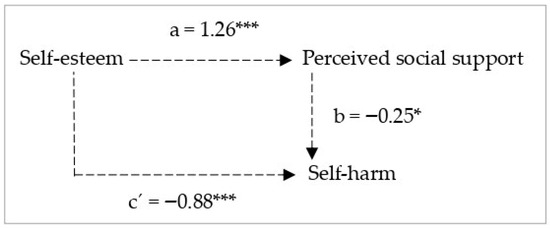
Path a (see Figure 1) indicated that lower levels of self-esteem were significantly (p < 0.001) associated with lower levels of perceived social support.
Figure 1.
Schema of the direct and indirect effects of self-esteem on self-harm (Note: * p < 0.05; *** p < 0.001).
Path b demonstrated that perceived social support significantly predicted self-harm while controlling for self-esteem; specifically, lower perceived social support was associated with higher levels of self-harm. The direct effect of self-esteem on self-harm (path c) remained statistically significant after controlling for perceived social support, indicating that self-esteem continued to exert a significant negative effect on self-harm even when the mediator was included in the model. The indirect effect (a × b) of self-esteem on self-harm through perceived social support was statistically significant, as the 95% bootstrap confidence interval did not include zero (B = −0.31, 95% BootCI (−0.63, −0.09)) (Table 6).
Table 6.
Direct and indirect effects of self-esteem on self-harm.
These findings indicate that perceived social support partially mediates the relationship between self-esteem and self-harm. More specifically, individuals with lower self-esteem tend to perceive weaker social support, which in turn is associated with higher levels of self-harm. The persistence of a statistically significant direct effect suggests that the mediation is partial rather than full. The mediated proportion (indirect effect divided by the direct effect) equals 0.26, indicating that approximately 26% of the total effect of self-esteem on self-harm is mediated by perceived social support.
4. Discussion
4.1. Relationship Between Self-Esteem and Self-Harm
The results of the analyses highlight the significant role of self-esteem in explaining self-harming behavior during adolescence. The very low mean level of self-esteem among adolescents who engage in self-harm, compared with the mean reported in validation studies among adolescents in the neighboring Czech Republic (Ceresnik et al., 2022), as well as the statistically significant differences in self-esteem between adolescents who engage in self-harm and those who do not, suggest that self-harm may be strongly associated with reduced self-esteem. This finding is consistent with theoretical models suggesting that low self-esteem represents an important intrapersonal risk factor for risky behaviors (Guz et al., 2025) and for maladaptive coping strategies with psychological distress. Self-harm belongs to the category of risk behaviors (Demuthova, 2023) and, according to the affect-regulation function (see Klonsky, 2009), serves as a maladaptive strategy for alleviating intense negative emotions. Within this theoretical framework, low self-esteem has considerable potential to influence the occurrence of self-harming behavior.
The regression model further indicated that self-esteem explains approximately 22% of the variance in self-harm, which may be considered a moderate effect size within psychological research. Although self-esteem clearly does not represent the sole factor influencing the occurrence of self-harming behavior, the results suggest that it constitutes a significant psychological predictor that may contribute to adolescents’ vulnerability to self-harm. The negative regression coefficient additionally suggests that higher self-esteem may have a protective role, as it is associated with lower levels of self-harming behavior. These findings support the implementation of targeted intervention strategies aimed at strengthening self-esteem as part of preventive programs designed to reduce the occurrence of self-harming behavior in adolescence (see, for example, Wilkinson et al., 2025). At the same time, it is important to emphasize that a substantial proportion of the variance in self-harm remains unexplained, indicating the need to consider additional individual factors (e.g., depression—Zhu & Shek, 2023; neuroticism—Liao et al., 2022), social factors (e.g., childhood maltreatment—Li et al., 2023; victimization—Long et al., 2024), and environmental influences (e.g., environmental urges—Hepp et al., 2021; digital technologies—Galindo et al., 2026) that may contribute to the development of this behavior.
4.2. Mediating Role of Perceived Social Support
The findings indicate that perceived social support functions as a significant partial mediator in the relationship between self-esteem and self-harm, suggesting that lower self-esteem may increase the likelihood of self-harming behavior partly through its influence on individuals’ perception of available social support. One possible explanation for this relationship is that individuals with low self-esteem frequently exhibit cognitive biases (Rimes et al., 2023) that lead them to underestimate or discount accessible social resources. Consequently, even when objective social support is present, individuals with low self-esteem may perceive such support as insufficient, unreliable, or inaccessible. This perceptual process may contribute to heightened feelings of social isolation and increase vulnerability to maladaptive coping strategies, including self-harm. Within this framework, self-esteem may influence self-harming behavior not only through intrapersonal mechanisms, such as difficulties in emotional regulation, heightened self-criticism, or maladaptive coping strategies (He et al., 2025; Bradley et al., 2025), but also through interpersonal processes, particularly through the ways in which individuals interpret, evaluate, and utilize their social environment.
However, the mediation effect observed was partial rather than full, as the direct effect of self-esteem on self-harm remained statistically significant after controlling for perceived social support. Approximately 26% of the total effect of self-esteem on self-harm was mediated by perceived social support, indicating that additional mechanisms are likely involved in the association between these variables. Previous research suggests that low self-esteem may contribute to self-harm through several other psychological pathways, including increased self-criticism (Robillard et al., 2025), perfectionism (Gyori et al., 2023), and loneliness (Ahn et al., 2025), all of which have also been identified as significant predictors of self-harming behavior. Future research should therefore consider additional mediating variables that may operate alongside perceived social support in explaining the relationship between self-esteem and self-harm.
The identification of perceived social support as a mediator between self-esteem and self-harm also carries important implications for applied psychology. Specifically, the findings suggest that interventions aimed at strengthening adolescents’ perception of available social support may reduce the vulnerability associated with low self-esteem and consequently decrease the likelihood of self-harm. Preventive programs implemented in school settings may therefore focus on enhancing supportive peer and teacher relationships, promoting help-seeking behavior, and fostering social connectedness. In clinical contexts, therapeutic approaches such as cognitive-behavioral therapy, dialectical behavior therapy (Apicella et al., 2025), or family-based interventions (Yang et al., 2025) may incorporate strategies designed to strengthen supportive interpersonal networks and improve adolescents’ perception of available support. Enhancing perceived social support may thus function both as a protective factor and as a therapeutic resource in reducing the occurrence of self-harming behavior among adolescents.
4.3. Limitations
Despite providing insights into the relationship between self-esteem, perceived social support, and self-harm among adolescents, the present exploratory probe is subject to several limitations that should be considered when interpreting the findings.
First, the cross-sectional design of the exploratory probe limits the ability to draw causal conclusions regarding the relationships among the examined variables. Although mediation analysis suggested that perceived social support partially mediates the association between self-esteem and self-harm, the temporal direction of these relationships cannot be definitively established within a cross-sectional framework. It is therefore possible that self-harming behavior also influences self-esteem or adolescents’ perceptions of social support. Longitudinal research designs would be necessary to clarify the causal mechanisms and temporal dynamics underlying these associations. In addition, cross-sectional data may lead to biased estimates of mediation effects, as indirect pathways can be over- or underestimated when temporal ordering is not established. This limitation increases the risk of misinterpreting associative patterns as directional processes, potentially inflating the apparent explanatory role of perceived social support.
Second, the examination relied exclusively on self-report measures. Although the instruments used demonstrated satisfactory psychometric properties and internal consistency within the present sample, self-report data may be influenced by social desirability bias, recall bias, or respondents’ subjective interpretations of questionnaire items. This limitation may be particularly relevant in research on sensitive topics such as self-harm, where participants may underreport or overreport their experiences, thereby introducing systematic measurement error. Such measurement bias may attenuate or inflate observed relationships between variables, thereby affecting the accuracy of correlation and regression estimates. In particular, shared method variance may artificially strengthen the associations among self-esteem, perceived social support, and self-harm. Future studies could strengthen the validity of findings by incorporating multi-method approaches, including clinical assessments, behavioral measures, or reports from parents, teachers, or peers.
The third limitation concerns the research sample. As it consisted of a general (non-clinical) population, its size (N = 151) and characteristics do not allow it to be considered representative. Additionally, the use of a convenience sampling method limits the generalizability of the findings. The data collection was conducted among Slovak participants. Although the cultural context in which the research was carried out is comparable to that of other European countries and the Western world, it is possible that the findings may differ in other countries or in culturally distinct contexts. Participants were recruited from public schools; private and parochial schools were not represented. To date, no studies have examined differences in the variables of interest and their interrelationships across school types; therefore, such differences cannot be ruled out. For example, a meta-analysis of the association between religiosity and self-harm reports a small but statistically significant negative correlation between self-harm and religiosity (Haney, 2020). Overall, the results may not fully represent the broader adolescent population, particularly adolescents from different cultural contexts, educational environments, or clinical populations. It would also be beneficial to expand the information concerning the research sample—specifically regarding the presence of mental disorders—in order to determine whether the findings pertain exclusively to a non-clinical population or may have been influenced by the presence of other psychological difficulties. Therefore, future research involving larger and more diverse samples would allow for greater generalizability and provide a more comprehensive understanding of the examined relationships.
Another limitation concerns the scope of variables included in the model. Although self-esteem and perceived social support explained a meaningful proportion of the variance in self-harming behavior, a substantial part of the variance remained unexplained. Self-harm is a complex, multifactorial phenomenon influenced by numerous psychological, social, and environmental factors, such as depression, emotion regulation difficulties, personality traits, childhood adversity, or peer victimization. Future research should therefore incorporate a broader range of potential mediators and moderators to better capture the complexity of the processes leading to self-harming behavior.
Finally, perceived social support was assessed as a global construct without examining the potentially distinct roles of different sources of support, such as family, peers, or romantic partners. Differentiating these sources may provide more nuanced insights into the interpersonal mechanisms underlying adolescent self-harm.
5. Conclusions
The present exploratory probe offers preliminary insights into the psychological and interpersonal mechanisms associated with self-harming behavior in adolescence. The findings indicate that lower self-esteem is associated with higher levels of self-harm and may represent a meaningful predictor of such behavior. Furthermore, perceived social support emerged as a partial mediator of this relationship, suggesting that adolescents with lower self-esteem may perceive less available support, which could be linked to increased vulnerability to self-harm. Given the exploratory design, cross-sectional nature, and limited, non-representative sample, these findings should be interpreted with caution and should not be generalized to the broader adolescent population. Rather, they point to potential patterns of association that warrant further investigation using larger, more diverse, and longitudinal samples. Despite these limitations, the results underscore the potential relevance of both intrapersonal (self-esteem) and interpersonal (perceived social support) factors in understanding self-harming behavior. From a practical perspective, the findings suggest that interventions targeting self-esteem and the perception and utilisation of social support may be beneficial. However, the effectiveness and general applicability of such approaches require further empirical validation. Overall, this study contributes to the existing body of literature by identifying associations that may inform future research aimed at clarifying the complex and multifactorial nature of adolescent self-harm.
Author Contributions
Conceptualization, S.D.; methodology, S.D.; software, S.D.; formal analysis, S.D.; investigation, K.B.; resources, K.B.; data curation, K.B. and S.D.; writing—original draft preparation, S.D.; writing—review and editing, K.B. and S.D.; visualization, S.D.; supervision, S.D.; project administration, S.D.; funding acquisition, S.D. All authors have read and agreed to the published version of the manuscript.
Funding
This work was supported by the Slovak Research and Development Agency under the Contract No. APVV-23-0181.
Institutional Review Board Statement
The study was conducted in accordance with the Declaration of Helsinki, and approved by the Ethics Committee of the Faculty of Arts, University of Ss. Cyril and Methodius in Trnava (registration no. UCM-FF-EK 6/2023, date of approval: 15 November 2023).
Informed Consent Statement
Informed consent was obtained from all subjects (and their legal representatives) involved in the study.
Data Availability Statement
The raw data supporting the conclusions of this article will be made available by the authors on request.
Conflicts of Interest
The authors declare no conflicts of interest.
Abbreviations
The following abbreviations are used in this manuscript:
| RSES | Rosenberg’s Self-Esteem Scale |
| SHI | Self-Harm Inventory |
| MSPPS | Multidimensional Scale of Perceived Social Support |
| SPSS | Statistical Product and Service Solutions |
| SH’s | Self-Harmers |
| nonSH’s | non Self-Harmers |
| SE | Standard Error |
| CI | Confidence Intervals |
References
- Ahn, C. Y., Kim, J. H., Kim, S., Kim, J. W., Na, J. J., Seo, D. G., & Lee, J. S. (2025). The impact of negative emotions on adolescents’ nonsuicidal self-injury thoughts: An integrated application of machine learning and multilevel logistic models. PLoS ONE, 20(11), e0320104. [Google Scholar] [CrossRef] [Scilit]
- Apicella, M., Pontillo, M., Maglio, G., Di Vincenzo, C., Della Santa, G., Andracchio, E., & Vicari, S. (2025). Non-suicidal self-injury in adolescents: A clinician’s guide to understanding the phenomenon, diagnostic challenges, and evidence-based treatments. Frontiers in Psychiatry, 16, 1605508. [Google Scholar] [CrossRef] [Scilit] [PubMed]
- Bradley, H., Orchard, F., & Matcham, F. (2025). Historical nonsuicidal self-injury and current coping strategies: The role of emotion regulation. Personality and Mental Health, 19(4), e70035. [Google Scholar] [CrossRef] [Scilit] [PubMed]
- Calvo, N., Lugo-Marín, J., Oriol, M., Pérez-Galbarro, C., Restoy, D., Ramos-Quiroga, J. A., & Ferrer, M. (2024). Childhood maltreatment and non-suicidal self-injury in adolescent population: A systematic review and meta-analysis. Child Abuse & Neglect, 157, 107048. [Google Scholar] [CrossRef] [Scilit]
- Cao, P., Peng, R., Yuan, Q., Zhou, R., Ye, M., & Zhou, X. (2024). Predictors of non-suicidal self-injury in adolescents with depressive disorder: The role of alexithymia, childhood trauma, and body investment. Frontiers in Psychology, 15, 1336631. [Google Scholar] [CrossRef] [Scilit]
- Case, J., Burke, T. A., Siegel, D. M., Piccirillo, M. L., Alloy, L. B., & Olino, T. M. (2020). Functions of non-suicidal self-injury in late adolescence: A latent class analysis. Archives of Suicide Research, 24(sup2), S165–S186. [Google Scholar] [CrossRef] [Scilit] [PubMed]
- Ceresnik, M., Dolejs, M., Ceresnikova, M., & Tomsik, R. (2022). Psychometric analysis of Rosenberg’s self-esteem scale: A specific application of the scale on adolescents aged 11–19. TEM Journal, 11(4), 1732–1741. [Google Scholar] [CrossRef] [Scilit]
- Cheng, L., Wang, L., Lin, J., & Chen, J. (2025). Exploring the mediating role of self-hate in the relationship between adverse childhood experiences and non-suicidal self-injury among adolescents. Journal of Affective Disorders, 373, 60–66. [Google Scholar] [CrossRef] [Scilit]
- Cherewick, M., Matergia, M., Dukpa, C., Mukhia, D., Lama, R., Rai, R. P., & Giri, P. (2025). Psychometric evaluation of the multidimensional scale of perceived social support among early adolescents in Darjeeling, India. European Journal of Investigation in Health, Psychology and Education, 15(12), 251. [Google Scholar] [CrossRef] [Scilit]
- Demuthova, S. (2023). Self-harming behavior in adolescent age. Peter Lang. [Google Scholar]
- Demuthova, S., & Demuth, A. (2019). The prevalence and most frequent forms of self-harm in adolescents. In International conference on research in psychology (pp. 39–51). Diamond Scientific Publication. [Google Scholar]
- Demuthova, S., & Rojkova, Z. (2025). Self-harming behaviour in young adults in the context of Cloninger’s psychobiological model of temperament. BRAIN: Broad Research in Artificial Intelligence and Neuroscience, 16(4), 598–617. [Google Scholar] [CrossRef] [Scilit]
- Drageset, J. (2021). Social Support. In G. Haugan, & M. Eriksson (Eds.), Health promotion in health care—Vital theories and research (Internet). Springer. [Google Scholar] [CrossRef] [Scilit]
- Efthymiou, V., Chrousos, G. P., Kounenou, K., Kalamatianos, A., Pezirkianidis, C., Korelopoulos, M., Stefanaki, C., & Kourmousi, N. (2025). Validity and reliability of the multidimensional scale of perceived social support (MSPSS) in Greek secondary school students. Children, 12(6), 706. [Google Scholar] [CrossRef] [Scilit]
- Forrester, R. L., Slater, H., Jomar, K., Mitzman, S., & Taylor, P. J. (2017). Self-esteem and non-suicidal self-injury in adulthood: A systematic review. Journal of Affective Disorders, 221, 172–183. [Google Scholar] [CrossRef] [Scilit]
- Galindo, D., Lopez, A., Osorno, D., Galindo Ruiz, L., & Osorno, I. (2026). The effects of social networks and digital technology on non-suicidal self-injury in children and adolescents: A systematic review. Cureus, 18(1), e101014. [Google Scholar] [CrossRef] [Scilit]
- Guan, M., Liu, J., Li, X., Cai, M., Bi, J., Zhou, P., Wang, Z., Wu, S., Guo, L., & Wang, H. (2024). The impact of depressive and anxious symptoms on non-suicidal self-injury behavior in adolescents: A network analysis. BMC Psychiatry, 24(1), 229. [Google Scholar] [CrossRef] [Scilit]
- Guz, E., Brodowicz-Król, M., Malm, M., Korżyńska-Piętas, M., Włoszczak-Szubzda, A., Goniewicz, M., Gómez-Salgado, J., Al-Wathinani, A. M., & Goniewicz, K. (2025). The relationship between self-esteem and risky behaviors: A cross-sectional study of residents in Lublin province, Poland. Medicine, 104(31), e43733. [Google Scholar] [CrossRef] [Scilit]
- Gyori, D., & Balazs, J. (2021). Nonsuicidal self-injury and perfectionism: A systematic review. Frontiers in Psychiatry, 12, 691147. [Google Scholar] [CrossRef] [Scilit] [PubMed]
- Gyori, D., Farkas, B. F., Komaromy, D., Horvath, L. O., Kollarovics, N., Garas, P., & Balazs, J. (2023). The association between nonsuicidal self-injury and perfectionism in adolescence: The role of mental disorders. European Journal of Investigation in Health, Psychology and Education, 13(11), 2299–2327. [Google Scholar] [CrossRef] [Scilit] [PubMed]
- Haney, A. M. (2020). Nonsuicidal self-injury and religiosity: A meta-analytic investigation. The American Journal of Orthopsychiatry, 90(1), 78–89. [Google Scholar] [CrossRef] [Scilit] [PubMed]
- He, S., Li, C., Zhang, S., Hu, Y., Wen, J., Liu, L., Gao, J., Wu, J., & Huang, G. (2025). The complexity of associations between emotion regulation, interpersonal sensitivity, cognitive insight, and non-suicidal self-injury: A study based on network analysis. BMC Psychiatry, 25(1), 846. [Google Scholar] [CrossRef] [Scilit]
- Hepp, J., Carpenter, R. W., Freeman, L. K., Vebares, T. J., & Trull, T. J. (2021). The environmental, interpersonal, and affective context of nonsuicidal self-injury urges in daily life. Personality Disorders, 12(1), 29–38. [Google Scholar] [CrossRef] [Scilit]
- Hu, J. T., Cao, Y., Liu, L. L., Wang, D., Zhu, P., Du, X., Ji, F., Peng, R. J., Tian, Q., & Zhu, F. (2025). Adolescent non-suicidal self-injury: The moderating influence of social support utilization on depression. World Journal of Psychiatry, 15(6), 106017. [Google Scholar] [CrossRef] [Scilit] [PubMed]
- Huang, L., Hou, D., Xiao, Q., & Huang, X. (2024). Associations among psychological resilience, self-esteem, social support, and non-suicidal self-injury behaviors in adolescents receiving inpatient psychiatric care. Journal of Psychosocial Nursing and Mental Health Services, 62(9), 47–54. [Google Scholar] [CrossRef] [Scilit] [PubMed]
- Klonsky, E. D. (2009). The functions of self-injury in young adults who cut themselves: Clarifying the evidence for affect-regulation. Psychiatry Research, 166(2–3), 260–268. [Google Scholar] [CrossRef] [Scilit]
- Lei, H., Xiong, J., Rao, Y., Zhu, T., & Zhang, X. (2024). Relationships among self-esteem, depression and self-injury in adolescents: A longitudinal study. Frontiers in Public Health, 12, 1406283. [Google Scholar] [CrossRef] [Scilit]
- Li, X., Liu, X. L., Wang, Y. J., Zhou, D. S., & Yuan, T. F. (2023). The effects of childhood maltreatment on adolescent non-suicidal self-injury behavior: Mediating role of impulsivity. Frontiers in Psychiatry, 14, 1139705. [Google Scholar] [CrossRef] [Scilit]
- Liao, C., Gu, X., Wang, J., Li, K., Wang, X., Zhao, M., & Feng, Z. (2022). The relation between neuroticism and non-suicidal self-injury behavior among college students: Multiple mediating effects of emotion regulation and depression. International Journal of Environmental Research and Public Health, 19(5), 2885. [Google Scholar] [CrossRef] [Scilit]
- Lim, K. X., Krebs, G., Rimfeld, K., Pingault, J. B., & Rijsdijk, F. V. (2021). Investigating the genetic and environmental aetiologies of non-suicidal and suicidal self-harm: A twin study. Psychological Medicine, 52(15), 1–11. [Google Scholar] [CrossRef] [Scilit] [PubMed]
- Lin, Z., Zhang, Y., Kong, S., Ruan, Q., Zhu, L. L., & Li, C. H. (2025). Social support as a mediator between life events and non-suicidal self-injury: Evidence for urban-rural moderation in medical students. Frontiers in Psychiatry, 16, 1522889. [Google Scholar] [CrossRef] [Scilit]
- Liu, Z., Wei, Y., Yang, Y., & Kong, L. (2024). Unveiling a novel clinical risk assessment model for identifying non-suicidal self-injury risks in depressed Chinese adolescents amidst the COVID-19 pandemic: Insights from low self-esteem, internet use, and sleep disturbance. Frontiers in Psychiatry, 14, 1259909. [Google Scholar] [CrossRef] [Scilit]
- Long, Q., Huang, B., Tang, Y., Wu, J., Yu, J., Qiu, J., Huang, Y., & Huang, G. (2024). Peer victimization and non-suicidal self-injury among high school students: The mediating role of social anxiety, mobile phone addiction, and sex differences. BMC Psychiatry, 24(1), 25. [Google Scholar] [CrossRef] [Scilit]
- Muris, P., & Otgaar, H. (2023). Self-esteem and self-compassion: A narrative review and meta-analysis on their links to psychological problems and well-being. Psychology Research and Behavior Management, 16, 2961–2975. [Google Scholar] [CrossRef] [Scilit]
- NCBI. (2026). Adolescent—MESH—NCBI. Available online: https://www.ncbi.nlm.nih.gov/mesh/68000293 (accessed on 10 February 2026).
- Nemati, H., Sahebihagh, M. H., Mahmoodi, M., Ghiasi, A., Ebrahimi, H., Barzanjeh Atri, S., & Mohammadpoorasl, A. (2020). Non-suicidal self-injury and its relationship with family psychological function and perceived social support among Iranian high school students. Journal of Research in Health Sciences, 20(1), e00469. [Google Scholar] [CrossRef] [Scilit]
- Osváth, A., Hankó, C., Csáki, M., Molnár, E., Pahocsa, J., Kocsor, S., Tóth, K., Fertői, D., Sándor-Bajusz, K. A., Dergez, T., & Csábi, G. (2024). Risk factors and personality characteristics of nonsuicidal self-injurious behavior in clinical sample of female adolescents. European Psychiatry, 67(Suppl. S1), S446–S447. [Google Scholar] [CrossRef] [Scilit]
- Pan, B., Guo, M. Y., Gong, Y., Lin, Z., & Zhang, B. R. (2026). Protective role of perceived social support against adolescent self-injury addiction: Serial mediation of negative emotion and impulsivity. World Journal of Psychiatry, 16(2), 113573. [Google Scholar] [CrossRef] [Scilit] [PubMed]
- Peng, B., Liao, J., Li, Y., Jia, G., Yang, J., Wu, Z., Zhang, J., Yang, Y., Luo, X., Wang, Y., Zhang, Y., & Pan, J. (2023). Personality characteristics, defense styles, borderline symptoms, and non-suicidal self-injury in first-episode major depressive disorder. Frontiers in Psychology, 14, 989711. [Google Scholar] [CrossRef] [Scilit] [PubMed]
- Poudel, A., Lamichhane, A., Magar, K. R., & Khanal, G. P. (2022). Non suicidal self injury and suicidal behavior among adolescents: Co-occurrence and associated risk factors. BMC Psychiatry, 22(1), 96. [Google Scholar] [CrossRef] [Scilit]
- Rajhvajn Bulat, L., Susac, N., & Ajdukovic, M. (2023). Predicting prolonged non-suicidal self-injury behaviour and suicidal ideations in adolescence—The role of personal and environmental factors. Current Psychology, 1–12. [Google Scholar] [CrossRef] [Scilit]
- Ren, Y., Cui, S., Cui, T., Tang, C., Song, J., Jackson, T., & He, J. (2024). Relations of body dissatisfaction with self-injurious thoughts and behaviours in clinical and non-clinical samples: A meta-analysis of studies published between 1995 and 2022. Health Psychology Review, 18(3), 599–618. [Google Scholar] [CrossRef] [Scilit] [PubMed]
- Richardson, R., Connell, T., Foster, M., Blamires, J., Keshoor, S., Moir, C., & Zeng, I. S. (2024). Risk and protective factors of self-harm and suicidality in adolescents: An umbrella review with meta-analysis. Journal of Youth and Adolescence, 53(6), 1301–1322. [Google Scholar] [CrossRef] [Scilit]
- Rimes, K. A., Smith, P., & Bridge, L. (2023). Low self-esteem: A refined cognitive behavioural model. Behavioural and Cognitive Psychotherapy, 51(6), 579–594. [Google Scholar] [CrossRef] [Scilit]
- Robillard, C. L., Claes, L., Victor, S. E., Myin-Germeys, I., & Kiekens, G. (2025). Self-criticism is a real-time predictor of non-suicidal self-injury and disordered eating: An ecological momentary assessment study among treatment-seeking individuals. Journal of Affective Disorders, 371, 13–21. [Google Scholar] [CrossRef] [Scilit]
- Rosenberg, M. (1965). Society and the adolescent self-image. Princeton University Press. [Google Scholar]
- Sansone, R. A., & Sansone, L. A. (2010). Measuring self-harm behavior with the self harm inventory. Psychiatry, 7(4), 16–20. [Google Scholar]
- Sorgi-Wilson, K. M., Cheung, J. C., Ciesinski, N. K., & McCloskey, M. S. (2023). Cognition and non-suicidal self-injury: Exploring relationships with psychological functions. Archives of Suicide Research, 27(3), 1002–1018. [Google Scholar] [CrossRef] [Scilit] [PubMed]
- Wilkinson, J., Taylor, P. J., & Dunlop, B. J. (2025). HERE-Bi: Feasibility and acceptability of a self-esteem intervention for young bisexual people to reduce non-suicidal self-injury. Clinical Psychology & Psychotherapy, 32(4), e70117. [Google Scholar] [CrossRef] [Scilit]
- Yang, C. J., Zhou, R., Liu, Y. D., Wang, S. B., Hou, C. L., & Jia, F. J. (2025). The association between family function and adolescents’ non-suicidal self-injury behaviors-is Chinese culture involved? Frontiers in Psychiatry, 16, 1522975. [Google Scholar] [CrossRef] [Scilit] [PubMed]
- Zhang, Y., Ying, R., Lu, W., Liu, X., Hu, K., Feng, Q., Yu, Z., Wang, Z., Lu, F., Miao, Y., Ma, N., Tao, F., Jiang, T., & Zhang, Q. (2025). Association among BMI, self-esteem, and nonsuicidal self-injury in young adults to understand the influence of socioenvironmental factors: Longitudinal study. JMIR Public Health and Surveillance, 11, e52928. [Google Scholar] [CrossRef] [Scilit]
- Zhu, X., & Shek, D. (2023). The predictive effect of depression on self-injury: Positive youth development as a moderator. Applied Research Quality Life, 18, 2877–2894. [Google Scholar] [CrossRef] [Scilit]
- Zimet, G. D., Dahlem, N. W., Zimet, S. G., & Farley, G. K. (1988). Multidimensional scale of perceived social support (MSPSS) [Database record]. APA PsycTests. [Google Scholar] [CrossRef] [Scilit]

Disclaimer/Publisher’s Note: The statements, opinions and data contained in all publications are solely those of the individual author(s) and contributor(s) and not of MDPI and/or the editor(s). MDPI and/or the editor(s) disclaim responsibility for any injury to people or property resulting from any ideas, methods, instructions or products referred to in the content. |
© 2026 by the authors. Licensee MDPI, Basel, Switzerland. This article is an open access article distributed under the terms and conditions of the Creative Commons Attribution (CC BY) license.