


Abstract
We show how the pre-geometric MacDowell–Monsouri gravity inevitably leads to an irreversible quantum cascade mechanism for the vacuum energy density. Such a process is a consequence of the spontaneous symmetry breaking (SSB) dynamics and quantum anomalies. The dynamics are governed by a periodic Higgs potential, which generates a countably infinite sequence of metastable vacua separated by large energy barriers. The multi-vacua structure is direct consequence of a see-saw duality of the -term, the vacuum expectation values and the cosmological constant. After the SSB, a discrete spectrum of vacuum energy levels is predicted. As a consequence, starting from an initial high-energy vacuum energy associated to cosmological constant , the system evolves via sequential quantum tunneling accessing through the landscape of lower minima. In particular, we demonstrate that the transition probability is maximized for the strictly ordered cascade flowing towards the attractor. This process is intrinsically time-asymmetric, offering a natural quantum origin for the thermodynamic arrow of time. In this mechanism, the vacuum relaxation acts as a “cosmic clock”, correlating the expansion history with the progressive reduction in the cosmological constant. Our findings suggest that the observed smallness of the vacuum energy today is the result of a dynamical selection effect.
1. Introduction
In a series of recent investigations, we have developed the proposal that General Relativity (GR) originates from a spontaneous symmetry breaking (SSB) of the (A)dS gauge isometry group to the Lorentz subgroup—specifically or [1,2,3,4,5]. Our program builds upon the proposals of MacDowell & Mansouri [6], Chamseddine–West [7] and Stelle–West [8] and it is supplemented by a gauge-covariant SSB potential of the Wilczek type [9]. Within this scheme, both the cosmological constant (CC) and the Planck scale arise from the rearrangement of gauge couplings and the Higgs vacuum expectation value. A reasonable inquiry is whether such a framework can shed new light on the CC problem. The CC problem constitutes the most problematic naturalness crisis in contemporary physics. Standard Effective Field Theory (EFT) estimates yield, and when integrated up to the electroweak scale, the vacuum energy surpasses the observed dark energy by some orders of magnitude. Raising the cutoff to worsens this discrepancy to a staggering [10].
In this work, we present theoretical evidence of quantum vacuum energy relaxation dynamics within the Higgsphase of MacDowell–Mansouri pre-geometric gravity. Our primary finding follows from a set of dualities predicted by the theory, relating the cosmological constant, the Planck Mass and the gravitational -angle. These relations are crucial in order to establish a foundational principle of the model: cosmological constant quantization into discrete levels, corresponding to a countably infinite family of vacua of the Gravi-Higgs field. The Higgs vacua are separated by potential barriers, allowing exponentially suppressed quantum tunneling transitions between them. Crucially, we show that the transition probabilities favor ordered sequences , with a preference for smaller , which arises from the growing number of microstates. This naturally drives the cosmological constant toward smaller values over cosmological time, asymptotically towards the attractor .
2. Pre-Geometric MM Gravity
2.1. Initial Action
Our starting point is a gauge theory formulated on a topological four-manifold with no metric or tetrad structure assumed from the outset. The gauge group is , with connection and curvature . General covariance is imposed and the only internal structure is the metric on the gauge tangent space. All action densities are constructed using the densitized Levi-Civita symbol .
Let us begin with an action that is composed of three contributions:
where is the MacDowell–Mansouri Action [6].
where is the Gravi-Higgs field in the fundamental representation of and is the MM coupling constant with mass dimension .
The topological pre-geometric Pontryagin -term, denoted , reads
The action is
where
is the pre-geometric gauge volume form and is a generic functional of the scalar field, which drives it toward a VEV. In the Higgs phase, the -form reconstructs the covariant 4-volume form.
Higgs Phase and General Relativity
When the Higgs acquires a VEV as , the gauge potentials decompose into tetrads and spin connections:
with the tetrads and the spin connection; Lorentz indices; with the scale having the same dimension as .
After SSB [1], the MM term yields
where , R is the Ricci scalar and the Gauss–Bonnet scalar density. The initial theory parameters are recombined into :
This also yields a new insightful relation among the three gravitational parameters, which reads as
This relation is a pure prediction of MM theory, whereas, as is well known, the three parameters in GR are not connected.
After the SSB, the topological -term described by contains the Holst term [11] as
with the Immirzi parameter [12] that, remarkably, is related to the -angle and the CC as follows
with . The Immirzi parameter is conventionally viewed as a quantum ambiguity: it does not affect the classical equations of motion but it influences quantum dynamics, as well known in Loop Quantum Gravity (LQG) [13]. In our framework, this parameter emerges as the ratio of -angles, thereby unifying the Immirzi ambiguity with the more gauge -ambiguity (it is noteworthy that for , the formalism naturally reproduces results obtained via the Chern–Simons–Kodama state approach, suggesting an emergent gravitational quantum Hall effect [14,15,16,17,18]). A complete decomposition of Equation (3), after spontaneous symmetry breaking, leads to the Pontryagin density and the Holst term, as well as the Nieh–Yan term. The explicit decomposition reads
This identifies the Pontryagin angle , the Nieh–Yan coefficient, and the Immirzi parameter. The presence of the term is a direct consequence of the topological nature of and plays a crucial role in the quantization of the Gauss–Bonnet coupling and, consequently, of the cosmological constant. This is consistent with Equation (11).
2.2. Topological Sectors and Periodic Potential
Equation (11) non-trivially relates the topological angles to the CC and to the VEV of the Higgs. This constitutes the key observation on the basis of our subsequent arguments. As in Yang–Mills theory, in gravity the angle is periodic: leaves the Path Integral unchanged. However, less trivial from the YM perspective, but true for 4d gravity, is that also has the same discrete shift periodicity: in 4d, the GB term is a global integral and a topological invariant. Thus, we have a unified periodicity law:
Using Equation (11), we obtain that the CC is quantized:
and the vacuum energy levels as
The first level corresponds to —Planckian energy level—and will map to the observed value of ; as and . The Planck Mass does not change with n, and the Gravitational Newton constant remains universal for all n-vacuum states.
The -angle periodicity immediately implies the monodromy of the Higgs potential, i.e., a countably infinite number of possible VEVs as
up to the proportionality factor.
The VEV periodicity allows fixing a class of Higgs potential as follows:
where is a new constant controlling the potential, and is a power-law index. This potential resembles the well-known axion-like case, with several minima separated by large barriers. Moreover, each minimum corresponds to a different cosmological constant. In case, ultimately, is promoted to a dynamical gravi-axion field, its monodromy will be related to the Higgs one.
Here, we clarify three important points concerning the topological origin of the quantization.
(a) The quantization of the Gauss–Bonnet coefficient is due to its topological nature, not to Equation (11). Equation (11) is used to relate the periodicity of to the quantization of . The relation between the Gauss–Bonnet angle and is a new prediction of the present model, which is not guaranteed in General Relativity without starting from a pre-metric theory.
(b) The angles and are not independent: they arise from the same topological structure of the pre-geometric gauge theory. Specifically, is the coefficient of the Pontryagin term, while is the coefficient of the Gauss–Bonnet term, which emerges from the same topological structure after SSB. Therefore, their periodicities are correlated, and . This is a specific new prediction of this model.
(c) The quantization of depends on the assumption that is quantized, which in general leads to the quantization of the combination rather than v alone. We therefore assume that is fixed and does not grow with n, while . One may consider the alternative possibility in which v is fixed and is quantized. However, this second case can be discarded for the following reasons. First, in the limit , it would lead to , an impossible limit in which the MacDowell–Mansouri Lagrangian density completely decouples, since multiplies the entire MM action. Second, the large-n limit would become absurd, since it would drive the theory toward a new physics scale associated with a coupling that can be arbitrarily small depending on n, remembering that the physical dimension of is . Therefore, it appears far more reasonable to fix at a large fixed energy scale, such as the Planck scale, rather than admitting a paradoxical theory in which the interaction coupling changes with the topological sector. It is much more natural to consider the case of a Higgs field with a periodic potential and multiple vacua, as already considered in many other models, such as axion-like models, especially in relation to the -term. This is a physical model assumption, and we have clarified it in the revised version.
2.2.1. Massive Scalaron Field
Let us expand the potential around the minimum . The quadratic mass term for the radial fluctuation is
with and .
This estimate follows directly from the periodic potential, which depends on the coupling , the MM coupling , the squared cosmological constant , and the fifth power of the VEV scale . The factor arises from the modulus of the pre-geometric four-volume form , which after spontaneous symmetry breaking reduces to . The resulting combination of parameters carries the correct physical dimension of a squared mass, since .
This suggests that, in general, the scalaron mass can acquire an n-dependence. Substituting the scalings and into Equation (18), while leaving the n-dependence of the couplings unspecified, yields
where and are undetermined exponents controlling the running of the SSB and MM couplings, respectively:
The behavior of the scalaron mass is then governed by the sign of the combination , which we now examine in three regimes.
(i) Growing regime, . The mass grows with n and eventually becomes super-Planckian for sufficiently large topological sectors. This would bear an intriguing analogy to Kaluza–Klein (KK) towers of excited modes, whose masses can extend well beyond the Planck scale.
(ii) Conservative regime, . This requirement ensures for all n, up to order-one numerical coefficients, leading to . A further lower bound follows from requiring that the scalaron not be lighter than the Hubble scale, ; otherwise it would behave as an effectively massless (or infinite Yukawa radius) field. This imposes . Saturating this bound, , corresponds to a superlight scalaron that could serve as a candidate for dynamical dark energy.
(iii) Scale-invariant regime, . This case is particularly interesting, as it yields for every n, implying that the mass is invariant under n-translations. Assuming that the mass scaling is predominantly controlled by the SSB parameters rather than the MM kinetic term, a natural choice is and , which corresponds to a factor in , i.e., . In this case, the -field provides a natural candidate for super-heavy dark matter (SHDM).
2.2.2. Quantum Tunneling Transitions and Relaxation
We now estimate the rate of quantum tunneling between adjacent vacua of the periodic potential. In the semiclassical approximation, the transition is mediated by an instanton, and the dominant suppression factor is the Euclidean bounce action [19].
In the thick-wall approximation, the bounce action associated with the instanton reads
where is the scalar Compton wavelength, which also sets the relevant integration cutoff for the Euclidean integral, and is the energy difference between neighboring vacua,
Combining these two expressions, the bounce action reduces to
In the large-n limit, the thin-wall approximation becomes physically appropriate [20]. There, the bounce action scales as , with the wall thickness and the wall tension. Substituting these scalings gives the holographic form , which reproduces the thick-wall result obtained above. The parametric agreement between the two regimes confirms that the bounce action is controlled by the same combination of parameters across the entire range of n, so that no additional suppression or enhancement arises from the change in the approximation scheme.
2.2.3. Density of States and Quantization of de Sitter Entropy
As it is known, the Gibbons–Hawking formula for the de Sitter entropy [21] gives
Substituting from Equation (15), we obtain
This is also related to the quantization of the dS surface in Planckian size cells as
Thus de Sitter entropy and the dS area are quantized, taking discrete values proportional to the topological index n. Remarkably, the observed CC value corresponds to , corresponding to a large topological quantum number labeling our present vacuum sector. Moreover, since , the entropy is also proportional to the VEV of the pre-geometric Higgs field, suggesting that is an entropy field encoding the whole information content of the cosmological horizon.
This suggests de Sitter entropy as a measure of the topological quantum memory in vacuo: each unit of entropy corresponds to a topological qubit. Such an interpretation is supported by the scaling relations
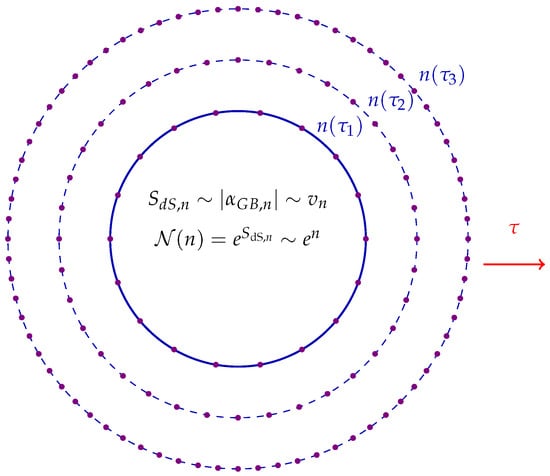
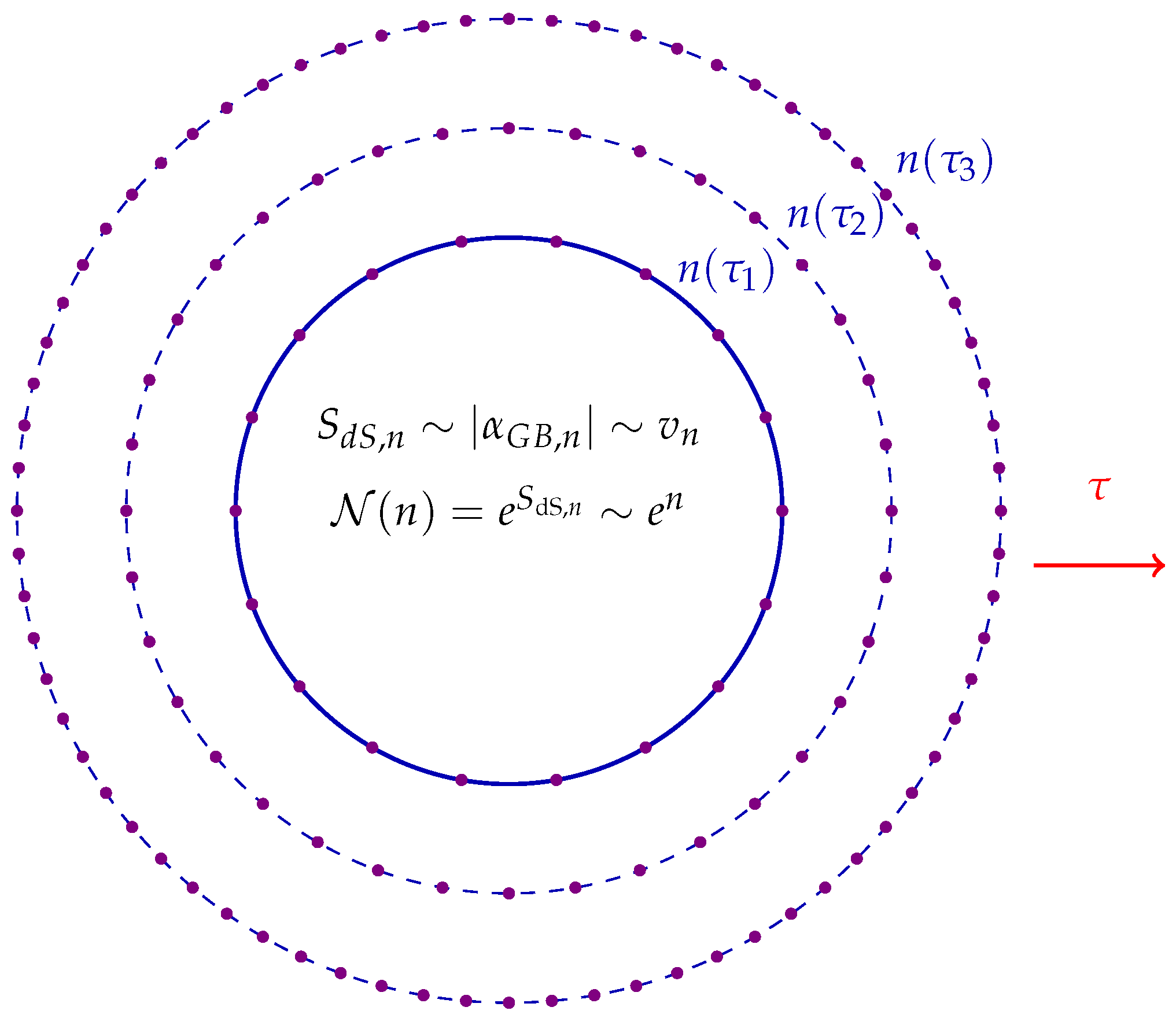
which establish a direct correspondence among the topological index, the Gauss–Bonnet coupling, the gravitational -angle, the Higgs VEV and the de Sitter entropy. The total storage capacity of the Universe is then fixed by the topological index n with qubits of quantum information. In this picture, the CC is not merely an energy density but rather a measure of the information density stored on the horizon: a smaller implies a larger horizon area and, correspondingly, a larger quantum memory capacity. The discrete spectrum thus acquires a direct information-theoretic meaning: each vacuum sector corresponds to a Universe with a different maximum storage capacity, and our observed vacuum is one with an enormous information content. Therefore, the asymptotic attractor corresponds to an infinite memory capacity. (See Figure 1).
Figure 1.
As the system evolves in time (displayed as red arrow), the de Sitter horizon (blue circle) expands from to to to larger shells (dashed circles). Each surface shell encodes an increasing number of qubits, , and a growing entropy ; with n displayed as violet dots the dS horizon. The entropy scales as the Gauss–Bonnet topological charge , the -angle and the Higgs VEV . This leads to a direct link among gravitational thermodynamics, the topological sector and the pre-geometric SSB.
2.2.4. Master Equation, Vacuum Relaxation Dynamics
We now develop the general dynamical framework describing the quantum evolution of the vacuum energy across the discrete landscape of topological sectors. The key insight is that the total transition rate must include not only the Euclidean bounce action but also the entropy of the final state, which counts the number of available microstates.
For a single transition from sector n to sector , the bare quantum tunneling rate into a specific final vacuum state is given by the standard instanton result:
where is the Euclidean bounce action. However, in a landscape with multiple vacua, the total rate into any state at level must include the degeneracy factor , which counts the number of available final states:
From Equation (25), the de Sitter entropy is quantized. The number of microstates is related to entropy by the Boltzmann relation:
Therefore, the complete transition rate becomes
Note that the initial sector n does not receive an entropy factor , because the coarse-grained probability already sums over all microstates in sector n. The rate is the transition rate from a specific initial microstate (or averaged over initial states with equal weight) to any final microstate in sector . This directly implies that
even in cases where —which also is, in general, not true.
The probability distribution over the discrete vacuum sectors evolves according to a Markovian Master Equation:
Here denotes the coarse-grained probability that the Universe resides in vacuum sector n at time , marginalized over the microstates within that sector and satisfying .
Using Equation (31), we obtain the following:
The first term represents transitions into sector n from all other sectors , while the second term represents transitions out of sector n to all other sectors.
The Master Equation exhibits fundamental asymmetry. Consider the ratio of transition rates for upward versus downward adjacent transitions:
In particular, in any cases where the entropic factor dominates over the bounce action, this ratio is nearly independent of the bounce action and we obtain . In these cases, transitions to higher n (smaller cosmological constant) are always entropically favored over transitions to lower n by a factor of , purely due to the larger number of available states at higher n.
For long jumps, the asymmetry is even more pronounced:
This demonstrates that in the entropic dominant regime, typical for the large-n limit, the system exhibits a net drift towards larger values of the topological index n, corresponding to smaller values of the cosmological constant.
The entropy factor in Equation (31) arises from summing the bare tunneling rate over all available final microstates in sector . This is a standard Fermi-golden-rule-like counting: the total rate into a degenerate final manifold is the single-channel rate multiplied by the number of available channels. The initial sector n does not receive an analogous factor because the coarse-grained probability already sums over all microstates in sector n. This asymmetry between initial and final state counting is the origin of the effective irreversibility of the Master Equation. At the microscopic level, the underlying quantum gravitational dynamics is assumed to be unitary, and the individual transition amplitudes satisfy detailed balance. The irreversibility emerges only after coarse-graining over the horizon microstates, in close analogy with the emergence of the second law of thermodynamics from reversible microscopic dynamics.
It is important to distinguish between the microscopic transition amplitudes and the coarse-grained transition rates. At the microscopic level, the individual transition amplitudes satisfy , reflecting the unitarity of the underlying quantum gravitational dynamics. The coarse-grained rates and are not equal, however, because they involve different numbers of initial and final microstates. Specifically, and , so that their ratio is . This is perfectly consistent with microscopic reversibility: the apparent irreversibility emerges at the coarse-grained level as a consequence of tracing over the unobserved horizon degrees of freedom, in analogy with the emergence of the second law of thermodynamics from reversible microscopic dynamics. The arrow of time is therefore not imposed externally but arises from the statistical asymmetry between the number of initial and final microstates.
Crucially, the local micro-reversibility approximation for the bounce actions, , does not imply that the coarse-grained rates are symmetric. Even with symmetric bounce actions, the entropy factor breaks the symmetry. This is a direct consequence of the fact that the number of microstates grows exponentially with n. The irreversibility is therefore not present at the level of the fundamental transition amplitudes but emerges from the statistical asymmetry between the number of initial and final microstates, in full analogy with the derivation of the Boltzmann equation from reversible microscopic dynamics.
From a microscopic perspective, the de Sitter entropy counts the number of independent horizon microstates. In the N-portrait picture [22,23,24], these correspond to different configurations of the soft graviton condensate that produce the same macroscopic geometry. The entropy factor in the transition rate is thus both a degeneracy of final states and a measure of the coarse-graining over horizon degrees of freedom. These two interpretations are consistent because the horizon microstates are precisely the degrees of freedom that are traced over in the coarse-graining procedure. The effective irreversibility of the Master Equation is therefore a consequence of tracing over inaccessible horizon degrees of freedom, not of any fundamental time-asymmetry in the microscopic laws.
The typical rate of change in n is given by the net transition rate:
Therefore, in the large-n limit, we can approximate it as
with (local micro-reversibility approximation). This is the central equation governing the relaxation dynamics. The behavior of the system depends critically on the scaling of with n.
We now apply the general formalism to the specific scaling predicted by the pre-geometric gravity framework. From Equation (18), the scalaron mass scales as follows:
where encodes the scaling of the SSB parameters. With , the Euclidean action scales as follows:
As argued above, a possible condition in a high-energy SSB framework is that the scalaron mass is n-independent:
This corresponds to
with .
Master Equation (34) is derived in the WKB (semiclassical) approximation, where the transition rate is dominated by the Euclidean bounce action . This approximation is valid when the bounce action is large compared to the de Sitter entropy:
In this bounce-dominated regime but same scaling of the dS-entropy in n, the transition rate is suppressed as , and the Master Equation reduces to
for and . This yields the relaxation law:
This case corresponds to , i.e., , representing the case of a scalaron with the minimal possible mass saturating the Hubble rate. Note that the numerical coefficient multiplying the coupling constant in is a free parameter that determines which contribution dominates—the bounce action or the entropy—when both share the same n-scaling.
In the critical case the two factors in the exponential elide and the relaxation dynamics can be much faster as
For generic , the transition rate is
so the Master Equation becomes
For , the integral is dominated by the upper limit, leading to
and therefore
For , this reduces to the logarithmic relaxation , while for the relaxation is slower, with decaying as an inverse power of . However, let us note that corresponds to -masses, which are below the Hubble rate , and therefore effectively massless. Thus, we discard this possibility since this would introduce massless dilaton-like new long-range interactions.
The case corresponds instead to the regime of entropic domination, where the barrier is completely negligible compared to the entropic factor. The evolution is then entirely thermal, independent of the quantum tunneling rate. This also includes the case , which corresponds to a n-scale invariant Euclidean action and .
In all cases , the system flows toward the asymptotic attractor:
This represents a universal feature of the case: is the unique attractor of the relaxation dynamics. However, the relaxation time diverges as in this limit. The observed small but nonzero value of the cosmological constant may therefore be understood as a reflection of the finite age of the Universe: we occupy the sector simply because the Universe has had a finite time to relax from its initial state.
For the situation is more subtle. Considering the entropy-dominated equation
which diverges at the finite time . This finite-time singularity signals a breakdown of the effective description since an infinite tower of higher-order terms has to be included. More than a relaxation, this suggests an uncontrolled cascade toward a vacuum energy density decay. Note that in the case and this process will be in Planckian time. We postpone more analysis of this scenario for future works.
A brief comment on the interplay between quantum break-time and vacuum relaxation is in order. In the cases , and in particular the most physically motivated case , the quantum break-time is parametrically shorter than the vacuum tunneling time . However, this does not obstruct the relaxation; rather, the decoherence processes responsible for the quantum break-time provide an alternative channel for vacuum transitions. Individual coherent-state gravitons can scatter out of the condensate more efficiently than the full instanton transition, effectively accelerating the escape rate from
Thus, the quantum break-time enhances the barrier tunneling from an exponential suppression to a power-law process, as coherent quanta can more easily tunnel out of the condensate while preserving a given vacuum sector . In the critical case , the relaxation time is already faster than the quantum break-time , so the system tunnels to smaller sectors before decoherence becomes relevant. Consequently, in both cases the system flows toward the asymptotic attractor , albeit through different dynamical regimes.
These considerations invite speculation on the possibility of a pre-Big Bang phase, whose memory might be encoded in the present smallness of the cosmological constant. A dynamical decreasing suggests that in the far future the cosmic acceleration will gradually diminish, potentially leading to an expansion turning point and subsequent collapse—a scenario reminiscent of bounce or cyclic cosmologies. Within the pre-geometric gravity framework, such a critical bounce could be interpreted as a gauge and topological phase transition. Quantum corrections may further modify the equation of the state of dark energy, accelerating the asymptotic relaxation. It is also conceivable that the observed dark energy is not the tail of the asymptotic relaxation but rather a temporary metastable state in a more complex landscape. We leave a detailed exploration of these possibilities for future work.
The entropic asymmetry in the transition rates provides a natural explanation for the arrow of time. Master Equation (34) is manifestly irreversible: the system evolves toward higher n (larger entropy) and cannot spontaneously return to lower n without violating the second law of thermodynamics. The probability of a downward transition from n to is suppressed by , as follows from Equation (36). For a transition from the observed sector down to the Planckian sector , the suppression is
which is effectively zero for all practical purposes. This ensures that the cosmological relaxation is a one-way process, with the Universe evolving toward ever smaller cosmological constant and asymptotically approaching .
This thermodynamic arrow is not imposed externally but emerges dynamically from the topological structure of the pre-geometric gauge theory, providing a fundamental connection between quantum gravity, entropy, and the observed arrow of time. The entropy factor is precisely the holographic counting of degrees of freedom on the de Sitter horizon. The de Sitter entropy serves simultaneously as the topological index and the measure of available microstates. This provides a concrete realization of the Holographic Naturalness proposal [25,26,27,28]: the observed smallness of the cosmological constant is protected by the enormous entropy of the horizon, which makes transitions to lower entropy states exponentially improbable. The vacuum energy relaxation described here is therefore not a fine-tuning but a thermodynamic inevitability: the Universe simply evolves toward its most probable state, which is the one with maximal entropy and minimal cosmological constant.
Before concluding this section, a critical remark on the quantitative status of the relaxation mechanism is in order. All the scaling relations employed in our analysis—whether it is the entropy factor , the inverse-linear law , or quantum break-time scaling —indicate that, starting from an initial cosmological constant around , the time required to relax to the presently observed value is far beyond the age of the Universe. This naturally invites speculation about a pre-Big Bang phase. In such a scenario, our mechanism establishes an asymptotic attractor, but this alone does not explain why the observed cosmological constant corresponds to , unless one assumes a pre-Big Bang Universe as in cyclic cosmology or similar scenarios.
However, a different perspective is also possible. One may instead assume that the initial cosmological constant is small as an initial condition, and ask whether such a parameter is technically natural in our framework—in the sense that it will never spontaneously flow, through quantum effects, to values of order . From this standpoint, our mechanism does appear to solve the problem, aided by the Fermi-Golden-rule counting of final states, the configuration space of states, and the associated entropy factor. In this sense, the smallness of the cosmological constant is protected by the enormous entropy of the horizon, which makes transitions to lower-entropy (larger ) states exponentially improbable.
On the other hand, stimulated by these considerations, we have identified another branch of solutions. Specifically, by carefully solving the case , we find a much faster relaxation scenario in which the cosmological constant decays to zero in a finite time. However, when starting from , this scenario appears to imply a decay time that is nearly instantaneous, of order of the Planckian time. Such a case, contrary to the others, would eventually favor the introduction of a new field as dynamical dark energy to explain the observed Universe acceleration. A detailed study of this new case—which was not noticed in our previous analysis—will be essential for our future work, beyond the scope of this first seminal study.
From a microscopic perspective, the increase in n corresponds to an increasing number of soft graviton states, which can be understood as an ultra-cold condensate. In the thermodynamic picture, the cosmological constant sets a de Sitter temperature ; the relaxation dynamics thus corresponds to a spontaneous cooling of the graviton system. This may be interpreted as a splitting dynamics, such as graviton rescatterings with , which dynamically increase the number of states with lower-energy single partons emerging from the collision center-of-mass energy. In this sense, the arrow of time can emerge microscopically as an overall macroscopic effect of high-multiplicity graviton splitting scatterings. Indeed, in our picture the metric tensor and gravitons are emergent condensates rather than fundamental fields, and as quantum operators they contain an extra quantum number operator compared to the traditional quantum gravity picture. This suggests that graviton creation operators increase with the graviton occupation number, leading to spontaneous multiplicity growth. As shown in Ref. [4], the insertion of such soft gravitons with Standard Model propagating fields can cure UV divergences coming from virtual bubble diagrams, effectively replacing with .
3. Conclusions and Outlooks
In this work, we have investigated a new quantum relaxation mechanism for the vacuum energy density within MacDowell–Mansouri meta-geometric gravity. The spontaneous breaking leads to an infinite set of vacua labeled by a discrete topological index n, which arises from the periodicity of the gravitational -angle. These vacua are separated by energetic potential barriers, and quantum tunneling transitions mediated by instantons can be envisaged.
Our central result is that the system preferentially evolves along the ordered sequence , where the cosmological constant gradually decreases toward the asymptotic attractor . This behavior is driven by the entropic favorability of higher topological sectors. Indeed, the number of available microstates exponentially grows as . The resulting Master Equation exhibits fundamental irreversibility, providing a possible explanation for the arrow of time, from first principles based on pre-geometric gravity. Thus, the quantization of vacuum energy offers a new perspective on the cosmological constant problem. In this framework, the observed value may be understood not as a fine-tuned parameter but as a reflection of the finite age of the Universe. Following this reasoning, we occupy the sector because the Universe has had finite relaxation time from an initial Planck energy vacuum.
In our analysis, we included two cases of interest: is n-independent; . In the first case, the scalaron provides a super-heavy dark matter candidate, and in the second case, a dynamical dark energy field. Extended versions of the model would offer testable predictions through dynamical dark energy [29], for a possible explanation of DESI data [30]. It is important to stress that the relaxation dynamics derived here are not a phenomenological ansatz but a direct consequence of the pre-geometric gauge framework. The countable infinity of multi-vacua, the discrete spectrum and the entropic irreversibility of the Master Equation emerge from the spontaneous symmetry breaking mechanism co-working with the periodicity of the gravitational -angle. If realized in Nature, this framework may resolve the cosmological constant problem dynamically; the entropic selection drives the system toward smaller and the arrow of time emerges from the irreversibility of vacuum relaxation.
Funding
This research received no external funding.
Data Availability Statement
The original contributions presented in this study are included in the article. Further inquiries can be directed to the corresponding author.
Acknowledgments
I acknowledge the Program for Innovative Research Team in Anqing Normal University.
Conflicts of Interest
The authors declare no conflicts of interest.
References
- Addazi, A.; Capozziello, S.; Marciano, A.; Meluccio, G. Gravity from Pre-geometry. Class. Quant. Gravity 2025, 42, 045012. [Google Scholar] [CrossRef] [Scilit]
- Addazi, A.; Capozziello, S.; Marcianò, A.; Meluccio, G. Hamiltonian analysis of pregeometric gravity. Phys. Rev. D 2025, 112, 064058. [Google Scholar] [CrossRef] [Scilit]
- Addazi, A. Emergent Gravity from a Spontaneously Broken Gauge Symmetry: A Pre-geometric Prospective. arXiv 2025, arXiv:2512.20681v1. [Google Scholar]
- Addazi, A.; Capozziello, S.; Meluccio, G. Holographic Naturalness and Pre-Geometric Gravity. Physics 2026, 8, 2. [Google Scholar] [CrossRef] [Scilit]
- Addazi, A.; Capozziello, S.; Liu, J.; Marciano, A.; Meluccio, G.; Su, X.L. Emergent Gravity from Topological Quantum Field Theory: Stochastic Gradient Flow Perspective away from the Quantum Gravity Problem. Phys. Lett. B 2026, 879, 140576. [Google Scholar] [CrossRef] [Scilit]
- MacDowell, S.W.; Mansouri, F. Unified Geometric Theory of Gravity and Supergravity. Phys. Rev. Lett. 1977, 38, 739. [Google Scholar] [CrossRef] [Scilit]
- Chamseddine, A.H.; West, P.C. Supergravity as a gauge theory of supersymmetry. Nucl. Phys. B 1977, 129, 39–44. [Google Scholar] [CrossRef] [Scilit]
- Stelle, K.S.; West, P.C. de Sitter gauge invariance and the geometry of the Einstein-Cartan theory. J. Phys. A Math. Gen. 1979, 12, L205. [Google Scholar] [CrossRef] [Scilit]
- Wilczek, F. Riemann-Einstein Structure from Volume and Gauge Symmetry. Phys. Rev. Lett. 1998, 80, 4851–4854. [Google Scholar] [CrossRef] [Scilit]
- Weinberg, S. The Cosmological Constant Problem. Rev. Mod. Phys. 1989, 61, 1. [Google Scholar] [CrossRef] [Scilit]
- Holst, S. Barbero’s Hamiltonian derived from a generalized Hilbert-Palatini action. Phys. Rev. D 1996, 53, 5966. [Google Scholar] [CrossRef] [Scilit] [PubMed]
- Immirzi, G. Real and complex connections for canonical gravity. Class. Quant. Gravity 1997, 14, L177. [Google Scholar] [CrossRef] [Scilit]
- Rovelli, C. Quantum Gravity; Cambridge University Press: Cambridge, UK, 2004. [Google Scholar]
- Kodama, H. Holomorphic wave function of the universe. Phys. Rev. D 1990, 42, 2548. [Google Scholar] [CrossRef] [Scilit] [PubMed]
- Freidel, L.; Smolin, L. The Linearization of the Kodama state. Class. Quant. Gravity 2004, 21, 3831. [Google Scholar] [CrossRef] [Scilit]
- Alexander, S.; Herczeg, G.; Freidel, L. An inner product for 4D quantum gravity and the Chern–Simons–Kodama state. Class. Quant. Gravity 2023, 40, 145010. [Google Scholar] [CrossRef] [Scilit]
- Magueijo, J. Equivalence of the Chern-Simons state and the Hartle-Hawking and Vilenkin wave-functions. Phys. Rev. D 2020, 102, 044034. [Google Scholar] [CrossRef] [Scilit]
- Alexander, S.; Bernardo, H.; Hui, A. Cosmological Constant from Quantum Gravitational θ Vacua and the Gravitational Hall Effect. Phys. Rev. Lett. 2026, 136, 151501. [Google Scholar] [CrossRef] [Scilit] [PubMed]
- Coleman, S. The Fate of the False Vacuum. 1. Semiclassical Theory. Phys. Rev. D 1977, 15, 2929. [Google Scholar] [CrossRef] [Scilit]
- Coleman, S.; De Luccia, F. Gravitational Effects on and of Vacuum Decay. Phys. Rev. D 1980, 21, 3305. [Google Scholar] [CrossRef] [Scilit]
- Gibbons, G.W.; Hawking, S.W. Cosmological Event Horizons, Thermodynamics, and Particle Creation. Phys. Rev. D 1977, 15, 2738–2751. [Google Scholar] [CrossRef] [Scilit]
- Dvali, G.; Gomez, C. Black Hole’s Quantum N-Portrait. Fortsch. Phys. 2013, 61, 742–767. [Google Scholar] [CrossRef] [Scilit]
- Dvali, G.; Gomez, C. Quantum Compositeness of Gravity: Black Holes, AdS and Inflation. JCAP J. Cosmol. Astropart. Phys. 2014, 1401, 023. [Google Scholar] [CrossRef] [Scilit]
- Dvali, G.; Gomez, C. Quantum Exclusion of Positive Cosmological Constant? Ann. Phys. 2016, 528, 68–73. [Google Scholar] [CrossRef] [Scilit]
- Addazi, A. Holographic Naturalness. Int. J. Mod. Phys. D 2020, 29, 2050084. [Google Scholar] [CrossRef] [Scilit]
- Addazi, A.A. Holographic Naturalness and Cosmological Relaxation. Eur. Phys. J. Plus 2020, 135, 940. [Google Scholar] [CrossRef] [Scilit]
- Addazi, A. Holographic naturalness and topological phase transitions. Int. J. Geom. Meth. Mod. Phys. 2021, 18, 2150030. [Google Scholar] [CrossRef] [Scilit]
- Addazi, A.; Meluccio, G. Holographic Naturalness and Information See-Saw Mechanism for Neutrinos. Particles 2026, 9, 11. [Google Scholar] [CrossRef] [Scilit]
- Addazi, A.; Aldabergenov, Y.; Berkimbayev, D.; Cai, Y.; Capozziello, S.; Meluccio, G. DESI and Dynamical Dark Energy from Extended Pre-geometric Gravity. arXiv 2026, arXiv:2605.07344. [Google Scholar]
- Adame, A.G.; Aguilar, J.; Ahlen, S.; Alam, S.; Alexander, D.M.; Alvarez, M.; Alves, O.; Anand, A.; Andrade, U.; Armengaud, E.; et al. DESI 2024 VI: Cosmological constraints from the measurements of baryon acoustic oscillations. JCAP J. Cosmol. Astropart. Phys. 2025, 2, 021. [Google Scholar] [CrossRef] [Scilit]
Disclaimer/Publisher’s Note: The statements, opinions and data contained in all publications are solely those of the individual author(s) and contributor(s) and not of MDPI and/or the editor(s). MDPI and/or the editor(s) disclaim responsibility for any injury to people or property resulting from any ideas, methods, instructions or products referred to in the content. |
© 2026 by the author. Licensee MDPI, Basel, Switzerland. This article is an open access article distributed under the terms and conditions of the Creative Commons Attribution (CC BY) license.