


Abstract
Digital technologies are reshaping companion-animal healthcare by expanding access to veterinary services and enabling more connected, data-driven models of care. This narrative review synthesizes current evidence on digital veterinary care, with a focus on the integration of telemedicine, artificial intelligence (AI), and remote patient monitoring (RPM) in companion-animal practice. A targeted narrative literature search of PubMed, Scopus, CAB Abstracts, Google Scholar, and relevant professional guidelines published between 2010 and 2026 was conducted to identify evidence on digital veterinary healthcare; the synthesis was narrative, and no formal risk-of-bias or study-quality assessment was undertaken. Current evidence suggests that telemedicine has shown the greatest value for teletriage, follow-up consultations, chronic disease management, specialist referral, and postoperative care, while RPM extends longitudinal monitoring beyond clinic visits and AI has been evaluated for applications in diagnostic imaging, predictive analytics, clinical decision support, and workflow efficiency, largely in retrospective, pilot-scale, or single-center veterinary studies. However, widespread implementation remains constrained by limited veterinary-specific validation of AI algorithms and commercial biosensors, evolving veterinarian–client–patient relationship (VCPR) regulations, cybersecurity and data privacy concerns, interoperability challenges, and the need for robust clinical evidence. Emerging concepts—including AI-integrated RPM, digital phenotyping, digital twins, federated learning, and One Health interoperability—remain largely prospective or extrapolated from human healthcare but have the potential to advance precision companion-animal medicine, strengthen disease surveillance, and improve preventive healthcare. Overall, digital veterinary care should complement rather than replace conventional veterinary practice. Future progress will depend on rigorous clinical validation, interoperable digital infrastructure, transparent AI governance, harmonized regulatory frameworks, and evidence-based implementation to improve animal welfare, veterinary service delivery, and One Health outcomes.
1. Introduction
Companion animal ownership and demand for accessible veterinary services have expanded, while workforce constraints and uneven access to specialty care continue to affect service delivery [1,2,3]. Digital technologies can extend access, continuity, and data-supported decision-making, and the COVID-19 pandemic accelerated the adoption of remote consultation formats in veterinary practice [1,3]. In companion-animal medicine, telehealth now encompasses mobile communication, wearable sensors, cloud platforms, artificial intelligence (AI), and electronic medical records, but its expansion has also exposed regulatory, ethical, technical, and evidentiary challenges [1,3,4,5]. Moreover, telehealth terminology remains inconsistently applied, complicating comparison across studies [1,4,5].
Given this terminological inconsistency, this review adopts operational definitions before proceeding (Table 1). Telehealth is the umbrella term for technology-enabled clinical and non-clinical veterinary services. In contrast, telemedicine refers to remote patient-specific clinical care, generally within the applicable veterinarian-client-patient relationship (VCPR) [4,5]. Teletriage assesses urgency and directs the next level of care without necessarily establishing a diagnosis; teleconsultation denotes synchronous or asynchronous exchange between a veterinarian and client or between veterinary professionals; remote patient monitoring (RPM) involves longitudinal collection of physiological or behavioral data; and AI decision support applies computational methods to diagnosis, triage, documentation, or monitoring-data interpretation [1,4,5]. These operational definitions draw on AVMA and WSAVA telehealth guidance [4,5] but, where authoritative consensus terminology was unavailable, reflect terminology adopted specifically for this review. Treating these as distinct but interrelated components allows evidence and limitations to be evaluated by function rather than treating telemedicine as a single intervention.
Table 1.
Operational definitions of digital veterinary care modalities used throughout this review.
This narrative review aims to synthesize the current evidence base on digital veterinary care technologies for companion animals, organized by functional domain rather than chronological development. The review addresses teletriage, teleconsultation, remote patient monitoring, and AI decision support as applied to companion animal (canine and feline, with selected references to other small companion species where relevant) practice, and considers the regulatory and clinical workflow implications of their integration; supporting technologies such as generative AI-assisted documentation and biosensor validation are also considered where they directly interface with these four core modalities. Livestock and equine telemedicine applications fall outside the scope of this review, as do administrative telehealth functions unrelated to direct clinical decision-making, such as scheduling or billing systems. Whereas prior veterinary telemedicine and AI reviews have typically addressed these technologies separately, the novelty of this review lies in integrating telemedicine, RPM, AI decision support, and their regulatory and future-ecosystem implications within a single functional framework.
2. Search Strategy and Evidence Synthesis
This review was informed by a targeted narrative literature search of PubMed, Scopus, and CAB Abstracts, supplemented by Google Scholar for gray literature and professional guidance documents. Searches were conducted by the lead author between March and July 2026, without duplicate independent screening or a predefined protocol; this approach provides less methodological reproducibility than a systematic or scoping review, and the term “structured” is used here only to indicate that a defined set of search terms and databases was applied, not that formal systematic-review procedures were followed. Publications published between January 2010 and July 2026 were considered to capture both foundational and recent advances in digital veterinary care. The search combined terms related to telehealth, telemedicine, teletriage, teleconsultation, remote patient monitoring, wearable sensors, artificial intelligence, machine learning, digital health, and companion animals; database-specific search strings and search dates are provided in Supplementary Table S1. Additional searches addressed emerging topics, including generative AI, digital phenotyping, digital twins, cybersecurity, electronic veterinarian–client–patient relationships (e-VCPRs), precision veterinary medicine, and One Health interoperability.
Eligible sources included peer-reviewed original research, review articles, clinical guidelines, consensus statements, regulatory documents, and selected gray literature relevant to companion-animal practice. Human healthcare literature was included only when veterinary-specific evidence was limited and the technology or regulatory framework was directly applicable. Reference lists of eligible articles and guidance from organizations including the AVMA, WSAVA, FVE, RCVS, and WOAH were manually screened to identify additional sources. To help readers weigh the strength of individual claims, evidence cited throughout this review is informally classified into five tiers: veterinary primary evidence (original clinical or experimental studies), veterinary secondary evidence (veterinary reviews and syntheses), professional or regulatory guidance, commercial or gray literature, and human evidence used for contextual extrapolation; the relevant tier is flagged in the text wherever it materially affects the strength of a claim.
Given the heterogeneity of study designs, technologies, and outcome measures, evidence was synthesized narratively and organized by functional domains of digital veterinary care rather than quantitatively pooled. No formal quality assessment or PRISMA-based study selection was performed, consistent with the objectives of a narrative review. Table 2 nonetheless reports, for each representative study, the design, sample size, comparator (where applicable), and principal limitation, to give an informal indication of methodological strength; studies were selected for Table 2 as illustrative examples spanning the range of veterinary evidence available for each modality (including pilot, retrospective, and prospective designs) rather than as an exhaustive or systematically weighted set, and this selection basis should be considered when interpreting the synthesis.
Table 2.
Representative studies evaluating telemedicine, remote patient monitoring, artificial intelligence in companion-animal practice (2018–2026).
3. Core Digital Care Modalities
3.1. Telemedicine in Companion Animal Practice
Telemedicine has become an increasingly prominent component of digital veterinary care by enabling remote interactions between veterinarians and pet owners. Rather than a single service, it encompasses complementary modalities, including teletriage for initial assessment and teleconsultation for primary, specialist, and follow-up care. Early veterinary evidence, drawn largely from perception surveys and small or single-center studies, suggests these approaches may improve access to veterinary expertise, support timely clinical decision-making, and enhance continuity of care, though demonstrated outcomes should be distinguished from presumed or potential benefits. Representative studies are summarized in Table 2.
3.1.1. Teletriage
Teletriage provides the first point of contact in many digital care pathways by assessing case urgency and directing clients to emergency care, scheduled appointments, or home management; it is distinct from teleadvice, which offers general guidance without an urgency assessment, and from remote clinical examination, which entails direct diagnostic evaluation. Each carries different regulatory and liability implications, and the terms should not be used interchangeably. It is commonly delivered through telephone services, mobile applications, or chatbot-based symptom checkers using structured decision algorithms. Emerging veterinary evidence supports the feasibility of veterinarian-led synchronous teletriage, although outcome and diagnostic validation studies remain limited [17,22].
The accuracy of teletriage depends on case complexity, the quality of owner-provided information, and appropriate escalation protocols. For example, remote assessment of respiratory function in brachycephalic dogs showed variable agreement with in-person evaluation, particularly among less experienced assessors [17], a cautionary finding that should be weighed alongside the potential benefits emphasized elsewhere in this review. Clinically relevant safety outcomes of teletriage, including under-triage, over-triage, delayed presentation, emergency-referral accuracy, and adverse outcomes, remain sparsely reported in veterinary studies. Referral rate alone, as reported by Ireifej et al. [22], does not by itself establish safety or effectiveness, and future teletriage research should report these endpoints explicitly. Accordingly, teletriage should complement rather than replace physical examination, using standardized protocols, clear safety-netting, and predefined referral thresholds. Because recommendations are often made without direct examination, teletriage must also comply with jurisdiction-specific veterinarian–client–patient relationship (VCPR) requirements (Section 5.1) [17,22].
3.1.2. Teleconsultation
Teleconsultation extends digital care beyond triage by supporting client-to-veterinarian consultations and veterinarian-to-veterinarian specialist referral. A 2025 JAVMA survey identified teleconsultation and telemedicine as operationally distinct activities, emphasizing specialist consultation and patient-specific care within an established VCPR, respectively [19].
Teleconsultation is delivered through real-time or store-and-forward models, the latter allowing clinical information to be reviewed asynchronously by specialists [24]. Veterinary applications now span numerous disciplines, including teleradiology, telecardiology, teledermatology, telecytology, teleophthalmology, tele-endoscopy, telerehabilitation, and telepalliative care, reflecting its growing integration into specialist practice [1].
Veterinary-specific teleconsultation outcome data remain limited. As indirect, human-derived evidence, teledermatology studies report high diagnostic concordance, shorter referral times, educational benefits for referring clinicians, and improved access to specialist expertise, particularly through store-and-forward networks [25,26,27,28,29]; transferability to veterinary practice may nonetheless be limited by differences in species, image acquisition, client-mediated examination, lesion presentation, and referral pathways, and these findings should not be read as demonstrated veterinary outcomes. These challenges are conceptually similar to those faced in companion-animal medicine, where specialist availability is often geographically constrained. Overall, teleconsultation appears particularly promising for follow-up care, specialist referral, and chronic disease management, while diagnostic performance remains dependent on appropriate case selection, image quality, and an established VCPR [24,25,26,27,28,29].
3.2. Remote Patient Monitoring (RPM)
Remote patient monitoring (RPM) extends veterinary care beyond episodic clinic visits by enabling continuous home monitoring of physiological and behavioral parameters, including activity and mobility [7], cardiac rhythm [8], blood pressure [11], and pruritic behavior [30]. By complementing teleconsultation, RPM supports longitudinal assessment of chronic conditions, although its clinical value depends on validated measurements, actionable alerts, and integration with veterinary oversight.
Veterinary RPM evidence remains sparse and heterogeneous across endpoints, but the most direct clinical data currently available relate to dermatology and chronic disease management. A single study using wearable accelerometers demonstrated that remote monitoring, combined with real-time communication with veterinary practices, improved treatment adherence and facilitated early detection of disease flare-ups in dogs with pruritic skin disease [30]; given the limited number of comparable veterinary RPM studies, this finding should be regarded as preliminary rather than established. Recent advances have expanded RPM beyond wearable devices to include non-contact technologies such as infrared thermography, remote photoplethysmography, radar sensing, and computer vision, enabling less stressful and continuous health monitoring. However, these technologies require further validation across different species, breeds, and clinical environments [31].
According to industry/trade reporting, commercial RPM systems are increasingly being integrated with telemedicine platforms, combining biometric monitoring with virtual consultations to support chronic disease management, postoperative recovery, and personalized care [32]; this source illustrates market development rather than demonstrated clinical effectiveness or adoption and should not be weighted as primary clinical evidence. This convergence highlights RPM as a potential component of connected digital care that could generate continuous data complementing teleconsultation and AI-assisted clinical decision support, rather than functioning as a standalone technology. Nevertheless, much of the current evidence remains based on manufacturer-supported studies, small observational cohorts, or extrapolation from human medicine, underscoring the need for independent veterinary validation before widespread clinical implementation (Section 5).
3.3. Artificial Intelligence for Clinical Decision Support
Artificial intelligence (AI) is rapidly transforming companion-animal medicine through applications in diagnostic imaging, predictive analytics, remote patient monitoring, and clinical workflow support. A 2026 systematic review identified AI applications spanning diagnostic imaging, disease prediction, wearable monitoring, telemedicine, and large language models, but found only 18 eligible primary studies published between 2013 and 2025, highlighting the limited veterinary evidence despite rapid technological advances [33].
Radiology is currently the most mature veterinary AI application. Independent, peer-reviewed comparative studies report that commercial AI radiology software achieves an overall error rate approaching, and in some task-specific comparisons below, that of veterinary radiologists interpreting canine and feline thoracic radiographs [10,21]; vendor-reported validation data (e.g., [34]) are not weighted equivalently to these independent studies. Independent external validation has also identified important limitations, particularly for general-practice-sourced radiographs and complex clinical cases, with deficiencies reported when AI performance is tested outside the enriched datasets used for vendor validation [35,36]. Diagnostic performance of AI systems is highly task-, species-, and case-mix-dependent, and broad claims of radiologist-level performance should be read in this context; AI should support rather than replace expert interpretation until further prospective multicenter validation is available [35,36].
AI is also emerging in veterinary point-of-care ultrasound (POCUS), where image acquisition and interpretation are highly operator-dependent. Recent veterinary studies report that deep-learning models can detect pleural and peritoneal effusion and pneumothorax on canine POCUS with site-dependent accuracy of up to 97% [37], and can achieve excellent agreement with experienced operators for lung B-line counting and classification of pathological patterns in dogs [38]; automated organ/lesion segmentation and echocardiographic measurement remain earlier-stage applications currently supported mainly by proof-of-concept and human-medicine work rather than veterinary clinical validation. AI is also emerging in digital pathology (an area currently supported largely by human-medicine literature [39,40]) with potential veterinary applications including whole-slide image analysis, automated cell detection, mitotic counting, tumor grading, and cytological interpretation. These technologies have the potential to improve diagnostic consistency, facilitate telepathology and telecytology, and expand access to specialist expertise, although veterinary-specific validation remains limited for most of these applications.
Adoption of AI is increasing more rapidly than the supporting evidence base. A 2024 Digital–American Animal Hospital Association survey reported that 83.8% of veterinary professionals were familiar with AI, 39.2% had already used AI tools in practice, and 38.7% planned near-term implementation [41]. AI is also being integrated with remote patient monitoring and predictive analytics to identify animals at risk of disease and support personalized treatment planning [42]. Together, these developments reflect a transition toward multimodal clinical decision support, but independent validation across diverse veterinary settings remains essential before widespread clinical adoption.
Beyond clinical decision support, AI may also support veterinarian–client communication, although the supporting evidence is predominantly from human medicine [43,44]. Large language models and multimodal AI systems can generate plain-language explanations of diagnostic findings, annotate medical images, and produce personalized educational materials that could facilitate shared decision-making. These applications are plausible extensions to veterinary practice and require veterinary-specific validation before claims of improved client understanding or treatment adherence can be made; any such AI-generated information should in any case be reviewed by the attending veterinarian to ensure clinical accuracy and appropriate interpretation.
4. Supporting Technologies for Digital Veterinary Care
4.1. Generative AI and Ambient Clinical Intelligence
Generative AI is extending veterinary telemedicine beyond videoconferencing by enabling ambient clinical intelligence, in which automatic speech recognition and large language models generate draft clinical documentation, including subjective–objective–assessment–plan (SOAP) notes, discharge instructions, referral summaries, and client communications. Early evidence, drawn predominantly from human clinical practice [45,46] alongside veterinary guidance on generative AI more broadly, suggests these systems can reduce documentation burden and improve workflow, particularly during virtual consultations where clinicians must simultaneously obtain histories, observe patients, communicate with owners, and document encounters; veterinary-specific evidence for ambient documentation systems remains limited, and reported workload reductions should not yet be treated as an established veterinary outcome. AI-generated records may also omit findings or introduce errors. Ambient AI should therefore function as a supervised documentation aid, with veterinarians verifying all records, obtaining appropriate consent for recording, and maintaining responsibility for the final medical record.
4.2. Validation of Companion-Animal Biosensors
Continuous data generation alone does not establish the clinical validity of companion-animal biosensors. Validation should separately assess discrimination (e.g., sensitivity, specificity, predictive values, receiver-operating-characteristic area under the curve), agreement between measurement methods (Bland–Altman analysis, with prespecified clinically acceptable limits of agreement and confidence intervals), and repeatability/reliability (intraclass or concordance correlation coefficients), since these metrics answer different validation questions and should not be reported interchangeably [47,48]. Validation frameworks should also account for repeated measurements and within-animal clustering, since continuous or longitudinal wearable data violate independence assumptions when observations from the same animal are treated as separate samples, along with calibration, missing-data handling, device failure, breed and body-size effects, activity context, and out-of-distribution performance. Existing studies report moderate-to-strong agreement between commercial activity monitors and validated accelerometers, but many are limited by small sample sizes, short study durations, and proprietary algorithms [9,30,47,48]. Future studies should incorporate independent validation against appropriate reference standards, applying the distinctions above, before biosensor-derived alerts are used for clinical decision-making.
4.3. Cybersecurity and Data Privacy
Digital veterinary platforms increasingly collect sensitive client, clinical, and device-generated data, including consultation recordings, geolocation, and continuous physiological or behavioral measurements. Cloud-based services and Internet-of-Things (IoT) devices expand the risk of unauthorized access, ransomware, insecure application programming interfaces, and misuse of owner-linked data. Current cybersecurity guidance, including the NIST Cybersecurity Framework and US federal breach-notification rules [49,50], provides a useful general framework but reflects broad or US-specific requirements rather than veterinary-sector-specific compliance obligations, which vary by jurisdiction and are not yet comprehensively codified for veterinary practice. Beyond technical safeguards, digital veterinary platforms raise governance questions only partly addressed by general consent frameworks, including data ownership, secondary use of clinical and wearable data, vendor access to client and patient data, use of client or patient data to train commercial AI models, data retention periods, and cross-border cloud storage. Veterinary practices should implement robust cybersecurity policies, including multifactor authentication, role-based access, secure backup, vendor risk assessment, breach-response planning, and clear client consent covering data collection, sharing, AI analysis, model training, and retention.
5. Regulatory, Legal, and Ethical Frameworks
5.1. The Electronic VCPR Policy Debate
Establishing an appropriate VCPR, or its equivalent professional relationship, remains the cornerstone of veterinary telemedicine in the jurisdictions reviewed here (United States, European Union, United Kingdom, and Australia; Table 3). Although terminology and legal requirements vary, these jurisdictions require that veterinarians assume responsibility for clinical decision-making, possess sufficient knowledge of the patient, and maintain continuity of care [4]; because regulatory frameworks change frequently, the positions summarized here should be verified against current guidance (information current as of July 2026). Traditionally, this relationship has been established through an in-person examination, limiting telemedicine primarily to follow-up care, chronic disease management, and specialist consultation. However, regulatory approaches are evolving in response to increasing demand for accessible digital veterinary services.
Regulatory frameworks differ considerably across jurisdictions (Table 3). In the United States, VCPR requirements are determined primarily at the state level, whereas the European Union harmonizes veterinary medicines through Regulation (EU) 2019/6 while leaving professional practice to individual Member States. Similarly, the United Kingdom regulates telemedicine through the Royal College of Veterinary Surgeons (RCVS) and the Veterinary Medicines Directorate (VMD), while Australia adopts state- and territory-based regulation coordinated by the Australasian Veterinary Boards Council (AVBC). Despite these differences, professional organizations including the AVMA, WSAVA, and the Federation of Veterinarians of Europe (FVE) consistently emphasize professional accountability, patient welfare, antimicrobial stewardship, and continuity of care when delivering telemedicine services [4,51,52,53,54,55,56,57,58,59].
Table 3.
Comparison of current regulatory frameworks governing digital veterinary care across major jurisdictions.
5.2. Legal Issues
Veterinary telemedicine operates within diverse legal frameworks governing licensure, prescribing, informed consent, medical records, data protection, and professional liability. Recent reforms in several countries have expanded opportunities for remote consultation while maintaining safeguards for prescribing and diagnosis [60,61,62]. Nevertheless, remote prescribing, establishment of an electronic VCPR, and cross-border service provision remain among the most variable regulatory issues internationally. Remote prescribing without adequate physical examination also carries specific antimicrobial stewardship risk: diagnosis-by-proxy and client pressure for rapid resolution may encourage empirical or repeat antimicrobial prescribing without culture-guided confirmation, undermining stewardship principles emphasized by the AVMA, WSAVA, and FVE [4,51,52,53,54,55,56,57,58,59]. Veterinarians should therefore retain clinical and professional independence in telemedicine encounters, declining to prescribe, particularly antimicrobials and other medicines prone to misuse, when remote information is insufficient to support a safe and accurate diagnosis, irrespective of client or platform pressure to do so. Consequently, veterinarians providing telemedicine should comply with the legislation and professional standards applicable in the jurisdiction where the animal is located, rather than assuming regulatory equivalence across regions [60,61,62,63,64].
5.3. Ethical Considerations
The ethical implementation of digital veterinary care extends beyond legal compliance. Clear differentiation among tele-advice, teletriage, teleconsultation, and telemedicine is essential because each involves different levels of clinical responsibility and regulatory oversight. Veterinarians should ensure informed client consent, maintain confidentiality and cybersecurity, recognize the limitations of remote assessment, and exercise appropriate oversight of AI-assisted decision-support systems. Several further ethical issues warrant explicit consideration. Algorithmic bias may arise when AI training datasets underrepresent particular breeds, species, or body types, potentially degrading performance for underrepresented patient groups; unequal access to broadband connectivity, smartphones, and digital literacy may also limit which clients and patients benefit from digital veterinary care, raising equity concerns. Responsibility for clinical decisions should remain with the attending veterinarian when AI recommendations conflict with clinical judgment, and clients should be informed transparently when AI tools contribute to a diagnostic or triage decision, including disclosure of relevant commercial relationships or vendor sponsorship that could influence tool selection or the presentation of results. False-positive and false-negative AI-generated alerts also carry distinct welfare implications (overdiagnosis and unnecessary intervention in the former, delayed recognition of disease in the latter) and should be weighed explicitly when evaluating whether an AI tool is fit for clinical use. Emerging regulatory reforms that distinguish these digital care modalities reflect a broader international trend toward harmonizing terminology and promoting the safe, evidence-based adoption of digital veterinary care while safeguarding animal welfare and preserving the veterinarian–client relationship [52,65].
6. Integrating Digital Technologies into Companion-Animal Practice
6.1. Clinical Workflow Integration
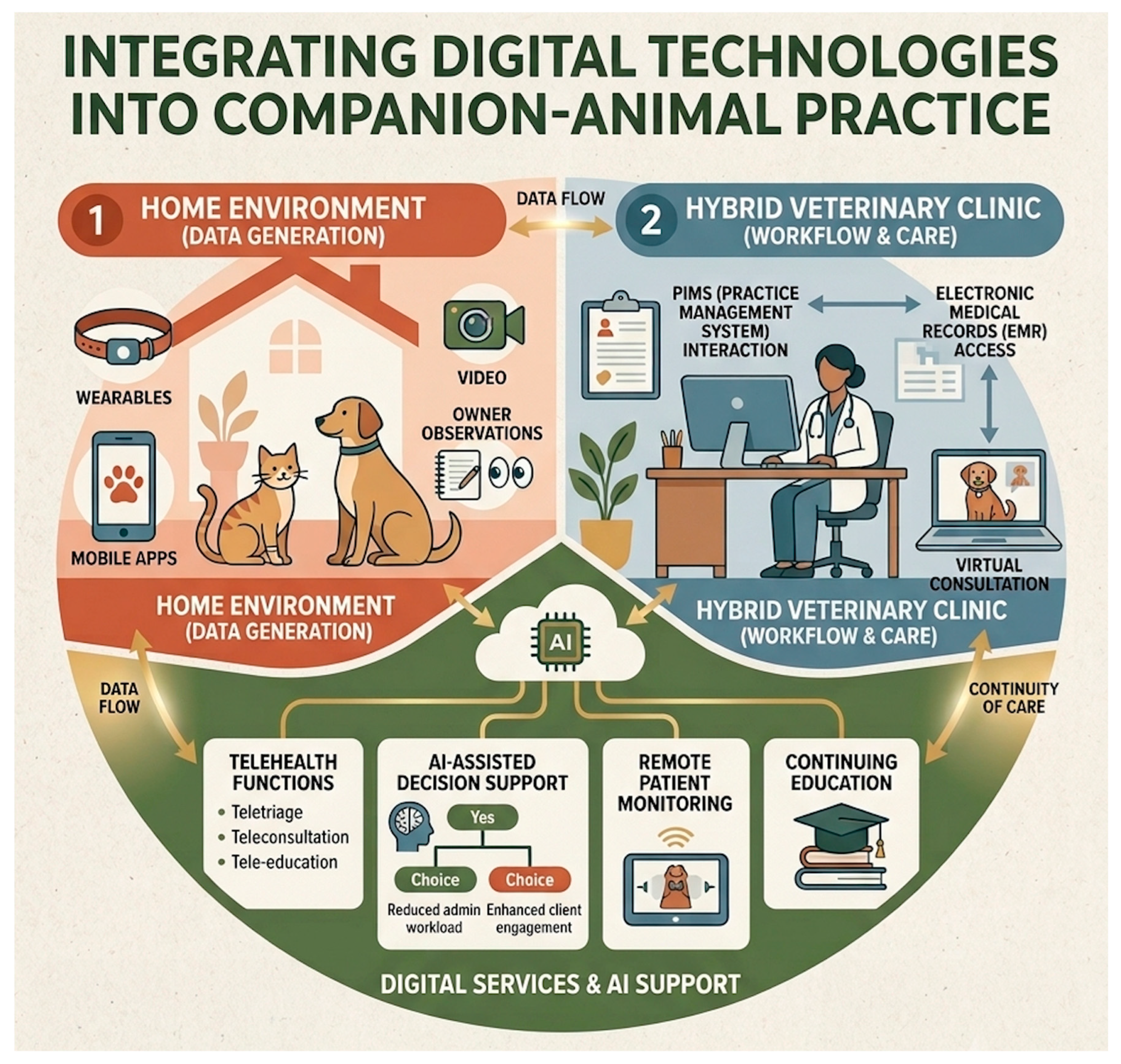
Digital veterinary care is increasingly evolving from individual technologies into an integrated clinical ecosystem that complements conventional in-person practice rather than replacing it (Figure 1). Within this model, health data generated in the home environment (including wearable sensors, mobile applications, owner-reported observations, and audio–video recordings) are transmitted through cloud-based platforms to support teletriage, teleconsultation, RPM, and AI-assisted clinical decision support. Integration with electronic health records and practice information management systems (PIMS) is intended to enable continuous information flow between virtual and in-person encounters, facilitating longitudinal patient monitoring, timely clinical intervention, and continuity of care, although published veterinary evidence directly evaluating this integration is limited; illustrative technology-guide descriptions of such integration are available [66], but stronger peer-reviewed or professional informatics sources would strengthen this claim in future work.
Figure 1.
Conceptual framework illustrating the integrated digital veterinary ecosystem for companion-animal practice. Data generated within the home environment (wearables, mobile applications, video, and owner observations) are transmitted through cloud-based platforms to support teletriage, teleconsultation, AI-assisted decision support, remote patient monitoring, and integration with electronic health records, enabling hybrid veterinary care. This figure presents a conceptual model synthesized by the authors rather than an empirically validated clinical workflow.
The adoption of these technologies reflects a shift toward hybrid models of veterinary care. A 2025 JAVMA survey found that teleconsultation, telemedicine, tele-education, telesupervision, and RPM are increasingly incorporated into routine companion-animal practice, indicating that multimodal digital care is becoming an established component of clinical workflow rather than a future aspiration [18]. Successful implementation, however, depends less on client acceptance than on workflow integration, regulatory clarity, interoperability, and clinician preparedness. Consistent with this, little difference in telehealth adoption has been observed between rural and urban practices [18]; because similar uptake in two groups does not by itself establish the causal importance of competing determinants, this pattern is better read as a hypothesis that organizational and regulatory factors may outweigh geographic barriers—than as an established conclusion.
AI is further strengthening digital workflow by automating documentation, assisting clinical decision-making, and integrating continuously generated patient data into routine practice. A 2024 AAHA–Digital survey of nearly 4000 veterinary professionals identified improved operational efficiency, reduced administrative burden, and enhanced client engagement as the principal perceived benefits of AI, although concerns regarding diagnostic reliability remain. Notably, veterinarians with practical experience using AI reported greater confidence in its clinical integration, highlighting the importance of digital literacy and continuing professional education for successful implementation [41].
6.2. Economic Considerations
The sustainability of digital veterinary care ultimately depends on demonstrating clinical and economic value, and distinct cost categories should be considered separately: costs to the veterinary practice (platform subscriptions, staff time, integration with existing systems), costs to clients, implementation costs, opportunity costs, and potential savings from reduced travel or improved scheduling; cost-effectiveness should not be conflated with client willingness to pay or with practice-level efficiency gains. Unlike human healthcare, where telehealth reimbursement is frequently supported by insurance systems, companion-animal telemedicine in the countries reviewed here appears to remain largely direct-pay, although this varies with the extent of pet-insurance coverage across countries and has not been comprehensively documented, making adoption largely dependent on improvements in practice efficiency, client convenience, and retention rather than reimbursement policy. Current evidence suggests that reduced travel, improved access to veterinary expertise, greater scheduling flexibility, and enhanced continuity of care may increase owner acceptance and willingness to pay, though this remains descriptive rather than generalized given the limited underlying evidence. However, robust veterinary evidence evaluating cost-effectiveness, return on investment, and long-term economic outcomes remains limited, highlighting an important priority for future research [2,8,15,18].
7. Emerging Trends and Future Perspectives
Digital veterinary care is evolving from isolated telemedicine services toward integrated, intelligent healthcare ecosystems. The subsections below distinguish, where possible, technologies already undergoing veterinary evaluation (Section 7.1 and Section 7.6) from concepts that remain largely conceptual or are extrapolated from human digital medicine (Section 7.2, Section 7.3, Section 7.4, Section 7.5 and Section 7.7). Increasing interoperability among telemedicine, RPM, AI, and electronic health records could support preventive care, precision medicine, and longitudinal health management. Although many of these technologies remain at an early stage in companion-animal medicine, and their eventual clinical impact should be treated as plausible rather than established, they have the potential to shape veterinary practice over the coming decade.
7.1. Integration of AI and RPM
Integrating AI with RPM represents one of the most promising advances in digital veterinary care [31,33]. Continuous data from wearable sensors (including activity, heart rate, respiratory rate, sleep, body temperature, and mobility) can be analyzed by machine-learning algorithms to detect subtle deviations from an individual animal’s baseline, predict disease progression, and generate early clinical alerts. Consequently, telemedicine is expected to evolve from reactive consultations toward proactive monitoring of chronic diseases, postoperative recovery, obesity, osteoarthritis, cardiac disorders, and age-related conditions. AI should, however, complement rather than replace veterinary clinical judgment, with transparent algorithms, independent validation, and human oversight remaining essential.
7.2. Digital Twins and Precision Veterinary Medicine
Veterinary digital twins remain a speculative concept, with no mature companion-animal implementation yet demonstrated; the framework is illustrated here by analogy to a human precision-cardiology application [67] rather than by veterinary evidence. By integrating multimodal data—including clinical history, imaging, genomics, wearable sensors, laboratory findings, environmental exposures, and behavior—a continuously updated virtual patient could support individualized diagnosis, treatment planning, and prediction of disease progression. Although veterinary applications remain largely conceptual, advances in electronic health records, connected biosensors, and genomics provide a foundation for future implementation, provided standardized data architectures and longitudinal validation studies are established.
7.3. Digital Phenotyping
Continuous digital phenotyping enables objective measurement of physiological, behavioral, and environmental characteristics using connected devices and computational analytics; the concept itself is drawn from human behavioral-health literature [37,68] and has not yet been established in veterinary practice. Compared with episodic clinical examinations, longitudinal digital phenotypes are proposed as a future use case that could improve early detection and monitoring of chronic pain, dermatological, metabolic, cardiovascular, and behavioral disorders, though each application requires dedicated veterinary validation. Integration with genomic and other multi-omics data may further advance individualized preventive healthcare if these validation studies are undertaken.
7.4. Federated Learning
The development of robust veterinary AI is constrained by fragmented clinical datasets. Federated learning addresses this limitation by enabling multiple veterinary institutions to train AI models collaboratively without transferring identifiable patient data [38,69]. Federated learning does not, however, automatically guarantee privacy or security: model updates can themselves leak information and create new vulnerabilities, and dataset heterogeneity, label inconsistency, institutional imbalance, and governance of collaborative models remain significant implementation challenges. This approach nonetheless has the potential to improve model generalizability across breeds, species, imaging systems, and clinical settings while supporting multicenter AI development, provided these challenges are addressed.
7.5. One Health Interoperability
Future digital platforms may support secure interoperability among veterinary clinics, diagnostic laboratories, public health agencies, environmental monitoring systems, and human healthcare providers where appropriate, building on the One Health Joint Plan of Action of WHO, FAO, WOAH, and UNEP [70]; true interoperability requires shared data standards (e.g., structured, machine-readable clinical and laboratory records) rather than simple point-to-point data exchange, and concrete veterinary-specific interoperability standards remain underdeveloped relative to human health informatics. Such integration could strengthen surveillance of zoonoses, antimicrobial resistance, vector-borne diseases, and other emerging health threats; for example, routinely generated digital records of household pet-management practices, such as feeding and food-bowl hygiene, have been linked to bacterial contamination relevant to household zoonotic risk [71,72], illustrating how home-generated data captured by digital veterinary platforms could feed into preventive-care and One Health surveillance strategies. Achieving this broader vision will require standardized data formats, interoperable health records, robust cybersecurity, and harmonized governance frameworks.
7.6. Future Research Priorities
Future research should prioritize prospective multicenter studies evaluating the effectiveness and cost-effectiveness of telemedicine, independent validation of AI systems and commercial biosensors, development of species-specific digital biomarkers, assessment of client acceptance and workforce implications, and establishment of international standards for interoperability, cybersecurity, and ethical AI governance. Longitudinal studies integrating telemedicine, RPM, genomics, and environmental data will be particularly important for advancing precision veterinary medicine and One Health surveillance.
7.7. Toward Veterinary 5.0
Building on Industry 4.0/5.0 and human “Medicine 5.0” framings used elsewhere in health-innovation discourse, we use “Veterinary 5.0” in this review as a descriptive label (rather than an established term from the veterinary literature) for a proposed next generation of digital veterinary care: a human-centered model in which AI augments rather than replaces veterinary expertise [31,33,43,70]. As proposed here, Veterinary 5.0 would be distinguished from current digital veterinary care and from precision veterinary medicine by its degree of integration and automation, and could be characterized by measurable features such as interoperable, standards-based data exchange across telemedicine, RPM, and AI systems; explainable, independently validated AI decision support; and documented human oversight of AI-assisted decisions. Explainable AI, multimodal foundation models, and large language models are expected to enhance clinical reasoning, documentation, evidence retrieval, and client education while maintaining human oversight of medical decisions. Future implementation should emphasize equitable access, climate-smart care, rigorous clinical validation, interoperable digital infrastructure, transparent AI governance, and robust cybersecurity. Ultimately, this proposed model should strengthen animal welfare, evidence-based practice, and the veterinarian–client relationship while delivering more accessible, personalized, and sustainable companion-animal healthcare.
8. Limitations
This narrative review has several limitations that should be considered when interpreting its conclusions. As a narrative rather than systematic review, it was conducted by a single reviewer without dual independent screening, a predefined protocol, formal quality assessment, or PRISMA-guided study selection, making the synthesis susceptible to selection bias and qualitative interpretation; database coverage was also restricted to PubMed, Scopus, and CAB Abstracts (supplemented by Google Scholar), and searches were limited to English-language sources, so relevant non-English or unindexed literature may have been missed. The available evidence is highly heterogeneous in study design, outcome measures, technologies, and sample sizes, limiting direct comparisons and quantitative synthesis, and no formal evidence-grading system was applied beyond the informal evidence-tier classification described in Section 2. Because veterinary evidence remains limited for several emerging technologies, particularly AI-assisted decision support and teleconsultation, some conclusions draw on analogous findings from human medicine, which may not be directly transferable across species. Evidence supporting commercial AI tools and remote patient-monitoring devices remains immature, with relatively few independent validation studies and inconsistent findings. Information on technology adoption and market trends partly relies on industry reports and vendor publications [73], which should be interpreted cautiously. Regulatory frameworks governing veterinary telemedicine, particularly electronic veterinarian–client–patient relationships (e-VCPRs), continue to evolve across jurisdictions and may change after publication. Publication and reporting bias may favor positive findings, whereas negative or inconclusive studies on telemedicine, AI, and wearable technologies are likely underrepresented in the available literature. Finally, because digital veterinary technologies are evolving rapidly, parts of this synthesis may become outdated within a relatively short time of the literature search being conducted.
9. Conclusions
Digital veterinary care is reshaping companion-animal practice by integrating telemedicine, remote patient monitoring, and AI-assisted clinical decision support. Emerging evidence demonstrates that telemedicine and RPM offer the highest current value by expanding access to expertise, streamlining follow-up and specialist consultations, and enabling continuous chronic disease management. Conversely, applications involving AI, digital twins, and system interoperability are still in their early and largely theoretical stages of validation. Broader implementation will require stronger veterinary-specific evidence, standardized validation of digital technologies, interoperable health information systems, robust cybersecurity, and clear regulatory frameworks.
Future progress will depend on integrating these technologies into evidence-based clinical practice while preserving veterinary oversight and the veterinarian–client–patient relationship, and implementation should remain conditional not only on technical validation but also on demonstrated clinical utility, safety, cost-effectiveness, workflow feasibility, and equitable access across practice settings and client populations. As digital platforms continue to evolve, they have the potential to advance precision companion-animal medicine, strengthen One Health surveillance, improve animal welfare, and deliver more accessible, personalized, and sustainable veterinary healthcare.
Supplementary Materials
The following supporting information can be downloaded at: https://www.mdpi.com/article/10.3390/pets3040044/s1, Table S1. Database-specific search strings, filters, and search dates used to synthesize the narrative literature review.
Author Contributions
M.A.I., S.A.R., and M.R. conceived the idea; M.K.H.S., J.S., and S.A.R. collected literature. M.A.I. validated and compiled the literature, prepared the tables, and drafted the initial version of the manuscript. All authors critically reviewed and edited the manuscript and approved the final version. All authors have read and agreed to the published version of the manuscript.
Funding
Md Aminul Islam received fellowship support from the Fulbright Visiting Scholar Program of the U.S. Department of State. The funder has no role in study design, collection, analysis, and interpretation of data, writing of the report, and decision to submit the article for publication. This research received no other external funding.
Informed Consent Statement
Not applicable.
Data Availability Statement
No new data were created or analyzed in this study. Data sharing is not applicable for this article.
Acknowledgments
Artificial intelligence-assisted tools (OpenAI, GPT-4.0) were used for figure generation and visual design. All scientific content was reviewed and verified by the authors.
Conflicts of Interest
Author Mohammad Rahman was employed by the company PetNest Animal Hospital, 11990 Coit Rd., STE 110, Frisco, TX 75035, USA. The remaining authors declare that the research was conducted in the absence of any commercial or financial relationships that could be construed as a potential conflict of interest.
References
- Hassan, M.H.; Abdulkarim, A.; Abu-Seida, A.M. Veterinary telemedicine: A new era for animal welfare. Open Vet. J. 2024, 14, 952–961. [Google Scholar] [CrossRef] [Scilit] [PubMed]
- Lundahl, L.; Powell, L.; Reinhard, C.L.; Healey, E.; Watson, B. A pilot study examining the experience of veterinary telehealth in an underserved population through a university program integrating veterinary students. Front. Vet. Sci. 2022, 9, 871928. [Google Scholar] [CrossRef] [Scilit] [PubMed]
- Becker, B.; Tipold, A.; Ehlers, J.; Kleinsorgen, C. Veterinarians’ perspective on telemedicine in Germany. Front. Vet. Sci. 2023, 10, 1062046. [Google Scholar] [CrossRef] [Scilit] [PubMed]
- Telehealth and the VCPR; American Veterinary Medical Association n.d.: Schaumburg, IL, USA; Available online: https://www.avma.org/resources-tools/animal-health-and-welfare/telehealth-telemedicine-veterinary-practice/telehealth-and-vcpr (accessed on 31 July 2026).
- American Veterinary Medical Association. Telehealth in Veterinary Practice. Available online: https://www.avma.org/resources-tools/animal-health-and-welfare/telehealth-telemedicine-veterinary-practice (accessed on 31 July 2026).
- Bishop, G.T.; Evans, B.A.; Kyle, K.L.; Kogan, L.R. Owner satisfaction with use of videoconferencing for recheck examinations following routine surgical sterilization in dogs. J. Am. Vet. Med. Assoc. 2018, 253, 1151–1157. [Google Scholar] [CrossRef] [Scilit] [PubMed]
- Belda, B.; Enomoto, M.; Case, B.C.; Lascelles, B.D.X. Initial evaluation of PetPace activity monitor. Vet. J. 2018, 237, 63–68. [Google Scholar] [CrossRef] [Scilit] [PubMed]
- Brložnik, M.; Likar, Š.; Krvavica, A.; Avbelj, V.; Domanjko Petrič, A. Wireless body sensor for electrocardiographic monitoring in dogs and cats. J. Small Anim. Pract. 2019, 60, 223–230. [Google Scholar] [CrossRef] [Scilit] [PubMed]
- Bradley, R.; Tagkopoulos, I.; Kim, M.; Kokkinos, Y.; Panagiotakos, T.; Kennedy, J.; De Meyer, G.; Watson, P.; Elliott, J. Predicting early risk of chronic kidney disease in cats using routine clinical laboratory tests and machine learning. J. Vet. Intern. Med. 2019, 33, 2644–2656. [Google Scholar] [CrossRef] [Scilit] [PubMed]
- Boissady, E.; de La Comble, A.; Zhu, X.; Hespel, A.M. Artificial intelligence evaluating primary thoracic lesions has an overall lower error rate compared to veterinarians or veterinarians in conjunction with the artificial intelligence. Vet. Radiol. Ultrasound 2020, 61, 619–627. [Google Scholar] [CrossRef] [Scilit] [PubMed]
- Koo, S.T.; Carr, A.P. Comparison of home blood pressure and office blood pressure measurement in dogs and cats. Can. J. Vet. Res. 2022, 86, 203–208. [Google Scholar] [PubMed]
- Reagan, K.L.; Deng, S.; Sheng, J.; Sebastian, J.; Wang, Z.; Huebner, S.N.; Wenke, L.A.; Michalak, S.R.; Strohmer, T.; Sykes, J.E. Use of machine-learning algorithms to aid in the early detection of leptospirosis in dogs. J. Vet. Diagn. Investig. 2022, 34, 612–621. [Google Scholar] [CrossRef] [Scilit] [PubMed]
- Wong, S.Y.; Alvarez, L.X. Veterinary telerehabilitation was as satisfactory as in-person consultations. Can. Vet. J. 2023, 64, 587–592. [Google Scholar]
- Springer, S.; Lund, T.B.; Corr, S.A.; Sandøe, P. Seeing the benefits, but not taking advantage of them: Dog and cat owners’ beliefs about veterinary telemedicine. Vet. Rec. 2024, 194, e3312. [Google Scholar] [CrossRef] [Scilit] [PubMed]
- Juodžentė, D.; Burbaitė, E.; Stankevičius, R.; Karvelienė, B.; Rudejevienė, J.; Daunorienė, A. Veterinary Telemedicine in Lithuania: Analysis of the Current Market, Animal Owner Knowledge, and Success Factors for Digital Transformation of Clinics. Animals 2024, 14, 1912. [Google Scholar] [CrossRef] [Scilit] [PubMed]
- Akchurin, S.V.; Benseghir, H.; Bouchemla, F.; Akchurina, I.V.; Fedotov, S.V.; Dyulger, G.P.; Dmitrieva, V.V. Veterinary telemedicine practicability: Analyzing Russian pet owners’ feedback. Vet. World 2024, 17, 1184–1189. [Google Scholar] [CrossRef] [Scilit] [PubMed]
- Peng, Z.H.; Ham, K.M.; Ladlow, J.; Stefaniak, C.; Jeffery, N.D.; Thieman Mankin, K.M. Comparison of remote and in-person respiratory function grading of brachycephalic dogs. Vet. Surg. 2025, 54, 573–580. [Google Scholar] [CrossRef] [Scilit] [PubMed]
- Nagamori, Y.; Scimeca, R.; Hall-Sedlak, R.; Blagburn, B.; Starkey, L.A.; Bowman, D.D.; Lucio-Forster, A.; Little, S.E.; Cree, T.; Loenser, M.; et al. Multicenter evaluation of the Vetscan Imagyst system using Ocus 40 and EasyScan One scanners to detect gastrointestinal parasites in feces of dogs and cats. J. Vet. Diagn. Investig. 2024, 36, 32–40. [Google Scholar] [CrossRef] [Scilit] [PubMed]
- Neill, C.L.; Morgan, K.L. Few differences in rural and urban adoption of veterinary telehealth services. J. Am. Vet. Med. Assoc. 2025, 263, 1–7. [Google Scholar] [CrossRef] [Scilit] [PubMed]
- Haase, L.; Sedlmayr, B.; Sedlmayr, M.; Monett, D.; Winter, J. Towards mHealth applications for pet animal owners: A comprehensive literature review of requirements. BMC Vet. Res. 2025, 21, 190. [Google Scholar] [CrossRef] [Scilit] [PubMed]
- Ndiaye, Y.S.; Cramton, P.; Chernev, C.; Ockenfels, A.; Schwarz, T. Comparison of radiological interpretation made by veterinary radiologists and state-of-the-art commercial AI software for canine and feline radiographic studies. Front. Vet. Sci. 2025, 12, 1502790. [Google Scholar] [CrossRef] [Scilit] [PubMed]
- Ireifej, S.J.; Morello, S.L.; Lesser, M. Retrospective analysis of teletriage and teleadvice administered to 1,575 dogs with gastrointestinal signs. Open Vet. J. 2026, 16, 327–336. [Google Scholar] [CrossRef] [Scilit] [PubMed]
- Ellingsberg, L.; Solano, M.; Milton Hicks, J. Performance of an artificial intelligence convolution neural network software for the detection of confirmed heart failure in dogs and cats. Vet. Radiol. Ultrasound 2026, 67, e70144. [Google Scholar] [CrossRef] [Scilit] [PubMed]
- Pang, D.S.J.; Pang, J.M.; Payne, O.J.; Clement, F.M.; Faber, T. Teleconsulting in the time of a global pandemic: Application to anesthesia and technological considerations. Can. Vet. J. 2020, 61, 1092–1100. [Google Scholar] [PubMed]
- Sánchez-Martín, E.; Moreno-Sánchez, I.; Morán-Sánchez, M.; Pérez-Martín, M.; Martín-Morales, M.; García-Ortiz, L. Store-and-forward teledermatology in a Spanish health area significantly increases access to dermatology expertise. BMC Prim. Care 2024, 25, 227. [Google Scholar] [CrossRef] [Scilit] [PubMed]
- Moreno-Ramirez, D.; Ferrandiz, L.; Nieto-Garcia, A.; Carrasco, R.; Moreno-Alvarez, P.; Galdeano, R.; Bidegain, E.; Rios-Martin, J.J.; Camacho, F.M. Store-and-forward teledermatology in skin cancer triage: Experience and evaluation of 2009 teleconsultations. Arch. Dermatol. 2007, 143, 479–484. [Google Scholar] [CrossRef] [Scilit] [PubMed]
- Lee, M.S.; Stavert, R. Factors Contributing to Diagnostic Discordance Between Store-and-Forward Teledermatology Consultations and In-Person Visits: Case Series. JMIR Dermatol. 2021, 4, e24820. [Google Scholar] [CrossRef] [Scilit] [PubMed]
- Wootton, R.; Liu, J.; Bonnardot, L.; Venugopal, R.; Oakley, A. Experience with quality assurance in two store-and-forward telemedicine networks. Front. Public Health 2015, 3, 261. [Google Scholar] [CrossRef] [Scilit] [PubMed]
- von Oettingen, J.E.; Craven, M.; Duperval, R.; Sine St. Surin, F.; Eveillard, R.; Saint Fleur, R.; Van Vliet, G.; Chanoine, J.-P.; Louis, R. Experience with store-and-forward consultations in providing access to pediatric endocrine consultations in low- and middle-income countries. Front. Public Health 2019, 7, 272. [Google Scholar] [CrossRef] [Scilit] [PubMed]
- Canfield, M.; Lavan, R.P.; Canfield, T.; Springer, T.; Armstrong, R.; Gingold, G.; Thomas, J.; Sampeck, B. Remote Monitoring of Canine Patients Treated for Pruritus during the COVID-19 Pandemic in Florida Using a 3-D Accelerometer. Animals 2023, 13, 3875. [Google Scholar] [CrossRef] [Scilit] [PubMed]
- Zhao, X.; Tanaka, R.; Mandour, A.S.; Shimada, K.; Hamabe, L. Remote Vital Sensing in Clinical Veterinary Medicine: A Comprehensive Review of Recent Advances, Accomplishments, Challenges, and Future Perspectives. Animals 2025, 15, 1033. [Google Scholar] [CrossRef] [Scilit] [PubMed]
- AI-Powered Pet Collar Allows Data Sharing with Veterinarians. dvm360. 29 September 2025. Available online: https://www.dvm360.com/view/ai-powered-pet-collar-allows-data-sharing-with-veterinarians (accessed on 31 July 2026).
- Polapragada, S.K.S.S. AI applications in veterinary digital health: A systematic survey. Front. Vet. Sci. 2026, 13, 1853395. [Google Scholar] [CrossRef] [Scilit] [PubMed]
- Breakthrough Study Validates AI for Use in Interpreting Pet X-Rays; SignalPET: Dallas, TX, USA, 2025; Available online: https://www.signalpet.com/articles/breakthrough-study-validates-ai/ (accessed on 31 July 2026).
- Joslyn, S.K.; Faulkner, J.; Ma, D.; Appleby, R. Commentary: Comparison of radiological interpretation made by veterinary radiologists and state-of-the-art commercial AI software for canine and feline radiographic studies. Front. Vet. Sci. 2025, 12, 1615947. [Google Scholar] [CrossRef] [Scilit] [PubMed]
- Ma, D.; Faulkner, J.E.; Stander, N.; Raisis, A.; Joslyn, S. Pilot study: External validation of commercial veterinary radiology artificial intelligence services shows deficiencies in interpretation of general practice–sourced canine abdominal radiographs. J. Am. Vet. Med. Assoc. 2026, 264, 1022–1029. [Google Scholar] [CrossRef] [Scilit] [PubMed]
- Martinez, R.; Amezcua, K.L.; Hernandez Torres, S.I.; Winter, T.; Yankin, I.; Venn, E.; Snider, E.J.; Edwards, T. Artificial intelligence models for point-of-care ultrasound diagnostics in dogs. Front. Vet. Sci. 2026, 13, 1729114. [Google Scholar] [CrossRef] [Scilit] [PubMed]
- Jourdan, A.; Dania, C.; Cambournac, M. Sonographic machine-assisted recognition and tracking of B-lines in dogs: The SMARTDOG study. Front. Vet. Sci. 2025, 12, 1647547. [Google Scholar] [CrossRef] [Scilit] [PubMed]
- Bera, K.; Schalper, K.A.; Rimm, D.L.; Velcheti, V.; Madabhushi, A. Artificial intelligence in digital pathology—New tools for diagnosis and precision oncology. Nat. Rev. Clin. Oncol. 2019, 16, 703–715. [Google Scholar] [CrossRef] [Scilit] [PubMed]
- Aeffner, F.; Zarella, M.D.; Buchbinder, N.; Bui, M.M.; Goodman, M.R.; Hartman, D.J.; Lujan, G.M.; Molani, M.A.; Parwani, A.V.; Lillard, K.; et al. Introduction to Digital Image Analysis in Whole-slide Imaging: A White Paper from the Digital Pathology Association. J. Pathol. Inform. 2019, 10, 9. [Google Scholar] [CrossRef] [Scilit] [PubMed]
- Gabor, S.; Danylenko, G.; Voegeli, B. Familiarity with artificial intelligence drives optimism and adoption among veterinary professionals: 2024 survey. Am. J. Vet. Res. 2025, 86, S63–S69. [Google Scholar] [CrossRef] [Scilit] [PubMed]
- Artificial Intelligence and Predictive Analytics in Veterinary Medicine; Ross University School of Veterinary Medicine: Basseterre, Saint Kitts and Nevis, 2026; Available online: https://veterinary.rossu.edu/about/blog/ai-predictive-analytics-veterinary-medicine (accessed on 31 July 2026).
- Aydin, S.; Karabacak, M.; Vlachos, V.; Margetis, K. Large language models in patient education: A scoping review of applications in medicine. Front. Med. 2024, 11, 1477898. [Google Scholar] [CrossRef] [Scilit] [PubMed]
- Ayers, J.W.; Poliak, A.; Dredze, M.; Leas, E.C.; Zhu, Z.; Kelley, J.B.; Faix, D.J.; Goodman, A.M.; Longhurst, C.A.; Hogarth, M.; et al. Comparing Physician and Artificial Intelligence Chatbot Responses to Patient Questions Posted to a Public Social Media Forum. JAMA Intern. Med. 2023, 183, 589–596. [Google Scholar] [CrossRef] [Scilit]
- Chu, C.P. ChatGPT in veterinary medicine: A practical guidance of generative artificial intelligence in clinics, education, and research. Front. Vet. Sci. 2024, 11, 1395934. [Google Scholar] [CrossRef] [Scilit] [PubMed]
- Tierney, A.A.; Gayre, G.; Hoberman, B.; Mattern, B.; Ballesca, M.; Kipnis, P.; Liu, V.; Lee, K. Ambient artificial intelligence scribes to alleviate the burden of clinical documentation. NEJM Catal. Innov. Care Deliv. 2024, 5. [Google Scholar] [CrossRef] [Scilit]
- Bland, J.M.; Altman, D.G. Statistical methods for assessing agreement between two methods of clinical measurement. Lancet 1986, 1, 307–310. [Google Scholar] [CrossRef] [Scilit]
- Mokkink, L.B.; Terwee, C.B.; Patrick, D.L.; Alonso, J.; Stratford, P.W.; Knol, D.L.; Bouter, L.M.; de Vet, H.C.W. The COSMIN checklist for assessing the methodological quality of studies on measurement properties of health status measurement instruments: An international Delphi study. Qual. Life Res. 2010, 19, 539–549. [Google Scholar] [CrossRef] [Scilit] [PubMed]
- National Institute of Standards and Technology. NIST Cybersecurity Framework (CSF) 2.0; NIST: Gaithersburg, MD, USA, 2024. [CrossRef] [Scilit]
- U.S. Federal Trade Commission. Health Breach Notification Rule, 16 CFR Part 318; Final Rule; U.S. Federal Trade Commission: Washington, DC, USA, 2024.
- U.S. Food and Drug Administration (FDA). Extralabel Use of Approved Animal and Human Drugs in Animals. 21 CFR Part 530, §530.3(i) (Definition of Veterinarian–Client–Patient Relationship). Available online: https://www.ecfr.gov/current/title-21/chapter-I/subchapter-E/part-530 (accessed on 31 July 2026).
- American Association of Veterinary State Boards (AAVSB). Telehealth and the Veterinarian–Client–Patient Relationship (VCPR); AAVSB: Kansas City, MO, USA, 2024; Available online: https://www.kcvma.com/2024/01/01/telehealth-and-the-veterinary-client-patient-relationship/ (accessed on 31 July 2026).
- European Parliament and Council of the European Union. Regulation (EU) 2019/6 of the European Parliament and of the Council of 11 December 2018 on veterinary medicinal products and repealing Directive 2001/82/EC. Off. J. Eur. Union 2019, L4, 43–167. [Google Scholar]
- Federation of Veterinarians of Europe (FVE). Veterinary Telemedicine in Europe: Interactive Regulatory Map; FVE: Brussels, Belgium, 2025; Available online: https://uevp.fve.org/news/interactive-map-on-veterinary-telemedicine-in-europe (accessed on 31 July 2026).
- Royal College of Veterinary Surgeons (RCVS). Code of Professional Conduct for Veterinary Surgeons. Supporting Guidance: Under Care and Remote Prescribing; RCVS: London, UK, 2024; Available online: https://www.rcvs.org.uk/setting-standards/advice-and-guidance/code-of-professional-conduct-for-veterinary-surgeons/ (accessed on 31 July 2026).
- Veterinary Medicines Directorate (VMD). Veterinary Medicines Guidance Note 3 (VMGN 3): Veterinary Medicines and Prescribing; VMD: New Haw, UK, 2024. Available online: https://www.yumpu.com/en/document/read/45771526/vmgn-3-veterinary-medicines-directorate-defra/1 (accessed on 31 July 2026).
- Veterinary Medicines Directorate (VMD). Supporting Guidance on “Under Care” and Remote Prescribing, Effective 1 January 2026; VMD: New Haw, UK, 2025. Available online: https://www.rcvs.org.uk/about-us/our-policies/under-care-guidance (accessed on 31 July 2026).
- Veterinary Practitioners Board of New South Wales (VPB NSW). Technology-Based Patient Consultations: Guidance for Veterinarians; VPB NSW: Sydney, Australia, 2024. Available online: https://big-charity-233c476a87.media.strapiapp.com/GR_07_Technology_based_patient_consultations_20220906_e87db6ef3e.pdf (accessed on 31 July 2026).
- Australasian Veterinary Boards Council (AVBC). Accreditation Standards for Veterinary Programs 2026 V2; AVBC: Brisbane, Australia, 2026. Available online: https://avbc.asn.au/wp-content/uploads/2026/06/AVBC-Accreditation-Standards-2026-V2.1.pdf (accessed on 31 July 2026).
- Veterinarian Client-Patient Relationship (VCPR) by State; Otto: San Francisco, CA, USA, 2024; Available online: https://otto.vet/vcpr/ (accessed on 31 July 2026).
- State Budget Bill Includes Provision on Veterinary Telehealth; Farm Office, The Ohio State University: Columbus, OH, USA, 2025; Available online: https://farmoffice.osu.edu/blog/tue-08262025-419pm/state-budget-bill-includes-provision-veterinary-telehealth (accessed on 31 July 2026).
- C.S.H.B. 3364 Bill Analysis (Referencing Hines v. Pardue, 117 F.4th 769 (5th Cir. 2024)); Texas House of Representatives: Austin, TX, USA, 2025. Available online: https://capitol.texas.gov/tlodocs/89R/analysis/html/HB03364H.htm (accessed on 31 July 2026).
- The Patchwork Quilt of State Veterinary Telehealth Laws. AAHA NEWStat. 7 October 2024. Available online: https://www.aaha.org/newstat/publications/the-patchwork-quilt-of-state-veterinary-telehealth-laws/ (accessed on 31 July 2026).
- Veterinarian-Client-Patient Relationships, Prescribing/Dispensing Animal Drugs and Telemedicine; U.S. Food and Drug Administration: Silver Spring, MD, USA, 2024. Available online: https://www.fda.gov/animal-veterinary/product-safety-information/veterinarian-client-patient-relationships-prescribingdispensing-animal-drugs-and-telemedicine (accessed on 31 July 2026).
- Senate Bill 105: Legislative Update for GA Veterinarians; Georgia Veterinary Medical Association: Norcross, GA, USA, 2025; Available online: https://gvma.net/2025/02/24/senate-bill-105-legislative-update-for-ga-veterinarians/ (accessed on 31 July 2026).
- Veterinary Integration Solutions: Complete Technology Guide. Vida AI Agent OS. 9 December 2025. Available online: https://vida.io/blog/veterinary-integration-solutions (accessed on 31 July 2026).
- Corral-Acero, J.; Margara, F.; Marciniak, M.; Rodero, C.; Loncaric, F.; Feng, Y.; Gilbert, A.; Fernandes, J.F.; Bukhari, H.A.; Wajdan, A.; et al. The “Digital Twin” to enable the vision of precision cardiology. Eur. Heart J. 2020, 41, 4556–4564. [Google Scholar] [CrossRef] [Scilit] [PubMed]
- Onnela, J.-P.; Rauch, S.L. Harnessing smartphone-based digital phenotyping to enhance behavioral and mental health. Neuropsychopharmacology 2016, 41, 1691–1696. [Google Scholar] [CrossRef] [Scilit] [PubMed]
- Rieke, N.; Hancox, J.; Li, W.; Milletari, F.; Roth, H.R.; Albarqouni, S.; Bakas, S.; Galtier, M.N.; Landman, B.A.; Maier-Hein, K.; et al. The future of digital health with federated learning. NPJ Digit. Med. 2020, 3, 119. [Google Scholar] [CrossRef] [Scilit] [PubMed]
- World Health Organization; Food and Agriculture Organization of the United Nations; United Nations Environment Programme; World Organisation for Animal Health. One Health Joint Plan of Action (2022–2026): Working Together for the Health of Humans, Animals, Plants and the Environment; WHO: Geneva, Switzerland, 2022. [Google Scholar] [CrossRef] [Scilit]
- Raspa, F.; Schiavone, A.; Pattono, D.; Galaverna, D.; Cavallini, D.; Vinassa, M.; Bergero, D.; Dalmasso, A.; Bottero, M.T.; Valle, E. Pet feeding habits and the microbiological contamination of dog food bowls: Effect of feed type, cleaning method and bowl material. BMC Vet. Res. 2023, 19, 261. [Google Scholar] [CrossRef] [Scilit] [PubMed]
- Luisana, E.; Saker, K.; Jaykus, L.A.; Getty, C. Survey evaluation of dog owners’ feeding practices and dog bowls’ hygiene assessment in domestic settings. PLoS ONE 2022, 17, e0259478. [Google Scholar] [CrossRef] [Scilit] [PubMed]
- Veterinary Telemetry Systems Market Size, Share & Trends Analysis Report; Grand View Research: San Francisco, CA, USA, 2024; Available online: https://www.grandviewresearch.com/industry-analysis/veterinary-telemetry-systems-market-report (accessed on 31 July 2026).

Disclaimer/Publisher’s Note: The statements, opinions and data contained in all publications are solely those of the individual author(s) and contributor(s) and not of MDPI and/or the editor(s). MDPI and/or the editor(s) disclaim responsibility for any injury to people or property resulting from any ideas, methods, instructions or products referred to in the content. |
© 2026 by the authors. Licensee MDPI, Basel, Switzerland. This article is an open access article distributed under the terms and conditions of the Creative Commons Attribution (CC BY) license.