


Abstract
Antimicrobial resistance (AMR) is a major global health threat that erodes the effectiveness of antibiotics and increases morbidity, mortality, and healthcare costs. Updated forecasts project that bacterial AMR could directly cause approximately 39 million deaths between 2025 and 2050, with annual deaths rising from 1.14 million in 2021 to an estimated 1.91 million in 2050; earlier economic modelling placed the cumulative cost of unchecked resistance at up to 100 trillion United States dollars. These figures underscore the need for sustainable alternatives to conventional antibiotics. This review synthesizes current evidence on non-antibiotic strategies, including bacteriophages, antimicrobial peptides, CRISPR-based antimicrobials, microbiome modulation, host-directed therapies, nanotechnology, and artificial-intelligence-driven drug discovery. We searched more than one hundred peer-reviewed studies, clinical trial reports, primary epidemiological analyses, and international policy and regulatory documents to evaluate therapeutic mechanisms, clinical progress, and implementation barriers, with particular attention to which strategies suit personalized, patient-specific application and which are more amenable to standardized mass production. Bacteriophages and antimicrobial peptides show potent broad-spectrum activity with reduced resistance selection pressure, CRISPR-based approaches enable precise pathogen targeting, and microbiome therapies restore colonization resistance. Clinical translation, however, is hindered by inconsistent regulatory frameworks, limited manufacturing scalability, incomplete safety profiles, and constrained funding in low-resource settings. Mitigating the AMR crisis will require a coordinated, multidisciplinary response grounded in the One Health paradigm, emphasizing antimicrobial stewardship, equitable global access to emerging therapeutics, and sustained investment in translational research.
1. Introduction
The discovery of antibiotics in the 20th century, heralded by Alexander Fleming’s identification of penicillin in 1928, transformed the management of infectious diseases and opened the way to successive generations of antimicrobial agents that made previously fatal conditions treatable [1]. Widespread misuse and overuse in human medicine, veterinary practice, and agriculture has since precipitated a global health crisis: the emergence and dissemination of antimicrobial resistance (AMR).
AMR arises when microorganisms evolve mechanisms that render once-effective agents ineffective. Bacteria adapt through genetic and phenotypic strategies including modification of drug targets, enzymatic inactivation of antibiotics, reduced membrane permeability, and activation of efflux pumps [2,3]. These adaptations have produced multidrug-resistant (MDR) and extensively drug-resistant (XDR) strains that pose formidable therapeutic challenges.
The 2024 Global Research on Antimicrobial Resistance (GRAM) Project analysis, published in The Lancet, extended these estimates across 1990 to 2021 with forecasts to 2050. It projects approximately 39 million deaths directly attributable to bacterial AMR between 2025 and 2050, with annual direct deaths rising by 67.5 percent, from 1.14 million in 2021 to an estimated 1.91 million in 2050, and deaths among people aged 70 years and older more than doubling, even as mortality among children under five continues to decline [4]. The same analysis indicates that a substantial share of this future burden, at minimum several hundred thousand deaths annually, is avertible through existing interventions such as infection prevention and control, water, sanitation and hygiene programmes, and paediatric vaccination, particularly in low- and middle-income countries (LMICs) [4,5].
The World Health Organization (WHO) has designated AMR one of the top three public health threats of the 21st century, recognizing its capacity to undermine food security, socioeconomic stability, and the gains of modern medicine [6,7]. In response, the WHO Global Antimicrobial Resistance Surveillance System (GLASS) and national antimicrobial stewardship (AMS) programmes have been established to monitor resistance and optimize antibiotic use [8,9]. The WHO’s 2024 update to its Bacterial Priority Pathogens List has further sharpened research and development priorities by ranking pathogens according to regional resistance patterns, mortality, and the adequacy of the existing treatment pipeline [10].
Despite these efforts, the pipeline for novel antibiotics remains critically underfunded, largely because short treatment courses yield limited financial returns [11]. This economic reality has forced a shift: rather than relying solely on new antibiotics, the scientific community is increasingly exploring fundamentally different therapeutic approaches. This review evaluates the evidence base for these emerging alternatives, identifies key barriers to implementation, and proposes a roadmap for sustainable antimicrobial strategies.
The breadth of this review is deliberate. Antibiotic alternatives are a heterogeneous set of biological, engineered, computational, and environmental technologies that differ fundamentally in mechanism, regulatory pathway, and manufacturing model. For clinicians, policy makers, and early-career researchers in resource-constrained settings, the central translational question is comparative: which alternative suits which clinical and health-system context. A narrow review of a single modality cannot answer it. This review is therefore an integrative narrative synthesis mapping the mechanistic, clinical, regulatory, and implementation landscape across six major modalities and their emerging combinations, with an explicit framework distinguishing strategies suited to personalized application from those amenable to mass production, and time-bound recommendations.
2. Current Landscape of Antibiotic Resistance
Bacteria adapt continuously to environmental pressures to ensure survival and propagation [4]. Under antibiotic exposure they can undergo rapid genetic evolution, acquiring resistance traits that allow them to persist despite treatment [6]. Antibiotics principally target four bacterial structures: the cell wall, protein synthesis machinery, cell membrane, and nucleic acid replication machinery [7].
Resistance emerges through several well-characterized mechanisms: reduced antibiotic uptake through membrane modifications; target-site mutations, such as alterations in penicillin-binding proteins or ribosomal RNA; enzymatic drug inactivation, notably through beta-lactamases; and active drug efflux via pump systems [8,9]. Horizontal gene transfer further accelerates the spread of resistance genes across bacterial populations, enabling rapid dissemination of resistance traits [1,7].
The clinical consequences are significant. Resistant infections are associated with a twofold increase in serious complications and a threefold increase in mortality compared with infections caused by susceptible organisms [12]. Common adverse effects of antibiotics, including gastrointestinal disturbance, photosensitivity, allergic reactions, and secondary infections such as Clostridioides difficile-associated diarrhoea, further complicate management [1].
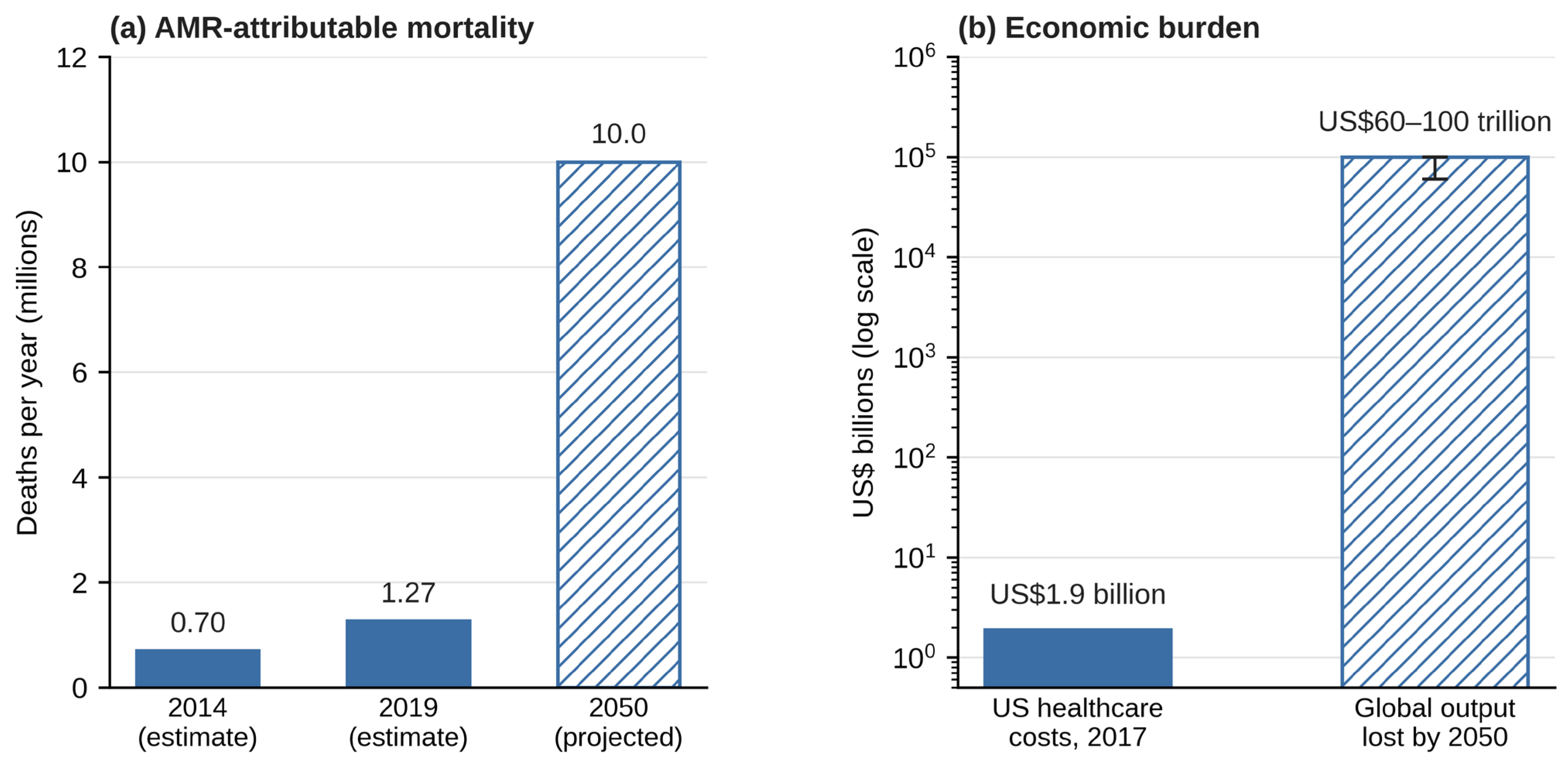
AMR also increases healthcare costs and places a growing burden on national health systems and gross domestic product (GDP) [13,14], as summarized in Figure 1. Historically, approximately 700,000 deaths each year were attributed to drug-resistant infections, and the Review on Antimicrobial Resistance projected that, left unchecked, resistance could cause up to 10 million deaths per year by 2050, a projection subsequently endorsed by the United Nations Interagency Coordination Group on Antimicrobial Resistance [13,15]. These earlier projections span all drug-resistant infections, including tuberculosis, HIV and malaria; the more recent 2024 GRAM analysis, restricted to bacterial AMR, estimates 1.14 million deaths directly attributable in 2021, rising to 1.91 million per year by 2050 [4]. The economic burden is correspondingly large: multidrug-resistant infections cost an estimated US$1.9 billion among older adults in the United States in 2017 alone [14], and unchecked resistance is projected to cost 60 to 100 trillion US dollars in cumulative global economic output by 2050 [13].
Efforts to curb AMR include the WHO Global Action Plan on Antimicrobial Resistance, national AMS programmes, and global surveillance initiatives such as GLASS [16]. Well-implemented AMS programmes have produced meaningful reductions in antibiotic consumption and hospital-acquired resistance [17,18]. Significant challenges persist, however, particularly in LMICs where diagnostic infrastructure is limited, antibiotic regulation is inconsistent, and political commitment varies [2].
Figure 1.
The reported and projected burden of antimicrobial resistance. (a) Global deaths per year attributed to drug-resistant infections: the 2014 value (about 0.7 million) is from the Review on Antimicrobial Resistance [13], the 2019 value (1.27 million, bacterial AMR) is the GBD estimate [19], and the 2050 value (10 million) is the Review’s projection for all drug-resistant infections, later endorsed by the UN Interagency Coordination Group [13,15]. (b) Economic burden on a logarithmic scale: US healthcare costs among older adults in 2017 [14] and the projected cumulative loss of global economic output by 2050 [13]. The 2014 and 2050 projections encompass all drug-resistant infections, including tuberculosis, HIV and malaria, whereas the 2019 estimate is restricted to bacterial AMR; the bacterial-specific GRAM 2024 forecast is discussed in the text [4].
3. Emerging Alternatives to Antibiotics
The escalating threat of AMR, compounded by a dwindling conventional antibiotic pipeline, has catalysed research into fundamentally novel therapeutic strategies [20]. The following sections describe the most clinically and scientifically advanced of these alternatives, examining their mechanisms, current status, and limitations; Table 1 summarizes the comparison.
Table 1.
Comparative overview of six major antibiotic alternatives: mechanisms of action, clinical status, key advantages, and primary challenges.
3.1. Bacteriophage Therapy
Bacteriophages (phages) are viruses that infect and lyse bacterial cells. Their therapeutic potential was first recognized following independent discoveries by Frederick Twort in 1915 and Felix d’Herelle in 1917 [21,22]. Largely supplanted by antibiotics after Fleming’s discovery of penicillin, phage therapy has regained attention as a viable clinical tool in the face of the AMR crisis [21,23,24,25].
Phages are ubiquitous in nature and particularly abundant in bacteria-rich environments such as wastewater and soil. Depending on their receptor-binding proteins, they exhibit either broad-spectrum activity against multiple bacterial species or high specificity for individual strains [23,24]. Their mechanism involves attachment to the bacterial cell wall, injection of genetic material into the cytoplasm, and subsequent replication. Lytic phages, which destroy the host cell during replication, are therapeutically preferred over temperate phages, which may integrate into the bacterial genome [23].
Clinical evidence is encouraging. A Phase I safety trial of phage therapy in venous leg ulcers found no adverse effect on wound healing, and a double-blind trial in patients with chronic otitis demonstrated superior clinical improvement in the phage-treated group compared with placebo [24]. Phage therapy was used to treat bacterial dysentery in children as early as the 1930s, establishing an early proof of concept [23].
A key concern is the potential for bacterial resistance to phages. This is being addressed through phage cocktail formulations such as Pyophage and Intestiphage, which combine multiple phages targeting the same pathogen to reduce the probability of resistance emerging [21,24,25]. Historically, treatment failures have been attributed primarily to inappropriate phage selection, suboptimal preparation, and inadequate storage [24,26,27]. In parallel, the regulatory environment has begun to mature, most notably through Belgium’s magistral preparation framework, which since 2016 has allowed pharmacists to compound tailor-made phage cocktails for individual patients under a dedicated quality-control monograph, and through the 2024 introduction of a dedicated European Pharmacopoeia general chapter on phage therapy active substances [28].
3.2. Antimicrobial Peptides (AMPs)
Antimicrobial peptides (AMPs) are short to medium-length polypeptides, typically 10 to 100 amino acid residues, distributed across prokaryotes, plants, insects, fish, birds, and mammals. They are a critical component of innate immunity, acting as a first line of defence against a wide array of pathogens [26,27].
The first clinically relevant AMP, gramicidin, was isolated in 1939 from the soil bacterium Brevibacillus brevis and showed efficacy against Gram-positive bacteria [26,27]. Fleming had identified lysozyme in 1922 as an antimicrobial enzyme with structural similarities to AMPs. Contemporary AMPs, including daptomycin and colistin, are in active clinical use or advanced investigation [26,27].
AMPs act through multiple complementary mechanisms, including formation of transient pores that disrupt microbial membrane integrity, inhibition of macromolecular synthesis, and interference with metabolic pathways. This multi-target action substantially reduces the likelihood of resistance developing, a critical advantage over conventional antibiotics [26,27,29].
AMPs also show antiviral, anticancer, and immunomodulatory activity, and can inhibit biofilm formation. Barriers to widespread use include high synthesis costs, susceptibility to proteolytic degradation in vivo, and potential cytotoxicity at higher concentrations. Formulation strategies such as liposomal encapsulation and polymer conjugation are being explored to improve stability and therapeutic index [29]. As discussed in Section 5.2, artificial-intelligence-guided design is now a major driver of new AMP candidates entering preclinical evaluation [30].
3.3. CRISPR-Based Antimicrobials
The clustered regularly interspaced short palindromic repeats (CRISPR) and CRISPR-associated (Cas) protein system is the adaptive immune machinery of prokaryotes. It protects bacteria and archaea against mobile genetic elements (MGEs) by incorporating short fragments of foreign DNA (spacers) into the CRISPR array, which serves as a molecular memory of prior invasions. On subsequent encounter with the same MGE, the array is transcribed into mature CRISPR RNAs (crRNAs) that guide Cas effector proteins to cleave the foreign DNA in a sequence-specific manner [31].
CRISPR-Cas systems are classified into Class 1 (Types I, III, IV) and Class 2 (Types II, V, VI), each with distinct structural and functional characteristics [21,31,32,33]. Their programmability has enabled repurposing as precision antimicrobials able to target specific resistance genes or virulence factors within bacterial genomes. This differs conceptually from conventional antibiotics: rather than broadly inhibiting bacterial growth, CRISPR-based antimicrobials can be engineered to eliminate resistant or pathogenic strains selectively while sparing the commensal microbiota [32].
Significant obstacles remain before clinical translation, including efficient delivery vehicles to introduce the CRISPR machinery into target bacteria, minimization of off-target genomic effects, and the regulatory and ethical considerations surrounding genome editing [32,33].
3.4. Microbiome-Based Therapies
The human gut microbiome is indispensable to immune homeostasis, nutrient absorption, and colonization resistance against pathogens. Dysbiosis, the pathological disruption of microbial community composition, has been implicated in conditions including inflammatory bowel disease (IBD) and recurrent Clostridioides difficile infection. Disruption of colonization resistance by antibiotic use facilitates acquisition of antibiotic resistance genes by C. difficile, contributing to approximately 500,000 recurrent infections annually [34].
Colonization resistance extends beyond the gastrointestinal tract. The vaginal microbiome, for example, protects against urinary tract infections (UTIs) and sexually transmitted infections including HIV, herpes simplex virus, and human papillomavirus, with reduced microbiome diversity associated with heightened susceptibility [34].
Microbiome-based interventions include probiotics, prebiotics, and faecal microbiota transplantation (FMT). FMT has shown particularly strong outcomes in preventing recurrent C. difficile infection [34]. Key challenges include standardizing FMT protocols, ensuring microbiological safety, and accounting for inter-individual variability in microbiome composition. Synthetic microbiota formulations and personalized microbiome therapies are promising future directions [34].
3.5. Host-Directed Therapies (HDTs)
Host-directed therapies (HDTs) aim to enhance the host’s innate and adaptive immune responses rather than targeting the pathogen directly, which in theory reduces selective pressure for resistance. Key modalities include monoclonal antibodies (mAbs) against bacterial toxins and virulence factors, such as mAbs targeting Bacillus anthracis toxins, and immunomodulatory agents including interferons and cytokines that potentiate immune cell activity [35].
Because the therapeutic target resides in the host rather than the pathogen, HDTs carry a lower probability of inducing resistance. Barriers to adoption include the high cost of biologic development, incomplete understanding of host–pathogen interaction dynamics, and the risk of immune dysregulation [35,36].
3.6. Nanotechnology-Based Antimicrobials
Nanotechnology offers platforms for targeted antimicrobial delivery and intrinsic bactericidal activity. Silver and gold nanoparticles exert direct antimicrobial effects through membrane disruption and interference with essential metabolic processes. Nanocarrier systems can be engineered for targeted, controlled release of antibiotics, minimizing systemic toxicity while improving drug concentrations at the infection site [37].
Research gaps remain, including long-term safety and bioaccumulation, potential environmental ecotoxicity from nanomaterial discharge, and the cost-effectiveness of large-scale production. Regulatory frameworks for nanomedicines are still evolving and will require careful alignment with emerging safety evidence [37].
4. Challenges in Developing and Deploying Alternatives
Translating antibiotic alternatives from laboratory discovery to clinical deployment requires navigating scientific, regulatory, economic, and systemic barriers.
4.1. Scientific and Technical Challenges
Many emerging therapies face technical hurdles well beyond proof of mechanism. Phages and AMPs degrade under physiological conditions, limiting in vivo half-life and bioavailability [38]. Phage candidates must additionally undergo whole-genome sequencing to exclude lysogeny, toxin, and antibiotic resistance genes, together with host-range profiling and stability testing, before clinical use [38,39]. Industrial-scale production is complicated by batch-to-batch variability in titre and purity, the need for endotoxin removal from Gram-negative preparations, and the absence of standardized potency assays that would allow manufacturing sites to be compared directly [39]. Phages are also sensitive to temperature, pH, and excipients in ways small-molecule antibiotics are not, and a stable cold chain is frequently unrealistic in the low-resource settings carrying the greatest AMR burden [39,40]. CRISPR-based antimicrobials require very high delivery precision to prevent unintended genomic edits [33]. Scaling these biological agents to clinical demand therefore involves complex, costly manufacturing that materially slows deployment relative to conventional pharmaceuticals [19,38,39].
4.2. Regulatory Complexity
Existing regulatory frameworks were designed for small-molecule antibiotics and are poorly adapted to biological antimicrobial agents such as phages or CRISPR constructs. Each novel therapy typically requires individualized evaluation, extending approval timelines and inflating costs [38]. Ethical questions surrounding gene editing, its potential ecological consequences, and equitable access add further complexity [39].
The international regulatory picture is markedly uneven, and this unevenness is itself a barrier worth describing concretely. Since 2016 Belgium has operated the most developed national pathway for personalized phage therapy in the West, under which a pharmacist may compound a patient-specific cocktail as a magistral preparation once the constituent phages pass a quality assessment against a national monograph maintained by the Belgian Federal Agency for Medicines and Health Products [39]. Belgian-prepared phages have been exported for compassionate use in French patients with the approval of French competent authorities, and Germany and the Netherlands are investigating comparable frameworks [39]. At the supranational level, the European Directorate for the Quality of Medicines and HealthCare adopted European Pharmacopoeia general chapter 5.31 on phage therapy in 2024, the first pan-European quality standard specific to this modality, although no harmonized European Medicines Agency authorisation pathway yet exists for standardized, non-personalized phage products [28,41]. In the United States, individual-patient phage therapy has relied on the Food and Drug Administration’s expanded access and single-patient investigational new drug provisions rather than a compounding framework, and the United Kingdom has no parallel magistral route, leaving named-patient use to case-by-case discussion [41]. A therapy lawfully deployable for a patient in Belgium may therefore have no equivalent route to the same patient in a neighbouring country, a disparity we consider among the most immediately correctable barriers discussed here, and one we return to in Section 6.2.
4.3. Economic Barriers
The economics of antimicrobial development are structurally unfavourable. High upfront research and development costs, narrow therapeutic indications, short treatment durations, and the expectation that novel agents will be held in reserve together limit commercial attractiveness. Public–private partnership models offer a partial solution but remain underutilized and insufficiently funded to compensate for these market failures [11,38].
4.4. Clinical Integration
Clinician familiarity with novel therapies is limited, and institutional inertia can impede adoption. Therapies such as FMT and personalized phage therapy require specialized infrastructure and trained personnel that are not available in all healthcare settings. Education and training initiatives will be essential to accelerate safe clinical integration [19,38,39].
4.5. Global Inequity
The disparity between high-income countries and LMICs in accessing antimicrobial innovation is a critical and underappreciated dimension of the AMR crisis. LMICs bear the highest burden of resistant infections yet face the greatest barriers to adopting and sustaining novel therapeutics, including prohibitive costs, limited regulatory capacity, and logistical challenges. Modelling suggests much of this burden could nonetheless be averted in the near term through existing, lower-cost interventions, namely infection prevention and control, water, sanitation and hygiene programmes, and expanded paediatric vaccination, none of which depend on the novel modalities described in Section 3 and which should therefore be pursued in parallel with, rather than instead of, investment in next-generation therapeutics. Failure to address this inequity risks entrenching the global AMR crisis [19].
5. Innovations and Prospects in Antimicrobial Research
5.1. Combination Therapies
Pairing conventional antibiotics with alternative agents offers synergistic benefits against resistant pathogens. Phage–antibiotic combination therapy has been investigated against methicillin-resistant Staphylococcus aureus and Acinetobacter baumannii, among other organisms [38,39,42]. Nanomaterial–antibiotic combinations, such as silver nanoparticles with ciprofloxacin or zinc nanoparticles with vancomycin, show enhanced activity against Gram-positive and Gram-negative MDR bacteria by disrupting cell membranes and interfering with metabolic pathways [43,44,45]. Optimization of dosing, administration routes, and safety profiling remains essential before these approaches enter routine practice [46,47,48].
5.2. Artificial Intelligence and Computational Drug Discovery
Machine learning and artificial neural networks (ANNs) are transforming antimicrobial drug discovery, and the subfield has expanded rapidly since early proof-of-concept studies. Foundational work showed that ANNs could identify compounds active against Escherichia coli with accuracies up to 95 percent [49,50], and that machine learning could engineer molecules able to penetrate the outer membrane of Pseudomonas aeruginosa [51]. More recent efforts have moved from predicting individual candidates toward genome- and proteome-wide mining. Deep learning applied to the global microbiome has identified close to one million candidate peptide antibiotics from metagenomic data [30], while related work mining the human proteome uncovered thousands of previously unrecognized encrypted peptides with antimicrobial activity, many apparently contributing to normal host immune physiology [52]. A parallel line of research applies deep learning to antibiotic de-extinction, using generative and predictive models to resurrect and optimize abandoned scaffolds, yielding candidates active against multidrug-resistant pathogens in preclinical models [53]. Transformer-based language models and graph neural networks now outperform classical machine learning for AMP activity and toxicity prediction, and are increasingly coupled to generative frameworks that design novel sequences rather than screening existing ones [54]. These approaches accelerate early discovery and reduce the cost of identifying leads, although translating a computationally validated candidate into a manufactured, regulator-approved therapeutic remains a separate undertaking.
5.3. Synthetic Biology and Engineered Phages
Advances in genetic and chemical engineering have expanded the therapeutic repertoire of phage therapy. One approach inserts toxin genes into phage genomes to amplify bactericidal activity within the infected host cell: filamentous phage M13 engineered to carry the lambda S105 holin gene and the restriction endonuclease BglII triggered host DNA cleavage and cell death, while avoiding the endotoxin release associated with lytic killing [55]. In a separate innovation, M13 phages coated with silver nanoparticles by ionic binding showed potent activity against Fusobacterium nucleatum in the colorectal cancer microenvironment [56]. Concerns regarding the immunogenicity and potential mutagenicity of engineered constructs, and the regulatory hurdles described in Section 4.2, remain significant challenges to clinical translation [38,39,41].
5.4. Eco-Friendly and Green Antimicrobial Approaches
The global discharge of approximately 100,000 tons of antibiotics into the environment each year is a significant driver of environmental resistance gene dissemination [57,58]. Aerobic and co-metabolic biodegradation pathways in wastewater bacteria can degrade some antibiotic residues but are frequently insufficient for complex pharmaceutical compounds [59]. Green nanotechnology offers a promising supplement: iron oxide nanoparticles have removed amoxicillin degradation products with up to 99 percent efficiency, a model for managing broader antibiotic contamination [60].
5.5. Global Research Collaborations and Surveillance
The WHO’s GLASS initiative is the primary global platform for tracking antimicrobial resistance trends across pathogens, and is particularly important for the LMICs that are disproportionately affected [16]. By aggregating national resistance data, GLASS accelerates identification of novel resistance mechanisms and informs research and development priorities, a prioritization now further guided by the WHO’s 2024 Bacterial Priority Pathogens List [10]. Strengthening such networks and ensuring equitable data sharing will be critical to sustaining global innovation [8].
5.6. Personalized Versus Mass-Producible Strategies: A Comparative Framework
A recurring and, in our view, underappreciated distinction across the alternatives reviewed in Section 3 is whether a technology is best conceived as a personalized therapy tailored to an individual patient’s infecting strain, or as a standardized product suited to conventional mass manufacture and distribution. This distinction has direct implications for regulatory strategy, cost, and equity, and we set it out here as a lens for interpreting the preceding sections.
Natural phage therapy and, to a lesser extent, CRISPR-based antimicrobials sit at the personalized end of this spectrum. Because phage efficacy depends on a close match between the phage’s receptor-binding proteins and the infecting strain, effective therapy frequently requires susceptibility testing against the patient’s own isolate and compounding of a bespoke cocktail. This maps naturally onto Belgium’s magistral framework (Section 4.2) but poorly onto the fixed-dose, centrally manufactured model underpinning conventional antibiotic regulation [28,38]. FMT and personalized microbiome reconstitution occupy similar territory, since donor–recipient matching and individual dysbiosis patterns affect outcomes [34]. For these modalities the short-term priority should be decentralized, hospital- or regional-pharmacy-based compounding and characterization capacity on the Belgian model, rather than a centralized marketing authorisation that the biology does not support.
At the other end of the spectrum, AMPs formulated as defined single or fixed-combination molecular entities, nanoparticle–antibiotic conjugates, and small-molecule hits from AI-guided pipelines are in principle amenable to the centralized manufacturing, batch-release testing, and marketing authorisation pathways used for conventional antibiotics, because the active entity is chemically defined and reproducible at scale [37]. Here the rate-limiting step is less regulatory novelty than the economic barriers discussed in Section 4.3, and we consider the medium-term priority to be targeted public procurement commitments and push-incentive funding, for example advance purchase commitments and milestone-based grants, that make standardized production commercially viable despite narrow, reserve-use indications [11].
Host-directed therapies and engineered phage constructs occupy an intermediate position: individual monoclonal antibodies and cytokine-based agents can be mass produced once developed, but the development pathway itself may need to remain pathogen- or even outbreak-specific, particularly for agents targeting virulence factors of regionally important pathogens [42]. For this group our long-term recommendation is that funders and regulators plan explicitly for platform-based development, in which a validated delivery or engineering chassis can be rapidly re-targeted to new pathogens without repeating full-scale regulatory review of the underlying platform, an approach already validated for other biologics and vaccine platforms.
6. Pathways to Sustainable Antimicrobial Strategies
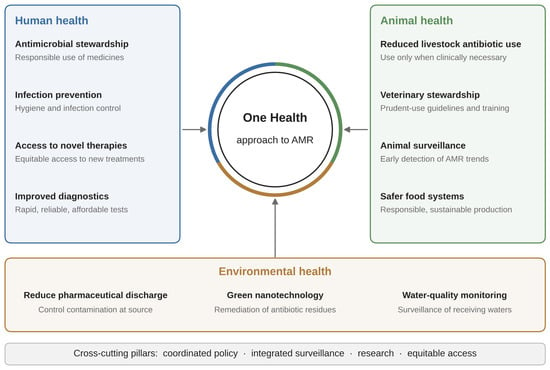
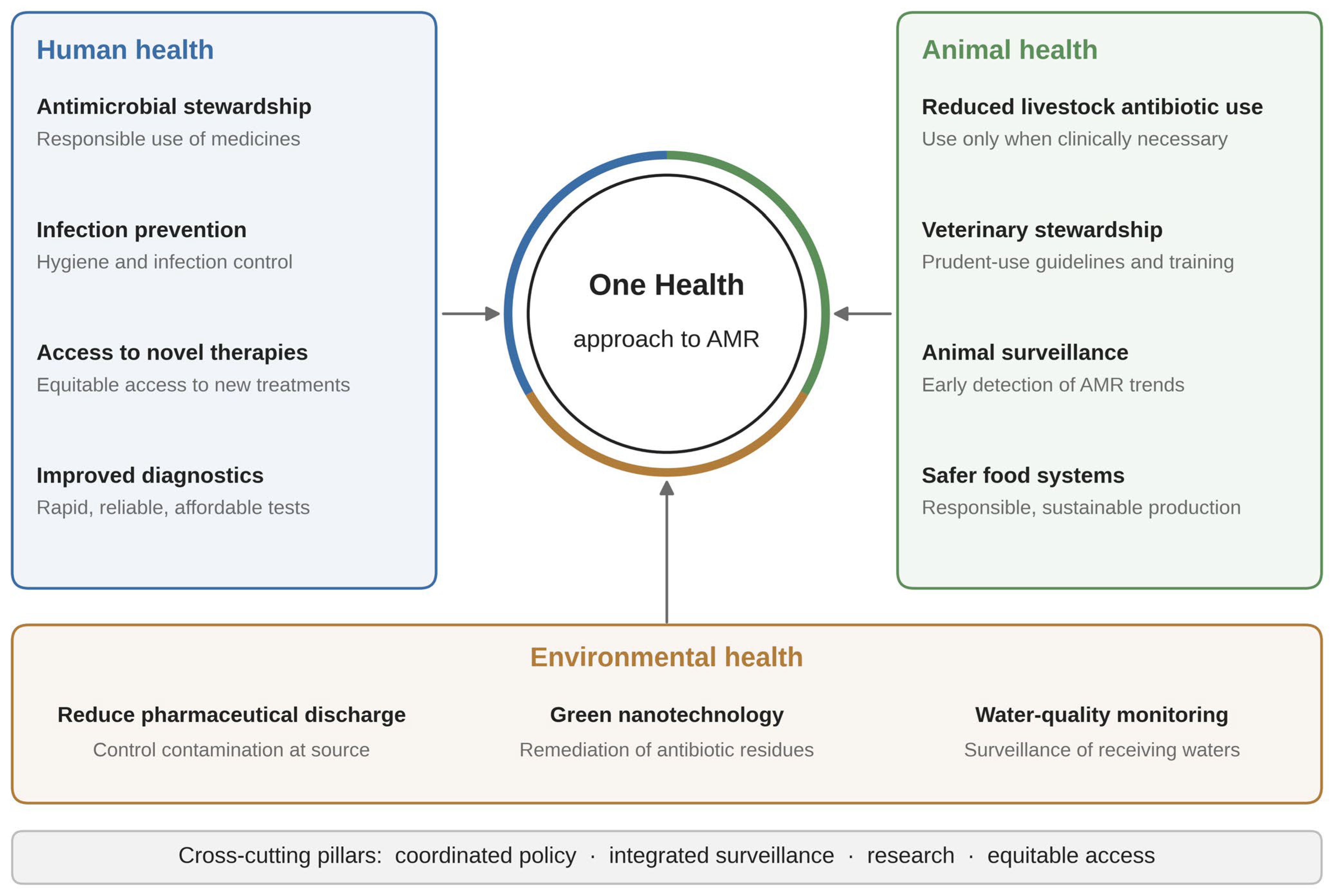
Confronting AMR sustainably demands an integrated, cross-sectoral response grounded in the One Health framework, summarized in Figure 2, which recognizes the interdependence of human, animal, and environmental health [61,62]. Antimicrobial use in livestock and agriculture contributes directly to resistance in human pathogens, and environmental contamination from pharmaceutical waste compounds the problem further [40]. Coordinated action across these three domains is therefore essential.
Figure 2.
The One Health framework applied to AMR. Interventions in human, animal, and environmental health act on a single shared resistance pool, with cross-cutting pillars of coordinated policy, integrated surveillance, research and equitable access applying across all three domains; the structure follows the quadripartite One Health Joint Plan of Action [61,62].
6.1. Strengthening Health Systems
Robust diagnostic and treatment infrastructure is foundational to rational antimicrobial use. In LMICs, gaps in diagnostic capacity frequently drive empirical prescribing, which accelerates resistance and wastes limited therapeutic resources. Investment in rapid diagnostics, laboratory infrastructure, and workforce training will directly reduce inappropriate antibiotic use and strengthen health security [5,19].
6.2. Policy, Advocacy, and Regulatory Frameworks
Governments must implement and enforce evidence-based policies that restrict over-the-counter antibiotic sales, regulate agricultural antibiotic use, and create financial incentives for developing novel antimicrobials and alternative therapies. Strong regulatory frameworks underpinned by robust pharmacovigilance are critical to the safe and appropriate use of both existing and emerging agents [11,17]. As set out in Section 4.2, we consider harmonization of personalized-therapy compounding frameworks, of the kind pioneered in Belgium and now partly reflected in the 2024 European Pharmacopoeia general chapter on phage therapy, an achievable near-term regulatory priority for other jurisdictions rather than an aspirational long-range goal [28,41].
6.3. Education and Stewardship
Public awareness campaigns and professional education initiatives targeting healthcare workers, veterinarians, farmers, and the general public are essential to shifting prescribing behaviour and consumption patterns. Antimicrobial stewardship programmes, when well implemented, produce significant reductions in antibiotic use and hospital-acquired resistance [18]. Expanding stewardship to primary care, community, and agricultural settings is a priority [40].
6.4. Equitable Global Access to Innovation
The benefits of antimicrobial innovation must reach all populations regardless of income level. This requires tiered pricing, technology transfer agreements, and research funding directed toward diseases disproportionately affecting LMICs. Sustainable stewardship cannot be achieved if vulnerable populations are excluded from access to life-saving alternatives; humanity’s collective ability to address AMR will be determined in large part by the inclusivity of the solutions it develops [11].
6.5. Priority Actions Across Time Horizons
Drawing together the analysis in Section 4 and Section 5.6, we propose the following time-bound priorities as an actionable complement to the review above.
In the short term, over the next one to three years, the most feasible actions are: expansion of decentralized phage characterization and magistral compounding capacity beyond Belgium, using existing European Pharmacopoeia standards as a template [38,39,41]; adoption of the WHO’s 2024 Bacterial Priority Pathogens List by national research funders as an explicit prioritization tool [10]; and scale-up of the already-costed LMIC interventions, namely infection prevention and control, water, sanitation and hygiene, and paediatric vaccination, shown to avert AMR-associated deaths without requiring any new technology [4].
In the medium term, approximately three to seven years, priorities should include establishment of push-incentive and advance purchase mechanisms targeted specifically at mass-producible alternatives such as defined AMP formulations and nanoparticle–antibiotic conjugates [37,43,44,45]; and development of streamlined, biologics-appropriate regulatory tracks for CRISPR-based and engineered phage constructs that do not default to small-molecule review timelines [32,33].
In the longer term, beyond approximately seven years, the central goal should be construction of platform-based development pipelines spanning host-directed biologics, engineered phage chassis, and AI-guided discovery, allowing rapid re-targeting to newly emergent priority pathogens without full re-review of the underlying platform, alongside sustained investment in translational research capacity within LMICs so that innovation is co-developed rather than perpetually imported [11,42].
7. Conclusions
The global rise of antimicrobial resistance is an urgent and multifaceted threat to public health, healthcare systems, and economic stability, and the most recent 2024 forecasts indicate it will intensify substantially over the coming decades without coordinated action [4]. The expanding portfolio of antibiotic alternatives, encompassing bacteriophages, antimicrobial peptides, CRISPR-based technologies, microbiome interventions, host-directed therapies, nanotechnology, and AI-driven drug discovery, represents the most credible path forward in the post-antibiotic era.
Each modality offers distinct mechanistic advantages and carries specific translational challenges, and, as we have argued, each maps differently onto the practical question of whether it is best delivered as a personalized, patient-specific intervention or as a mass-producible standardized product. Progress will depend on sustained investment in basic and translational research, streamlined and internationally harmonized regulatory pathways of the kind partially realized in Belgium’s magistral preparation framework, robust international collaboration through platforms such as GLASS, and application of the One Health framework to the interconnected drivers of resistance across human, animal, and environmental domains [16,28,61].
Critically, these innovations must be developed with equity at the centre. The populations bearing the greatest burden of AMR, particularly those in sub-Saharan Africa and other LMICs, must have access to the solutions research generates; as the evidence reviewed in Section 4.5 indicates, much of the nearer-term reduction in AMR mortality in these settings is achievable through existing, lower-cost interventions deployed alongside, rather than instead of, investment in next-generation therapeutics [5,19]. A future in which antimicrobial therapies remain effective is achievable, but only through concerted, coordinated, and inclusive effort by the global health community.
Author Contributions
Conceptualization, P.A.; validation, P.A.; formal analysis, all authors; data curation, all authors; writing, original draft preparation, all authors; writing, review and editing, all authors; visualization, P.A.; supervision, P.A.; project administration, P.A. All authors have read and agreed to the published version of the manuscript.
Funding
This research received no external funding.
Institutional Review Board Statement
Not applicable.
Informed Consent Statement
Not applicable.
Data Availability Statement
No new data were created or analysed in this study. Data sharing is not applicable to this article.
Acknowledgments
The authors gratefully acknowledge The Lind League, Nigeria, for providing invaluable resources and institutional support throughout this research project.
Conflicts of Interest
The authors declare no conflicts of interest.
Abbreviations
The following abbreviations are used in this manuscript:
| Abbreviation | Definition |
| AMR | Antimicrobial Resistance |
| AMPs | Antimicrobial Peptides |
| MDR | Multidrug-Resistant |
| XDR | Extensively Drug-Resistant |
| WHO | World Health Organization |
| GLASS | Global Antimicrobial Resistance Surveillance System |
| GRAM | Global Research on Antimicrobial Resistance (Project) |
| AMS | Antimicrobial Stewardship |
| LMICs | Low- and Middle-Income Countries |
| GDP | Gross Domestic Product |
| FMT | Faecal Microbiota Transplantation |
| IBD | Inflammatory Bowel Disease |
| UTIs | Urinary Tract Infections |
| HDTs | Host-Directed Therapies |
| mAbs | Monoclonal Antibodies |
| CRISPR | Clustered Regularly Interspaced Short Palindromic Repeats |
| Cas | CRISPR-Associated (protein) |
| MGEs | Mobile Genetic Elements |
| crRNAs | CRISPR RNAs |
| ANNs | Artificial Neural Networks |
| AI | Artificial Intelligence |
| MRSA | Methicillin-Resistant Staphylococcus aureus |
| C. difficile | Clostridioides difficile |
| EDQM | European Directorate for the Quality of Medicines and HealthCare |
| FAMHP | (Belgian) Federal Agency for Medicines and Health Products |
References
- Breijyeh, Z.; Jubeh, B.; Karaman, R. Resistance of Gram-negative bacteria to current antibacterial agents and approaches to resolve it. Molecules 2020, 25, 1340. [Google Scholar] [CrossRef] [Scilit]
- Nazir, A.; Nazir, A.; Zuhair, V.; Aman, S.; Sadiq, S.U.R.; Hasan, A.H.; Tariq, M.; Rehman, L.U.; Mustapha, M.J.; Bulimbe, D.B. The global challenge of antimicrobial resistance: Mechanisms, case studies, and mitigation approaches. Health Sci. Rep. 2025, 8, e71077. [Google Scholar] [CrossRef] [Scilit]
- Akunne, O.Z.; Emmanuel, B.N.; Saidu, U.F.; Akinnawo, A.S.; Adeyemi, N.A.; Egoh, L.C.; Muhammad, M.A.; Ade-adekunle, O.A.; Peter, D.A.; Freitas, A.A. Antibiotic resistance: The growing threats and potential solutions. Am. J. Pharmacother. Pharm. Sci. 2025, 4, 13. [Google Scholar] [CrossRef] [Scilit]
- Naghavi, M.; Vollset, S.E.; Ikuta, K.S.; Swetschinski, L.R.; Gray, A.P.; Wool, E.E.; Robles Aguilar, G.; Mestrovic, T.; Smith, G.; Han, C.; et al. Global burden of bacterial antimicrobial resistance 1990–2021: A systematic analysis with forecasts to 2050. Lancet 2024, 404, 1199–1226. [Google Scholar] [CrossRef] [Scilit]
- Kariuki, S.; Kering, K.; Wairimu, C.; Onsare, R.; Mbae, C. Antimicrobial resistance rates and surveillance in sub-Saharan Africa: Where are we now? Infect. Drug Resist. 2022, 15, 3589–3609. [Google Scholar] [CrossRef] [Scilit]
- Salam, M.A.; Al-Amin, M.Y.; Salam, M.T.; Pawar, J.S.; Akhter, N.; Rabaan, A.A.; Alqumber, M.A.A. Antimicrobial resistance: A growing serious threat for global public health. Healthcare 2023, 11, 1946. [Google Scholar] [CrossRef] [Scilit]
- Halawa, E.M.; Fadel, M.; Al-Rabia, M.W.; Behairy, A.; Nouh, N.A.; Abdo, M.; Olga, R.; Fericean, L.; Atwa, A.M.; El-Nablaway, M.; et al. Antibiotic action and resistance: Updated review of mechanisms, spread, influencing factors, and alternative approaches for combating resistance. Front. Pharmacol. 2024, 14, 1305294. [Google Scholar] [CrossRef] [Scilit]
- Ajulo, S.; Awosile, B. Global antimicrobial resistance and use surveillance system (GLASS 2022): Investigating the relationship between antimicrobial resistance and antimicrobial consumption data across the participating countries. PLoS ONE 2024, 19, e0297921. [Google Scholar] [CrossRef] [Scilit]
- Chen, L.; Kumar, S.; Wu, H. A review of current antibiotic resistance and promising antibiotics with novel modes of action to combat antibiotic resistance. Arch. Microbiol. 2023, 205, 356. [Google Scholar] [CrossRef] [Scilit]
- Sati, H.; Carrara, E.; Savoldi, A.; Hansen, P.; Garlasco, J.; Campagnaro, E.; Boccia, S.; Castillo-Polo, J.A.; Magrini, E.; Garcia-Vello, P.; et al. The WHO Bacterial Priority Pathogens List 2024: A prioritisation study to guide research, development, and public health strategies against antimicrobial resistance. Lancet Infect. Dis. 2025, 25, 1033–1043. [Google Scholar] [CrossRef] [Scilit]
- Miethke, M.; Pieroni, M.; Weber, T.; Bronstrup, M.; Hammann, P.; Halby, L.; Arimondo, P.B.; Glaser, P.; Aigle, B.; Bode, H.B.; et al. Towards the sustainable discovery and development of new antibiotics. Nat. Rev. Chem. 2021, 5, 726–749. [Google Scholar] [CrossRef] [Scilit]
- O’Neill, J. Tackling Drug-Resistant Infections Globally: Final Report and Recommendations; Review on Antimicrobial Resistance; Wellcome Trust and HM Government: London, UK, 2016; Available online: https://amr-review.org/Publications.html (accessed on 24 September 2026).
- O’Neill, J. Antimicrobial Resistance: Tackling a Crisis for the Health and Wealth of Nations; Review on Antimicrobial Resistance; Wellcome Trust and HM Government: London, UK, 2014; Available online: https://amr-review.org/sites/default/files/AMR%20Review%20Paper%20-%20Tackling%20a%20crisis%20for%20the%20health%20and%20wealth%20of%20nations_1.pdf (accessed on 24 September 2026).
- Nelson, R.E.; Hyun, D.; Jezek, A.; Samore, M.H. Mortality, length of stay, and healthcare costs associated with multidrug-resistant bacterial infections among elderly hospitalized patients in the United States. Clin. Infect. Dis. 2022, 74, 1070–1080. [Google Scholar] [CrossRef] [Scilit]
- Interagency Coordination Group on Antimicrobial Resistance. No Time to Wait: Securing the Future from Drug-Resistant Infections; Report to the Secretary-General of the United Nations; World Health Organization: Geneva, Switzerland, 2019; Available online: https://www.who.int/docs/default-source/documents/no-time-to-wait-securing-the-future-from-drug-resistant-infections-en.pdf (accessed on 24 September 2026).
- World Health Organization. Global Antimicrobial Resistance and Use Surveillance System (GLASS) Report 2021; World Health Organization: Geneva, Switzerland, 2021; Available online: https://www.who.int/publications/i/item/9789240027336 (accessed on 24 September 2026).
- Laxminarayan, R.; Duse, A.; Wattal, C.; Zaidi, A.K.M.; Wertheim, H.F.L.; Sumpradit, N.; Vlieghe, E.; Hara, G.L.; Gould, I.M.; Goossens, H.; et al. Antibiotic resistance—The need for global solutions. Lancet Infect. Dis. 2013, 13, 1057–1098. [Google Scholar] [CrossRef] [Scilit]
- Huang, L.J.; Chen, S.J.; Hu, Y.W.; Liu, C.Y.; Wu, P.F.; Sun, S.M.; Lee, S.Y.; Chen, Y.Y.; Lee, C.Y.; Chan, Y.J.; et al. The impact of antimicrobial stewardship program designed to shorten antibiotics use on the incidence of resistant bacterial infections and mortality. Sci. Rep. 2022, 12, 913. [Google Scholar] [CrossRef] [Scilit]
- Murray, C.J.L.; Ikuta, K.S.; Sharara, F.; Swetschinski, L.; Robles Aguilar, G.; Gray, A.; Han, C.; Bisignano, C.; Rao, P.; Wool, E.; et al. Global burden of bacterial antimicrobial resistance in 2019: A systematic analysis. Lancet 2022, 399, 629–655. [Google Scholar] [CrossRef] [Scilit]
- Saeed, U.; Insaf, R.A.; Piracha, Z.Z.; Tariq, M.N.; Sohail, A.; Abbasi, U.A.; Fida Rana, M.S.; Gilani, S.S.; Noor, S.; Noor, E.; et al. Crisis averted: A world united against the menace of multiple drug-resistant superbugs-pioneering anti-AMR vaccines, RNA interference, nanomedicine, CRISPR-based antimicrobials, bacteriophage therapies, and clinical artificial intelligence strategies to safeguard global antimicrobial arsenal. Front. Microbiol. 2023, 14, 1270018. [Google Scholar] [CrossRef] [Scilit]
- Aranaga, C.; Pantoja, L.D.; Martinez, E.A.; Falco, A. Phage therapy in the era of multidrug resistance in bacteria: A systematic review. Int. J. Mol. Sci. 2022, 23, 4577. [Google Scholar] [CrossRef] [Scilit]
- Furfaro, L.L.; Payne, M.S.; Chang, B.J. Bacteriophage therapy: Clinical trials and regulatory hurdles. Front. Cell. Infect. Microbiol. 2018, 8, 376. [Google Scholar] [CrossRef] [Scilit]
- Strathdee, S.A.; Hatfull, G.F.; Mutalik, V.K.; Schooley, R.T. Phage therapy: From biological mechanisms to future directions. Cell 2023, 186, 17–31. [Google Scholar] [CrossRef] [Scilit]
- Kakasis, A.; Panitsa, G. Bacteriophage therapy as an alternative treatment for human infections: A comprehensive review. Int. J. Antimicrob. Agents 2019, 53, 16–21. [Google Scholar] [CrossRef] [Scilit]
- Chegini, Z.; Khoshbayan, A.; Taati Moghadam, M.; Farahani, I.; Jazireian, P.; Shariati, A. Bacteriophage therapy against Pseudomonas aeruginosa biofilms: A review. Ann. Clin. Microbiol. Antimicrob. 2020, 19, 45. [Google Scholar] [CrossRef] [Scilit]
- Chen, N.; Jiang, C. Antimicrobial peptides: Structure, mechanism, and modification. Eur. J. Med. Chem. 2023, 255, 115377. [Google Scholar] [CrossRef] [Scilit]
- Luo, Y.; Song, Y. Mechanism of antimicrobial peptides: Antimicrobial, anti-inflammatory and antibiofilm activities. Int. J. Mol. Sci. 2021, 22, 11401. [Google Scholar] [CrossRef] [Scilit]
- Pirnay, J.P.; Verbeken, G.; Ceyssens, P.J.; Huys, I.; De Vos, D.; Ameloot, C.; Fauconnier, A. The magistral phage. Viruses 2018, 10, 64. [Google Scholar] [CrossRef] [Scilit]
- Wang, C.; Hong, T.; Cui, P.; Wang, J.; Xia, J. Antimicrobial peptides towards clinical application: Delivery and formulation. Adv. Drug Deliv. Rev. 2021, 175, 113818. [Google Scholar] [CrossRef] [Scilit]
- Szymczak, P.; Zarzecki, W.; Wang, J.; Duan, Y.; Wang, J.; Coelho, L.P.; de la Fuente-Nunez, C.; Szczurek, E. AI-driven antimicrobial peptide discovery: Mining and generation. Acc. Chem. Res. 2025, 58, 1831–1846. [Google Scholar] [CrossRef] [Scilit]
- Bikard, D.; Barrangou, R. Using CRISPR-Cas systems as antimicrobials. Curr. Opin. Microbiol. 2017, 37, 155–160. [Google Scholar] [CrossRef] [Scilit]
- Shim, H. Investigating the genomic background of CRISPR-Cas genomes for CRISPR-based antimicrobials. Evol. Bioinform. 2022, 18, 11769343221103887. [Google Scholar] [CrossRef] [Scilit]
- Palacios Araya, D.; Palmer, K.L.; Duerkop, B.A. CRISPR-based antimicrobials to obstruct antibiotic-resistant and pathogenic bacteria. PLoS Pathog. 2021, 17, e1009672. [Google Scholar] [CrossRef] [Scilit]
- Manrique, P.; Montero, I.; Fernandez-Gosende, M.; Martinez, N.; Cantabrana, C.H.; Rios-Covian, D. Past, present, and future of microbiome-based therapies. Microbiome Res. Rep. 2024, 3, 23. [Google Scholar] [CrossRef] [Scilit]
- Wallis, R.S.; O’Garra, A.; Sher, A.; Wack, A. Host-directed immunotherapy of viral and bacterial infections: Past, present and future. Nat. Rev. Immunol. 2023, 23, 121–133. [Google Scholar] [CrossRef] [Scilit]
- Jeong, E.K.; Lee, H.J.; Jung, Y.J. Host-directed therapies for tuberculosis. Pathogens 2022, 11, 1291. [Google Scholar] [CrossRef] [Scilit]
- Sahli, C.; Moya, S.E.; Lomas, J.S.; Gravier-Pelletier, C.; Briandet, R.; Hemadi, M. Recent advances in nanotechnology for eradicating bacterial biofilm. Theranostics 2022, 12, 2383–2405. [Google Scholar] [CrossRef] [Scilit]
- Zhou, Z.; Fu, H.; Li, M.; Han, Z.; Wu, Z.; Fan, H.; Shen, N.; Zheng, J. Bacteriophage therapy: Current strategies and future perspectives. MedComm 2026, 7, e70645. [Google Scholar] [CrossRef] [Scilit]
- Niazi, S.K. Bacteriophage therapy: Discovery, development, and FDA approval pathways. Pharmaceuticals 2025, 18, 1115. [Google Scholar] [CrossRef] [Scilit]
- Chang, Q.; Wang, W.; Regev-Yochay, G.; Lipsitch, M.; Hanage, W.P. Antibiotics in agriculture and the risk to human health: How worried should we be? Evol. Appl. 2015, 8, 240–247. [Google Scholar] [CrossRef] [Scilit]
- Gallina, A.; Gallina, M.; Cona, A.; Vitulo, P.; Mularoni, A.; Provenzani, A. Phage therapy at the crossroads between clinical promise and regulatory challenge. Pharmaceuticals 2026, 19, 162. [Google Scholar] [CrossRef] [Scilit]
- Ling, H.; Lou, X.; Luo, Q.; He, Z.; Sun, M.; Sun, J. Recent advances in bacteriophage-based therapeutics: Insight into the post-antibiotic era. Acta Pharm. Sin. B 2022, 12, 4348–4364. [Google Scholar] [CrossRef] [Scilit]
- Yin, I.X.; Zhang, J.; Zhao, I.S.; Mei, M.L.; Li, Q.; Chu, C.H. The antibacterial mechanism of silver nanoparticles and its application in dentistry. Int. J. Nanomed. 2020, 15, 2555–2562. [Google Scholar] [CrossRef] [Scilit]
- Raghunath, A.; Perumal, E. Metal oxide nanoparticles as antimicrobial agents: A promise for the future. Int. J. Antimicrob. Agents 2017, 49, 137–152. [Google Scholar] [CrossRef] [Scilit]
- Aabed, K.; Mohammed, A.E. Synergistic and antagonistic effects of biogenic silver nanoparticles in combination with antibiotics against some pathogenic microbes. Front. Bioeng. Biotechnol. 2021, 9, 652362. [Google Scholar] [CrossRef] [Scilit]
- Adeniji, O.O.; Ojemaye, M.O.; Okoh, A.I. Antibacterial activity of metallic nanoparticles against multidrug-resistant pathogens isolated from environmental samples: Nanoparticles/antibiotic combination therapy and cytotoxicity study. ACS Appl. Bio Mater. 2022, 5, 4814–4826. [Google Scholar] [CrossRef] [Scilit]
- Baptista, P.V.; McCusker, M.P.; Carvalho, A.; Ferreira, D.A.; Mohan, N.M.; Martins, M.; Fernandes, A.R. Nano-strategies to fight multidrug resistant bacteria—A battle of the titans. Front. Microbiol. 2018, 9, 1441. [Google Scholar] [CrossRef] [Scilit]
- Sandhiya, S.; Dkhar, S.A.; Surendiran, A. Emerging trends of nanomedicine—An overview. Fundam. Clin. Pharmacol. 2009, 23, 263–269. [Google Scholar] [CrossRef] [Scilit]
- Yegnanarayana, B. Artificial Neural Networks; PHI Learning: New Delhi, India, 2009. [Google Scholar]
- Badura, A.; Krysinski, J.; Nowaczyk, A.; Bucinski, A. Application of artificial neural networks to prediction of new substances with antimicrobial activity against Escherichia coli. J. Appl. Microbiol. 2021, 130, 40–49. [Google Scholar] [CrossRef] [Scilit]
- Mansbach, R.A.; Leus, I.V.; Mehla, J.; Lopez, C.A.; Walker, J.K.; Rybenkov, V.V.; Hengartner, N.W.; Zgurskaya, H.I.; Gnanakaran, S. Machine learning algorithm identifies an antibiotic vocabulary for permeating Gram-negative bacteria. J. Chem. Inf. Model. 2020, 60, 2838–2847. [Google Scholar] [CrossRef] [Scilit]
- Xia, X.; Torres, M.D.T.; de la Fuente-Nunez, C. Proteasome-derived antimicrobial peptides discovered via deep learning. bioRxiv 2025. [Google Scholar] [CrossRef] [Scilit]
- Krishnan, A.; Anahtar, M.N.; Valeri, J.A.; Jin, W.; Donghia, N.M.; Sieben, L.; Luttens, A.; Zhang, Y.; Modaresi, S.M.; Hennes, A.; et al. A generative deep learning approach to de novo antibiotic design. Cell 2025, 188, 5962–5979.e22. [Google Scholar] [CrossRef] [Scilit]
- Saleem, N.; Kumar, N.; El-Omar, E.; Willcox, M.; Jiang, X.T. Harnessing machine learning approaches for the identification, characterization, and optimization of novel antimicrobial peptides. Antibiotics 2025, 14, 1263. [Google Scholar] [CrossRef] [Scilit]
- Hagens, S.; Blasi, U. Genetically modified filamentous phage as bactericidal agents: A pilot study. Lett. Appl. Microbiol. 2003, 37, 318–323. [Google Scholar] [CrossRef] [Scilit]
- Dong, X.; Pan, P.; Zheng, D.W.; Bao, P.; Zeng, X.; Zhang, X.Z. Bioinorganic hybrid bacteriophage for modulation of intestinal microbiota to remodel tumor-immune microenvironment against colorectal cancer. Sci. Adv. 2020, 6, eaba1590. [Google Scholar] [CrossRef] [Scilit]
- Nnadozie, C.F.; Odume, O.N. Freshwater environments as reservoirs of antibiotic resistant bacteria and their role in the dissemination of antibiotic resistance genes. Environ. Pollut. 2019, 254, 113067. [Google Scholar] [CrossRef] [Scilit]
- Michael, I.; Rizzo, L.; McArdell, C.S.; Manaia, C.M.; Merlin, C.; Schwartz, T.; Dagot, C.; Fatta-Kassinos, D. Urban wastewater treatment plants as hotspots for the release of antibiotics in the environment: A review. Water Res. 2013, 47, 957–995. [Google Scholar] [CrossRef] [Scilit]
- Li, S.; Peng, L.; Yang, C.; Song, S.; Xu, Y. Cometabolic biodegradation of antibiotics by ammonia oxidizing microorganisms during wastewater treatment processes. J. Environ. Manag. 2022, 305, 114336. [Google Scholar] [CrossRef] [Scilit]
- Aksu Demirezen, D.; Yildiz, Y.S.; Demirezen Yilmaz, D. Amoxicillin degradation using green synthesized iron oxide nanoparticles: Kinetics and mechanism analysis. Environ. Nanotechnol. Monit. Manag. 2019, 11, 100219. [Google Scholar] [CrossRef] [Scilit]
- Uchil, R.R.; Kohli, G.S.; Katekhaye, V.M.; Swami, O.C. Strategies to combat antimicrobial resistance. J. Clin. Diagn. Res. 2014, 8, ME01–ME04. [Google Scholar] [CrossRef] [Scilit]
- FAO; UNEP; WHO; WOAH. One Health Joint Plan of Action (2022–2026): Working Together for the Health of Humans, Animals, Plants and the Environment; FAO: Rome, Italy, 2022. [Google Scholar] [CrossRef] [Scilit]

Disclaimer/Publisher’s Note: The statements, opinions and data contained in all publications are solely those of the individual author(s) and contributor(s) and not of MDPI and/or the editor(s). MDPI and/or the editor(s) disclaim responsibility for any injury to people or property resulting from any ideas, methods, instructions or products referred to in the content. |
© 2026 by the authors. Published by MDPI on behalf of the Hellenic Society for Microbiology. Licensee MDPI, Basel, Switzerland. This article is an open access article distributed under the terms and conditions of the Creative Commons Attribution (CC BY) license.