


Abstract
Bromalites (trace fossils produced by food processing) from the early Eocene Willwood Formation of Wyoming contain abundant glyptosaurid lizard skeletal elements. They clearly represent bromalites as they are discrete, three-dimensional, disarticulated accumulations of biological materials. Furthermore, they contain abundant skeletal elements, principally osteoderms, that exhibit no indication of digestion, so they can be identified as regurgitalites. The Willwood specimens represent orniothoregurgitalites, specifically strigilites, the regurgitalites of owls. These strigilites are assigned to Sauresus osteodermus igen. et isp. nov. This ichnotaxon is characterized by an elongate, sub-cylindrical or sub-ovoid bromalite pellet with irregular surface texture that is composed of a micritic matrix and contains abundant, well-preserved skeletal elements of glyptosaurids, principally osteoderms. The strigilites were probably produced by Primoptynx poliotauros that used its feet to kill glyptosaurids. The lizard, rather than rodent, content of the strigilite supports the hypothesis that Eocene owls were diurnal in habit and only became nocturnal in the Oligocene.
1. Introduction
Paleogene bromalites from nonmarine strata are best represented by specimens from lacustrine Lagerstätten such as Messel, Green River and Menat (e.g., [1,2,3,4,5,6,7]). Most vertebrate bromalites from Paleogene fluvial environments are coprolites (e.g., [8,9,10,11,12]). Fluvial strata of the Paleocene–Eocene age in the western interior of the United States have yielded extensive and significant vertebrate faunas, notably of mammals, but few bromalites have been described (e.g., [10,13]). Here, we describe specimens of an unusual bromalite from the Eocene Willwood Formation of Wyoming that contains abundant bony material of a glyptosaurid lizard.
2. Geologic Setting
Fluvial sediments derived from the rising Rocky Mountains buried and preserved abundant remains of early Cenozoic vertebrates in the Bighorn Basin of northwestern Wyoming [14]. Subsequently, uplift and erosion exposed large areas of Paleocene and early Eocene sedimentary rocks. Jacob L. Wortman made the first paleontological collections from these rocks for Edward Drinker Cope [15]. Later, several institutions made extensive paleontological collections in these strata, notably the American Museum of Natural History, Princeton and Yale universities and the University of Michigan [16].
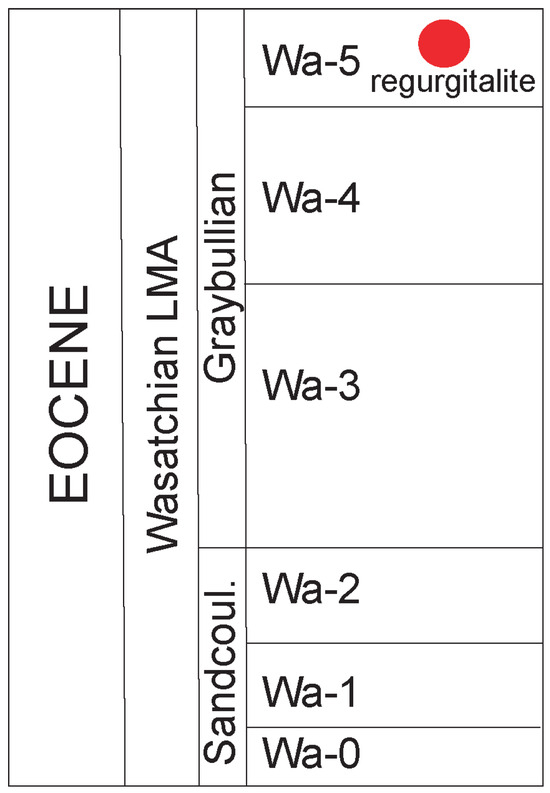
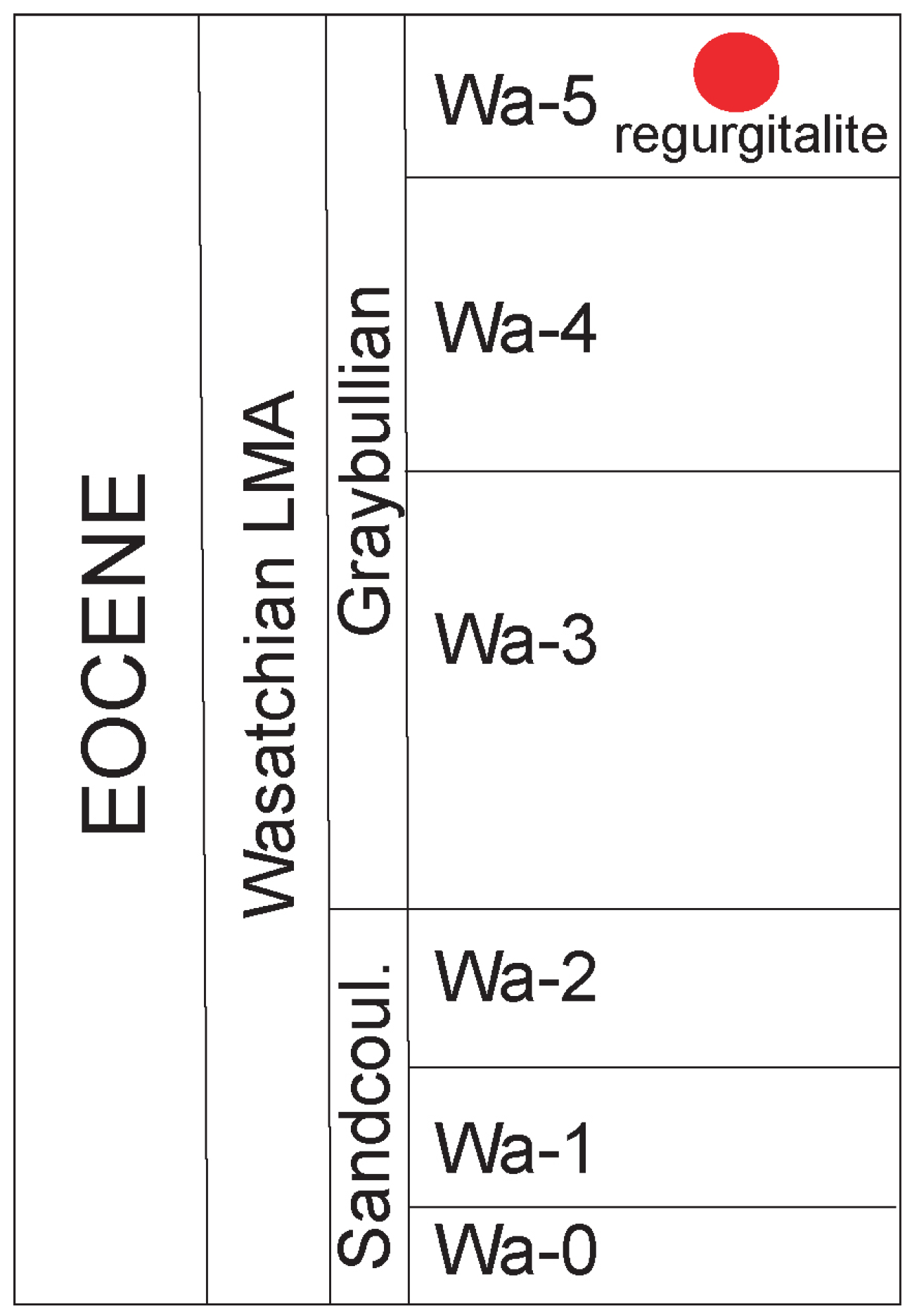
The Willwood Formation was named by F. B. Van Houten for about 762 m of “red-banded strata in the Big Horn Basin that in their normal position overlie the Polecat Bench, or ‘Fort Union,’ formation and underlie the Tatman” ([17], p. 176). The Willwood Formation consists of a complex association of marginal alluvial fan conglomerates grading basinward into stream channel and floodbasin deposits [18]. Paleosol horizons that are developed in Willwood mudstones yield abundant remains of fossil vertebrates spanning the early Clarkforkian (late Paleocene) and middle Clarkforkian (late Paleocene) through early Bridgerian (late early Eocene) land-mammal “ages” (LMAs) (e.g., [19,20,21,22,23,24,25,26,27]: Figure 1). Granger [27] recognized four subdivisions of what is now considered the Wasatchian LMA (early Eocene)—the Sand Coulee, Graybull, Lysite, and Lost Cabin. In the Bighorn Basin, the middle Wasatchian is equivalent to the Graybullian land-mammal sub-age of Granger and includes three biochrons or zones: Wa3, Wa4 and Wa5. The specimens described here are from Wa5 or late Graybullian strata (Figure 1) and were collected by Robert T. Bakker for the University of Colorado in the Wardel Reservoir area from 1979 to 1983 (UCM [University of Colorado Museum, Boulder, Colorado] localities 85230 and 76800).
Figure 1.
Chronostratigraphy of the glyptosaurid-bearing regurgitalite showing subdivisions of the early Eocene Wasatchian land-mammal “age” (LMA) used in the Bighorn Basin, Wyoming, USA.
3. Nature of Bromalites
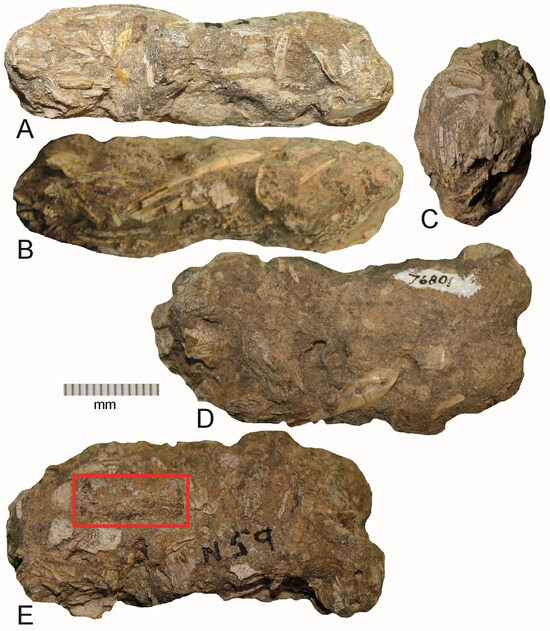
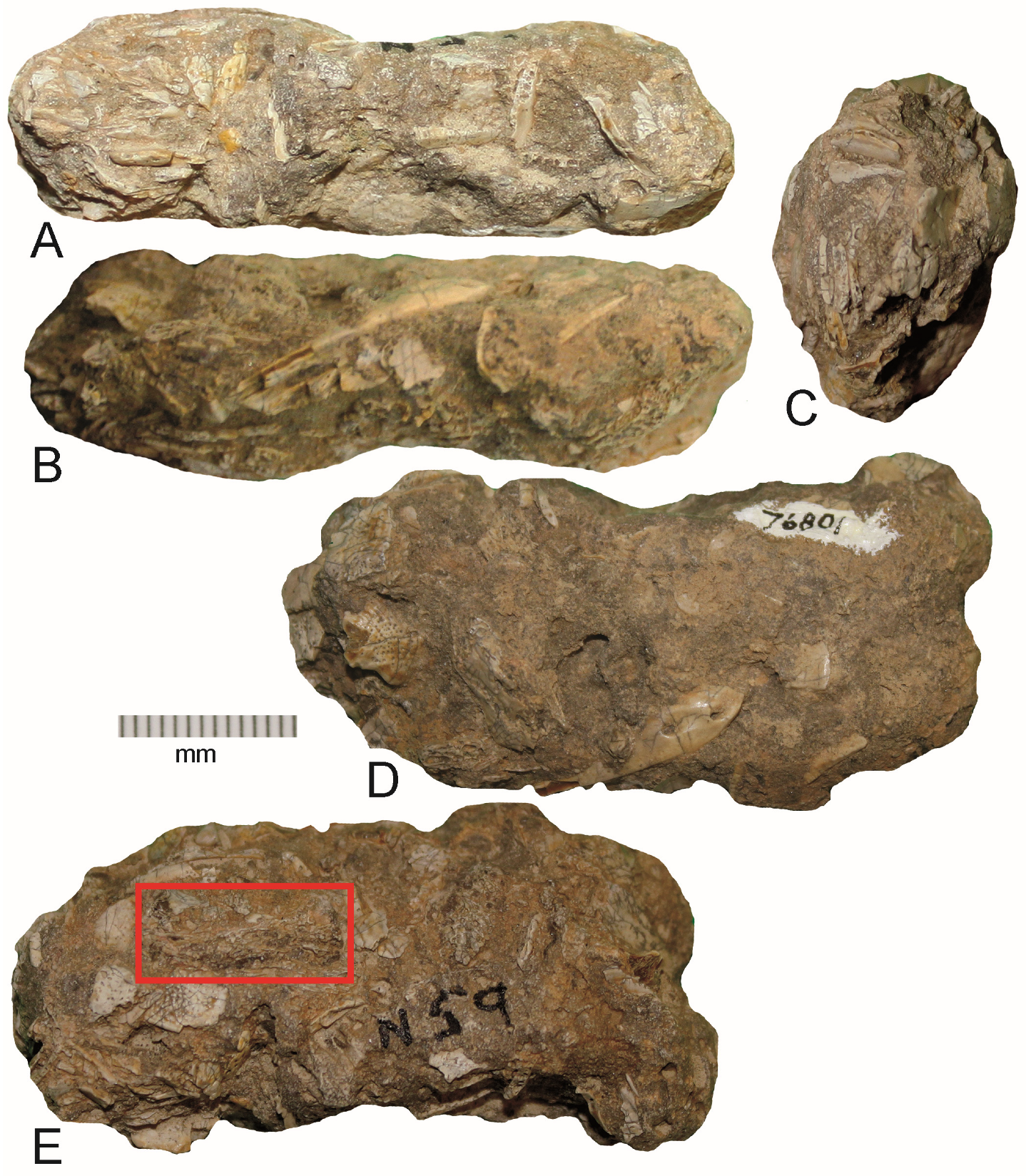
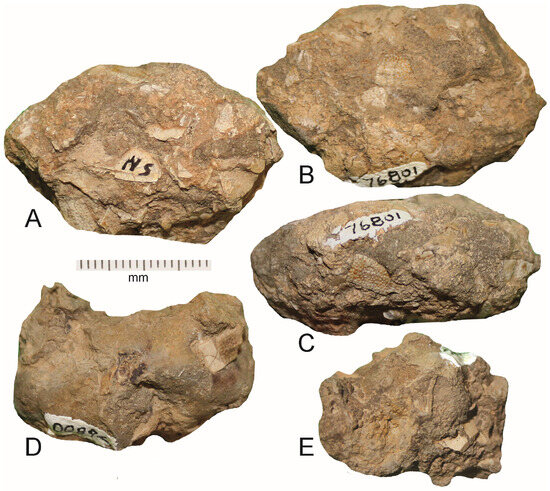
The hypodigm consists of two specimens (UCM 76801) from locality L85330 and three (UCM 7600) from locality L92212 (Figure 1 and Figure 2). We consider them to represent bromalites as they are discrete, three-dimensional concentrations of biological materials.
Figure 2.
Holotype of Sauresus osteodermus igen et isp. nov. (UCM 76801) in lateral (A,B), terminal (C), dorsal (D) and ventral (E) views. Red box surrounds dentigerous palatal bone (vomer, palatine or pterygoid).
Furthermore, they contain abundant skeletal elements, principally osteoderms, belonging to one or more closely related animals (possibly one individual) in which the anatomical relationships of the bones to one another is disrupted. Whereas the 3D preservation of bones in anatomical relationship might result from different processes, such as mummification or adipocere development [28], the disarticulation implies that the soft tissue had been digested [see [29]], suggesting their passage into the digestive tract of a predator. Because the bones exhibit no indication of digestion, the pellets can be identified as regurgitalites [4,7,30,31,32]. The characteristics that distinguish regurgitalites from other bromalites have been discussed recently by several authors [4,7,31,32,33,34,35,36].
Regurgitalites are bromalites that are egested through the mouth [30]. They are the least studied bromalites prior to their Quaternary records, although there has been a notable increase in publications on them during the past few years (see reviews in [4,7,37]). Regurgitalites also have the least extensive fossil record among bromalites, although that record extends back to the Ordovician [4,5,7]. Hunt and Lucas [38] coined terms to distinguish those that had been retained in the anterior digestive tract for a short period of time (ejectalites) from those that had a longer residence time and had undergone more digestion in the stomach and intestines (ekrhexalites). Myhrvold [39] proposed the term emetolite for regurgitalites produced by routine emesis (i.e., some ekrhexalites of birds).
The Willwood regurgitalites are derived from strata deposited in a fluvial environment. The majority of terrestrial regurgitalites from the Cenozoic pertain to birds, but there are rare examples from the Eocene of specimens produced by snakes and lizards [4,5,6,7].
Snakes do not commonly produce regurgitations [e.g., [40]], and serpentalites (snake regurgitalites) are rare and are currently only known from one locality [5]. Snake ejectalites such as Messelemeticus lehmanni consist of a complete but compressed, articulated skeleton, whereas ekrhexalites such as Ophiemeticus smithi are elongate accumulations of bones of a single skeleton [5]. Some living lizards, notably varanids, have been speculated to produce gastric pellets (ekrhexalites) composed of indigestible fur, feathers, horns and bones of their prey but there is little documentation [5,39,41,42,43]. Lizards from the Willwood Formation are typically not large enough—with the possible exception of Saniwa sp.—to have produced these regurgitalites. Sub-cylindrical regurgitalites are only known from birds [4,5,6,7] and thus we conclude that the Willwood specimens represent orniothoregurgitalites (bird regurgitalites). Among extant birds in forested environments, only owls produce pellets containing large numbers of undigested and generally unbroken bones [44]. Thus, we conclude that the regurgitalites are strigilites (owl regurgitalites). Further support for this hypothesis is provided by the presence of owls in the Willwood avifauna (see discussion below).
4. Identification of Regurgitalite Inclusions
It appears that most, if not all, of the inclusions in the bromalites documented here pertain to a glyptosaurid anguimorph (Figure 2 and Figure 3). Glyptosaurids are heavily armored lizards related to Anguidae that traditionally comprise two tribes—the paraphyletic “Melansaurinae” and monophyletic Glyptosaurinae [45,46,47]. Glyptosauridae is a Holarctic anguid radiation that originated in North America with a radiation in the late Cretaceous and Paleogene and expansion to Europe in the early Eocene with a single occurrence in Asia [47,48,49,50]. Glyptosaurids diversified during the early and middle Eocene and declined thereafter with the last occurrence in the middle Oligocene of South Dakota [49,51,52,53,54,55,56,57].
Figure 3.
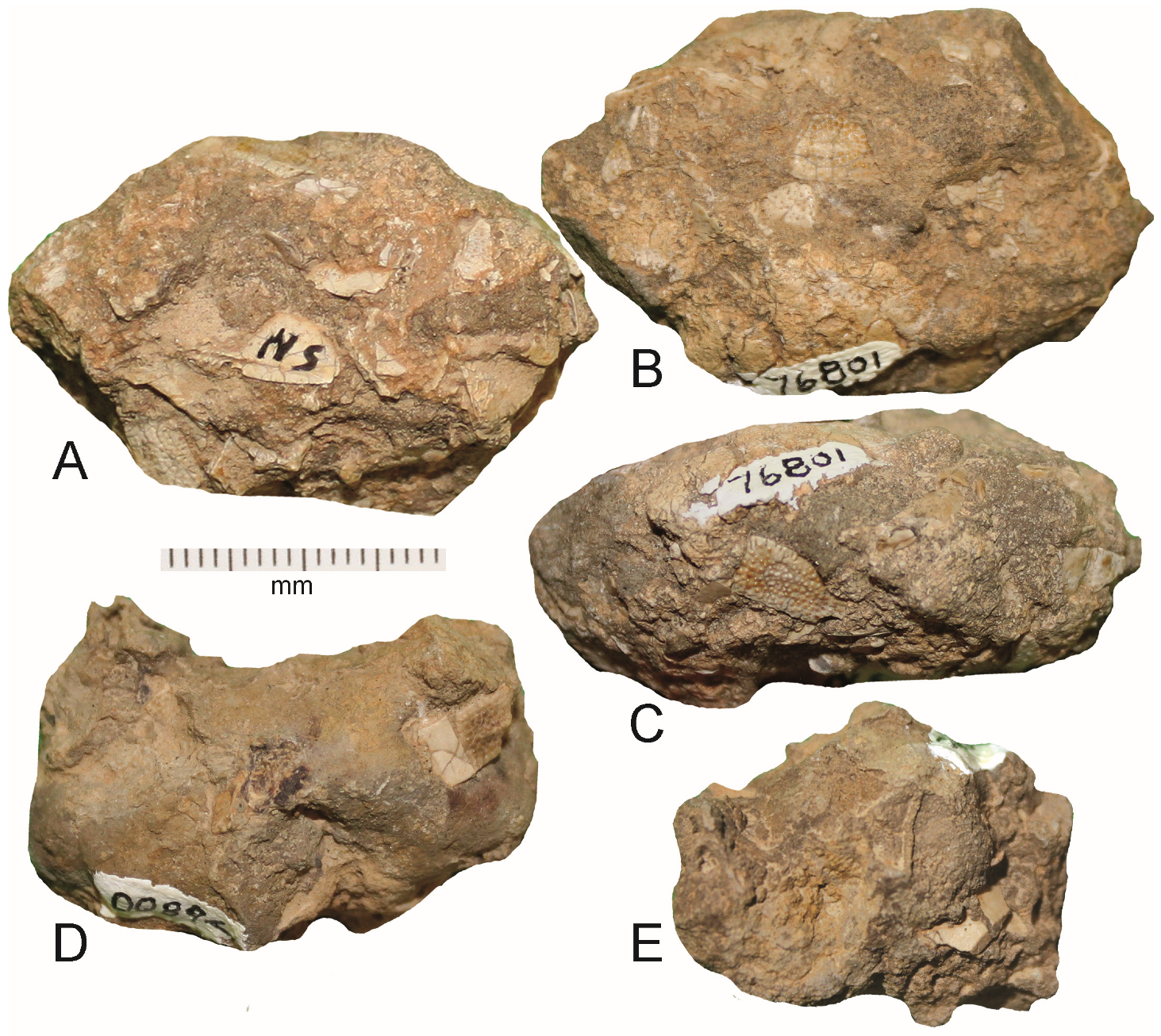
Paratype and referred specimens of Sauresus osteodermus igen et isp. nov. (A–C); paratype (UCM 76801) in dorsal (A), ventral (B) and lateral (C) views. (D,E) Two referred specimens (UCM 7600) in lateral view.
The most common glyptosaurid elements in the bromalites are the distinctive tuberculate osteoderms, and other elements include a dentary and a dentigerous palatal bone (vomer, palatine or pterygoid) in edge view (Figure 2E). There are several glyptosaurine taxa present in the Graybullian strata of western North America, including Melanosaurus maximus (Wa2–Wa3: Willwood Formation, Clark’s Fork Basin [49]), Xestops savagei (Wa4–Wa6?: Wasatch Formation, Washakie Basin [55], glyptosaurine A and B (Wa4–Wa6?: Wasatch Formation, Washakie Basin [55]); it would currently be termed “glyptosaurid A and B”), Glyptosaurus rhodinos (Wa5: Willwood Formation, Bighorn Basin [53]), Proxestops sp. (Wa5: Willwood Formation [52]), glyptosaurine indet. (Wa5: Willwood Formation [52]; it would currently be termed “glyptosaurid indet.”) and Glyptosaurus cf. G. yatkolai (Wa5-Wa6: San Jose Formation [58]). Based on present knowledge, the most likely candidates are the three taxa known from the late Graybullian (Wa5) of the Willwood Formation in the Bighorn Basin, viz., glyptosaurid indet., Glyptosaurus rhodinos and Proxestops sp.
The majority of the inclusions in the bromalites are osteoderms. Glyptosaur osteoderms are generally not considered to be very diagnostic, but they provide useful information in comparing some taxa [45,48,52,59,60]. Smith’s [52] dentary of an indeterminate glyptosaurine has no associated osteoderms and thus cannot be compared. The specimen of Proxestops sp. (Glyptosauridae, non-subfamily Glyptosaurinae or Melanosaurinae) includes a left frontal fragment that preserves a distinct ornamentation that includes ridges that are not present on the inclusions ([52]). Glyptosaurus rhodinos (subfamily Glyptosaurinae) preserves strongly projecting osteoderms in the center of the parietal with much larger and flatter osteoderms elsewhere, including the interparietal. The osteoderms in the bromalites are consistent with the ornamentation of Glyptosaurus rhodinos (Figure 12 in [52]) and other species of this genus (e.g., [48]). However, without more diagnostic traits (and recognizing our incomplete understanding of the stratigraphic distribution of glyptosaurids), we remain agnostic on the identification of the glyptosaur.
5. Producer of Regurgitalites
While the Willwood Formation is most famous for its mammalian fossils, it also yields a diverse fossil avifauna [e.g., [14,61,62,63,64,65,66,67,68,69,70,71,72,73,74]].
There are fossils of three raptorial birds in the Willwood Formation that are possible sources of the regurgitalites. Paracathartes howardae is a cathartid vulture from the Graybullian whose type and only specimen is the distal end of a tibiotarsus. It is an unlikely source for the bromalite because of its size, as it has a wingspan larger than Cathartes aura, which is typically 160–183 cm [65]. Also, the abundance of the Willwood bromalite at more than one locality might suggest an owl as a source as they are known from several localities. There are two owls that could have produced the bromalites.
Eostrix (Protostrix) mimica is represented by the distal end of a right tibiotarsus and the distal end of a metatarsus from the Wasatchian [64,72]. Primoptynx poliotauros is a large owl from the early middle Wasatchian (Wa3; early Graybullian) in the northern Bighorn Basin [72]. Unlike all other owls, except the Bridgerian protostrigid Minerva spp., Primoptynx has ungual phalanges of the hallux and the second toe that are distinctly larger than those of the other toes. Mayr et al. [72] note that these features occur in extant hawks and allies (Accipitridae). Thus, they concluded that Primoptynx and protostrigid owls used their feet to dispatch prey like hawks do, whereas extant owls kill prey with their beak. This suggests that Primoptynx was possibly specialized in foraging on prey items that required an accipitrid-like killing strategy, such as larger or more defensive prey [72], which could include glyptosaurids with thick osteoderms covering their head and body. Given their co-occurrence in the late Graybullian and the unusual adaptation of this owl we tentatively identify the most likely producer of the Willwood regurgitalites as Primoptynx poliotauros. Bridgerian–Oligocene protostrigids (e.g., Minerva, Oligostrix) may have had similar predatory habits, and their fossil record extends into the early Oligocene (only in Europe), and this parallels the later stratigraphic distribution of glyptosaurs [49], which could be significant, although we do not have enough evidence to suggest that glyptosaurids were the principal diet of protostrigids.
6. Paleogene Strigilites and Diurnal Behavior in Early Owls
Mayr [75] first suggested that early and middle Eocene owls were less nocturnal than recent taxa based on osteological evidence. Subsequently, the description of Ypresiglaux michaeldanielsi from the early Eocene London Clay of England and Primoptynx poliotauros from the Willwood Formation of Wyoming have lent more credence to this hypothesis [72,76]. Notably, Ypresiglaux michaeldanielsi apparently had eyes that were not as greatly enlarged and forward-facing as in extant owls and an inability to rotate its head to the extent possible in the crown group Strigiformes. This suggests a mosaic evolution of the strigiform body plan, with owls developing raptorial adaptations before the development of specializations of the visual and acoustic systems that relate to crepuscular or nocturnal activity [76]. Mayr and Schaal [44] noted that the nocturnal behavior of owls is likely to have evolved in response to the activity patterns of rodents, which constitute the main component of the diet of most extant owl species.
Inclusions in putative strigilites in the Eocene and Oligocene can provide evidence for this hypothesis because it can be hypothesized that rodents would be rare or absent in strigilites produced by diurnal owls (Table 1). Strigilites can be distinguished from ornithoregurgitalites produced by raptors because they contain a higher percentage of bone and most are not broken [77]. The only middle Eocene strigilite is of Palaeostrigiithus mayri from the Messel Lagerstätte, which contains only bird bones [5,44]. A possible strigilite contains elements of the early leptochoerid artiodactyl Stibarus from the latest Eocene Peanut Peak Member of the Chadron Formation in South Dakota, USA [9]. Putative Oligocene, and younger strigilites, such as those described herein, are, in contrast, composed primarily of rodent skeletons [11,78].
Table 1.
Early (Eocene–Miocene) strigilites (owl regurgitalites).
The Eocene Omomys Quarry in Wyoming in the United States consists almost exclusively of bones of the eponymous primate as well as bones of birds, including owls. The quarry may represent a strigilite purgolite [79,80,81].
Lucas et al. [11] described a purgolite composed of the strigilite Bubobromus kathyhuntae from the early Oligocene of eastern Wyoming [6,82,83]. The strigilites are preserved as calcareous nodules full of fossil mammal bones and yield the type specimens of the sciurid rodent Cedromus wilsoni and the todid bird Palaeotodus emryi. The strigilite assemblage also includes the skeletons, bearing skulls, of at least three individual owls. Other possible Oligocene occurrences from Wyoming include a skeleton of the insectivore Centenodon chadronensis that exhibits features suggestive of it originating in a strigilite [84], and pellets and possible owl bones from another locality [82].
The late Oligocene Enspel Lagerstätte in Germany also preserves presumed strigilites that contain rodent specimens [77,85]. The main prey species are rodents, but other prey include cyprinid fishes, frogs and anguimorph lizards [77].
Gawne [85] identified a strigilite from the early Miocene of central New Mexico. This specimen is a small pellet containing tightly packed cranial and postcranial specimens of two rodents (Proheteromys cejanus and P. aff. P. floridanus).
The rich fossil mammalian assemblage from the middle Miocene of Gratkorn, Austria, includes a diverse fauna of small mammals (rodents, lagomorphs, insectivores, bats) including Schizogalerix voesendorfensis, Galericinae gen. et sp. indet., Desmanodon fluegeli, Dinosorex sp., cf. Myotis sp., “Cricetodon” fandli, Megacricetodon minutus, Eumyarion sp., Spermophilinus bredai, Blackia sp., Forsythia gaudryi, Albanensia albanensis, Muscardinus aff. sansaniensis, Miodyromys sp., Keramidomys sp., Euroxenomys minutus minutus, Prolagus oeningensis, cf. Eurolagus fontannesi and Ochotonidae indet. Based on the degree of corrosion on the dental elements and the presence of pellets, most, but not all, of the material is interpreted as a result of accumulation of regurgitations of nocturnal raptors [87,88,89].
Tobien [90] described Megacricetodon (rodent) specimens from the late Miocene Öhningen locality, Baden-Württemberg, Germany. These specimens are preserved in regurgitalites.
Younger strigilites are composed primarily of rodent skeletons (e.g., [6,77,78,79,80,81,82,83,84,85,86,87,88,89,90,91,92]). In conclusion, it appears that rodents are absent in putative strigilites until the early Oligocene. Assuming that there was no dietary change in owls at the end of the Eocene, this pattern supports the hypothesis that early owls were diurnal in habit. In addition, glyptosaurids were probably principally diurnal [93], as are most extant lizards, which would further suggest that the Willwood predator was not nocturnal.
7. Ichnotaxonomy
Sauresus igen. nov.
- Coprolite containing glyptosaur elements: Hunt and Lucas [10], p. 85, Figure 4E in [10].
- Type ichnospecies: Sauresus osteodermus, Hunt et al., isp. nov.
- Included ichnospecies: Known only from the type ichnospecies.
- Etymology: From the Greek sauros (lizard) and the Latin esum (eaten), in reference to the origin of this bromalite.
- Distribution: Early Eocene of Wyoming, USA.
- Diagnosis: Elongate, sub-cylindrical or sub-ovoid bromalite pellet with irregular surface texture that is composed of a micritic matrix and contains abundant, well-preserved skeletal elements, principally osteoderms, of glyptosaurid lizards.
Sauresus osteodermus isp. nov.
- Holotype: UCM 76801, complete regurgitalite (Figure 2).
- Paratype: UCM 76801, nearly complete regurgitalite (Figure 3A–C).
- Etymology: For the osteoderms that constitute the majority of inclusions in this regurgitalite.
- Type locality: UCM locality 85230, Wardel Reservoir area, Bighorn County, Wyoming, USA.
- Type horizon: Willwood Formation (early Eocene, Wasatchian, late Graybullian: Wa5).
- Distribution: As the ichnogenus.
- Referred specimens: UCM 7600, three regurgitalites from locality 92212 (Wardel Reservoir area, Bighorn County, Wyoming, USA) from the Willwood Formation (early Eocene, Wasatchian, late Graybullian: Wa5).
- Diagnosis: As the ichnogenus.
- Description: UCM 76801 is composed of two regurgitalites. The designated holotype is an irregular, flattened cylinder with rounded margins (Figure 2). It is 52 mm long with a maximum width of 24 mm and a thickness of 19 mm. The matrix is calcareous. There are multiple bony inclusions of possibly a single glyptosaurid individual including multiple osteoderms.
The paratype (also UCM 780: Figure 3A–C) is a flattened ovoid with angular margins in dorsal and ventral view. It is 41 mm long, 25 mm in width and 19 mm in depth, and its surficial inclusions are primarily glyptosaurid osteoderms. Three referred specimens (UCM 7600) derive from a different locality (Figure 3D,E). These specimens contain slightly fewer surficial inclusions than the holotype and paratype, the majority of which are glyptosaurid osteoderms. The largest specimen has the shape of an irregular cylinder and is 35 mm long and 23 mm in diameter (Figure 3D). The second largest is an irregular flattened ovoid with a maximum length of 28 mm and width of 25 mm (Figure 3E). The smallest specimen is subtriangular in shape, with a maximum length of 25 mm and width of 21 mm.
Discussion: This is the only known regurgitalite ichnotaxon to contain inclusions of a lizard. Smith et al. [29,92] described chameleon and other lizard specimens from the middle Pleistocene of Israel that were probably accumulated from barn owl regurgitalites.
8. Conclusions
Bromalites from the early Eocene Willwood Formation of Wyoming contain abundant glyptosaurid skeletal elements. These are strigilites assigned to Sauresus osteodermus igen. et isp. nov. The strigilites were probably produced by Primoptynx poliotauros which used its feet to kill specimens of glyptosaurs, potentially Glyptosaurus rhodinos. The number of examples of this type of strigilite in a restricted area suggests specialized predation on glyptosaurids by Primoptynx poliotauros. The lizard, rather than rodent, content of the strigilite supports the hypothesis that Eocene owls were diurnal in habit and only became nocturnal in the Oligocene.
Author Contributions
Conceptualization, A.P.H., S.G.L. and K.T.S.; methodology, A.P.H., S.G.L. and K.T.S.; formal analysis, A.P.H., S.G.L. and K.T.S.; investigation, A.P.H., S.G.L. and K.T.S.; writing—original draft preparation, A.P.H., S.G.L. and K.T.S.; writing—review and editing, A.P.H., S.G.L. and K.T.S. All authors have read and agreed to the published version of the manuscript.
Funding
This research received no external funding.
Data Availability Statement
The original contributions presented in this study are included in the article. Further inquiries can be directed to the corresponding author.
Acknowledgments
We thank Karen Chin for access to the specimens described herein. Jacob Van Veldhuizen provided locality information. Four anonymous reviewers provided useful feedback.
Conflicts of Interest
The authors declare no conflicts of interest.
Abbreviations
The following abbreviations are used in this manuscript:
| UCM | University of Colorado Museum, Boulder, Colorado, USA |
| SMF | Senckenberg Research Institute, Frankfurt, Germany |
References
- Schmitz, M. Die Koprolithen mitteleozäner Vertebraten aus der Grube Messel bei Darmstadt. Cour. Forschungsinstitut Senckenberg 1991, 137, 1–159. [Google Scholar]
- Smith, K.T.; Schaal, S.F.K.; Habersetzer, J. (Eds.) Messel: An Ancient Greenhouse Ecosystem Senckenberg Bücher 80; E. Schweizerbart Science Publishers: Stuttgart, Germany, 2018; 355p. [Google Scholar]
- Wedmann, S.; Uhl, D.; Lehmann, T.; Garrouste, R.; Nel, A.; Gomez, B.; Smith, K.; Schaal, S.F.K. The Konservat-Lagerstätte Menat (Paleocene; France)—An overview and new insights. Geol. Acta 2018, 16, 189–213. [Google Scholar] [CrossRef] [Scilit]
- Hunt, A.P.; Lucas, S.G. The ichnology of vertebrate consumption: Dentalites, gastroliths and bromalites. New Mex. Mus. Nat. Hist. Sci. Bull. 2021, 87, 215. [Google Scholar]
- Hunt, A.P.; Lucas, S.G. A diverse ichnofauna of tetrapod regurgitalites from the Middle Eocene Messel Lagerstätte of Germany. New Mex. Mus. Nat. Hist. Sci. Bull. 2025, 101, 142–151. [Google Scholar]
- Hunt, A.P.; Lucas, S.G. The ichnotaxonomy of regurgitalites with description of new ichnogenera. New Mex. Mus. Nat. Hist. Sci. Bull. 2025, 101, 153–162. [Google Scholar]
- Hunt, A.P.; Lucas, S.G. Regurgitalites. In Vertebrate Ichnology: Tracks and Trails, Consumption, Digging and Reproduction, Geoconservation; Lucas, S.G., Hunt, A.P., Klein, H., Eds.; Elsevier: Amsterdam, The Netherlands, 2025; pp. 381–404. [Google Scholar]
- Edwards, P.; Yatkola, D. Coprolites of White River (Oligocene) carnivorous mammals: Origin and paleoecologic and sedimentologic significance. Contrib. Geol. Univ. Wyo. 1974, 13, 67–73. [Google Scholar]
- Hunt, A.P.; Lucas, S.G. Cenozoic vertebrate trace fossils of North America: Ichnofaunas, ichnofacies and biochronology. New Mex. Mus. Nat. Hist. Sci. Bull. 2007, 42, 17–41. [Google Scholar]
- Hunt, A.P.; Lucas, S.G. The record of vertebrate coprolites across the Cretaceous/Paleogene boundary. New Mex. Mus. Nat. Hist. Sci. Bull. 2016, 74, 79–93. [Google Scholar]
- Lucas, S.G.; Emry, R.J.; Krainer, K.; Hunt, A.P.; Spielmann, J.A. Strigilites (fossilized owl pellets) from the Oligocene of Wyoming. New Mex. Mus. Nat. Hist. Sci. Bull. 2012, 57, 325–335. [Google Scholar]
- Halaçlar, K.; Rummy, P.; Liu, J.; Hunt, A.P.; Do, T.V.; Minh, N.T.; Deng, T. Exceptionally well-preserved crocodilian coprolites from the Late Eocene of Northern Vietnam: Ichnology and paleoecological significance. iScience 2023, 26, 107607. [Google Scholar] [CrossRef] [Scilit]
- Woodburne, M.O. (Ed.) Late Cretaceous and Cenozoic Mammals of North America: Biostratigraphy and Geochronology; Columbia University Press: New York, NY, USA, 2004; 400p. [Google Scholar]
- Gingerich, P.D. New earliest Wasatchian mammalian fauna from the Eocene of northwestern Wyoming: Composition and diversity in a rarely sampled high-floodplain assemblage. Univ. Mich. Pap. Paleontol. 1989, 28, 1–97. [Google Scholar]
- Cope, E.D. The northern Wasatch fauna. Am. Nat. 1880, 14, 908–909. [Google Scholar]
- Gingerich, P.D. History of early Cenozoic vertebrate paleontology in the Bighorn Basin. Univ. Mich. Pap. Paleontol. 1980, 24, 7–24. [Google Scholar]
- Van Houten, F.B. Stratigraphy of the Willwood and Tatman formations in northwestern Wyoming. Bull. Geol. Soc. Am. 1944, 55, 165–210. [Google Scholar] [CrossRef] [Scilit]
- Neasham, J.W.; Vondra, C.F. Stratigraphy and petrology of the lower Eocene Willwood formation, Bighorn Basin, Wyoming. Geol. Soc. Am. Bull. 1972, 83, 2167–2180. [Google Scholar] [CrossRef] [Scilit]
- Bown, T.M. Geology and mammalian paleontology of the Sand Creek facies. lower Willwood Formation (lower Eocene). Washakie County. Wyoming. Mem. Geol. Surv. Wyo. 1979, 2, L-151. [Google Scholar]
- Gingerich, P.D.; Rose, K.D.; Krause, D.W. Early Cenozoic mammalian faunas of the Clark’s Fork Basin—Polecat Bench area, northwestern Wyoming. Univ. Mich. Pap. Paleontol. 1980, 24, 51–68. [Google Scholar]
- Bown, T.M.; Kraus, M.J. Lower Eocene alluvial paleosol, (Willwood Formation. northwest Wyoming. U.S.A. and their significance for paleoecology. Palaeogeogr. Palaeoclimatol. Palaeoecol. 1981, 34, 1–30. [Google Scholar] [CrossRef] [Scilit]
- Bown, T.M.; Kraus, M.J. Vertebrate fossil-bearing paleosol units (Willwood Formation. lower Eocene. Northwest Wyoming. U.S.A.): Implications for taphonorny, biostratigraphy, and assemblage analysis. Palaeogeogr. Palaeoclimatol. Palaeoecol. 1981, 34, 31–56. [Google Scholar] [CrossRef] [Scilit]
- Rose, K.D. The Clarkforkian Land-Mammal Age and mammalian faunal composition across the Paleocene-Eocene boundary. Pap. Paleontol. Univ. Mich. 1981, 26, L-196. [Google Scholar]
- Gingerich, P.D. Time resolution in mammalian evolution: Sampling, lineages, and faunal turnover. In Proceedings of the Third North American Paleontological Convention; Business and Economic Service: Mumbai, India, 1982; Volume 1, pp. 205–210. [Google Scholar]
- Gingerich, P.D. Paleocene-Eocene faunal zones and a preliminary analysis of Laramide structural deformation in the Clark’s Fork Basin, Wyoming. Wyo. Geol. Assoc. Guideb. 1983, 34, 185–195. [Google Scholar]
- Torres, V.; Gingerich, P.D. Summary of Eocene stratigraphy at the base of Jim Mountain. North Fork of the Shoshone River. northwestern Wyoming. Wyo. Geol. Assoc. Guideb. 1983, 34, 205–208. [Google Scholar]
- Granger, W. On the names of lower Eocene faunal horizons of Wyoming and New Mexico. Bull. Am. Mus. Nat. Hist. 1914, 33, 201–207. [Google Scholar]
- Smith, K.T.; Wuttke, M. From tree to shining sea: Taphonomy of the arboreal lizard Geiseltaliellus maarius from Messel, Germany. Palaeobiodivers. Palaeoenviron. 2012, 92, 45–65. [Google Scholar] [CrossRef] [Scilit]
- Smith, K.T.; Comay, O.; Maul, L.; Wegmüller, F.; Le Tensorer, J.-M.; Dayan, T. A model of digestive tooth corrosion in lizards: Experimental tests and taphonomic implications. Sci. Rep. 2021, 11, 12877. [Google Scholar] [CrossRef] [Scilit]
- Hunt, A.P. Late Pennsylvanian coprolites from the Kinney Brick Quarry, central New Mexico, with notes on the classification and utility of coprolites. New Mex. Bur. Mines Miner. Resour. Bull. 1992, 138, 221–229. [Google Scholar]
- Klug, C.; Vallon, L.H. Regurgitated ammonoid remains from the latest Devonian of Morocco. Swiss J. Palaeontol. 2018, 138, 87–97. [Google Scholar] [CrossRef] [Scilit]
- Hoffmann, R.; Stevens, K.; Keupp, H.; Simonsen, S.; Schweigert, G. Regurgitalites–a window into the trophic ecology of fossil cephalopods. J. Geol. Soc. 2019, 177, 82–102. [Google Scholar] [CrossRef] [Scilit]
- Gordon, C.M.; Roach, B.T.; Parker, W.G.; Briggs, D.E. Distinguishing regurgitalites and coprolites: A case study using a Triassic bromalite with soft tissue of the pseudosuchian archosaur Revueltosaurus. Palaios 2020, 35, 111–121. [Google Scholar] [CrossRef] [Scilit]
- Freimuth, W.J. Paleoecological Utility of Feeding Traces at Egg Mountain, a Rich Terrestrial Vertebrate Locality of the Upper Cretaceous Two Medicine Formation, Montana, U.S.A. Master’s Thesis, Montana State University, Bozeman, MT, USA, 2020. [Google Scholar]
- Freimuth, W.J.; Varricchio1, D.J.; Brannick, A.L.; Weaver, L.N.; Wilson Mantilla, G. Mammal-bearing gastric pellets potentially attributable to Troodon formosus at the Cretaceous Egg Mountain locality, Two Medicine Formation, Montana, USA. Palaeontology 2021, 64, 699–725. [Google Scholar] [CrossRef] [Scilit]
- Foster, J.R.; Hunt, A.P.; Kirkland, J.I. Significance of a small regurgitalite containing Lissamphibian bones, from the Morrison Formation (Upper Jurassic), within a diverse plant locality deposit in southeastern Utah, USA. Palaios 2022, 37, 433–442. [Google Scholar] [CrossRef] [Scilit]
- Lucas, S.G.; Hunt, A.P.; Klein, H. (Eds.) History of study of vertebrate trace fossils. In Vertebrate Ichnology: Tetrapod Tracks and Trackways; Elsevier: Amsterdam, The Netherlands, 2024; pp. xxxix–lxxi. [Google Scholar]
- Hunt, A.P.; Lucas, S.G. Classification of vertebrate coprolites and related trace fossils. New Mex. Mus. Nat. Hist. Sci. Bull. 2012, 57, 137–146. [Google Scholar]
- Myhrvold, N.P. A call to search for fossilised gastric pellets. Hist. Biol. 2012, 24, 505–517. [Google Scholar] [CrossRef] [Scilit]
- Bury, S.; Drohobycka-Wawryka, A. Pellet egestion in modern carnivorous snakes. Curr. Zool. 2020, 66, 593–595. [Google Scholar] [CrossRef] [Scilit]
- Auffenberg, W. The Behavioral Ecology of the Komodo Monitor; University Presses of Florida: Gainesville, FL, USA, 1981; pp. 1–406. [Google Scholar]
- Auffenberg, W. Gray’s Monitor Lizard; University Presses of Florida: Gainesville, FL, USA, 1988; pp. 1–419. [Google Scholar]
- Auffenberg, W. The Bengal Monitor; University Presses of Florida: Gainesville, FL, USA, 1981; pp. 1–561. [Google Scholar]
- Mayr, G.; Schaal, S.F.K. Gastric pellets with bird remains from the early Eocene of Messel. Palaios 2016, 31, 447–451. [Google Scholar] [CrossRef] [Scilit]
- Gauthier, J.A. Fossil xenosaurid and anguid lizards from the early Eocene Wasatch Formation, southeast Wyoming, and a revision of the Anguioidea. Rocky Mt. Geol. 1982, 21, 7–54. [Google Scholar]
- Conrad, J.L. Phylogeny and systematics of Squamata (Reptilia) based on morphology. Bull. Am. Mus. Nat. Hist. 2008, 310, 1–182. [Google Scholar] [CrossRef] [Scilit]
- Conrad, J.L.; Norell, M.A. The braincases of two glyptosaurines (Anguidae, Squamata) and anguid phylogeny. Am. Mus. Novit. 2008, 3613, 1. [Google Scholar] [CrossRef] [Scilit]
- Sullivan, R.M. Revision of the Paleogene genus Glyptosaurus (Reptilia, Anguidae). Bull. Am. Mus. Nat. Hist. 1979, 163, 1–76. [Google Scholar]
- Sullivan, R.M. The taxonomy, chronostratigraphy and paleobiogeography of glyptosaurine lizards (Glyptosaurinae, Anguidae). Comptes Rendus Palevol 2019, 18, 747–763. [Google Scholar] [CrossRef] [Scilit]
- Gao, K.; Fox, R.C. Taxonomy and evolution of Late Cretaceous lizards (Reptilia: Squamata) from western Canada. Bull. Carnegie Mus. Nat. Hist. 1996, 33, 1–107. [Google Scholar] [CrossRef] [Scilit]
- Smith, K.T. A new lizard assemblage from the earliest Eocene (zoneWa0) of the Bighorn Basin, Wyoming, USA: Biogeography during the warmest interval of the Cenozoic. J. Syst. Palaeontol. 2009, 7, 299–358. [Google Scholar] [CrossRef] [Scilit]
- Smith, K.T. The long-term history of dispersal among lizards in the early Eocene: New evidence from a microvertebrate assemblagein the Bighorn Basin, Wyoming, USA. Palaeontology 2011, 54, 1243–1270. [Google Scholar] [CrossRef] [Scilit]
- Smith, K.T. The evolution of mid-latitude faunas during the Eocene: Late Eocene lizards of the Medicine Pole Hill reconsidered. Bull. Peabody Mus. Nat. Hist. 2011, 52, 3–105. [Google Scholar] [CrossRef] [Scilit]
- Smith, K.T. A diverse new assemblage of late Eocene squamates (Reptilia) from the Chadron Formation of North Dakota. Palaeontol. Electron. 2013, 9, 44. [Google Scholar]
- Smith, K.T.; Gauthier, J. Early Eocene lizards of the Wasatch Formation near Bitter Creek, Wyoming: Diversity and paleoenvironment during an interval of global warming. Bull. Peabody Mus. Nat. Hist. 2013, 54, 135–230. [Google Scholar] [CrossRef] [Scilit]
- ElShafie, S.J. Body Size and Species Richness Changes in Glyptosaurinae (Squamata: Anguidae) Through Climatic Transitions of the North American Cenozoic. Master’s Thesis, University of Nebraska, Lincoln, NE, USA, 2014. [Google Scholar]
- Scarpetta, S.G. Peltosaurus granulosus (Squamata, Anguidae) from the middle Oligocene of Sharps Corner, South Dakota, and the youngest known chronostratigraphic occurrence of Glyptosaurinae. J. Vertebr. Paleontol. 2019, 39, E1622129. [Google Scholar] [CrossRef] [Scilit]
- Sullivan, R.M.; Lucas, S.G. Fossil Squamata from the San José Formation, early Eocene, San Juan Basin, New Mexico. J. Paleontol. 1998, 62, 631–639. [Google Scholar]
- Sullivan, R.M.; Augé, M. Redescription of the holotype of Placosaurus rugosus Gervais 1848–1852 (Squamata, Anguidae, Glyptosaurinae) from the Eocene of France and a revision of the genus. J. Vertebr. Paleontol. 2006, 26, 127–132. [Google Scholar] [CrossRef] [Scilit]
- Cicimurri, D.J.; Knight, J.L.; Self-Trail, J.M.; Ebersole, S.M. Late Paleocene glyptosaur (Reptilia: Anguidae) osteoderms from South Carolina, USA. J. Paleontol. 2016, 90, 147–153. [Google Scholar] [CrossRef] [Scilit]
- Matthew, W.D.; Granger, W.; Stein, W. The skeleton of Diatryma, a gigantic bird from the Lower Eocene of Wyoming. Bull. Am. Mus. Nat. Hist. 1917, 37, 307–354. [Google Scholar]
- Sinclair, W.J. Omorhamphus, a new flightless bird from the lower Eocene of Wyoming. Proc. Am. Philos. Soc. 1928, 67, 51–65. [Google Scholar]
- Wetmore, A. Fossil bird remains from the Eocene of Wyoming. Condor 1933, 35, 115–118. [Google Scholar] [CrossRef] [Scilit]
- Wetmore, A. Another fossil owl from the Eocene of Wyoming. Proc. U.S. Nat. Mus. 1938, 85, 27–29. [Google Scholar] [CrossRef] [Scilit]
- Harrison, C.J. A new cathartid vulture from the lower Eocene of Wyoming. Tert. Res. Spec. Pap. 1979, 5, 7–10. [Google Scholar]
- Gingerich, P.D. Early Eocene bats (Mammalia, Chiroptera) and other vertebrates in freshwater limestones of the Willwood Formation, Clark’s Fork Basin, Wyoming. Contrib. Mus. Paleontol. Univ. Mich. 1987, 27, 275–320. [Google Scholar]
- Houde, P.W. Paleognathous Birds from the Early Tertiary of the Northern Hemisphere; Publications of the Nuttall Ornithological Club: Cambridge, MA, USA, 1988; Volume 22, pp. 1–148. [Google Scholar]
- Witmer, L.M.; Rose, K.D. Biomechanics of the jaw apparatus of the gigantic Eocene bird Diatryma: Implications for diet and mode of life. Paleobiology 1991, 17, 95–120. [Google Scholar] [CrossRef] [Scilit]
- Houde, P.; Olson, S.L. A radiation of coly-like birds from the Eocene of North America (Aves: Sandcoleiformes new order). Nat. Hist. Mus. Los Angeles Cty. Sci. Ser. 1992, 36, 137–160. [Google Scholar]
- Cavigelli, J.P. Fossil Birds of Wyoming. In Wyoming Geological Association Guidebook; Wyoming Geological Association: Casper, WY, USA, 2008; Volume 2008, pp. 171–185. [Google Scholar]
- Mayr, G.; Gingerich, P.D.; Smith, T. Calcardea junnei Gingerich, 1987 from the late Paleocene of North America is not a heron, but resembles the early Eocene Indian taxon Vastanavis Mayr et al., 2007. J. Paleontol. 2019, 93, 359–367. [Google Scholar] [CrossRef] [Scilit]
- Mayr, G.; Gingerich, P.D.; Smith, T. Skeleton of a new owl from the early Eocene of North America (Aves, Strigiformes) with an accipitrid-like foot morphology. J. Vertebr. Paleontol. 2020, 40, e1769116. [Google Scholar] [CrossRef] [Scilit]
- Camarena, D. A New Avifauna from the Early Eocene of the Clarks Fork Basin in Northcentral Wyoming. Master’s Thesis, New Mexico State University, Las Cruces, NM, USA, 2021. [Google Scholar]
- Houde, P.; Dickson, M.; Camarena, D. Basal Anseriformes from the early Paleogene of North America and Europe. Diversity 2023, 15, 233. [Google Scholar] [CrossRef] [Scilit]
- Mayr, G. The early Eocene birds of the Messel fossil site: A 48-million-year-old bird community adds a temporal perspective to the evolution of tropical avifaunas. Biol. Rev. 2017, 92, 1174–1188. [Google Scholar] [CrossRef] [Scilit]
- Mayr, G.; Kitchener, A.C. Early Eocene fossil illuminates the ancestral (diurnal) ecomorphology of owls and documents a mosaic evolution of the strigiform body plan. Ibis 2023, 165, 231–247. [Google Scholar] [CrossRef] [Scilit]
- Andrews, P. Owls, Caves and Fossils: Predation, Preservation and Accumulation of Small Mammal Bones in Caves, with an Analysis of the Pleistocene Cave Faunas from Westbury-Sub-Mendip, Somerset, UK; University of Chicago Press: Chicago, IL, USA, 1990; pp. 1–239. [Google Scholar]
- Smith, K.T.; Wuttke, M. Avian pellets from the late Oligocene of Enspel, Germany-ecological interactions in deep time. Palaeobiodivers. Palaeoenviron. 2015, 95, 103–113. [Google Scholar] [CrossRef] [Scilit]
- Alexander, J.P.; Burger, B.J. Stratigraphy and taphonomy of Grizzly Buttes, Bridger Formation, and the Middle Eocene of Wyoming. In Eocene Biodiversity: Unusual Occurrences and Rarely Sampled Habitats; Gunnell, G.F., Ed.; Kluwer Academic/Plenum Publishers: New York, NY, USA, 2001; pp. 165–196. [Google Scholar]
- Murphey, P.C.; Torick, L.L.; Bray, E.S.; Chandler, R.; Evanoff, E. Taphonomy, fauna, and depositional environment of the Omomys Quarry, an unusual accumulation from the Bridger Formation (middle Eocene) of southwestern Wyoming (USA). In Eocene Biodiversity: Unusual Occurrences and Rarely Sampled Habitats; Gunnell, G.F., Ed.; Kluwer Academic/Plenum Publishers: New York, NY, USA, 2001; pp. 361–401. [Google Scholar]
- Murphey, P.C.; Townsend, K.E.B.; Friscia, A.R.; Evanoff, E. Paleontology and stratigraphy of middle Eocene rock units in the Bridger and Uinta Basins, Wyoming and Utah. In Geologic Field Trips to the Basin and Range, Rocky Mountains, Snake River Plain, and Terranes of the U.S. Cordillera; Geological Society of America: Washington, DC, USA, 2011; Volume 21, pp. 125–166. [Google Scholar]
- Walton, A.H. Owl pellets and the fossil record. In Evolutionary Paleobiology of Behavior and Coevolution; Boucot, A.J., Ed.; Elsevier: Amsterdam, The Netherlands, 1990; pp. 233–241. [Google Scholar]
- Korth, W.W.; Emry, R.J. The skull of Cedromus and a review of the Cedromurinae (Rodentia, Sciuridae). J. Paleontol. 1991, 65, 984–994. [Google Scholar] [CrossRef] [Scilit]
- Lillegraven, J.A.; McKenna, M.C.; Krishtalka, L. Evolutionary Relationships of Middle Eocene and Younger Species of Centetodon (Mammalia, Insectivora, Geolabidae) with a Description of the Dentition of Ankylodon (Adapisoricidae); University of Wyoming: Laramie, WY, USA, 1981; Volume 45, pp. 1–115. [Google Scholar]
- Engesser, B.; Storch, G. Eomyiden (Mammalia, Rodentia) aus dem Oberoligozän von Enspel im Westerwald (Westdeutschland). Eclogae Geol. Helv. 1999, 92, 483–493. [Google Scholar]
- Gawne, C.E. Rodents from the Zia Sand Miocene of New Mexico. Am. Mus. Novit. 1975, 2586, 1–25. [Google Scholar]
- Prieto, J.; Böhme, M.; Gross, M. The cricetid rodents from Gratkorn (Austria, Styria): A benchmark locality for the continental Sarmatian sensu stricto (late Middle Miocene) in the Central Paratethys. Geol. Carpathica 2010, 61, 419–436. [Google Scholar] [CrossRef] [Scilit]
- Prieto, J.; Angelone, C.; Casanovas-Vilar, I.; Gross, M.; Hír, J.; van den Hoek Ostende, L.W.; Maul, L.C.; Vasilyan, D. The small mammals from Gratkorn: An overview. Palaeobiodivers. Palaeoenviron. 2014, 94, 135–162. [Google Scholar] [CrossRef] [Scilit]
- Gross, M.; Böhme, M.; Prieto, J. Gratkorn: A benchmark locality for the continental Sarmatian s.str. of the Central Paratethys. Int. J. Earth. Sci. Geol. Rundsch. 2011, 100, 1895–1913. [Google Scholar] [CrossRef] [Scilit]
- Tobien, H. Eine Gewöllrest mit Megacricetodon (Rodentia, Mammalia) aus dem Obermiozän von Oningen (Baden Württemberg). Berichte Naturforsch. Freibg. 1977, 67, 359–369. [Google Scholar]
- Czaplewski, N.J. An owl-pellet accumulation of small Pliocene vertebrates from the Verde Formation, Arizona, USA. Palaeontol. Electron. 2011, 14, 1–33. [Google Scholar]
- Smith, K.T.; Maul, L.C.; Barkai, R.; Gopher, A. To catch a chameleon, or actualism vs. natural history in the taphonomy of the microvertebrate fraction at Qesem Cave, Israel. J. Archaeol. Sci. 2013, 40, 3326–3339. [Google Scholar] [CrossRef] [Scilit]
- Hsiang, A.Y.; Field, D.J.; Webster, T.H.; Behlke, A.D.; Davis, M.B.; Racicot, R.A.; Gauthier, J.A. The origin of snakes: Revealing the ecology, behavior, and evolutionary history of early snakes using genomics, phenomics, and the fossil record. BMC Evol. Biol. 2015, 15, 87. [Google Scholar] [CrossRef] [Scilit]

Disclaimer/Publisher’s Note: The statements, opinions and data contained in all publications are solely those of the individual author(s) and contributor(s) and not of MDPI and/or the editor(s). MDPI and/or the editor(s) disclaim responsibility for any injury to people or property resulting from any ideas, methods, instructions or products referred to in the content. |
© 2026 by the authors. Licensee MDPI, Basel, Switzerland. This article is an open access article distributed under the terms and conditions of the Creative Commons Attribution (CC BY) license.