
Blockchain-Enabled Central Bank Digital Currency: Technological Architecture, Privacy, and Institutional Design

Abstract
1. Introduction
1.1. Research Background and Significance
1.2. Literature Review
1.3. Research Design, Contributions, and Structure
1.4. Methodology and Underlying Assumptions
2. Blockchain as Infrastructure for CBDC: Architectural Choices
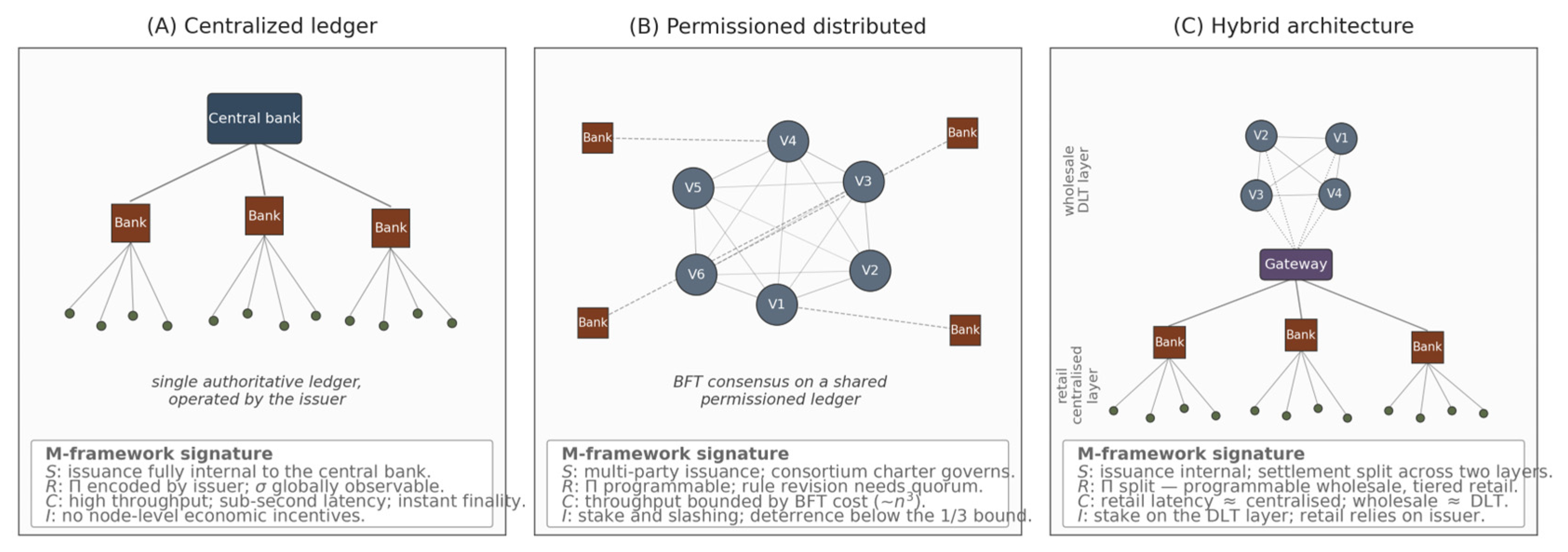
2.1. Distributed Ledger vs. Centralized Systems
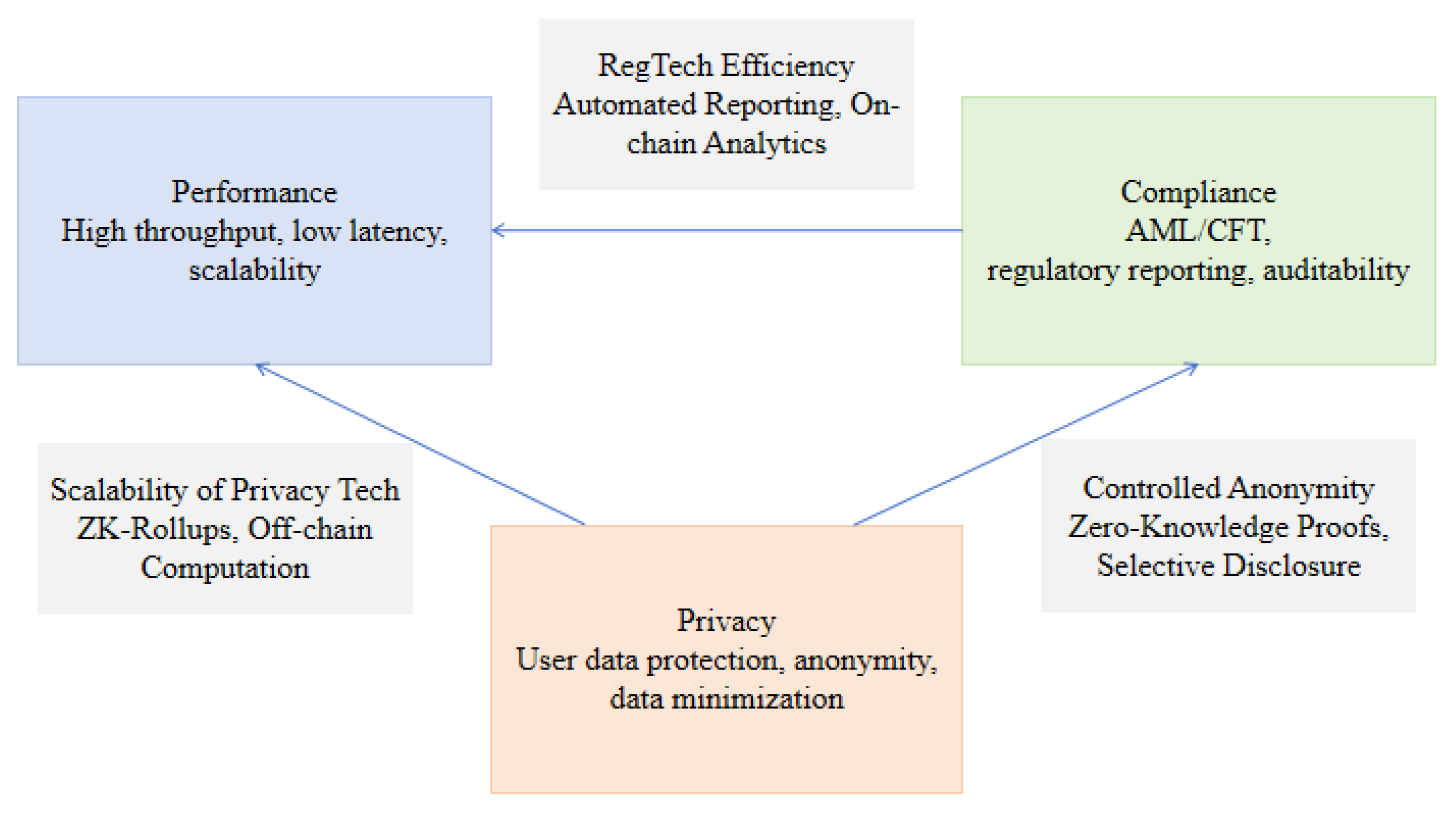
2.2. Privacy Computing and Controlled Anonymity
2.3. Smart Contracts and Programmable Money
2.4. Technology Development Support for CBDC
2.5. Challenges in Technological Integration
3. Institutional Innovation: The Monetary System Under CBDC
3.1. Monetary Attributes and Legal Status
3.2. Transformation of Monetary Policy Transmission
3.3. Financial Stability and Risk Prevention
3.4. Institutional Environment as a Determinant of Architectural Choice
4. The AB2023 Model: A Formal Framework for CBDC Institutional Design
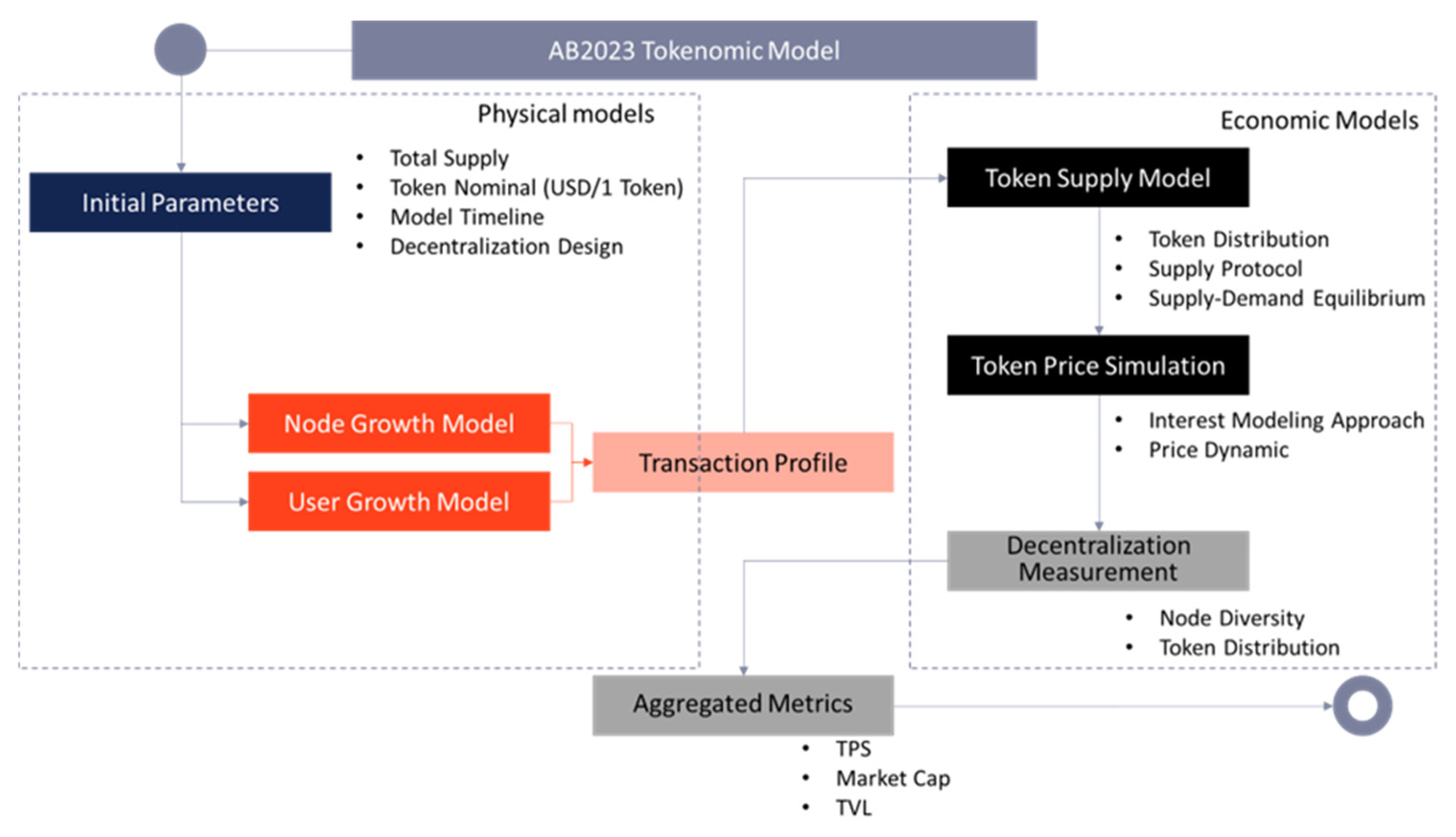
4.1. Core Architecture of the AB2023 Model
- Initial Parameters: Defines system initial state and boundary conditions—initial node count, user base, total token supply, etc.
- Token Supply Model: Simulates token issuance dynamics and supply control mechanisms, including minting rules and burning mechanisms. This module corresponds to in the formal framework and is conceptually compatible with Kumhof & Noone’s analysis of CBDC balance sheet implications [16], as both focus on how digital currency issuance affects overall system equilibrium.
- Node Growth Model: Characterizes expansion process of network participants (financial institutions, enterprise nodes) and its impact on network value.
- User Growth Model: Tracks end-user adoption behavior, reflecting network externality effects. This corresponds to (circulation parameters) in the formal framework.
- Token Price Simulation: Predicts dynamic changes in token prices based on supply–demand relationships and market sentiment.
- Decentralization Measurement: Assesses power distribution and consensus security of the system—Gini coefficient, node concentration metrics.
- Aggregated Metrics: Generates comprehensive evaluations of overall system performance, including derived indicators such as network entropy, liquidity, and stability. This corresponds to (incentive structure) in the formal framework.
4.2. Comparison with Existing Tokenomic Models
4.3. Implications for CBDC Institutional Design
- Holding limits correspond to constraints on the parameter in the digital currency unit representation . By setting maximum thresholds on for different holder types, the system can mitigate bank disintermediation risk while preserving payment functionality.
- Graduated interest rates represent a dynamic element of the rule set , adjusting incentives for holding versus spending CBDC based on policy objectives.
- Controlled anonymity is encoded in the (programmable constraints) and (state) parameters, enabling different privacy levels based on transaction characteristics.
- Programmable money is directly represented by , which can specify purpose-binding, time restrictions, or jurisdictional limits.
- Countries with higher financial stability concerns might set stricter holding limits to prevent deposit substitution.
- Countries with stronger privacy protection requirements might adopt stronger anonymity protection technologies, reflected in more permissive constraints regarding information disclosure.
- Economies heavily dependent on cross-border trade might prioritize wholesale CBDC and multilateral interoperability protocols, calibrating parameters to facilitate international transactions while managing capital flow risks.
4.4. Two Analytical Propositions and Stylized Numerical Exercises
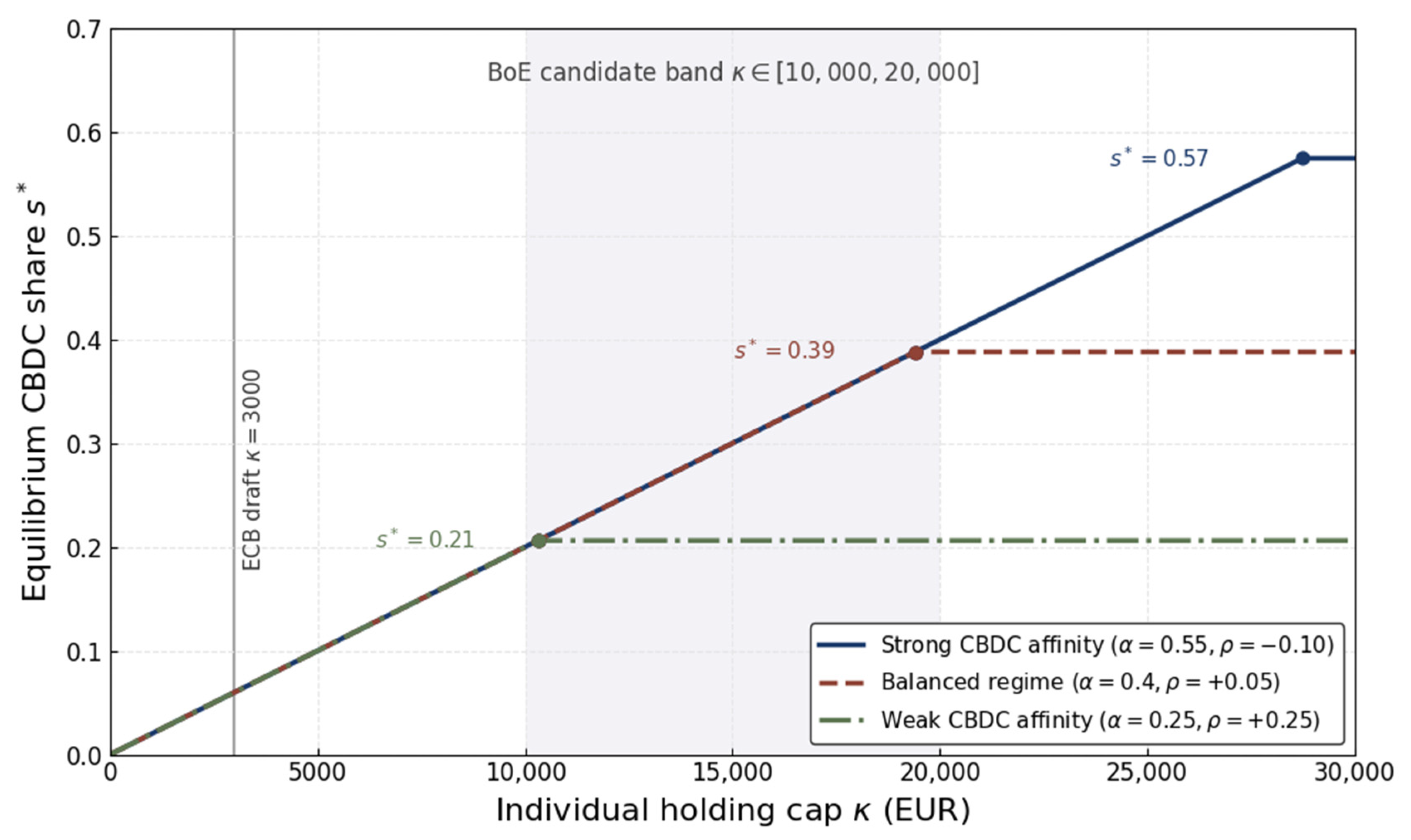
4.4.1. Proposition A: Threshold Property of the Retail Holding Cap
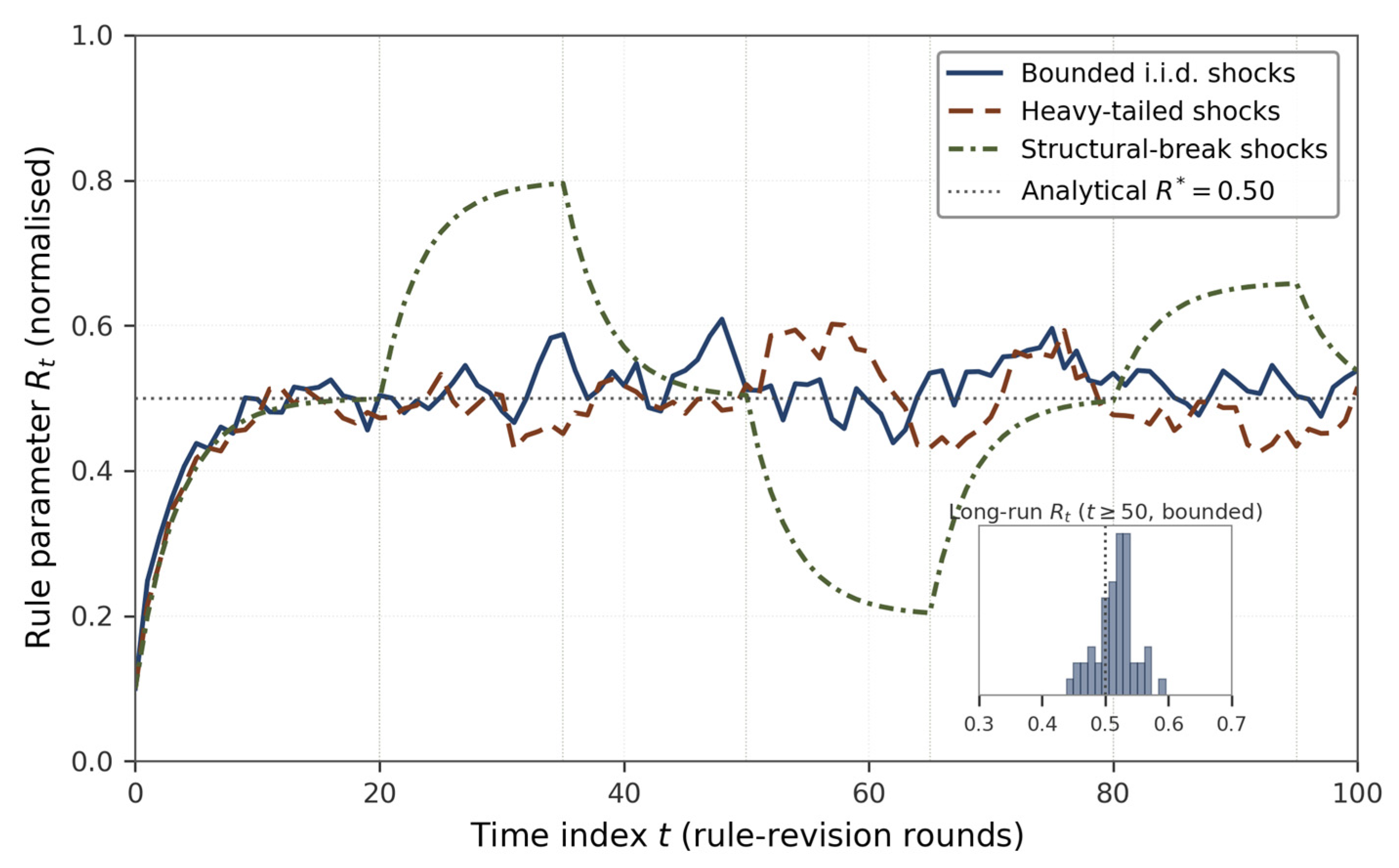
4.4.2. Proposition B: Fixed Point of the Rule-Update Map Φ
4.4.3. What the Exercises Do and Do Not Establish
5. Conclusions
5.1. Policy Implications
5.2. Limitations and Future Research
Author Contributions
Funding
Data Availability Statement
Acknowledgments
Conflicts of Interest
References
- World Bank. Global Payment Systems Survey (GPSS); World Bank: Washington, DC, USA, 2024. [Google Scholar]
- Atlantic Council. Central Bank Digital Currency Tracker. Available online: https://www.atlanticcouncil.org/cbdctracker (accessed on 24 April 2026).
- International Monetary Fund. Crypto-Assets and Financial Stability. In Global Financial Stability Report; International Monetary Fund: Washington, DC, USA, 2024; pp. 12–15. [Google Scholar]
- Chainalysis. The 2024 State of Crypto Crime; Chainalysis Inc.: New York, NY, USA, 2024. [Google Scholar]
- Bank for International Settlements. 2023 BIS Annual Economic Report; BIS: Basel, Switzerland, 2023. [Google Scholar]
- Frizzo-Barker, J.; Chow-White, P.A.; Adams, P.R.; Mentanko, J.; Ha, D.; Green, S. Blockchain as a disruptive technology for business: A systematic review. Int. J. Inf. Manag. 2020, 51, 102029. [Google Scholar] [CrossRef]
- Song, H.; Yang, Y.D.; Tao, Z. The application of blockchain in enterprise financing: A literature review and knowledge framework. Nankai Bus. Rev. 2022, 25, 34–48. [Google Scholar]
- Yu, D.J.; Sheng, L.B. Knowledge diffusion paths of blockchain domain: The main path analysis. Scientometrics 2020, 125, 471–497. [Google Scholar] [CrossRef]
- Auer, R.; Frost, J. Central bank digital currency and monetary sovereignty. J. Financ. Econ. 2024, 141, 511–523. [Google Scholar]
- People’s Bank of China. E-CNY White Paper (2024 Update); China Financial Publishing House: Beijing, China, 2024. [Google Scholar]
- Yao, Q. Controlled anonymity in CBDC system architecture. J. Digit. Curr. Res. 2024, 7, 513–529. [Google Scholar]
- Bank for International Settlements Innovation Hub. Annual Report 2023; BIS: Basel, Switzerland, 2023. [Google Scholar]
- Graduate School of Business, HSE University. Retail central bank digital currency design choices: Guide for policymakers. IEEE Access 2024, 12, 66129–66146. [Google Scholar] [CrossRef]
- International Monetary Fund. Conflict of Laws in Cross-Border CBDC Transactions; IMF Policy Paper 2025-003; International Monetary Fund: Washington, DC, USA, 2025. [Google Scholar]
- Grosman, A.; Sayyid, A.; Klarin, A. Central bank digital currencies and institutional systems: Design choices based on institutional characteristics. Eur. J. Int. Manag. 2024, 23, 245–271. [Google Scholar]
- Kumhof, M.; Noone, C. Central Bank Digital Currencies—Design Principles and Balance Sheet Implications; BIS Working Papers No. 725; Bank for International Settlements: Basel, Switzerland, 2018. [Google Scholar]
- Bindseil, U.; Panetta, F. Central Bank Digital Currency as a Monetary Policy Instrument; ECB Working Paper Series No. 2871; European Central Bank: Frankfurt, Germany, 2025. [Google Scholar]
- Barrdear, J.; Kumhof, M. The macroeconomics of central bank digital currencies. J. Econ. Dyn. Control 2022, 142, 104148. [Google Scholar] [CrossRef]
- Iyengar, G.; Saleh, F.; Sethuraman, J.; Sethuraman, J.; Wang, W. Economics of permissioned blockchain adoption. Manag. Sci. 2023, 69, 3415–3436. [Google Scholar] [CrossRef]
- Brunnermeier, M.K.; Niepelt, D. On the equivalence of private and public money. J. Monet. Econ. 2019, 106, 27–41. [Google Scholar] [CrossRef]
- Kumhof, M.; Noone, C. Payment Efficiency Gains from Central Bank Digital Currency. In BIS Quarterly Review; Bank for International Settlements, Monetary and Economic Department: Basel, Switzerland, 2024; pp. 22–35. [Google Scholar]
- Guliyev, B.; Bethlendi, A. Blockchain vs. centralized ledgers in CBDC: A comparative analysis of efficiency, scalability, and security. Sci. Cult. 2026, 12, 12–27. [Google Scholar]
- European Central Bank. Report on a Digital Euro; European Central Bank: Frankfurt, Germany, 2023. [Google Scholar]
- mBridge Project Consortium. Phase III Technical Implementation Report; Hong Kong Monetary Authority: Hong Kong, China, 2024.
- Panetta, F. Shaping Europe’s Digital Future: The Path towards a Digital Euro; European Central Bank: Frankfurt, Germany, 2023. [Google Scholar]
- National Institute of Standards and Technology. Post-Quantum Cryptography for Financial Networks; NIST Special Publication 800-208; U.S. Department of Commerce: Gaithersburg, MD, USA, 2024.
- Yaksetig, M.; Pereira, P.M.F.; Yang, S.; Nejadgholi, M.; Xu, J. Rayls II: Fast, Private, and Compliant CBDCs; Paper 2025/1638; IACR Cryptology ePrint Archive: Bellevue, WA, USA, 2025. [Google Scholar]
- Yaksetig, M.; Xu, J. Rayls: A Novel Design for CBDCs; Paper 2025/1639; IACR Cryptology ePrint Archive: Bellevue, WA, USA, 2025. [Google Scholar]
- National Institute of Standards and Technology. Status Report on the Third Round of the NIST Post-Quantum Cryptography Standardization Process; NIST IR 8413; U.S. Department of Commerce: Gaithersburg, MD, USA, 2022.
- Bernstein, D.J.; Lange, T. Post-quantum cryptography. Nature 2017, 549, 188–194. [Google Scholar] [CrossRef] [PubMed]
- Central Bank of The Bahamas. Sand Dollar Design Paper: Programmable Fiscal Rules; Central Bank of The Bahamas: Nassau, Bahamas, 2023. [Google Scholar]
- Liu, X.; Shan, X.G.; Jiang, N. Analysis of Sino-US blockchain technology competition situation based on patent information. Sci. Technol. Prog. Policy 2020, 37, 18. [Google Scholar]
- Committee on Payments and Market Infrastructures. Interlinking Payment Systems and the Role of Application Programming Interfaces; Bank for International Settlements: Basel, Switzerland, 2023. [Google Scholar]
- Financial Stability Board. FSB Report on the International Regulation of Crypto-Asset Activities; Financial Stability Board: Basel, Switzerland, 2023. [Google Scholar]
- Central Bank of Nigeria. Regulatory Guidelines on the eNaira (CBN Circular); Central Bank of Nigeria: Abuja, Nigeria, 2021.
- ISO 20022; Financial Services—Universal financial industry message scheme. International Organization for Standardization: Geneva, Switzerland, 2026.
- European Commission. Proposal for a Regulation of the European Parliament and of the Council on the Establishment of the Digital Euro; COM(2023) 369 final; European Commission: Brussels, Belgium, 2023. [Google Scholar]
- Zatti, F. From legal tender to prohibition: Competing paradigms in central bank digital currency law. Inst. ZA Uporedno Pravo 2025, 69, 561–575. [Google Scholar] [CrossRef]
- Bank for International Settlements Innovation Hub. Project Pyxtrial: Monitoring the Backing of Stablecoins; BIS: Basel, Switzerland, 2024. [Google Scholar]
- Monetary Authority of Singapore. Purpose Bound Money Whitepaper; Monetary Authority of Singapore: Singapore, 2023.
- Martinez Resano, J.R. CBDCs and the (Calibrated) Tiering of Money: The Financial Stability Arguments; SUERF Policy Note, No. 366; The European Money and Finance Forum: Vienna, Austria, 2025. [Google Scholar]
- Bogdanov, A.; Khvatov, V.; Uteshev, A.; Shchegoleva, N. Virtual Blockchain Network for Secure Financial and Industrial Applications. In Proceedings of the ICCSA 2024 Workshops, LNCS 14815, Hanoi, Vietnam, 1–4 July 2024; Springer: Cham, Switzerland, 2024; pp. 142–161. [Google Scholar]
- Hu, B.; Bogdanov, A.V. Blockchain as Infrastructure for CBDC: Technological Foundations and Challenges. In Proceedings of the ICCSA 2026 Workshops, Braga, Portugal, 30 June–3 July 2026; Springer: Cham, Switzerland, 2026. [Google Scholar]
- Cong, L.W.; Li, Y.; Wang, N. Tokenomics: Dynamic adoption and valuation. Rev. Financ. Stud. 2021, 34, 1105–1155. [Google Scholar] [CrossRef]
- Letychevsky, O.; Peschanenko, V.; Radchenko, V.; Poltoratzkyi, M.; Kovalenko, P.; Mogylko, S. Formal verification of token economy models. In Proceedings of the 2019 IEEE International Conference on Blockchain and Cryptocurrency (ICBC), Seoul, Republic of Korea, 14–17 May 2019; pp. 201–204. [Google Scholar]
- Jürjens, J.; Scheider, S.; Yildirim, F.; Henke, M. Tokenomics: Decentralized incentivization in the context of data spaces. In Designing Data Spaces; Otto, B., ten Hompel, M., Wrobel, S., Eds.; Springer: Cham, Switzerland, 2022; pp. 91–110. [Google Scholar]
- Lesavre, L.; Varin, P.; Yaga, D. Blockchain Networks: Token Design and Management Overview; NIST Interagency Report 8301; National Institute of Standards and Technology: Gaithersburg, MD, USA, 2021.
- Khvatov, V.; Bogdanov, A. DGT Network Tokenomics—AB2023 Model Specification; DGT Network Technical Report; DGT Technologies AG: Toronto, ON, Canada, 2023. [Google Scholar]
- Mishra, B.; Prasad, E. A Simple Model of a Central Bank Digital Currency; Working paper; Cornell University: New York, NY, USA, 2023. [Google Scholar]



| Design Parameter | Centralized Ledger | Permissioned DLT | Hybrid Architecture |
|---|---|---|---|
| Throughput | High | Medium | High |
| Transparency | Low | High | Medium |
| Governance | Strong Central Bank Control | Shared | Mixed |
| Cyber Risk | Single-point failure risk | Byzantine fault tolerance | Mixed risk profile |
| Settlement Finality | Instant | Program-dependent | Tiered |
| Interoperability | Limited | High | Medium |
| Challenge Dimension | Specific Manifestations | Severity | Existing Solutions | Research Frontiers |
|---|---|---|---|---|
| Performance Bottlenecks | Throughput limits, latency, energy consumption | Significant | Sharding, Layer 2 scaling, hybrid architectures | ZK-Rollups, hardware acceleration |
| Quantum Computing Threats | Vulnerability of asymmetric encryption algorithms | Long-term high risk | Migration to post-quantum cryptography | Lattice-based cryptography, multivariate cryptography |
| Consensus Mechanism Attacks | Collusion attacks, Sybil attacks | Moderate | Economic penalties, node authentication | Verifiable Random Functions |
| Smart Contract Vulnerabilities | Code defects, logical errors | Significant | Formal verification, security auditing | Zero-knowledge proof verification |
| Cross-chain Interoperability | Inconsistent standards, protocol differences | Significant | ISO 20022, cross-chain protocols | Universal cross-chain communication protocols |
| Traditional Cybersecurity | DDoS attacks, intrusions, key leakage | Persistent threat | Defense-in-depth, Hardware Security Modules | Zero-trust architecture |
| Policy Tool | Transmission Channel | Primary Impact | Potential Risk | Precision | Representative Example |
|---|---|---|---|---|---|
| Interest-bearing CBDC | Interest rate transmission | Directly affects public risk-free yield | Bank deposit substitution, digital runs | High | Sweden e-krona study [16] |
| Tiered Balance Tool | Tiered interest rate/limits | Buffers bank deposit outflows | Threshold calibration difficulty | Medium | ECB €3000 limit [24] |
| Programmable Transfers | Targeted payments | Precise fiscal transfers, consumption stimulus | Data privacy, market intervention concerns | Very High | Singapore PBM protocol [41] |
| Liquidity Trigger | Automatic reserve conversion | Optimizes interbank liquidity management | System complexity | Medium | ECB trigger solution [21] |
| Jurisdiction | Type | Architecture | Privacy Model | Holding Limits | Programmability | Cross-Border Readiness |
|---|---|---|---|---|---|---|
| Bahamas | Retail | Centralized + Offline | Tiered KYC | Yes (undisclosed) | Fiscal rules engine | Limited |
| China | Retail | Hybrid Architecture | Small anonymous, large traceable | Tiered limits | Pilot (vouchers) | mBridge |
| Nigeria | Retail | Centralized | Tiered KYC | Individual ₦500k | None | Limited |
| Singapore | Wholesale + Retail | DLT Platform | Tiered privacy | Under study | Highly programmable (PBM) | Strong |
| EU | Retail | Under study | Strong Privacy (GDPR compliant) | €3k (proposed) | Restricted | Under study |
| Model/Paper | Main Focus | Methodology | Key Features/Findings |
|---|---|---|---|
| Tokenomics: Dynamic Adoption and Valuation [44] | Pricing Model of Tokens | Dynamic Asset Pricing Model |
|
| Formalization and Algebraic Modeling of Tokenomics Projects [45] | Verification and Simulation of Tokenomics | Algebraic Programming and Insertion Modeling |
|
| Tokenomics: Decentralized Incentivization in the Context of Data Spaces [46] | Business Application of Tokens | Comprehensive Guide and Case Studies |
|
| Blockchain Networks: Token Design and Management Overview [47] | Token Design and Management | Overview and Guidelines |
|
| AB2023 Model (Current Model) [48] | Analyzing and Projecting Tokenomics Behavior | Hybrid Blockchain Economy Modeling |
|
| Regime | α | ρ | s_uncon | κ* (EUR) | s* @ κ = 3000 | s* @ κ = 10,000 |
|---|---|---|---|---|---|---|
| Strong CBDC affinity | 0.55 | −0.10 | 0.5746 | 28,730 | 0.0600 | 0.2000 |
| Balanced regime | 0.40 | +0.05 | 0.3881 | 19,403 | 0.0600 | 0.2000 |
| Weak CBDC affinity | 0.25 | +0.25 | 0.2061 | 10,305 | 0.0600 | 0.2000 |
Disclaimer/Publisher’s Note: The statements, opinions and data contained in all publications are solely those of the individual author(s) and contributor(s) and not of MDPI and/or the editor(s). MDPI and/or the editor(s) disclaim responsibility for any injury to people or property resulting from any ideas, methods, instructions or products referred to in the content. |
© 2026 by the authors. Licensee MDPI, Basel, Switzerland. This article is an open access article distributed under the terms and conditions of the Creative Commons Attribution (CC BY) license.
Share and Cite
Bitai, H.; Khvatov, V.; Savkov, E.; Bogdanov, A.V. Blockchain-Enabled Central Bank Digital Currency: Technological Architecture, Privacy, and Institutional Design. Blockchains 2026, 4, 12. https://doi.org/10.3390/blockchains4030012
Bitai H, Khvatov V, Savkov E, Bogdanov AV. Blockchain-Enabled Central Bank Digital Currency: Technological Architecture, Privacy, and Institutional Design. Blockchains. 2026; 4(3):12. https://doi.org/10.3390/blockchains4030012
Chicago/Turabian StyleBitai, Hu, Valery Khvatov, Egor Savkov, and Aleksandr V. Bogdanov. 2026. "Blockchain-Enabled Central Bank Digital Currency: Technological Architecture, Privacy, and Institutional Design" Blockchains 4, no. 3: 12. https://doi.org/10.3390/blockchains4030012
APA StyleBitai, H., Khvatov, V., Savkov, E., & Bogdanov, A. V. (2026). Blockchain-Enabled Central Bank Digital Currency: Technological Architecture, Privacy, and Institutional Design. Blockchains, 4(3), 12. https://doi.org/10.3390/blockchains4030012