


Abstract
Within modern culinary education, education on sustainable development is essential for vocational students. Using the example of sous vide, its suitability for addressing sustainability in culinary education was investigated as well as the extent to which it is currently implemented in Germany. Therefore, the literature on potential environmental, social, economic and health impacts of sous vide was reviewed and its current implementation in German culinary educational materials was analyzed. The literature review revealed a number of sustainability aspects of sous vide. Despite being covered in textbooks, it is not brought into a sustainability context. Moreover, existing sustainability concepts for the gastronomy sector neither identify environmental conditions as a basic requirement for any socio-economic activity nor illustrate interdependencies and trade-offs between different sustainability dimensions. Therefore, the sustainability concepts and culinary teaching and training materials currently used in German culinary schools do not support the development of a systemic understanding and multi-dimensional engagement in the training of future chefs.
1. Introduction
In the face of global challenges such as climate change and food security, a transformation towards sustainability is imperative. According to the UN’s Sustainable Development Goals (SDGs) [1] achieving global sustainability depends on the knowledge, skills, values and attitudes of current and future generations. For example, the twelfth SDG focuses on responsible consumption and production by aiming to provide everyone with relevant information and foster awareness for lifestyles that are in harmony with nature by 2030. To reach all SDGs, we need an understanding of the complexity of environmentally and socially responsible behaviors and recognize the need for a profound transformation of our economic systems as well as our everyday lives and practices. Thus, education on sustainable development plays a pivotal role in equipping students with the knowledge and skills to pioneer innovative and creative responses to societal and working process transformation, thereby achieving wider economic, social and environmental well-being [2,3].
In line with the UN’s ambitions regarding education for sustainable development [4], Germany released a strategy report in 2002, outlining its plans to implement education for sustainable development in primary, secondary and tertiary education [5]. With respect to vocational education and training (VET) in particular, this agenda is supposed to be advanced and implemented through a specific national initiative, vocational education and training for sustainable development [6]. Twenty-four years have now passed since these declarations were issued, and this study focuses on German culinary education for future chefs. Two major German national sustainability goals that are aligned with the SDGs coincide here: education for sustainable development and sustainable nutrition and food security [1] coincide As well as the apparent theoretical overlap between these two goals and their crucial importance for creating sustainable food systems, these principles also need to be incorporated into training of practical skills and in operational processes, including food preparation and cooking itself, during VET in order to equip future chefs with the necessary skills to foster sustainable development [7,8]. Understanding the characteristics of restaurant products and their preparation processes is essential for a sustainable catering industry [9]. German VET curricula outline the range of skills and competences (professional, methodical and social) necessary to “impart the vocational skills, knowledge and abilities (occupational competence […] to engage in a form of skilled occupational activity in a changing working world” [10]. Due to open curricula, teaching and learning contents that support teaching these competences remain optional [11]. Based on these national standards, educational researchers and textbook authors can decide how to design particular teaching contents to achieve these overarching educational goals. This includes providing adequate educational materials for sustainable development such as textbooks, work books and digital educational materials for culinary education.
At the same time, consumer preferences and expectations are changing. Due to an increasing awareness of the relationship between food production and consumption and their impact on the environment, human health and planetary health, these issues are becoming more and more important [12]. At the same time, novel trends in food preparation and cooking such as sous vide are receiving public and professional interest [13]. These changes should be reflected in culinary education.
1.1. Sustainability Concept for the Catering Sector
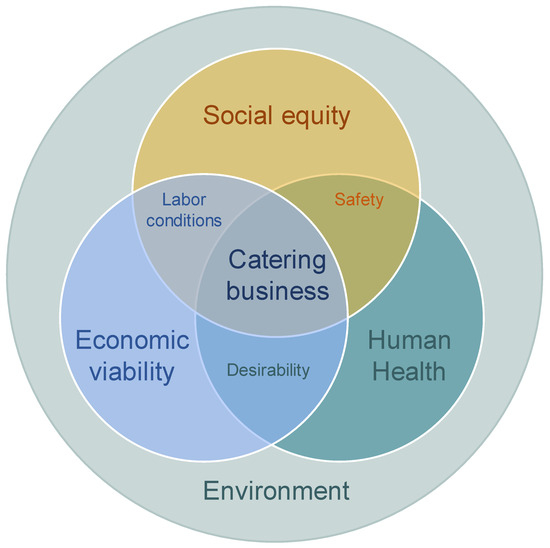
The three main interdependent pillars of sustainability—environmental, economic, and social– can be applied to nutrition-related and culinary professions and more specifically to the catering business. In this context, a fourth dimension is added: health. Incorporated in fundamental environmental sustainability of food systems, economic viability, social conditions and health outcomes are major, interdependent dimensions of sustainability for a catering business (see Figure 1). The term “economic viability” emphasizes the need to shift prevailing economic targets from direct growth to individual wellbeing. This requires the inclusion of the external environmental, health and social costs of food systems. Globally, these costs have been estimated to exceed the annual market value of food system by $2 trillion [14].
Figure 1.
A sustainability concept for the culinary sector. Environmental sustainability (light green) is the fundamental prerequisite for achieving sustainability in all dimensions, including social equity (yellow), economic viability (blue) and human health (dark green) as well as their respective scopes, such as labor conditions, safety and desirability. These factors are of crucial importance for a business’s overall sustainability (own design).
While there are a number of concepts for a sustainable food system framework in the literature [15,16], few sustainability concepts have already been applied specifically to the catering sector or hospitality sector. One such concept is depicted by the ‘a’verdis house’ by Roehl and Strassner [17]. The “house” is constructed with economic viability at its foundation, “supporting walls” made up of health and desirability and a “protective roof” comprising social and environmental aspects. However, the authors do not explain how the economic viability of a business can form the basis of their conceptualization when environmental and social conditions are effectively prerequisites for any economic activity. Furthermore, interdependencies and trade-offs between dimensions of sustainability are not considered.
Figure 1 displays a sustainability concept for the catering sector, which was developed for this study. The overlapping circles model of sustainable development has been adapted to illustrate interdimensional overlaps without hierachichal elements. This concept differs considerably from the a’verdis approach in that it recognizes environmental conditions as a prerequisite for all socio-economic activities. Human health and a productive and equitable society both depend heavily on the global ecosystem. The environmental dimension encompasses social equity, human health and economic viability, which are depicted as subsequent, interdependent dimensions. At their intersections, sub-dimensions such as food safety and the nutritional value of foods, occupational health and safety; labor conditions including wages, benefits and social security; and the desirability of products assessed in terms of taste, affordability, popularity and (perceived) health-promoting properties are found. When applying this sustainability concept to culinary VET for sustainable development in general and the teaching of sous vide in particular, its impact must be analyzed from a variety of interdependent sustainability perspectives.
1.2. Sous Vide
Sous vide is a gentle cooking method that preserves flavors and nutrients. An increasing number of restaurants and caterers are integrating sous vide in their menus [18,19,20]. First developed by French chefs in the 1970s [21], it has grown in popularity beyond high-end gourmet restaurants since 2010. It is now increasingly also used widely in the catering sector (including in hospitals and nursing homes), in the food industry and even in private households [13,18,22,23,24,25]. The term “sous vide” means “under vacuum”, i.e., food is vacuum-sealed in an impermeable, heat-resistant plastic bag using a vacuum sealer, and then slowly cooked in warm water (or sometimes steam) at tightly controlled, low temperatures [26]. Water temperatures range between 55 and 85 °C. The lower end is typically used for cooking fish, seafood and meats, taking several hours, while the upper end is used for cooking vegetables for a few minutes to several hours [25,27]. The sous-vide method enables optimal cooking times and desired texture to be controlled as well as greater reproducibility and consistent quality [18,26,28,29]. Foods cooked using sous vide can also be cooled quickly and, if necessary, frozen and stored. When needed, they can be regenerated at any time [30,31]. They can be marinated and seasoned before sous vide or briefly roasted after sous vide to generate roasting flavors and colors [18,26,32]. However, not all foods are suitable for sous-vide methods. For example, certain varieties of cabbage and beans cannot be cooked using this method [18,26,32].
It is proposed that this cooking method provides culinary educators with an opportunity to not only teach apprentices the technical aspects of sous vide but also to integrate sustainability dimensions, such as environmental, economic, social and health impacts, into their teaching and training. This enables active and critical engagement with these topics, as well as the development of cohesive, forward-thinking and problem-solving competencies in apprentices. However, this also requires sustainable approaches to be integrated into educational materials such as textbooks, since it has been suggested that these directly influence content and teaching method [33]. Taking sous vide as an example, this study aimed to evaluate the extent to which national guidelines for VET for sustainable development have been formally and practically implemented in German culinary education to date. First, we reviewed and summarized the current literature on the potential environmental, economic, social and health-related sustainability issues of sous vide. Then, its general coverage in current German culinary educational materials and how well it was put in a sustainability context as part of practical educational approaches was analyzed. Finally, the results of this analysis were discussed in relation to existing teaching approaches and materials, as well as German culinary curricula.
2. Materials and Methods
2.1. Literature Review
An extensive, integrative literature review—including gray literature—of English and German literature was conducted using Google Scholar to obtain an overview of the sustainability aspects associated with sous vide.
Examples of search terms included “sous vide sustainab*”, “sous vide environmental impact”, “sous vide health impact”, “Sous-Vide-Garen” and “Vakuumgaren”. Additional studies were identified through the reference lists of relevant publications. The collected literature was screened for relevance and used to summarize the current state of knowledge regarding the sustainability implications of sous vide.
2.2. Textbook Analysis
The integration of sous vide in general as well as its sustainability-related aspects in particular, was analyzed in textbooks, which are currently used in German public culinary schools. These books were identified through informal conversations with vocational school teachers as part of collaborative educational projects. Seven German culinary textbooks and two exemplary workbooks were analyzed Five of these textbooks were designed to cover all topics of a cook apprenticeship. Two of the books were designed to be used together (part 1 and 2) with one book covering the first year of the apprenticeship (Experience kitchen 1) and the second book (Experience kitchen 2) covering years two and three.
The methodical approach of the textbook analysis is described in detail in Table 1. First, we searched both tables of contents and indexes of all books for the terms ‘sous vide’ and its German equivalent, ‘Vakuumgaren’. We then checked the resulting sections for cross-references to the topic in other parts of the books as well as for any additional mentions of these terms throughout all the books. All sections of the books that covered sous vide were investigated using an analytical framework (see Table 1). Using an inductive approach, we counted the number of references to environmental, health, social, economic and desirability aspects. The “desirability/attractiveness” aspect was included in the textbook analysis based on the a’verdis house [17] as it plays a central role in the out-of-home sector (see also Figure 1). To this end, terms describing taste, texture, or appearance were included. The operationalization of these five aspects, inclusion criteria, exclusion criteria and coded text examples is shown in Table 2. If a statement in the textbook could be assigned to more than one sustainability dimension, it was counted multiple times. For instance, a statement about the energy consumption of sous vide was attributed to both the environmental and economic dimensions.
Table 1.
Methodical approach of the textbook analysis.
Table 2.
Coding manual.
In addition, the presence of exercises on sous vide was checked. If present, we also checked whether the exercises contained aspects of sustainability or encouraged students to consider sustainability issues. This comprehensive approach enabled all information on the sustainability aspects of sous vide in the textbooks and workbooks to be gathered together.
3. Results
3.1. Literature Analysis of Sustainable Aspects of Sous Vide
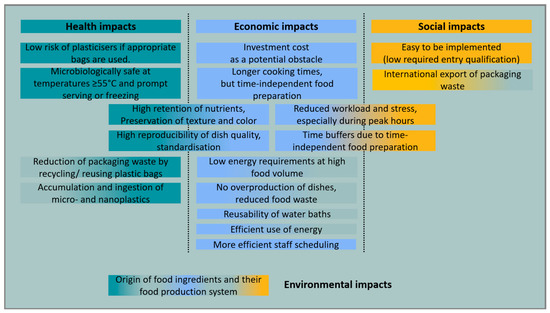
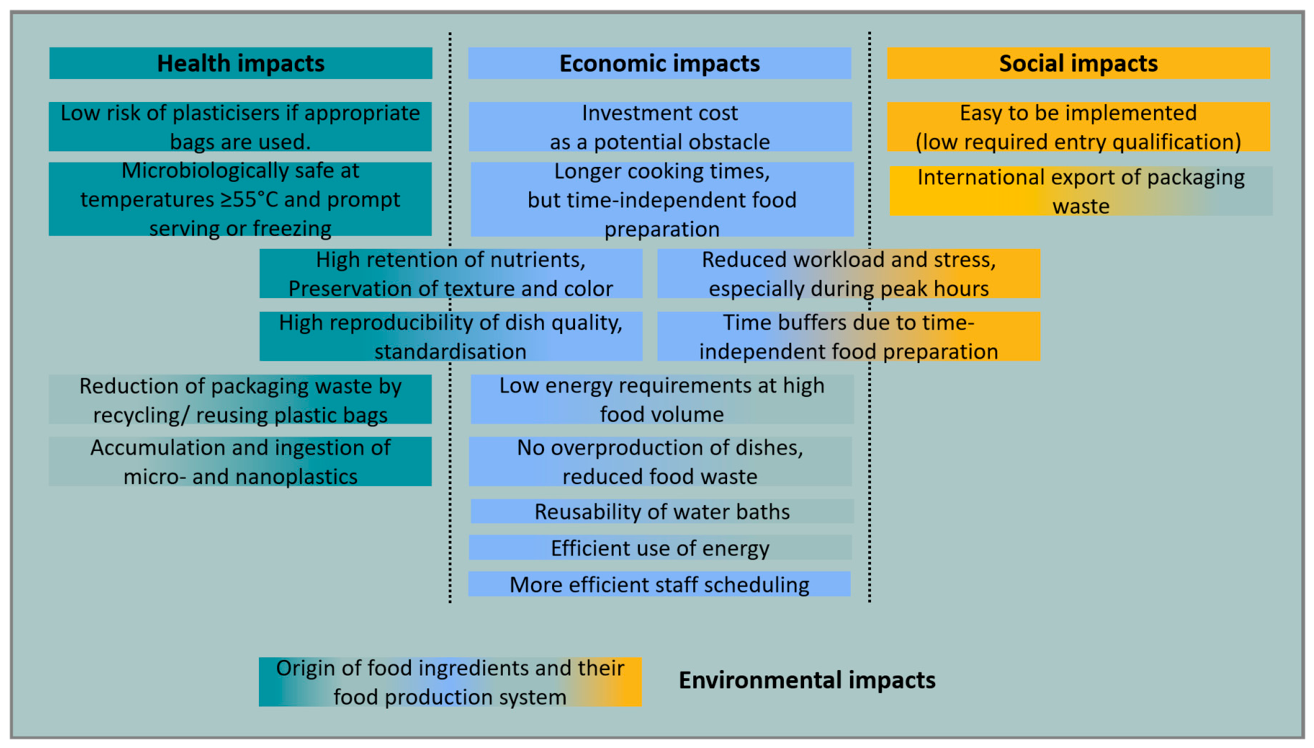
The literature analysis revealed that sous vide is a multifaceted topic with a number of environmental, health, social, and economic implications. In Figure 2, an overview of all identified sustainability aspects and their potential interdimensional overlap between the dimensions of environmental impact, health impact, economic impact and social impact is shown. This overlap is illustrated by the gradient color fill of the text boxes. The four dimensions of sustainability of sous vide are described in more detail in the following subchapters.
Figure 2.
An overview of all sustainability aspects concerning sous vide, as identified in the literature review. Their potential interdimensional overlap is indicated by their gradient color fills (light green: environmental impacts, dark green: health impacts, blue: economic impacts, yellow: social impacts).
3.1.1. Environmental Impact
The use of natural resources, as well as the recycling or disposal of waste, play an important role in the overall sustainability of the food system [38]. It has been demonstrated that the total life cycle of one portion of food product results in lower global warming potential when the sous-vide technique is used (2.664 ng) compared to traditional cooking techniques such as boiling or frying (4.702 ng) [9]. The carbon footprint of sous-vide-cooked food products depends on the electricity consumption (cooking temperature, treatment time), water usage, and the carbon footprint of the bag and product itself (production, transport) [39]. In addition to purchasing organic, seasonal and regional products, the overall environmental sustainability of sous vide can be improved by managing waste efficiency and using material, water and energy sustainably.
- Origin of ingredients
The environmental impacts of sous vide can vary drastically depending on the type of food (often fish or meat) and its particular production system. The impacts include water and land use, fertilizer and pesticide application, greenhouse gas emissions from production and transport, and biodiversity. They can accelerate environmental degradation and the exploitation of land [40,41]. Additionally, sourcing food locally or regionally produced foods from regenerative farms or from well-managed pasture-raised animals can significantly impact the environmental sustainability, nutritional value and safety of the food chosen [42,43,44]. Labels indicating organic or fair-trade production facilitate the purchase of ingredients that are more environmentally and socially friendly [45,46]. However, most consumers would prefer to search for a single sustainability label that addresses multiple dimensions of sustainability [47].
- Food waste and associated natural resource use
The sous-vide method can help to reduce food waste by minimizing cooking waste and the perishing of fresh ingredients as well as preventing overproduction [48]. Additionally, cooking losses can be reduced depending on the food product, temperature and time. It has been demonstrated that losses can be as low as 8% for beef, 10% for chicken and 12% for pork. Yield mainly decreases with increasing temperature [49]. Potato loss can also be reduced from 5% to 2% when sous vide is used instead of traditional cooking methods such as boiling or frying [9]. With approximately 5.5 million tonnes of avoidable food waste generated in Germany each year [50], food waste reduction could play a significant role in decreasing the use of natural resources such as irrigation water and land use in the agricultural sector [38]. Furthermore, unlike boiling foods, the freshwater used for sous-vide water baths can potentially be reused multiple times before cleaning the equipment becomes necessary [51].
- Plastic waste
Every year, Germany exports around one million tonnes of plastic waste, primarily in the form of plastic packaging made from polyethylene and polypropylene (which are also used for vacuum bags), as well as polystyrene. This makes up one sixth of national annual plastic waste. Proper recycling cannot be guaranteed in importing countries such as Malaysia or Turkey, which are posing a threat to the local environment and human health [52]. Using and disposing of a plastic bag for each food item stands in stark contrast to sustainability goals, even if the bag’s chemical composition theoretically allows for recycling [53]. However, if they are not recycled, plastic bags can pose a significant risk to environmental health [54]. Reusable plastic bags with zip fastening and air valves can be reused up to 50 times [55]. Suitable alternatives include reusable, heat-resistant silicone bags that are free from plasticizers [56] as well as stainless steel containers with lids equipped with air-valves [57].
- Energy
Głuchowski et al. [48] found that sous vide, including vacuum sealing, requires five to ten times more energy than traditional cooking or steaming methods. Therefore, this technique is only energetically efficient when used in large commercial kitchens [58]. Well insulated and tempered water containers can keep total energy use relatively low [58,59,60]. Regardless of the steps taken to minimize overall energy use, using renewable energy sources is the most effective way to reduce global greenhouse gas emissions.
3.1.2. Health Impacts
- Nutrition and Sensory Aspects
Because sous vide foods do not come into direct contact with cooking liquids and are processed at lower cooking temperatures, they retain more minerals and vitamins than foods cooked by other methods [32,61,62,63,64]. This is due to the protection of nutrients susceptible to oxidation and heat degradation [18], as well as the preservation of plant cell membranes that act as a physical barrier to nutrient leaching [65,66,67]. As a gentler cooking method, sous vide also preserves color [61,67,68,69], texture [70,71], juiciness and tenderness better than other cooking methods, especially with respect to meats [72,73]. It was shown that sous vide improves the quality of meat, including its sensory and nutritional properties [74]. For vegetables, improved bioavailability and bioaccessibility of phytonutrients have been observed [75]. Furthermore, the antioxidant activity and total phenolic, carotenoid, glucosinolate and chlorophyll contents of broccoli were improved with sous-vide processing compared to conventional thermal processing [76]. However, some meat products require a two-step cooking method such as sous vide followed by grilling, or searing in a pan followed by sous vide to generate roasting flavors and colors thanks to the Maillard reaction [13,18]. Additionally, higher palatability of meat is achieved at temperatures above70 °C. This is presumably due to the development of umami flavor from nucleotides and volatile flavor due to degradation of amino acids [77].
- Plasticisers
Vacuum bags, which are primarily made of polyethylene or polypropylene [78,79], are typically used for sous vide. Both materials are associated with low health risks [79]. Oz and Seyvar [80] assessed the migration of bisphenol A (BPA) during sous vide and found concentrations as low as 0.005–0.025 mg/kg in the studied foods. These concentrations are below the current European Union threshold of 0.6 mg/kg of food [81] but above the upcoming threshold of not being detectable with a limit of detection of 0.01 mg/kg of food [82]. In a 2023 opinion paper, the European Food Safety Authority (EFSA) concluded that dietary exposure to BPA was a health concern and recommended a tolerable daily intake (TDI) 20,000 times lower than previously recommended (0.2 ng/kg body weight per day instead of 4 µg/kg body weight per day) [83]. Due to this EFSA opinion, there is an ongoing initiative to “impose a ban on the use of BPA in food contact materials (FCMs), including plastic and coated packaging” [84]. However, vacuum bag producers often do not list precise chemical compositions. Currently, customers must rely entirely on producer information regarding BPA and other plasticizers. By sampling over 300 products, Yang et al. [85] found that nearly all commercially available plastic products leached detectable amounts of estrogenic chemicals, including those advertised as BPA-free. Some of these products leached estrogenic chemicals at higher rates than products with declared BPA contents [85].
- Micro- and nanoplastics
Conservative estimates of the amount of micro- and nanoplastic ingestion through food on a per capita basis amounts to 39,000 to 52,000 particles annually. However, food overconsumption, inhalation, and consumption of bottled water more than double these estimates [86]. All foods containing such particles threaten human and environmental health. The ongoing use of plastic products, such as vacuum bags used for sous vide, further contributes to the accumulation of micro- and nanoplastics in our food systems [87]. One study compared the microplastic content of packaged salmon with and without oil using sous vide at temperatures ranging from 45 and 80 °C and concluded that sous vide can promote the release of microplastics from vacuum packaging. The highest amount of microplastics was detected in the fish marinated with oil and subjected to heat treatment at 80 °C. However, all microplastic levels found were below the individual limit of quantification [88]. While the direct health impacts of plasticizers from sous vide might be minimal, the indirect impacts from plastic use could pose an additional health and environmental risk [87].
- Microbiological safety
To eliminate any microbiological hazards, the core temperature of food has to be held at 72 °C for two minutes [89,90], which is equivalent to the pasteurization process. Regular sous vide temperatures are below this specific threshold, which is offset by an extended cooking time [26,32,68] at a minimum temperature of 60 °C, which is necessary to ensure microbiological safety [91]. Although this is sufficient for food preparation, the effectiveness of these conditions in eliminating microbial pathogens, including viruses, parasites, and vegetative and spore forms of bacteria, is limited [92]—a fact that needs to be kept in mind when handling food using sous vide. To ensure food safety, adding natural antimicrobials, such as essential oils, has been shown to be effective [93]. Additionally, recontamination of foods with microorganisms is prevented as long as foods stay within vacuum bags [20,23,28]. Adhering to the cold chain allows for the safe frozen storage of sous-vide foods for up to 21 days [57,94,95], which also suppresses the growth of particularly resistant microorganisms, such as Listeria monocytogenes, Bacillus cereus and Clostridium botulinum [23,27]. In compliance with general food safety rules, sous vide has been safely practiced for years [96,97].
3.1.3. Social Impacts
In addition to fair wages, continued training, and additional benefits, efforts to ensure the continued mental and physical health and resilience of workers are also critical for the social sustainability of (catering) businesses [98]. Employment in the catering sector often involves low entry qualifications and working under high time pressure. Although sous vide takes longer to prepare than conventional techniques, it allows food to be prepared in advance and shortens the time taken to prepare food before serving. This creates a temporal buffer, which can facilitate kitchen management and reduce the workload of kitchen personnel, especially during peak hours [30]. It also requires less preparation such as adjusting cooking temperature or rotation, freeing up time for other tasks [99]. As sous-vide food can be regenerated without specific professional qualifications, kitchen chefs do not need to be present when food is ordered [95]. However, training of the operating personnel remains necessary [100].
3.1.4. Economic Impacts
Sous vide has the potential to reduce labor, material and storage costs [74]. Since it allows for better planning and management in the kitchen, sous vide can contribute to more efficient personnel scheduling, which can lead to lower labor costs [30,95,99]. Additionally, it can reduce or avoid food waste due to overproduction because dishes can be frozen and reheated as needed without losing their sensory qualities. This increases the caterer’s ability to offer a varied yet high-quality, reproducible menu. On a larger scale, reduced electricity needs could provide an additional economic advantage [95]. For example, sous vide has been shown to use less energy than oven cooking at low temperatures [101]. However, there is a lack of scientific evidence on the energy use of sous vide. Additionally, lower food waste during cooking and decreased seasoning requirements can lower the overall demand for commodities, and reduce the costs—but also the environmental impacts—of food production [20,48,99]. However, relatively high initial costs might create a potential obstacle for businesses. Still, many caterers may already have the necessary appliances, such as bain-maries [95,99]. Since sous vide may not offer nutritional, sensory or economic advantages to all dishes, businesses must weigh the costs and benefits of using it for individual dishes [102].
The brief overview on economic but also environmental, health and social impacts of sous vide shows that the topic is highly suitable to engage students in multifaceted sustainability issues and highlight trade-offs. In the following sub-chapter, the coverage of sous vide in textbooks in relation to sustainability was examined.
3.2. Sous Vide in Textbooks for Culinary Students
As interest in sous vide grew, culinary textbooks began including procedures and providing guidance for training trainees in sous-vide methods. Table 3 shows an overview of the results of a text and keyword analysis regarding sustainability aspects in seven German culinary textbooks and two exemplary workbooks. Though the specific focus varied between textbooks analyzed, all of them cover the basic technical procedures of sous vide and focus primarily on developing students’ professional competencies. However, both “Die Lehrküche” (the teaching kitchen) [103] and “Gastronomie Grundstufe” (gastronomy basics) [104] include some technical inconsistencies and errors, e.g., grouping sous vide with cook-and-hold methods. With a total of 19 pages (four pages main text and references on 15 additional pages), the textbook “Pauli Lehrbuch der Küche” (Pauli textbook of the kitchen) [105] covers sous vide most extensively and includes additional learning material in the form of a short video on DVD. With the exception of one open assessment task, being identical in two out of the five books (in the textbooks by Herrmann and colleagues [103,104]), none of the textbooks offer accompanying exercises for students. There is also an exercise to translate the French term sous vide in the textbook by Bartl and colleagues [36]. An additional exercise can be found in one of the two workbooks by Brandes et al. [106]. Thus, the educational scope in all seven analyzed educational materials mainly focuses on technical knowledge of sous vide itself.
Table 3.
Overview of the results of a text and keyword analysis regarding the coverage of the topic sous vide and its sustainability aspects in seven German culinary textbooks (1–7) and exemplary workbooks (8–9). This includes number of pages covering sous vide as chapter or sub-chapter (main text) and the number of pages with additional references to sous vide in other chapters, as well as the direct, explicit and indirect references to sustainability aspects of sous vide.
Every textbook contains a chapter on sustainability in catering businesses. However, the environmental and social dimensions of sustainability are barely acknowledged in the majority of the analyzed books. Only the two most recent textbooks “Erlebnis Küche Band 1 und 2” (Experience kitchen 1 and 2) [36,37] briefly cover environmental aspects such as energy consumption, food waste, regionality, seasonality and carbon footprint on one page [37] and packaging and food waste, degree of processing, regionality, seasonality, utilization of leftovers, nose-to-tail, and waste separation on two pages [36]. Nevertheless, the information on sous vide provided in all of the textbooks lists a number of aspects that could be placed in a sustainability context.
The “Pauli Lehrbuch der Küche” (Pauli textbook of the kitchen) [105] lists the most sustainability aspects of sous vide with 35 hits, referring to health 13, economic aspects eleven, desirability seven, and environmental and social aspects each two times. The sous vide content in “Der junge Koch Die junge Köchin” (the young cook) [35] amounts to 28 sustainability-related hits, referring to economic aspects each twelve, desirability aspects ten, health aspects three, environmental two times, and social aspects one time. In comparison, “Die Lehrküche” (the teaching kitchen) [103] and “Gastronomie Grundstufe” (gastronomy basics) [104] refer to economic aspects six, desirability aspects six, health aspects two times, and social aspects one time (15 hits altogether each). Together, the textbooks “Erlebnis Küche 1” and “Erlebnis Küche 2” (Experience kitchen 1 and 2) [36,37] contain 20 sustainability-related aspects including seven aspects concerning desirability, seven economic aspects, and four health aspects, as well as one environmental and one social aspect. Only three sustainability-related aspects were identified in the first book, “Erlebnis Küche 1” (Experience kitchen 1). One aspect mentioned in “Erlebnis Küche 2” (Experience kitchen 2) is explicitly put into a sustainability context (via a sustainability icon) and refers to the energy consumption of sous vide (both environmental and economic aspect). This is the only explicit connection between sous vide and sustainability in all seven analyzed textbooks. In the textbook “Der Gast & ich” (the guest and me) [107] only five aspects concerning the sustainability of sous vide are mentioned (desirability aspects four times and economic aspect once). Potential issues stemming from, for example, plastic waste and plasticizers, are not discussed in all educational materials included in the analysis. The energy use of sous vide is generally described as low, likely because there is a lack of scientific evidence.
In conclusion, all textbooks cover sustainability issues as well as sous vide. However, a general lack of information on environmental and social sustainability together with a lack of direct links to sous and accompanying exercises, means that students are unable to establish a conscious relationship between the two topics and engage with them comprehensively.
4. Discussion
The literature review revealed a number of aspects concerning the sustainability of sous vide. It showed that sous vide provides an appropriate topic for integrating sustainability dimensions in culinary schools—especially compared to other cooking methods. While each of the analyzed textbooks cover sustainability to some degree in a separate chapter and list a number of aspects of sous vide (e.g., desirability, economics) that could theoretically be placed in a sustainability context, only one directly addresses one of these aspects (energy consumption) and none provide indirect coverage in the form of accompanying learning materials. Based on the current outline of the textbooks, students may therefore struggle to establish a conscious relationship between the limited and incomplete information provided in the sustainability chapter and the chapters covering sous-vide methods. During their careers, future chefs will likely encounter sous vide, as its utilization in the catering sector is increasing [20]. Despite being outlined in current textbooks, this cooking method is not yet included in standardized professional training programs in Germany. Of the available online teaching materials, only one wall chart on cooking methods from the Federal Office for Agriculture and Food (BLE) [109] mentioned sous vide. Given the growing consumer interest in sustainably produced meals and services [110], the lack of sous-vide training materials for apprentices highlights four shortcomings of current German culinary education:
- Although current training standards were updated in 2022, they have yet to explicitly include technical skills for increasingly popular cooking methods, such as sous vide. However, it has been recommended that sous vide be taught as part of in-company-training in the context of topic ‘9. Processing meat and offal’ [111].
- With less than ten years remaining to achieve the national and international goal of implementing education for sustainable development, this goal was finally embedded in the VET curricula in summer 2021. A new standard occupational profile was adopted dictating that general skills in sustainability be taught in every VET [112]. Until now, this issue has received little consideration at a national political level [113].
- Comprehensive sustainability issues that go beyond a catering company’s direct economic sustainability are inadequately covered. Other dimensions need to be integrated and/or set in a direct sustainability context. For example, environmental issues such as packaging waste are often mentioned in textbooks without being set in this context.
- The widespread implementation of education on sustainable development requires students to be exposed to the practical implications of meeting generally defined sustainability goals. This can be achieved by creating teaching and training materials that allow for active engagement and application during practical learning and everyday working life (compare [114]). One example is the numerous implications of sous vide for environmental, social, health and economic sustainability.
The literature review showed that the benefits and challenges of sous vide depend on process conditions, such as temperature and time, as well as the food product. Given the information currently available, further research is required on the full life-cycle impacts and the safety and recyclability of vacuum bags. Restaurants and cafeterias have an impact on both our food system and general food culture by preparing millions of meals every day. Present-day culinary education should therefore aim to equip future chefs with the knowledge and skills to make informed decisions and create healthy, nutritious and sustainable dishes. However, education on sustainable development has yet to be fully and comprehensively implemented in VET of future chefs in Germany. Although environmental protection has been part of the curriculum for several decades, a practical multi-dimensional implementation of sustainability has yet to be achieved [115]. Nevertheless, even before the revised national Vocational Education and Training Act [10] was passed in 2020, efforts had already been made to advance culinary curricula by developing new frameworks [116,117,118], extending the current national teaching standards and issuing various teaching and training materials to support teachers and students in integrating sustainability themes in the classroom [119,120,121,122]. Topics covered include the seasonal and regional sourcing of fruit and vegetables, sustainable fisheries, food waste and organic and/or climate-friendly meat sources.
However, the example of sous vide in particular, and an exploration of the current educational literature in general, revealed that there is still a lack of practical approaches and materials that enable future chefs to develop an integrated understanding of various sustainability issues across time and spatial scales, throughout work processes such as food preparation and cooking (compare [121]). Although materials on a variety of environmental, social, economic and health issues exist, they generally discuss these issues in isolation from the overall work process or food supplies. For example, although various environmental issues relating to fisheries are outlined in a number of available resources, their associated social, economic and health aspects are entirely omitted [119]. Similarly, educational materials on planning a sustainable breakfast buffet or sustainable convenience food are lacking [120]. Once again, the only sustainability dimension discussed is the environmental sustainability of ingredients. Despite the comprehensiveness of our literature reviews in both English and German within the narrow scope of the culinary education in Germany, potential limitations to these findings might lie in the exclusion of research and gray literature on the sustainability of sous vide published in other languages and potential German training materials which may be subject to change and which might complement those from the range of major textbook and workbook publishers that we assessed, as well as the additional (online) resources we discussed above. The representativeness of the text analysis of only two workbooks is another limitation of the study. Furthermore, it focused only on the suitability of sous vide to implement sustainability aspects in German culinary VET and only considered German educational materials. A comparison with educational materials from culinary VET in other countries is also missing. Additionally, a comparison with other, traditional cooking methods (e.g., traditional roasting, steaming, boiling) is missing. However, extending the study to other countries and languages, as well as to other cooking methods, would have gone beyond the scope of the study. Another limitation of the study is inductive coding during the text analysis. This approach depends heavily on the researcher’s interpretation; there is a risk of subjectivity and bias. This is exacerbated by the single coder performing the analysis. Furthermore, as the coding schemes are tailor-made, they are difficult to reuse. Replicating the research or comparing the results is therefore complicated.
5. Conclusions
The literature review revealed that the topic of sous vide provides ample opportunities to implement sustainability and its interdimensional trade-offs in culinary education. However, our findings regarding the availability of teaching and learning materials in Germany contrast sharply with the concept of truly transformative vocational education and training, which combines economic development, social equity and environmental sustainability concerns [123]. There is a risk that culinary students will not being able to develop a complex, systemic understanding of, and application of, sustainability principles. To transform current culinary education towards culinary education for sustainable development and thus pave the way not only for national but also global socio-ecological transformations needed to create sustainable food systems, a successful nationwide implementation through integrated teaching approaches and materials instead of the still prevailing compartmentalized ones is urgently needed. Future research could focus on developing and testing the effectiveness of practical applications of adaptable, transferable teaching approaches, such as learning stations, which allow students to combine various self-selected teaching modules on a range of sustainability issues. While integrating existing materials, these could be developed to cover new culinary trends, such as sous vide, or air or vacuum frying, for which a range of sustainability issues could be presented and discussed by students simultaneously.
Author Contributions
B.A.R., M.K. and N.L. designed the analysis. M.K. conducted the literature review and analysis. B.A.R., K.D. and N.L. conceptualized the paper. B.A.R. and K.D. wrote the first draft, complemented the literature review and designed the graphs. B.A.R. wrote the second draft and conducted a complementary analysis. B.A.R., K.D. and N.L. contributed to the writing of the paper. All authors have read and agreed to the published version of the manuscript.
Funding
This work was supported by the German Federal Ministry of Education and Research under grant number 01JA1928 (project TUB Teaching 2.0 in the framework of the „Qualitätsoffensive Lehrerbildung”) and by the German Federal Ministry for the Environment, Nature Conservation, Nuclear Safety and Consumer Protection under grant agreement EURENI_23_D_026 (project CulSus). (This manuscript only reflects the author’s view and the ministries are not responsible for any use that may be made of any information it contains.).
Data Availability Statement
The raw data supporting the conclusions of this article will be made available by the authors on request.
Acknowledgments
Part of this study is based on the master thesis “Das Sous-Vide-Garverfahren—Unterrichtsmaterial fuer den Ausbildungsberuf Koech*innen unter Beruecksichtigung von Nachhaltigkeitsaspekten” (2020).
Conflicts of Interest
The authors declare no conflicts of interest. The funders had no role in the design of the study; in the collection, analyses, or interpretation of data; in the writing of the manuscript; or in the decision to publish the results.
Abbreviations
The following abbreviations are used in this manuscript:
| VET | Vocational education and training |
References
- United Nations Transforming Our World: The 2030 Agenda for Sustainable Development. Available online: https://sdgs.un.org/2030agenda (accessed on 17 April 2024).
- Steuer, N.; Marks, N.; Murphy, M.M.; New Economics Foundation. University Challenge: Towards a Well-Being Approach to Quality in Higher Education; New Economics Foundation: London, UK, 2008. [Google Scholar]
- McGrath, S.; Powell, L. Skills for Sustainable Development: Transforming Vocational Education and Training beyond 2015. Int. J. Educ. Dev. 2016, 50, 12–19. [Google Scholar] [CrossRef] [Scilit]
- United Nations (UN). Resolutions and Decisions Adopted by the General Assembly During Its 57th Session; United Nations General Assembly: New York, NY, USA, 2002; p. 50. [Google Scholar]
- BMBF. Bericht der Bundesregierung zur Bildung für eine Nachhaltige Entwicklung (Report by the Federal Government on Education for Sustainable Development); Bundesministerium für Bildung und Forschung (BMBF): Bonn, Germany, 2002; pp. 1–70.
- Hahne, K.; Diettrich, A.; Winzier, D. Berufsbildung für eine Nachhaltige Entwicklung: Hintergründe, Aktivitäten, Erste Ergebnisse (Vocational Education and Training for Sustainable Development: Background, Activities, Initial Results). BWP 2007, 36, 7–12. Available online: https://www.bwp-zeitschrift.de/dienst/publikationen/de/1262 (accessed on 16 July 2026).
- Kastrup, J. Leitlinien für die Didaktische Gestaltung der Berufsbildung für eine Nachhaltige Entwicklung Anhand von Beispielen aus der Ernährung und Hauswirtschaft (Guidelines for the Pedagogical Design of Vocational Education and Training for Sustainable Development, Based on Examples from Food and Home Economics). BWP 2013, 1, 55–65. [Google Scholar]
- Dordai, L.; Becze, A.; Roman, M. Gastronomic Tourism: Global Trends, Sustainability Challenges, and Research Directions (2010–2025)—A Comprehensive Review. Gastronomy 2026, 4, 4. [Google Scholar] [CrossRef] [Scilit]
- Avató, J.L.; Mannheim, V. Life Cycle Assessment Model of a Catering Product: Comparing Environmental Impacts for Different End-of-Life Scenarios. Energies 2022, 15, 5423. [Google Scholar] [CrossRef] [Scilit]
- BMBF. The New Vocational Training Act (Berufsbildungsgesetz—BBiG); Bundesministerium für Bildung und Forschung (BMBF): Bonn, Germany, 2020.
- Sloane, P.F.E. Didaktische Analyse und Planung im Lernfeldkonzept (Didactic Analysis and Planning in the Learning Field Concept). In Didaktik und Methodik der Berufsbildung; Bonz, B., Ed.; Berufsbildung konkret; Schneider Verl. Hohengehren: Baltmannsweiler, Germany, 2009; pp. 195–216. ISBN 978-3-8340-0546-5. [Google Scholar]
- Göbel, C.; Teitscheid, P.; Friedrich, S.; Langen, N.; Speck, M.; Engelmann, T.; Rohn, H. Implementing Sustainable Business Models in the Hospitality Sector with the Help of a Mission Statement. In Proceedings of the System Dynamics and Innovation in Food Networks 2017, Innsbruck-Igls, Austria, 13–17 February 2017; pp. 323–328. [Google Scholar] [CrossRef]
- Douglas, S.L.; Bernardez-Morales, G.M.; Nichols, B.W.; Belk, A.D.; Reyes, T.M.; Ball, J.J.; Sawyer, J.T. Influence of Sous Vide Cooking on Ground Beef Patties. Foods 2023, 12, 3664. [Google Scholar] [CrossRef] [Scilit] [PubMed]
- The Food and Land Use Coalition Growing Better: Ten Critical Transitions to Transform Food and Land Use—The Global Consultation Report of the Food and Land Use Coalition. Available online: https://www.foodandlandusecoalition.org/wp-content/uploads/2019/09/FOLU-GrowingBetter-GlobalReport.pdf (accessed on 6 March 2024).
- Wünsche, J.F.; Fernqvist, F. The Potential of Blockchain Technology in the Transition towards Sustainable Food Systems. Sustainability 2022, 14, 7739. [Google Scholar] [CrossRef] [Scilit]
- FAO. Sustainable Food Systems—Concept and Framework. Available online: https://www.oneplanetnetwork.org/sites/default/files/from-crm/ca2079en.pdf (accessed on 25 April 2026).
- Roehl, R.; Strassner, C. Inhalte und Umsetzung Einer Nachhaltigen Verpflegung; Schriftenreihe des Projektes Nachhaltigkeitsorientiertes Rahmencurriculum für die Ernährungs- und Hauswirtschaftsberufe; Fachhochschule Münster: Münster, Germany, 2012; Available online: https://averdishome.wordpress.com/wp-content/uploads/2014/06/2011_ibl_schriftenreihe_band_1.pdf (accessed on 16 July 2026).
- Baldwin, D.E. Sous Vide Cooking: A Review. Int. J. Gastron. Food Sci. 2012, 1, 15–30. [Google Scholar] [CrossRef] [Scilit]
- Briggs, W.; Papadopoulos, A.; Wilcock, A. Sous Vide Cooking in Restaurants: A Qualitative Study of Ontario Public Health Inspector Knowledge, Experience, Practices and Needs. FPT 2019, 39, 51–61. [Google Scholar]
- Hoeche, U. The Sous Vide Revolution: Coming Full Circle and Beyond. In Proceedings of the Dublin Gastronomy Symposium 2016—Food and Revolution, Dublin, Ireland, 31 May–1 June 2016; pp. 109–114. [Google Scholar]
- Creed, P.G. Sensory and Nutritional Aspects of Sous Vide Processed Foods. In Sous Vide and Cook Chill Processing for the Food Industry; Ghazala, S., Ed.; Aspen Publishers: Gaithersburg, MD, USA, 1998; ISBN 978-0-7514-0433-3. [Google Scholar]
- Bongiorno, T.; Tulli, F.; Comi, G.; Sensidoni, A.; Andyanto, D.; Iacumin, L. Sous Vide Cook-Chill Mussel (Mytilus galloprovincialis): Evaluation of Chemical, Microbiological and Sensory Quality During Chilled Storage (3 °C). LWT 2018, 91, 117–124. [Google Scholar] [CrossRef] [Scilit]
- Kilibarda, N.; Brdar, I.; Baltic, B.; Markovic, V.; Mahmutovic, H.; Karabasil, N.; Stanisic, S. The Safety and Quality of Sous Vide Food. Meat Technol. 2018, 59, 38–45. [Google Scholar] [CrossRef] [Scilit]
- Törkel, N. Eigengefertigte Annehmlichkeit. Welche Technik Benötigen Großküchen, um sich Convenience Selbst Herzustellen? (Homemade Convenience. What Technology Do Commercial Kitchens Need to Create Their Own Convenience?). GV Manag. 2018, 11. Available online: https://www.bko-partner.de/.cm4all/uproc.php/0/GV%20ManagerNr.%2011.pdf?cdp=a&_=170bf6d0570 (accessed on 16 July 2026).
- Walter, J. Garsysteme—System Unter Beobachtung. GV-Kompakt 2012, 03/2012, 44–45. Available online: https://www.branchenkalender-gv.de/files/HAUPTSEITE/Presse/2014/Pressespiegel/GVkompakt_VdF_Ueze0312.pdf (accessed on 16 July 2026).
- Fellows, P. Food Processing Technology: Principles and Practice, 4th ed.; Woodhead Publishing series in food science, technology and nutrition; Woodhead Publishing: Amsterdam, The Netherlands; Cambridge, MA, USA, 2017; ISBN 978-0-08-101907-8. [Google Scholar]
- Carlin, F. Microbiology of Sous-Vide Products. In Encyclopedia of Food Microbiology, 2nd ed.; Elsevier: Amsterdam, The Netherlands, 2014; ISBN 978-0-12-384733-1. [Google Scholar]
- Fofanova, T.S. Sous Vide Technology—Several Aspects of Quality and Microbiological Safety. Theory Pract. Meat Process. 2018, 3, 59–68. [Google Scholar] [CrossRef] [Scilit]
- Juneja, V.K.; Snyder, O.P. Sous Vide and Cook-Chill Processing of Foods: Concept Development and Microbiological Safety. In Advances in Thermal and Non-Thermal Food Preservation; Tewari, G., Juneja, V.K., Eds.; Wiley: Hoboken, NJ, USA, 2007; pp. 145–163. ISBN 978-0-8138-2968-5. [Google Scholar]
- Costa, A.I.A. Collaborative Product Innovation in the Food Service Industry. Do Too Many Cooks Really Spoil the Broth? In Open Innovation in the Food and Beverage Industry; Elsevier: Amsterdam, The Netherlands, 2013; pp. 154–173. ISBN 978-0-85709-595-4. [Google Scholar]
- Tansey, F.S.; Gormley, T.R. Sous Vide/Freezing Technology for Ready Meals. In Novel Food Processing Technologies; Barbosa-Canovas, G.V., Tapia, M.S., Cano, M.P., Eds.; CRC Press: Boca Raton, FL, USA, 2004; ISBN 978-0-203-99727-7. [Google Scholar]
- Berghofer, E.; Schönlechner, R.; Schmidt, J. Neue Verfahren und Techniken bei der Lebensmittelherstellung und Lebensmittelversorgung—Bedeutung für Konsumentinnen und Konsumenten; Austrian Ministry of Health: WienVienna, Austria, 2015; ISBN 978-3-902611-95-6.
- Korsager, M.; Fiskum, K.; Reitan, B.; Erduran, S. Nature of Science in Science Textbooks for Vocational Training in Norway. Res. Sci. Technol. Ed. 2024, 42, 768–783. [Google Scholar] [CrossRef] [Scilit]
- KMK. Handreichung für die Erarbeitung von Rahmenlehrplänen der Kultusministerkonferenz für den berufsbezogenen Unterricht in der Berufsschule und ihre Abstimmung mit Ausbildungsordnungen des Bundes für Anerkannte Ausbildungsberufe. Available online: https://www.kmk.org/fileadmin/veroeffentlichungen_beschluesse/2021/2021_06_17-GEP-Handreichung.pdf (accessed on 1 May 2026).
- Brandes, F.; Harten, H.; Krödel, C.; Voll, M.; Wolffgang, T. Der Junge Koch/Die Junge Köchin (The Young Chef), 38th ed.; Auflage, korrigierter Nachdruck; Fachbuchverlag Pfanneberg GmbH & Co. KG: Haan-Gruiten, Germany, 2023; ISBN 978-3-8057-0838-8. [Google Scholar]
- Bartl, D.; Breitwieser, D.; Fischer, P.; Forjan, R.; Schreiber, M. Erlebnis Küche Band 2 Koch/Köchin (Kitchen Experience 2: Cook), 1st ed.; Auflage 2024; Trauner Verlag: Linz, Austria, 2023; ISBN 978-3-99113-765-8. [Google Scholar]
- Breitwieser, D.; Drischel, C.; Fischer, P.; Forjan, R.; Gutmayer, W.; Letzner, C.; Rehak, S.; Schreiber, M.; Stanek, W.; Stickler, J.; et al. Erlebnis Küche. Koch/Köchin 1. Lernfelder 1–5 (Kitchen Experience. Cook 1. Learning Fields 1–5), 1st ed.; Auflage; Trauner: Linz, Austria, 2023; ISBN 978-3-99113-764-1. [Google Scholar]
- Willett, W.; Rockström, J.; Loken, B.; Springmann, M.; Lang, T.; Vermeulen, S.; Garnett, T.; Tilman, D.; DeClerck, F.; Wood, A.; et al. Food in the Anthropocene: The EAT–Lancet Commission on Healthy Diets from Sustainable Food Systems. Lancet 2019, 393, 447–492. [Google Scholar] [CrossRef] [Scilit] [PubMed]
- Phoemchalard, C.; Tathong, T.; Pornanek, P. The Effects of Sous-Vide Cooking on the Physicochemical, Microbiological, and Carbon Footprint of Buffalo Meat at Various Temperatures and Times. Int. J. Agric. Technol. 2021, 17, 2235–2250. [Google Scholar]
- Medland, L. Misconceiving ‘Seasons’ in Global Food Systems: The Case of the EU Seasonal Workers Directive. Eur. Law. J. 2017, 23, 157–171. [Google Scholar] [CrossRef] [Scilit]
- Poore, J.; Nemecek, T. Reducing Food’s Environmental Impacts through Producers and Consumers. Science 2018, 360, 987–992. [Google Scholar] [CrossRef] [Scilit] [PubMed]
- Nicolopoulou-Stamati, P.; Maipas, S.; Kotampasi, C.; Stamatis, P.; Hens, L. Chemical Pesticides and Human Health: The Urgent Need for a New Concept in Agriculture. Front. Public Health 2016, 4, 148. [Google Scholar] [CrossRef] [Scilit] [PubMed]
- Schreefel, L.; Schulte, R.P.O.; de Boer, I.J.M.; Schrijver, A.P.; van Zanten, H.H.E. Regenerative Agriculture—The Soil Is the Base. Glob. Food Secur. 2020, 26, 100404. [Google Scholar] [CrossRef] [Scilit]
- van den Pol-van Dasselaar, A.; Hennessy, D.; Isselstein, J. Grazing of Dairy Cows in Europe—An In-Depth Analysis Based on the Perception of Grassland Experts. Sustainability 2020, 12, 1098. [Google Scholar] [CrossRef] [Scilit]
- Darko, E.; Lynch, A.; Smith, W. The Impact of Fairtrade. A Review of Research Evidence 2009–2015; Overseas Development Institute: London, UK, 2017. [Google Scholar]
- Muller, A.; Schader, C.; El-Hage Scialabba, N.; Brüggemann, J.; Isensee, A.; Erb, K.-H.; Smith, P.; Klocke, P.; Leiber, F.; Stolze, M.; et al. Strategies for Feeding the World More Sustainably with Organic Agriculture. Nat. Commun. 2017, 8, 1290. [Google Scholar] [CrossRef] [Scilit] [PubMed]
- Janßen, D.; Langen, N. The Bunch of Sustainability Labels—Do Consumers Differentiate? J. Clean. Prod. 2017, 143, 1233–1245. [Google Scholar] [CrossRef] [Scilit]
- Głuchowski, A.; Czarniecka-Skubina, E.; Buła, M. The Use of the Sous-Vide Method in the Preparation of Poultry at Home and in Catering—Protection of Nutrition Value Whether High Energy Consumption. Sustainability 2020, 12, 7606. [Google Scholar] [CrossRef] [Scilit]
- Latoch, A.; Głuchowski, A.; Czarniecka-Skubina, E. Sous-Vide as an Alternative Method of Cooking to Improve the Quality of Meat: A Review. Foods 2023, 12, 3110. [Google Scholar] [CrossRef] [Scilit] [PubMed]
- Schmidt, T.; Schneider, F.; Leverenz, D.; Hafner, G. Lebensmittelabfälle in Deutschland—Baseline 2015; Kurzfassung Thünen Report; Johann Heinrich von Thünen-Institut: Braunschweig, Germany, 2019. Available online: https://www.thuenen.de/media/institute/lv/Startseite_Aktuelles/Baseline_Kurzfassung_de_190916.pdf (accessed on 16 July 2026).
- McGrath, A. Sous Vide FAQ. PolyScience Culinary. Available online: https://www.breville.com/us/en/breville-commercial-blog/sous-vide-faq.html (accessed on 13 April 2021).
- Naturschutzbund (NABU). Export von Plastikabfällen. Undurchsichtige Praxis mit Ökologischen und Sozialen Folgen; NABU: Berlin, Germany, 2026; Available online: https://www.nabu.de/umwelt-und-ressourcen/abfall-und-recycling/26205.html (accessed on 16 July 2026).
- Meran, C.; Ozturk, O.; Yuksel, M. Examination of the Possibility of Recycling and Utilizing Recycled Polyethylene and Polypropylene. Mater. Des. 2008, 29, 701–705. [Google Scholar] [CrossRef] [Scilit]
- Kalogerakis, N.; Karkanorachaki, K.; Kalogerakis, G.C.; Triantafyllidi, E.I.; Gotsis, A.D.; Partsinevelos, P.; Fava, F. Microplastics Generation: Onset of Fragmentation of Polyethylene Films in Marine Environment Mesocosms. Front. Mar. Sci. 2017, 4, 84. [Google Scholar] [CrossRef] [Scilit]
- Zoomyo GmbH 15 Wiederverwendbare Profi Vakuumierbeutel—Sous Vide Geeignet. Available online: https://www.meateor.de/ (accessed on 26 August 2020).
- Guan, M.-L.; BCIT School of Health Sciences, Environmental Health; Heacock, H.; McIntyre, L. Evaluating the Effects of Using Plastic, Silicone, and Glass on Time of Sous Vide Cooking of Gravy. BCIT Environ. Public Health J. 2019, 1–16. [Google Scholar] [CrossRef] [Scilit]
- Johnscher, I. Konzepte der Lebensmittelversorgung im Krankenhaus. Krankenhaushygiene Up2date 2020, 15, 191–203. [Google Scholar] [CrossRef] [Scilit]
- Pears, A. It’s Heating up Energy-Efficient Cooking. ReNew Technol. A Sustain. Future 2015, 28–30. Available online: https://www.jstor.org/stable/renetechsustfutu.130.28 (accessed on 16 July 2026).
- Gupta, S.; Smith, J. Research Gap Analysis for Zero-Net Energy Buildings Appendices C-Q; California Energy Commission: Sacramento, CA, USA, 2019.
- Rybolt, T.R.; Mebane, R.C. Economical High-Temperature Water Bath Control and Monitoring with a Sous Vide Cooking Device. J. Chem. Educ. 2018, 95, 1402–1405. [Google Scholar] [CrossRef] [Scilit]
- Czarnowska-Kujawska, M.; Draszanowska, A.; Chróst, M.; Starowicz, M. The Effect of Sous-Vide Processing Time on Chemical and Sensory Properties of Broccoli, Green Beans and Beetroots. Appl. Sci. 2023, 13, 4086. [Google Scholar] [CrossRef] [Scilit]
- Petersen, M.A. Influence of Sous Vide Processing, Steaming and Boiling on Vitamin Retention and Sensory Quality in Broccoli Florets. Z. Lebensm. Unters. Forsch. 1993, 197, 375–380. [Google Scholar] [CrossRef] [Scilit] [PubMed]
- Schellekens, M. New Research Issues in Sous-Vide Cooking. Trends Food Sci. Technol. 1996, 7, 256–262. [Google Scholar] [CrossRef] [Scilit]
- Stea, T.H.; Johansson, M.; Jägerstad, M.; Frølich, W. Retention of Folates in Cooked, Stored and Reheated Peas, Broccoli and Potatoes for Use in Modern Large-Scale Service Systems. Food Chem. 2007, 101, 1095–1107. [Google Scholar] [CrossRef] [Scilit]
- Chiavaro, E.; Mazzeo, T.; Visconti, A.; Manzi, C.; Fogliano, V.; Pellegrini, N. Nutritional Quality of Sous Vide Cooked Carrots and Brussels Sprouts. J. Agric. Food Chem. 2012, 60, 6019–6025. [Google Scholar] [CrossRef] [Scilit] [PubMed]
- Guillén, S.; Mir-Bel, J.; Oria, R.; Salvador, M.L. Influence of Cooking Conditions on Organoleptic and Health-Related Properties of Artichokes, Green Beans, Broccoli and Carrots. Food Chem. 2017, 217, 209–216. [Google Scholar] [CrossRef] [Scilit] [PubMed]
- Zavadlav, S.; Blažić, M.; Van De Velde, F.; Vignatti, C.; Fenoglio, C.; Piagentini, A.M.; Pirovani, M.E.; Perotti, C.M.; Bursać Kovačević, D.; Putnik, P. Sous-Vide as a Technique for Preparing Healthy and High-Quality Vegetable and Seafood Products. Foods 2020, 9, 1537. [Google Scholar] [CrossRef] [Scilit] [PubMed]
- Baldwin, D.E. Ein Praktisches Handbuch des Sous-Vide Garens (A Practical Guide to Sous-Vide Cooking). Available online: https://douglasbaldwin.com/Guide_German.pdf (accessed on 5 June 2026).
- Dominguez-Hernandez, E.; Salaseviciene, A.; Ertbjerg, P. Low-Temperature Long-Time Cooking of Meat: Eating Quality and Underlying Mechanisms. Meat Sci. 2018, 143, 104–113. [Google Scholar] [CrossRef] [Scilit] [PubMed]
- Mortensen, L.M.; Frøst, M.B.; Skibsted, L.H.; Risbo, J. Effect of Time and Temperature on Sensory Properties in Low-Temperature Long-Time Sous-Vide Cooking of Beef. J. Culin. Sci. Technol. 2012, 10, 75–90. [Google Scholar] [CrossRef] [Scilit]
- Trbovich, V.R. The Effects of Sous Vide Cooking on Tenderness and Protein Concentration in Young Fed Beef and Cow Semitendinosus Muscles. Master’s Thesis, Ohio State University, Columbus, OH, USA, 2017. [Google Scholar]
- Park, C.H.; Lee, B.; Oh, E.; Kim, Y.S.; Choi, Y.M. Combined Effects of Sous-Vide Cooking Conditions on Meat and Sensory Quality Characteristics of Chicken Breast Meat. Poult. Sci. 2020, 99, 3286–3291. [Google Scholar] [CrossRef] [Scilit] [PubMed]
- Vaudagna, S.R.; Sánchez, G.; Neira, M.S.; Insani, E.M.; Picallo, A.B.; Gallinger, M.M.; Lasta, J.A. Sous Vide Cooked Beef Muscles: Effects of Low Temperature–Long Time (LT–LT) Treatments on Their Quality Characteristics and Storage Stability. Int. J. Food Sci. Technol. 2002, 37, 425–441. [Google Scholar] [CrossRef] [Scilit]
- Thathsarani, A.P.K.; Alahakoon, A.U.; Liyanage, R. Current Status and Future Trends of Sous Vide Processing in Meat Industry: A Review. Trends Food Sci. Technol. 2022, 129, 353–363. [Google Scholar] [CrossRef] [Scilit]
- Kathuria, D.; Dhiman, A.K.; Attri, S. Sous Vide, a Culinary Technique for Improving Quality of Food Products: A Review. Trends Food Sci. Technol. 2022, 119, 57–68. [Google Scholar] [CrossRef] [Scilit]
- Jiang, S.; Yu, M.; Jiang, P.; Nakamura, Y.; Qi, H. Effects of Domestic Cooking Methods on Physicochemical Properties, Bioactive Compounds and Antioxidant Activities of Vegetables: A Mini-Review. Food Rev. Int. 2023, 39, 7004–7018. [Google Scholar] [CrossRef] [Scilit]
- Ismail, I.; Hwang, Y.-H.; Bakhsh, A.; Lee, S.-J.; Lee, E.-Y.; Kim, C.-J.; Joo, S.-T. Control of Sous-Vide Physicochemical, Sensory, and Microbial Properties through the Manipulation of Cooking Temperatures and Times. Meat Sci. 2022, 188, 108787. [Google Scholar] [CrossRef] [Scilit] [PubMed]
- Stankov, S.; Fidan, H.; Baeva, M.; Rusev, R. Low-Temperature Cooking Method “Sous Vide” in the Restaurant Industry: A Review. Food Sci. Appl. Biotechnol. 2020, 3, 92. [Google Scholar] [CrossRef] [Scilit]
- Guidelines for Restaurant Sous Vide Cooking Safety in British Columbia. Available online: https://www.bccdc.ca/resource-gallery/Documents/Guidelines%20and%20Forms/Guidelines%20and%20Manuals/EH/FPS/Food/SVGuidelines_FinalforWeb.pdf (accessed on 10 June 2026).
- Oz, F.; Seyyar, E. Formation of Heterocyclic Aromatic Amines and Migration Level of Bisphenol-A in Sous-Vide-Cooked Trout Fillets at Different Cooking Temperatures and Cooking Levels. J. Agric. Food Chem. 2016, 64, 3070–3082. [Google Scholar] [CrossRef] [Scilit] [PubMed]
- European Parliamentary Research Service (EPRS). New Rules on Bisphenol A in Food Contact Materials; At a glance; EPRS: Brussels, Belgium, 2018; p. 2. [Google Scholar]
- European Commission. Draft of Commission Regulation (EU) on the Use of Bisphenol A (BPA) and Other Bisphenols and Their Derivatives with Harmonised Classification for Specific Hazardous Properties in Certain Materials and Articles Intended to Come into Contact with Food, Amending Regulation (EU) No 10/2011, Amending Regulation (EC) No 1895/2005 and Repealing Regulation (EU) 2018/213; European Commission: Brussels, Belgium, 2024.
- EFSA Panel on Food Contact Materials, Enzymes and Processing Aids (CEP); Lambré, C.; Barat Baviera, J.M.; Bolognesi, C.; Chesson, A.; Cocconcelli, P.S.; Crebelli, R.; Gott, D.M.; Grob, K.; Lampi, E.; et al. Re-Evaluation of the Risks to Public Health Related to the Presence of Bisphenol A (BPA) in Foodstuffs. EFSA 2023, 21, e06857. [Google Scholar] [CrossRef] [Scilit] [PubMed]
- European Commission Food Safety—Restrictions on Bisphenol A (BPA) and Other Bisphenols in Food Contact Materials. Available online: https://ec.europa.eu/info/law/better-regulation/have-your-say/initiatives/13832-Food-safety-restrictions-on-bisphenol-A-BPA-and-other-bisphenols-in-food-contact-materials_en (accessed on 23 May 2024).
- Yang, C.Z.; Yaniger, S.I.; Jordan, V.C.; Klein, D.J.; Bittner, G.D. Most Plastic Products Release Estrogenic Chemicals: A Potential Health Problem That Can Be Solved. Environ. Health Perspect. 2011, 119, 989–996. [Google Scholar] [CrossRef] [Scilit] [PubMed]
- Cox, K.D.; Covernton, G.A.; Davies, H.L.; Dower, J.F.; Juanes, F.; Dudas, S.E. Human Consumption of Microplastics. Environ. Sci. Technol. 2019, 53, 7068–7074. [Google Scholar] [CrossRef] [Scilit] [PubMed]
- Campanale, C.; Massarelli, C.; Savino, I.; Locaputo, V.; Uricchio, V.F. A Detailed Review Study on Potential Effects of Microplastics and Additives of Concern on Human Health. Int. J. Environ. Res. Public Health 2020, 17, 1212. [Google Scholar] [CrossRef] [Scilit] [PubMed]
- Işın, A.; Köktürk, M.; Atamanalp, M.; İstanbullugil, F.R.; Alak, G. Microplastic Content and Phthalate Profile in Packaged Salmon Marinated with or without Oil Using the Sous Vide method. LWT 2026, 250, 119455. [Google Scholar] [CrossRef] [Scilit]
- BfR Hygieneregeln in der Gemeinschaftsgastronomie. Available online: https://mobil.bfr.bund.de/cm/350/hygieneregeln-in-der-gemeinschaftsgastronomie-deutsch.pdf (accessed on 23 February 2024).
- Ebermann, R.; Elmadfa, I. Lehrbuch Lebensmittelchemie und Ernährung, 2nd ed.; korrigierte und erw. Aufl.; Springer: Vienna, Austria, 2011; ISBN 978-3-7091-0210-7. [Google Scholar]
- Abel, T.; Boulaaba, A.; Lis, K.; Abdulmawjood, A.; Plötz, M.; Becker, A. Inactivation of Listeria Monocytogenes in Game Meat Applying Sous Vide Cooking Conditions. Meat Sci. 2020, 167, 108164. [Google Scholar] [CrossRef] [Scilit] [PubMed]
- Onyeaka, H.; Nwabor, O.; Jang, S.; Obileke, K.; Hart, A.; Anumudu, C.; Miri, T. Sous Vide Processing: A Viable Approach for the Assurance of Microbial Food Safety. J. Sci. Food Agric. 2022, 102, 3503–3512. [Google Scholar] [CrossRef] [Scilit] [PubMed]
- Gál, R.; Čmiková, N.; Prokopová, A.; Kačániová, M. Antilisterial and Antimicrobial Effect of Salvia officinalis Essential Oil in Beef Sous-Vide Meat during Storage. Foods 2023, 12, 2201. [Google Scholar] [CrossRef] [Scilit] [PubMed]
- Nissen, H.; Rosnes, J.T.; Brendehaug, J.; Kleiberg, G.H. Safety Evaluation of Sous Vide-Processed Ready Meals. Lett. Appl. Microbiol. 2002, 35, 433–438. [Google Scholar] [CrossRef] [Scilit] [PubMed]
- Wilkinson, P.J.; Dart, S.P.; Hadlington, C.J. Cook-Chill, Cook-Freeze, Cook-Hold, Sous Vide: Risks for Hospital Patients? J. Hosp. Infect. 1991, 18, 222–229. [Google Scholar] [CrossRef] [Scilit] [PubMed]
- Blum, K.; Lehmann, E. Trends in der Krankenhausküche. Das. Krankenh. 2020, 3, 241–244. [Google Scholar]
- NSW Food Authority. Sous Vide—Food Safety Precautions for Restaurants; NSW Food Authority: Newington, Australia, 2022.
- Pfeffer, J. Building Sustainable Organizations: The Human Factor. Acad. Manag. Perspect. 2010, 24, 34–45. [Google Scholar] [CrossRef] [Scilit]
- Creed, P.G.; Reeve, W.G. Principles and Applications of Sous Vide Processed Foods. In Sous Vide and Cook Chill Processing for the Food Industry; Ghazala, S., Ed.; Aspen Publishers: Gaithersburg, MD, USA, 1998; ISBN 978-0-7514-0433-3. [Google Scholar]
- Misu, G.A.; Canja, C.M.; Lupu, M.; Matei, F. Advances and Drawbacks of Sous-Vide Technique—A Critical Review. Foods 2024, 13, 2217. [Google Scholar] [CrossRef] [Scilit] [PubMed]
- Reynolds, C.J. Energy Embodied in Household Cookery: The Missing Part of a Sustainable Food System? Part 2: A Life Cycle Assessment of Roast Beef and Yorkshire Pudding. Energy Procedia 2017, 123, 228–234. [Google Scholar] [CrossRef] [Scilit]
- Flachenecker, B. Verpflegungssysteme im Vergleich. Cook & Serve, Cook & Chill Oder High Convenience? (A Comparison of Food Service Systems: Cook & Serve, Cook & Chill, or High Convenience?). Profiküche Zuk. Spez. 2017, 28–31. Available online: https://www.holzmann-medien.de/wp-content/uploads/2018/08/Profiku%CC%88che_2017.pdf (accessed on 16 July 2026).
- Herrmann, F.J.; Nothnagel, T.; Nothnagel, D. Die Lehrküche. Lernfelder im Kochberuf (The Teaching Kitchen: Learning Fields in the Culinary Profession), 6th ed.; überarbeitete und erweiterte Auflage; Handwerk und Technik: Hamburg, Germany, 2016; ISBN 978-3-582-40039-0. [Google Scholar]
- Herrmann, F.J. Gastronomie: Grundstufe. Lehrbuch (Culinary Arts: Introductory Level. Textbook), 8th ed.; überarbeitete und erweiterte Auflage; Dr. Felix Büchner, Handwerk und Technik: Hamburg, Germany, 2015; ISBN 978-3-582-40050-5. [Google Scholar]
- Pauli, P.; Pauli, C. (Eds.) Pauli Lehrbuch der Küche (Pauli’s Culinary Textbook), 14th ed.; Auflage; Pauli Fachbuchverlag AG: Winterthur, Switzerland, 2016; ISBN 978-3-9523024-4-6. [Google Scholar]
- Brandes, F.; Harten, H.; Voll, M.; Wolffgang, T. Arbeitsheft Koch/Köchin—Schülerausgabe (Workbook Chef—Student Edition), 1st ed.; Pfanneberg: Haan-Gruiten, Germany, 2019; ISBN 978-3-8057-0735-0. [Google Scholar]
- Bock, A.; Juran, M.; Müller-Lücht, R.; Mutter, C.; Telschow, P.; Wersien, S. Der Gast & Ich. 1. bis 3. Ausbildungsjahr, [Schülerband]: Koch/Köchin/Andreas Bock, Marco Juran, Renate Müller-Lücht, Christian Mutter, Peter Telschow, Sven Wersien, 1st ed.; Auflage; Westermann: Braunschweig, Germany, 2017; ISBN 978-3-14-235550-4. [Google Scholar]
- Herrmann, F.J. Gastronomie: Grundstufe. Arbeitsheft (Culinary Arts: Beginner Level. Workbook), 6th ed.; überarbeitete und erweiterte Auflage; Dr. Felix Büchner; Handwerk und Technik: Hamburg, Germany, 2016; ISBN 978-3-582-40052-9. [Google Scholar]
- Brokjans, C.; Schlich, M.; Lichtenberg, W. Verkleinerte Übersicht der Lehrtafeln Garverfahren (Poster in Heft 1622/2018 Einfach Kochen Lernen—Basiswissen Küche) (Condensed Overview of the Cooking Methods Charts (Poster in Issue 1622/2018 of Learn to Cook Easily—Basic Kitchen Knowledge)). Available online: https://www.ble-medienservice.de/0465-1-din-a3-poster-lehrtafeln-garverfahren.html (accessed on 23 February 2024).
- Cecchini, L.; Torquati, B.; Chiorri, M. Sustainable Agri-Food Products: A Review of Consumer Preference Studies through Experimental Economics. Agric. Econ.Czech 2018, 64, 554–565. [Google Scholar] [CrossRef] [Scilit]
- Schneider, H.; Becker, H.; Truglia, A.; Theobald, B. Fachkraft Küche, Koch Köchin Informationen für Ausbilder und Ausbilderinnen, Auszubildende, Berufsschullehrer und Berufsschullehrerinnen, Prüfer und Prüferinnen; Bundesinstitut für Berufsbildung: Bonn, Germany, 2022; ISBN 978-3-8474-2908-1.
- BMBF. Karliczek: Digitalisierung und Nachhaltigkeit künftig Pflichtprogramm für Auszubildende—Bund, Länder, Arbeitgeber und Gewerkschaften beschließen gemeinsam Mindeststandards für alle Ausbildungsberufe (Pressemitteilung 052/2020) (Karliczek: Digitalization and Sustainability to Become Mandatory for Apprentices in the Future—Federal Government, States, Employers, and Unions Jointly Agree on Minimum Standards for All Apprenticeship Programs (Press Release 052/2020)); BMBF: Bonn, Germany, 2020.
- Rauner, F. Berufliche Umweltbildung Zwischen Anspruch und Wirklichkeit: Eine Systemanalyse (Ocational Environmental Education: The Gap Between Aspiration and Reality—A Systems Analysis); WBV: Bielefeld, Germany, 2020; ISBN 978-3-7639-6109-2. [Google Scholar]
- United Nations. Education for Sustainable Development Goals: Learning Objectives; UNESCO: Paris, France, 2017; ISBN 978-92-3-100209-0. [Google Scholar]
- Brock, A.; Grapentin, T.; Haan, G.D.; Kammertöns, V.; Otte, I.; Singer-Brodowski, M. Was Ist Gute BNE?—Ergebnisse einer Kurzerhebung (“What Is Good ESD?”—Results from a Brieg Survey). Available online: https://www.ewi-psy.fu-berlin.de/erziehungswissenschaft/arbeitsbereiche/institut-futur/aktuelles/dateien/Kurzerhebung_gute_BNE.pdf (accessed on 1 May 2026).
- Kastrup, J. Transfer von Ergebnissen aus Projekten der Nachhaltigkeitsbildung—Allgemein und Fachspezifisch. Fachtagung Ernährung und Hauswirtschaft—Herausforderungen und Chancen Zwischen Heterogenität, Inklusion und Profilbildung. BWP 2015, 9, 1–15. [Google Scholar]
- Kettschau, I. Berufliche Bildung für eine Nachhaltige Entwicklung—Konzepte und Entwicklungslinien. BWP 2011, 5, 1–12. [Google Scholar]
- Kettschau, I. Nachhaltigkeitsorientiertes Rahmencurriculum Ernährung/Hauswirtschaft. Ein Projekt für die Berufliche Bildung. Berufsbildung 2013, 67, 14–16. [Google Scholar]
- EPIZ. Erfolgsrezepte. Inklusive Lernmaterialien für eine nachhaltige Gastronomie; EPIZ: Berlin, Germany, 2018. [Google Scholar]
- EPIZ. Handreichung zur Umsetzung des KMK-Rahmenlehrplans für den Ausbildungsberuf koch/Köchin Unter Einbezug Globalen Lernens und Bildung für Nachhaltige Entwicklung; EPIZ: Berlin, Germany, 2011. [Google Scholar]
- Kettschau, I.; Mattausch, N. (Eds.) Nachhaltigkeit im Berufsfeld Ernährung und Hauswirtschaft am Beispiel der Gemeinschaftsverpflegung: Arbeitsprozesse, Qualifikationsanforderungen und Anregungen zur Umsetzung in Unterricht und Ausbildung; Handwerk und Technik: Hamburg, Germany, 2014; ISBN 978-3-582-04786-1. [Google Scholar]
- Stomporowski, S. “Be My Guest”—Arbeitsmaterialien zur Nachhaltigkeit: Schülerbuch; Ernährung 1. Aufl.; Cornelsen Verlag: Berlin, Germany, 2012; ISBN 978-3-06-450665-7. [Google Scholar]
- McGrath, S.; Alla-Mensah, J.; Langthaler, M. Skills for Decent Work, Life and Sustainable Development: Vocational Education and the Sustainable Development Goals; ÖFSE Briefing Paper; Austrian Foundation for Development Research (ÖFSE): Vienna, Austria, 2018. [Google Scholar]

Disclaimer/Publisher’s Note: The statements, opinions and data contained in all publications are solely those of the individual author(s) and contributor(s) and not of MDPI and/or the editor(s). MDPI and/or the editor(s) disclaim responsibility for any injury to people or property resulting from any ideas, methods, instructions or products referred to in the content. |
© 2026 by the authors. Licensee MDPI, Basel, Switzerland. This article is an open access article distributed under the terms and conditions of the Creative Commons Attribution (CC BY) license.