


Abstract
Bioinformatics courses are widely available at US institutions of higher learning. These courses meet the high demand for experiential learning and provide training in relevant job skills for biology students. However, courses based on the biology of genomes, the findings of high-throughput approaches and the potential for future discovery have not been studied separately from informatics. Because of the pervasiveness of genomic research in science, medicine, and multiple other fields, the lack of genome biology courses could represent a significant barrier to the future success of the nation’s biology majors. We therefore performed an audit of genome biology courses provided at 297 US colleges and universities offering at least one bachelor’s degree in biology. Four researchers independently searched course catalogs and department websites of each institution for descriptions of courses focused on genome biology. The results showed that there are significant disparities in genome biology course offerings across the US. Specifically, highly funded institutions are most likely to offer such courses, whereas less-funded, minority-serving, and historically black institutions offer far fewer such opportunities.
1. Introduction
Biology courses in the US have evolved with major shifts in the field. After Gregor Mendel’s work was re-discovered in the early 1900s, courses in the new field of genetics began to appear across the country [1]. In the 1940s and 1950s, after numerous important discoveries clarified the importance of DNA to biology, universities began offering courses in molecular biology [2]. Currently, we are witnessing a similar leap forward in biology education that coincides with the genome revolution. Incorporating genomics is a major goal of undergraduate biology education in the United States [3,4]. Understanding of genomics and genome-level thinking is essential to a trained workforce. A number of genomics curricular resources, mostly centered around bioinformatics, are now available [5,6,7,8,9,10,11]. Genomics-related courses are growing in popularity in a range of undergraduate departments from biology to computational science [12,13,14,15,16,17,18]. Because most universities now publish course descriptions online, we can study this phenomenon as it is occurring. This study sought to determine whether courses focused on the biology of genomes are equally distributed across US institutions of higher learning.
Now that scientists have been surveying genomic landscapes for decades, the time is ripe for undergraduate science courses to look not only at the ‘how’ of omics approaches, but also at the broader discoveries and future potential. Here, we question whether the knowledge amassed and powerful capabilities of high-throughput approaches have been incorporated into dedicated courses for undergraduate students. Specifically, we were curious about conceptual courses that teach undergraduates how to think, question, and interpret data from an omics perspective, without necessarily going through the motions of analyzing large datasets. We propose that, while computational skills are important for our current job market, they may or may not prepare students to be thought leaders in biology. We therefore compared the availability of courses dedicated to the above-defined ‘genome biology’ field available to undergraduates across the US. We found considerable disparities between the types of institutions at which such courses are offered. These findings indicate a specific, actionable limitation in the US STEM training pipeline.
2. Materials and Methods
Artificial Intelligence (OpenAI, San Fransisco, CA, USA, GPT 5.5) was asked in April 2026 to generate a list of 297 United States colleges and universities granting undergraduate bachelor’s degrees in biology. This list was evaluated by 4 researchers, each of whom had been involved in a genome biology course and were familiar with typical genetics, molecular biology and informatics curricula. Each researcher independently searched the course offerings and descriptions for each college on the list for all relevant majors (biology, biological sciences, biochemistry, cell and/or molecular biology, and microbiology). Search terms included ‘genom,’ ‘genome,’ ‘genomics,’ and ‘omics.’ A stand-alone lecture course with/without a lab that was centered on genome-wide biology, methodologies, current paradigms established by omics methods, and research questions enabled by these approaches was defined as a ‘hit.’ Courses that included genomics content but were not primarily focused on the topic were not included in the dataset. For example, many genetics courses are entitled ‘Genetics and Genomics’; however, the course descriptions do not suggest a specific focus on genomes. Stand-alone computational or bioinformatics courses that focused on computing methods were also not included. The reasoning for this is that these courses teach the ‘how’ but not the ‘why,’ preparing students to perform computing tasks without clear preparation for a career analyzing, synthesizing, hypothesizing and designing original research. ‘Special topics’ courses were also not included, since clear descriptions are rarely available. Graduate-only courses were not included. However, courses clearly designated as open to both undergraduate and graduate students were included.
Multiple researchers performed the analysis due to the subjective nature of the task and the variability in course description detail, and to reduce implicit bias. Researchers were from diverse racial, geographic, and socioeconomic backgrounds. Once trained on the objective, each researcher collected data de novo, so that researchers could not be biased by the opinions of the others. Each researcher provided a ‘yes’ or ‘no’ response for each university searched. If one researcher found a course available at a university that was designated as ‘no’ by other researchers, the course was presented blindly to the other researchers for consideration. The goal of this was to avoid any ‘no’ answers that occurred simply due to a researcher overlooking the course in their search. This was necessary, since genome biology courses can appear in a number of departments under different titles, and one researcher’s search criteria may have differed slightly from another’s. However, independent judgment was encouraged for each course presented to the group to avoid undue influence by the other group members. Instructions explicitly encouraged formation of independent conclusions from this second round of scoring. Thus, though identifying courses as fitting the genome biology definition set forth in the study was somewhat subjective, researchers were encouraged to make independent decisions at each step. On average, researchers changed their call 57% of the time in the second round when reviewing courses identified by their peers. Therefore, for 43% of second-round calls, researchers maintained their answer, even knowing there was disagreement.
The Carnegie classification system was used to categorize universities, because it is the primary body in the US that tracks and classifies accredited institutions of higher education in the United States. In particular, this system designates institutions as Research 1 (R1) or Research 2 (R2) based on the amount of money spent on research and doctorates awarded. For our study, 85 R1 and 40 R2 universities were randomly chosen. Master’s degree-granting institutions (MS) were defined as non-R1/R2 institutions that grant Master’s degrees in biology and related fields (n = 41). The National Science Foundation definition for primarily undergraduate institutions (PUIs) was used (n = 47) (Carnegie Baccalaureate, not granting Ph.D. degrees in biology or related fields). Minority-serving institutions were defined based on the US Department of Education classification as serving a significant number of minority, Hispanic, Native, or Pacific Islander students (n = 31). Note that predominately black institutions (PBIs) were kept in this category. Historically Black Colleges and Universities (HBCUs) were considered separately, and as defined by the Higher Education Act of 1965 (n = 35). Regional, undergraduate-focused colleges (RUFs) were defined as bachelor’s or Master’s degree-granting institutions with total enrollment under 15,000, mostly regional students, and a mission emphasizing teaching and professional preparation (n = 40). As expected, some overlap can be found between the categories. In these cases, institutions were left in both lists. For example, San Jose State University is both a Research 2 and a minority-serving institution. US Census regions were used to divide course availability by region.
One-way ANOVA (Analysis of Variance) was performed in SigmaPlot version 16.0 to compare course availability between different groups. Shapiro–Wilk and Brown-Forsyth tests for normality and equal variance, respectively, verified normal distribution and equal variance of groups. Post hoc pairwise comparison between groups was performed using the Holm–Sidak method, with an alpha value set at 0.05. To compare institutions by region, the Kruskal–Wallis ANOVA on ranks was used, because the Shapiro–Wilk test for normality revealed deviation from normal distribution. Comparison of private versus public institution groups was done using Student’s T-Test. For comparison of IDeA states with non-IDeA states, the Mann–Whitney rank-sum test was used, because the Shapiro–Wilk test showed a non-normal distribution between groups.
3. Results
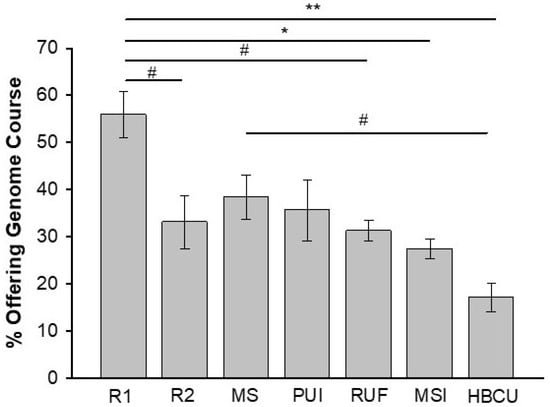
Four researchers independently evaluated course offerings at US colleges and universities that offer a 4-year biology degree. We specifically searched for upper-level, undergraduate courses on the biology of genomes that did not appear to be mainly focused on informatics methods (Table 1). The raw data from this analysis can be found in Supplementary Material. We found that, on average, 38% of US colleges and universities offer a genome biology course consistent with this definition (mean of four researchers, SEM 3.89%). There were significant variations in offerings among different types of institutions. For example, 55.9% +/− 4.9% of highly funded R1 universities offered a genome biology course to undergraduates, while only 33% +/− 5.6% of R2 institutions did. Master’s degree-granting institutions and primarily undergraduate institutions (PUIs) kept pace with doctoral institutions, with 38% +/− 4.7% and 36% +/− 6.5%, respectively, offering a genome biology course. Small regional undergraduate-focused (RUF) and minority-serving institutions (MSIs) remained close to the average, with 31% +/− 2.2% and 27% +/− 2.08%, respectively, offering such a course. Historically Black Colleges and Universities fell well below the norm, with only 17% +/− 3.1% offering this course (Figure 1). A one-way ANOVA of the differences between the university types revealed a statistically significant increase in genome courses available at R1 universities as compared to R2 (p = 0.029), RUF institutions (p = 0.015), MSIs (p = 0.004), and HBCUs (p < 0.001). A statistically significant advantage was also observed between Master’s degree-granting institutions and HBCUs. None of the other comparisons revealed statistically significant differences.
Table 1.
Rubric for course classification as ‘genome biology’.
Figure 1.
Availability of genome biology courses at United States colleges and universities. Course offerings according to college type. Bars are averages of 4 researchers’ results. Shown are highly funded Research 1 (R1) universities, moderately funded Research 2 (R2) universities, Master’s degree-granting colleges and universities, primarily undergraduate institutions (PUIs), small regional undergraduate-focused colleges (RUF), minority-serving institutions (MSIs), and Historically Black Colleges and Universities (HBCUs). Data comparison by one-way ANOVA. ** p < 0.001. * p < 0.01. # p < 0.05.
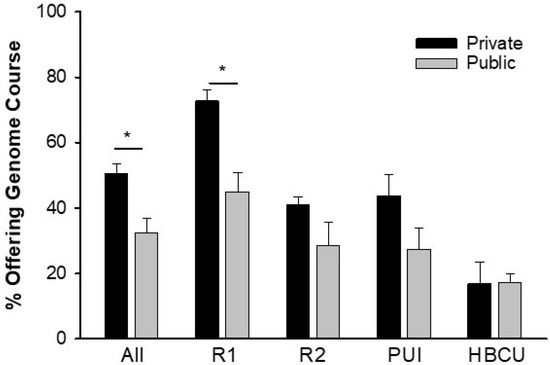
The relationship between genome biology course offerings and whether institutions were private or public was also examined. Of the 297 colleges and universities examined, 88 were private and 209 were public. As shown in Figure 2, there was a statistically significant advantage at private colleges and universities (mean = 51%, SEM = 2.9%) compared to public colleges and universities (mean = 32%, SEM = 4.3%) (p = 0.008, Student’s T). This effect was mainly driven by the differences in private versus public R1 universities. A total of 73% of private R1 universities (SEM 3.5%) offered such a course, while 45% +/− 6% of public R1 universities did (p = 0.0057). While private R2 and PUIs also showed an increase in course availability over their public counterparts, these advantages were not statistically significant.
Figure 2.
Comparison of genome biology course offerings at private versus public colleges and universities in the US. % of all colleges and universities evaluated is compared to data disaggregated by college type. Bars represent the mean of 4 researchers’ results. Error bars represent S.E.M. * p < 0.01, Student’s T-Test.
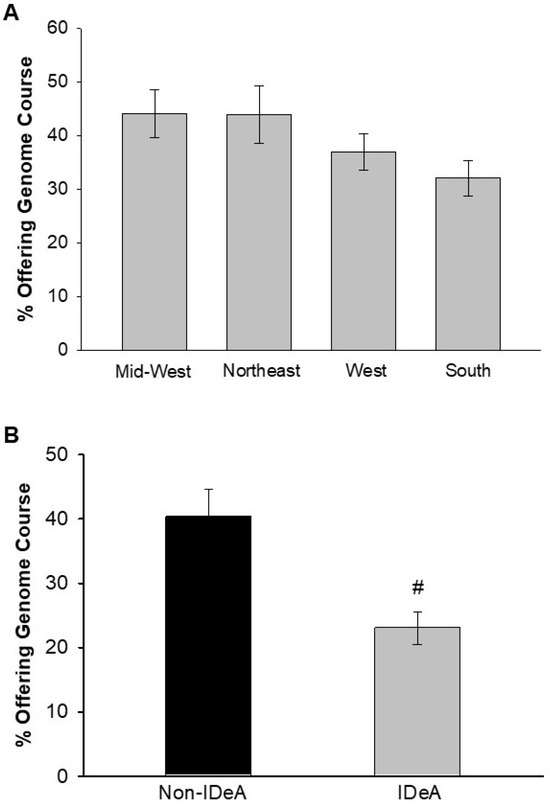
Finally, regional differences in genome biology course offerings were examined. Midwestern and northeastern schools were most likely (44% +/− 4% and 44% +/− 5.4%, respectively) to offer genome biology education to undergraduates. A total of 37 +/− 3.5% of western schools offered such a course. In total, 32% +/− 3.3% of southern institutions list a genomics course for undergraduates. A one-way ANOVA comparison revealed no statistically significant differences between the regions in genome biology course listings. These data are summarized in Figure 3A.
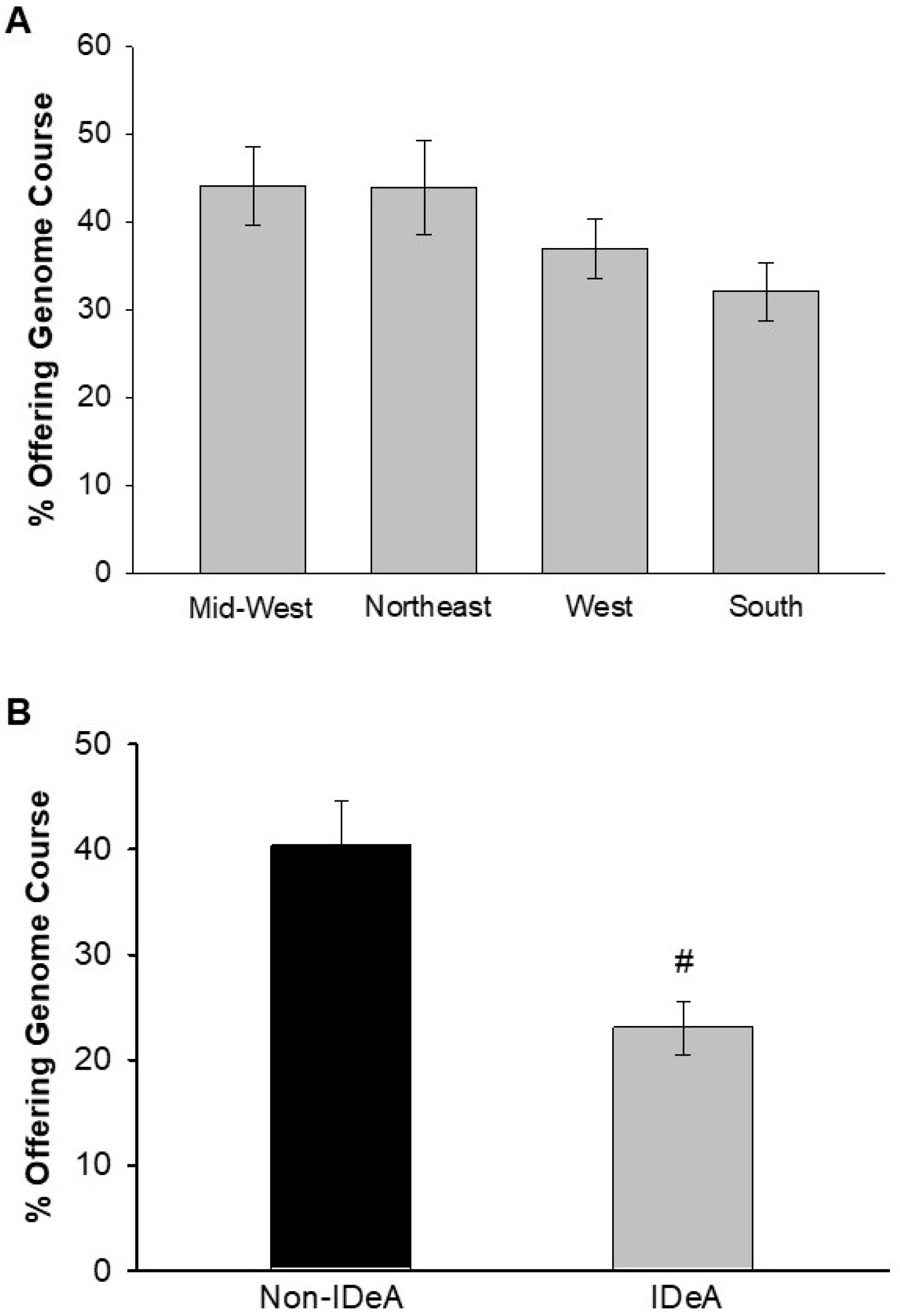
Figure 3.
Comparison of genome biology course offerings according to US regions. (A) Colleges and universities were compared by US census region. No statistically significant differences were found between the regions (one-way ANOVA). (B) IDeA regions, defined by lower-than-normal NIH funding for the area’s population, were compared to non-IDeA regions. # p < 0.05, Mann–Whitney.
We hypothesized that disparities might be associated with the unequal distribution of research funds across the country. The National Institutes of Health qualifies a state as an ‘IDeA’ (named for the Institutional Development Award program) state if it receives less research funding than would be expected based on population. When IDeA states and territories were grouped, it was indeed found that only 23% +/− 2.6% of IDeA state-located institutions offered genome biology education, as compared to 40% +/− 4.3% in the remainder of the nation (Figure 3B). Thus, genome biology education is offered to undergraduate students in about half of the US colleges and universities evaluated, but there are significant differences in whether these courses are taught, based on the classification of the university, whether it is private or publicly funded, and the amount of associated research funding.
4. Discussion
Separating dedicated conceptual genome biology courses from informatics-based study allows us to distinguish ‘job-skills’-focused learning from learning focused on the potential for these skills to be applied to major research questions in science. By this reasoning, offering strictly computational learning prepares students to work in a research group, but not to lead it and to contribute conceptually to the research questions. This is an issue almost specific to omics approaches. In most other areas of biology, we teach understanding of concepts long before students have the opportunity to apply those concepts to research. Making science more experiential has in fact been a major effort of biology educators [3]. Therefore, the implementation of computational methods prior to conceptual understanding is a potential advantage to genomics courses from the learner’s viewpoint. However, to stop at informatics course offerings falls short of preparing the next generation of scientists to realize the full potential of emerging technologies. Future biologists should of course be able to use algorithms to identify patterns, but generating and testing hypotheses based on the observed patterns is necessary for biologists to advance research. Merging informatics learning with this type of thinking would strengthen students’ preparedness for their careers.
According to our findings, course availability follows funding, with the majority of highly funded R1 institutions offering a conceptual, usually literature-based, genome biology course. However, IDeA states and regions, which receive less NIH funding per capita, have significantly fewer genome biology course offerings. It is unsurprising that funding research has paid dividends to undergraduate biology education. Large, R1 institutions often have multiple biology majors with specific focuses, and also have expert research faculty that can design diverse, advanced courses. Further, institutions that grant doctorates offer graduate courses that can be gradually made available to undergraduate students. By comparison, smaller, less-funded schools do not have the extensive community of faculty, postdoctoral fellows or graduate peers that may foster the incorporation of such a course. Despite disadvantages, our results reveal that laudable efforts have been made by all types of US institutions to implement such courses. This signifies a general agreement among biologists that this type of course should be included in the undergraduate biology major.
The observation that HBCUs have the fewest course offerings in this area likely reflects a number of factors. First, it is important to note that HBCUs were established at a time in US history when segregated education was the law in the US. Following the end of segregation, these institutions were continually deeply underfunded [19,20,21], a problem that persists today [22]. Because our data show a strong relationship between funding and advancement of genome biology study at universities, it is likely that the persistent lack of resources at HBCUs plays a role in this result. The observed trend may also be influenced by the facts that HBCUs are largely located in the southeastern United States, and tend to educate smaller, regional groups of students. According to our data, the latter factors were both predictive of fewer course offerings. This finding is important because black students are under-represented in STEM fields in the US [23,24]. HBCUs contribute a significant proportion of the country’s black STEM professionals [25,26,27]. Thus, policies to expand molecular biology education at HBCUs could pay dividends in the form of increased diversity in the STEM workforce.
In contrast to HBCUs, minority-serving institutions, which train a significant amount of minority students and include predominantly black institutions, did not significantly differ from most other institution types. These institutions are spread throughout the US, and do not share the same history of direct educational suppression that black, southern institutions experienced. However, bolstering genomics education at these institutions is still needed. According to our data, only 27% of MSIs studied offer this opportunity, compared to 73% of private R1 students.
Whether students go from their undergraduate biology education to medical or graduate school or to the workforce, understanding the techniques, data, and potential of omics approaches puts them at a major advantage. This work shows that only about half of US colleges and universities are offering a dedicated lecture course that immerses students in discussion of the methods, data, and potential of the high-throughput viewpoint. Further, these courses are not equally available across the US, with clear regional and racial disparities in offerings. The disparities observed in genome biology courses underscore a specific example of the broader inequities in STEM education across the US.
5. Conclusions
While biology education is always evolving with scientific achievement, the genomics revolution came about swiftly and with high impact on every field touched by DNA. Thus, the measurement of how education has kept up with the science in this area is telling for the future of the US STEM workforce. These data indicate that training in this area is most accessible to those that attend high-priced, exclusive institutions. Work and advanced-study opportunities for students educated elsewhere may be limited by the lack of training. This study strongly suggests that policymakers could better prepare the STEM workforce in the US by addressing these inequities.
Supplementary Materials
The following supporting information can be downloaded at: https://www.mdpi.com/article/10.3390/higheredu5030077/s1, Table S1: GenomeBioAnalysis.xls.
Author Contributions
Conceptualization, L.R.E.; methodology, K.D.C., A.K.K., N.A.M. and L.R.E.; formal analysis, L.R.E.; data curation, L.R.E.; writing—original draft preparation, L.R.E. All authors have read and agreed to the published version of the manuscript.
Funding
This research received no external funding.
Institutional Review Board Statement
Not applicable.
Informed Consent Statement
Not applicable.
Data Availability Statement
Data contained within the article and Supplementary Files.
Acknowledgments
During the preparation of this manuscript/study, the authors used OpenAI (GPT 5.5) for the purposes of generating lists of colleges and universities that belong to each category. The authors have reviewed and edited the output and take full responsibility for the content of this publication.
Conflicts of Interest
The authors declare no conflicts of interest.
Abbreviations
The following abbreviations are used in this manuscript:
| R1 | Research 1 Institution |
| R2 | Research 2 Institution |
| MSI | Minority-Serving Institution |
| RUF | Regional Undergraduate-Focused |
| PUI | Primarily Undergraduate Institution |
| HBCU | Historically Black College and University |
References
- Smith, M.K.; Wood, W.B. Teaching Genetics: Past, Present, and Future. Genetics 2016, 204, 5–10. [Google Scholar] [CrossRef] [Scilit] [PubMed]
- Shubinski, B. The Rockefeller Foundation and the Birth of Molecular Biology. Available online: https://Resource.Rockarch.Org/Story/Birth-and-Development-of-Molecular-Biology-Field-Rockefeller-Foundation/ (accessed on 18 July 2026).
- American Association for the Advancement of Science. Vision and Change in Undergraduate Biology Education: A Call to Action; American Association for the Advancement of Science: Washington, DC, USA, 2011. [Google Scholar]
- Reed, L.K.; Kleinschmit, A.J.; Buonaccorsi, V.; Hunt, A.G.; Chalker, D.; Williams, J.; Jones, C.J.; Martinez-Cruzado, J.-C.; Rosenwald, A. A Genomics Learning Framework for Undergraduates. PLoS ONE 2025, 20, e0313124. [Google Scholar] [CrossRef] [Scilit] [PubMed]
- Buonaccorsi, V.; Peterson, M.; Lamendella, G.; Newman, J.; Trun, N.; Tobin, T.; Aguilar, A.; Hunt, A.; Praul, C.; Grove, D.; et al. Vision and Change through the Genome Consortium for Active Teaching Using Next-Generation Sequencing (GCAT-SEEK). CBE Life Sci. Educ. 2014, 13, 1–158. [Google Scholar] [CrossRef] [Scilit] [PubMed][Green Version]
- Dinsdale, E.; Elgin, S.C.R.; Grandgenett, N.; Morgan, W.; Rosenwald, A.; Tapprich, W.; Triplett, E.W.; Pauley, M.A. NIBLSE: A Network for Integrating Bioinformatics into Life Sciences Education. LSE 2015, 14, le3. [Google Scholar] [CrossRef] [Scilit] [PubMed][Green Version]
- Elgin, S.C.R.; Hauser, C.; Holzen, T.M.; Jones, C.; Kleinschmit, A.; Leatherman, J. The GEP: Crowd-Sourcing Big Data Analysis with Undergraduates. Trends Genet. 2017, 33, 81–85. [Google Scholar] [CrossRef] [Scilit] [PubMed]
- Mathur, V.; Arora, G.S.; McWilliams, M.; Russell, J.; Rosenwald, A.G. The Genome Solver Project: Faculty Training and Student Performance Gains in Bioinformatics. J. Microbiol. Biol. Educ. 2019, 20, 10–1128. [Google Scholar] [CrossRef] [Scilit] [PubMed]
- Rele, C.P.; Sandlin, K.M.; Leung, W.; Reed, L.K. Manual Annotation of Drosophila Genes: A Genomics Education Partnership Protocol. F1000Research 2022, 11, 1579. [Google Scholar] [CrossRef] [Scilit] [PubMed]
- Rosenwald, A.G.; Pauley, M.A.; Welch, L.; Elgin, S.C.R.; Wright, R.; Blum, J. The CourseSource Bioinformatics Learning Framework. LSE 2016, 15, le2. [Google Scholar] [CrossRef] [Scilit] [PubMed]
- Sargent, L.; Liu, Y.; Leung, W.; Mortimer, N.T.; Lopatto, D.; Goecks, J.; Elgin, S.C.R. G-OnRamp: Generating Genome Browsers to Facilitate Undergraduate-Driven Collaborative Genome Annotation. PLoS Comput. Biol. 2020, 16, e1007863. [Google Scholar] [CrossRef] [Scilit] [PubMed]
- Hanauer, D.I.; Graham, M.J.; Arnold, R.J.; Ayuk, M.A.; Balish, M.F.; Beyer, A.R.; Butela, K.A.; Byrum, C.A.; Chia, C.P.; Chung, H.-M.; et al. Instructional Models for Course-Based Research Experience (CRE) Teaching. CBE Life Sci. Educ. 2022, 21, ar8. [Google Scholar] [CrossRef] [Scilit] [PubMed]
- Hatfull, G.F. Innovations in Undergraduate Science Education: Going Viral. J. Virol. 2015, 89, 8111–8113. [Google Scholar] [CrossRef] [Scilit] [PubMed][Green Version]
- Heller, D.M.; Sivanathan, V.; Asai, D.J.; Hatfull, G.F. SEA-PHAGES and SEA-GENES: Advancing Virology and Science Education. Annu. Rev. Virol. 2024, 11, 1–20. [Google Scholar] [CrossRef] [Scilit] [PubMed]
- Ouyang, L.; Zhang, H.; Zhang, X.; Wu, H. Genomics Course Design and Combined Teaching Strategy to Enhance Learning Initiatives in Classroom. Biochem. Mol. Biol. Educ. 2019, 47, 632–637. [Google Scholar] [CrossRef] [Scilit] [PubMed]
- Prost, S.; Winter, S.; De Raad, J.; Coimbra, R.T.F.; Wolf, M.; Nilsson, M.A.; Petersen, M.; Gupta, D.K.; Schell, T.; Lammers, F.; et al. Education in the Genomics Era: Generating High-Quality Genome Assemblies in University Courses. Gigascience 2020, 9, giaa058. [Google Scholar] [CrossRef] [Scilit] [PubMed]
- Smith, J.J.; Wiley, E.A.; Cassidy-Hanley, D.M. Tetrahymena in the Classroom. Methods Cell Biol. 2012, 109, 411–430. [Google Scholar] [CrossRef] [Scilit] [PubMed]
- Wang, J.T.H. Course-Based Undergraduate Research Experiences in Molecular Biosciences-Patterns, Trends, and Faculty Support. FEMS Microbiol. Lett. 2017, 364, fnx157. [Google Scholar] [CrossRef] [Scilit] [PubMed][Green Version]
- Allen, W. The Color of Success: African-American College Student Outcomes at Predominantly White and Historically Black Public Colleges and Universities. Harv. Educ. Rev. 1992, 62, 26–45. [Google Scholar] [CrossRef] [Scilit]
- Kim, M.M.; Conrad, C.F. The Impact of Historically Black Colleges and Universities on the Academic Success of African-American Students. Res. High Educ. 2006, 47, 399–427. [Google Scholar] [CrossRef] [Scilit]
- Kim, M.M. Historically Black vs. White Institutions: Academic Development among Black Students. Rev. High. Educ. 2002, 25, 385–407. [Google Scholar] [CrossRef] [Scilit]
- NEA. HBCU 2023 Update: Continued Crisis for HBCUs; National Education Association: Washington, DC, USA, 2023; p. 7. [Google Scholar]
- Chang, M.J.; Eagan, M.K.; Lin, M.H.; Hurtado, S. Considering the Impact of Racial Stigmas and Science Identity: Persistence among Biomedical and Behavioral Science Aspirants. J. High. Educ. 2011, 82, 564–596. [Google Scholar] [CrossRef] [Scilit]
- Barr, D.A.; Gonzalez, M.E.; Wanat, S.F. The Leaky Pipeline: Factors Associated with Early Decline in Interest in Premedical Studies Among Underrepresented Minority Undergraduate Students. Acad. Med. 2008, 83, 503–511. [Google Scholar] [CrossRef] [Scilit] [PubMed]
- Gasman, M.; Smith, T.; Ye, C.; Nguyen, T.-H. HBCUs and the Production of Doctors. AIMS Public Health 2017, 4, 579–589. [Google Scholar] [CrossRef] [Scilit] [PubMed]
- Rodríguez, J.E.; López, I.A.; Campbell, K.M.; Dutton, M. The Role of Historically Black College and University Medical Schools in Academic Medicine. J. Health Care Poor Underserved 2017, 28, 266–278. [Google Scholar] [CrossRef] [Scilit] [PubMed]
- Capers, Q.; Way, D.P. Academic and Post-Graduate Performance of African American Medical Students by Category of Premed Institution: Historically Black vs. Predominantly White Institutions. J. Health Care Poor Underserved 2015, 26, 617–630. [Google Scholar] [CrossRef] [Scilit] [PubMed]

Disclaimer/Publisher’s Note: The statements, opinions and data contained in all publications are solely those of the individual author(s) and contributor(s) and not of MDPI and/or the editor(s). MDPI and/or the editor(s) disclaim responsibility for any injury to people or property resulting from any ideas, methods, instructions or products referred to in the content. |
© 2026 by the authors. Licensee MDPI, Basel, Switzerland. This article is an open access article distributed under the terms and conditions of the Creative Commons Attribution (CC BY) license.