


Abstract
Active citizenship is a key goal of higher education. However, limited empirical evidence exists on how learning management approaches support legal literacy and citizen participation among university students. This research lacuna was addressed by examining whether a legal literacy enhancement program, incorporating creativity-based learning and gamification, was related to changes in legal literacy and active citizenship using a quasi-experimental pre-test–post-test design with follow-up assessment. The sample comprised 40 undergraduate students, obtained by purposive sampling. The classroom was divided into the experimental group (n = 20) and the control group (n = 20) based on their timetables and the lecturer’s readiness. The experimental group received activities as scheduled for four weeks. The program was designed to enhance their experience-based learning, problem-solving, and enthusiastic participation through creative learning activities and gamification elements. Legal literacy forms and a self-assessment form on active citizenship were used to collect the data with mixed-design ANOVA used for data analysis. The results revealed that legal literacy and active citizenship in the experimental group were significantly higher than those in the control group. There was a significant coeffect between group and time (Group × Time interaction effect) on legal literacy, was well as on active citizenship. Changes were observed in the post-test and follow-up phases. This provided preliminary evidence that the program was associated with increased legal literacy and active citizenship during the short-term follow-up period. The experimental group also showed a higher awareness of civic responsibility and participation in social issues.
1. Introduction
A university education prepares undergraduate students for employment and for responsible participation in a democratic society. In highly complex social, political, and technological environments, higher-education institutions face greater pressure to develop students who are capable of critical assessment, understanding their own rights and duties, and participating in creative citizenship [1,2]. In this context, active citizenship has become a vital educational outcome, encompassing the knowledge, characteristics, and participatory competence required to engage in a democracy with social responsibility. These goals are closely aligned with the United Nations Sustainable Development Goal 16, which focuses on justice, cross-sector participation, citizen participation, and strong institutions [3].
Despite the widespread recognition of the importance of active citizenship, many universities face challenges in transforming these goals into meaningful learning experiences. Educational management of citizenship emphasizes factual knowledge rather than developing practical competence that encourages students’ participation in real-world public issues. The students embrace a basic understanding of citizenship but lack confidence, critical thinking, and the required skills to apply this knowledge in daily life [4].
One of the dimensions receiving increased attention in the circle of civic education is legal literacy. This refers to individuals’ ability to access, understand, assess, and apply legal information to support decision-making based on the information obtained, and to perform their civic duties responsibly. From the perspective of active citizenship, legal literacy is not limited to legal knowledge; it also includes an understanding of how a legal system plays key roles in shaping ways of life, protecting rights, and generating mechanisms for justice and responsibility. Individuals with high legal literacy are more effective at exercising their rights, fulfilling civic duties, and participating in democratic processes [5,6].
Several higher-education institutions have limited opportunities for legal literacy development. Instructional management primarily relies on lectures that highlight perceived content rather than experience-based participation. The students understand the legal principles in conceptual terms, but they struggle to apply this knowledge to real-world social situations that require ethical reasoning, problem-solving, and decision-making. This challenge arises in contexts where citizenship and law education are officially included in curricula, but not continuously supported through active learning management approaches and participation.
Previous research has identified active learning as an effective approach to enhance legal literacy and citizen participation, with creativity-based learning and gamification gaining increasing interest. Creativity-based learning encourages knowledge creation through searching, collaboration, reflection, and problem-solving. It connects intangible concepts to real-life experiences [7,8]. Gamification uses motivation-related elements such as challenges, progress levels, feedback, and rewards to increase participation and determination in learning activities [9]. Several studies concluded that learning environments that used gamification enhanced advanced thinking, problem-solving, and civic competence [10,11], whereas creative instruction approaches enhanced insights and learning independence [12].
The efficiency of integrating both approaches is strongly related to civic education. Creativity-based learning provides opportunities to explore complex issues involving citizens and law through a problem-solving process that closely mirrors real-life situations. Gamification encourages motivation and continuous participation throughout the learning process, creating a meaningful learning environment with intellectual challenge at the individual level. However, empirical evidence on the effectiveness of such integration remains limited. Previous research mainly examined creativity-based learning or gamification separately, focusing on short-term outcomes or relying on student perceptions, with few studies integrating interventions to enhance legal literacy and active citizenship among university students, particularly in Southeast Asian higher-education contexts.
To address this research lacuna, this study developed and assessed a legal literacy enhancement program. Creativity-based learning and gamification were used to support legal literacy and active citizenship among undergraduate students, drawing on experience-based learning theory, self-determination theory, and civic education. The program was designed to facilitate the students’ participation in realistic legal problem-solving, with their motivation, participation, and collaborative searching also reinforced. Results suggested that creativity-based learning fostered insights into law through direct experience, whereas gamification maintained participation through motivation mechanisms. Integrating these two aspects supported legal literacy and, in turn, fostered active citizenship. A quasi-experimental design was employed, using a pre-test–post-test format with a follow-up assessment. The objective of this study was to examine changes associated with the integrated learning management framework in higher education.
1.1. Active Citizenship
Active citizenship refers to the enthusiasm of citizens, people, and community members with regard to their intention to participate and play a role in activities and society due to their sense of responsibility. The study participants respected the law and the principles of democracy, protected human rights, had responsibility, supported sustainable and beneficial development, were of their rights, and attentively participated in activities that promoted a positive quality of life in society [13,14,15]. Active citizenship can be divided into three key components: (1) social participation, which refers to individuals with an interest in society, social responsibility, and adherence to the law and proper values for the society in which they live together; (2) social responsibility, which refers to individuals performing their duties as well-mannered citizens, participating in charities, volunteering for activities, having volunteer spirit, and participating in political decision-making; (3) citizenship literacy, which refers to individuals having knowledge and understanding of the problems and major issues associated with both Thai society and the global society. These individuals can also decide to choose and express their critical thinking with creativity to find causes and suggest correct solutions. There is no single technique for children and youths to develop their active citizenship; this arises from experiences in their daily life through interactions within and outside educational environments. Active citizenship can be acquired by learning and practicing through classroom activities and extracurricular activities, and continuously cultivated by socialization.
1.2. Legal Literacy
Legal literacy has become more important over the past decade due to increasingly complicated challenges in society such as social inequality, digital transformation, and a larger number of lawsuits associated with human rights. Legal literacy is a key foundation of active citizenship that gives individuals the ability to protect their rights and those of others [16]. Legal literacy attempts to meet the necessity of providing information and guidelines to those who have recently entered the justice system, and help individuals and communities understand their rights and duties. Legal literacy is based on the development of a basic legal framework associated with the learning, comprehension, and evaluation of the law, the legal system, and legal resources, with discretion to strengthen and promote the use of individuals’ legal efficiency in real-life situations [17].
The term legal literacy was first used to describe the components of studying professional law and the ability to comprehend and write legal contentions, judgments, and laws or rules that are the responsibilities of legal entities [6]. The American Bar Association [18] defines legal literacy as the ability to use the legal system efficiently and to set strategies for improvement. Similarly, the Canadian Bar Association [19] defines legal literacy as the ability to comprehend wording in legal contexts, draw conclusions from those words, and put them into practice. In this study, legal literacy refers to the ability of individuals to comprehend rights, duties, laws, and the justice system, including the use of such knowledge to take proper actions in daily life. This ability is not limited to remembering legislation and provisions, but also includes the interpretation, evaluation, and application of skills in real-life situations for resolving legal problems.
Many relevant studies have been conducted overseas, but empirical research on legal literacy at the level of higher education in Thailand is sparse, with most papers concentrating on theories rather than creating experiences that directly connect to the daily lives of students. Moreover, there is no systematic integration between civic education and legal literacy. Therefore, this study was conducted to fill this research lacuna.
1.3. Creative-Based Learning
Creative-based learning originates from the principles of problem-based learning. This process encourages students to think outside of the box to question and create answers through imagination, using their knowledge and experiences to efficiently create new ideas through actions [20,21]. Instructors and teachers direct the students to maximize their efficacy in learning how to obtain the most satisfactory outcomes. Five stages of creative learning have been identified. First, arousing interest to draw students’ attention to lessons is a key factor for the success of learning management. Second, hypothetical problems are created. The students are divided into groups according to their interests. They then discuss the problem as a group to derive the best solution. Third is research and thinking, which takes the longest time. Instructors or teachers serve as advisors, while students are responsible for studying, conducting research, and making their own decisions. Fourth, presentations are utilized to verify and comprehend the data obtained. Finally, an evaluation is carried out to assess the outcomes of all the activities. A review of previous research indicated that most studies found that creative-based learning helped to develop undergraduate students’ creative thinking skills. Poolsombat et al. [22] reported that a blended creative-based active learning model in computer and information technology courses enhanced students’ creative thinking through experiential activities, creative problem-solving, and collaborative teamwork. Similarly, Galea et al. [21] reported increases in participants’ creativity following creative-based learning (CBL), providing evidence that CBL methodology is a valid approach for cultivating creative skills. However, creative-based learning has not been applied to the development of legal literacy and active citizenship among Thai undergraduate students.
1.4. Gamification
Gamification involves the application of the basic principles of gaming mechanism design to the learning process. This approach increases the level of attention among participants [23]. The mechanisms used to strengthen active citizenship consist of points, levels, badge achievements, virtual goods, leaderboards, and teammates in educational contexts rather than games. This efficient strategy improves student motivation and learning outcomes [24]. Gamification in class is generally divided into two types as: (1) topic-specific gamification that uses games for fun instruction or specific perspectives through lessons as missions, using games such as MS Kodu and MIT’s Scratch; (2) classroom gamification in which the entire classroom is used as a competitive game. Learning activities are assigned as missions that require investigation to search for answers. These activities can be compared to short games for learning and collecting points to compete with classmates through leaderboards [11]. Students create their own avatars and collect experience points (XP) to increase their levels through participation [25,26].
This technique provides a fun and motivating atmosphere to promote attention to learning. Nguyen-Viet et al. [27] surveyed 225 university students and reported that gamified instruction enhanced learning outcomes by elevating engagement, satisfaction, and intrinsic motivation. Complementing these results, Hanifah et al. [11] concluded their systematic review by stating that gamification-based learning is not merely a motivational lever but a pedagogically robust strategy for developing comprehensive civic competencies. However, this educational concept took longer than regular learning activity management and required a computer-based system as a tool to manage activities. Using gamification in education continues to be an interesting concept that is expected to become more popular in the future.
Legal literacy underpins active citizenship, but many undergraduates find legal concepts abstract, procedural, and disconnected from everyday civic life. Traditional lecture-based formats rarely cultivate the motivation, agency, and problem-solving needed to apply law in real-life contexts. Gamification can increase engagement and persistence, while creative learning builds critical and participatory competencies, suggesting that an integrated, experiential approach could translate legal knowledge into civic action more effectively than conventional instruction. However, there is a clear research gap. Most legal literacy studies focus on law students or compliance training, and literature on gamification/creative learning is largely siloed in general civics, with few studies rigorously evaluating integrated gamified–creative interventions for legal literacy among non-law undergraduates. The existing studies are also typically descriptive and short-term, lacking control groups, validated outcome measures, or behavioral indicators of active citizenship. This study addressed these gaps by developing and evaluating a structured program that fused creative learning with gamified mechanics and then assessed its impact on legal literacy and its subsequent translation into active citizenship among the undergraduate population. Filling this research lacuna contributes valuable insights to the fields of legal education, civic pedagogy, and gamification, providing a scalable model for fostering a more just and participatory society.
1.5. Theoretical Framework and Conceptual Model
Active citizenship requires more knowledge than just being a citizen. However, it is up to the abilities of individuals to understand social issues, to use their rights with responsibility, and to creatively participate in democratic processes. In this context, legal literacy can be defined as a basic competence that enables individuals to access, interpret, assess, and apply legal information to support their judgment and civic duties based on the data/information obtained. Those with high legal literacy are better prepared to understand their rights and duties, to assess public issues with judgment, and to participate in citizenship and democratic processes efficiently. Therefore, enhancing legal literacy is a crucial mechanism for developing active citizenship.
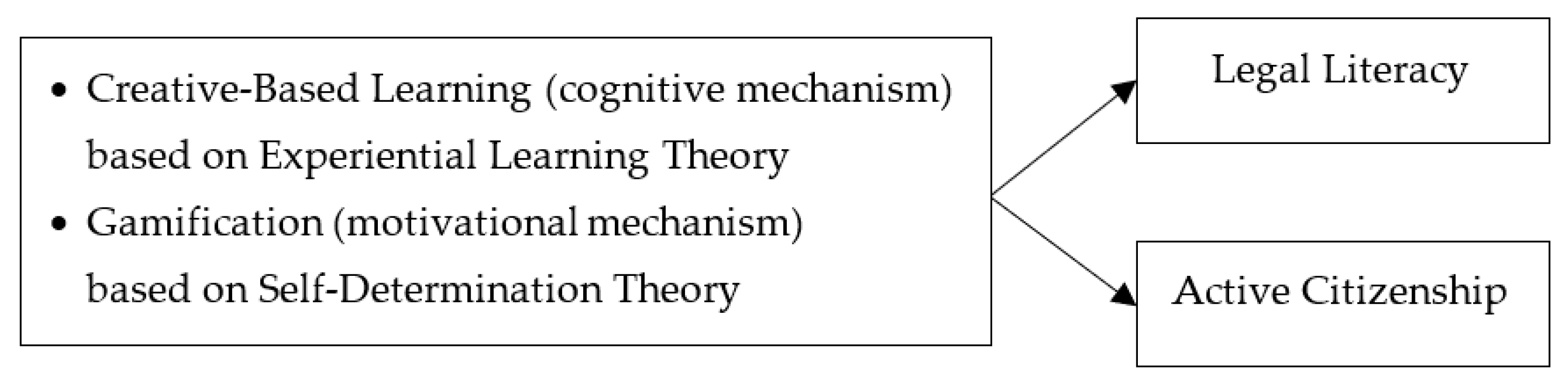
This study proposed that creativity-based learning and gamification supported legal literacy through educational mechanisms consistent with experiential learning theory and creativity-based learning. This offered an opportunity for students to search for information, solve problems, work together, and show their results. The students were encouraged to apply legal concepts in real-world situations rather than merely remembering factual content. Self-determination theory explains that elements of gamification such as challenges, feedback, progress levels, and collaborative missions, support students’ basic needs for autonomy, competence, and relatedness. These maintain motivation and continuous participation throughout the learning process. As expected, integrating both approaches provided a learning experience associated with more profound legal literacy and ongoing learning.
From the perspectives of civic studies, meaningful participation is the core of active citizenship development. The integration of creativity-based learning and gamification gave the students more opportunities to investigate legal issues through realistic scenarios, while enhancing their interest and motivation to learn throughout the project. The main hypothesis was posited that active citizenship served as a proximal educational outcome and connected innovative learning experience to wide-ranging political outcomes. The integration of creative-based learning and gamification was expected to be associated with improvements in legal literacy and promote the development of active citizenship. Figure 1 presents the conceptual model guiding this study.
Figure 1.
Theoretical framework linking creative-based learning, gamification, legal literacy, and active citizenship.
1.6. Aim of the Study
This study examined whether a legal literacy enhancement program using creativity-based learning and gamification was associated with improvement in legal literacy and active citizenship among undergraduate students. The study also viewed legal literacy as the basic efficiency that connected innovative learning experiences to wide-ranging political outcomes. Empirical evidence was presented on the roles of instructional innovations in preparing knowledgeable, responsible citizens to effectively engage in creative participation in contemporary democratic society. This study asked the research question: To what extent do legal literacy and active citizenship change over time among undergraduate students participating in a legal literacy program integrating creative-based learning and gamification compared with students receiving conventional instruction? Two hypotheses were tested as:
- There will be a significant Group × Time interaction for legal literacy scores, with changes in legal literacy across the pre-test, post-test, and follow-up assessment differing between the experimental and control groups. Students participating in the legal literacy program integrating creative-based learning and gamification are expected to demonstrate greater increases in legal literacy from pre-test to post-test, with these improvements maintained at the follow-up assessment, compared with students receiving conventional instruction.
- There will be a significant Group × Time interaction for active citizenship scores, with changes in active citizenship across the pre-test, post-test, and follow-up assessment differing between the experimental and control groups. Students participating in the legal literacy program integrating creative-based learning and gamification are expected to demonstrate greater increases in active citizenship from pre-test to post-test, with these improvements maintained at the follow-up assessment, compared with students receiving conventional instruction.
2. Materials and Methods
2.1. Research Design
This study employed a quantitative, quasi-experimental research design featuring a pre-test–post-test experimental structure with a control group and a follow-up phase. This methodology was chosen because it was not possible to fully control all the variables impacting the experimental process.
2.2. Participants
The study participants were drawn from a public university in Bangkok using purposive sampling. Eligibility criteria required that the participants be enrolled in a bachelor’s degree program and be at least 18 years old. All the participants provided written informed consent before participation. Two intact undergraduate classes were allocated to conditions based on timetable and instructor availability to minimize cross-condition contamination. The experimental class (n = 20) received the Gamified Creative Learning for Legal Literacy program, and the control class (n = 20) received traditional instruction.
2.3. Intervention Procedure
The program Gamified Creative Learning for Legal Literacy was used twice a week for four weeks. Each activity lasted 45 min, which aligned with the standard class duration (Table 1). The program was designed to develop outcomes in two aspects. The first was legal literacy, which included the accessibility, understanding, and applicability of legal information. The second was active citizenship, which focused on the awareness of citizens’ roles, social responsibility, and participation in public activities. The program originated from the integration of creative-based learning and gamification. The learning process for creativity enhancement was combined with the game-inspired mechanisms to increase motivation, participation, and experiential understanding of issues on law and citizens in realistic contexts.
Table 1.
Gamified creative learning for legal literacy.
Various forms of gamification were used in the eight activities, including points, progress levels, digital badges, leaderboards, and team-based challenges. The students were divided into small groups at the start of the project, with their experience points (XP) earned through participation in discussions, missions, collaborative problem-solving, and presentations. Progress levels were used to reflect the students’ improvements through more complex legal and civic situations in sequence. Digital badges were awarded for specific successes in the correct detection of distorted information, efficient legal reasoning, or creative participation in group discussions. Leaderboards were used to display each team’s progress and to encourage positive competition. Collaboration and success were the highlights rather than individual competitions.
To ensure the program’s validity (intervention fidelity), all the activities proceeded following the SPARK model, employing the same standards throughout the experiment duration. Each activity was designed to examine implementation at all five stages of the SPARK model. For stimulation, the students were allocated legal or civic real-life problem scenarios to pique their curiosity and initiate discussion. Problem Identification and Peer Collaboration to analyze issues covering law and citizenship were embedded in the scenarios and searching questions were formulated. To complete the Analysis and Research stage, the students examined law, regulations, digital information, and case studies to generate recommendations or evidence-based answers. For Reporting and Presentation, each team presented solution approaches through debate, infographics, or a short video. For Knowledge Evaluation and Reflection, the students completed the test and reflected on how to connect the legal concepts to civic responsibility in real-life scenarios. The instructional process is outlined in Table 2. All activities were monitored using the assessment form to evaluate the program’s regularity and accuracy. Any errors detected were reported and discussed with the lecturer to maintain the conformity of the implementation throughout the study period.
Table 2.
SPARK model and associated gamification mechanics used in the legal literacy intervention.
For transparency and consistency in gamification, experience points (XP), progress levels, and digital badges were defined following previously established standards. The students were scored based on their participation in activities and missions, collaboration, quality of legal reasoning, and problem-solving skills. Digital badges were awarded to individuals or teams who achieved ≥80% of the total score in each activity. This process was applied consistently throughout the project to ensure that gamification elements were applied objectively and impartially to all the participants.
In Activity 3: Legal Assessment of Fake News, gamification was used under the title Fact or Fake? Each team received a set of sample posts from social media and online news with different levels of distortion. For the required missions, the students assessed the reliability of sources and identified relevant legal implications under the law on computer-related crimes and dissemination of fake news/false information. They also showed evidence-based reasoning. The XP of the teams was based on analysis accuracy, legal reasoning, and collaboration. Digital badges were presented to teams with outstanding critical assessment skills. All the activities ended with a final overall discussion to compare different perspectives and to reflect on the roles of responsible digital citizens.
In Activity 7: Law for Social Change, the students’ collaborative participation focused on contemporary social problem-solving including corruption, cyberbullying, or discrimination. Each team was assigned to analyze problems, identify relevant law, suggest practical solutions, and design public awareness campaigns, culminating in a class presentation. Peer scoring was calculated as challenge points and digital badges. This activity was designed to connect legal literacy to active citizenship, providing an opportunity for students to apply their legal knowledge to real-life social problems and to be aware of their roles and responsibilities as members of a democratic society.
To control for the potential effects of extraneous variables, the experimental and control groups received the same content, objectives, duration, and evaluation criteria. They were also instructed by the same lecturer throughout the experiment. The goal of differentiating the two groups was to reflect differences in learning management approaches rather than differences in content, durations, or the lecturer’s characteristics.
2.4. Instruments
All the data were collected using a self-report questionnaire at the baseline, post-intervention, and one-month follow-up.
- The Active Citizenship Questionnaire
The Active Citizenship Questionnaire was developed by the research team based on a targeted review of the citizenship education literature and the conceptualization of active citizenship adopted in this study. The instrument consisted of 45 items across three dimensions: Community Participation (15 items), Social Responsibility (15 items), and Civic Literacy (15 items). Example items included “I contribute to volunteer activities organized by the university or society” and “I verify the reliability of social or political information before sharing it.” Responses were recorded on a five-point Likert scale ranging from 1 (never) to 5 (always). Subscale scores and total scores were calculated as the mean of the relevant items, with higher scores indicating higher levels of self-reported active citizenship. To establish content validity, the draft questionnaire was reviewed independently by three experts in legal education, citizenship education, educational measurement, as well as curriculum and instruction. Each item was evaluated using the Index of Item–Objective Congruence (IOC). Items with IOC values below the acceptable criterion (IOC < 0.50) were revised or removed based on the reviewers’ recommendations regarding clarity, relevance, and consistency with the intended construct. Following revision, all the retained items demonstrated IOC values ranging from 0.60 to 1.00, indicating satisfactory content validity. In a pilot study involving 30 undergraduate students, Cronbach’s alpha coefficients were 0.717 for Community Participation, 0.745 for Social Responsibility, 0.713 for Civic Literacy, and 0.733 for the overall scale, indicating acceptable internal consistency.
- The Legal Literacy Questionnaire
The Legal Literacy Questionnaire was developed by the research team following the operational definition of legal literacy used in this study. The instrument comprised 45 items across three dimensions: Legal Knowledge (15 items), Legal Awareness and Interpretation (15 items), and Legal Action and Empowerment (15 items). Representative items included “I understand the procedures for filing complaints when my rights are violated” and “I consider the potential legal implications of my actions before making decisions.” Responses were recorded on a five-point Likert scale ranging from 1 (strongly disagree) to 5 (strongly agree). Subscale and total scores were calculated as mean scores, with higher values reflecting higher levels of self-reported legal literacy. The questionnaire underwent an expert review by the same panel of three specialists using the IOC procedure. Items not meeting the predetermined criterion were revised based on the expert feedback concerning content relevance, wording, and conceptual clarity. The retained items demonstrated IOC values ranging from 0.60 to 1.00. Pilot testing with 30 undergraduate students produced Cronbach’s alpha coefficients of 0.744 for Legal Knowledge, 0.721 for Legal Awareness and Interpretation, 0.718 for Legal Action and Empowerment, and 0.780 for the overall instrument, indicating acceptable-to-good internal consistency.
2.5. Data Collection
Before the intervention, the participants were informed about the study objectives and procedures, and those agreeing to participate provided written informed consent. A pre-test assessing active citizenship and legal literacy was administered to determine the baseline levels. The experimental group engaged in gamified creative learning for the legal literacy program, following the five-stage model of creative-based learning integrated with gamification, while the control group received traditional instruction. After a four-week intervention period, both groups completed post-tests to measure changes in active citizenship and legal literacy. A follow-up assessment was conducted four weeks later to evaluate the sustainability of the learning outcomes. All the study procedures were approved by the Srinakharinwirot University Human Research Ethics Committee (Certificate No. SWUEC-672397), ensuring adherence to ethical research standards.
2.6. Data Analysis
The descriptive statistics utilized the mean and standard deviations, with the Shapiro–Wilk test used to establish the normality of data distribution, and the Levene test used to confirm the homogeneity of the differences. A two-way mixed-ANOVA was conducted, with time of measurement as the within-subjects factor and group (experimental vs. control) as the between-subjects factor. Bonferroni-corrected post hoc comparisons were then performed to investigate the study hypotheses. All the statistical analyses were conducted using a standard statistical software package, with the significance level set at 0.05.
A mixed analysis of variance (mixed ANOVA) was utilized to examine the efficacy of the educational program. When the assumption of homogeneity of variances is breached, this method tends to be more robust than other statistical approaches. A 2 × 3 mixed-design ANOVA was conducted to examine the differences between the control and experimental groups in active citizenship and legal literacy across three measurement points (pre-test, post-test, and one-month follow-up). The Group × Time interaction was the primary test of interest, reflecting whether the trajectory of change, relative to each group’s baseline, differed between conditions. To achieve this, one within-subjects factor (i.e., time: pre-test, post-test, and both follow-ups) and one between-subjects factor (i.e., group: control and experimental) were integrated into the data inquiry.
3. Results
Basic demographic data, including gender and age distribution provided the contextual information about the study sample. Gender distribution was equally balanced, with most of the participants between 21 and 22 years of age, consistent with the typical age range of undergraduate students.
Before the hypothesis testing, the assumptions underlying the two-factor mixed-design ANOVA were systematically evaluated. Normality was examined using the Shapiro–Wilk test, homogeneity of variance using Levene’s test, and sphericity using Mauchly’s test. For both legal literacy and active citizenship, score distributions across all subgroups satisfied the normality assumption (all p > 0.05). Levene’s test was non-significant at each measurement (all p > 0.05), indicating that the homogeneity of variance assumption was met. Mauchly’s test further confirmed that the sphericity assumption was not violated. Therefore, the unadjusted ANOVA F-statistics were retained for all subsequent analyses.
Table 3 presents the descriptive statistics and the results of the 2 × 3 mixed-design ANOVA examining the effects of group (experimental vs. control) and time (pre-test, post-test, and follow-up) on legal literacy and active citizenship.
Table 3.
Descriptive statistics for active citizenship and results of mixed ANOVA analyses.
- Legal Literacy
The 2 × 3 mixed-design ANOVA revealed significant main effects of group, F(1,38) = 6.034, p = 0.019, η2p = 0.137, and time, F = 8.155, p = 0.001, η2p = 0.306, for legal literacy. The Group × Time interaction was also statistically significant, F = 4.026, p = 0.026, η2p = 0.179, indicating that changes in legal literacy over time differed between the experimental and control groups (Table 3).
Bonferroni-adjusted between-group comparisons (Table 4) indicated no significant difference at pre-test (MD = 0.246, p > 0.05, 95% CI [−0.043, 0.536]), confirming baseline equivalence. Significant between-group differences emerged at post-test (MD = 0.324, p < 0.05, 95% CI [0.024, 0.624]), and these were sustained at follow-up (MD = 0.464, p < 0.05, 95% CI [0.162, 0.767]), with the experimental group reporting higher legal literacy scores than the control group for both measurements.
Table 4.
Bonferroni post hoc comparisons between the experimental and control groups at each measurement point.
Table 5 presents the Bonferroni-adjusted within-group comparisons for legal literacy across the three measured assessments. In the experimental group, legal literacy scores were significantly higher at the post-test phase than at the pre-test phase (MD = 0.180, p < 0.01, 95% CI [0.079, 0.281]). Likewise, follow-up scores remained significantly higher than pre-test scores (MD = 0.209, p < 0.001, 95% CI [0.099, 0.318]). No statistically significant difference was observed between the post-test and follow-up assessment (MD = 0.029, p > 0.05, 95% CI [−0.079, 0.136]), indicating that the higher self-reported legal literacy scores were maintained over the follow-up period. In the control group, legal literacy scores were also significantly higher at the post-test phase than at the pre-test phase (MD = 0.103, p < 0.05, 95% CI [0.002, 0.203]). However, no significant difference was found between the pre-test and follow-up assessment (MD = −0.009, p > 0.05, 95% CI [−0.119, 0.100]). By contrast, the follow-up scores were significantly lower than the post-test scores (MD = −0.112, p < 0.05, 95% CI [−0.220, −0.004]), suggesting that the increase observed immediately after instruction was not maintained at the follow-up assessment.
Table 5.
The Bonferroni post hoc test to compare variables at measurement times.
- Active Citizenship
A similar pattern emerged for active citizenship. The experimental group scores increased from pre-test (M = 3.711) to post-test (M = 3.892) and remained relatively elevated at follow-up (M = 3.817), whereas the control group scores remained stable across all three measurements (M = 3.643, 3.661, and 3.652, respectively). Significant main effects were observed for group, F = 4.642, p = 0.038, η2p = 0.109, and time, F = 6.366, p = 0.003, η2p = 0.143. The Group × Time interaction was also significant, F = 3.956, p = 0.028, η2p = 0.176, indicating that changes in active citizenship over time differed between the groups.
Between-group comparisons (Table 4) confirmed the baseline equivalence at pre-test (MD = 0.069, p > 0.05, 95% CI [−0.096, 0.233]). Significant differences in favor of the experimental group were observed at post-test (MD = 0.231, p < 0.01, 95% CI [0.066, 0.396]) and follow-up (MD = 0.165, p < 0.05, 95% CI [0.016, 0.314]).
Within-group comparisons (Table 5) indicated significant improvements in the experimental group from pre-test to post-test (MD = 0.181, p < 0.001) and from pre-test to follow-up (MD = 0.106, p < 0.01). The absence of a significant post-test-to-follow-up difference (MD = −0.075, p > 0.05) suggested that the improvements were maintained across the follow-up period. No significant within-group differences were observed across the measurements in the control group. These patterns concurred with a positive intervention effect; however, given the quasi-experimental design and the absence of random assignment, the findings should be interpreted as preliminary evidence of association rather than causal effects.
4. Discussion
This study examined whether a legal literacy enhancement program with creative-based learning and gamification was associated with students’ legal literacy and active citizenship. The findings provided preliminary evidence that integrating creative-based learning and gamification supported improvements in undergraduate students’ self-reported legal literacy and active citizenship. This change persisted after the post-test and follow-up phases, indicating that the self-reported positive changes in legal literacy and active citizenship were retained after the short-term follow-up phase. The results supported the efficiency of approaches using active instructional management and participation in citizenship development in the context of higher education.
Another key finding of this study was student participation in realistic activities, with emphasis on collaboration and problem-based learning. The students showed higher legal literacy at the post-test phase. No direct evidence indicated a causal relationship, but the results suggested that providing students with opportunities to analyze issues in law and citizenship in real-world contexts could support their understanding of law and practical reasoning [5,6], rather than merely treating law as an intangible regulation. The students were encouraged to analyze real-life situations, discuss aspects from different perspectives, and apply legal principles to resolve social problems in daily life. This process encouraged them to delve deeper into legal concepts and develop legal reasoning in a meaningful context. Experience-based learning theory posits that knowledge tends to last longer when students construct their own meanings through reflection and practice rather than passive actions. Therefore, the findings of this study provide fundamental evidence for the feasibility of participatory learning as a useful approach to legal literacy development in higher educational contexts.
Higher levels of active citizenship as measured by self-report are another interesting issue. Active citizenship refers to citizenship literacy and also to the abilities and willingness to participate in society and democratic responsibility [2]. The program was designed to encourage discussion, collaboration, decision-making, and problem-solving to improve citizenship development. The students gained knowledge by engaging in collaborative learning. This experience encouraged their civic conscience, social responsibility, and confidence in participating in public issues; aligning with the concept that citizenship development can derive benefits from opportunities for participation and practices, parallel to formal instruction.
The integration of creativity-based learning and gamification clarified the positive outcomes found in the experimental group. Each approach was valuable for autonomy, while the integration created mutually supportive learning conditions. Creativity-based learning facilitated searching, reflection, and knowledge creation [22], whereas gamification served as a motivation mechanism that encouraged continuous participation throughout the learning process [23,26,27]. These positive outcomes were explained by motivational mechanisms hidden in the learning environment using gamification. Self-determination theory and gamification elements (e.g., challenges, progress, instant feedback, and acceptance of success) met the basic psychological needs for competence, autonomy, and relatedness.
When these elements were integrated into collaborative and creative activities, the students tended to participate more and showed greater intellectual and emotional devotion in the learning process. This interpretation concurred with research suggesting that gamification supported learning outcomes through increased participation, satisfaction, and intrinsic motivation, serving as a key mechanism linking learning design and academic/educational outcomes [27]. The results were also consistent with research on higher education reporting that gamification-based learning increased motivation and participation, as well as student development of social competence and citizenship. These results indicated that gamification contributed to more engaging instruction as well as to conditions that supported sustained learning participation and deeper interaction [9].
The results indicated that educational management for citizenship goes beyond transferring knowledge. An environment that encourages enthusiastic participation, a sense of learning ownership, collaboration, reflection, and problem-solving connected to real-world situations is invaluable for enhancing legal literacy and active citizenship in the contemporary context of higher education. The students applied all the knowledge gained in social situations to enhance their understanding of complexities that changed over times.
This study also contributed to the body of knowledge on instructional management innovation in higher education. Despite the frequent separation between creativity-based learning and gamification, the results indicated that integrating the two approaches reinforced the development of both legal literacy and active citizenship. The discovery of positive changes in legal literacy and active citizenship, as self-reported by non-law students, deepened their understanding of the role of legal literacy as an essential element of civic studies, with evidence that the concept prepared them for informed and responsible participation in a democratic society.
Theoretically, the results provided primary evidence that legal literacy serves as a basic competence that connects innovative learning experiences to wide-ranging citizenship-related outcomes. The mediator was not directly tested, but the relationship was consistent with the proposal that legal literacy plays a key role in connecting innovative learning experiences to citizenship-related results. Future research should employ mediators and a larger sample size, with long-term follow-up to assess the feasibility of the results of this study.
Higher-education institutions seeking to produce students who can address complex social challenges, engage creatively with diverse people, and participate responsibly in democratic processes should seek to develop a learning environment that combines real-life public problems/issues, searching, creative problem-solving, and motivation-related elements. Instead of viewing citizenship as a specific subject, institutions integrating legal literacy and citizen participation into their curricula view it as a cohesive approach that connects to real-world social issues.
However, several limitations should be considered when interpreting the results. First, the sample was drawn from a single university using purposive sampling. Intact classes were assigned to conditions based on timetable and instructor availability rather than random allocation, a constraint that renders the quasi-experimental design susceptible to selection bias, pre-existing between-class differences, and unmeasured contextual influences. These factors preclude causal inference, and the findings should therefore be treated as preliminary. Future studies would benefit from randomized designs or, where randomization remains impractical, statistical controls such as ANCOVA or linear mixed-effects models to account more rigorously for baseline differences and other sources of confounding. Second, this study relied primarily on researcher-developed self-reported questionnaires to assess legal literacy and active citizenship. The instruments demonstrated satisfactory content validity and internal consistency reliability, but additional evidence of construct validity is required. The measures assessed the students perceived legal literacy and active citizenship rather than objective legal competence or observed civic behavior. Consequently, the findings should be interpreted as reflecting participants’ self-perceptions rather than direct evidence of actual legal reasoning ability or civic engagement. Future research should incorporate validated instruments, performance-based assessments, behavioral indicators, and multi-method data sources to strengthen measurement validity and provide a more comprehensive evaluation of these constructs. Third, the duration of the program and follow-up was short, and whether the outcomes will stand the test of time remains unknown.
The outcome variables were assessed by the specific tool used in this study. Despite the acceptable content validity and internal reliability, additional evidence about structural validity is required. This tool reflected perceived learning about legal literacy and active citizenship rather than measuring legal abilities or directly observed civic behaviors. Therefore, conclusions about actual citizen participation, legal decision-making abilities, or concretely measurable legal competence remain tentative. Future research should use tested tools, authentic assessments, behavioral indicators, and data from multiple sources to strengthen the measurement quality.
This study presented primary evidence that a legal literacy program incorporating creativity-based learning and gamification, supported the development of legal literacy and active citizenship. This was measured by self-reported questionnaires at the undergraduate level. However, due to the limitations of the quasi-experimental design, the small sample size, and the reliance on self-assessment data, the results should be interpreted carefully and not regarded as evidence to confirm causal relationships. The findings suggested that an instructional management approach, emphasizing participation and collaboration with students as the center was suitable for citizenship studies in higher education. Future research should include larger sample sizes, a randomized design, longer follow-up periods, validation tools, and behavioral indicators to assess security and broader generalization abilities. Higher-education institutions are now seeking new approaches to prepare students for participation in a more complex democratic society. Integrating legal literacy with creative learning experience and gamification is an efficient approach that requires more detailed evaluation in future studies.
5. Conclusions
This study presented preliminary empirical evidence that a legal literacy program using creativity-based learning and gamification was positively associated with improvements in legal literacy and active citizenship among Thai undergraduate students. This instructional management innovation encouraged critical reflection and provided opportunities for the students to apply legal knowledge in practice.
The results reflected legal literacy as a key competence that connected active learning experiences to wide-ranging citizenship-related results. Despite the need for careful interpretation given the identified limitations, the results provide primary evidence supporting the value of creative learning and gamification integrated with educational management for citizenship.
Universities play important roles by preparing students to participate in an ever more complex society driven by digital technology. Potential approaches to develop citizens with higher literacy, responsibility, and creative participation in society include integrating legal literacy into realistic learning environments, encouraging collaboration, and positioning students as the center of learning.
Author Contributions
Conceptualization, P.M., N.P. and P.P.; methodology, P.M. and P.P.; software, P.M.; validation, P.M., N.P. and P.P.; formal analysis, P.M.; investigation, P.M.; resources, N.P.; data curation, P.P.; writing—original draft preparation, P.M. and P.P.; writing—review and editing, P.P.; visualization, P.P.; supervision, P.P.; project administration, P.P.; funding acquisition, P.M. All authors have read and agreed to the published version of the manuscript.
Funding
This research was funded by a grant from the Graduate School, Srinakharinwirot University.
Institutional Review Board Statement
The study was conducted in accordance with the Declaration of Helsinki, and approved by the Ethics Committee of Srinakharinwirot University (protocol code SWUEC-672397 and date 23 July 2024).
Informed Consent Statement
Before enrolling in the study, participants were fully informed about the study’s aims, procedures, potential risks, and expected benefits. Participation was voluntary, and students were assured that choosing not to participate or withdrawing from the study at any point would have no consequences for their academic progress, course grades, or institutional standing.
Data Availability Statement
The article is derived from the corresponding author’s doctoral research, which was conducted under the supervision of the co-author.
Acknowledgments
The authors sincerely thank all individuals and organizations who contributed to this study through their valuable support and assistance. All individuals acknowledged in this section have provided their consent to be acknowledged.
Conflicts of Interest
The authors declare no conflicts of interest.
Abbreviations
The following abbreviations are used in this manuscript:
| EG | Experimental group |
| CG | Control group |
| M | Mean |
| SD | Standard deviation |
References
- Heggart, K. Citizenship Education in Higher Education. In An Introduction to Civics and Citizenship Education: A Machine-Generated Literature Overview; Springer Nature: Singapore, 2024; pp. 87–104. [Google Scholar]
- Jerome, L.; Hyder, F.; Hilal, Y.; Kisby, B. A systematic literature review of research examining the impact of citizenship education on active citizenship outcomes. Rev. Educ. 2024, 12, e3472. [Google Scholar] [CrossRef] [Scilit]
- Aasim, M. Civic Education and Its Role in Promoting the Sustainable Development Goals. In Education, Technology and Sustainability; Ahamad, J., Jabbar, A., Barkati, M.G., Tabish, M., Eds.; Bluerose Publishers: London, UK, 2024; pp. 189–194. [Google Scholar]
- Mellor, S.; Kennedy, K.; Greenwood, L. Citizenship and Democracy: Australian Students’ Knowledge and Beliefs: The IEA Civic Education Study of Fourteen Year Olds; Australian Council for Educational Research (ACER): Camberwell, VIC, Australia, 2002; Available online: https://research.acer.edu.au/civics/1 (accessed on 10 June 2026).
- Freudenberg, B. Beyond Lawyers: Legal Literacy for the Future. Aust. Bus. Law Rev. 2017, 45, 387. [Google Scholar] [CrossRef] [Scilit]
- Zariski, A. Legal Literacy: An Introduction to Legal Studies; Athabasca University Press: Athabasca, AB, Canada, 2014. [Google Scholar]
- Buenadicha-Mateos, M.; Sánchez-Hernández, M.I.; González-López, O.R.; Tato-Jiménez, J.L. From engagement to achievement: How gamification impacts academic success in higher education. Educ. Sci. 2025, 15, 1054. [Google Scholar] [CrossRef] [Scilit]
- Lampropoulos, G.; Sidiropoulos, A. Impact of gamification on students’ learning outcomes and academic performance: A longitudinal study comparing online, traditional, and gamified learning. Educ. Sci. 2024, 14, 367. [Google Scholar] [CrossRef] [Scilit]
- Campillo-Ferrer, J.-M.; Miralles-Martínez, P.; Sánchez-Ibáñez, R. Gamification in higher education: Impact on student motivation and the acquisition of social and civic key competencies. Sustainability 2020, 12, 4822. [Google Scholar] [CrossRef] [Scilit]
- Villanueva, A.; Destari, D.; Riatmaja, D.S. Gamification in higher education: Enhancing student motivation and cognitive outcomes through game-based learning. J. Soc. Sci. Util. Technol. 2026, 4, 14–25. [Google Scholar] [CrossRef]
- Hanifah, H.; Suastika, I.N.; Sanjaya, D.B. A systematic review of gamification-based learning resources in civic education: Enhancing student engagement and civic competence. J. Profesi Pendidik. 2025, 4, 115–131. [Google Scholar] [CrossRef] [Scilit]
- Cremin, T.; Chappell, K. Creative pedagogies: A systematic review. Res. Pap. Educ. 2021, 36, 299–331. [Google Scholar] [CrossRef] [Scilit]
- Bee, C. Active Citizenship and Its Components. In Active Citizenship in Europe: Practices and Demands in the EU, Italy, Turkey and the UK; Palgrave Macmillan: London, UK, 2017; pp. 57–79. [Google Scholar]
- Hoskins, B.L.; Mascherini, M. Measuring active citizenship through the development of a composite indicator. Soc. Indic. Res. 2009, 90, 459–488. [Google Scholar] [CrossRef] [Scilit]
- Villalobos, C.; Morel, M.J.; Treviño, E. What is a “good citizen”? A systematic literature review. In Good Citizenship for the Next Generation; Springer: Cham, Switzerland, 2021; pp. 13–32. [Google Scholar] [CrossRef] [Scilit]
- Manley-Casimir, M.E.; Cassidy, W.M.; Castell, S.D. Legal Literacy: Toward a Working Definition; Canadian Law Information Council: Ottawa, ON, Canada, 1986. [Google Scholar]
- Nigam, S. Legal Literacy: A Tool for Empowerment. SSRN. 2008. Available online: https://ssrn.com/abstract=2976377 (accessed on 10 June 2026).
- American Bar Association. Legal Literacy Survey Summary; Commission on Public Understanding About the Law: Chicago, IL, USA, 1989. [Google Scholar]
- Canadian Bar Association. Report of the Canadian Bar Association Task Force on Legal Literacy; Canadian Bar Association: Ottawa, ON, Canada, 1992. [Google Scholar]
- Barr, R.B.; Tagg, J. From teaching to learning—A new paradigm for undergraduate education. Change 1995, 27, 12–26. [Google Scholar] [CrossRef] [Scilit]
- Galea, Y.T.; Ramos, V.J. Fostering creative skills of future teachers through creative-based learning. J. Early Child. Teach. Educ. 2025. [Google Scholar] [CrossRef] [Scilit]
- Poolsombat, P.; Laisuwannachart, P.; Phuphaniat, M. Integrating creative-based learning into the active learning process to enhance creative thinking skills in computer information courses. Int. J. Educ. Commun. Technol. 2025, 5, 69–84. Available online: https://ph01.tci-thaijo.org/index.php/IJECT/article/view/261654 (accessed on 10 June 2026).
- Papadakis, S.; Karakose, T. Gamification and student achievement: Potential benefits, limitations, and effective use in educational environments. Educ. Process Int. J. 2025, 19, e2025529. [Google Scholar] [CrossRef] [Scilit]
- Allehaidan, A.F.; Zainon, W.M.N.W. Gamification and student engagement in higher education: The moderating role of concentration. Amazon. Investig. 2024, 13, 57–70. [Google Scholar] [CrossRef] [Scilit]
- Dichev, C.; Dicheva, D.; Angelova, G.; Agre, G. From gamification to gameful design and gameful experience in learning. Cybern. Inf. Technol. 2015, 14, 80–100. [Google Scholar] [CrossRef] [Scilit]
- Oliveira, W.; Hamari, J.; Joaquim, S.; Toda, A.M.; Palomino, P.T.; Vassileva, J.; Isotani, S. The effects of personalized gamification on students’ flow experience, motivation, and enjoyment. Smart Learn. Environ. 2022, 9, 16. [Google Scholar] [CrossRef] [Scilit]
- Nguyen-Viet, B.; Nguyen-Duy, C.; Nguyen-Viet, B. How does gamification affect learning effectiveness? The mediating roles of engagement, satisfaction, and intrinsic motivation. Interact. Learn. Environ. 2025, 33, 2635–2653. [Google Scholar] [CrossRef] [Scilit]

Disclaimer/Publisher’s Note: The statements, opinions and data contained in all publications are solely those of the individual author(s) and contributor(s) and not of MDPI and/or the editor(s). MDPI and/or the editor(s) disclaim responsibility for any injury to people or property resulting from any ideas, methods, instructions or products referred to in the content. |
© 2026 by the authors. Licensee MDPI, Basel, Switzerland. This article is an open access article distributed under the terms and conditions of the Creative Commons Attribution (CC BY) license.