1. Introduction
In many higher education systems, research has become a central currency shaping university rankings, funding flows, and academic careers. Faculty research productivity is now commonly linked to promotion, tenure, salary increments, and institutional reputation [
1,
2,
3]. This trend is visible not only in research-intensive universities in the Global North, but also in the contexts of developing countries where governments and regulatory agencies increasingly emphasize research outputs and citations in accreditation and performance-based funding [
4,
5].
In the Philippines, state universities and colleges (SUCs) are mandated by Republic Act 7722 and related policies to contribute to national development through instruction, research, and extension, often described as trifocal functions. Institutional narratives present these three roles as mutually reinforcing: high-quality instruction should be research-informed, and extension should translate research into community benefit [
6,
7,
8,
9]. Yet, empirical work repeatedly documents persistent challenges in faculty research productivity, including heavy teaching loads, limited time, uneven research training, and restricted access to funding and infrastructure [
2,
3,
5,
10,
11].
International debates on the teaching–research nexus (TRN) further complicate this picture. Systematic reviews suggest that the relationship between faculty research activity and student learning is complex and context-dependent, with evidence ranging from positive to neutral or ambiguous [
12,
13,
14,
15]. More recent syntheses in Southeast Asia underscore the fact that institutional conditions, such as workload policies, research incentives, and curriculum design, largely determine whether the TRN supports or undermines teaching quality [
16,
17]. Much of this literature, however, remains focused on the binary of teaching and research and tends to emerge from higher-income systems.
In Philippine Higher Education Institutions (HEIs), local studies have started to map barriers and enablers of research productivity, typically through surveys of faculty perceptions and outputs [
2,
3,
10,
11]. These studies are valuable for documenting trends, but they rarely provide rich qualitative accounts of how faculty themselves weave research into the lived realities of trifocal work, especially in science disciplines where laboratory-based and field research must be coordinated with demanding teaching and extension responsibilities. Moreover, there is also limited empirical work that explicitly adopts a systems perspective on academic work; that is, one that attends to how individual, relational, and structural conditions interact to shape research engagement.
This article addresses these gaps and draws inspiration from both case-study traditions [
18,
19] and systems thinking approaches to educational change [
20,
21]; this article focuses on the research function within a broader qualitative multiple-case study of the trifocal roles of science faculty members in a Philippine SUC system. Framed through an interpretivist and systems lens, it asks:
How do science faculty in a SUC system describe the ways their research activities connect with instruction and extension?
How do science faculty experience research in relation to promotion and career progression within NBC- and CHED-based performance?
What relational and infrastructural conditions shape science faculty research engagement?
By concentrating on science faculty across academic ranks and campuses, this study offers a grounded account of how research is positioned at the core of academic life, yet remains entangled with workload, promotion systems, collegial relations, and institutional infrastructures. In doing so, it contributes a nuanced Global South perspective to debates on the teaching—research nexus and research productivity, and foregrounds the triadic interplay of instruction, research, and extension as experienced in a Philippine SUC context.
2. Literature Review
2.1. Trifocal Functions and Research in Philippine SUCs
Philippine state universities and colleges are formally tasked to pursue instruction, research, and extension in an integrated way, yet these functions are often unevenly realized in practice. Recent studies in different SUCs describe how research is frequently treated as a requirement for accreditation, institutional ranking, and compliance with regulatory mandates, while faculty workloads remain dominated by teaching and service [
3,
5,
22]. Survey results consistently point to low-to-moderate levels of research output and participation, with faculty citing time constraints, limited methodological training, and inadequate funding as persistent barriers [
2,
10,
11].
At the same time, research is increasingly framed in Philippine policy and institutional discourse as central to quality assurance, innovation, and national development. For example, institutional support systems such as clear research policies, grant schemes, mentoring, and access to electronic information resources are among the strongest predictors of research productivity in higher education institutions [
4]. More recent work on research culture in a state university system argues that institutional capacity, faculty capability, and research culture interact in a systems-like fashion, with culture mediating the effects of capacity on productivity [
23]. In this view, research engagement is not simply an individual choice but an outcome of how university systems are designed and enacted.
These national and institutional trends highlight the importance of understanding how faculty in SUCs navigate research expectations within trifocal mandates. However, much of the existing evidence is survey-based. There remains a need for qualitative work that traces how science faculty themselves make sense of research in their everyday academic roles and how they experience university systems from the inside.
2.2. Teaching–Research Nexus and the Triadic Link with Extension
The teaching–research nexus (TRN) has been a longstanding topic in higher education research. A recent review of review studies concludes that the TRN is multidimensional and highly context-dependent; relationships between research engagement and student learning range from positive to negligible depending on how research is embedded in curricula, assessment, and pedagogy [
12,
14]. Rather than treating the nexus as a simple correlation, scholars now distinguish between research-led, research-oriented, and inquiry-based teaching, emphasizing that academics assemble these practices in diverse ways across disciplines and institutional types [
13,
15,
16].
In Southeast Asia, including the Philippines, the emerging literature highlights how workload formulas, incentive structures, and local curriculum frameworks condition whether the TRN becomes generative or merely rhetorical. Ref. [
16] notes that when teaching loads are very high and research expectations are poorly resourced, faculty tend to compartmentalize rather than integrate teaching and research. Conversely, when institutions deliberately design research-infused curricula and provide time and support for inquiry-based activities, the TRN can enhance both student learning and faculty scholarship [
13,
16].
Philippine work on community engagement and extension adds another layer by conceptualizing a triadic relationship between instruction, research, and extension. Institutional documents and case studies portray extension as a vehicle for translating research into community programs, while also generating new research questions and data from local contexts [
7,
8,
9,
24]. This aligns with Boyer’s [
25] influential argument for recognizing the scholarships of discovery, integration, application, and teaching as interconnected forms of academic work. In this framing, the traditional teaching–research nexus is nested within a broader instruction–research–extension nexus.
The existing literature suggests that such integration is not automatic. Achieving a robust instruction–research–extension nexus appears to require particular conditions, such as time, infrastructure, mentoring and supportive policies, rather than simply increasing research expectations. Despite these conceptual developments, relatively empirical work has examined how TRN and extension are experienced together in everyday practice, particularly in public science institutions in the Global South. Most studies either focus on teaching–research linkages without considering extension or describe extension separately from faculty research and pedagogy. This study addresses this gap by exploring how science faculty in a Philippine SEC describe the relationships between instruction, research, and extension seen in their own work.
2.3. Research Productivity, Promotion, and Performance Regimes
International and Philippine studies alike point to a tightening link between research productivity and academic advancement. Comparative analyses show that output-based evaluation regimes, often centered on counts of publications, citations, or external grants, are now widely used to allocate promotion, tenure, and institutional prestige [
1,
2]. In the Philippine context, survey-based work has consistently reported modest levels of refereed and indexed publications among faculty, while also documenting a strong association between research output, rank, and perceived status [
3,
10].
Recent quantitative studies have begun to unpack the predictors of research engagement and output. Ref. [
5] finds that self-motivation, institutional support, and a conducive working environment significantly predict faculty research involvement in a state university. Ref. [
18] reports the fact that self-efficacy research is a significant predictor of refereed publications, though many faculty still point to structural challenges in writing and publication. Parallel work in STEM higher education underscores that self-determined motivation, clear expectations, and supportive climates are associated with higher research output and persistence in academic careers [
26].
While these studies clarify the role of performance regimes and individual factors, they provide limited insight into how faculty subjectively experience research expectations and promotion rules in their day-to-day academic lives. In particular, little is known about how Philippine science faculty negotiate the tension between research as a requirement for advancement and research as a personally meaningful activity, or how these negotiations are shaped by local institutional policies. The present study contributes to this gap by examining faculty narratives about research, promotion, and career progression within NBC- and CHED-based evaluation systems.
2.4. Relational and Infrastructural Conditions for Research Engagement
Beyond individual motivation and policy incentives, recent scholarship has drawn attention to the relational and infrastructural dimensions of academic research. Studies of mentoring in higher education show that structured and informal mentorship can enhance early-career academics’ research confidence, skills, and publication trajectories [
27,
28,
29,
30]. Scoping reviews of mentoring models argue that effective mentorship is multi-level, connecting individual academics to networks, institutional support mechanisms, and disciplinary communities rather than functioning as a purely dyadic relationship [
28,
29].
Parallel research on research capacity building emphasizes that supportive infrastructures—laboratories, information systems, research offices, and internal grant schemes—are crucial for sustaining interest and productivity [
31,
32]. Evidence from diverse systems shows that administrative overload and cumbersome procurement procedures significantly constrain faculty research time, even in technologically advanced institutions [
32,
33,
34].
These strands of the literature highlight the fact that research engagement is produced within networks of people and infrastructures, not solely by individual effort or formal incentives. However, most existing work has been conducted in large research universities in the Global North or in national capacity-building programs, with fewer studies focusing on everyday relational and infrastructural conditions in provincial public universities. There is limited qualitative evidence on how mentoring, collegial support, laboratory access, procurement systems, and digitalization are actually experienced by faculty in Philippine SUCs. This study extends the literature by documenting how science faculty describe the relational and infrastructural supports and constraints that surround their research work.
2.5. Boyer’s Multidimensional Scholarship and Trifocal Work
Boyer’s reconceptualization of academic work into four overlapping scholarships—discovery, integration, application, and teaching—offers a useful lens for interpreting the Philippine trifocal mandate [
25]. Scholarships of discovery correspond to the generation of new disciplinary knowledge through empirical research, while scholarship of integration emphasizes synthesizing insights across studies, disciplines, or contexts. The scholarship of application, subsequently termed engagement, highlights the use of scholarly expertise to address societal problems in partnership with communities, and the scholarship of teaching foregrounds systematic inquiry into student learning and pedagogical practice.
Rather than treating them as separate domains, Boyer argues that they are mutually reinforcing and collectively define a full academic role. In SUCs, instruction, research, and extension closely map onto these four forms of scholarship: research projects often combine discovery and integration; extension programs enact application; and classroom-based action research exemplifies teaching as scholarship. However, institutional policies and evaluation systems do not always recognize these interconnections. The present study draws on Boyer’s framework to make sense of how science faculty narrate their research as simultaneously a scholarly, pedagogical, and civic endeavor and to identify where policy and practice might better align with a holistic view of academic work.
3. Materials and Methods
3.1. Research Design
Given the focus on how faculty members conceptualize and enact research functions within complex institutional arrangements, a qualitative multiple-case study design was adopted. Case study approaches are well-suited to exploring contemporary phenomena within their real-life context, especially when the boundaries between phenomenon and context are blurred [
18,
35]. This design aligns with recent calls to use case-based, qualitative methods to illuminate the teaching–research nexus and academic work beyond survey snapshots [
12,
14,
16]. This study followed an interpretivist orientation, seeking to understand participants’ meanings while attending to the institutional, policy, and cultural context of a Philippine SUC system.
3.2. Participants and Contexts
This study was conducted in a multi-campus Philippine SUC system recognized for strong performance in quality assurance and trifocal functions [
36]. This SUC was purposively selected because national and regional quality assurance exercises consistently describe it as having relatively mature policies and practices for instruction, research, and extension. Studying a system already known for comparatively strong performance allowed it to be treated as a critical strategic case; if tensions and gaps in enacting the research function are visible even here, they are likely to be present, and possibly more pronounced, in less-resourced or less research-active SUCs.
Twelve faculty members teaching science-related disciplines (biology, chemistry, physics, environmental science, and science education) participated as focal cases. They were selected using maximum-variation sampling to capture diversity in academic ranks (from instructors to full professors), disciplinary specialization, campus location (main and satellite campuses), and involvement in research, extension, and administrative work. In the Philippine National Budget Circular (NBC) system, academic ranks progress from Instructor to Assistant Professor, Associate Professor, and Professor. Roman numerals (e.g., I, II, III) indicate incremental steps within a rank, with higher numerals signifying higher positions (for example, Instructor III is higher than Instructor II). Focusing on science fields was intentional because these disciplines are particularly sensitive to the tensions between teaching, research, and extension: laboratory- and field-based research must be coordinated with demanding teaching schedules and community projects, and national policies explicitly expect science programs to contribute to innovation and development.
Participants were recruited through formal invitation letters sent via an institutional email and endorsed by the college deans and/or campus administrators. Inclusion criteria were (a) holding at least a master’s degree in science or the science education field; (b) occupying a tenured faculty position within the SUC system for at least three years; and (c) experience in at least one completed research project. Participation was voluntary, and no incentives were provided. To preserve confidentiality, all participants were assigned pseudonyms.
Table 1 summarizes key characteristics of the twelve cases in relation to the inclusion criteria.
3.3. Data Collection
Data were collected primarily through semi-structured interviews. Individual interviews explored participants’ trajectories into academia, understandings of trifocal functions, specific research activities, supports and barriers, and perceived links between instruction, research, and extension. Interviews lasted for approximately 60–90 min, were conducted in English and Filipino/Hiligaynon depending on participant preference, were audio-recorded with consent, and were transcribed verbatim. Follow-up clarifications were sought via email or brief conversation when needed.
Institutional policies, college research guidelines, NBC and CHED circular relevant to promotion, faculty workload and accomplishment reports, and selected course syllabi and extension proposals were also collected. These documents provided contextual information on expectations, procedures, and formal recognition of research work.
Throughout the data collection and analysis, analytic and reflexive memos were kept to identify emerging insights, questions, and positionality reflections, consistent with qualitative rigor standards [
25]. Data collection and preliminary analysis proceeded iteratively. Interview guides were refined as patterns emerged, and document selection was adjusted to clarify or challenge emerging interpretations. Rather than aiming for statistical representativeness, this study sought conceptual depth; the twelfth interview mainly contributed with elaborations rather than new thematic categories, suggesting a pragmatic point of thematic sufficiency for this context.
3.4. Data Analysis
Data analysis followed Braun and Clarke’s [
37] reflexive thematic analysis while drawing on Miles, Huberman, and Saldaña’s [
38] tools for cross-case comparison. Analysis proceeded in four overlapping phases: (1) familiarization and initial coding, where researchers read all transcripts and documents multiple times to gain an overall sense of the data and line-by-line coding using a combination of descriptive and process codes were utilized; (2) codebook development and second-cycle coding, where researchers developed an initial codebook and grouped similar codes into provisional categories and coding differences were discussed until conceptual agreement was reached; (3) within-case and cross-case comparisons, where the researchers summarized the written cases of the participants, matrices were constructed to map how research activities intersected with instruction, research, and extension, and cross-case matrices were compared to identify patterns across academic ranks highlighting both convergence and deviant or negative cases; and (4) theme development and integration with documents, wherein the researchers clustered the coded segments into higher-order themes with the institutional and policy documents and interviews to corroborate faculty accounts.
Additionally, to move beyond an individual account, the themes were interpreted using an adapted ecological systems perspective [
19] and higher-education system-thinking literature [
20]. Research engagement of the faculty was examined at three interacting levels: (1) individual motivation, capabilities, and experiences; (2) relational contexts such as mentoring, collegial networks and supports, and departmental cultures; and (3) institutional and policy structures including NBC/CHED promotion rules, workload policies, and procurement procedures.
Table 2 provides a worked example of how initial codes were iteratively clustered into focused codes and sub-themes, and the final theme.
Document analysis used the same codebook. NBC and CHED circulars, college research guidelines, and workload templates were coded to identify how much weight was given to research in relation to instruction and extension and the specificity of research expectations. The analysis showed that research outputs, especially refereed publications and externally funded projects, carry disproportionately high point values for higher academic ranks, while extension and pedagogical scholarship receive fewer high-value categories. Workload reports and syllabi, in turn, corroborated faculty accounts of dense teaching loads and limited formal time to allocate to research, particularly in satellite campuses.
3.5. Trustworthiness, Reliability, and Validity
In line with Lincoln and Guba’s [
25] criteria for qualitative rigor, this study prioritized credibility, transferability, dependability, and confirmability rather than statistical reliability and validity. Credibility was enhanced through member checking, peer debriefing, and triangulation of interviews with institutional documents and workload reports. Participants received summaries of their interview transcripts and preliminary thematic interpretations via email and were invited to clarify or correct statements. Transferability was supported by maximum-variation sampling across ranks, disciplines, and campuses and by providing descriptions of the SUC context and participants (
Table 1). Dependability was fostered by maintaining an audit trail of interview guides and memos, allowing the logic of analysis to be traced. Confirmability was addressed through reflexive journaling that documented authors’ positions as insiders of faculty, which might shape data collection and interpretation. While these strategies do not eliminate subjectivity, they make the interpretive process transparent and provide readers with sufficient information to judge the plausibility and applicability of the findings to similar SUC and Global South higher education systems.
As researchers employed within the same SUC system, the authors occupy a dual role as colleagues and investigators. Both authors (one instructor and one associate professor) have direct experience with the institution’s research and extension requirements. This positioning provided contextual knowledge and access but also risked normalizing existing practices. To mitigate this, the authors intentionally recruited participants beyond their immediate departments, used formal channels for invitations, bracketed prior assumptions in reflexive memos, and invited an external colleague to serve as a “critical friend” who challenged their interpretations in several rounds of peer debriefing.
3.6. Cross-Case Comparison and Campus-Level Differences
Beyond individual cases, the researchers examined patterns by campus type (main vs. satellite) using cross-case matrices that mapped reported mentoring access, research infrastructure, and degree of instruction–research–extension integration.
Table 3 summarizes these contrasts.
4. Results
Three interrelated themes characterize how science faculty in the SUC enact the research functions: (1) research as a catalyst for instruction and extension; (2) research as a pathway to advancement amid institutional pressures; and (3) research as a relational and infrastructural practice.
4.1. Research as a Catalyst for Instruction and Extension
Participants consistently described research as crucial to keep within current teaching trends and grounded in authentic problems. Corazon, an instructor in science education, explained that “research propels instruction as well. The more we do research, it also improves our instruction”, referring to how her action research on inquiry-based activities led to redesigned lesson plans and laboratory tasks. This resonated with international evidence that engaging in research can support inquiry-based and research-led teaching, particularly when faculty deliberately bring their expertise into lesson design [
12,
13].
Furthermore, Lucas, a biological science instructor, emphasized a holistic sequence: “It’s theoretical but it would really be tested through our research. Then, we share it to the community through extension. so, it is very holistic”. This then became the basis of extension seminars for the community.
Faculty members also narrated a less linear, more cyclical relationship between instruction, research, and extension. Corazon noted that “extension comes from research, and there are extensions that can lead to research. Extension and research go hand in hand”, describing a case in which an outreach activity on environmental awareness led to the identification of local waste management issues that later became the focus of a research proposal. For Giselle, an assistant professor, long-term mangrove rehabilitation projects were “both extension and research site”, where students collected data for theses while community partners co-designed monitoring indicators.
These accounts show that the instruction–research–extension nexus is not merely rhetorical. It may operate as an everyday practice in which course requirements, student projects, and community partnerships flow into formal research outputs and back into courses. At the same time, the degree of integration varied. Early-career instructors in satellite campuses more often confined research examples to classroom discussions because of limited time and laboratory facilities, whereas senior faculty members in the main campus described co-publishing with graduate students and embedding research directly into coursework.
The extent of this triadic integration was uneven. Senior faculty members based at the main campus, such as Melanie and Stefano, narrated long-standing programs in which research sites doubled as teaching and extension laboratories and in which co-authorship with students was routine. By contrast, early-career instructors in satellite campuses often lacked laboratories and relied on theoretical discussions of their own or others’ research during class as the primary form of integration. For them, full research-based projects with students or community partners were aspirational rather than achievable given current conditions. This variation suggests that the instruction–research–extension nexus operates as a realized practice for some faculty members in privileged locations and as an aspirational ideal for others whose structural conditions constrain deeper integration.
Faculty members’ experiences echo Philippine policy and institutional documents that conceive extension as a vehicle for translating research into community benefits and as a context for generating new research [
7,
8,
9]. Compared to some international TRN studies where teaching and research are treated as separate or competing domains [
12,
14,
15], these SUC faculty narratives suggest a triadic instruction–research–extension nexus, with research at the center.
4.2. Research as a Pathway to Advancement Under Institutional Pressure
Faculty also highlighted research as essential for promotion and career progression within NBC- and CHED-based evaluation systems. Rizza, an associate professor, described the tension between fatigue and the need to meet research expectations: “Our trifocal functions help a lot with our promotion…sometimes we complain that it is exhausting, but whenever promotion time comes, we always make it in”. For Jonas, a full professor, publication requirements were experienced as “a ticking clock once I became eligible for higher rank”, prompting him to prioritize projects with clear prospects of resulting in refereed journals and articles.
Moreover, several participants described a gradual shift in how they distributed efforts across trifocal functions as they moved up the ranks. Stefano, another associate professor, observed that as one moves up the ranks, “you need to pay more attention to research and extension and a little bit [less] to instruction”, after promotion, reflecting the increased weighting of research outputs at higher academic levels. While some welcomed the shift due to recognition of their scholarly work, others worried that their passion for teaching might be undervalued.
A small number of faculty members articulated more critical stances toward output-based regimes. Melanie, another full professor, argued that “not everything is about Scopus”, emphasizing the value of locally published research outputs that directly inform LGU decision-making. She intentionally devoted a portion of her time to mentoring colleagues and supervising undergraduate research, even when these activities did not contribute towards promotion points. Her stance resonates with ethics-of-care perspectives in higher education that foreground relational responsibility, attentiveness, and responsiveness over individual advancement. Rather than rejecting productivity metrics outright, she selectively complied with them while simultaneously cultivating mentoring and community-responsive projects that sustain others’ participation in research.
Unlike some accounts that portray faculty members as primarily coerced into research, participants gave responses that expressed ambivalence rather than simple resistance; that is, research is experienced both as an external requirement and as an arena of professional fulfillment. Promotion systems are seen as both pressure and opportunity, difficult to satisfy but also capable of validating research as a serious component of academic work.
Contrasting cases also illustrate how similar performance regimes can lead to divergent trajectories depending on relational and structural support. Rizza, in a satellite campus with limited on-site mentors and equipment, described feeling “
in a race against the clock” to secure publication for promotion while juggling heavy teaching loads and extension duties. Stefano, in the main campus, likewise, faced promotion pressures but benefited from a long-term mentoring relationship with a senior researcher and faculty member, shared laboratory spaces, and internal seed grants. As a result, he was able to build a steady publication record and extend mentoring to junior colleagues. Without such support, Stefano’s trajectory remained precarious, marked by stalled projects and missed opportunities. These comparative cases concretize the researchers’ claim that the same performance regime can create different trajectories depending on how it interacts with personal commitments, mentoring, and institutional supports. This pattern mirrors international findings that productivity metrics can both motivate and distort academic work [
1,
2,
3,
32].
4.3. Research as Relational and Infrastructural Practice
Finally, research was described as deeply dependent on collegial relationships, mentoring, and institutional infrastructures such as laboratories, funding, and digital systems. Galinda, an instructor, detailed how colleagues helped her manage overlapping teaching and research duties: “So I asked my colleague if it was possible, if it was just to get chemicals, if it was possible for my colleague to sign their request. Or if it was possible if duties were at bay to watch over my students”. Such arrangements allowed faculty members to meet both teaching and research obligations but also rely heavily on informal goodwill.
Moreover, mentoring emerged as a critical resource. Lucas emphasized the importance of guidance: “Actually, part of it, it was really a part of your growth as a teacher to ask guidance also from a well-experienced teacher”. John Ray, another associate professor, recounted that as a researcher, he “would not know how to write proposals or deal with ethics without senior mentors”, highlighting the transmission of tacit knowledge about institutional procedures. Early-career faculty members in satellite campuses, however, reported fewer available mentors and relied more on self-study, which slowed their entry into competitive funding schemes; this uneven mentoring landscape echoes broader concerns about concentrated research capacity in main campuses.
These accounts mirror research showing that mentoring and collegial support are key to developing research capacity, improving workload efficacy, and supporting early-career academics [
27,
28,
29,
30]. At the same time, broader reviews caution that mentoring alone is insufficient without a supportive working environment and realistic workload [
4,
5,
28].
Participants also pointed to bureaucratic processes—procurements, approvals, and reporting—as significant drains on research time. Melanie noted with frustration that “procurement takes a long time. What you can do for one week somewhere else, here, we have been doing it for six months because of the delays”.
Early-career faculty members in satellite campuses repeatedly linked procurement delays and limited local research offices to a sense of being “left behind” relative to main campus colleagues, reinforcing perceptions that structural rather than individual deficits underlie differences in research productivity. It can also be noted in Jonas’ remarks that “there is a need for a change how systems go in this institution to better support faculty functions, most especially in terms of research”.
The SUC in question has begun digitizing administrative processes, such as moving to electronic forms and centralized management, to streamline workflow. This aligns with studies arguing that digital information systems, combined with supportive policies, can reduce transaction costs and free up academic time for core scholarly work [
4,
33]. However, faculty reported that, while helpful, digitalization did not entirely resolve workload pressures, echoing international findings that administrative overload remains a concern even in technologically advanced institutions [
1,
33]. The data suggest that research engagement is co-produced by relational support and structural conditions; without attention to both, individual motivation and capability are insufficient.
5. Discussion
These findings portray the research function for science faculty in the Philippine SUC system as central yet constrained. They simultaneously confirm and extend international debates on the teaching–research nexus and research productivity.
Viewed through Boyer’s four scholarships, the three themes illuminate how discovery, integration, application, and teaching are intertwined in the everyday work of SUC science faculty members. “Research as a catalyst for instruction and extension” foregrounds the scholarship of discovery as it feeds into the scholarship of teaching and the scholarship of application, with classroom innovations and community programs explicitly grounded in ongoing studies. “Research as a pathway to advancement under institutional pressure” identifies tensions around the scholarship of discovery and integration being evaluated mainly through promotion metrics, while also showing how these same mechanisms can legitimize research as core academic work. Finally, “research as relational and infrastructural practice” points to the often-invisible scholarship of integration—mentoring, collaborative proposal writing, and navigating institutional systems—which enables other forms of scholarship to occur. Taken together, the findings suggest that supporting research in Philippine SUCs requires recognizing and rewarding the full spectrum of Boyer’s concept of scholarship rather than privileging narrow accounts of indexed publications.
5.1. Research as Integrative in a Trifocal Context
The descriptions of research as propelling instruction and feeding into extension suggest a practice-based, integrative teaching–research nexus (TRN) that extends beyond the binary of teaching versus research. This aligns with work that conceptualizes the TRN as multidimensional, encompassing research-led, research-oriented, and inquiry-based teaching rather than a single linear relationship [
12,
13,
14].
However, the SUC context adds another dimension: extension. Rather than being a separate “third mission,” extension emerged as tightly entangled with research and instruction, echoing Boyer’s [
21] broader view of scholarship and Philippine institutional narratives [
7,
8,
9,
24]. The cyclical movement from classroom to research to community and back to the classroom illustrates what might be called an instruction–research–extension system, in which feedback loops are central. For example, extension projects based on local environmental issues generated research questions, which then informed course redesign and student fieldwork.
In this sense, this study contributes a distinctly triadic view of academic work in the form of an instruction–research–extension nexus to TRN debates, highlighting how the research function is simultaneously a scholarly, pedagogical, and civic practice. At the same time, researchers’ variation analysis shows that such integration is unevenly distributed. For well-resourced main campus faculty, an instruction–research–extension nexus is a lived reality, whereas for many satellite campus faculty it remains an aspiration constrained by time and infrastructure. This finding provides nuance to binary TRN formulations by suggesting that the question is not simply whether research supports teaching, but for whom, under what conditions, and with what kind of institutional support.
5.2. Productivity, Pressure, and Agency—Ethics of Care
The experiences of some faculty members confirm international findings that research productivity is closely tied to promotion and institutional prestige; institutional rankings in many systems, including Philippine HEIs, sometimes lead to intensified pressure and perceptions of overload [
1,
2,
3,
4,
10]. Performance regimes centered on NBC and CHED circulars shape how faculty allocate time across trifocal functions. Early-career faculty in particular feel strong pressure to quickly build a research track record, a pattern also seen in the international literature on academic labor [
32,
34].
Yet the narratives in this study complicate purely negative portrayals of metric-driven regimes. Many faculty members also derived satisfaction and a sense of agency from research, especially when projects aligned with local community needs or disciplinary passions. Institutional policies can, thus, either suppress or harness this intrinsic motivation. When research expectations are paired with mentoring, internal grants, and administrative support, they can encourage meaningful engagement; when paired primarily with compliance demands and bureaucratic hurdles, they can generate frustration and burnout [
5,
22,
26]. Understanding these dynamics is important for designing promotion systems that incentivize high-quality research without eroding other forms of functions.
The ethics of care stance exemplified by Melanie provides an important counter-narrative to purely market-oriented views of academic productivity. Rather than maximizing individual outputs, she uses her seniority and research reputation to secure resources that benefit students and junior colleagues, even when these efforts are not fully captured in NBC points. This kind of care-oriented practice is, however, fragile—it depends on individual commitment and may be difficult to sustain under increasing metrics and workload pressures. Recognizing, rewarding, and structurally supporting mentoring and community-engaged scholarship would help move such practices from exceptional personal commitments to more stable institutional norms.
5.3. Relational and Infrastructural Levers for Sustainable Research
The findings underscore that faculty research engagement is shaped by the interplay of individual, relational, and structural factors [
5,
23,
26,
29]. Mentoring relationships, peer networks, and informal collegial arrangements can mediate constraints such as overwork and procurement delays. This resonates with mentoring, showing how near-peer and faculty-embedded mentoring can enhance research productivity and confidence [
27,
28,
29,
30]. This also aligns with work on research readiness and administrative workload, which highlights infrastructure and process design as critical determinants of academic research capacity [
31,
32].
Hence, improving research engagement in SUCs is not only about training faculty to perform research, but about creating systems that make research practically feasible and intellectually worthwhile.
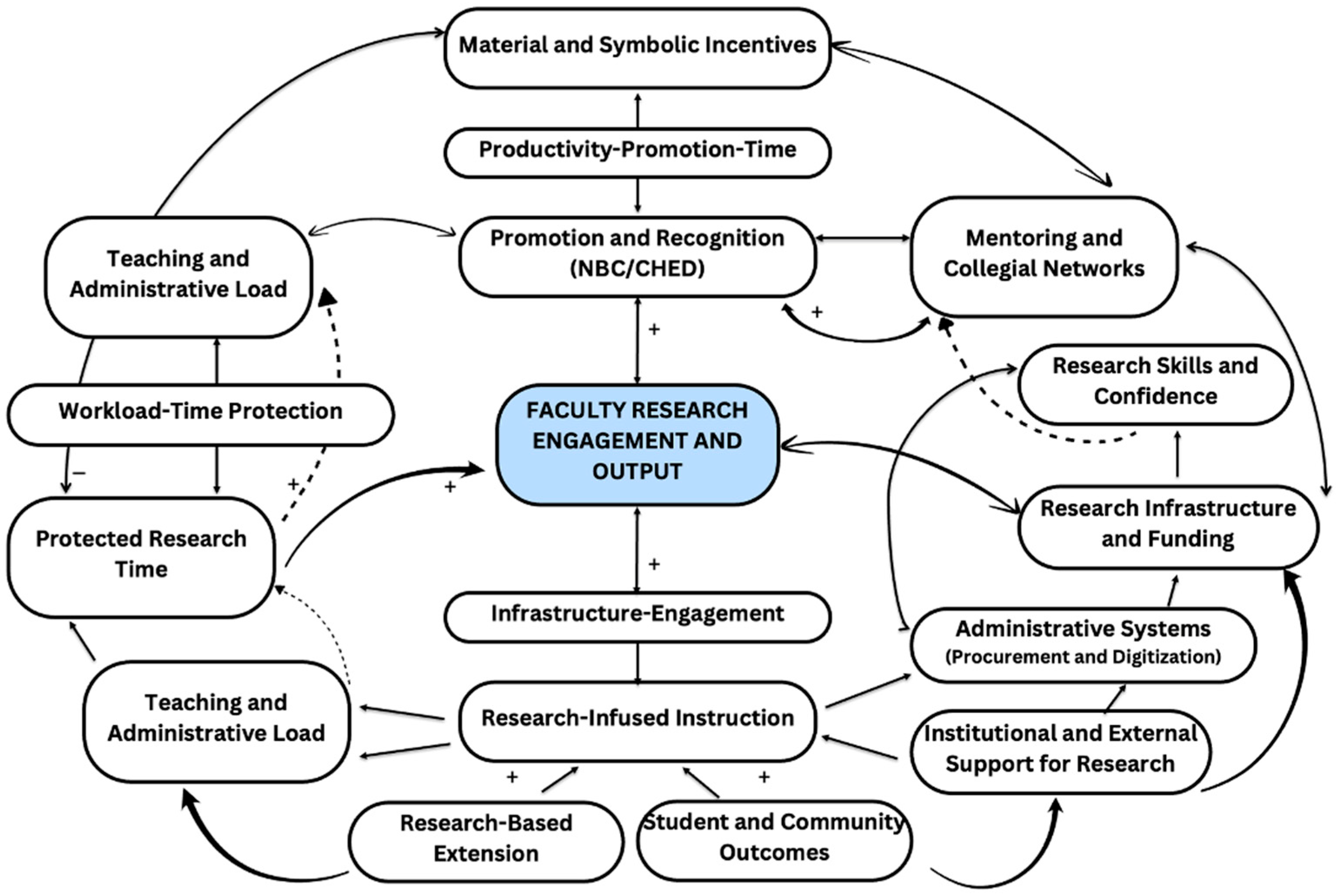
Figure 1 synthesizes these dynamics, depicting how reinforcing loops around productivity, mentoring, and infrastructure interact with balancing loops related to workload, highlighting time protection, mentoring relationships, and procurement reform as key leverage points.
5.4. Addressing Structural Inequities in Research Access
A critical contribution of this study is its documentation of campus-level inequities in research access. Early-career faculty members in satellite campuses reported heavier teaching loads, fewer on-site mentors, limited laboratories, and less direct access to research offices compared with their main campus counterparts. Yet formal expectations for research output and promotion were largely identical across campuses. These shared expectations but unequal conditions create what several participants describe as an “unfair race.”
From a systems perspective, this pattern constitutes a structural rather than individual deficit. Equity-oriented capacity-building literature emphasizes that research development initiatives should explicitly recognize contextual differences and provide compensatory support where needed. Building on these findings, the researchers suggest several possibilities: (a) differentiated workload policies that temporarily reduce teaching hours for faculty members who are building their first major projects; (b) cross-campus mentoring arrangements, including virtual mentoring, visiting-scholar schemes, and collaborative research teams that intentionally pair main- and satellite-campus staff; and (c) targeted infrastructure investments that expand research possibilities outside the main campus. These strategies would not lower the bar but would address the structural conditions that currently make meeting common expectations more difficult.
5.5. Policy Implications and Limitations
Drawing on the systems-thinking analysis and faculty narratives, several staged recommendations emerge for SUC leaders and policymakers:
- (a)
Institutionalizing transparent mechanisms to protect research time. Rather than a generic call for “protected time,” SUCs could adopt tiered models—for example, guaranteeing at least 3 h per week of scheduled research time for instructors and assistant professors with active projects, 6 h for associate professors, and 9 h for full professors serving as project leaders. These hours should appear explicitly in official workload forms, with accountability mechanisms that prevent ad hoc reassignment to teaching or committee work.
- (b)
Establishing structured, multi-level mentoring programs. Structured, multi-level mentoring ecologies could include: (1) formal mentor–mentee pairings within campuses; (2) cross-campus research teams where main campus faculty members co-design projects with satellite campus colleagues; and (3) virtual mentoring circles using online platforms for proposal review and manuscript clinics. Recognizing mentoring contributions in evaluation criteria would further encourage such practices.
- (c)
Streamlining procurement and research administration. Process-mapping of current procurement workflows could identify specific bottlenecks. A feasible target would be able to reduce signature approvals from, for example, eight to four, and commit to a maximum 2-week turnaround for in-stock items via an online tracking system. Establishing a small research support unit with staff trained in both procurement and grants management would further reduce administrative load on faculty members.
- (d)
Aligning NBC/CHED criteria with diverse forms of scholarship. Finally, revising evaluation criteria to value community-engaged scholarship, curricular research, and mentoring—alongside traditional indexed publications—would better reflect Boyer’s multidimensional view of scholarship. This could involve allocating dedicated points for peer-reviewed extension outputs, curriculum research publications, and documented mentoring that leads to junior faculty outputs. Such reforms would align the SUC more closely with international movements that aim to move beyond bibliometric measures.
At the same time, several limitations temper the transferability of these findings. This study focused on a single SUC system and on science-related disciplines; patterns may differ in private institutions, non-science disciplines, or SUCs with different histories and resources. The analysis relied primarily on faculty self-reports complemented by institutional documents, including perspectives from students, administrators, and community partners that would offer a more holistic picture. Finally, although maximum-variation sampling was used, the small number of cases means that some subgroups are under-represented.
Within these boundaries and given trustworthiness strategies and equity analysis outlined in different sections, the themes presented in this study offer a credible and contextually grounded account of how science faculty enact the research function in one SUC system.
6. Conclusions
This study has examined how science faculty in a Philippine SUC system enact their research function within the trifocal roles of instruction, research, and extension. The findings show that research is conceptualized as a catalyst for richer teaching and meaningful extension, a pathway to promotion and institutional recognition, and a practice deeply reliant on relational and infrastructural supports.
Situating these narratives within national policy and international aspects of the teaching–research nexus and the third mission, this study underscores that enabling faculty research in SUCs requires not only individual capacity-building but also systemic realignment of workloads, incentives, mentoring, and administrative processes. Designing such systems is crucial if research is to remain at the core of academic work rather than a peripheral or purely compliance-driven function.
Future research should trace how reforms in workload, mentoring, and digitalization reshape research practices over time, and explore how emerging technologies including generative AI, reconfigure the instruction–research–extension nexus in Philippine higher education systems.