


Highlights
- Cd accumulation in cacao threatens its commercialization under EU limits; this study evaluated locally available organic and inorganic amendments for their capacity to reduce Cd concentration and mitigate Cd stress in CCN-51 cacao seedlings in Cd-spiked substrate under greenhouse conditions.
- Cacao pod compost was the most effective amendment tested, lowering cadmium concentration in cacao shoots by 55% relative to the control and outperforming poultry manure and seabird guano, while recycling potassium and other nutrients back into low-fertility Amazonian soils.
- Inorganic phosphate fertilizers increased cadmium uptake, with diammonium phosphate (DAP) raising cadmium availability through rhizosphere acidification, whereas triple superphosphate (TSP) resulted in 33.7% lower shoot cadmium than DAP, making it the preferable phosphorus source in acidic cacao soils.
- All organic amendments lowered cadmium uptake compared with inorganic fertilizers, giving smallholder cacao farmers a low-cost, locally available strategy to reduce cadmium uptake in cacao seedlings without expensive inputs or complex remediation practices.
- Shoot cadmium correlated positively with phosphorus and manganese, pointing to fertilizer inputs and nutrient-interaction mechanisms as key drivers and underscoring the need for trace-element quality standards for phosphate fertilizers in Peru.
Abstract
Aims: Cacao is a highly profitable tropical crop; however, regulations may affect its commercialization worldwide. The aim of this study was to assess the effect of inorganic and organic amendments on soil chemical attributes, the biometric characteristics of cacao seedlings grown in cadmium (Cd)-contaminated pots, and nutrient uptake and interactions in the plant. Methods: The experiment was carried out under greenhouse conditions using dolomite, calcium hydroxide, triple superphosphate (TSP), diammonium phosphate (DAP), potash (KCl), potassium sulfate (K2SO4), cacao pod compost, poultry manure, and seabird guano. The experiment lasted four months, during which soil properties (pH, P, Ca, Mg, K, organic matter, available Cd), biometric characteristics (height, diameter, number of leaves, dry weight), nutrients (P, Mg, K, Cu, Fe, Mn and Zn), and Cd concentration (shoots and roots) were measured. Results: Calcium hydroxide, TSP + KCl and cacao compost were the best treatments for improving soil fertility, reducing available Cd, and improving seedling growth. Plant dry weight was higher with DAP + KCl. Regarding macro- and micronutrient uptake, calcium hydroxide, DAP + KCl and poultry manure enhanced nutrient uptake in cacao under Cd stress. Shoot Cd concentration was reduced by Ca(OH)2 and all the organic amendments, with cacao compost being the most effective. Conversely, inorganic fertilizers increased Cd concentrations compared with the control. Conclusions: Cacao compost with TSP and Ca(OH)2 reduced shoot Cd by nearly 55% compared with the control. These results are promising; however, field validation and direct measurement of bean Cd are still required.
1. Introduction
Cacao is one of the most important commodities in the world, with a gross income of around USD 30 billion worldwide. In Peru, cacao is synonymous with the fight against narcotics; coca production areas are inversely correlated with new cacao crop areas [1]. Cacao in Peru is mainly cultivated by small farmers, who are therefore very susceptible to highly variable prices in the cacao market. In 2014, the European Union (EU) published new maximum levels for cadmium (Cd) in chocolate (Regulation Nº 488/2014) [2], which took effect in January 2019. This regulation has direct and significant impacts on cocoa agriculture in several Latin American countries, given that this region has the highest naturally occurring levels of Cd [3]. Even though this regulation applies to Cd in chocolate, many buyers have taken advantage of it by limiting cacao exports, mainly affecting small-scale cocoa farmers.
Cadmium is a carcinogenic and mutagenic heavy metal [4,5] that causes several adverse effects in living organisms. Cd has been reported to affect cell proliferation, differentiation and apoptosis, and it can also affect the skeletal system, renal function, reproduction and development of different mammalian species, as well as the central and peripheral nervous systems [5,6,7,8,9]. Given its high mobility in soil and its ready availability to plants, Cd has been established to have a bioconcentration factor above 1 [10]. Nevertheless, Cd absorption by plants is highly dependent on the availability of the ion (Cd2+), which is affected by external factors such as climate (rainfall and temperature) and soil physicochemical characteristics such as texture, pH, organic matter, and nutrients (mainly phosphorus) [11].
However, Cd accumulation patterns differ among plant species and genotypes. In general, leafy vegetables accumulate the highest concentrations and cereals the lowest [12]. Uptake of Cd in plants can be reduced by changing its soil availability or by selecting plants with specific traits that lead to lower Cd absorption [13,14,15]. Therefore, the main agricultural practices and solutions are focused on soil and genetic factors.
One technique to reduce the uptake of metals such as Cd is their in situ stabilization through the addition of organic amendments. These materials have a high specific surface area and, consequently, a high metal retention capacity [16,17]. Different materials have been used for this purpose, such as biochar, manure, compost, vermicompost, agricultural residues, and municipal waste [12,15,18]. In general, these materials can decrease heavy metal availability by increasing pH and CEC and by forming complexes with heavy metals present in the soil [12,15].
Cacao in Peru is cultivated in the Amazon region, which has high precipitation and temperatures. These characteristics promote the growth of this species; however, soils of the Peruvian Amazon are commonly acidic and of low fertility [19,20,21]. The cacao plant requires soils with high fertility [22,23]. The general approach to managing soil fertility is, first, to correct soil acidity by applying lime amendments (CaO and/or dolomite) and, second, to apply fertilizers and other amendments such as compost or biochar. Even though organic amendments can partially supply the nutrient requirements of this crop [24], the use of fertilizers is sometimes needed. Therefore, the choice of appropriate fertilizers is important, given that these products can modify the bioavailability of heavy metals for plants, especially Cd [25]. Among the main products associated with Cd inputs to soils are phosphate fertilizers such as triple superphosphate (TSP) and monoammonium phosphate (MAP). These are derived from phosphate rocks that can contain high levels of this element. Despite the importance of the Cd concentration in fertilizer products, their acidic reaction after application to soils may be more relevant to Cd concentration by plants [26,27].
High Cd concentrations could have adverse impacts on cacao plant nutrition as well as on bean quality, threatening Latin American cocoa farmers. To propose solutions for these problems in the short term, the first step in the present study was to explore the effect of the most common amendments used in Peruvian cacao fields on Cd concentration. Among lime amendments, dolomite and calcium hydroxide are the most widely used. Among fertilizers, according to Indecopi [28], the most common are TSP and diammonium phosphate (DAP) as phosphorus sources, KCl and K2SO4 as potassium sources, and “Guano de Isla” (seabird guano) and poultry manure as organic amendments. We also included a waste product commonly present in cacao fields: cacao pods, used here as compost. Cacao pods amount to more than 8 tonnes per tonne of cacao beans produced, potentially making their compost an important product not only to reduce Cd concentration but also to recycle nutrients (especially K) and improve overall cacao nutrition [22,23,29,30].
We hypothesized that (i) liming with calcium hydroxide would decrease Cd availability and Cd concentration more than dolomite because of its faster and stronger neutralizing reaction; (ii) organic amendments, particularly cacao pod compost, would reduce Cd concentration relative to the unamended control through pH increase and Cd complexation while recycling nutrients; and (iii) phosphate fertilizers would increase Cd concentration, with DAP exceeding TSP owing to its acidifying reaction. To our knowledge, this is the first controlled assessment of cacao pod compost as a Cd-mitigating amendment for cacao and the first side-by-side comparison of the lime and fertilizer products most widely used by Peruvian smallholders; its novelty therefore lies in evaluating locally available, low-cost materials under controlled Cd stress rather than in the individual products themselves, and its scope is restricted to seedling responses.
Thus, the objectives of this work were to: (I) determine the effect of inorganic and organic amendments on soil chemical properties when exposed to Cd, (II) study the effect of inorganic and organic amendments on the biometric characteristics of cacao seedlings grown in Cd-contaminated pots, and (III) explore the effects of these amendments on the uptake and interactions of nutrients and Cd in the plant.
2. Materials and Methods
2.1. Location
The experiment was conducted at the Instituto de Cultivos Tropicales (ICT) at the “Juan Bernito” experimental station located in the district of La Banda del Shilcayo in San Martin, Peru, at 06°30′28″ S 76°00′18″ W, at an altitude of 333 m.a.s.l. The average annual precipitation is 1150 mm with an average temperature of 26 °C, corresponding to the Pre-Mountain Tropical Dry Forest (PmTDF). As the trial was conducted in a greenhouse, these values describe the site context only, while the controlled conditions are described in Section 2.5.
2.2. Substrate and Substrate Contamination
The substrate was prepared by mixing sand and secondary forest soil (upper layer, 0–5 cm) at a 1:3 ratio. The physicochemical characteristics of this substrate are summarized in Table 1. Plastic pots of 4 L capacity were filled with 4 kg of the above-mentioned substrate. To contaminate the substrate with Cd at a nominal concentration of 25 mg/kg, CdCl2 was applied and mixed, and the substrate was incubated for approximately 30 days. This level exceeds typical concentrations in tropical soils of Peruvian cacao-growing regions and was chosen to discriminate the effects of the different treatments. The total Cd concentration in the substrate before and after spiking is presented in Table 1. Type II water was used for incubation to avoid contamination from other sources.
Table 1.
Main physicochemical characteristics of the substrate after preparation.
2.3. Organic and Inorganic Amendments
Organic (compost from cacao pods, Seabird Guano, and poultry manure) and inorganic (dolomite, calcium hydroxide, urea, triple superphosphate, diammonium phosphate, potassium chloride and potassium sulfate) amendments were selected based on the fertilizers most commonly used by cacao farmers in Peru and on their availability in the market. The only non-commercial product used was the compost from cacao pods. The chemical analyses of each amendment are presented in Table 2.
Table 2.
Chemical analysis of the amendments used in this experiment.
2.4. Plant Material
Plant material was collected from the ICT germplasm bank located at the Choclino Station in San Martin, Peru. Considering that CCN-51 is the most widely used clone in Peru, this material was selected for the pot trial. Therefore, 10 pods of CCN-51 from 20 different plants were collected, and seeds were extracted from the central part of the pods and mixed for better randomization of the experiment. The seeds were then pre-germinated in sawdust and, after three days, selected and planted in the Cd-contaminated pots with different treatments as described in the Section 2.5.
2.5. Greenhouse Experiment
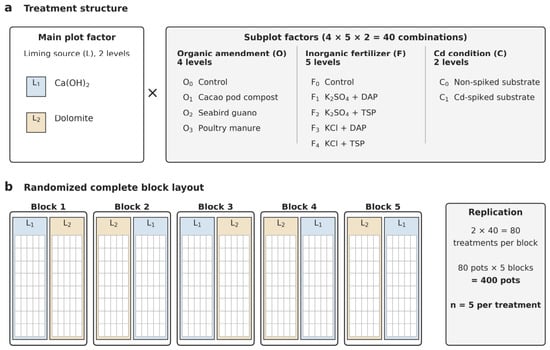
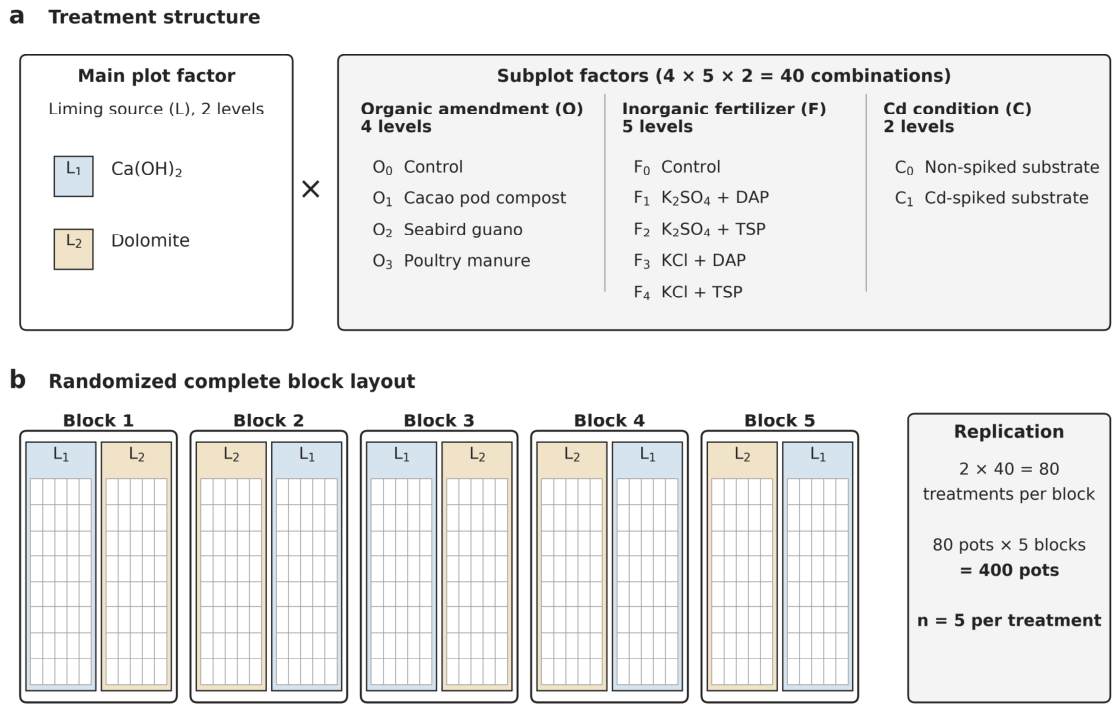
The experiment lasted 120 days and was arranged as a split-plot design in randomized complete blocks, with cadmium (Cd) contamination included as an experimental factor. Two liming sources (calcium hydroxide and dolomite) were assigned to the main plots. Within each main plot, subplot treatments followed a 4 × 5 × 2 factorial: four organic-amendment levels (cacao pod compost, seabird guano, poultry manure, and an unamended control) and five inorganic-fertilizer combinations (K2SO4 + DAP, K2SO4 + TSP, KCl + DAP, KCl + TSP, and a control). Finally, all combinations were established on both Cd-spiked and non-spiked substrate to allow comparison of seedling performance with and without Cd, and each combination was replicated five times, giving 400 pots with one seedling per pot (Figure 1).
Figure 1.
Experimental design with different organic and inorganic amendments applied to cacao seedlings grown in Cd-spiked and non-spiked substrate under greenhouse conditions for 120 days.
For liming, both calcium hydroxide (95% neutralizing value) and dolomite (80% neutralizing value) were applied at the same dose of 4 g pot−1. Although their neutralizing values differ, this dose was used to represent a common field-recommended rate. To meet the recommendations for cacao, additional amendments were applied to the substrate to achieve the following nutrient composition: 169 mg kg−1 of N; 400 mg kg−1 of P; 120 mg kg−1 of K; 50 mg kg−1 of sulfur (S); 10 mg kg−1 of manganese (Mn); 2 mg kg−1 of copper (Cu); 0.8 mg kg−1 of boron (B) [31], in the form of urea, manganous sulfate, copper sulfate, ulexite and ammonium molybdate; for P, TSP or DAP was used; and for K, KCl or K2SO4. Foliar micronutrients (B, Cu, Fe, Mn, Zn) were applied every 30 days. Organic and inorganic amendments were applied according to locally recommended doses for cacao. For P sources, we applied 7.97 g pot−1 for both TSP and DAP. For K sources, we applied 0.96 g pot−1 for KCl and 1.16 g pot−1 for K2SO4. For organic sources, a dose of approximately 8.45 g pot−1 was applied for all amendments. This dose was based on a general dose used for organic amendments to simulate common agricultural recommendations. All doses were balanced in terms of N to avoid confounding effects of this element.
Plants were maintained at 80% of field capacity throughout the experiment, with moisture monitored every other day. The average temperature of the experiment was 26 °C, with a minimum of 22 °C and a maximum of 32 °C. The experimental area had a photosynthetic photon flux density of 1000 ± 50 μmol m−2 s−1 measured using an MQ-200 Quantum sensor (Apogee Instruments, Logan, UT, USA).
2.6. Biometric Measurements
At the end of the experiment (120 days after seeding), the height (cm) and diameter (cm) of the cacao seedlings were measured. They were then cut, collected, and washed in 0.01 M HCl solution to remove adhering soil particles or impurities, rinsed with distilled water, and finally oven-dried at 60 °C for 48 h or until a constant weight was achieved. Afterwards, each seedling was weighed to determine shoot dry weight (SDw) and root dry weight (RDw).
2.7. Substrate Analysis After Experiment
At the end of the experiment, 250 g of soil was collected from each pot for chemical analysis (pH, CEC, CaCO3, OM, N, P, K, Ca2+, Mg2+, Na+) using the methods described in Table 1. In addition, extractable Cd was determined using 0.01 N CaCl2 and quantified using an atomic absorption spectrophotometer (AAS; Varian model “Spectra 55B”, Melbourne, Australia).
2.8. Determination of Elements in Shoots and Roots
Dried samples of shoots and roots were weighed (500 mg each) and digested with 10 mL of concentrated HNO3 (65%, trace grade, from Merck®, Darmstadt, Germany). The digestion was conducted on a digestion block at 90 °C for 90 min and then at 135 °C for approximately 5 h. The digested solution was filtered using Whatman N°42 filter paper and diluted prior to analysis. Concentrations of K, Mg, Cd, Cu, Fe, Mn and Zn in the filtrate were determined using a flame atomic absorption spectrophotometer (FAAS, Varian Spectra 55B, Melbourne, Australia) while P was determined using a UV-Vis spectrophotometer (420 nm). To ensure analytical quality, three analytical replicates per sample were performed and the means were submitted to statistical analysis. Accuracy was verified with certified reference materials analysed alongside the samples: NIST SRM 1515 (Apple Leaves) for plant tissues and SCP Science EnviroMAT SS-1 for soils, with recoveries between 85 and 117%. Instruments were calibrated with certified standards (R2 ≥ 0.99). The limit of detection (LOD) and limit of quantification (LOQ) for Cd were 0.003 and 0.005 mg kg−1, respectively, and procedural blanks ranged from 0.001 to 0.002 mg kg−1. All sample concentrations were consistently well above the LOQ.
To calculate the element uptake, the procedure described in Arévalo-Hernández et al. [32] was used. Briefly, the dry matter was multiplied by the concentration of each element and divided by 10 for macronutrients (P, K, Ca, Mg) and by 1 for micronutrients (Fe, Cu, Mn, Zn) and Cd, resulting in g per plant for macronutrients and mg per plant for micronutrients.
2.9. Statistical Analysis
All statistical analyses were performed in R, version 4.1 [33]. Soil chemical characteristics, biometric variables, and shoot concentrations of Cd, P, Mg, K, Fe, Cu, Mn and Zn were submitted to analysis of variance (ANOVA) under the split-plot factorial model described in Section 2.5, with lime as the main-plot factor, organic amendment and inorganic fertilizer (and their interactions) as subplot factors, block as a random effect, and Cd contamination as an additional factor. Main effects and their two- and three-way interactions were tested against the appropriate error terms. Prior to ANOVA, residual normality (Shapiro–Wilk) and homogeneity of variance (Levene) were assessed, and variables that did not meet the assumptions were transformed. When significant differences were observed (p < 0.05), means were compared using the Scott–Knott test (p ≤ 0.05). Finally, a Spearman correlation analysis was performed to assess the relationship between the studied nutrients and Cd.
3. Results
3.1. Substrate Changes Due to the Application of Organic and Inorganic Fertilizers and Amendments
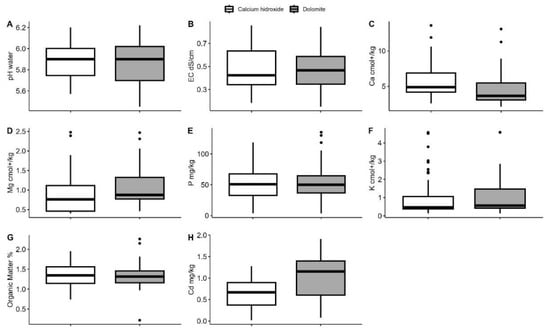
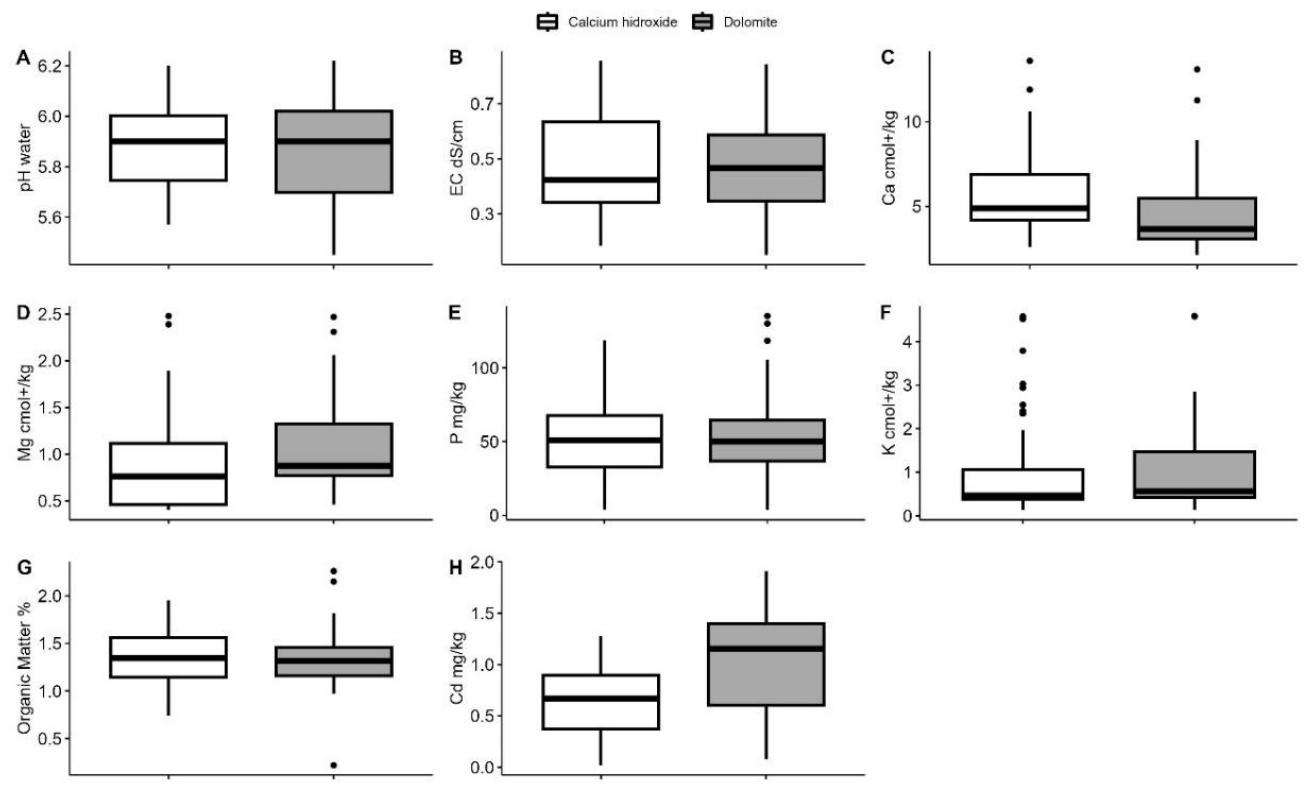
Significant differences for all treatments were observed in soil bioavailable Cd (p < 0.05), except for the lime × inorganic fertilizers interaction (Table S2). The simple effects of inorganic fertilizers and organic amendments showed significant differences (p < 0.05) for all the chemical properties determined in the substrate. However, for OM, inorganic fertilizers did not show significant differences (p > 0.05). Lime treatments showed significant differences (p < 0.05) only for soil exchangeable Ca and Mg (Figure 2).
Figure 2.
Effect of lime sources on substrate chemical characteristics at the end of the experiment. (A) pH in water, (B) Electrical Conductivity (EC) in dS/m, (C) Ca in cmol+/kg, (D) Mg in cmol+/kg, (E) P in mg/kg, (F) K in cmol+/kg, (G) Organic matter %, (H) Available Cd mg/kg.
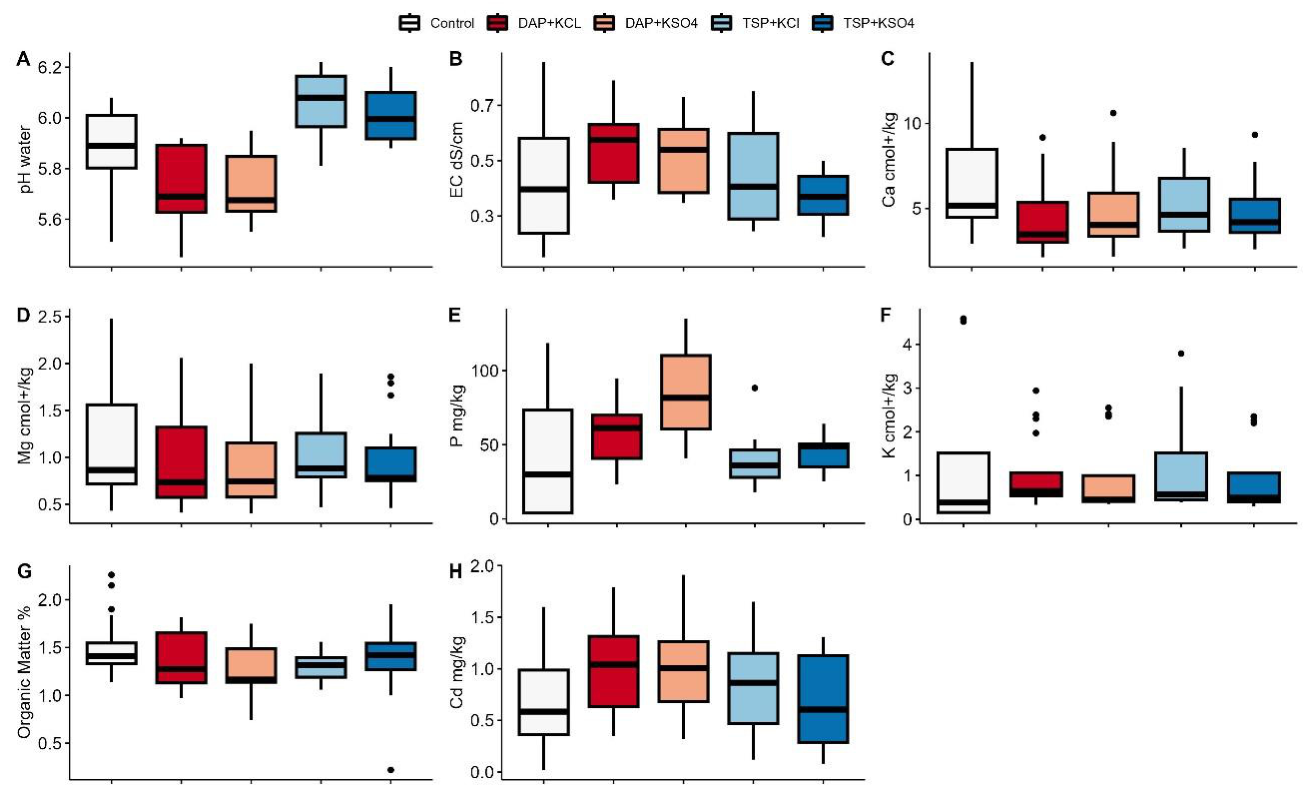
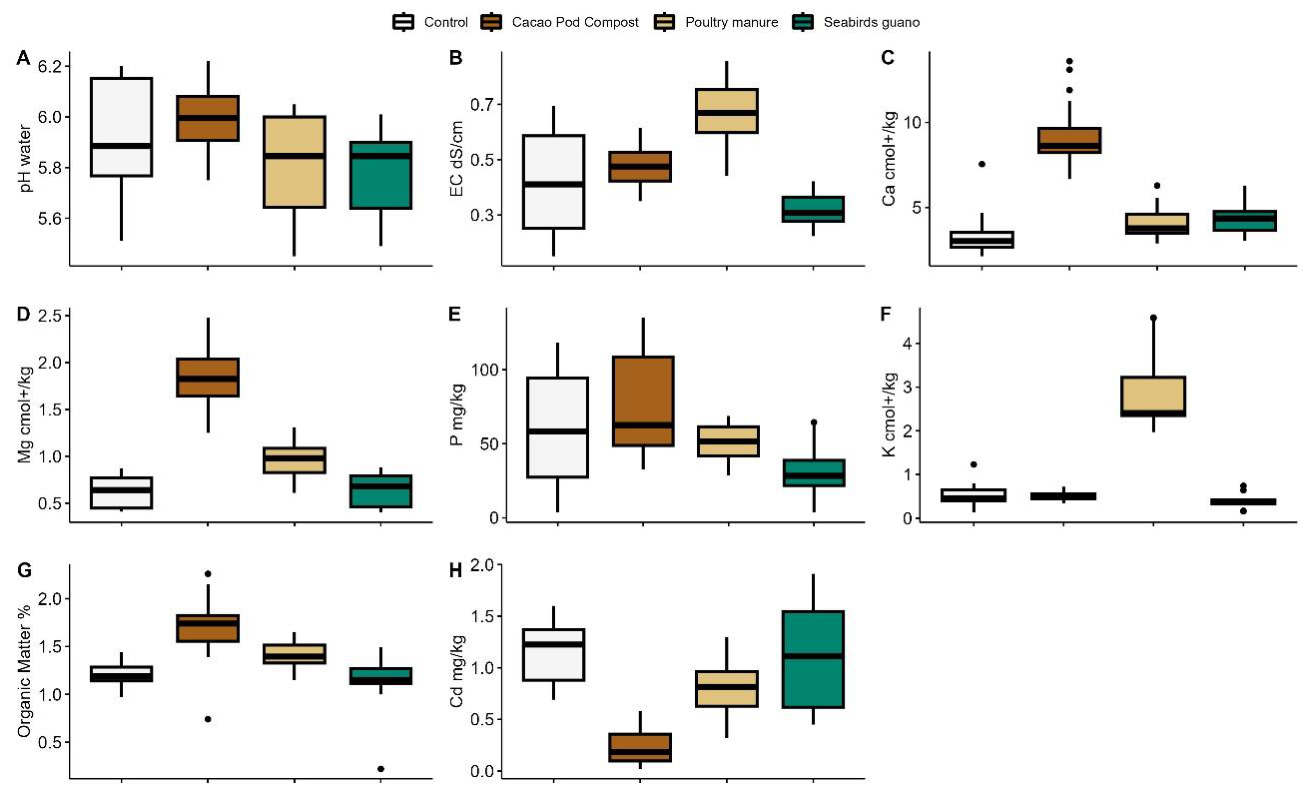
In Figure 2, mean comparisons for lime are presented while organic and inorganic fertilizers are presented in Figure 3 for variables with significant differences under Cd stress. The pH of the substrate treated with cacao compost was higher than that with the other organic amendments. In addition, the pH for inorganic fertilizer treatments with TSP was higher than with DAP. Nevertheless, the addition of K sources did not induce any significant changes in pH (p > 0.05).
Figure 3.
Effect of fertilizer sources on substrate chemical characteristics at the end of the experiment. (A) pH in water, (B) Electrical Conductivity (EC) in dS/m, (C) Ca in cmol+/kg, (D) Mg in cmol+/kg, (E) P in mg/kg, (F) K in cmol+/kg, (G) Organic matter %, (H) Available Cd mg/kg.
For EC, the highest values were associated with the application of poultry manure. In general, compost and manures from bird sources tend to have a higher EC and are not recommended for salinity-sensitive crops [34,35]. Even though the results do not show a hazard due to salinity, it should be considered that high doses could cause stress in cacao plantations in some soil types. Calcium concentrations were higher in Ca(OH)2 treatments, likely due to the higher Ca content of this product relative to dolomite. In addition, exchangeable Mg was higher in treatments with dolomite, also due to its higher concentration in this amendment.
For available Cd, treatments with Ca(OH)2 resulted in lower available Cd than dolomite application. Even though both can be used for liming acidic soils, the former tends to react faster and more effectively than dolomite due to its granulometric and chemical properties [36]. However, in the Peruvian Amazon, Ca(OH)2 is a controlled chemical due to its current use in the production of illegal narcotics. Despite the positive results observed, Peruvian producers may be limited to using a mixture of Ca(OH)2 with other products in order to achieve better results in reducing Cd availability in soils.
For inorganic fertilizers, P sources increased Cd availability, especially when DAP was applied. This effect could be attributed to changes in soil acidity when DAP is applied, since the application of this fertilizer acidified the substrate in comparison to TSP (Figure 2), which has a neutral effect on soil pH. The presence of other ions may also have had an effect, as TSP contains Ca and DAP contains ammonium. Calcium is generally recognized as having an antagonistic effect on Cd [11,12]. Ammonium, in contrast, tends to acidify the rhizosphere. By contrast, no differences were observed for K sources (KCl and K2SO4) indicating that either K source could be used regardless of the accompanying ion, without increasing Cd mobility, as has been reported in other plant species [37,38].
The lowest average value for all combinations was observed when cacao pod compost was present, indicating that this organic amendment could have a positive effect in reducing Cd absorption in cacao. Nevertheless, in terms of improving soil fertility, the combination with poultry manure may help to improve plant nutrition and reduce Cd availability even further.
3.2. Effects of Treatments on the Biometric Characteristics of Cacao Seedlings
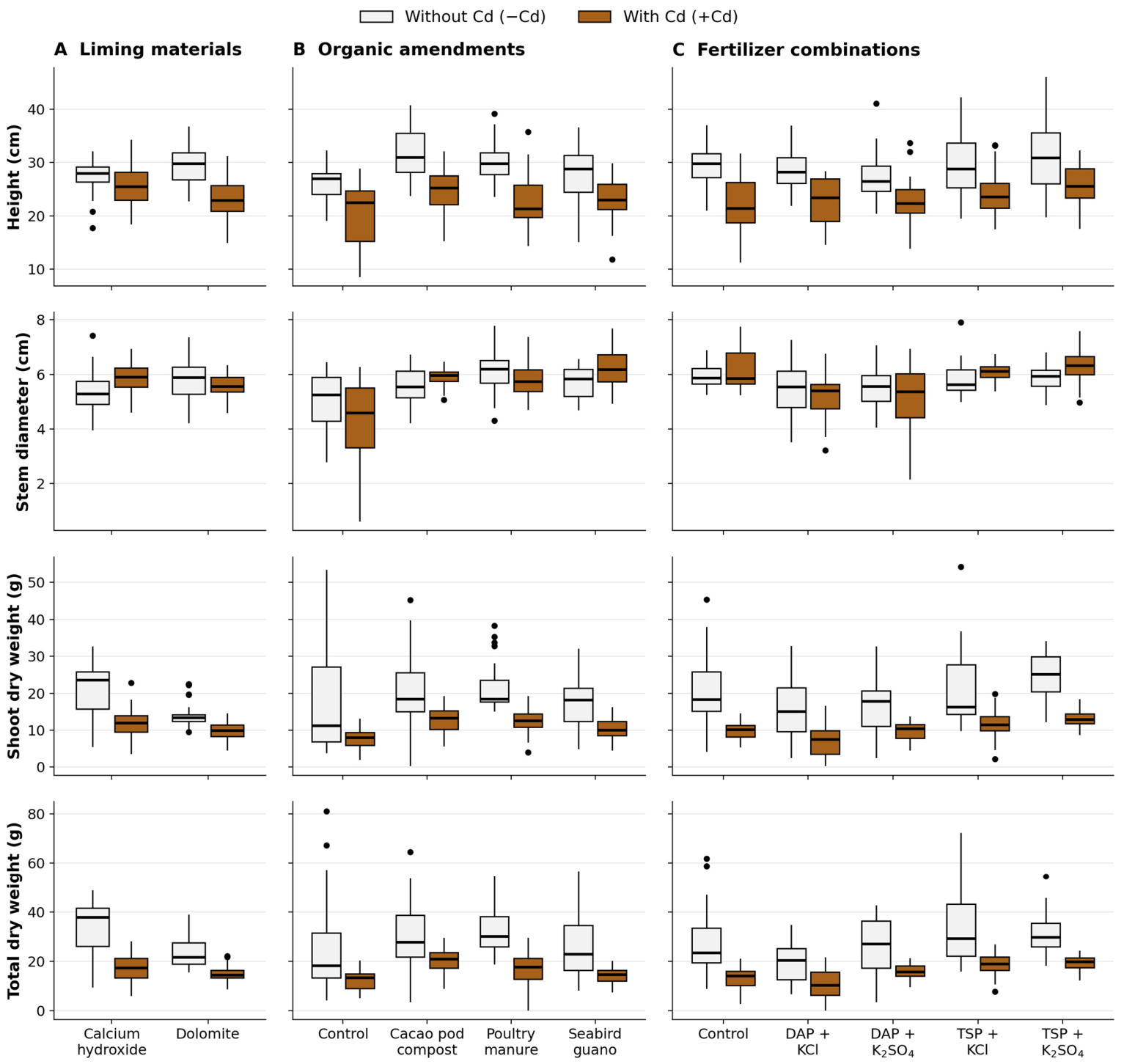
The ANOVA results for biometric characteristics are presented in Table S3. All of them showed significant differences (p < 0.05) between treatments with and without Cd, with average values without Cd being significantly higher (p < 0.05) than those with Cd. Differences in shoot, root and total dry weight and in height were significant, and a significant three-way interaction among lime, inorganic and organic amendment factors was observed in plants with and without Cd contamination. For diameter, all simple effects presented significant differences (p < 0.05) but the interaction between lime and organic amendment factors was significant in plants without Cd contamination.
Mean comparisons for dry weight (shoot and total), height and diameter among treatments with Cd are shown in Figure 4. In general, greater biomass, height and diameter were observed in Ca(OH)2 treatments compared to dolomite treatments. Nevertheless, the differences in diameter were less apparent between dolomite and Ca(OH)2 application. These results may be related to lower Cd availability in the substrate as shown in Figure 2, which reduced Cd stress in plants. For inorganic fertilizers, treatments with TSP —regardless of the K source—showed higher dry weight, height and diameter in comparison to DAP. This could be explained by the higher Cd availability, which induced greater stress in treatments with DAP. For organic amendments, treatments with cacao pod compost, followed by poultry manure, showed higher dry weight, height and diameter as shown in Figure 5, indicating that even in high Cd conditions, these organic amendments could significantly reduce the effect of Cd stress in cacao seedlings.
Figure 4.
Effect of lime (A), organic amendments (B), and inorganic fertilizers (C) on cacao seedling height (cm), diameter (cm), Shoot Dry Weight—SDw (g) and Total Dry Weight—TDw (g) at the end of the experiment.
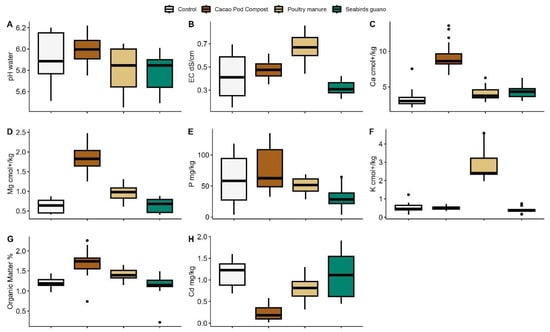
Figure 5.
Effect of organic amendments on substrate chemical characteristics at the end of the experiment. (A) pH in water, (B) Electrical Conductivity (EC) in dS/m, (C) Ca in cmol+/kg, (D) Mg in cmol+/kg, (E) P in mg/kg, (F) K in cmol+/kg, (G) Organic matter %, (H) Available Cd mg/kg.
3.3. Effect of Treatments and Cd on Cacao Seedlings Nutrition and Cd Concentration
Variation in nutrition under the different treatments and in the presence of Cd contamination is summarized in Table S5. Overall, all plants exposed to Cd showed lower uptake of P, K, Mg, Cu, Fe, Mn, and Zn. Among the applied treatments, significant differences (p < 0.05) were found only for K. Copper uptake was affected by all treatments whereas Fe and Mn uptake showed significant differences in lime treatments (without Cd) and in organic and inorganic fertilizers (with and without Cd). Moreover, Zn uptake was affected only by lime and organic fertilizers.
Among the factors studied, the treatments that best improved cacao seedling nutrition under Cd stress were Ca(OH)2, the combination of TSP and KCl, and poultry manure for lime, inorganic and organic amendments, respectively. Micronutrients were more affected by Cd than macronutrients, since neither P nor Mg uptake was affected by any treatment.
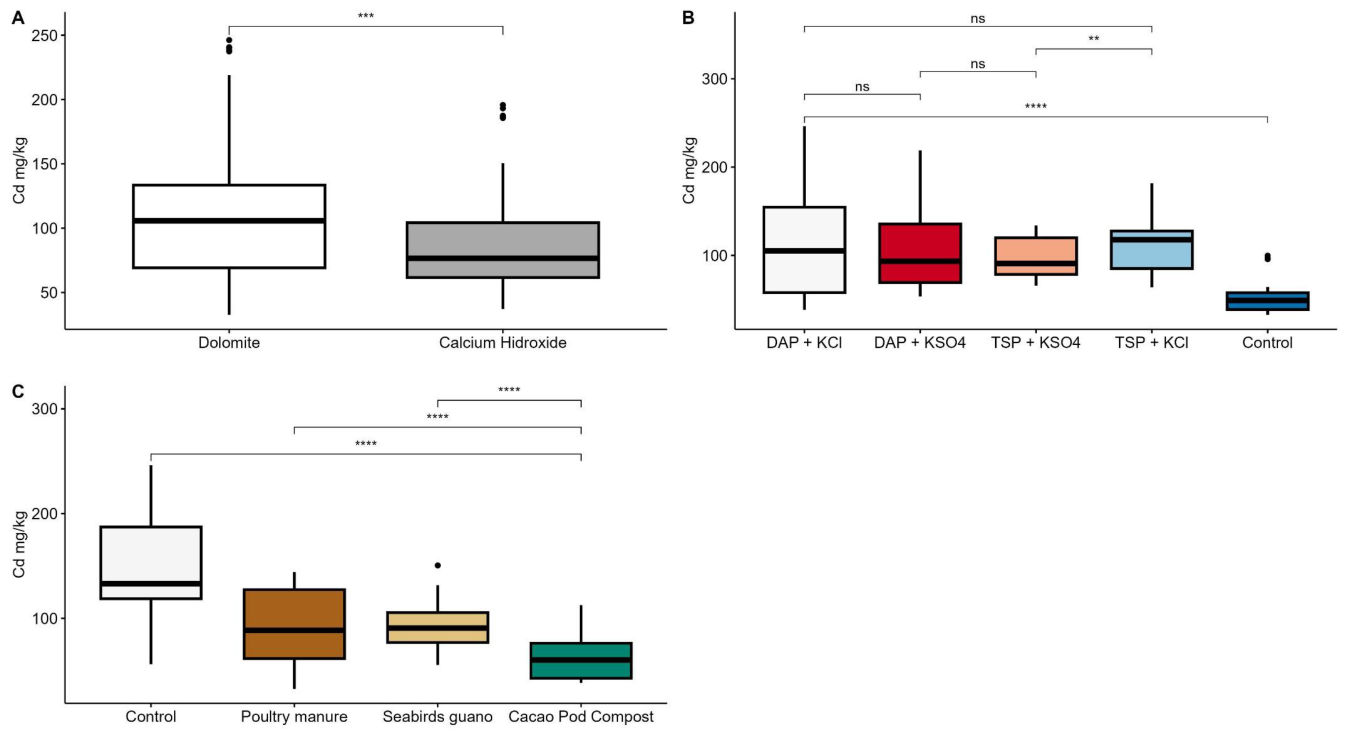
Roots showed a significantly (p < 0.05) higher Cd concentration than shoots. However, differences among the applied amendments followed similar patterns in shoots and roots; therefore, only shoot results are addressed in this section, and the complete results are presented in Table S6. Cadmium average concentrations in shoots are presented in Figure 6. For liming sources, treatments with Ca(OH)2 showed a lower Cd concentration than dolomite, probably due to the lower Cd availability in the substrate.
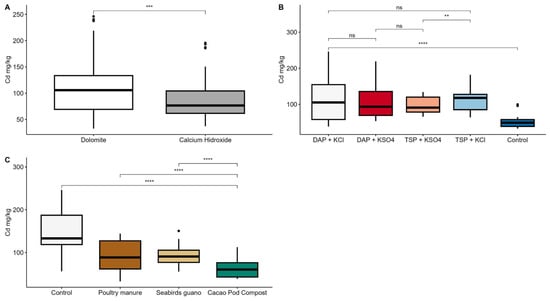
Figure 6.
Cadmium concentrations (mg/kg) in shoots of cacao seedlings grown under different substrate treatments: lime (A), inorganic (B) and organic (C) amendments. Ns = no significant differences, ** = significant differences at p < 0.01, *** = significant differences at p < 0.001 and **** = significant differences at p < 0.0001.
For fertilizers, treatments with DAP showed a higher shoot Cd concentration than treatments with TSP (33.7% lower than DAP) (Figure 6 and Table S6), making TSP the preferred source of P in acidic soils to reduce Cd concentration and improve P nutrition in plants. Also, only with TSP application were significant differences (p < 0.01) observed between K sources, with potash (KCl) increasing shoot Cd concentration in plants compared with K2SO4 (Figure 6 and Table S6). Nevertheless, it is important to consider that TSP contains 18% Ca, and Ca is known to be an important Cd antagonist due to their similar ionic ratio, despite the pronounced Cd:Ca selectivity in soils [11]. In addition, all fertilizer treatments resulted in higher shoot Cd concentrations than the unfertilized control (Figure 6B and Table S6). This difference cannot be explained by growth dilution, because the control did not have the lowest shoot biomass: its shoot dry weight (12.3 g) was higher than that of three of the four fertilizer treatments (Table S4). With DAP, the higher shoot Cd concentration is consistent with the lower substrate pH and higher available Cd (Table S2). With TSP, however, available Cd was lower than in the control, so the increase in shoot Cd cannot be attributed to Cd availability as measured by CaCl2 extraction; it may be related to fertilizer-induced changes in root activity or rhizosphere conditions, which require further study.
All organic amendments showed lower Cd concentrations than the controls (Figure 6 and Table S6). The amendment that resulted in the lowest shoot Cd concentration was cacao pod compost, which was significantly lower (p < 0.05) than the other organic treatments, by 34 and 38% (seabird guano and poultry manure, respectively), and 55% lower than the control. No differences were observed between poultry manure and seabird guano. To our knowledge, this is one of the first reports on the use of cacao pod compost to reduce Cd concentration; its use as a K-rich organic fertilizer has been described elsewhere [29]. Our findings may help farmers reduce Cd in the field without requiring high resource inputs, considering that most of them are small farmers with limited income. This last point highlights the limitations of adopting other agricultural practices to effectively reduce Cd concentration in cacao plants. Because Cd was quantified in the shoots and roots of four-month-old seedlings under greenhouse conditions rather than in harvested cacao beans, extrapolation to bean Cd under field conditions requires further research and validation of the findings presented in this work.
3.4. Relationship Between Cd and Other Elements
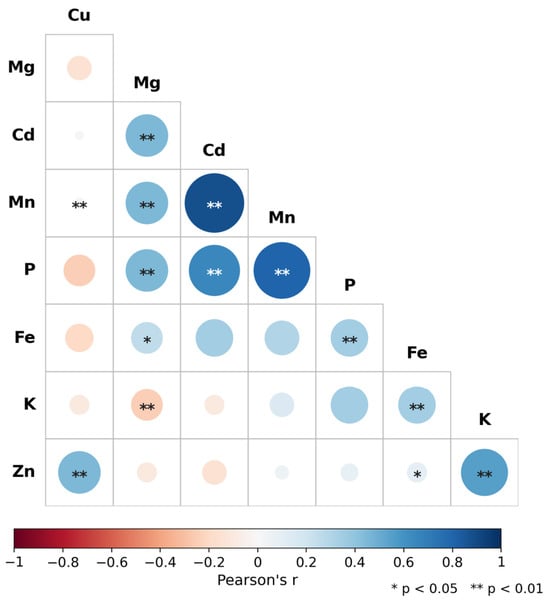
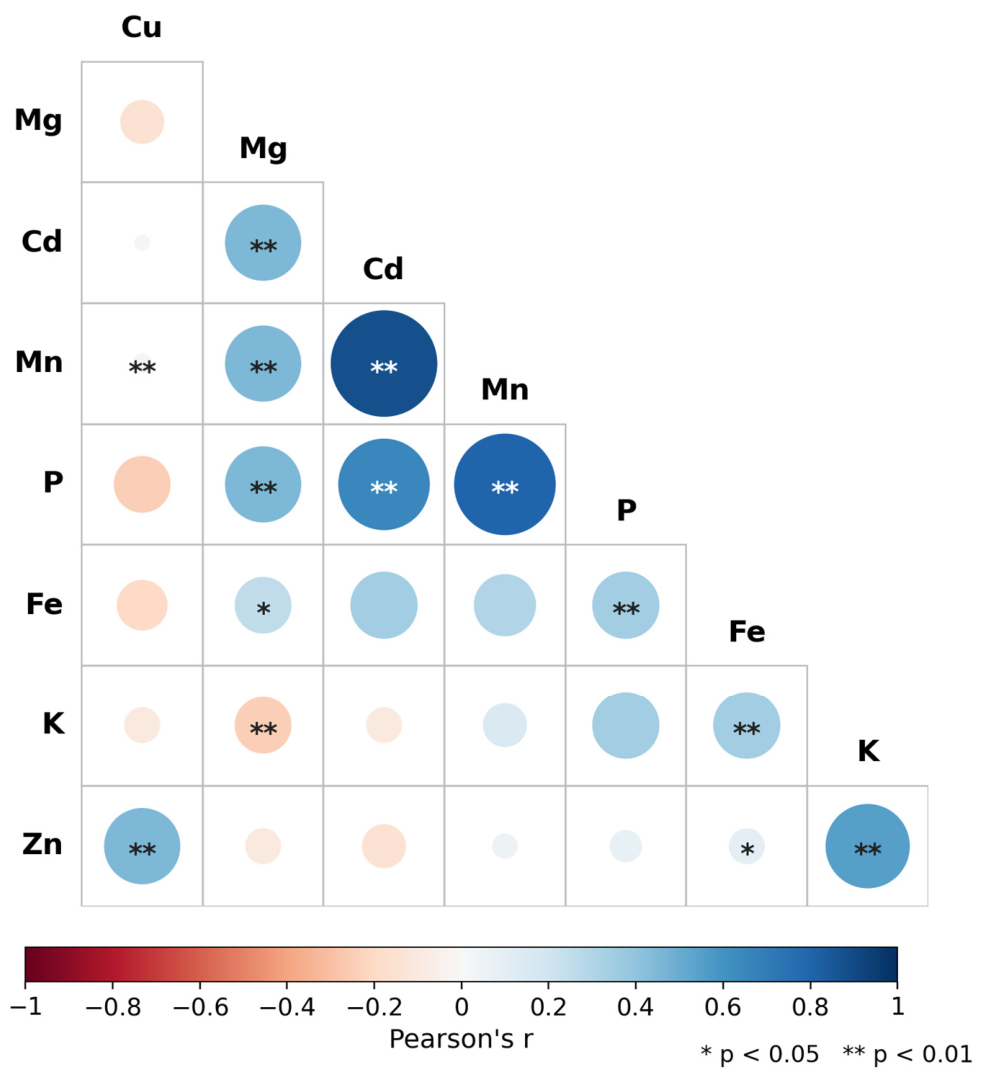
The correlation between Cd and the nutrients studied is presented in Figure 7. Cadmium was positively and significantly correlated with P and Mn, despite the low effect of the treatments in P uptake. Also, Cd showed a positive correlation with Mg, although the correlation coefficient was low (<0.4) compared to P and Mn.
Figure 7.
Spearman correlation plot of nutrient concentrations in cacao seedlings grown in Cd-contaminated pots under greenhouse conditions (n = 200). * = significant differences at p < 0.05 and ** = significant differences at p < 0.01.
These results suggest a direct association of P and Mn with shoot Cd. However, as this relationship may be affected by other factors, conclusions should be drawn with caution. For P, this may be directly related to fertilizer use, whereas for Mn it could be related to synergistic interactions [10]. It has been reported that P fertilizers have relatively high concentrations of Cd depending on the source of phosphate rock used for commercial production, ranging from <0.2 to 507 mg kg−1 worldwide, and they can increase soil Cd concentrations by 50–400% above natural background levels [27]. However, as addressed in the “Substrate changes” section, P limits production in tropical soils, so the use of this type of fertilizer is necessary to increase cacao yields. Therefore, better quality control of fertilizers is needed in Peru, since to date there is no regulation of trace elements in fertilizers in the country. For Mn, interactions with Cd could be due to a tolerance mechanism, since Mn may reduce the toxic effects of Cd and, at low concentrations, may enhance sensitivity to Cd stress as reported in other species [39,40].
4. Discussion
4.1. Substrate Characteristics and Cd Availability
Organic amendments tend to increase soil pH and can immobilize metals by adsorption, precipitation and complexation [12,15,16]. This means that the use of compost can reduce the effects of toxic ions such as Al and Cd in plants by binding these cations to carboxyl and acidic hydroxyl groups [16,41].
The solubility of Cd is greater at low pH; therefore, increases in pH tend to decrease Cd availability by enhancing its immobilization in the soil [42]. In cacao plantations in Trinidad and Tobago, lime treatments reduced Cd availability, but it later stabilized, with no significant changes [43]. However, when the correct dose is applied under field conditions, a significant Cd reduction can be observed in cacao plantations [17,44]. In other crops such as rice (Oryza sativa) and Chinese cabbage (Brassica chinensis L.), liming reduced Cd bioavailability significantly [45,46].
Regarding fertilizers, K sources did not affect Cd availability. Nevertheless, in a study carried out in Huánuco, Peru, it was reported that Cd availability was higher on farms where inorganic fertilizer was applied continuously, showing a direct correlation with P [47]. By contrast, in Ecuador, Argüello et al. [48] observed an inconsistent relationship between inorganic fertilizers and Cd availability in cacao plantations.
Organic amendments tend to have a great impact on trace metal availability, and different types of animal and plant waste have been used successfully in the past [49,50,51]. These toxic elements tend to be adsorbed onto the surface of colloidal particles such as humus and fulvic acids; therefore, the application of organic amendments binds Cd, reducing its availability in soil. Different amendments such as biochar, compost, humus and fulvic acids have been explored to reduce Cd availability in the soil [12,15,49]. In cacao soils in Ecuador, among the organic amendments tested, vermicompost at 2% was the most efficient treatment in reducing Cd availability [15]. Other studies using different plant species have shown that poultry manure reduces Cd availability [50,52]. However, metal availability and stabilization in soil depend on the application rate, soil physicochemical attributes and Cd content [12]. Like these products, cacao pod compost showed promising results, reducing Cd to a greater extent than the other organic amendments.
4.2. Effect of Cd on Biometric Characteristics and Nutrition
In general, Cd toxicity affects biometric parameters by reducing dry matter in roots and leaves, photosynthesis, sugars, proteins and antioxidant enzymes [53,54,55]. Also, Clemente et al. [56] observed that, when remediating a soil with high Cd content, organic amendments increased the biomass of Atriplex halimus and reduced Cd availability. In rice and wheat, Azhar et al. [54] found that organic amendments reduced the effect of Cd stress by enhancing growth parameters in both crops and by reducing Cd availability, consistent with reports that organic fertilization enhances growth of Amazonian species under low-fertility conditions [24]. In another study on tomato (Lycopersicon esculentum) and cucumber (Cucumis sativus) grown in soil from a mining site, Khan et al. [12] observed a direct relationship between organic amendments and Cd concentration, with enhanced biomass and height compared with other amendments.
As already mentioned, cacao requires soil with high fertility, and it is also well known that in tropical soils, production is limited more by P than by N [57]. In this experiment, Cd did not affect P nutrition. Nevertheless, K, the most required nutrient in cacao [23], was affected by Cd. Potassium plays an important role in plant physiology and structure by regulating osmotic potential and the tolerance to abiotic stress [58]. Therefore, K nutrition is fundamental for cacao growth and production. Cd may enter the roots through the same channels as some micronutrients such as Fe, Cu, Mn or Zn and may translocate to shoots by symplastic or apoplastic pathways, therefore reducing uptake of these nutrients by cacao seedlings [59,60]. Specific work in cacao by Blommaert et al. [61] proposed that Cd accumulates more in aerial parts and that most Cd is loaded into the xylem and transported with the other nutrients.
4.3. Cd Concentration in Plants
Our results are similar to those of other studies on cacao grown in the greenhouse and in the field, which showed that liming reduces Cd concentrations in the plant [44,47,48,62,63]. However, in other cases, liming materials may have the opposite effect [64]. It should also be noted that the present design compared two liming sources (Ca(OH)2 and dolomite) without a no-lime control; therefore, our results describe differences between lime sources and do not quantify the effect of liming relative to no liming, which should be addressed in future studies.
For K sources, some studies have shown no differences in Cd concentration [38] or significant differences [37] for KCl and K2SO4. However, we attribute the lack of significant differences between K sources in the treatments with DAP to the acidity produced by this fertilizer, which may be a more important factor in Cd concentration than the K source. In treatments with TSP, no acidity is produced; therefore, accompanying anions may be an important factor since Cl− tends to be related to higher micronutrient and heavy metal uptake [10].
It has been reported that organic amendments reduce Cd concentration in cacao plants. As a result, Cd concentration in cacao beans from organic plots is lower than in farms with inorganic fertilization [47]. Also, in Trinidad and Tobago, Ramtahal et al. [17], using biochar as an organic amendment, observed a 25–31% reduction in leaf Cd concentration. In Ecuador, Argüello et al. [48], in a nationwide study, highlighted that on farms with inorganic fertilization, bean Cd concentrations were higher than on organic farms. Further work by the same research group has shown that Cd was reduced in leaves, but cacao beans were unaffected, or that the effect may be slower when using compost [44]. In Bolivia, Gramlich et al. [62] observed that cacao grown under monoculture and conventional management (use of inorganic fertilizers) showed higher Cd concentrations in leaves than organically managed farms, and lower Cd concentrations were reported in agroforestry systems. Nevertheless, no significant differences were observed in Cd levels in cacao beans.
Cacao pods constitute a large proportion of the residues produced after harvest and it has been estimated that for each ton of cacao beans almost 7 tons of fresh pods (80% moisture) are produced, amounting to 1.4 tons of dry pods per hectare [65]. These residues generally remain in plantations as husks after harvest and in many cases are not treated with fungicides, which can make them a source of pathogenic fungi such as “witches’ broom” that can affect yield. In general, Peruvian farmers do not exploit this resource, which has many advantages such as the production of pectin or organic fertilizers that can be used in the farm following circular economy precepts, as well as the valorization of cacao husk by-products [65,66,67]. Cacao pod husk compost has a high K content and can help farmers save on K fertilization. Many researchers have worked on the use of compost from cacao pod husks as organic fertilizer, observing that it enhances yield and cacao bean quality in production fields and in the greenhouse and can suppress some pathogens [29,65,68].
5. Conclusions
Cadmium is a toxic element that can affect cacao growth and development and may cause health issues due to consumption of Cd-contaminated cacao beans. This element is mainly absorbed from the soil; therefore, exploring different amendments (organic and inorganic) to reduce Cd concentration in cacao under greenhouse conditions is of great relevance. We found that Ca(OH)2, TSP + KCl and cacao pod compost were the best treatments for improving soil fertility characteristics, reducing Cd availability in the soil, and improving the biometric characteristics of cacao seedlings. For macro- and micronutrient uptake, Ca(OH)2, DAP + KCl and poultry manure enhanced nutrient uptake in cacao when exposed to Cd. In addition, Ca(OH)2 and all the organic amendments reduced shoot Cd concentration, with cacao compost being the best treatment. However, our study only compared two lime sources and did not quantify the effect relative to treatments without liming. By contrast, inorganic fertilizers increased shoot Cd concentrations. Finally, Cd was highly correlated with P and Mn.
Our findings may help farmers reduce Cd in the field without requiring large resource input, considering that most of them are small farmers with limited income. This last point highlights the limitations of adopting other agricultural practices including amendment methods to effectively reduce Cd concentration in cacao plants. This study was conducted under greenhouse conditions with four-month-old CCN-51 seedlings, and Cd was measured in shoots and roots rather than in cacao beans; therefore, the extent to which cacao pod compost lowers Cd in harvested cacao beans remains to be confirmed in multi-year field trials.
Supplementary Materials
The following supporting information can be downloaded at https://www.mdpi.com/article/10.3390/agrochemicals5040042/s1, Figure S1: Experimental setup of cacao greenhouse experiment with organic and inorganic amendments to reduce Cd uptake; Table S1: Analysis of Variance of split-plot design for substrate after experiment with contamination of Cd under two levels of Lime (L), five levels of Inorganic amendments (I) combined with four levels of organic amendments (O); Table S2: Average ± standard deviation for simple effects of lime, organic and inorganic fertilizers on soil chemical characteristics in cacao seedlings grown under greenhouse conditions under Cd stress; Table S3: Analysis of Variance of split-plot design for biometric measurements of cacao seedlings with and without contamination of Cd under two levels of Lime (L), five levels of Inorganic amendments (I) combined with four levels of organic amendments (O); Table S4. Average ± standard deviation for simple effects of lime, organic and inorganic fertilizers in biometric characteristics (height, diameter, number of leaves, shoot dry weight-(SDw) and Total dry weight (TDw) in cacao seedlings grown under greenhouse conditions; Table S5. Average ± standard deviation for simple effects of lime, organic and inorganic fertilizers on nutrient uptake) in cacao seedlings grown under greenhouse conditions; Table S6. Average ± standard deviation for simple effects of lime, organic and inorganic fertilizers on Cd concentration in shoots and roots of cacao seedlings grown under greenhouse conditions; Table S7. Translocation factor (TF = Cd in shoot / Cd in root) for simple effects of lime, organic and inorganic fertilizers on cacao seedlings grown under greenhouse conditions; Table S8. Bioconcentration factor (BCF = Cd in tissue / Cd in soil) for simple effects of lime, organic and inorganic fertilizers on cacao seedlings grown under greenhouse conditions.
Author Contributions
C.O.A.-H.: conceptualization, sample preparation and chemical analysis, statistical analysis, co-supervision, funding acquisition, project administration, writing, review & editing. F.B.: data curation and validation, co-supervision, writing, review & editing. J.A.C.-V.: experimental set-up, in-field measurement, sample preparation and chemical analysis. E.A.-G.: project administration, resources, review & editing. K.A.C.L.: F.B.: data curation and validation, co-supervision, writing, review & editing. A.N.A.-J.: F.B.: data curation and validation, co-supervision, writing, review & editing. Z.H.: writing, review & editing. V.B.: writing, review & editing. All authors have read and agreed to the published version of the manuscript.
Funding
This research was supported by the United States Department of Agriculture—Agricultural Research Service (USDA-ARS) and by the University of Florida under the Cooperative Agreement ICT-IRREC/UF.
Institutional Review Board Statement
Not applicable.
Informed Consent Statement
Not applicable.
Data Availability Statement
The original contributions presented in this study are included in the article/supplementary material. Further inquiries can be directed to the corresponding author(s).
Acknowledgments
We are grateful to the United States Department of Agriculture—Agricultural Research Service (USDA-ARS) for technical and financial support; to the University of Florida—USA for technical support (Cooperative Agreement ICT-IRREC/UF); and to the “Instituto de Cultivos Tropicales—ICT” for providing infrastructure and laboratory facilities.
Conflicts of Interest
The authors declare no conflicts of interest.
Abbreviations
The following abbreviations are used in this manuscript:
| AAS | Atomic absorption spectrophotometer |
| ANOVA | Analysis of variance |
| Ca(OH)2 | Calcium hydroxide |
| Cd | Cadmium |
| CEC | Cation exchange capacity |
| DAP | Diammonium phosphate |
| EC | Electrical conductivity |
| ESI | Electronic supplementary information |
| EU | European Union |
| IARC | International Agency for Research on Cancer |
| KCl | Potassium chloride |
| K2SO4 | Potassium sulfate |
| LOD | Limit of Detection |
| LOQ | Limit of Quantification |
| MAP | Monoammonium phosphate |
| OM | Organic matter |
| PmTDF | Pre-Mountain Tropical Dry Forest |
| RDw | Root dry weight |
References
- Arévalo-Gardini, E.; Zúñiga-Cernades, L.B.; Arévalo-Hernández, C.O.; Adriazola-del-Águila, J. Cacao: Manejo Integrado del Cultivo y Transferencia de Tecnología; Instituto de Cultivos Tropicales (ICT): Tarapoto, Perú, 2004; 184p. [Google Scholar]
- European Commission. Commission Regulation (EU) No 488/2014 of 12 May 2014 amending Regulation (EC) No 1881/2006 as regards maximum levels of cadmium in foodstuffs. Off. J. Eur. Union L 2014, 138, 75–79. [Google Scholar]
- Bertoldi, D.; Barbero, A.; Camin, F.; Caligiani, A.; Larcher, R. Multielemental fingerprinting and geographic traceability of Theobroma cacao beans and cocoa products. Food Control 2016, 65, 46–53. [Google Scholar] [CrossRef] [Scilit]
- International Agency for Research on Cancer (IARC). Arsenic, Metals, Fibres and Dusts. IARC Monogr. 2012, 100, 407–443. [Google Scholar]
- Rahimzadeh, M.R.; Rahimzadeh, M.R.; Kazemi, S.; Moghadamnia, A.A. Cadmium toxicity and treatment: An update. Casp. J. Intern. Med. 2017, 8, 135–145. [Google Scholar] [CrossRef] [Scilit] [PubMed]
- Ismail, S.M.; Ismail, H.A.; Al-Sharif, G. Neuroprotective effect of barley plant (Hordeum vulgare) against the changes in MAO induced by lead and cadmium administration in different CNS regions of male guinea pig. TIT J. Life Sci. 2014, 2, 53–60. [Google Scholar]
- Rani, A.; Kumar, A.; Lal, A.; Pant, M. Cellular mechanisms of cadmium-induced toxicity: A review. Int. J. Environ. Health Res. 2014, 24, 378–399. [Google Scholar] [CrossRef] [Scilit] [PubMed]
- Staessen, J.A.; Roels, H.A.; Emelianov, D.; Kuznetsova, T.; Thijs, L.; Vangronsveld, J.; Fagard, R. Environmental exposure to cadmium, forearm bone density, and risk of fractures: Prospective population study. Lancet 1999, 353, 1140–1144. [Google Scholar] [CrossRef] [Scilit] [PubMed]
- Thompson, J.; Bannigan, J. Cadmium: Toxic effects on the reproductive system and the embryo. Reprod. Toxicol. 2008, 25, 304–315. [Google Scholar] [CrossRef] [Scilit] [PubMed]
- Kabata-Pendias, A. Trace Elements in Soils and Plants, 4th ed.; CRC Press: Boca Raton, FL, USA, 2010. [Google Scholar] [CrossRef] [Scilit]
- Smolders, E.; Mertens, J. Chapter 10 Cadmium. In Heavy Metals in Soils: Trace Metals and Metalloids in Soils and Their Bioa-Vailability, 3rd ed.; Alloway, B.J., Ed.; Springer: Dordrecht, The Netherlands, 2013; pp. 283–311. [Google Scholar] [CrossRef] [Scilit]
- Khan, M.A.; Ding, X.; Khan, S.; Brusseau, M.L.; Khan, A.; Nawab, J. The influence of various organic amendments on the bioavailability and plant uptake of cadmium present in mine-degraded soil. Sci. Total Environ. 2018, 636, 810–817. [Google Scholar] [CrossRef] [Scilit] [PubMed]
- Arévalo-Gardini, E.; Arévalo-Hernández, C.O.; Baligar, V.C.; He, Z.L. Heavy metal accumulation in leaves and beans of cacao (Theobroma cacao L.) in major cacao growing regions in Peru. Sci. Total Environ. 2017, 605, 792–800. [Google Scholar] [CrossRef] [Scilit] [PubMed]
- Arévalo-Hernández, C.O.; Arévalo-Gardini, E.; Barraza, F.; Farfán, A.; He, Z.; Baligar, V.C. Growth and nutritional responses of wild and domesticated cacao genotypes to soil Cd stress. Sci. Total Environ. 2021, 763, 144021. [Google Scholar] [CrossRef] [Scilit] [PubMed]
- Chavez, E.; He, Z.L.; Stoffella, P.J.; Mylavarapu, R.; Li, Y.; Baligar, V.C. Evaluation of soil amendments as a remediation alternative for cadmium-contaminated soils under cacao plantations. Environ. Sci. Pollut. Res. 2016, 23, 17571–17580. [Google Scholar] [CrossRef] [Scilit] [PubMed]
- Hamid, Y.; Tang, L.; Sohail, M.I.; Cao, X.; Hussain, B.; Aziz, M.Z.; Usman, M.; He, Z.L.; Yang, X. An explanation of soil amendments to reduce cadmium phytoavailability and transfer to food chain. Sci. Total Environ. 2019, 660, 80–96. [Google Scholar] [CrossRef] [Scilit] [PubMed]
- Ramtahal, G.; Umaharan, P.; Hanuman, A.; Davis, C.; Ali, L. The effectiveness of soil amendments, biochar and lime, in mitigating cadmium bioaccumulation in Theobroma cacao L. Sci. Total Environ. 2019, 693, 133563. [Google Scholar] [CrossRef] [Scilit] [PubMed]
- Carrillo Zenteno, M.D.; De Freitas, R.C.A.; Fernandes, R.B.A.; Fontes, M.P.F.; Jordão, C.P. Sorption of cadmium in some soil amendments for in situ recovery of contaminated soils. Water Air Soil Pollut. 2013, 224, 1418. [Google Scholar] [CrossRef] [Scilit]
- Sombroek, W.G. Soils of the Amazon Region; Springer: Dordrecht, The Netherlands, 1984; pp. 521–535. [Google Scholar] [CrossRef] [Scilit]
- Villacis-Fajardo, J.D.; Arévalo-López, L.A.; Rengifo-Panduro, A.M.; Villacis-Fajardo, N.A. Fertilidad natural de los suelos aluviales en la Amazonía. Rev. Peru. Investig. Agropecu. 2023, 2, e32. [Google Scholar] [CrossRef] [Scilit]
- Arévalo-Hernández, C.O.; Arévalo-Gardini, E.; Arévalo-López, L.A.; Tuesta-Hidalgo, O.; Romero-Vela, D.S.; Ruiz-Camus, C.E. Predicción de la fertilidad del suelo mediante aprendizaje automático en la provincia de Alto Amazonas, Perú. Rev. Peru. Investig. Agropecu. 2024, 3, e63. [Google Scholar] [CrossRef] [Scilit]
- Carmona Rojas, L.M.; Gutiérrez Rodríguez, E.A.; Henao Ramirez, A.M.; Urrea Trujillo, A.I. Nutrition in cacao (Theobroma cacao L.) crops: What determining factors should be considered? Rev. Fac. Agron. 2022, 121, 101. [Google Scholar] [CrossRef] [Scilit]
- Marrocos, P.C.L.; Loureiro, G.A.H.d.A.; Araujo, Q.R.d.; Sodré, G.A.; Ahnert, D.; Escalona-Valdez, R.A.; Baligar, V.C. Mineral nutrition of cacao (Theobroma cacao L.): Relationships between foliar concentrations of mineral nutrients and crop productivity. J. Plant Nutr. 2020, 43, 1498–1509. [Google Scholar] [CrossRef] [Scilit]
- Arévalo-López, L.A.; Pérez-Echeverría, M.J.L.; Pérez-Vela, J.M. Impacto del abonamiento orgánico y manejo de la hojarasca de Marupa (Simarouba amara) sobre el desarrollo de Palo de rosa (Aniba rosaeodora Ducke) en Yurimaguas. Rev. Peru. Investig. Agropecu. 2022, 1, e19. [Google Scholar] [CrossRef] [Scilit]
- Young, S.D. Chemistry of Heavy Metals Metalloids in Soils. In Heavy Metals in Soils: Trace Metals and Metalloids in Soils and Their Bioavailability, 3rd ed.; Alloway, B.J., Ed.; Springer: Dordrecht, The Netherlands, 2013; pp. 51–95. [Google Scholar] [CrossRef] [Scilit]
- Bailey, L.; Grant, C.; Flore, N.; Harapiak, J. Effect of phosphate source, rate and cadmium content and use of Penicillium bilaii on phosphorus, zinc and cadmium concentration in durum wheat grain. J. Sci. Food Agric. 2002, 82, 301–308. [Google Scholar] [CrossRef] [Scilit]
- Suciu, N.A.; De Vivo, R.; Rizzati, N.; Capri, E. Cd content in phosphate fertilizer: Which potential risk for the environment and human health? Curr. Opin. Environ. Sci. Health 2022, 30, 100392. [Google Scholar] [CrossRef] [Scilit]
- Indecopi. Reporte de Mercado de Fertilizantes en el Perú; Instituto Nacional de Defensa de la Competencia y de la Protección de la Propiedad Intelectual (Indecopi): Lima, Perú, 2023. [Google Scholar]
- de Souza Júnior, J.O.; de Carmello, Q.A.C.; Sodré, G.A. Substrato e adubação fosfatada para a produção de mudas clonais de cacau. Rev. Bras. Ciênc. Solo 2011, 35, 151–159. [Google Scholar] [CrossRef] [Scilit]
- Kraiser, T.; Gras, D.E.; Gutiérrez, A.G.; González, B.; Gutiérrez, R.A. A holistic view of nitrogen acquisition in plants. J. Exp. Bot. 2011, 62, 1455–1466. [Google Scholar] [CrossRef] [Scilit] [PubMed]
- Neto, R.O.C.; de Souza, J.O.; Andrade Sodré, G.; Baligar, V.C. Growth and nutrition of cacao seedlings influenced by zinc application in soil. Rev. Bras. Frutic. 2015, 37, 1053–1064. [Google Scholar] [CrossRef] [Scilit]
- Arévalo-Hernández, C.O.; Arévalo-Gardini, E.; Farfan, A.; Amaringo-Gomez, M.; Daymond, A.; Zhang, D.; Baligar, V.C. Growth and Nutritional Responses of Juvenile Wild and Domesticated Cacao Genotypes to Soil Acidity. Agronomy 2022, 12, 3124. [Google Scholar] [CrossRef] [Scilit]
- R Core Team. R: A Language and Environment for Statistical Computing; R Foundation for Statistical Computing: Vienna, Austria, 2021. [Google Scholar]
- Azeez, J.O.; van Averbeke, W. Dynamics of Soil pH and Electrical Conductivity with the Application of Three Animal Manures. Commun. Soil Sci. Plant Anal. 2012, 43, 865–874. [Google Scholar] [CrossRef] [Scilit]
- Li-Xian, Y.; Guo-Liang, L.; Shi-Hua, T.; Gavin, S.; Zhao-Huan, H. Salinity of animal manure and potential risk of secondary soil salinization through successive manure applications. Sci. Total Environ. 2007, 383, 106–114. [Google Scholar] [CrossRef] [Scilit] [PubMed]
- Vondráčková, S.; Hejcman, M.; Tlustoš, P.; Száková, J. Effect of quick lime and dolomite application on mobility of elements (Cd, Zn, Pb, As, Fe, and Mn) in contaminated soils. Pol. J. Environ. Stud. 2013, 22, 577. [Google Scholar]
- Elouear, Z.; Bouhamed, F.; Boujelben, N.; Bouzid, J. Application of sheep manure and potassium fertilizer to contaminated soil and its effect on zinc, cadmium and lead accumulation by alfalfa plants. Sustain. Environ. Res. 2016, 26, 131–135. [Google Scholar] [CrossRef] [Scilit]
- Zahedifar, M.; Moosavi, A.A.; Shafigh, M.; Zarei, Z.; Karimian, F. Cadmium accumulation and partitioning in Ocimum basilicum as influenced by the application of various potassium fertilizers. Arch. Agron. Soil Sci. 2016, 62, 663–673. [Google Scholar] [CrossRef] [Scilit]
- Peng, K.; Luo, C.; You, W.; Lian, C.; Li, X.; Shen, Z. Manganese uptake and interactions with cadmium in the hyperaccumulator—Phytolacca americana L. J. Hazard. Mater. 2008, 154, 674–681. [Google Scholar] [CrossRef] [Scilit] [PubMed]
- Zornoza, P.; Sánchez-Pardo, B.; Carpena, R.O. Interaction and accumulation of manganese and cadmium in the manganese accumulator Lupinus albus. J. Plant Physiol. 2010, 167, 1027–1032. [Google Scholar] [CrossRef] [Scilit] [PubMed]
- Yi, X.; Ji, L.; Hu, Z.; Yang, X.; Li, H.; Jiang, Y.; He, T.; Yang, Y.; Ni, K.; Ruan, J. Organic amendments improved soil quality and reduced ecological risks of heavy metals in a long-term tea plantation field trial on an Alfisol. Sci. Total Environ. 2022, 838, 156017. [Google Scholar] [CrossRef] [Scilit] [PubMed]
- Alloway, B.J. Heavy Metals in Soils: Trace Metals and Metalloids in Soils and Their Bioavailability, 3rd ed.; Springer: Berlin/Heidelberg, Germany, 2013. [Google Scholar]
- Ramtahal, G.; Chang Yen, I.; Hamid, A.; Bekele, I.; Bekele, F.; Maharaj, K.; Harrynanan, L. The Effect of Liming on the Availability of Cadmium in Soils and Its Uptake in Cacao (Theobroma cacao L.) in Trinidad & Tobago. Commun. Soil Sci. Plant Anal. 2018, 49, 2456–2464. [Google Scholar] [CrossRef] [Scilit]
- Argüello, D.; Chavez, E.; Gutierrez, E.; Pittomvils, M.; Dekeyrel, J.; Blommaert, H.; Smolders, E. Soil amendments to reduce cadmium in cacao (Theobroma cacao L.): A comprehensive field study in Ecuador. Chemosphere 2023, 324, 138318. [Google Scholar] [CrossRef] [Scilit] [PubMed]
- Du, Y.; Wang, X.; Ji, X.; Zhang, Z.; Saha, U.K.; Xie, W.; Xie, Y.; Wu, J.; Peng, B.; Tan, C. Effectiveness and potential risk of CaO application in Cd-contaminated paddy soil. Chemosphere 2018, 204, 130–139. [Google Scholar] [CrossRef] [Scilit] [PubMed]
- Shangguan, Y.; Qin, Y.; Yu, H.; Chen, K.; Wei, Y.; Zeng, X.; Zhou, Z.; Guo, S.; He, S. Lime Application Affects Soil Cadmium Availability and Microbial Community Composition in Different Soils. CLEAN–Soil Air Water 2019, 47, 1800416. [Google Scholar] [CrossRef] [Scilit]
- Zug, K.L.M.; Huamaní Yupanqui, H.A.; Meyberg, F.; Cierjacks, J.S.; Cierjacks, A. Cadmium Accumulation in Peruvian Cacao (Theobroma cacao L.) and Opportunities for Mitigation. Water Air Soil Pollut. 2019, 230, 72. [Google Scholar] [CrossRef] [Scilit]
- Argüello, D.; Chavez, E.; Lauryssen, F.; Vanderschueren, R.; Smolders, E.; Montalvo, D. Soil properties and agronomic factors affecting cadmium concentrations in cacao beans: A nationwide survey in Ecuador. Sci. Total Environ. 2019, 649, 120–127. [Google Scholar] [CrossRef] [Scilit] [PubMed]
- Hamid, Y.; Tang, L.; Wang, X.; Hussain, B.; Yaseen, M.; Aziz, M.Z.; Yang, X. Immobilization of cadmium and lead in contaminated paddy field using inorganic and organic additives. Sci. Rep. 2018, 8, 17839. [Google Scholar] [CrossRef] [Scilit] [PubMed]
- Huang, Q.; Yu, Y.; Wan, Y.; Wang, Q.; Luo, Z.; Qiao, Y.; Su, D.; Li, H. Effects of continuous fertilization on bioavailability and fractionation of cadmium in soil and its uptake by rice (Oryza sativa L.). J. Environ. Manag. 2018, 215, 13–21. [Google Scholar] [CrossRef] [Scilit] [PubMed]
- Lin, S.; Wang, W.; Peñuelas, J.; Sardans, J.; Fernández-Martínez, M.; Su, C.; Xu, X.; Singh, B.P.; Fang, Y. Combined slag and biochar amendments to subtropical paddy soils lead to a short-term change of bacteria community structure and rise of soil organic carbon. Appl. Soil Ecol. 2022, 179, 104593. [Google Scholar] [CrossRef] [Scilit]
- Grüter, R.; Meister, A.; Schulin, R.; Tandy, S. Green manure effects on zinc and cadmium accumulation in wheat grains (Triticum aestivum L.) on high and low zinc soils. Plant Soil 2018, 422, 437–453. [Google Scholar] [CrossRef] [Scilit]
- Ali, S.; Rizwan, M.; Noureen, S.; Anwar, S.; Ali, B.; Naveed, M.; Abd_Allah, E.F.; Alqarawi, A.A.; Ahmad, P. Combined use of biochar and zinc oxide nanoparticle foliar spray improved the plant growth and decreased the cadmium accumulation in rice (Oryza sativa L.) plant. Environ. Sci. Pollut. Res. 2019, 26, 11288–11299. [Google Scholar] [CrossRef] [Scilit] [PubMed]
- Azhar, M.; Zia ur Rehman, M.; Ali, S.; Qayyum, M.F.; Naeem, A.; Ayub, M.A.; Anwar ul Haq, M.; Iqbal, A.; Rizwan, M. Comparative effectiveness of different biochars and conventional organic materials on growth, photosynthesis and cadmium accumulation in cereals. Chemosphere 2019, 227, 72–81. [Google Scholar] [CrossRef] [Scilit] [PubMed]
- Gratão, P.L.; Monteiro, C.C.; Rossi, M.L.; Martinelli, A.P.; Peres, L.E.P.; Medici, L.O.; Lea, P.J.; Azevedo, R.A. Differential ultrastructural changes in tomato hormonal mutants exposed to cadmium. Environ. Exp. Bot. 2009, 67, 387–394. [Google Scholar] [CrossRef] [Scilit]
- Clemente, R.; Walker, D.J.; Pardo, T.; Martínez-Fernández, D.; Bernal, M.P. The use of a halophytic plant species and organic amendments for the remediation of a trace elements-contaminated soil under semi-arid conditions. J. Hazard. Mater. 2012, 223–224, 63–71. [Google Scholar] [CrossRef] [Scilit] [PubMed]
- Yuan, Z.Y.; Chen, H.Y.H. A global analysis of fine root production as affected by soil nitrogen and phosphorus. Proc. R. Soc. B Biol. Sci. 2012, 279, 3796–3802. [Google Scholar] [CrossRef] [Scilit] [PubMed]
- Sardans, J.; Peñuelas, J. Potassium control of plant functions: Ecological and agricultural implications. Plants 2021, 10, 419. [Google Scholar] [CrossRef] [Scilit] [PubMed]
- Mourato, M.; Pinto, F.; Moreira, I.; Sales, J.; Leitão, I.; Martins, L.L. The Effect of Cd Stress in Mineral Nutrient Uptake in Plants. In Cadmium Toxicity and Tolerance in Plants: From Physiology to Remediation; Elsevier: Amsterdam, The Netherlands, 2018; pp. 327–348. [Google Scholar] [CrossRef] [Scilit]
- Song, Y.; Jin, L.; Wang, X. Cadmium absorption and transportation pathways in plants. Int. J. Phytoremediation 2017, 19, 133–141. [Google Scholar] [CrossRef] [Scilit] [PubMed]
- Blommaert, H.; Aucour, A.M.; Wiggenhauser, M.; Moens, C.; Telouk, P.; Campillo, S.; Beauchêne, J.; Landrot, G.; Testemale, D.; Pin, S.; et al. From soil to cacao bean: Unravelling the pathways of cadmium translocation in a high Cd accumulating cultivar of Theobroma cacao L. Front. Plant Sci. 2022, 13, 1055912. [Google Scholar] [CrossRef] [Scilit] [PubMed]
- Gramlich, A.; Tandy, S.; Andres, C.; Chincheros Paniagua, J.; Armengot, L.; Schneider, M.; Schulin, R. Cadmium uptake by cocoa trees in agroforestry and monoculture systems under conventional and organic management. Sci. Total Environ. 2017, 580, 677–686. [Google Scholar] [CrossRef] [Scilit] [PubMed]
- Ramtahal, G.; Chang Yen, I.; Ahmad, N.; Bekele, I.; Bekele, F.; Maharaj, K.; Wilson, L.; Harrynanan, L. Prediction of Soil Cadmium Bioavailability to Cacao (Theobroma cacao L.) using Single-Step Extraction Procedures. Commun. Soil Sci. Plant Anal. 2015, 46, 2585–2594. [Google Scholar] [CrossRef] [Scilit]
- López, J.E.; Builes, S.; Gil, A.; Restrepo, T.I.; Aristizábal, A.; Arroyave, C. Effects of Different Liming Materials on the Uptake of Cadmium and Mineral Nutrients in Cacao Plants. ACS Agric. Sci. Technol. 2023, 3, 1139–1147. [Google Scholar] [CrossRef] [Scilit]
- Sodré, G.A.; Venturini, M.T.; Ribeiro, D.O.; Marrocos, P.C.L. Extrato da casca do fruto do cacaueiro como fertilizante potássico no crescimento de mudas de cacaueiro. Rev. Bras. Frutic. 2012, 34, 881–887. [Google Scholar] [CrossRef] [Scilit]
- Intriago-Flor, F.G.; Zambrano-Vera, M.J.; Ramos-Pino, J.J.; Alvarado-Vásquez, K.E. Actividad antioxidante y contenido fenólico de la cascarilla de cacao variedad CCN-51 inducidos durante la fermentación con microorganismos eficientes. Rev. Peru. Investig. Agropecu. 2025, 4, e97. [Google Scholar] [CrossRef] [Scilit]
- Marsiglia, D.E.; Ojeda, K.A.; Ramírez, M.C.; Sánchez, E. Pectin extraction from cocoa pod husk (Theobroma cacao L.) by hydrolysis with citric and acetic acid. Int. J. Chem. Technol. Res. 2016, 9, 497–507. [Google Scholar]
- Doungous, O.; Minyaka, E.; Longue, E.A.M.; Nkengafac, N.J. Potentials of cocoa pod husk-based compost on Phytophthora pod rot disease suppression, soil fertility, and Theobroma cacao L. growth. Environ. Sci. Pollut. Res. 2018, 25, 25327–25335. [Google Scholar] [CrossRef] [Scilit] [PubMed]

Disclaimer/Publisher’s Note: The statements, opinions and data contained in all publications are solely those of the individual author(s) and contributor(s) and not of MDPI and/or the editor(s). MDPI and/or the editor(s) disclaim responsibility for any injury to people or property resulting from any ideas, methods, instructions or products referred to in the content. |
© 2026 by the authors. Licensee MDPI, Basel, Switzerland. This article is an open access article distributed under the terms and conditions of the Creative Commons Attribution (CC BY) license.