


Abstract
Acute myeloid leukemia (AML) harboring KMT2A rearrangements (KMT2A-r) accounts for approximately 5–10% of newly diagnosed cases and represents a high-risk AML subtype associated with poor clinical outcomes despite intensive treatment strategies, including allogeneic hematopoietic stem cell transplantation (HSCT). KMT2A-r AML is also characterized by a higher incidence of extramedullary disease compared with other AML subtypes. Therapeutic options for patients with relapsed/refractory (R/R) disease, particularly after post-HSCT relapse, remain extremely limited. In recent years, menin inhibitors have emerged as a promising targeted therapeutic class for KMT2A-r and NPM1-mutated AML by disrupting the aberrant HOX/MEIS1 transcriptional program. Revumenib, a first-in-class menin inhibitor, has shown encouraging efficacy in early-phase clinical trials. Other menin inhibitors, including ziftomenib, bleximenib, and enzomenib, have also demonstrated clinical activity, with distinct pharmacokinetic, pharmacodynamic, and safety profiles. We report the case of a 36-year-old patient with KMT2A-r AML who relapsed after HSCT with both bone marrow and hepatic involvement. Compassionate-use treatment with revumenib (160 mg twice daily on days 1–28 of each 28-day cycle) induced, after two treatment cycles, complete hematologic remission with no detectable abnormal myeloid blast population by multiparameter flow cytometry (MFC) and complete radiological resolution of hepatic lesions. However, despite prior intrathecal CNS-directed therapy and sustained systemic disease control, the patient subsequently developed an isolated central nervous system (CNS) relapse. This case highlights a potential discordance between systemic and CNS disease control during menin inhibitor therapy and emphasizes the need for further investigation into CNS surveillance and disease management in patients achieving deep systemic responses.
1. Introduction
Acute myeloid leukemia (AML) harboring KMT2A rearrangements (KMT2A-r) represents a high-risk AML subtype, accounting for approximately 5–10% of newly diagnosed AML cases [1]. Despite advances in intensive chemotherapy regimens and the widespread use of allogeneic hematopoietic stem cell transplantation (HSCT), patients with relapsed/refractory (R/R) KMT2A-r AML continue to experience poor outcomes, with a median overall survival of nearly 6 months, particularly in the presence of extramedullary disease (EMD), including central nervous system (CNS) involvement [2,3].
In recent years, menin inhibitors have emerged as a novel targeted therapeutic approach for KMT2A-r and NPM1-mutated AML These agents disrupt the interaction between menin and KMT2A fusion proteins, thereby suppressing the aberrant HOX/MEIS1 transcriptional program that sustains leukemogenesis [4,5]. Revumenib, a first-in-class menin inhibitor, demonstrated encouraging activity in the AUGMENT-101 trial, inducing deep and durable remissions even in heavily pretreated patients with R/R AML, and has increasingly been considered a potential bridge to HSCT in eligible patients [6,7,8,9].
Despite these encouraging results, experience with menin inhibitors outside controlled clinical trials remains limited, particularly with regard to disease control at extramedullary sites, patterns of relapse, and the management of CNS disease. Consequently, several clinically relevant questions remain unanswered, especially concerning the behavior of these agents in sanctuary sites and their role in patients undergoing sequential transplantation strategies. We therefore report the case of a young adult with R/R KMT2A-r AML treated with compassionate-use revumenib as bridge therapy to a second HSCT. This case provides real-world insight into an uncommon pattern of disease evolution and highlights the need for further clinical evidence to better define the optimal use of menin inhibitors in this high-risk population.
2. Case Presentation
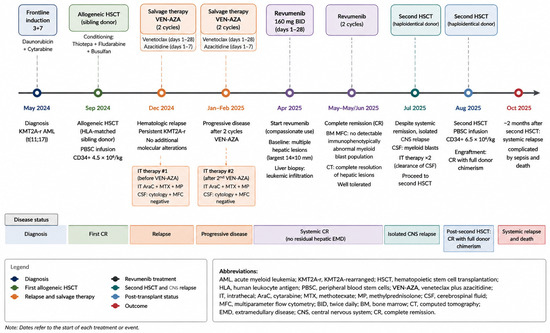
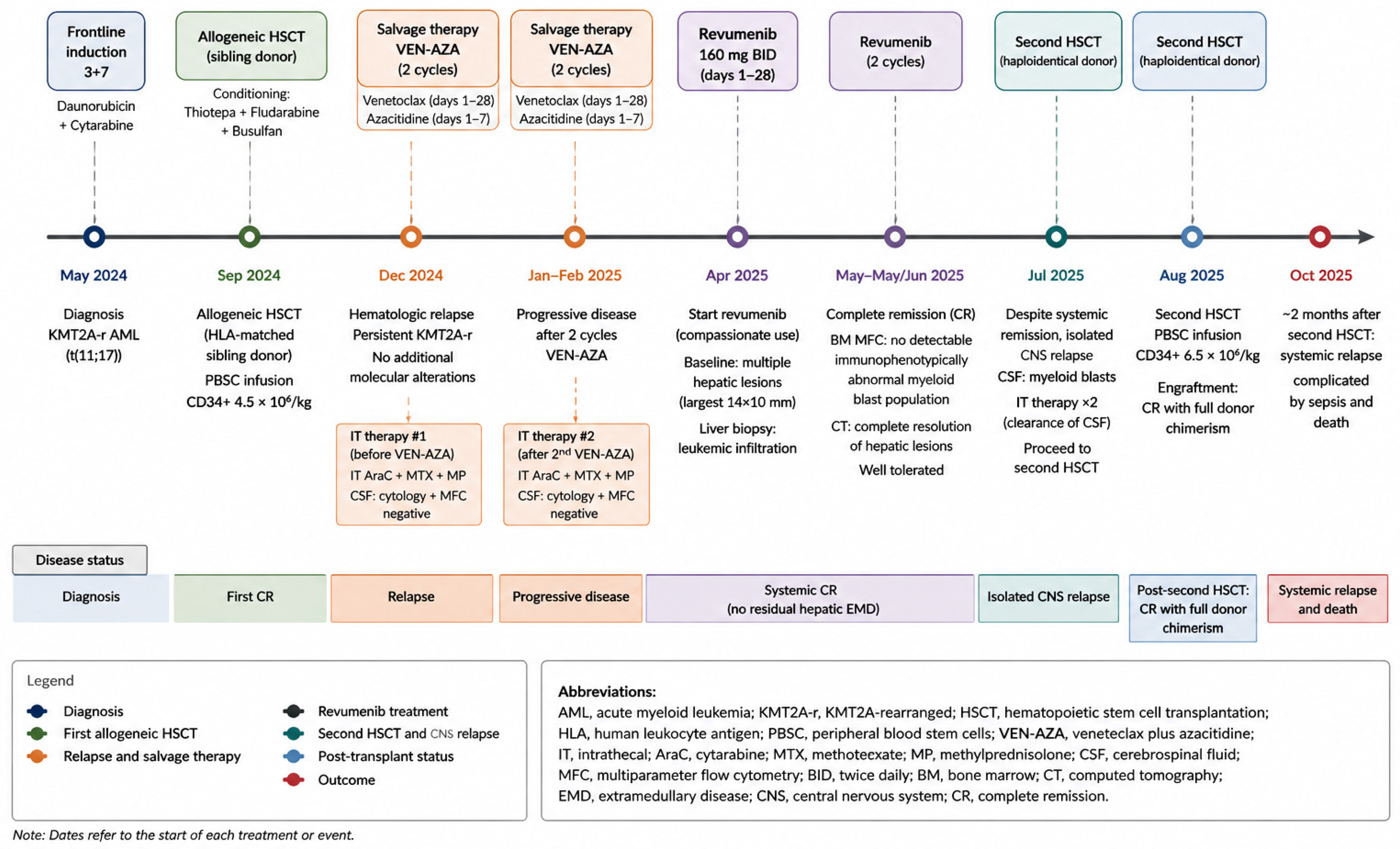
A 36-year-old man was diagnosed in May 2024 with AML harboring a KMT2A rearrangement associated with t(11;17). Molecular characterization beyond fluorescence in situ hybridization (FISH) was not available; therefore, the specific KMT2A fusion partner could not be identified. Frontline treatment consisted of the standard 3 + 7 regimen, including daunorubicin (60 mg/m2/day intravenously on days 1–3) and continuous intravenous infusion of cytarabine (100 mg/m2/day on days 1–7). The patient achieved complete remission (CR) and subsequently underwent allogeneic hematopoietic stem cell transplantation (HSCT) from an HLA-matched sibling donor in September 2024. The conditioning regimen consisted of thiotepa (5 mg/kg/day for 2 days), fludarabine (50 mg/m2/day for 3 days), and busulfan (3.2 mg/kg/day for 3 days). Peripheral blood stem cells were infused, with a CD34+ cell dose of 4.5 × 10⁶ cells/kg (Figure 1).
Figure 1.
Clinical case timeline.
Three months after HSCT, in December 2024, hematologic relapse occurred, with persistence of the KMT2A rearrangement and no additional molecular alterations. Salvage therapy with venetoclax plus azacitidine (VEN-AZA) was initiated, consisting of venetoclax (400 mg/day administered continuously on days 1–28) and azacitidine (75 mg/m2/day on days 1–7) in 28-day treatment cycles. Disease reassessment after two cycles demonstrated progressive disease.
During this period, the patient received two courses of intrathecal (IT) therapy consisting of cytarabine (40 mg), methotrexate (12.5 mg), and methylprednisolone (40 mg). The first IT treatment was administered before initiation of VEN-AZA, whereas the second was performed after completion of the second VEN-AZA cycle, when disease progression was documented. Cerebrospinal fluid (CSF) samples obtained at both time points were evaluated by cytological examination and multiparameter flow cytometry (MFC), with no evidence of leukemic blast infiltration.
Given the presence of a targetable KMT2A rearrangement, revumenib was obtained through a compassionate-use program and initiated in April 2025. Revumenib was administered at a dose of 160 mg twice daily (BID), continuously on days 1–28 of each 28-day cycle. Before treatment initiation, the patient presented with abnormal liver function tests, and abdominal ultrasound demonstrated multiple focal hepatic lesions, the largest measuring 14 × 10 mm. Histopathological examination of a liver biopsy confirmed hepatic infiltration by leukemic blasts.
Following two cycles of revumenib, the patient achieved CR. Bone marrow evaluation by MFC showed no detectable immunophenotypically abnormal myeloid blast population. At the same time, contrast-enhanced computed tomography (CT) demonstrated complete radiological resolution of the hepatic lesions, with no residual evidence of extramedullary liver involvement. Revumenib was well tolerated throughout treatment, with no adverse events requiring dose modification or treatment interruption.
Given the achievement of CR, the absence of an immunophenotypically abnormal myeloid blast population by bone marrow, and complete resolution of hepatic extramedullary disease, the patient became eligible for a second HSCT from a haploidentical donor while continuing revumenib as bridge therapy. However, despite achieving sustained systemic remission, in July 2025 he unexpectedly developed a severe headache. CSF examination demonstrated an isolated CNS relapse with myeloid blasts by MFC. Two additional courses of IT therapy with cytarabine, methotrexate, and methylprednisolone resulted in complete clearance of leukemic blasts from the CSF, thereby allowing the patient to proceed to a second HSCT.
The second HSCT was performed using peripheral blood stem cells from a haploidentical donor following conditioning with treosulfan (14 g/m2/day for 3 consecutive days), fludarabine (30 mg/m2/day for 5 consecutive days), and thiotepa (5 mg/kg for one day). A CD34+ cell dose of 6.5 × 10⁶ cells/kg was infused. Engraftment evaluation confirmed CR with full donor chimerism. Unfortunately, approximately two months after the second HSCT, the patient developed systemic relapse complicated by sepsis and died.
3. Discussion
In the era of rapidly evolving targeted therapies, real-world evidence has become increasingly important for defining both the effectiveness and the limitations of novel agents beyond the highly selected populations enrolled in clinical trials. Although clinical trials remain the cornerstone for regulatory approval, they often do not fully capture the heterogeneity, complexity, and therapeutic challenges encountered in routine clinical practice.
Revumenib received U.S. Food and Drug Administration (FDA) approval based on the results of the AUGMENT-101 trial, which demonstrated meaningful clinical activity in heavily pretreated patients with relapsed/refractory (R/R) KMT2A-rearranged AML [4]. Importantly, approximately one-third of responding patients proceeded to HSC, supporting the role of revumenib as an effective bridge-to-transplant strategy in eligible patients [4]. This benefit is likely attributable to the achievement of deep bone marrow responses together with the favorable safety profile of revumenib, which may facilitate recovery of patient fitness before transplantation. Furthermore, the AUGMENT-101 trial reported a patient with splenic leukemic involvement who achieved a response after two cycles of revumenib, providing preliminary evidence of activity against extramedullary disease [4].
Our case extends these observations in a real-world setting by demonstrating deep systemic and extramedullary responses to revumenib, including complete resolution of hepatic leukemic infiltration, absence of an immunophenotypically abnormal myeloid blast population by MFC, excellent treatment tolerability, and successful bridging to a second HSCT. These findings further support the clinical activity of revumenib in heavily pretreated patients with KMT2A-r AML.
However, the most clinically relevant observation in our patient was the occurrence of an isolated CNS relapse despite sustained systemic remission. Rather than demonstrating inadequate activity of revumenib within the CNS, this finding highlights a potential discordance between systemic and CNS disease control during menin inhibitor therapy. Although limited CNS penetration of revumenib represents one possible explanation, our findings do not allow definitive conclusions regarding its pharmacokinetic behavior within the CNS, as CSF drug concentrations were not assessed. Alternative mechanisms should also be considered, including persistence of pre-existing CNS-tropic leukemic subclones, the timing or efficacy of CNS-directed therapy, or other biological mechanisms contributing to immune-privileged sanctuary sites [10]. These mechanisms are not mutually exclusive and may have contributed simultaneously to the observed clinical course.
Increasing evidence suggests that CNS leukemia may arise from neurotropic leukemic subclones that seed the CNS early during disease evolution and remain clinically silent until relapse [11]. Our observation suggests that the achievement of a deep systemic response should not necessarily be interpreted as evidence of disease eradication within immune-privileged compartments such as the CNS. Therefore, careful CNS evaluation using both conventional cytology and MFC should be considered in selected high-risk AML patients, particularly those harboring KMT2A rearrangements. Because MFC may detect occult CNS disease that is not identifiable by conventional cytology, its integration into the diagnostic evaluation may further improve disease assessment in this setting. Whether systematic CNS monitoring or intensified CNS-directed prophylaxis should be incorporated into future treatment strategies for patients receiving menin inhibitors remains to be determined in prospective studies.
The inherent limitations of a single-case observation preclude definitive conclusions regarding causality or the CNS activity of revumenib. Nevertheless, the striking discordance between systemic and CNS disease control observed in our patient raises an important clinical hypothesis that deserves further investigation. Future prospective clinical studies, together with dedicated pharmacokinetic analyses evaluating CSF drug exposure, will be essential to better define the activity of revumenib within the CNS compartment and to optimize strategies for preventing CNS relapse in this high-risk population.
4. Conclusions
This case highlights a potential discordance between systemic and CNS disease control during menin inhibitor therapy in KMT2A-rearranged AML. Although revumenib induced a deep systemic response, characterized by complete remission, the absence of an immunophenotypically abnormal myeloid blast population by bone MFC, and complete resolution of hepatic extramedullary disease, an isolated CNS relapse subsequently occurred. While this single observation does not permit definitive conclusions regarding the CNS activity of revumenib, it underscores the importance of maintaining a high index of suspicion for CNS involvement in high-risk patients, even in the presence of deep systemic responses. Prospective studies and collaborative multicenter registries will be essential to clarify patterns of CNS relapse, define the role of CNS surveillance and prophylactic strategies, and better characterize the activity of menin inhibitors within the CNS compartment.
Author Contributions
M.C. (Martina Canichella) contributed to conception, writing up and revising the paper. C.P. and J.N. contributed to the revised manuscript and wrote some sections. M.C. (Mariagiovanna Cefalo) contributed to the bibliography. V.G., L.C. and C.M. provided clinical records. F.M. and A.S. provided diagnostic information. I.C. and MFC. conducted immunophenotypic analysis. P.d.F. and M.I.D.P. revised the final version of the manuscript. All authors have read and agreed to the published version of the manuscript.
Funding
This research received no external funding.
Institutional Review Board Statement
The study was conducted in accordance with the principles of the Declaration of Helsinki. The patient was treated according to protocol version 1.0 (30 September 2024; NCT05918913). Approval for this case report was obtained from the Ethics Committee of the IRCCS Azienda Ospedaliero-Universitaria di Bologna (Ospedale Sant’Orsola) on 10 April 2025.
Informed Consent Statement
Informed consent was obtained from all subjects involved in the study.
Data Availability Statement
The original contributions presented in this study are included in the article. Further inquiries can be directed to the corresponding author.
Conflicts of Interest
The authors declare no conflicts of interest.
References
- Döhner, H.; Wei, A.H.; Appelbaum, F.R.; Craddock, C.; DiNardo, C.D.; Dombret, H.; Ebert, B.L.; Fenaux, P.; Godley, L.A.; Hasserjian, R.P.; et al. Diagnosis and management of AML in adults: 2022 recommendations from an international expert panel on behalf of the ELN. Blood 2022, 140, 1345–1377. [Google Scholar] [CrossRef] [Scilit] [PubMed]
- Issa, G.C.; Zarka, J.; Sasaki, K.; Qiao, W.; Pak, D.; Ning, J.; Short, N.J.; Haddad, F.; Tang, Z.; Patel, K.P.; et al. Predictors of outcomes in adults with acute myeloid leukemia and KMT2A rearrangements. Blood Cancer J. 2021, 11, 162. [Google Scholar] [CrossRef] [Scilit] [PubMed]
- Kapur, R.; Steinberg, A.; Moussly, A.; Trias, J.A.; Quintas, J. Widespread myeloid sarcoma with KMT2A rearrangement involving the testis, oral cavity, heart, kidney and gallbladder without bone marrow involvement. Leuk. Res. Rep. 2022, 18, 100349. [Google Scholar] [CrossRef] [Scilit] [PubMed]
- Vetro, C.; Haferlach, T.; Meggendorfer, M.; Stengel, A.; Jeromin, S.; Kern, W.; Haferlach, C. Cytogenetic and molecular genetic characterization of KMT2A-PTD positive acute myeloid leukemia in comparison to KMT2A-rearranged acute myeloid leukemia. Cancer Genet. 2020, 240, 15–22. [Google Scholar] [CrossRef] [Scilit] [PubMed]
- Grembecka, J.; He, S.; Shi, A.; Purohit, T.; Muntean, A.G.; Sorenson, R.J.; Showalter, H.D.; Murai, M.J.; Belcher, A.M.; Hartley, T.; et al. Menin-MLL inhibitors reverse oncogenic activity of MLL fusion proteins in leukemia. Nat. Chem. Biol. 2012, 8, 277–284. [Google Scholar] [CrossRef] [Scilit] [PubMed]
- Aldoss, I.; Issa, G.C.; Thirman, M.J.; DiPersio, J.; Arellano, M.; Blachly, J.S.; Mannis, G.; Perl, A.; Dickens, D.; McMahon, C.M.; et al. Revumenib monotherapy in patients with relapsed/refractory KMT2A-r acute leukemias: Efficacy and safety results from the AUGMENT-101 phase 1/2 study. Blood 2023, 142, 2907. [Google Scholar] [CrossRef] [Scilit]
- Wang, E.S.; Issa, G.C.; Erba, H.P.; Altman, J.K.; Montesinos, P.; DeBotton, S.; Walter, R.B.; Pettit, K.; Savona, M.R.; Shah, M.V.; et al. Ziftomenib in Relapsed or Refractory Acute Myeloid Leukaemia (KOMET-001): A Multicentre, Open-Label, Multi-Cohort, Phase 1 Trial. Lancet Oncol. 2024, 25, 1310–1324, Correction in Lancet Oncol 2024, 25, E542. [Google Scholar] [CrossRef] [Scilit] [PubMed]
- Searle, E.; Recher, C.; Abdul-Hay, M.; Abedin, S.; Aldoss, I.; Pierola, A.A.; Alonso-Dominguez, J.M.; Chevallier, P.; Cost, C.; Daskalakis, N.; et al. Bleximenib Dose Optimization and Determination of RP2D from a Phase 1 Study in Relapsed/Refractory Acute Leukemia Patients with KMT2A and NPM1 Alterations. Blood 2024, 144, 212. [Google Scholar] [CrossRef] [Scilit]
- Daver, N.; Zeidner, J.; Watts, J.; Yuda, J.; Levis, M.; Montesinos, P.; Papayannidis, C.; Fukushima, K.; Shima, T.; Raffoux, E.; et al. Monotherapy Update from Phase 1 Portion in Phase 1/2 Trial of the Menin-MLL Inhibitor Enzomenib (DSP-5336) in Patients with Relapsed or Refractory Acute Leukemia. Blood 2025, 146, 763. [Google Scholar] [CrossRef] [Scilit]
- Del Principe, M.I.; Buccisano, F.; Soddu, S.; Maurillo, L.; Cefalo, M.; Piciocchi, A.; Consalvo, M.I.; Paterno, G.; Sarlo, C.; De Bellis, E.; et al. Involvement of central nervous system in adult patients with acute myeloid leukemia: Incidence and impact on outcome. Semin. Hematol. 2018, 55, 209–214. [Google Scholar] [CrossRef] [Scilit] [PubMed]
- Bartram, J.; Goulden, N.; Wright, G.; Adams, S.; Brooks, T.; Edwards, D.; Inglott, S.; Yousafzai, Y.; Hubank, M.; Halsey, C. High throughput sequencing in acute lymphoblastic leukemia reveals clonal architecture of central nervous system and bone marrow compartments. Haematologica 2018, 103, e110–e114. [Google Scholar] [CrossRef] [Scilit] [PubMed]
Disclaimer/Publisher’s Note: The statements, opinions and data contained in all publications are solely those of the individual author(s) and contributor(s) and not of MDPI and/or the editor(s). MDPI and/or the editor(s) disclaim responsibility for any injury to people or property resulting from any ideas, methods, instructions or products referred to in the content. |
© 2026 by the authors. Licensee MDPI, Basel, Switzerland. This article is an open access article distributed under the terms and conditions of the Creative Commons Attribution (CC BY) license.