


Abstract
With their success in the treatment of various malignancies, immune checkpoint inhibitors (ICIs) are quickly being established as a critical component of treatment plans in oncology. However, due to concerns regarding autoimmune flares and immune-related adverse events, patients with autoimmune disease have historically been excluded from clinical trials. While research has been slowly incorporating those with autoimmune disease, research focusing on some autoimmune diseases such as systemic sclerosis is still lacking. This scoping review aimed to characterize the safety and outcomes of immune checkpoint inhibitor therapy in patients with systemic sclerosis. A literature search conducted through PubMed, Semantic Scholar, and OpenAlex was performed through June 2026 in accordance with the PRISMA-Scoping Review guidelines. Available evidence regarding the safety of ICI therapy in patients with pre-existing systemic sclerosis remains limited and heterogeneous. Autoimmune flares and immune-related adverse events, including severe complications, have been reported, and the available data are insufficient to establish the safety or tolerability of ICIs in this population. Further prospective studies are needed to better characterize outcomes and identify factors associated with increased risk.
1. Introduction
Immune checkpoint inhibitors (ICIs) have transformed the treatment landscape for numerous advanced malignancies by enhancing antitumor immunity through the inhibition of immune regulatory pathways, including programmed cell death protein-1 (PD-1), programmed death ligand-1 (PD-L1), and cytotoxic T-lymphocyte-associated protein-4 (CTLA-4) [1]. These agents have significantly improved survival across multiple cancer types, including melanoma, non-small-cell lung cancer, renal cell carcinoma, and urothelial carcinoma. Despite their therapeutic success, immune activation associated with ICIs can lead to immune-related adverse events (irAEs), which may affect nearly every organ system and often resemble autoimmune disease.
Patients with pre-existing autoimmune diseases present a unique therapeutic challenge because they have historically been excluded from pivotal clinical trials evaluating ICIs. Consequently, evidence regarding the safety and efficacy of immunotherapy in this population remains limited, and treatment decisions frequently rely on retrospective studies, case reports, and expert opinion. Although several observational studies suggest that ICIs can be administered safely in selected patients with autoimmune diseases, these patients appear to have an increased risk of autoimmune disease flare and other immune-related toxicities compared with the general oncology population [2].
Systemic sclerosis (SSc) represents a complex autoimmune disease characterized by heterogeneous manifestations resulting from immune dysregulation, vasculopathy, and fibrosis, with involvement of the skin, lungs, gastrointestinal tract, kidneys, heart, and vasculature. Exacerbation of systemic sclerosis during immune checkpoint inhibition may result in significant morbidity, particularly in patients with diffuse cutaneous disease or pre-existing internal organ involvement [3]. At the same time, withholding potentially life-prolonging cancer immunotherapy because of concerns regarding autoimmune toxicity may adversely affect oncologic outcomes. Balancing these competing risks remains a significant clinical challenge for both rheumatologists and oncologists. In addition to concerns regarding disease flare in patients with established systemic sclerosis, an increasing number of reports have described new-onset systemic sclerosis and scleroderma-like syndromes developing after the initiation of immune checkpoint inhibitor therapy. These observations suggest that immune checkpoint blockade may contribute to immune dysregulation through mechanisms that are not yet fully understood.
Although several reviews have examined immune checkpoint inhibitor use in patients with autoimmune diseases, evidence specifically addressing patients with pre-existing systemic sclerosis and ICI-induced systemic sclerosis remains limited and dispersed throughout the literature [3]. A comprehensive synthesis of the available evidence is needed to better characterize the frequency and severity of disease flares, identify patient characteristics associated with adverse outcomes, summarize management strategies, and evaluate reported oncologic outcomes. Therefore, we conducted a scoping review to map the current literature regarding the use of immune checkpoint inhibitors in patients with pre-existing systemic sclerosis, with additional consideration of reports of new-onset SSc and scleroderma-like syndromes following ICI exposure as contextual evidence.
2. Methods
2.1. Search Strategy and Study Selection
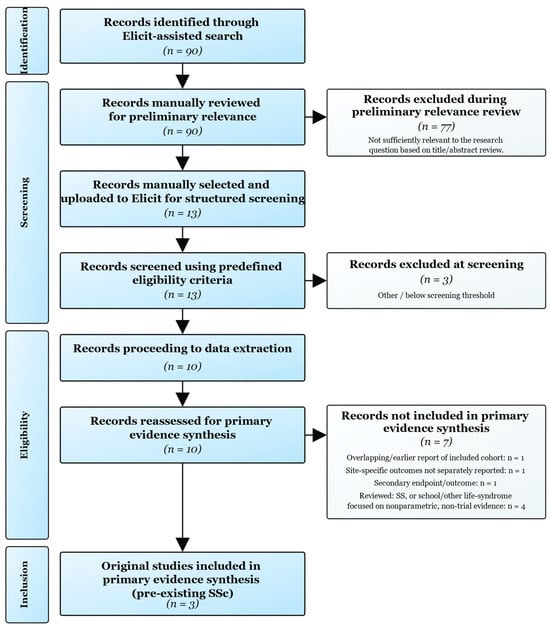
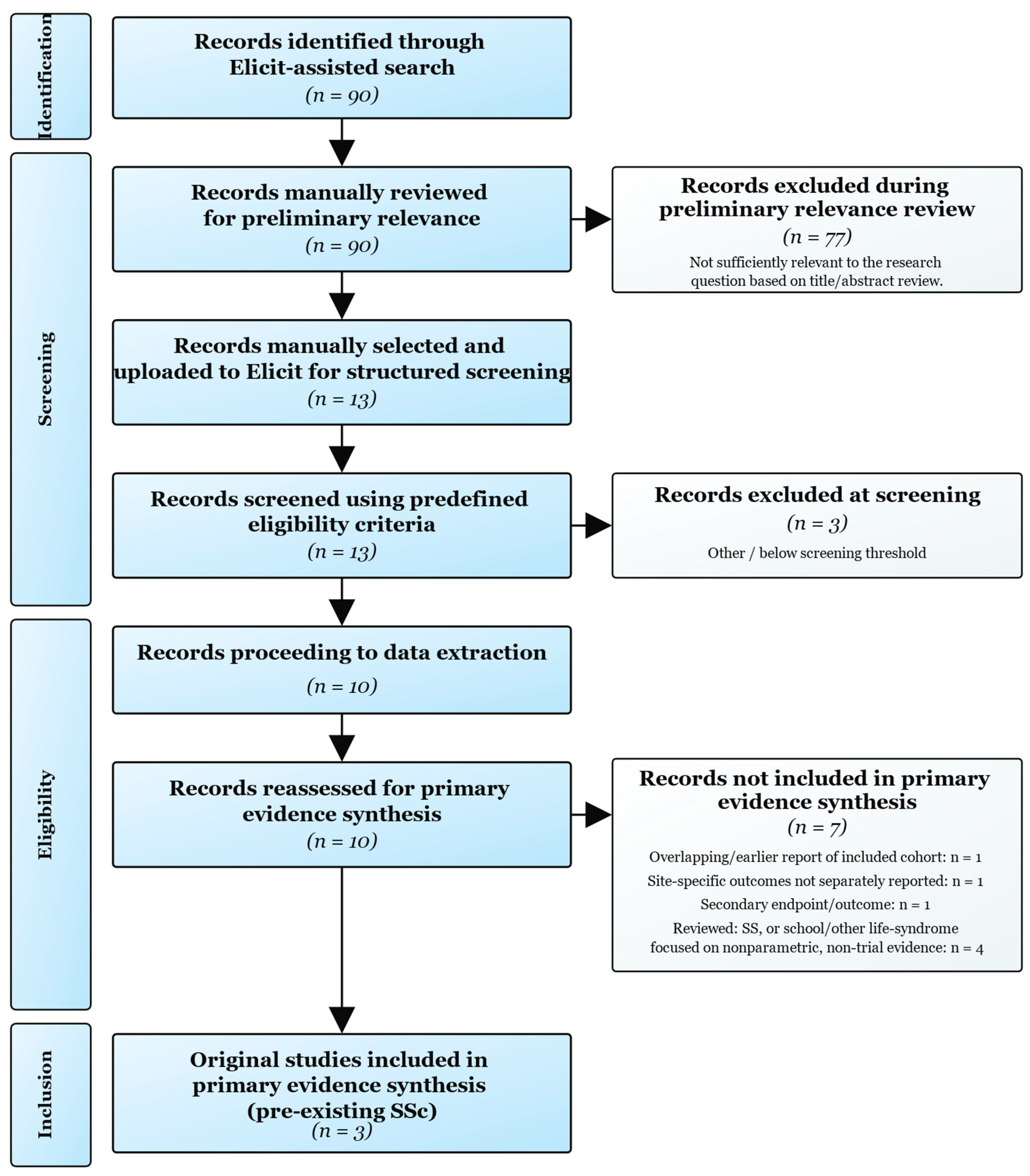
A scoping review was conducted to evaluate the association of immune checkpoint inhibitors (ICIs) and systemic sclerosis (SSc). This scoping review was conducted in accordance with the PRISMA Extension for Scoping Reviews (PRISMA-ScR). A formal review protocol was not developed or prospectively registered for this scoping review. The literature search was conducted using Elicit, which searched PubMed, Semantic Scholar, and OpenAlex to identify studies relevant to the research question. Because the search was conducted through Elicit rather than through independent database-specific searches, separate database-specific search strings and record counts were not available. The search query entered into Elicit was “immune checkpoint inhibitors” and “systemic sclerosis.” The initial Elicit-assisted search surfaced 90 potentially relevant records, which were manually reviewed for assessment of their preliminary relevance. Of these, 77 were excluded during preliminary review, and 13 potentially relevant records were manually selected and uploaded to Elicit for structured screening using the predefined eligibility criteria. Of the 13 records screened, 3 did not meet the screening threshold and 10 proceeded to data extraction. Following manual reassessment of the extracted records and application of the primary eligibility criteria, three original studies reporting outcomes in patients with pre-existing SSc comprised the primary evidence set. Of the remaining seven records, one represented an earlier report of an overlapping cohort, one did not separately report SSc-specific outcomes, one was retained as a secondary evidence source, and four reports describing new-onset SSc or scleroderma-like syndromes were retained as nonsystematic contextual evidence. The study identification and selection process is summarized in the PRISMA-ScR flow diagram (Figure 1). Studies were eligible for the primary evidence synthesis if they included adult patients with pre-existing systemic sclerosis (SSc), including limited or diffuse cutaneous disease, who were treated with immune checkpoint inhibitors (ICIs) and reported SSc-related clinical outcomes, including disease flare, skin or organ manifestations, disease progression, or treatment-related adverse events. Reports describing new-onset SSc or scleroderma-like syndromes following ICI exposure were not considered part of the systematically identified primary evidence set but were included as nonsystematic contextual evidence to characterize reported clinical manifestations of ICI-associated scleroderma. For this contextual literature, terminology was based on the clinical diagnosis reported in the original study; “ICI-associated SSc” refers to cases reported as systemic sclerosis, whereas “ICI-associated scleroderma-like syndrome” refers to scleroderma-like presentations not clearly characterized as systemic sclerosis. Eligible studies evaluated treatment with PD-1, PD-L1, CTLA-4, or other checkpoint inhibitors and reported SSc- or scleroderma-related clinical outcomes, including skin involvement, organ manifestations, disease progression, or treatment-related adverse events.
Figure 1.
PRISMA-ScR flow diagram of the process of study identification, screening, and selection for the primary evidence synthesis.
Eligible study designs for the primary evidence synthesis included randomized and non-randomized clinical trials, cohort studies, case–control studies, case series, and other original human clinical studies published prior to June 2026. Review articles, editorials, commentaries, opinion articles, conference abstracts without a corresponding full-text publication, basic science or animal studies, and studies in which systemic sclerosis was mentioned only as a comorbidity without reporting disease-specific outcomes were excluded from the primary analysis. Review articles and other secondary sources were screened for relevant references. One clinical practice guideline with an accompanying systematic review [4] was additionally included as a secondary evidence source because it specifically addressed the management of patients with pre-existing systemic sclerosis and other systemic autoimmune rheumatic diseases receiving immune checkpoint inhibitors. Other review articles and secondary sources were excluded from the evidence set when they did not provide additional SSc-specific evidence or recommendations directly relevant to ICI management. The primary unit of evidence was the unique patient population reported in an eligible original clinical study. Patients summarized through guidelines, systematic reviews, or literature-review components of included publications were treated as secondary contextual evidence and were not added to primary-study denominators or used to calculate SSc-specific outcome estimates. When multiple publications reported overlapping patient populations, the most complete or most recent report was used for outcome synthesis to avoid the duplicate counting of patients. Guideline-derived findings were considered separately from findings derived from original clinical studies and were used to provide clinical context and synthesize available evidence rather than as an original clinical study.
2.2. Data Extraction
Data was extracted using a standardized data collection form. Information collected included study characteristics (author, publication year, study design, and sample size), patient demographics, underlying malignancy, immune checkpoint inhibitor class and agent, treatment duration, dosing information when available, and whether immunotherapy was continued, modified, or discontinued following adverse events.
Clinical variables extracted included baseline systemic sclerosis characteristics (disease subtype, duration, previous immunosuppressive therapy, baseline skin involvement, and autoantibody profile), clinical manifestations following ICI therapy (cutaneous, vascular, pulmonary, gastrointestinal, renal, cardiac, and laboratory findings), the timing of symptom onset, disease progression, and whether findings represented flare of pre-existing disease or new-onset ICI-induced systemic sclerosis. Definitions of SSc flare, immune-related adverse events (irAEs), severity grading, baseline SSc disease activity, and follow-up duration were extracted as reported by the individual studies. Because definitions and reporting of these outcomes were not standardized across the included studies, outcomes were not reclassified retrospectively when study-specific definitions were unavailable. Flare proportions and adverse event frequencies were therefore interpreted as study-specific descriptive outcomes rather than directly comparable estimates. No pooled estimate of SSc flare frequency or irAE incidence was calculated. Management strategies, including corticosteroids, disease-modifying antirheumatic drugs, and other immunosuppressive therapies; treatment response; the reversibility of symptoms; long-term outcomes; and the ability to resume ICI therapy were also recorded. Additional variables included cancer characteristics, concurrent medications, biomarkers, and other clinical factors identified as potential predictors of systemic sclerosis flare or ICI-associated disease.
3. Results
3.1. Characteristics of Included Studies
The primary evidence set consisted of original clinical studies examining ICI therapy in patients with pre-existing SSc. Additional reports describing new-onset SSc or scleroderma-like syndromes following ICI exposure were considered separately as nonsystematic contextual evidence and were not included in the primary evidence set or its denominators. The Ye et al., 2025 [4] living clinical practice guideline with systematic review was retained as a secondary evidence source because it synthesized available evidence regarding patients with pre-existing systemic autoimmune rheumatic diseases receiving immune checkpoint inhibitors and provided disease-specific recommendations. Findings from secondary evidence sources were considered separately and were not included in primary-study denominators.
The studies were broadly categorized into two groups: studies examining the safety of ICIs in patients with pre-existing SSc [4,5,6] and studies characterizing new-onset or ICI-associated scleroderma as an immune-related adverse event, which were considered separately as contextual evidence [7,8,9,10,11]. The Ye et al. guideline additionally incorporated data from nine studies involving patients with pre-existing SSc, including 28 patients overall [6].
All studies were limited by small sample sizes and observational designs (Table 1).
Table 1.
Included studies addressing the use of immune checkpoint inhibitors (ICIs) in pre-existing systemic sclerosis and de novo systemic sclerosis.
In the SCLERONCO-1 cohort, 4 of 17 patients (24%) experienced a flare of SSc following ICI therapy, while other available cohorts also reported worsening of pre-existing SSc [4]. However, differences in study design, small sample sizes, disease characteristics, and outcome definitions limit direct comparison of flare frequencies across studies; therefore, these findings should be interpreted as study-specific descriptive outcomes rather than estimates of flare incidence. In the largest aggregated dataset with 28 patients across 9 studies, both mild and severe SSc flares were observed, including scleroderma renal crisis and interstitial lung disease progression [4]. Importantly, no deaths attributable to SSc flare or irAEs were reported in any of these cohorts [5,6]. The Panhaleux et al., 2021 study noted that SSc aggravation occurred without new organ involvement [5], whereas Wallwork et al., 2024 reported that the one patient who experienced worsening had early, active diffuse cutaneous SSc and developed both skin thickening and scleroderma renal crisis simultaneously with immune checkpoint-related nephritis [6] (Table 2).
3.2. Disease Subtype and Baseline Activity in Relation to Flare Risk
Available observations suggest that SSc disease subtype and baseline disease activity may influence the risk of flare following ICI therapy. Wallwork et al., 2024 found that patients with long-standing sine or limited cutaneous SSc did not experience progressive skin thickening, while the single patient with early diffuse cutaneous SSc experienced significant worsening [6]. This observation led the authors to conclude that early, active SSc may confer greater risk from ICI therapy [6]. The Ye et al., 2025 guideline similarly highlighted that patients with anti-RNA polymerase III antibodies or with SSc onset close to cancer diagnosis are at particular risk of flare and warrant close monitoring [4]. In the Panhaleux et al., 2021 cohort, two patients with paraneoplastic SSc associated with anti-RNA polymerase III antibodies were identified [5], though specific flare outcomes in this subgroup were not delineated (Table 2).
Table 2.
Effect of ICIs on pre-existing systemic sclerosis. Abbreviations used: SSc (systemic sclerosis), irAE (immune-related adverse event), dcSSc (diffuse cutaneous systemic sclerosis), ILD (interstitial lung disease), and AD (autoimmune disease).
3.3. Oncologic Outcomes
Oncologic outcomes were reported in a limited subset of the available literature. Panhaleux et al., 2021 reported an overall response rate of 41% (7/17 patients) and a median overall survival of 15.8 months (95% CI: 7.3 not reached) [5]. Given the small sample size and absence of an appropriate comparator group, no conclusions regarding the relative oncologic efficacy of ICI therapy in patients with pre-existing SSc can be drawn. The Ye et al., 2025 guideline conditionally recommended continuing baseline immunosuppression in patients with pre-existing SSc, particularly for organ- or life-threatening manifestations, reflecting a careful balance between flare prevention and cancer treatment efficacy [4].
3.4. New-Onset Systemic Sclerosis and Scleroderma-like Syndromes Following ICI Exposure
As contextual evidence, published case reports and pharmacovilgilance analyses have described new-onset systemic sclerosis and scleroderma-like syndromes following ICI-exposure. Pharmacovigilance data from both VigiBase (WHO) and EudraVigilance converge in identifying anti-PD-1 agents—pembrolizumab and nivolumab—as carrying a disproportionate signal for scleroderma reporting [7,8]. No disproportionality was found for ipilimumab (anti-CTLA-4), atezolizumab, or durvalumab (anti-PD-L1) [7], although individual case reports of durvalumab-induced SSc have been published [10]. Terrier et al. 2020 observed that skin changes appeared or worsened more quickly with pembrolizumab than nivolumab, with different clinical patterns noted between the two drugs [7]. The median time to onset in the EudraVigilance analysis was approximately 325 days for pembrolizumab and 347 days for nivolumab [8], suggesting a subacute onset pattern. However, the Lyu et al., 2026 case report documented symptom onset as early as three days after ICI initiation, with a formal diagnosis at approximately six months [9] (Table 3).
Table 3.
Clinical presentation of new-onset ICI-associated systemic sclerosis and ICI-associated scleroderma.
3.5. Management and Treatment Outcomes
Corticosteroids were frequently used for the management of immune-related adverse events and scleroderma-related manifestations across the included studies. However, their use in patients with systemic sclerosis requires caution because corticosteroid exposure may increase the risk of scleroderma renal crisis [8]. Although corticosteroids may be necessary for the treatment of certain immune-related adverse events, the potential benefits should be weighed against this risk, with consideration of the lowest effective dose and close monitoring when corticosteroid therapy is required. In the case of new-onset ICI-SSc, combination regimens involving disease-modifying antirheumatic drugs (hydroxychloroquine, methotrexate, mycophenolate mofetil) showed favorable responses [10,11,12]. ICI treatment was discontinued in both the Lyu et al., 2026 and Li & Xiong 2024 case reports due to severe scleroderma effects [9,10] (Table 4).
Table 4.
Management and treatment outcomes.
4. Discussion
Overall, the literature remains limited and is composed primarily of retrospective cohort studies, pharmacovigilance analyses, and individual case reports. Among patients with pre-existing SSc, the available evidence is insufficient to establish the safety or tolerability of ICI therapy because of small sample sizes, observational study designs, heterogeneous patient populations, and potential overlap between study populations. Although some patients with stable or longstanding SSc received ICIs without reported disease progression, disease flares and immune-related adverse events, including severe complications, were also reported. These findings should therefore be interpreted descriptively rather than as evidence that ICIs are generally tolerable in patients with stable SSc. These findings regarding safety and tolerability are based specifically on studies of patients with pre-existing SSc and should be distinguished from the separate literature describing new-onset scleroderma following ICI exposure.
Flares of pre-existing SSc have been reported following the initiation of ICI therapy, although the available evidence is derived from very small observational cohorts. In the SCLERONCO-1 cohort, 4 of 17 patients (24%) experienced worsening of SSc. Severe complications, including scleroderma renal crisis and progression of interstitial lung disease, have also been reported in the broader literature. Given the limited number of patients and heterogeneity of available studies, the frequency of SSc flare following ICI therapy cannot be reliably estimated. Limited observations suggest that patients with long-standing limited cutaneous SSc may experience fewer disease-related complications following ICI therapy; however, the small number of reported patients precludes firm conclusions regarding the influence of SSc subtype or disease duration on risk. In particular, anti-RNA polymerase III antibody positivity has been proposed as a potential risk factor for severe disease progression, although additional studies are needed to validate this observation.
Checkpoint inhibitors enhance antitumor immunity by disrupting inhibitory pathways that normally restrain T-cell activation, including CTLA-4 during T-cell priming and PD-1/PD-L1 signaling in peripheral tissues [12]. The predominance of scleroderma-like events reported with anti-PD-1 agents raise the possibility that the PD-1/PD-L1 pathway may have relevance to SSc pathobiology. PD-1/PD-L1 signaling has immunoregulatory functions within peripheral tissues, including effects on T-cell activation, immune tolerance, and fibroblast-associated pathways [13,14]. Disruption of this signaling may enhance autoreactive T-cell responses, alter regulatory T-cell function, and promote inflammatory and profibrotic cytokine signaling involving pathways such as TGF-β, IL-6, IL-13, and IL-17, potentially contributing to fibroblast activation and extracellular matrix deposition [13,14]. These mechanisms provide biologic plausibility for ICI-associated worsening of established SSc or the emergence of scleroderma-like manifestations; however, they remain incompletely understood and do not establish a direct causal relationship between checkpoint inhibition and SSc. Patients with early, active diffuse SSc may represent a particularly vulnerable population, although the limited clinical evidence does not permit definitive identification of high-risk subgroups.
Oncologic outcomes were reported in only a limited subset of patients. Although tumor responses and survival outcomes were described in some patients receiving ICIs, the small sample sizes and absence of appropriate comparator groups preclude conclusions regarding whether oncologic efficacy is preserved in patients with pre-existing SSc. These limitations emphasize the importance of individualized treatment decisions through multidisciplinary collaboration between rheumatologists and oncologists. Careful patient selection, baseline assessment of disease activity, and close monitoring throughout treatment may help to balance the potential oncologic benefits of ICI therapy against the risk of autoimmune complications in patients with systemic sclerosis.
Although the primary objective of this review was to evaluate ICIs in patients with pre-existing SSc, the growing literature describing new-onset ICI-associated scleroderma and scleroderma-like syndromes provides important context. Unlike classical idiopathic systemic sclerosis, some reported cases lack features such as the Raynaud phenomenon and SSc-specific autoantibodies, suggesting that ICI-associated scleroderma may represent a distinct or heterogeneous clinicopathologic entity. Numerous case reports and pharmacovigilance studies have described the development of scleroderma-like syndromes following PD-1 inhibitor therapy, particularly with pembrolizumab and nivolumab. However, the temporal development or recognition of SSc manifestations following ICI exposure does not establish causality; in some cases, previously unrecognized disease may have been present before ICI initiation, with ICI exposure potentially precipitating or accelerating clinical manifestations rather than causing de novo SSc. Nevertheless, these observations reinforce the concept that immune checkpoint blockade has the potential to promote immune dysregulation, vasculopathy, and fibrosis while underscoring the importance of vigilant monitoring in patients with established autoimmune disease.
The limited available evidence does not permit the establishment of standardized criteria for the continuation or discontinuation of ICI therapy in patients with SSc. Decisions should therefore be individualized according to baseline SSc activity, the severity and trajectory of disease manifestations, the presence of organ-threatening involvement, the severity of concurrent irAEs, oncologic response, and the availability of alternative cancer therapies. Caution may be warranted in patients with early, active diffuse cutaneous SSc, as worsening disease has been reported in this population [4]. For patients considered at higher risk, baseline assessment should document skin involvement, blood pressure and renal function, pulmonary involvement, and overall disease activity, with close reassessment throughout ICI therapy. New or progressive skin thickening, new hypertension or renal dysfunction, worsening respiratory symptoms or pulmonary function, or other evidence of significant organ progression should prompt multidisciplinary reassessment and consideration of ICI interruption or discontinuation. When SSc manifestations become organ- or life-threatening, such as rapidly progressive interstitial lung disease or scleroderma renal crisis, management should prioritize the immediate clinical threat, with the risks and benefits of continued ICI therapy reassessed jointly by rheumatology and oncology. However, the current literature is insufficient to establish specific thresholds at which ICI therapy should be discontinued.
The timing of SSc manifestations following ICI exposure is also highly variable. Pharmacovigilance data have reported median times to onset of approximately 325 days with pembrolizumab and 347 days with nivolumab [8], whereas symptoms were reported as early as three days after ICI initiation in an individual case [9]. This variability may reflect differences in baseline disease susceptibility, ICI exposure, cancer-associated immune factors, or the presence of previously unrecognized SSc; however, the available evidence is insufficient to determine the factors responsible for differences in latency. Consequently, no duration of uneventful ICI exposure can currently be considered a threshold beyond which subsequent SSc flare or disease progression can be excluded, supporting continued clinical surveillance throughout therapy. Long-term oncologic outcomes and duration of ICI exposure were also inconsistently reported across studies, precluding conclusions regarding overall survivorship, the longest duration for which ICI therapy can be safely maintained in patients with SSc, or whether a period of treatment exists after which the risk of subsequent flare becomes negligible.
Several limitations should be considered when interpreting these findings. The literature search was conducted using Elicit across PubMed, Semantic Scholar, and OpenAlex. Although this approach allowed for the identification of relevant studies across multiple sources, reliance on these selected bibliographic sources may have resulted in relevant studies not indexed within these databases being missed. Differences in database coverage and indexing practices may also have influenced study retrieval. Therefore, the findings of this scoping review should be interpreted in the context of the selected search sources. The available evidence is largely derived from observational studies and case reports, resulting in a high risk of selection and publication bias. Severe or unusual toxicities are more likely to be published than uncomplicated courses. Significant heterogeneity existed among studies with respect to patient characteristics, systemic sclerosis subtype, baseline immunosuppressive therapy, malignancy type, immune checkpoint inhibitor regimen, and outcome reporting, limiting direct comparisons between studies. While pharmacovigilance studies are helpful resources, they cannot establish incidence or prove causality, are subject to duplicate reporting, and lack denominator data. Additionally, the Ye et al., 2025 [4] living clinical practice guideline was included as a secondary evidence source because of its disease-specific synthesis and recommendations. Because this guideline incorporated data from previously published studies, its findings may overlap with the original studies included in this review. Therefore, guideline-derived evidence was interpreted as contextual and was not considered an independent patient population. Because of these limitations, quantitative synthesis and estimation of the true incidence of disease flares were not feasible.
5. Conclusions
This review provides a synthesis of the current literature regarding immune checkpoint inhibitor therapy in systemic sclerosis, with evidence from patients with pre-existing SSc considered separately from reports of new-onset ICI-induced scleroderma. The small sample sizes, observational study designs, heterogeneous patient populations, and reliance on case reports and pharmacovigilance data preclude definitive conclusions regarding the safety of ICI therapy in this population. Reports of patients with new-onset ICI-induced scleroderma represent a distinct clinical population and provide additional context regarding potential immune-mediated toxicity but should not be used to infer the safety or tolerability of ICIs in patients with established SSc. Larger multicenter prospective studies are needed to better define predictors of disease flare and establish evidence-based recommendations regarding ICI treatment and immunosuppressive management in patients with pre-existing SSc. As the use of immune checkpoint inhibitors continues to expand, collaboration between oncology and rheumatology will be essential to optimize both cancer outcomes and autoimmune disease control in this unique patient population.
Author Contributions
Conceptualization: J.G., J.K.; methodology J.G., H.K.J., M.O.; software J.G., M.O.; validation J.K., H.K.J.; data curation J.G., M.O.; writing—original draft preparation J.G.; writing—review and editing M.O., J.K., H.K.J. All authors have read and agreed to the published version of the manuscript.
Funding
This research received no external funding.
Data Availability Statement
No new data were created or analyzed in this study. Data sharing is not applicable to this article.
Conflicts of Interest
The authors declare no conflicts of interest.
References
- Topalian, S.L.; Hodi, F.S.; Brahmer, J.R.; Gettinger, S.N.; Smith, D.C.; McDermott, D.F.; Powderly, J.D.; Carvajal, R.D.; Sosman, J.A.; Atkins, M.B.; et al. Safety, Activity, and Immune Correlates of Anti–PD-1 Antibody in Cancer. N. Engl. J. Med. 2012, 366, 2443–2454. [Google Scholar] [CrossRef] [Scilit] [PubMed]
- Tison, A.; Garaud, S.; Chiche, L.; Cornec, D.; Kostine, M. Immune-checkpoint inhibitor use in patients with cancer and pre-existing autoimmune diseases. Nat. Rev. Rheumatol. 2022, 18, 641–656. [Google Scholar] [CrossRef] [Scilit] [PubMed]
- Macklin, M.; Yadav, S.; Jan, R.; Reid, P. Checkpoint Inhibitor-Associated Scleroderma and Scleroderma Mimics. Pharmaceuticals 2023, 16, 259. [Google Scholar] [CrossRef] [Scilit] [PubMed]
- Ye, C.; Nikolic, R.P.; Choi, M.; Fifi-Mah, A.V.; Graham, J.; O’neil, L.J.; Kobza, A.; Lau, K.C.; Arreola, L.G.; Pardo, J.P.; et al. Canadian Rheumatology Association/Canadian Research Group of Rheumatology in Immuno-Oncology Living Guidelines for Baseline Immunosuppression in Individuals with Preexisting Rheumatic Diseases Initiating Immune Checkpoint Inhibitors. Part 2: Preexisting Systemic Autoimmune Rheumatic Diseases. J. Rheumatol. 2025, 52, 1218–1230. [Google Scholar] [CrossRef] [Scilit] [PubMed]
- Panhaleux, M.; Espitia, O.; Terrier, B.; Manson, G.; Maria, A.; Humbert, S.; Godbert, B.; Perrin, J.; Achille, A.; Arrondeau, J.; et al. Anti-programmed death ligand 1 immunotherapies in cancer patients with pre-existing systemic sclerosis: A postmarketed phase IV safety assessment study. Eur. J. Cancer 2022, 160, 134–139. [Google Scholar] [CrossRef] [Scilit] [PubMed]
- Wallwork, R.S.; Kotzin, J.J.; Cappelli, L.; Mecoli, C.; Bingham, C.O.; Wigley, F.M.; Wilson, P.C.; DiRenzo, D.D.; Shah, A.A. Immune checkpoint inhibitor therapy in patients with cancer and pre-existing systemic sclerosis. Semin. Arthritis Rheum. 2024, 67, 152460. [Google Scholar] [CrossRef] [Scilit] [PubMed]
- Terrier, B.; Humbert, S.; Préta, L.-H.; Delage, L.; Razanamahery, J.; Laurent-Roussel, S.; Mestiri, R.; Beaudeau, L.; Legendre, P.; Goupil, F.; et al. Risk of scleroderma according to the type of immune checkpoint inhibitors. Autoimmun. Rev. 2020, 19, 102596. [Google Scholar] [CrossRef] [Scilit] [PubMed]
- Nicoletti, M.M.; Crisci, E.; Cosenza, V.; Riccardi, C.; Campitiello, M.R.; Ruggiero, D.; Berrino, P.M.; Docimo, G.; Scavone, C. Immune Checkpoint Inhibitors and Scleroderma: Data from the European Pharmacovigilance Database. Drugs—Real World Outcomes 2023, 11, 33–41. [Google Scholar] [CrossRef] [Scilit] [PubMed]
- Lyu, Q.; Xu, X.; She, W.; Wang, J.; Aimurula, M.; Zhou, M.; Ding, J.; Gu, Y. PD-1 inhibitor-induced systemic sclerosis with early interstitial lung disease and autoimmune thyroiditis in advanced gastric cancer: A case report and literature review. Front. Oncol. 2026, 16, 1776228. [Google Scholar] [CrossRef] [Scilit] [PubMed]
- Li, D.; Xiong, X. Immune Checkpoint Inhibitor-Associated Systemic Sclerosis in the Treatment of a Small Cell Lung Cancer Patient with Durvalumab: A Case Report. Clin. Cosmet. Investig. Dermatol. 2024, 17, 663–669. [Google Scholar] [CrossRef] [Scilit] [PubMed]
- Farrugia, S.; Mercieca, L.; Betts, A.; Refalo, N.; Boffa, M.J. Scleroderma Secondary to Pembrolizumab: A Case Report and Review of 19 Cases of Anti-PD-1-Induced Scleroderma. Case Rep. Oncol. 2023, 16, 846–856. [Google Scholar] [CrossRef] [Scilit] [PubMed]
- Waldman, A.D.; Fritz, J.M.; Lenardo, M.J. A guide to cancer immunotherapy: From T cell basic science to clinical practice. Nat. Rev. Immunol. 2020, 20, 651–668. [Google Scholar] [CrossRef] [Scilit] [PubMed]
- Celada, L.J.; Kropski, J.A.; Herazo-Maya, J.D.; Luo, W.; Creecy, A.; Abad, A.T.; Chioma, O.S.; Lee, G.; Hassell, N.E.; Shaginurova, G.I.; et al. PD-1 up-regulation on CD4+ T cells promotes pulmonary fibrosis through STAT3-mediated IL-17A and TGF-β1 production. Sci. Transl. Med. 2018, 10, eaar8356. [Google Scholar] [CrossRef] [Scilit] [PubMed] [PubMed Central]
- Aspari, M.; Ong, V.; Søndergaard, K.; Næser, E.; Hvid, M.; Ravnskjaer, K.; Tam, A.Y.Y.; Xu, S.; Bian, X.; Lopez, H.; et al. Engaging the PD-1 pathway in systemic sclerosis attenuates inflammation-driven fibrosis. Ann. Rheum. Dis. 2026, 85, 1811–1824. [Google Scholar] [CrossRef] [Scilit] [PubMed]

Disclaimer/Publisher’s Note: The statements, opinions and data contained in all publications are solely those of the individual author(s) and contributor(s) and not of MDPI and/or the editor(s). MDPI and/or the editor(s) disclaim responsibility for any injury to people or property resulting from any ideas, methods, instructions or products referred to in the content. |
© 2026 by the authors. Licensee MDPI, Basel, Switzerland. This article is an open access article distributed under the terms and conditions of the Creative Commons Attribution (CC BY) license.