


Highlights
What are the main findings?
- Bariatric surgery normalized basal and zymosan-associated ROS production in granulocytes.
- LPS-associated ROS production remained elevated after surgery and correlated with body weight and BMI.
What are the implications of the main findings?
- Bariatric surgery may differentially modulate TLR2- and TLR4-associated oxidative responses.
- Metabolic improvement does not necessarily reflect the complete restoration of innate immune redox homeostasis.
Abstract
Background/Objectives: Obesity is characterized by chronic low-grade inflammation and oxidative stress, mediated in part by Toll-like receptor (TLR)-associated pathways. Bariatric surgery improves clinical and metabolic parameters, but its effects on TLR-associated reactive oxygen species (ROS) responses in immune cells remain unclear. This study aimed to investigate ROS production following TLR2- and TLR4-associated stimulation in granulocytes from women with obesity before and after bariatric surgery, compared with age-matched non-obese controls. Methods: ROS production was evaluated using a luminol-dependent chemiluminescence assay in granulocytes isolated from women with obesity before (PRE, n = 12) and after (POST, n = 12) bariatric surgery, as well as from age-matched non-obese controls (n = 12). ROS production was assessed under basal conditions and following stimulation with lipopolysaccharide (LPS, a TLR4 agonist) or zymosan (ZY, a TLR2-associated stimulus). Clinical, anthropometric, and biochemical parameters were assessed, and their associations with ROS production were analyzed. Results: Bariatric surgery was associated with significant improvements in clinical and metabolic parameters, although mean BMI in the POST group remained within the obesity range. Granulocytes from the PRE group exhibited increased basal ROS production and enhanced responses following both LPS and ZY stimulation. In the POST group, basal ROS production and the response following ZY stimulation were comparable to those observed in controls, whereas LPS-associated ROS production remained elevated. Correlation analyses showed positive associations between anthropometric and biochemical parameters and ROS production in both PRE and POST groups, with body weight and BMI remaining positively associated with basal and LPS-associated ROS production after surgery. Conclusions: Bariatric surgery was associated with substantial clinical and metabolic improvement but did not completely restore innate immune redox homeostasis. The persistence of TLR4-driven ROS production suggests that some alterations in innate immune redox balance may persist after surgery despite metabolic improvement.
1. Introduction
Obesity is a complex and multifactorial condition that has reached epidemic proportions worldwide, with profound health and economic implications [1]. If current trends continue, nearly two-thirds of adults aged 25 years or older will be classified as overweight or obese by 2050 [2]. Beyond excessive fat accumulation, obesity is strongly associated with metabolic dysfunction and an increased risk of comorbidities such as type 2 diabetes, cardiovascular disease, musculoskeletal and neurological disorders, mood and reproductive disorders, sleep disturbances, hepatic and renal impairments, and several different cancers [3,4].
Evidence indicates that the chronic low-grade inflammation observed in individuals with obesity plays a central role in its pathophysiology, with the innate immune system acting as a major mediator of this process [5,6,7]. A key mechanism underlying this inflammatory state is the overproduction of reactive oxygen species (ROS). Elevated ROS levels are closely linked to oxidative stress, promoting tissue injury and amplifying redox-sensitive signaling pathways. Among the molecular mediators involved in the interplay between metabolism and immunity, Toll-like receptors (TLRs) are important pattern-recognition receptors that detect pathogen-associated molecular patterns (PAMPs), as well as endogenous signals associated with metabolic stress. TLR2 and TLR4 have been implicated in the recognition of endogenous signals associated with adipose tissue expansion and lipotoxicity, thereby linking metabolic disturbances to innate immune activation. Activation of these receptors can engage downstream pathways that may promote NADPH oxidase activity and ROS generation, thereby contributing to a persistent proinflammatory environment and reinforcing the metabolic dysfunction associated with obesity [8,9,10].
Bariatric surgery has emerged as one of the most effective interventions for achieving sustained weight loss in individuals with severe obesity [11]. Beyond weight loss, this procedure is well described for its beneficial effects on metabolic parameters, including improvements in insulin sensitivity, lipid profile, and blood pressure. Several studies also report alterations in immune cell populations and reductions in circulating inflammatory markers after surgery, supporting a partial resolution of systemic inflammation [12,13,14,15,16,17,18,19,20,21]. However, little is known about how bariatric surgery influences immune cell function, particularly with respect to TLR-associated ROS production. Most studies evaluating the effects of bariatric surgery have focused on changes in circulating inflammatory mediators, adipokines, and metabolic parameters. Although these biomarkers consistently demonstrate an attenuation of systemic inflammation after surgery, considerably less is known about the functional behavior of innate immune cells. Granulocytes constitute the first line of defense against pathogens and are among the major sources of ROS during inflammatory responses. Beyond their antimicrobial activity, excessive granulocyte-derived ROS contributes to oxidative stress, tissue injury, and amplification of chronic inflammation. Assessing ROS production by granulocytes following stimulation of TLR2- and TLR4-associated pathways provides a functional approach to investigate whether bariatric surgery attenuates obesity-associated alterations in innate immune function or whether residual inflammatory activation persists despite marked improvements in body weight and metabolic profile. Therefore, the present study investigated ROS generation following TLR2- and TLR4-associated stimulation in granulocytes from women with obesity before and after bariatric surgery, compared with age-matched non-obese controls. Using luminol-dependent chemiluminescence to evaluate ROS production under basal conditions and following stimulation with the TLR2-associated agonist zymosan (ZY) or the TLR4 agonist lipopolysaccharide (LPS), we investigated whether bariatric surgery differentially modulates these innate immune responses. We hypothesized that bariatric surgery would attenuate obesity-associated oxidative responses.
2. Materials and Methods
2.1. Study Population
Adult female participants (≥18 years of age) were recruited for this study at the “Centro de Especialidades Médicas” (CEM) of Santa Casa de Belo Horizonte Hospital. All participants provided written informed consent prior to inclusion, in accordance with the study protocol approved by the institutional ethics committee (Ethics Committee of Santa Casa Hospital, Brazil, approval number: 69385917.7.0000.5138). This investigation was designed as a cross-sectional observational study comparing three independent groups of women. The PRE and POST groups did not comprise the same individuals. Participants were consecutively recruited according to predefined eligibility criteria during routine outpatient follow-up. Exclusion criteria comprised pregnancy, dementia, systemic inflammatory disease, acute infections, cancer, autoimmune disease, and substance dependence.
A total of 36 women were included and allocated into three groups: (i) healthy, age-matched, non-obese controls (n = 12); (ii) women with morbid obesity awaiting bariatric surgery (PRE, n = 12); and (iii) women who had previously undergone Roux-en-Y gastric bypass (POST, n = 12). The POST group consisted of patients who had undergone Roux-en-Y gastric bypass at the same institution and were evaluated during routine postoperative follow-up, with a mean postoperative period of 1.8 ± 0.9 years. All postoperative participants were receiving routine multivitamin supplementation according to institutional recommendations. Clinical evaluations were performed on the day of blood collection and included medical history, medication use, anthropometric assessment, and biochemical data obtained from routine laboratory examinations. Body weight, height, waist circumference, and hip circumference were measured using standardized procedures. Body mass index (BMI) was calculated as body weight divided by height squared (kg/m2) (Table 1).
Table 1.
Characteristics of the studied population.
2.2. Preparation of Granulocytes
Granulocytes (G) were isolated from peripheral blood using a modified Ficoll–Hypaque density gradient method, as described by Bicalho et al. [22]. Briefly, 10 mL of heparinized venous blood were carefully layered onto a discontinuous density gradient (1.08 and 1.12 g/mL) prepared in-house and centrifuged for 30–40 min at room temperature. Following centrifugation, peripheral blood mononuclear cells were recovered from the upper interface, whereas granulocytes were collected from the second cellular layer.
After isolation, granulocytes were washed and resuspended in phosphate-buffered saline (PBS), prepared in-house, for functional assays. Cell identification was based on cell morphology, size, and cytoplasmic granulation under light microscopy (400× magnification). Cell viability was assessed by trypan blue exclusion (Merck KGaA, Darmstadt, Germany) and consistently exceeded 90% in all preparations included in the analyses.
All samples were processed immediately after blood collection using the same standardized protocol and identical laboratory conditions to minimize pre-analytical variability between study groups.
2.3. Assessment of ROS Production, Luminol-Based Chemiluminescence Method
ROS production was assessed using a luminol-dependent chemiluminescence assay, a well-established method for evaluating oxidative burst in phagocytic cells [23]. Luminol (5-amino-2,3-dihydro-1,4-phthalazine-dione; Merck KGaA, Darmstadt, Germany) is a redox-sensitive probe that emits blue light upon oxidation. For each experiment, 200 μL of luminol solution (10−4 M prepared in 0.4 M DMSO; Merck KGaA, Darmstadt, Germany) was mixed with 100 μL of granulocyte suspension (1 × 10⁶ cells/mL) in PBS. Basal ROS production was initially recorded for 20 min using a luminometer (Promega, Madison, WI, USA).
To evaluate ROS responses following TLR2- and TLR4-associated stimulation, granulocytes were subsequently stimulated with either lipopolysaccharide (LPS from Escherichia coli; Merck KGaA, Darmstadt, Germany; 50 μg/50 μL), a TLR4 agonist, or zymosan A from Saccharomyces cerevisiae (Merck KGaA; 13 mg/mL; 30 μL), a TLR2 agonist. Chemiluminescence was continuously monitored for an additional 20 min under identical acquisition settings for all experimental conditions.
Hydrogen peroxide (H2O2) was used as a positive control to verify assay responsiveness. Results were expressed as relative light units per minute (RLU/min), which represented the predefined outcome measure for comparisons among the study groups.
2.4. Statistical Analysis
Statistical analyses were performed using GraphPad Prism version 10.1.2 (GraphPad Software, San Diego, CA, USA). Data are presented as mean ± SD (table) or mean ± standard error (figure). Comparisons among the three study groups were performed using one-way analysis of variance (ANOVA), followed by Bonferroni’s multiple-comparison post hoc test when appropriate. Pearson’s correlation coefficients were calculated to assess associations between ROS production and anthropometric or biochemical variables [23]. p-values < 0.05 were considered statistically significant.
3. Results
3.1. Bariatric Surgery Is Associated with Significant Clinical and Metabolic Improvements
As shown in Table 1, patients in the POST group exhibited significant improvements in several clinical and metabolic parameters compared with the PRE group. Body weight, body mass index, waist circumference, and hip circumference were significantly reduced after surgery (p < 0.05). Biochemical parameters also improved, including glycated hemoglobin, triglycerides, and HDL cholesterol (p < 0.05). Despite these improvements, female patients did not reach a body mass index of ≤ 25 kg/m2 almost two years after surgery, indicating that significant weight reduction occurs but normalization of BMI is often not fully achieved. The mean BMI in the POST group remained within the obesity range (32.1 ± 5.0 kg/m2).
3.2. ROS Responses Following TLR4-Associated Stimulation Remain Elevated in the POST Group
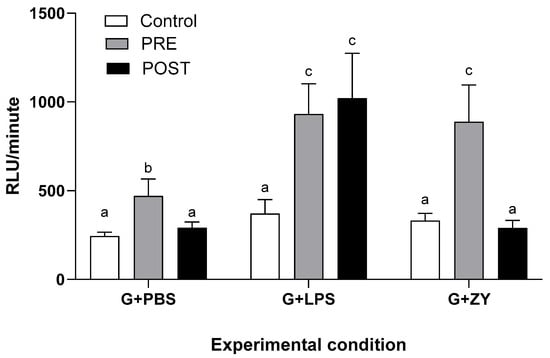
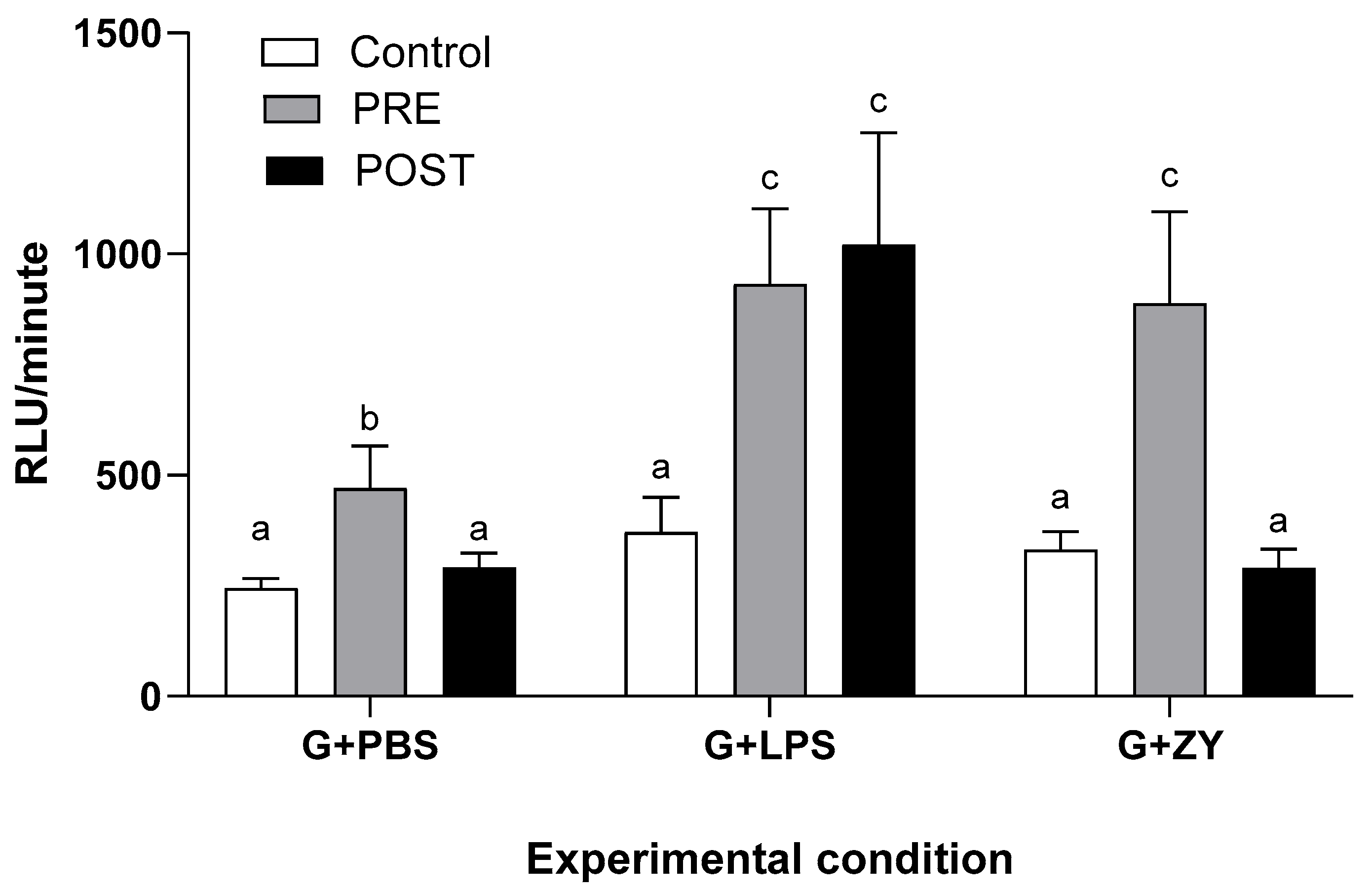
As shown in Figure 1, granulocytes from the PRE group exhibited a significant increase (p < 0.05) in ROS production under basal conditions (PBS) compared to controls and POST group. After bariatric surgery, basal ROS production decreased to levels comparable to those observed in controls. LPS stimulation markedly increased ROS generation in the PRE group, and this response remained significantly elevated in the POST group compared with controls (p < 0.05), indicating the persistence of the LPS-associated oxidative response after surgery. In contrast, zymosan stimulation significantly increased ROS production in the PRE group compared with basal conditions (p < 0.05); however, this increase was not observed in either the control or POST group. Thus, the postoperative ROS response to zymosan was comparable to that of controls, while the response to LPS remained elevated after surgery.
Figure 1.
ROS production in Granulocytes (G) from obese patients before (PRE) and after (POST) bariatric surgery upon TLR stimulation. ROS production was measured by luminol-dependent chemiluminescence in granulocytes at baseline (PBS) or stimulated with lipopolysaccharide (LPS, TLR4 agonist) or zymosan (ZY, TLR2 agonist). Results are expressed as relative light units per minute (RLU/minute). Data are presented as mean ± SEM. a,b,c different letters indicate significant differences (p < 0.05), as determined by one-way ANOVA followed by Bonferroni’s post-test.
3.3. Persistent Associations of Body Weight and BMI with Basal and TLR4-Induced ROS Generation Following Bariatric Surgery
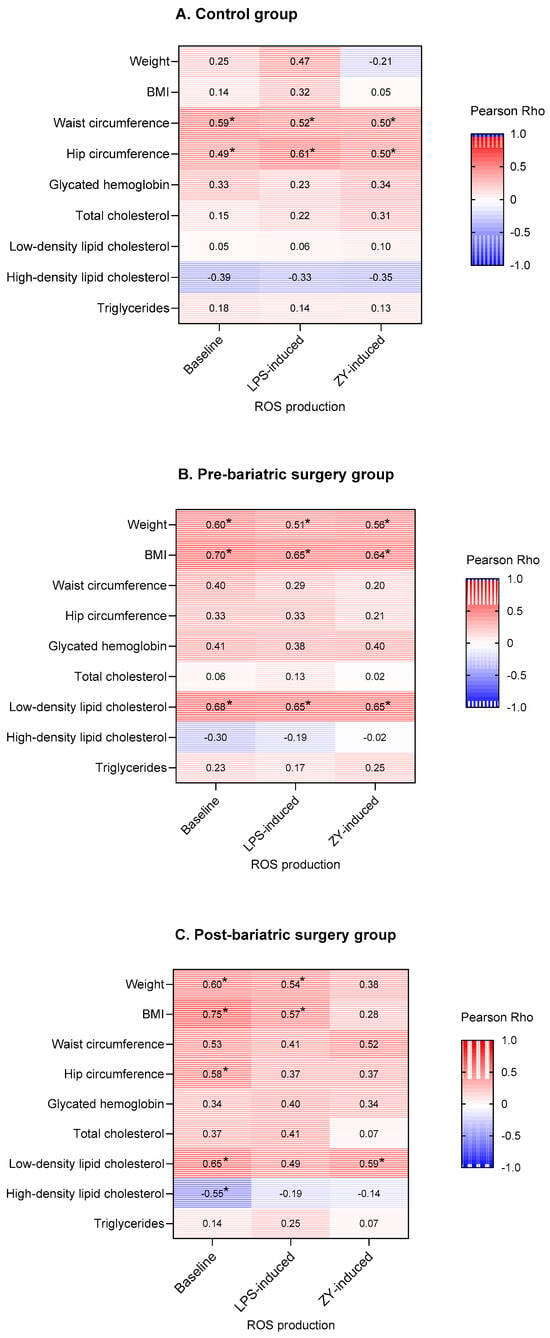
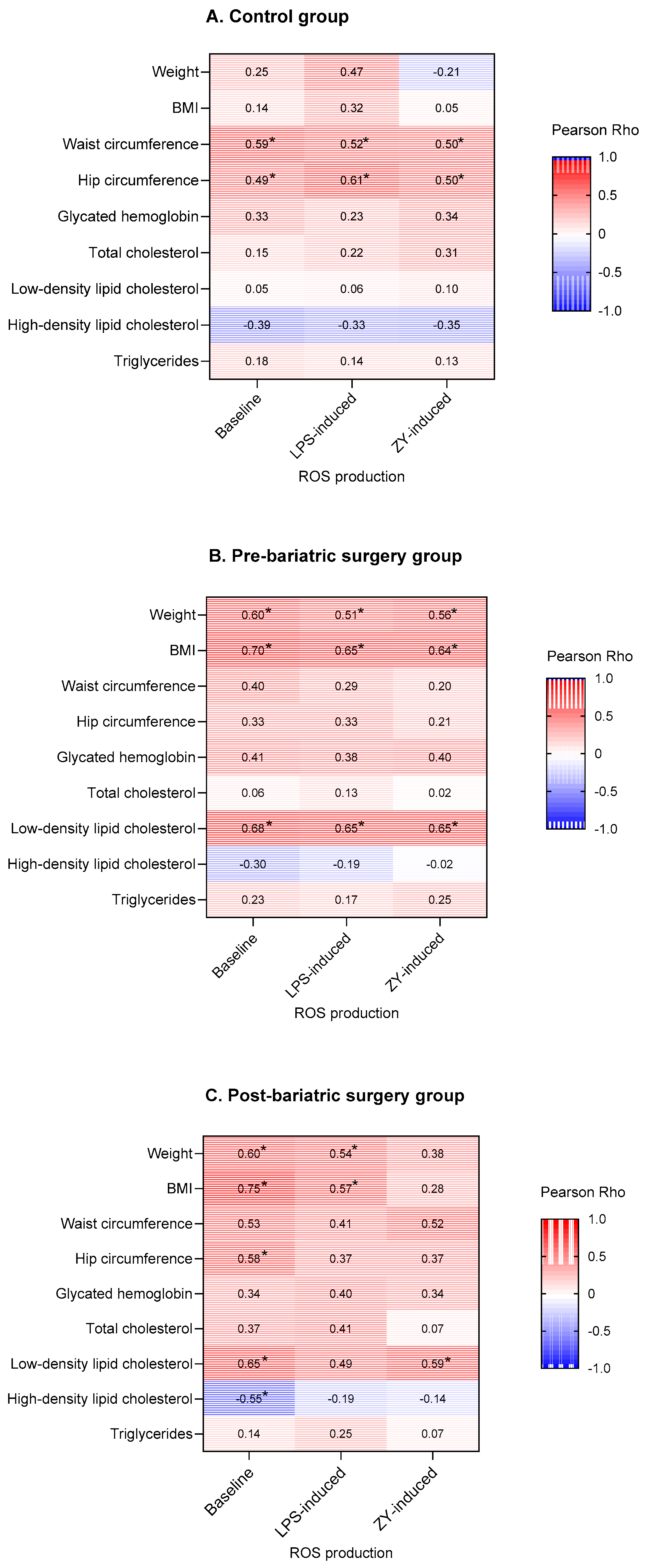
To further explore the relationship between oxidative responses and clinical variables, Pearson correlation analyses were performed separately within each study group between ROS production (baseline, LPS-induced, and zymosan-induced) and anthropometric and biochemical parameters (Figure 2).
Figure 2.
Correlation heatmaps showing associations between ROS production (baseline, LPS-induced, and ZY-induced), anthropometric measures, and biochemical variables. Each group included n = 12 participants. Correlations were calculated using Pearson’s correlation coefficient (r). Red squares indicate positive correlations, while blue squares indicate negative correlations. * p < 0.05. BMI, body mass index; LPS, lipopolysaccharide; ROS, reactive oxygen species; ZY, zymosan.
In the control group (Figure 2A), waist and hip circumference showed positive correlations with ROS production under basal conditions (r = 0.59 and r = 0.49, respectively), following LPS stimulation (r = 0.52 and r = 0.61, respectively), and following ZY stimulation (r = 0.50 and r = 0.50, respectively). In the PRE group (Figure 2B), body weight, BMI, and LDL-C showed positive correlations with ROS production under all experimental conditions. In the POST group (Figure 2C), basal ROS production was positively correlated with body weight (r = 0.60), BMI (r = 0.75), hip circumference (r = 0.58), and LDL-C (r = 0.65) and inversely correlated with HDL-C (r = −0.55). LPS-associated ROS production was positively correlated with body weight (r = 0.54) and BMI (r = 0.57), whereas ZY-associated ROS production was positively correlated with LDL-C (r = 0.59). These findings indicate that anthropometric and biochemical parameters remained associated with oxidative responses in the POST group, particularly under LPS stimulation.
4. Discussion
Our results suggest distinct responses of granulocyte ROS production to TLR2- and TLR4-associated stimulation in the POST group. Granulocytes from PRE patients exhibited elevated basal ROS and increased responses to both ZY and LPS stimulation. In the POST group, basal ROS production and the response to ZY were comparable to those observed in controls, whereas the response to LPS remained elevated (Figure 1). Correlation analyses further showed that body weight and BMI remained positively associated with baseline and LPS-induced ROS production in the POST group (Figure 2). Together, these findings indicate that substantial metabolic improvement after bariatric surgery was accompanied by differential changes in granulocyte oxidative responses.
Bariatric surgery is well established as an effective intervention for morbid obesity. Clinical trials and longitudinal studies have shown sustained weight loss and improvements in comorbidities such as type 2 diabetes and cardiovascular disease [12,13,14,24,25,26,27]. In agreement with these findings, women in the POST group exhibited lower body weight, BMI, waist and hip circumference, glycated hemoglobin, and triglycerides, together with higher HDL cholesterol, compared with the PRE group. Despite these improvements, our data show that female patients in the POST group did not reach BMI normalization (<25 kg/m2), even nearly two years after surgery, suggesting that although patients in the POST group exhibited substantially lower measures of adiposity, residual excess adiposity persisted in most individuals (Table 1). This residual excess adiposity may contribute to the persistence of metabolic and inflammatory alterations after surgery, consistent with the concept of obesity-associated metabolic memory [28].
Oxidative stress is a major contributor to obesity-related complications. It underlies insulin resistance in diabetes, endothelial dysfunction in cardiovascular disease, hepatic inflammation in non-alcoholic fatty liver disease (NAFLD), and carcinogenesis through DNA damage and impaired cell signaling [10]. In this context, elucidating how bariatric surgery influences redox balance is essential for understanding long-term outcomes. Granulocytes are important sources of ROS during inflammatory responses, contributing to antimicrobial defense as well as to oxidative and inflammatory processes [29].
In obesity, hyperlipidemia elevates circulating fatty acids, which stimulate NADPH oxidase, leading to excessive ROS generation and metabolic dysfunction [30,31,32,33,34]. In the present study, granulocytes from PRE patients displayed increased ROS production under basal conditions and following both LPS and ZY stimulation (Figure 1). Although bariatric surgery has generally been associated with improvements in systemic oxidative stress, findings across studies have not been entirely consistent. Reductions in oxidized LDL, insulin resistance, and inflammatory markers, together with increases in antioxidant defenses, have been reported, whereas other markers, including plasma TBARS (thiobarbituric acid reactive substances), a marker of lipid peroxidation, may remain unchanged. These discrepancies suggest that systemic metabolic improvement does not necessarily imply complete normalization of all oxidative pathways [32,33,34,35].
TLR2 and TLR4 share important components of the MyD88-dependent signaling pathway, involving the recruitment and activation of interleukin-1 receptor-associated kinases (IRAKs), TNF receptor-associated factor 6 (TRAF6), and transforming growth factor-β-activated kinase 1 (TAK1), ultimately leading to the activation of NF-κB and mitogen-activated protein kinase (MAPK) pathways [36]. TLR4 can additionally signal through the TRIF-dependent pathway, which contributes to IRF3 activation and late-phase NF-κB signaling [37]. However, the relative contribution of this pathway is cell-type-dependent, and studies in human neutrophils have shown that the MyD88-independent pathway is not detectably mobilized following LPS stimulation [38]. These differences in signaling architecture and cellular context may contribute to distinct responses to TLR2- and TLR4-associated stimulation. In neutrophils, TLR agonists can also modulate NADPH oxidase priming and activation, thereby influencing ROS generation [39]. Thus, although TLR2 and TLR4 share important signaling components, their downstream responses in granulocytes are not necessarily functionally equivalent, particularly with respect to oxidative burst.
The differential regulation of TLR pathways observed here underlines the complexity of immune modulation following bariatric surgery. Gihring et al. [40] reported that although inflammatory markers and adipocytokine levels undergo rapid changes during the first year after surgery, these changes are not necessarily accompanied by equivalent alterations in peripheral immune cells. TLR4 can be activated not only by LPS but also by endogenous signals associated with metabolic stress, including saturated fatty acids, leading to NF-κB activation; production of proinflammatory cytokines such as TNF-α, IL-1β, and IL-6; and ROS generation [35,37]. Circulating LPS and fatty acids are associated with metabolic endotoxemia and dyslipidemia in obesity, while alterations in gut permeability and microbiota composition may contribute to persistent metabolic and inflammatory signals after bariatric surgery [40,41,42]. In our study, ROS generation following ZY stimulation was attenuated in the POST group and reached levels comparable to those observed in controls, whereas the response following LPS stimulation remained elevated (Figure 1). These findings suggest that bariatric surgery may restore certain TLR-associated responses, particularly TLR2-associated oxidative responses, while having a less pronounced effect on TLR4-associated ROS generation. The persistence of LPS-induced ROS after surgery may reflect residual metabolic and immunological signals capable of sustaining TLR4-associated oxidative responses despite the substantial metabolic improvement achieved after surgery.
The relationship between weight loss, oxidative stress, and long-term immune cell responses after bariatric surgery remains poorly understood. Our findings suggest that residual inflammatory signals may persist despite substantial metabolic improvements. Notably, body weight and BMI were positively correlated with LPS-associated ROS production in both the PRE and POST groups (Figure 2B,C), consistent with evidence that metabolic improvements are not necessarily accompanied by equivalent changes in peripheral immune cell function [40].
Interestingly, the correlation analysis further highlighted distinct patterns of TLR2- and TLR4-associated oxidative responses after bariatric surgery (Figure 2C). In the POST group, both basal and LPS-associated ROS production were positively correlated with body weight and BMI, whereas ZY-associated ROS production was not correlated with either anthropometric parameter. Instead, ZY-associated ROS production showed a positive correlation with LDL-C. Together with the normalization of the ZY-induced ROS response to control levels, these findings suggest that the oxidative response associated with ZY stimulation may be less closely linked to residual adiposity after bariatric surgery than the response associated with TLR4 stimulation. Although these findings do not establish receptor-specific mechanisms, they reinforce the concept that TLR2- and TLR4-associated oxidative responses may be differentially modulated following bariatric surgery.
Several factors may contribute to the persistence of TLR4-associated inflammatory and oxidative responses after bariatric surgery. Residual or recurrent obesity, nutritional inadequacies, adherence to lifestyle recommendations, and other behavioral factors may influence long-term metabolic outcomes [43,44,45]. Alterations in gut permeability and microbiota composition may also contribute to persistent metabolic and inflammatory signals after surgery, although current evidence regarding changes in gastrointestinal permeability after bariatric surgery remains heterogeneous [42]. These factors provide potential contexts for persistent TLR4-associated responses, although they were not directly assessed in the present study.
Sex-specific biological factors should also be considered when interpreting these findings. Sex differences in innate and adaptive immune responses are well documented and are influenced by both genetic factors and the differential effects of sex steroid hormones on immune cells. Estrogen, progesterone, and testosterone can modulate immune cell activity, cytokine production, and TLR expression and signaling, contributing to differences in inflammatory and immune responses between women and men [46,47,48,49]. These effects may be particularly relevant in obesity, in which sex-related differences in adipose tissue distribution and metabolic dysfunction can further influence inflammatory and oxidative pathways. In the context of bariatric surgery, such biological differences may also affect the extent to which TLR-associated responses are modulated after metabolic improvement. Because only women were included in the present study, our findings should not be directly extrapolated to male populations. Further studies including both sexes are warranted to determine whether the differential responses to TLR2- and TLR4-associated stimulation observed after bariatric surgery are influenced by biological sex.
This study has some limitations. First, the cross-sectional design and the use of independent PRE and POST groups preclude direct assessment of within-individual changes following surgery and limit causal inference regarding the effects of bariatric surgery on ROS production. Second, only female patients were included, which limits the generalizability of our findings to male populations. Third, only one surgical procedure was investigated, although different bariatric procedures have been associated with substantial improvements in weight loss, diabetes outcomes, and gastrointestinal hormonal adaptations [50,51,52,53,54,55]. Finally, the POST group had a mean postoperative period of 1.8 ± 0.9 years; however, the cross-sectional design does not allow determination of how TLR-associated oxidative responses evolve over time after surgery.
From a clinical perspective, our findings suggest that substantial clinical and metabolic improvement after bariatric surgery does not necessarily correspond to complete restoration of innate immune homeostasis. Although marked improvements were observed in anthropometric and metabolic parameters, the persistence of an altered oxidative response to LPS stimulation suggests that inflammatory and oxidative pathways may remain dysregulated despite substantial weight loss. This observation reinforces the importance of long-term multidisciplinary follow-up, including nutritional counseling, promotion of healthy dietary patterns, and physical activity. Future studies should evaluate longitudinal cohorts before and after bariatric surgery and investigate TLR2 and TLR4 expressions, intracellular signaling pathways, NADPH oxidase activation, and additional inflammatory mediators. Such approaches may help clarify the mechanisms underlying the persistence of LPS-associated oxidative responses after substantial weight loss.
5. Conclusions
Bariatric surgery was associated with marked improvements in anthropometric and metabolic parameters but did not completely normalize innate immune redox homeostasis in women with obesity. While ROS production following ZY stimulation was attenuated to levels comparable to those observed in controls, ROS production following LPS stimulation remained elevated and was positively associated with body weight and BMI in the POST group. These findings suggest that bariatric surgery may differentially modulate oxidative responses to TLR2- and TLR4-associated stimulation and that alterations in innate immune redox balance may persist despite substantial clinical and metabolic improvement. Further longitudinal studies are needed to determine whether these differential responses persist over time and to elucidate the underlying mechanisms, including TLR expression and downstream signaling pathways.
Author Contributions
Conceptualization, R.P.S.; data curation, R.P.S. and E.O.d.F.; formal analysis, C.M.d.O.V.; funding acquisition, C.M.d.O.V.; investigation, R.P.S., J.V.C., A.M.F.C., L.F.A., J.S.G.R., C.M.A.F.V., E.O.d.F. and C.M.d.O.V.; methodology, R.P.S., L.F.A. and E.O.d.F.; project administration, R.P.S., C.M.A.F.V. and C.M.d.O.V.; resources, R.P.S., J.V.C., A.M.F.C., L.F.A., J.S.G.R., C.M.A.F.V. and E.O.d.F.; supervision, C.M.d.O.V.; writing—original draft preparation, R.P.S., E.O.d.F. and C.M.d.O.V.; writing—review and editing, C.M.d.O.V. All authors have read and agreed to the published version of the manuscript.
Funding
This study was supported by FAPEMIG (Fundação de Amparo à Pesquisa do Estado de Minas Gerais), grant number APQ 03767-23.
Institutional Review Board Statement
The study was conducted in accordance with the Declaration of Helsinki and approved by the Research Ethics Committee of Santa Casa de Belo Horizonte, Brazil (CAAE: 69385917.7.0000.5138, approved on 2 June 2023).
Informed Consent Statement
Informed consent has been obtained from the patients to publish this paper.
Data Availability Statement
The data presented in this study is available on request from the corresponding author. The data are not publicly available due to privacy or ethical restrictions.
Acknowledgments
The authors are thankful to the management of the Ambulatório de Obesidade Clínica for providing facilities to conduct the research study.
Conflicts of Interest
The authors declare no conflicts of interest.
Abbreviations
The following abbreviations are used in this manuscript:
| BMI | Body Mass Index |
| G | Granulocytes |
| HbA1c | Glycated Hemoglobin |
| HDL-C | High-Density Lipoprotein Cholesterol |
| LDL-C | Low-Density Lipoprotein Cholesterol |
| LPS | Lipopolysaccharide |
| NAFLD | Non-Alcoholic Fatty Liver Disease |
| NF-κB | Nuclear Factor kappa B |
| POST | Post-bariatric surgery group |
| PRE | Pre-bariatric surgery group |
| ROS | Reactive Oxygen Species |
| TBARS | Thiobarbituric Acid Reactive Substances |
| TLR | Toll-Like Receptor |
| ZY | Zymosan |
References
- World Health Organization. Obesity and Overweight. Available online: https://www.who.int/news-room/fact-sheets/detail/obesity-and-overweight (accessed on 14 August 2026).
- GBD 2021 Adult BMI Collaborators. Global, regional, and national prevalence of adult overweight and obesity, 1990–2021, with forecasts to 2050: A forecasting study for the Global Burden of Disease Study 2021. Lancet 2025, 405, 813–838. [Google Scholar] [CrossRef] [Scilit] [PubMed]
- Kyrou, I.; Randeva, H.S.; Tsigos, C.; Kaltsas, G.; Weickert, M.O. Clinical Problems Caused by Obesity. In Endotext; Feingold, K.R., Adler, R.A., Ahmed, S.F., Anawalt, B., Blackman, M.R., Chrousos, G., Corpas, E., de Herder, W.W., Dhatariya, K., Dungan, K., et al., Eds.; MDText.com, Inc.: South Dartmouth, MA, USA, 2018. [Google Scholar]
- Hecker, J.; Freijer, K.; Hiligsmann, M.; Evers, S.M.A.A. Burden of disease study of overweight and obesity; the societal impact in terms of cost-of-illness and health-related quality of life. BMC Public Health 2022, 22, 46. [Google Scholar] [CrossRef] [Scilit] [PubMed]
- Pereira, S.S.; Alvarez-Leite, J.I. Low-Grade Inflammation, Obesity, and Diabetes. Curr. Obes. Rep. 2014, 3, 422–431. [Google Scholar] [CrossRef] [Scilit] [PubMed]
- Fuster, J.J.; Ouchi, N.; Gokce, N.; Walsh, K. Obesity-Induced Changes in Adipose Tissue Microenvironment and Their Impact on Cardiovascular Disease. Circ. Res. 2016, 118, 1786–1807. [Google Scholar] [CrossRef] [Scilit] [PubMed]
- Cildir, G.; Akincilar, S.C.; Tergaonkar, V. Chronic adipose tissue inflammation: All immune cells on the stage. Trends Mol. Med. 2013, 19, 487–500. [Google Scholar] [CrossRef] [Scilit] [PubMed]
- Hotamisligil, G.S. Inflammation, metaflammation and immunometabolic disorders. Nature 2017, 542, 177–185. [Google Scholar] [CrossRef] [Scilit] [PubMed]
- Glass, C.K.; Olefsky, J.M. Inflammation and lipid signaling in the etiology of insulin resistance. Cell Metab. 2012, 15, 635–645. [Google Scholar] [CrossRef] [Scilit] [PubMed]
- Manna, P.; Jain, S.K. Obesity, oxidative stress, adipose tissue dysfunction, and the associated health risks: Causes and therapeutic strategies. Metab. Syndr. Relat. Disord. 2015, 13, 423–444. [Google Scholar] [CrossRef] [Scilit] [PubMed]
- Perdomo, C.M.; Cohen, R.V.; Sumithran, P.; Clément, K.; Frühbeck, G. Contemporary medical, device, and surgical therapies for obesity in adults. Lancet 2023, 401, 1116–1130. [Google Scholar] [CrossRef] [Scilit] [PubMed]
- Nandagopal, R.; Brown, R.J.; Rother, K.I. Resolution of type 2 diabetes following bariatric surgery: Implications for adults and adolescents. Diabetes Technol. Ther. 2010, 12, 671–677. [Google Scholar] [CrossRef] [Scilit] [PubMed]
- Maciejewski, M.L.; Arterburn, D.E.; Van Scoyoc, L.; Smith, V.A.; Yancy, W.S., Jr.; Weidenbacher, H.J.; Livingston, E.H.; Olsen, M.K. Bariatric Surgery and Long-term Durability of Weight Loss. JAMA Surg. 2016, 151, 1046–1055. [Google Scholar] [CrossRef] [Scilit] [PubMed]
- Lautenbach, A.; Stoll, F.; Mann, O.; Busch, P.; Huber, T.B.; Kielstein, H.; Bähr, I.; Aberle, J. Long-Term Improvement of Chronic Low-Grade Inflammation After Bariatric Surgery. Obes. Surg. 2021, 31, 2913–2920. [Google Scholar] [CrossRef] [Scilit] [PubMed]
- Wadden, T.A.; Chao, A.M.; Bahnson, J.L.; Bantle, J.P.; Clark, J.M.; Gaussoin, S.A.; Jakicic, J.M.; Johnson, K.C.; Miller, G.D.; Unick, J.L.; et al. The Look AHEAD Research Group. End-of-Trial Health Outcomes in Look AHEAD Participants Who Elected to Have Bariatric Surgery. Obesity 2019, 27, 581–590. [Google Scholar] [CrossRef] [Scilit] [PubMed]
- Fernández-Soto, M.L.; Martín-Leyva, A.; González-Jiménez, A.; García-Rubio, J.; Cózar-Ibáñez, A.; Zamora-Camacho, F.J.; Leyva-Martínez, M.S.; Jiménez-Ríos, J.A.; Escobar-Jiménez, F. Remission of Type 2 Diabetes Mellitus after Bariatric Surgery—Comparison between Procedures. Endokrynol. Pol. 2017, 68, 18–25. [Google Scholar] [PubMed]
- Zagorski, S.M.; Papa, N.N.; Chung, M.H. The Effect of Weight Loss after Gastric Bypass on C-Reactive Protein Levels. Surg. Obes. Relat. Dis. 2005, 1, 81–85. [Google Scholar] [CrossRef] [Scilit] [PubMed]
- Mallipedhi, A.; Prior, S.L.; Barry, J.D.; Caplin, S.; Baxter, J.N.; Stephens, J.W. Changes in Inflammatory Markers after Sleeve Gastrectomy in Patients with Impaired Glucose Homeostasis and Type 2 Diabetes. Surg. Obes. Relat. Dis. 2014, 10, 1123–1128. [Google Scholar] [CrossRef] [Scilit] [PubMed]
- Askarpour, M.; Khani, D.; Sheikhi, A.; Ghaedi, E.; Alizadeh, S. Effect of Bariatric Surgery on Serum Inflammatory Factors of Obese Patients: A Systematic Review and Meta-Analysis. Obes. Surg. 2019, 29, 2631–2647. [Google Scholar] [CrossRef] [Scilit] [PubMed]
- Chen, C.-Y.; Lee, W.-J.; Asakawa, A.; Fujitsuka, N.; Chong, K.; Chen, S.-C.; Lee, S.-D.; Inui, A. Insulin Secretion and Interleukin-1β Dependent Mechanisms in Human Diabetes Remission after Metabolic Surgery. Curr. Med. Chem. 2013, 20, 2374–2388. [Google Scholar] [CrossRef] [Scilit] [PubMed]
- Chen, Y.; Yuan, J.; Lei, X.; Cheng, Y.; Wei, X. Metabolic Status and Vascular Endothelial Structure in Obese Hypertensive Patients Treated with Non-Pharmacological Therapies: A Systematic Review and Meta-Analysis. PLoS ONE 2022, 17, e0279582. [Google Scholar] [CrossRef] [Scilit] [PubMed]
- Bicalho, H.M.S.; Gontijo, C.M.; Nogueira-Machado, J.A. A simple technique for simultaneous human leukocytes separation. J. Immunol. Methods 1981, 40, 115–116. [Google Scholar] [CrossRef] [Scilit] [PubMed]
- Freitas, M.; Lima, J.L.F.C.; Fernandes, E. Optical probes for detection and quantification of neutrophils’ oxidative burst. A review. Anal. Chim. Acta 2009, 649, 8–23. [Google Scholar] [CrossRef] [Scilit] [PubMed]
- Mukaka, M.M. Statistics corner: A guide to appropriate use of correlation coefficient in medical research. Malawi Med. J. 2012, 24, 69–71. [Google Scholar] [PubMed]
- Schauer, P.R.; Kashyap, S.R.; Wolski, K.; Brethauer, S.A.; Kirwan, J.P.; Pothier, C.E.; Thomas, S.; Abood, B.; Nissen, S.E.; Bhatt, D.L. Bariatric surgery versus intensive medical therapy in obese patients with diabetes. N. Engl. J. Med. 2012, 366, 1567–1576. [Google Scholar] [CrossRef] [Scilit] [PubMed]
- Colquitt, J.L.; Pickett, K.; Loveman, E.; Frampton, G.K. Surgery for weight loss in adults. Cochrane Database Syst. Rev. 2014, 8;2014(8), CD003641. [Google Scholar] [CrossRef] [Scilit] [PubMed]
- Thomas, D.D.; Anderson, W.A.; Apovian, C.M.; Hess, D.T.; Yu, L.; Velazquez, A.; Carmine, B.; Istfan, N.W. Weight Recidivism After Roux-en-Y Gastric Bypass Surgery: An 11-Year Experience in a Multiethnic Medical Center. Obesity 2019, 27, 217–225. [Google Scholar] [CrossRef] [Scilit] [PubMed]
- Hinte, L.C.; Castellano-Castillo, D.; Ghosh, A.; Melrose, K.; Gasser, E.; Noé, F.; Massier, L.; Dong, H.; Sun, W.; Hoffmann, A.; et al. Adipose tissue retains an epigenetic memory of obesity after weight loss. Nature 2024, 636, 457–465. [Google Scholar] [CrossRef] [Scilit] [PubMed]
- Ribeiro, D.A.; da Silva, G.N.; Malacarne, I.T.; Pisani, L.P.; Salvadori, D.M.F. Oxidative Stress Responses in Obese Individuals Undergoing Bariatric Surgery: Impact on Carcinogenesis. Pathophysiology 2024, 31, 352–366. [Google Scholar] [CrossRef] [Scilit] [PubMed]
- Furukawa, S.; Fujita, T.; Shimabukuro, M.; Iwaki, M.; Yamada, Y.; Nakajima, Y.; Nakayama, O.; Makishima, M.; Matsuda, M.; Shimomura, I. Increased oxidative stress in obesity and its impact on metabolic syndrome. J. Clin. Investig. 2004, 114, 1752–1761. [Google Scholar] [CrossRef] [PubMed]
- Houstis, N.; Rosen, E.D.; Lander, E.S. Reactive oxygen species have a causal role in multiple forms of insulin resistance. Nature 2006, 440, 944–948. [Google Scholar] [CrossRef] [Scilit] [PubMed]
- Carmona-Maurici, J.; Amigó, N.; Cuello, E.; Bermúdez, M.; Baena-Fustegueras, J.A.; Peinado-Onsurbe, J.; Pardina, E. Bariatric surgery decreases oxidative stress and protein glycosylation in patients with morbid obesity. Eur. J. Clin. Investig. 2020, 50, e13284. [Google Scholar] [CrossRef] [Scilit] [PubMed]
- Min, T.; Prior, S.L.; Dunseath, G.; Churm, R.; Barry, J.D.; Stephens, J.W. Temporal Effects of Bariatric Surgery on Adipokines, Inflammation and Oxidative Stress in Subjects with Impaired Glucose Homeostasis at 4 Years of Follow-up. Obes. Surg. 2020, 30, 1712–1718. [Google Scholar] [CrossRef] [Scilit] [PubMed]
- Metere, A.; Graves, C.E.; Pietraforte, D.; Casella, G. The Effect of Sleeve Gastrectomy on Oxidative Stress in Obesity. Biomedicines 2020, 8, 190. [Google Scholar] [CrossRef] [Scilit] [PubMed]
- Horn, R.C.; Gelatti, G.T.; Mori, N.C.; Tissiani, A.C.; Mayer, M.S.; Pereira, E.A.; Ross, M.; Moreira, P.R.; Bortolotto, J.W.; Felippin, T. Obesity, bariatric surgery and oxidative stress. Rev. Assoc. Med. Bras. 2017, 63, 229–235. [Google Scholar] [CrossRef] [Scilit] [PubMed]
- Akira, S.; Takeda, K. Toll-like receptor signalling. Nat. Rev. Immunol. 2004, 4, 499–511. [Google Scholar] [CrossRef] [Scilit] [PubMed]
- Fitzgerald, K.A.; Palsson-McDermott, E.M.; Bowie, A.G.; Jefferies, C.A.; Mansell, A.S.; Brady, G.; Brint, E.; Dunne, A.; Gray, P.; Harte, M.T.; et al. Mal (MyD88-adapter-like) is required for Toll-like receptor-4 signal transduction. Nature 2001, 413, 78–83. [Google Scholar] [CrossRef] [Scilit] [PubMed]
- Tamassia, N.; Le Moigne, V.; Calzetti, F.; Donini, M.; Gasperini, S.; Ear, T.; Cloutier, A.; Martinez, F.O.; Fabbri, M.; Locati, M.; et al. The MyD88-independent pathway is not mobilized in human neutrophils stimulated via TLR4. J. Immunol. 2007, 178, 7344–7356. [Google Scholar] [CrossRef] [Scilit] [PubMed]
- Belambri, S.A.; Rolas, L.; Raad, H.; Hurtado-Nedelec, M.; Dang, P.M.; El-Benna, J. NADPH oxidase activation in neutrophils: Role of the phosphorylation of its subunits. Eur. J. Clin. Investig. 2018, 48, e12951. [Google Scholar] [CrossRef] [Scilit] [PubMed]
- Gihring, A.; Gärtner, F.; Mayer, L.; Roth, A.; Abdelrasoul, H.; Kornmann, M.; Elad, L.; Knippschild, U. Influence of bariatric surgery on the peripheral blood immune system of female patients with morbid obesity revealed by high-dimensional mass cytometry. Front. Immunol. 2023, 14, 1131893. [Google Scholar] [CrossRef] [Scilit] [PubMed]
- Zhang, K.; Huang, Q.; Deng, S.; Yang, Y.; Li, J.; Wang, S. Mechanisms of TLR4-Mediated Autophagy and Nitroxidative Stress. Front. Cell. Infect. Microbiol. 2021, 11, 766590. [Google Scholar] [CrossRef] [Scilit] [PubMed]
- Latorre, E.; Mendoza, C.; Layunta, E.; Alcalde, A.I.; Mesonero, J.E. TLR2, TLR3, and TLR4 activation specifically alters the oxidative status of intestinal epithelial cells. Cell Stress Chaperones 2014, 19, 289–293. [Google Scholar] [CrossRef] [Scilit] [PubMed]
- Inoguchi, T.; Li, P.; Umeda, F.; Yu, H.Y.; Kakimoto, M.; Imamura, M.; Aoki, T.; Etoh, T.; Hashimoto, T. High glucose level and free fatty acid stimulate reactive oxygen species production through protein kinase C-dependent activation of NAD(P)H oxidase in cultured vascular cells. Diabetes 2000, 49, 1939–1945. [Google Scholar] [CrossRef] [Scilit] [PubMed]
- Sarmiento-Andrade, Y.; Suárez, R.; Quintero, B.; Garrochamba, K.; Chapela, S.P. Gut microbiota and obesity: New insights. Front. Nutr. 2022, 9, 1018212. [Google Scholar] [CrossRef] [Scilit] [PubMed]
- O’Brien, J.W.; Merali, N.; Pring, C.; Rockall, T.; Robertson, D.; Bartlett, D.; Frampton, A. Gastrointestinal Permeability After Bariatric Surgery: A Systematic Review. Cureus 2024, 16, e60480. [Google Scholar] [CrossRef] [Scilit] [PubMed]
- Athanasiadis, D.I.; Martin, A.; Kapsampelis, P.; Monfared, S.; Stefanidis, D. Factors associated with weight regain post-bariatric surgery: A systematic review. Surg. Endosc. 2021, 35, 4069–4084. [Google Scholar] [CrossRef] [Scilit] [PubMed]
- Istfan, N.W.; Lipartia, M.; Anderson, W.A.; Hess, D.T.; Apovian, C.M. Approach to the patient: Management of the post-bariatric surgery patient with weight regain. J. Clin. Endocrinol. Metab. 2021, 106, 251–263. [Google Scholar] [CrossRef] [Scilit] [PubMed]
- Szekeres, Z.; Szabados, E.; Pálfi, A. Molecular mechanisms against successful weight loss and promising treatment options in obesity. Biomedicines 2025, 13, 1989. [Google Scholar] [CrossRef] [Scilit] [PubMed]
- Klein, S.L.; Flanagan, K.L. Sex differences in immune responses. Nat. Rev. Immunol. 2016, 16, 626–638. [Google Scholar] [CrossRef] [Scilit] [PubMed]
- Kovats, S. Estrogen receptors regulate an inflammatory pathway of dendritic cell differentiation: Mechanisms and implications for immunity. Horm. Behav. 2012, 62, 254–262. [Google Scholar] [CrossRef] [Scilit] [PubMed]
- Trigunaite, A.; Dimo, J.; Jørgensen, T.N. Suppressive effects of androgens on the immune system. Cell. Immunol. 2015, 294, 87–94. [Google Scholar] [CrossRef] [Scilit] [PubMed]
- Dunn, S.E.; Perry, W.A.; Klein, S.L. Mechanisms and consequences of sex differences in immune responses. Nat. Rev. Nephrol. 2024, 20, 37–55. [Google Scholar] [CrossRef] [Scilit] [PubMed]
- Pham, S.; Gancel, A.; Scotte, M.; Houivet, E.; Huet, E.; Lefebvre, H.; Kuhn, J.-M.; Prevost, G. Comparison of the effectiveness of four bariatric surgery procedures in obese patients with type 2 diabetes: A retrospective study. J. Obes. 2014, 2014, 638203. [Google Scholar] [CrossRef] [Scilit] [PubMed]
- Shetye, B.; Hamilton, F.R.; Bays, H.E. Bariatric surgery, gastrointestinal hormones, and the microbiome: An Obesity Medicine Association (OMA) Clinical Practice Statement (CPS) 2022. Obes. Pillars 2022, 2, 100015. [Google Scholar] [CrossRef] [Scilit] [PubMed]
- Meek, C.L.; Lewis, H.B.; Reimann, F.; Gribble, F.M.; Park, A.J. The effect of bariatric surgery on gastrointestinal and pancreatic peptide hormones. Peptides 2016, 77, 28–37. [Google Scholar] [CrossRef] [Scilit] [PubMed]

Disclaimer/Publisher’s Note: The statements, opinions and data contained in all publications are solely those of the individual author(s) and contributor(s) and not of MDPI and/or the editor(s). MDPI and/or the editor(s) disclaim responsibility for any injury to people or property resulting from any ideas, methods, instructions or products referred to in the content. |
© 2026 by the authors. Licensee MDPI, Basel, Switzerland. This article is an open access article distributed under the terms and conditions of the Creative Commons Attribution (CC BY) license.