


Abstract
Background: Heart rate variability (HRV) is an important marker of autonomic regulation and training status. Although athletes may adapt physiologically to regular exercise, high training volumes may affect autonomic balance. Methods: This cross-sectional study included 18 participants, comprising 8 athletes and 10 physically active individuals. Athletes performed approximately 10–15 h of exercise per week, whereas physically active individuals performed approximately 5 h. We assessed resting HRV using time- and frequency-domain measures, including RMSSD, SDNN, SD1, SD2, HF, LF, and the LF/HF ratio. Group differences were analyzed using bootstrapped bias-corrected and accelerated confidence intervals and Cohen’s d effect sizes. Results: Physically active individuals presented higher RMSSD (92.66 ± 17.66 vs. 50.46 ± 37.65 ms; d = 1.50), SDNN (84.01 ± 13.47 vs. 47.95 ± 23.77 ms; d = 1.93), SD1 (65.58 ± 12.43 vs. 35.31 ± 27.00 ms; d = 1.50), and SD2 (98.32 ± 19.56 vs. 56.35 ± 24.44 ms; d = 1.92) than athletes (all p < 0.01). Conclusions: Physically active individuals exhibited greater parasympathetic modulation and overall HRV than athletes, suggesting potential autonomic effects of high-volume athletic training.
1. Introduction
Regular athletic training exerts a strong influence on both cardiovascular and autonomic function. Among the markers commonly used to assess these adaptations, heart rate variability (HRV) stands out as an indicator of cardiac autonomic regulation and the body’s capacity to adjust to internal and external demands. Elevated HRV values, which typically reflect parasympathetic activity, are associated with more favorable cardiovascular profiles and reduced risk of clinical complications. Conversely, lower HRV values may reflect differences in cardiac autonomic modulation and have been associated with less favorable cardiovascular profiles [1]. From a vascular surgery perspective, HRV assessment may provide complementary information for cardiovascular risk stratification, perioperative evaluation, and the early identification of autonomic dysfunction in physically active individuals, potentially contributing to more personalized preventive and therapeutic strategies in vascular care.
While the influence of exercise on HRV has been extensively explored, most investigations have concentrated on either specific exercise modalities or general physically active populations [2,3]. Athletes, due to their systematic and high-volume training routines, tend to develop distinct cardiovascular and autonomic adaptations compared with individuals who engage in exercise primarily for health and leisure purposes [4,5]. These adaptations may include enhanced vagal tone, improved baroreflex sensitivity, and greater autonomic flexibility [6]. However, emerging evidence from cardiac imaging studies indicates that long-term, high-intensity endurance training may also be associated with coronary atherosclerosis, particularly in Masters athletes (>35 years), for whom coronary artery disease remains a leading cause of sudden cardiac death.
Although higher fitness levels are associated with a markedly reduced incidence of coronary events—even in the presence of coronary disease—these findings highlight the complexity of cardiovascular adaptations in athletes, who may exhibit favorable autonomic profiles alongside specific cardiovascular alterations. This complex scenario underscores the need to differentiate the autonomic characteristics of athletes from those of recreational exercise practitioners, who, despite benefiting from improved cardiovascular and metabolic health, are generally exposed to lower cumulative training loads [7,8]. In general, athletes are characterized by structured, performance-oriented training programs with substantially higher weekly training volumes, whereas physically active individuals typically engage in lower-volume, recreational exercise primarily aimed at health maintenance and well-being, representing markedly different levels of habitual physiological stress.
This distinction underscores the importance of better understanding how HRV differs between athletes and non-athlete exercise practitioners, as both groups engage in physical activity but under markedly different conditions of training load and physiological adaptation. Such knowledge may help refine exercise recommendations, optimize recovery strategies, and provide insights into how performance-oriented and health-oriented training are associated with cardiac autonomic modulation [8].
2. Materials and Methods
2.1. Study Design
This cross-sectional study was conducted between March and August 2025. Participants were recruited from a university campus community in Brazil through flyers and social media advertisements. Between May and June, they attended laboratory visits for anthropometric assessments and evaluation of physical activity levels. Afterward, participants attended the laboratory again for the assessment of HRV parameters. The study protocol was approved by the Institutional Review Board under protocol code: 55184922.5.0000.5699; ethical approval code: 5.701.963, on 7 December 2024. All participants provided written informed consent prior to participation.
2.2. Participants
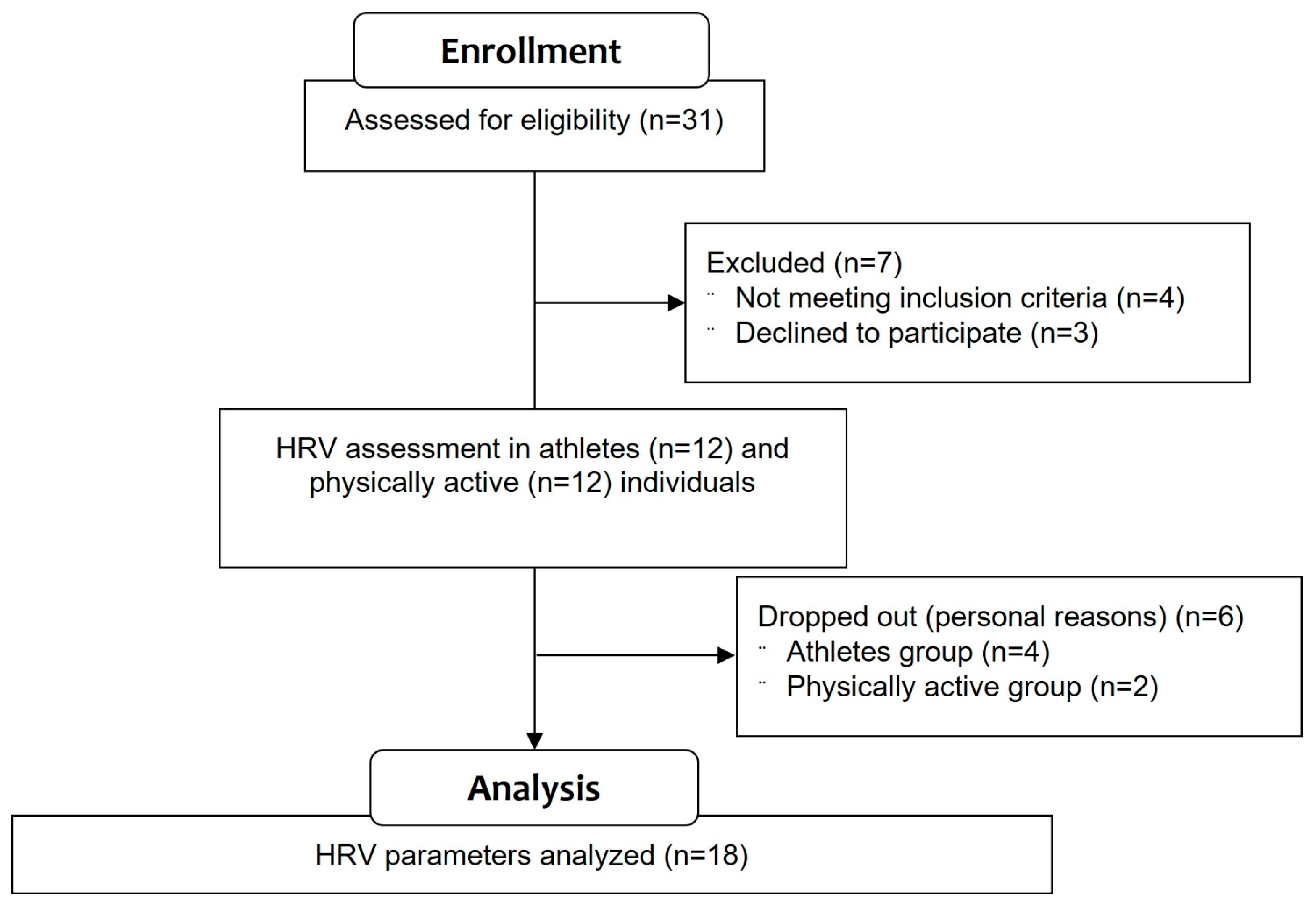
A total of thirty-one male participants were initially recruited, of whom twenty-four met the inclusion and exclusion criteria and were eligible for the study. However, only eighteen, being 8 athletes and 10 recreational exercise practitioners, completed all experimental procedures (Figure 1). All participants were healthy young men (aged 18–45 years) with no history of comorbidities, including diabetes mellitus, hypertension, or dyslipidemia. Exclusion criteria comprised smoking, use of psychoactive substances (e.g., caffeine, pre-workout supplements), anabolic steroid use within the six months prior to the study, and any history of cardiovascular disease.
Figure 1.
STROBE flowchart of the study.
The athlete group consisted of individuals engaged in structured cycling training for at least five years before the experimental procedures, with a weekly frequency of five to six sessions and training durations exceeding two or three hours per day (weekly exercise volume = approximately 10–15 h). The exercise practitioner group included recreationally active individuals who had not engaged in systematic athletic training for at least five years. These participants regularly performed both resistance training and aerobic exercise (cycling and/or running), with a weekly frequency of five to six sessions, each lasting approximately 40 min. The time spent by athletes was substantially greater than that of physically active individuals [9].
To ensure consistency in HRV analysis, participants were instructed to abstain from physical exercise for at least 48 h before data collection and to refrain from consuming caffeine-containing foods and beverages (e.g., coffee, tea, soda, chocolate) for at least 24 h. Baseline characteristics of the sample are presented in Table 1.
Table 1.
Demographic characteristics of the participants.
2.3. Heart Rate Variability Measurement
For the evaluation of HRV parameters, participants were positioned supine on an examination bed in a temperature-controlled, quiet environment and wore a heart rate monitor strap positioned over the distal third of the sternum. HRV assessments were conducted at 9:00 a.m. using the Polar RS800CX® heart rate monitor (Polar Electro Oy, Kempele, Finland), a device validated for HRV assessment [9]. Data collection included a 15 min resting period, consisting of a ten-minute stabilization period followed by a five-minute recording, with the same protocol applied to all participants. The Polar device was connected to the Elite HRV® application via Bluetooth. Following each recording, the data were saved, transferred to a computer, and imported into Kubios® HRV software (version 2.0, University of Kuopio, Kuopio, Finland) for analysis, using the automatic artifact correction setting. A five-minute segment of the HRV recording was selected for analysis. Data quality was ensured by maintaining the percentage of corrected R–R intervals below 2% for all participants. The R–R interval data were detrended using the smoothness priors method, with the Lambda parameter fixed at 500. During the assessment, participants breathed spontaneously without respiratory pacing.
Time-domain parameters included the Root Mean Square of Successive Differences between adjacent normal R-R intervals (RMSSD) and the Standard Deviation of Normal-to-Normal R-R intervals (SDNN). Frequency-domain analysis included High-Frequency (HF) and Low-Frequency (LF) components, both expressed in normalized units (nu), as well as the LF/HF ratio. Non-linear analysis was performed using the Poincaré plot, with SD1 representing the Standard Deviation of the plot width and SD2 representing the Standard Deviation of its length.
Physiologically, RMSSD and HF are recognized as sensitive indicators of parasympathetic nervous system activity, while SDNN reflects overall autonomic modulation. The LF component is influenced by both sympathetic and parasympathetic activity. The HRV parameters analyzed in this study (RMSSD, SDNN, HF, LF, LF/HF ratio, SD1, SD2) were selected based on their frequent use and validation in prior studies [4,7,9,10].
2.4. Statistical Analysis
A priori power analysis was conducted using G*Power software (version 3.1). The study was designed with a statistical power of 1 − β = 0.80 and an expected effect size of d = 1.5, based on preliminary data from our laboratory. The effect size utilized in the sample size calculation was based on a previous study from our laboratory [9]. The significance level was set at α = 0.05. According to these calculations, a minimum of 18 participants (nine per group) were required to achieve sufficient power to detect meaningful differences between groups.
Data were assessed for normality and homogeneity of variances using the Shapiro-Wilk and Levene tests, respectively. Differences in HRV parameters (RMSSD, HFnu, LFnu, SD1, SD2, SDNN, and LF/HF ratio) between athletes and recreational exercise practitioners were examined separately using independen t-samples t-tests. The appropriate t-test results were selected according to the homogeneity of variance assumption, with Welch’s correction applied when equal variances could not be assumed. To increase the robustness of the findings and account for potential deviations from normality, bootstrap resampling (1000 iterations) was applied to estimate mean differences and their corresponding 95% bias-corrected and accelerated (BCa) confidence intervals. Exact p-values were obtained from the independent-samples t-tests. Additionally, univariate analyses adjusted for age were performed to examine whether the between-group differences in RMSSD and SDNN remained significant after accounting for age. As no primary HRV outcome was prespecified, no adjustment for multiple comparisons was applied, and the analyses were considered exploratory.
Effect sizes were calculated using Cohen’s d, with thresholds defined as <0.2 (trivial), 0.2–<0.5 (small), 0.5–<0.8 (moderate), and ≥0.8 (large). All statistical analyses were performed using IBM SPSS® Statistics version 26 for Mac (Chicago, IL, USA), and results are presented as means ± standard deviation (SD).
3. Results
Table 1 presents the demographic characteristics of the participants.
Regarding demographic characteristics, athletes were significantly older than physically active individuals (p = 0.006) and had a higher PAL (p < 0.01). No significant between-group differences were observed for height (p = 0.101), body weight (p = 0.894), or BMI (p = 0.587). After adjustment for age, between-group differences in both RMSSD (p = 0.002) and SDNN (p < 0.001) remained significant, indicating that age did not fully explain the observed differences between groups.
Table 2 presents the HRV metrics for athletes and physically active individuals. Overall, participants in the physically active group demonstrated substantially higher parasympathetic-related HRV metrics compared with athletes, with large to very large effect sizes.
Table 2.
Heart rate variability (HRV) parameters data in athletes and physically active individuals.
RMSSD values were markedly higher in the physically active group (92.66 ± 17.66 ms) compared with athletes (50.46 ± 37.65 ms), yielding a very large effect size (Cohen’s d = 1.50). The mean difference was –42.19 ms, with a BCa 95% confidence interval ranging from –70.56 to –13.83 ms (p < 0.01). Similarly, SDNN was greater among physically active individuals (84.01 ± 13.47 ms) than among athletes (47.95 ± 23.77 ms), with a very large effect size (d = 1.93) and a BCa 95% confidence interval of –54.86 to –17.26 ms (p < 0.01).
Short-term and long-term HRV indices followed the same pattern. SD1 was higher in physically active participants (65.58 ± 12.43 ms) than in athletes (35.31 ± 27.00 ms), corresponding to a very large effect size (d = 1.50; BCa 95% CI: –50.53 to –10.01; p < 0.01). Likewise, SD2 values were greater in the physically active group (98.32 ± 19.56 ms) compared with athletes (56.35 ± 24.44 ms), with a very large effect size (d = 1.92) and a BCa 95% CI of –63.93 to –20.01 ms (p < 0.01).
No significant differences between groups were observed for HF and LF in normalized units (p > 0.05); however, effect sizes indicated meaningful differences. HF showed a large effect size in favor of physically active individuals (d = 0.79), whereas LF demonstrated a large effect size in favor of athletes (d = 0.78). Although no significant effect in LF/HF ratio was found (p = 0.059), a large effect size (d = 0.96) was observed.
4. Discussion
The present study found that athletes presented lower HRV metrics compared with physically active individuals. Specifically, athletes exhibited significantly lower SDNN, RMSSD, and SD1 metrics. Given that SDNN reflects overall HRV, while RMSSD and SD1 are closely related indices of short-term HRV, predominantly associated with parasympathetic modulation, our data suggest that athletes exhibit lower overall and short-term HRV compared with physically active individuals.
A recent study reported that the relationship between endurance exercise volume and the prevalence of coronary atherosclerosis assessed by non-invasive imaging may follow a reverse J-shaped rather than a descending curvilinear pattern [11]. It has been suggested that high-volume (approximately 5–8 h per week), high-intensity endurance exercise for decades (i.e., master athletes) may be associated with a greater prevalence of sub-clinical coronary calcification and perhaps true atherosclerosis [11]. Although these findings provide relevant context regarding the complex relationship between exercise volume and cardiovascular adaptations, the present study did not assess coronary atherosclerosis or vascular markers, and therefore no direct association with the observed HRV differences can be established.
Interestingly, a previous study showed that cyclist athletes presented higher HRV metrics (SDNN and RR mean) compared to the sedentary individuals [12]. In another study, male veteran athletes (master soccer players) were divided into two groups according to whether they engaged in regular aerobic exercise. Additionally, age-matched non-athletes and sedentary individuals were included as a control group [13]. It was reported that significantly higher SDNN, HF, and RMSSD values were observed in athletes compared with non-athletes [13]. Moreover, a study investigating HRV metrics in athlete and non-athlete individuals with spinal cord injury, a significant higher SDNN, HF, and RMSSD metrics in athletes compared to the non-athlete individuals was observed [14]. Taken together, these studies suggest that HRV patterns may vary according to the characteristics of the populations studied, including training status, exercise habits, and other individual factors. Therefore, differences in study populations and comparison groups should be considered when interpreting HRV responses among athletes and physically active individuals. Furthermore, several studies have reported preserved or enhanced parasympathetic-related HRV indices in endurance-trained athletes, suggesting that regular endurance training may be associated with favorable cardiac autonomic adaptations. However, these responses may vary according to training characteristics, individual factors, and recovery status.
It is important to note that the aforementioned studies [12,13,14] primarily compared athletes with non-athlete individuals, typically sedentary controls. This approach limits our understanding of the effects of regular exercise performed at levels recommended for maintaining physical health on HRV metrics. For example, the American College of Sports Medicine (ACSM) recommends that most adults engage in at least 30 min of moderate-intensity cardiorespiratory exercise on ≥5 days per week (≥150 min·wk−1) or 20 min of vigorous-intensity exercise on ≥3 days per week (≥75 min·wk−1) [15]. A combination of moderate- and vigorous-intensity exercise is also acceptable, provided that total weekly energy expenditure reaches 500–1000 MET·min·wk−1 [15]. It is important to consider that individuals who engage in regular physical activity according to general health recommendations may differ substantially from athletes in terms of training volume, intensity, and exercise-related demands. In this context, the present study provides an opportunity to examine HRV differences between these distinct physical activity profiles. However, whether these differences translate into distinct long-term cardiovascular benefits cannot be determined from the present findings.
It has been reported that physical exercise programs can positively modulate HRV metrics [9,16,17]. Barbosa et al. [9] in a cross-sectional study observed that resistance-trained individuals exhibited significantly higher RMSSD, SDNN, and SD1, among other metrics, compared to their control counterparts. Several studies have demonstrated that resistance training (RT) promotes favorable adaptations in HRV. Li et al. [16] reported that an eight-week RT program in anxious female college students significantly increased SDNN and reduced the LF/HF ratio. Similarly, Lin et al. [17] found that 24 weeks of RT led to reductions in the LF/HF ratio in middle-aged and older adults, with high-intensity RT (80% 1RM) additionally increasing HF compared with controls. Evidence from Brazilian populations aligns with these results since De Rezende Barbosa et al. [18] observed that 12 weeks of RT resulted in significant increases in SD1 and SD2 in women, indicating changes in short-term HRV and overall R–R interval dispersion, respectively. Overall, these studies suggest that resistance training may positively influence HRV parameters across different populations and training protocols. However, the magnitude and nature of these responses may vary according to individual characteristics and exercise prescription. These findings provide additional context for understanding the potential influence of different exercise modalities on cardiac autonomic modulation.
The present study is not without limitations. The small sample size (18 participants) should be considered, and caution should be taken when interpreting the data. Nevertheless, significant between-group differences with large effect sizes were observed in the main HRV outcomes (RMSSD and SDNN). Although athletes were significantly older than physically active individuals, these differences in RMSSD and SDNN remained significant after adjustment for age, suggesting that age alone did not fully explain the observed group differences. However, the large effect size estimates should be interpreted cautiously given the small sample size and the uncertainty surrounding their magnitude [19].
Another limitation is the use of a single-day HRV assessment. Although multi-day averaging (e.g., 3 to 7 consecutive days) [20] is recommended to enhance reliability, single-measurement protocols remain widely accepted and commonly applied in the literature, particularly in studies evaluating HRV responses to training or health status [9,12,13,14]. Future research should consider implementing multi-day HRV recordings to improve methodological robustness and reduce measurement noise. Moreover, the present study did not assess additional physiological parameters (e.g., VO2max, muscular strength, or body composition) that could further characterize the participants. Other potential confounding factors, such as sleep quality, stress levels, and training experience, were also not assessed and should be considered in future investigations. Cardiovascular and vascular parameters, including aerobic capacity and vascular structure or function, were also not directly assessed. Therefore, the observed HRV differences should not be interpreted as evidence of cardiovascular impairment or vascular pathology. Future studies incorporating these assessments, alongside repeated HRV measurements, may provide a more comprehensive understanding of the physiological implications of different exercise profiles.
These findings indicate that athletes and physically active non-athletes may exhibit different HRV patterns despite their distinct training characteristics. The physiological mechanisms underlying these differences remain unclear, and factors such as training volume, exercise intensity, and recovery status may contribute to the observed variations. Further investigations are needed to better understand the relationship between different exercise profiles and cardiac autonomic modulation.
5. Conclusions
In conclusion, athletes demonstrated lower HRV indices compared with physically active individuals, indicating differences in cardiac autonomic modulation between the groups. These findings suggest that different physical activity profiles may be associated with distinct HRV patterns. However, the clinical and long-term cardiovascular implications of these differences remain unclear, and further studies are needed to better understand their physiological significance.
Author Contributions
Conceptualization, G.V.d.O. and A.M.; methodology, D.G., A.d.S., A.M., B.G.R. and G.V.d.O.; software, G.V.d.O.; validation, D.G., A.M. and G.V.d.O.; formal analysis, G.V.d.O.; investigation, A.M., A.d.S. and B.G.R.; resources, D.G.; data curation, A.d.S.; writing—original draft preparation, D.G., A.d.S., B.G.R. and G.V.d.O.; writing—review and editing, D.G.; visualization, A.M.; supervision, G.V.d.O.; project administration, G.V.d.O.; funding acquisition, G.V.d.O. All authors have read and agreed to the published version of the manuscript.
Funding
This work is supported by the Fundação de Amparo à Pesquisa do Estado do Rio de Janeiro (FAPERJ), Brazil—grant numbers E-26/210.617/2025 and E-26/204.496/2025.
Institutional Review Board Statement
The study was conducted in accordance with the Declaration of Helsinki and received approval from the Ethics Committee of the Federal University of Rio de Janeiro, Brazil (protocol no. 55184922.5.0000.5699).
Informed Consent Statement
All participants received detailed information about the study procedures and objectives and provided written informed consent.
Data Availability Statement
The datasets used in this study are available from the corresponding author upon reasonable request due to ethical and privacy restrictions related to human participants, as well as institutional regulations.
Acknowledgments
We also acknowledge the financial support from the Federal University of Rio de Janeiro and the participation of all volunteers in the study. ChatGPT (GPT-6, OpenAI) was used to assist in the creation and design of the graphical abstract. The authors reviewed and approved the final version and take full responsibility for its content.
Conflicts of Interest
The authors declare no conflicts of interest.
Abbreviations
The following abbreviations are used in this manuscript:
| HRV | Heart Rate Variability |
| BMI | Body mass index |
| PAL | Physical activity level |
| SD | Standard deviation |
| RMSSD | Root mean square of successive differences between adjacent normal R-R intervals |
| SDNN | Standard deviation of the normal-to-normal R-R intervals |
| HF | High-frequency |
| LF | Low-frequency |
| LF/HF ratio | High-frequency/low-frequency ratio |
| SD1 | Standard deviation of the Poincaré plot width |
| SD2 | Standard deviation of the length of the Poincaré plot |
References
- Van Ravenswaaij-Arts, C.M.; Kollee, L.A.; Hopman, J.C.; Stoelinga, G.B.; van Geijn, H.P. Heart rate variability. Ann. Intern. Med. 1993, 118, 436–447. [Google Scholar] [CrossRef] [Scilit]
- Shaffer, F.; Ginsberg, J.P. An overview of heart rate variability metrics and norms. Front. Public Health 2017, 5, 258. [Google Scholar] [CrossRef] [Scilit]
- Cornelissen, V.A.; Verheyden, B.; Aubert, A.E.; Fagard, R.H. Effects of aerobic training intensity on resting, exercise, and post-exercise blood pressure, heart rate, and heart-rate variability. J. Hum. Hypertens. 2010, 24, 175–182. [Google Scholar] [CrossRef] [Scilit]
- da Silva, V.P.; de Oliveira, N.A.; Silveira, H.; Mello, R.G.; Deslandes, A.C. Heart rate variability indexes as a marker of chronic adaptation in athletes: A systematic review. Ann. Noninvasive Electrocardiol. 2015, 20, 108–118. [Google Scholar] [CrossRef] [Scilit]
- Bhati, P.; Moiz, J.A.; Menon, G.R.; Hussain, M.E. Does resistance training modulate cardiac autonomic control? A systematic review and meta-analysis. Clin. Auton. Res. 2019, 29, 75–103. [Google Scholar] [CrossRef] [Scilit]
- Graessler, B.; Thielmann, B.; Boeckelmann, I.; Hoekelmann, A. Effects of different training interventions on heart rate variability and cardiovascular health and risk factors in young and middle-aged adults: A systematic review. Front. Physiol. 2021, 12, 657274. [Google Scholar] [CrossRef] [Scilit]
- Marasingha-Arachchige, S.U.; Rubio-Arias, J.Á.; Alcaraz, P.E.; Chung, L.H. Factors that affect heart rate variability following acute resistance exercise: A systematic review and meta-analysis. J. Sport Health Sci. 2022, 11, 376–392. [Google Scholar] [CrossRef] [Scilit]
- Earnest, C.P.; Blair, S.N.; Church, T.S. Autonomic function and change in insulin for exercise training in the Heritage Study. Eur. J. Cardiovasc. Prev. Rehabil. 2013, 20, 273–281. [Google Scholar]
- Barbosa, G.M.; Gobbo, H.R.; Oliveira, L.C.; Morales, A.P.; Oliveira, G.V. The impact of resistance training on heart rate variability parameters in physically active young adults. J. Vasc. Bras. 2025, 24, e20240150. [Google Scholar] [CrossRef] [Scilit]
- Dobbs, W.C.; Fedewa, M.V.; MacDonald, H.V.; Holmes, C.J.; Cicone, Z.S.; Plews, D.J.; Esco, M.R. The accuracy of acquiring heart rate variability from portable devices: A systematic review and meta-analysis. Sports Med. 2019, 49, 417–435. [Google Scholar] [CrossRef] [Scilit]
- Claessen, G.; Eijsvogels, T.M.; Albert, C.M.; Baggish, A.L.; Levine, B.D.; Marijon, E.; Michos, E.D.; La Gerche, A. Coronary atherosclerosis in athletes: Emerging concepts and preventive strategies. Eur. Heart J. 2025, 46, 890–903. [Google Scholar] [CrossRef] [Scilit]
- Martinelli, F.S.; Chacon-Mikahil, M.P.; Martins, L.E.; Lima-Filho, E.C.; Golfetti, R.; Paschoal, M.A.; Gallo, L., Jr. Heart rate variability in athletes and nonathletes at rest and during head-up tilt. Braz. J. Med. Biol. Res. 2005, 38, 639–647. [Google Scholar] [CrossRef] [Scilit]
- Sotiriou, P.; Kouidi, E.; Samaras, T.; Deligiannis, A. Linear and non-linear analysis of heart rate variability in master athletes and healthy middle-aged non-athletes. Med. Eng. Phys. 2013, 35, 1676–1681. [Google Scholar] [CrossRef] [Scilit]
- Dias, E.D.; de Menezes, L.D.; da Silva, T.D.; da Silva, N.M.; Vidal, P.R.; Brondane, B.R.; Padula, N.; Gaspar, R.C.; Santos, S.; Auricchio, J.R.; et al. Comparison of cardiac autonomic modulation of athletes and non-athletes individuals with spinal cord injury at rest and during a non-immersive virtual reality task. Spinal Cord 2021, 59, 1294–1300. [Google Scholar] [CrossRef] [Scilit]
- Garber, C.E.; Blissmer, B.; Deschenes, M.R.; Franklin, B.A.; Lamonte, M.J.; Lee, I.M.; Nieman, D.C.; Swain, D.P. American College of Sports Medicine position stand. Quantity and quality of exercise for developing and maintaining cardiorespiratory, musculoskeletal, and neuromotor fitness in apparently healthy adults: Guidance for prescribing exercise. Med. Sci. Sports Exerc. 2011, 43, 1334–1359. [Google Scholar]
- Li, X.; Zhang, J. Effect of resistance training on heart rate variability in anxious female college students: A randomized controlled trial. BMC Sports Sci. Med. Rehabil. 2022, 10, 1050469. [Google Scholar]
- Lin, Y.; Chen, Z.; Su, Y.; Chang, Y. Effect of resistance training intensity on heart rate variability in middle-aged adults. J. Strength. Cond. Res. 2022, 36, 33–41. [Google Scholar]
- de Rezende Barbosa, M.P.; Netto, J., Jr.; Cassemiro, B.M.; Bernardo, A.F.; da Silva, A.K.; Vanderlei, F.M.; Pastre, C.M.; Vanderlei, L.C. Effects of functional training on geometric indices of heart rate variability. J. Sport. Health Sci. 2016, 5, 183–189. [Google Scholar] [CrossRef] [Scilit]
- Sullivan, G.M.; Feinn, R. Using effect size—Or why the P value is not enough. J. Grad. Med. Educ. 2012, 4, 279–282. [Google Scholar] [CrossRef] [Scilit]
- Plews, D.J.; Laursen, P.B.; Stanley, J.; Kilding, A.E.; Buchheit, M. Training Adaptation and Heart Rate Variability in Elite Endurance Athletes: Opening the Door to Effective Monitoring. Sports Med. 2013, 43, 773–781. [Google Scholar] [CrossRef] [Scilit]

Disclaimer/Publisher’s Note: The statements, opinions and data contained in all publications are solely those of the individual author(s) and contributor(s) and not of MDPI and/or the editor(s). MDPI and/or the editor(s) disclaim responsibility for any injury to people or property resulting from any ideas, methods, instructions or products referred to in the content. |
© 2026 by the authors. Licensee MDPI, Basel, Switzerland. This article is an open access article distributed under the terms and conditions of the Creative Commons Attribution (CC BY) license.