


Abstract
Off-pump coronary artery bypass grafting (OPCAB) represents one of the most significant technical innovations in contemporary cardiac surgery. Developed as an alternative to conventional on-pump coronary artery bypass grafting (ONCAB), OPCAB avoids cardiopulmonary bypass and its associated systemic inflammatory response, aiming to reduce perioperative morbidity and improve recovery. Over the past three decades, advances in stabilization devices, intracoronary shunts, anesthetic management, and surgical training have refined the procedure, making it safer and more reproducible. Despite these developments, OPCAB adoption remains inconsistent worldwide, reflecting ongoing debate about its relative benefits and limitations. Evidence from randomized controlled trials, meta-analyses, and large registries suggests that OPCAB achieves comparable early mortality to ONCAB, with potential advantages in reducing renal dysfunction, neurocognitive decline, and perioperative bleeding. These benefits appear most pronounced in high-risk subgroups, including elderly patients and those with significant comorbidities. However, concerns persist regarding long-term graft patency, completeness of revascularization, and variability in outcomes depending on surgeon experience and institutional expertise. Cost-effectiveness analyses have suggested potential resource savings, but these are offset by training requirements and the technical complexity of the procedure. Global practice variation highlights the influence of surgical culture, guideline ambiguity, and institutional resources. Barriers to universal adoption include technical challenges, inconsistent long-term outcomes, and limited exposure in training programs. In the future, robotic and minimally invasive OPCAB, as well as hybrid revascularization strategies, may expand its role. This review synthesizes current evidence, explores barriers to widespread implementation, and outlines future directions for integrating OPCAB into balanced, evidence-based clinical practice.
1. Introduction
Coronary artery bypass grafting (CABG) remains the most frequently performed cardiac surgical procedure worldwide and is considered the gold standard for patients with multivessel coronary artery disease—particularly those with diabetes, left main involvement, or a high SYNTAX score, which integrates anatomical and clinical complexity to guide contemporary revascularization strategies [1]. Conventional CABG performed with cardiopulmonary bypass (ONCAB) provides a motionless and bloodless surgical field, facilitating precise anastomoses, but is associated with systemic inflammatory responses, renal dysfunction, neurocognitive decline, and coagulopathy [2,3]. These complications prompted the development of off-pump coronary artery bypass grafting (OPCAB), performed on the beating heart without cardiopulmonary bypass, as a strategy to mitigate perioperative morbidity.
The resurgence of OPCAB in the 1990s was enabled by advances in mechanical stabilization devices, intracoronary shunts, and anesthetic techniques that allowed surgeons to perform coronary anastomoses on a beating heart with acceptable precision [4,5]. Early reports suggested reductions in perioperative complications, shorter hospital stays, and lower transfusion requirements compared with ONCAB [6]. However, concerns regarding incomplete revascularization, technical complexity, and long-term graft patency tempered enthusiasm for widespread adoption.
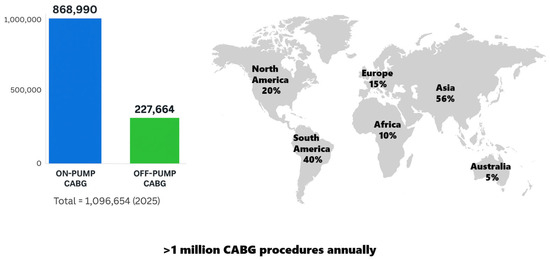
Despite three decades of experience, OPCAB adoption remains variable across regions. In some countries, particularly in Asia, OPCAB accounts for a substantial proportion of CABG procedures, whereas in North America and Europe its use is limited (Figure 1) [7]. This variation reflects differences in surgical training, institutional resources, and guideline recommendations. The ongoing debate underscores the need for a balanced, evidence-based appraisal of OPCAB, integrating technical evolution, clinical outcomes, and barriers to universal adoption.
Figure 1.
Global coronary artery bypass grafting (CABG) landscape. Percentages represent the proportion of off-pump CABG among all CABG procedures in each continent.
The literature for this review was identified through a structured search of PubMed, Embase, and the Cochrane Library using combinations of the following terms: “off-pump coronary artery bypass,” “OPCAB,” “on-pump CABG,” “coronary revascularization,” “clinical outcomes,” and “graft patency.” Additional references were identified through manual screening of bibliographies from key trials and meta-analyses. Approximately 180 manuscripts—including randomized trials, meta-analyses, large registries, and contemporary observational studies—were reviewed for inclusion.
2. Technical Principles and Evolution
2.1. Surgical Techniques and Stabilization Devices
The cornerstone of OPCAB is the ability to perform coronary anastomoses on a beating heart with precision and safety. Early attempts were limited by excessive cardiac motion and hemodynamic instability, but the introduction of mechanical stabilizers revolutionized the field [8]. Modern stabilizers, such as suction-based and compression devices, allow localized immobilization of the target coronary segment while maintaining global cardiac function. Intracoronary shunts further facilitate bloodless fields, reducing ischemia during anastomosis [9].
Advances in positioning techniques, including pericardial traction sutures and heart positioning devices, have expanded access to posterior and lateral vessels, enabling more complete revascularization [10]. These innovations have reduced the technical barriers that initially limited OPCAB to anterior vessels. The refinement of stabilizers and positioning systems has been critical in broadening the applicability of OPCAB to multivessel disease.
Despite these advances, technical complexity remains a challenge. OPCAB requires meticulous planning of graft sequence, careful management of hemodynamics, and precise coordination between surgeons and anesthesiologists. The learning curve is steep, with outcomes strongly correlated to surgeon experience and institutional volume [11]. As such, stabilization devices are not merely adjuncts but essential enablers of safe and reproducible OPCAB.
2.2. Anaesthetic and Perfusion Considerations
Anesthetic management in OPCAB differs significantly from ONCAB, as the absence of cardiopulmonary bypass necessitates continuous hemodynamic stability throughout the procedure. Anesthesiologists must anticipate hemodynamic shifts during cardiac displacement and stabilization, employing strategies such as volume loading, vasopressor support, and transesophageal echocardiography monitoring [12].
Ventilation strategies are also critical, as lung volume reduction during heart positioning can impair oxygenation. Low tidal volume ventilation and careful adjustment of positive end-expiratory pressure are often required [13]. In addition, anesthetic agents must balance myocardial protection with rapid recovery, favoring short-acting drugs that allow prompt postoperative extubation.
Perfusion considerations extend to the avoidance of systemic inflammatory responses associated with cardiopulmonary bypass. OPCAB patients typically demonstrate reduced cytokine release, lower complement activation, and attenuated coagulation disturbances compared with ONCAB [14]. These physiological advantages may contribute to observed reductions in renal dysfunction and neurocognitive decline in selected populations.
The anesthetic team plays a pivotal role in OPCAB success, requiring close collaboration with the surgeon to anticipate hemodynamic challenges and optimize myocardial perfusion. This interdependence underscores the multidisciplinary nature of OPCAB and the need for specialized training across the operative team.
2.3. Advances in Training and Simulation
The technical demands of OPCAB have driven innovations in surgical training and simulation. Traditional apprenticeship models proved insufficient for mastering the complex coordination required, leading to the development of dedicated OPCAB training curricula [15]. These programs emphasize stepwise skill acquisition, beginning with anterior vessel grafting and progressing to multivessel revascularization.
Simulation platforms, including beating-heart models and virtual reality systems, have emerged as valuable tools for skill development. These allow trainees to practice stabilization, positioning, and anastomotic techniques in controlled environments without patient risk [16]. Studies have demonstrated that simulation training accelerates proficiency, reduces intraoperative errors, and shortens the learning curve [17].
Institutional experience remains a critical determinant of outcomes. High-volume centers consistently report superior results compared with low-volume institutions, reflecting the cumulative expertise of surgical teams [18]. This has prompted calls for regionalization of OPCAB training and the establishment of centers of excellence to ensure consistent quality.
Future directions in training include integration of robotic platforms and hybrid revascularization strategies into curricula. As OPCAB evolves, simulation and structured training will remain essential to overcoming technical barriers and ensuring safe, reproducible outcomes across diverse practice settings.
3. Clinical Outcomes: Evidence from Trials and Registries Comparing OPCAB vs. ONCAB
3.1. Early vs. Late Outcomes: Mortality, Renal Function, and Neurological Outcomes
The evidence comparing OPCAB and ONCAB derives from both randomized controlled trials and large observational registries. Major randomized trials—including ROOBY, CORONARY, and GOPCABE—provide high-quality comparative data [19,20,21], while contemporary observational studies have increasingly adopted propensity score–based methods such as matching, weighting, and stratification to reduce confounding related to baseline risk differences. Together, these complementary study designs form the foundation of current understanding of early and long-term outcomes following OPCAB.
Early outcomes following OPCAB have been extensively studied in randomized controlled trials (RCTs) and registries. Most large RCTs, including ROOBY (1.6% OPCAB vs. 1.2% ONCAB), CORONARY (2.5% OPCAB vs. 2.5% ONCAB), and GOPCABE (2.6% OPCAB vs. 2.8% ONCAB), demonstrated no significant difference in 30-day mortality between OPCAB and ONCAB [19,20,21]. However, observational data suggest that OPCAB may confer modest reductions in perioperative complications, particularly in high-risk patients.
Renal outcomes have been a focus of comparative studies, given the association between cardiopulmonary bypass and acute kidney injury. In major randomized trials, renal dysfunction rates were similar—for example, 7.8% OPCAB vs. 5.8% ONCAB in the ROOBY trial [19], 1.2% OPCAB vs. 1.4% ONCAB in CORONARY trial [20], and 8.5% OPCAB vs. 8.8% ONCAB in GOPCABE trial [21]. On the other hand, several analyses have reported lower rates of postoperative renal dysfunction with OPCAB, especially in patients with pre-existing chronic kidney disease [22]. This advantage appears most pronounced in elderly and comorbid populations, where renal reserve is limited.
Neurological outcomes, including stroke and cognitive decline, have also been investigated. OPCAB has been associated with reduced perioperative stroke rates in several analyses, likely due to avoidance of aortic manipulation and embolic phenomena [23]. On the contrary, contemporary randomized trials demonstrate comparable stroke rates with no advantage for OPCAB—for example, 1.5% vs. 2.1% in CORONARY, 2.2% vs. 2.7% in GOPCABE, and 2.0% vs. 2.4% in ROOBY. Cognitive outcomes are more nuanced; while some studies and meta-analyses suggest attenuated early neurocognitive decline with OPCAB, others report no sustained long-term difference compared with ONCAB [24].
Late outcomes, including survival at 5–10 years, generally show equivalence between OPCAB and ONCAB, though some trials report higher rates of repeat revascularization in OPCAB cohorts [23,25]. These findings highlight the balance between short-term morbidity reduction and long-term durability.
3.2. Subgroup Analyses: High-Risk Patients, Elderly, Comorbidities
Subgroup analyses have consistently demonstrated that OPCAB may offer particular benefits in high-risk populations. Elderly patients, who are more susceptible to complications from cardiopulmonary bypass, often experience reduced perioperative morbidity with OPCAB [26]. Similarly, patients with significant comorbidities such as chronic kidney disease, chronic obstructive pulmonary disease, or peripheral vascular disease may benefit from the less invasive physiological profile of OPCAB [22,27,28].
Diabetic patients represent another important subgroup. Some registry data suggest improved perioperative outcomes with OPCAB in diabetics, though long-term survival and graft patency remain comparable to ONCAB [29]. Patients with severe left ventricular dysfunction have also been studied, with mixed results: while OPCAB may reduce perioperative complications, concerns about completeness of revascularization persist [30].
These subgroup findings underscore the importance of patient selection. OPCAB may not be universally superior, but in carefully chosen populations it can provide meaningful reductions in morbidity without compromising survival.
3.3. Meta-Analyses and Guideline Perspectives
Meta-analyses pooling RCTs and observational studies have provided nuanced insights into OPCAB outcomes. Several analyses report reduced perioperative stroke and renal dysfunction with OPCAB, but no consistent survival advantage [22,23]. Importantly, heterogeneity in trial design, surgeon expertise, and patient populations complicates interpretation.
Guideline perspectives reflect this uncertainty. The European Society of Cardiology and American Heart Association guidelines acknowledge OPCAB as a reasonable alternative in selected patients, particularly those at high risk for complications from cardiopulmonary bypass [31,32]. However, they stop short of recommending universal adoption, citing concerns about incomplete revascularization and variable long-term outcomes.
Thus, while meta-analyses and guidelines recognize potential benefits, they emphasize individualized decision-making and the importance of surgical expertise.
3.4. Graft Patency and Completeness of Revascularization
Long-term graft patency remains a central concern in OPCAB. Angiographic studies have reported slightly lower patency rates in OPCAB compared with ONCAB, particularly in multivessel disease [33]. This may reflect technical challenges in accessing posterior vessels and ensuring complete revascularization.
Incomplete revascularization has been cited as a limitation of OPCAB, with some trials reporting lower rates of multivessel grafting compared with ONCAB [19]. However, experienced centers have demonstrated comparable completeness of revascularization, highlighting the role of surgeon expertise [18].
The debate over graft patency underscores the tension between short-term morbidity reduction and long-term durability. Ensuring technical excellence and adequate training is critical to addressing these concerns.
3.5. Cost-Effectiveness and Resource Utilization
Economic analyses have explored the cost implications of OPCAB. Reduced transfusion requirements, shorter intensive care stays, and lower complication rates suggest potential cost savings [34]. However, these advantages may be offset by longer operative times, intraoperative conversion, specialized equipment, and the need for highly trained surgical teams.
Registry data from high-volume centers indicate that OPCAB can be cost-effective when performed by experienced teams, particularly in high-risk populations [18]. Conversely, in low-volume institutions, variability in outcomes may negate economic benefits.
Ultimately, cost-effectiveness is closely tied to institutional expertise and patient selection. OPCAB may provide resource savings in appropriate contexts, but universal adoption without adequate training infrastructure could increase variability and costs.
4. Global Variation in Practice
4.1. Regional Trends and Adoption Rates
The adoption of OPCAB has varied significantly across regions, reflecting differences in surgical philosophy, healthcare infrastructure, and patient demographics. In Asia—particularly India, Korea, and Japan—OPCAB has achieved widespread use, with some centers reporting that more than half of CABG procedures are performed off-pump [35,36]. In India, for example, several high-volume institutions routinely perform 50–60% of CABG procedures using OPCAB techniques, while Japanese and Korean centers similarly report >50% utilization in selected hospitals [35,36]. This trend has been driven by resource constraints, where avoiding cardiopulmonary bypass reduces costs and perioperative morbidity, making OPCAB attractive in high-volume, cost-sensitive environments.
In contrast, adoption in North America and Europe has been more limited. Data from the Society of Thoracic Surgeons (STS) registry indicate that OPCAB accounts for less than 20% of CABG procedures in the United States, with national estimates ranging from 15 to 18% depending on the reporting period [37]. European practice patterns are similarly conservative, with most centers favoring ONCAB due to concerns about graft patency and completeness of revascularization. Nonetheless, select high-volume institutions in the UK, Germany, and Italy have demonstrated excellent outcomes with OPCAB, underscoring the importance of institutional expertise rather than regional norms [11].
Latin America and the Middle East present intermediate adoption rates, with variability depending on institutional resources and surgeon training. In Brazil, national registry data indicate that OPCAB represents approximately 13–20% of CABG procedures, with favorable outcomes reported in large patient cohorts [38,39]. This reflects both economic considerations and a strong tradition of surgical innovation in the region.
Overall, global adoption of OPCAB remains heterogeneous, with high penetration in Asia and parts of Latin America, but more limited uptake in North America and Europe. These differences highlight the interplay between healthcare economics, surgical culture, and institutional expertise.
4.2. Influence of Surgical Training and National Guidelines
Surgical training has played a pivotal role in shaping OPCAB adoption. In regions where OPCAB is integrated into residency and fellowship curricula, such as India and Brazil, surgeons gain early exposure to beating-heart techniques, facilitating widespread practice [40]. Conversely, in North America and Europe, training programs often emphasize ONCAB, with limited opportunities for OPCAB proficiency. This disparity could contribute to regional differences in adoption and outcomes.
Institutional culture further shapes adoption. High-volume centers with dedicated OPCAB programs report superior outcomes, while low-volume institutions often struggle with variability. This has led to calls for regionalization of OPCAB training and the establishment of centers of excellence to ensure consistent quality [18].
Ultimately, surgical training and guideline perspectives are central to the global variation in OPCAB practice. Regions that prioritize structured training and provide clear guideline support demonstrate higher adoption rates and better outcomes, while regions with limited exposure remain cautious.
5. Barriers to Universal Adoption
5.1. Technical Complexity
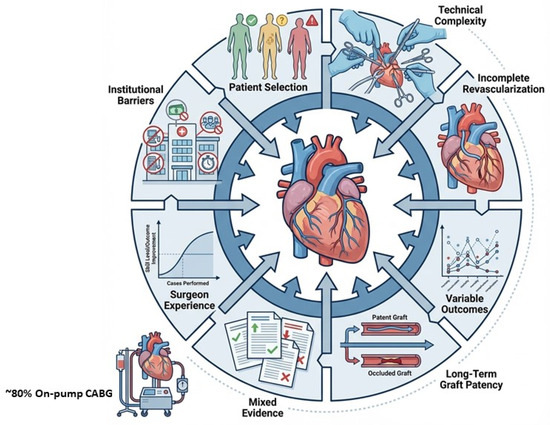
One of the most frequently cited barriers to OPCAB adoption is its technical complexity (Figure 2). Performing coronary anastomoses on a beating heart requires advanced surgical dexterity, precise stabilization, and continuous hemodynamic management [41]. The steep learning curve means that outcomes are strongly correlated with surgeon experience and institutional volume. In low-volume centers, variability in results has reinforced skepticism about OPCAB’s reproducibility.
Figure 2.
Barriers to universal adoption of off-pump coronary artery bypass grafting (CABG).
Technical challenges are particularly evident in multivessel disease, where accessing posterior and lateral vessels demands complex positioning maneuvers. Inadequate exposure can compromise graft quality and completeness of revascularization [42]. These difficulties have limited OPCAB’s appeal among surgeons who are more comfortable with the controlled environment of cardiopulmonary bypass.
Simulation and structured training programs have mitigated some of these challenges, but widespread adoption remains constrained by the need for specialized expertise. Without consistent exposure during training, many surgeons lack confidence in performing OPCAB safely across diverse patient populations [43].
5.2. Incomplete Revascularization
Concerns about incomplete revascularization have persisted since the introduction of OPCAB. Several trials and registries have reported lower rates of multivessel grafting compared with ONCAB, raising questions about long-term durability [44]. Incomplete revascularization has been linked to higher rates of repeat interventions and adverse outcomes in some studies.
However, experienced centers have demonstrated that complete revascularization is achievable with OPCAB, particularly when stabilization and positioning devices are used effectively [18]. The discrepancy between high-volume and low-volume institutions underscores the importance of surgical expertise.
Incomplete revascularization remains a barrier to universal adoption, as many surgeons perceive OPCAB as less reliable for complex coronary anatomy. Addressing this concern requires both technical innovation and structured training to ensure reproducibility across diverse practice settings. Hybrid coronary revascularization, which combines OPCAB for the left anterior descending artery with percutaneous coronary intervention (PCI) for non-left anterior descending (LAD) lesions, has emerged as a potential strategy to address incomplete revascularization in selected patients [45]. This approach may offer the durability of surgical grafting while leveraging PCI to treat anatomically challenging or diffusely diseased vessels, thereby improving overall completeness of revascularization.
5.3. Variable Outcomes
Outcome variability is another major barrier. While some centers report excellent results with OPCAB, others have documented inferior graft patency and higher rates of repeat revascularization [46]. This inconsistency has fueled debate and limited guideline endorsement.
Variability reflects differences in surgeon experience, institutional resources, and patient selection. In high-volume centers with dedicated OPCAB programs, outcomes are comparable to ONCAB, but in low-volume institutions, results are less predictable [18]. This disparity has reinforced the perception that OPCAB is a niche technique rather than a universally applicable approach.
Reducing variability requires standardization of training, institutional support, and careful patient selection. Without these measures, OPCAB will continue to face skepticism from the broader surgical community.
5.4. Long-Term Graft Patency Concerns
Long-term graft patency remains a critical concern. Angiographic studies have reported slightly lower patency rates in OPCAB compared with ONCAB, particularly in complex multivessel disease [47]. These findings have raised doubts about the durability of OPCAB and its ability to provide equivalent long-term outcomes.
Some studies suggest that patency differences may be attributable to technical factors rather than intrinsic limitations of OPCAB. In experienced hands, graft patency rates are comparable to ONCAB, highlighting the importance of surgical expertise [6].
Nevertheless, concerns about long-term durability persist, particularly among guideline committees and institutions with limited OPCAB experience. Addressing these concerns requires ongoing research, standardized reporting, and long-term follow-up data.
5.5. Mixed Evidence and Trial Design Limitations
The evidence base for OPCAB is complicated by trial design limitations. High crossover rates, surgeon expertise bias, and heterogeneous patient populations have undermined the generalizability of findings [48]. For example, the ROOBY trial reported inferior outcomes with OPCAB, but critics noted that participating surgeons had limited experience, potentially skewing results.
Meta-analyses have attempted to synthesize data, but heterogeneity in trial design and patient selection complicates interpretation (Table 1) [23,24,33,49,50,51,52,53,54,55,56,57,58,59,60,61,62,63,64,65,66,67,68,69,70,71,72,73,74,75,76,77,78,79]. Registry data provide valuable insights but are subject to confounding and selection bias.
Table 1.
Meta-Analyses of randomized controlled trials comparing off-pump and on-pump CABG.
These limitations have contributed to ongoing debate and guideline ambiguity. Without robust, well-designed trials, OPCAB will continue to face skepticism despite promising results in selected populations.
5.6. Surgeon and Team Training and Experience
Surgeon and team experience are central to OPCAB success. Outcomes are consistently superior in high-volume centers, reflecting cumulative expertise and multidisciplinary coordination [18]. Conversely, limited exposure during training programs has constrained adoption in many regions.
Team dynamics are particularly important, as anesthesiologists and perfusionists play critical roles in managing hemodynamics and ensuring patient safety. Institutions that invest in multidisciplinary training report better outcomes and greater confidence in OPCAB [80].
Expanding OPCAB adoption requires structured curricula, simulation platforms, and mentorship programs. Without these investments, variability in outcomes will persist, reinforcing skepticism about OPCAB’s reproducibility.
5.7. Institutional and Resource Barriers
Institutional resources also influence adoption. OPCAB requires specialized stabilization devices, positioning systems, and trained personnel, which may not be available in all centers. Smaller institutions often lack the infrastructure to support OPCAB, limiting its feasibility.
Economic considerations further shape adoption. While OPCAB can reduce costs through shorter hospital stays and fewer complications, these savings may be offset by equipment costs and training requirements. Institutions must weigh these factors when deciding whether to invest in OPCAB programs.
Resource barriers remain a significant obstacle, particularly in low-volume centers and resource-limited settings [37]. Addressing these challenges requires strategic investment and regionalization of expertise.
5.8. Guideline Ambiguity
Guideline ambiguity has reinforced skepticism about OPCAB. While major societies acknowledge its potential benefits in selected patients, they stop short of recommending routine use [31,32]. This cautious stance reflects concerns about variability, incomplete revascularization, and long-term patency.
Ambiguous guidelines create uncertainty for institutions and surgeons, limiting confidence in adopting OPCAB. Clearer recommendations, informed by robust evidence, are needed to support broader integration.
Until guidelines provide stronger endorsement, OPCAB will remain a selective rather than universal strategy.
5.9. Patient Selection Issues
Patient selection is critical to OPCAB success. While high-risk patients may benefit from reduced morbidity, others may derive little advantage compared with ONCAB [19]. Identifying appropriate candidates requires careful assessment of coronary anatomy, comorbidities, and institutional expertise.
Inconsistent patient selection has contributed to variability in outcomes and skepticism about OPCAB’s reproducibility. Standardized criteria are needed to guide decision-making and ensure consistent results.
Across the available evidence, several high-risk subgroups appear to derive particular benefit from OPCAB. These include elderly patients, especially those over 75 years; individuals with significant aortic calcification or a ‘porcelain aorta,’ in whom avoiding aortic manipulation reduces embolic risk; patients with advanced chronic kidney disease, who may be more vulnerable to CPB-associated renal injury; those with impaired left ventricular function; and individuals with multiple comorbidities such as diabetes, peripheral vascular disease, or frailty [36]. These readily identifiable clinical variables can help guide patient selection in settings where minimizing perioperative risk is a priority.
Ultimately, patient selection remains both a barrier and an opportunity. With appropriate criteria, OPCAB can deliver meaningful benefits, but without them, outcomes will remain inconsistent.
6. Future Directions
6.1. Robotic and Minimally Invasive OPCAB
Robotic and minimally invasive approaches represent the next frontier in OPCAB. Robotic platforms allow enhanced visualization, precision, and dexterity, enabling surgeons to perform coronary anastomoses through small thoracic incisions without sternotomy [81]. These techniques aim to reduce surgical trauma, accelerate recovery, and improve cosmetic outcomes while maintaining the physiological benefits of off-pump surgery.
Early experiences with robotic OPCAB have demonstrated feasibility and safety, with promising short-term outcomes in selected patients [82]. Minimally invasive OPCAB, performed through limited thoracotomies, has also gained traction, particularly for single-vessel or minimally complex disease. These approaches reduce postoperative pain, shorten hospital stays, and may lower infection risk [83].
However, widespread adoption is limited by technical challenges, steep learning curves, and the need for specialized equipment. Robotic OPCAB requires significant institutional investment and surgeon training, while minimally invasive approaches demand advanced positioning and stabilization techniques [84]. As technology evolves, integration of robotic assistance with OPCAB may expand its role, particularly in centers committed to innovation and training.
6.2. Role in Hybrid Revascularization Strategies
Hybrid revascularization strategies combine surgical and percutaneous approaches to optimize outcomes. OPCAB plays a central role in these strategies, particularly when used to graft the left internal mammary artery (LIMA) to the LAD, while PCI addresses non-LAD lesions [85]. This approach leverages the durability of surgical grafts with the minimally invasive nature of PCI.
Comparative evidence between surgical and percutaneous revascularization provides additional context for the role of OPCAB and ONCAB. Long-term follow-up from the Octopus randomized trials demonstrates that OPCAB and PCI achieve similar 20-year survival, although OPCAB is associated with significantly fewer repeat revascularizations [86]. Stroke outcomes are also comparable between OPCAB and PCI, as shown in the CREDO-Kyoto registry [87]. In contrast, the SYNTAXES 10-year analysis confirms that ONCAB provides superior long-term survival compared with PCI in patients with complex multivessel or left main disease [88]. A recent network meta-analysis further indicates that all surgical techniques—including OPCAB, OPCAB with proximal anastomotic device, and anaortic OPCAB—achieve more complete revascularization than PCI, with anaortic OPCAB offering the lowest stroke risk [89]. These findings highlight how the distinct strengths of surgical and percutaneous revascularization can be combined, providing a conceptual foundation for the use of OPCAB as the surgical component within hybrid revascularization strategies.
Hybrid revascularization is particularly advantageous in complex or high-risk patients, where combining an off-pump LIMA–LAD graft with PCI to non-LAD vessels can provide a rapid, reproducible, and physiologically gentle approach. This strategy avoids aortic manipulation—critical in patients with porcelain aorta—while reducing operative stress in frail or comorbid individuals. By pairing the durability of the LIMA–LAD anastomosis with the flexibility of PCI for multivessel disease, hybrid revascularization offers a safe and effective solution for very sick or anatomically challenging patients, complementing the strengths of both OPCAB and percutaneous techniques.
Hybrid strategies are particularly attractive for patients with multivessel disease who may benefit from reduced surgical trauma and shorter recovery times. Studies have demonstrated comparable outcomes to conventional CABG, with reduced hospital stays and faster return to daily activities [90].
OPCAB is well suited to hybrid approaches, as it avoids cardiopulmonary bypass and facilitates minimally invasive access. The combination of OPCAB and PCI may provide a balanced solution for patients with complex coronary anatomy, offering both durability and reduced morbidity [91].
Challenges include coordination between surgical and interventional teams, timing of procedures, and management of dual antiplatelet therapy. Nevertheless, hybrid revascularization represents a promising avenue for integrating OPCAB into contemporary practice.
6.3. Research Priorities and Trial Design
Future research must address the limitations of existing evidence. Many trials have been criticized for high crossover rates, limited surgeon experience, and heterogeneous patient populations, which undermine generalizability [92]. Designing robust trials with standardized training requirements and stratified patient selection is essential to clarify OPCAB’s role.
Long-term graft patency remains a critical research priority. Studies should incorporate angiographic and imaging follow-up to assess durability across diverse patient populations. Additionally, neurocognitive outcomes and quality of life measures warrant further investigation, as these may represent meaningful advantages of OPCAB not captured by traditional endpoints.
Economic analyses are also needed to evaluate cost-effectiveness in different healthcare systems. Comparative studies across high- and low-volume centers could clarify the impact of institutional expertise on outcomes and resource utilization.
Finally, integration of emerging technologies such as robotics, artificial intelligence, and advanced simulation into OPCAB research will be essential. These innovations may reduce technical barriers, improve reproducibility, and expand the applicability of OPCAB in the coming decades [93].
7. Conclusions
OPCAB has evolved from a technically challenging innovation into a mature surgical technique supported by advances in stabilization devices, anesthetic management, and structured training. Evidence from randomized controlled trials, meta-analyses, and registries demonstrates that OPCAB achieves comparable early mortality to conventional ONCAB, with potential advantages in reducing perioperative morbidity, particularly renal dysfunction and neurological complications. These benefits appear most pronounced in high-risk populations such as elderly patients and those with significant comorbidities. However, concerns regarding incomplete revascularization, variable outcomes across institutions, and long-term graft patency continue to limit universal adoption.
Global practice variation underscores the influence of surgical training, institutional resources, and guideline perspectives. Regions with structured training programs and high-volume centers report excellent outcomes, while low-volume institutions often struggle with reproducibility. This disparity highlights the importance of surgeon and team expertise, as well as the need for standardized curricula and simulation platforms to ensure consistent quality.
Future directions, including robotic and minimally invasive OPCAB, hybrid revascularization strategies, and integration of emerging technologies, hold promise for expanding the role of OPCAB. Nevertheless, robust trial design, long-term follow-up, and comprehensive cost-effectiveness analyses remain essential to clarify its place in contemporary practice.
In summary, OPCAB should not be viewed as a universal replacement for ONCAB, but rather as a complementary technique with distinct advantages in selected patient populations. A balanced, evidence-based approach that integrates OPCAB into surgical practice according to patient risk profiles, institutional expertise, and evolving technological innovations offers the most rational path forward. By aligning technical evolution with rigorous clinical evidence, OPCAB can continue to contribute meaningfully to the advancement of coronary revascularization.
Funding
This research received no external funding.
Data Availability Statement
No new data were created or analyzed in this study.
Conflicts of Interest
The author declares no conflicts of interest.
References
- Vrints, C.; Andreotti, F.; Koskinas, K.C.; Rossello, X.; Adamo, M.; Ainslie, J.; Banning, A.P.; Budaj, A.; Buechel, R.R.; Chiariello, G.A.; et al. 2024 ESC Guidelines for the management of chronic coronary syndromes. Eur. Heart J. 2024, 45, 3415–3537. [Google Scholar] [CrossRef] [Scilit] [PubMed]
- Lamy, A.; Devereaux, P.J.; Prabhakaran, D.; Taggart, D.P.; Hu, S.; Straka, Z.; Piegas, L.S.; Avezum, A.; Akar, A.R.; Lanas Zanetti, F.; et al. Five-Year Outcomes after Off-Pump or On-Pump Coronary-Artery Bypass Grafting. N. Engl. J. Med. 2016, 375, 2359–2368. [Google Scholar] [CrossRef] [Scilit] [PubMed]
- Paparella, D.; Yau, T.M.; Young, E. Cardiopulmonary bypass induced inflammation: Pathophysiology and treatment. An update. Eur. J. Cardiothorac. Surg. 2002, 21, 232–244. [Google Scholar] [CrossRef] [Scilit]
- Buffolo, E.; de Andrade, C.S.; Branco, J.N.; Teles, C.A.; Aguiar, L.F.; Gomes, W.J. Coronary artery bypass grafting without cardiopulmonary bypass. Ann. Thorac. Surg. 1996, 61, 63–66. [Google Scholar] [CrossRef] [Scilit]
- Benetti, F.J. MINI-off-pump coronary artery bypass graft: Long-term results. Future Cardiol. 2010, 6, 791–795. [Google Scholar] [CrossRef] [Scilit]
- Puskas, J.D.; Williams, W.H.; Duke, P.G.; Staples, J.R.; Glas, K.E.; Marshall, J.J.; Leimbach, M.; Huber, P.; Garas, S.; Sammons, B.H.; et al. Off-pump coronary artery bypass grafting provides complete revascularization with reduced myocardial injury, transfusion requirements, and length of stay: A prospective randomized comparison of two hundred unselected patients undergoing off-pump versus conventional coronary artery bypass grafting. J. Thorac. Cardiovasc. Surg. 2003, 125, 797–808. [Google Scholar] [CrossRef] [Scilit]
- Farina, P.; Gaudino, M.; Angelini, G.D. Off-pump coronary artery bypass surgery: The long and winding road. Int. J. Cardiol. 2019, 279, 51–55. [Google Scholar] [CrossRef] [Scilit]
- Gaudino, M.; Angelini, G.D.; Antoniades, C.; Bakaeen, F.; Benedetto, U.; Calafiore, A.M.; Di Franco, A.; Di Mauro, M.; Fremes, S.E.; Girardi, L.N.; et al. Off-Pump Coronary Artery Bypass Grafting: 30 Years of Debate. J. Am. Heart Assoc. 2018, 7, e009934. [Google Scholar] [CrossRef] [Scilit]
- Amabile, A.; Williams, E.E.; Rosati, C.M.; Torregrossa, G.; Puskas, J.D. Off-Pump Coronary Artery Bypass Grafting: How I Teach It. Ann. Thorac. Surg. 2021, 112, 1741–1745. [Google Scholar] [CrossRef] [Scilit]
- Abicht, J.M.; Beiras-Fernandez, A.; Bengel, D.; Vicol, C. Deep pericardial traction suture versus vacuum-assisted apical suction to expose the posterior wall of the heart in off-pump coronary artery bypass: A prospective, randomized study. Heart Surg. Forum 2012, 15, E224–E231. [Google Scholar] [CrossRef] [Scilit]
- Naito, S.; Demal, T.J.; Sill, B.; Reichenspurner, H.; Onorati, F.; Gatti, G.; Mariscalco, G.; Faggian, G.; Salsano, A.; Santini, F.; et al. Impact of Surgeon Experience and Centre Volume on Outcome After Off-Pump Coronary Artery Bypass Surgery: Results from the European Multicenter Study on Coronary Artery Bypass Grafting (E-CABG) Registry. Heart Lung Circ. 2023, 32, 387–394. [Google Scholar] [CrossRef] [Scilit] [PubMed]
- Michelsen, L.G.; Horswell, J. Anesthesia for off-pump coronary artery bypass grafting. Semin. Thorac. Cardiovasc. Surg. 2003, 15, 71–82. [Google Scholar] [CrossRef] [Scilit] [PubMed]
- Kelleher, A.; Gothard, J. Anaesthesia for off-pump coronary artery surgery. Br. J. Anaesth. 2004, 92, 324–326. [Google Scholar] [CrossRef] [Scilit]
- Ascione, R.; Lloyd, C.T.; Underwood, M.J.; Gomes, W.J.; Angelini, G.D. On-pump versus off-pump coronary revascularization: Evaluation of renal function. Ann. Thorac. Surg. 1999, 68, 493–498. [Google Scholar] [CrossRef] [Scilit]
- Bouma, W.; Kuijpers, M.; Bijleveld, A.; De Maat, G.E.; Koene, B.M.; Erasmus, M.E.; Natour, E.; Mariani, M.A. A new beating-heart off-pump coronary artery bypass grafting training model. Interact. Cardiovasc. Thorac. Surg. 2015, 20, 7–9. [Google Scholar] [CrossRef] [Scilit]
- Kasai, M.; Osako, M.; Yoshino, H. Novel Low-Cost, High-Fidelity, Portable Simulation Device for off-Pump Coronary Artery Bypass Graft. Ann. Thorac. Surg. 2020, 109, e387. [Google Scholar] [CrossRef] [Scilit]
- Mascheroni, J.; Stockburger, M.; Patwala, A.; Mont, L.; Rao, A.; Retzlaff, H.; Garweg, C.; Gallagher, A.G.; Verbelen, T. Surgical skill simulation training to proficiency reduces procedural errors among novice cardiac device implanters: A randomized study. Europace 2024, 26, euae229. [Google Scholar] [CrossRef] [Scilit]
- Benedetto, U.; Lau, C.; Caputo, M.; Kim, L.; Feldman, D.N.; Ohmes, L.B.; Di Franco, A.; Soletti, G.; Angelini, G.D.; Girardi, L.N.; et al. Comparison of Outcomes for Off-Pump Versus On-Pump Coronary Artery Bypass Grafting in Low-Volume and High-Volume Centers and by Low-Volume and High-Volume Surgeons. Am. J. Cardiol. 2018, 121, 552–557. [Google Scholar] [CrossRef] [Scilit]
- Shroyer, A.L.; Grover, F.L.; Hattler, B.; Collins, J.F.; McDonald, G.O.; Kozora, E.; Lucke, J.C.; Baltz, J.H.; Novitzky, D.; Veterans Affairs Randomized On/Off Bypass (ROOBY) Study Group. On-pump versus off-pump coronary-artery bypass surgery. N. Engl. J. Med. 2009, 361, 1827–1837. [Google Scholar] [CrossRef] [Scilit]
- Lamy, A.; Devereaux, P.J.; Prabhakaran, D.; Taggart, D.P.; Hu, S.; Paolasso, E.; Straka, Z.; Piegas, L.S.; Akar, A.R.; Jain, A.R.; et al. Off-pump or on-pump coronary-artery bypass grafting at 30 days. N. Engl. J. Med. 2012, 366, 1489–1497. [Google Scholar] [CrossRef] [Scilit]
- Diegeler, A.; Börgermann, J.; Kappert, U.; Breuer, M.; Böning, A.; Ursulescu, A.; Rastan, A.; Holzhey, D.; Treede, H.; Rieß, F.C.; et al. Off-pump versus on-pump coronary-artery bypass grafting in elderly patients. N. Engl. J. Med. 2013, 368, 1189–1198. [Google Scholar] [CrossRef] [Scilit] [PubMed]
- Ahmed, M.; Majeed, K.; Ali, H.; Syed, H.; Batool, A. Off-pump vs. on-pump coronary artery bypass grafting in patients with chronic kidney disease: An updated systematic review and meta-analysis. Int. Urol. Nephrol. 2025, 57, 463–477. [Google Scholar] [CrossRef] [Scilit] [PubMed]
- He, L.; Tiemuerniyazi, X.; Chen, L.; Yang, Z.; Huang, S.; Nan, Y.; Song, Y.; Feng, W. Clinical outcomes of on-pump versus off-pump coronary-artery bypass surgery: A meta-analysis. Int. J. Surg. 2024, 110, 5063–5070. [Google Scholar] [CrossRef] [Scilit]
- Marasco, S.F.; Sharwood, L.N.; Abramson, M.J. No improvement in neurocognitive outcomes after off-pump versus on-pump coronary revascularisation: A meta-analysis. Eur. J. Cardiothorac Surg. 2008, 33, 961–970. [Google Scholar] [CrossRef] [Scilit]
- Comanici, M.; Bulut, H.I.; Raja, S.G. 10-Year Mortality of Off-Pump Versus On-Pump Coronary Artery Bypass Grafting: An Updated Systematic Review, Meta-Analysis, and Meta-Regression. Am. J. Cardiol. 2024, 219, 77–84. [Google Scholar] [CrossRef] [Scilit]
- Khan, H.; Uzzaman, M.; Benedetto, U.; Butt, S.; Raja, S.G. On- or off-pump coronary artery bypass grafting for octogenarians: A meta-analysis of comparative studies involving 27,623 patients. Int. J. Surg. 2017, 47, 42–51. [Google Scholar] [CrossRef] [Scilit]
- Cappellaro, A.P.; de Almeida, L.F.C.; Pinto, M.L.; Martins, M.A.B.; Sousa, A.G.E.; Gadelha, J.G.; Vieira, A.C.P.; Rocha, L.F.R.; Thet, M.S. Off-pump versus on-pump coronary artery bypass grafting in patients with chronic obstructive pulmonary disease: A systematic review and meta-analysis. Gen. Thorac. Cardiovasc. Surg. 2025, 73, 201–208. [Google Scholar] [CrossRef] [Scilit]
- Karthik, S.; Musleh, G.; Grayson, A.D.; Keenan, D.J.; Pullan, D.M.; Dihmis, W.C.; Hasan, R.; Fabri, B.M. Coronary surgery in patients with peripheral vascular disease: Effect of avoiding cardiopulmonary bypass. Ann. Thorac. Surg. 2004, 77, 1245–1249. [Google Scholar] [CrossRef] [Scilit]
- Huang, K.C.; Wu, I.H.; Chou, N.K.; Yang, Y.Y.; Lin, L.C.; Yu, H.Y.; Chi, N.H. Late outcomes of off-pump versus on-pump coronary bypass in patients with diabetes: A nationwide study from Taiwan. J. Thorac. Cardiovasc. Surg. 2019, 157, 960–969.e2. [Google Scholar] [CrossRef] [Scilit]
- Ascione, R.; Narayan, P.; Rogers, C.A.; Lim, K.H.; Capoun, R.; Angelini, G.D. Early and midterm clinical outcome in patients with severe left ventricular dysfunction undergoing coronary artery surgery. Ann. Thorac. Surg. 2003, 76, 793–799. [Google Scholar] [CrossRef] [Scilit]
- Sousa-Uva, M.; Neumann, F.J.; Ahlsson, A.; Alfonso, F.; Banning, A.P.; Benedetto, U.; Byrne, R.A.; Collet, J.P.; Falk, V.; Head, S.J.; et al. 2018 ESC/EACTS Guidelines on myocardial revascularization. Eur. J. Cardiothorac. Surg. 2019, 55, 4–90. [Google Scholar] [CrossRef] [Scilit] [PubMed]
- Writing Committee Members; Lawton, J.S.; Tamis-Holland, J.E.; Bangalore, S.; Bates, E.R.; Beckie, T.M.; Bischoff, J.M.; Bittl, J.A.; Cohen, M.G.; DiMaio, J.M.; et al. 2021 ACC/AHA/SCAI Guideline for Coronary Artery Revascularization: A Report of the American College of Cardiology/American Heart Association Joint Committee on Clinical Practice Guidelines. J. Am. Coll. Cardiol. 2022, 79, e21–e129. [Google Scholar] [CrossRef] [Scilit] [PubMed]
- Zhou, Z.; Fu, G.; Feng, K.; Huang, S.; Chen, G.; Liang, M.; Wu, Z. Randomized evidence on graft patency after off-pump versus on-pump coronary artery bypass grafting: An updated meta-analysis. Int. J. Surg. 2022, 98, 106212. [Google Scholar] [CrossRef] [Scilit]
- Lamy, A.; Wang, X.; Farrokhyar, F.; Kent, R. A cost comparison of off-pump CABG versus on-pump CABG at one-year: The Canadian off-pump CABG registry. Can. J. Cardiol. 2006, 22, 699–704. [Google Scholar] [CrossRef] [Scilit]
- Saha, K.K. Off-pump coronary artery bypass grafting in India. Indian Heart J. 2014, 66, 203–207. [Google Scholar] [CrossRef] [Scilit]
- Guida, G.A.; Chivasso, P.; Fudulu, D.; Rapetto, F.; Sedmakov, C.; Marsico, R.; Zakkar, M.; Bryan, A.J.; Angelini, G.D. Off-pump coronary artery bypass grafting in high-risk patients: A review. J. Thorac. Dis. 2016, 8, S795–S798. [Google Scholar] [CrossRef] [Scilit]
- Bakaeen, F.G.; Shroyer, A.L.; Gammie, J.S.; Sabik, J.F.; Cornwell, L.D.; Coselli, J.S.; Rosengart, T.K.; O’Brien, S.M.; Wallace, A.; Shahian, D.M.; et al. Trends in use of off-pump coronary artery bypass grafting: Results from the Society of Thoracic Surgeons Adult Cardiac Surgery Database. J. Thorac. Cardiovasc. Surg. 2014, 148, 856–864.e1; discussion 863–864. [Google Scholar] [CrossRef] [Scilit]
- Paez, R.P.; Hossne Junior, N.A.; Santo, J.A.D.E.; Berwanger, O.; Santos, R.H.N.; Kalil, R.A.K.; Jatene, F.B.; Cavalcanti, A.B.; Zilli, A.C.; Bettiati, L.C., Jr.; et al. Coronary Artery Bypass Surgery in Brazil: Analysis of the National Reality Through the BYPASS Registry. Braz. J. Cardiovasc. Surg. 2019, 34, 142–148. [Google Scholar] [CrossRef] [Scilit]
- Oliveira, G.M.M.; Brant, L.C.C.; Polanczyk, C.A.; Malta, D.C.; Biolo, A.; Nascimento, B.R.; Souza, M.F.M.; Lorenzo, A.R.; Fagundes Júnior, A.A.P.; Schaan, B.D.; et al. Cardiovascular Statistics—Brazil 2023. Arq. Bras. Cardiol. 2024, 121, e20240079. (In Portuguese) [Google Scholar] [CrossRef] [Scilit]
- Gomes, W.J.; Angelini, G.D. On- or Off-pump Coronary Artery Bypass Surgery. Is the Debate Settling Down? Braz. J. Cardiovasc. Surg. 2019, 34, VIII–XI. [Google Scholar] [CrossRef] [Scilit]
- Shaefi, S.; Mittel, A.; Loberman, D.; Ramakrishna, H. Off-Pump Versus On-Pump Coronary Artery Bypass Grafting-A Systematic Review and Analysis of Clinical Outcomes. J. Cardiothorac. Vasc. Anesth. 2019, 33, 232–244. [Google Scholar] [CrossRef] [Scilit] [PubMed]
- Møller, C.H.; Penninga, L.; Wetterslev, J.; Steinbrüchel, D.A.; Gluud, C. Off-pump versus on-pump coronary artery bypass grafting for ischaemic heart disease. Cochrane Database Syst. Rev. 2012, 2012, CD007224. [Google Scholar] [CrossRef] [Scilit] [PubMed]
- Comanici, M.; Soni, M.; Raja, S.G. Trainee Perceptions of Off-Pump Coronary Artery Bypass Grafting: United Kingdom Training Needs Survey. Am. J. Cardiol. 2024, 220, 47–48. [Google Scholar] [CrossRef] [Scilit]
- Benedetto, U.; Caputo, M.; Patel, N.N.; Fiorentino, F.; Bryan, A.; Angelini, G.D. Long-term survival after off-pump versus on-pump coronary artery bypass graft surgery. Does completeness of revascularization play a role? Int. J. Cardiol. 2017, 246, 32–36. [Google Scholar] [CrossRef] [Scilit]
- Hage, A.; Giambruno, V.; Jones, P.; Chu, M.W.; Fox, S.; Teefy, P.; Lavi, S.; Bainbridge, D.; Harle, C.; Iglesias, I.; et al. Hybrid Coronary Revascularization Versus Off-Pump Coronary Artery Bypass Grafting: Comparative Effectiveness Analysis with Long-Term Follow-up. J. Am. Heart Assoc. 2019, 8, e014204. [Google Scholar] [CrossRef] [Scilit]
- Kim, K.B.; Lim, C.; Lee, C.; Chae, I.H.; Oh, B.H.; Lee, M.M.; Park, Y.B. Off-pump coronary artery bypass may decrease the patency of saphenous vein grafts. Ann. Thorac. Surg. 2001, 72, S1033–S1037. [Google Scholar] [CrossRef] [Scilit]
- Parolari, A.; Tremoli, E.; Biglioli, P.; Alamanni, F. Off-pump coronary bypass surgery: Another brick in the wall of reduced graft patency. Ann. Thorac. Surg. 2009, 87, 675–676, author reply 676. [Google Scholar] [CrossRef] [Scilit]
- Mukherjee, D.; Ahmed, K.; Baig, K.; Patel, V.M.; Darzi, A.; Athanasiou, T. Conversion and safety in off-pump coronary artery bypass: A system failure that needs re-emphasis. Ann. Thorac. Surg. 2011, 91, 630–639. [Google Scholar] [CrossRef] [Scilit]
- Machado, R.J.; Saraiva, F.A.; Mancio, J.; Sousa, P.; Cerqueira, R.J.; Barros, A.S.; Lourenço, A.P.; Leite-Moreira, A.F. A systematic review and meta-analysis of randomized controlled studies comparing off-pump versus on-pump coronary artery bypass grafting in the elderly. J. Cardiovasc. Surg. 2022, 63, 60–68. [Google Scholar] [CrossRef] [Scilit]
- Mauldon, H.; Dieberg, G.; Smart, N.; King, N. Effect of Age on Clinical Outcomes Following On-/Off-Pump Coronary Artery Bypass: Meta-Analysis and Meta-Regression. Braz. J. Cardiovasc. Surg. 2020, 35, 797–814. [Google Scholar] [CrossRef] [Scilit]
- Gaudino, M.; Benedetto, U.; Bakaeen, F.; Rahouma, M.; Tam, D.Y.; Abouarab, A.; Di Franco, A.; Leonard, J.; Elmously, A.; Puskas, J.D.; et al. Off- Versus On-Pump Coronary Surgery and the Effect of Follow-Up Length and Surgeons’ Experience: A Meta-Analysis. J. Am. Heart Assoc. 2018, 7, e010034. [Google Scholar] [CrossRef] [Scilit] [PubMed]
- Smart, N.A.; Dieberg, G.; King, N. Long-Term Outcomes of On- Versus Off-Pump Coronary Artery Bypass Grafting. J. Am. Coll. Cardiol. 2018, 71, 983–991. [Google Scholar] [CrossRef] [Scilit] [PubMed]
- Takagi, H.; Hari, Y.; Mitta, S.; Kawai, N.; Ando, T.; ALICE (All-Literature Investigation of Cardiovascular Evidence) Group. A meta-analysis of ≥5-year mortality in randomized controlled trials of off-pump versus on-pump coronary artery bypass grafting. J. Card. Surg. 2018, 33, 716–724. [Google Scholar] [CrossRef] [Scilit] [PubMed]
- Zhou, P.; Zhu, P.; Xiao, Z.; Lin, X.; Xu, R.; Zheng, S. Meta-Analysis of Repeat Revascularization of Off-Pump and On-Pump Coronary Artery Bypass Surgery. Ann. Thorac. Surg. 2018, 106, 526–531. [Google Scholar] [CrossRef] [Scilit]
- Filardo, G.; Hamman, B.L.; da Graca, B.; Sass, D.M.; Machala, N.J.; Ismail, S.; Pollock, B.D.; Collinsworth, A.W.; Grayburn, P.A. Efficacy and effectiveness of on- versus off-pump coronary artery bypass grafting: A meta-analysis of mortality and survival. J. Thorac. Cardiovasc. Surg. 2018, 155, 172–179.e5. [Google Scholar] [CrossRef] [Scilit]
- Kowalewski, M.; Pawliszak, W.; Malvindi, P.G.; Bokszanski, M.P.; Perlinski, D.; Raffa, G.M.; Kowalkowska, M.E.; Zaborowska, K.; Navarese, E.P.; Kolodziejczak, M.; et al. Off-pump coronary artery bypass grafting improves short-term outcomes in high-risk patients compared with on-pump coronary artery bypass grafting: Meta-analysis. J. Thorac. Cardiovasc. Surg. 2016, 151, 60–77.e1-58. [Google Scholar] [CrossRef] [Scilit]
- Dieberg, G.; Smart, N.A.; King, N. On- vs. off-pump coronary artery bypass grafting: A systematic review and meta-analysis. Int. J. Cardiol. 2016, 223, 201–211. [Google Scholar] [CrossRef] [Scilit]
- Deppe, A.C.; Arbash, W.; Kuhn, E.W.; Slottosch, I.; Scherner, M.; Liakopoulos, O.J.; Choi, Y.H.; Wahlers, T. Current evidence of coronary artery bypass grafting off-pump versus on-pump: A systematic review with meta-analysis of over 16,900 patients investigated in randomized controlled trials†. Eur. J. Cardiothorac Surg. 2016, 49, 1031–1041; discussion 1041. [Google Scholar] [CrossRef] [Scilit]
- Luo, T.; Ni, Y. Short-term and Long-term Postoperative Safety of Off-Pump versus On-Pump Coronary Artery Bypass Grafting for Coronary Heart Disease: A Meta-analysis for Randomized Controlled Trials. Thorac. Cardiovasc. Surg. 2015, 63, 319–327. [Google Scholar] [CrossRef] [Scilit]
- Zhang, B.; Zhou, J.; Li, H.; Liu, Z.; Chen, A.; Zhao, Q. Comparison of graft patency between off-pump and on-pump coronary artery bypass grafting: An updated meta-analysis. Ann. Thorac. Surg. 2014, 97, 1335–1341. [Google Scholar] [CrossRef] [Scilit]
- Takagi, H.; Watanabe, T.; Mizuno, Y.; Kawai, N.; Umemoto, T.; ALICE (All-Literature Investigation of Cardiovascular Evidence) Group. A meta-analysis of large randomized trials for mid-term major cardio- and cerebrovascular events following off-pump versus on-pump coronary artery bypass grafting. Interact. Cardiovasc. Thorac. Surg. 2014, 18, 522–524. [Google Scholar] [CrossRef] [Scilit]
- Takagi, H.; Umemoto, T.; All-Literature Investigation of Cardiovascular Evidence (ALICE) Group. Worse long-term survival after off-pump than on-pump coronary artery bypass grafting. J. Thorac. Cardiovasc. Surg. 2014, 148, 1820–1829. [Google Scholar] [CrossRef] [Scilit] [PubMed]
- Chaudhry, U.A.; Harling, L.; Rao, C.; Ashrafian, H.; Ibrahim, M.; Kokotsakis, J.; Casula, R.; Athanasiou, T. Off-pump versus on-pump coronary revascularization: Meta-analysis of mid- and long-term outcomes. Ann. Thorac. Surg. 2014, 98, 563–572. [Google Scholar] [CrossRef] [Scilit] [PubMed]
- Zhang, B.; Zhou, J.; Li, H.; Zhou, M.; Chen, A.; Zhao, Q. Off-pump coronary artery bypass grafting does not increase the 1-year mortality compared to on-pump: A meta-analysis of randomized controlled trials. Int. J. Cardiol. 2013, 169, e93–e95. [Google Scholar] [CrossRef] [Scilit] [PubMed]
- Takagi, H.; Mizuno, Y.; Niwa, M.; Goto, S.N.; Umemoto, T.; ALICE (All-Literature Investigation of Cardiovascular Evidence) Group. A meta-analysis of randomized trials for repeat revascularization following off-pump versus on-pump coronary artery bypass grafting. Interact. Cardiovasc. Thorac. Surg. 2013, 17, 878–880. [Google Scholar] [CrossRef] [Scilit]
- Sun, J.H.; Wu, X.Y.; Wang, W.J.; Jin, L.L. Cognitive dysfunction after off-pump versus on-pump coronary artery bypass surgery: A meta-analysis. J. Int. Med. Res. 2012, 40, 852–858. [Google Scholar] [CrossRef] [Scilit]
- Sá, M.P.; Ferraz, P.E.; Escobar, R.R.; Martins, W.N.; Lustosa, P.C.; Nunes Ede, O.; Vasconcelos, F.P.; Lima, R.C. Off-pump versus on-pump coronary artery bypass surgery: Meta-analysis and meta-regression of 13,524 patients from randomized trials. Rev. Bras. Cir. Cardiovasc. 2012, 27, 631–641. [Google Scholar] [CrossRef] [Scilit]
- Chen, Y.B.; Shu, J.; Yang, W.T.; Shi, L.; Guo, X.F.; Wang, F.G.; Qian, Y.Y. Meta-analysis of randomized trials comparing the effectiveness of on-pump and off-pump coronary artery bypass. Chin. Med. J. 2012, 125, 338–344. [Google Scholar]
- Afilalo, J.; Rasti, M.; Ohayon, S.M.; Shimony, A.; Eisenberg, M.J. Off-pump vs. on-pump coronary artery bypass surgery: An updated meta-analysis and meta-regression of randomized trials. Eur. Heart J. 2012, 33, 1257–1267. [Google Scholar] [CrossRef] [Scilit]
- Takagi, H.; Matsui, M.; Umemoto, T. Lower graft patency after off-pump than on-pump coronary artery bypass grafting: An updated meta-analysis of randomized trials. J. Thorac. Cardiovasc. Surg. 2010, 140, e45–e47. [Google Scholar] [CrossRef] [Scilit]
- Takagi, H.; Matsui, M.; Umemoto, T. Off-pump coronary artery bypass may increase late mortality: A meta-analysis of randomized trials. Ann. Thorac. Surg. 2010, 89, 1881–1888. [Google Scholar] [CrossRef] [Scilit] [PubMed]
- Seabra, V.F.; Alobaidi, S.; Balk, E.M.; Poon, A.H.; Jaber, B.L. Off-pump coronary artery bypass surgery and acute kidney injury: A meta-analysis of randomized controlled trials. Clin. J. Am. Soc. Nephrol. 2010, 5, 1734–1744. [Google Scholar] [CrossRef] [Scilit] [PubMed]
- Feng, Z.Z.; Shi, J.; Zhao, X.W.; Xu, Z.F. Meta-analysis of on-pump and off-pump coronary arterial revascularization. Ann. Thorac. Surg. 2009, 87, 757–765. [Google Scholar] [CrossRef] [Scilit] [PubMed]
- Takagi, H.; Kawai, N.; Umemoto, T. Neurocognitive decline after off-pump versus on-pump coronary artery bypass. Ann. Thorac. Surg. 2008, 86, 690. [Google Scholar] [CrossRef] [Scilit]
- Møller, C.H.; Penninga, L.; Wetterslev, J.; Steinbrüchel, D.A.; Gluud, C. Clinical outcomes in randomized trials of off- vs. on-pump coronary artery bypass surgery: Systematic review with meta-analyses and trial sequential analyses. Eur. Heart J. 2008, 29, 2601–2616. [Google Scholar] [CrossRef] [Scilit]
- Takagi, H.; Tanabashi, T.; Kawai, N.; Umemoto, T. Off-pump surgery does not reduce stroke, compared with results of on-pump coronary artery bypass grafting: A meta-analysis of randomized clinical trials. J. Thorac. Cardiovasc. Surg. 2007, 134, 1059–1060. [Google Scholar] [CrossRef] [Scilit]
- Takagi, H.; Tanabashi, T.; Kawai, N.; Umemoto, T. Cognitive decline after off-pump versus on-pump coronary artery bypass graft surgery: Meta-analysis of randomized controlled trials. J. Thorac. Cardiovasc. Surg. 2007, 134, 512–513. [Google Scholar] [CrossRef] [Scilit]
- Parolari, A.; Alamanni, F.; Polvani, G.; Agrifoglio, M.; Chen, Y.B.; Kassem, S.; Veglia, F.; Tremoli, E.; Biglioli, P. Meta-analysis of randomized trials comparing off-pump with on-pump coronary artery bypass graft patency. Ann. Thorac. Surg. 2005, 80, 2121–2125. [Google Scholar] [CrossRef] [Scilit]
- Parolari, A.; Alamanni, F.; Cannata, A.; Naliato, M.; Bonati, L.; Rubini, P.; Veglia, F.; Tremoli, E.; Biglioli, P. Off-pump versus on-pump coronary artery bypass: Meta-analysis of currently available randomized trials. Ann. Thorac. Surg. 2003, 76, 37–40. [Google Scholar] [CrossRef] [Scilit]
- Murzi, M.; Caputo, M.; Aresu, G.; Duggan, S.; Angelini, G.D. Training residents in off-pump coronary artery bypass surgery: A 14-year experience. J. Thorac. Cardiovasc. Surg. 2012, 143, 1247–1253. [Google Scholar] [CrossRef] [Scilit]
- Bonatti, J.; Schachner, T.; Bernecker, O.; Chevtchik, O.; Bonaros, N.; Ott, H.; Friedrich, G.; Weidinger, F.; Laufer, G. Robotic totally endoscopic coronary artery bypass: Program development and learning curve issues. J. Thorac. Cardiovasc. Surg. 2004, 127, 504–510. [Google Scholar] [CrossRef] [Scilit]
- de Cannière, D.; Wimmer-Greinecker, G.; Cichon, R.; Gulielmos, V.; Van Praet, F.; Seshadri-Kreaden, U.; Falk, V. Feasibility, safety, and efficacy of totally endoscopic coronary artery bypass grafting: Multicenter European experience. J. Thorac. Cardiovasc. Surg. 2007, 134, 710–716. [Google Scholar] [CrossRef] [Scilit] [PubMed]
- Ushioda, R.; Hirofuji, A.; Yoongtong, D.; Sakboon, B.; Cheewinmethasiri, J.; Lokeskrawee, T.; Patumanond, J.; Lawanaskol, S.; Kamiya, H.; Arayawudhikul, N. Multi-vessel coronary artery grafting: Analyzing the minimally invasive approach and its safety. Front. Cardiovasc. Med. 2024, 11, 1391881. [Google Scholar] [CrossRef] [Scilit] [PubMed]
- Sugimura, Y.; Suzuki, T.; Bauer, S.J.; Schoettler, F.I.; Immohr, M.B.; Maliwa, M.A.; Mehdiani, A.; Tewarie, L.; Schaelte, G.; Moza, A.; et al. Experience in setting up non-robotic minimally invasive direct coronary artery bypass grafting in a non-routine off-pump coronary artery bypass center. Eur. J. Med. Res. 2025, 30, 64. [Google Scholar] [CrossRef] [Scilit] [PubMed]
- McKiernan, M.; Halkos, M.E. Hybrid coronary revascularization: Are we there yet? Curr. Opin. Cardiol. 2020, 35, 673–678. [Google Scholar] [CrossRef] [Scilit]
- Koop, Y.; Nathoe, H.; Bots, M.; Grobbee, D.E.; Timmermans, M.; Wimmers, R.H.; Gianoli, M.; van Dijk, D.; Vaartjes, I.; PCI and Cardiothoracic Surgery Registration Committees of the Netherlands Heart Registration (Appendix 1). Octopus follow-up: 20 year prognosis in patients randomized to on-pump CABG, off-pump CABG or PCI. Int. J. Cardiol. 2024, 414, 132426. [Google Scholar] [CrossRef] [Scilit]
- Marui, A.; Kimura, T.; Tanaka, S.; Okabayashi, H.; Komiya, T.; Furukawa, Y.; Kita, T.; Sakata, R.; CREDO-Kyoto Investigators. Comparison of frequency of postoperative stroke in off-pump coronary artery bypass grafting versus on-pump coronary artery bypass grafting versus percutaneous coronary intervention. Am. J. Cardiol. 2012, 110, 1773–1778. [Google Scholar] [CrossRef] [Scilit]
- Kageyama, S.; Serruys, P.W.; Ninomiya, K.; O’Leary, N.; Masuda, S.; Kotoku, N.; Colombo, A.; van Geuns, R.J.; Milojevic, M.; Mack, M.J.; et al. Impact of on-pump and off-pump coronary artery bypass grafting on 10-year mortality versus percutaneous coronary intervention. Eur. J. Cardiothorac. Surg. 2023, 64, ezad240. [Google Scholar] [CrossRef] [Scilit]
- Harta, I.K.A.P.; Pertiwi, P.F.K.; Julia Arta, I.G.; Putu Yasa, K. Effectiveness of the various revascularization techniques in multivessel coronary artery disease: A systematic review with network meta-analysis. Ann. Med. 2025, 57, 2566878. [Google Scholar] [CrossRef] [Scilit]
- Giambruno, V.; Jones, P.; Khaliel, F.; Chu, M.W.; Teefy, P.; Sridhar, K.; Cucchietti, C.; Barnfield, R.; Kiaii, B. Hybrid Coronary Revascularization Versus On-Pump Coronary Artery Bypass Grafting. Ann. Thorac. Surg. 2018, 105, 1330–1335. [Google Scholar] [CrossRef] [Scilit]
- Zhang, S.; Li, P.; Li, G.; Yan, Y.; Sun, T.; Lin, J.; Zhang, C.; Liu, S.; Qu, Z.; You, B. Generalized hybrid coronary revascularization vs. conventional off-pump coronary artery bypass grafting for multivessel coronary artery disease. Front. Cardiovasc. Med. 2025, 12, 1459072. [Google Scholar] [CrossRef] [Scilit]
- Davierwala, P.M. Current outcomes of off-pump coronary artery bypass grafting: Evidence from real world practice. J. Thorac. Dis. 2016, 8, S772–S786. [Google Scholar] [CrossRef] [Scilit]
- Serruys, P.W.; Oshima, A.; Ferraz-Costa, G.; Garg, S.; Tsai, T.Y.; Sharif, F.; Onuma, Y. Coronary revascularization: A long-term perspective. Eur. Heart J. 2025, ehaf883. [Google Scholar] [CrossRef] [Scilit]

Disclaimer/Publisher’s Note: The statements, opinions and data contained in all publications are solely those of the individual author(s) and contributor(s) and not of MDPI and/or the editor(s). MDPI and/or the editor(s) disclaim responsibility for any injury to people or property resulting from any ideas, methods, instructions or products referred to in the content. |
© 2026 by the author. Licensee MDPI, Basel, Switzerland. This article is an open access article distributed under the terms and conditions of the Creative Commons Attribution (CC BY) license.