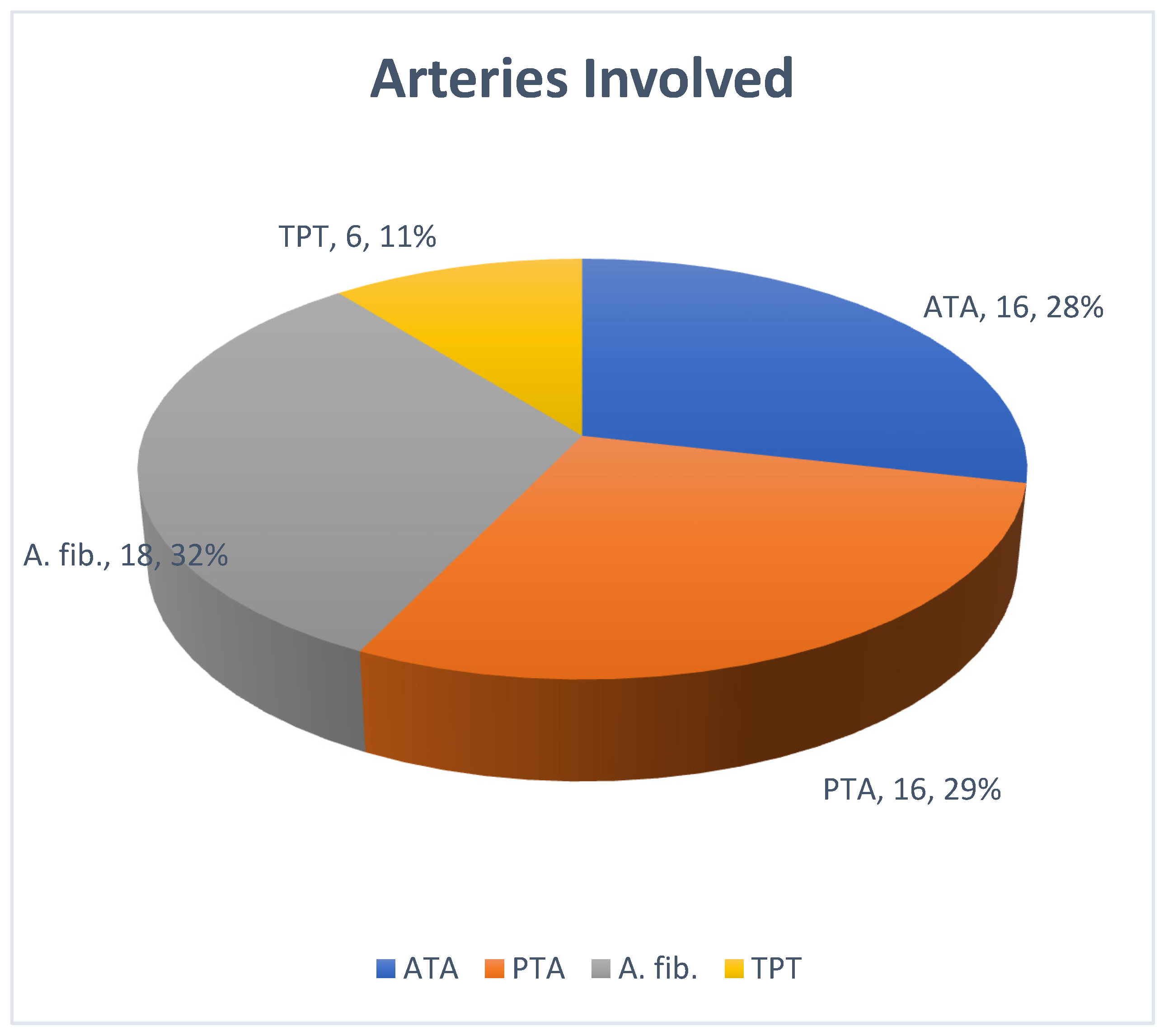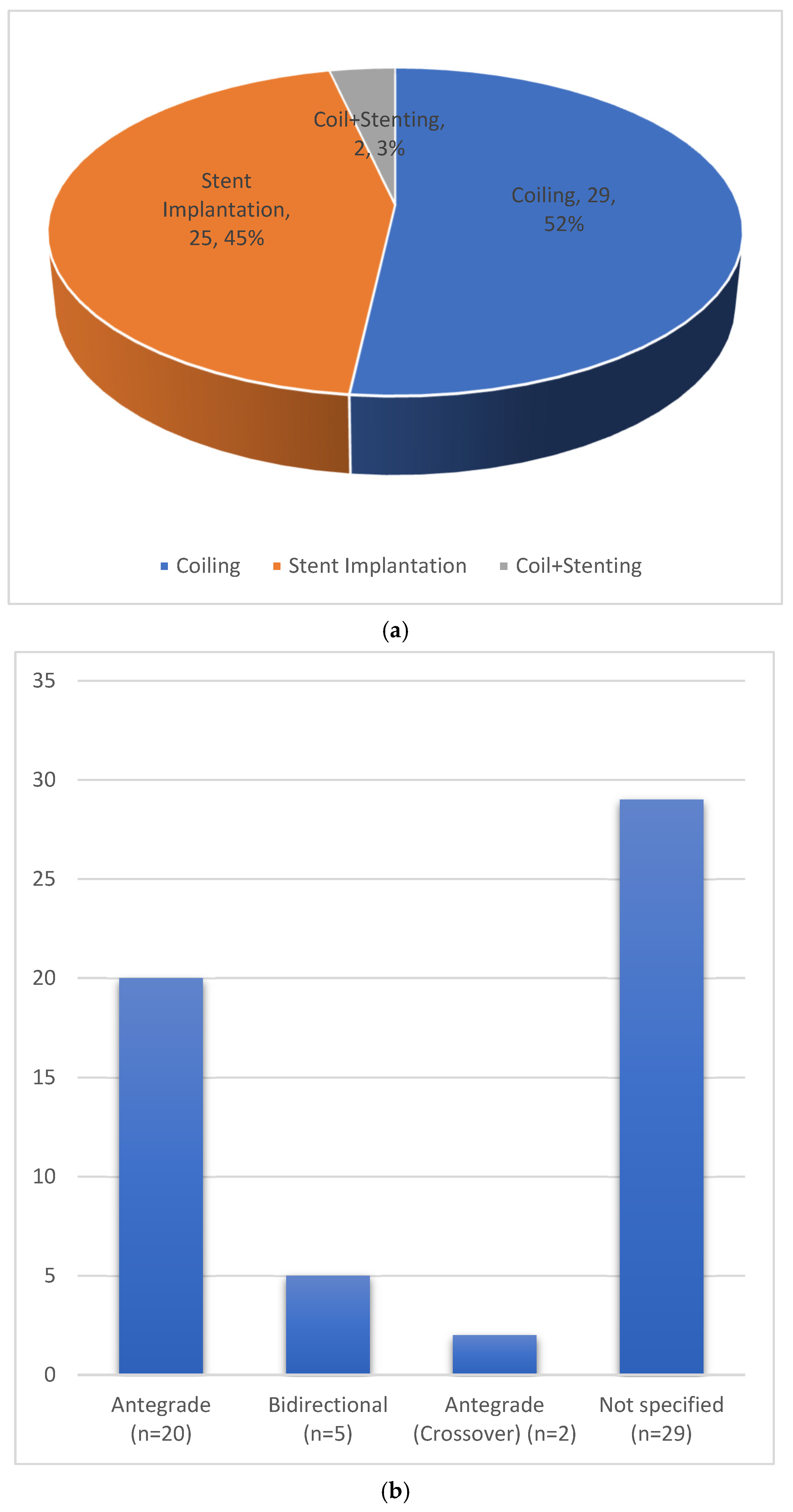

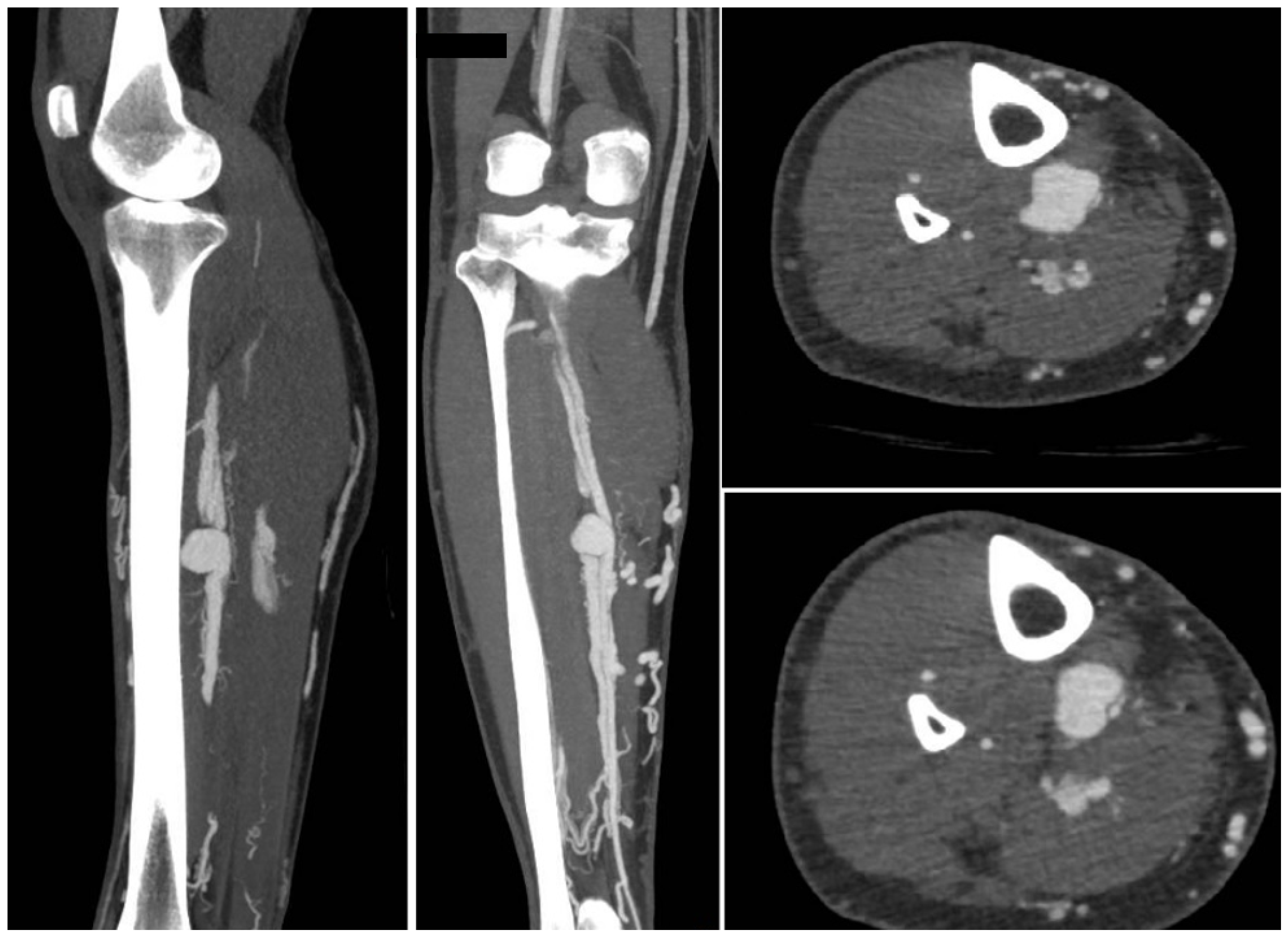
Endovascular Treatment of Crural Aneurysms: Case Report and Systematic Review Regarding Indications, Stent Characteristics, and Patency


Abstract
1. Introduction
2. Materials and Methods
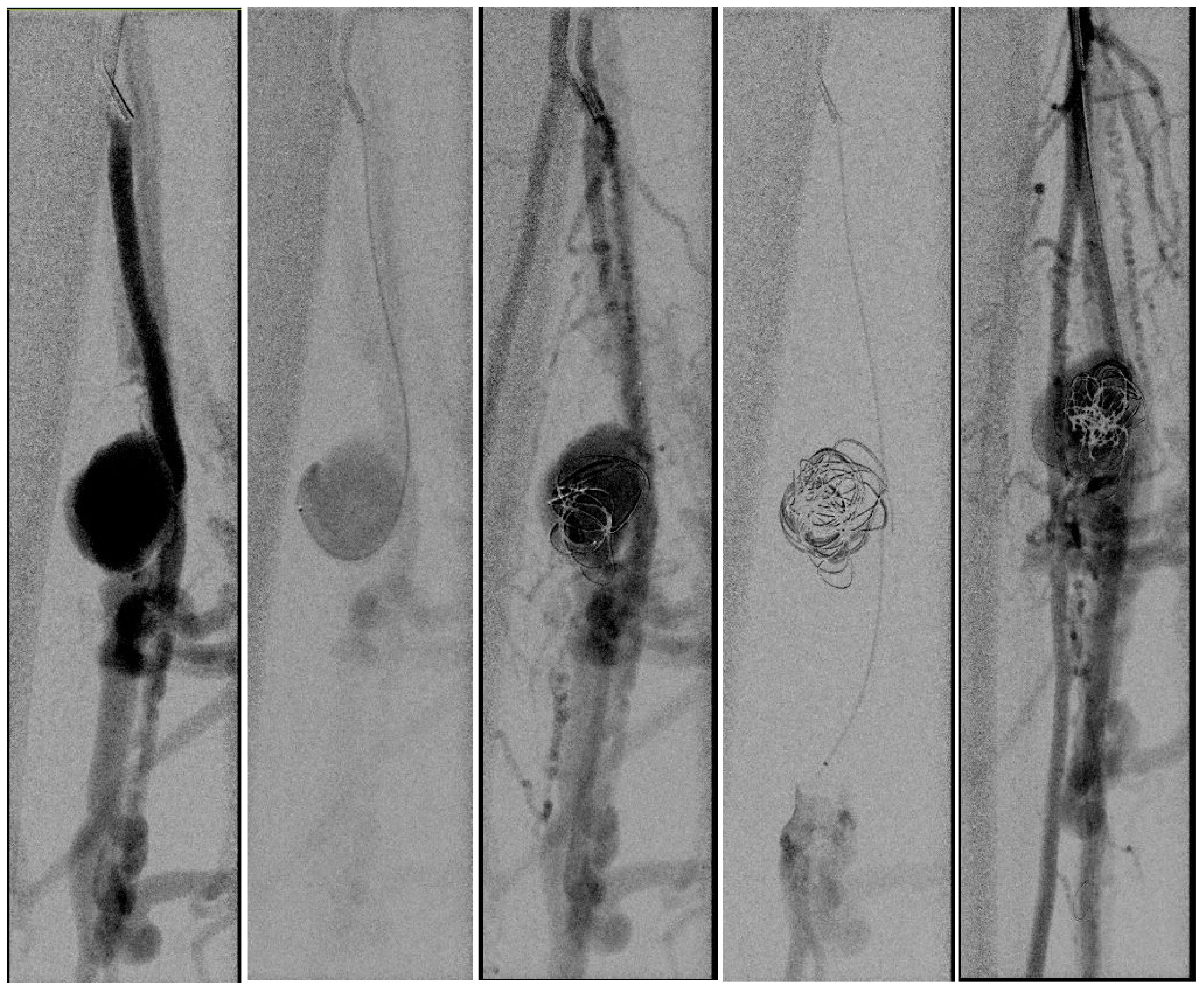
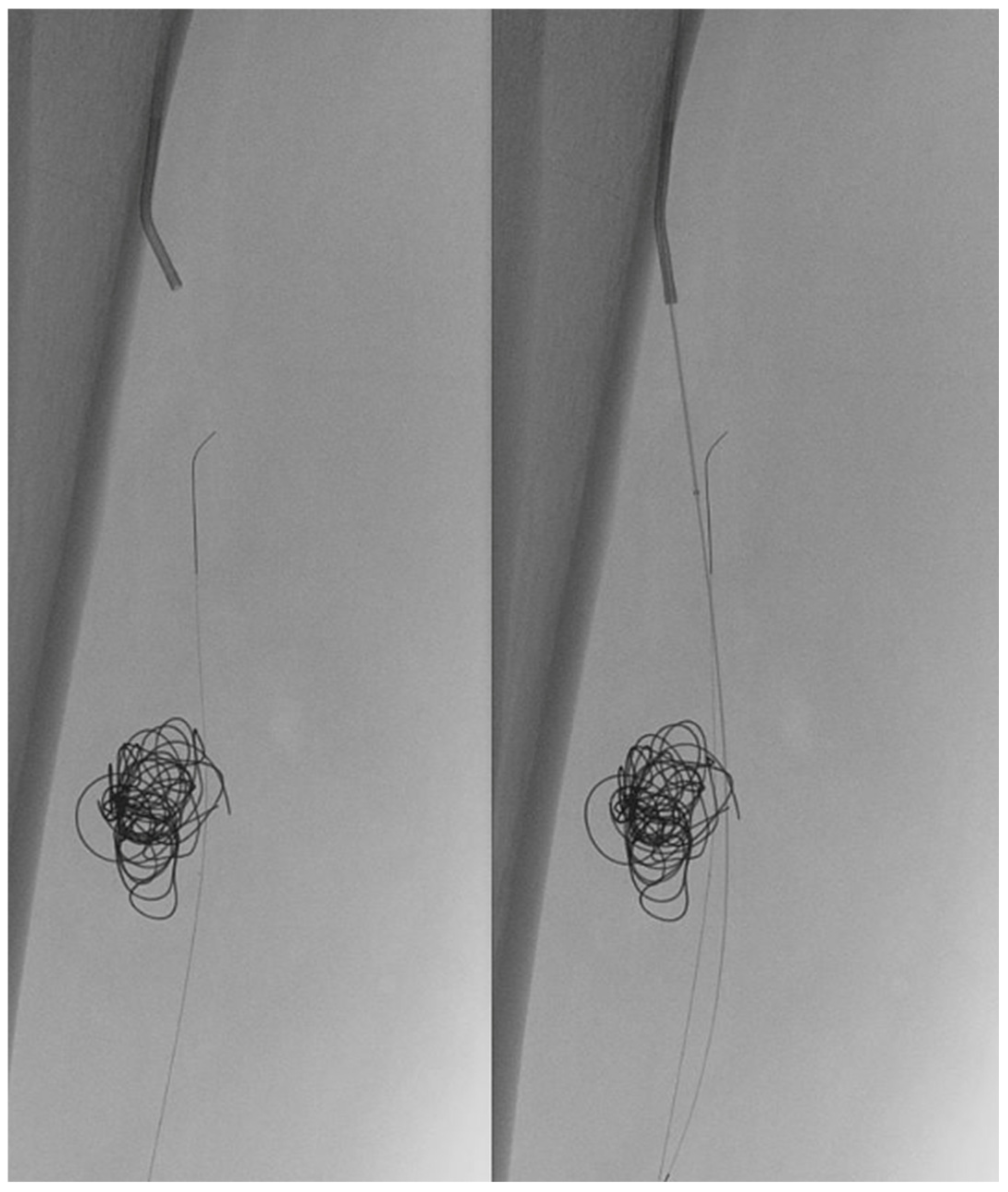
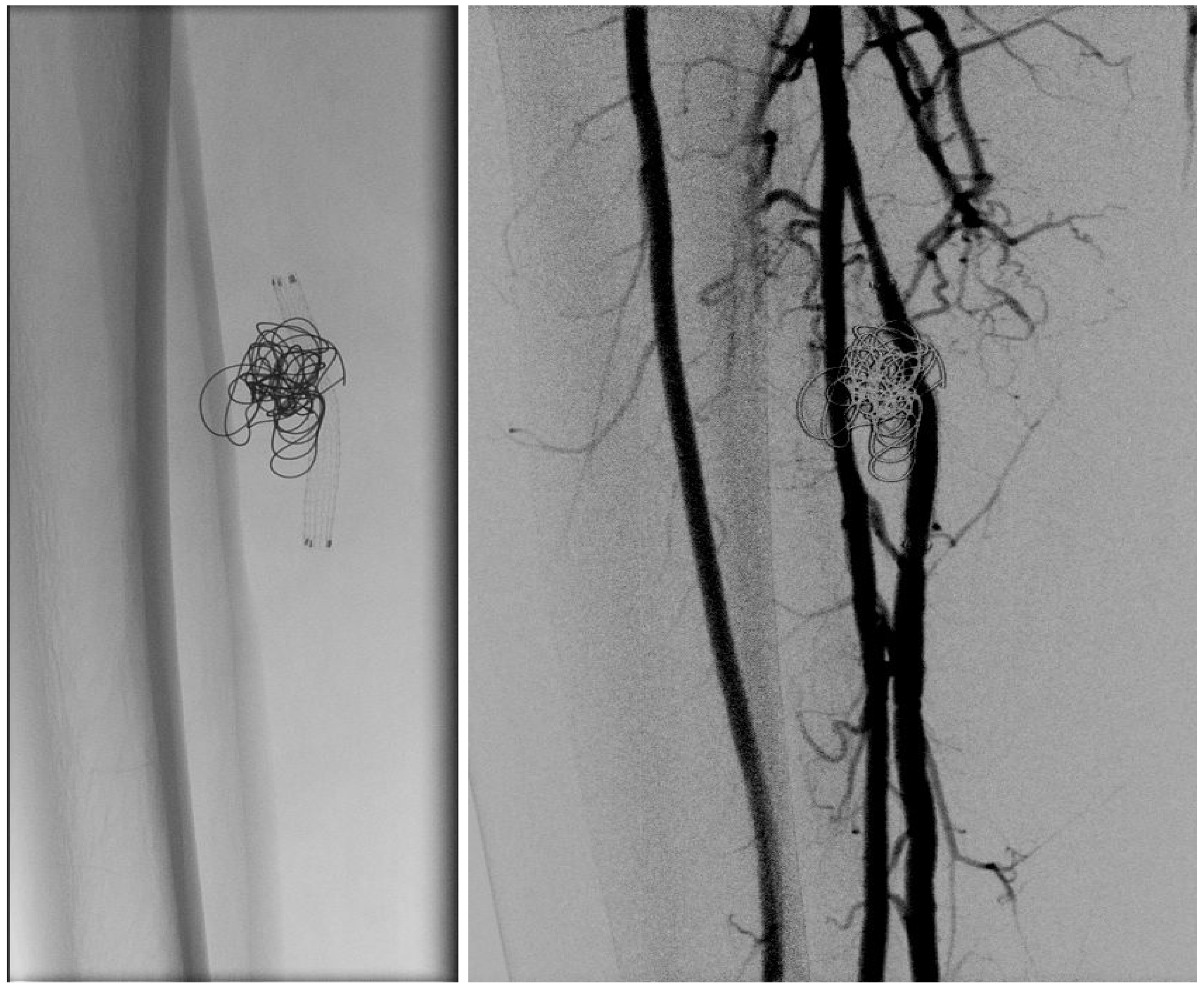
Case Report
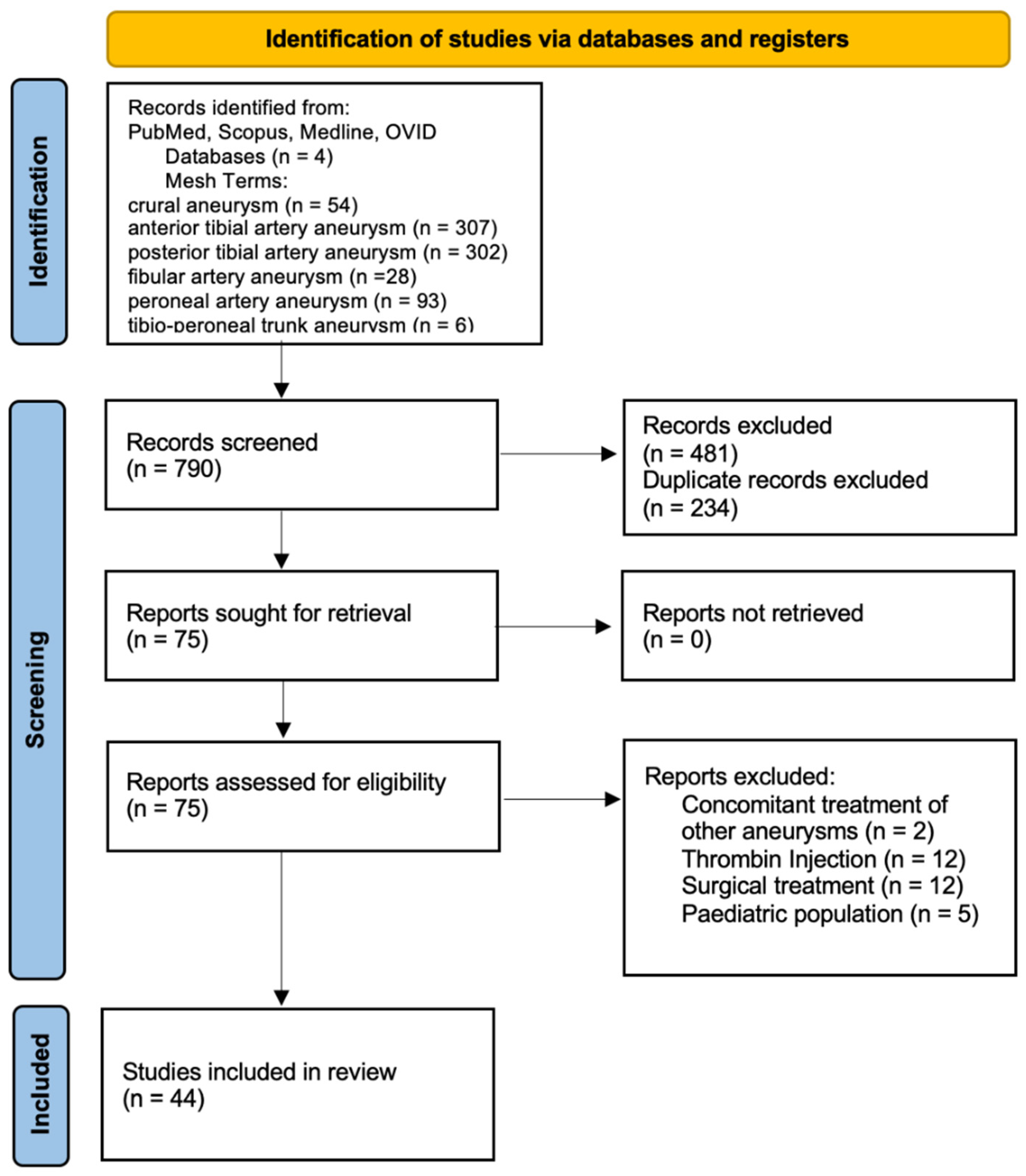
3. Systematic Review
4. Results
5. Discussion
6. Conclusions
Author Contributions
Funding
Institutional Review Board Statement
Informed Consent Statement
Data Availability Statement
Conflicts of Interest
References
- Sadat, U.; See, T.; Cousins, C.; Hayes, P.; Gaunt, M. Peroneal artery pseudoaneurysm—A case report and literature review. BMC Surg. 2007, 7, 4. [Google Scholar] [CrossRef] [PubMed]
- Griffith, J.F.; Cheng, J.C.; Lung, T.K.; Chan, M. Pseudoaneurysm after high tibial osteotomy and limb lengthening. Clin. Orthop. Relat. Res. 1998, 354, 175–179. [Google Scholar] [CrossRef] [PubMed]
- Han, K.J.; Won, Y.Y.; Khang, S.Y. Pseudoaneurysm after tibial nailing. Clin. Orthop. Relat. Res. 2004, 418, 209–212. [Google Scholar] [CrossRef]
- Oehlert, W.H. A complication of the Fogarty arterial embolectomy catheter. Am. Heart J. 1972, 84, 484–486. [Google Scholar] [CrossRef]
- Chrencik, M.T.; Caraballo, B.; Yokemick, J.; Pappas, P.J.; Lal, B.K.; Nagarsheth, K. Infrapopliteal Arterial Pseudoaneurysm Development Secondary to Blunt Trauma: Case Series and Literature Review. Vasc. Endovasc. Surg. 2020, 54, 367–374. [Google Scholar] [CrossRef]
- Brunoro, M.; Baldassarre, V.; Sirignano, P.; Mansour, W.; Capoccia, L.; Speziale, F. Endovascular Treatment of an Anterior Tibial Artery Pseudoaneurysm Secondary to Penetrating Trauma in a Young Patient: Case Report and Literature Review. Ann. Vasc. Surg. 2019, 60, 479.e5–479.e9. [Google Scholar] [CrossRef] [PubMed]
- Maga, P.; Batko, B.; Kaczmarczyk, P.; Krawiec, P.; Krzanowski, M. Unusual presentation of polyarteritis nodosa with unilateral pseudoaneurysm of the posterior tibial artery. Pol. Arch. Med. 2015, 125, 301–302. [Google Scholar] [CrossRef]
- Hagspiel, K.D.; Bonatti, H.; Sabri, S.; Arslan, B.; Harthun, N.L. Metachronous bilateral posterior tibial artery aneurysms in Ehlers-Danlos syndrome type IV. Cardiovasc. Interv. Radiol. 2011, 34, 413–418. [Google Scholar] [CrossRef]
- Rico, J.V.; Gallardo Pedrajas, F.; Cao González, I.; Segura Iglesias, R.J. Urgent endovascular treatment of a ruptured tibioperoneal pseudoaneurysm in Behçet’s disease. Ann. Vasc. Surg. 2011, 25, 385.e11–385.e14. [Google Scholar] [CrossRef]
- Ferrero, E.; Ferri, M.; Carbonatto, P.; Viazzo, A.; Robaldo, A.; Calvo, A.; Pecchio, A.; Berardi, G.; Piazza, S.; Cumbo, P.; et al. Endovascular treatment of a symptomatic mycotic aneurysm of the peroneal artery. Ann. Vasc. Surg. 2011, 25, 982.e11–982.e14. [Google Scholar] [CrossRef]
- Domenick, N.; Cho, J.S.; Abu Hamad, G.; Makaroun, M.S.; Chaer, R.A. Endovascular repair of multiple infrageniculate aneurysms in a patient with vascular type Ehlers-Danlos syndrome. J. Vasc. Surg. 2011, 54, 848–850. [Google Scholar] [CrossRef] [PubMed]
- Singh, D.; Ferero, A. Traumatic pseudoaneurysm of the posterior tibial artery treated by endovascular coil embolization. Foot Ankle Spec. 2013, 6, 54–58. [Google Scholar] [CrossRef] [PubMed]
- Kars, H.Z.; Topaktas, S.; Dogan, K. Aneurysmal peroneal nerve compression. Neurosurgery 1992, 30, 930–931. [Google Scholar]
- Madison, M.K.; Wang, S.K.; King, J.R.; Motaganahalli, R.L.; Sawchuk, A.P. Urgent Endovascular Repair of an Anterior Tibial Artery Aneurysm: Case Report and Literature Review. Vasc. Endovasc. Surg. 2020, 54, 760–764. [Google Scholar] [CrossRef]
- Nwilati, A.E.; AlQedra, D.; Shafiei, M.; AlSaleh, F.M. True anterior tibial artery aneurysm with rupture and compartment syndrome. J. Vasc. Surg. 2019, 70, e198–e199. [Google Scholar] [CrossRef]
- Ono, S.; Shimogawara, T.; Yamazoe, S.; Matsui, J. Successful endovascular isolation of a huge true anterior tibial artery aneurysm by the bi-directional approach in a young patient. Catheter. Cardiovasc. Interv. 2020, 95, E175–E178. [Google Scholar] [CrossRef]
- Musio, D.; Perfumo, M.C.; Gazzola, V.; Pane, B.; Spinella, G.; Palombo, D. A true giant aneurysm of the anterior tibial artery. Ann. Vasc. Surg. 2015, 29, 1319.e5–1319.e9. [Google Scholar] [CrossRef]
- Gratl, A.; Klocker, J.; Glodny, B.; Wick, M.; Fraedrich, G. Treatment options of crural pseudoaneurysms. Vasa 2014, 43, 209–215. [Google Scholar] [CrossRef] [PubMed]
- Yamamoto, Y.; Uchiyama, H.; Oonuki, M. Endovascular coil embolization of a large tibioperoneal trunk pseudoaneurysm. J. Vasc. Surg. Cases Innov. Tech. 2020, 6, 365–368. [Google Scholar] [CrossRef] [PubMed]
- Micari, A.; Vadalà, G. Tibioperoneal trunk pseudoaneurysm coil embolization. Catheter. Cardiovasc. Interv. 2010, 75, 276–278. [Google Scholar] [CrossRef]
- Miura, T.; Soga, Y.; Nobuyoshi, M. Iatrogenic peroneal artery pseudoaneurysm treated by transluminal coil embolization. Cardiovasc. Interv. Ther. 2013, 28, 128–130. [Google Scholar] [CrossRef]
- Okugi, S.; Watanabe, K. Endovascular Embolisation for Proximal Anterior Tibial Artery Aneurysm. Eur. J. Vasc. Endovasc. Surg. 2021, 61, 979. [Google Scholar] [CrossRef] [PubMed]
- de Troia, A.; Biasi, L.; Iazzolino, L.; Azzarone, M.; Tecchio, T.; Rossi, C.; Salcuni, P. Endovascular stent grafting of a posterior tibial artery pseudoaneurysm secondary to penetrating trauma: Case report and review of the literature. Ann. Vasc. Surg. 2014, 28, 1789.e13–1789.e17. [Google Scholar] [CrossRef] [PubMed]
- Golledge, J.; Velu, R.; Quigley, F. Use of a covered stent to treat two large false aneurysms of the anterior tibial artery. J. Vasc. Surg. 2008, 47, 1090. [Google Scholar] [CrossRef] [PubMed]
- Joglar, F.; Kabutey, N.K.; Maree, A.; Farber, A. The role of stent grafts in the management of traumatic tibial artery pseudoaneurysms: Case report and review of the literature. Vasc. Endovasc. Surg. 2010, 44, 407–409. [Google Scholar] [CrossRef]
- de Roo, R.A.; Steenvoorde, P.; Schuttevaer, H.M.; Outer, A.J.D.; Oskam, J.; Joosten, P.P.H. Exclusion of a crural pseudoaneurysm with a PTFE-covered stent-graft. J. Endovasc. Ther. 2004, 11, 344–347. [Google Scholar] [CrossRef]
- Page, M.J.; McKenzie, J.E.; Bossuyt, P.M.; Boutron, I.; Hoffmann, T.C.; Mulrow, C.D.; Shamseer, L.; Tetzlaff, J.M.; Akl, E.A.; Brennan, S.E.; et al. The PRISMA 2020 statement: An updated guideline for reporting systematic reviews. BMJ 2021, 372, n71. [Google Scholar] [CrossRef]
- Parry, D.; Parikh, A.; Robertson, I.; Kessel, D.; Scott, D. Arterial haemorrhage from a chronic venous ulcer-pseudoaneurysm formation of the posterior tibial artery. Eur. J. Vasc. Endovasc. Surg. 2000, 20, 489–491. [Google Scholar] [CrossRef]
- Hebrang, A.; Grga, A.; Brkljacic, B.; Drinkovic, I. Successful closure of large pseudoaneurysm of peroneal artery using transluminal temporary occlusion of the neck with the catheter. Eur. Radiol. 2001, 11, 1206–1209. [Google Scholar] [CrossRef]
- Rosa, P.; O’DOnnell, S.D.; Goff, J.M.; Gillespie, D.L.; Starnes, M.B. Endovascular management of a peroneal artery injury due to a military fragment wound. Ann. Vasc. Surg. 2003, 17, 678–681. [Google Scholar] [CrossRef] [PubMed]
- Spirito, R.; Trabattoni, P.; Pompilio, G.; Zoli, S.; Agrifoglio, M.; Biglioli, P. Endovascular treatment of a post-traumatic tibial pseudoaneurysm and arteriovenous fistula: Case report and review of the literature. J. Vasc. Surg. 2007, 45, 1076–1079. [Google Scholar] [CrossRef] [PubMed]
- van Hensbroek, P.B.; Ponsen, K.J.; A Reekers, J.; Goslings, J.C. Endovascular treatment of anterior tibial artery pseudoaneurysm following locking compression plating of the tibia. J. Orthop. Trauma 2007, 21, 279–282. [Google Scholar] [CrossRef]
- Barbano, B.; Gigante, A.; Zaccaria, A.; Polidori, L.; Martina, P.; Schioppa, A.; Ferrazza, A.; Lanciotti, K.; Cianci, R. True posterior tibial artery aneurysm in a young patient: Surgical or endovascular treatment? BMJ Case Rep. 2009, 2009, bcr0420091812. [Google Scholar] [CrossRef]
- Verma, R.; Seymour, R.; Hockings, M. Endovascular coil embolization of pseudoaneurysm of a branch of the anterior tibial artery following total knee replacement. J. Knee Surg. 2009, 22, 269–271. [Google Scholar] [CrossRef]
- Goltz, J.P.; Bastürk, P.; Hoppe, H.; Triller, J.; Kickuth, R. Emergency and elective implantation of covered stent systems in iatrogenic arterial injuries. Rofo 2011, 183, 618–630. [Google Scholar] [CrossRef] [PubMed]
- Jacobs, E.; Groot, D.; Das, M.; Hermus, J.P. Pseudoaneurysm of the anterior tibial artery after ankle arthroscopy. J. Foot Ankle Surg. 2011, 50, 361–363. [Google Scholar] [CrossRef]
- Chatterjee, S.; Bodhey, N.K.; Gupta, A.K.; Bele, K. Coil migration through skin after posterior tibial artery pseudoaneurysm trapping. Cardiovasc. Interv. Radiol. 2011, 34, S315–S317. [Google Scholar] [CrossRef] [PubMed]
- Ferrero, E.; Ferri, M.; Carbonatto, P.; Robaldo, A.; Viazzo, A.; Calvo, A.; Berardi, G.; Pecchio, A.; Piazza, S.; Cumbo, P.; et al. Symptomatic aneurysm of a perforating peroneal artery after a blunt trauma. Ann. Vasc. Surg. 2012, 26, 277.e1–277.e3. [Google Scholar] [CrossRef]
- De Santis, F.; Mani, G.; Martini, G.; Zipponi, D. Endovascular exclusion coupled with operative anterior leg compartment decompression in a case of postthromboembolectomy tibialis anterior false aneurysm. Ann. Vasc. Surg. 2013, 27, 973.e1–973.e8. [Google Scholar] [CrossRef] [PubMed]
- Gopal, A.; Aranson, N.; Woo, K.; Clavijo, L.; Shavelle, D.M. Recalcitrant peroneal artery pseudoaneurysm in a patient with Hemophilia B. Cardiovasc. Revasc. Med. 2013, 14, 359–362. [Google Scholar] [CrossRef]
- Sala, F.; Salerno, C.F.; Albisetti, W. Pseudoaneurysm of the peroneal artery: An unusual complication of open docking site procedure in bone transport with Taylor Spatial Frame. Musculoskelet. Surg. 2013, 97, 183–186. [Google Scholar] [CrossRef] [PubMed]
- Kaczynski, J.; Beveridge, E.; Holdsworth, R.J. Iatrogenic pseudoaneurysm of the peroneal artery. BMJ Case Rep. 2016, 2016, bcr2016215836. [Google Scholar] [CrossRef] [PubMed] [PubMed Central]
- Zhao, R.; Li, Y.; Liu, Y.; Zhang, K.; Liu, Z. Pseudoaneurysm of a high-division anterior tibial artery following primary TKA. Orthopade 2017, 46, 275–279. [Google Scholar] [CrossRef]
- Yanaka, K.; Miki, K.; Akahori, H.; Imanaka, T.; Yoshihara, N.; Tanaka, T.; Nakayama, H.; Masuyama, T.; Ishihara, M. Therapy with a Covered Stent Graft for Pseudoaneurysm of the Peroneal Artery Complicating High Tibial Osteotomy—A Case Report. Ann. Vasc. Surg. 2019, 58, 380.e13–380.e16. [Google Scholar] [CrossRef] [PubMed]
- Cvetic, V.; Lukic, B. Endovascular Management of Tibioperoneal Trunk Pseudoaneurysm with Arteriovenous Fistula. Eur. J. Vasc. Endovasc. Surg. 2020, 60, 429. [Google Scholar] [CrossRef] [PubMed]
- Cristiani-Winer, M. Distal peroneal artery pseudoaneurysm. Acta Ortop. Mex. 2021, 35, 290–293. [Google Scholar] [CrossRef]
- Scherer, J.; Schäfer, F.P.; Kobe, A.R.; Messmer, F.; Pape, H.C.; Rauer, T. Ordinary injury, big surprise—Traumatic false aneurysm and arteriovenous fistula of the posterior tibial artery after civilian trauma: A case report. Trauma Case Rep. 2021, 32, 100432. [Google Scholar] [CrossRef] [PubMed] [PubMed Central]
- Plotnik, A.N.; Srinivasa, R.N.; Szeder, V.; Moriarty, J. Preservation of Posterior Tibial Artery Flow Following Dissection with Associated Aneurysmal Degeneration in Ehlers-Danlos Syndrome Type IV Treated with Flow-Diverting Stent. Ann. Vasc. Surg. 2021, 73, 521–524. [Google Scholar] [CrossRef] [PubMed]
- Papageorgopoulou, C.; Nikolakopoulos, K.; Ntouvas, I.; Papadoulas, S.; Kritikos, N. A rare combination of tibial artery aneurysm and traumatic arteriovenous fistula: A case report. Pan Afr. Med. J. 2022, 42, 122. [Google Scholar] [CrossRef] [PubMed] [PubMed Central]
- Park, J.J.; Perry, L.D.; Tamburrini, D.; Kumar, S. Successful Coil Embolization of a Large Anterior Tibial Artery Pseudoaneurysm After Open Reduction Internal Fixation of a Bi-condylar Tibial Plateau Fracture. Am. Surg. 2023, 89, 3886–3888. [Google Scholar] [CrossRef] [PubMed]
- Green, R.J.; Sellars, J.; Vennam, S.; Bhutia, S. Off-label use of PK Papyrus coronary covered stent to treat traumatic pseudoaneurysm of posterior tibial artery. ANZ J. Surg. 2023, 93, 1398–1399. [Google Scholar] [CrossRef] [PubMed]
- Spronk, S.; den Hoed, P.T.; Veen, H.F. Case report: Blue toe syndrome caused by a true crural aneurysm. J. Vasc. Nurs. 2003, 21, 70–71. [Google Scholar] [CrossRef] [PubMed]
- Zhao, B.; Zhang, J.; Ma, J.; Huang, M.; Li, J.; Ma, X. Comparison of three different treatment methods for traumatic and Iatrogenic peripheral artery pseudoaneurysms. Orthop. Surg. 2022, 14, 1404–1412. [Google Scholar] [CrossRef] [PubMed]



| Authors | Year | Age | Sex | Etiology | Involved Artery | |
|---|---|---|---|---|---|---|
| 1 | Parry, D.J. et al. [28] | 2000 | 44 | M | Idiopathic | PTA |
| 2 | Hebrang, A. et al. [29] | 2001 | 51 | M | Iatrogenic | A. fib. |
| 3 | Rosa, P. et al. [30] | 2003 | 19 | M | Post-traumatic | A. fib. |
| 4 | De Roo, R.A. et al. [26] | 2004 | 58 | M | Iatrogenic | ATA |
| 5 | Sadat, U. et al. [1] | 2007 | 68 | M | Iatrogenic | A. fib. |
| 6 | Spirito, R. et al. [31] | 2007 | 74 | M | Post-traumatic | ATA |
| 7 | Van Hensbroek, P.B. et al. [32] | 2007 | 55 | M | Iatrogenic | ATA |
| 8 | Golledge, J. et al. [24] | 2008 | 42 | M | Post-traumatic | ATA |
| 9 | Barbano, B. et al. [33] | 2009 | 28 | M | Idiopathic | PTA |
| 10 | Verma, R. et al. [34] | 2009 | 79 | M | Iatrogenic | ATA |
| 11 | Joglar, F. et al. [25] | 2010 | 39 | M | Post-traumatic | PTA |
| 12 | Micari, A. et al. [20] | 2010 | 68 | M | Idiopathic | TPT |
| 13 | Domenick, N. et al. [11] | 2011 | 33 | F | Ehler–Danlos sy. | PTA |
| 14 | Ferrero, E. et al. [10] | 2011 | 69 | M | Mycotic | A. fib. |
| 15 | Goltz, J.P. et al. [35] | 2011 | 87 | M | Iatrogenic | A. fib. |
| 16 | Hagspiel, K.D. et al. [8] | 2011 | 24 | M | Ehler–Danlos sy. | PTA |
| 17 | Jacobs, E. et al. [36] | 2011 | 63 | F | Iatrogenic | ATA |
| 18 | Chatterjee, S. et al. [37] | 2011 | 18 | M | Post-traumatic | PTA |
| 19 | Rico, J.V. et al. [9] | 2011 | 41 | M | Behcet’s disease | TPT |
| 20 | Ferrero, E. et al. [38] | 2012 | 48 | M | Post-traumatic | A. fib. |
| 21 | De Santis, F. et al. [39] | 2013 | 68 | M | Iatrogenic | ATA |
| 22 | Gopal, A. et al. [40] | 2013 | 40 | M | Post-traumatic | A. fib. |
| 23 | Miura, T. et al. [21] | 2013 | 82 | M | Iatrogenic | A. fib. |
| 24 | Sala, F. et al. [41] | 2013 | 19 | M | Iatrogenic | A. fib. |
| 25 | Singh, D. et al. [12] | 2013 | 23 | M | Post-traumatic | PTA |
| 26 | De Troia, A. et al. [23] | 2014 | 34 | M | Post-traumatic | PTA |
| 27 | Gratl, A. et al. [18] | 2014 | Range (15–84) | Iatrogenic | .fib (n = 6), PTA (n = 3), TPT (n = 2), ATA (n = 2) | |
| 28 | Maga, P. et al. [7] | 2015 | 32 | M | PAN | PTA |
| 29 | Kaczynski, J. et al. [42] | 2016 | 78 | M | Iatrogenic | A. fib. |
| 30 | Zhao, R. et al. [43] | 2017 | 72 | F | Iatrogenic | ATA |
| 31 | Brunoro, M. et al. [6] | 2019 | 18 | F | Post-traumatic | ATA |
| 32 | Yanaka, K. et al. [44] | 2019 | 69 | F | Iatrogenic | A. fib. |
| 33 | Chrencik, M.T. et al. [5] | 2020 | 60 | M | Post-traumatic | PTA |
| 34 | Cvetic, V. et al. [45] | 2020 | 49 | M | Post-traumatic | TPT |
| 35 | Madison, M.K. et al. [14] | 2020 | 26 | M | Ehler–Danlos sy. | ATA |
| 36 | Ono, S. et al. [16] | 2020 | 33 | F | Idiopathic | ATA |
| 37 | Yamamoto, Y. et al. [19] | 2020 | 70 | M | Iatrogenic | TPT |
| 38 | Cristiani-Winer, M. [46] | 2021 | 60 | M | Iatrogenic | A. fib. |
| 39 | Okugi, S. et al. [22] | 2021 | 72 | F | Idiopathic | ATA |
| 40 | Scherer, J. et al. [47] | 2021 | 39 | F | Post-traumatic | PTA |
| 41 | Plotnik, A. et al. [48] | 2021 | 38 | M | Ehler–Danlos sy. | PTA |
| 42 | Papageorgopoulou, C. et al. [49] | 2022 | 60 | M | Post-traumatic | ATA |
| 43 | Park, J. et al. [50] | 2023 | NM | NM | Iatrogenic | ATA |
| 44 | Green, R.J. et al. [51] | 2023 | 18 | F | Post-traumatic | PTA |
| Authors | Stent Nr./Size (mm) | Stent Type | Stent Name, Manufacturer | Follow-Up (Months) | Patent Stents | |
|---|---|---|---|---|---|---|
| 1 | De Roo, R.A. et al. [26] | 1/4 × 31 | SESG | Symbiot, Boston Scientific | 12 | 1 |
| 2 | Spirito, R. et al. [31] | 1/4 × 26 | BESG | Graftmaster, Abbott | 12 | 1 |
| 3 | Van Hensbroek, P.B. et al. [32] | 1/3 × 20 | SESG | Symbiot, Boston Scientific | 6 | 1 |
| 4 | Golledge, J. et al. [24] | 1/3 × 19, 1/3.5 × 19 | BESG | Graftmaster, Abbott | 1.5 | 1 |
| 5 | Joglar, F. et al. [25] | 1/3 × 19 | BESG | Graftmaster, Abbott | 8 | 1 |
| 6 | Domenick, N. et al. [11] | 1/5 × 10 | SESG | Viabahn, WL. Gore | 12 | 1 |
| 7 | Ferrero, E. et al. [10] | 1/3 × 26 | BESG | Graftmaster, Abbott | 60 | 1 |
| 8 | Goltz, J.P. et al. [35] | 1/3 × 19 | BESG | Graftmaster, Abbott | 1 | 1 |
| 9 | De Santis, F. et al. [39] | 1/4 × 19 | BESG | Direct-Stent, InSitu Techn. | 10 | 1 |
| 10 | De Troia, A. et al. [23] | 1/3 × 19 | BESG | Direct-Stent, InSitu Techn. | 18 | 1 |
| 11 | Gratl, A. et al. [18] | NM | BESG | Graftmaster, Abbott | 7 | 1 |
| 12 | Maga, P. et al. [7] | 1/3.5 × 2.8 | BESG | AnuGraft, IGTI | 6 | 1 |
| 13 | Brunoro, M. et al. [6] | 1/3.5 × 16, 1/4 × 24 | BESG | B-Graft, Bentley | 13 | 1 |
| 14 | Yanaka, K. et al. [44] | 1/2.8 × 16 | BESG | Graftmaster, Abbott | 4 | 1 |
| 15 | Yamamoto, Y. et al. [19] | 1/6 × 40 | SESB | Innova, Boston Scientific | 1 | 0 |
| 16 | Scherer, J. et al. [47] | NM | SG | NM | 1 | 1 |
| 17 | Plotnik, A. et al. [48] | 1/3.5 × 30 | PED | Pipeline Embolization Device (PED), Medtronic | 2 | 1 |
| 18 | Papageorgopoulou, C. et al. [49] | NM | SG | NM | 6 | 1 |
| 19 | Green, R.J. et al. [51] | 1/2.5 × 20 | BESG | PK Papyrus, Biotronik | 1 W | 1 |
Disclaimer/Publisher’s Note: The statements, opinions and data contained in all publications are solely those of the individual author(s) and contributor(s) and not of MDPI and/or the editor(s). MDPI and/or the editor(s) disclaim responsibility for any injury to people or property resulting from any ideas, methods, instructions or products referred to in the content. |
© 2026 by the authors. Licensee MDPI, Basel, Switzerland. This article is an open access article distributed under the terms and conditions of the Creative Commons Attribution (CC BY) license.
Share and Cite
Setia, A.; Scaratti, R.; Fattoum, M.; Khan, S.; Adili, F. Endovascular Treatment of Crural Aneurysms: Case Report and Systematic Review Regarding Indications, Stent Characteristics, and Patency. J. Vasc. Dis. 2026, 5, 6. https://doi.org/10.3390/jvd5010006
Setia A, Scaratti R, Fattoum M, Khan S, Adili F. Endovascular Treatment of Crural Aneurysms: Case Report and Systematic Review Regarding Indications, Stent Characteristics, and Patency. Journal of Vascular Diseases. 2026; 5(1):6. https://doi.org/10.3390/jvd5010006
Chicago/Turabian StyleSetia, Abhay, Roberto Scaratti, Maher Fattoum, Samir Khan, and Farzin Adili. 2026. "Endovascular Treatment of Crural Aneurysms: Case Report and Systematic Review Regarding Indications, Stent Characteristics, and Patency" Journal of Vascular Diseases 5, no. 1: 6. https://doi.org/10.3390/jvd5010006
APA StyleSetia, A., Scaratti, R., Fattoum, M., Khan, S., & Adili, F. (2026). Endovascular Treatment of Crural Aneurysms: Case Report and Systematic Review Regarding Indications, Stent Characteristics, and Patency. Journal of Vascular Diseases, 5(1), 6. https://doi.org/10.3390/jvd5010006