


Abstract
This article examines how TEI-based digital archives and human-curated annotation layers can support documented uses of large language models in literary analytics. It argues that structured textual infrastructures strengthen the conditions for evaluating and interpreting LLM outputs by making scholarly decisions explicit, inspectable, auditable, and contestable. Here, semantic data governance refers to provenance, documentation, controlled vocabularies, interpretive criteria, and critical evaluation. The case study is the LdoD Archive and its Virtual Edition “Philosophical Intertextuality,” built on TEI-encoded sources for Fernando Pessoa’s Livro do Desassossego, a fragmentary and posthumously assembled work. The virtual edition adds a human-authored semantic layer through taxonomies and tagging tools that connect fragments with philosophical categories and named thinkers. Building on this architecture, the article proposes a layered workflow in which TEI, taxonomies, authority records, annotation tables, machine-readable metadata, and validation procedures interact. A curated dataset derived from the virtual edition can support qualitative comparison between human annotations and model outputs, exploratory evaluation of omissions, unsupported associations, and interpretive divergences, and prompt design based on concise scholarly examples. The annotations function as situated scholarly claims, allowing interpretive plurality to coexist with stronger provenance, inspection, and critical assessment in transparent and reproducible conditions for future LLM-assisted literary analysis across different analytical contexts.
1. Introduction
Large language models can be used to summarize, classify, compare, and interpret textual corpora. In literary studies, their appeal seems clear. They can process long texts quickly, propose thematic associations, generate explanations, identify candidate intertexts, and assist with exploratory reading across corpora that would otherwise require extensive manual labor. Yet this usefulness produces a methodological problem. When an LLM suggests that a literary fragment echoes a philosopher, belongs to a category, or participates in a conceptual tradition, the output may be rhetorically persuasive while remaining difficult to verify. The model does not usually expose a stable chain of textual evidence, and its internal reasoning remains opaque even when the prompt and output are visible [1,2,3]. For interpretive research, the central issue is therefore not only whether the model can produce plausible readings, but whether those readings can be situated in relation to documented sources, editorial decisions, and explicit interpretive criteria.
Digital humanities have long developed methods for making textual objects more explicit, inspectable, and auditable. TEI/XML encoding, scholarly digital editions, authority control, controlled vocabularies, linked data, and annotation systems all respond to a common problem: textual interpretation depends on decisions that should remain visible to other readers and researchers [4,5,6,7,8]. In this respect, the current excitement around LLMs does not make earlier infrastructures obsolete. It makes them more important. If LLMs are used on literary corpora without documented textual sources, without clear editorial provenance, and without human-curated interpretive layers against which outputs may be compared, then the model’s answers risk appearing more authoritative than the data conditions that produced them.
Data governance is used here in a project-level and scholarly sense. In established data-governance research, governance concerns the allocation of decision rights, accountabilities, roles, and decision domains through which data are defined, controlled, and evaluated [9,10,11]. Applied to a digital scholarly edition, these decisions include who defines an interpretive category, which labels and authority mappings are admissible, how provenance is recorded, how transformations are documented, and by what criteria machine-generated relations are accepted, revised, or rejected. I use semantic data governance to describe the framework that coordinates these decisions across the interpretive layer of the archive. The adjective semantic identifies the governed objects—taxonomies, authority records, relation types, and annotation claims—while governance identifies the explicit assignment of criteria and accountability for their creation and reuse. Data curation and stewardship refer to the operational work of encoding, cleaning, documenting, preserving, and publishing the data; provenance management provides one of the mechanisms through which that work remains traceable. Semantic data governance therefore names the broader arrangement that makes curatorial and provenance practices answerable to declared scholarly criteria. Within this project-level framework, interpretive categories, authority mappings, and annotation criteria are specified for a particular dataset release. Revisions to labels, mappings, or annotations are documented through versioned repository releases that preserve earlier states of the dataset and make changes traceable. Divergent interpretations may be represented through separately attributed annotation layers rather than incorporated into a single consensual taxonomy. The present dataset records one curated interpretive layer; its claims remain contestable because their provenance, categories, and version history are explicit and available for inspection, criticism, and subsequent revision.
The case study is the LdoD Archive [12] and the Virtual Edition “Philosophical Intertextuality” [13]. The LdoD Archive is an especially demanding case because Fernando Pessoa’s Livro do Desassossego is not a stable book in the conventional sense. It is a posthumously assembled, fragmentary textual project whose order, selection, and editorial identity vary across editions. The LdoD Archive responds to this instability by combining TEI-encoded textual witnesses and editorial transcriptions with a platform that allows readers and users to read different scholarly editions and to construct virtual editions. The Virtual Edition “Philosophical Intertextuality” uses this environment to map philosophical-intertextual relations by associating fragments with categories and names such as “Intertextualidade”, “Pós-Textualidade”, “Filosofia Moderna”, “Blaise Pascal”, “Friedrich Nietzsche”, or “Michel Foucault”. The important point is that these relations are not encoded directly as TEI markup. They are a separate human-authored semantic layer built on top of TEI-encoded textual sources. Because of the way TEI models information, it might seem that markup could carry all semantic and interpretive information itself. The LdoD case shows a more realistic architecture. TEI encodes and structures the textual object; the platform’s taxonomy and tagging tools record an interpretive layer; a derived dataset can make selected elements of that layer portable; external authority identifiers can disambiguate named entities; and dataset metadata can document how the table could be reused. When an LLM is then used to classify or interpret a fragment, its output can be compared with a documented human annotation. Agreement does not prove correctness, and disagreement does not prove error. What changes is that the model response becomes situated within an explicit interpretive workflow.
The paper therefore treats analytics as the structured preparation, documentation, comparison, and evaluation of interpretive data and develops four arguments. First, TEI should be understood as a textual infrastructure that supports but does not exhaust semantic interpretation. Second, platform-based taxonomies and tags can function as human-curated interpretive layers, provided that their provenance and criteria are documented. Third, a derived annotation dataset can serve as a reference dataset for limited LLM-assisted uses, including qualitative comparison, exploratory analysis of omissions, and few-shot prompting. Fourth, semantic data governance in this context is best understood as the controlled articulation of textual encoding, human interpretation, tabular data, authority records, and metadata. The result is a documented workflow that makes interpretive contestation more visible. This article is a conceptual and methodological case study accompanied by the publication of a curated dataset and a documented worked demonstration. Its principal contribution is the articulation of a layered workflow connecting TEI-encoded textual sources, platform-based scholarly annotations, tabular data, authority records, repository metadata, and LLM-assisted comparison. The article does not present a benchmark or a controlled comparative evaluation of language models.
2. Background and Related Work
2.1. TEI, Digital Scholarly Editing, and the Modeling of Textual Instability
The Text Encoding Initiative has provided one of the most influential frameworks for scholarly text encoding. TEI P5 defines a vocabulary of XML elements and attributes that can represent textual structures, editorial interventions, manuscript features, variants, additions, deletions, notes, names, dates, and other phenomena relevant to textual scholarship [4]. Its importance lies in the fact that it makes editorial modeling explicit. Encoding is never a neutral transcription of an object. It is a formalization of decisions about what counts as a textual unit, a variant, a structural boundary, or a meaningful feature [5,6]. This modeling function is important in digital scholarly editing, where the textual object may be unstable, multiple, or genetically complex. Work in textual scholarship and digital editing has emphasized that a digital edition can model relations among witnesses, documents, transcriptions, and editorial hypotheses rather than simply reproduce a single fixed text [6,7,8]. In such contexts, TEI becomes an interpretive infrastructure, because it records how textual phenomena are segmented, related, and made available for computational processing. The Livro do Desassossego is a paradigmatic example of textual instability. Pessoa left a large and heterogeneous set of fragments, many of which have been ordered, selected, and attributed differently by successive editors. The LdoD Archive addresses this condition by treating the work simultaneously as authorial project and editorial project. Its TEI model allows the comparison of variations between witnesses and between different editorial transcriptions of the same witness [14,15]. The archive therefore does not merely store texts. It creates an environment in which the transformation of an archive into editions can be observed as a dynamic process.
2.2. The LdoD Archive and Virtual Editions
The LdoD Archive contains facsimiles of autograph documents, new transcriptions, and transcriptions of four major expert editions of the Livro do Desassossego. Its documentation states that all transcriptions are encoded according to the TEI Guidelines and that XML-TEI is used to describe textual facts and events in ways that are legible to machines and humans [15]. The archive’s encoding model uses parallel segmentation and a critical apparatus through which witnesses and editions become comparable. This allows users to examine textual microvariation and macrovariation across different scales, from characters and words to fragments, sequences, and editions. The archive also includes a virtual dimension. Registered users can create virtual editions by combining textual units defined by authorial or editorial interpretations. These virtual editions inherit the TEI-based structure of the underlying units, but they also add new organizational and interpretive layers. In the case of “Philosophical Intertextuality”, the editor uses the archive’s taxonomy and tagging tools to associate fragments with philosophical categories and names. The edition page describes the project as a mapping of the philosophical intertextual network that nourishes the Livro do Desassossego and echoes contemporary philosophical texts. It also states that this mapping results from the use of taxonomy and search tools provided by the LdoD digital archive [13].
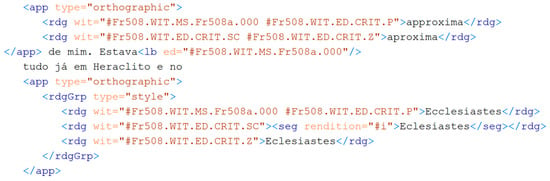
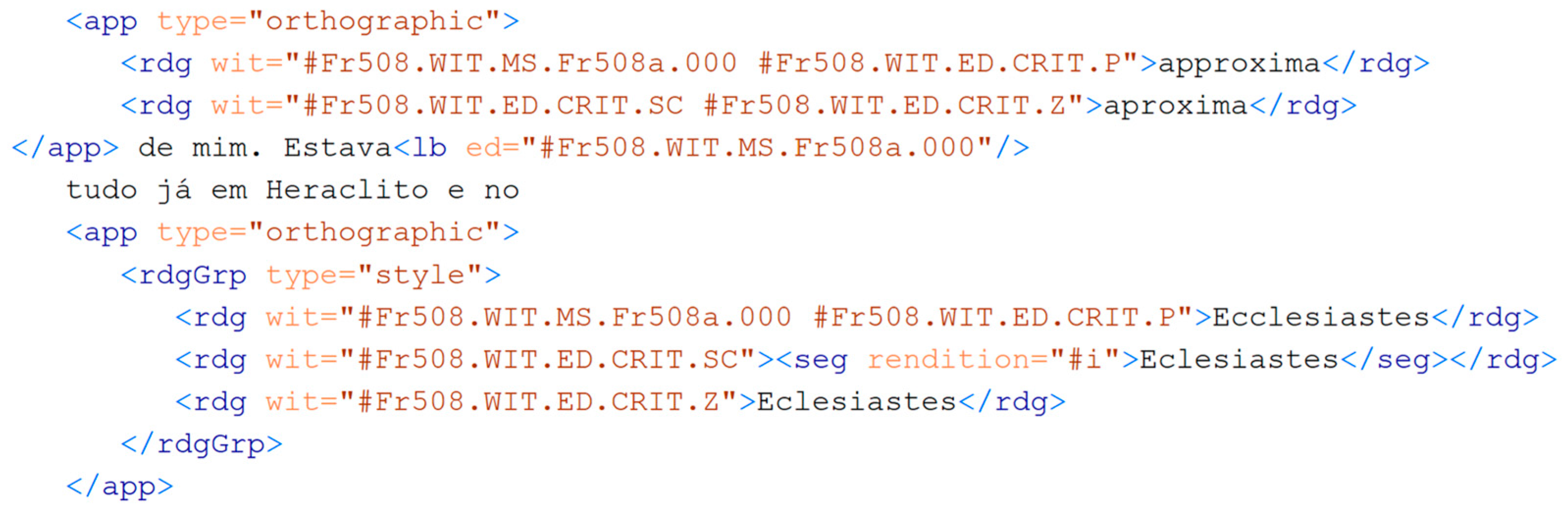
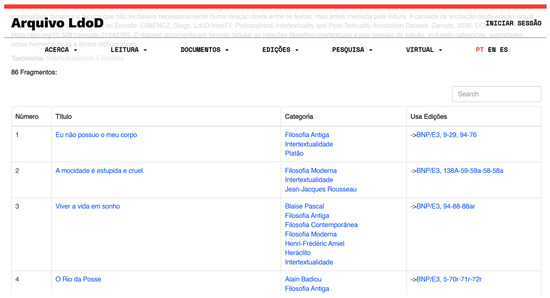
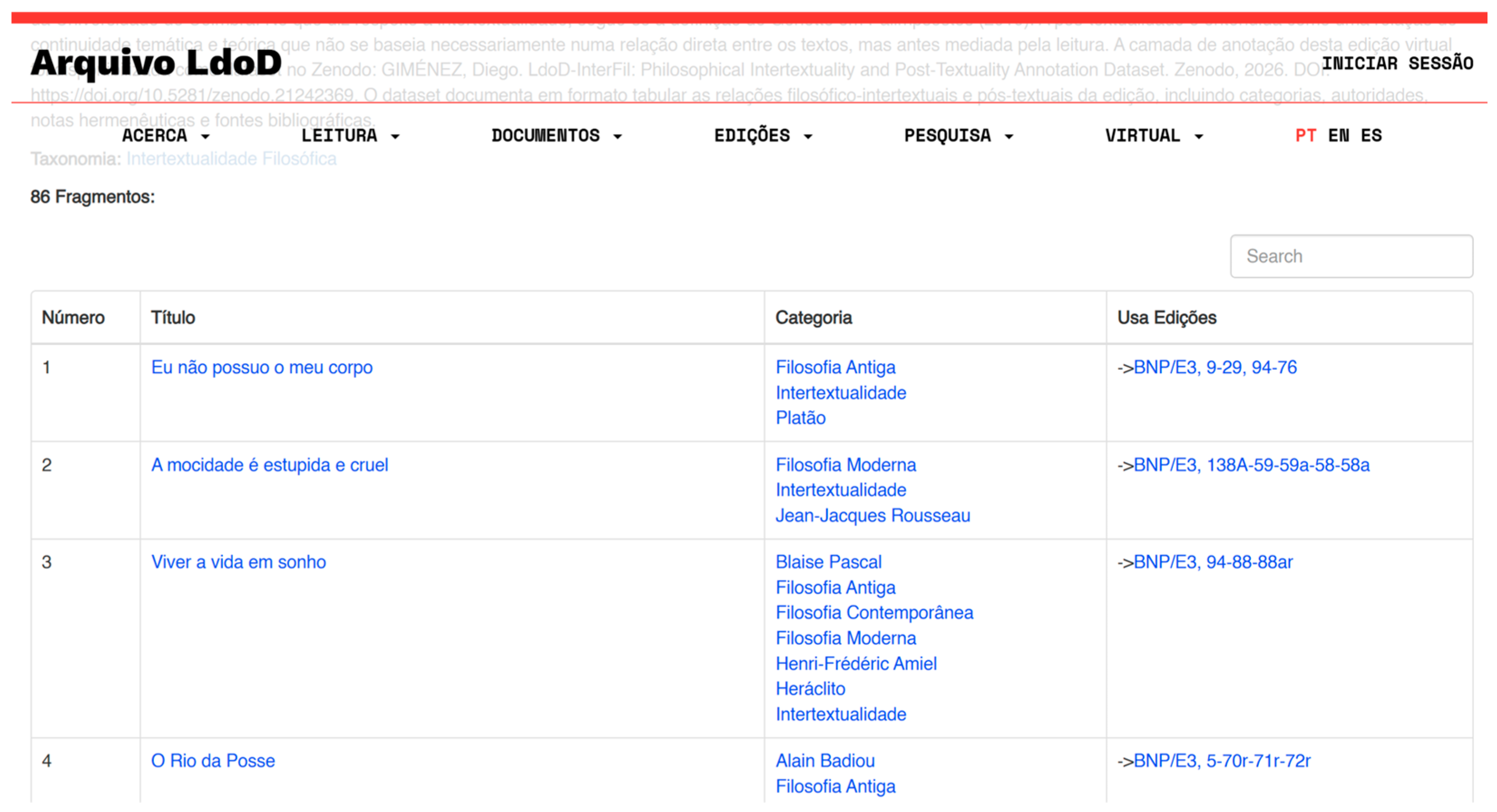
This architecture matters because it separates two layers that are often conflated. The first layer, in Figure 1, is the TEI-encoded textual infrastructure, which models documents, transcriptions, variants, textual units, and editorial comparisons. The second layer, in Figure 2 and Figure 3, is the virtual-edition taxonomy, which associates fragments with interpretive categories such as intertextuality and post-textuality (The two principal relation categories require some theoretical clarification. Intertextualidade is used in the virtual edition in relation to the tradition of intertextual theory associated with Genette’s broader taxonomy of transtextual relations in Palimpsestes [16]. It designates relations in which a fragment can be read in connection with an earlier textual or intellectual source through quotation, allusion, thematic correspondence, or other forms of textual relation. Pós-Textualidade, by contrast, is a project-specific category used to describe retrospective relations of thematic or theoretical continuity with texts and thinkers that postdate Pessoa and therefore cannot constitute sources in a historical or genetic sense. These relations are mediated by subsequent reading and interpretation rather than by claims of direct textual influence. The distinction allows the virtual edition to separate historically plausible intertextual relations from later conceptual resonances without treating the latter as sources available to Pessoa.), as well as with philosopher names and philosophical periods. The second layer depends on the first, but it is not identical with it.
Figure 1.
First layer. Partial TEI-encoded textual infrastructure of fragment Fr 508.
Figure 2.
Second layer. Taxonomies manually annotated in the Portuguese Virtual Edition of the LdoD Archive. The Portuguese interface labels are retained from the source. Número = Number; Título = Title; Categoria = Category; Usa Edições = Uses Editions.
Figure 3.
Second layer. Annotated comments and taxonomies of Portuguese LdoD Archive’s Virtual Edition. The Portuguese interface labels are retained from the source.
2.3. Semantic Annotation, Authority Control, and Literary Analytics
Semantic annotation in the digital humanities often operates between close reading and data modeling. An annotation can identify a person, place, work, concept, rhetorical form, intertextual relation, genre feature, or theoretical category. In each case, the annotation creates a relation between a textual target and a semantic description. This relation can remain informal, as in marginal commentary, or become computationally reusable, as in a database, RDF graph, Web Annotation structure, or tabular dataset [17]. Annotation research has traditionally treated explicit annotation schemes and guidelines, annotator training, and inter-annotator agreement as important components of annotation quality management [18,19]. Agreement measures can help assess the consistency of a coding scheme, but disagreement is not always reducible to annotation error. For interpretive tasks, it may also register textual ambiguity, differences in granularity, disciplinary position, or differences in scholarly perspective. Perspectivist approaches to data annotation therefore argue for preserving and examining disagreement rather than automatically aggregating multiple judgments into a single gold label [20]. The present dataset records one curator’s interpretive layer, produced within a specific virtual edition, and should accordingly be understood as a set of attributable and revisable scholarly claims. Future extensions could preserve alternative readings through separately identified annotation layers, allowing comparison without collapsing disagreement into a single taxonomy.
Authority control adds another dimension. When a tag refers to “Pascal”, “Nietzsche”, or “Amiel”, the label alone may be insufficient for data reuse. External identifiers such as Wikidata QIDs can disambiguate entities and allow the same person to be recognized across languages and datasets [21]. Yet authority control should not be confused with interpretive validation. Linking “Blaise Pascal” to Wikidata identifies the person to whom the annotation refers; it does not prove that a fragment truly alludes to Pascal. The interpretive claim remains local, situated, and contestable. This distinction is essential for avoiding a positivist treatment of literary annotation.
In computational literary studies, structured data and annotations can support corpus exploration and distant-reading practices [22,23]. In LLM-assisted workflows, such annotations may additionally provide a documented reference layer for comparison. However, literary categories are rarely equivalent to labels in conventional supervised classification. They often encode theoretical perspectives, historical assumptions, or scholarly traditions. A category such as “Pós-Textualidade” does not simply denote a surface feature; it defines a relation of thematic and theoretical continuity that may be mediated by reading rather than direct textual contact. For this reason, literary annotation datasets should be treated as reference resources rather than neutral ground truth.
2.4. FAIR Data, Provenance, and Reproducible Literary Analytics
The publication of interpretive datasets also intersects with FAIR-oriented and reproducible research practices [24,25]. The FAIR principles identify findability, accessibility, interoperability, and reusability as guiding properties for scholarly digital objects and extend these concerns beyond data alone to the tools and workflows involved in their production [24]. In the present context, reproducibility refers to the capacity to inspect and reconstruct the corpus selection, category definitions, transformations, identifiers, validation procedures, and attribution of interpretive responsibility. It does not require mechanical reproduction of identical literary interpretation. Persistent identifiers, machine-readable metadata, data dictionaries, versioned files, validation reports, and checksums can support findability, accessibility, interoperability, reuse, and reconstruction of the research process [24,25], while preserving the situated character of scholarly judgment. These practices make the conditions of interpretation available for scrutiny, extension, and criticism.
2.5. LLMs, Documentation, and the Limits of Model-Centered Evaluation
LLMs have renewed interest in computational approaches to interpretation because they can produce natural-language analyses that resemble expert commentary. Nevertheless, their outputs raise well-known challenges: hallucination, instability across prompts, opacity of internal reasoning, lack of source awareness, and sensitivity to context [1,2,3]. Model-centered evaluation methods, such as accuracy against a gold label, are useful in many tasks, but they do not directly map onto interpretive humanities questions. A model may diverge from a human annotation because it is wrong, because the annotation is partial, because both are plausible, or because the question itself admits competing interpretive traditions.
For this reason, documented LLM-assisted literary analytics should be designed around situated comparison rather than automated judgment. The relevant question is not simply whether the model reproduces a label. It is how the model’s output can be examined in relation to documented textual sources and human interpretive claims. In this sense, curated annotation data can support evaluation, but only if the limits of such evaluation are made clear. A reference annotation dataset enables comparison; it does not remove interpretive plurality.
This paper therefore shifts attention from the model to the workflow. The aim is to improve the conditions in which LLM outputs are produced, compared, and evaluated. Those conditions include provenance, documentation, versioning, category definitions, authority links, and restrictions on redistribution. When these elements are absent, an LLM output may float free of the textual and editorial context that would make it critically inspectable. When they are present, the output can be discussed as one response within a documented interpretive environment. Evaluation of generative models in humanities research therefore requires documentation at the level of the individual analytical interaction. Relevant information includes the model provider and identifier, access date, complete prompt and input, available inference parameters, raw output, and any subsequent selection, editing, or authorial interpretation. Such documentation does not make a non-deterministic model fully reproducible, but it allows readers to distinguish observed model behavior from hypothetical use cases and from the researcher’s critical assessment.
3. Case Study, Dataset Construction, and Methodological Framework
3.1. Case Study Selection
The case study combines the LdoD Archive with the Virtual Edition “Philosophical Intertextuality”. This case was selected for three reasons. First, the Livro do Desassossego is a difficult textual object because it is fragmentary, posthumously assembled, and editorially unstable. A governance model that works in this context has to deal with textual multiplicity rather than assume a fixed corpus. Second, the LdoD Archive provides a TEI-based textual infrastructure whose encoding principles are documented. Third, the virtual edition adds a platform-based interpretive layer that is explicitly distinct from TEI encoding.
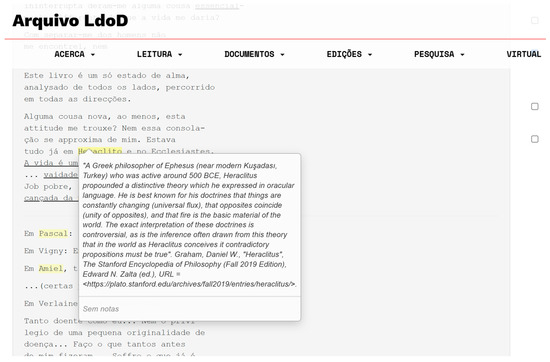
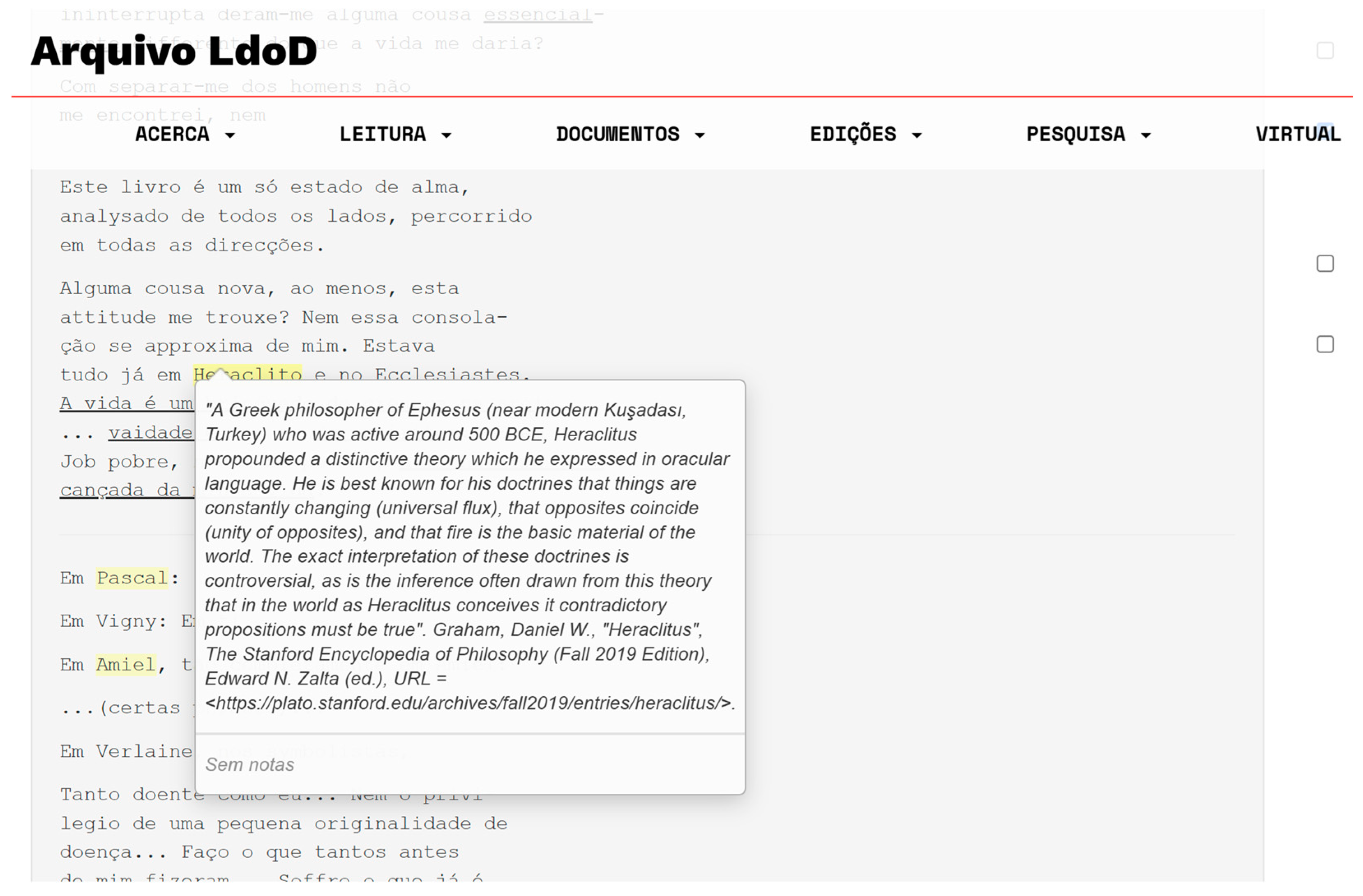
The virtual edition lists 86 fragments. The public edition page displays fragment titles, categories, philosopher names, and document references. For example, the fragment “Viver a vida em sonho” is associated with “Intertextualidade”, “Blaise Pascal”, “Filosofia Antiga”, “Filosofia Contemporânea”, “Filosofia Moderna”, “Henri-Frédéric Amiel”, and “Heráclito”. The corresponding fragment page shows the fragment text, the associated tags, the editor responsible for the tags, the witness information, and the relation to expert and virtual editions [26]. This makes the fragment a useful worked example because the relation between textual source, human annotation, and semantic category is visible.
The case study also requires an explicit acknowledgment of researcher positionality. The author of this paper is also the editor of the “Philosophical Intertextuality” virtual edition and the curator of the dataset derived from it. This continuity provides direct knowledge of the editorial history, annotation criteria, and transformations through which the dataset was produced, but it also means that the reference annotations are not independent of the interpretive framework advanced in the article. They should therefore be treated as documented, attributable scholarly judgments rather than as an externally validated benchmark. In the LLM-assisted comparisons discussed below, agreement with the curated annotations is consequently interpreted as correspondence with this particular scholarly layer, while disagreement may indicate model error, omission, or a divergent interpretive choice requiring further examination. Structural validation of the repository establishes consistency and traceability of the data, rather than independent confirmation of the annotations themselves.
3.2. Source Data and Spreadsheet Structure
The dataset was constructed through a manual curation workflow followed by a structured transformation process, rather than through automated scraping or direct database export. The source annotations were consulted in the LdoD Virtual Edition “Philosophical Intertextuality” and manually transcribed into a Microsoft Excel working spreadsheet. This spreadsheet served as the intermediate curatorial environment in which fragment-level annotations were organized, checked, and normalized. The fragment_id values preserve the fragment identifiers used by the LdoD Archive. Local authority_id values were created for the purposes of the dataset, and Wikidata mappings were established manually, entity by entity, by checking each relevant authority against the corresponding Wikidata record. Separate working tables were then created to organize these authority records and mappings. The extraction corresponds to the state of the LdoD-InterFil virtual edition consulted on 7 July 2026; no frozen source snapshot was generated at the time of manual transcription. The profile of the resulting dataset is summarized in Table 1.
Table 1.
Profile of the final LdoD-InterFil Zenodo dataset.
3.3. Transformation into a Reference Annotation Dataset
The final dataset prepared for repository deposit contains four complementary data files: an annotation edge table, an authority table, a fragment notes table, and a bibliographic sources table. The annotation edge table contains 334 fragment–category/entity relations associated with 86 fragments in the Virtual Edition “Philosophical Intertextuality”. The authority table contains 72 authority records, including 70 categories/entities used in the annotation edge table and two contextual entities, Fernando Pessoa and Bernardo Soares. The fragment notes table contains 86 concise hermeneutic notes, one for each fragment. The sources table contains 28 bibliographic records documenting post-textual and hermeneutic references.
The consolidated Excel working spreadsheet described in Section 3.2 was subsequently reorganized into these four tabular files. ChatGPT was used as an assistance tool during this restructuring process, particularly to help separate the consolidated information into the distributed tables and organize their fields. The scholarly annotations themselves, the selection of authorities, and the Wikidata mappings were established by the author rather than generated by the model. The resulting tables, identifiers, mappings, and relations were reviewed by the author before repository publication.
No separate automated deduplication stage was applied. During preparation of the relational export, the working data were checked to ensure that the same fragment–authority relation was not represented more than once in the final annotation-edge table. The uniqueness criterion for an annotation relation is therefore the combination of fragment_id and authority_id. The published annotation-edge table contains 334 such relations. This constraint is also tested independently by the repository validation script. Because the original working spreadsheet was not preserved as a formally versioned pre-deduplication state, the study does not report a separate before-and-after duplicate count.
Stable local identifiers were assigned to annotation relations, authority records, fragment notes, and bibliographic sources, while the original LdoD fragment identifiers were preserved. The final tables were serialized as comma-delimited UTF-8 CSV files, using standard CSV quoting for fields containing delimiters or textual punctuation. XLSX copies of selected tables were retained as convenience files for manual inspection, while the CSV files constitute the authoritative tabular release.
Provenance is documented at different levels of granularity. Dataset-level provenance records the source virtual edition, curator, extraction date, transformation workflow, repository version, and validation procedure, while fragment-level documentation is provided through hermeneutic notes and source URLs. The present release does not provide explicit edge-level links between each annotation_id and a specific note passage or bibliographic source_id. Reconstruction of the justification for an individual annotation relation may therefore require consultation of the corresponding fragment and commentary in the LdoD Virtual Edition. Because the fragment notes vary in their documentary function, their specificity was also assessed manually at fragment level. A note was classified as relation-specific when it articulated a thematic, conceptual, textual, or work-based rationale for at least one annotated relation or authority; as authority/relation-naming when it identified an annotated authority or relation without developing such a rationale; and as general contextual when it provided broader hermeneutic commentary without identifying a specific annotated relation. Explicit bibliographic or source support was recorded separately when the note identified a work, edition, scholarly source, or editorial commentary supporting the association. This assessment characterizes the documentary specificity of the notes but does not infer edge-level provenance where no explicit mapping is encoded.
The final serialized files were validated directly from disk using the deposited validate_repository.py script. Validation includes checks of file readability and UTF-8 encoding, expected schemas and record counts, controlled vocabularies, identifier and URL formats, uniqueness constraints, referential integrity across tables, consistency of fragment metadata, round-trip CSV readability, agreement between authoritative CSV files and the corresponding XLSX copies, repository DOI and licensing metadata, and SHA-256 checksums. The validation procedure produced machine-readable reports deposited with the dataset. For version 1.1.0, the final validation completed 130 checks with 0 errors and 0 warnings. The structure of the published repository is summarized in Table 2.
Table 2.
Published Zenodo repository structure.
3.4. Relational Export and Semantic Interoperability
The published dataset uses a normalized relational export rather than a native Web Annotation, RDF, PROV-O, nanopublication, or knowledge-graph representation. This choice reflects the immediate purpose, audience, and scale of the case study. The release was designed to provide literary scholars with files that can be inspected directly, opened in widely available software, validated with standard parsers, and reused without requiring a triplestore, SPARQL endpoint, or ontology-engineering environment. The relational tables also correspond closely to the principal objects of the virtual edition: fragments, annotation relations, authority records, interpretive notes, and bibliographic sources.
The relational export is not presented as semantically equivalent to richer models. Web Annotation can represent interoperable relations among annotation bodies, targets, motivations, and agents; RDF can express these relations as graph statements; PROV-O can model entities, activities, agents, and derivation; and nanopublications can associate individual assertions with granular provenance and publication information. These approaches would support more expressive attribution, versioning, interoperability, and representation of competing claims than the present release.
The current export should therefore be understood as an accessible publication and validation layer. Stable fragment identifiers, local authority identifiers, source URLs, Wikidata mappings, curator fields, and versioned repository metadata provide points of alignment from which a future Web Annotation, RDF, or provenance-aware knowledge-graph representation could be developed.
3.5. Category Typing and Authority Linking
The annotation labels in the spreadsheet do not all have the same status. Some labels name interpretive relation types, such as “Intertextualidade”. Some name broad philosophical periods, such as “Filosofia Antiga”, “Filosofia Moderna”, and “Filosofia Contemporânea”. Others name philosophers, writers, theorists, or fictional/heteronymic figures. These differences should be preserved because they correspond to different semantic functions in the workflow. The current annotation-edge table instantiates four category_type values: relation_category, period_category, philosopher, and heteronym. The authority table has a slightly broader type vocabulary because it also contains two contextual authority records: Fernando Pessoa, typed as poet, and Bernardo Soares, typed as semi_heteronym. These contextual records are retained for documentation and future reuse and are not instantiated as annotation categories in the current edge table.
Entity type, as described in Table 3, and record scope are treated as separate dimensions. category_type describes what kind of authority record an item is, whereas record_scope indicates whether that authority is instantiated in the current annotation-edge table (annotation_authority) or retained only as contextual metadata (contextual_authority). The value philosopher is an operational category derived from the scope of the “Philosophical Intertextuality” virtual edition rather than a claim about the definitive disciplinary identity of every person assigned to it. It therefore includes named figures mobilized within the philosophical-intertextual layer, including philosophers as well as adjacent theorists, critics, writers, or intellectual figures.
Table 3.
Semantic status of annotation labels.
Named entities can be linked to external authority records when the identification is unambiguous. Wikidata is a useful candidate because it provides persistent QIDs, multilingual labels, and links to external databases [21]. However, the local interpretive categories should not be forced into Wikidata. They are better treated as concepts belonging to the virtual edition’s own taxonomy. If formal representation is required, these local categories may be described through a lightweight vocabulary or through a table with labels, definitions, notes, and relations. The important distinction is that Wikidata identifies entities, whereas the local taxonomy records interpretive claims.
The authority table also records the relation between a local authority record and an external Wikidata identifier through the match_status field. The field match_status uses three project-level controlled values: exact_match, broad_match, and local_only. exact_match is assigned when the local authority and the Wikidata item denote the same named entity; this applies primarily to identifiable persons. broad_match is used when a Wikidata item provides a useful external point of reference but is conceptually broader than the local interpretive category or period label. For example, the local category Intertextualidade is aligned with Wikidata Q667404 as a broad match rather than treated as an equivalent concept. local_only is used when no sufficiently appropriate external authority was identified and the category is therefore retained within the local taxonomy without an external mapping. These mappings were checked manually by the author, entity by entity, during construction of the authority table. They should be understood as curatorial alignment decisions rather than automatically generated correspondences.
3.6. Metadata and Repository Strategy
The dataset has been deposited in Zenodo with a persistent DOI [27]. The repository contains the annotation edge table, authority table, fragment notes table, bibliographic sources table, README documentation, data dictionary, license information, citation metadata, validation summary, and user-friendly spreadsheet copies of selected files. The deposit avoids reproducing full textual transcriptions from the expert editions of the Livro do Desassossego. The LdoD copyright page states that items in the archive may be shared under CC BY-NC 4.0, while the four expert editions are excluded from that license and may only be used within the LdoD infrastructure unless written permission is granted [12] (To align the reuse conditions of the derived dataset with those of the source archive, the corrected Zenodo release (version 1.1.0) is distributed under the Creative Commons Attribution-NonCommercial 4.0 International (CC BY-NC 4.0) license. This license applies to rights held by the curator in the derived dataset and does not override the copyright or licensing conditions governing the LdoD Archive, the underlying textual witnesses, or the expert editions). For this reason, the public dataset includes fragment identifiers, titles or incipits, cotas, category labels, authority identifiers, source URLs, concise hermeneutic notes, bibliographic references, and provenance metadata, rather than full textual transcriptions from expert editions.
The repository also includes materials for structural validation of the published release. The final serialized distribution files were reopened and validated directly from disk using the deposited validate_repository.py script rather than relying on the intermediate working tables. The validation procedure checks file readability and encoding, expected schemas and record counts, controlled vocabularies, identifier and URL formats, uniqueness constraints, referential integrity across tables, consistency of fragment metadata, and agreement between the authoritative CSV files and corresponding XLSX convenience copies. File integrity is additionally documented through SHA-256 checksums. The validation results are preserved both in a tabular validation summary and in a machine-readable JSON report. For version 1.1.0 used in this article, the final validation completed 130 checks with 0 errors and 0 warnings.
These procedures establish the structural consistency, readability, and referential integrity of the published files. They do not validate the interpretive correctness of individual annotations, which remain attributable scholarly claims subject to critical examination.
3.7. Potential LLM-Assisted Uses
This section outlines potential uses of the curated annotation dataset in LLM-assisted literary analysis rather than reporting a reproducible model-evaluation experiment. The proposed uses are intended as methodological scenarios that illustrate how a documented human-authored interpretive layer may support comparison, exploratory analysis of omissions, unsupported associations, interpretive divergences, and prompt design. A full evaluation study would require a predefined sampling strategy, task specification, model and version, complete prompt set, inference parameters, repetition scheme, coding rubric, evaluator procedure, and output-recording format. For a future comparative evaluation, the unit of comparison would be the fragment–authority relation represented by an annotation edge. Model outputs would first be preserved in their original form and then normalized, through documented human review, into candidate relations between a fragment_id and an authority in the same controlled vocabulary used by the human-curated dataset. A convergence would be recorded when a model-generated relation and a curated annotation resolve to the same fragment_id and authority_id. An omission would refer to a curated edge for which no corresponding model-generated relation can be established, while an additional relation would designate a model-generated association with no corresponding curated edge. These categories describe correspondence with the curated interpretive layer rather than objective correctness. Matching would operate at the authority level rather than by literal string identity. Multilingual labels, spelling variants, and aliases would be normalized to the same authority_id when the identification is unambiguous. Paraphrases of local interpretive categories could likewise be aligned only when their equivalence to an existing category can be established without changing its semantic scope. Broader or narrower concepts would not be collapsed into exact convergence: they would be recorded separately as hierarchical or partial divergences. Outputs that cannot be mapped unambiguously to an existing authority would remain unresolved or be recorded as candidate novel relations. The raw model output and the normalization decision should be retained so that the mapping itself remains inspectable.
Three related uses are considered, as shown in Table 4. First, the dataset can provide a reference layer for qualitative comparison between human-curated annotations and LLM-generated relations. Second, it can support exploratory analysis of omissions, unsupported associations, and divergent interpretive choices. Third, selected documented annotations may be used as examples in prompts designed to guide model responses toward the categories and distinctions employed in the virtual edition. These scenarios do not treat agreement with the curated annotations as a measure of objective correctness. The dataset represents one attributable scholarly interpretation, so correspondence with it indicates alignment with that interpretive layer, while disagreement requires critical examination rather than automatic classification as model failure.
Table 4.
Limited uses of the reference annotation dataset in LLM-assisted workflows.
4. Proposed Workflow and Documented Demonstration
This section demonstrates how the components described above operate together in the LdoD-InterFil case study. The purpose is not to report the results of a controlled LLM evaluation, but to show how the TEI-based textual infrastructure, the curated semantic layer, the relational dataset, and its documentation can be combined in a workflow for inspectable LLM-assisted literary analysis. The demonstration first describes the structure and distribution of the curated annotation layer and then considers how this documented layer can support comparison with model-generated interpretations.
4.1. From TEI-Encoded Sources to Platform-Based Annotation
The case study illustrates a layered architecture in which textual encoding and semantic annotation remain distinct. The LdoD Archive’s TEI infrastructure models the textual object, including witnesses, editorial transcriptions, variants, additions, deletions, and textual units. The Virtual Edition “Philosophical Intertextuality” operates on this infrastructure but adds a separate layer of categories and tags. This separation is methodologically productive because it prevents TEI from being overburdened with interpretive claims that belong to another level of scholarly modeling.
The workflow described in Table 5 can be described as follows. At the base layer, the archive provides TEI-encoded textual sources. At the virtual-edition layer, fragments are selected and associated with philosophical-intertextual tags. At the tabular layer, those associations are represented as fragment–category relations in the derived dataset. At the authority layer, named entities can be linked to external identifiers. At the metadata layer, the dataset is documented for reuse. At the LLM layer, model outputs would be compared with the documented annotation table.
Table 5.
Layered architecture of the proposed workflow.
4.2. Descriptive Profile of the Curated Annotation Layer
The derived dataset shows that individual fragments may carry multiple annotations within the curated interpretive layer. The 86 fragments are associated with 334 unique annotation edges involving 70 distinct labels, corresponding to an average of approximately 3.88 annotation relations per fragment. This ratio is descriptive and is not intended as a measure of network density; the present study does not undertake a formal network analysis of the bipartite fragment–authority structure. Among the 334 annotation edges, the most frequent labels are Filosofia Contemporânea (56; 16.8%), Pós-Textualidade (54; 16.2%), Intertextualidade (40; 12.0%), and Filosofia Moderna (29; 8.7%). Filosofia Antiga and Friedrich Nietzsche each occur in 14 edges (4.2%). These frequencies refer to annotation edges within the curated “Philosophical Intertextuality” virtual edition. They measure the distribution of labels assigned within this particular interpretive layer and should not be read as quantitative measures of the philosophical prevalence or importance of these concepts and figures in the Livro do Desassossego as a whole.
The presence of multiple annotations per fragment is relevant to potential LLM-assisted comparison because a model may generate broader, narrower, or differently formulated associations for the same passage. The reference dataset makes it possible to situate such outputs in relation to an existing human-curated interpretive layer. For example, if a model proposes “existentialism” for a fragment annotated with Nietzsche and Pós-Textualidade, the comparison could examine whether the model is producing a broader conceptual association, omitting a more specific named authority, or introducing a category absent from the virtual edition. Such distinctions would depend on the matching policy described above and would indicate correspondence with, or divergence from, this particular curated layer rather than objective interpretive correctness.
4.3. Worked Example: “Viver a Vida em Sonho”
The following example is illustrative rather than the result of a controlled LLM evaluation. It uses a fragment included in the “Philosophical Intertextuality” virtual edition to show how a documented annotation layer could structure comparison with a model-generated interpretation. The fragment is identified by its LdoD Archive identifier and source URL, which provide access to the full textual and editorial context. Because the present article does not reproduce the complete transcription, only a short excerpt is quoted here.
The fragment titled “Viver a vida em sonho” (Fr508), document reference (cota) BNP/E3, 94-88-88ar, is available in the LdoD-InterFil Virtual Edition at https://ldod.uc.pt/fragments/fragment/Fr508/inter/Fr508_WIT_ED_VIRT_LdoD-InterFil_1, (accessed on 31 July 2026). A short passage relevant to the present example reads: “Alguma coisa nova, ao menos, esta atitude me trouxe? Nem essa consolação se aproxima de mim. Estaria tudo já em Heraclito e no Eclesiastes: A vida é um brinquedo de criança na areia… vaidade e (…) de espanto… E eu Job pobre, numa só frase, A minha alma está cansada da minha vida./Em Pascal:/Em Vigny: Em ti (…)/Em Amiel, tão completamente em Amiel” [26]. In the virtual edition, the fragment is associated with tags including “Intertextualidade”, “Blaise Pascal”, “Filosofia Antiga”, “Filosofia Contemporânea”, “Filosofia Moderna”, “Henri-Frédéric Amiel”, and “Heráclito”. The fragment page makes these associations visible alongside the textual witness and the corresponding editorial and virtual-edition contexts. The accompanying note explicitly identifies intertextual relations with Blaise Pascal, Henri-Frédéric Amiel, and Heraclitus, thereby providing fragment-level hermeneutic context.
These annotations represent the human-curated interpretive layer of the virtual edition. A hypothetical model output can then be compared with this layer using the matching policy described above. Because no controlled model run is reported here, any additional name or category introduced in the example should be understood as illustrating a possible comparison outcome rather than as an observed model response.
A potential LLM-assisted workflow might ask a model to read the fragment and identify philosophical relations or named thinkers. The output might mention Pascal, Heraclitus, Amiel, or other names, depending on the prompt and model. In the documented workflow proposed here, the fragment identifier, cota, existing tags, source URL, and available fragment-level interpretive documentation are recorded before comparison. The model output would then be normalized and compared with the curated fragment–authority relations according to the matching policy described above. If Pascal and Heraclitus resolved to the same authorities present in the curated layer, these relations would be recorded as convergences. If Amiel were absent from the normalized model output, this would constitute an omission relative to the curated layer. A newly proposed philosopher would be recorded as an additional relation and could subsequently be examined as a possible new hypothesis, unsupported association, or broader interpretive divergence.
The reference dataset does not determine the truth of an interpretation. It provides a documented and attributable basis against which model-generated relations can be inspected. The LLM output thus becomes one layer within a sequence of textual and interpretive operations rather than an isolated act of automated reading.
4.4. Prompt Design Under a Documented Workflow
The following prompts are prospective templates. No controlled LLM execution is reported in this section. The same fragment can be used to define three possible prompting strategies. A minimal prompt would give the model only the fragment and ask for philosophical references. A contextual prompt would provide the fragment, its cota, and the list of human-curated categories. A critical comparison prompt would ask the model to explain where its reading agrees with or diverges from the existing annotations. The third approach is the most closely aligned with the article’s argument because it treats the model as an assistant for comparison rather than as an autonomous classifier.
An illustrative critical-comparison prompt template for a future documented analysis is:
Illustrative Prompt Template: You are analyzing a fragment from Fernando Pessoa’s Livro do Desassossego. The fragment belongs to the LdoD Virtual Edition “Philosophical Intertextuality”.
Fragment identifier: [fragment_id]
Document reference: [cota]
Existing human annotations: [categories and named authorities]
Source URL: [source_url]
Fragment text: [complete textual input supplied to the model]
Read the fragment and compare your interpretation with the existing human annotations. Identify where your interpretation converges with these annotations, where it diverges, and which claims require textual evidence. If you propose an additional philosophical relation or named authority, distinguish it clearly from the existing annotations and explain the textual basis for the proposal. Do not treat the existing annotations as ground truth; treat them as documented scholarly claims.
Such a prompt would not eliminate hallucination or interpretive disagreement. Its purpose is to make the textual input and the reference annotation layer explicit and to structure the resulting response around categories that can subsequently be examined by a human reader, including convergence, divergence, additional relations, textual evidence, and uncertainty. In an empirical implementation, each placeholder would be replaced by the exact information supplied to the model. The complete prompt and textual input, together with the model provider and identifier, access date, available inference parameters, number of runs, raw outputs, and any subsequent human editing or normalization, would need to be preserved for analysis.
4.5. What Structured Infrastructures Improve
The case study supports a narrower claim about documentation and inspectability. Structured textual infrastructures can improve the conditions of LLM use in three ways. They improve provenance because the model’s input can be tied to fragment identifiers, document references, source URLs, and edition layers. They can improve the conditions for evaluation because outputs can be compared with a documented annotation table rather than judged only by plausibility. They can support critical interpretation because divergences between model and human annotation can be analyzed as interpretive events. This claim is intentionally limited. The workflow strengthens the conditions under which computational outputs can be related to textual sources and human scholarship. In literary analytics, this shift from model authority to documented comparison is a methodological gain if the modeling and construction of knowledge are taken into consideration.
The following table presents two author-constructed scenarios illustrating how different forms of correspondence and divergence could be represented under the proposed workflow. It does not report empirical model outputs. The scenarios distinguish convergence at the level of named authorities, correspondence with broader interpretive categories, omission relative to the curated layer, and additional model-generated relations requiring subsequent scholarly assessment.
The example in Table 6 illustrates how additional contextual information and explicit annotation criteria could make an LLM-assisted comparison more inspectable, particularly when model-generated relations need to be evaluated against a pre-existing scholarly layer. The illustrative scenario shows how a documented annotation dataset could structure critical comparison between human annotations and hypothetical LLM-generated commentary. Such a comparison should not treat the annotation dataset as a ground-truth label set. A model-generated interpretation might reproduce some human annotations, omit others, or introduce relations at different levels of specificity. These differences could involve explicitly named or textually grounded sources, allusive relations, broad period-level categories, or post-textual interpretive framings. Distinguishing among these possibilities is central to the proposed workflow. The annotation edge table makes the curated relations available for structured comparison, while the authority table supports the identification and disambiguation of entities. Fragment-level notes and source URLs provide additional hermeneutic and documentary context that can assist the researcher in evaluating individual relations, although the present dataset does not encode an explicit note or source justification for every annotation edge.
Table 6.
Illustrative comparison scenarios under the proposed workflow (The examples in this table are author-constructed illustrations of how the proposed comparison framework could be applied. They do not reproduce or summarize a documented model run.).
5. Discussion
5.1. Layered Infrastructure and Project-Level Governance
The LdoD case illustrates the value of separating textual representation from subsequent interpretive layers. TEI provides the structured textual and editorial infrastructure on which the “Philosophical Intertextuality” virtual edition operates, while philosophical relations are produced through a distinct taxonomy and annotation apparatus. This modular arrangement allows textual, editorial, taxonomic, tabular, and computational representations to interact without requiring any one layer to function as a complete semantic representation of the work. Within this architecture, semantic data governance operates at the level of scholarly decision-making: the definition of categories, assignment of authority mappings, documentation of provenance and transformations, validation of published data, and evaluation of machine-generated relations. Its contribution is therefore not to stabilize interpretation permanently, but to make the criteria and responsibilities underlying a particular interpretive layer explicit and inspectable. The resulting dataset exposes rather than eliminates the conditions under which its semantic claims were produced.
5.2. Contestability, Curatorial Plurality, and Taxonomy Revision
A documented annotation layer becomes particularly useful when interpretation is contested rather than consensual. Conflicting annotations need not always be resolved by selecting a single preferred label. In literary scholarship, disagreement may arise from textual ambiguity, different theoretical assumptions, or distinct scholarly traditions. Where multiple curators are involved, separately attributed annotation layers could preserve these differences while allowing areas of convergence and divergence to be examined without collapsing them into a single consensus taxonomy.
Taxonomies themselves are also subject to revision. A category may be renamed, divided, merged, narrowed, or abandoned as the editorial project develops. Such changes should therefore be represented through versioned releases and documented mappings between earlier and later terms rather than silently propagated through the dataset. A category can be stable within a particular release while remaining open to subsequent revision. Versioning in this sense provides a record of interpretive change rather than an assertion of permanent semantic stability.
Curatorial plurality also complicates the notion of a reference annotation layer. The present dataset represents one interpretive project developed by a single curator and consequently reflects the categories, interests, and intellectual history of the “Philosophical Intertextuality” virtual edition. Some annotation patterns may therefore reflect the priorities of a particular interpretive tradition rather than properties intrinsic to the Livro do Desassossego. Additional separately attributed annotation layers could make such systematic differences visible and permit comparison among scholarly perspectives.
Model-generated relations introduce a further source of disagreement. If a model proposes a philosopher, concept, or textual parallel absent from the curated layer but supports the proposal with relevant textual evidence, the difference should not automatically be classified as error. It may constitute an additional interpretive hypothesis requiring scholarly assessment. Conversely, agreement with the curated layer establishes correspondence with that layer rather than interpretive correctness. The relevant analytical object is therefore the relation among textual evidence, attributed human annotation, model-generated claims, and subsequent scholarly judgment.
5.3. Reference Annotation Without Ground Truth
The relational dataset combines structured annotation edges with fragment-level hermeneutic notes and links to the corresponding virtual-edition pages. These components serve different purposes. The edge table makes curated relations available for structured comparison, whereas the notes and source URLs preserve additional interpretive and documentary context. The present release does not encode a separate justification for every individual annotation edge, so reconstruction of a particular relation may require consultation of the corresponding fragment and commentary in the virtual edition. A manual assessment of the 86 fragment-level notes further confirms that their documentary specificity is heterogeneous. Of these, 18 notes explicitly articulate a thematic, conceptual, textual, or work-based rationale for at least one annotated relation or authority, while 68 identify an annotated authority or relation without providing a developed interpretive rationale in the note itself. No note was classified as exclusively general contextual commentary without identification of a specific relation or authority. Explicit bibliographic or source support was identified in 44 notes. Because source support was recorded independently from note specificity, source-supported notes may occur in either of the first two categories. These categories describe the documentary function of the notes at fragment level; they do not imply that every annotation edge associated with a fragment is individually justified by that note.
The term reference annotation dataset should therefore be understood operationally rather than as a synonym for truth. A future model comparison could measure correspondence with the curated layer, including convergence, omission, additional relations, and unresolved mappings, but such categories would describe relations to one documented scholarly interpretation. Quantitative measures such as precision and recall could be calculated in a later experiment, although their meaning would remain limited to reproduction of that annotation layer rather than successful resolution of philosophical intertextuality as an interpretive problem.
5.4. Authority Linking Without Interpretive Positivism
Linking named figures to Wikidata can improve identification, disambiguation, and interoperability, but external authority control does not validate the interpretive relation between an entity and a fragment. The Wikidata identifier identifies an entity or provides an external alignment point; the scholarly annotation asserts the relation. This distinction is particularly important in LLM-assisted workflows because fluent generation of a recognizable entity name does not establish its relevance to the passage under examination. The project-level distinctions among exact_match, broad_match, and local_only therefore document different forms of external alignment while preserving the semantic autonomy of the local taxonomy.
5.5. Relation to Alternative Semantic Frameworks
The relational publication model adopted here, as summarized in Table 7, prioritizes inspectability and relatively low technical barriers for literary scholars, but it offers less formal semantic expressivity than alternative approaches. The W3C Web Annotation model provides an interoperable representation of annotation bodies, targets, motivations, and agents [17]. TEI-to-RDF workflows can transform information represented in document-centric TEI structures into graph-based statements with formally expressed relations, although this transformation requires additional semantic and technical modeling decisions [28]. Cultural-heritage models such as CIDOC CRM provide a formal ontology for the integration of heterogeneous cultural information and allow entities and their contextual relations to be represented more explicitly [29]. The present tables should therefore be understood as an accessible publication and validation layer rather than as a replacement for these frameworks. Repository versioning provides a straightforward mechanism for documenting successive releases of the tabular dataset, although it is less granular than models capable of representing changes to individual assertions. Stable identifiers, authority mappings, source links, and versioned metadata nevertheless provide points from which more expressive semantic representations could be developed if future research questions required them.
Table 7.
Scope-dependent trade-offs of alternative representations for the present case study.
This comparison is limited to the requirements of the present case study and is not intended as a general evaluation of these frameworks. The choice of CSV is pragmatic and scope-dependent: it favors direct scholarly inspection and reuse while accepting reduced expressivity in provenance and semantic representation.
5.6. Limitations
Several limitations must be acknowledged. The dataset is small and derived from a single virtual edition. It reflects one interpretive project and should not be generalized to philosophical intertextuality in Pessoa as a whole. A further limitation concerns the overlap between authorship, editorial responsibility, and dataset curation. Because the same researcher constructed the interpretive layer and analyzes its use as a reference resource, the case study cannot provide independent validation of the annotation framework. The reference layer may also reproduce systematic preferences associated with the interpretive framework in which it was constructed. Because the current release does not contain independently attributed annotations from multiple scholars, it cannot distinguish relations broadly shared across curatorial perspectives from those specific to this particular scholarly tradition. Future work could introduce separately attributed annotations by additional scholars and examine agreement, disagreement, and alternative categorizations across curatorial perspectives.
The dataset documents the annotation layer of one specific virtual edition, “Intertextualidade Filosófica,” rather than an exhaustive map of philosophical references in the Livro do Desassossego. It formalizes selected elements of the virtual edition in tabular form but does not reproduce the full complexity of the platform interface. It includes annotation edges, authority records, concise hermeneutic notes, bibliographic sources, dataset-level provenance metadata, and documentation, but it does not include full fragment transcriptions, full editorial comments, timestamps of platform activity, or the complete internal history of the virtual edition. A related limitation concerns provenance granularity. Although the repository documents the provenance of the dataset and provides fragment-level interpretive notes and bibliographic records, it does not encode an explicit justification or source mapping for each individual annotation edge. Reconstructing the rationale for a particular relation may therefore require consultation of the corresponding fragment and commentary through the LdoD fragment URLs. A future release could introduce edge-to-note and edge-to-source relations, together with separately attributed revision histories, where such evidence can be reconstructed reliably.
The article does not provide a large-scale quantitative evaluation of LLM performance or a controlled model experiment. It proposes a workflow and demonstrates its logic through a case study. The dataset may support qualitative comparison, exploratory analysis of model-generated relations, and documented prompt design, but it should not be treated as a large benchmark or as neutral ground truth for philosophical intertextuality. Copyright and licensing constraints also limit redistribution of the underlying textual material. The Zenodo dataset therefore does not reproduce full textual transcriptions from the expert editions of the Livro do Desassossego. Instead, it provides fragment identifiers, titles or incipits, annotation labels, authority identifiers, source URLs, concise interpretive notes, bibliographic references, and documentation that allows the published data to be related back to their source context.
6. Conclusions
TEI-based archives and human-curated taxonomies can play a role in LLM-assisted literary analytics, but their contribution should be defined precisely. They can improve the documentary and evaluative environment in which LLMs are used, without eliminating interpretive disagreement. In the case of the LdoD Archive and the Virtual Edition “Philosophical Intertextuality”, TEI provides the textual infrastructure, the virtual edition provides a platform-based interpretive layer, and the derived dataset makes selected elements of that layer portable and inspectable.
The paper has developed and documented a layered workflow for transforming a human-curated annotation layer from the LdoD Virtual Edition into a reusable tabular dataset. The case study demonstrates the extraction, structuring, authority alignment, documentation, repository publication, and validation of this interpretive layer. It also shows how such a dataset could provide a documented reference structure for future comparison with LLM-generated interpretations. The present study does not, however, report a reproducible comparative evaluation of model outputs. The principal contribution therefore lies in the conditions established before model comparison takes place: explicit scholarly categories, stable identifiers, documented transformations, authority mappings, fragment-level contextual information, repository versioning, and structural validation. Together, these elements make the provenance and limits of the curated interpretive layer more inspectable and provide a basis on which future LLM-assisted analyses could be designed and critically evaluated. At the same time, the dataset represents one attributable scholarly interpretation of philosophical intertextuality in the Livro do Desassossego. Agreement with this layer would indicate correspondence with that interpretation, while disagreement could reflect model error, omission, a different level of conceptual specificity, or an alternative interpretive hypothesis. Future work involving multiple curators and separately attributed annotation layers could make such differences more explicit.
The broader implication of this case study is that LLM-assisted literary analysis benefits from attention to the infrastructures within which model outputs are produced and evaluated. Model choice is only one component of that environment; textual sources, annotation criteria, provenance documentation, conditions of reuse, and procedures for examining disagreement are equally consequential. In this sense, semantic data governance provides a framework for making interpretive infrastructures, transformations, and responsibilities more explicit and accountable to their sources and readers. A subsequent empirical study could implement the proposed comparison framework using preserved textual inputs, complete prompts, model and execution metadata, repeated runs, raw outputs, normalization decisions, and documented matching procedures.
Funding
This research was funded by the University of Macau, grant number SRG2026-00007-FAH.
Data Availability Statement
The dataset supporting this study is available on Zenodo. The versioned dataset record is maintained under the concept DOI 10.5281/zenodo.21242368. The corrected and validated release used for the present article is version 1.1.0, available under the immutable DOI 10.5281/zenodo.21700502. This release supersedes version 1.0.0 (DOI 10.5281/zenodo.21242369), in which ldod_interfil_fragment_notes.csv contained a malformed serialization. Version 1.1.0 includes the corrected tabular files, data dictionary, README, licensing and citation metadata, the repository validation script (validate_repository.py), machine-readable validation outputs, and SHA-256 checksums. Future corrections or extensions may be deposited as new Zenodo versions under the same concept record; the immutable version DOI cited above identifies the exact release used in this article. The revised article does not report a controlled LLM experiment or empirical model outputs; therefore, no raw LLM outputs or execution logs are presented as research data. The prompt discussed in the article is an illustrative template rather than a recorded experimental prompt.
Acknowledgments
During the preparation of this manuscript, the author used ChatGPT-5.6, OpenAI, for grammar checking, editorial revision, and assistance in restructuring the consolidated working table into the distributed tabular files described in Section 3.3. The scholarly annotations, authority selection, and Wikidata mappings were established and reviewed by the author. Claude was used during an exploratory stage of manuscript development; no Claude output is reported or analyzed as empirical evidence in the revised article. The author reviewed and edited all outputs and takes full responsibility for the content of this publication.
Conflicts of Interest
The author is the editor of the Virtual Edition “Philosophical Intertextuality”, which is used as the case study in this article. This authorial involvement is treated as part of the methodological context and is disclosed here for transparency. The author declares no conflict of interest.
Abbreviations
The following abbreviations are used in this manuscript:
| AI | Artificial intelligence |
| CSVW | CSV on the Web |
| DH | Digital humanities |
| LdoD | Livro do Desassossego |
| LLM | Large language model |
| RDF | Resource Description Framework |
| TEI | Text Encoding Initiative |
| XML | Extensible Markup Language |
References
- Bender, E.M.; Gebru, T.; McMillan-Major, A.; Shmitchell, S. On the Dangers of Stochastic Parrots: Can Language Models Be Too Big? In Proceedings of the 2021 ACM Conference on Fairness, Accountability, and Transparency (FAccT ′21), Virtual, 3–10 March 2021; pp. 610–623. [Google Scholar] [CrossRef] [Scilit]
- Bommasani, R.; Hudson, D.A.; Adeli, E.; Altman, R.; Arora, S.; von Arx, S.; Bernstein, M.; Bohg, J.; Bosselut, A.; Brunskill, E.; et al. On the Opportunities and Risks of Foundation Models. arXiv 2021, arXiv:2108.07258. [Google Scholar]
- Weidinger, L.; Mellor, J.; Rauh, M.; Griffin, C.; Uesato, J.; Huang, P.S.; Cheng, M.; Glaese, M.; Balle, B.; Kasirzadeh, A.; et al. Ethical and Social Risks of Harm from Language Models. arXiv 2021, arXiv:2112.04359. [Google Scholar]
- TEI Consortium. TEI P5: Guidelines for Electronic Text Encoding and Interchange. Available online: https://tei-c.org/guidelines/p5/ (accessed on 11 July 2026).
- Burnard, L. What Is the Text Encoding Initiative? OpenEdition Press: Marseille, France, 2014. [Google Scholar] [CrossRef] [Scilit]
- Pierazzo, E. Digital Scholarly Editing: Theories, Models and Methods; Ashgate: Farnham, UK, 2015. [Google Scholar]
- McGann, J. Radiant Textuality: Literature After the World Wide Web; Palgrave: New York, NY, USA, 2001. [Google Scholar]
- Sahle, P. Digitale Editionsformen: Zum Umgang Mit der Überlieferung Unter den Bedingungen des Medienwandels; Books on Demand: Norderstedt, Germany, 2013. [Google Scholar]
- Khatri, V.; Brown, C.V. Designing Data Governance. Commun. ACM 2010, 53, 148–152. [Google Scholar] [CrossRef] [Scilit]
- Weber, K.; Otto, B.; Österle, H. One size does not fit all—A contingency approach to data governance. J. Data Inf. Qual. (JDIQ) 2009, 1, 4. [Google Scholar] [CrossRef] [Scilit]
- Abraham, R.; Schneider, J.; vom Brocke, J. Data governance: A conceptual framework, structured review, and research agenda. Int. J. Inf. Manag. 2019, 49, 424–438. [Google Scholar] [CrossRef] [Scilit]
- Portela, M.; Silva, A.R. Arquivo LdoD: Arquivo Digital Colaborativo do Livro do Desassossego; Centro de Literatura Portuguesa da Universidade de Coimbra: Coimbra, Portugal, 2017. [Google Scholar]
- Giménez, D. Edição Virtual: Intertextualidade Filosófica. Arquivo LdoD: Arquivo Digital Colaborativo do Livro do Desassossego. 2025. Available online: https://ldod.uc.pt/edition/acronym/LdoD-InterFil (accessed on 11 July 2026).
- Portela, M.; Silva, A.R. A Model for a Virtual LdoD. Digit. Scholarsh. Humanit. 2015, 30, 354–370. [Google Scholar] [CrossRef] [Scilit]
- Silva, A.R.; Portela, M. TEI4LdoD: Textual Encoding and Social Editing in Web 2.0 Environments. J. Text Encoding Initiat. 2014, 8. [Google Scholar] [CrossRef] [Scilit]
- Genette, G. Palimpsestes: La littérature au Second Degré; Éditions du Seuil: Paris, France, 1982. [Google Scholar]
- W3C. Web Annotation Data Model. W3C Recommendation. 23 February 2017. Available online: https://www.w3.org/TR/annotation-model/ (accessed on 11 July 2026).
- Klie, J.-C.; Eckart de Castilho, R.; Gurevych, I. Analyzing Dataset Annotation Quality Management in the Wild. Comput. Linguist. 2024, 50, 817–866. [Google Scholar] [CrossRef] [Scilit]
- Artstein, R.; Poesio, M. Survey Article: Inter-Coder Agreement for Computational Linguistics. Comput. Linguist. 2008, 34, 555–596. [Google Scholar] [CrossRef] [Scilit]
- Cabitza, F.; Campagner, A.; Basile, V. Toward a Perspectivist Turn in Ground Truthing for Predictive Computing. Proc. AAAI Conf. Artif. Intell. 2023, 37, 6860–6868. [Google Scholar] [CrossRef] [Scilit]
- Vrandečić, D.; Krötzsch, M. Wikidata: A Free Collaborative Knowledgebase. Commun. ACM 2014, 57, 78–85. [Google Scholar] [CrossRef] [Scilit]
- Moretti, F. Distant Reading; Verso: London, UK, 2013. [Google Scholar]
- Jockers, M.L. Macroanalysis: Digital Methods and Literary History; University of Illinois Press: Urbana, IL, USA, 2013. [Google Scholar]
- Wilkinson, M.D.; Dumontier, M.; Aalbersberg, I.J.; Appleton, G.; Axton, M.; Baak, A.; Blomberg, N.; Boiten, J.W.; da Silva Santos, L.B.; Bourne, P.E.; et al. The FAIR Guiding Principles for Scientific Data Management and Stewardship. Sci. Data 2016, 3, 160018. [Google Scholar] [CrossRef] [Scilit] [PubMed]
- Sandve, G.K.; Nekrutenko, A.; Taylor, J.; Hovig, E. Ten Simple Rules for Reproducible Computational Research. PLoS Comput. Biol. 2013, 9, e1003285. [Google Scholar] [CrossRef] [Scilit] [PubMed]
- Viver a Vida em Sonho. Virtual Edition “Intertextualidade Filosófica” LdoD Archive. Available online: https://ldod.uc.pt/fragments/fragment/Fr508/inter/Fr508_WIT_ED_VIRT_LdoD-InterFil_1 (accessed on 11 July 2026).
- Giménez, D. LdoD-InterFil: Philosophical Intertextuality and Post-Textuality Annotation Dataset, version 1.1.0; Zenodo: Geneva, Switzerland, 2026. [CrossRef]
- Giovannetti, F.; Tomasi, F. Linked Data from TEI (LIFT): A Teaching Tool for TEI to Linked Data Transformation. Digit. Humanit. Q. 2022, 16, 1–14. [Google Scholar]
- Bekiari, C.; Bruseker, G.; Canning, E.; Doerr, M.; Michon, P.; Ore, C.-E.; Stead, S.; Velios, A. (Eds.) Definition of the CIDOC Conceptual Reference Model, version 7.1.3; CIDOC CRM Special Interest Group: Heraklion, Greece, 2024.

Disclaimer/Publisher’s Note: The statements, opinions and data contained in all publications are solely those of the individual author(s) and contributor(s) and not of MDPI and/or the editor(s). MDPI and/or the editor(s) disclaim responsibility for any injury to people or property resulting from any ideas, methods, instructions or products referred to in the content. |
© 2026 by the author. Licensee MDPI, Basel, Switzerland. This article is an open access article distributed under the terms and conditions of the Creative Commons Attribution (CC BY) license.