


Abstract
Background: Mitragynine pseudoindoxyl (MP) is a semi-synthetic kratom metabolite increasingly sold online and over-the-counter, marketed misleadingly as “kratom” or “7-OH,” despite lacking FDA approval and safety data in humans. Methods: This case report describes a 44-year-old male with polysubstance use history who developed opioid withdrawal symptoms after regular MP use (400 mg daily for pain management following neck injury). Vital signs, alcohol and opioid withdrawal scores and clinical outcomes were recorded. Results: The patient presented exhibiting symptoms of moderate opioid withdrawal in the absence of other opioid use. A buprenorphine macro-induction protocol was initiated. Following pre-treatment using chlorpromazine as an anti-emetic and diazepam to treat concomitant alcohol withdrawal, 32 mg buprenorphine were provided (16 mg × 2) on day one, with subsequent maintenance dosing and adjunctive medications. The patient demonstrated significant symptomatic improvement with decreased COWS scores and expressed interest in long-acting injectable buprenorphine maintenance therapy. Discussion: This represents the first documented case of suspected MP withdrawal successfully managed with buprenorphine macro-induction, demonstrating the potential efficacy of this approach for novel semi-synthetic kratom metabolites when standard withdrawal management protocols are insufficient. Further studies should evaluate long term outcomes and validate findings.
1. Introduction
“Kratom” is a blend of botanical substances derived from the leaves of the Mitragyna speciosa tree, containing alkaloids that act as partial agonists at the mu-opioid receptor [1]. While traditionally consumed as a tea, kratom has been increasingly promoted for opioid-related indications, including pain management and self-directed treatment of opioid use disorder, despite the absence of FDA-approval for these indications [2,3,4]. Mitragynine is the most abundant alkaloid in kratom and undergoes metabolism to progressively more potent μ-opioid receptor agonists, including 7-hydroxymitragynine (7-HMG) and then mitragynine pseudoindoxyl (MP).
Over the last year, these metabolites have emerged as semi-synthetic products sold online and over the counter, generally misleadingly marketed as “kratom” or “7-OH” [5,6,7]. Although there are animal studies to suggest that 7-HMG and MP are far more potent at the mu-opioid receptor than kratom or mitragynine, there are no clinically validated dose-equivalent conversions between kratom, 7-HMG, and MP [1]. Moreover, the safety of 7-HMG and MP in humans remains understudied with no regulatory standards provided by the FDA and no FDA-approved indications for these substances [7,8].
This case report describes a middle-aged male experiencing opioid withdrawal in the setting of reported MP use, for which his withdrawal and pain were successfully treated with a buprenorphine macro-induction protocol. Available literature on the use of high dose buprenorphine for synthetic opioid withdrawal is also reviewed.
2. Case Report
A 44-year-old man with a history of alcohol use disorder, alcohol withdrawal-associated seizures, opioid use disorder, anxiety, and depression was admitted to an urban teaching hospital with a chief complaint of alcohol and “kratom” withdrawal.
He reported an extensive history of substance use over the prior 25 years, punctuated by periods of sobriety both with and without medication support. He noted his first substance use, smoking cannabis occasionally, at the age of 16. His use escalated to include MDMA, LSD, psilocybin, and mescaline, followed by a period of sobriety while incarcerated. Upon release, he started using cannabis again, along with smoking cocaine. Shortly after this, he began injecting heroin. Life circumstances encouraged the patient to stop using, and he successfully achieved abstinence on methadone. He received a high dose taper coinciding with decreased heroin use, lasting approximately three months, after which, he was weaned off methadone entirely and was sober from all substances for almost seven years.
He briefly returned to the use of medical cannabis (daily), K2 (synthetic cannabis), and sporadic cocaine use; however, he stopped all use again without medication support during a different period of incarceration. Within the preceding 18 months, he reported heavy alcohol use, progressing from 750 mL (25 drinks) to 1200 mL (40 drinks) of hard liquor daily in more recent months, including immediately prior to hospitalization. He additionally suffered a neck injury about 6 months prior to presentation, for which he started using mitragynine pseudoindoxyl chewable tablets for pain control.
He initially heard about them from a friend as a synthetic, “powerful”, and legal opioid-like medication. He purchased the mitragynine pseudoindoxyl at a local nicotine vaporizer shop. At initiation, he was using approximately 100 mg daily. Within 2–3 weeks, he required 200–400 mg daily to control his pain, which was intermittently more severe after he required a cervical fusion procedure for his neck. He reported using 400 mg of pseudoindoxyl daily as a maintenance dose. He stated that he would have increased his dose further, but was limited by the price of medication to $40 per day for 400 mg. Immediately prior to presenting to the hospital, he had to stop using for 2–3 days because his belongings and money were stolen. As a result, he reported using 1 bag of fentanyl and cocaine by injection prior to presenting to the hospital to ward off withdrawal symptoms.
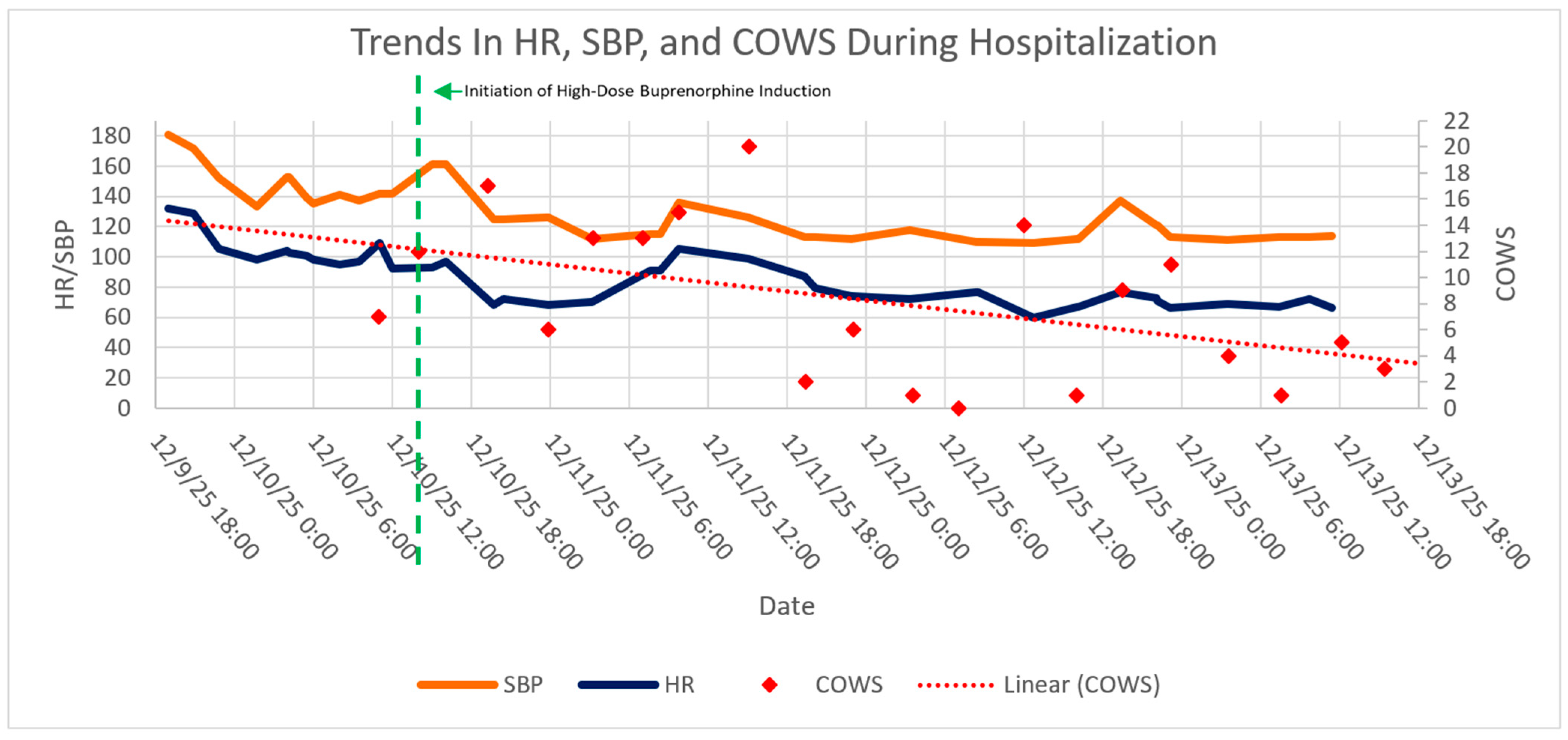
On admission, he was in moderate alcohol and opioid withdrawal with an Alcohol Withdrawal Symptoms (AWS) score of 9 and a Clinical Opiate Withdrawal Scale (COWS) score of 17, respectively. He reported symptoms including but not limited to nausea, diarrhea, diaphoresis, chills, piloerection, myalgias, tremor, anxiety, insomnia, and restlessness. He was tachycardic 101–129 and hypertensive 150–170 s/80–110 s on admission; both conditions stabilized to 60–90 s and 100–130 s/50–70 s, respectively, through the course of treatment. His labs were significant for urine toxicology, screening positive for cannabinoids, fentanyl, and cocaine and were negative for oxycodone, methadone, opiates, benzodiazepines, barbiturates, and methadone. No other toxicology testing was available for MP exposure. He was started on AWS and COWS monitoring every 4 h with maximum scores and associated medications documented in Table 1.
Table 1.
Buprenorphine Macro-Induction Titration Schedule with Benzodiazepines for Alcohol Withdrawal.
On hospital day one, his COWS score was documented at 26, indicating moderately severe opioid withdrawal. After discussing treatment goals, the decision was made to proceed with a high-dose, or macro-induction, of buprenorphine. The patient preferred rapid induction (in case he had to leave abruptly), and his withdrawal severity and use patterns meant high dose induction were unlikely to result in precipitated withdrawal.
He reported a negative reaction to a naltrexone injection given in the past so he was given buprenorphine alone (without naloxone). He was pre-treated with chlorpromazine 25 mg IV followed by diazepam 5 mg IV 15 min later, then 16 mg buprenorphine (2 × 8 mg buprenorphine), immediately followed by another 16 mg buprenorphine 30 min later, as soon as the first two tablets were completely dissolved.
Buprenorphine was provided every 4 h as needed (2 mg at a time) for COWS scores > 5. Further information on dosing is provided in Table 1. He was additionally started on the following adjunctive medications: acetaminophen 1000 mg orally four times daily (increased from three times daily due to acute pain trigger), ketorolac 30 mg every 6 h intravenously (increased from 15 mg every 6 h due to acute pain trigger from a skin infection), clonidine orally 0.3 mg three times daily, in addition to 0.1 mg as needed for vital signs elevations (systolic blood pressure > 140, heart rate > 110), tizanidine 4 mg orally three times day, and ondansetron 4 mg orally as needed for nausea. For his alcohol withdrawal, he was treated with oral benzodiazepines (see Table 1). See Figure 1 for a trend chart of vital signs and COWS over his hospitalization.
Figure 1.
Trend lines of systolic blood pressure (SBP), heart rate (HR) and COWS scores across the duration of the hospitalization.
3. Results
He noted a significant decrease in opioid withdrawal symptoms shortly after starting the buprenorphine macro-induction. On day 2, he felt that his opioid withdrawal, pain, and cravings were better controlled. On day 3, he expressed interest in maintenance buprenorphine therapy through long-acting injectable buprenorphine (LAIB). By day 4, the patient stabilized on buprenorphine 24 mg daily (8 mg administered three times daily). His course was complicated by an abscess and overlying cellulitis in his right hand that required operative management. He requested to stop buprenorphine to allow for pain management with full opioid agonists while undergoing surgery. All buprenorphine doses were discontinued by his primary medicine team for 24 h. Upon re-evaluation post operatively, he agreed to restarting buprenorphine at a reduced dose of 12 mg daily (4 mg administered three times daily), along with full opioid agonists for acute pain management up-titrating to a total of 24 mg/day (8 mg every 8 h) with the goal of starting a long-acting injectable buprenorphine. Due to a combination of insurance and personal issues, he left before LAIB dosing could be secured, but was provided resources to obtain medication upon arriving at his next destination.
4. Discussion
4.1. Kratom, 7-HMG, and MP Misuse and Withdrawal
Although there have been multiple cases of documented withdrawal syndromes for kratom and 7-HMG metabolites—both successfully managed with buprenorphine—there were no documented cases of mitragynine pseudoindoxyl withdrawal, specifically, in the literature [9,10,11,12,13,14,15]. There were also no documented cases of using buprenorphine macro-induction for management of kratom-related withdrawal. We therefore report successfully managing withdrawal suspected to be related to mitragynine pseudoindoxyl through the use of buprenorphine macro-induction.
MP is formed from 7-HMG via a CYP3A-mediated metabolism and represents the most pharmacologically potent alkaloid in the mitragynine metabolic cascade [1]. In vitro radioligand binding assays using murine opioid receptor clones demonstrate that MP has a Ki of 0.8 nM at the mu-opioid receptor (MOR) and 3 nM at the delta-opioid receptor (DOR), while showing negligible affinity at the kappa-opioid receptor [9]. For comparison, mitragynine itself has poor affinity across all opioid receptor subtypes, and 7-HMG shows only moderate MOR affinity, making MP orders of magnitude more potent at MOR than its parent compounds [1,9]. Functionally, MP acts as a MOR agonist and DOR antagonist, a dual mechanism that, in animal models, is associated with a slower development of analgesic tolerance compared to that of morphine [9]. MP also fails to recruit β-arrestin-2, a signaling pathway implicated in opioid-related adverse effects including respiratory depression and constipation [9]. However, no human pharmacokinetic data exist for exogenously administered MP; half-life, bioavailability, and dose-response relationships remain entirely uncharacterized in humans. The absence of human safety data is particularly concerning given that MP is now commercially available as an over-the-counter product at doses far exceeding any studied in animal models, as exemplified by this patient’s consumption of 400 mg daily, a dose for which no relevant studies exist.
Kratom has dose-dependent effects, acting as a mild stimulant at low doses (<5 g) while producing opioid-like effects at 5 to 15 g and sedation at doses >15 g [2,3,4]. Despite the reputation as a safer alternative to opioids, kratom is not a risk-free intervention, being paradoxically associated with physical dependence and opioid use disorder. There is currently no standard of care for treating patients with opioid use disorder related to kratom use, however, given the pharmacologic action of kratom at opioid receptors, buprenorphine has been utilized to treat kratom dependence [10,11,12,13,14,15,16]. Kratom-dependent individuals, meeting the DSM-V criteria for opioid use disorder, were shown to be stabilized on buprenorphine dosing for treatment of opioid use disorder, with dosing based on kratom use. For example, those using <20 g kratom could stabilize on 4/1 mg–8/2 mg buprenorphine naloxone, whereas those using >40 g kratom daily could be initiated on larger doses of 12/3 mg–16/4 mg of buprenorphine–naloxone daily [11].
Other studies have shown buprenorphine can also be utilized for management of kratom-related withdrawal symptoms and subsequent maintenance therapy. One case report detailed an individual with alcohol use disorder in remission and opioid use disorder on 30 mg daily 7-HMG, who presented in moderate to severe opioid withdrawal and was successfully initiated on a standard buprenorphine micro induction of 2 mg sublingually, followed by 4 mg every 3 h as needed based on COWS scoring. She stabilized on day 3 of admission with buprenorphine 8 mg twice daily [12]. Two other case reports have assessed successful inductions with buprenorphine-naloxone 4/1 mg given every 2 h for a total of buprenorphine-naloxone 16/4 mg on day 1 for individuals presenting with kratom withdrawal and opioid use disorder. Both were stabilized outpatient at 8/2 mg twice daily [13,14]. Home inductions with buprenorphine, starting at 4–8 mg daily, for withdrawal and long-term maintenance in the setting of kratom dependence have also been proven to be successful when up-titrated in the outpatient setting to buprenorphine 16–20 mg [16].
4.2. Macro-Induction Buprenorphine: Safety Profile and Clinical Indications
Macro-induction buprenorphine, typically defined as administration of ≥16 mg on day 1 of treatment with initial loading doses typically ranging from 8–32 mg, has emerged in response to the proliferation of high-potency synthetic opioids. Buprenorphine’s unique pharmacological profile, including high mu-opioid receptor affinity, partial agonism, slow receptor dissociation kinetics, and a ceiling effect on respiratory depression, provides a wide therapeutic window for high-dose administration [17]. The safety profile of macro-induction has been established across multiple clinical settings and patient populations. Snyder et al. reported zero cases of respiratory depression or clinically significant precipitated withdrawal in a multicenter emergency department study of patients receiving up to 32 mg buprenorphine on day one, including those with fentanyl exposure [18]. Similarly, Herring et al. reported no respiratory depression or other severe adverse effects in 336 patients encounters receiving ≥12 mg buprenorphine induction [19]. Wu et al. similarly demonstrated the safety of high-dose inductions (≥24 mg day 1) in hospital settings without adverse respiratory events, additionally noting a reduced length of stay compared to that with conventional dosing [20]. The safety of macro-induction extends to high-risk populations, with Berry et al. reporting successful initiation using ≥24 mg on day one in pregnant patients with opioid use disorder without maternal or fetal complications [21].
Clinical indications for macro-induction over conventional or micro-dosing protocols center on the use of high-potency synthetic opioids where standard ceiling doses may be pharmacologically inadequate. Tsui et al. demonstrated that buprenorphine maintenance doses ≥24 mg daily were significantly associated with improved treatment retention in the fentanyl era, compared to lower doses [22]. Case reports have documented treatment failures with standard dosing (8–16 mg) that were successfully managed with macro-dosing (32–48 mg), particularly in patients using ultra-high potency synthetic opioids [23,24].
Macro-induction has also demonstrated efficacy in managing buprenorphine-precipitated withdrawal. Bormann et al. and Quattlebaum et al. reported rapid stabilization of patients experiencing precipitated withdrawal following administration of high-dose buprenorphine (≥24 mg), rather than dose reduction or withholding [25,26]. Randomized controlled trials have further validated the efficacy of single high-dose approaches, with Ahmadi et al. demonstrating that a single, high dose administration of buprenorphine can suppress opioid craving and withdrawal for 48 h without adverse events [27]. Given that mitragynine pseudoindoxyl exhibits a substantially higher μ-opioid receptor binding affinity than mitragynine, comparable in potency to synthetic opioid, macro-induction represents a pharmacologically rational approach for MP-related withdrawal. The evolving landscape of opioid receptor agonists in the illicit and over-the-counter drug supply underscores the need for treatment strategies that account for variable receptor binding profiles and potencies across novel substances [28].
4.3. Synthetic Opioid and Adulterant Withdrawal and Future Directions
This case highlights the growing challenge of managing withdrawal from novel and synthetic opioid receptor agonists within an increasingly adulterated drug supply. Skolnick et al. have argued that the unique physicochemical properties of synthetic opioids have fundamentally hampered conventional approaches to opioid overdose management, requiring a re-evaluation of established treatment paradigms [29]. This principle extends to withdrawal management, where conventional protocols may prove inadequate for substances with high receptor binding affinities and atypical pharmacokinetic profiles, as seen here with mitragynine pseudoindoxyl. As the complexity of withdrawal presentations increases, so too does the need for dedicated, systematic, and multimodal treatment approaches that can be rapidly adapted as the drug supply evolves [30].
Further complicating matters is the emergence of non-opioid adulterants that introduce overlapping withdrawal syndromes poorly addressed by opioid-directed therapies alone. Additions such as xylazine and medetomidine, veterinary α2-adrenergic agonists, have rapidly emerged as a fentanyl adulterants in multiple locations [31,32,33,34,35]. These adulterants are associated with severe skin ulceration in the case of xylazine and intractable withdrawal for medetomidine, characterized by sympathetic activation, treatment resistant vomiting, and encephalopathy, with higher rates of ICU admission and lower rates of symptom resolution compared to prior adulterant exposures [31,32,33,34,35]. These challenges speak to a need for a nimble community drug testing strategy and a willingness to revise previously effective strategies to meet the needs of those who use these substances.
4.4. Limitations
There are multiple important limitations to this study. First, the basis of labeling this mitragynine pseudoindoxyl withdrawal was solely made by patient report. No biochemical testing for MP was available or performed. Second, this is a single case, and individual characteristics, including his other substance use disorders, complicate generalizability.
5. Conclusions
Novel opioids and mu-agonists continue to adulterate the recreational drug supply. Use of novel modalities, like macro-induction buprenorphine, may be considered in some settings. Further research is needed to validate this therapy.
Author Contributions
Conceptualization, T.W.-S., P.D. and K.L.; methodology, K.L.; formal analysis, P.D., D.G., E.P., G.F., M.M. and C.M.; investigation, K.F. and T.W.-S.; writing—original draft preparation, T.W.-S., K.F. and K.L.; writing—review and editing, T.W.-S., K.F., P.D., D.G., E.P., G.F., C.M. and K.L.; supervision, K.L.; project administration, T.W.-S. All authors have read and agreed to the published version of the manuscript.
Funding
This research received no external funding.
Institutional Review Board Statement
Ethical review and approval were waived for this study due to internal IRB policy for case reports and short case series with de-identified and retrospective analysis.
Informed Consent Statement
Informed consent was obtained from the subject involved in the study.
Data Availability Statement
All data are available in the manuscript, no other data are available.
Acknowledgments
We acknowledge the entirety of the Jefferson Addiction Multidisciplinary Service.
Conflicts of Interest
Authors declare no conflicts of interest.
Abbreviations
The following abbreviations are used in this manuscript:
| 7-HMG | 7-hydroxymitragynine |
| MP | mitragynine pseudoindoxyl |
| AWS | Alcohol Withdrawal Scale |
| HR | Heart Rate |
| SBP | Systolic Blood Pressure |
| COWS | Clinical Opiate Withdrawal Scale |
| LAIB | Long-Acting Injectable Buprenorphine |
References
- Chakraborty, S.; Uprety, R.; Slocum, S.T.; Irie, T.; Le Rouzic, V.; Li, X.; Wilson, L.L.; Scouller, B.; Alder, A.F.; Kruegel, A.C.; et al. Oxidative metabolism as a modulator of kratom’s biological actions. J. Med. Chem. 2021, 64, 16553–16572. [Google Scholar] [CrossRef] [Scilit] [PubMed]
- Wilson, L.L.; Chakraborty, S.; Eans, S.O.; Kort, M.E.; Kalia, V.; Liauw, J.; Mottinelli, M.; Kulkarni, A.; Slocum, S.T.; Upham, J.; et al. Kratom alkaloids, natural and semi-synthetic, show less physical dependence and ameliorate opioid withdrawal. Cell. Mol. Neurobiol. 2021, 41, 1131–1143. [Google Scholar] [CrossRef] [Scilit] [PubMed]
- Ahmad, I.; Prabowo, W.C.; Arifuddin, M.; Fadraersada, J.; Indriyanti, N.; Herman, H.; Purwoko, R.Y.; Nainu, F.; Rahmadi, A.; Paramita, S.; et al. Mitragyna species as pharmacological agents: From abuse to promising pharmaceutical products. Life 2022, 12, 193. [Google Scholar] [CrossRef] [Scilit] [PubMed]
- McCurdy, C.R.; Sharma, A.; Smith, K.E.; Veltri, C.A.; Weiss, S.T.; White, C.M.; Grundmann, O. An update on the clinical pharmacology of kratom: Uses, abuse potential, and future considerations. Expert Rev. Clin. Pharmacol. 2024, 17, 131–142. [Google Scholar] [CrossRef] [Scilit]
- Chang-Chien, G.C.; Odonkor, C.A.; Amorapanth, P. Is kratom the new “legal high” on the block? The case of an emerging opioid receptor agonist with substance abuse potential. Pain Physician 2017, 20, E195–E198. [Google Scholar] [CrossRef] [Scilit]
- Hill, K.; Boyer, E.W.; Grundmann, O.; Smith, K.E. De facto opioids: Characterization of novel 7-hydroxymitragynine and mitragynine pseudoindoxyl product marketing. Drug Alcohol Depend. 2025, 272, 112701. [Google Scholar] [CrossRef] [Scilit]
- Ellis, C.R.; Racz, R.; Kruhlak, N.L.; Kim, M.T.; Zakharov, A.V.; Southall, N.; Hawkins, E.G.; Burkhart, K.; Strauss, D.G.; Stavitskaya, L. Evaluating kratom alkaloids using PHASE. PLoS ONE 2020, 15, e0229646. [Google Scholar] [CrossRef] [Scilit]
- Henningfield, J.E.; Grundmann, O.; Huestis, M.A.; Smith, K.E. Kratom safety and toxicology in the public health context: Research needs to better inform regulation. Front. Pharmacol. 2024, 15, 1403140. [Google Scholar] [CrossRef] [Scilit]
- Marrone, G.F.; Grinnell, S.G.; Lu, Z.; Bharat, C.; Eans, S.O.; Murray, T.F.; Elbein, J.A.; McLaughlin, J.P.; Pan, Y.-X.; Majumdar, S. Mitragynine/corynantheidine pseudoindoxyls as opioid analgesics with mu agonism and delta antagonism, which do not recruit β-arrestin-2. J. Med. Chem. 2016, 59, 8381–8397. [Google Scholar] [CrossRef] [Scilit]
- Buresh, M. Treatment of kratom dependence with buprenorphine-naloxone maintenance. J. Addict. Med. 2018, 12, 481–483. [Google Scholar] [CrossRef] [Scilit]
- Weiss, S.T.; Douglas, H.E. Treatment of kratom withdrawal and dependence with buprenorphine/naloxone: A case series and systematic literature review. J. Addict. Med. 2021, 15, 167–172. [Google Scholar] [CrossRef] [Scilit] [PubMed]
- Sivakumar, D.; Pascual, J.; Kennedy, M.; Clark, K.T.; Mason, J.M.; Walfield, A.L.; Maldonado, G. The successful use of buprenorphine to manage kratom withdrawal secondary to self-treatment of opioid withdrawal. Clin. Toxicol. 2025, 63, 1018–1019. [Google Scholar] [CrossRef] [Scilit] [PubMed]
- Khazaeli, A.; Jerry, J.M.; Vazirian, M. Treatment of kratom withdrawal and addiction with buprenorphine. J. Addict. Med. 2018, 12, 493–495. [Google Scholar] [CrossRef] [Scilit] [PubMed]
- Lei, J.; Butz, A.; Valentino, N. Management of kratom dependence with buprenorphine/naloxone in a veteran population. Subst. Abus. 2021, 42, 497–502. [Google Scholar] [CrossRef] [Scilit]
- Wightman, R.S.; Hu, D. A case of 7-OH mitragynine use requiring inpatient medically managed withdrawal. J. Addict. Med. 2025. [Google Scholar] [CrossRef] [Scilit]
- Broyan, V.R.; Brar, J.K.; Allgaier, T.; Allgaier, J.T. Long-term buprenorphine treatment for kratom use disorder: A case series. Subst. Abus. 2022, 43, 763–766. [Google Scholar] [CrossRef] [Scilit]
- Pande, L.J.; Arnet, R.E.; Piper, B.J. An examination of the complex pharmacological properties of the non-selective opioid modulator buprenorphine. Pharmaceuticals 2023, 16, 1397. [Google Scholar] [CrossRef] [Scilit]
- Snyder, H.; Chau, B.; Kalmin, M.M.; Speener, M.; Campbell, A.; Moulin, A.; Herring, A.A. High-dose buprenorphine initiation in the emergency department among patients using fentanyl and other opioids. JAMA Netw. Open 2023, 6, e231572. [Google Scholar] [CrossRef] [Scilit]
- Herring, A.A.; Vosooghi, A.A.; Luftig, J.; Anderson, E.S.; Zhao, X.; Dziura, J.; Hawk, K.F.; McCormack, R.P.; Saxon, A.; D’Onofrio, G. High-dose buprenorphine induction in the emergency department for treatment of opioid use disorder. JAMA Netw. Open 2021, 4, e2117128. [Google Scholar] [CrossRef] [Scilit]
- Wu, S.A.; Archer, G.N.; Schnipke, B.D. High-dose buprenorphine inductions in hospital settings. Am. J. Med. Open 2025, 14, 100118. [Google Scholar] [CrossRef] [Scilit]
- Berry, M.; Kiefer, M.K.; Hinely, K.A.; Bowden, H.; Jordan, A.; Vilensky, M.; Rood, K.M. High-dose buprenorphine initiation in the management of opioid use disorder in pregnancy. Obstet. Gynecol. 2024, 143, 815–818. [Google Scholar] [CrossRef] [Scilit]
- Tsui, J.I.; Bhatraju, E.P.; Hallgren, K.A.; Rhew, I.C.; Samet, J.H. High-dose buprenorphine treatment in the setting of fentanyl. JAMA Netw. Open 2025, 8, e2528119. [Google Scholar] [CrossRef] [Scilit]
- Danilewitz, M.; McLean, M. High-dose buprenorphine for treatment of high potency opioid use disorder. Drug Alcohol Rev. 2020, 39, 135–137. [Google Scholar] [CrossRef] [Scilit]
- Kahan, M.; Marion-Bellemare, L.; Samson, J.; Srivastava, A. “Macrodosing” sublingual buprenorphine and extended-release buprenorphine in a hospital setting: 2 case reports. J. Addict. Med. 2023, 17, 485–487. [Google Scholar] [CrossRef] [Scilit] [PubMed]
- Bormann, N.L.; Gout, A.; Kijewski, V.; Lynch, A. Case report: Buprenorphine-precipitated fentanyl withdrawal treated with high-dose buprenorphine. F1000Research 2023, 11, 487. [Google Scholar] [CrossRef] [Scilit] [PubMed]
- Quattlebaum, T.H.N.; Kiyokawa, M.; Murata, K.A. A case of buprenorphine-precipitated withdrawal managed with high-dose buprenorphine. Fam. Pract. 2022, 39, 292–294. [Google Scholar] [CrossRef] [Scilit] [PubMed]
- Ahmadi, J.; Jahromi, M.S.; Ghahremani, D.; London, E.D. Single high-dose buprenorphine for opioid craving during withdrawal. Trials 2018, 19, 675. [Google Scholar] [CrossRef] [Scilit]
- Tabanelli, R.; Brogi, S.; Calderone, V. Targeting opioid receptors in addiction and drug withdrawal: Where are we going? Int. J. Mol. Sci. 2023, 24, 10888. [Google Scholar] [CrossRef] [Scilit]
- Skolnick, P.; Paavola, J.; Heidbreder, C. Synthetic opioids have disrupted conventional wisdom for treating opioid overdose. Drug Alcohol Depend. Rep. 2024, 12, 100268. [Google Scholar] [CrossRef] [Scilit]
- London, K.S.; Li, Y.; Kahoud, J.L.; Cho, D.; Mulholland, J.; Roque, S.; Stugart, L.; Gillingham, J.; Borne, E.; Slovis, B. Tranq dope: Characterization of an ED cohort treated with a novel opioid withdrawal protocol in the era of fentanyl/xylazine. Am. J. Emerg. Med. 2024, 85, 130–139. [Google Scholar] [CrossRef] [Scilit]
- D’Orazio, J.; Nelson, L.; Perrone, J.; Wightman, R.; Haroz, R. Xylazine adulteration of the heroin–fentanyl drug supply: A narrative review. Ann. Intern. Med. 2023, 176, 1370–1376. [Google Scholar] [CrossRef] [Scilit]
- Durney, P.; Paquin, E.; Fitzpatrick, G.; Lockstein, D.; Warrick-Stone, T.; Montesi, M.; Patel-Francis, S.H.; Rashid, J.; Vaughan-Ogunlusi, O.; Goodsell, K.; et al. Profound opioid and medetomidine withdrawal: A case series and narrative review of available literature. Psychoactives 2025, 4, 37. [Google Scholar] [CrossRef] [Scilit]
- London, K.S.; Durney, P.; Warrick-Stone, T.; Alexander, K.; Kahoud, J.L. Decreased effectiveness of a novel opioid withdrawal protocol following the emergence of medetomidine as a fentanyl adulterant. BioMed 2025, 5, 13. [Google Scholar] [CrossRef] [Scilit]
- London, K.S.; Huo, S.; Murphy, L.; Warrick-Stone, T.; Goodstein, D.; Montesi, M.; Carter, M.; Butt, S.; Alexander, K.; Satz, W.; et al. Severe fentanyl withdrawal associated with medetomidine adulteration: A multicenter study from Philadelphia, PA. J. Addict. Med. 2025. [Google Scholar] [CrossRef] [Scilit]
- Durney, P.; Kahoud, J.L.; Warrick-Stone, T.; Montesi, M.; Carter, M.; Butt, S.; Mencia, A.M.; Omoregie, L.; Shah, M.; Bloomfield, M.; et al. Biochemical identification and clinical description of medetomidine exposure in people who use fentanyl in Philadelphia, PA. Int. J. Mol. Sci. 2025, 26, 6715. [Google Scholar] [CrossRef] [Scilit]

Disclaimer/Publisher’s Note: The statements, opinions and data contained in all publications are solely those of the individual author(s) and contributor(s) and not of MDPI and/or the editor(s). MDPI and/or the editor(s) disclaim responsibility for any injury to people or property resulting from any ideas, methods, instructions or products referred to in the content. |
© 2026 by the authors. Licensee MDPI, Basel, Switzerland. This article is an open access article distributed under the terms and conditions of the Creative Commons Attribution (CC BY) license.