


Abstract
Low back pain (LBP) is the leading cause of years lived with disability globally, and a major rehabilitation priority, yet nursing education often does not translate burden evidence into first-contact actions across care settings. This article aimed to develop a nursing education and practice framework that converts global LBP evidence into competencies for assessment, education, medication safety, referral, follow-up and occupational prevention. A focused, Global Burden of Disease-informed narrative review and practice-oriented educational synthesis was conducted. PubMed/MEDLINE, CINAHL, Scopus, Google Scholar, and organisational sources were searched for burden estimates, clinical guidelines, pain education scholarship, nursing occupational health evidence and nurse-led self-management literature. Sources were selected for relevance to nurse-deliverable actions and curriculum assessment; systematic-review methods, meta-analysis and formal risk-of-bias appraisal were not used. Evidence was mapped iteratively to six nursing practice domains: red-flag triage and escalation; functional, psychosocial and contextual assessment; brief therapeutic education; medication safety and low-value-care reduction; follow-up and referral; and occupational prevention. The revised framework adds an explicit evidence-to-competency map, implementation guidance and evaluation indicators for undergraduate education, postgraduate training, continuing professional development, clinical supervision and quality improvement. LBP should be taught as a nursing-sensitive disability and rehabilitation priority, supporting nurses to screen for danger, validate pain, reduce threat, promote graded activity, monitor medicines, coordinate continuity and prevent occupational harm.
1. Introduction
Low back pain (LBP) is encountered so frequently in nursing practice that it can become clinically invisible. A person mentions back pain during medication administration, a worker attends primary care because a flare-up prevents lifting, an older adult reports disturbed sleep and fear of walking, or a patient in the emergency department requests imaging because of pain intensity. These encounters are often brief, distracted and fragmented. Their cumulative significance is substantial: LBP is the leading cause of disability worldwide and one of the conditions for which rehabilitation is most important [1,2]. The implication for nurse education is practical rather than merely epidemiological: LBP appears across acute care, primary care, community care, occupational health, rehabilitation, older-adult services and chronic disease management.
The Global Burden of Disease (GBD) framework is useful because it describes health loss that mortality statistics cannot capture. LBP rarely kills directly, but it restricts mobility, sleep, work, self-care, family roles, social participation and confidence. In 2020, 619 million people were estimated to be living with LBP worldwide, and cases are projected to reach 843 million by 2050 [3]. The World Health Organisation identifies LBP as the single leading cause of disability globally and notes that non-specific LBP represents approximately 90% of presentations [1]. These figures should change how nursing education frames the condition. A disability problem requires more than pain scoring; it requires assessment of function, participation, fear, work, medicines, safety, access, and the person’s ability to act on advice.
For terminological consistency, this manuscript uses LBP as the umbrella term, non-specific LBP when serious or specific spinal pathology is not suspected, and chronic primary LBP only when referring directly to the WHO guideline category for persistent primary pain [4]. This distinction is important for nurse education because the same nurse may encounter acute non-specific LBP, recurrent LBP, LBP with radicular symptoms, or chronic primary LBP; however, the teachable nursing tasks of screening, explanation, functional assessment, safe medicines, referral coordination and follow-up remain recognisable across presentations.
The epidemiological framing of LBP is necessary but insufficient for nursing education. A manuscript may accurately state that LBP generates millions of years lived with disability and still fail the nurse who has ten minutes to decide whether a person needs urgent escalation, reassurance, medication review, physiotherapy referral, work advice or follow-up. The critical gap is translation. Nurses need teachable frameworks, communication scripts, escalation criteria, documentation prompts and measurable outcomes. They also need the confidence to explain why most LBP is real but not structurally dangerous, why routine imaging is usually unhelpful when serious pathology is not suspected, why staying active is preferable to prolonged bed rest and why pain relief should be linked to function rather than passive dependency [5,6,7,8,9,10,11,12,13].
Nursing education is central because the initial explanation given by providers can influence beliefs, fear, activity and help-seeking. Pain education research shows persistent gaps in nursing students’ and nurses’ knowledge, attitudes and applied pain-management reasoning [14,15]. These deficiencies matter in LBP because well-intentioned but poorly framed advice can reinforce fear avoidance, low self-efficacy and passive coping. Phrases such as ‘your spine is damaged’, ‘do not bend’ or ‘wait until the scan explains it’ may increase perceived threat. Conversely, skilled nursing communication can validate pain, screen for danger, normalise active recovery, support graded return to valued activities and create a clear safety-net plan. The International Association for the Study of Pain curriculum for nursing emphasises that every nurse should be able to assess and manage pain and that education should test applied clinical practice, not only theoretical retention [16].
The importance of nurses is also structural. WHO estimates that there are about 29 million nurses worldwide and emphasises the contribution of nursing and midwifery to primary health care and universal health coverage [17]. Global strategic directions for nursing and midwifery also identify education, jobs, leadership, and service delivery as policy priorities for strengthening the nursing workforce [18]. This reach makes nurses indispensable for scalable LBP care, especially in low-resource or rural settings where access to imaging, physiotherapy, pain specialists or multidisciplinary rehabilitation may be limited. At the same time, nurses are exposed to occupational risks for LBP through patient handling, prolonged standing, awkward postures, shift work, high workload and psychosocial stress. A systematic review and meta-analysis in African clinical settings reported a 12-month LBP prevalence of 64.07% among nurses [19]. Therefore, the nursing priority is dual: nurses educate and care for people with LBP, and health systems must protect nurses from becoming part of the burden they are expected to manage.
The revised contribution of this paper is not to claim that a new clinical treatment has been proven effective. Rather, it is to provide a transparent, evidence-informed curriculum-to-practice bridge: a map from global burden evidence and guideline-consistent messages to nursing competencies, clinical documentation, simulation assessment, referral decisions, and quality indicators. This responds to the educational gap between knowing that LBP is globally disabling and knowing what nurses should be taught to assess, say, document, and evaluate in daily care.
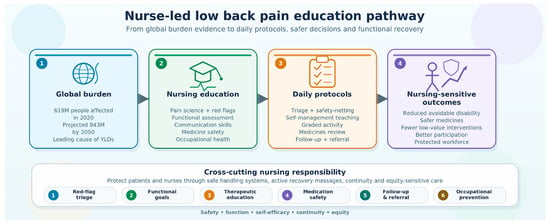
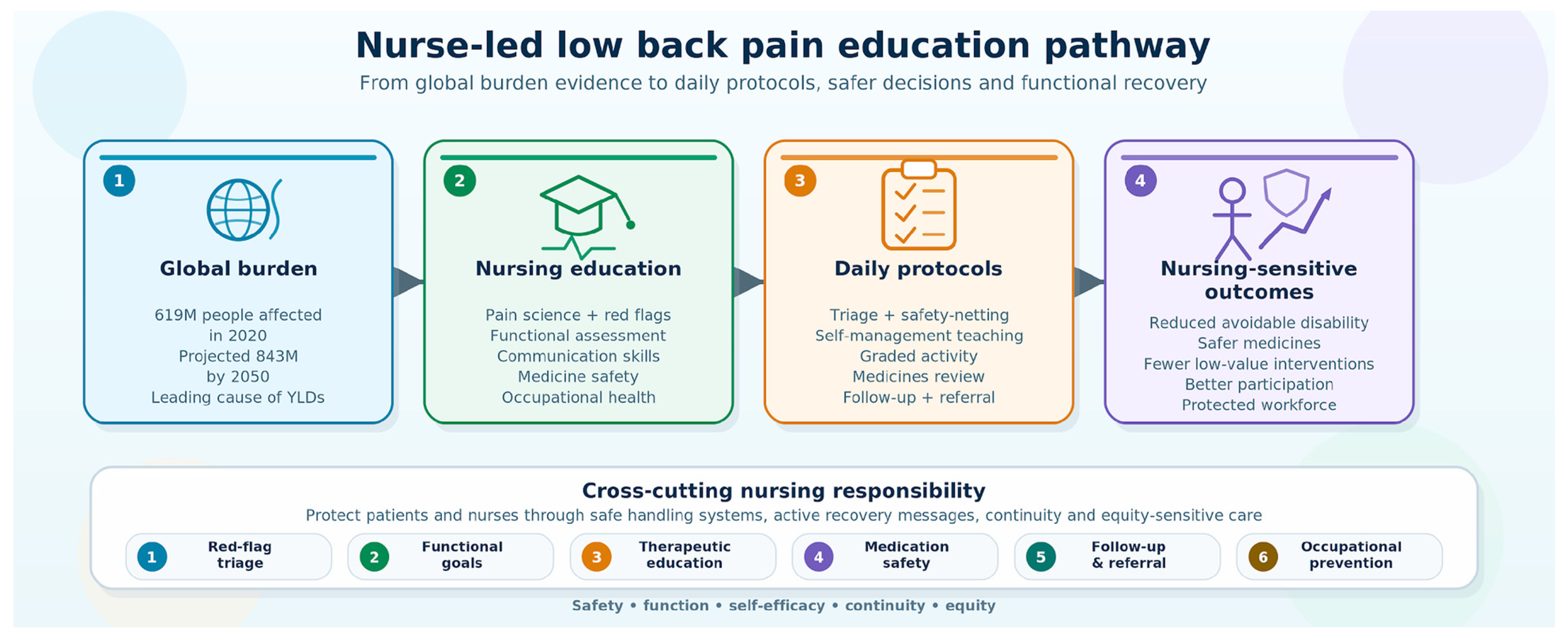
This discussion paper reframes the global LBP burden as a nursing education and practice problem. Figure 1 summarises the proposed pathway from burden evidence to nursing education, daily practice, and nursing-sensitive outcomes. The aim is to help nurses answer five recurring questions: Is this presentation safe or urgent? What functional problems matter most to this person? What explanation will reduce fear and support action? Which medicines, referrals or investigations may help or harm? What follow-up and education are needed to prevent avoidable disability? By answering these questions, nurses can convert global epidemiology into daily high-value care.
Figure 1.
Nursing education pathway for low back pain, moving from global burden evidence to nurse-led daily practice components and nursing-sensitive outcomes.
2. Materials and Methods
2.1. Design and Reporting Orientation
This manuscript is a focused, GBD-informed narrative review and practice-oriented educational synthesis, developed as a discussion paper for nurse education and practice. The synthesis translates high-level burden evidence and guideline principles into nurse-deliverable competencies, practice components and educational priorities. Because the objective was conceptual and educational rather than to estimate intervention effects, the work was not registered as a systematic review and did not use meta-analysis, duplicate screening, formal certainty grading, or risk-of-bias appraisal. To strengthen transparency for a narrative review, the revised manuscript reports the evidence-identification strategy, selection logic, synthesis process, and limitations in line with the principles of clear aims, the literature-search description, and balanced referencing emphasised by SANRA [20].
2.2. Evidence Identification and Search Strategy
For the revision, the evidence base was expanded through a focused search designed to identify literature relevant to nursing education, clinical practice and implementation, rather than to exhaustively capture all LBP intervention trials. Searches covered PubMed/MEDLINE, CINAHL, Scopus and Google Scholar, together with organisational and guideline sources from WHO, GBD, IASP, NICE, and major low back pain guideline publications. The main search window was January 2010 to July 2026, with older seminal sources retained when they provided widely used screening or competency-assessment concepts.
Search terms were combined around four concepts: (1) condition terms: ‘low back pain’, ‘back pain’, ‘non-specific low back pain’, ‘chronic primary low back pain’, and ‘musculoskeletal pain’; (2) nursing and education terms: ‘nursing’, ‘nurse-led’, ‘nursing education’, ‘nursing students’, ‘curriculum’, ‘competency’, ‘simulation’, and ‘continuing professional development’; (3) practice terms: ‘red flags’, ‘triage’, ‘functional assessment’, ‘patient education’, ‘self-management’, ‘medication safety’, ‘opioids’, ‘imaging’, ‘referral’, ‘occupational health’, and ‘safe patient handling’; and (4) implementation terms: ‘guideline’, ‘clinical practice guideline’, ‘quality improvement’, ‘implementation’, ‘barriers’, ‘facilitators’, and ‘evaluation’. Reference lists of highly relevant guidelines and reviews were hand-searched to identify additional sources.
2.3. Source Selection and Handling of Competing Evidence
Sources were included when they met at least one of the following criteria: they quantified global or workforce LBP burden; provided international or national guideline recommendations relevant to first-contact or community care; addressed pain education or nursing curriculum gaps; described nurse-led, self-management or patient-education models; or informed assessment, implementation or evaluation of nursing competencies. Sources were excluded when they focused primarily on surgical or invasive treatment, highly specialised diagnostic pathways outside nursing scope, non-lumbar pain without transferable musculoskeletal-care recommendations, or opinion pieces that did not add a clear educational or practice contribution. English language sources were prioritised, which is acknowledged as a limitation.
When evidence or guidelines differed in the strength of specific modality recommendations, the synthesis prioritised recommendations that were consistent across multiple high-quality guidelines and within nursing scope: early recognition of serious pathology, avoidance of routine imaging when red flags are absent, promotion of activity and self-management, medication-risk detection, person-centred education, referral when recovery is not progressing, and reduction in low-value care. The framework therefore does not prescribe a single treatment package; it defines nursing-sensitive assessment, education, escalation and coordination tasks that are compatible with local regulation and clinical governance.
2.4. Development of Practice Domains and Competency Framework
The six practice domains were developed through structured thematic mapping and iterative author discussion. First, burden indicators and guideline principles were extracted as nursing-relevant statements. Second, statements were coded into everyday nursing tasks: triage, functional assessment, psychosocial screening, patient explanation, self-management support, medicines review, imaging-expectation management, referral coordination, follow-up, and occupational prevention. Third, overlapping tasks were grouped into domains when they represented a distinct decision point in the patient or workforce pathway. Fourth, the domains were checked against three criteria: relevance across common nursing settings, teachability as observable competencies, and suitability for assessment through simulation, documentation audit, or supervised practice.
The final six domains were retained because together they cover the nurse-sensitive trajectory from first contact to recovery and workforce protection: diagnostic safety, disability-oriented assessment, therapeutic education, medication and low-value-care safety, continuity/referral, and occupational prevention. The framework was refined through iterative author discussion rather than formal Delphi consensus; this is now stated explicitly and treated as a design limitation. Table 1 maps the principal source categories to the practice domains and proposed competencies.
Table 1.
Mapping of evidence source categories to nursing practice domains, competencies and evaluation implications.
2.5. Ethical Considerations
This work uses published, aggregate and publicly available evidence. It did not involve human participants, identifiable data, primary data collection or generation of a new dataset; therefore, ethical approval and informed consent were not required.
3. Results: Educational Synthesis and Practice Framework
3.1. Low Back Pain as a Nursing-Sensitive Disability Condition
The central synthesis is that LBP should be taught as a nursing-sensitive disability condition. Global estimates are not abstract numbers; they predict consultation volume, medication exposure, functional dependence, work absence, rehabilitation demand, and caregiver burden. The condition is common; therefore, most nursing encounters will involve non-specific LBP rather than serious spinal pathology. This creates a delicate balance: nurses must be vigilant enough to detect danger, but skilled enough not to overmedicalize the large majority of people whose recovery depends on reassurance, activity, self-efficacy, and continuity.
Key epidemiological findings can be translated into concrete nursing priorities. First, the estimated 619 million people affected in 2020 and projected 843 million by 2050 indicate that LBP should be treated as a routine, high-volume condition in first-contact, community, emergency, inpatient, rehabilitation, and occupational health settings. Second, because the burden is primarily disability rather than mortality, nursing assessment should record function, participation, sleep, work, caregiving, confidence, and patient-defined goals rather than pain intensity alone. Third, because most presentations are non-specific, nurses need education that combines red-flag screening with explanations that validate pain without reinforcing structural damage beliefs or unnecessary imaging expectations. Fourth, because LBP is a major rehabilitation need, nurses should support graded activity, self-management, referral, and follow-up of functional goals. Finally, occupational ergonomic factors mean that the nursing workforce is both a care provider and an at-risk population, so curricula and clinical governance should include safe patient handling, early reporting, ergonomic systems, return-to-work support, and embedded prompts in records, triage systems, supervision, and continuing professional development.
3.2. What the Framework Adds to Existing Evidence-Based Health Education
The practical proposal is not presented as a new evidence-proven clinical programme. Its new contribution is educational and translational: it integrates burden evidence, guideline-consistent LBP messages, nursing pain education needs, medication safety, referral decisions, occupational prevention, and competency assessment into a single nurse-deliverable framework. Existing evidence-based health education for LBP commonly emphasises reassurance, activity, self-management, avoidance of low-value imaging, and person-centred advice. The present framework specifies how those principles can be taught, observed, and audited in nursing education and daily practice.
The framework adds four concrete outputs for educators and service leaders: an evidence-to-domain map, six practice components expressed as teachable nursing actions, a competency matrix with assessment methods, and implementation/evaluation examples. Its value therefore lies in curriculum design, clinical supervision, and quality improvement, not in replacing existing multidisciplinary guidelines or claiming effectiveness beyond the evidence base.
3.3. Justification for the Six Practice Domains
The six domains were organised around the nursing decision sequence rather than around anatomical pathology or treatment modality. Red-flag triage comes first because diagnostic safety is the threshold task at first contact. Functional, psychosocial, and contextual assessment follows because the global burden of LBP is expressed as disability, participation loss, and inequity. Brief therapeutic education is separated as its own domain because communication is an active clinical intervention that can reduce threat or, if poorly delivered, intensify fear. Medication safety and low-value-care reduction are grouped because high LBP prevalence creates high exposure to analgesics, opioids, duplicate medicines, adverse effects, imaging expectations, and passive care dependency. Follow-up and referral are a distinct domain because unsupported advice is often insufficient when function fails to improve. Occupational prevention is retained as a separate domain because nurses are simultaneously educators and a high-risk workforce.
This organisation makes the framework useful across settings. A nurse in an emergency department may emphasise triage and safety-netting; a primary care nurse may emphasise activity planning, medicines, and follow-up; a rehabilitation nurse may emphasise functional goals and self-management; an occupational health nurse may emphasise safe handling, work modification, and return-to-work support. The same domains can therefore support undergraduate teaching, postgraduate training, continuing professional development, and local quality improvement.
3.4. Core Nurse-Led Practice Components
Across settings, the nurse’s role can be organised into six daily practice components: triage for danger, assess function, identify modifiable barriers, educate for active recovery, review medication safety, and coordinate follow-up. These components apply whether the nurse works in a primary care clinic, emergency triage desk, inpatient ward, community programme, occupational health service, or rehabilitation team. The intensity and referral pathway differ by setting, but the educational message remains consistent: the aim is safe movement, participation, self-efficacy, and timely escalation when indicated.
A major weakness in many LBP pathways is that nurses are asked to ‘advise’ people without being given a framework for what advice should contain. Generic reassurance is not enough. People often need a structured explanation of why pain can be severe without implying serious damage, how to stay active safely, when to seek urgent care, how to use medicines without harm, and what short-term functional goal will be reviewed. The following practice components convert these points into teachable actions.
3.5. Practice Component 1: First-Contact Nursing Triage and Red-Flag Escalation
The first-contact component prioritises diagnostic safety without making serious pathology seem common (Table 2). Nurses should use a framework that is brief enough for real clinical workflow but specific enough to identify people who require urgent medical review. Red flags should not be used mechanically; they are most useful when interpreted as a pattern, in context, and according to local escalation policy. The component should be embedded in triage forms and electronic documentation.
Table 2.
Practice component 1: first-contact nursing triage for low back pain.
3.6. Practice Component 2: Functional, Psychosocial and Contextual Nursing Assessment
Once urgent features have been excluded or escalated, nursing assessment should shift from a narrow pain-intensity model to a functional and biopsychosocial model (Table 3). This is where nursing adds distinctive value. A person’s pain score may remain high while meaningful recovery begins through walking, sleeping better, returning to modified work, or regaining confidence. Conversely, a moderate pain score may hide high disability, fear, social vulnerability, or unsafe medicine use.
Table 3.
Practice component 2: function-focused nursing assessment.
3.7. Practice Component 3: Brief Nurse-Led Therapeutic Education
Patient education is the most immediate nursing intervention for uncomplicated LBP. The encounter should be brief, memorable, and behaviourally specific. It should not overpromise rapid cure or dismiss the person’s suffering. The aim is to validate pain, reduce danger beliefs, promote safe activity, link medicines to function, and give clear safety-netting. A five-minute encounter can be taught as a sequence of concise nursing actions that are adapted to local language and culture.
First, validate the experience: the nurse acknowledges that pain is affecting movement and daily life, then explains that warning signs will be checked and a safe action plan will be agreed. This builds trust and prevents the person from feeling dismissed. Second, explain safety: when the assessment does not suggest an emergency cause, the nurse states calmly that most LBP is real and painful but not caused by serious damage. This reduces the threat while keeping diagnostic safety explicit. Third, promote activity: the nurse explains that complete bed rest usually slows recovery and encourages tolerable gentle movement, short walks, and gradual increases in activity. This replaces immobilisation with graded activity. Fourth, set one functional goal for the next two days, such as walking to the bathroom independently, completing a five-minute walk, or returning to light tasks. This converts general advice into measurable behaviour. Fifth, use medicines safely: the nurse reminds the person to use medicines only as advised and to report stomach bleeding, kidney disease, blood thinners, pregnancy, drowsiness, or dose escalation. This reduces adverse events and unsafe escalation. Sixth, safety-net explicitly: urgent help is needed for bladder or bowel changes, numbness around the saddle area, fever, major trauma, unexplained weight loss, or worsening weakness. This supports early detection of rare but serious deterioration. Seventh, plan follow-up: if function is not improving, pain is spreading, or fear is stopping movement, the nurse arranges reassessment and considers physiotherapy, medical review, or other support. This creates continuity and prevents repeated generic advice.
3.8. Practice Component 4: Medication Safety and Low-Value-Care Reduction
Medication safety is a nursing responsibility because LBP drives large-scale use of non-steroidal anti-inflammatory drugs (NSAIDs), paracetamol or acetaminophen, muscle relaxants, opioids, sedatives, and adjuvant medicines (Table 4). The nurse should reconcile all medicines, including over-the-counter and traditional remedies; assess duration and dose; identify contraindications; monitor adverse effects; and clarify expectations. Medicines should be framed as temporary support for movement, sleep and participation, not as the sole treatment plan.
Table 4.
Practice component 4: nursing checks for medicines and low-value care.
Low-value-care reduction is equally important. Routine imaging for uncomplicated non-specific LBP can reinforce structural fear, increase cost, and lead to interventions that do not improve function. WHO guidance for chronic primary LBP supports non-surgical, person-centred management, and identifies interventions that should not be routinely offered in most contexts, including lumbar braces or supports, traction, and opioid painkillers because harms may outweigh benefits [4]. Nurses can protect patients by explaining why a scan is not automatically helpful when red flags are absent, by discouraging prolonged passive treatment dependency and by escalating when clinical features justify further evaluation.
3.9. Practice Component 5: Follow-Up, Referral and Stratified Support
Follow-up is the difference between advice and care. A person with uncomplicated acute LBP may need brief education and safety-netting only, whereas a person with persistent disability, high fear, work conflict, or repeated analgesic escalation needs planned reassessment. Nurses should document a review point and a functional outcome. The follow-up question is not only ‘How much pain do you have?’ but ‘What can you do now that you could not do before?’
Referral should be guided by urgency and need. Same-day escalation is required for suspected cauda equina syndrome, infection, fracture, malignancy, or progressive neurological deficit. Expedited review is appropriate for severe or worsening radicular symptoms, uncontrolled pain with functional compromise, unsafe medicine use, major work disability, or persistent symptoms beyond the expected recovery window. Routine referral to physiotherapy, rehabilitation, psychology, occupational health, or multidisciplinary pain care is appropriate when disability persists, psychosocial barriers are prominent, or self-management is not progressing. Stratified tools such as STarT Back can help match intensity of support to risk where available.
Follow-up and referral thresholds can be described in narrative form. Improving acute LBP without red flags is managed by reinforcing education, graded activity, safe medicine use, and return to normal activities; routine imaging is not indicated, and follow-up is needed if symptoms worsen or function fails to improve.
Persistent functional limitation should prompt reassessment of goals, barriers, work or caregiving demands, sleep, mood, and medicine use, followed by referral to physiotherapy, rehabilitation or a primary care clinician according to the local pathway.
High fear, low mood or catastrophising should be addressed with validating language, pacing, avoidance of threatening explanations and, where available, behavioural, psychological or multidisciplinary support.
Radicular symptoms or neurological change require documentation of distribution, weakness, numbness and functional impact. Progressive motor deficit requires urgent escalation, while persistent or severe radicular symptoms warrant medical review.
Unsafe medicine use requires escalation to a prescriber or pharmacist, with tapering or alternatives supported only within local protocols. Work absence or occupational risk should prompt discussion of modified duties, pacing, patient-handling demands, and employer support, with occupational health referral when available.
Follow-up intensity should be adapted to local resources, scope of practice, and patient risk. The aim is continuity, not repeated generic advice.
3.10. Practice Component 6: Occupational Prevention and Protection of the Nursing Workforce
Nursing cannot credibly lead LBP education while normalising preventable LBP among nurses. Occupational prevention should be treated as part of patient safety, workforce sustainability, and quality of care. Training in body mechanics alone is insufficient if nurses are expected to mobilise or transfer patients without equipment, staffing, or time. A safe patient-handling culture requires mechanical aids, appropriate staffing, task design, early symptom reporting, supportive return-to-work procedures, and leadership accountability.
The educational message for nurses should therefore be two-directional. Nurses teach patients to remain active and protect function, and organisations teach and resource nurses to protect their own backs. This includes simulation in transfer techniques, competence in using lifting devices, awareness of cumulative load, communication for requesting help, and refusal of unsafe manual handling where policy permits. The goal is not to make nurses fearful of movement, but to prevent avoidable overload in a profession with high exposure.
3.11. Nursing Education Competency Matrix
For nursing education to add value, the practice components must be embedded in curricula and assessed. Table 5 proposes competencies that can be taught through lectures, case-based learning, simulation, supervised clinical practice, reflective debriefing, and quality-improvement projects.
Table 5.
Nursing education competency matrix for low back pain.
3.12. Practical Curriculum Integration and Competency Evaluation Examples
Table 6 provides practical examples for integrating the framework into undergraduate, postgraduate, and continuing education. The examples are intentionally modular so that programmes can adopt a one-hour session, a simulation scenario, a clinical audit, or a longitudinal quality-improvement project depending on available time and faculty expertise.
Table 6.
Examples of curriculum integration, assessment strategies and competency evaluation.
4. Discussion
4.1. From Back-Pain Advice to Nursing-Sensitive Disability Prevention
The critical weakness of many LBP manuscripts is that they overdescribe burden and underdescribe nursing work. Epidemiology shows why LBP matters, but it does not automatically tell a nurse what to say, document or escalate. This synthesis argues that the nursing endpoint should be avoidable disability. That endpoint is broader than pain intensity. It includes walking, sleep, self-care, work, caregiving, mood, confidence, medication safety and participation. When nurses assess and document these outcomes, they align daily practice with the way global burden is measured through years lived with disability.
This shift also protects patients from the false choice between dismissal and overmedicalisation. Nurses can validate pain while explaining that most LBP is non-specific and usually managed through active recovery. They can screen for danger while avoiding language that makes rare pathologies seem likely. They can encourage activity without blaming people for pain. These communication skills are not optional soft skills; they are core clinical interventions.
4.2. From Passive Care to Patient Activation and Supported Self-Management
The WHO guideline and contemporary LBP literature support non-surgical, person-centred, active strategies for chronic primary LBP [4,27]. Nursing education should therefore move away from teaching LBP as a sequence of analgesia, rest and referral. The more useful sequence is safety, explanation, activation, function and review. Self-management is not abandonment. It is supported autonomy: the person receives clear information, a feasible activity plan, medicine safety advice, safety-netting, and access to reassessment when recovery is not progressing [21,22].
Emerging nurse-led models are relevant here. A nurse-led web-based self-management programme for chronic LBP was reported as acceptable and feasible, and included health behaviour change counselling using motivational interviewing [23]. Such evidence does not mean all LBP care should become digital or nurse-only. It does show that nurses can deliver structured activation, coaching, and follow-up when they are trained and supported. In busy clinical settings, even low-technology versions of these principles can improve the encounter: a functional goal, a flare-up plan, a safety-net statement, and a scheduled review.
4.3. From Individual Responsibility to System-Level Nursing Education
The burden of LBP cannot be solved by asking individual nurses to ‘do better’ without systems. Practice components, documentation templates, referral maps, educational materials, electronic prompts, and audit indicators are needed. For example, an electronic LBP nursing template can require red-flag screening, functional-goal documentation, medication-risk review, and safety-netting before the note is closed. A primary care service can offer nurse-led group education for recurrent LBP. An emergency department can audit imaging requests and discharge education. A hospital can integrate LBP prevention into safe patient-handling programmes.
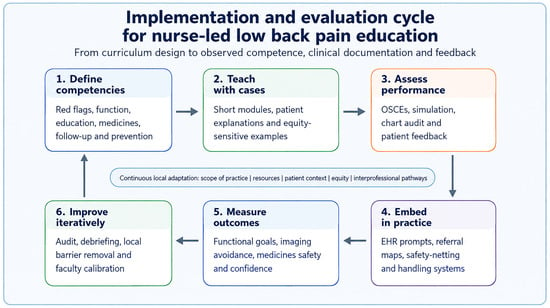
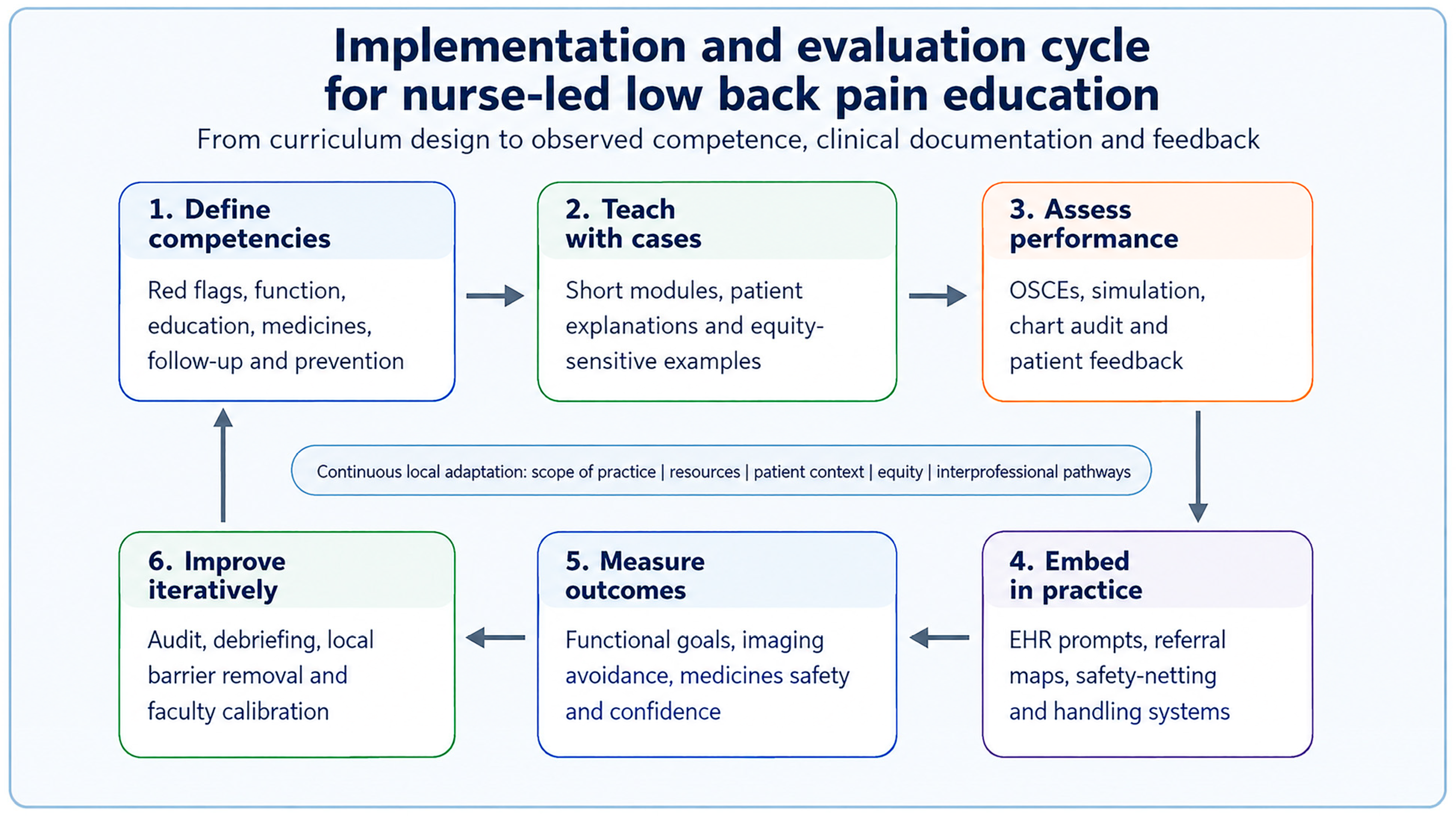
Quality indicators should reflect nursing-sensitive outcomes. Possible indicators include the proportion of patients with documented red-flag screening, functional goal recording, medicines reconciliation, safety-netting, advice to remain active, referral completion, reduction in non-indicated imaging, opioid review, return-to-work planning, and patient-reported confidence to self-manage. These indicators connect global burden evidence to local practice change. Figure 2 summarizes the proposed implementation and evaluation cycle, linking competency definition, teaching, performance assessment, practice integration, outcome measurement, and iterative improvement.
Figure 2.
Implementation and evaluation cycle for integrating the low back pain nursing framework into curriculum design, performance assessment, clinical documentation and quality improvement.
4.4. Equity and Global Applicability
Global applicability requires humility. Advice that assumes private physiotherapy, paid sick leave, safe housing, transport, digital access or control over work tasks may fail in low-resource contexts. Nurses should ask what is feasible for the person rather than prescribe idealised self-management. Walking may mean walking inside a crowded home; modified work may be impossible for a day labourer; medication safety may depend on what is available and affordable; follow-up may require community health workers rather than specialist clinics. Equity-sensitive nursing care adapts the plan without diluting the principles of safety, activity, self-efficacy, and timely escalation.
The projected growth of LBP in regions with expanding and ageing populations makes this point urgent. Specialist-intensive models cannot meet global demand alone. Nurses, community health workers, physiotherapists, pharmacists, physicians, and occupational health teams need shared messages and simple pathways. In this context, nursing education becomes a scalability strategy: a well-trained nurse can deliver safe first-contact triage, reduce fear, prevent harmful medication use, support activity, and coordinate care in settings where specialist access is delayed or unavailable.
4.5. Implications for Undergraduate Education, Continuing Professional Development and Leadership
Undergraduate curricula should not confine LBP to anatomy, posture, and analgesics. Students should learn contemporary pain science, non-specific pain explanations, red flags, yellow flags, functional assessment, safe movement advice, medication safety, low-value-care reduction, equity, and occupational prevention. Simulation should test how students explain LBP to a frightened person, how they escalate suspected cauda equina syndrome, how they negotiate activity after a flare-up, and how they manage a request for imaging without indication. Assessment should reward applied reasoning and communication, not rote recall.
Continuing professional development should focus on nurses already making first-contact decisions. Short modules can be built around real cases: acute LBP in a manual worker, recurrent LBP in a caregiver, LBP with urinary symptoms, chronic LBP with opioid escalation, older-adult LBP with falls risk, and nurse occupational back pain after patient transfer. Leadership should ensure that training is accompanied by frameworks, referral access, safe staffing, and patient-handling equipment. Without organisational support, education becomes moral pressure placed on individual nurses.
Nurse managers and educators should also address the hidden curriculum. If clinical environments reward rapid analgesia and discharge without education, students learn that LBP is low priority. If senior staff casually describe patients as ‘just back pain’, students learn dismissal. If nurses continue unsafe manual transfers because equipment is unavailable or culturally discouraged, students learn that occupational injury is normal. A nursing education article on LBP must therefore address both patient care and the culture of nursing work.
4.6. Barriers and Facilitators to Implementation
Implementation barriers are predictable and should be addressed explicitly. In nursing programmes, barriers may include crowded curricula, limited faculty confidence in contemporary pain science, weak links between classroom teaching and clinical documentation, and assessment methods that reward recall rather than performance. In healthcare organisations, barriers may include time pressure, inconsistent local scope of practice, medicalised imaging expectations, limited physiotherapy or occupational health referral pathways, electronic records without LBP prompts, shortage of safe patient-handling equipment, and a culture that normalises back pain among staff.
Facilitators include educator champions, interprofessional teaching with physiotherapy, medicine and pharmacy, brief simulation cases, patient-friendly scripts, local referral maps, electronic templates, audit-and-feedback cycles, medication-safety prompts, visible leadership support for safe handling, and adaptation to local language, literacy and resource constraints. These facilitators convert the framework from a content list into an implementable educational and clinical pathway.
4.7. Evaluation in Educational and Clinical Settings
The framework can be evaluated at multiple levels. At the education level, evaluation can follow a progression from knowledge and reasoning to observed performance and workplace documentation, consistent with competency-assessment principles such as Miller’s model [25]. Programmes can measure whether learners identify red flags, explain non-specific LBP without threat, set a functional goal, reconcile medicines, provide safety-netting, and document follow-up. At the implementation level, behaviour change thinking reminds educators that knowledge is not enough; nurses also need opportunity, prompts, workflow support, and motivation to use new behaviours in practice [24].
Clinical evaluation can include the proportion of eligible encounters with red-flag screening, functional goals, medicine reconciliation, explicit safety-netting, advice to remain active, referral completion, avoided non-indicated imaging, opioid or sedative review, return-to-work planning, and patient-reported confidence to self-manage. For occupational prevention, evaluation can include safe patient-handling training completion, equipment availability, early symptom reporting, injury rates, modified-duty use, and return-to-work outcomes. These measures do not prove the framework’s effectiveness by themselves, but they provide a feasible starting point for pragmatic trials and implementation studies.
4.8. Research Implications
Nursing research should evaluate whether nurse-led LBP frameworks improve functional outcomes, patient confidence, safety-net understanding, medicine safety, referral appropriateness, and reduction in low-value care. Pragmatic trials and implementation studies are needed in primary care, emergency departments, community services, occupational health, and low-resource settings. Research should also test educational interventions, including simulation, case-based learning, digital modules, and interprofessional teaching.
Outcomes should include disability, participation, work status, sleep, self-efficacy, patient activation, opioid exposure, imaging use, adverse medication events, and patient experience. For occupational prevention, studies should examine safe patient-handling programmes, staffing models, early reporting, return-to-work pathways, and organisational culture. Equity-focused studies should assess whether nurse-led education reaches older adults, migrants, rural communities, manual workers, people with low literacy, and patients without easy access to rehabilitation.
4.9. Limitations
This article has important design limitations. It is a narrative review and educational synthesis, not a systematic review of intervention effectiveness. Although the revision adds a more explicit search strategy, source-selection logic and evidence-to-domain mapping, the search was not conducted with duplicate independent screening, a registered protocol, a PRISMA flow diagram, exhaustive database extraction, formal risk-of-bias assessment, or certainty-of-evidence grading. Selection bias is therefore possible, and relevant studies may have been missed, particularly non-English literature, unpublished curricula, local implementation reports, and studies outside databases accessible to the authors.
The framework should consequently be interpreted as a structured, evidence-informed educational proposal rather than as proof that the proposed nursing competencies improve patient outcomes. Its domains are based on thematic mapping of burden evidence, guidelines, nursing pain education scholarship, occupational evidence, and author interpretation. The process did not include an external Delphi panel, patient advisory group, or formal consensus conference. Future work should test the framework with nursing educators, students, patients, practising nurses, physicians, physiotherapists, pharmacists, and occupational health staff across diverse settings.
The practice components are derived from global burden evidence, WHO guidance, international guidelines and selected nursing literature, but they must be adapted to local scope of practice, regulation, workforce capacity, referral availability, and financing. The GBD estimates are modelled and depend on source data, severity weights, and uncertainty intervals; they should be interpreted as population-health estimates rather than bedside diagnostic facts. Some guideline evidence was developed predominantly in high-income settings, whereas much future LBP growth is expected in regions where rehabilitation access may be limited. The proposed framework is therefore deliberately pragmatic and resource-sensitive, but implementation will require local co-design with patients, nurses, educators, physicians, physiotherapists, pharmacists, occupational health staff, and service managers.
5. Conclusions
LBP is a global nursing education priority because it is common, disabling, recurrent, and highly dependent on the quality of first-contact communication and follow-up. In 2020, it affected 619 million people globally and remained the leading cause of years lived with disability; by 2050, prevalent cases are projected to reach 843 million. These numbers justify a change in nursing curricula and clinical pathways.
The nurse’s contribution is not limited to recording pain or administering analgesics. Nurses can detect red flags, assess function, identify psychosocial and contextual barriers, educate without increasing fear, promote graded activity, review medicine safety, reduce low-value care, coordinate referral, and protect work participation. Nurses also need occupational protection because they are themselves at high risk of LBP. The most important educational message is practical: every nurse who encounters LBP should know what to assess, what to say, when to escalate, how to support self-management, and how to document recovery in functional terms.
Author Contributions
Conceptualization, J.A.S.-G.; methodology, J.A.S.-G., A.-B.Z., G.G., J.J.V.-F. and M.O.-D.; resources, G.G. and M.O.-D.; validation, G.G. and M.O.-D.; writing—original draft preparation, J.A.S.-G.; writing—review and editing, J.A.S.-G., G.G., J.J.V.-F. and M.O.-D.; supervision, J.A.S.-G. and G.G. All authors have read and agreed to the published version of the manuscript.
Funding
This research received no external funding.
Institutional Review Board Statement
Ethical review and approval were waived for this study because this manuscript is based on secondary, aggregate and publicly available evidence and does not involve human participants, identifiable data, or primary data collection.
Informed Consent Statement
Not applicable.
Data Availability Statement
The epidemiological data discussed in this article are available from the cited GBD and WHO sources. No new dataset was generated or analysed for this manuscript.
Conflicts of Interest
The authors declare no conflicts of interest. The opinions and assertions expressed herein are those of the author(s) and do not reflect the official policy or position of the Uniformed Services University of the Health Sciences or the Department of Defence.
Abbreviations
The following abbreviations are used in this manuscript:
| CPD | Continuing professional development |
| GBD | Global Burden of Disease |
| IASP | International Association for the Study of Pain |
| LBP | Low back pain |
| NSAIDs | Non-steroidal anti-inflammatory drugs |
| OSCE | Objective structured clinical examination |
| WHO | World Health Organisation |
| YLDs | Years lived with disability |
References
- World Health Organization. Low Back Pain. Available online: https://www.who.int/news-room/fact-sheets/detail/low-back-pain (accessed on 20 July 2026).
- Cieza, A.; Causey, K.; Kamenov, K.; Hanson, S.W.; Chatterji, S.; Vos, T. Global estimates of the need for rehabilitation based on the Global Burden of Disease Study 2019: A systematic analysis for the Global Burden of Disease Study 2019. Lancet 2020, 396, 2006–2017. [Google Scholar] [CrossRef] [Scilit] [PubMed]
- GBD 2021 Low Back Pain Collaborators. Global, regional, and national burden of low back pain, 1990–2020, its attributable risk factors, and projections to 2050: A systematic analysis of the Global Burden of Disease Study 2021. Lancet Rheumatol. 2023, 5, e316–e329. [CrossRef] [Scilit] [PubMed]
- World Health Organization. WHO Guideline for Non-Surgical Management of Chronic Primary Low Back Pain in Adults in Primary and Community Care Settings; World Health Organization: Geneva, Switzerland, 2023; Available online: https://www.who.int/publications/i/item/9789240081789 (accessed on 20 July 2026).
- Hartvigsen, J.; Hancock, M.J.; Kongsted, A.; Louw, Q.; Ferreira, M.L.; Genevay, S.; Hoy, D.; Karppinen, J.; Pransky, G.; Sieper, J.; et al. What low back pain is and why we need to pay attention. Lancet 2018, 391, 2356–2367. [Google Scholar] [CrossRef] [Scilit] [PubMed]
- Foster, N.E.; Anema, J.R.; Cherkin, D.; Chou, R.; Cohen, S.P.; Gross, D.P.; Ferreira, P.H.; Fritz, J.M.; Koes, B.W.; Peul, W.; et al. Prevention and treatment of low back pain: Evidence, challenges, and promising directions. Lancet 2018, 391, 2368–2383. [Google Scholar] [CrossRef] [Scilit] [PubMed]
- Buchbinder, R.; van Tulder, M.; Öberg, B.; Costa, L.M.; Woolf, A.; Schoene, M.; Croft, P.; Lancet Low Back Pain Series Working Group. Low back pain: A call for action. Lancet 2018, 391, 2384–2388. [Google Scholar] [CrossRef] [Scilit] [PubMed]
- Buchbinder, R.; Underwood, M.; Hartvigsen, J.; Maher, C.G. The Lancet Series call to action to reduce low value care for low back pain: An update. Pain 2020, 161, S57–S64. [Google Scholar] [CrossRef] [Scilit] [PubMed]
- Oliveira, C.B.; Maher, C.G.; Pinto, R.Z.; Traeger, A.C.; Lin, C.-W.C.; Chenot, J.-F.; van Tulder, M.; Koes, B.W. Clinical practice guidelines for the management of non-specific low back pain in primary care: An updated overview. Eur. Spine J. 2018, 27, 2791–2803. [Google Scholar] [CrossRef] [Scilit] [PubMed]
- Qaseem, A.; Wilt, T.J.; McLean, R.M.; Forciea, M.A.; Clinical Guidelines Committee of the American College of Physicians. Noninvasive treatments for acute, subacute, and chronic low back pain: A clinical practice guideline from the American College of Physicians. Ann. Intern. Med. 2017, 166, 514–530. [Google Scholar] [CrossRef] [Scilit] [PubMed]
- National Institute for Health and Care Excellence. Low Back Pain and Sciatica in over 16s: Assessment and Management; NICE Guideline NG59; National Institute for Health and Care Excellence: London, UK, 2016. Available online: https://www.ncbi.nlm.nih.gov/books/NBK562933/ (accessed on 20 July 2026).
- George, S.Z.; Fritz, J.M.; Silfies, S.P.; Schneider, M.J.; Beneciuk, J.M.; Lentz, T.A.; Gilliam, J.R.; Hendren, S.; Norman, K.S. Interventions for the management of acute and chronic low back pain: Revision 2021. J. Orthop. Sports Phys. Ther. 2021, 51, CPG1–CPG60. [Google Scholar] [CrossRef] [Scilit] [PubMed]
- Lin, I.; Wiles, L.; Waller, R.; Goucke, R.; Nagree, Y.; Gibberd, M.; Straker, L.; Maher, C.G.; O’Sullivan, P.P.B. What does best practice care for musculoskeletal pain look like? Eleven consistent recommendations from high-quality clinical practice guidelines: Systematic review. Br. J. Sports Med. 2020, 54, 79–86. [Google Scholar] [CrossRef] [Scilit] [PubMed]
- Alshehri, F.A.; Levett-Jones, T.; Pich, J. Nursing students’ knowledge of and attitudes towards pain management: An integrative review. Nurse Educ. Today 2024, 139, 106207. [Google Scholar] [CrossRef] [Scilit] [PubMed]
- Cousins, M.; Lane-Krebs, K.; Matthews, J.; Johnston-Devin, C. Student nurses’ pain knowledge and attitudes towards pain management over the last 20 years: A systematic review. Nurse Educ. Today 2022, 108, 105169. [Google Scholar] [CrossRef] [Scilit] [PubMed]
- International Association for the Study of Pain. IASP Curriculum Outline on Pain for Nursing. Available online: https://www.iasp-pain.org/education/curricula/iasp-curriculum-outline-on-pain-for-nursing/ (accessed on 20 July 2026).
- World Health Organization. Nursing and Midwifery. Available online: https://www.who.int/news-room/fact-sheets/detail/nursing-and-midwifery (accessed on 20 July 2026).
- World Health Organization. Global Strategic Directions for Nursing and Midwifery 2021–2025; World Health Organization: Geneva, Switzerland, 2021; Available online: https://www.who.int/publications/i/item/9789240033863 (accessed on 20 July 2026).
- Kasa, A.S.; Workineh, Y.; Ayalew, E.; Temesgen, W.A. Low back pain among nurses working in clinical settings of Africa: Systematic review and meta-analysis of 19 years of studies. BMC Musculoskelet. Disord. 2020, 21, 310. [Google Scholar] [CrossRef] [Scilit] [PubMed]
- Baethge, C.; Goldbeck-Wood, S.; Mertens, S. SANRA—A scale for the quality assessment of narrative review articles. Res. Integr. Peer Rev. 2019, 4, 5. [Google Scholar] [CrossRef] [Scilit] [PubMed]
- Kongsted, A.; Ris, I.; Kjaer, P.; Hartvigsen, J. Self-management at the core of back pain care: 10 key points for clinicians. Braz. J. Phys. Ther. 2021, 25, 396–406. [Google Scholar] [CrossRef] [Scilit] [PubMed]
- O’Hagan, E.T.; Cashin, A.G.; Traeger, A.C.; McAuley, J.H. Person-centred education and advice for people with low back pain: Making the best of what we know. Braz. J. Phys. Ther. 2023, 27, 100478. [Google Scholar] [CrossRef] [Scilit] [PubMed]
- Skolasky, R.L.; Nolan, S.; Pierre, R.; Vinch, P.; Taylor, J.L. Nurse-led web-based self-management program to improve patient activation and health outcomes in patients with chronic low back pain: An acceptability and feasibility pilot study. BMC Nurs. 2024, 23, 524. [Google Scholar] [CrossRef] [Scilit] [PubMed]
- Michie, S.; van Stralen, M.M.; West, R. The behaviour change wheel: A new method for characterising and designing behaviour change interventions. Implement. Sci. 2011, 6, 42. [Google Scholar] [CrossRef] [Scilit] [PubMed]
- Miller, G.E. The assessment of clinical skills/competence/performance. Acad. Med. 1990, 65, S63–S67. [Google Scholar] [CrossRef] [Scilit] [PubMed]
- Hill, J.C.; Dunn, K.M.; Lewis, M.; Mullis, R.; Main, C.J.; Foster, N.E.; Hay, E.M. A primary care back pain screening tool: Identifying patient subgroups for initial treatment. Arthritis Care Res. 2008, 59, 632–641. [Google Scholar] [CrossRef] [Scilit] [PubMed]
- Briggs, A.M.; Sumi, Y.; Banerjee, A. The World Health Organization guideline for non-surgical management of chronic primary low back pain in adults: Implications for equitable care and strengthening health systems globally. Glob. Health Res. Policy 2025, 10, 26. [Google Scholar] [CrossRef] [Scilit] [PubMed]

Disclaimer/Publisher’s Note: The statements, opinions and data contained in all publications are solely those of the individual author(s) and contributor(s) and not of MDPI and/or the editor(s). MDPI and/or the editor(s) disclaim responsibility for any injury to people or property resulting from any ideas, methods, instructions or products referred to in the content. |
© 2026 by the authors. Published by MDPI on behalf of the Academic Society for International Medical Education. Licensee MDPI, Basel, Switzerland. This article is an open access article distributed under the terms and conditions of the Creative Commons Attribution (CC BY) license.