


Abstract
Background: In-person conferences (IPCs) in family medicine remain central for cross-border collaboration and early-career development. With the rise of digital formats, the motivations of young general practitioners (GPs) to attend or organise IPCs require closer investigation. Methods: Using a modified two-round Delphi design, we surveyed 107 participants and 23 organisers of the 2024 and 2025 EYFDM (European Young Family Doctors’ Movement) Forums. Round one included open and closed questions; round two involved prioritisation tasks. Quantitative data were analysed with non-parametric statistics; qualitative responses were thematically coded. Results: Participants primarily attended in-person conferences for networking (56.1%), workshops, and inspiration, while formal content played a secondary role. Organisers emphasised personal development, citing project management and teamwork as key benefits, though 34.8% reported workload and lack of recognition as major barriers. A strong preference for in-person formats (94.4%) reflected the perceived importance of interpersonal interaction, which online formats could not replicate. Conclusions: The findings highlight IPC as key environments for identity formation, motivation, and sustainable European collaboration in family medicine. Organising offers learning opportunities but demands better structural support. Future conference planning must prioritise in-person interaction, while using hybrid formats as complementary tools. IPCs remain essential for fostering authentic networks and collaboration among young GPs.
1. Introduction
The first medical congress was held in France in 1867 [1]. Today, each medical specialty organises its own national and international conferences, often involving numerous stakeholders [1]. Since the COVID-19 pandemic, online conferences have increased, while in-person conferences (IPC) became less common.
Both formats aim to exchange knowledge and discuss innovations, guidelines, and future research [1,2,3]. Previous studies have shown that IPCs can offer distinct advantages. They facilitate the exchange of ideas, promote professional networking and foster project collaboration, including initiation of collaboration [1,3,4,5]. IPCs also provide opportunities for informal interactions during social events or coffee breaks [3,5]. Such interactions have been associated, amongst other factors, with a lower risk of burnout [3].
Criticism of IPCs includes high costs, difficulties in measuring outcomes, and concerns regarding social and environmental impacts. Quantitative analyses show that travel-related emissions account for approximately 91–96% of the total carbon footprint of in-person conferences, primarily due to air travel. In addition, per-participant emissions have been estimated at around 1894 kg CO2 equivalents for in-person attendance compared to approximately 10 kg CO2 equivalents for virtual formats, indicating a substantial environmental burden associated with international conferences [6,7].
Over the past decades, postgraduate general practitioner (GP) education has broadened towards a broader understanding of family medicine (FM), emphasising communication skills and self-care skills in postgraduate medical training [8]. An expanding GP training curriculum and a more complex clinical reality for GPs create additional stress and uncertainty amongst young doctors [8]. Large organisations and educational bodies, such as the European Academy of Teachers in General Practice/Family Medicine (EURACT), actively promote conferences, especially IPCs. Attending such conferences is considered a valuable learning experience during GP training by EURACT. However, the reasons underlying the decision of young general practitioners (GPs) to attend conferences—whether in person or online—remain to be explored. The reason why young GPs organise such events also need to be clarified, especially in a post-COVID era, where alternative online formats have proven applicable.
This study aims to systematically explore the motivation of young GPs to attend and organise international in-person conferences in FM using a modified Delphi approach.
Specifically, it investigates (1) the key reasons for attending in person, (2) the motivation and perceived benefits of conference organisation within the young cohort, and (3) the relative importance of these factors as determined through iterative consensus-building (modified Delphi).
2. Methods
Setting: Data were collected in 2024 and 2025 via a voluntary online questionnaire, invited via EYFDM-related communication channels. Informed consent for anonymous data processing and storage (for 10 years) was obtained prior to participation.
The study participants were attendees, hereinafter referred to as “participants”, and organisers involved in the EYFDM Forums in Vienna 2024 and in the Grande Region (France, Luxembourg, Germany) 2025. These included undergraduate medical students with an interest in FM and trainees or specialists in FM (less and more than five years post-specialisation). For the purpose of this study, relevant expertise was defined as direct experience with IPCs, either as participants or as organisers at a young doctor event. Study participants who were not involved with FM were excluded from the study. EYFDM Forums were chosen as the study setting because they represent the official European representation of young FM doctors. EYFDM has a tradition of young GP related online and in-person events. The question of young doctors’ preferences for educational formats remains a highly discussed topic in both the EYFDM and WONCA (World Organisation of National Colleges of Family Medicine). Ethical approval was granted on 24 June 2024 (Bu 234/20; Germany).
Study design: A modified two-stage Delphi design with two parallel respondent groups was used, administered via online surveys using Google Forms® and Microsoft Forms®: one targeted participants of the 8th and 9th EYFDM Forums, and the other targeted organisers of the 7th, 8th and 9th EYFDM Forums. The design was considered modified because round one combined qualitative and quantitative information, while round two was developed from the responses of round one, and because two distinct expert groups were included. The modified Delphi process was planned as a two-round study from the outset, to permit large member participation in the consensus finding phase.
2.1. First Round
Round one was conducted online from 11 December 2024 to 11 April 2025 and served as the theme-generating stage. The study-specific questionnaire was developed collaboratively by the research team to describe the study population and explore their motivations for attending a conference, including the decision to travel or not. It was piloted within the qualitative research consortium at Saarland University to assess the clarity, comprehensibility and relevance and was revised accordingly before use. Forum participants and organisers each received a separate questionnaire with split logic. This explored the following: 1. demographics (4 identical questions for both groups), 2. quantitative section on career stages, experiences and preferences for online or IPC (11 questions for participants, 8 for organisers), 3. qualitative section focusing on motivations: reasons for attending (participants) or reasons for organising (organisers), with 5 and 4 questions, respectively. The responses to the open-ended questions were evaluated separately, and the resulting answers were coded and grouped into inductively derived categories.
Respondents comprised forum participants (n = 107)—general practitioners (GPs) from Europe, Georgia and Israel, and forum organisers (n = 23).
2.2. Second Round (Validation)
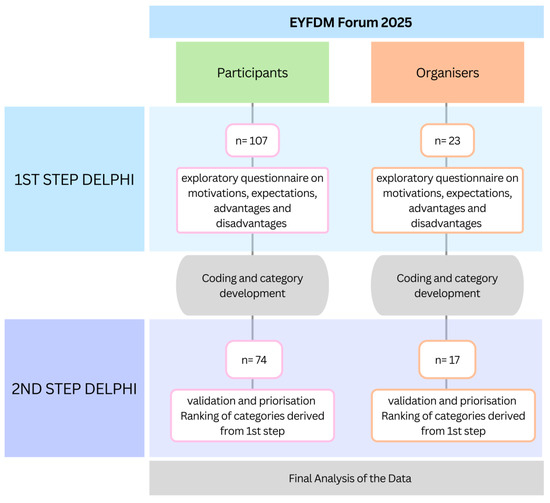
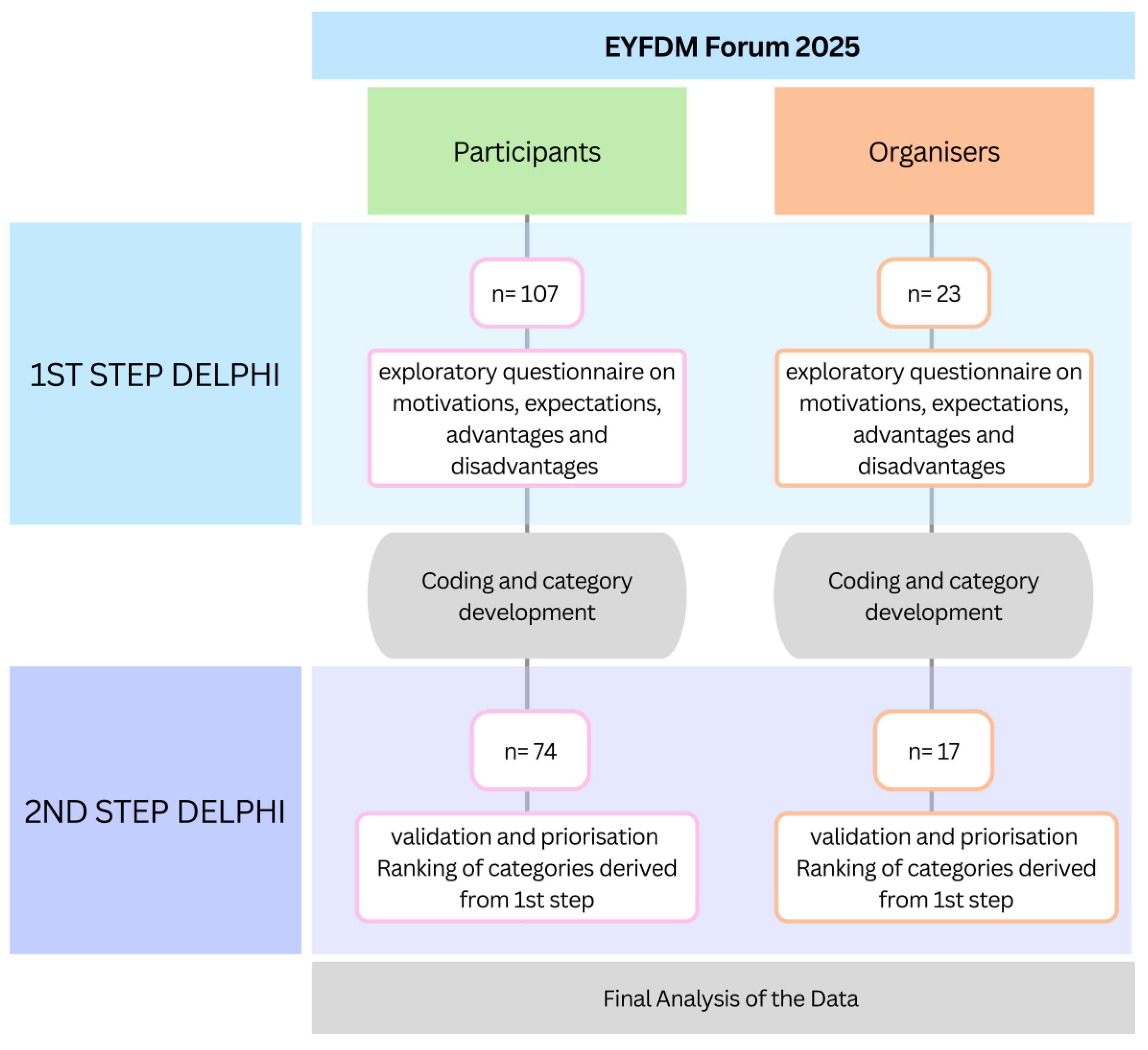
The second round was conducted online from 24 April to 18 May 2025 and served as the validation and prioritisation stage. Following data analysis from round one, the inductive categories derived from round one responses were used for item generation in round two, which were then validated within the same cohort. Separate online questionnaires were used for both organisers and participants, again with split logic. The survey was adaptive, i.e., it contained follow-up questions based on previous responses, and participation was voluntary. Items could be skipped, resulting in varying response rates for individual questions (see Figure 1). The questionnaire comprised two sections: 1. demographics (1 item, identical for both groups) and 2. ranking tasks (10 or 13 items for participants, 16 items for organisers). A total of 74 participants and 17 organisers responded.
Figure 1.
Individual stages of the modified Delphi study.
2.3. Data Analysis
Quantitative questionnaire data were analysed using Jamovi (version 2.6.26). Descriptive statistics included item-level median and cluster-level median. Ranking analysis was performed using Friedman’s test, with p-values adjusted using the Benjamini–Hochberg false discovery rate (FDR) correction to control for multiple testing. Concordance and consensus analysis was performed using Kendall’s Coefficient of Concordance (W). The degree of consensus (DoC) was defined as strong (≥0.7), moderate (0.3–0.69), or weak (<0.3) [9].
Qualitative questionnaire data from round one were analysed using Kuckartz’s qualitative content analysis. Codes were developed inductively from the data and organised into categories. Categorisation was carried out independently by PV and NW in Microsoft Excel® (version 2411), followed by iterative discussion and consensus-building on 16 April 2025 (researcher triangulation) with the team and external qualitative researchers. The resulting categorisations were then made available to the study participants by incorporation into the second-round questionnaire. The changes were made clearly visible during the consensus process.
3. Results
Study population: The first organiser questionnaire was completed by 23 eligible organisers, of whom 57% were female and 43% male. Most were specialists with less than five years of professional experience (30%), followed GP trainees (26%), specialists with >5 years of professional experience (17%), undergraduate medical students (13.0%) and academic staff from GP departments (13%).
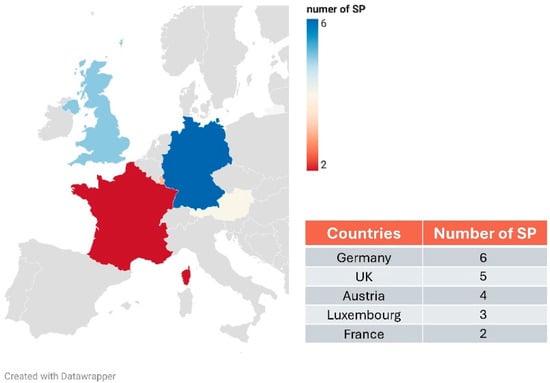
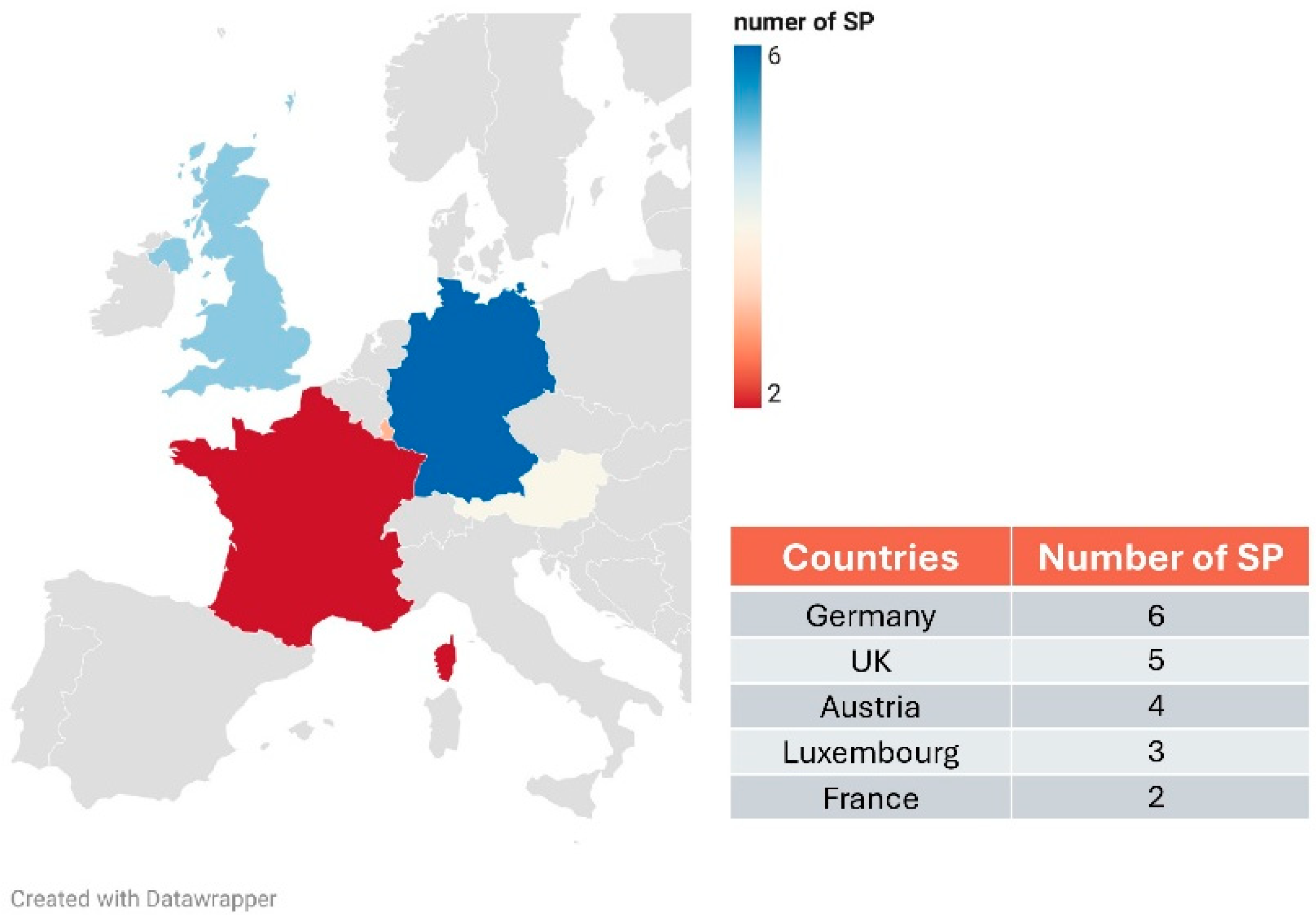
The age range was 24 to 42 years (mean 32.5 years). Participants represented six European countries. Of these, people working in Germany were the largest group (30%), followed by the UK (25%), Austria (20%) Luxembourg (15%) and France (10%) (see Figure 2).
Figure 2.
Countries represented by the organising team.
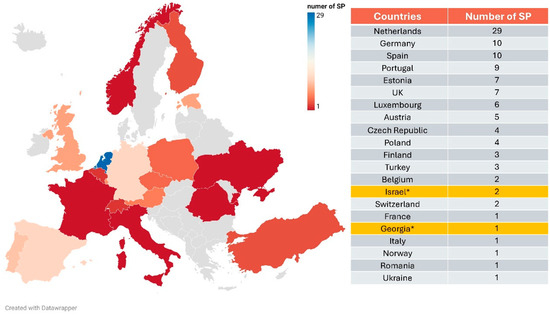
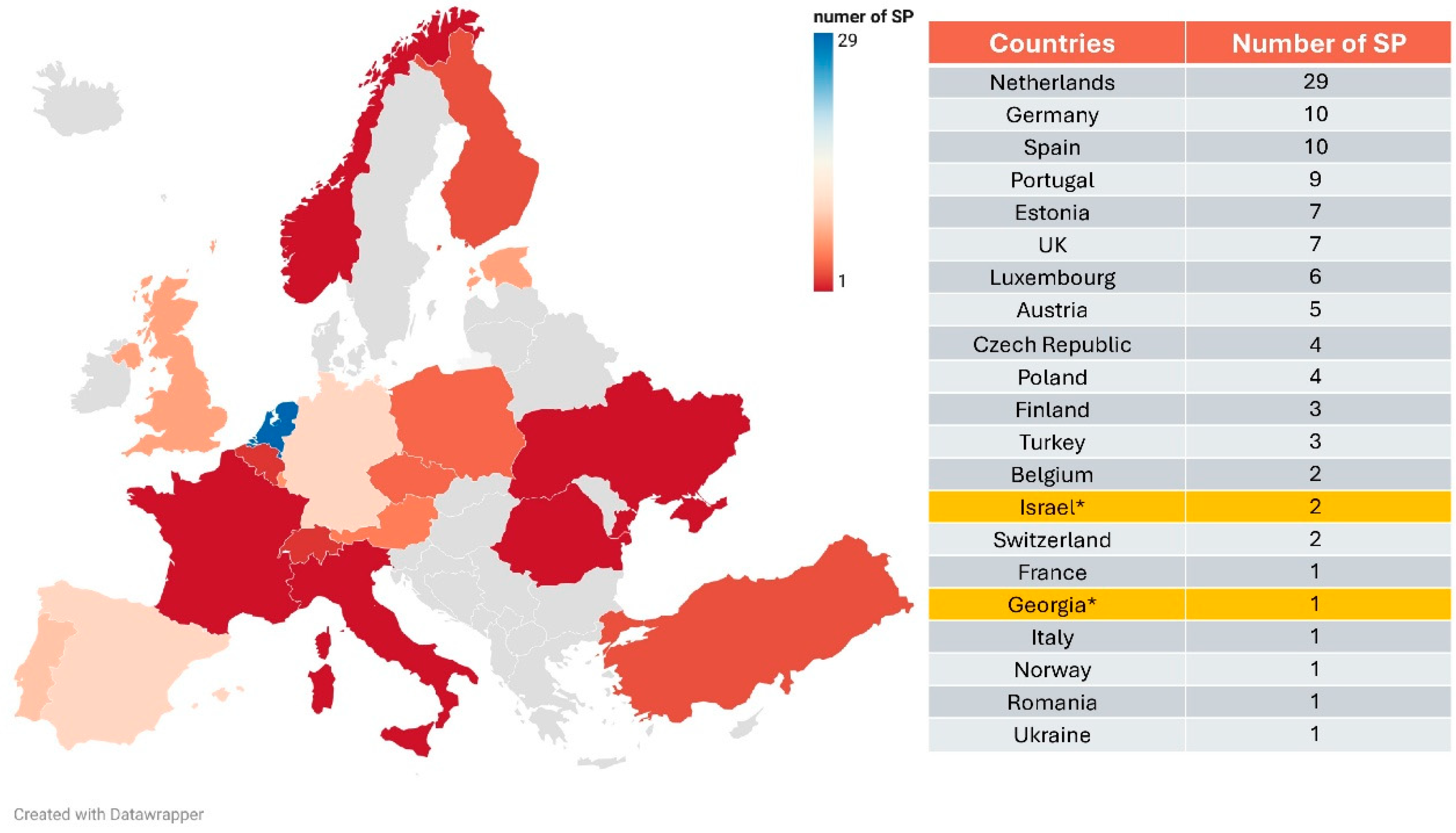
The first participant questionnaire was completed by 107 eligible congress attendees; two were excluded for not being affiliated with FM (109 completed surveys). Most respondents were female (77% vs. 23%). Most were GP specialists with less than five years of professional experience (26%), followed by GP trainees (61%) and GP specialists with more than five years of experience (13%). The age range was 26 to 54 years (mean 33.2 years). A total of 21 countries were represented in the study (19 within Europe, Israel, and Georgia). Of these, people working in the Netherlands were the largest group (27%), followed by Spain and Germany (each 9%) (see Figure 3).
Figure 3.
Countries represented by the conference participants (* Israel and Georgia are not shown in this map of Europe).
In the validation questionnaire, 74 participants and 17 organisers participated.
3.1. Results of the First Questionnaire: Conference Organisers
Motivations for involvement: The most frequently stated reasons for being involved in conference organisation clustered around the themes of intrinsic motivation and social contribution. Many expressed an interest in organising (26.1%) the event itself and in learning (21.7%) from the experience, reflecting intrinsic personal interest, such as “I like organising […]” (OQ1, SP23). A second major theme related to community engagement, particularly building connections (47.8%) and contributing as “helping hands” (34.8%). Career-oriented motives such as leadership skills or expanding the outreach of the event were mentioned less frequently (both < 14%).
Perceived positive impact: Many conference organisers (65.6%) reported positive outcomes for themselves personally or for their careers as a result of their involvement. The most commonly mentioned benefits included gaining experience (26.1%) in organising events, providing guidance in organisational processes and developing project management skills (21.7% each), as well as opportunities for social engagement and teamwork (17.4% each). Some organisers also referred to improved well-being (4.4%) related aspects, as reflected in one comment “mental health was the most important factor” (OQ2, SP6).
Reported challenges: In addition to the positive aspects, some conference organisers (34.8%) described negative emotions. These included feelings of irrelevance, as in “A congress is a short-term event, I will have no benefit […]” (OQ2, SP16), as well as a heavy workload and a lack of financial compensation.
3.2. Results of the First Questionnaire: Conference Participants
Reasons for participation: Conference participants identified networking (56.1%) as the primary reason for participating in the upcoming IPC. This theme included references to connection and exchange to “connect[ing] and share[ing] ideas with other young doctors” (PQ1, SP24). Participation was also viewed as a learning opportunity (18.7%) and as a form of re-engagement (10.3%). Other themes, including community, internationality, interest, and enjoyment were mentioned less frequently (4.7–11.2%).
Expectations and Hopes: Participants’ expectations mainly related to socialising (44.9%) and gaining new input (32.7%), particularly through exposure to new perspectives and knowledge. These responses included the opportunity “to learn new things […]” (PQ2, SP6) and to get together. Intercultural curiosity (14.0%) was also mentioned, whereas other categories such as feeling the EYFDM spirit, getting inspire(d), scientific value and sharing experiences were less common (<5%).
Online Conferences: Out of the 107 participants, six preferred an online forum, mentioning reasons such as convenience, personal life circumstances and travel issues.
Preference for an in-person conference: The vast majority of participants (n = 101) expressed a preference for in-person conference attendance. The main reason was the value placed on interpersonal interaction (71.0%), underscoring the importance of direct human connection, for example to “engage with […] many people” (PQ4, SP1). Other reasons (e.g., trip abroad, authentic experience, motivation, focus, fun) were mentioned by fewer than 10%.
3.3. Results of the Validation Questionnaire: Conference Organisers
The prioritisation data from the organiser group showed differing levels of consensus across the nine rankings (Ranking of Organisers, RoO1-RoO12). In the first three rankings (MR-O: RoO1-RoO3), which addressed overall motives, the DoC was low (adj_p > 0.05, W ≤ 0.128). Despite this, items such as organising, learning, helping hands, and amusement were still individually rated as important (iMd ≤ 2), indicating personal relevance despite limited group-level agreement.
In RoO4-RoO7 (BE, IPC-O), the results were more distinct, with a medium level of consensus (adj_p < 0.05, W = 0.263–0.585). Organisers consistently prioritised experience, project management, and teamwork (all iMd ≤ 2). Among negative aspects, workload emerged as the most influential factor (BE, RoO6), showing the highest overall consensus (W = 0.585).
In RoO7-RoO12 (IPC-O, OC), motivational aspects such as interpersonal interactions and traveling were identified as the most valued benefits of interprofessional collaboration, with both rated as highly important (iMd = 1). Preferences for online formats were mainly linked to accessibility (iMd = 1). For further information, see Table 1.
Table 1.
DoC in 12 different rankings of the validation questionnaire. MR-O: Main Reason Organisers, BE: Benefits and Effects, IPC-O: IPC Preferences Organisers, OC: Online Conference Preferences (Full list of codes in the Supplementary Materials).
3.4. Results of the Validation Questionnaire: Conference Participants
The questionnaire included nine prioritisation ratings (Ranking of Participants, RoP1-RoP9). Friedman’s test revealed a generally clear ranking of key issues, with the exception of RoP4 (HE), where no significant consensus was observed (adj_p = 0.668; all others adj_p > 0.05). The DoC varied substantially across the different rankings.
The strongest agreement was found for RoP8 (IPC-P, W = 0.654), followed by RoP2 (MR-P, W = 0.503) and RoP1 (MR-P, W = 0.472). These results point to a moderate group-level preference for workshops as a popular conference activity (iMd = 1), as well as for community, networking, inspiration, and self-improvement (all iMd = 2), suggesting these as central motives for attending a congress.
In contrast, RoP5 and RoP6 showed lower levels of consensus (HE, W = 0.229–0.315), indicating more diverse expectations. Still, the individual desire to “feel the spirit” of the event remained evident (iMd = 1).
The lowest consensus was observed for RoP7 (IPC-P, W = 0.138) and RoP9 (IPC-P, W = 0.088), both related to preferences regarding interprofessional collaboration. Despite the weak agreement, interpersonal and authentic experiences were still ranked as most relevant (iMd = 2), underscoring their perceived value across participants. For more information, see Table 2.
Table 2.
DoC in nine different rankings of the validation questionnaire. MR-P: Main Reason Participants, HE: Hopes and Expectations, IPC-P: IPC Preferences Participants (Full list of codes in the Supplementary Materials).
4. Discussion
The social core of IPCs: Young GPs value IPCs mainly for networking and authentic exchange, rather than for formal knowledge transfer. Organisers emphasise personal growth and teamwork, but they report struggles with high workload and limited recognition by supervisors. Although online formats may improve accessibility, they appear to offer less interpersonal depth or perspective exchange. The findings should be interpreted with caution given the likely participant bias, and broader samples may provide a more nuanced picture.
IPCs facilitate the development of professional and social relationships, by enabling informal exchange. The literature suggests that such interactions, occurring during workshops, breaks or social activities, provide benefits beyond knowledge transfer, including greater well-being and reduced burnout [1,3,10]. These interpersonal dimensions are difficult to replicate in online settings reinforcing the particular distinct value of IPCs.
Participants appreciate the low-threshold opportunities for networking [1,4], inspiration, and belonging, while organisers emphasise outcomes such as project management and leadership experience. In this sense, conference organisation itself functions as a form of postgraduate education. However, intrinsic motivation and team cohesion are often necessary to sustain engagement when structural support or recognition is limited.
Both this study and the existing literature suggest that online conferences may improve accessibility (e.g., family duties, mobility or travel constraints) [5,11], but they may lack interpersonal depth due to physical distance [3]. Hybrid formats may help balance reach and interaction when structured around active elements, such as small-group workshops or networking sessions. They should, however, be considered complementary rather than a replacement for IPC.
Organisational challenges and future impact: Organisers often cite heavy workload and limited recognition [2], raising broader concerns regarding the sustainability of medical conferences. When organisational work remains unpaid or insufficiently recognised, frustration and disengagement may follow even with high intrinsic motivation. While a strong team spirit can maintain commitment, institutional recognition and financial resources are needed to ensure long-term quality and prevent overload.
Young GPs favour interactive formats, especially workshops and hands-on sessions, which may therefore be more valuable than passive lectures [8]. Effective conference design must allocate sufficient time and space for informal exchange (e.g., networking sessions, meet-ups, social activities). Institutions need to provide sustainable financial support to ensure quality and protect organisers well-being. While hybrid elements can extend access and reduce travel demands [11], IPCs should remain to support building international networks and initiating collaboration.
Limitations and further research needs: Because the sample is centred on EYFDM Forums, self-selection bias towards IPC-positive attitudes cannot be excluded. Individuals who choose to attend or organise IPCs may already have placed comparatively high personal value on certain aspects, such as interpersonal exchange or international networking. Moreover, the organiser sample was relatively small (n = 23 round 1; n = 17 round 2), which limits the robustness of subgroup analyses and calls for a cautious interpretation of the ranking results. Divergent rankings were retained as reflecting the heterogeneity of views within the study sample rather than resolved through an additional Delphi round. Several members of the research team were familiar with the EYFDM Forums, which supported contextual understanding but may also have influenced the interpretation. Cultural and national expectations were not analysed in detail, which may restrict transferability. Future research should explore the long-term effects of IPC attendance and organisation for professional development, networking, and cross-border collaboration, as well as considering hybrid design features that most effectively maintain interpersonal value.
5. Conclusions
In-person conferences remain crucial for young GPs in Europe, primarily for networking, informal exchange, and shared experiences. Organisers gain personal development and growth of professional identity formation, but workload and limited recognition can hinder engagement. To support organisers, institutions should provide financial backing, reduce administrative burden, and actively facilitate networking opportunities. While digital and hybrid formats enhance accessibility, they cannot replace the interpersonal depth of in-person meetings. Future conference planning should combine efficient knowledge transfer online with structured interactive in-person sessions to strengthen community and collaboration.
Supplementary Materials
The following supporting information can be downloaded at: https://www.mdpi.com/article/10.3390/ime5020039/s1, Table S1: Categories & topics of the rankings for organisers & participants.
Author Contributions
N.W., P.V. and F.D. created the questionnaire for the participants. N.W. and P.V. analysed the quantitative data afterwards. The qualitative data after round one of the Delphi approach were evaluated by N.W. and P.V. The first draft of the manuscript was written by N.W., F.D. and P.V. It was revised and linguistically improved by S.V.-W., D.G., A.K., S.H., C.B., S.J., S.D., A.M., T.S., L.Z., M.M., A.P. and F.D. F.D., the corresponding author, was also the one who provided overall coordination. He also led the submission process. All authors have read and agreed to the published version of the manuscript.
Funding
There was external funding for the combination of an interregional study and the Forum 2025 from the Saarland University Internationalisation Fund. Publication was supported by Saarland University.
Institutional Review Board Statement
Ethical approval was granted on 24 June 2024 by the Saarland Ethics Committee (Bu 234/20, Germany).
Informed Consent Statement
Informed consent was obtained from all subjects involved in the study.
Data Availability Statement
The datasets used and/or analysed during the current study are available from the corresponding author upon reasonable request.
Conflicts of Interest
No external influence was exerted on the study design, planning, data collection, or evaluation. Only members of the study team and the Department of Family Medicine at Saarland University in Homburg (Germany) were involved in all processes. The authors have been involved in the organisation of EYFDM Forums. F.D. is part of the WONCA World executive committee, world young doctor (WONCA) representative. A.P. is part of the WONCA Europe executive committee. D.G. is EYFDM regional president. L.Z. and F.D. are national EYFDM council members.
Abbreviations
| adj_p | adjusted p-values |
| BE | Benefits and Effects |
| cMd | cluster-level median |
| DoC | Degree of Consensus |
| EYFDM | European Young Family Doctors’ Movement |
| FDR | False Discovery Rate |
| FM | Family Medicine |
| GPs | General Practitioners |
| IPC-O | IPC Preferences Organisers |
| IPC-P | IPC Preferences Participants |
| iMd | item-level median |
| IPC | In-Person Conference |
| MR-O | Main Reason Organisers |
| OC | Online Conference Preferences |
| OQ | Organisers Qualitative question |
| PQ | Participants Qualitative question |
| RoO | Ranking of Organisers |
| RoP | Ranking of Participants |
| SP | study participants |
| W | Kendall’s Coefficient of Concordance |
References
- Acuña Mora, M.; Borregaard, B. From networking to knowledge sharing: Cracking the code of scientific conferences. Eur. J. Cardiovasc. Nurs. 2024, 23, e28–e30. [Google Scholar] [CrossRef] [Scilit] [PubMed]
- Zoccali, C.; Mallamaci, F. The crisis of medical congresses and the future ahead. J. Nephrol. 2024, 37, 207–214. [Google Scholar] [CrossRef] [Scilit] [PubMed]
- The Lasting Value of Attending Medical Conferences in Person in a Post-COVID World; Elevate-Derm: Macon, GA, USA, 2023.
- The Value of Conferences in Scientific Collaboration; Lab Manager: Midland, ON, Canada, 2023.
- Ram, S.S.; Stricker, D.; Pannetier, C.; Tabin, N.; Costello, R.W.; Stolz, D.; Eva, K.W.; Huwendiek, S. Voices of conference attendees: How should future hybrid conferences be designed? BMC Med. Educ. 2024, 24, 393. [Google Scholar] [CrossRef] [Scilit] [PubMed]
- Kemple, T. What’s the value of annual medical conferences? Br. J. Gen. Pract. 2025, 75, 222–223. [Google Scholar] [CrossRef] [Scilit] [PubMed]
- Gattrell, W.T.; Barraux, A.; Comley, S.; Whaley, M.; Lander, N. The Carbon Costs of In-Person Versus Virtual Medical Conferences for the Pharmaceutical Industry: Lessons from the Coronavirus Pandemic. Pharm. Med. 2022, 36, 131–142. [Google Scholar] [CrossRef] [Scilit] [PubMed]
- Junge, H.; Poppleton, A.; Sun, S.; Janos, S.; Dupont, F. What competencies do European general practice trainees value the most? A prioritisation exercise using a Delphi-informed approach. Educ. Prim. Care 2023, 34, 192–198. [Google Scholar] [CrossRef] [Scilit]
- Schmidt, R.C. Managing Delphi surveys using nonparametric statistical techniques. Decis. Sci. 1997, 28, 763–774. [Google Scholar] [CrossRef] [Scilit]
- Zajdela, E.R.; Huynh, K.; Feig, A.L.; Wiener, R.J.; Abrams, D.M. Face-to-face or face-to-screen: A quantitative comparison of conference modalities. Proc. Natl. Acad. Sci. USA 2024, 4, 522. [Google Scholar] [CrossRef] [Scilit] [PubMed]
- Puccinelli, E.; Zeppilli, D.; Stefanoudis, P.V.; Wittische-Helou, A.; Kermorgant, M.; Fuchs, S.; Menot, L.; Easton, E.E.; Weber, A.A. Hybrid conferences: Opportunities, challenges and ways forward. Front. Mar. Sci. 2022, 9, 902772. [Google Scholar] [CrossRef] [Scilit]

Disclaimer/Publisher’s Note: The statements, opinions and data contained in all publications are solely those of the individual author(s) and contributor(s) and not of MDPI and/or the editor(s). MDPI and/or the editor(s) disclaim responsibility for any injury to people or property resulting from any ideas, methods, instructions or products referred to in the content. |
© 2026 by the authors. Published by MDPI on behalf of the Academic Society for International Medical Education. Licensee MDPI, Basel, Switzerland. This article is an open access article distributed under the terms and conditions of the Creative Commons Attribution (CC BY) license.