


Abstract
Pressure projection often limits the scalability of incompressible Navier–Stokes solvers because exact incompressibility requires a globally coupled Poisson solve. We develop Locality-Certified Screened Projection (LCSP), which replaces the classical projection with a screened pressure correction and combines exponentially localized tile solves with face-correction overlap–restrict (FCOR) assembly on a staggered grid. The screening parameter sets the localization length and makes the residual divergence explicit. For a spectrally commensurate class of two-dimensional periodic flows, each patch spans one spatial subperiod, so the assembled local correction reproduces the global screened solution without iterative interface communication. Double-precision tests on and grids give assembly errors below , velocity errors below relative to the classical projection, and compatible-divergence ratios below . Time-dependent tests remain stable to and agree with the global screened reference to roundoff. Communication traces record no inter-rank exchange, collective operation, or global reduction during the local correction, and a fixed-work batch attains a speedup of on four graphics processing units (GPUs). These results establish a mathematically controlled communication-free screened pressure correction for this periodic class.
1. Introduction
Projection methods decouple momentum advancement from incompressibility enforcement. Given a provisional velocity , the classical correction solves a pressure Poisson equation (PPE) and removes the irrotational component through a gradient update [1,2,3,4,5]. The predictor involves local differential stencils, whereas the pressure inverse is nonlocal. In parallel implementations, this global dependence appears as distributed transposes, repeated halo exchanges, coarse-grid synchronization, or Krylov reductions, depending on the elliptic solver [6,7,8,9].
Multigrid, fast Fourier transform (FFT) solvers, and communication-avoiding Krylov methods reduce the cost of the pressure step but retain a globally coupled inverse. Classical Schwarz decompositions likewise require trace iteration or a coarse correction to propagate long-range pressure information [10,11]. Local pressure-correction methods reduce global work by combining local projections with a coarse global component [12]; a one-pass local Poisson solve alone has no intrinsic decay scale and cannot, in general, reproduce a global projection.
Let denote the screening parameter in the modified operator , where I is the identity. If denotes radial distance, its free-space Green function decays exponentially; in two dimensions, it is proportional to and satisfies as [13]. The associated screening length quantifies the range of the pressure response. Helmholtz-type pressure corrections and related incompressibility relaxations have appeared in artificial-compressibility and penalty-projection formulations [14,15,16]. In LCSP, the zero-order term is used specifically to create a controllable localization scale for the pressure correction.
The local screened potentials are differentiated on their patches, and the resulting staggered-face corrections are inserted through FCOR. This construction avoids forming a discontinuous piecewise pressure. Exact local-to-global consistency follows on a spectrally commensurate periodic subspace: each patch spans one complete spatial subperiod, so translation invariance and uniqueness identify the local and global screened solutions. For general boundary perturbations, a discrete barrier estimate quantifies attenuation into the patch interior.
The study addresses how screening changes the pressure-projection operator and when its local corrections can be assembled without iterative inter-tile synchronization. Its contributions are threefold: (i) a screened projection analysis that quantifies divergence filtering, contraction, and convergence to the classical PPE limit; (ii) a compatible marker-and-cell discretization with face-owned FCOR assembly and an exact commensurate local-to-global result; and (iii) static, dynamic, and communication experiments that separate screening error from assembly error and verify the communication pattern of the local correction.
2. Materials and Methods
2.1. Classical and Screened Pressure Corrections
Let be the two-dimensional periodic domain, with side length . At time , , let be the corrected velocity, the provisional velocity produced by the momentum step, and the time-step size. Set . The classical projection is
where is the zero-mean classical pressure potential. The screened potential is denoted by , is the penalty coefficient, and is the screening parameter. LCSP replaces the exact constraint by
which yields
For a Fourier mode ,
Thus, the pressure update is no longer an exact orthogonal projection, but its divergence residual is explicit. Here, and denote the standard Lebesgue and Sobolev spaces, respectively, and is the norm. The following result records well-posedness and the classical limit.
Theorem 1
(Screened filter and Poisson limit). Let and . For every , Equation (3) has a unique periodic solution . Moreover,
where is a frequency cutoff and retains modes with . If ϕ is the zero-mean solution of the classical PPE, then
and hence the screened correction converges to the classical projection in as .
Proof.
The parameter therefore controls both the residual divergence and the localization length.
Corollary 1
(Contractive screened projection). Let . For every nonzero Fourier mode, write , where the two components are orthogonal and the second is parallel to ξ. Then,
Consequently, is self-adjoint, positive, and contractive in , and it converges strongly to the Leray projector as .
Proof.
Substituting into the velocity update shows that the solenoidal component is unchanged and the longitudinal component is multiplied by . The asserted properties follow mode by mode from Parseval’s identity. □
The spectral representation shows that screening replaces the orthogonal projection with a positive contraction: the divergence-free component is unchanged, whereas the gradient component is continuously attenuated. The principal notation used below is summarized in Table 1.
Table 1.
Principal notation used in the formulation and experiments.
2.2. Compatible Marker-And-Cell Discretization and FCOR
Let N be the number of cells in each coordinate direction while is the grid spacing. The pressure correction is cell-centered, while the components of are stored on the corresponding faces of a marker-and-cell (MAC) grid. With periodic indexing,
The compatible discrete screened operator is
with in the periodic grid inner product. Consequently, the exact discrete screened correction satisfies
The domain is decomposed into disjoint cores, each enlarged by a halo. A periodic screened problem is solved on every patch. Rather than restricting cell-centered pressure, FCOR differentiates the local potential and assigns every global velocity face to a unique core:
where selects the faces owned by patch p and inserts them in the global staggered field. The local solves and the face insertion require neither trace iteration nor a global reduction.
2.3. Spectral Commensurability
Define
whose Fourier support is contained in . On a grid with N divisible by 16, let be the core width in cells, r the halo width in grid layers, and the patch width. The decomposition is
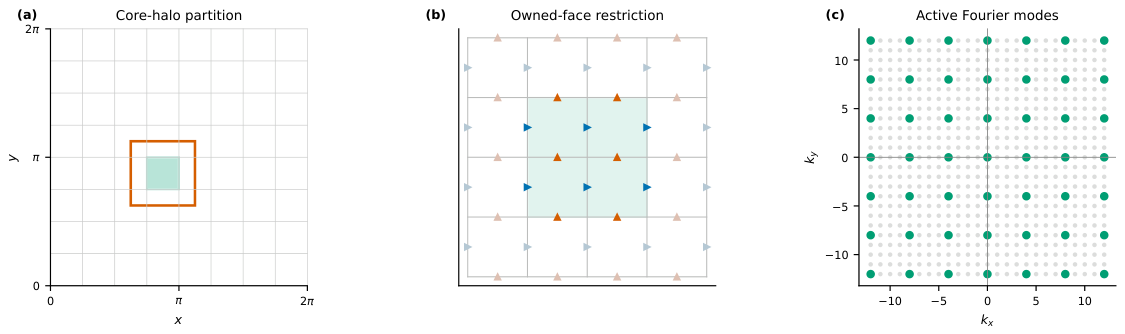
The patch width is therefore , exactly one period of (13); the two-dimensional overlap redundancy is four. Figure 1 summarizes the geometry, staggered-face ownership, and active Fourier lattice.
Figure 1.
Commensurate decomposition used in the analysis. (a) An core partition with one highlighted core and its periodic halo patch. (b) Unique ownership of staggered velocity faces in the FCOR update. (c) Fourier modes of the invariant subspace .
Let denote translations of cell arrays by entries in the coordinate directions, and let denote the corresponding shifts of staggered face arrays. The discrete invariant spaces are
Proposition 1
(Exact commensurate assembly). If , each -cell periodic patch uses the same compatible stencil and grid spacing as the global problem, and the patch right-hand side is obtained by periodic extraction, then every local screened potential equals the corresponding restriction of the global screened potential. The FCOR velocity correction is therefore identical to the global screened correction in exact arithmetic.
Proof.
The compatible operators commute with the -cell translations:
If , uniqueness gives . Opposite traces of every -cell segment therefore agree. The restriction of the global solution satisfies the local wraparound equations, and coercivity of gives uniqueness on each patch. The local face gradients coincide with the global gradient, and unique face ownership inserts every correction exactly once. □
2.4. Localization Outside the Commensurate Class
For a cut rectangular patch with prescribed boundary data, a standard discrete barrier argument supplies an explicit decay estimate [17].
Proposition 2
(Discrete interior localization). Let be the difference between the local and global screened solutions on patch p, with in the patch interior. If its core lies at least r grid layers from the artificial boundary and , then
Proof.
For a translated patch , where and are its side lengths, set
Then, on the boundary, in the core, and the stated condition gives . The discrete maximum principle applied to proves the estimate. □
Combining Equation (17) with the stencil estimate gives the a priori budget
The first term is the screened-projection residual and the second is the propagated artificial-boundary error; denotes the discrete area of core . Their balance links the screening strength to the required physical overlap.
2.5. Numerical Experiments
The experiments use , the compatible MAC operator, , 64-bit floating-point (FP64) arithmetic, and the geometry in (14). Static tests comprise phase-shifted single modes, mixed modes, and spectrally generated fields at and 1024. Dynamic tests use a wavenumber-four Taylor–Green vortex and a forced two-mode vortex lattice with kinematic viscosity ; both are evolved to the final time by a projected second-order Runge–Kutta method. Global periodic FFT solves provide the classical and screened references.
For a grid field q and a staggered velocity , define the RMS norms
The reported quantities are the relative assembly error , the total error , and the compatible-divergence ratio . The interface diagnostic measures the FCOR–global-screened assembly discrepancy in a two-cell strip surrounding core interfaces. Further details of the time discretization and test fields are collected in Appendix A.
3. Results
3.1. Static Consistency
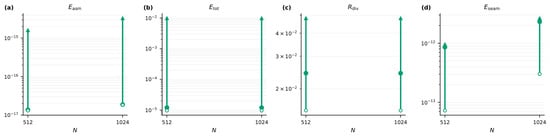
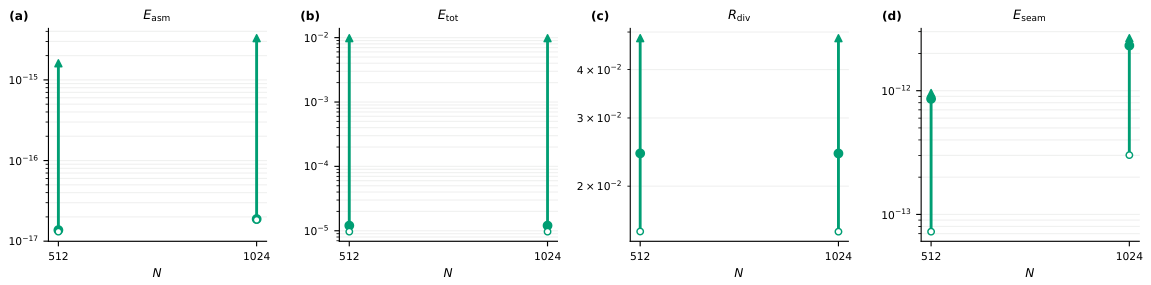
Figure 2 summarizes the FP64 errors over the static test set. The assembly error remains at roundoff, with a maximum of . The maximum velocity error relative to the classical projection is , whereas the compatible-divergence ratio remains below . The seam error is at most . Within , the observed discrepancy is therefore governed by the screened relaxation rather than by overlap assembly.
Figure 2.
Static FP64 accuracy at and 1024. Vertical segments show the range over all phase-shifted and mixed-mode states; circles and triangles denote the median and maximum, respectively. (a) Assembly error . (b) Total velocity error relative to the classical projection. (c) Compatible-divergence ratio . (d) Interface seam error .
The maximum static and dynamic errors are summarized in Table 2.
Table 2.
Maximum errors in the static and dynamic experiments. Energy and enstrophy deviations are measured relative to the global screened trajectory.
3.2. Dynamic Periodic Flows
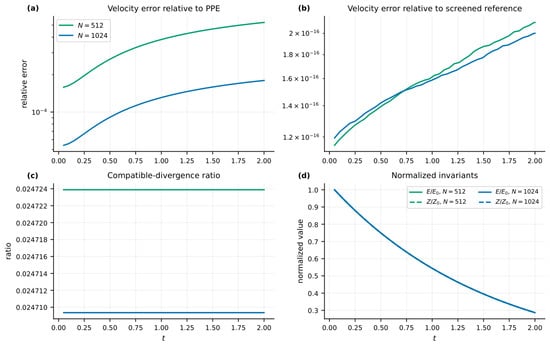
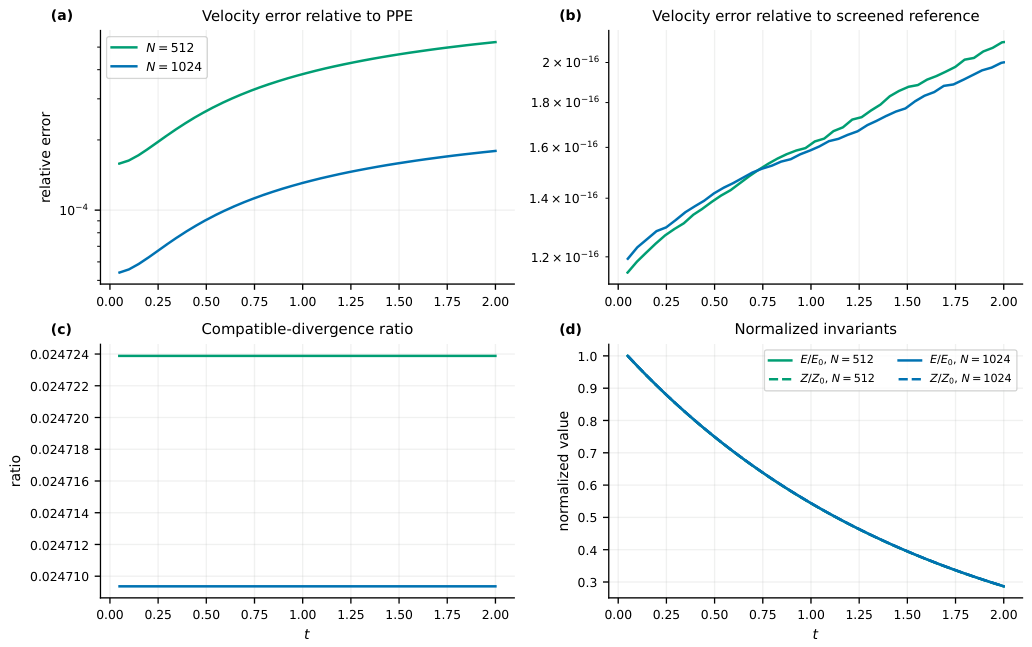
All Taylor–Green and forced two-mode trajectories reach without a global pressure reset. In the Taylor–Green tests, the FCOR and global screened trajectories remain indistinguishable to roundoff, while their difference from the classical projection reflects the prescribed screened relaxation. Figure 3 shows the velocity errors, compatible-divergence ratio, and decay of kinetic energy and enstrophy for and 1024. Spectral power outside remains below , consistent with invariance of the commensurate subspace.
Figure 3.
Wavenumber-four Taylor–Green evolution to . (a) Relative velocity error with respect to the classical PPE projection. (b) Relative velocity error with respect to the global screened reference. (c) Compatible-divergence ratio. (d) Normalized kinetic energy and enstrophy . The FCOR correction remains at roundoff relative to the global screened reference; energy and enstrophy are normalized by their first recorded values.
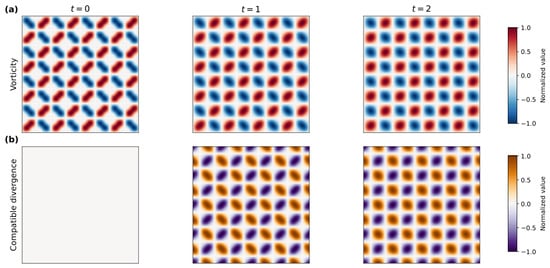
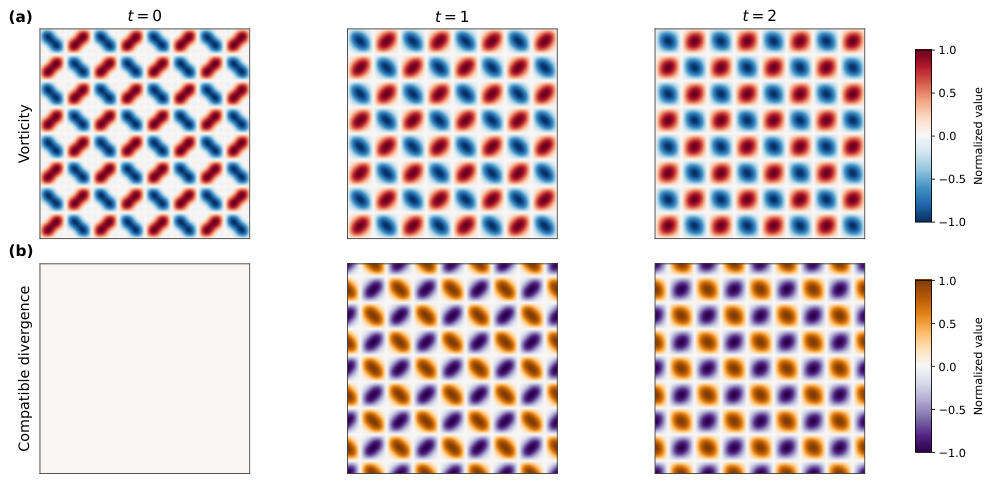
The forced two-mode lattice provides a nonstationary test within the same Fourier sublattice. Its vorticity decays smoothly while the divergence retains the expected screened pattern (Figure 4). The maximum velocity difference between FCOR and the global screened reference is again at roundoff, confirming the preservation of the invariant Fourier sublattice by the nonlinear, forced discrete evolution.
Figure 4.
Forced two-mode vortex lattice at . (a) Vorticity and (b) compatible divergence at , 1, and 2. Each nonzero snapshot is normalized by its own norm to preserve spatial contrast; the absolute vorticity maxima are , , and , while the divergence maxima at and 2 are and . Diverging color maps are centered at zero.
3.3. Communication and Parallel Execution
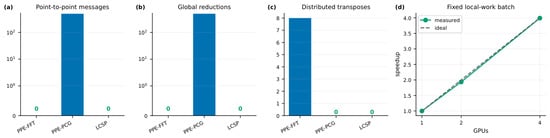
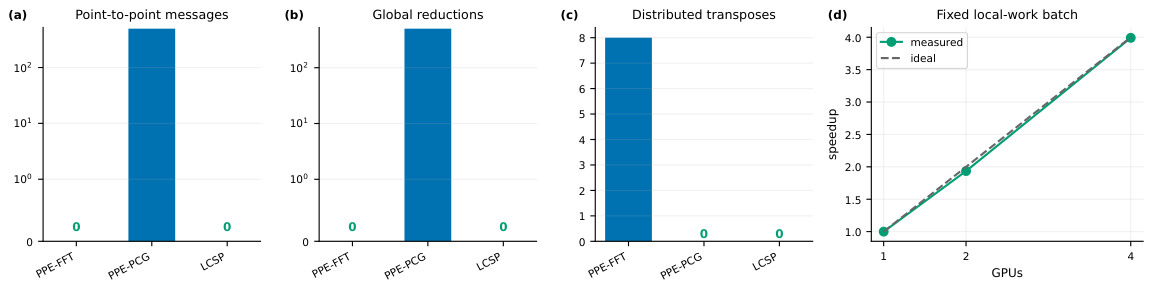
Communication tracing of the local pressure correction records no point-to-point message, collective operation, distributed transpose, global reduction, or trace exchange. An independent system-level trace confirms this result. Figure 5 contrasts this execution pattern with representative distributed FFT and preconditioned conjugate-gradient (PCG) pressure solves. On a fixed batch of 256 local patches, the measured speedups on one, two, and four graphics processing units (GPUs) are , , and , corresponding to a four-GPU efficiency of .
Figure 5.
Communication structure and local-work throughput. Panels (a–c) report measured rank-summed communication counts for representative four-GPU pressure solves; the LCSP correction contains no inter-rank operation. Panel (d) shows the measured speedup of a fixed 256-patch batch on a single four-GPU host.
The timing interval begins after patch formation and ends after face insertion; momentum prediction and patch formation are excluded.
3.4. Noncommensurate Comparison
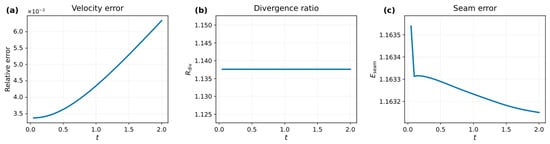
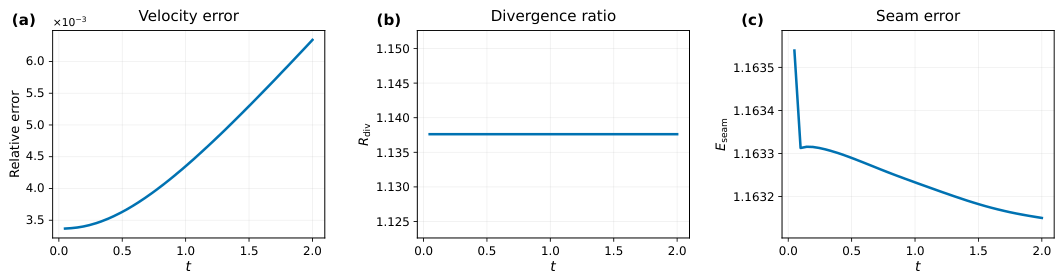
A wavenumber-one Taylor–Green trajectory uses the same grid, screening parameter, and patch geometry but does not belong to . Its periodic patch traces are not equivalent. Figure 6 shows the resulting separation from the global screened solution: the final compatible-divergence ratio is , and the seam error is approximately . The comparison marks the limit of exact periodic-patch equivalence. Proposition 2 controls prescribed boundary perturbations, but it does not make incompatible periodic wraparound data consistent.
Figure 6.
Wavenumber-one Taylor–Green comparison outside . (a) Velocity error relative to the global screened reference, (b) compatible-divergence ratio, and (c) seam error. The local periodic patches no longer reproduce the global screened correction.
4. Discussion
Two distinct mechanisms govern the local error. Screening provides exponential decay for general boundary perturbations, as expressed by (17), while spectral commensurability yields exact periodic patch equivalence. The near-roundoff assembly errors arise from the second mechanism and are therefore a commensurability result, not an observed generic overlap-convergence rate.
The screened projection also exposes a fundamental trade-off. From (11), decreasing brings the corrected velocity closer to the strictly divergence-free projection. At the same time, the localization length increases, and the admissible decay exponent in (17) decreases. A practical choice of and overlap must therefore balance the global screening residual against the artificial-boundary contribution. In the commensurate class, the latter vanishes algebraically, allowing this trade-off to be observed without interface contamination.
The noncommensurate comparison in Figure 6 isolates the role of the periodic sublattice and indicates where additional interface treatment is required.
The parallel result follows from the operator decomposition rather than from a particular iterative acceleration. Each local screened problem is coercive and independent; FCOR inserts each face once. Consequently, the correction has no iterative communication path. The present measurements establish this property on a single multi-GPU node. Extension to nonperiodic boundaries, noncommensurate spectra, and multi-node flow simulations requires additional numerical and performance analysis.
5. Conclusions
LCSP replaces the globally coupled pressure Poisson correction by a screened problem with an intrinsic localization length. A compatible MAC discretization and face-owned overlap–restrict assembly convert the pressure update into independent local solves. For the spectrally commensurate two-dimensional periodic class studied here, translation invariance makes the assembled correction identical to the global screened solution up to roundoff. The dynamic tests preserve this equivalence, while communication traces confirm that the local correction contains no inter-rank exchange or global synchronization. This construction makes the balance between incompressibility accuracy and spatial locality explicit and removes communication from the local screened correction.
Author Contributions
Conceptualization, J.X., Z.-A.Y. and Q.W.; methodology, J.X.; software, J.X.; validation, J.X.; formal analysis, J.X.; investigation, J.X.; writing—original draft, J.X.; writing—review and editing, J.X., Z.-A.Y. and Q.W.; supervision, Z.-A.Y. and Q.W. All authors have read and agreed to the published version of the manuscript.
Funding
This research was supported by the National Key Research and Development Program of China, Grant Number 2020YFA0712501; the Research and Development Project of Pazhou Lab (Huangpu), Grant Number 2023K0601.
Institutional Review Board Statement
Not applicable.
Informed Consent Statement
Not applicable.
Data Availability Statement
The numerical data and implementation materials supporting the reported results are available from the corresponding author upon reasonable request.
Conflicts of Interest
The authors declare no conflicts of interest. The funders had no role in the design of the study; in the collection, analysis, or interpretation of data; in the writing of the manuscript; or in the decision to publish the results.
Abbreviations
The following abbreviations are used in this manuscript:
| FCOR | Face-correction overlap–restrict | FFT | Fast Fourier transform |
| FP64 | 64-bit floating-point arithmetic | GPU | Graphics processing unit |
| LCSP | Locality-Certified Screened Projection | MAC | Marker-and-cell |
| PCG | Preconditioned conjugate gradient | PPE | Pressure Poisson equation |
| RMS | Root-mean-square |
Appendix A. Numerical Specification
Appendix A.1. Projected Second-Order Time Integration
With centered differences and the periodic five-point Laplacian, the semidiscrete momentum operator is
Writing for the chosen pressure correction, the projected Heun step is
All dynamic experiments use , , and a time step satisfying both advective and explicit diffusive stability bounds.
Appendix A.2. Flow Fields
The wavenumber-k Taylor–Green initial condition is
with in the primary experiments. The forced case combines wavenumbers four and eight,
where the phases are chosen so that the exact state remains in . The body force is constructed from the compatible discrete momentum equation and applied identically to each projection method.
Appendix B. Supplementary Numerical Comparisons
Direct Pressure Restriction
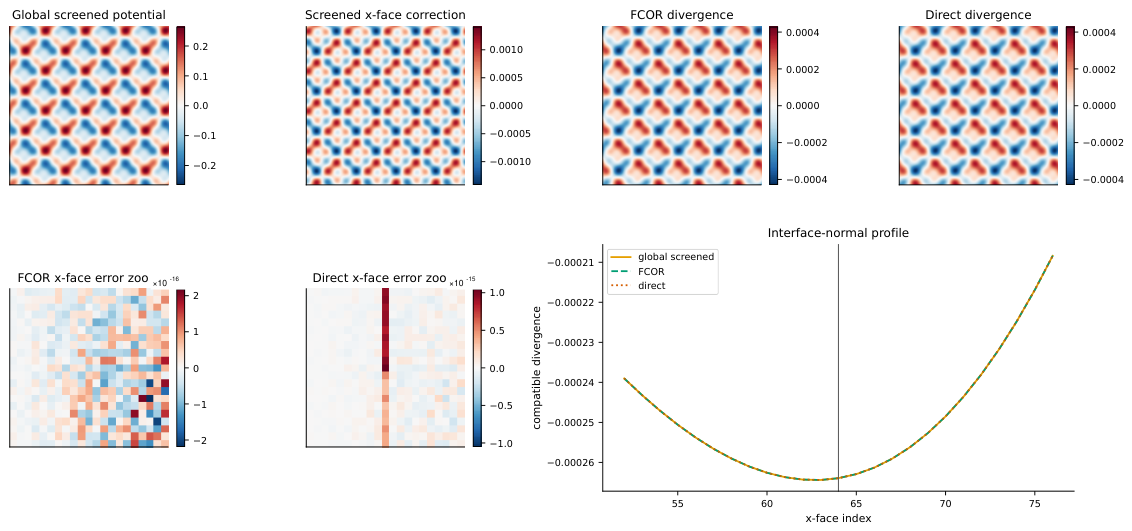
Figure A1 compares direct restriction of the local pressure with FCOR for a representative commensurate state. Both approaches are near roundoff in , although FCOR retains the structural advantage of assembling a single compatible correction on each staggered face.
Figure A1.
Direct pressure restriction and face-owned FCOR for a representative commensurate state. Divergence panels use common limits; face-error panels use their own symmetric near-roundoff scales.
References
- Chorin, A.J. Numerical solution of the Navier–Stokes equations. Math. Comp. 1968, 22, 745–762. [Google Scholar] [CrossRef]
- Temam, R. Sur l’approximation de la solution des équations de Navier–Stokes par la méthode des pas fractionnaires. II. Arch. Ration. Mech. Anal. 1969, 33, 377–385. [Google Scholar] [CrossRef] [Scilit]
- Kim, J.; Moin, P. Application of a fractional-step method to incompressible Navier–Stokes equations. J. Comput. Phys. 1985, 59, 308–323. [Google Scholar] [CrossRef] [Scilit]
- Brown, D.L.; Cortez, R.; Minion, M.L. Accurate projection methods for the incompressible Navier–Stokes equations. J. Comput. Phys. 2001, 168, 464–499. [Google Scholar] [CrossRef] [Scilit]
- Guermond, J.-L.; Minev, P.; Shen, J. An overview of projection methods for incompressible flows. Comput. Methods Appl. Mech. Eng. 2006, 195, 6011–6045. [Google Scholar] [CrossRef] [Scilit]
- Ament, M.; Knittel, G.; Weiskopf, D.; Straßer, W. A parallel preconditioned conjugate gradient solver for the Poisson problem on a multi-GPU platform. In Proceedings of the 18th Euromicro Conference on Parallel, Distributed and Network-Based Processing, Pisa, Italy, 17–19 February 2010; pp. 583–592. [Google Scholar] [CrossRef] [Scilit]
- Zolfaghari, H.; Obrist, D. A high-throughput hybrid task and data parallel Poisson solver for large-scale simulations of incompressible turbulent flows on distributed GPUs. J. Comput. Phys. 2021, 437, 110329. [Google Scholar] [CrossRef] [Scilit]
- Xie, J.; He, J.; Bao, Y.; Chen, X. A low-communication-overhead parallel DNS method for the 3D incompressible wall turbulence. Int. J. Comput. Fluid Dyn. 2021, 35, 413–432. [Google Scholar] [CrossRef] [Scilit]
- Ghosh, S.; Lu, J.; Gupta, V.; Tryggvason, G. Communication-efficient algorithms for solving pressure Poisson equation for multiphase flows using parallel computers. PLoS ONE 2022, 17, e0277940. [Google Scholar] [CrossRef] [Scilit] [PubMed]
- Toselli, A.; Widlund, O.B. Domain Decomposition Methods: Algorithms and Theory; Springer: Berlin/Heidelberg, Germany, 2005. [Google Scholar] [CrossRef] [Scilit]
- Dolean, V.; Jolivet, P.; Nataf, F. An Introduction to Domain Decomposition Methods: Algorithms, Theory, and Parallel Implementation; SIAM: Philadelphia, PA, USA, 2015. [Google Scholar] [CrossRef] [Scilit]
- Kaya, U.; Becker, R.; Braack, M. Local pressure-correction for the Navier–Stokes equations. Int. J. Numer. Methods Fluids 2021, 93, 1199–1212. [Google Scholar] [CrossRef] [Scilit]
- Stakgold, I.; Holst, M.J. Green’s Functions and Boundary Value Problems, 3rd ed.; Wiley: Hoboken, NJ, USA, 2011. [Google Scholar] [CrossRef] [Scilit]
- Williams, M. Method for calculating incompressible viscous flows. Numer. Heat Transf. B Fundam. 1991, 20, 241–253. [Google Scholar] [CrossRef] [Scilit]
- Shen, J. On error estimates of some higher order projection and penalty-projection methods for Navier–Stokes equations. Numer. Math. 1992, 62, 49–74. [Google Scholar] [CrossRef] [Scilit]
- Jobelin, M.; Lapuerta, C.; Latché, J.-C.; Angot, P.; Piar, B. A finite element penalty–projection method for incompressible flows. J. Comput. Phys. 2006, 217, 502–518. [Google Scholar] [CrossRef] [Scilit]
- Hackbusch, W. Elliptic Differential Equations: Theory and Numerical Treatment, 2nd ed.; Springer: Berlin/Heidelberg, Germany, 2017. [Google Scholar] [CrossRef] [Scilit]

Disclaimer/Publisher’s Note: The statements, opinions and data contained in all publications are solely those of the individual author(s) and contributor(s) and not of MDPI and/or the editor(s). MDPI and/or the editor(s) disclaim responsibility for any injury to people or property resulting from any ideas, methods, instructions or products referred to in the content. |
© 2026 by the authors. Licensee MDPI, Basel, Switzerland. This article is an open access article distributed under the terms and conditions of the Creative Commons Attribution (CC BY) license.