


Abstract
This paper studies a fractal–fractional model of Zika virus transmission using the Atangana–Baleanu and Caputo–Fabrizio operators. We first establish the existence and uniqueness of the model solution and then examine its Hyers–Ulam stability using fixed-point theory. Numerical simulations are presented to study the effects of the fractional and fractal orders on the spread of infection. The results show that the Atangana–Baleanu operator yields a slower decline in infected humans and mosquitoes, while the Caputo–Fabrizio operator yields a faster decline and earlier stabilization. The simulations also show that increasing the fractal order from to leads to a faster reduction in the infected human population. These results show how different memory kernels and fractal orders can influence predicted Zika virus transmission.
Keywords:
Zika virus model; fractal–fractional derivative; Atangana–Baleanu fractional derivative; Mittag-Leffler kernel; Caputo derivative; Hyers–Ulam stability; fixed-point theory; epidemic transmission dynamics MSC:
26A33; 34A08; 34D20; 37N25; 92D30
1. Introduction
The Zika virus [1] is an arthropod-borne disease transmitted mainly by infected Aedes mosquitoes. Researchers first isolated the virus from a rhesus monkey in the Zika Forest of Uganda in 1947 and later identified it in humans in Uganda and Tanzania. For many years, Zika infection was considered relatively mild and received limited attention compared with other mosquito-borne diseases. However, large outbreaks on Yap Island, French Polynesia, and Brazil revealed its potential for rapid transmission and serious health consequences. The clinical manifestations of Zika infection usually include fever, skin rash, conjunctivitis, headache, muscle pain, and joint pain [2,3,4]. In recent years, studies have shown that the virus can also be transmitted through sexual contact, blood transfusion, and from infected mothers to their infants. Of particular concern is the reported association of Zika virus infection with Guillain–Barré syndrome and congenital abnormalities such as microcephaly. Because of its widespread distribution and the lack of a specific treatment, the Zika virus remains a topic of considerable interest in epidemiological and mathematical modeling studies [2,5,6,7,8].
Fractal–fractional (FF) operators are employed to more accurately represent the complex dynamics of Zika virus transmission, including memory effects, population heterogeneity, and long-term trends. Integer-order models frequently overlook these features, whereas fractional models may not adequately capture the fractal structures and irregular temporal patterns characteristic of biological systems. Consequently, we analyze both the Caputo–Fabrizio (CF) and Atangana–Baleanu (AB) FF operators. The CF operator uses a nonsingular exponential kernel, which is well-suited to modeling processes with fading memory and enables efficient computation [9,10,11,12]. In contrast, the AB operator employs the Mittag-Leffler kernel (M-L) [13,14], which more effectively captures the nonlocal effects and long-term memory observed in disease transmission. Because these operators address memory differently, we must evaluate how these differences affect the predictions of Zika virus transmission. We compare the two operators using numerical solutions to assess their accuracy and computational efficiency. This assessment clarifies how different memory kernels affect modeling. It informs the selection of the most appropriate FF framework for the reliable simulation and prediction of Zika virus spread [15,16,17,18,19].
In [20,21], the authors analyzed a new fractal–fractional operational matrix based on orthonormal normalized ultraspherical polynomials to solve the FF Riccati differential equation involving a generalized Caputo derivative. By combining the operational matrix with the spectral Tau method. The authors reduced the nonlinear differential equation to a system of algebraic equations and solved it using Newton’s method. Several test problems and comparisons with existing methods demonstrated the proposed approach’s accuracy and efficiency.
Recent studies have highlighted the value of fractal–fractional methods for analyzing Zika virus dynamics. Khan et al. integrated a FF Zika transmission model with artificial intelligence and neural networks, using simulation data to train and test the network and assess prediction errors [22]. Rezapour et al. introduced an FF M-L model to study the co-infection dynamics of COVID-19 and the Zika virus [23]. They examined the stability of the disease-free equilibrium, proved the existence and uniqueness of solutions and Hyers–Ulam stability, and developed a numerical approximation scheme using Newton polynomials. These findings confirm the effectiveness of FF operators in modeling memory-dependent Zika transmission and support further comparisons of different memory kernels.
Although fractional and FF operators have been increasingly applied to epidemic models, the qualitative analysis of Zika transmission models and direct numerical comparisons of the CF and AB memory kernels remain underexplored. This study develops a FF Zika model to characterize disease transmission between human and mosquito populations. The primary contributions include establishing the positivity and uniform boundedness of the model solutions, identifying a biologically feasible region, and numerically investigating how the fractional order and fractal dimension affect the susceptible and infected populations. Additionally, we compare the FF–CF and FF–AB operators using identical parameter values and initial conditions to elucidate how their distinct memory kernels affect predicted epidemic dynamics. These findings provide a foundation for selecting appropriate FF operators for modeling memory-dependent infectious disease transmission.
The paper is organized as follows. Section 2 presents the preliminary concepts of the fractal–fractional calculus. Section 3 formulates the proposed Zika epidemic model. Section 4 discusses the model’s qualitative properties, and Section 5 presents numerical simulations and discusses the results. Finally, the Section 6 presents the concluding remarks.
2. Preliminaries
This section provides the basic definitions from fractional and fractal–fractional calculus that form the foundation for our model analysis. We include key operators in various senses and recall their integral and derivative forms for later use [17,18,24].
Definition 1
([17,25]). The fractal derivative (Hausdorff derivative) of a function with respect to the fractal measure is defined as
Definition 2
([17,18]). Let be continuous and fractal-differentiable on . The fractal–fractional derivative of order , with fractal dimension , in the Riemann–Liouville sense with a power-law kernel, is given by
where and . Moreover,
Definition 3
([17]). Let be continuous on . The fractal–fractional derivative of order , with fractal dimension , in the Caputo sense with a power-law kernel, is defined as
where and .
Definition 4
([17]). The FF integral of a continuous function of order and fractal dimension in the CF sense is defined by
where , , and is the normalization function satisfying .
Definition 5
([18]). Let be fractal differentiable on . The FF derivative of order and fractal dimension in the CF sense is
where
Definition 6
([18]). Let and suppose that is continuous. Consider the FF Cauchy problem
with and .
Then the equivalent integral equation is
Definition 7
([18]). Let be fractal-differentiable on , with order . The FF derivative of order in the AB sense is defined by
where
and
Definition 8
([18]). The FF integral in the AB setting is given by
Remark 1.
The AB operator is chosen for its nonsingular M-L, which effectively captures nonlocal and long-term memory effects in disease dynamics. This is important because an epidemic’s current state often depends on previous states. In contrast, the CF operator uses a nonsingular exponential kernel that models fading memory and is computationally simpler. Its integral form incorporates both local and historical terms, highlighting the influence of current and past conditions. Comparing these operators shows how different memory structures affect Zika transmission predictions.
3. C-F Fractional Zika Model
In this section, we formulate the fractal–fractional Zika epidemic model using the Caputo–Fabrizio (CF) operator. The model is given by [3,26]
and , , , and denote the initial conditions of the model [3].
Additional information regarding model (12) can be found in the chapter [27], in which the authors formulated an FF Zika virus model using the Atangana–Baleanu (FF–AB) derivative. The M-L kernel associated with this operator enables the model to capture memory effects and fractal behavior inherent in biological systems. The proposed FF–AB model is given by
For this model, the authors established conditions that ensure the existence and uniqueness of solutions and investigated its Hyers–Ulam stability using fixed-point theory. Overall, this study extends the work in [27] by comparing the FF–AB and FF–CF operators. In particular, it provides a detailed mathematical analysis of the FF–CF formulation and investigates its application to the Zika virus transmission model.
In the proposed model (12), the human population consists of susceptible () and infected () individuals. The mosquito population is similarly divided into susceptible () and infected () groups within the same region.
The parameters and represent the recruitment rates of susceptible humans and mosquitoes, respectively. Zika virus is transmitted from infected mosquitoes to susceptible humans at the rate , and from infected humans to susceptible mosquitoes at the rate . The parameter denotes the infection rate among susceptible humans. The natural death rates of humans and mosquitoes are and , respectively.
Thus, every term in system (12) has the same physical dimension . We interpret the model parameters as effective epidemiological rates under the fractal–fractional time scale, following [15]. We assume that . In the classical case , the parameters recover their usual epidemiological dimensions and interpretations.
In compact vector form,
where
For the system (14), the corresponding FF–CF integral representation is given by
4. Qualitative Properties of the Solution
Motivated by the approach described in [19], we establish the following result.
Theorem 1.
Proof.
Let Using the linearity of the FF–CF derivative operator [28], summing all equations of the FF–CF Zika model (12) yields
The nonlinear terms cancel pairwise, such as
After cancellation of the nonlinear terms, we obtain
Since all state variables are nonnegative, we have Therefore,
where
Taking , we obtain
Applying the comparison principle stated in Lemma 3.2 of [29,30] to the FF–CF operator defined in [15], since for all , we obtain
where denotes the positive part of z. Therefore,
and
Hence, the solutions are uniformly bounded in the region
Moreover, for any , every solution eventually enters and remains in the region
Thus, is an ultimately bounded region.
Next, we verify positivity. On the boundary of the positive orthant, we have
In Equation (21), all state variables are nonnegative. Therefore,
Therefore, every solution with nonnegative initial conditions remains in for all . Consequently, constitutes the biologically feasible region of the FF–CF Zika model (12). □
5. Numerical Results and Discussion
We ran numerical simulations of the FF Zika virus model using these parameter values: and The initial conditions were Numerical simulations were performed using Python 3.11.11, NumPy 2.2.2, and the RK45 method in SciPy [31,32]; figures were generated with Matplotlib 3.10.0.
We calculated numerical solutions using schemes for the FF–AB [33] and FF–CF [15] operators. By changing the fractional order and fractal order , we studied how memory and fractal effects influence Zika transmission. The simulations show that both orders affect the numbers of susceptible and infected humans and mosquitoes. We also compared the AB and CF operators to examine how their distinct memory kernels affect the predicted epidemic course.
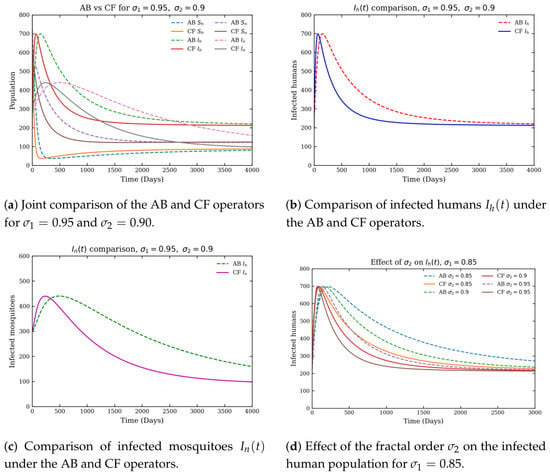
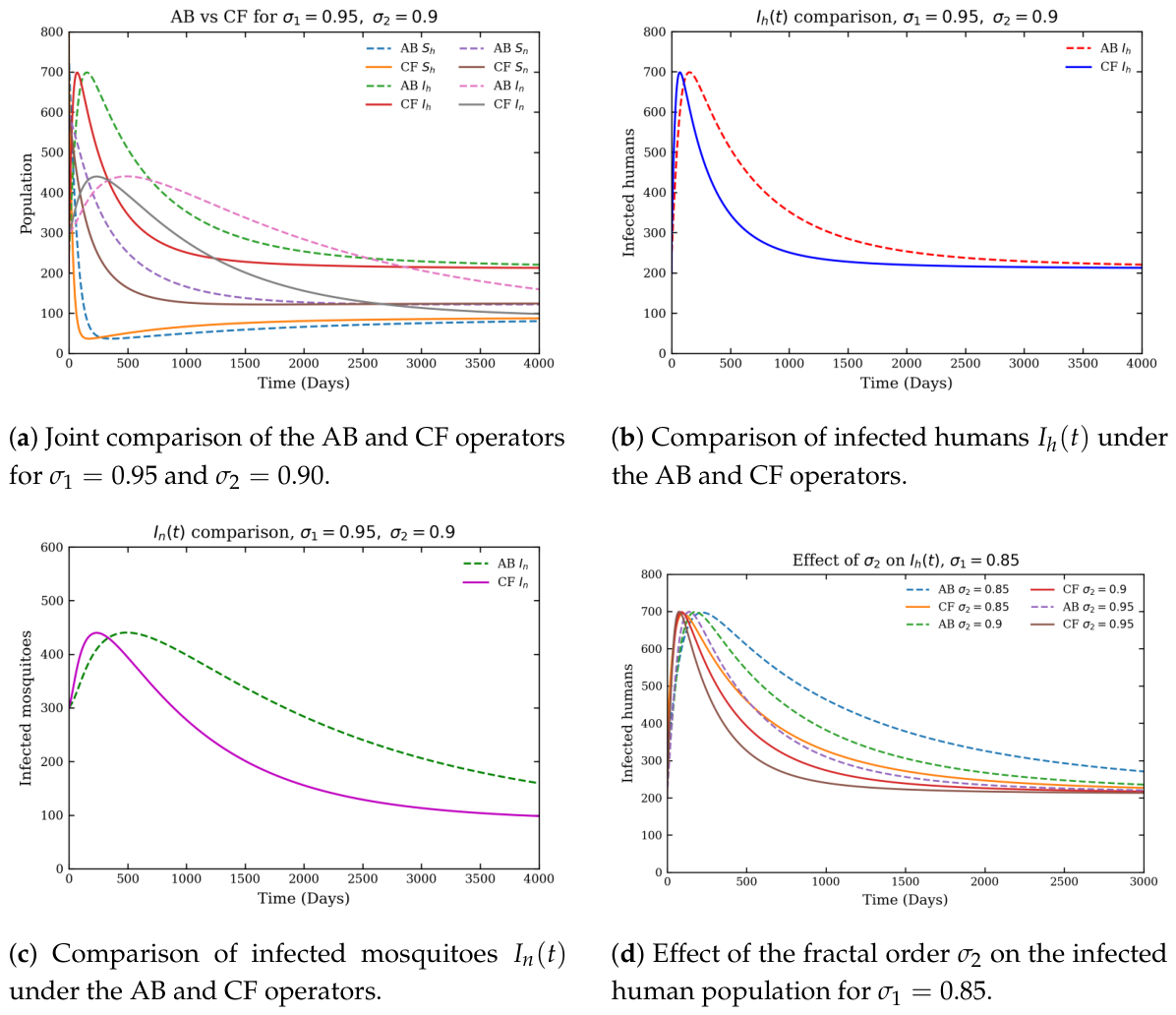
Figure 1a–d presents the numerical comparison between the fractal–fractional AB and CF operators. The results show that the AB operator produces stronger memory effects and slower infection decay, whereas the CF operator leads to faster stabilization. Moreover, changes in fractal order noticeably affect the human-infected population, highlighting the role of fractal memory in the dynamics of Zika virus transmission [3].
Figure 1.
Comparative numerical simulations of the FF-AB and FF-CF operators for the Zika virus model [3]. The results illustrate how memory effects and fractal order influence disease transmission dynamics.
6. Conclusions
The results indicate that the proposed FF Zika virus model realistically describes transmission between humans and mosquitoes, highlighting the important role of memory effects in the spread and persistence of the disease. The comparative study further shows that the AB operator retains stronger memory and therefore predicts a slower decline in infections. In contrast, the CF operator leads to more rapid stabilization of the epidemic because of its fading-memory characteristics. These observations suggest that the choice of fractional operator can substantially influence the model’s predictions. Future studies can extend the considered Zika model to include variable-order and mixed FF derivatives, directional memory effects, and appropriate control interventions, which may offer a more realistic framework for managing Zika virus outbreaks.
Author Contributions
P.V. and W.S.; Methodology, P.V.; Software, P.V.; Validation, P.V. and W.S.; formal analysis, P.V.; Investigation, W.S.; Resources, P.V.; Writing—original draft, W.S.; Writing—review & editing, W.S.; Supervision, W.S. All authors have read and agreed to the published version of the manuscript.
Funding
This research was funded in whole by the National Science Center, Poland, grant number 2023/51/B/ST8/01062. For the purpose of Open Access, the authors have applied a CC-BY public copyright license to any Author Accepted Manuscript (AAM) version arising from this submission.
Institutional Review Board Statement
Not applicable.
Informed Consent Statement
Not applicable.
Data Availability Statement
No new data were created or analyzed and no external datasets were used in this study. Therefore, data sharing is not applicable to this article.
Conflicts of Interest
The authors declare that they have no conflict of interest.
References
- WHO. Zika Virus. Available online: https://www.who.int/news-room/fact-sheets/detail/zika-virus (accessed on 6 November 2025).
- Addai, E.; Zhang, L.; Ackora-Prah, J.; Gordon, J.F.; Asamoah, J.K.K.; Essel, J.F. Fractal-fractional order dynamics and numerical simulations of a Zika epidemic model with insecticide-treated nets. Phys. A Stat. Mech. Its Appl. 2022, 603, 127809. [Google Scholar] [CrossRef] [Scilit]
- Begum, R.; Tunç, O.; Khan, H.; Gulzar, H.; Khan, A. A fractional order Zika virus model with Mittag–Leffler kernel. Chaos Solitons Fractals 2021, 146, 110898. [Google Scholar] [CrossRef] [Scilit]
- Khan, M.A.; Ullah, S.; Farhan, M. The dynamics of Zika virus with Caputo fractional derivative. AIMS Math. 2019, 4, 134–146. [Google Scholar] [CrossRef]
- Yamazaki, K. Zika virus dynamics partial differential equations model with sexual transmission route. Nonlinear Anal. Real World Appl. 2019, 50, 290–315. [Google Scholar] [CrossRef] [Scilit]
- Biswas, S.K.; Ghosh, U.; Sarkar, S. Mathematical model of Zika virus dynamics with vector control and sensitivity analysis. Infect. Dis. Model. 2020, 5, 23–41. [Google Scholar] [CrossRef] [Scilit] [PubMed]
- Owolabi, K.M.; Pindza, E. Modeling and simulation of nonlinear dynamical system in the frame of nonlocal and non-singular derivatives. Chaos Solitons Fractals 2019, 127, 146–157. [Google Scholar] [CrossRef] [Scilit]
- Verma, H.; Mishra, V.N.; Mathur, P. Effectiveness of lock down to curtail the spread of corona virus: A mathematical model. ISA Trans. 2022, 124, 124–134. [Google Scholar] [CrossRef] [Scilit] [PubMed]
- Khan, S.A.; Shah, K.; Zaman, G.; Jarad, F. Existence theory and numerical solutions to smoking model under Caputo–Fabrizio fractional derivative. Chaos 2019, 29, 013128. [Google Scholar] [CrossRef] [Scilit] [PubMed]
- Asamoah, J.K.K.; Okyere, E.; Yankson, E.; Opoku, A.A.; Adom-Konadu, A.; Acheampong, E.; Arthur, Y.D. Non-fractional and fractional mathematical analysis and simulations for Q fever. Chaos Solitons Fractals 2022, 156, 111821. [Google Scholar] [CrossRef] [Scilit]
- Verma, P.; Tiwari, S.; Verma, A. Theoretical and numerical analysis of fractional order mathematical model on recent COVID-19 model using singular kernel. Proc. Natl. Acad. Sci. India Sect. Phys. Sci. 2023, 93, 219–232. [Google Scholar] [CrossRef] [Scilit]
- Verma, P.; Kumar, M. Positive solutions and stability of fuzzy Atangana–Baleanu variable fractional differential equation model for a novel coronavirus (COVID-19). Int. J. Model. Simul. Sci. Comput. 2021, 12, 2150059. [Google Scholar]
- Sene, N. SIR Epidemic model with Mittag–Leffler fractional derivative. Chaos Solitons Fractals 2020, 137, 109833. [Google Scholar] [CrossRef] [Scilit]
- Wang, W.; Khan, M.A. Analysis and numerical simulation of fractional model of bank data with fractal–fractional Atangana–Baleanu derivative. J. Comput. Appl. Math. 2020, 369, 112646. [Google Scholar] [CrossRef] [Scilit]
- Singh, H.K.; Pandey, D.N. Analysis of the Chickenpox Disease Evolution in an MSEIR Model Using Fractal-Fractional Differential Operator. Differ. Equ. Dyn. Syst. 2026, 34, 275–295. [Google Scholar] [CrossRef] [Scilit]
- Rakkiyappan, R.; Latha, V.P.; Rihan, F.A. A fractional-order model for Zika virus infection with multiple delays. Complexity 2019, 2019, 4178073. [Google Scholar] [CrossRef] [Scilit]
- Nagpurkar, M.B.; Kachhia, K.B. A novel numerical method for solving fractal-fractional differential equations with exponential memories. J. Appl. Math. Comput. 2025, 71, 1453–1475. [Google Scholar] [CrossRef] [Scilit]
- Attia, N.; Akgul, A.; Seba, D.; Nour, A.; Asad, J. A novel method for fractal-fractional differential equations. Alex. Eng. J. 2021, 61, 9733–9748. [Google Scholar] [CrossRef] [Scilit]
- Althubyani, M.; Saber, S. Hyers–Ulam Stability of Fractal–Fractional Computer Virus Models with the Atangana–Baleanu Operator. Fractal Fract. 2025, 9, 158. [Google Scholar] [CrossRef] [Scilit]
- Youssri, Y.H.; Atta, A.G. Spectral Collocation Approach via Normalized Shifted Jacobi Polynomials for the Nonlinear Lane-Emden Equation with Fractal-Fractional Derivative. Fractal Fract. 2023, 7, 133. [Google Scholar] [CrossRef] [Scilit]
- Youssri, Y.H. Orthonormal Ultraspherical Operational Matrix Algorithm for Fractal–Fractional Riccati Equation with Generalized Caputo Derivative. Fractal Fract. 2021, 5, 100. [Google Scholar] [CrossRef] [Scilit]
- Khan, H.; Alfwzan, W.F.; Alzabut, J.; Almutairi, D.K.; Azim, M.A.; Thinakaran, R. Artificial Intelligence and Neural Networking for an Analysis of Fractal–Fractional Zika Virus Model. Fractals 2025, 33, 2540143. [Google Scholar] [CrossRef] [Scilit]
- Rezapour, S.; Asamoah, J.K.K.; Etemad, S.; Akgul, A.; Avcı, I.; Din, S.M.E. On the fractal-fractional Mittag-Leffler model of a COVID-19 and Zika Co-infection. Results Phys. 2023, 55, 107118. [Google Scholar] [CrossRef] [Scilit]
- Verma, P.; Sumelka, W. Mathematical and Numerical Analysis of a Fractional Diabetes Model with Singular Operator. Fractal Fract. 2026, 10, 320. [Google Scholar] [CrossRef] [Scilit]
- Butt, S.I.; Khan, A. New fractal–fractional parametric inequalities with applications. Chaos Solitons Fractals 2023, 172, 113529. [Google Scholar] [CrossRef] [Scilit]
- Verma, P.; Sumelka, W. Qualitative and Numerical Study of a Zika Epidemic Model with Fractal–Fractional Operators. In Proceedings of the 2nd International Online Conference on Mathematics and Applications, Online, 10–12 June 2026. [Google Scholar]
- Verma, P.; Sumelka, W.; Verma, H.; Singh, H.K. Stability analysis and numerical simulation of a Zika epidemic model using a fractal–fractional derivative with a non-singular kernel. In Advances in Applied Analysis; CRC Press (Taylor & Francis): Boca Raton, FL, USA, accepted for publication.
- Agathiyana, A.; Vinothkumar, B.; Akgul, A.; Alshammarig, F.S. Fractal–fractional modeling and chaos analysis of a financial system with generalized memory kernels. Results Control. Optim. 2025, 21, 100632. [Google Scholar] [CrossRef] [Scilit]
- Zhong, W.; Wang, L.; Abdeljawad, T. Separation and stability of solutions to nonlinear systems involving Caputo–Fabrizio derivatives. Adv. Differ. Equ. 2020, 2020, 166. [Google Scholar] [CrossRef] [Scilit]
- Wang, Z.; Yang, D.; Ma, T.; Sun, N. Stability analysis for nonlinear fractional-order systems based on comparison principle. Nonlinear Dyn. 2014, 75, 387–402. [Google Scholar] [CrossRef] [Scilit]
- Jin, B.; Li, Z. Solving initial value problems of ordinary differential equations using Runge–Kutta methods in python-based scientific computing platforms. Int. J. Model. Simul. Sci. Comput. 2026, 17, 2650017. [Google Scholar] [CrossRef] [Scilit]
- Mavi, H.S.; Mallick, R.; Singla, A. Scientific Python (SciPy) based Simulation and Control of Underactuated Robotic System. In AIR’23: Proceedings of the 2023 6th International Conference on Advances in Robotics; Association for Computing Machinery: New York, NY, USA, 2026; pp. 1–7. [Google Scholar]
- Vijayalakshmi, G.M.; Ariyanatchi, M.; Govindan, V.; Mustafa Inc. Fractal-fractional modelling of thrombocytopenia influence on pregnant women in the context of dengue infection with Mittag–Leffler decay analysis. Model. Earth Syst. Environ. 2025, 11, 123. [Google Scholar] [CrossRef] [Scilit]
Disclaimer/Publisher’s Note: The statements, opinions and data contained in all publications are solely those of the individual author(s) and contributor(s) and not of MDPI and/or the editor(s). MDPI and/or the editor(s) disclaim responsibility for any injury to people or property resulting from any ideas, methods, instructions or products referred to in the content. |
© 2026 by the authors. Licensee MDPI, Basel, Switzerland. This article is an open access article distributed under the terms and conditions of the Creative Commons Attribution (CC BY) license.