1. Introduction
Leptospirosis is a globally distributed zoonotic disease that is particularly prevalent in tropical regions and is caused by pathogenic bacteria of the genus
Leptospira [
1]. Transmission occurs primarily through contact with water or soil contaminated by the urine of infected animals, especially synanthropic rodents, although a wide range of mammals can serve as reservoirs [
2]. Environmental and socio-structural factors, including inadequate sanitation, unplanned urbanization, and high population density, play an important role in sustaining transmission [
3]. Clinically, leptospirosis presents a broad spectrum, ranging from mild, self-limiting illness to severe manifestations involving hepatic, renal, and hemorrhagic complications [
4]. This clinical heterogeneity reflects the interaction between host responses and pathogen characteristics, influencing disease progression and severity [
5].
The occurrence of leptospirosis is strongly associated with environmental conditions that favor pathogen survival and human exposure. Contact with contaminated water, flooding, and inadequate housing and sanitation infrastructure facilitate the persistence of
Leptospira in soil and aquatic environments [
6]. The survival and dissemination of the pathogen are influenced by factors such as temperature, moisture, and physicochemical characteristics, enabling its persistence in environments conducive to transmission [
6]. These conditions are often intensified in rapidly urbanizing settings, where irregular land occupation, poor drainage systems, and high rodent infestation further increase human exposure [
3].
In the Brazilian Amazon, environmental and socioeconomic vulnerabilities create conditions that favor leptospirosis transmission [
7,
8]. High rainfall, extensive hydrological networks, and limited access to sanitation contribute to pathogen persistence and increase opportunities for human exposure [
9,
10]. In addition, barriers to healthcare access may contribute to delayed diagnosis and underreporting, reinforcing regional disparities in disease burden [
11,
12].
Periods of intense rainfall and flooding may amplify transmission by dispersing contaminated materials across urban and peri-urban areas and increasing human contact with contaminated water [
13]. Although previous studies have highlighted the role of climatic variability and extreme events in triggering outbreaks [
14,
15,
16,
17], the specific contribution of different hydroclimatic factors to the temporal dynamics of leptospirosis remains poorly understood, particularly in the Brazilian Amazon. The environmental complexity of the region, combined with increasing climate variability and persistent socioeconomic inequalities, underscores the need for integrated analyses capable of disentangling these relationships over time. Therefore, this study investigated the temporal dynamics of leptospirosis and its associations with environmental variables, including mean temperature, accumulated precipitation, heavy rainfall events, flooding occurrence, and sanitation coverage, in the Brazilian Amazon from 2005 to 2024.
2. Materials and Methods
2.1. Study Area
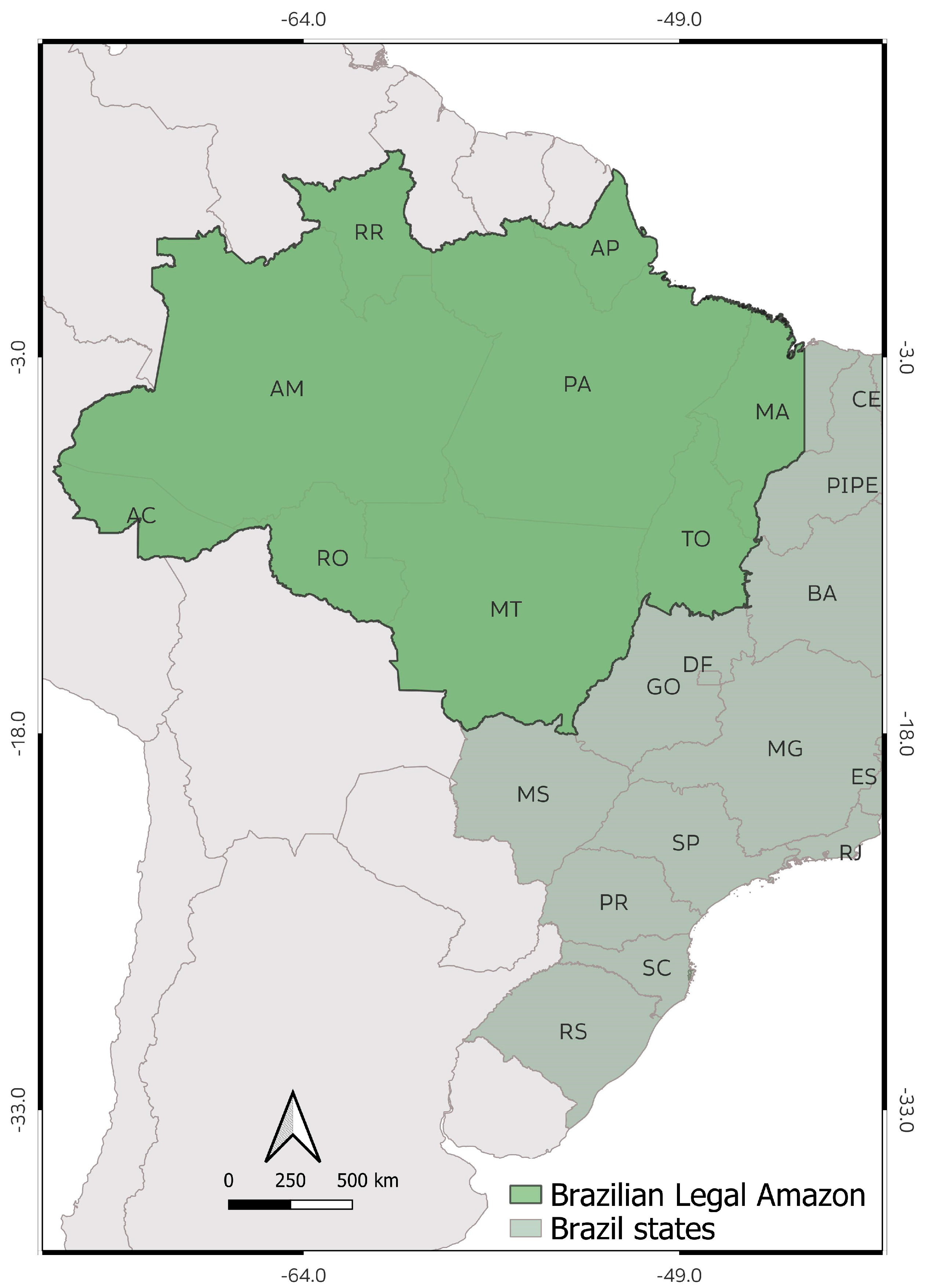
This study was conducted in the Brazilian Legal Amazon (
Figure 1), comprising all municipalities officially included within this administrative region across nine states (Acre, Amapá, Amazonas, Maranhão, Mato Grosso, Pará, Rondônia, Roraima, and Tocantins). The region is characterized by pronounced environmental and socioeconomic heterogeneity [
18]. It has a predominantly humid tropical climate, with high annual temperatures, spatial variation in precipitation, and marked hydroclimatic seasonality driven by interactions between large river basins and regional atmospheric systems [
19].
Within this setting, hydrological dynamics are strongly influenced by precipitation regimes, favoring the occurrence of extreme events such as heavy rainfall and flooding [
20]. These processes play a central role in shaping ecological conditions and patterns of human exposure across the region. In recent years, increases in both the frequency and intensity of these events have contributed to greater interannual environmental variability [
18]. These dynamics are particularly relevant to waterborne diseases such as leptospirosis, whose transmission is closely associated with the interaction between climatic variability, hydrological disturbances, and sanitation conditions [
2,
21].
2.2. Data Collection
Leptospirosis data were obtained from the Notifiable Diseases Information System (Sistema de Informação de Agravos de Notificação—SINAN), available through the Department of Informatics of the Brazilian Unified Health System (DataSUS), Ministry of Health [
11]. Based on the municipality of residence, annual numbers of confirmed cases were extracted for the period from 2005 to 2024, covering the Brazilian Amazon. Municipality-level records were aggregated to generate annual indicators for the Brazilian Amazon as a whole. Municipality- and state-specific effects were not modeled separately because the analysis focused on regional-scale patterns. Annual population estimates were also obtained from DataSUS, allowing standardization of epidemiological indicators and adjustment of statistical models according to the population at risk. Official census counts were used for census years, whereas intercensal estimates provided by the Ministry of Health were used for the remaining years, ensuring temporal continuity of population denominators.
Climatic variables, including mean annual temperature (°C) and accumulated annual precipitation (mm), were obtained from the Brazilian National Institute of Meteorology (INMET), which compiles standardized observational records nationwide. These variables were aggregated annually to ensure compatibility with the epidemiological time series and to minimize the influence of short-term seasonal variability. To characterize extreme environmental conditions, annual counts of heavy rainfall events (n) and flooding events (n) were obtained from the Brazilian Digital Atlas of Disasters. This database integrates records from official civil defense and disaster management systems, providing standardized classifications of disaster events at the national level. Heavy rainfall events correspond to disasters attributed to intense precipitation, whereas flooding events refer to the temporary accumulation or overflow of water affecting populated areas. These categories represent distinct but related hydrological processes and were used as indicators of extreme environmental conditions.
Sanitation coverage (%) was included as a structural variable representing underlying socio-environmental conditions associated with leptospirosis transmission. This indicator was obtained from the Atlas of Human Development in Brazil, a publicly accessible database developed by the United Nations Development Programme (UNDP) and the Institute for Applied Economic Research (IPEA) [
22]. Sanitation estimates were derived from municipal-level data, linearly interpolated for intercensal years, and subsequently aggregated as annual mean values for the Brazilian Amazon. The indicator represents the proportion of the population with access to basic sanitation services and was used as a proxy for socio-environmental vulnerability, reflecting conditions that may influence environmental contamination, human exposure to contaminated water, and the persistence of animal reservoirs.
2.3. Statistical Analysis
All analyses were conducted using GNU R version 4.4.1 [
23]. Annual leptospirosis incidence was calculated as the ratio of confirmed cases to the estimated population and expressed per 100,000 inhabitants. For count-based modeling, the logarithm of the population was included as an offset term, allowing expected counts to be standardized according to the population at risk and model estimates to be interpreted as incidence rates.
Temporal patterns were initially explored through descriptive analysis of the time series. Monotonic trends (i.e., consistent increases or decreases over time without assuming linearity) were formally evaluated using the non-parametric Mann–Kendall test, selected for its robustness to non-normal distributions and sensitivity to monotonic changes in environmental and epidemiological data. The test was applied to leptospirosis incidence and to all climatic, hydrological, and sanitation variables included in the study.
Prior to model fitting, multicollinearity among explanatory variables was assessed using the Variance Inflation Factor (VIF). Values ≥ 5 were considered indicative of potential redundancy among predictors and possible instability in parameter estimation.
Associations between environmental variables and leptospirosis dynamics were evaluated using generalized additive models (GAMs) with a negative binomial distribution, an approach appropriate for overdispersed count data and capable of capturing nonlinear relationships. The annual number of cases was specified as the response variable, and the logarithm of the population was included as an offset term. Annual aggregation was adopted to ensure temporal consistency among epidemiological, climatic, hydrological, and sanitation indicators and to examine long-term patterns linking hydrological conditions with leptospirosis incidence across the Brazilian Amazon. Explanatory variables included mean temperature, accumulated precipitation, heavy rainfall events, flooding events, and sanitation coverage. Smooth functions were applied to continuous variables to allow flexible modeling of potential nonlinear effects, whereas year was included as a smooth term to account for long-term temporal structure.
A base model including all environmental and structural variables was first fitted as the primary analytical specification. Given the relatively short annual time series, model complexity was intentionally constrained by limiting the number of predictors to variables selected a priori based on biological plausibility. In addition, the number of basis functions was restricted (k = 5 for environmental predictors), and smoothing parameters were estimated using restricted maximum likelihood (REML) to reduce the risk of overfitting. A one-year lag model was then fitted, in which precipitation and flooding variables were included with a one-year lag to evaluate whether hydrological conditions in one year were associated with leptospirosis incidence in the subsequent year. Given the annual temporal resolution of the data, this analysis was intended to assess the persistence of environmental effects across consecutive years rather than represent a direct biological delay between rainfall and infection. To reduce the risk of overparameterization, these variables were evaluated separately from current-year exposures. Effective degrees of freedom were examined to assess the complexity of the fitted smooth functions.
Sensitivity analyses were conducted to evaluate the robustness of the estimated associations across alternative model specifications. For this purpose, additional models were fitted after selectively excluding groups of variables: (i) a model excluding sanitation coverage to evaluate the influence of structural conditions on environmental associations; and (ii) a model excluding indicators of extreme events (heavy rainfall and flooding) to assess the stability of associations involving baseline climatic variables. This approach allowed evaluation of the consistency of the findings and identification of potential dependencies among environmental and structural components.
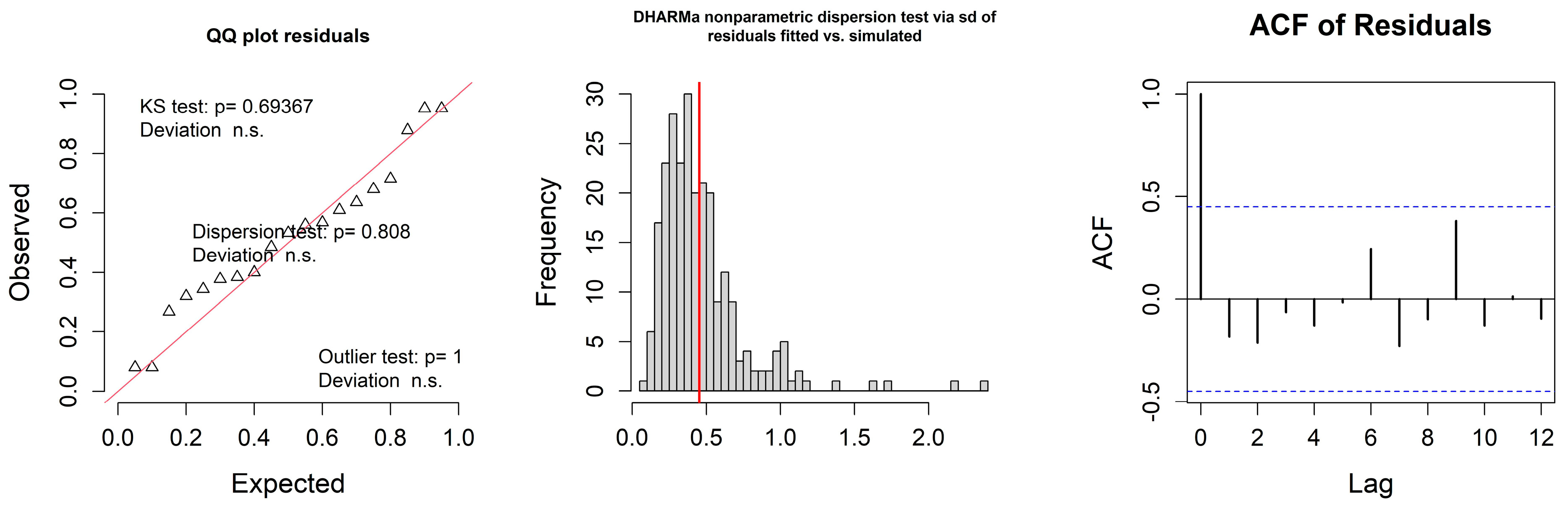
Model adequacy was assessed using simulation-based residual diagnostics, including tests of dispersion and residual distribution. Residual diagnostics were performed using the DHARMa package in R. Residual simulations were generated with the simulateResiduals() function and evaluated using the testUniformity() and testDispersion() functions. Temporal autocorrelation was assessed using the autocorrelation function (ACF) applied to model residuals, allowing identification of temporal dependencies not captured by the model.
3. Results
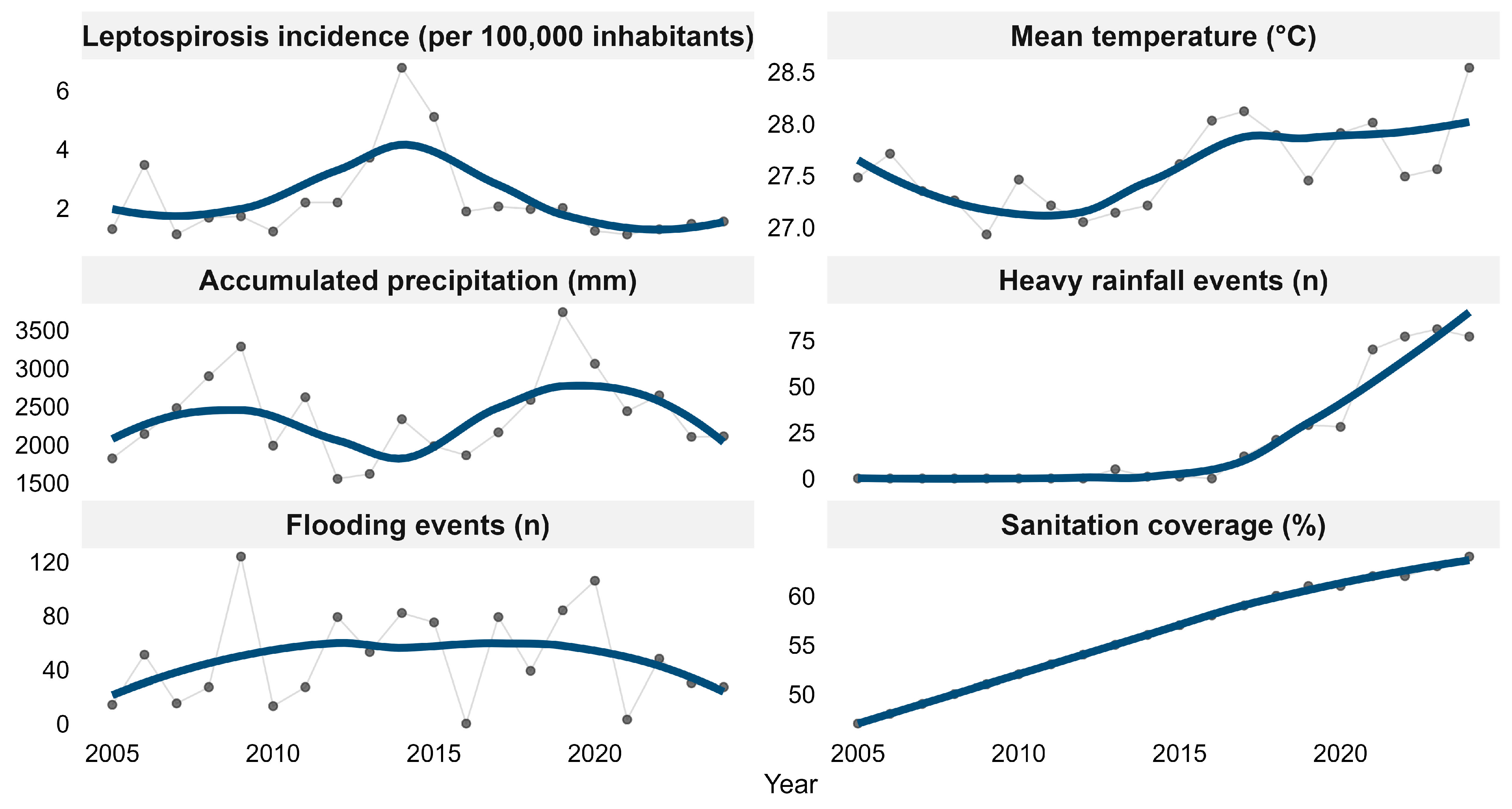
Exploratory analysis of the time series revealed marked interannual variability in leptospirosis incidence, with no evidence of a consistent monotonic temporal trend (
Figure 2). This lack of directional change was confirmed by the Mann–Kendall test, which detected no significant temporal trend (τ = −0.08;
p = 0.62). In contrast, environmental variables exhibited distinct temporal patterns. Mean temperature showed a moderate but significant increasing trend (τ = 0.35;
p = 0.032), whereas accumulated precipitation remained stable, with no evidence of monotonic variation (τ = 0.11;
p = 0.49).
A different pattern was observed for hydrological extremes. Heavy rainfall events showed a marked and sustained increase throughout the study period (τ = 0.81; p < 0.001), indicating a progressive intensification of extreme precipitation conditions in recent years. In contrast, flooding events exhibited substantial interannual variability but no significant temporal trend (τ = 0.08; p = 0.62). Sanitation coverage showed a strong and consistent upward trend (τ = 0.99; p < 0.001), reflecting gradual improvements in structural conditions across the region. Multicollinearity diagnostics indicated low levels of correlation among predictors, with VIF values ranging from 1.27 to 3.89, supporting the stability of subsequent model estimates.
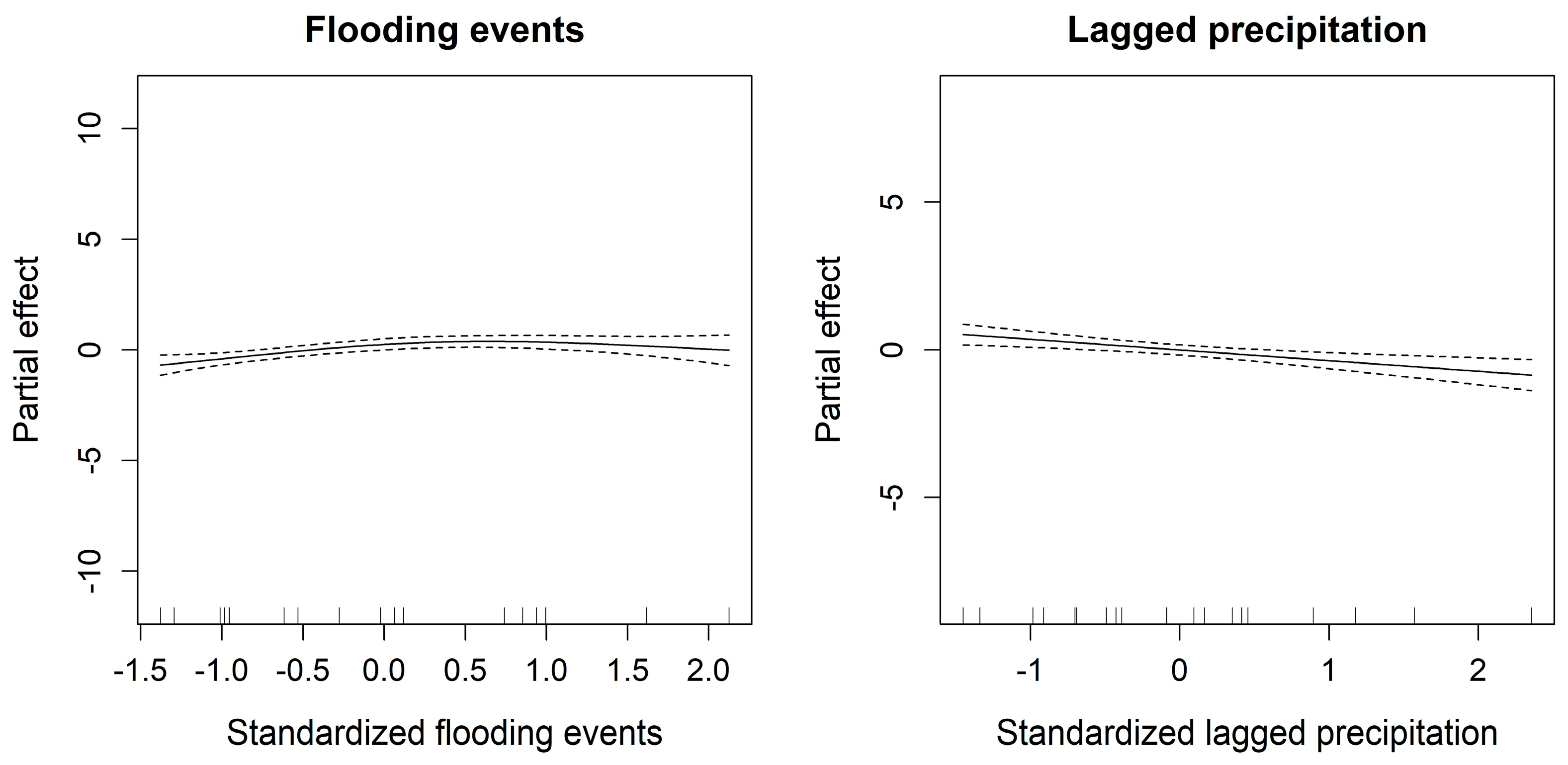
The generalized additive model fitted with the full set of predictors identified flooding events as the only variable significantly associated with leptospirosis incidence (edf = 2.34; χ
2 = 15.07;
p = 0.002). The corresponding partial effect plot suggested a positive nonlinear association across most of the observed range of flooding intensity (
Figure A1). The remaining variables, including mean temperature (edf = 1.00; χ
2 = 0.15;
p = 0.70), accumulated precipitation (edf = 1.00; χ
2 = 0.18;
p = 0.68), heavy rainfall events (edf = 2.14; χ
2 = 0.99;
p = 0.79), and sanitation coverage (edf = 1.00; χ
2 = 1.85;
p = 0.17), were not significantly associated with incidence. Likewise, the temporal smooth term showed no evidence of a long-term trend (edf = 1.00; χ
2 = 1.45;
p = 0.23). Overall, the model showed satisfactory performance, with an adjusted R
2 of 0.37 and 79.4% of the deviance explained.
Including a one-year lag changed the pattern of results, revealing a strong and statistically significant association between lagged precipitation and leptospirosis incidence (edf = 1.00; χ
2 = 11.27;
p < 0.001). The corresponding partial effect plot indicated an approximately linear negative association between lagged precipitation and disease incidence (
Figure A1). This finding contrasted with the base model and suggests that environmental conditions associated with rainfall may persist beyond the year of occurrence. In this specification, mean temperature (edf = 1.00; χ
2 = 1.45;
p = 0.23), heavy rainfall events (edf = 1.00; χ
2 = 2.36;
p = 0.12), flooding events (edf = 1.00; χ
2 = 0.78;
p = 0.38), and sanitation coverage (edf = 1.00; χ
2 = 0.35;
p = 0.55) remained non-significant. Likewise, the temporal smooth term showed no evidence of a long-term trend (edf = 1.00; χ
2 = 0.53;
p = 0.47). This model explained 66.4% of the deviance, indicating that lagged precipitation accounted for a substantial proportion of the temporal variability in leptospirosis incidence under this specification.
Sensitivity analyses further supported the robustness of these findings (
Table 1). In the model excluding sanitation coverage, flooding events retained a marginal association with leptospirosis incidence, whereas the remaining variables were not significantly associated with the outcome. This model showed an adjusted R
2 of 0.39 and explained 74.8% of the deviance. In contrast, excluding indicators of extreme events resulted in a model in which none of the predictors was significantly associated with leptospirosis incidence, despite an improved overall fit (adjusted R
2 = 0.65; deviance explained = 79.1%). This pattern suggests a redistribution of explanatory variance among the remaining variables. A comprehensive comparison of all fitted models, including model performance metrics and sensitivity analyses, is presented in
Table A1.
Residual diagnostics indicated adequate model performance across all specifications. No evidence of overdispersion was detected (
p = 0.81), and no influential outliers were identified (
p = 1.00). Graphical inspection of the residuals showed good agreement between observed and expected distributions, with no systematic deviations (
Figure A2). In addition, the autocorrelation function revealed no significant temporal dependence, indicating that the temporal structure of the data was adequately captured by the models (
Figure A2).
4. Discussion
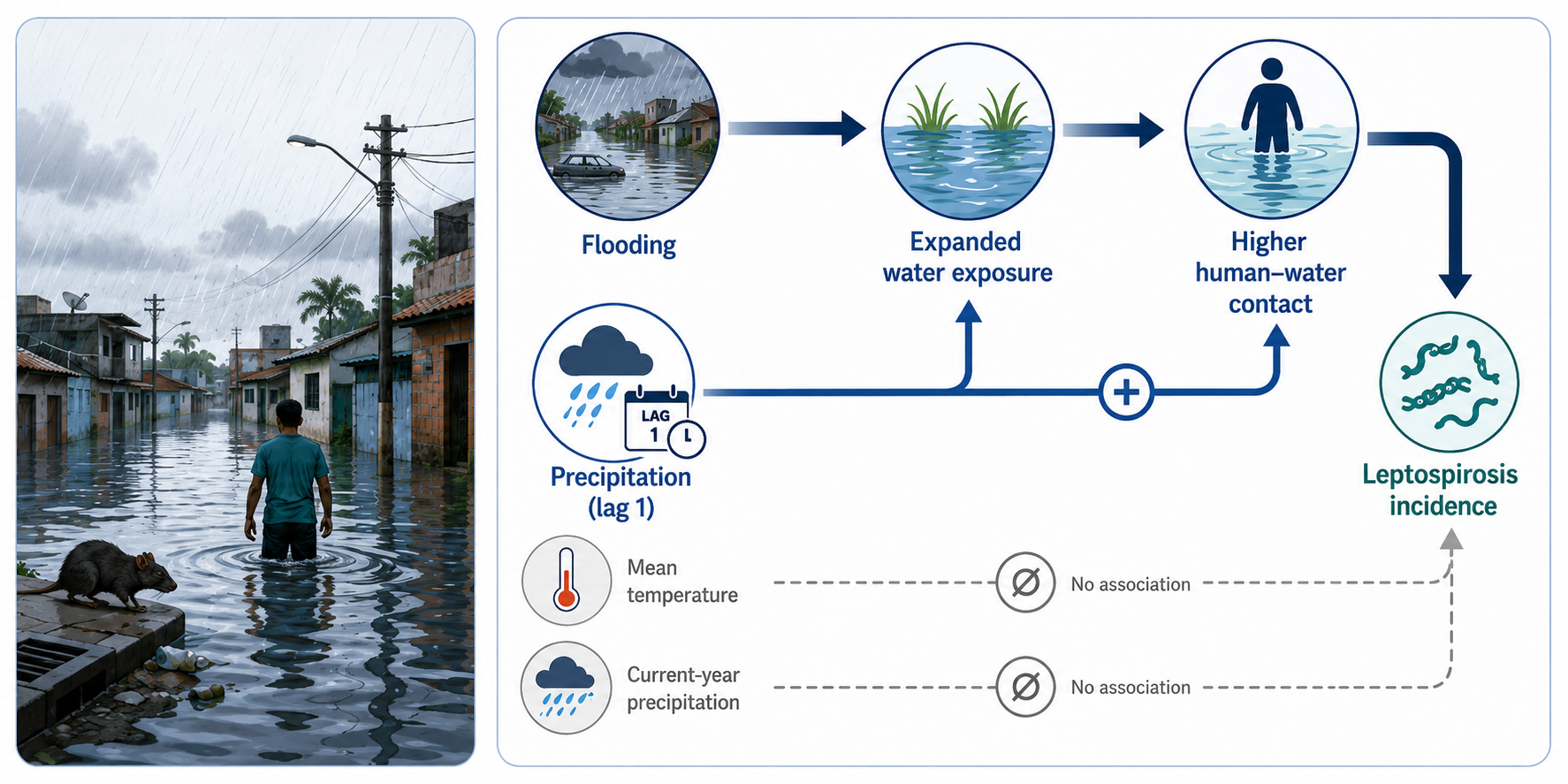
This study investigated the temporal dynamics of leptospirosis in the Brazilian Amazon, a region characterized by pronounced environmental variability and marked hydroclimatic seasonality. Our findings indicate that, although leptospirosis incidence showed no consistent temporal trend during the study period, its interannual variability was associated with specific environmental processes. In particular, flooding events were significantly associated with disease incidence in the main model, whereas lagged precipitation emerged as the strongest predictor when delayed effects were considered. In contrast, mean temperature, accumulated precipitation, and sanitation coverage were not independently associated with incidence in most model specifications.
Flooding represents an abrupt environmental disturbance capable of rapidly altering transmission settings [
20]. The accumulation and redistribution of contaminated water across urban and peri-urban areas increase the likelihood of human contact with environments contaminated by
Leptospira [
7]. These events facilitate the spread of urine from infected reservoirs, particularly rodents, across surfaces that would otherwise remain dry, thereby expanding the spatial extent of contamination [
1,
24]. In addition, flooding may disrupt sanitation infrastructure and drainage systems, increasing exposure in densely populated settings [
4]. Similar mechanisms have been described in tropical environments and southern Brazil, where hydrological instability and flooding have been associated with increased leptospirosis incidence, reinforcing the importance of hydrological disturbances in shaping transmission across diverse environmental settings [
6,
21,
25]. This interpretation was further supported by the sensitivity analyses, in which excluding indicators of extreme events eliminated significant associations among the remaining predictors, suggesting that these disturbances accounted for a substantial proportion of the observed temporal variability in leptospirosis incidence.
The absence of a significant association between accumulated precipitation and leptospirosis incidence reinforces the distinction between average climatic conditions and hydrological extremes. Whereas precipitation represents a continuous environmental input, flooding reflects the combined effects of rainfall intensity, soil saturation, land use, and drainage capacity [
6,
9]. Consequently, hydrological extremes capture epidemiologically relevant conditions more effectively than average climatic measures. This distinction is particularly important for understanding transmission dynamics in complex environments such as the Amazon, where similar annual precipitation levels may result in markedly different hydrological responses [
8].
The significant association between lagged precipitation and leptospirosis incidence suggests that the effects of rainfall are not restricted to immediate exposure. Instead, precipitation may initiate environmental processes that persist over time, creating favorable conditions for bacterial survival and delayed human exposure [
2]. The persistence of
Leptospira in moist soils and stagnant water, combined with prolonged environmental contamination following intense rainfall, may extend the transmission period beyond the initial hydrological event [
3]. Similar delayed associations between hydrological conditions and leptospirosis incidence have been reported previously, indicating that the effects of rainfall and flooding may persist beyond the initial exposure period through sustained environmental contamination and prolonged pathogen survival [
6,
21]. These findings are consistent with ecological mechanisms in which environmental suitability accumulates over time rather than acting as a short-term trigger [
16].
In contrast, the absence of an association between mean temperature and leptospirosis incidence suggests that thermal conditions alone may be insufficient to explain transmission variability at the annual scale. Temperature influences bacterial survival and host dynamics, but its effects are often nonlinear and depend on specific ecological thresholds [
14]. In environments where temperatures remain within a relatively stable tropical range, their influence may be secondary to hydrological processes that directly shape exposure pathways [
15]. Although sanitation coverage showed a strong increasing trend over time, it was not independently associated with incidence in the adjusted models. This pattern suggests that structural improvements may reduce baseline vulnerability but are insufficient to offset the effects of acute environmental disturbances such as flooding.
The absence of a temporal trend in leptospirosis incidence, despite increasing trends in heavy rainfall events and sanitation coverage, highlights the complexity of disease dynamics in the region. Opposing processes may be occurring simultaneously, with improvements in sanitation and infrastructure potentially reducing exposure, while the intensification of extreme events increases the likelihood of episodic transmission [
5,
26]. As a result, leptospirosis dynamics were characterized by marked interannual variability rather than a consistent directional trend, suggesting that disease occurrence is primarily shaped by episodic environmental conditions.
These findings have important implications for epidemiological surveillance because indicators based solely on average climatic conditions may underestimate periods of increased transmission, whereas variables reflecting hydrological extremes and delayed precipitation provide more informative signals of disease dynamics. Incorporating these indicators into surveillance systems may improve the identification of periods of increased transmission and support more targeted public health interventions, particularly in regions experiencing increasing environmental variability.
Although these findings provide important insights into leptospirosis dynamics in the Brazilian Amazon, several limitations should be considered. The ecological design and use of annually aggregated data restrict causal inference, preclude assessment of individual-level exposure, and introduce the possibility of ecological fallacy, whereby associations observed at the population level may not necessarily reflect individual-level relationships. Moreover, the relatively short annual time series limits the statistical power of residual and autocorrelation diagnostics, potentially reducing the ability to detect subtle departures from model assumptions.
Regional aggregation may also mask substantial heterogeneity among the nine states included in the study, which differ in ecological characteristics, biodiversity, public health infrastructure, surveillance capacity, socioeconomic conditions, and other contextual factors that may influence disease occurrence through transmission pathways not captured by regional-scale analyses. In addition, flooding and heavy rainfall indicators were derived from disaster records and may have been influenced by temporal variation in reporting practices and completeness, despite the use of a standardized national database. Underdiagnosis and underreporting remain important challenges for leptospirosis surveillance in Brazil because of limited diagnostic access, the nonspecific clinical presentation of the disease, and variation in surveillance performance across locations. Changes in diagnostic capacity and reporting practices over time may also have influenced case ascertainment, potentially affecting temporal patterns independently of disease transmission. Consequently, the reported incidence should be interpreted as a surveillance-based estimate and may underestimate the true burden of leptospirosis. Despite these limitations, integrating epidemiological data with climatic and hydrological indicators provides a robust framework for investigating the role of environmental variability in shaping leptospirosis dynamics in complex tropical settings.




 and
and