


Abstract
Over the last decade, FinTech companies, also referred to as neobanks, have started to crowd out traditional banks in an increasing number of financial services. This development has not been uniform across countries. Asian countries and the Baltics are at the forefront of adopting FinTech solutions, while countries such as Germany still lag behind. Building upon this heterogeneity, the study aims to elaborate on differences in consumers’ preference structures regarding different aspects characterizing neobanks. A cross-country discrete choice experiment has been utilized to study the impact of five unique attributes on consumer perceptions and their preference structures. The design of the experiment is motivated by the structure of the UTAUT2 framework and evaluated via interviews with FinTech experts. The results illustrate the differences not only on a country level but also on a supranational (European vs. Asian) level. Across all countries, a general openness towards neobanks can be observed. Further findings indicate that even though differences do exist, they are mostly marginal. At the same time, preferences for attributes like ease of use and safety standards are present across all three observed countries. The results furthermore allow for a differentiation between hygiene factors and motivators.
JEL Classification:
C25; G21; G41
1. Introduction
Over the past decade, the financial services industry has undergone a structural transformation driven by advances in digital technology, widespread smartphone adoption, and increasing capabilities in data analytics. This transformation has shifted retail banking from a traditional branch-centric model toward a more platform- and application-based ecosystem [1]. From an industry perspective, neobanks have enabled financial institutions to deliver competitive banking services without extensive physical branch networks [2,3].
A macro-level divergence in net interest income between traditional and digital banks underscores the need to analyze how consumers evaluate the trade-offs among key attributes, specifically convenience, fees, and trust [4,5].
Digitalization reduces information search and onboarding costs, enabling consumers to maintain multiple accounts and allocate them according to usage scenarios. In terms of value proposition, neobanks often differentiate themselves through intuitive interfaces, real-time transaction notifications, personal financial management tools, and relatively transparent or competitive fee structures, making them especially appealing in mobile-first and high-frequency transaction contexts [6].
Whether neobanks evolve into consumers’ primary banking providers or remain secondary accounts, utilized mainly for transactional purposes, such as payments, budgeting, cross-border transfers, or investments, is contingent upon how individuals balance convenience, costs, functionality, and trust. Consumers typically trust traditional banks more with sensitive financial data. Consequently, neobanks face customer retention deficits relative to legacy banks, illustrating the parallel coexistence of digital appeal and an inherent trust deficit [1,6].
Convenience, low fees, and innovative features may drive initial adoption, but sustained primary usage depends on security perceptions, institutional backing, and confidence in long-term reliability. This gives rise to a fundamental tension, the attractiveness-trust gap, wherein neobanks must fortify trust signals without compromising the cost efficiencies and convenience benefits that drove their initial adoption [7,8]. However, competition in digital-only banking is not only about superior user experience and cost advantages. It also involves regulatory oversight, consumer protection, and the ongoing construction of trust.
Consequently, this development provides a first research rationale for this study’s focus on the trade-offs regarding perceived utility, in particular, between convenience and fees as well as trust and security signals [9]. For instance, strengthening trust may require investments in regulatory compliance, cybersecurity, and customer support, potentially increasing operational costs and weakening the low-fee advantage that initially attracts users. This creates a strategic trade-off that must be informed by quantified consumer preferences.
A review of the literature reveals that neobank and FinTech adoption are traditionally analyzed using the unified theory of acceptance and use of technology (UTAUT2) framework or its methodological precursors, like the technology acceptance model (TAM) or alternative technology acceptance models [10]. There is very limited evidence of studies using discrete choice experiments in this context.
Dehnert and Schumann [11] represent one of the few exceptions implementing a DCE in this context. Their study examines both digital and non-digital service characteristics alongside service provider selection, focusing specifically on the extent to which legacy banks are still preferred as compared to neobanks. Regionally, it is comparable to the present study in its focus on German banking customers.
Focusing on Germany as well, the study by Stewart and Jürjens [12] puts the emphasis more strongly on the aspects of security and trust of the service providers. In this regard, the study is comparable to the one by Athey et al. [13], who, for a sample of US students, establish the privacy paradox in the context of FinTech applications. Consequently, they illustrate that both the cost and the security dimension need to be considered when evaluating FinTech applications and neobanks. These studies contextualize consumer behavior and perceptions within Western socio-economic environments. While choice-based studies on Germany exist, they do not address neobanks from a holistic perspective. While extensive research addresses FinTech adoption in Lithuania [10], empirical studies utilizing choice-based modeling remain absent.
The study by Klein et al. [14], focusing on Israeli consumers, offers an intermediate perspective. They emphasize the different viewpoints in banking by conducting a paired experiment eliciting both the lender’s and the borrower’s perspectives and preferences in the context of credit and loans.
Similarly, the literature on Taiwanese FinTech adoption or the intention to adopt relies predominantly on technology acceptance models [15]. To date, no conjoint or choice-based analysis has been conducted in this context. The study by Hou et al. [16] focuses on Asian consumers, but instead of a focus on FinTech solutions and banking in general, they put a particular focus on the acceptance of robo-advisors. The study by Jinkyung [17], in more general terms, considers the adoption of mobile payments while focusing on Korean consumers. The study by Sinthiya and Saini [18] addresses the adoption of e-wallets, basing their sample on Indian consumers.
Finally, expanding the geographic and developmental scope, Sarfo et al. [19] investigate preference heterogeneities regarding digital versus traditional lending in Madagascar.
The present study contributes to the literature in two principal ways. The first contribution addresses a methodological and conceptual gap. The existing literature predominantly focuses on explaining behavioral intention through self-assessments, rarely considering that the perceived utility of neobanks, in line with Lancaster’s [20] new consumer theory, results from their characteristic attributes. Thus, understanding utility-based trade-offs requires analytical approaches that capture attribute-level preferences, rather than relying solely on attitudinal constructs. Empirical research addresses this issue primarily through the utilization of acceptance models, such as the TAM or the UTAUT2 frameworks. The attitude-behavior gap inherent in most of these models’ designs can partially be closed through discrete choice experiments (DCE). Consequently, this study utilizes the UTAUT2 framework as an input into the design of a DCE. Although the hypothetical nature of the choice tasks cannot entirely bridge the attitude-behavior gap, the resulting preference structures effectively capture the trade-offs across distinct attributes. Ajzen’s [21] theory of planned behavior, furthermore, suggests that preferences and thus behavioral intentions are valid proxies of actual behavior.
The second gap, addressed in this study, is comparative in nature. Although cross-national studies frequently examine cultural variations in technology acceptance, neobank adoption rates diverge significantly across countries even where cultural differences are marginal. This suggests that institutional environments, market structures, and regulatory contexts may play a more decisive role than cultural psychology alone [22]. This observation highlights the need for research frameworks that directly compare how consumers evaluate tangible banking attributes, such as fees, convenience, and trust or security signals, across different national contexts.
This study proposes a Germany–Lithuania–Taiwan comparison, as it enables a contrast of consumer preference structures under different market, institutional, and regulatory environments. Taiwan represents a rapidly digitalizing Asian financial market, where prior research highlights the critical roles of information security, privacy concerns, and perceived risk in shaping user intentions toward online-only banking. Germany, conversely, serves as a benchmark for mature European banking systems characterized by strong regulatory frameworks and high institutional trust, facilitating an investigation into how consumers balance cost efficiencies, digital convenience, and legacy financial institutions. Lithuania provides a distinct third perspective as an established European FinTech hub, where a highly supportive regulatory framework [23] and a high concentration of licensed electronic banking institutions have accelerated the expansion of digital financial services and cross-border neobanks [24].
By comparing these three contexts, this study seeks to identify whether differences in preferences for neobanks and particular attributes of neobanks are primarily driven by institutional trust structures, FinTech ecosystem maturity, or consumer risk perceptions. This comparative design quantifies the relative weights assigned to fees, convenience, and trust or security signals by consumers across Germany, Taiwan, and Lithuania regarding digital banking services. In doing so, the research contributes to bridging the gap between cross-country perceptions regarding different characteristics of neobanks and the underlying decision mechanisms that shape those differences.
To address these empirical and conceptual gaps, this study poses two central research questions:
RQ1: Which attributes of neobanks impact consumers’ perceptions of them?
RQ2: What differences in preference structures exist between Germany, Lithuania, and Taiwan?
Under the framework of the adopted DCE, survey participants in this study are presented with hypothetical decision scenarios and asked to select their preferred banking alternative from profiles defined by varying combinations of attributes. This framework compels respondents to evaluate options under realistic constraints, thereby facilitating the estimation of marginal utilities. Thus, it provides a more precise understanding of how consumers prioritize different banking attributes [25].
2. Methodology
2.1. Research Design
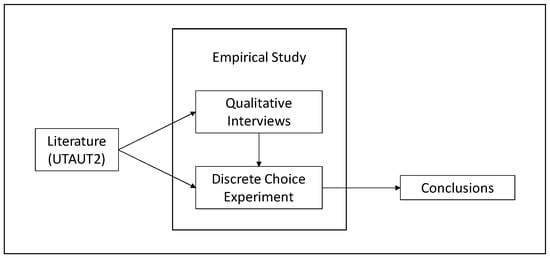
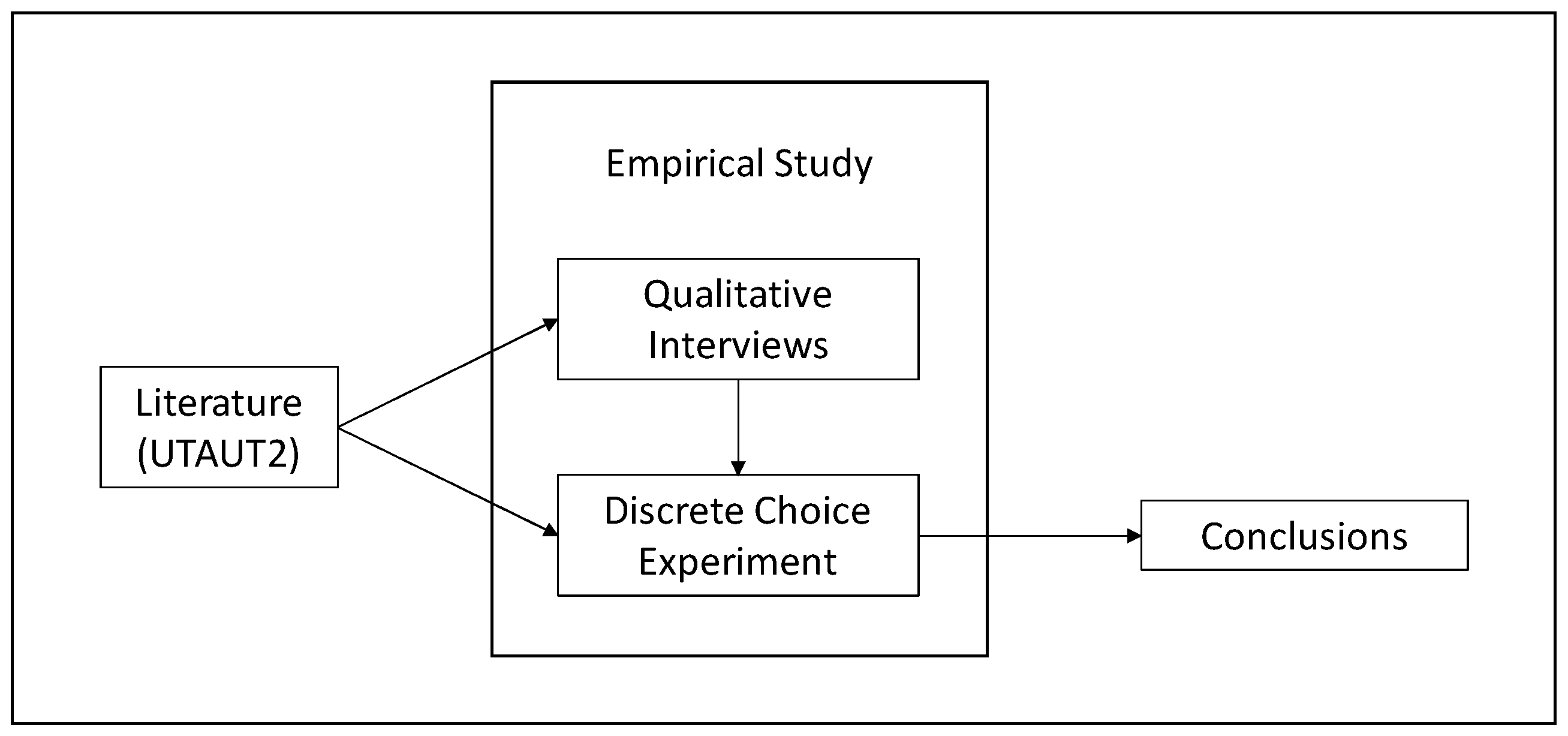
This study inherently adopts a mixed-methods approach, combining semi-structured expert interviews with a cross-cultural discrete choice experiment. The qualitative expert interviews primarily serve to validate predetermined salient decision factors, refining a list of attributes grounded in both literature and expert expertise [26]. As the qualitative component plays a secondary methodological role, the required scope and sample size of the interviews are reduced. Figure 1 illustrates how the different parts integrate.
Figure 1.
Research Design.
The UTAUT2 framework [27] is utilized to provide the initial structure, i.e., the attributes, of the DCE and thus the interview guide. Consequently, this alignment ensures that the DCE captures both functional and psychological drivers discussed in the literature on neobank adoption intention. DCEs’ approach to reveal latent preference structures is rooted in Lancaster’s [20] new consumer theory and the random utility theory. These two frameworks posit that the utility of goods and services results from their characteristics or attributes, whereby every attribute consists of different levels, which coincide with their characteristic values.
Drawing upon the theory of planned behavior [21], the UTAUT2 framework posits that actual user behavior is driven by behavioral intention, which in turn is influenced by the following core constructs [27]:
- Performance expectancy;
- Effort expectancy;
- Social influence;
- Hedonic motivation;
- Price value;
- Habit;
- Trust and security;
- Facilitating conditions.
2.2. Preliminary Qualitative Expert Interviews
Experts were recruited using purposive sampling to identify professionals in the financial sector or FinTech researchers. Eligibility criteria included relevant years of experience, roles, or seniority within financial or FinTech organizations and demonstrated involvement in domain-specific activities such as banking innovation, digital payments, or financial technology research. Potential participants were contacted through professional networks and LinkedIn, and interviews were conducted and recorded online based on participant availability, with durations ranging from 30 to 50 min. Since all interviewees hold expertise within the financial sector, their insights reflect a supply-side orientation rather than a direct consumer perspective. While the UTAUT2 framework was originally designed to capture demand-side consumer preferences, integrating both perspectives provides a valuable design choice.
Three experts were interviewed: two industry professionals operating within the FinTech sector and one academic professor specializing in FinTech research and practice. The two practitioners originate from Taiwan and Lithuania, while the academic expert originates from Germany. Thus, perspectives from all three countries are covered. While this sample size inherently limits theoretical saturation, the qualitative part was designed as a formative evaluation to assess the attributes derived from the UTAUT2 framework. Furthermore, the interviews provide insights about the operationalization of the themes into actionable attributes, preparing the structure of the DCE.
Consequently, the interview guide focused on eliciting decision-relevant insights across three core dimensions, i.e., service characteristics, costs and charges, and security and trust for the banking attributes. Selection of these characteristics was driven by the structure of the UTAUT2 framework and the previously discussed literature.
Prior to participation, all interviewees received comprehensive information regarding the study’s purpose and provided informed consent after being assured of anonymous data processing and secure data storage. Following transcription, all audio recordings were permanently deleted in compliance with the data retention assurances.
Transcripts were analyzed using an initially deductive approach centered on the existing categories. While a deductive approach was primary, utilizing an iterative and constant-comparative analysis allowed for the inductive generation of new categories. Coding was conducted with systematic review and reflexive checking by the involved researchers to enhance analytic consistency and transparency.
2.3. Quantitative Discrete Choice Experiment
This study employs a discrete choice experiment, generating the attributes from the underlying UTAUT2 framework and the qualitative themes developed from the results of the expert interviews to represent the most salient and decision-relevant features of using neobank services. Attributes were framed to be actionable and capable of varying across alternatives by translating recurring qualitative concepts into manipulable service characteristics that can be varied across hypothetical neobank profiles. For example, repeated emphasis on frictionless everyday banking experiences (fast transfers, mobile-first operations, and simple card management) was translated into candidate attributes capturing convenience/speed and controllability of payment instruments.
Similarly, cost-related narratives, i.e., transparent fees, predictable pricing, cross-border transfers, and FX attractiveness, are communicated via a pricing and fees attribute. Discussions of deposit and loan incentives, in contrast, are communicated separately via an attribute on financial incentives, i.e., interest rates.
Trust-related narratives, i.e., licensing and compliance, data protection, transparency signals, and customer support responsiveness, were translated into candidate attributes representing institutional assurance and perceived safety.
Context-specific inputs from Taiwan, i.e., digitized mortgage processes and remote identity verification to adjust transfer limits, were preserved as candidate attributes reflecting the availability of high-impact remote services under the local regulatory and fraud environment. The resulting list of attributes consists of the following attributes.
2.3.1. Ease of Use
The ease-of-use attribute captures fundamental aspects of user experience in digital banking, including interface intuitiveness and the cognitive effort required to learn system functionalities, ranging from easy to use to very intuitive to use. This dimension strongly shapes first impressions and ongoing engagement, as lower learning barriers reduce perceived risk and switching costs, particularly among older or less digitally confident consumers. From a behavioral perspective, intuitive usability enhances perceived control and satisfaction, increasing both trial likelihood and habitual usage, thereby directly influencing platform stickiness and customer retention.
2.3.2. Safety and Trust
The safety attribute reflects the strength and credibility of protection mechanisms, spanning from top-tier security alliances with major brands to basic compliance (limited information). For consumers, perceived security directly determines trust, which in the literature is widely recognized as the primary prerequisite for financial service adoption. Strong security signaling not only mitigates concerns related to fraud and data privacy but also reduces psychological uncertainty, thereby accelerating trust-building and willingness to transfer primary financial activities to neobanks. Consequently, safety perceptions can substantially influence brand legitimacy, perceived reliability, and long-term loyalty.
2.3.3. Transfer Fee
Although the costs component of the price value dimension represents a multi-dimensional construct in neobanks, disaggregating it into multiple distinct attributes will increase the complexity of the DCE. For participants, it would imply an increase in the cognitive burden if they have to weigh an increasing number of attributes. Consequently, to balance granularity with cognitive load, the DCE design was constrained to a single cost-related attribute. Given that general service fees are largely absent in neobanking platforms, the cost attribute was operationalized specifically as transfer fees.
The transfer-fee attribute evaluates transaction costs and usage limits, ranging from $0 (unlimited) to $5 (five times per month) or $5 per transaction. This attribute addresses everyday financial friction points, particularly for users engaging in frequent domestic or international transfers. From a consumer standpoint, lower or transparent fees increase perceived economic value and fairness, reinforcing the perception of neobanks as cost-efficient alternatives to traditional banks. Over time, this can shape habitual transaction patterns and strengthen behavioral lock-in, making pricing structure a key determinant of sustained usage and advocacy.
2.3.4. Usefulness
The usefulness attribute captures the breadth and relevance of functional offerings, from app integration (e.g., crypto, faster transfers, streamlined application processes) to basic banking features. Consumers evaluate usefulness based on how effectively services enhance financial efficiency, convenience, and personalization. Advanced functionalities can increase perceived performance benefits and innovation appeal, particularly among digitally savvy or early-adopter segments. This dimension influences initial adoption through performance expectancy and supports ecosystem integration, thereby deepening engagement and differentiating neobanks in competitive cross-market contexts.
2.3.5. Interest Rate
The interest-rate attribute compares financial returns and borrowing costs, ranging from better than market to worse than market. For consumers, this attribute directly translates into tangible financial gains or losses, making it a highly salient economic motivator. Competitive rates can accelerate acquisition by offering immediate monetary incentives while also shaping long-term financial planning decisions and portfolio allocation behaviors. In low-interest environments, even marginal rate advantages can significantly influence perceived value and switching intentions, positioning interest competitiveness as a critical strategic lever for both market entry and customer retention.
For each retained attribute, levels were specified to cover realistic and market-relevant ranges while maintaining clear ordering where applicable and ensuring respondent comprehension. Candidate levels were derived from interview content and adapted to the European context. All levels were checked for feasibility in the target context and calibrated as appropriate to avoid implausible extremes that could bias choice behavior or reduce external validity. Thus, the design as summarized in Table 1 resulted. The levels marked in bold are used as base levels in the analysis.
Table 1.
Attributes and Levels.
A pretest was conducted with 10 participants from the target populations to assess comprehension, perceived realism, and the ability to make decisions across attributes and levels. Feedback was used to revise wording, remove confusing levels, and adjust level ranges before launching the final DCE survey.
An explanatory note was appended to the questionnaire to facilitate participant comprehension. Additionally, as a consistency test, a ranking task was included in which respondents ordered the five attributes by their perceived importance, enabling cross-validation of stated attribute importance. Finally, a short financial literacy module was incorporated to ensure that participants possessed a basic level of financial knowledge and to serve as an attention check during survey completion. The items were adapted from the financial literacy scale developed by Lusardi and Mitchell [28].
An orthogonal design of nine cards was generated utilizing IBM SPSS 28. This design resulted in a total of 36 choice sets. To reduce respondent burden and minimize fatigue effects, the choice tasks were randomly and evenly distributed, such that each respondent was required to complete 8 choice tasks only [29]. Each task included two hypothetical alternatives, along with an opt-out option, allowing respondents to defer or reject both alternatives. This design better captures real-world consumer behavior and improves the behavioral realism and predictive performance of the estimated model [30]. Furthermore, the random allocation mitigates potential common-method bias.
The experiment has been implemented to ensure that each choice set is selected for evaluation with approximately the same frequency, realizing a uniform distribution.
All alternatives were described using a consistent set of five attributes, each defined at three levels (high, medium, and low benefit levels). Attribute levels were systematically combined across choice sets to enable the identification and estimation of marginal utilities. In addition, radar charts were used to visually present attribute profiles, facilitating clearer comparison and improving the readability of the information provided to respondents.
The survey was administered online and made available in both English and Taiwanese, i.e., traditional Chinese. Both parts of the study, the expert interviews as well as the quantitative survey, have been approved by the ethics committee of the International School of Management and are registered under code 31-JP-K-2026.
3. Results
3.1. Preliminary Qualitative Study
To operationalize the findings from the expert study, the themes derived from the interviews were synthesized into a list of candidate attributes with preliminary definitions and illustrative descriptors. Table 2 summarizes the core themes, pairing each with representative paraphrases to elucidate how experts conceptualize them. The third column outlines the resulting implications for constructing the subsequent DCE.
Table 2.
Themes resulting from the Qualitative Expert Interviews.
Across the interviews, convenience and speed were consistently named as primary drivers of adoption, expressed through frictionless mobile user experiences such as rapid task completion, intuitive card management, and seamless everyday transfers. This dimension aligns with the construct of effort expectancy in the UTAUT2 framework and perceived ease in the TAM. Within this study, it is operationalized via the attribute ease of use.
The performance expectancy in the UTAUT2 framework corresponds to the theme of card control and digital payments, which is operationalized through the usefulness attribute.
Cost-related considerations emphasized transparent fees and predictable pricing structures, e.g., competitive FX rates and lower cross-border transaction fees, whereas short-term promotional incentives were characterized as less effective for sustained adoption. This aspect maps to the price value component of the UTAUT2 framework. To capture its nuanced effects, the construct is deconstructed into two distinct attributes: transfer fees (pricing) and interest rates (value proposition).
Security and trust emerged as prerequisites for primary-account adoption, underscored by regulatory licensing, clear compliance communication, external audits, transparent signals, and accessible customer support. This aspect aligns with the security and trust construct of the UTAUT2 framework and, in the study, is designated as the safety attribute in the experimental design.
While facilitating conditions were addressed by the experts within the final theme, their highly region-specific nature precluded them from inclusion as an explicit DCE attribute. Furthermore, because the target population comprises individuals who already possess smartphones and mobile internet access, basic infrastructure is treated as a baseline condition rather than a differentiating attribute [31].
The remaining three UTAUT2 constructs, i.e., social influence, hedonic motivation, and habit, were not highlighted by the experts. Moreover, Marcevičiūtė et al. [10] demonstrated within the context of Lithuanian FinTech adoption that hedonic motivation and social influence exert negligible effects. Consequently, these constructs were excluded from the construction of the choice design.
3.2. Description of the Quantitative Sample
The survey has been disseminated in the student networks of a German private and a Lithuanian public university. Additionally, participants were invited via multiple social media special interest groups, focusing on FinTech, investment advice, and comparable topics. To ensure a baseline level of financial literacy, the screening protocol excluded respondents who demonstrated consistently incorrect responses regarding the implemented financial literacy scale. After further cleaning the collected data for incomplete questionnaires and inconclusive answers, the final sample consists of 243 participants. All participants exhibited a demonstrated interest in and prior experience with FinTech solutions. Following the initial objective, the sample consists of respondents residing primarily in Taiwan (N = 109), Germany (N = 66), Lithuania (N = 50), and other countries (N = 19). The remaining 19 participants residing in other locations were identified as Taiwanese, German, or Lithuanian nationals, resulting in a total of 113 Taiwanese, 68 German, and 63 Lithuanian participants. Since every participant evaluated eight choice cards, a total of 1952 observations resulted (904 for Taiwan, 544 for Germany, and 504 for Lithuania). The self-assessment of the participants can be considered accurate for Germans and Lithuanians insofar as the sampling strategy suggests that they not only share the nationality, but the majority currently live in the respective country as well. Regarding the Taiwanese subsample, a substantial proportion of respondents may be Taiwanese nationals who resided abroad in recent years. These participants might, therefore, be less familiar with the Taiwanese banking infrastructure and consequently add a bias to the sample or increase heterogeneity in the results.
The formula by Yamane [32] implies a sampling error for the full sample of 6.41%, putting it below the critical threshold of 10%. Because data collection occurred via an online survey, the strict requirements of random sampling were not fully satisfied, resulting in a convenience sample. As Yamane’s formula offers a conservative estimate, any potential bias impacting the sample size recommendations might be mitigated. Additionally, the sampling recommendations by Pearmain et al. [33] and Lancsar and Louviere [34] both agree that 100 participants constitute a sufficient sample. Orme’s [35] formula would recommend a minimum of 62.5 participants, which would justify even separate evaluation for each of the three countries. Findings by Winton and Sabol [36] mitigate concerns regarding the convenience nature of the sample, as they indicate that quality differences between professional and convenience samples might be marginal. Consequently, potential sampling biases are expected to be minimal.
With a median age of 36 years, the sample is heavily weighted toward generations Y and Z, though not exclusively restricted to them. This skew is underscored by participants who are aged 46 years or older and account for only 26% of the total sample. Consequently, the sample is not representative of the general population in these countries, with median ages in Taiwan (45 years), Germany (46 years), and Lithuania (43 years). However, these demographic deviations are minor and are logically explained by the applied screening criteria, as interest in FinTech solutions remains skewed toward generations Y and Z. The sub-samples, however, are distributed unequally, and while the German and Lithuanian samples are comparatively young, the Taiwanese sub-sample more closely represents the population structure.
Regarding their economic background, the median monthly net income of the sample lies at $2841.43. While this value lies slightly below the German median income ($3276), it is almost double the median income of Taiwan and Lithuania (€1400).
Consequently, the sample is overrepresented by younger, higher-income cohorts, particularly within the German and Lithuanian subsamples. While these demographics constitute the primary target market for FinTechs and neobanks, the constraint implies that the results will not be perfectly representative of the entire populations of the three considered countries.
To test the robustness of the observed results in light of sociodemographic and socioeconomic differences, interaction effects for each of the variables, considering the participants’ gender, age, and income, are included in the estimations. This analysis was facilitated by converting these three sociodemographic variables into binary ones.
Given the lack of gender-diverse respondents in the sample, gender was binary-coded as female and male. Age and income were measured as ordinal grouped variables in the questionnaire. Consequently, in the estimation, they were introduced as binary dummy variables, with the lowest category being the reference category, i.e., Generation Z and the lowest income category.
The subjective financial literacy scale employed in the study [28] consists of three items measuring respondents’ self-assessed understanding of basic financial concepts, ability to compare financial products, and capability to make informed financial decisions. Results indicate good internal consistency, with a Cronbach’s alpha of 0.869. The responses indicate that the sample exhibits high financial literacy, with accuracy rates ranging between 80% and 90% across all items. This performance is significantly higher than the national averages and the OECD average [37]. This deviation results from a self-selection bias inherent in the data set, as participants with low financial literacy would either have been filtered out at the beginning of the survey or have selected to skip it entirely.
The ranking questions in the data set assess respondents’ preferences for the five considered key neobank attributes. Safety and trust emerge as the most critical attributes, while, in contrast, ease of use shows a wider dispersion, indicating heterogeneous perceptions of its importance. Transfer fees demonstrate comparatively lower priority, although their variability suggests differing cost sensitivities across respondents. Overall, the ranking distribution highlights trust-related factors as the primary determinant of neobank preferences, while functional usability, pricing, and financial benefits exhibit more heterogeneous importance patterns across the sample.
3.3. Results of the Discrete Choice Experiment
Table 3 and Table 4 present the results of the estimated discrete choice models. For all estimations, the Apollo package for R [38], employing the Bunch-Gay-Welsch (BGW) algorithm [39], has been utilized. While Table 3 summarizes the results of MNL estimations, Table 4 summarizes the results of mixed logit estimations, which were added to account for interpersonal heterogeneities in the preference structures. The mixed logit approach was implemented with 5000 draws for all coefficients. The draws were generated using the Modified Latin Hypercube Sampling (MLHS) Algorithm as implemented in the Apollo package. Parameters for all independent variables were modeled as ‘mean + draw·standard deviation’, with the draws being generated by use of the MLHS Algorithm, assuming a normal distribution for the draws. The standard deviations, reflecting preference heterogeneity, were also estimated; however, they are only reported in Table A1 in Appendix A.
Table 3.
Estimation Results—Multinomial Logit.
Table 4.
Estimation Results—Mixed Logit.
In Model I of both tables, results for the baseline estimation without any control variables have been reported, providing a reference for the remainder of the analysis. To test the robustness of the results and provide cross-cultural comparisons, Model II is introduced. It includes additional control variables for gender, age, and income. The three countries of origin are compared in two ways. Dummy variables for Germany and Lithuania, with Taiwan as the reference category, are introduced. They capture baseline differences in overall preferences for FinTech solutions across countries. Interaction terms with the country dummy variables, Germany and Lithuania, and each of the ten attribute variables are introduced. They account for differences between the countries.
Even the expanded model yields a modest Rho2 statistic, indicating that a large share of unexplained heterogeneity remains. Thus, in Table 4, the same models are estimated again using a mixed logit approach.
For each variable, the first value is the coefficient, while standard errors are reported in the parentheses below the coefficients.
In the baseline model, only three variables demonstrate significant coefficients. Participants exhibit a negative perception of low safety standards while demonstrating a preference for low transfer fees and competitive interest rates. The constant term is positive and significant, suggesting a baseline preference for neobanks. The sparsity of significant variables contributes to the relatively low Rho2 statistic of 7.14%. Even though Mokhtarian [40] argues that Rho2 is not comparable to the standard R2 and even lower values might be acceptable, the explanatory power of the model remains limited.
Results for the expanded Model II remain consistent. Notably, only high interest rates yielded a positive, statistically significant coefficient. Among the sociodemographic and socioeconomic variables, only the indicator variable for the baby boomer age cohort achieved significance.
Regarding cross-country comparisons, the issue of scale heterogeneity may be raised. Using a likelihood ratio (LR) test yields a significant outcome for Model I (LR = 51.88; p < 0.001) as well as for Model II (LR = 10.36; p = 0.006). Even though both tests indicate the presence of scale heterogeneity, which would skew a direct comparison of coefficients, Faro [41] argues for the sensitivity of LRLR ratio tests in the context of DCEs. Furthermore, Hess and Train [42] stress the problem of differentiating scale heterogeneity from preference heterogeneity in the context of DCEs. Together with the still comparatively low absolute LR statistics, a structured comparison of the model is still considered valid.
Both dummy variables for Germany and Lithuania report positive coefficients, but only the variable for Lithuania is significant. Thus, in Lithuania the preference for neobanks is significantly higher than in Taiwan. Similarly, the interaction terms indicate only significant differences regarding low usefulness and interest rates. Lithuanian participants demonstrated a significantly stronger aversion compared to the Taiwanese reference group. To expand the comparative study, for each of the three countries, a separate model is estimated. In Table 3, they are summarized as Model III. Even if the number of participants only slightly exceeds the minimum given by Orme’s formula, the samples are sufficient to elaborate cross-country comparisons further. For Germany and Lithuania, the results are mostly comparable and coincide with those for the full model, i.e., low ease of use and low safety standards are disliked. In both sub-samples, the constant is significant and positive, indicating the preference of the participants for neobanks. Model quality, expressed by Rho2, in both cases is superior to the baseline model, even in the expanded version. Similarly, Taiwanese participants exhibited aversion toward low safety standards while displaying a preference for either low or high fees, a pattern potentially attributable to an implicit price value signalling effect. Nevertheless, the model reports a comparatively lower Rho2. This finding indicates that explaining preference patterns in Taiwan is inherently more complex than in the case of the two European countries. This aligns with the experts’ position that there are particularities of the Taiwanese market that need to be accounted for. This finding is also consistent with the potential confounding factor that a non-trivial proportion of Taiwanese participants may currently reside abroad, exhibiting perception patterns distinct from domestic residents.
To enhance the comparative analysis further, a version of Wald’s test for comparing coefficients across models as presented by Clogg et al. [43] is used. The results, however, only point out limited differences that are significant. Results are summarized in Table 5 and the subsequent text. The general acceptance of neobanks, expressed via the constant, in Lithuania is significantly higher than in Germany and even more so than in Taiwan. As evidenced by the previous results, Lithuanians’ aversion towards low usefulness and low interest rates is significantly stronger than in Taiwan. Germans have a significantly stronger dislike of high fees compared to the Taiwanese.
Table 5.
Summarizing Heatmap.
The results indicate that still a relevant share of the heterogeneity in the data remains unexplained. To explore this part further, the same model designs are estimated utilizing a mixed logit approach, since a mixed logit estimation accounts for the individual heterogeneity among participants. Table 4 summarizes the respective results using the same notation for models and standard errors.
The Rho2 statistics in all five models improved, which indicates that, as proposed, inter-participant heterogeneity has been a relevant issue. Table A1 in the appendix summarizes the standard deviations from the random coefficients. Considering that multiple standard deviations turn out to be significant indicates a significant level of heterogeneity across both the full and the country-specific models, emphasizing the previous statement.
To account for potential scale heterogeneity, an LR test has been conducted for Model I. The result (LR = 8.7; p = 0.0129) again indicates significance, but only at the 5% level. Considering the caveats previously issued regarding the sensitivity of LR tests and scale heterogeneity in DCEs, the results seem to imply that actual issues resulting from scale heterogeneity can be considered small enough to validate a cross-country analysis based on the mixed logit results.
The reference Model I still reports a significantly positive constant, which indicates a per se preference for neobanks. While participants prefer a high ease of use in their applications, the model indicates both a dislike of both high and low safety features. Although seemingly counterintuitive, this finding may be attributed to the well-documented trade-off between stringent security features and ease of use. The preference for low fees, on the other hand, seems reasonable within the frame of expectations.
These results remain unchanged in the expanded Model II, where a positive coefficient, furthermore, hints at a preference for high interest rates. While age and income turn unanimously insignificant, gender becomes significant. Thus, sociodemographic and socioeconomic factors still impact the choices only weakly. Similar to Table 3, Lithuania reports a significantly higher affinity for neobanks than Taiwan as the reference category. Of the interaction effects, only the German participants’ preference for higher safety standards significantly stands out. Considering that this model achieves a Rho2 of 19.3%, following Mokhtarian [40], it can be considered of high quality even with a limited number of significant variables.
While all three variants of Model III improved their model quality, i.e., the Rho2 statistic, compared to Table 3, the results do not change significantly. Applying the modified Wald test illustrates that the intercultural differences diminish and only three significant differences remain. Compared to Taiwan, Lithuania still reports a significantly stronger affinity towards neobanks per se while disliking low usefulness and low interest rates significantly more.
Summarizing, Table 5 lists the strongest, i.e., significant, drivers of neobank preference, in general, per country of origin and in comparison. The last column summarizes the adjusted Wald t-tests for comparison of coefficients across different models. The summarized results are based on the more comprehensive results of Table 4.
While Taiwanese participants report different preference patterns, interestingly, German and Lithuanian participants report rather comparable patterns. Even in the pooled model, some preferences emerge significantly, indicating universal preference structures independent of any cultural background. Even if Table 5 only marks those preferences and dislikes that turned out significant, it can be stated that for all participants a preference for neobanks exists, which, however, might be related to a self-selection bias of the participants during sampling. Similarly, all participants prefer a high ease of use while disliking low safety standards. Secondarily, participants display a distinct preference for lower fees and higher interest rates.
Considering the results of the Wald tests, they illustrate that only a limited number of significant differences between the coefficients persist. Regarding the general affinity for neobanks, i.e., the constant in the estimations, Lithuania reports a higher value than Germany (t = 1.9987; p < 0.05) and Taiwan (t = 4.0563; p < 0.001). Regarding the specific attribute variables, significant cross-country variations remain minimal. For usefulness perceptions, significant differences only occurred in the comparisons of Lithuania and Taiwan regarding low usefulness (t = 2.7140; p < 0.01) and Germany and Taiwan regarding high usefulness (t = 2.4267; p < 0.05). Aside from usefulness, significant differences can only be detected regarding low interest rates when comparing Lithuania and Taiwan (t = 2.2242; p < 0.05). Thus, the extent of cross-country differences in most cases remains marginal.
3.4. Discussion
Although employing a DCE in this context specifically captures determinants of preference structures and behavioral intentions rather than actual behaviour. Nevertheless, the findings remain relevant and can be used to elaborate on the first research question, RQ1, postulated in the introduction, i.e., the relevance of different attributes of neobanks impacting the overall perception thereof. The limited number of participants per country slightly restricts the interpretability of the results but allows an elaboration focused on common and country-specific impact factors, thus providing the first empirical answer regarding research question RQ2.
Research Question RQ1:
In Eurozone countries such as Germany and Lithuania, transfer-related fees under the Single Euro Payments Area (SEPA) framework are generally close to zero or practically free. This has made interbank transfers a taken-for-granted standard feature. Consequently, the marginal utility of transfer fees in the estimated models is comparatively low and insignificant. Nevertheless, these results do not coincide with the findings by Taujanskaitė and Milcius [44], who determine cost structures as one of the main drivers of FinTech adoption in Lithuania. The particular focus on B2B lending by Taujanskaitė and Milcius [44], however, can explain the discrepancies, at least in part.
Regarding functional features, participants dislike low usability (Lithuania) and low ease of use (Germany and Lithuania). Thus, it can be conjectured that as soon as usability meets a basic threshold, further enhancements do not constitute a meaningful difference. Even if the study foci do not perfectly align, these preference structures coincide with the findings by Taujanskaitė and Milcius [44] on Lithuania, i.e., if transaction speed is interpreted as usability-related. For Germany, Gerlach and Lutz [45] find that ease of use or convenience plays the least important role. Considering a difference of at least six years between the two studies might explain the deviations.
While the Germans and Lithuanians report a general preference towards neobanks, for the Taiwanese participants, this effect does not become significant, even though it is positive as well. An explanation for this difference could be that Taiwan has a relatively strict financial regulatory framework and high banking penetration. Consequently, high household deposit rates persist, suggesting a strong inclination toward asset preservation among retail banking consumers. In the case of Germany, this finding aligns with Dehnert and Schumann [11], who determine that customers are open to digital neobanks as one of the six main banking customer types. Jünger and Mietzner [46] also attest to growing acceptance of FinTechs among German consumers.
While low fees and high return expectations yield positive effects on the preference structures, their effects remain limited to a preference for low fees and the avoidance of low returns. Since these effects can only be observed for the pooled sample, they might, at least in part, be artifacts related to Meehl’s paradoxon [47].
The results for Lithuania are generally in line with those for the existing literature. Marcevičiūtė et al. [10], even though more strongly focusing on FinTech adoption by companies, report comparable results. For German consumers, the study by Weber et al. [48] yields comparable findings. Moslehpour et al. [15], in their study on Taiwanese consumers, determine the significance of ease of use and usefulness. While in this study the results for ease of use are insignificant, the sign of the corresponding coefficients in both studies align. Regarding usefulness, the results align with those by Moslehpour et al. [15] and turn out to be significant.
Research Question RQ2:
The uniform aversion to low safety standards observed across all three sub-samples stems from a baseline level of general risk aversion. In particular, in Taiwan, frequent telecom and financial fraud cases reported by the media [49] have continuously heightened the public perception of financial and information security risks.
The joint preference for high ease of use and against low safety standards alludes to the privacy paradox [13] that consumers value privacy and thus safety features without compromising on ease of use, occasionally to the extent of foregoing essential safety features. This could also explain why this study only determined an aversion to prohibitively low safety standards but not in favor of high safety standards.
Taken together, the cross-country differences observed in this study are linked to each country’s payment system design, cost structure, and digital risk environment. In the Eurozone context, the SEPA system significantly reduces additional costs for cross-border and interbank transfers [50]. Accordingly, respondents in the German and Lithuanian samples generally seem to regard the transfer feature as a system-level basic provision or hygiene factor. Evaluation thus shifts to basic requirements, i.e., safety, ease of use, and usefulness. These aspects, consequently, might still act as motivators. Experts interviewed in the study by Weber et al. [48] highlight that ease of use has been the primary objective from the supply side, followed by the realization of safety standards, always observing the trade-off between the two attributes.
Overall, these findings align well with the extant literature. Differences between the three countries are less pronounced than initially expected and indicate that while market diversification of neobanks might be beneficial to address market particularities or current regulatory frameworks, consumer general preference patterns strongly align.
4. Conclusions
4.1. Theoretical Insights
By employing a cross-country discrete choice experiment, this study comprehensively examines key neobank characteristics and their impact on consumer perceptions, yielding both aggregate and granular insights into participant preference structures. The study yields both general and specific insights into the participants’ preference structures. The results reveal a consistent preference for neobanks alongside a uniform aversion to low-security features. Furthermore, high usability emerges as a universally valued attribute. The findings align with prior literature highlighting the central importance of these features, thereby reinforcing their cross-contextual validity.
At the individual level, the results suggest that Lithuanian participants exhibit a significantly stronger preference for neobanks compared to participants from Germany and Taiwan. Although a lower preference for neobanks in Taiwan appears counterintuitive, it may be partially attributable to the sample’s older demographic profile and higher heterogeneity. However, the results persist even if gender, age, and income are controlled for. A distinct dislike for low usefulness in the case of Lithuania underlines their rather functional approach towards FinTech use [10].
In summary, these findings indicate that consumers primarily evaluate neobanks through a dual framework of risk mitigation and functional utility. Additionally, the findings reveal substantial heterogeneity in preference patterns across the three partial samples, while effects from gender, age, and income are less pronounced overall.
Finally, cross-country comparisons underscore the importance of institutional and environmental contexts in shaping consumer preferences. In European countries such as Germany and Lithuania, where the SEPA system standardizes and minimizes transfer costs, transfer functionality is largely perceived as a basic requirement rather than a source of differentiation. Consequently, consumers in these markets focus more on other functional aspects. Respondents in Taiwan generally place significant emphasis on security, likely due to higher perceived risks associated with financial fraud and a strong savings-oriented culture. These contextual differences demonstrate that neobank perceptions are not solely determined by product attributes but also by broader financial ecosystems and risk perceptions.
4.2. Practical Recommendations
For legacy banks, a critical managerial implication is that while digital convenience is valued, the findings suggest that it is insufficient in isolation to drive customer acquisition. Given that safety, i.e., trust, dominates the consumer preference structure, banks must treat it as a core value driver rather than as a supporting communication element.
Financial institutions should prioritize visible trust design needs by embedding security protocols, deposit guarantees, licensing credentials, fraud prevention mechanisms, and complaint-handling processes into the user interface, given that trust functions as a foundational prerequisite rather than a secondary branding feature.
Although transfer fees demonstrate significance only within the pooled model, banks should nonetheless leverage financial incentives. Competitive interest rates on savings or credit products should be positioned as a central part of the product proposition.
A market-specific localization strategy is recommended. In Germany and Lithuania, banks should emphasize safety, institutional assurance, and functional benefits first, because these attributes dominate choice behavior. In Taiwan, aside from safety, usability communication may support adoption, but more research is required to justify stringent recommendations.
Traditional banks should not rely solely on legacy trust and regulatory reputation; they must translate those strengths into simple digital experiences if they want to remain attractive in increasingly app-centered banking choices.
4.3. Limitations and Outlook
Several limitations should be considered when interpreting the results. First, the study is based on choice-based preference data derived from a discrete choice experiment rather than observed real-world banking behavior. As such, the estimated preferences reflect structured hypothetical decisions and may not fully capture behavioral inertia, switching costs, or patterns of long-term account usage in practice.
Second, the country-level subsamples are relatively small and unevenly distributed. This imbalance limits the generalizability of cross-country comparisons. Moreover, demographic structures vary across samples. The Lithuanian group is characterized by a comparatively younger demographic, whereas the Taiwanese group is older, suggesting that some observed differences may partly reflect sample composition rather than purely national contextual effects. Although these imbalances were controlled for, the sample distribution suggests that the preferences in the German and Lithuanian subsamples primarily reflect a younger generation with higher incomes, while the preference structures determined for Taiwan represent more fully the entire Taiwanese population. Future research should employ larger, highly representative samples to mitigate potential composition bias.
An additional methodological limitation stems from the languages employed in the context of the DCE. While Taiwanese participants could answer the questionnaire in their native language, for German and Lithuanian participants, only an English variant was administered. This language barrier may have reduced the response rate among prospective participants and led to the bias towards young, high-income participants. Although empirical indications do not suggest systematic bias, this design choice may have constrained the overall validity of the survey. Future studies should offer localized questionnaire versions to eliminate potential language-induced variance.
Third, the final DCE design necessarily reduces the complexity of banking decisions to five high-level attributes. Although this simplification enhances analytical tractability and respondent comprehension, it constrains a multifaceted decision-making environment with factors such as service quality, ecosystem integration, brand familiarity, branch accessibility, and regulatory awareness. Increasing attribute granularity could improve real-world relevance, provided it does not induce excessive cognitive load.
Future research can extend this study in several directions. One promising avenue is the estimation of richer models that incorporate observed or unobserved heterogeneity, such as segment-based or random-parameter approaches, to more clearly identify distinct user profiles, e.g., trust-oriented, return-seeking, or convenience-driven consumers. Another extension involves linking stated preferences with observed behavioral data, such as app usage, account ownership, or switching patterns, to assess whether the prominent roles of trust and interest rates persist in real adoption and retention outcomes.
A further line of inquiry concerns the deepening of cross-country analysis. Expanding the range of markets and ensuring more balanced sampling would help disentangle whether observed differences are primarily driven by regulatory environments, FinTech ecosystem maturity, banking system structures, or demographic composition. In addition, future studies could investigate more granular dimensions of trust, such as deposit insurance schemes, cybersecurity assurances, availability of human support, or licensing frameworks, to identify which signals are most critical for positioning neobanks as primary rather than secondary financial relationships.
Author Contributions
Conceptualization, J.K.P., Y.S. and K.T.; methodology, J.K.P. and Y.S.; formal analysis, J.K.P. and Y.S.; investigation, J.K.P.; data curation, Y.S. and K.T.; writing—original draft preparation, J.K.P. and Y.S.; writing—review and editing, J.K.P., Y.S. and K.T. All authors have read and agreed to the published version of the manuscript.
Funding
This research received no external funding.
Institutional Review Board Statement
The study was conducted in accordance with the Declaration of Helsinki and approved by the Ethics Committee of the International School of Management (registration ID 31-JP-K−2026 approved on 1 July 2026).
Informed Consent Statement
Informed consent was obtained from all subjects involved in the study.
Data Availability Statement
Data are available from the corresponding author upon reasonable request.
Acknowledgments
During the preparation of this manuscript, the authors used Google Gemini (version 3.8) to adust phrasing in the text. The authors have reviewed and edited the output and take full responsibility for the content.
Conflicts of Interest
The authors declare no conflicts of interest.
Appendix A
Table A1.
Standard Deviations of the Mixed Logit Estimations.
References
- European Parliament. Neobanks: Relevance, Benefits and Challenges for the Banking Union. Available online: https://www.europarl.europa.eu/RegData/etudes/BRIE/2026/773731/ECTI_BRI(2026)773731_EN.pdf (accessed on 14 July 2026).
- Al-Harbi, A. The global rise of neobanks and challenger banks: Disruption in the banking sector. J. Bus. Econ. Finance 2025, 14, 15–24. [Google Scholar] [CrossRef] [Scilit]
- Bradford, T. Neobanks: Banks by Any Other Name? Available online: https://www.kansascityfed.org/Payments%20Systems%20Research%20Briefings/documents/7600/psrb20bradford0812.pdf (accessed on 3 September 2026).
- Statista. Digital Banks—Lithuania. 2025. Available online: https://www.statista.com/outlook/fmo/banking/digital-banks/lithuania (accessed on 3 September 2026).
- Taneja, S.; Ali, L.; Siray, A.; Ferasso, M.; Luthra, S.; Kumar, A. Leveraging digital payment adoption experience to advance the development of digital-only (neo) banks: Role of trust, risk, security, and green concern. IEEE Trans. Eng. Manag. 2024, 71, 10862–10873. [Google Scholar] [CrossRef] [Scilit]
- Sardar, S.; Anjaria, K. The future of banking: How neo banks are changing the industry. Int. J. Manag. Public Policy Res. 2023, 2, 32–41. [Google Scholar] [CrossRef] [Scilit]
- Dey, M. Neobank vs. Traditional Bank Adoption Statistics by Comparison, Features, Finance, Trends and Facts. Available online: https://electroiq.com/stats/neobank-vs-traditional-bank-adoption-statistics/ (accessed on 14 July 2026).
- Soelasih, Y.; Samani; Sorongan, F.A.; Legowo, M.B. Building attitude, trust, and social influence in increasing behavioral intention to use neobanks. Qual.-Access Success 2025, 26, 224–235. [Google Scholar] [CrossRef] [Scilit]
- Global Partnership for Financial Inclusion. G20 High-Level Principles for Digital Financial Inclusion. 2016. Available online: https://www.gpfi.org/sites/default/files/G20%20High%20Level%20Principles%20for%20Digital%20Financial%20Inclusion.pdf (accessed on 3 September 2026).
- Marcevičiūtė, G.; Taujanskaitė, K.; Perret, J.K. Determinants of FinTech payment services adoption: An empirical study of Lithuanian businesses. FinTech 2025, 4, 44. [Google Scholar] [CrossRef] [Scilit]
- Dehnert, M.; Schumann, J. Uncovering the digitalization impact on consumer decision-making for checking accounts in banking. Electron. Mark. 2022, 32, 1503–1528. [Google Scholar] [CrossRef] [Scilit]
- Stewart, H.; Jürjens, J. Data security and consumer trust in FinTech innovation in Germany. Inf. Comput. Secur. 2018, 26, 109–128. [Google Scholar] [CrossRef] [Scilit]
- Athey, S.; Catalini, C.; Moehring, A.; Tucker, C. The digital privacy paradox and choice architecture: Evidence from an experiment in Fintech. MIS Q. 2026, 50, 801–816. [Google Scholar] [CrossRef] [Scilit]
- Klein, G.; Shtudiner, Z.; Zwilling, M. Why do peer-to-peer (P2P) lending platforms fail? The gap between P2P lenders’ preferences and the platforms’ intentions. Electron. Commer. Res. 2021, 23, 709–738. [Google Scholar] [CrossRef] [Scilit]
- Moslehpour, M.; Pham, V.K.; Wong, W.-K.; Bilgicli, I. E-purchase intention of Taiwanese consumers: Sustainable mediation of perceived usefulness and perceived ease of use. Sustainability 2018, 10, 234. [Google Scholar] [CrossRef] [Scilit]
- Hou, J.-R.; Li, Y.-H.; Kankham, S. The service attributes of robo-advisors: A choice-based conjoint analysis. Inf. Technol. People 2023, 38, 338–362. [Google Scholar] [CrossRef] [Scilit]
- Jinkyung, H. Consumer valuation of Fintech: The case of mobile payment in Korea. In Proceedings of the 22nd Biennial Conference of the International Telecommunications Society, Seoul, Republic of Korea, 24–27 June 2018; Available online: https://www.econstor.eu/handle/10419/190341 (accessed on 14 July 2026).
- Sinthiya; Saini, A.K. A fractional factorial design for evaluating digital wallet attribute utilities: Evidence from Indian e-payment systems. Int. J. Inf. Technol. 2025, 17, 4463–4471. [Google Scholar] [CrossRef] [Scilit]
- Sarfo, Y.; Musshof, O.; Weber, R.; Danne, M. Farmers’ willingness to pay for digital and conventional credit: Insight from a discrete choice experiment in Madagascar. PLoS ONE 2021, 16, e0257909. [Google Scholar] [CrossRef] [Scilit] [PubMed]
- Lancaster, K.J. A new approach to consumer theory. J. Polit. Econ. 1966, 74, 132–157. [Google Scholar] [CrossRef] [Scilit] [PubMed]
- Ajzen, I. The theory of planned behavior. Organ. Behav. Hum. Decis. Process. 1991, 50, 179–211. [Google Scholar] [CrossRef] [Scilit]
- Meijer, K.; Abhishta, A.; Joosten, R. Role of culture in customer acceptance of neobanks. In Enterprise Applications, Markets and Services in the Finance Industry; van Hillegersberg, J., Osterrieder, J., Rabhi, F., Abhishta, A., Marisetty, V., Huang, V., Eds.; Springer: Cham, Switzerland, 2023; pp. 97–116. [Google Scholar]
- Amon, A.; Jagric, T. A tool for detecting neobanking users. Int. J. Financ. Stud. 2025, 13, 51. [Google Scholar] [CrossRef] [Scilit]
- Citterio, A.; Marques, B.P.; Tanda, A. The early days of neobanks in Europe: Identification, performance, and riskiness. J. Financ. Serv. Res. 2025, 68, 153–199. [Google Scholar] [CrossRef] [Scilit]
- Louviere, J.J.; Hensher, D.A.; Swait, J.D. Stated Choice Methods: Analysis and Applications; Cambridge University Press: Cambridge, UK, 2000. [Google Scholar]
- Coast, J.; Al-Janabi, H.; Sutton, E.J.; Horrocks, S.A.; Vosper, A.J.; Swancutt, D.R.; Flynn, T.N. Using qualitative methods for attribute development for discrete choice experiments: Issues and recommendations. Health Econ. 2012, 21, 730–741. [Google Scholar] [CrossRef] [Scilit] [PubMed]
- Venkatesh, V.; Thong, J.Y.L.; Xu, X. Consumer acceptance and use of information technology: Extending the unified theory of acceptance and use of technology. MIS Q. 2012, 36, 157–178. [Google Scholar] [CrossRef] [Scilit]
- Lusardi, A.; Mitchell, O.S. The economic importance of financial literacy: Theory and evidence. J. Econ. Lit. 2014, 52, 5–44. [Google Scholar] [CrossRef] [Scilit] [PubMed]
- Orme, B. Getting Started with Conjoint Analysis, 2nd ed.; Research Publishers LLC: Manhattan Beach, CA, USA, 2010. [Google Scholar]
- Hensher, D.A.; Rose, J.M.; Greene, W.H. Applied Choice Analysis: A Primer, 2nd ed.; Cambridge University Press: Cambridge, UK, 2015. [Google Scholar]
- Nguyen, G.D.; Dao, T.H.T. Factors influencing continuance intention to use mobile banking: An extended expectation-confirmation model with moderating role of trust. Humanit. Soc. Sci. Commun. 2024, 11, 276. [Google Scholar] [CrossRef] [Scilit]
- Yamane, Y. Mathematical formulae for sample size determination. J. Math. 1967, 1, 1–29. [Google Scholar]
- Pearmain, D.; Swanson, J.; Kroes, E.; Bradley, M. Stated Preference Techniques: A Guide to Practice, 2nd ed.; Steer Davies Gleave and Hague Consulting Group: London, UK, 1991. [Google Scholar]
- Lancsar, E.; Louviere, J. Conducting discrete choice experiments to inform healthcare decision making. PharmacoEconomics 2008, 26, 661–677. [Google Scholar] [CrossRef] [Scilit] [PubMed]
- Orme, B. Sample Size Issues for Conjoint Analysis Studies; Research Paper Series No. 98382; Sawtooth Software: Provo, UT, USA, 1998. [Google Scholar]
- Winton, B.G.; Sabol, M.A. A multi-group analysis of convenience samples: Free, cheap, friendly, and fancy sources. Int. J. Soc. Res. Methodol. 2022, 25, 861–876. [Google Scholar] [CrossRef] [Scilit]
- OECD. International Survey of Adult Financial Literacy; OECD Business and Finance Policy No. 39; OECD: Paris, France, 2023. [Google Scholar]
- Hess, S.; Palma, D. Apollo: A flexible, powerful and customisable freeware package for choice model estimation and application. J. Choice Model. 2019, 32, 100170. [Google Scholar] [CrossRef] [Scilit]
- Bunch, D.S.; Gay, D.; Welsch, R.E. Algorithm 717: Subroutines for maximum likelihood and quasi-likelihood estimation of parameters in nonlinear regression models. ACM Trans. Math. Softw. 1993, 19, 109–130. [Google Scholar] [CrossRef] [Scilit]
- Mokhtarian, P.L. Discrete choice models’ ρ2: A reintroduction to an old friend. J. Choice Model. 2016, 21, 60–65. [Google Scholar] [CrossRef] [Scilit]
- Faro, S.T. Taste of scale? Methodological approach to health preferences comparison across groups. Med. Decis. Mak. 2026. Online first. [Google Scholar] [CrossRef] [Scilit] [PubMed]
- Hess, S.; Train, K.E. Correlation and scale in mixed logit models. J. Choice Model. 2017, 23, 1–8. [Google Scholar] [CrossRef] [Scilit]
- Clogg, C.C.; Petkova, E.; Haritou, A. Statistical methods for comparing regression coefficients between models. Am. J. Sociol. 1995, 100, 1261–1293. [Google Scholar] [CrossRef] [Scilit] [PubMed]
- Taujanskaitė, K.; Milcius, E. Accelerated growth of peer-to-peer lending and its impact on the consumer credit market: Evidence from Lithuania. Economies 2022, 10, 210. [Google Scholar] [CrossRef] [Scilit]
- Gerlach, J.M.; Lutz, J. Evidence on usage behavior and future adoption intention of FinTechs and digital finance solutions. Int. J. Bus. Finance Res. 2019, 13, 83–105. [Google Scholar]
- Jünger, M.; Mietzner, M. Banking goes digital: The adoption of FinTech services by German households. Finance Res. Lett. 2020, 34, 101260. [Google Scholar] [CrossRef] [Scilit]
- Meehl, P.E. Theory-testing in psychology and physics: A methodological paradox. Philos. Sci. 1967, 34, 103–115. [Google Scholar] [CrossRef] [Scilit]
- Weber, J.; Perret, J.K.; Taujanskaitė, K. Consumer Preferences for FinTech Solutions: Results of a Mixed-Method Study. 2026. Available online: https://www.researchgate.net/publication/414625556_Consumer_Preferences_for_FinTech_Solutions_-Results_of_a_Mixed-_Method_Study (accessed on 14 September 2026).
- International Criminal Police Organization. Asia and South Pacific Cyberthreat Assessment Report 2024; International Criminal Police Organization: Lyon, France, 2024. [Google Scholar]
- European Central Bank. Single Euro Payments Area (SEPA). Available online: https://www.ecb.europa.eu/paym/retail/sepa/html/index.en.html (accessed on 3 September 2026).

Disclaimer/Publisher’s Note: The statements, opinions and data contained in all publications are solely those of the individual author(s) and contributor(s) and not of MDPI and/or the editor(s). MDPI and/or the editor(s) disclaim responsibility for any injury to people or property resulting from any ideas, methods, instructions or products referred to in the content. |
© 2026 by the authors. Licensee MDPI, Basel, Switzerland. This article is an open access article distributed under the terms and conditions of the Creative Commons Attribution (CC BY) license.