Article

Assessing the Impact of Storage Duration on Alder (Alnus glutinosa (L.) Gaertn.) and Downy Birch (Betula pubescens Ehrh.) Seed Quality and Germination


by
Saoirse O’Neill Field
1,
Antonia Alessandra Lemos Dos Santos
2,
Elena Grosu
3,
Eoin O’Connor
3,
Brian O’Connor
3,
Colin T. Kelleher
4 and
Dheeraj Singh Rathore
1,*
1
Teagasc, Forestry Development Department, Oak ParkResearch Centre, R93 XE12 Carlow, Ireland
2
Department of Mathematics and Statistics, Maynooth University, W23 XY3X Maynooth, Ireland
3
Department of Agriculture, Food & the Marine, Backweston Laboratory Complex, Youngs Cross, Ballymadeer, W23 X3PH Celbridge, Ireland
4
National Botanic Gardens, Glasnevin, D09 VY63 Dublin, Ireland
*
Author to whom correspondence should be addressed.
Seeds 2026, 5(3), 29; https://doi.org/10.3390/seeds5030029 (registering DOI)
Submission received: 9 April 2026 / Revised: 15 May 2026 / Accepted: 18 May 2026 / Published: 23 May 2026

Abstract

The long-term storage of seeds is important for conserving native species, but its effectiveness depends on maintaining seed quality. This study assessed the impact of storage duration on seed quality in Alnus glutinosa (alder) and Betula pubescens (downy birch). Seed quality was evaluated using thousand-seed weight (TSW), moisture content (MC), tetrazolium (TZ) viability, and germination tests. Results from stored seed lots were compared with those from recently collected seeds. Moisture content, TZ viability, and germination were significantly affected by storage duration, although sensitivity analyses indicated that storage conditions, particularly lower temperature and airtight storage, may have contributed to improved seed viability in specific seed lots. A relationship between TZ viability and germination was observed, although this was influenced by zero values. Cold stratification improved germination in downy birch but did not compensate for reduced viability in older seed lots. These findings highlight the importance of storage conditions and species-specific pre-treatments and support the use of TZ testing as a rapid indicator of seed viability when used alongside germination testing. The results provide practical guidance for managing seed resources and maintaining reliable forest reproductive material supply.

1. Introduction

Seeds represent a fundamental form of Forest Reproductive Material (FRM) used in the establishment, regeneration and succession of plant populations in forestry systems [1]. However, many tree species do not produce consistent quantities of seed each year. Instead, they exhibit periodic episodes of high seed production known as mast years [2,3]. A mast year occurs when a species produces synchronised and elevated levels of FRM across a geographic range [4]. The interval between mast events varies among species and locations [5], and this reproductive strategy is particularly common among forest trees [6], including species such as alder and downy birch. Because these species are long-lived, populations can persist despite occasional years of low seed production [6]. Nevertheless, irregular seed production presents challenges for the consistent supply of FRM required to meet forestry and restoration targets [3].
One strategy to address this variability is the effective collection and storage of seed during mast years, when FRM availability is high [7]. Under suitable storage conditions, surplus seed can be used in subsequent years when natural production is limited, thereby supporting continuous forestry operations and contributing to long-term species conservation and forest resilience [7,8].
Successful seed storage relies on slowing the natural ageing processes within the seed, thereby maintaining viability and physiological function over time [9]. The effectiveness of long-term storage is influenced by several factors, including species-specific seed physiology, initial seed quality, seed moisture content, and storage environment [10,11,12]. Although general recommendations for seed storage are available [9,11], empirical data describing seed longevity under operational storage conditions remains limited for many native tree species. This knowledge gap can hinder decision-making in seed banks, nurseries, and breeding programmes managing valuable seed collections [13]. Monitoring seed performance during long-term storage is therefore an important approach for understanding how storage conditions influence seed quality over time [14].
Seed quality testing plays a central role in evaluating stored seed lots and informing sowing and storage decisions [9,15]. Common assessments include measurements of seed purity, seed mass, germination capacity, moisture content, vigour, viability and seed health [16,17]. These tests provide insights into whether seeds remain viable, metabolically active and capable of supporting normal seedling development [18]. Thousand-seed weight (TSW) is commonly used to estimate seed mass and to standardise germination tests, particularly for species with very small seed such as downy birch [19]. Moisture content (MC) analysis helps determine appropriate storage conditions and can influence the response seeds to dormancy-breaking treatments [20]. The tetrazolium (TZ) test provides a rapid biochemical assessment of seed viability by detecting the activity of the respiration enzymes in living tissues [21]. Because results can be obtained within 24–48 h and dormant seeds can still be classified as viable, TZ testing is widely used as a complementary tool to germination testing [21,22,23]. This timeframe can often be beneficial for seeds with a deep dormancy or those that are hard to germinate [24,25]. Germination capacity, defined as the proportion of seeds that develop into normal seedlings under specified conditions [26], remains the primary measure of functional seed performance.
In Ireland, Teagasc has breeding programmes for species such as alder and downy birch, where seeds are sourced from gene banks and indoor qualified seed orchards [27,28]. Seed collections from these sources have been harvested and maintained under a range of cold-storage conditions to support national forestry initiatives [29]. Alder (Alnus glutinosa) and downy birch (Betula pubescens) are important native broadleaf species in Irish forestry and restoration programmes, where reliable seed supply is essential for planting and regeneration. Their reliance on seed-based propagation highlights the importance of maintaining seed quality during storage. Long-term collections therefore provide a valuable opportunity to investigate seed longevity and quality across multiple harvest years under realistic storage scenarios [30]. Seed banks and seed stands are important components of a strategy to conserve genetic resources at the national level [31].
The aim of this study was to assess the impact of long-term storage duration on seed quality and germination in alder (Alnus glutinosa) and downy birch (Betula pubescens) seed lots maintained under operational storage conditions. Specifically, we examined (1) how seed quality indicators and germination capacity changed with storage duration, and (2) the relationship between TZ-based viability estimates and observed germination outcomes. The effect of cold stratification on the germination of stored downy birch seeds was also investigated.

2. Materials and Methods

2.1. Seed Material and Storage History

Seeds of alder (Alnus glutinosa) and downy birch (Betula pubescens) were obtained from multiple seed lots harvested between 2010 and 2024. Seed lots originated from the Teagasc alder and birch breeding programme and were maintained in Ireland for forestry and research purposes. Following harvest, seeds were cleaned, packaged and transferred to cold storage. Details of the seed lots used in this study are summarised in Table 1.
Two principal storage protocols were represented. Seeds supplied by Teagasc were stored at approximately 4 °C. Individual seed lots were placed in brown paper bags, which were then enclosed in resealable plastic bags, and stored together within plastic storage boxes. Seed samples supplied by Coillte were stored in air-tight plastic bags at approximately −3 °C. When transferred for seed testing, these samples were placed into resealable plastic bags within paper bags and held temporarily in a 9 °C cold store prior to testing. Storage duration was defined as the number of years between seed harvest and testing (years post-harvest; YPH).

2.2. Experimental Design

The study examined alder and downy birch independently under similar analytical frameworks. For downy birch germination, a stratification treatment was included as an additional factor. Individual seed lots, as defined in Table 1, were treated as experimental units, with multiple replicates used for each test.
The following seed quality analyses were performed on both alder and downy birch: thousand-seed weight (TSW), moisture content (MC), tetrazolium viability (TZ) testing and germination testing. Replication differed depending on the test performed. TSW was determined using eight counts of 100 seeds. MC analysis used two replicates per seed lot. TZ testing was conducted using four replicates of 50 seeds for alder and two replicates of 50 seeds for downy birch. The germination test for alder consisted of four replicates of 100 seeds, while the downy birch germination test consisted of two treatments (stratified and unstratified) each with four replicates of 0.1 g of seed.
All seed testing procedures were conducted in accordance with the International Seed Testing Association (ISTA) rules [32].

2.3. Thousand-Seed Weight

For each replicate, 100 seeds were counted and weighed using an analytical balance. Weights were recorded to four decimal places. TSW was calculated using standardised ISTA procedures [32].

2.4. Moisture Content Analysis

Seed MC for both species was determined according to ISTA rules [32] using the oven-drying method at 103 ± 2 °C for 17 ± 1 h. Fresh seed weights were recorded prior to drying and dry weights were recorded following drying. MC was calculated using the following equation:
MC (%) = ((Wf − Wd)/Wf) × 100
where W f represents the fresh seed weight and W d is the dry seed weight. Values were expressed to one decimal place.

2.5. Tetrazolium Viability Testing

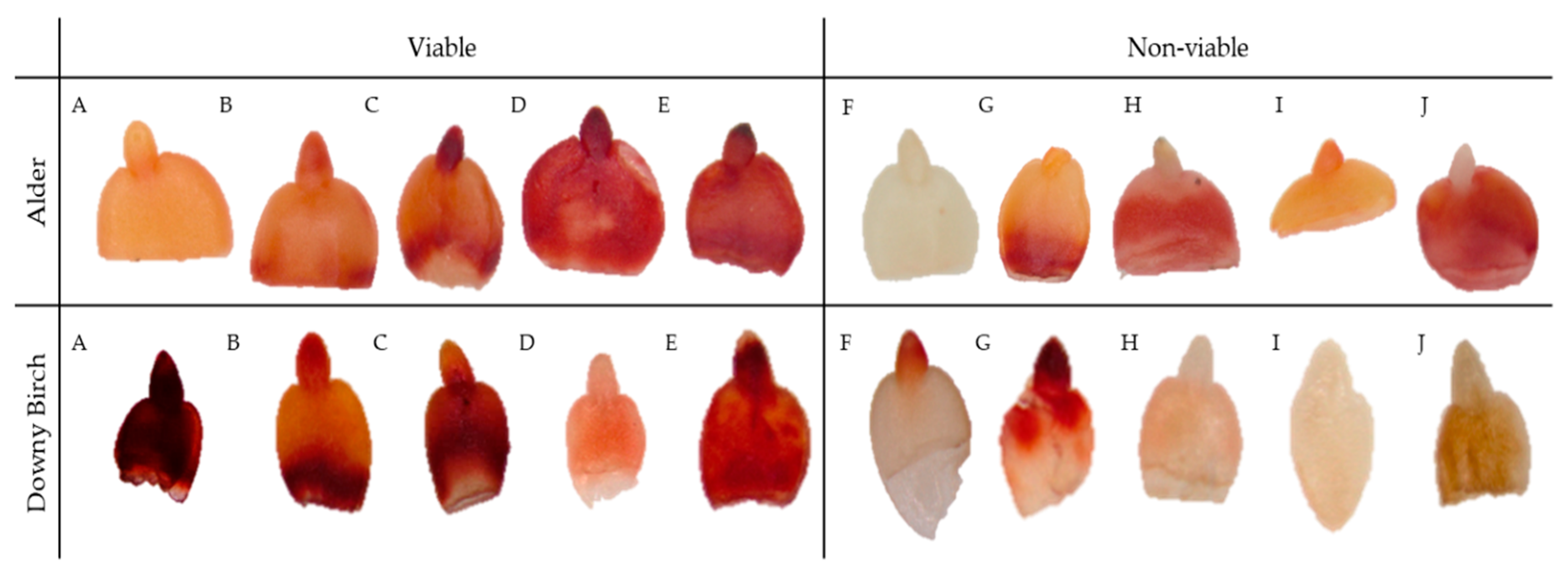
TZ testing was conducted for both species in accordance with ISTA procedures [32]. Seeds were soaked in water for 18 h to allow imbibition. Following soaking, seeds were cut and stained in a 1% tetrazolium chloride solution. After staining, embryos were examined and classified as viable or non-viable based on the staining intensity and pattern observed on the embryos (Figure 1).

2.6. Germination Test

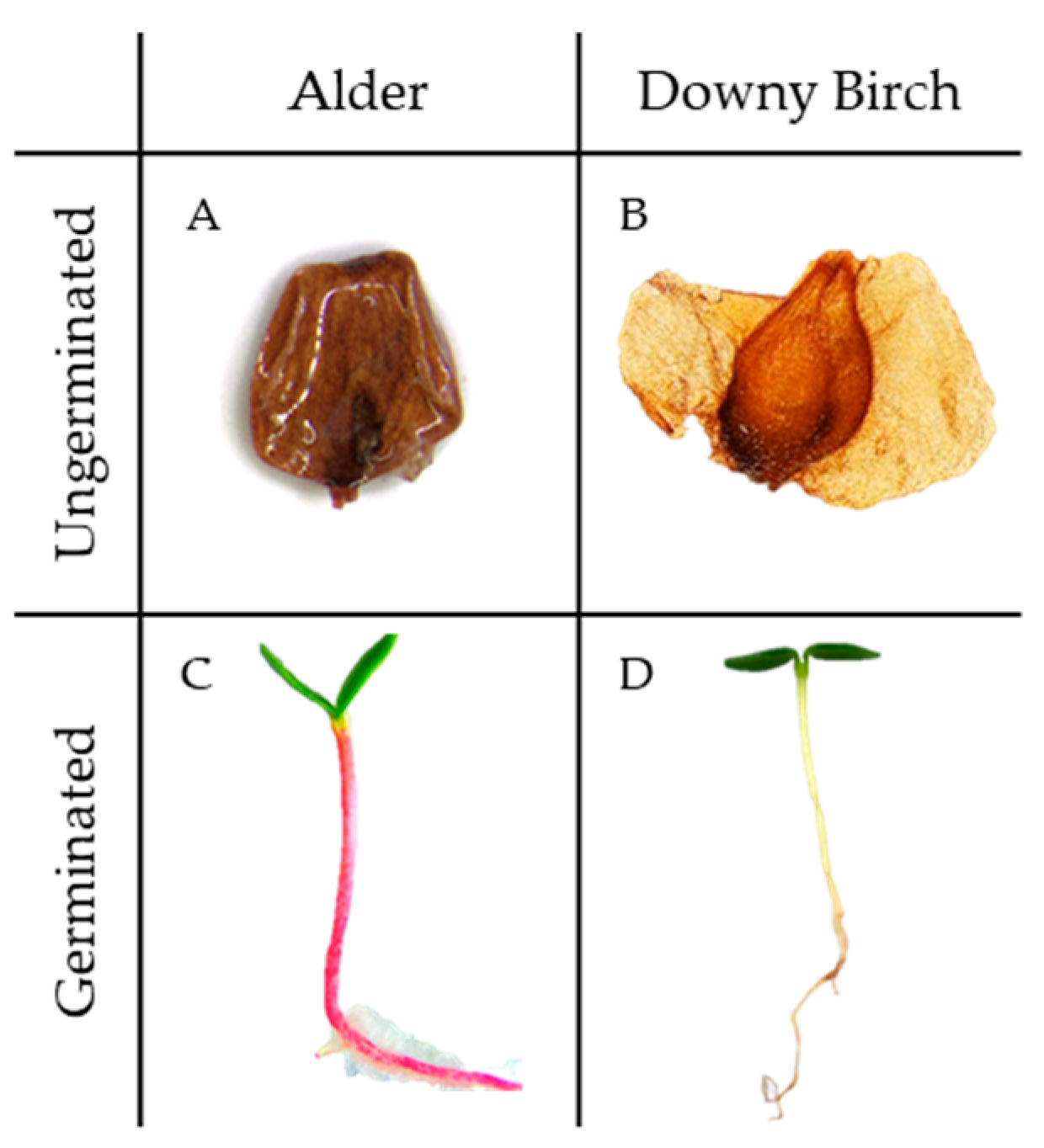
Alder and downy birch seeds were placed on moist filter paper in plastic germination boxes. Germination tests were conducted under alternating temperatures of 20–30 °C for 21 days, and germinated seedlings were counted at seven-day intervals. Representative germinated seedlings and ungerminated seeds are shown in Figure 2.
For downy birch, two treatments were conducted: stratified and unstratified. In the stratified treatment, seeds were held at 4 °C for 21 days prior to incubation in the climatic chamber. Unstratified seeds were incubated directly without prior chilling.
Alder germination percentage (G) was calculated as:
G = (Ng/Nt) × 100
where Ng is the number of germinated seeds and Nt is the total number of seeds tested.
For downy birch, germination was first expressed as viable seeds per kilogram and subsequently converted to germination percentage. Viable seeds per kilogram (VSkg) was calculated as:
V S k g = N n × 1000 W r
where N n is the number of normal seedlings and W r represents the replicate weight in grams. Total seeds per kilogram ( S k g ) was calculated from TSW as:
S k g = 1,000,000 T S W
where TSW represents the weight (g) of 1000 seeds. Germination percentage (G) was calculated as:
G = V S k g S k g × 100
where V S k g represents viable seeds per kilogram and S k g represents total seeds per kilogram.

2.7. Statistical Analysis

All statistical analyses were conducted using R (version 4.4.2). Analyses were performed separately for each species. For TSW and MC variables, the relationship between them and YPH was quantified using simple linear regression fitted by ordinary least squares. The assumptions of homoscedasticity, normality of residuals and independence were verified by residual analysis. The effect of YPH on the viability of alder and downy birch seeds was modelled using bias-reduced Generalized Linear Models for two response variables: TZ viability and germination. They represented proportional data, specifically the count of viable seeds or normal seedlings relative to the total number of seeds tested per replicate. The models were fit using a binomial error distribution with a logit link function. To account for the non-linear biological trajectories observed in the data, such as the initial increase in viability and staggered maturation, polynomial terms were incorporated. Specifically, for alder, a quadratic version of the model was used to capture the maturation peak observed at 2 YPH. For downy birch, a third-order polynomial model was applied to test the hypothesis of a secondary peak occurring at approximately 8 YPH, mirroring the early-stage behaviour of alder but on an extended timeline. To address potential non-independence among replicates within lots, MC was analysed at the sample level calculating the replicate means, while binomial models for TZ viability and germination were additionally fitted as GLMMs with a random intercept for seed lot and as bias-reduced GLMs on lot-aggregated counts. Linear regression was used to assess the association between TZ viability (%) and germination (%) for each species, first using all observations and then repeating the analysis after excluding zero values.
To assess the influence of storage conditions on the observed patterns, additional analyses were conducted excluding seed lots stored under alternative conditions (Coillte samples). These analyses were performed using the same statistical approaches described above. To formally evaluate the robustness of the duration-effect estimates across disparate storage protocols, a parallel model-fitting exercise was conducted as a sensitivity analysis; results are presented in the Supplementary Materials Table S1 and Figure S1.

3. Results

3.1. Changes in Thousand-Seed Weight (TSW), Moisture Content (MC), Tetrazolium (TZ) Viability and Germination with Storage Duration

Alder TSW ranged from 1.2634 g (5 years post-harvest (YPH)) to 1.8733 g (6 YPH) (Table 2). Seeds stored for 1 YPH had a TSW of 1.8120 g, compared with the oldest seed sample (15 YPH), which had a TSW of 1.6258 g. Storage duration had no statistically significant effect on alder TSW (p = 0.873).
Downy birch TSW ranged from 0.0789 g (5 YPH) to 0.2476 g (8 YPH) (Table 2). The sample with the shortest storage duration (1 YPH) had a TSW of 0.1545 g, whereas the oldest sample (10 YPH) had a TSW of 0.2126 g. Storage duration had no statistically significant effect on TSW in downy birch (p = 0.296), indicating that observed variation was likely influenced by factors other than storage duration.
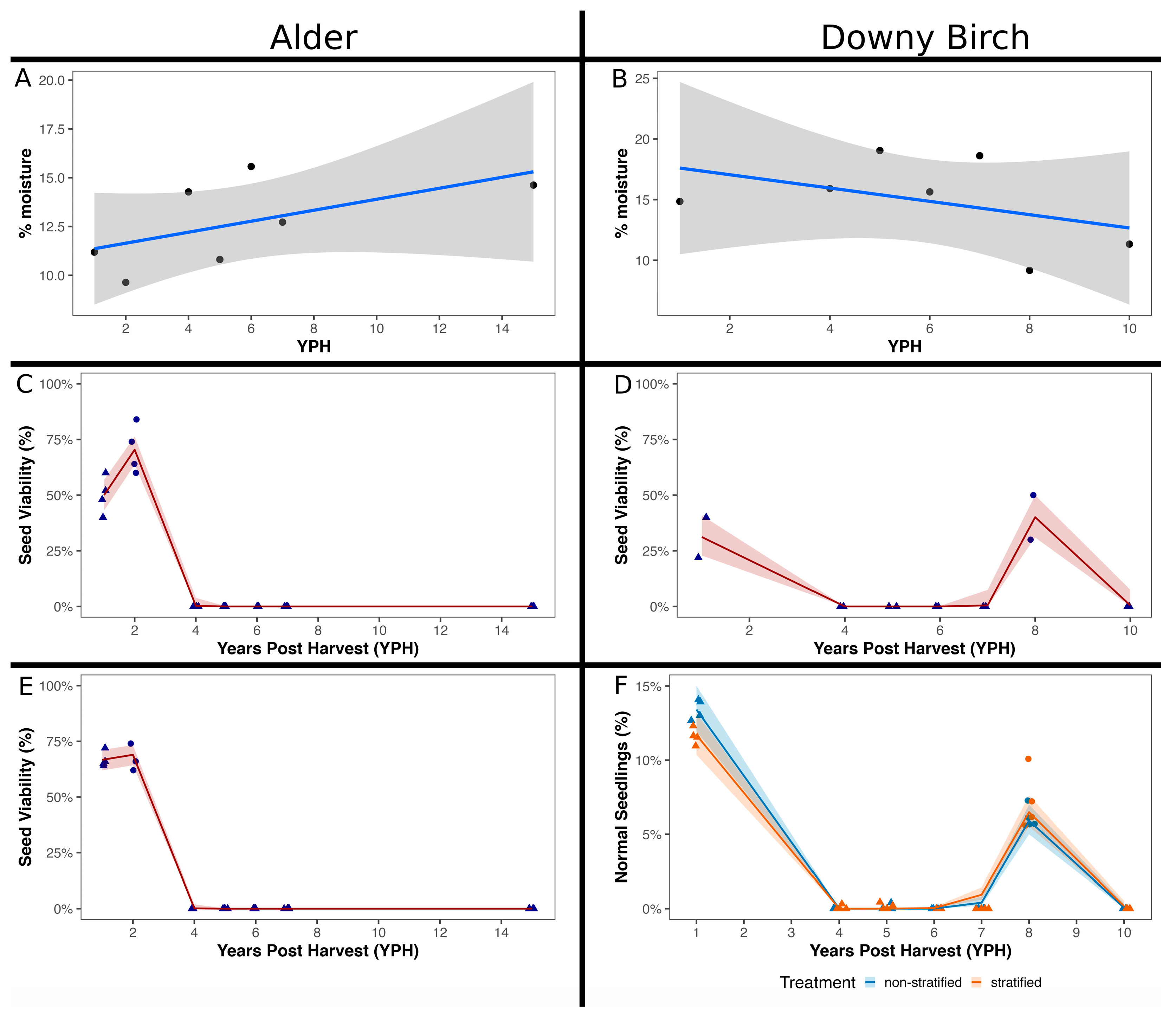
For alder, MC ranged from 9.6% (2 YPH) to 15.6% (6 YPH) (Figure 3A). Seeds stored for 1 YPH had an MC of 11.2%, whereas those stored for 15 YPH had an MC of 14.6%. The model estimated an MC of 11.1% at 0 YPH, with an increase of 0.3% per year. However, storage duration did not have a statistically significant effect on MC in alder (p = 0.169). For downy birch, MC ranged from 9.2% (8 YPH) to 19.0% (5 YPH) (Figure 3B). The sample with the shortest storage duration (1 YPH) had an MC of 14.8%, whereas the sample with the longest storage duration had an MC of 11.3%. The model estimated an MC of 18.2% at 0 YPH, with a decrease of 0.5% per year; however, this relationship was not statistically significant (p = 0.320).
Storage duration had a significant effect on TZ viability in both species (p < 0.001). In alder, viability increased from 1 YPH (averaging 50%) to a maximum at 2 YPH (averaging 70%), with some replicates reaching 84% (Figure 3C). Following this peak, viability dropped sharply by 4 YPH, viable seed counts fell to nearly zero and remained at zero through to 15 YPH. The effect of YPH on downy birch TZ viability showed a strong non-linear pattern (p < 0.001; R2 = 0.959), with relatively higher viability observed in the early storage durations. A peak in viability was recorded at 8 YPH (averaging 40%, with one replicate reaching 50%), followed by a decline in older seed lots (Figure 3D).
Germination success was significantly affected by storage duration in both species, alder and downy birch (p < 0.001) (Figure 3E,F). The germination of alder seeds followed a sharp and linear decline as YPH increased. The model for this species explained approximately 92.5% of the variance in germination. In downy birch, germination declined markedly after 1 YPH, with most seed lots showing minimal or no germination. However, a higher level of germination was observed in the 8 YPH seed lot. Stratification had a significant effect on germination (p = 0.0458), with stratified seeds showing a higher probability of germination compared with unstratified seeds.
Additional analyses excluding seed lots stored under alternative conditions (Coillte samples) are presented in the Supplementary File S1, Table S1 and Figure S1. These analyses showed a consistent decline in viability and germination with increasing storage duration.

3.2. Relationship Between TZ Viability and Germination

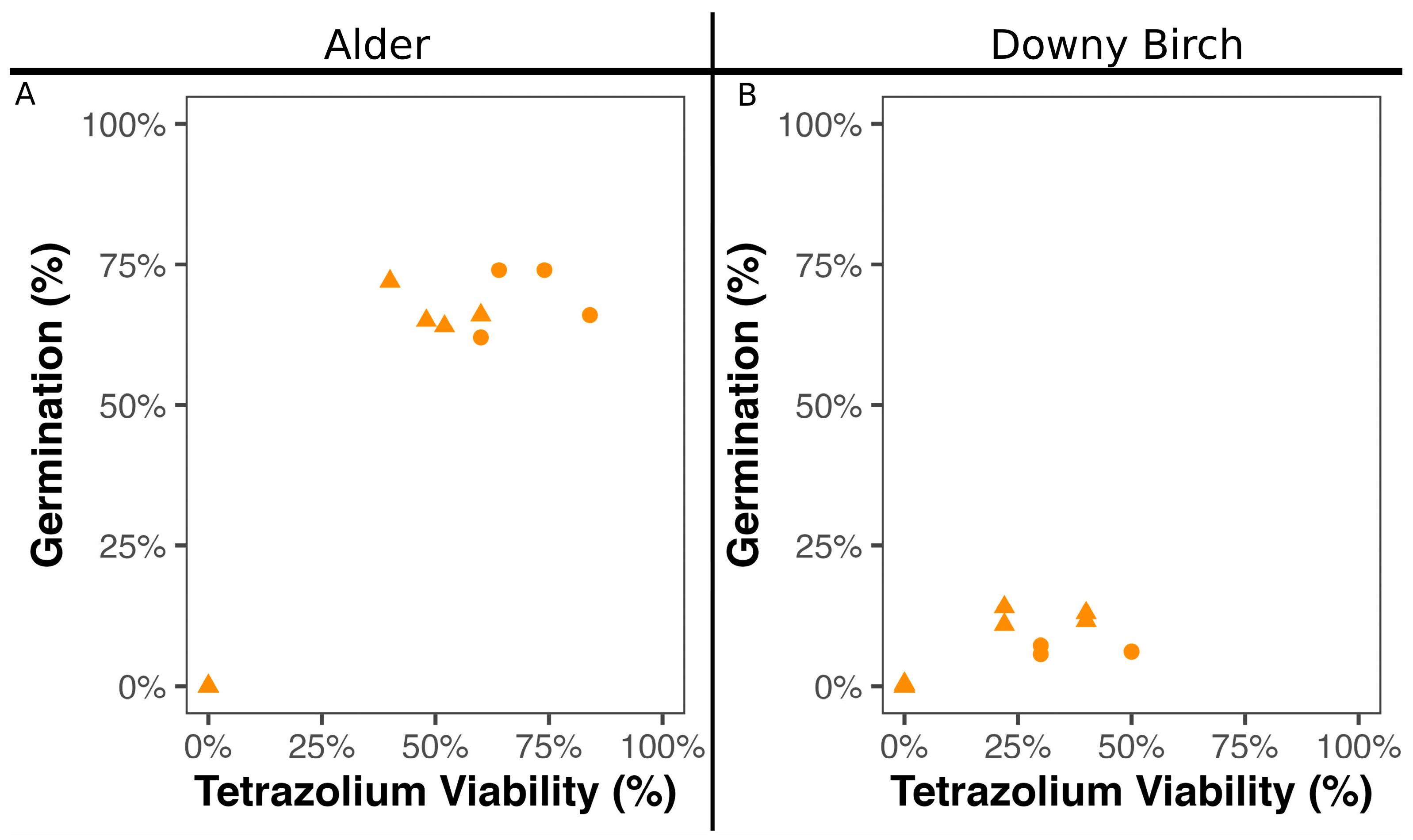
For alder, a strong positive association was observed when all viability and germination observations were included (p < 0.001, R2 = 0.935) (Figure 4A). However, after excluding zero values, the association was no longer significant (p = 0.808, R2 = 0.011). Similarly, for downy birch, a positive association was found when zero values were kept (p < 0.001, R2 = 0.670) (Figure 4B), whereas no association was found after excluding zero values (p = 0.270, R2 = 0.198). This indicates that the significant relationships observed in the full datasets were driven mainly by the presence of zero observations, with no evidence of a linear association among the positive values alone.

3.3. Effect of Stratification in Downy Birch

While there was a marginal hint of an interaction between YPH and treatment (p = 0.0647), this effect was not significant. Therefore, the benefit provided by stratification is relatively stable regardless of how many years have passed (Figure 3F). Pairwise comparisons between stratified and unstratified treatments across storage durations (YPH) are presented in Table 3.

4. Discussion

4.1. The Effect of Long-Term Storage on Seed Quality

Analysis of TSW in alder and downy birch showed that storage duration (YPH) did not significantly affect seed weight. Seed weight is a quantitative trait influenced by both genetic and environmental factors. Studies in other species, such as linseed and rapeseed, indicate that variation in TSW can result from seed size, cell number, and maternal genotype [33,34]. Although these are crop species, TSW is largely determined during seed development and is therefore less sensitive to post-harvest storage conditions, explaining the lack of significant change with YPH observed in this study. Ecologically, seed weight affects dispersal and establishment; lighter seeds are typically adapted for wind dispersal, whereas larger seeds may confer advantages under stressful environmental conditions [33]. Alder and downy birch seeds are both wind-dispersed species, consistent with their relatively low TSW values [35,36]. Thus, these findings suggest that TSW is relatively stable under the storage conditions tested. While both species were examined within the same study framework, they were analysed independently, and direct comparisons between species should be interpreted with caution due to differences in seed biology, treatment conditions, and experimental design.
The interpretation of storage duration effects must be considered in the context of the storage conditions represented in this study. Seed lots from different sources were stored under distinct temperature and packaging regimes, resulting in partial confounding between storage duration and storage environment. To address this, a sensitivity analysis excluding seed lots stored under alternative conditions (Coillte samples) was performed (Supplementary File S1, Table S1 and Figure S1). This analysis confirmed that the overall decline in viability and germination with increasing storage duration remains consistent, while deviations from this trend are likely attributable to differences in storage conditions. These findings further indicate that seed longevity is strongly influenced by storage environment, particularly temperature and moisture control, in addition to storage duration.
Moisture content (MC) analysis showed that alder seed MC showed variations across storage durations, whereas downy birch seed MC remained comparatively stable. This indicates that moisture dynamics during storage are species-specific. Under controlled cold-store conditions, moisture levels would typically be expected to remain stable, provided that packaging is fully airtight [9]. The higher MC observed in alder seed lots suggests that the packaging used may have allowed moisture exchange with the environment. Previous studies on alder and downy birch have demonstrated that MC interacts with storage conditions and pre-treatments differently between alder and birch, with alder often showing greater sensitivity to moisture variation [37,38]. These findings suggest that MC is not solely influenced by storage duration but also by species-specific physiological traits and environment. MC is a critical determinant of seed longevity, as it regulates metabolic activity during storage [39]. Elevated or fluctuating moisture levels can increase metabolic activity and accelerate seed deterioration, thereby contributing to viability loss/decline over time [40].
Seed viability and germination in both alder and downy birch declined with increasing storage duration, consistent with known seed ageing processes, including cellular damage and structural degradation [41]. These processes are accelerated under suboptimal temperature and moisture conditions [42]. However, deviations from this general decline were observed. In particular, peaks in tetrazolium (TZ) viability and germination were observed at 2 YPH (alder) and 8 YPH (downy birch). These are associated with a seed lot stored under different conditions (−3 °C in airtight plastic bags), suggesting that storage environment plays a critical role in maintaining seed quality. Previous studies support this interpretation; higher storage temperatures accelerated viability loss in alder and birch [43], whereas lower storage temperatures and controlled moisture conditions may help maintain seed vigour over longer periods [37]. Harrington [40] further demonstrated that increase in storage temperature substantially accelerate seed ageing rates.
Taken together, these findings highlight that while seed viability generally declines with storage duration, the rate and extent of decline are strongly influenced by storage conditions, particularly temperature and moisture control. Elevated MC is known to accelerate deterioration in orthodox seeds by increasing metabolic activity and susceptibility to fungal damage and can lead to rapid declines in viability even over short time periods [44]. The reduction in seed quality observed may reflect the combined effects of storage duration and moisture uptake due to imperfect packaging. This possibility highlights the importance of packaging integrity in long-term seed conservation. In contrast, structural traits such as TSW remain largely unaffected. These results emphasise the importance of optimising storage environments to maintain seed quality in long-term collections.
A limitation of this study was the availability and distribution of seed lots across storage durations and storage sources. The dataset did not include consistent representation of both Teagasc and Coillte samples across all storage durations, limiting direct comparisons between storage regimes. In particular, storage duration and storage conditions were partially confounded, as most seed lots were stored under a single protocol, with limited overlap between conditions. These factors are known to influence seed longevity and may interact with ageing processes. Consequently, the observed differences in viability and germination cannot be attributed solely to storage duration, as variation in storage environment may also have contributed to the observed differences. Moreover, the absence of baseline (post-harvest) seed quality data limits the ability to quantify absolute declines in viability over time. Findings should be interpreted with this understanding and future work using controlled, standardised storage conditions will be required to isolate the specific effects on alder and birch seeds. In addition, the absence of intermediate storage durations between viable and non-viable seed lots restricts the resolution of viability decline patterns. Expanding the range and continuity of sampled storage durations, and including parallel seed lots stored under comparable conditions, would allow for more robust modelling of seed longevity and clearer separation of storage effects.

4.2. Predictive Value and Limitations of the TZ Test

The relationship between TZ viability and germination showed that significant correlations were largely driven by the inclusion of zero values. When these zero values were excluded, no statistically significant linear association was detected. This indicates that the apparent association between TZ viability and germination may be influenced by extreme observations, such as complete loss of viability, and reflects the limited number of seed lots with positive viability.
Although TZ testing is widely used as a rapid indicator of seed viability by detecting dehydrogenase activity in living tissues [45,46], it measures metabolic viability rather than actual germination performance. In aged seed lots, this divergence is likely to reflect the presence of embryos that retain metabolic activity but lack sufficient physiological vigour to complete germination. Discrepancies between TZ and germination have been reported in aged seed lots and in species with dormancy requirements [21,23]. The dehydrogenase activity in living tissues can persist in seeds that have experienced ageing damage. These seeds may therefore stain positive in TZ tests while being too weak to initiate or sustain growth [47]. The higher TZ values observed in the alder and birch seed lots could reflect residual metabolic activity rather than true germinability. In Betula species, dormancy and stratification requirements strongly influence germination outcomes [48,49], which may also explain the higher TZ viability compared to germination observed in the 1 YPH and 8 YPH downy birch seed lots [38]. Suboptimal germination conditions and seed mortality during testing may also contribute to underestimation of viable seeds [22]. Furthermore, variation in TZ methodology, including staining duration and incubation conditions, can influence test outcomes [23,50]. In this context, while TZ testing provides a rapid and useful estimate of seed viability, it should be interpreted alongside germination testing, particularly for aged seed lots or species with dormancy constraints. Future advances in image-based analysis, including AI-assisted interpretation, may improve the consistency and efficiency of tetrazolium assessment by reducing subjectivity in staining evaluation.

4.3. Relationship Between Stratification and Germination

Downy birch seeds exhibit physiological dormancy, which can be alleviated by cold stratification [38]. In this study, a 21-day cold stratification treatment significantly increased germination compared with unstratified seeds, and this effect remained relatively stable during storage durations. These findings are consistent with previous studies demonstrating that stratification enhances germination in Betula species by overcoming dormancy [48,49].
Although stratification improved germination, its effect was limited in seed lots with low viability, indicating that dormancy-breaking treatments cannot compensate for viability loss during storage. Previous work suggest that longer stratification periods may further enhance germination in viable seed lots [38]. Therefore, combining appropriate storage conditions with effective pre-treatments is essential to maximise germination potential and support the use of stored seed in forestry applications.

5. Conclusions

This study assessed the impact of storage duration on seed quality in alder (Alnus glutinosa) and downy birch (Betula pubescens) under operational storage conditions. Physiological traits, including moisture content and viability, declined with storage duration, whereas thousand-seed weight remained stable. The results indicate that seed viability generally declines during long-term storage under suboptimal conditions, highlighting the limited storage longevity of these species and suggesting that storage environment, particularly temperature and moisture control, plays an important role in maintaining seed quality.
Storage conditions, particularly temperature and moisture control, played a key role in maintaining seed quality. Seed lots stored under lower temperature and airtight conditions (Coillte samples) retained higher levels of viability and germination, demonstrating the importance of optimised storage environments in extending seed longevity. These findings have direct implications for the management of forest reproductive material, particularly in making effective use of mast-year surpluses and ensuring a reliable supply of planting stock.
A relationship between tetrazolium (TZ) viability and germination was observed, although this was largely influenced by zero values, highlighting the need for cautious interpretation. Stratification improved germination in downy birch but did not compensate for loss of viability in older seed lots. These results support the use of TZ testing as a rapid indicator of viability when used alongside germination tests.
Limitations in seed availability across storage durations and sources constrained direct comparisons between storage regimes. Because storage duration and conditions were confounded between seed sources, the effects of time cannot be fully isolated from environmental influences, and the results should be interpreted within this context. Further work under additional controlled conditions is needed to better define the role of moisture content in long-term storage and to improve consistency in TZ assessment, including the development of image-based or AI-assisted approaches to improve the consistency and efficiency. These advances will support the development of more effective seed storage strategies and improve the use of mast-year surpluses in forestry, restoration, and conservation.

Supplementary Materials

The following supporting information can be downloaded at: https://www.mdpi.com/article/10.3390/seeds5030029/s1, Figure S1: Sensitivity analysis showing modelled trends for moisture content, tetrazolium viability, and germination after excluding Coillte seed lots stored under the alternative storage protocol; Table S1: Comparison of model results from the main analysis and the sensitivity analysis excluding Coillte seed lots; File S1: Sensitivity analysis: effect of excluding seed lots stored under the alternative protocol (Coillte, −3 °C, airtight).

Author Contributions

Conceptualisation, S.O.F. and D.S.R.; methodology, S.O.F., E.G., E.O. and D.S.R.; investigation, S.O.F. and E.G.; resources, E.O., B.O., C.T.K. and D.S.R.; data curation, S.O.F., formal analysis, A.A.L.D.S.; visualisation, S.O.F. and A.A.L.D.S.; writing—original draft preparation, S.O.F.; writing—review and editing S.O.F., A.A.L.D.S., E.G., E.O., B.O., C.T.K. and D.S.R.; supervision D.S.R.; project administration, C.T.K. and D.S.R.; funding acquisition, C.T.K. and D.S.R. All authors have read and agreed to the published version of the manuscript.

Funding

This research was funded by the Department of Agriculture, Food and the Marine under the 2024 Policy and Strategic Studies Research Call (grant number 2024PSSRC362).

Data Availability Statement

The original contributions presented in this study are included within the article and Supplementary Materials. Further inquiries can be directed to the corresponding author.

Acknowledgments

The authors would like to thank the staff/students of the Teagasc, Forestry Development Department (Oak Park and Ashtown), including Tomás Byrne, Robert Pim, Oliver Sheridan, Donna Gregan and Derek Gibson, for their long-term support in seed collection, storage, cataloguing, and management of seed orchards. We also acknowledge Richard O’Hanlon and the team at the Department of Agriculture, Food and the Marine (DAFM) Official Seed Testing Laboratory for providing access to laboratory facilities and technical support. We further acknowledge the contribution and support of Office of Public Works and project stakeholders, including Coillte, None-So-Hardy (Forestry) Ltd., and Woodlands of Ireland, to the development and delivery of the NATSEED project.

Conflicts of Interest

The authors declare no conflicts of interest.

References

  1. Šerá, B. Tree Regeneration by Seeds in Natural Forests. Forests 2021, 12, 1346. [Google Scholar] [CrossRef]
  2. Silvertown, J.W. The Evolutionary Ecology of Mast Seeding in Trees. Biol. J. Linn. Soc. 1980, 14, 235–250. [Google Scholar] [CrossRef]
  3. Koenig, W.D.; Knops, J.M. The Mystery of Masting in Trees: Some Trees Reproduce Synchronously over Large Areas, with Widespread Ecological Effects, but How and Why? Am. Sci. 2005, 93, 340–347. [Google Scholar] [CrossRef]
  4. Kelly, D. The Evolutionary Ecology of Mast Seeding. Trends Ecol. Evol. 1994, 9, 465–470. [Google Scholar] [CrossRef]
  5. Gosling, P. Raising Trees and Shrubs from Seed; Forestry Commission Practice Guide FCPG018; Forestry Commission: Edinburgh, UK, 2007. Available online: https://cdn.forestresearch.gov.uk/2007/08/fcpg018.pdf (accessed on 15 May 2026).
  6. Kelly, D.; Sork, V.L. Mast Seeding in Perennial Plants: Why, How, Where? Annu. Rev. Ecol. Syst. 2002, 33, 427–447. [Google Scholar] [CrossRef]
  7. Luna, T.; Wilkinson, K.M. Collecting, Processing, and Storing Seeds. In Nursery Manual for Native Plants: A Guide for Tribal Nurseries; USDA: Washington, DC, USA, 2009; Volume 1. [Google Scholar]
  8. Tylkowski, T. Betula pendula Seed Storage and Sowing Pre-Treatment: Effect on Germination and Seedling Emergence in Container Cultivation. Dendrobiology 2012, 67, 49–58. [Google Scholar]
  9. De Vitis, M.; Hay, F.R.; Dickie, J.B.; Trivedi, C.; Choi, J.; Fiegener, R. Seed Storage: Maintaining Seed Viability and Vigor for Restoration Use. Restor. Ecol. 2020, 28, S249–S255. [Google Scholar] [CrossRef]
  10. Mayrinck, R.C.; Vaz, T.A.A.; Davide, A.C. Physiological Classification of Forest Seeds Regarding Desiccation Tolerance and Storage Behaviour. Cerne 2016, 22, 85–91. [Google Scholar] [CrossRef]
  11. da Silva, B.S.; dos Santos, J.R.P.; de Souza David, A.M.S.; Rodrigues, F.E.; Magalhães, D.B.; Barbosa, T.N.T.; de Souza Cangussú, L.V.; Júnior, G.A.A.R.; Borges, J.B.; Freitas, H.K.C. Storage of Orthodox Seeds-Literature Review. Obs. Econ. Latinoam. 2025, 23, e12710. [Google Scholar] [CrossRef]
  12. Maleki Farahani, S.; Rezazadeh, A.; Paravar, A. Influence of Seed Moisture Content and Storage Period on Germination and Biochemical Indices: Lallemantia Iberica and Lallemantia Royleana. Sci. Rep. 2025, 15, 4462. [Google Scholar] [CrossRef] [PubMed]
  13. Sommerville, K.D.; Errington, G.; Newby, Z.-J.; Liyanage, G.S.; Offord, C.A. Assessing the Storage Potential of Australian Rainforest Seeds: A Decision-Making Key to Aid Rapid Conservation. Biodivers. Conserv. 2021, 30, 3185–3218. [Google Scholar] [CrossRef]
  14. Hay, F.R.; Whitehouse, K.J. Rethinking the Approach to Viability Monitoring in Seed Genebanks. Conserv. Physiol. 2017, 5, cox009. [Google Scholar] [CrossRef] [PubMed]
  15. Balasupramaniyam, S.; Merritt, D.J.; Hay, F.R.; Dalziell, E.L. Assessing the Storage Potential of Seed Collections to Inform the Management of Wild Species Seed Banks. Aust. J. Bot. 2025, 73, BT24065. [Google Scholar] [CrossRef]
  16. Ghive, D.V.; Barabde, N.P.; Pote, S.R. Seed Viability and Factors Affecting Seed Storage; Hind Agri-Horticultural Society: Muzaffarnagar, India, 2007; Volume 2, pp. 205–208. [Google Scholar]
  17. Dadlani, M.; Gupta, A.; Sinha, S.N.; Kavali, R. Seed Storage and Packaging. In Seed Science and Technology; Dadlani, M., Yadava, D.K., Eds.; Springer Nature: Singapore, 2023; pp. 239–266. [Google Scholar]
  18. Gavranović Markić, A.; Bogdan, S.; Gradečki Poštenjak, M.; Lanšćak, M.; Vujnović, Z.; Bogunović, S.; Ivanković, M. Acorn Yields and Seed Viability of Pedunculate Oak in a 10year Period in Forest Seed Objects across Croatia. South-East Eur. For. SEEFOR 2022, 13, 27–36. [Google Scholar]
  19. Felix, F.C.; Mocelim, F.L.; Torres, S.B.; Kratz, D.; Ribeiro, R.; Nogueira, A.C. Thousand-Seed Weight Determination in Forest Species by Image Analysis. J. Seed Sci. 2021, 43, e202143040. [Google Scholar] [CrossRef]
  20. Powell, A. What Is Seed Quality and How to Measure It; Responding to the challenges of a changing world: The role of new plant varieties and high quality seed in agriculture. In Proceedings of the Second World Seed Conference, Rome, Italy, 8–10 September 2009. [Google Scholar]
  21. Elias, S.; Garay, A. Tetrazolium Test (TZ): A Fast, Reliable Test to Determine Seed Viability; Oregon State University Seed Laboratory Publication: Corvallis, OR, USA, 2004; p. 97331. [Google Scholar]
  22. Gosling, P.G. What Is the Relationship between a ‘Germination’ Test and a ‘Viability’ Test. In Proceedings of the ISTA Forest Tree and Shrub Seed Committee Workshop, Prague, Czech Republic, 20–22 October 2003; p. 48. [Google Scholar]
  23. Peng, C.Y.; Wu, Y.; Huang, W.H.; Deng, Z.Y.; Sun, X.R.; Wang, M.Z.; Pritchard, H.W.; Shen, Y.B.; Xu, J.Y.; Yu, X.Y.; et al. Phylogenetic Trends in TZ Staining Analysis of Six Deep Dormancy Seeds. Seed Sci. Res. 2024, 34, 90–102. [Google Scholar] [CrossRef]
  24. Arrieta, S.; Suárez, F. Germination and Seed Bank Depletion of Holly (Ilex aquifolium L.) in Four Microhabitat Types. Seed Sci. Res. 2004, 14, 305–313. [Google Scholar] [CrossRef]
  25. Santos, F.S.D.; Vieira, E.S.N.; Panobianco, M. Tetrazolium Test for Pinus Taeda: Preparation, Staining, and Seed Viability Classes. Pesqui. Agropecuária Bras. 2019, 54, e01088. [Google Scholar] [CrossRef]
  26. Bonner, F. Glossary of Seed Germination Terms for Tree Seed Workers; US Department of Agriculture, Forest Service, Southern Forest Experiment Station: Asheville, NC, USA, 1984; Volume 49.
  27. O’ Connor, E. Birch and Alder—The Development of a Tree Breeding Programme and a Seed Supply for Irish Forestry; Teagasc: Carlow, Ireland, 2011. [Google Scholar]
  28. Farrelly, N.; NemesioGorriz, M.; Short, I.; Ní Dhubháin, Á.; Tobin, B.; O’Hanlon, R.; Earl, R.; McCullagh, A.; O’Donoghue, C.; Ryan, M. An Outline of Achievements in Selected Areas of Forest Research in Ireland 1960–2021. Ir. J. Agric. Food Res. 2022, 61, 218–228. [Google Scholar] [CrossRef]
  29. O’Connor, E. Progress in the Selection and Improvement of Irish Birch; COFORD Connects: Dublin, Ireland, 2006. [Google Scholar]
  30. Walsh, D.G.F.; Waldren, S.; Martin, J.R. Monitoring Seed Viability of Fifteen Species after Storage in the Irish Threatened Plant Genebank. Biol. Environ. Proc. R. Ir. Acad. 2003, 103B, 59–67. [Google Scholar] [CrossRef]
  31. Kelleher, C.T. A National Forest Tree Gene Conservation Strategy and Action Plan for Ireland. Ir. For. 2020, 77, 7. [Google Scholar]
  32. The International Seed Testing Association. ISTA International Rules for Seed Testing 2025; ISTA: Wallisellen, Switzerland, 2025. [Google Scholar]
  33. Li, N.; Peng, W.; Shi, J.; Wang, X.; Liu, G.; Wang, H. The Natural Variation of Seed Weight Is Mainly Controlled by Maternal Genotype in Rapeseed (Brassica napus L.). PLoS ONE 2015, 10, e0125360. [Google Scholar] [CrossRef]
  34. Saroha, A.; Gomashe, S.S.; Kaur, V.; Pal, D.; Ujjainwal, S.; Aravind, J.; Singh, M.; Rajkumar, S.; Singh, K.; Kumar, A.; et al. Genetic Dissection of Thousand-Seed Weight in Linseed (Linum usitatissimum L.) Using Multi-Locus Genome-Wide Association Study. Front. Plant Sci. 2023, 14, 1166728. [Google Scholar] [CrossRef]
  35. McVean, D.N. Ecology of Alnus glutinosa (L.) Gaertn.: II. Seed Distribution and Germination. J. Ecol. 1955, 43, 61. [Google Scholar] [CrossRef]
  36. Liu, Z.; Evans, M. Effect of Tree Density on Seed Production and Dispersal of Birch (Betula pendula Roth and Betula pubescens Ehrhs). Forests 2021, 12, 929. [Google Scholar] [CrossRef]
  37. De Atrip, N.; O’Reilly, C. The Response of Prechilled Alder and Birch Seeds to Drying, Freezing, and Storage. Can. J. For. Res. 2006, 36, 749–760. [Google Scholar] [CrossRef]
  38. O Reilly, C.; De Atrip, N. Seed Moisture Content during Chilling and Heat Stress Effects after Chilling on the Germination of Common Alder and Downy Birch Seeds. Silva Fenn. 2007, 41, 235. [Google Scholar]
  39. Ellis, R.H.; Hong, T.D.; Roberts, E.H. A Comparison of the Low-Moisture-Content Limit to the Logarithmic Relation Between Seed Moisture and Longevity in Twelve Species. Ann. Bot. 1989, 63, 601–611. [Google Scholar] [CrossRef]
  40. Harrington, J. Drying, Storage, and Packaging Seed to Maintain Germination and Vigor; Mississippi State University: Starkville, MS, USA, 1959. [Google Scholar]
  41. Walters, C. Orthodoxy, Recalcitrance and in-between: Describing Variation in Seed Storage Characteristics Using Threshold Responses to Water Loss. Planta 2015, 242, 397–406. [Google Scholar] [CrossRef]
  42. Rezaei, S.; Buitink, J.; Hay, F.R. Contrasting Seed Moisture Sorption Behaviour between Two Species and the Implication for Seed Longevity. Seed Sci. Res. 2023, 33, 126–134. [Google Scholar] [CrossRef]
  43. Tiebel, K.; Dahlmann, J.; Karge, A. Global Warming Could Shorten the Seed Lifespan of Pioneer Tree Species and Thus Natural Regeneration Window of Damaged Areas. Eur. J. For. Res. 2024, 143, 437–450. [Google Scholar] [CrossRef]
  44. Corbineau, F. The Effects of Storage Conditions on Seed Deterioration and Ageing: How to Improve Seed Longevity. Seeds 2024, 3, 56–75. [Google Scholar] [CrossRef]
  45. Soares, V.N.; Elias, S.G.; Gadotti, G.I.; Garay, A.E.; Villela, F.A. Can the Tetrazolium Test Be Used as an Alternative to the Germination Test in Determining Seed Viability of Grass Species? Crop Sci. 2016, 56, 707–715. [Google Scholar] [CrossRef]
  46. França-Neto, J.D.B.; Krzyzanowski, F.C. Use of the Tetrazolium Test for Estimating the Physiological Quality of Seeds. Seed Sci. Technol. 2022, 50, 31–44. [Google Scholar] [CrossRef]
  47. Bewley, J.D.; Bradford, K.J.; Hilhorst, H.W.M.; Nonogaki, H. Seeds. In Physiology of Development, Germination and Dormancy; Springer Science & Business Media: Berlin/Heidelberg, Germany, 2012. [Google Scholar]
  48. Vanhatalo, V.; Leinonen, K.; Rita, H.; Nygren, M. Effect of Prechilling on the Dormancy of Betula pendula Seeds. Can. J. For. Res. 1996, 26, 1203–1208. [Google Scholar] [CrossRef]
  49. Sofi, P.A.; Aslam, M.; Masoodi, T.H.; Pala, N.A.; Rashid, M.; Ishtiyak, P. Influence of Seed Source and Stratification on Germination and Growth of Betula utilis D. Don under Temperate Conditions in Kashmir Himalaya. Indian For. 2020, 146, 532–537. [Google Scholar] [CrossRef]
  50. Chen, B.; Zhang, Q.; Dai, Z.; Gao, J.; Zhang, W.; Wu, R.; Song, S.; Liu, J. Study on TTC Staining and Germination Characteristics of Rice Seeds. Guangdong Agric. Sci. 2021, 48, 1–8. [Google Scholar]
Figure 1. Tetrazolium (TZ) staining patterns used to classify viable and nonviable seeds of alder (Alnus glutinosa) and downy birch (Betula pubescens). For alder, viable seeds show: (A) even light-red staining; (B) light-red staining with darker patches; (C) mixed lighter and darker staining with pale distal section indicating cutting damage; (D) intense red colour with minor pale/unstained areas; and (E) uniformly intense red staining. Nonviable seeds show: (F) unstained embryo; (G) uneven staining with radicle tip absent; (H) uneven staining with more than one-third of the cotyledon and radicle tip unstained; (I) more than one-third of the embryo removed from the distal end; and (J) radicle tip unstained. For downy birch, viable seeds show: (A) intense red staining with minimal lighter shading; (B) fully stained embryo with lighter and darker patches; (C) intense red staining with pale distal section indicating cutting damage; (D) even light-red staining; and (E) intense red staining with minor light patches and less than one-third of the radicle tip unstained. Nonviable seeds show: (F) staining restricted to radicle tip; (G) uneven staining with more than one-third of cotyledon unstained; (H) largely pale/unstained embryo; (I) embryo not cut; and (J) unstained necrotic tissue.
Seeds 05 00029 g001
Figure 2. Ungerminated seeds of alder (A) and downy birch (B), and germinated seedlings of alder (C) and downy birch (D).
Seeds 05 00029 g002
Figure 3. (A,B) Moisture content (MC); (C,D) Tetrazolium (TZ) viability; (E,F) Germination of alder (Alnus glutinosa) and downy birch (Betula pubescens), all plotted against storage duration (years post-harvest; YPH). Point shape denotes seed source, with circles representing Coillte and triangles representing Teagasc.
Seeds 05 00029 g003
Figure 4. Relationship between tetrazolium (TZ) viability and germination in (A) alder (Alnus glutinosa) and (B) downy birch (Betula pubescens) seed lots. Point shape denotes seed source, with circles representing Coillte and triangles representing Teagasc.
Seeds 05 00029 g004
Table 1. Seed lots of alder (Alnus glutinosa) and downy birch (Betula pubescens) used in this study, including harvest year, storage duration (YPH), source, and storage protocol. M1: 4 °C, paper bag + resealable plastic bag. M2: −3 °C, airtight plastic bag.
SpeciesSampleHarvest YearStorage Duration
(Years Post Harvest; YPH)
SourceStorage Method
alderag-2420241TeagascM1
ag-2320232CoillteM2
ag-2120214TeagascM1
ag-2020205TeagascM1
ag-1920196TeagascM1
ag-1820187TeagascM1
ag-10201015TeagascM1
birchbp-2420241TeagascM1
bp-2120214TeagascM1
bp-2020205TeagascM1
bp-1920196TeagascM1
bp-1820187TeagascM1
bp-1720178CoillteM2
bp-15201510TeagascM1
Table 2. Thousand-seed weight (TSW) for alder (Alnus glutinosa) and downy birch (Betula pubescens) seed lots across storage duration (years post-harvest; YPH).
AlderDowny Birch
SampleYPHTSWSampleYPHTSW
ag-2411.8120bp-2410.1545
ag-2321.6629bp-2140.1850
ag-2141.2836bp-2050.0789
ag-2051.2634bp-1960.1881
ag-1961.8733bp-1870.1416
ag-1871.2769bp-1780.2476
ag-10151.6258bp-15100.2126
Table 3. Pairwise comparisons of stratified and unstratified treatments across storage duration (YPH).
YPHContrastOdds Ratiop-Value
1Stratified/Unstratified0.8550.1054
4Stratified/Unstratified36.1780.0549
5Stratified/Unstratified18.8370.0522
6Stratified/Unstratified6.7330.0496
7Stratified/Unstratified2.3320.0465
8Stratified/Unstratified1.1040.4365
10Stratified/Unstratified2.5120.3699
Disclaimer/Publisher’s Note: The statements, opinions and data contained in all publications are solely those of the individual author(s) and contributor(s) and not of MDPI and/or the editor(s). MDPI and/or the editor(s) disclaim responsibility for any injury to people or property resulting from any ideas, methods, instructions or products referred to in the content.