


Abstract
The utilization of cytoplasmic male sterility (CMS) is essential in hybrid seed production; however, its operational value in eggplant is insufficiently documented under practical conditions. This study compared CMS-based and conventional (non-CMS) hybridization systems with respect to flower production, flower functionality, and hybrid seed production efficiency, quantified as seed and viable seedling output per unit time, in three eggplant cultivars (‘Emi’, ‘Langada’, and ‘Tsakoniki’) in intra- and interspecific crosses. CMS did not affect total flower production or inflorescence architecture, which were primarily genotype-dependent. However, it altered flower opening, resulting in genotype- and position-dependent proportions of semi-opened and closed flowers at anthesis. Despite this effect, sufficient flowers suitable for hybridization remained available across all genotypes. CMS substantially simplified the hybridization process by eliminating emasculation, reducing flower manipulation time by approximately 55%, and increasing crossing rate by nearly twofold. Importantly, CMS did not negatively affect female fertility, as indicated by comparable percentages of successful crosses and high seed germination rates across cytoplasmic backgrounds. Seed production per fruit was moderately but significantly increased in intraspecific crosses, while it remained comparable between CMS and non-CMS systems for the interspecific crosses. As a result, CMS significantly increased hybrid seed output and effective seedling production per unit time in intraspecific crosses, while similar trends were observed in interspecific crosses, with gains ranging from 86% to 184% depending on genotype and pollen parent. Overall, this study demonstrates, from an operational perspective, that CMS enhances the efficiency of eggplant hybrid seed production by reducing labor requirements and increasing output per unit time without compromising reproductive performance. These findings highlight the practical value of CMS as a tool for improving hybrid seed production systems, including applications in both commercial hybrid development and rootstock breeding.
1. Introduction
Eggplant (Solanum melongena L.) is one of the most important vegetable crops, with a global production of 55,197,878 tons [1]. In eggplant breeding, both intra- and interspecific F1 hybrids play important roles. Intraspecific hybrids are cultivated per se, exhibit superiority in several agronomic traits (heterosis), and ensure the protection of breeders’ rights [2,3,4,5,6]. Interspecific hybrids represent the first step in the introgression of useful traits from related species such as S. aethiopicum, S. dasyphyllum, S. incanum, and S. elaeagnifolium. These traits include resistance to biotic and abiotic stresses [7,8,9,10,11,12], as well as the induction of cytoplasmic male sterility (CMS) in eggplant [13,14,15,16]. Moreover, eggplant interspecific hybrids constitute a valuable source of rootstocks for eggplant grafting [17,18,19,20,21].
Eggplant is a self-compatible, hermaphroditic species with self-pollination being the prevailing reproductive system [22]. Therefore, in eggplant hybrid seed production, hermaphrodite flowers must be emasculated prior to artificial pollination to prevent self-pollination and seed contamination. This labor-intensive procedure requires skilled personnel and precise timing (before anthesis), substantially increasing hybrid seed production costs. In addition, flower manipulation may cause injuries and premature exposure of the stigma to unfavorable environmental conditions, further reducing hybridization efficiency. A widely proposed strategy to reduce hybrid seed production costs is the development of eggplant CMS lines and their utilization as female parents in hybridization programs, as reported in eggplant and other solanaceous crops [23,24,25]. In CMS eggplant flowers, self-pollination is effectively prevented due to anther non-dehiscence, homeotic transformation of anthers, or failure of pollen formation [13,16,26].
Compared to their autoplasmic (i.e., carrying the native eggplant cytoplasm) non-CMS counterparts, eggplant CMS lines represent more efficient female parents because flower emasculation is unnecessary, offering several advantages such as: (1) higher number of crosses per unit time, (2) reduced incidence flower injury, (3) abortion of non-pollinated flowers, thereby preventing the formation of selfed fruits that would otherwise need to be removed to avoid competition with hybridized fruits and to maintain seed purity, (4) reduced requirement for highly specialized personnel and the possibility to use insect pollinators, and most importantly, (5) perfect hybrid seed purity [27,28,29]. Collectively, these factors simplify and increase the efficiency of the hybridization process in CMS systems [30,31].
Recent molecular and genomic studies have advanced the understanding of male sterility in eggplant, including the identification of CMS-associated mitochondrial variation and candidate genes [32,33,34], highlighting the need to bridge knowledge behind the CMS-inducing mechanisms with applied hybrid seed production systems.
Despite the availability of eggplant CMS lines for more than three decades [35], their practical usefulness in hybrid seed production remains insufficiently studied. Previous studies on eggplant CMS have primarily focused on CMS line development through cytoplasm substitution and repeated backcrossing to one or a limited number of eggplant genotypes [13,14,15,16,36]. Consequently, the available information on important seed production traits (e.g., percentage of successful crosses, number of seeds per fruit, and seed germination) mainly derives from backcrossing schemes rather than from hybrid seed production systems, which represent the primary intended application of CMS lines.
Moreover, detailed information on the flowering behavior of eggplant CMS lines, their operational feasibility, labor requirements for flower manipulation, and seed production per unit time remains limited. To date, no studies have evaluated the applicability of eggplant CMS lines in interspecific hybrid seed production, which is of particular importance for rootstock breeding [37]. Given the practical relevance of CMS systems in large-scale hybrid seed production, these knowledge gaps need to be investigated.
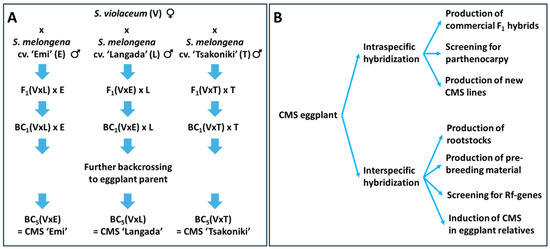
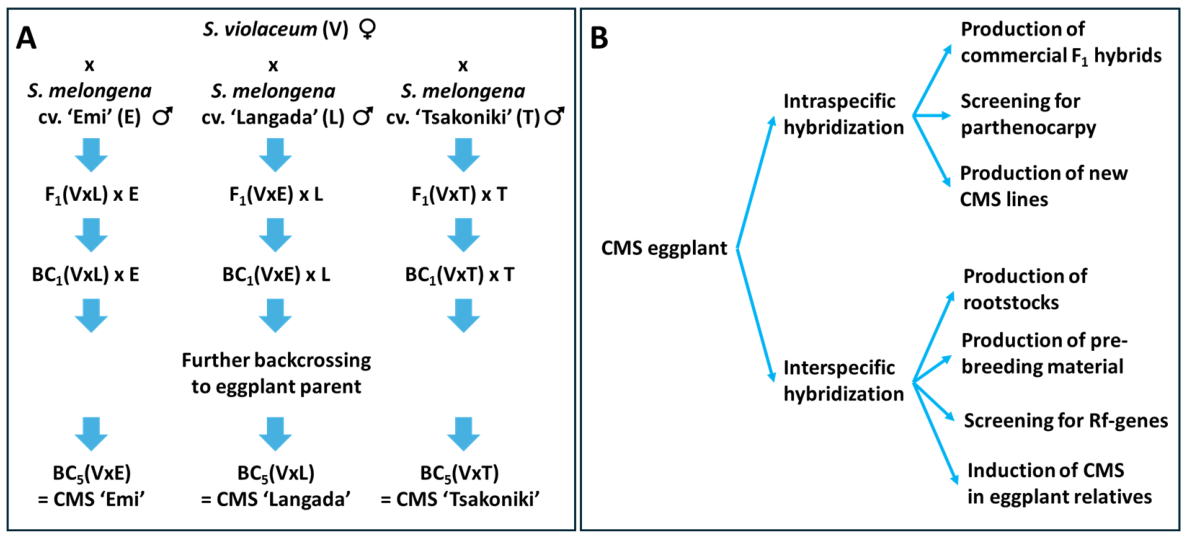
In a previous study, alloplasmic (i.e., carrying the cytoplasm of another species) CMS lines of three Greek eggplant cultivars were developed and genetically characterized, including evaluation of anther morphology, male sterility expression, and fertility restoration (Figure 1). The wild species S. violaceum was used as a cytoplasm donor, followed by repeated backcrossing to eggplant to recover the nuclear genome. This type of CMS was associated with non-dehiscent anthers and was shown to be stable throughout the years [13].
Figure 1.
(A) Crossing scheme for the development of three eggplant CMS lines carrying the cytoplasm of S. violaceum from a previous study [13]. (B) Potential applications of eggplant CMS lines in intra- and interspecific crosses and associated breeding objectives. Symbols: ♀ denotes the female parent and ♂ denotes the male parent; thick arrows in (A) indicate backcrossing to the respective recurrent parent.
To obtain commercially viable CMS-based eggplant hybrids, fertility restorer (Rf) genes or parthenocarpic genotypes are required. In contrast, fertility restoration is not necessary for CMS-based interspecific hybrids used as rootstocks. In this CMS system, restoration is genotype-dependent and not yet fully stabilized, requiring further breeding efforts [13]. However, the identification, stabilization, and practical deployment of fertility restorer genes or parthenocarpy are beyond the scope of the present study, which focuses on the efficiency of hybrid seed production using CMS lines as female parents. Accordingly, this work can be regarded as a technical-applied evaluation of CMS performance in hybrid seed production systems, rather than as a comprehensive biological characterization of the CMS system.
The present study focused on the practical utilization of these previously developed CMS lines in hybrid seed production systems. Unlike previous studies that primarily focused on CMS line development, this work provides a practical evaluation of CMS utilization in hybrid seed production. Specifically, this present study integrates flower functionality, hybridization labor requirements, and seed output per unit time, allowing a direct comparison between CMS-based and conventional hybridization systems under applied conditions. To our knowledge, such an integrated evaluation of CMS performance in eggplant hybrid seed production has not been previously reported.
The main objective of this study was to assess whether cytoplasmic male sterility (CMS) improves the practical efficiency of eggplant hybrid seed production in both intra- and interspecific crosses. This was investigated by evaluating: (i) the effect of CMS on flower production and the availability of flowers suitable for hybridization, (ii) hybridization labor requirements under conventional and CMS-based crossing systems, and (iii) female fertility, seed set, and overall hybrid seed production efficiency expressed per unit time.
2. Materials and Methods
2.1. Plant Material, Growing, and Experimental Design
The plant materials are presented in Table 1. The cytoplasmic male sterile (CMS) lines of the Greek eggplant cultivars ‘Langada’, ‘Emi’, and ‘Tsakoniki’ used in the present study carry the cytoplasm of S. violaceum and the nuclear genome of the respective cultivar ([13]; Figure 1). For each CMS line, the corresponding non-CMS eggplant cultivar was included as a control. The selected cultivars represent popular Greek commercial types that have been widely used in breeding and previous experimental studies, providing contrasting genetic backgrounds and practical relevance for hybrid seed production [38,39,40].
Table 1.
Eggplant (Solanum melongena) cultivars, their respective cytoplasmic male sterile (CMS) lines, and related Solanum species used as female and male parents in the hybridization experiments.
In addition, the Greek eggplant cultivar ‘Santorini’ and the wild species Solanum integrifolium (=S. aethiopicum Group Aculeatum; hereafter referred to as S. integrifolium) were used as pollen donors in intra- and interspecific crosses, respectively. Eggplant ‘Santorini’ was selected based on its favorable fruit quality traits. S. integrifolium was chosen due to its known cross-compatibility with eggplant and its ability to produce vigorous interspecific hybrids with potential as grafting rootstocks [17,37].
All eggplant materials were developed and are maintained at the Institute of Plant Breeding and Genetic Resources (IPBGR), Hellenic Agricultural Organization DEMETER (HAO-DEMETER), Thermi, Thessaloniki, Greece (22°59.956′ E, 40°32.281′ N). The accession of S. integrifolium belongs to the germplasm collection of IPBGR.
For each female genotype, 30 plants were transplanted in an experimental nethouse at the IPBGR facilities. The experiment was arranged according to a randomized complete block design (RCBD) with three blocks (10 plants per block). Marginal plants were excluded from analyses. Plants were spaced at 1.2 m between rows and 0.6 m within rows, drip-irrigated and left unpruned. Basal fertilization was applied before transplanting, followed by split applications during flowering and fruit set. Total nutrient inputs were approximately 160 kg N ha−1, 70 kg P2O5 ha−1, and 170 kg K2O ha−1. A single insecticide application (deltamethrin 2.5%) was performed two weeks after transplanting to control aphids. The climatic conditions during the experimental period are presented in Figure A1.
2.2. Flower Production and Classification
To determine whether CMS affects the availability of flowers suitable for hybridization, total flower production and positional distribution (basal vs. additional flowers) were evaluated across cytoplasmic backgrounds and genotypes. Flower traits were recorded on a per-plant basis starting eight weeks after transplanting. Within each block, seven plants per treatment (cytoplasm × genotype combination) were evaluated, and each plant was considered as one experimental unit. Flower counts were aggregated as cumulative counts per plant over the observation period. Therefore, the temporal component was not retained in the analysis, and the data were not analyzed as repeated measures.
Only long-styled flowers were considered, as medium- and short-styled flowers exhibit low or no female fertility [41] and therefore are not suitable for hybridization. Flowers were classified according to their position within the inflorescence as basal (first flower of the inflorescence; node 0) or additional (second flower; node 1) [42]. Flowers at higher-order nodes were rarely observed and aborted at early developmental stages; therefore, they could not be included in the analysis. Each flower bud was tagged and monitored daily until anthesis.
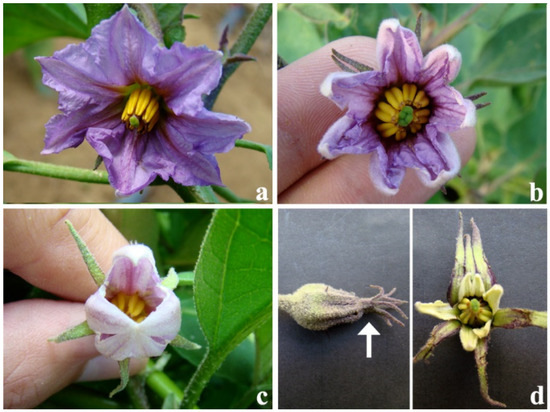
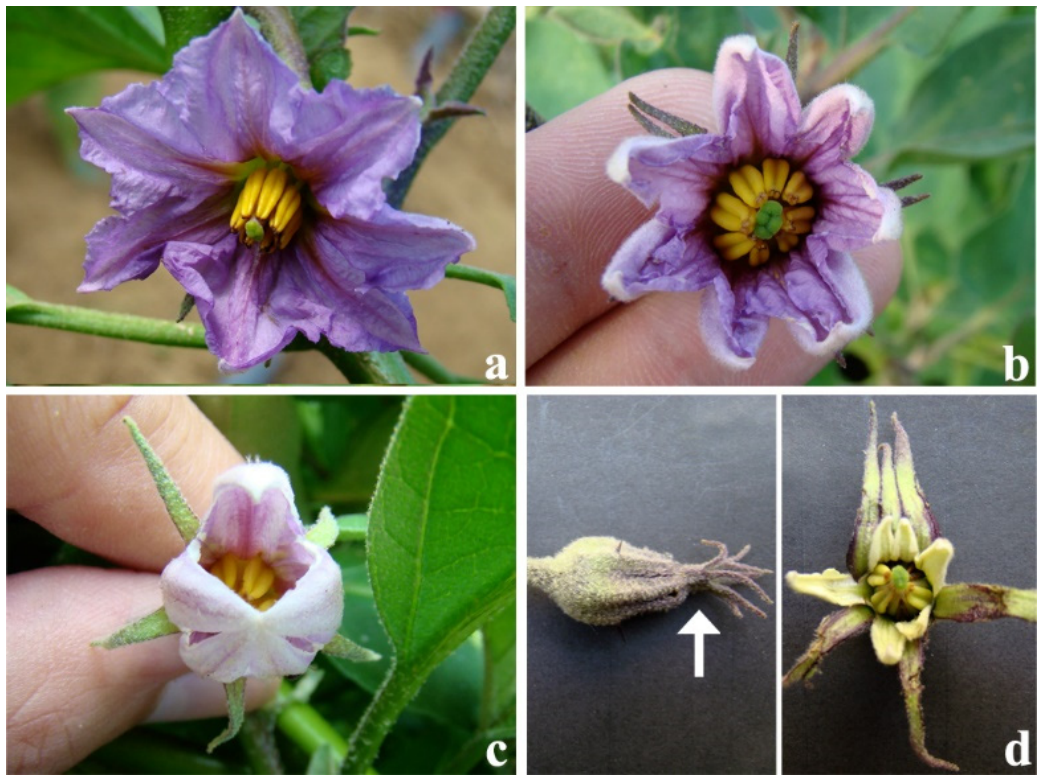
To evaluate whether CMS affects the suitability of flowers for hybridization, flowers were further categorized into functional classes (fully opened, semi-opened, or closed) based on the degree of corolla opening at anthesis (Figure 2). These classes were defined as follows: (i) fully opened flowers, reaching anthesis with complete petal separation and fully exposed reproductive organs; (ii) semi-opened flowers, reaching anthesis with partial corolla opening and limited petal separation; and (iii) closed flowers, reaching anthesis without petal separation, with reproductive organs remaining enclosed within the corolla.
Figure 2.
Representative flowers of the eggplant material studied at maximum stigma receptibility. Typical fully opened flowers at anthesis of (a) non-CMS ‘Emi’ and (b) CMS ‘Emi’. (c) Semi-opened flower of CMS ‘Tsakoniki’ and (d) closed flower of CMS ‘Langada’, both at optimum stigma receptivity and not progressing to the fully opened stage. The white arrow indicates the sepal constriction preventing the closed flower from opening; the flower was manually opened for visualization of the receptive stigma, which is surrounded by both normal and atrophic anthers and shorter petals.
All flowers of non-CMS lines reached full opening at anthesis. In contrast, semi-opened and closed flowers, which remained in these states throughout their functional lifespan and did not progress to full opening, were observed exclusively in CMS lines.
In the closed flowers, a reliable assessment of stigma receptivity required manual opening of each flower, which substantially increases handling time and requires experienced personnel. Because the objective of the study was to evaluate hybridization efficiency under practical crossing conditions, flowers suitable for hybridization were defined as flowers reaching anthesis with exposed or accessible stigma that could be readily utilized without additional manipulation. Accordingly, fully opened and semi-opened flowers were considered suitable for hybridization, whereas closed flowers were excluded from routine hybridization. This exclusion reflects practical hybridization conditions rather than an inherent biological incapacity of these flowers.
Absolute flower counts were recorded for each category over a 12-week period. The recorded traits included: (i) total number of flowers, (ii) number of fully opened flowers, (iii) number of semi-opened flowers, (iv) number of closed flowers, and (v) number of flowers suitable for hybridization (fully opened + semi-opened). In addition, the corresponding percentages were calculated relative to the total flower number.
2.3. Hybridization Procedure
To evaluate the effect of CMS on hybrid seed production efficiency, three available CMS lines and their respective non-CMS eggplant cultivars were used as female parents in all crosses. Controlled crosses were performed using flowers suitable for hybridization (fully opened and semi-opened flowers at anthesis).
Initially, hybridization was planned to use basal flowers only, as these are typically long-styled and therefore suitable for controlled crosses. However, at the beginning of the experiment, it was observed that in both CMS and non-CMS ‘Emi’ and ‘Langada’, a considerable proportion of additional flowers were long-styled and fully opened at anthesis, indicating their potential suitability for hybridization. Therefore, additional flowers were included in intraspecific crosses for these genotypes to evaluate the effect of flower position on hybrid seed production.
Crosses were conducted using one flower per inflorescence to avoid potential intra-inflorescence competition effects on fruit and seed development. The crossing scheme included: (1) intraspecific crosses with eggplant ‘Santorini’ as pollen donor, performed on basal flowers in all genotypes; (2) interspecific crosses with S. integrifolium, performed on basal flowers in all genotypes; and (3) intraspecific crosses with eggplant ‘Santorini’ conducted on additional flowers in ‘Emi’ and ‘Langada’ only.
Crosses on additional flowers were not performed in ‘Tsakoniki’ because this genotype produced very few inflorescences bearing additional flowers, resulting in an insufficient number of additional flowers.
In non-CMS lines, flower buds were emasculated one day prior to anthesis to prevent self-pollination. In CMS lines, emasculation was omitted due to male sterility and the absence of pollen release. Manual pollination was performed at anthesis using freshly collected pollen and repeated on the following day. Pollen was collected from newly opened flowers of the respective pollen donors immediately prior to pollination. Flowers were tagged after emasculation in non-CMS lines or at anthesis in CMS lines. In non-CMS plots, open flowers and fruits resulting from self-pollination were removed prior to crosses to avoid seed contamination. All crosses were carried out by the same experienced researcher to minimize variability.
Based on the distinct procedural requirements associated with the presence or absence of male fertility, two hybridization systems were defined for subsequent evaluation: (1) the conventional non-CMS system, including removal of selfed flowers/fruits, tagging, emasculation and pollination, and (2) the CMS system, in which emasculation and removal of selfed flowers/fruits were unnecessary due to the absence of functional pollen, while all other steps were retained.
2.4. Measurement of Hybridization Time Requirements
To quantify labor requirements for hybridization, the individual steps of the crossing procedure were timed using a digital timer. Measurements were performed on basal flowers only, which constituted the primary flowers used for hybridization in both CMS and conventional crossing systems.
Within each block, time measurements were recorded on groups of 10 flowers per treatment (cytoplasm × genotype combination). Each group of 10 flowers was considered as one experimental unit (n = 3). A total of 30 flowers per treatment (10 flowers × 3 blocks) were used to estimate hybridization time parameters.
The following hybridization steps were timed (seconds per 10 flowers): (1) removal of selfed flowers/fruits, (2) flower tagging, (3) emasculation, (4) pollination (day 1), and (5) pollination (day 2). Pollen collection was not timed separately, as it was associated with the male parent and was identical for both CMS and non-CMS crossing systems; therefore, it did not affect their comparative evaluation.
Total manipulation time per 10 flowers (s) was calculated as the sum of the above steps. Mean manipulation time per flower (s) was subsequently derived by dividing the total manipulation time by 10. Values expressed per flower, therefore represent averages derived from grouped measurements. Crossing rate (CR; flowers h−1), defined as the number of flowers that can be manually crossed per hour, was calculated based on the mean manipulation time per flower.
2.5. Evaluation of Female and Seed Fertility
To determine whether CMS affects reproductive performance, female fertility, and seed production traits were evaluated using basal flowers across cytoplasmic backgrounds, genotypes, and pollen donors.
Female fertility was evaluated on a per-block basis (n = 3) using the percentage of successful crosses (%SC) and the mean number of seeds per fruit (NSF).
For each combination of cytoplasm, genotype, and pollen donor, 30 controlled crosses per block were performed, resulting in a total of 90 attempted crosses per treatment across the three blocks. The percentage of successful crosses (%SC) was calculated within each block as the number of fruits containing seeds divided by the number of attempted crosses.
To estimate NSF, seeds from 10 representative fruits per crossing combination per block were bulked and weighed. Three subsamples of 100 seeds were then weighed to determine the mean seed weight. The total number of bulked seeds was calculated by dividing the total seed mass by the mean seed weight. Subsequently, NSF was estimated by dividing the total number of seeds by 10.
Seed germination percentage (%Germ) was determined by sowing 100 seeds per crossing combination in three replicates, and four weeks later, germinated seeds were counted.
All fertility and seed production traits (%SC, NSF, and %Germ) were calculated at the block level, and each block was considered as one experimental unit (n = 3) for statistical analysis.
2.6. Definition and Calculation of Hybrid Seed Production Efficiency
In the context of this study, hybridization efficiency is defined operationally as seed and viable seedling output per unit time, as seed constitutes the final product of hybrid seed production, while seedlings represent the practical output utilized in cultivation systems. To compare the efficiency of CMS and non-CMS hybridization systems, two indices of hybrid seed production performance were calculated by integrating time-related and fertility-related parameters.
Hybrid seed output rate (HSO; seeds h−1) was calculated as: HSO = CR × %SC × NSF, where CR represents the crossing rate (flowers h−1), %SC the percentage of successful crosses, and NSF the number of seeds per fruit. To further incorporate seed viability, effective seedling output rate (ESO; viable seedlings h−1) was calculated as: ESO = HSO × %Germ, where %Germ represents the seed germination percentage.
All parameters used for the calculation of HSO and ESO (CR, %SC, NSF, and %Germ) were derived at the block level. Consequently, HSO and ESO were also calculated at the block level, and each block was considered as one experimental unit (n = 3) for statistical analysis.
HSO and ESO represent practical estimates of the number of hybrid seeds and viable seedlings that can be produced per unit time under each hybridization system and were used to evaluate overall hybrid seed production efficiency.
2.7. Statistical Analysis
Statistical analyses were structured according to the main hypotheses of this study: (i) CMS does not affect flower production, (ii) CMS reduces hybridization time requirements, and (iii) CMS does not impair female fertility and overall seed production.
Accordingly, cytoplasm (CMS vs. non-CMS) and genotype were treated as the primary experimental factors. Pollen donor and flower position were included as trait-specific factors where biologically relevant.
All analyses were performed using SPSS 17.0 (SPSS Inc., Chicago, IL, USA). Percentage data were arcsine square-root transformed before analysis. Back-transformed means are presented for ease of interpretation. Homogeneity of variance was evaluated using Levene’s test. Data were transformed where required to improve compliance with ANOVA assumptions. Although certain observations were recorded over time, the data were aggregated as cumulative values. Therefore, the dataset does not represent repeated measures.
2.7.1. Flower Production and Suitability for Hybridization
Flower production traits (total, basal, and additional flowers, expressed as absolute numbers and percentages) were analyzed using a two-factor ANOVA under a randomized complete block design (RCBD) with cytoplasm and genotype as fixed factors.
Traits related to flower functionality (fully opened, semi-opened, and closed flowers) were analyzed exclusively within the CMS background, as these categories were biologically absent in non-CMS plants. These traits were analyzed using a two-factor RCBD ANOVA with genotype and flower position (basal vs. additional) as factors.
2.7.2. Measurements of Hybridization Time Requirements
Hybridization time measurements were recorded only on basal flowers, which constituted the primary flowers used for hybridization in both crossing systems. Manipulation time per flower and crossing rate were analyzed using a two-factor RCBD ANOVA with cytoplasm and genotype as factors.
2.7.3. Evaluation of Female Fertility and Seed Production
Female fertility and seed production traits (percentage of successful crosses, number of seeds per fruit, and seed germination percentage) were evaluated using basal flowers following intra- and interspecific crosses. These traits were analyzed using a three-factor RCBD ANOVA with cytoplasm, genotype, and pollen donor as factors.
2.7.4. Effect of Flower Position on Seed Production
To evaluate whether flower position influences hybrid seed production, an additional analysis was conducted within the intraspecific dataset where both basal and additional flowers were available. This analysis included the genotypes ‘Emi’ and ‘Langada’, for which sufficient additional flowers were present, while ‘Tsakoniki’ was excluded due to the limited availability of additional flowers.
The effect of flower position was analyzed using a three-factor RCBD ANOVA with cytoplasm, genotype, and flower position as factors.
3. Results
3.1. Flower Production and Positional Distribution
3.1.1. Flower Production
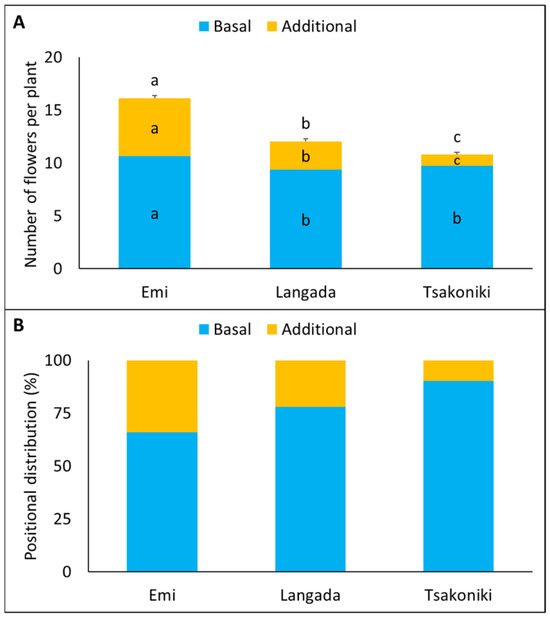
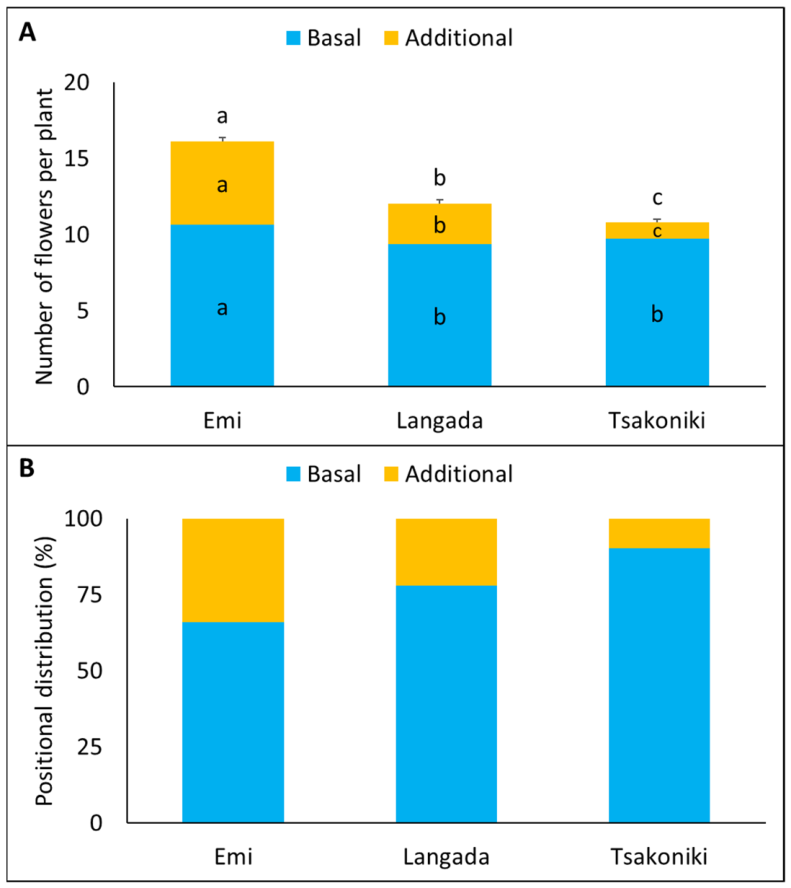
Flower production per plant differed significantly among genotypes (p ≤ 0.001); whereas, cytoplasm and cytoplasm × genotype had no significant effect (Table A1). Eggplant ‘Emi’ produced significantly more total flowers (16.1) than ‘Langada’ (12.1) and ‘Tsakoniki’ (10.8; Figure 3). A similar pattern was observed for basal and additional flowers. In the genotypes examined, additional flowers corresponded to second-node (N1) flowers, while flowers at higher nodes (mainly N2) were typically aborted at early developmental stages. The highest number of basal flowers was recorded in ‘Emi’ (10.6), while ‘Langada’ and ‘Tsakoniki’ had similar values (9.4 and 9.7, respectively). ‘Emi’ also formed substantially more additional flowers (5.5), while ‘Langada’ (2.7) and ‘Tsakoniki’ (1.1) had intermediate and low values, respectively.
Figure 3.
Total flower production and positional distribution in eggplants ‘Emi’, ‘Langada’, and ‘Tsakoniki’. (A) Genotypic effects on the number of total, basal (node 0), and additional (node 1, N1) flowers per plant. Bars represent estimated marginal means ± SE. Different letters indicate significant differences among means within the same flower category (Tukey’s HSD test; α = 0.05). (B) Positional distribution of basal and additional flowers expressed as a percentage of total flower number.
3.1.2. Flower Positional Distribution
No significant effects of cytoplasmic or cytoplasm × genotype interaction were detected for the positional distribution of flowers (basal vs. additional), whereas genotype effects were highly significant (p ≤ 0.001; Table A1). The highest proportion of basal flowers was observed in ‘Tsakoniki’ (90.3%) and the lowest in ‘Emi’ (65.9%), where additional flowers had a considerable contribution (34.1%). ‘Langada’ displayed intermediate values, with 77.9% basal and 22.1% additional flowers.
3.2. Flower Functionality in CMS Lines
Flower functionality was strongly affected by the CMS cytoplasm. While all flowers of the non-CMS lines reached full opening at anthesis, a differential opening behavior was observed in the CMS lines, where a proportion of flowers remained semi-opened or completely closed without reaching the fully open stage (Figure 2).
3.2.1. Genotypic and Positional Effects on Flower Opening
Factorial analysis of absolute flower counts revealed significant effects of genotype (p ≤ 0.001), flower position (p ≤ 0.001), and genotype × position interaction (p ≤ 0.05) for all flower functionality categories (Table A1).
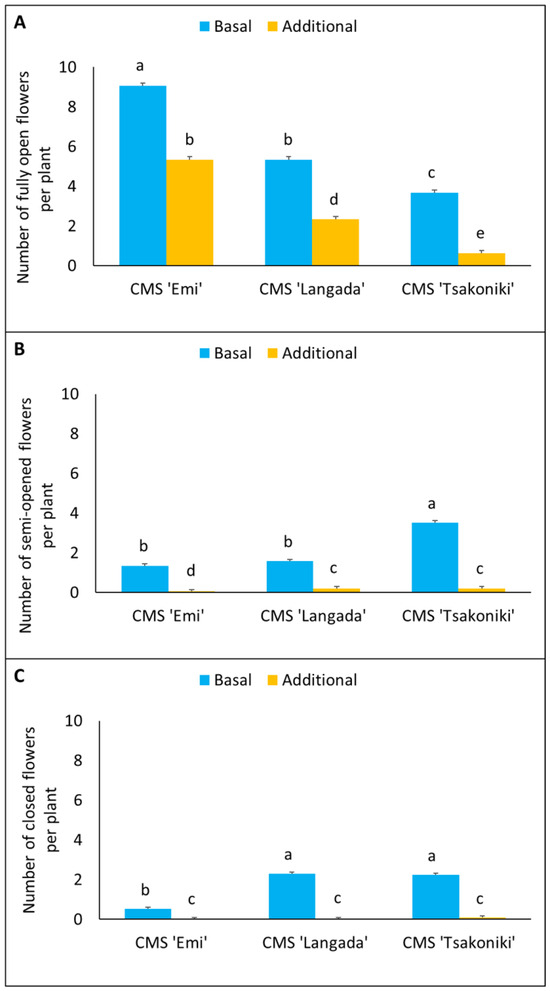
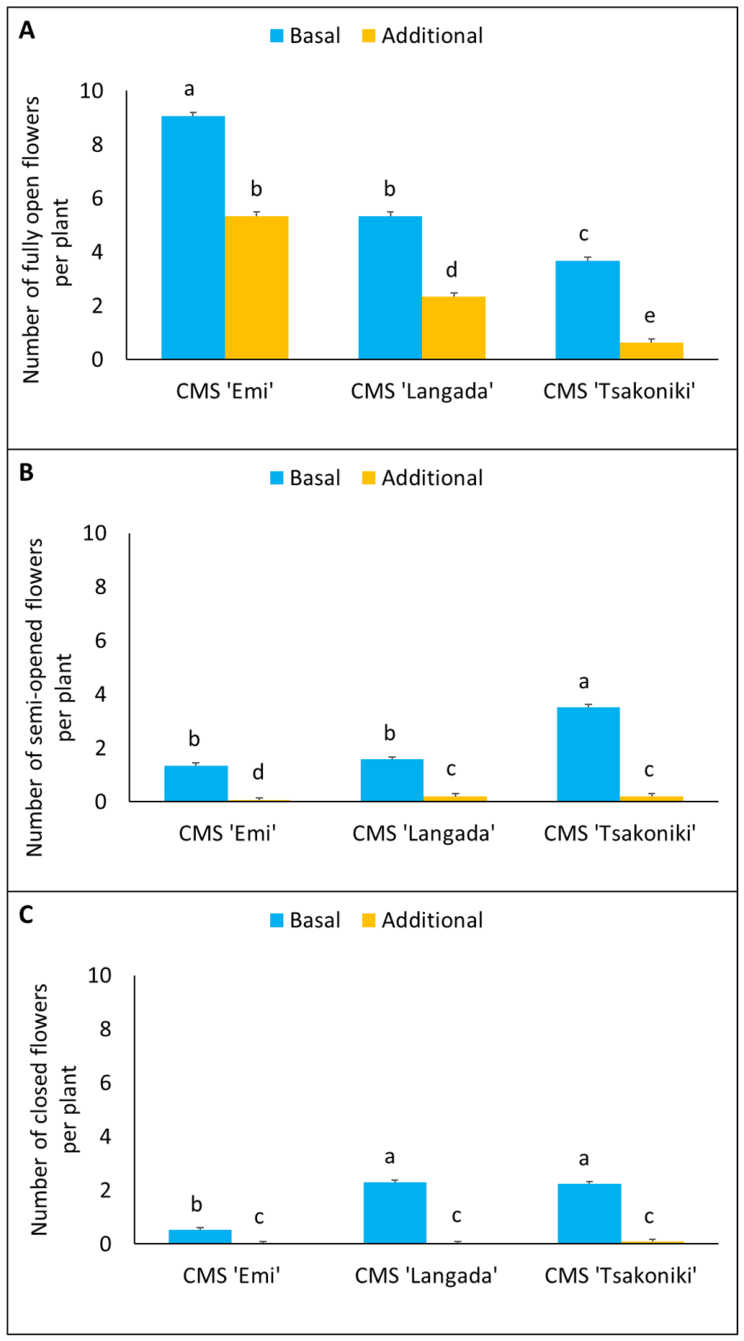
CMS ‘Emi’ produced the highest number of fully open basal flowers (9.1), followed by CMS ‘Langada’ (5.3) and CMS ‘Tsakoniki’ (3.7; Figure 4A). Semi-opened basal flowers were predominantly observed in CMS ‘Tsakoniki’ (3.5), exceeding CMS ‘Langada’ (1.6) and CMS ‘Emi’ (1.3) (Figure 4B). Closed basal flowers were more frequent in CMS ‘Langada’ (2.3) and CMS ‘Tsakoniki’ (2.2) compared with CMS ‘Emi’ (0.5; Figure 4C).
Figure 4.
Genotype × flower position interaction effects on flower functionality in CMS lines of eggplant genotypes ‘Emi’, ‘Langada’, and ‘Tsakoniki’. Flower position corresponds to basal (node 0) and additional (node 1, N1) flowers. (A) Fully open flowers, (B) semi-opened flowers, and (C) closed flowers. Bars represent estimated marginal means ± SE. Different letters indicate significant differences among means (Tukey’s HSD test; α = 0.05).
Additional flowers displayed improved functionality compared with the basal ones. CMS ‘Emi’ maintained the highest number of fully open additional flowers (5.3), followed by CMS ‘Langada’ (2.3) and CMS ‘Tsakoniki’ (0.6; Figure 4A). Semi-opened and closed additional flowers were nearly absent in all CMS lines (Figure 4B,C).
3.2.2. Distribution of Flower Functionality Classes
When expressed as proportions of total flower production, genotype and flower position effects remained highly significant (p ≤ 0.001), whereas the genotype × position interaction was significant only for closed flowers (p ≤ 0.001; Table A1).
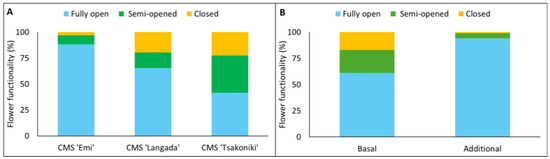
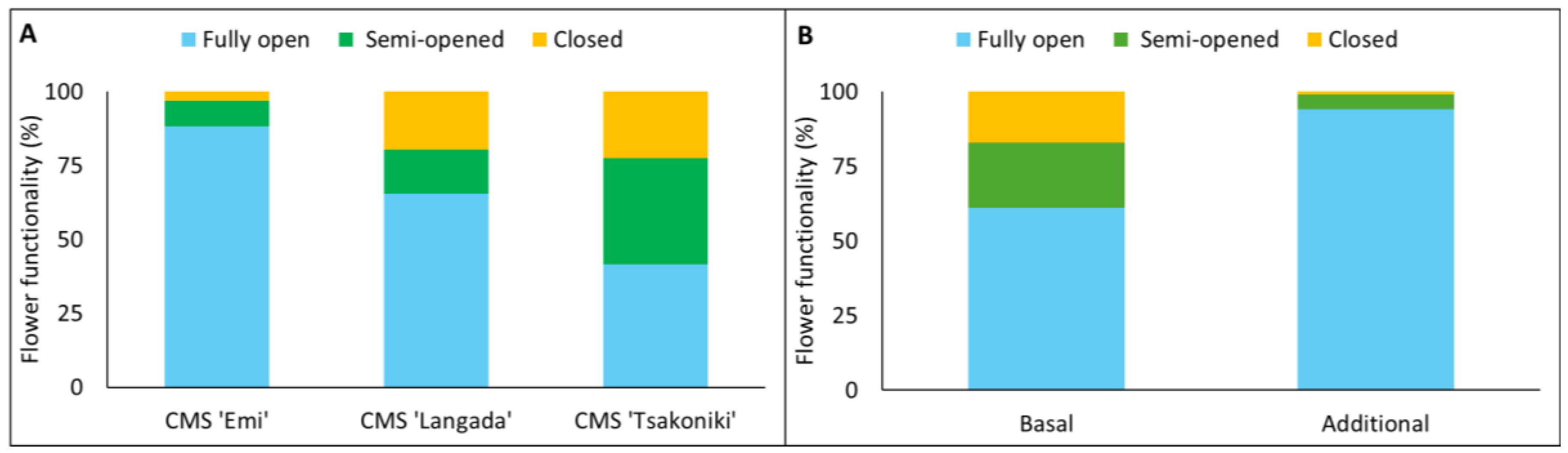
Genotypic differences were also evident when functionality classes were expressed as proportions of total flower production. The highest percentage of fully open flowers was recorded in CMS ‘Emi’ (88.3%), followed by CMS ‘Langada’ (65.5%) and CMS ‘Tsakoniki’ (41.5%; Figure 5A). The opposite trend was observed for semi-opened flowers, which were most frequent in CMS ‘Tsakoniki’ (35.9%), followed by CMS ‘Langada’ (15.0%) and CMS ‘Emi’ (3.2%). Closed flowers were also more frequent in CMS ‘Tsakoniki’ (22.6%) and CMS ‘Langada’ (19.5%) compared with CMS ‘Emi’.
Figure 5.
Percentage distribution of flower functionality classes in CMS lines of eggplant genotypes ‘Emi’, ‘Langada’, and ‘Tsakoniki’ across (A) genotypes and (B) flower positions.
Flower position also influenced functionality. Basal flowers showed lower proportions of full opening (61.1%) and higher proportions of semi-opened (21.8%) and closed flowers (17.1%), indicating a pronounced CMS effect at the basal position (Figure 5B). In contrast, additional flowers exhibited markedly improved functionality, with fully open flowers reaching 94.1%, while semi-opened (4.9%) and closed (1.1%) flowers occurred at minimal frequencies.
3.2.3. Production and Positional Distribution of Flowers Suitable for Hybridization
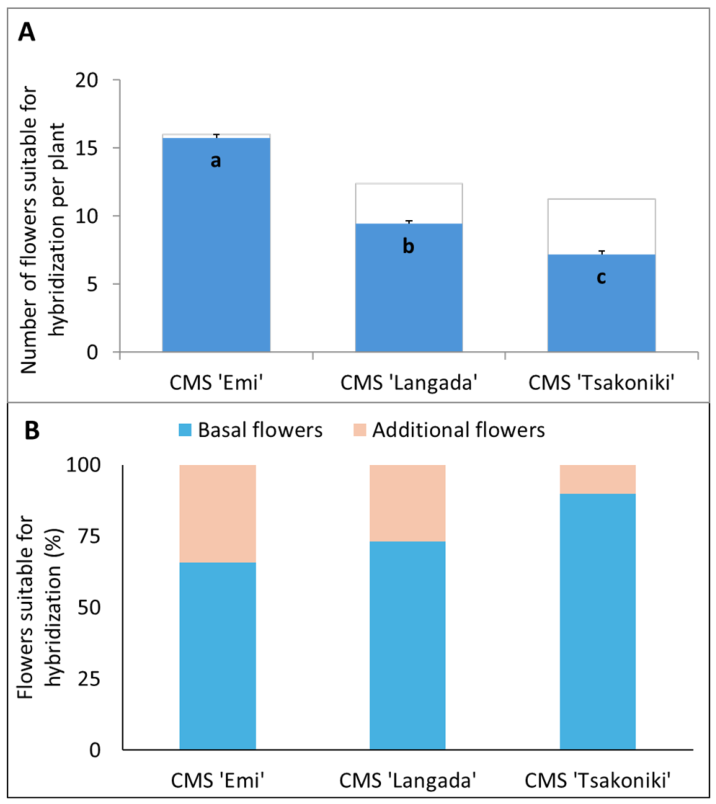
As a consequence of altered flower opening behavior, significant differences were observed among CMS lines in the number of flowers suitable for hybridization. A highly significant genotype effect was detected for the total number of flowers suitable for hybridization, as well as for the number of basal and additional suitable flowers (p ≤ 0.001; Table A1).
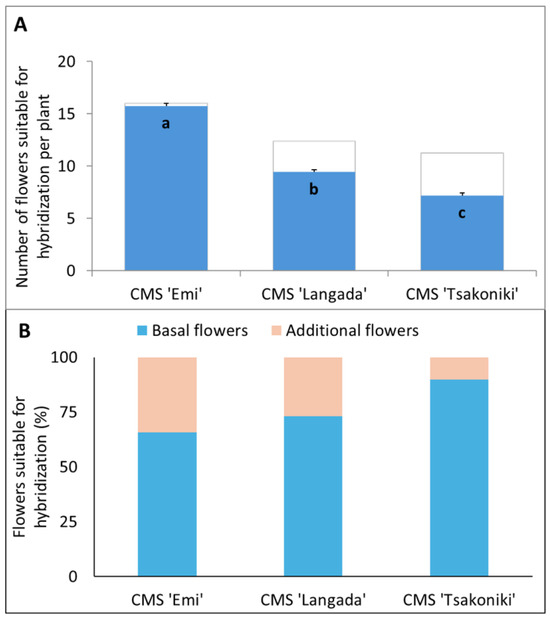
Among the CMS lines, CMS ‘Emi’ produced the highest number of flowers suitable for hybridization per plant (15.8), whereas CMS ‘Langada’ and CMS ‘Tsakoniki’ produced significantly fewer suitable flowers, with 9.4 and 7.2 flowers, respectively (Figure 6A). Relative to their non-CMS counterparts, the number of flowers suitable for hybridization was slightly reduced in ‘Emi’ (−1.5%) and more markedly in ‘Langada’ (−23.8%) and ‘Tsakoniki’ (−36.0%).
Figure 6.
Production of flowers suitable for hybridization and their positional distribution in CMS lines of the eggplant genotypes ‘Emi’, ‘Langada’, and ‘Tsakoniki’. (A) Total number of flowers suitable for hybridization per plant. Blue bars represent values for CMS lines, while white bars represent the corresponding values for non-CMS lines. Bars show estimated marginal means ± SE. Different letters indicate significant differences among means (Tukey’s HSD test; α = 0.05). (B) Positional distribution of flowers suitable for hybridization.
Basal flowers constituted the majority of flowers suitable for hybridization in all CMS lines, although their relative contribution differed among genotypes (Figure 6B). Basal flowers accounted for 65.7% in CMS ‘Emi’, 73.2% in CMS ‘Langada’, and 89.9% in CMS ‘Tsakoniki’. Consequently, the contribution of additional flowers was highest in CMS ‘Emi’ (34.3%), intermediate in CMS ‘Langada’ (26.8%), and lowest in CMS ‘Tsakoniki’ (10.1%).
3.3. Time Requirements of Hybridization Systems
3.3.1. Distribution of Labor Among Hybridization Steps
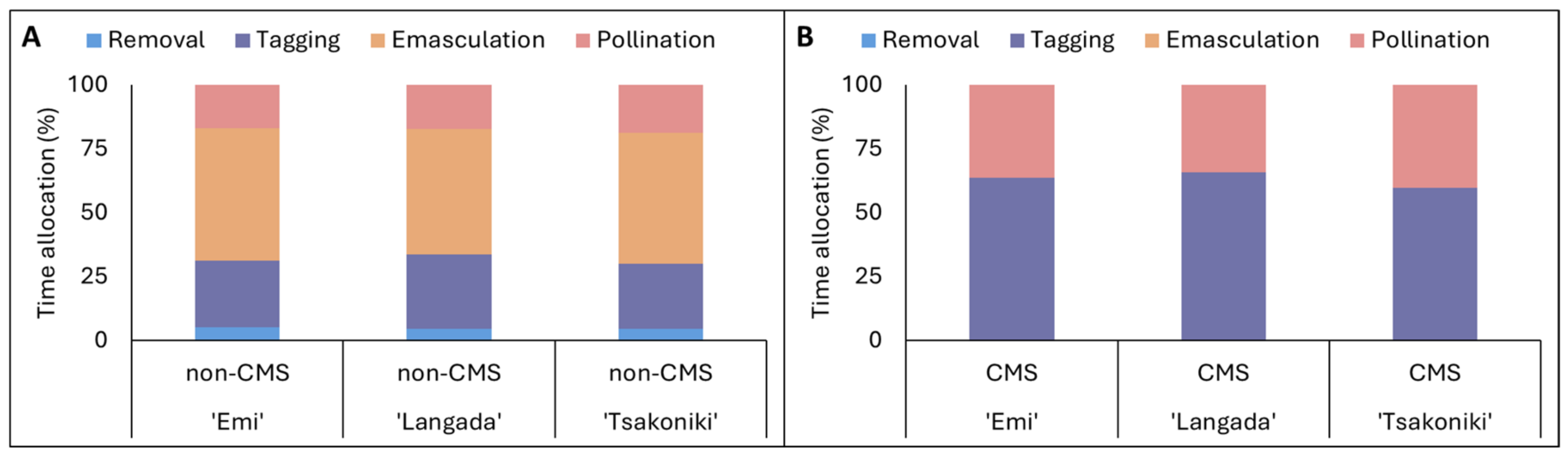
Analysis of time measurements revealed distinct patterns between the non-CMS and CMS hybridization systems (Figure 7). Within each system, these measurements were similar and accounted for similar percentages of flower manipulation time across genotypes. In non-CMS lines, emasculation accounted for approximately 49–52% of total manipulation time per flower. Tagging accounted for 25–29% of manipulation time, while pollination and removal of selfed flowers accounted for 17–19% and 4–5%, respectively.
Figure 7.
Time allocation (%) among hybridization operations (removal of selfed flowers/fruits, tagging, emasculation, and pollination) for (A) non-CMS lines and (B) CMS lines of eggplant genotypes ‘Emi’, ‘Langada’, and ‘Tsakoniki’.
In CMS lines, the time distribution differed from the conventional system. Tagging became the most time-consuming operation (approximately 60–66% of total time), followed by pollination (34–40%).
3.3.2. Manipulation Time per Flower and Crossing Rate
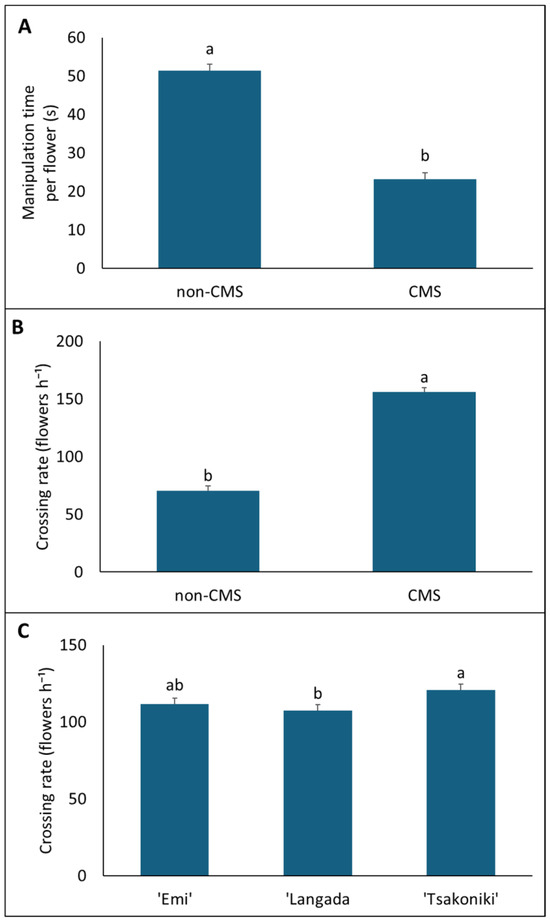
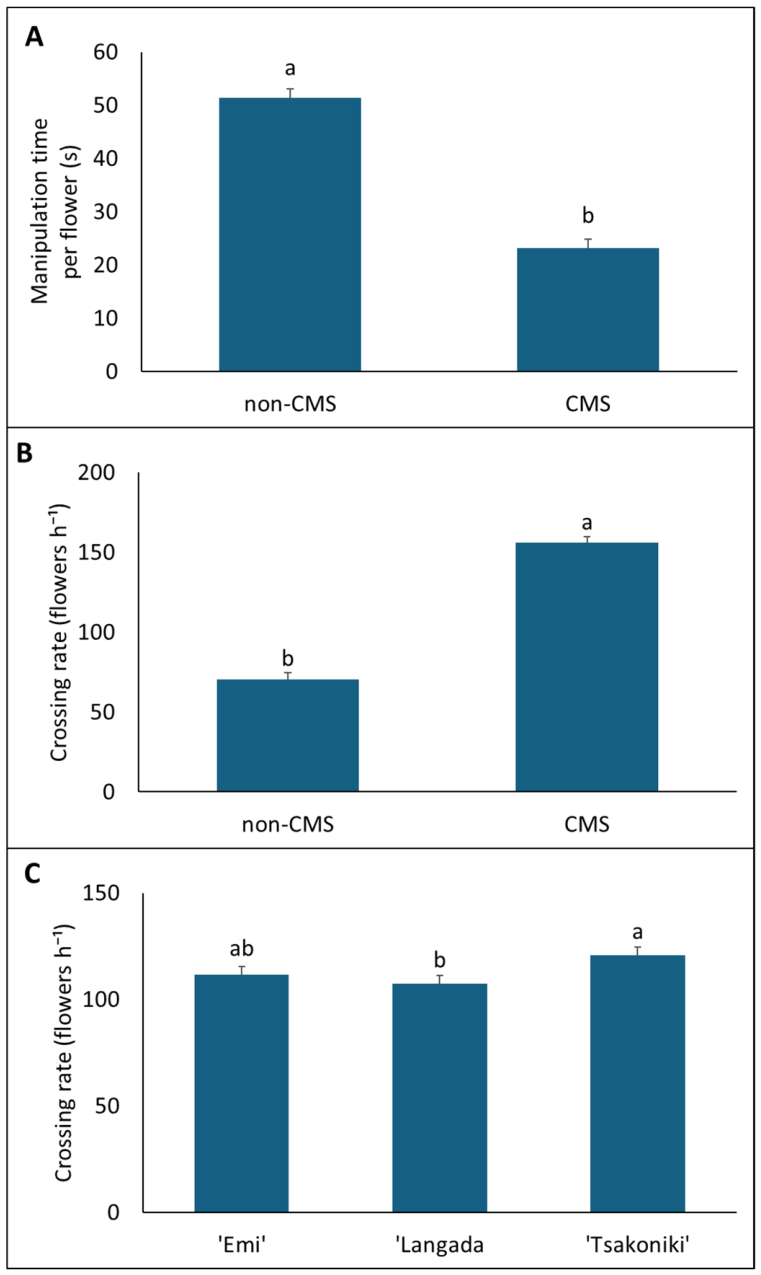
Cytoplasmic effects were significant (p ≤ 0.001) for both manipulation time per flower and crossing rate, while genotypic effects were significant only for crossing rate (p ≤ 0.05; Table A1). In the non-CMS system, manipulation time was 51.3 s, corresponding to a crossing rate of 70.6 flowers h−1 (Figure 8). In CMS lines, manipulation time was reduced to 23.2 s per flower, representing approximately a 55% reduction. Consequently, the crossing rate in CMS lines nearly doubled, reaching 155.9 flowers h−1.
Figure 8.
Hybridization time requirements in eggplant genotypes ‘Emi’ (E), ‘Langada’ (L), and ‘Tsakoniki’ (T) under conventional (non-CMS) and CMS hybridization systems. (A) Effect of cytoplasm on manipulation time per flower. (B) Effect of cytoplasm and (C) genotype on crossing rate (flowers h−1). Bars represent estimated marginal means ± SE. Different letters indicate significant differences among means (Tukey’s HSD test; α = 0.05).
Genotypic differences in crossing rate were relatively smaller, with slightly higher values observed in ‘Tsakoniki’ (120.8), closely followed by ‘Emi’ (111.5) and ‘Langada’ (107.4).
3.4. Female Fertility and Seed Production Parameters
3.4.1. Effects of Cytoplasm, Genotype, and Pollen Donor
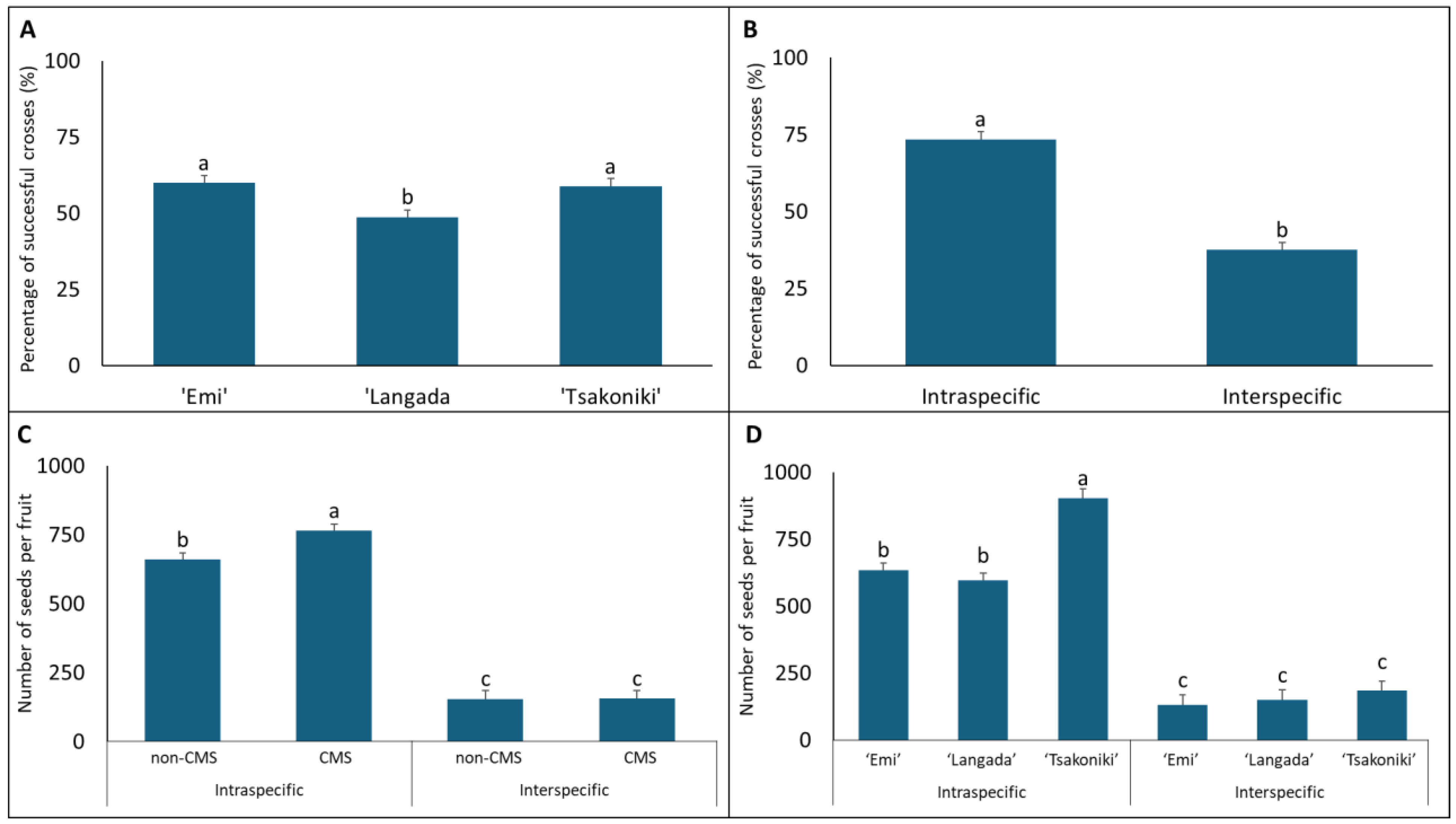
The percentage of successful crosses was significantly affected by female parent genotype (p = 0.009) and pollen donor (p ≤ 0.001), whereas cytoplasm and interaction effects were not significant (Table A1). Among female parent genotypes, ‘Emi’ and ‘Tsakoniki’ exhibited higher percentages (59.9% and 58.8%, respectively) compared with ‘Langada’ (48.8%; Figure 9A). Intraspecific crosses using eggplant ‘Santorini’ showed a higher success rate (73.5%) compared with interspecific crosses using S. integrifolium (37.5%; Figure 9B).
Figure 9.
Female fertility parameters in non-CMS and CMS lines of eggplant genotypes ‘Emi’ (E), ‘Langada’ (L), and ‘Tsakoniki’ (T), evaluated after intra- and interspecific crosses of the basal flower using eggplant ‘Santorini’ and S. integrifolium as pollen donors. Main effects of (A) eggplant genotype and (B) type of cross on the percentage of successful crosses (%). Interaction effects of (C) cytoplasm × type of cross and (D) eggplant genotype × type of cross on the number of seeds per fruit. Bars represent estimated marginal means ± SE. Different letters indicate significant differences among means (Tukey’s HSD test; α = 0.05).
The number of seeds per fruit was significantly influenced by cytoplasm (p = 0.008), female parent genotype (p ≤ 0.001), pollen donor (p ≤ 0.001), as well as by cytoplasm × pollen donor (p = 0.009) and female parent genotype × pollen donor interactions (p = 0.002; Table A1). Cytoplasmic effects were mainly evident in the intraspecific crosses, where CMS plants produced a higher number of seeds per fruit (764.3) compared with their non-CMS counterparts (659.2; Figure 9C). In contrast, such differences were not pronounced in the interspecific crosses, where all CMS and non-CMS lines produced similar low seed numbers (approximately 155 seeds per fruit; Figure 9D).
Genotypic differences were more pronounced in the intraspecific crosses. ‘Tsakoniki’ produced the highest number of seeds per fruit (902.8), whereas ‘Emi’ and ‘Langada’ produced fewer seeds (635.2 and 597.3 seeds per fruit, respectively). In the interspecific crosses, the differences among female genotypes were relatively small as all genotypes produced low seed numbers (132.2–183.8 seeds per fruit; Figure 9D).
Seed germination was not affected by cytoplasm, genotype, or pollen donor (Table A1) and remained high, ranging from 90.3 to 95.3% with an overall mean of 92.8%.
3.4.2. Effects of Flower Position
No significant effects of cytoplasm, genotype, flower position or their interactions were detected for percentage of successful crosses and seed germination (Table A1). Mean percentages were 71.5% for successful crosses and 92.1% for seed germination.
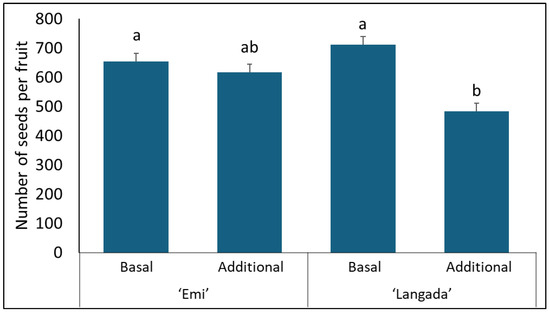
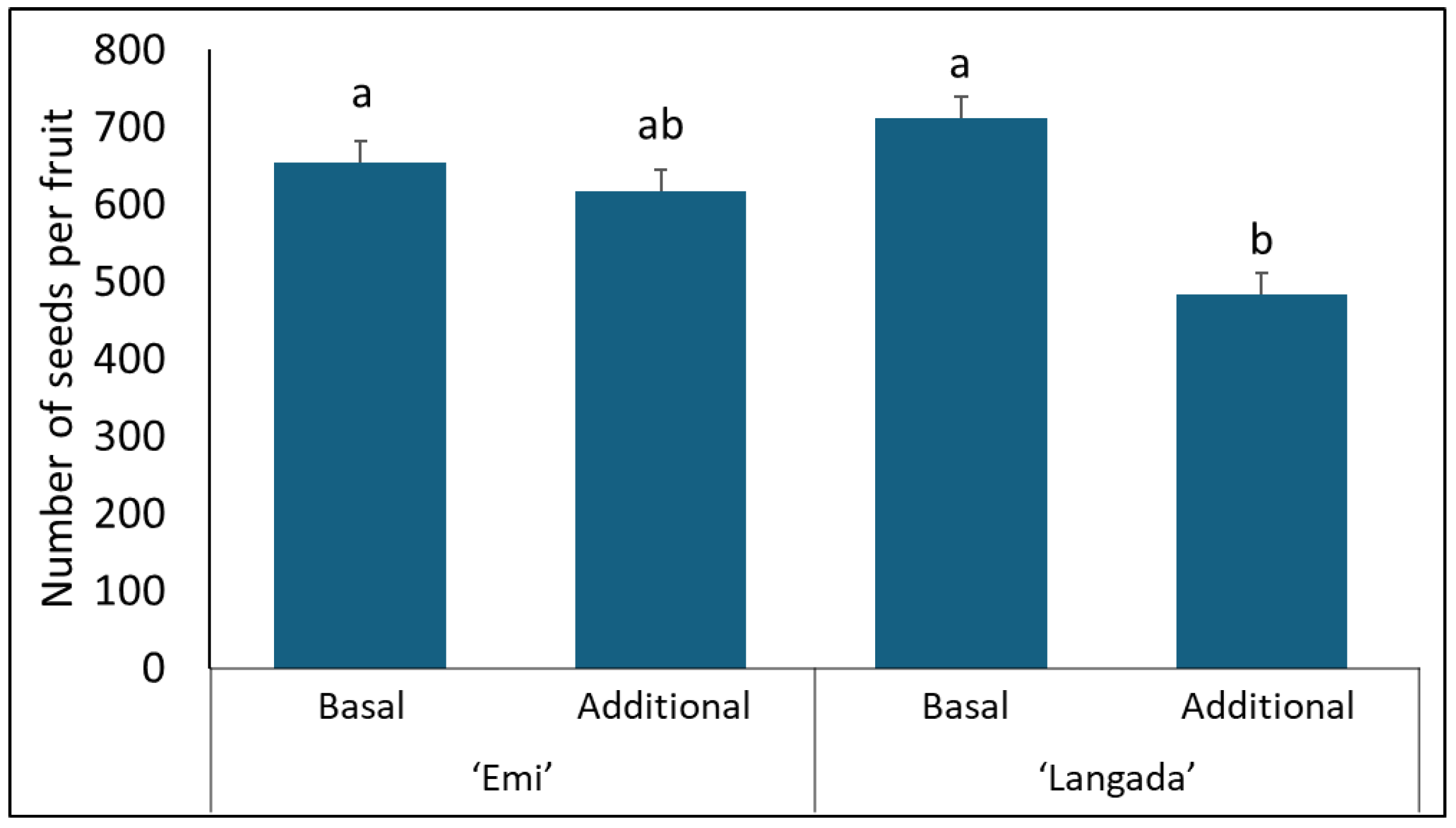
In contrast, the number of seeds per cross was significantly affected by flower position (p = 0.001) and genotype x flower position interaction (p = 0.046). Basal flowers produced more seeds than additional flowers in both genotypes with a significant difference observed only in ‘Langada’ (Figure 10). The highest seed number was recorded in basal flowers of ‘Langada’ (711.5), whereas the highest value for additional flowers was observed in ‘Emi’ (616.5), comparable to the seed number of basal flowers of ‘Emi’ (653.8)
Figure 10.
Effect of genotype × flower position interaction on the number of seeds per fruit in eggplant genotypes ‘Emi’ (E) and ‘Langada’ (L) following intraspecific crosses with eggplant ‘Santorini’. Flower position corresponds to basal (node 0) and additional (node 1, N1) flowers. Bars represent estimated marginal means ± SE. Different letters indicate significant differences among means (Tukey’s HSD test; α = 0.05). Means are averaged across cytoplasmic backgrounds (CMS and non-CMS), as the cytoplasm main effect was not significant (p > 0.05).
3.5. Hybrid Seed Production Efficiency
Both indices were significantly affected by cytoplasm, genotype, and pollen donor, as well as by all two-way and three-way interactions among these factors (p ≤ 0.009; Table A1).
3.5.1. Hybrid Seed Output Rate (HSO)
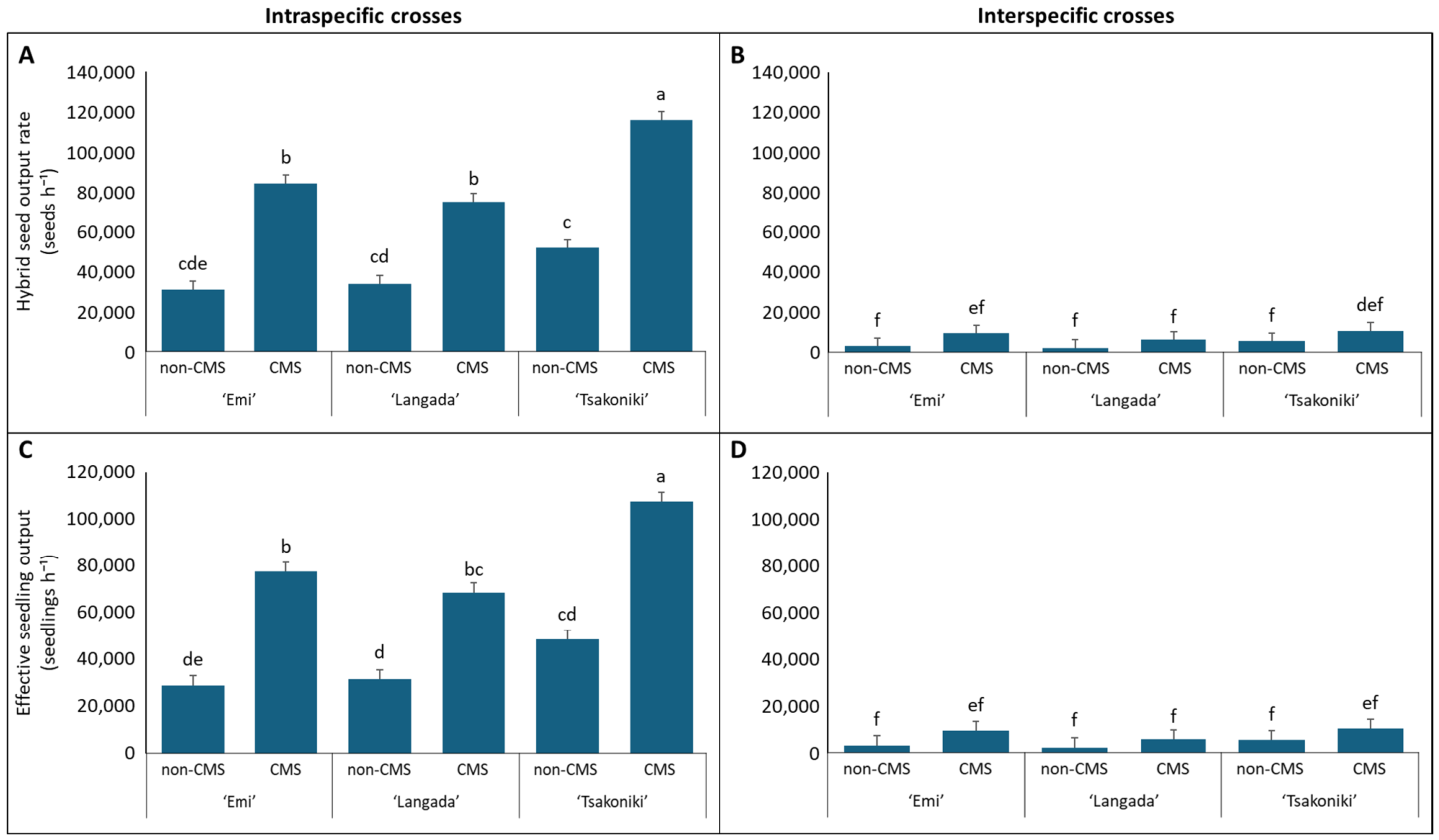
Hybrid seed output rate was significantly different between pollen donors, as intraspecific crosses with eggplant ‘Santorini’ produced significantly higher seed outputs than interspecific crosses with S. integrifolium (Figure 11). Eggplant ‘Tsakoniki’ tended to produce higher seed outputs regardless of cytoplasmic background or pollen donor.
Figure 11.
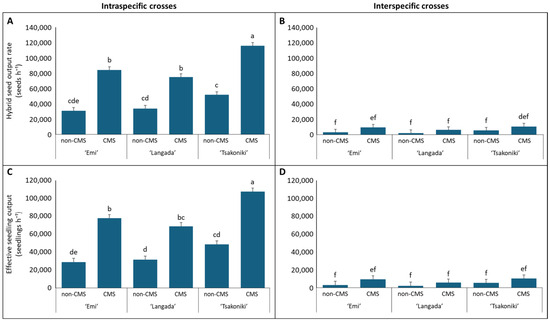
Hybrid seed production efficiency of eggplant genotypes ‘Tsakoniki’, ‘Emi’, and ‘Langada’ in intraspecific and interspecific crosses under CMS and conventional (non-CMS) hybridization systems. (A,B) Hybrid seed output rate and (C,D) effective seedling output in intraspecific and interspecific crosses. Panels are arranged to facilitate comparison between cross types and output traits. Bars represent estimated marginal means ± SE. Different letters indicate significant differences among all treatment combinations based on the full factorial analysis (Tukey’s HSD test; α = 0.05).
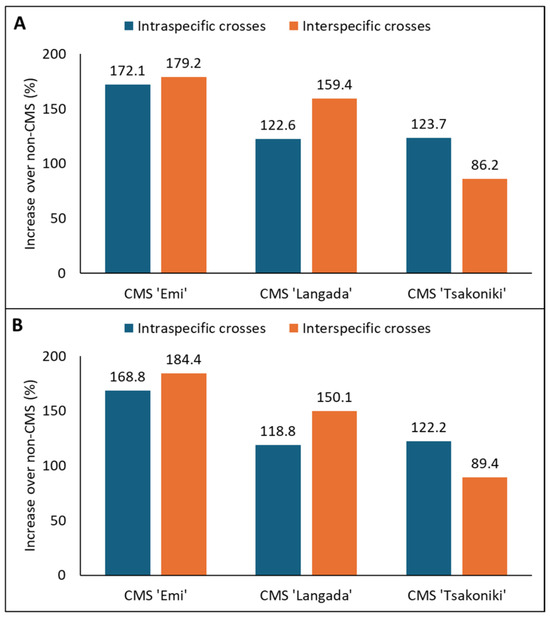
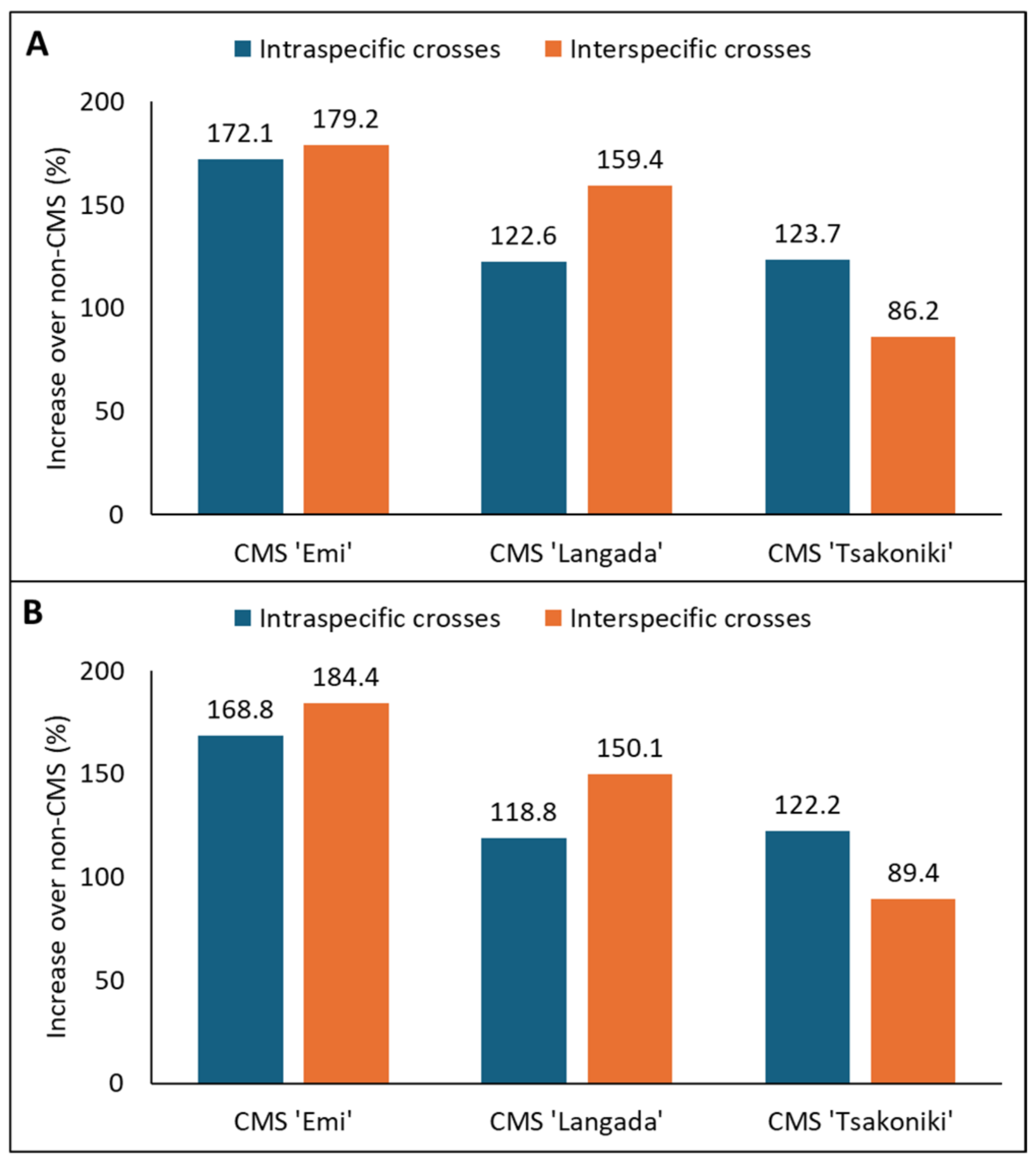
In intraspecific crosses, CMS lines were superior to their non-CMS counterparts, producing more than twice as many seeds per hour (Figure 11). The highest output was observed in CMS ‘Tsakoniki’ (116,020.6 seeds h−1), followed by CMS ‘Emi’ and CMS ‘Langada’ with 84,299.7 and 75,155.7 seeds h−1, respectively. In contrast, non-CMS lines displayed considerably lower values, ranging from 30,984.6 seeds h−1 in ‘Emi’ to 51,869.1 seeds h−1 in ‘Tsakoniki’. The corresponding increases in hybrid seed output ranged from 122.6% in CMS ‘Langada’ to 172.1% in CMS ‘Emi’ (Figure 12).
Figure 12.
Relative increase (%) in hybrid seed production efficiency of CMS lines of eggplant genotypes ‘Emi’, ‘Langada’, and ‘Tsakoniki’ compared with their non-CMS counterparts. (A) Hybrid seed output rate (seeds h−1). (B) Effective seedling output (seedlings h−1). Values represent the percentage increase achieved by the CMS hybridization system in intra- and interspecific crosses.
In interspecific crosses with S. integrifolium, seed production rates were lower across all genotypes and cytoplasmic backgrounds (2580.6–11,043.8 seeds h−1). While no significant differences were observed in this type of cross, CMS lines exhibited a tendency for increased seed production (Figure 11B). Relative increases in output ranged from 86.2% in CMS ‘Tsakoniki’ to 179.2% in CMS ‘Emi’.
3.5.2. Effective Seedling Output (ESO)
Similar patterns were observed for effective seedling output, which integrates HSO and seed germination rates (Table A1; Figure 11B). As with HSO, cytoplasmic effects were mainly evident in the intraspecific crosses, where CMS plants consistently produced higher effective seedling outputs than their non-CMS counterparts.
The highest ESO was recorded in intraspecific crosses of CMS ‘Tsakoniki’ (107,585.5 seedlings h−1), followed by CMS ‘Emi’ and CMS ‘Langada’ with 77,506.8 and 68,590.5 seedlings h−1, respectively (Figure 11B). Non-CMS lines showed lower values, ranging from 28,830.1 seedlings h−1 in ‘Emi’ to 48,413.4 seedlings h−1 in ‘Tsakoniki’. These differences corresponded to relative increases ranging from 118.8% in CMS ‘Langada’ to 168.8% in CMS ‘Emi’ (Figure 12).
In the interspecific crosses, ESO values were very low and similar among genotypes, reflecting reduced seed production when S. integrifolium was used as pollen donor. ESO values ranged from 2386.9 seedlings h−1 in non-CMS ‘Langada’ to 10,438.7 seedlings h−1 in CMS ‘Tsakoniki’ (Figure 11B). The corresponding relative increases in CMS lines ranged from 89.4% in CMS ‘Tsakoniki’ to 184.4% CMS ‘Emi’ (Figure 12).
4. Discussion
This study evaluated, from an operational perspective, the performance of cytoplasmic male sterile (CMS) lines in eggplant hybrid seed production using a system-level, performance-oriented approach. This framework, integrating flower functionality, hybridization time requirements, and seed production traits, enabled a direct comparison between CMS-based and conventional hybridization systems under applied conditions. The present work is intended as a first step towards bridging the gap between the biological characterization of CMS and its practical application in hybrid seed production, rather than as a comprehensive biological characterization of the CMS system.
4.1. CMS Maintained Flower Production but Affected the Availability of Flowers Suitable for Hybridization
Flower production and morphology are key components of the hybridization process, as flowers are the reproductive organs responsible for seed formation and serve as direct targets of controlled crosses. Consequently, any reduction in flower number or impairment of floral morphology may compromise hybridization efficiency.
In the present study, total flower production and inflorescence architecture (i.e., the proportion of basal vs. additional flowers) were not affected by the sterile cytoplasm, indicating that CMS did not impair floral initiation or overall inflorescence development. Instead, these traits were found to be largely determined by genotype, in agreement with previous reports on eggplant flower production [42,43,44]. The observed differences among genotypes may reflect the combined effects of variation in earliness and vigor.
On the other hand, CMS had a consistent effect on flower opening. A proportion of flowers in all CMS lines remained semi-opened or closed due to incomplete petal or sepal separation, whereas the corresponding non-CMS lines exhibited complete flower opening. Differential genotype responses to impaired flower opening suggest a genotype-dependent degree of sensitivity under the CMS cytoplasm, with ‘Emi’ showing minimal sensitivity and ‘Langada’ and ‘Tsakoniki’ displaying stronger responses.
Flower position also influenced the degree of sensitivity to this effect. Additional flowers exhibited a higher proportion of full opening compared with basal flowers, suggesting a lower degree of sensitivity. This improved functionality of additional flowers partially compensates for the reduced opening observed in basal flowers and represents a useful component of the hybridization system.
The physiological and molecular mechanisms of impaired flower opening were not investigated in this study. While flower opening is a developmental procedure that can be affected by several factors, including hormonal balance, genetic and transcriptional control, environmental cues, assimilate allocation, and water dynamics [45,46,47,48,49,50,51,52], further investigations are required to ascertain the association of these processes with the observed patterns.
Overall, these findings indicate that CMS-induced impairment of flower opening is both genotype- and position-dependent. Despite this effect, the practical feasibility of CMS-based hybridization is not compromised, as enough flowers suitable for hybridization remained available for crossing (see Section 4.4). From an applied perspective, this suggests that the negative effects of CMS on flower opening can be mitigated through appropriate genotype selection and effective utilization of flower position within the inflorescence.
4.2. CMS Enhanced Hybridization Efficiency Through Procedural Simplification
The CMS system substantially reduced hybridization time requirements compared with the non-CMS system. This reduction resulted from the elimination of the emasculation step, which was the most time-consuming hybridization step in the conventional system. In non-CMS lines, anthers should be removed prior to anthesis to prevent self-pollination [53], with caution to prevent female structure damage. In contrast, anthers of CMS lines carrying the cytoplasm of S. violaceum do not release their pollen [13,54], allowing omission of emasculation and considerably simplifying the process.
The reduction in flower manipulation time consequently increased crossing rate, as CMS enabled approximately a twofold increase in the number of flowers that could be hybridized per hour compared with the conventional system. These findings highlight one of the most important practical advantages of CMS systems in hybrid seed production, where time represents a major limiting factor. Importantly, this represents a procedural advantage that is largely independent of biological variation in reproductive traits, as it arises directly from the elimination of emasculation rather than from differences in reproductive performance. Similar improvements in hybridization efficiency have been reported in pepper, where hybrid seed production costs were reduced by 50% and increased labor productivity by 57.6% [55,56].
Although genotype effects on manipulation time were not significant, differences among genotypes were observed in crossing rate. These differences may be associated with variation in floral morphology or ease of handling during pollination, such as flower size, corolla opening, or accessibility of the stigma. Nevertheless, the absence of significant cytoplasm × genotype interactions indicates that the positive effect of CMS on hybridization efficiency was consistent across genotypes.
4.3. CMS Did Not Compromise Female and Seed Fertility
Despite the observed effects of CMS on flower opening, the results indicate that CMS did not impair female reproductive capacity. This is supported by the comparable percentages of successful crosses between CMS and non-CMS lines, implying that stigma receptivity, ovule viability and fruit set were not negatively affected by the sterile cytoplasm.
In addition, analysis of seed set on a per-fruit basis indicated that CMS did not compromise seed production, as evidenced by the moderate increase observed in intraspecific crosses and the comparable seed numbers in interspecific crosses. This increase may be partly associated with reduced flower manipulation in CMS lines, potentially minimizing micro-injuries to floral tissues and stigma exposure, although these effects were not directly evaluated in the present study. The significant interaction effects observed for this trait indicate that seed set responses should be interpreted within specific genetic and crossing contexts.
In most CMS systems, mitochondrial alterations primarily disrupt microsporogenesis and anther functionality without affecting megasporogenesis or pistil development [57]. The present findings are consistent with this pattern and confirm that the S. violaceum cytoplasm does not compromise female reproductive competence in eggplant [13,58]. Moreover, seed germination rates were not reduced in CMS-based intra- and interspecific hybrids, indicating that seed viability was maintained under CMS cytoplasm. This is very important as the seed is the final commercial product of the hybridization process.
The percentage of successful crosses and the number of seeds per fruit were influenced by the pollen donor, with intraspecific crosses expectedly being more successful and producing substantially higher seed numbers than interspecific crosses. These observations reflect the higher genetic compatibility between eggplant genotypes compared with the more distant S. integrifolium, as previously reported in several cases of eggplant interspecific hybridization [59]. Interestingly, the interspecific hybrid seed had high germination rates, which is an important aspect for the production of vigorous interspecific rootstocks [18,37,60].
Although interspecific crosses exhibited reduced success rates and seed production, these results are consistent with known biological constraints and should be interpreted within the specific context of wide hybridization rather than as a limitation of the hybridization system itself.
Additional flowers, although fewer, displayed a relatively high proportion of opening and were successfully utilized in the hybridization of CMS ‘Emi’ and CMS ‘Langada’. While seed production from additional flowers was somewhat lower, they still produced a considerable number of seeds.
In eggplant, additional flowers and their fruits constitute a weaker assimilate sink than basal ones and are typically smaller due to intra-inflorescence competition. Moreover, the development of additional fruits does not impair the development of basal fruits within the same inflorescence [52]. Therefore, the utilization of additional flowers, which usually open fully, may increase the number of available flowers and help maintain seed output, particularly when basal flowers remain closed or when pollination of basal flowers fails.
4.4. CMS Improves Hybrid Seed Production Efficiency at the System Level
The practical evaluation of CMS-based hybridization systems should not rely solely on floral morphology or individual fertility parameters, but rather on the overall efficiency of hybrid seed production. In this context, the observed improvements in hybridization efficiency are based on measured parameters such as crossing rate and seed output, while their practical implications should be interpreted accordingly. Within this framework, the present study demonstrated a remarkable improvement in seed production under the CMS system.
Although CMS affected flower opening and reduced the proportion of fully opened flowers in certain eggplant genotypes, sufficient flowers suitable for hybridization remained available for hybridization across all genotypes. Assuming a 75% crossing success rate and utilization of the available flowers suitable for hybridization, the expected hybridized fruit number per plant (12.0, 7.0, and 5.4, for ‘Emi’, ‘Langada’, and ‘Tsakoniki’, respectively) is within the range of 4–6 fruits reported for satisfactory seed yield in large-fruited eggplant cultivars [53].
Furthermore, the differential genotypic responses to reduced flower opening indicated that this negative effect of CMS represents a limitation that can be mitigated by genotype selection. Genotypes showing lower sensitivity to CMS and producing sufficient additional flowers (e.g., ‘Emi’) or genotypes with high seed production capacity (e.g., ‘Tsakoniki’) can maintain high seed output. The development of eggplant genotypes combining reproductive traits is feasible by using classical breeding methodologies [61].
The hybridization procedures were simplified and accelerated mainly through the elimination of the emasculation step in CMS lines, reducing the flower manipulation time by approximately half. As a result, hybridization efficiency estimated by hybrid seed output and effective seedling output rates substantially increased, often exceeding a twofold improvement compared with the conventional non-CMS hybridization system. In fact, while the magnitude of CMS-related improvements was not uniform and varied across cytoplasmic background, genotype, and pollen donor, the overall advantage of CMS was maintained across combinations.
Similar improvements in hybrid seed production efficiency have been reported in other crops using male sterility systems. For example, the use of male sterile lines increased seed yield by 75–100% in tomato and by 30.2% in pepper compared with conventional systems [56,62]. Moreover, efficiency can be further improved in CMS plots where a single pollen donor is used by omitting tagging, which accounts for 60–66% of flower manipulation time and is necessary to distinguish hybrids from self-pollinated fruits.
The applicability of CMS in interspecific hybridization is particularly relevant for rootstock breeding. Interspecific crosses with S. integrifolium exhibited lower success rates and reduced seed production compared with intraspecific crosses, reflecting reproductive barriers between eggplant and related species [59]. However, such limitations are inherent to wide hybridization and are commonly reported in eggplant breeding.
Despite this, interspecific hybrids are widely used, particularly for rootstock development, where traits such as vigor, stress tolerance, and graft compatibility are prioritized [18,19]. In a previous study, an average of 35 seeds per fruit was obtained from crosses between eggplant cultivars and S. integrifolium [63]. Therefore, production levels observed in the present study (≈130–180 seeds per fruit with >90% germination) can be considered adequate.
Importantly, CMS improved hybrid seed production efficiency even under these biologically constrained conditions. Although absolute seed numbers remained low, CMS consistently increased seed output per unit time compared with the conventional system, with gains approaching or exceeding twofold. These differences, although not always statistically significant within the full factorial model, showed a consistent trend across genotypes. This likely reflects the lower absolute values associated with interspecific crosses, which reduce statistical power and may mask biologically meaningful and operationally relevant differences.
It should also be noted that the level of reproductive success in interspecific hybridization is strongly dependent on the genetic distance and compatibility between parental species [64]. Therefore, the relatively low seed production observed with S. integrifolium may not be representative of all interspecific combinations. Crosses involving more compatible species, such as S. dasyphyllum or S. insanum [65,66], may result in higher fertilization success and seed yield, further improving the efficiency of CMS-based interspecific hybridization systems.
Overall, CMS improved the operational efficiency of hybrid seed production in eggplant under the conditions of the present study. Despite certain genotype-dependent effects on flower opening, CMS lines maintained sufficient hybridization capacity while reducing time requirements. The resulting increases in hybrid seed output and effective seedling production highlight the practical value of CMS systems under applied conditions. These findings suggest that CMS can serve as a tool for improving seed production efficiency.
4.5. Limitations and Future Prospects
The experiments in the present study were conducted in a single environment, focusing on the comparative evaluation of CMS and non-CMS hybridization systems under identical conditions. This type of CMS in eggplant is generally considered stable across environments and years and primarily affects procedural components of hybridization, particularly flower manipulation time through the elimination of emasculation, which is not expected to vary substantially across environments. Therefore, the relative comparison between CMS and conventional hybridization systems is unlikely to be influenced by environmental conditions. Nevertheless, future multi-environment studies would further validate the general applicability of these findings.
The study included three representative eggplant cultivars selected to provide contrasting genetic backgrounds. Validation across a broader range of eggplant cultivars, pollen donors, and cytoplasmic backgrounds would strengthen the general applicability of the conclusions and facilitate the identification or development of genotypes with reduced sensitivity to CMS-induced impaired flower opening combined with good seed production. In addition, interspecific hybridization efficiency was evaluated using a single commonly used related species (S. integrifolium). Testing additional wild relatives would further clarify the utility of CMS in rootstock-oriented hybridization programs.
The physiological or developmental mechanisms underlying impaired flower opening in CMS lines were not investigated in the present study. Future anatomical, hormonal, and molecular analyses would help elucidate the biological basis of this phenomenon, which is of practical relevance for hybrid seed production.
From an applied perspective, the integration of insect pollinators into CMS-based hybrid seed production systems deserves investigation to further reduce operational costs. Finally, the commercial advantage of CMS over conventional hybridization systems could be quantitatively estimated through dedicated economic analyses under commercial production conditions. Such studies would expand the available knowledge and facilitate the broader adoption of CMS technology in eggplant hybrid seed production.
5. Conclusions
The present study demonstrated, under the conditions tested, that cytoplasmic male sterility (CMS) enhances hybrid seed production efficiency in eggplant. Although flower opening was partially impaired in some genotypes, particularly in basal flowers, overall flower production and inflorescence architecture were not affected, and sufficient numbers of flowers suitable for hybridization remained available. The observed incomplete flower opening was genotype- and position-dependent, indicating that its impact can be mitigated through the selection of less sensitive genotypes and the use of additional flowers. CMS did not negatively affect female fertility, as indicated by the comparable success rates of crosses between CMS and non-CMS lines. Seed production responses further indicated that CMS does not negatively affect seed set and may moderately enhance seed production under specific genetic and crossing contexts, particularly in intraspecific crosses. Most importantly, the elimination of the emasculation step significantly reduced flower manipulation time and increased crossing rate, resulting in substantially higher hybrid seed and seedling output.
Overall, CMS represents a practical approach for improving hybrid seed production efficiency, primarily through its effect on time requirements and output per unit time. Since the present findings are based on a single environment, further validation across a wider range of environments and genetic backgrounds is required before broader generalizations can be made.
Author Contributions
Conceptualization, K.K., A.M., F.B. and D.R.; methodology, K.K., A.M., F.B. and D.R.; formal analysis, K.K. and A.M.; investigation, K.K. and A.M.; data curation, K.K.; writing—original draft preparation, K.K.; writing—review and editing, K.K., A.M., F.B. and D.R.; supervision, K.K. and D.R. All authors have read and agreed to the published version of the manuscript.
Funding
This research received no external funding.
Data Availability Statement
The original contributions presented in this study are included in the article. Further inquiries can be directed to the corresponding authors.
Conflicts of Interest
The authors declare no conflicts of interest.
Appendix A
Figure A1.
Meteorological data and photoperiod conditions during the experimental period. (A): Minimum (Tmin), mean (Tmean), and maximum (Tmax) temperatures (°C). (B): Precipitation (mm) (bars) and relative humidity (%) (line). (C): Duration (hours) of day and night periods.
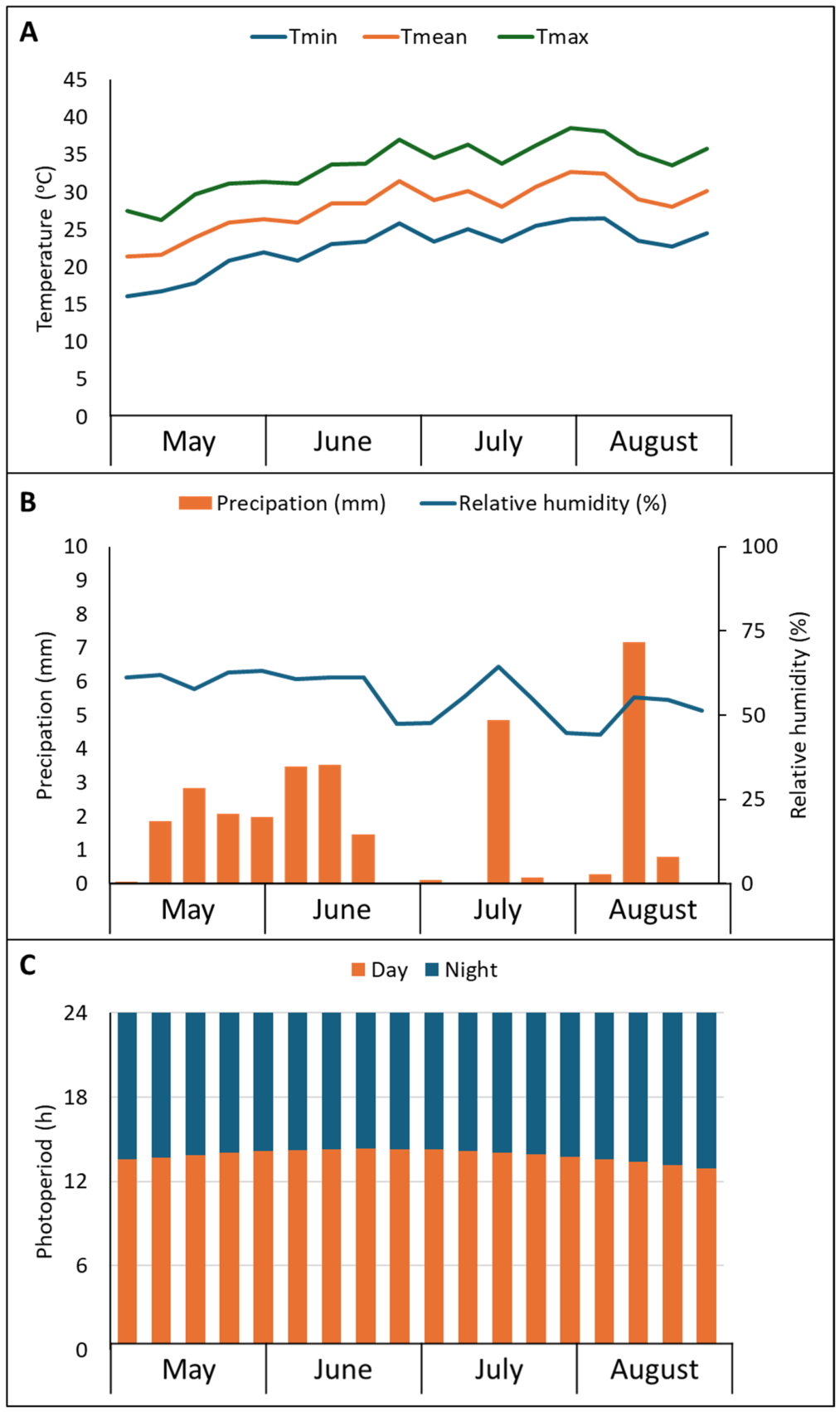
Table A1.
Analysis of variance (ANOVA) for flower production, flower functionality, hybridization time requirements, fertility, and seed production traits in CMS and non-CMS eggplant lines.
References
- FAOSTAT. Statistical Database of the Food and Agriculture Organization of the United Nations. Online Database. Available online: https://www.fao.org/faostat/en/#data/QCL (accessed on 4 August 2022).
- Rodríguez-Burruezo, A.; Prohens, J.; Nuez, F. Performance of Hybrids between Local Varieties of Eggplant (Solanum melongena) and Its Relation to the Mean of Parents and to Morphological and Genetic Distances among Parents. Eur. J. Hortic. Sci. 2008, 73, 76–83. [Google Scholar] [CrossRef] [Scilit]
- Ram, K.; Singh, P. Heterosis and Inbreeding Depression in Relation to Other Genetic Parameters in Eggplant. Asian J. Bio Sci. 2012, 7, 163–168. [Google Scholar]
- Sambandam, C.N. Heterosis in Eggplant (Solanum melongena Linn.). Econ. Bot. 1962, 16, 71–76. [Google Scholar] [CrossRef] [Scilit]
- Mistry, C.R.; Kathiria, K.B.; Sabolu, S.; Kumar, S. Heterosis and Inbreeding Depression for Fruit Yield Attributing Traits in Eggplant. Curr. Plant Biol. 2018, 16, 27–31. [Google Scholar] [CrossRef] [Scilit]
- Kumar, A.; Sharma, V.; Jain, B.T.; Kaushik, P. Heterosis Breeding in Eggplant (Solanum melongena L.): Gains and Provocations. Plants 2020, 9, 403. [Google Scholar] [CrossRef] [Scilit]
- García-Fortea, E.; Gramazio, P.; Vilanova, S.; Fita, A.; Mangino, G.; Villanueva, G.; Arrones, A.; Knapp, S.; Prohens, J.; Plazas, M. First Successful Backcrossing towards Eggplant (Solanum melongena) of a New World Species, the Silverleaf Nightshade (S. elaeagnifolium), and Characterization of Interspecific Hybrids and Backcrosses. Sci. Hortic. 2019, 246, 563–573. [Google Scholar] [CrossRef] [Scilit]
- Prohens, J.; Gramazio, P.; Plazas, M.; Dempewolf, H.; Kilian, B.; Díez, M.J.; Fita, A.; Herraiz, F.J.; Rodríguez-Burruezo, A.; Soler, S.; et al. Introgressiomics: A New Approach for Using Crop Wild Relatives in Breeding for Adaptation to Climate Change. Euphytica 2017, 213, 158. [Google Scholar] [CrossRef] [Scilit]
- Kaushik, P.; Andújar, I.; Vilanova, S.; Plazas, M.; Gramazio, P.; Herraiz, F.; Brar, N.; Prohens, J. Breeding Vegetables with Increased Content in Bioactive Phenolic Acids. Molecules 2015, 20, 18464–18481. [Google Scholar] [CrossRef] [Scilit]
- Toppino, L.; Acciari, N.; Mennela, G.; Lo Scalzo, R.; Rotino, G.L. Introgression Breeding in Eggplant (Solanum melongena L.) by Combining Biotechnological and Conventional Approaches. In Proceedings of the 53rd Italian Society of Agricultural Genetics Annual Congress, Torino, Italy, 16–19 September 2009; p. 900622. [Google Scholar]
- Toppino, L.; Valè, G.; Rotino, G. Inheritance of Fusarium Wilt Resistance Introgressed from Solanum aethiopicum Gilo and Aculeatum Groups into Cultivated Eggplant (S. melongena) and Development of Associated PCR-Based Markers. Mol. Breed. 2008, 22, 237–250. [Google Scholar] [CrossRef] [Scilit]
- Rakha, M.; Namisy, A.; Chen, J.R.; El-Mahrouk, M.E.; Metwally, E.; Taha, N.; Prohens, J.; Plazas, M.; Taher, D. Development of Interspecific Hybrids between a Cultivated Eggplant Resistant to Bacterial Wilt (Ralstonia solanacearum) and Eggplant Wild Relatives for the Development of Rootstocks. Plants 2020, 9, 1405. [Google Scholar] [CrossRef] [Scilit]
- Krommydas, K.S.; Tzikalios, Z.; Madesis, P.; Bletsos, F.A.; Mavromatis, A.; Roupakias, D. Development and Fertility Restoration of CMS Eggplant Lines Carrying the Cytoplasm of Solanum violaceum. J. Agric. Sci. 2016, 8, 10. [Google Scholar] [CrossRef] [Scilit]
- Khan, M.M.R.; Isshiki, S. Development of a Male Sterile Eggplant by Utilizing the Cytoplasm of Solanum virginianum and a Biparental Transmission of Chloroplast DNA in Backcrossing. Sci. Hortic. 2008, 117, 316–320. [Google Scholar] [CrossRef] [Scilit]
- Khan, M.M.R.; Isshiki, S. Development of the Male-Sterile Line of Eggplant Utilizing the Cytoplasm of Solanum aethiopicum L. Aculeatum Group. J. Jpn. Soc. Hortic. Sci. 2010, 79, 348–353. [Google Scholar] [CrossRef] [Scilit]
- Isshiki, S.; Kawajiri, N. Effect of Cytoplasm of Solanum violaceum Ort. on Fertility of Eggplant (S. melongena L.). Sci. Hortic. 2002, 93, 9–18. [Google Scholar] [CrossRef] [Scilit]
- Krommydas, K.; Mavromatis, A.; Bletsos, F.; Roupakias, D. Suitability of CMS-Based Interspecific Eggplant (Solanum melongena L.) Hybrids as Rootstocks for Eggplant Grafting. J. Agric. Ecol. Res. Int. 2018, 15, 1–15. [Google Scholar] [CrossRef] [Scilit]
- Gisbert, C.; Prohens, J.; Nuez, F. Performance of Eggplant Grafted onto Cultivated, Wild and Hybrid Materials of Eggplant and Tomato. Int. J. Plant Prod. 2011, 5, 367–380. [Google Scholar]
- Bletsos, F.A.; Olympios, C.M. Rootstocks and Grafting of Tomatoes, Peppers and Eggplants for Soil-Borne Disease Resistance, Improved Yield and Quality. Eur. J. Plant Sci. Biotechnol. 2008, 2, 62–73. [Google Scholar]
- Sabatino, L.; Iapichino, G.; Rotino, L.G.; Palazzolo, E.; Mennella, G.; D’Anna, F. Solanum aethiopicum Gr. Gilo and Its Interspecific Hybrid with S. melongena as Alternative Rootstocks for Eggplant: Effects on Vigor, Yield, and Fruit Physicochemical Properties of Cultivar ‘Scarlatti’. Agronomy 2019, 9, 223. [Google Scholar] [CrossRef] [Scilit]
- Kyriacou, M.C.; Rouphael, Y.; Colla, G.; Zrenner, R.; Schwarz, D. Vegetable Grafting: The Implications of a Growing Agronomic Imperative for Vegetable Fruit Quality and Nutritive Value. Front. Plant Sci. 2017, 8, 741. [Google Scholar] [CrossRef] [Scilit]
- Sekara, A.; Bieniasz, M. Pollination, Fertilization and Fruit Formation in Eggplant (Solanum melongena L.). Acta Agrobot. 2008, 61, 107–113. [Google Scholar] [CrossRef] [Scilit]
- Khan, M.M.R.; Isshiki, S. Cytoplasmic Male Sterility in Eggplant. Hortic. J. 2016, 85, 1–7. [Google Scholar] [CrossRef] [Scilit]
- Xu, F.; Yang, X.; Zhao, N.; Hu, Z.; MacKenzie, S.A.; Zhang, M.; Yang, J. Exploiting Sterility and Fertility Variation in Cytoplasmic Male Sterile Vegetable Crops. Hortic. Res. 2022, 9, uhab039. [Google Scholar] [CrossRef] [Scilit] [PubMed]
- Priyadarsini, S.; Singh, S.; Nandi, A. Male Sterility Systems in the Genomics Era for Expediting Vegetable Breeding. Sci. Hortic. 2024, 338, 113774. [Google Scholar] [CrossRef] [Scilit]
- Khan, M.M.R.; Isshiki, S. Development of a Cytoplasmic Male-Sterile Line of Eggplant (Solanum melongena L.) with the Cytoplasm of Solanum anguivi. Plant Breed. 2011, 130, 256–260. [Google Scholar] [CrossRef] [Scilit]
- Pickersgill, B. Interspecific Hybridization by Sexual Means. In Plant Breeding SE—6; Hayward, M.D., Bosemark, N.O., Romagosa, I., Cerezo, M., Eds.; Plant Breeding Series; Springer: Dordrecht, The Netherlands, 1993; pp. 63–78. [Google Scholar]
- Bertin, N. Competition for Assimilates and Fruit Position Affect Fruit Set in Indeterminate Greenhouse Tomato. Ann. Bot. 1995, 75, 55–65. [Google Scholar] [CrossRef] [Scilit]
- Hornyák, M.; Słomka, A.; Sychta, K.; Dziurka, M.; Kopeć, P.; Pastuszak, J.; Szczerba, A.; Płażek, A. Reducing Flower Competition for Assimilates by Half Results in Higher Yield of Fagopyrum esculentum. Int. J. Mol. Sci. 2020, 21, 8953. [Google Scholar] [CrossRef] [Scilit]
- Colombo, N.; Galmarini, C.R. The Use of Genetic, Manual and Chemical Methods to Control Pollination in Vegetable Hybrid Seed Production: A Review. Plant Breed. 2017, 136, 287–299. [Google Scholar] [CrossRef] [Scilit]
- Singh, H.; Sekhon, B.S.; Kumar, P.; Dhall, R.K.; Devi, R.; Dhillon, T.S.; Sharma, S.; Khar, A.; Yadav, R.K.; Tomar, B.S.; et al. Genetic Mechanisms for Hybrid Breeding in Vegetable Crops. Plants 2023, 12, 2294. [Google Scholar] [CrossRef] [Scilit]
- Deng, W.; Gan, G.; Li, W.; Yu, C.; Jiang, Y.; Li, D.; Yang, Q.; Li, W.; Wang, P.; Wang, Y. Comparative Analysis of the Mitochondrial Genome of Eggplant (Solanum melongena L.) to Identify Cytoplasmic Male Sterility Candidate Genes. Int. J. Mol. Sci. 2024, 25, 9743. [Google Scholar] [CrossRef] [Scilit]
- Yoshimi, M.; Kitamura, Y.; Isshiki, S.; Saito, T.; Yasumoto, K.; Terachi, T.; Yamagishi, H. Variations in the Structure and Transcription of the Mitochondrial Atp and Cox Genes in Wild Solanum species That Induce Male Sterility in Eggplant (S. melongena). Theor. Appl. Genet. 2013, 126, 1851–1859. [Google Scholar] [CrossRef] [Scilit]
- Luo, S.; Li, Q.; Kang, Y.; Liu, Y.; Wang, X.; Yu, P.; Shen, J.; Song, L.; Zhang, Z.; Chen, X. Mapping the Candidate Gene Controlling Male Sterility Using EMS-Mutagenized Mutant Smms1 in Eggplant (Solanum melongena L.). Sci. Hortic. 2024, 338, 113622. [Google Scholar] [CrossRef] [Scilit]
- Fang, M.; Mao, R.; Xie, W. Breeding of Cytoplasmically Inherited Male Sterile Lines of Eggplant (Solanum melongena L.). Acta Hortic. Sin. 1985, 12, 261–266. [Google Scholar]
- Saito, T.; Matsunaga, H.; Saito, A.; Hamato, N.; Koga, T.; Suzuki, T.; Yoshida, T. A Novel Source of Cytoplasmic Male Sterility and a Fertility Restoration Gene in Eggplant (Solanum melongena L.) Lines. J. Jpn. Soc. Hortic. Sci. 2009, 78, 425–430. [Google Scholar] [CrossRef] [Scilit]
- Krommydas, K.; Mavromatis, A.; Bletsos, F.; Roupakias, D. Morphology, Heterosis, and Fertility of Novel CMS-Based Solanum melongena × S. aethiopicum Hybrids. Agronomy 2026, 16, 306. [Google Scholar] [CrossRef] [Scilit]
- Krommydas, K.; Papa, E.; Gaitani, P.; Papadopoulou, A.; Mellidou, I.; Bouloumpasi, E.; Kadoglidou, K.I. Comparative Drought Response of Solanum melongena, S. macrocarpon, S. dasyphyllum, and S. melongena × S. dasyphyllum Interspecific Hybrids. Agronomy 2025, 15, 2516. [Google Scholar] [CrossRef] [Scilit]
- Bletsos, F.; Roupakias, D.; Tsaktsira, M.; Scaltsoyjannes, A. Production and Characterization of Interspecific Hybrids between Three Eggplant (Solanum melongena L.) Cultivars and Solanum macrocarpon L. Sci. Hortic. 2004, 101, 11–21. [Google Scholar] [CrossRef] [Scilit]
- Bletsos, F.; Roupakias, D.G.; Tsaktsira, M.L.; Scaltsoyjannes, A.B.; Thanassoulopoulos, C.C. Interspecific Hybrids between Three Eggplant (Solanum melongena L.) Cultivars and Two Wild Species (Solanum torvum Sw. and Solanum sisymbriifolium Lam.). Plant Breed. 1998, 117, 159–164. [Google Scholar] [CrossRef] [Scilit]
- Rylski, I.; Nothmann, J.; Arcan, L. Differential Fertility in Short-Styled Eggplant Flowers. Sci. Hortic. 1984, 22, 39–46. [Google Scholar] [CrossRef] [Scilit]
- Nothmann, J.; Rylski, I.; Spigelman, M. Floral Morphology and Position, Cluster Size and Seasonal Fruit Set in Different Eggplant Cultivars. J. Hortic. Sci. 1983, 58, 403–409. [Google Scholar] [CrossRef] [Scilit]
- Passam, H.C.; Baltas, C.; Boyiatzoglou, A.; Khah, E.M. Flower Morphology and Number of Aubergine (Solanum melongena L.) in Relation to Fruit Load and Auxin Application. Sci. Hortic. 2001, 89, 309–316. [Google Scholar] [CrossRef] [Scilit]
- Khah, E.M.; Antonopoulos, A.; Passam, H.C. Floral Behaviour and Fruit Set in Four Cultivars of Aubergine. Acta Hortic. 2002, 579, 259–264. [Google Scholar] [CrossRef] [Scilit]
- Van Doorn, W.G.; Kamdee, C. Flower Opening and Closure: An Update. J. Exp. Bot. 2014, 65, 5749–5757. [Google Scholar] [CrossRef] [Scilit] [PubMed]
- Krolikowski, K.A.; Victor, J.L.; Wagler, T.N.; Lolle, S.J.; Pruitt, R.E. Isolation and Characterization of the Arabidopsis organ Fusion Gene HOTHEAD. Plant J. 2003, 35, 501–511. [Google Scholar] [CrossRef] [Scilit] [PubMed]
- Lu, Y.H.; Arnaud, D.; Belcram, H.; Falentin, C.; Rouault, P.; Piel, N.; Lucas, M.O.; Just, J.; Renard, M.; Delourme, R.; et al. A Dominant Point Mutation in a RINGv E3 Ubiquitin Ligase Homoeologous Gene Leads to Cleistogamy in Brassica napus. Plant Cell 2013, 24, 4875–4891. [Google Scholar] [CrossRef] [Scilit]
- Ishiguro, S.; Kawai-Oda, A.; Ueda, J.; Nishida, I.; Okada, K. The DEFECTIVE IN ANTHER DEHISCENCE1 Gene Encodes a Novel Phospholipase A1 Catalyzing the Initial Step of Jasmonic Acid Biosynthesis, Which Synchronizes Pollen Maturation, Anther Dehiscence, and Flower Opening in Arabidopsis. Plant Cell 2001, 13, 2191–2209. [Google Scholar] [CrossRef] [Scilit]
- Weiss, D.; Halevy, A.H. Stamens and Gibberellin in the Regulation of Corolla Pigmentation and Growth in Petunia hybrida. Planta 1989, 179, 89–96. [Google Scholar] [CrossRef] [Scilit]
- Conley, C.A.; Hanson, M.R. How Do Alterations in Plant Mitochondrial Genomes Disrupt Pollen Development? J. Bioenerg. Biomembr. 1995, 27, 447–457. [Google Scholar] [CrossRef] [Scilit]
- Van Doorn, W.G.; Van Meeteren, U. Flower Opening and Closure: A Review. J. Exp. Bot. 2003, 54, 1801–1812. [Google Scholar] [CrossRef] [Scilit]
- Nothmann, J.; Rylski, I. Effects of Floral Position and Cluster Size on Fruit Development in Eggplant. Sci. Hortic. 1983, 19, 19–24. [Google Scholar] [CrossRef] [Scilit]
- Chen, N.C. Eggplant Seed Production; AVRDC—The World Vegetable Center: Shanhua, Taiwan, 1990. [Google Scholar]
- Isshiki, S.; Yoshida, S. Characteristics of the Cytoplasmic Male Sterility in the Eggplant (Solanum melongena L.) Carrying the Cytoplasm of S. violaceum Ort. Bull. Fac. Agric. Saga Univ. 2002, 87, 87–93. [Google Scholar]
- Jindal, S.K.; Dhaliwal, M.S.; Meena, O.P. Molecular Advancements in Male Sterility Systems of Capsicum: A Review. Plant Breed. 2020, 139, 42–64. [Google Scholar] [CrossRef] [Scilit]
- Yang, C.J.; Chen, B.J.; Liu, J.G.; Li, S. Study on the Superiority of Hybrid Breeding by Male Sterility in Hot Pepper. J. China Capsicum 2008, 28, 36–38. [Google Scholar]
- Chase, C.D. Cytoplasmic Male Sterility: A Window to the World of Plant Mitochondrial-Nuclear Interactions. Trends Genet. 2007, 23, 81–90. [Google Scholar] [CrossRef] [Scilit] [PubMed]
- Hasnunnahar, M.; Khan, M.M.R.; Isshiki, S. Pollen and Seed Fertility of Three Functional Male-Sterile Lines of Eggplant with the Wild Solanum cytoplasms. Sci. Hortic. 2012, 139, 58–61. [Google Scholar] [CrossRef] [Scilit]
- Daunay, M.-C.; Salinier, J.; Aubriot, X. Crossability and Diversity of Eggplants and Their Wild Relatives. In The Eggplant Genome; Chapman, M.A., Ed.; Compendium of Plant Genomes; Springer International Publishing: Cham, Switzerland, 2019. [Google Scholar]
- Gisbert, C.; Prohens, J.; Nuez, F. Treatments for Improving Seed Germination in Eggplant and Related Species. Acta Hortic. 2011, 898, 45–51. [Google Scholar] [CrossRef] [Scilit]
- Kikuchi, K.; Honda, I.; Matsuo, S.; Fukuda, M.; Saito, T. Stability of Fruit Set of Newly Selected Parthenocarpic Eggplant Lines. Sci. Hortic. 2008, 115, 111–116. [Google Scholar] [CrossRef] [Scilit]
- Atanassova, B.; Georgiev, H. Using Genic Male Sterility in Improving Hybrid Seed Production in Tomato (Lycopersicon esculentum Mill.). Acta Hortic. 2002, 579, 185–188. [Google Scholar] [CrossRef] [Scilit]
- Ali, M.; Fujieda, K. Cross Compatibility between Eggplant (Solanum melongena L.) and Wild Relatives. J. Jpn. Soc. Hortic. Sci. 1990, 58, 977–984. [Google Scholar] [CrossRef] [Scilit]
- Premabati Devi, C.; Munshi, A.D.; Behera, T.K.; Choudhary, H.; Gurung, B.V.; Saha, P. Cross Compatibility in Interspecific Hybridization of Eggplant, Solanum melongena, with Its Wild Relatives. Sci. Hortic. 2015, 193, 353–358. [Google Scholar] [CrossRef] [Scilit]
- Plazas, M.; Vilanova, S.; Gramazio, P.; Rodríguez-Burruezo, A.; Fita, A.; Herraiz, F.J.; Ranil, R.; Fonseka, R.; Niran, L.; Fonseka, H.; et al. Interspecific Hybridization between Eggplant and Wild Relatives from Different Genepools. J. Am. Soc. Hortic. Sci. 2016, 141, 34–44. [Google Scholar] [CrossRef] [Scilit]
- Kouassi, B.; Prohens, J.; Gramazio, P.; Kouassi, A.B.; Vilanova, S.; Galán-Ávila, A.; Herraiz, F.J.; Kouassi, A.; Seguí-Simarro, J.M.; Plazas, M. Development of Backcross Generations and New Interspecific Hybrid Combinations for Introgression Breeding in Eggplant (Solanum melongena). Sci. Hortic. 2016, 213, 199–207. [Google Scholar] [CrossRef] [Scilit]

Disclaimer/Publisher’s Note: The statements, opinions and data contained in all publications are solely those of the individual author(s) and contributor(s) and not of MDPI and/or the editor(s). MDPI and/or the editor(s) disclaim responsibility for any injury to people or property resulting from any ideas, methods, instructions or products referred to in the content. |
© 2026 by the authors. Licensee MDPI, Basel, Switzerland. This article is an open access article distributed under the terms and conditions of the Creative Commons Attribution (CC BY) license.