


Abstract
Plant–animal relationships, such as endozoochory, are crucial for ecosystem dynamics as they improve seed dispersal as well as enhance plant reproductive success. This study investigated the ecological role of camels in seed dispersal and in breaking physical dormancy of three wild perennial Fabaceae species (Retama raetam, Vachellia tortilis subsp. raddiana, and Genista saharae) dominant in Algerian Saharan rangelands. Feeding trials were conducted with four adult female camels (Camelus dromedarius). Each animal received 1500 manually extracted seeds per species in three doses mixed with the regular ration, and feces were collected for 24 days to recover seeds. Untreated control seeds were kept under identical environmental conditions. The results showed that camels contribute to seed dispersal and influence germination differently among species. Seeds of Retama raetam were rapidly excreted, favoring local dispersal and increasing germination from 8% to 32%. Genista saharae seeds showed early excretion and longer retention, promoting wider dispersal and increasing germination from 16% to 52%. Vachellia tortilis subsp. raddiana showed an intermediate pattern, with germination rising from 39% to 70%. Gut passage affected seed size in Genista saharae and Vachellia tortilis subsp. raddiana, while no change occurred in Retama raetam. These findings highlight the camel’s ecological role as a biological vector improving seed viability and supporting regeneration.
1. Introduction
More than half of the natural fodder in the Saharan rangelands comes from Fabaceae species, which are also essential to maintaining vegetative cover and pastoral systems, especially for camels, because of their capacity to adapt to the harsh desert environment. Additionally, a number of species have protein-rich leaves, pods, and seeds, which make them extremely desirable as domestic and wild animal feed [1,2]. By stopping erosion, these species also help to protect the soil [3].
According to [4], physical dormancy occurs in 18 angiosperm families, including Fabaceae, due to the presence of one or more palisade layers of Malpighian cells that inhibit water absorption in the seed coat or fruit [5]. In desert settings, dormancy can be mitigated by exposure to significant temperature changes [6,7], or transit through an animal’s digestive tract [8]. Additionally, many artificial methods, including chemical or mechanical scarification [5,9], and dry or humid heat treatments [10], may also be utilized.
Endozoochory, the process where animals ingest and disperse seeds [11], may stimulate germination resulting from seed scarification, while feces may act as a source of nutrients during the early stages of seedling establishment and growth [12]. The percentage of seeds under physical dormancy that successfully germinate increases after gut passage [8]. The importance of herbivorous mammals as endozoochorous seed dispersers has been recently emphasized [13].
Camels are an important part of Saharan ecosystems because their grazing habits control the kind of plants that grow, help seeds spread, and stop shrubs from taking over, which helps keep the ecosystem in balance [14].
Zoochory is a particularly crucial dispersal mechanism in arid regions, especially for plant families like the Fabaceae and Amaranthaceae [15]. The dromedary (Camelus dromedarius [16]) is a keystone species in these environments. Uniquely adapted to Saharan conditions, it surpasses other livestock in its ability to thrive in the Sahara desert and steppe rangelands. The significant value of camels as endozoochorous dispersers for Saharan vegetation is gaining recognition.
This study investigates seed dispersal mechanisms in three wild Saharan Fabaceae species, Retama raetam (Forssk.) Webb & Berthel., Vachellia tortilis (Forssk.) Galasso & Banfi, and Genista saharae Coss. & Durieu. These legumes are pastorally and ecologically significant, dominating Mediterranean shrublands and arid rangelands. These wild native phanerophytes can live in dry and semi-dry areas of North Africa, where they often grow on sandy soils and wadi beds, where they often inhabit sandy soils and wadi beds. G. saharae, in particular, is an endemic species of the Algerian Sahara habitats, where it plays a distinctive ecological role.
As an exceptionally resilient species that provides significant vegetation cover [17,18], they are considered keystones for maintaining dryland ecosystems by combating desertification and mitigating land degradation [19]. They represent high-quality forage for camels, notably due to their nutritional value, seasonal availability, and abundance in Saharan rangelands [1,20]. Their function in camel nutrition makes them strategic forage resources for the sustainability of livestock systems in dry regions.
They are considered keystones for maintaining dryland ecosystems by combating desertification and mitigating land degradation [19]. They possess remarkable morpho-physiological adaptations, such as extensive root systems and high drought tolerance, which enable them to stabilize loose soils, particularly sand dunes, thereby reducing wind and water erosion and providing favorable microhabitats for the establishment of other vegetation [21].
Their canopies help keep the area cool and hold in moisture, creating “fertility islands” with a lot of nutrients [22]. Soils under their canopies usually have more organic matter and nutrients, which is good for the plants and other species nearby, especially in places where resources are scarce [21,23]. Additionally, these species improve soil fertility by fixing nitrogen in a way that benefits both plants and animals. This is especially important in dry locations where the soil does not have a lot of nutrients [24]. This richness increases biodiversity and makes ecosystems more resilient to changes in the weather.
Current understanding of the dromedary’s ecological role reveals a significant gap: while its capacity for endozoochorous seed dispersal is acknowledged, its specific efficiency in breaking the physical dormancy of seeds, a crucial process for the regeneration of native Saharan pastures, remains poorly understood. Refs. [25,26,27,28] conducted research that highlighted the significance of the dromedary in the dispersal of Saharan Fabaceae seeds in their feces. Their research, utilizing a protocol for the collection of fecal samples directly from Saharan camel rangelands, demonstrated that the animal’s digestive system effectively disrupts physical seed dormancy, particularly for species such as Argyrolobium uniflorum, Astragalus cruciatus, and Astragalus ghysensis, thereby facilitating their germination, this in situ method proves beneficial for examining dispersal in natural rangelands; however, it lacks the ability to regulate crucial aspects of the digestion process. An analysis of the mechanisms, particularly regarding the important relationship between the duration of seed retention in the digestive tract and its effectiveness as a scarification treatment, was still lacking. This study stands out because of its distinct experimental protocol: controlled feeding experiments conducted under managed conditions. This method allowed for a precise evaluation of the seed retention duration for Genista saharae, Vachellia tortilis, and Retama raetam, in addition to quantifying the direct impact of gut passage on dormancy breaking and germination percentage. As a result, our objective was to go beyond purely observational approaches to dispersal, aiming to understand its precise kinetics and provide a comprehensive evaluation of the role and effectiveness of camel endozoochory in the restoration of Saharan rangelands.
To address this gap and extend beyond naturalistic observation, our study employed a controlled feeding experiment within a regulated environment to meticulously investigate three key questions:
- What proportion of ingested seeds is recovered from camel feces, and how does this recovery percentage vary over time?
- Does passage through the camel’s digestive system produce measurable changes in seed biometrical characteristics?
- Does the digestion retention time influence seed germination success?
2. Materials and Methods
2.1. Study Site and Seed Collection
The study was conducted in Ouargla, Algeria, between 22 January 2023 and 4 March 2023. The region’s climate is characterized by extremely low annual rainfall (0–8 mm) and an average annual temperature of 23.6 °C [29].
Seeds from three Fabacaae species Retama raetam from Ouargla (32.0094517° N 5.4515479° E, Vachellia tortilis from Illizi (25.5254561725° N 7.98775225° E) and Genista saharae from Ouargla (33.151375525° N 6.301539325° E) were collected from their natural habitats in the Algerian Saharan rangelands from different individuals (at least 20 individuals) at the peak fruiting stage during the summer of 2022 (Table 1), corresponding to the natural period of seed availability and dispersal in the rangeland, in order to simulate the natural dispersal phase via grazing animals and its potential effect on subsequent germination. Retama raetam and Genista saharae are naturally established in depressions, sandy soils, and wadi beds of the study area, where they occur naturally and regenerate mainly after seasonal rainfall. Vachellia tortilis subsp. raddiana shows a patchy distribution, restricted to sandy soils and wadis, with relatively low population densities (usually fewer than 10 mature individuals per hectare, according to regional surveys) [30]. After collection, pods were dehulled and any malformed or parasitized seeds were removed. The healthy seeds were stored in dry paper bags under controlled laboratory conditions (dry, dark and at 25 °C).
Table 1.
List of species studied.
2.2. Feeding Experiments
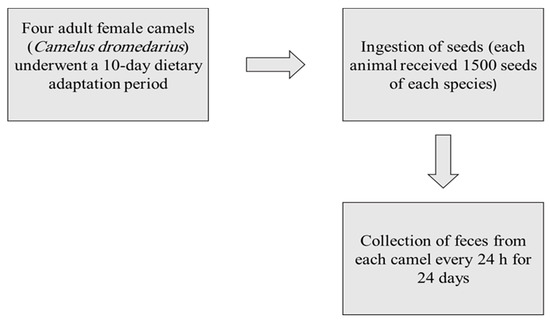
Four adult female camels (Camelus dromedarius) of similar size and age (4 years old, average weight 250–300 kg) were individually housed in separate enclosures at the University of Ouargla farm (Algeria) for the entire 34-day experimental period (10 days adaptation, 24 days treatment); during this period, seeds were incorporated into their diet in three successive ingestion phases, each separated by an eight-day interval. Throughout the experiment, each camel received a daily diet consisting of 10 L of water, 10 kg wheat straw, 10 kg wheat hay, 500 g wheat bran, and 400 g cereal concentrate.
Prior to the experiment, all animals underwent a dietary period of adaptation. From the first day of the adaptation period, each camel received 500 seeds of Retama raetam, on the second day 500 seeds of Vachellia tortilis, and on the third day 500 seeds of Genista saharae. Following ten days of dietary adaptation, each camel received a quantity of 1500 seeds per species. This quantity was divided into three ingestion stages, with 500 seeds per species per individual (500 seeds mixed with 500 g wheat bran, which were offered for 30 min, ensuring complete consumption) at eight-day intervals (Figure 1).
Figure 1.
A schematic diagram of the experimental feeding protocol.
2.3. Seed Recovery and Measurement
For eight consecutive days following each seed intake, all fecal excretions from each camel were collected at regular 24 h intervals, commencing immediately after feeding. Collections were conducted during the following intervals: 0–24 h (first day post-ingestion), 24–48 h, 48–72 h, 72–96 h, 96–120 h, 120–144 h, 144–168 h, and 168–192 h post-ingestion. The feces from each interval were subsequently analyzed in order to recover and quantify the excreted seeds.
To evaluate the impact of digestion on seed size, we compared the dimensions (length, width, and height) of uneaten control seeds with those of seeds retrieved from feces, using an electronic caliper (INSIZE Co., Ltd., Suzhou, China) (n = 100). Seeds retrieved from feces at 24–48 h post-ingestion were used for comparison.
2.4. Seed Germination After Digestive Tract Passage
To investigate the impact of the camel’s digestive tract on seed germination, and thus assess the effectiveness of seed dispersal by camels, we compared the germination of seeds retrieved from camel feces with that of uneaten (control) seeds. Seeds were categorized into seven groups (Table 2). Due to the low number of seeds recovered from camel feces after 120 h, we were unable to perform germination tests on these samples.
Table 2.
Experimental groups used for germination tests.
To ensure a clean testing environment, both uneaten control seeds and intact seeds retrieved from camel feces were disinfected by immersion in a solution of acetic acid (Sigma-Aldrich, St. Louis, MO, USA) for 5 min, and then rinsed with distilled water for 10 min. Seeds of each species were placed on two layers of filter paper in 9 cm Petri dishes, with 25 seeds per dish and four replicates for each treatment. Then, 4 mL of distilled water was added to each dish, which were then incubated in a phytotron (controlled environment growth chamber) at 25 °C in total darkness [18].
Germinated seeds were counted every two days. After 14 days, the seeds were no longer germinating. However, observations were continued until the 20th day to confirm the stability of the results. As no further increase in the number of germinated seeds was observed during this period, the experiment was concluded on day 20.
2.5. Statistical Analysis
Deviations were calculated as the standard error of the mean (SE). A significance level α of 0.05 was applied for every analysis. The data series were tested for normality with the Kolmogorov–Smirnov test and for homogeneity of variance with the Levene’s test. Differences in biometric characteristics between uneaten and retrieved seeds were tested using a t-test for independent samples. Inter-individual variation in seed recovery in camels, as well as differences in seed retrieval percentage from feces and final germination percentage, were tested using one-way analysis of variance (ANOVA) with Tukey’s honestly significant difference HSD test as post hoc analysis. All analyses were conducted using R version 4.5.1 [31].
3. Results
3.1. Inter-Individual Variation in Seed Recovery in Camels
Table 3 presents the percentage of seeds recovered from the feces of the four camels for the three studied species. Overall, seed recovery varied depending on the plant species, while differences between camels remained relatively limited.
Table 3.
Total percentage of seeds retrieved from four camels (mean ± SE).
Retama raetam showed the highest recovery percentages across all camels, ranging from 65.2% to 69.9%, with no significant differences among individuals (Tukey test; p ≤ 0.0001). This suggests a consistent digestive response among camels for this species.
For Genista saharae, recovery percentages ranged from 50.9% to 52.6%. A slight but significant difference was observed for Camel 3 (52.6%), which was statistically higher than the other camels (Tukey test; p ≤ 0.0001), indicating minor inter-individual variability.
In contrast, Vachellia tortilis exhibited very similar recovery values among all camels (51.1–52.1%), with no significant differences (Tukey test; p ≤ 0.0001), suggesting uniform seed passage and recovery across individuals.
Overall, these results indicate that plant species had a stronger effect on seed recovery than individual camel variation, although slight differences between animals may occur for certain species.
3.2. Seed Recovery After Digestive Tract Passage
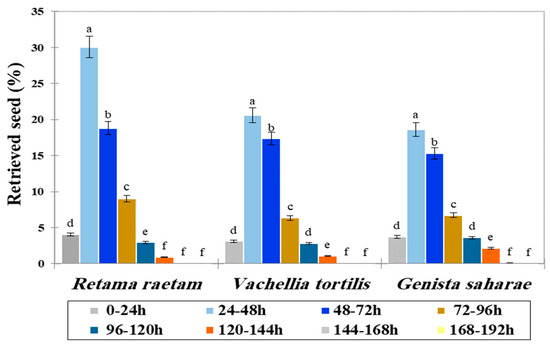
The percentage of seeds retrieved from camel feces varied every 24 h throughout the eight-day experiment (Figure 2), and this retrieval pattern differed among all studied species.
Figure 2.
Percentage of seeds (mean, n = 4) retrieved from camel feces 24–48, 72–96, 120–144, 168 and 192 h after consumption in the three species studied. Different letters indicate significant differences among species in the percentage of seeds retrieved (Tukey test; p ≤ 0.0001).
The excretion pattern showed an average temporal progression, characterized by a significant peak of excretion occurring between 24 and 48 h post-ingestion for all species studied. Significant interspecific variations were noted, indicating unique dispersal mechanisms associated with seed characteristics.
Initially, Retama raetam exhibited the highest excretion percentage at this early peak (30.05%), signifying a rapid and effective digestive transit.
Secondly, whereas Genista saharae showed a reduced initial peak (18.62%), it showed significantly prolonged digestion retention, with excretion quantities staying considerable for up to 144 h.
At last, Vachellia tortilis demonstrated an intermediate profile, attaining a peak excretion percentage of 20.63% before progressively decreasing. Some of the retrieved seeds were partially damaged, although their percentage remained very low compared to intact seeds across all species (R. raetam: 0.66%; V. tortilis: 0.4%; G. saharae: 0.06%).
3.3. Seed Biometric Characteristics
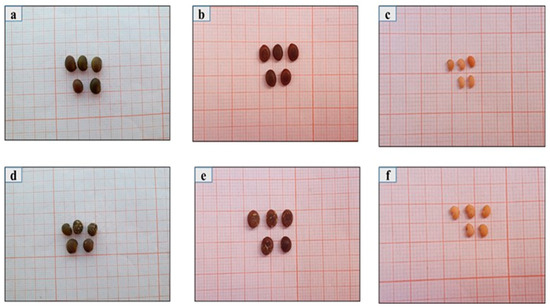
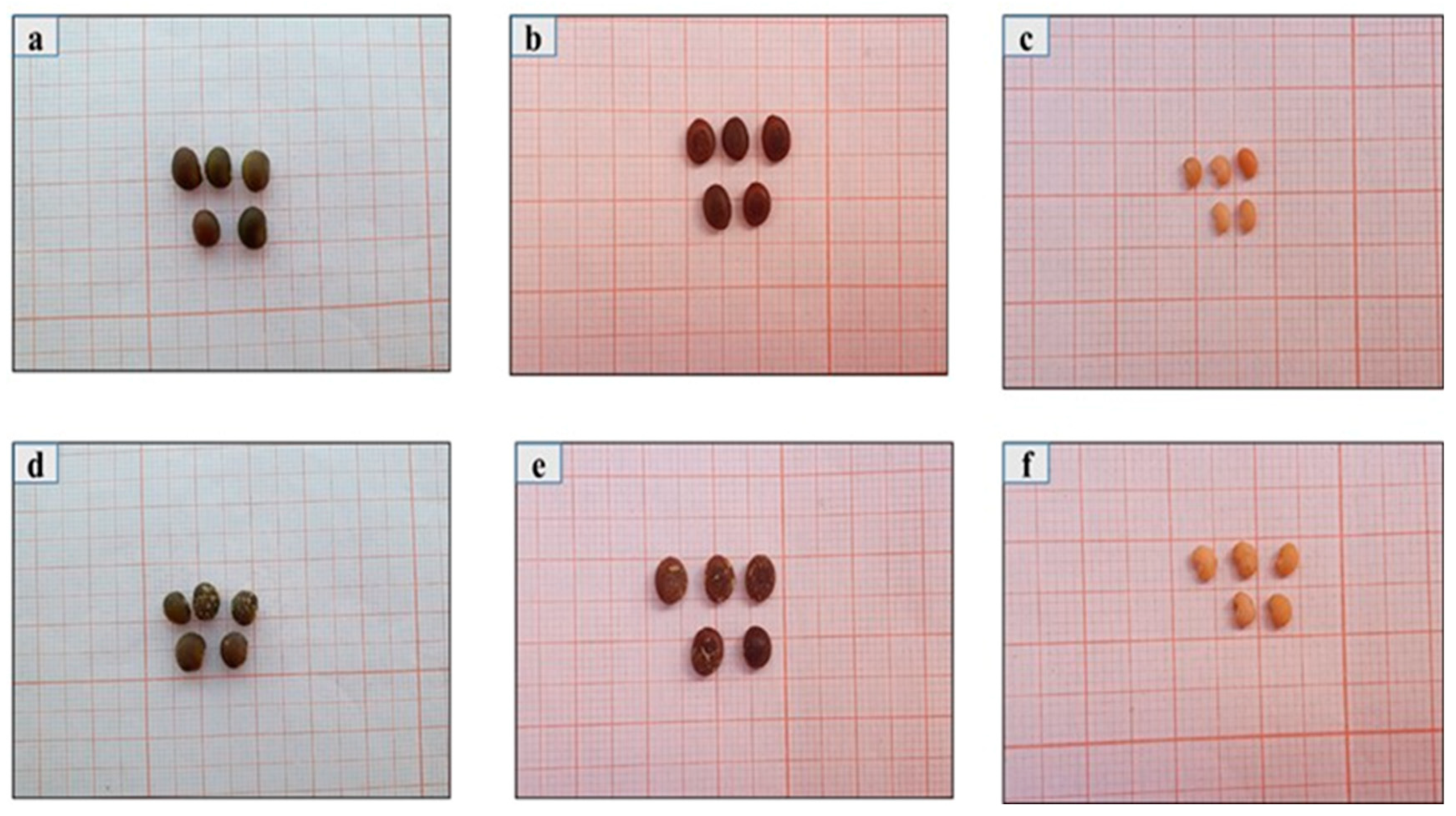
Significant differences in biometric traits were observed between retrieved and uneaten control seeds for Vachellia tortilis and Genista saharae. Retrieved seeds of both species were significantly longer, wider, and thicker than their corresponding controls (t-test, p ≤ 0.0001). In contrast, no significant differences were found in any biometric traits of Retama raetam seeds between retrieved and uneaten control seeds (t-test, p ≤ 0.0001) (Table 4) (Figure 3).
Table 4.
Seed biometric traits of the studied species (mean ± SE, n = 100).
Figure 3.
Seeds of three species before and after passage through the camel digestive tract, (a,d) seeds of Retama raetam. (b,e) Vachellia tortilis. (c,f) Genista saharae. Before passage (a–c) and after passage (d–f).
3.4. Effects of Digestive Tract Passage on Seed Germination
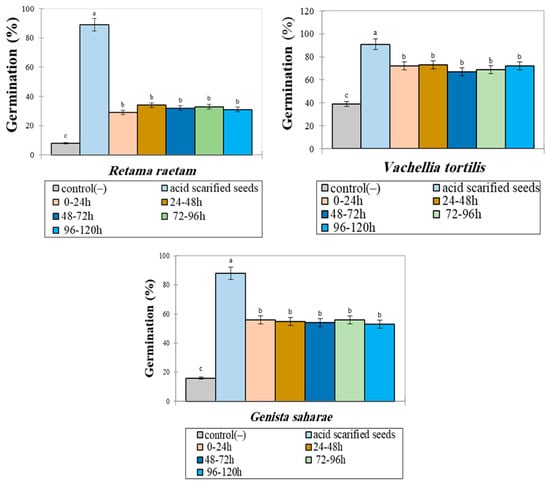
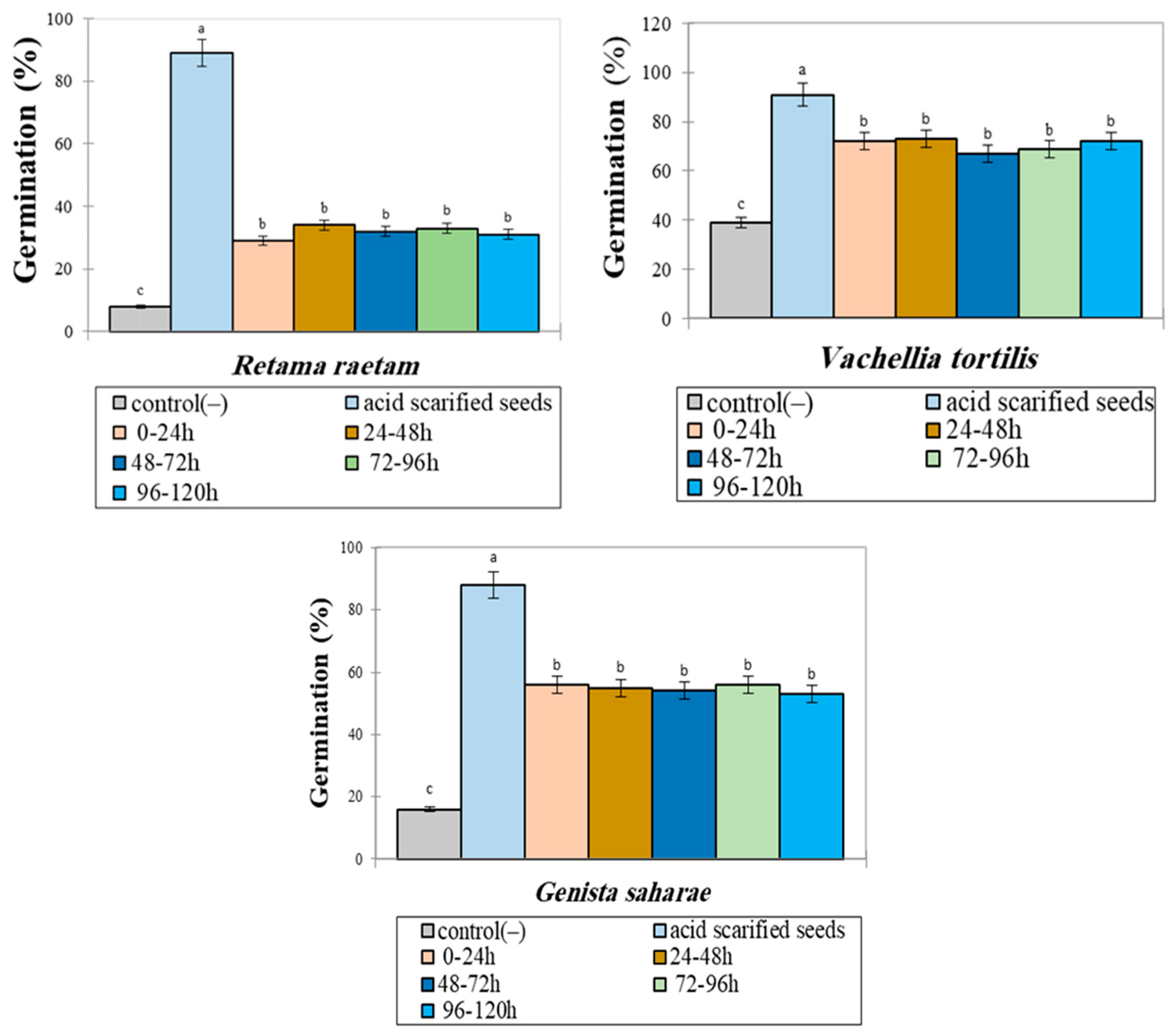
Passage through the camel’s digestive tract significantly increased the final germination percentage in all three species (R. raetam, V. tortilis, and G. saharae), compared to the uneaten control seeds (–) (ANOVA; Tukey’s test, p ≤ 0.0001) (Figure 4). Seeds recovered from camel feces showed intermediate germination values, which varied depending on the passage time (24, 48, 72, 96, and 120 h). These differences suggest that while camel gut passage promotes dormancy break, it is less effective than chemical scarification.
Figure 4.
Germination percentage (mean ± SE, n = 4) of control (−); uneaten seeds, without passage, acid scarified seeds, and defecated seeds of three species studied. Different letters indicate significant differences among treatments within each species (Tukey test; p ≤ 0.0001).
The combined analysis of excretion patterns and germination results reveals the distinct adaptive strategies each species has evolved to survive digestive passage and ensure their regeneration.
First Retama raetam’s a rapid and high excretion pattern, with a large proportion of seeds recovered early during the collection period. Germination increased from 8% to approximately 32% after gut passage. Germination rates remained relatively stable across the different collection intervals (0–24 h to 96–120 h), with no marked variation over time.
Second, Genista saharae’s germination results indicate that this prolonged retention comes at a cost. Germination rates (~52%) are the lowest of the three species following ingestion and remain below their maximum potential (88%).
Finally, in contrast to the other two species, Vachellia tortilis does not seem to exhibit a single, specialized transit strategy. Its robust seeds, which already show the highest germination rate without any treatment (39%), tolerate a wide range of retention times without major damage. Whether excreted early or late, they germinate very effectively (~70%), approaching their maximum potential.
4. Discussion
A significant proportion of seeds retrieved from camel feces (R. raetam: 65.8%, V. tortilis: 51.3%, G. saharae: 50.2%) demonstrates the dromedary’s efficiency as a disperser of these wild species. For all species, the elimination chronology showed a typical curve with a main excretion peak occurring 24 to 48 h after intake; nevertheless, significant interspecific differences were noted.
Retama raetam exhibited the highest excretion rate at the peak (30.05%), suggesting that its seed morphology may facilitate rapid passage through the digestive tract, likely due to its smooth and relatively small seed size. This rapid transit is likely advantageous, as it reduces the risk of digestive damage while still promoting germination through efficient scarification.
In contrast, Genista saharae showed a less pronounced initial peak (18.62%) but a markedly longer retention time, with excretion events extending up to 144 h. This pattern suggests an adaptation for long-distance dispersal. Specifically, it reflects a dual strategy in which some seeds are excreted early, while others are retained for extended periods, thereby increasing the potential dispersal range.
Vachellia tortilis displayed an intermediate profile, reaching a peak excretion rate of 20.63%, followed by a gradual decline. This pattern indicates a degree of physiological tolerance to varying retention times, which may contribute to stable germination performance regardless of excretion timing. Overall, these species-specific retention patterns, likely driven by differences in seed traits, highlight the important role of camels as effective long-distance dispersal agents, enabling seed distribution across a wide range of spatial scales, from local to landscape levels.
The movement of camels, traversing up to 50 km daily at an average speed of 1–2 km/h while grazing [32,33], enhances their dispersing effect. R. raetam advantages from limited depositing near to feeding and resting sites, while G. saharae utilizes long-distance dispersal spanning hundreds of kilometers, enhancing genetic linkage. V. tortilis demonstrates generalist characteristics, surviving across diverse spatiotemporal dimensions. In contrast to classical ruminants like cattle, which excrete most seeds within 48 h and rarely beyond 96 h [34]. This extended retention corresponds with camelids’ digestive adaptations for xerophytic flora [35].
The camel’s digestive characteristics, such as ruminal flora, nitrogen recycling, and sluggish transit [36], enhance forage consumption and output, resulting in superior forage utilization efficiency compared to other ruminants. Although the microbial population is qualitatively identical, the cellulolytic activity of the bacteria is significantly more pronounced in the camel’s forestomach, and the retention duration of solid particles in the forestomach is considerably extended. The progression of these two parameters facilitates improved digestion of organic matter and the cellulosic components of the diet [20].
Recovered seeds from dromedary feces were found to be intact, showing no signs of digestion or physical deterioration. This persistence can be attributed to the small size of the studied seeds (Table 2), which increases their likelihood of escaping mechanical damage during mastication and rumination, rather than reflecting any inherent physiological resistance to digestive processes [37]. Moreover, [38] demonstrated that ingestion, rumination, and intestinal transit in dromedaries over a 48–72 h period do not destroy the seeds subsequently excreted. Therefore, the mechanical processes, enzymatic activity, and retention time within the digestive tract generally do not alter the morphological characteristics of the ingested seeds.
The size of seeds recovered from G. saharae and V. tortilis are larger than that of the control seeds (Table 4). This can be explained by the swelling of the seeds after water penetrates and hydrates the seed during passage through the digestive tract of the camel. These results confirm those of [39], demonstrating that camel ingestion significantly increases the size (length, width and thickness) of Prosopis juliflora (Sw.) DC seed. Similarly, [40] observed that goat ingestion led to an increase in size and the darkening of Calicotome villosa seeds (Poir.) Link.
According to [41,42], seeds from feces were categorized as small (≤5 mm in length), medium (5–10 mm in length), and large (≥10 mm). Consequently, [43] deduced that in the Sahara Desert of Algeria, the seeds of wild plants were sufficiently diminutive to evade the mastication process and digestive tract of camels. Furthermore, they were generated in substantial quantities within a challenging environment conducive to a high possibility of ingestion.
Refs. [40,44] suggest that small seeds may have a better chance of surviving passage through an herbivore gut compared to large seeds, as they are likely to be expelled more quickly, which could enhance their survival rates. Spherically shaped seeds seem to endure gut passage more effectively than seeds of different shapes. The spherical shape is deemed to facilitate the passage of seeds through the digestive systems of animals [45]. Consequently, we deduced that small seeds exhibiting a spherical morphology are deemed advantageous for enduring transit through the camel digestive tract, and they also provide additional benefits, including prolonged viability in both feces and soil seed reserves.
The seeds of the three Fabaceae species studied exhibit physical dormancy (PY), a typical trait of this botanical family [4]. In this study, the passage of seeds through the camel’s digestive tract significantly enhanced their germination capacity compared to uneaten control seeds. For Fabaceae species exhibiting physical dormancy (PY), this dormancy is generally broken when a specialized structure in the seed coat, known as the “water gap,” opens, allowing water imbibition and initiating the germination process [9,46]. In this context, the increased germination rates observed in seeds recovered from camel feces suggest that digestive processes may have contributed to the opening of this water gap.
The uneaten seeds exhibited hard, water-impermeable seed coats, which prevented imbibition and blocked germination. The seeds recovered from feces were slightly larger, suggesting that the mechanical and chemical processes encountered during gut passage partially altered the integrity of the seed coat. This modification likely facilitated the opening of the water gap, allowing water to reach the embryo and thereby contributing to dormancy release and the initiation of germination. In particular, mechanical abrasion and microbial activity in the rumen may have initiated weakening of the seed coat through physical friction and enzymatic action, as previously reported by [47]. Subsequently, exposure to acidic conditions and digestive enzymes in the abomasum and small intestine may have further contributed to the erosion of the pericarp and seed coat structure [48]. This sequential combination of mechanical and chemical processes is likely responsible for triggering the opening of the water gap.
Many plant species’ seeds show improved germination percentage after passing through an animal’s digestive tract, especially in arid regions. Research conducted by [49] in the Palestinian Sahara suggested that the seeds of Acacia iraquensis and Retama raetam exhibit enhanced germination following ingestion by camels.
The elevated germination rates indicate that the camel’s digestive functions significantly aid in overcoming seed dormancy. Our research offers novel insights that reinforce the theory of the camel’s facilitative role and deepen our comprehension of the mechanisms underlying endozoochorous seed distribution in arid ecosystems. Our research elucidates the influence of intestinal transit on seeds from species possessing indehiscent fruits and/or hard seed coats characteristics prevalent in Saharan flora, thereby underscoring the ecological role of the camel as a natural dispersal agent.
5. Conclusions
The ingestion of Fabaceae seeds by camels (Retama raetam, Vachellia tortilis and Genista saharae) and their excretion in feces may play an important role in the dispersal of these species in the Algerian Sahara rangelands. Understanding the mechanisms underlying this process is crucial, as seed size, retention time, and digestive processes, including both physical abrasion and chemical exposure within the gastrointestinal tract, are key factors influencing seed dispersal. This study provides the first quantitative evidence of seed dispersal capacity, gut retention times, and germination responses after passage for key Saharan species. By highlighting these still little explored interactions, we emphasize the essential role of dromedaries as effective long-distance dispersers contributing to vegetation regeneration in arid ecosystems. In doing so, our work makes an original contribution by focusing on endemic Saharan Fabaceae and by providing species-specific data on camel-mediated seed dispersal, which has not been previously documented in this ecosystem. Furthermore, considering the projected increase in camel populations in North Africa and the ongoing degradation of arid rangelands, camel endozoochory may become an increasingly important ecological process, enhancing vegetation recovery and resilience under changing climatic and land-use conditions.
Future research should identify additional plant species dispersed by camels and track the fate of their seedlings to assess establishment and survival. Moreover, investigating how variations in seed traits influence their passage through the camel digestive system could deepen our understanding of plants.
Author Contributions
Conceptualization, methodology, investigation, analyses, and writing A.K., H.T. and A.C.; supervision, H.T., M.-N.G., L.O. and A.C. All authors have read and agreed to the published version of the manuscript.
Funding
This research received no external funding.
Institutional Review Board Statement
Not applicable.
Data Availability Statement
The data supporting the findings of this study are available from the corresponding author upon reasonable request.
Acknowledgments
We thank Reguia Benyaya from the Université de Ouargla, as well as Amria Kouidri and Wafa Chaouali, for their valuable assistance in collecting seeds used in this experiment.
Conflicts of Interest
The authors declare no conflicts of interest.
References
- Chehma, A. Étude Floristique et Nutritive des Parcours Camelins du Sahara Septentrional Algérien: Cas des Régions de Ouargla et Ghardaïa. Ph.D. Thesis, Université Kasdi Merbah, Ouargla, Algeria, 2005. [Google Scholar]
- Gutteridge, R.C.; Shelton, H.M. Forage Tree Legumes in Tropical Agriculture; CAB International: Wallingford, UK, 1994. [Google Scholar]
- Alstad, G.; Vetaas, O.R. The influence of Acacia tortilis stands on soil properties in arid northeastern Sudan. Acta Oecol. 1994, 15, 449–460. [Google Scholar]
- Jaganathan, G.K.; Yule, K.J.; Biddick, M. Determination of the water gap and the germination ecology of Adenanthera pavonina (Fabaceae, Mimosoideae): The adaptive role of physical dormancy in mimetic seeds. AoB Plants 2018, 10, ply048. [Google Scholar] [CrossRef] [Scilit] [PubMed]
- Baskin, J.M.; Baskin, C.C. Evolutionary considerations of claims for physical dormancy break by microbial action and abrasion by soil particles. Seed Sci. Res. 2000, 10, 409–413. [Google Scholar] [CrossRef] [Scilit]
- Cook, A.; Turner, S.R.; Baskin, J.M.; Baskin, C.C.; Steadman, K.J.; Dixon, K.W. Occurrence of physical dormancy in Australian Sapindaceae. Ann. Bot. 2008, 101, 1349–1362. [Google Scholar] [CrossRef] [Scilit]
- Jaganathan, G.K.; Wu, G.R.; Han, Y.Y.; Liu, B.L. Role of the lens in controlling physical dormancy break and germination of Delonix regia. Plant Biol. 2017, 19, 53–60. [Google Scholar] [CrossRef] [Scilit] [PubMed]
- Jaganathan, G.K. Are wildfires an adapted cue breaking physical dormancy? Seed Sci. Res. 2015, 25, 120–126. [Google Scholar] [CrossRef] [Scilit]
- Baskin, J.M.; Baskin, C.C. A classification system for seed dormancy. Seed Sci. Res. 2004, 14, 1–16. [Google Scholar] [CrossRef] [Scilit]
- Van Klinken, R.D.; Flack, L. Wet heat and dormancy release. Weed Sci. 2005, 53, 663–669. [Google Scholar] [CrossRef] [Scilit]
- Traveset, A.; Robertson, A.W.; Rodríguez-Pérez, J. A review on the role of endozoochory in seed germination. In Seed Dispersal: Theory and Its Application in a Changing World; CAB International: Wallingford, UK, 2007; pp. 78–103. [Google Scholar]
- Shiferaw, H.; Teketay, D.; Nemomissa, S.; Assefa, F. Some biological characteristics that foster the invasion of Prosopis juliflora in northeastern Ethiopia. J. Arid Environ. 2004, 58, 135–154. [Google Scholar] [CrossRef] [Scilit]
- Soltani, E.; Baskin, C.C.; Baskin, J.M.; Heshmati, S.; Mirfazeli, M.S. A meta-analysis of the effects of frugivory on seed germination. Plant Ecol. 2018, 219, 1283–1294. [Google Scholar] [CrossRef] [Scilit]
- Newman, D. Feeding habits of Old and New World camels. In Proceedings of the International Workshop on Camels; IFS: Stockholm, Sweden, 1979; pp. 171–200. [Google Scholar]
- Van Oudtshoorn, K.V.R.; Van Rooyen, M.W. Dispersal Biology of Desert Plants; Springer: Berlin, Germany, 1999. [Google Scholar]
- Linnaeus, C. Systema Naturae, 10th ed.; Laurentii Salvii: Stockholm, Sweden, 1758. [Google Scholar]
- Maxted, N.; Bennett, S.J. Plant Genetic Resources of Legumes in the Mediterranean; Springer: Dordrecht, The Netherlands, 2001. [Google Scholar]
- Trabelsi, H.; Kherraze, M. Effects of abiotic stress on Sahara psammohalophytes. In Handbook of Halophytes; Springer: Cham, Switzerland, 2020; pp. 1–15. [Google Scholar]
- Le Houérou, H.N. The role of cacti (Opuntia spp.) in erosion control. J. Arid Environ. 1996, 33, 135–159. [Google Scholar] [CrossRef] [Scilit]
- Faye, B. Combating desertification: The added value of camel farming. Ann. Arid Zone 2011, 50, 267–277. [Google Scholar] [CrossRef] [Scilit]
- Guerrache, N.; Akkouche, S.; Kadik, L. Evaluation of biodiversity and soil stabilization after dune fixation. Afr. J. Agric. Res. 2014, 9, 1467–1479. [Google Scholar] [CrossRef] [Scilit]
- Pugnaire, F.I.; Haase, P.; Puigdefábregas, J. Facilitation between plant species in semiarid environments. Ecology 1996, 77, 1420–1426. [Google Scholar] [CrossRef] [Scilit]
- Muñoz Vallés, S.; Gallego Fernández, J.; Dellafiore, C.; Cambrollé, J. Effects of Retama monosperma in dunes. Plant Ecol. 2011, 212, 169–179. [Google Scholar] [CrossRef] [Scilit]
- Xie, G.; Steinberger, Y. Temporal patterns of carbon and nitrogen under shrub canopy. Soil Biol. Biochem. 2005, 37, 1941–1948. [Google Scholar] [CrossRef] [Scilit]
- Trabelsi, H.; Senoussi, A.; Chehma, A. Dissémination des graines dans les fèces du dromadaire. Sécheresse 2012, 23, 94–101. [Google Scholar] [CrossRef] [Scilit]
- Trabelsi, H.; Chehma, A.; Jassim, R.A.; Senoussi, A.; Kherraze, M. Camel as seed disperser in the northern Sahara rangelands of Algeria. Int. J. Biosci. 2017, 10, 58–65. [Google Scholar] [CrossRef] [Scilit]
- Trabelsi, H.; Ghedaiar, Z.; Habita, I.; Chehma, A. Effect of camel’s digestive tract treatment on breaking seed germination of Helianthemum lippii (L.) Pers. from the Northern Sahara in Algeria. Afr. J. Ecol. 2022, 60, 830–833. [Google Scholar] [CrossRef] [Scilit]
- Trabelsi, H.; Chehma, A.; Senoussi, A.; Faye, B.; Kherraze, M.E. Camel potentiality in survival and germination of wild pastoral species. J. Arid Environ. 2023, 216, 105015. [Google Scholar] [CrossRef] [Scilit]
- Fick, S.E.; Hijmans, R.J. WorldClim 2: New climate surfaces for global land areas. Int. J. Climatol. 2017, 37, 4302–4315. [Google Scholar] [CrossRef] [Scilit]
- Salama, F.; Abd El-Ghani, M.M.; Amro, A.; Gaafar, A.; Abd El-Galil, E. Vegetation dynamics in a Saharan oasis. Not. Sci. Biol. 2018, 10, 363–372. [Google Scholar] [CrossRef] [Scilit]
- R Core Team. R: A Language and Environment for Statistical Computing; R Foundation: Vienna, Austria, 2024. [Google Scholar]
- Slimani, N.; Chehma, A.; Faye, B.; Huguenin, J. Diet and feeding behavior of dromedaries in Algeria. Livest. Res. Rural Dev. 2013, 25, 220. [Google Scholar]
- Mahma, H.; Chehma, A.; Huguenin, J. Comportement alimentaire journalier du dromadaire. Fourrages 2019, 240, 341–347. [Google Scholar]
- Albert, A.; Auffret, A.G.; Cosyns, E.; Baltzinger, C.; Moretti, M. Seed dispersal by ungulates as an ecological filter. Oikos 2015, 124, 1109–1120. [Google Scholar] [CrossRef] [Scilit]
- Bengoumi, M.; Faye, B. Camel Health and Diseases; Springer: Cham, Switzerland, 2020. [Google Scholar]
- Al-Jassim, R.; Hogan, J. Camel nutrition for meat production. In Camels in Asia and North Africa; Springer: Dordrecht, The Netherlands, 2012; pp. 177–186. [Google Scholar]
- Mancilla-Leytón, J.M.; Fernández-Alés, R.; Vicente, A.M. Goat gut passage effect on shrub seeds. J. Veg. Sci. 2011, 22, 1031–1037. [Google Scholar] [CrossRef] [Scilit]
- Richard, D. Le Dromadaire et Son élevage; CIRAD-IEMVT: Montpellier, France, 1985. [Google Scholar]
- Abbas, A.M.; Mancilla-Leytón, J.M.; Castillo, J.M. Can camels disperse seeds of the invasive tree Prosopis juliflora? Weed Res. 2018, 58, 221–228. [Google Scholar] [CrossRef] [Scilit]
- Grande, D.; Mancilla-Leytón, J.M.; Delgado-Pertíñez, A.; Martín-Vicente, A. Endozoochorous Seed Dispersal by Goats: Recovery, Germinability, and Emergence of Five Mediterranean Shrub Species. Span. J. Agric. Res. 2013, 11, 347–355. [Google Scholar] [CrossRef] [Scilit]
- Chapman, H.M.; Goldson, S.L.; Beck, J.; Kaplin, B.A. Post-dispersal removal and germination of seeds dispersed by Cercopithecus nictitans. Folia Primatol. 2009, 81, 41–50. [Google Scholar] [CrossRef] [Scilit] [PubMed]
- Sengupta, A.; McConkey, K.R.; Radhakrishna, S. Seed dispersal by rhesus macaques. Am. J. Primatol. 2014, 76, 1175–1184. [Google Scholar] [CrossRef] [Scilit] [PubMed]
- Trabelsi, H. Rôle du Dromadaire Dans la Régénération du Couvert Floristique Saharien. Ph.D. Thesis, Université Kasdi Merbah, Ouargla, Algeria, 2016. [Google Scholar]
- Pakeman, R.J.; Digneffe, G.; Small, J.L. Ecological correlates of endozoochory. Funct. Ecol. 2002, 16, 296–304. [Google Scholar] [CrossRef] [Scilit]
- Bruun, H.H.; Poschlod, P. Why are small seeds dispersed through animal guts? Oikos 2006, 113, 402–411. [Google Scholar] [CrossRef] [Scilit]
- Van Assche, J.A.; Debucquoy, K.L.A.; Rommens, W.A.F. Seasonal cycles in germination of buried legumes. New Phytol. 2003, 158, 315–323. [Google Scholar] [CrossRef] [Scilit]
- Robles, A.B.; Castro, J. Effect of thermal shock and ruminal incubation on seed germination. Acta Bot. Malacit. 2002, 27, 41–47. [Google Scholar] [CrossRef] [Scilit]
- Gardener, C.J.; McIvor, J.G.; Jansen, A. Passage of seeds through the digestive tract of cattle. J. Appl. Ecol. 1993, 30, 63–74. [Google Scholar] [CrossRef] [Scilit]
- Gutterman, Y. Strategies of seed dispersal and germination in desert plants. Bot. Rev. 1994, 60, 373–425. [Google Scholar] [CrossRef] [Scilit]

Disclaimer/Publisher’s Note: The statements, opinions and data contained in all publications are solely those of the individual author(s) and contributor(s) and not of MDPI and/or the editor(s). MDPI and/or the editor(s) disclaim responsibility for any injury to people or property resulting from any ideas, methods, instructions or products referred to in the content. |
© 2026 by the authors. Licensee MDPI, Basel, Switzerland. This article is an open access article distributed under the terms and conditions of the Creative Commons Attribution (CC BY) license.