


Abstract
Microalloy binary and complex particles play a fundamental role in controlling microstructures and properties throughout steelmaking processes. Their stability is described by solubility products; however, the relationships reported in the literature exhibit considerable variability among different authors and were established using different experimental and thermodynamic techniques. This review critically assesses the development and applicability of solubility products for microalloy precipitates in ferrite and austenite. More than 90 literature-reported solubility products were compiled and classified according to precipitate type, matrix phase in which they were obtained and methodology. Specific attention was directed towards NbC and TiC, to which published relationships were quantitatively compared. A regression analysis was used to derive global solubility products for ferrite and austenite. The assessment reveals considerable scatter in the reported relationships and a marked imbalance between matrix phases, with most studies focusing on austenite. Furthermore, it was also established that ferritic solubility products were obtained predominantly with thermodynamic calculations, as no experimental work has been reported in the literature. Experimental evidence under ferrite–austenite coexistence is particularly limited. Finally, industrial examples are provided to demonstrate that equilibrium solubility alone cannot describe the microalloying state developed during thermomechanical processing, where precipitation and dissolution kinetics are critical. Improved experimental validation, particularly in ferrite and the intercritical region, is therefore required to strengthen the application of solubility products to industrial steel design.
1. Introduction
Microalloying technology is an essential metallurgical strategy for the development and manufacturing of advanced high-strength steels, enabling the optimization of microstructures, mechanical properties and in-use properties, such as toughness, through small additions of elements such as Niobium (Nb), Titanium (Ti) and Vanadium (V) [1]. The direct interaction of microalloying elements with Carbon and Nitrogen, either in solid solution or through the formation of precipitates, provides steelmakers with effective mechanisms to control recrystallization, recovery, grain growth, phase transformation and precipitation strengthening [2,3]. As a result of that, the appropriate selection of microalloying elements and processing conditions is one of the most relevant challenges of steelmakers to implement substantial improvements in steel performance and optimization in their respective manufacturing routes.
One of the most established applications of microalloying technology to condition microstructures is thermomechanically controlled processing (TMCP), for which Niobium microalloying is the most widely considered and implemented approach [4,5]. In these controlled processes, Niobium in solid solution retards austenite recrystallization through solute drag, while strain-induced precipitation of NbC or Nb(C,N) exert Zener pinning pressure on austenite grain boundaries and subgrain boundaries, restricting their mobility, which leads to a delay in recrystallization and grain growth during interpass times [6]. The abovementioned mechanisms enable deformation to be performed below the non-recrystallization temperature (Tnr), promoting the accumulation of strain and the development of elongated or “pancaked” austenite [7]. The resulting increase in potential nucleation sites during the subsequent austenite to ferrite transformation contributes to microstructural refinement and therefore improved mechanical properties [8]. The effectiveness of this metallurgical strategy is intrinsically dependent on the size, number density, distribution and stability of the precipitates, as well as on the partitioning of the microalloying elements between the matrix and precipitated phases at each stage of processing.
The role of microalloying goes beyond hot rolling operations and controlled cooling is fundamental to guarantee that the hot band has the microalloying elements in the expected metallurgical state [9]. During downstream annealing operations, the interaction between solute redistribution, precipitation, recrystallization and phase transformation becomes important for controlling the final microstructure of cold-rolled steels, which are the bulk of consumption for the automotive industry [10]. Microalloying technology can influence recrystallization kinetics, grain-boundary mobility, precipitation strengthening, and crystallographic texture, providing additional possibilities for tailoring the properties of steels used in automotive and other demanding applications [11]. In these processing routes, the material will be exposed through a wide range of temperatures, where the microstructure can be fully austenitic, a mixture of ferrite and austenite (intercritical temperature range), and fully ferritic within relatively short processing times [12]. The metallurgical state and availability of the microalloying elements can therefore change during heating, soaking, transformation and cooling.
Having in-depth knowledge of the thermodynamic stability and solubility of carbides, nitrides, and carbonitrides is fundamental to increase the accuracy of prediction of their metallurgical states throughout the steelmaking process. Solubility products provide the thermodynamical framework for describing the equilibrium between dissolved elements and precipitated phases through temperature-dependent relationships and have been used to estimate precipitate dissolution temperatures and the amount of microalloying elements available in solid solution [13,14]. However, thermodynamic solubility must be differentiated from kinetics, as the microstructural state achieved during industrial processing depends heavily on diffusion, particle size, composition and nucleation barriers [15]. These limitations become particularly important when such temperature-dependent relationships, usually derived from simplified alloy systems, are applied to multicomponent steels where interactions among microalloying elements, interstitials and other alloying additions can modify activities and promote the formation of complex particles such as (Nb,Ti)(C,N) [16]. Therefore, solubility relationships for individual compounds cannot necessarily be transferred directly to industrial compositions without further considerations for competing precipitates, and the assumptions underlying their derivation.
The intercritical temperature range presents an important and insufficiently explored challenge for the application of solubility products. In this temperature range, ferrite and austenite coexist, so the partitioning of carbon and substitutional elements between both phases produces local compositions that differ from the nominal bulk composition [17,18]. Carbon rejected from transforming ferrite enriches austenite, while microalloying elements and existing precipitates interact with the moving ferrite–austenite interface [19,20]. As a result, precipitates may experience different thermodynamic and kinetic conditions depending on whether they are present in ferrite, austenite or near the transformation front.
The magnetic transition of ferrite from ferromagnetic to paramagnetic near the Curie temperature may introduce an additional influence on phase stability and diffusion kinetics [21,22]. Despite the technological importance of intercritical processing for advanced materials, little work has directly investigated microalloy solubility under conditions where ferrite and austenite coexist [23]. Most available solubility products are derived from single-phase systems and are therefore not readily transferable to this two-phase temperature range without considering phase-specific compositions, elemental partitioning and interface effects.
Against this background, the present work reviews microalloy solubility in steels by extensively collecting, discussing and consolidating published solubility products and industrial observations from the last 70 years. It evaluates the historical background, consistency of reported data, and effects of alloy designs and temperature ranges, besides the applicability and limitations of existing products. The discussion covers solubility descriptions in simplified and multicomponent systems, simple and complex precipitates, and the experimental and thermodynamic modeling methods used to obtain them. From the steelmaking perspective, it also considers the implication of solubility during reheating, austenite conditioning, phase transformation and ferritic processing, where relevant industrial cases will be provided to illustrate such effects. Finally, the review identifies limitations and knowledge gaps to support new research, improved characterization, statistical evaluation and ultimately prediction of microalloy solubility under intercritical and industrially relevant conditions.
2. Fundamentals of Microalloy Solubility in Steels
The metallurgical effects of microalloying elements on the development of advanced steels depend on their availability throughout the steelmaking process between solid solution and precipitated phases. The equilibrium between a precipitated compound and its constituent elements dissolved in the matrix provides the thermodynamic basis for the solubility product concept widely applied to microalloyed steels:
MC(precipitate) ↔ M(solution)C(solution)
In the relationship expressed in Equation (1), the factor M represents the microalloying element such as Nb, Ti or V and at thermodynamic equilibrium, the Gibbs free energy change associated with this reaction is zero, while the chemical potentials of each component are equal across the coexisting phases. Dissolution becomes thermodynamically favorable when transfer of the constituent elements from the precipitate to the matrix decreases the Gibbs free energy of the system.
Applying these principles to steel requires the chemical potential to be defined relative to a known reference state, since its absolute value cannot be directly measured. This allows the intrinsic thermodynamic contribution of each component to be distinguished from the contribution associated with its activity (a) in the system. For the dissolution of a stoichiometric precipitate MC, the standard Gibbs free energy change can therefore be related to the chemical potential and activities of the precipitate and its constituent elements, as expressed in Equation (2).
In the present review, decimal logarithms (log10) are used for conventional solubility product relationships, consistent with their representation in the original literature; however, natural logarithms (ln) are used in fundamental thermodynamic expressions. The two conventions are related by ln K = 2.303 log10 K, and this distinction is maintained to preserve the numerical coefficients of the published relationships.
The derivation of conventional solubility products commonly involves two important assumptions: First, that the activity of the precipitate, aMC, is equal to unity as it can be treated as a pure and stoichiometric bulk phase. Second, the dissolved microalloying elements are generally treated as components of a dilute solution, since Nb, Ti, and V are typically present in steels at low concentrations, often below 0.10 wt.%. Under these conditions, Henry’s law allows their thermodynamic activities to be approximated as proportional to their concentration (ai ≈ [i]), enabling activity-based equilibrium expressions to be simplified into the concentration-based solubility products commonly used for microalloy precipitates in steels [24].
It is important to highlight that the approximation of the activity of the precipitate to unity may become less accurate for very small particles, where interfacial curvature increases the chemical potential of the precipitate according to the Gibbs–Thomson effect [25,26]. Consequently, smaller precipitates require a higher equilibrium solute concentration in the surrounding matrix than particles with a planar interface, meaning that conventional bulk solubility products may underestimate the equilibrium solubility associated with nanoscale precipitates.
Considering the assumptions mentioned above, Equation (2) can be further simplified into Equation (3):
Taking the base-10 logarithm of Equation (3) converts the relationship into the conventional linear form used to describe the solubility of microalloy precipitates, represented in Equation (4), where Ks represents the concentration product and the constants A and B are related to the entropy and enthalpy changes in the dissolution reaction, respectively. Equation (4) has the same mathematical form as the Arrhenius equation [27], allowing the experimental equilibrium data to be represented as log K versus 1/T, with the intercept corresponding to A and the slope to −B, providing the basis for the empirical solubility relationships widely reported for microalloy precipitates in steels.
The temperature dependence of the equilibrium constant can also be described by the van’t Hoff relationship, presented in Equation (5), which relates changes in K with temperature to the enthalpy of the equilibrium reaction. Originally developed for chemical equilibria [28], this relationship is also applicable to metallurgical systems, allowing the dissolution enthalpy of precipitates to be determined from the slope of an ln K versus 1/T plot.
The conventional representation of solubility products is illustrated in Figure 1, using representative NbC relationships for ferrite and austenite [29]. As can be seen, the relationships exhibit the characteristic linear dependence described by Equation (4). The different slopes and intercepts further illustrate the strong influence of the matrix phase on the predicted equilibrium solubility of NbC.
Figure 1.
Example of temperature dependence of NbC equilibrium solubility products in austenite (γ) and ferrite (α), calculated from the relationships reported by Irvine et al. (1967) [30] and Taylor (1995) [29], respectively. The austenite relationship is based on experimental investigations, whereas the ferrite relationship was derived from thermodynamic calculations.
The thermodynamic framework described above provides the basis for conventional solubility products widely used for the development of microalloyed steels. However, it was highlighted that these relationships rely on several simplifying assumptions, including thermodynamic equilibrium conditions, dilute-solution behavior, fixed precipitate stoichiometry and negligible effects of particle curvature. In practical steelmaking processes, the situation is more complex because multiple alloying elements, competing and complex precipitates, non-ideal solution behavior and non-equilibrium processing conditions can all influence precipitation and dissolution. These factors can lead to differences between experimentally measured solubility relationships and those predicted from thermodynamic models.
The following review therefore examines the literature on microalloying solubility products, distinguishing between experimental investigations and thermodynamic approaches, while evaluating how the complexities of real alloy systems affect the applicability and limitations of the proposed solubility relationships.
3. Historical Development of Microalloy Solubility Products in Steels
The development of solubility products for microalloy precipitates in steel has evolved considerably over the past seven decades, both in the methodologies employed and in which matrix phase the studies were performed. Early studies relied predominantly on experimental approaches to establish equilibrium solubility relationships, with a strong emphasis on austenite, whereas subsequent developments in thermodynamic modeling progressively enabled the assessment of more complex systems and an increased consideration of ferrite.
To provide an overview of this evolution, Figure 2 presents the chronological distribution of the studies considered in this review, classified according to their experimental or thermodynamic basis and the matrix phase for which the solubility relationships were determined. This historical perspective provides a useful basis for examining how the available solubility products were established, how their underlying methodologies have evolved, and where important gaps in experimental evidence remain.
Figure 2.
Historical development of microalloy solubility product studies in steels, classified by methodology and matrix phase.
The early and foundational development of microalloy solubility products can be traced back to the 1950s, with early studies already employing both thermodynamic and experimental approaches. Bungardt et al. (1956) provided one of the earliest investigations of VC solubility in austenite, combining experimental observations with thermodynamic analysis [31]. Sawamura and Mori (1957) investigated the thermodynamic behavior of different carbides in steel, providing an early description of their stability and relationship with austenitic grain-size control [32]. This was followed by the experimental work of Fountain and Chipman (1958), who experimentally investigated the solubility and precipitation of VN in both ferrite and austenite, establishing solubility relationships for VN in the two matrix phases [33].
Investigations during the 1960s employed different experimental approaches to determine microalloy solubility, mostly in austenite, considering the development of TMCP processes. DeKazinczy et al. (1963) inferred NbC solubility from heat-treatment experiments and hardness measurements, whereas Smith (1966) and Johansen et al. (1967) adopted a more direct equilibrium approach, exposing Fe–Nb alloys to controlled H2–CH4 gas mixtures and determining the equilibrium carbon content at different temperatures. Irvine et al. (1967) investigated Nb solubility within a broader study of Nb-treated C–Mn steels, while Nordberg and Aronsson (1968) provided a reassessment of available NbC solubility data. Finally, at the end of the decade, Mori et al. (1968) used equilibrium heat treatments followed by quenching and chemical analysis to determine NbC and NbN solubility in austenite [30,34,35,36,37,38].
The 1970s also marked an important development in computational thermodynamics with the emergence of the CALPHAD (CALculation of PHAse Diagrams) methodology. Its foundations were established by Kaufman and Bernstein (1970), who demonstrated the use of thermodynamic models and computer calculations for the systematic description of phase equilibria [39,40]. Although its application to microalloy precipitate solubility was still not large during this early period, the development of the methodology established the basis for the thermodynamic assessments in the solubility context and multicomponent precipitation models that became important in subsequent decades.
Within the microalloying literature, however, experimental investigations remained predominant during this decade. Hudd et al. (1971) developed a thermodynamic approach to calculate the solubility and composition of Nb(C,N) precipitates [41]. An important contribution to the global steel industry is the work by Koyama et al. (1971), who systematically investigated the effects of Mn, Si, Cr and Ni on the solution and precipitation behavior of NbC and NbN in austenite. Their work demonstrated that solubility cannot necessarily be considered independently of the surrounding alloy composition, since such elements can modify the equilibrium behavior of microalloy precipitates. This is particularly important for practical steelmaking up to this date, where microalloying elements coexist with significant concentrations of Mn, Si, Cr and Ni, potentially affecting predictions based on simplified Fe–Nb–C/N systems [42,43]. This consideration is expected to become more relevant as the transition towards more circular steelmaking routes increases the use of scrap, leading to an increase in residual elements that may further influence alloy designs.
Wada et al. (1972) extended experimental equilibrium studies to carbide stability in Fe–V–C and other alloy systems [44], whereas Narita (1975), who participated on the work by Koyama mentioned above, provided a broader physical–chemical assessment of strong carbide- and nitride-forming elements in steels, consolidating several of the solubility relationships available at the time [45]. Matsuda and Okumura (1978) further contributed experimental data on TiN [46], closing a decade in which experimental determination remained central while increasingly systematic thermodynamic descriptions were beginning to emerge.
During the early 1980s, thermodynamic approaches continued to grow in the literature. Kunze (1982) assessed the solubility of TiN [47], while P.R Mei and Bresciani (1983) developed a calculation-based approach for determining Nb solubility in austenite in equilibrium with NbC0.87 or NbN. The resulting equations were evaluated against the experimental data available in the literature and subsequently extended through an algorithm for calculating Nb solubility in the presence of complex NbCxNᵧ carbonitrides [48]. Sharma et al. (1984) subsequently analyzed available NbC and Nb(C,N) solubility data using dilute-solution thermodynamics and interaction parameters to calculate precipitate–matrix equilibria in both austenite and ferrite [49].
Experimental determination nevertheless remained important: Lakshmanan and Kirkaldy (1984) determined NbC0.87 solubility in austenite using gas equilibration and precipitate extraction, providing an important experimental basis against which thermodynamic descriptions could be assessed [50], while Wada and Pehlke (1985) also experimentally investigated nitrogen solubility and TiN formation in austenitic Fe–Ti alloys [51]. Todd and Li (1986) investigated vanadium-containing steels through a combination of experimental characterization and thermodynamic analysis. Their experimental work examined the microstructural development and precipitation behavior of vanadium steels subjected to isothermal transformation, while thermodynamic calculations were used to evaluate the equilibrium stability of VC and VC0.75 [52].
By the second half of the decade, the increasing evolution of computational thermodynamics enabled the treatment of more complex precipitate chemistries. Grujicic et al. (1986) developed multicomponent thermodynamic descriptions of (V,Nb)(C,N) and (Ti,Nb)(C,N) equilibria in austenite, moving beyond the treatment of individual stoichiometric carbides and nitrides [16]. Experimental work continued with Wada (1987) on VN solubility and precipitation in austenitic Fe–V alloys [44] and Vassiliou (1987) investigated VC solubility in steels of different compositions and derived composition-specific solubility relationships from the experimental results. Rather than obtaining a single universal relationship, different A and B coefficients were reported depending on the investigated steel composition, providing an early indication of the sensitivity of experimentally derived solubility products to alloy chemistry [53]. Rios (1988), however, continued the thermodynamic work developing a simplified thermodynamic treatment of Nb(C,N) in austenite by considering the carbonitride as a solid solution between NbC and NbN [54].
With increased sophistication of these thermodynamic approaches, other important contributions to the Fe–Nb–C and Fe–Ti–C systems were made by Ohtani et al. in 1988 and 1989. Rather than describing NbC and TiC solubility solely through conventional temperature-dependent solubility products, as represented by Equation (4), their models accounted for the thermodynamic interactions between Nb, Ti, and C in austenite, introducing an explicit dependence of the solubility products on carbon concentration. The assessments also considered the variable stoichiometry of NbC, demonstrating the important capability of CALPHAD-based approaches to describe more complex precipitate–matrix equilibria [55,56].
The 1990s were marked not only by a continued development in thermodynamic modeling, but also by an evolution in the experimental methodologies available for investigating microalloy solubility. Balasubramanian et al. (1992) experimentally investigated NbC and TiC solubility in austenite using controlled gas-equilibration techniques, providing equilibrium data while also considering carbide non-stoichiometry and solute interactions through thermodynamic analysis [57,58]. A significant methodological development was introduced by Palmiere et al. (1994), who employed an atom probe technique (APT) to directly investigate the distribution of Nb between solid solution and precipitates in microalloyed steels [59]. This represented an important departure from conventional approaches based on bulk chemical analysis or indirect determination of precipitate dissolution, enabling the solute state of Nb to be examined at a much finer spatial scale.
In parallel, Akamatsu et al. (1994) used Thermo-Calc with additional thermodynamic parameters for the Fe–Nb–Ti–C–N system to calculate the stability of complex (Nb,Ti)(C,N) precipitates in both austenite and ferrite, predicting different precipitate stability and dissolved C and N contents between the two phases [60]. Another important contribution was made by Taylor (1995), who provided the first systematic thermodynamic treatment specifically addressing the solubility products of TiC, VC and NbC in ferrite. Taylor derived the ferrite solubility products from available austenite relationships together with thermodynamic activity data. This work established widely used solubility relationships for NbC, TiC and VC in ferrite, while simultaneously illustrating the limited experimental basis available for describing carbide solubility in this phase [29].
Toward the end of the decade, Dumitrescu and Hillert (1999) reassessed the solubility of TiC, TiN and Ti(C,N) in Fe using thermodynamic modeling, revising the parameters used to describe precipitate stability across the different Fe phases [61]. These studies illustrate an important feature of the 1990s: although solubility descriptions were increasingly extended from austenite to ferrite and multicomponent systems, this expansion relied predominantly on thermodynamic calculations rather than on new direct experimental measurements in ferrite.
In the early 2000s, Inoue et al. (2001) investigated phase equilibria between austenite and complex (Nb,Ti,V)(C,N) carbonitrides, considering the interactions between the different carbide and nitride components. Their thermodynamic calculations, supported by STEM-EDS analysis of the precipitates and X-ray diffraction, indicated that phase separation within complex carbonitrides could influence their equilibrium behavior [62]. Tamura et al. (2003) experimentally determined the VN solubility product in high-Cr austenitic steel by measuring the amount of V remaining in solid solution [63]. Later, Frisk (2008) developed a thermodynamic description of multicomponent cubic carbides and carbonitrides containing Nb, Ti and V; this represented further progression from individual solubility product expressions toward thermodynamic descriptions capable of treating complex precipitates, miscibility gaps and interactions between multiple microalloying elements within a common framework [64].
During the 2010s, the methodologies further expanded to first-principles calculations. Klymko and Sluiter (2012) calculated the solubility product of NbC using density functional theory (DFT), incorporating electronic, vibrational and magnetic contributions to the free energy. Despite the simplifications inherent to the approach, the calculated relationship was within the scatter of available experimental data. This work was particularly significant because it demonstrated that solubility products could be derived from atomistic thermodynamic calculations rather than being dependent exclusively on experimental equilibrium measurements or fitted thermodynamic databases [65]. By the end of the decade, Lei et al. (2019) systematically evaluated the effects of substitutional alloying elements on the solubility products of TiC, NbC, VC, TiN, NbN and VN in austenite. Rather than considering the solubility product solely as a function of temperature, their thermodynamic formulation explicitly incorporated the effects of Mn, Ni, Cr and Mo in solid solution. The calculations demonstrated that these elements could modify the equilibrium solubility of microalloy carbides and nitrides, emphasizing that relationships derived for simplified Fe–M–C or Fe–M–N systems may not be directly transferable to multicomponent industrial steels. This work therefore represents an important progression from conventional temperature-dependent solubility products toward composition-dependent thermodynamic descriptions that are more representative of practical steel chemistries [66].
Finally, in the most recent decade, Lei et al. (2021) extended thermodynamic calculations of carbide and carbonitride equilibria [67], while Webel et al. (2022) provided an important experimental development by combining atom probe tomography with electrical resistivity measurements to quantify the solubility of complex Nb–Ti carbonitrides in commercially relevant HSLA steels. By analyzing the solute concentration remaining in the matrix after interrupted quenching, the authors were able to directly relate increasing soaking temperature to the progressive dissolution of the precipitates, with the APT measurements showing good agreement with the bulk electrical-resistivity response [68,69].
Considering the most recent literature, Wang et al. (2024) used a two-sublattice model to evaluate the effects of substitutional alloying elements on TiC solubility in austenite, demonstrating that Mn, Mo and Cr increase the calculated TiC solubility, whereas Si and Al produce the opposite effect [70]. Sun et al. (2025) extended thermodynamic calculations to non-stoichiometric titanium carbonitride and vanadium carbonitride equilibria in steels, further demonstrating the continuing evolution from simplified stoichiometric solubility products toward composition-dependent descriptions of precipitate–matrix equilibrium [71].
The historical analysis presented in this section demonstrates that, despite more than seven decades of research, the available knowledge on microalloy precipitate solubility remains unevenly distributed between phases and processing conditions. Experimental investigations have been predominantly concentrated on austenite, whereas solubility relationships for ferrite, particularly for NbC and TiC, have relied to a much greater extent on thermodynamic calculations and extrapolations from austenitic data. Moreover, conventional solubility products generally describe equilibrium within a single matrix phase and therefore provide limited information for the intercritical region, where ferrite and austenite coexist and partitioning of carbon and substitutional elements occurs between the phases. The possible influence of the magnetic transition around the Curie temperature on carbide stability has also received little attention in the development of conventional solubility relationships. Consequently, direct experimental investigation of carbide solubility in ferrite and under intercritical conditions represents an important gap in the current literature.
Beyond the methodological and phase-related limitations identified in this historical assessment, considerable variability is also observed among the solubility products proposed for the same precipitate and matrix phase. Rather than restricting the present review to a compilation of these solubility products, which are provided in Appendix A, their collective behavior and the extent of the reported scatter needs further quantitative assessment. Such a comparison is particularly relevant for NbC and TiC, for which multiple relationships have been proposed over several decades using different experimental and thermodynamic approaches.
The following section therefore provides a systematic comparison of the available NbC and TiC solubility products in ferrite and austenite and uses the collective literature data to derive representative global solubility relationships.
4. Comparative Analysis and Global Solubility Products
To quantitatively assess the main deviations among the published solubility relationships, the products collected in this review were evaluated using a common methodology. For each published solubility product, log K was calculated at the same temperature range, respecting the original temperature range from its original publication, allowing relationships derived from different studies to be compared on the same basis. The resulting values were grouped according to precipitate type and matrix phase and plotted as a function of temperature. Particular attention was given to NbC and TiC in ferrite and austenite, for which sufficient literature data were available to enable a meaningful comparison and regression analysis.
The selection of the datasets was based on the availability of solubility product relationships for the corresponding carbide and matrix phase. A total of 34 published relationships were considered, generating 173 calculated data points across the four investigated systems. Both experimentally derived and thermodynamically derived relationships were included, with the latter representing all the available relationships considered for ferrite.
Ordinary least-squares (OLS) regression was performed without assigning different statistical weights to experimentally and thermodynamically derived relationships, with each calculated point contributing equally to the corresponding fit. This procedure, which can be seen in Figure 3 and Figure 4, resulted in four representative relationships for NbC and TiC in ferrite and austenite, hereafter referred to as the global solubility products and represented in Equations (7)–(10). The regression results were evaluated using the coefficient of determination (R2), root mean square error (RMSE), and 95% confidence intervals for the regression coefficients A and B, as summarized in Table 1. These statistical parameters provide a quantitative assessment of the dispersion among the collected literature values and the uncertainty associated with the fitted coefficients.
Table 1.
Number of literature relationships and calculated data points considered in the regression analysis of NbC and TiC solubility products in ferrite and austenite.
One interesting aspect that can be further explored from the Table 1 results is the relationship between the temperature-dependent coefficients (B) and the enthalpy of carbide dissolution. According to the van’t Hoff relationship [72], the standard enthalpy of dissolution is given by Equation (6), where R is the universal gas constant:
The coefficients correspond to dissolution enthalpies of 149.0 and 193.9 kJ/mol for NbC in austenite and ferrite, respectively, and 167.7 and 201.7 kJ/mol for TiC in the same phases. The higher values observed in ferrite indicate that the dissolution equilibria of both carbides are more sensitive to temperature in this phase, highlighting the influence of the crystal structure and the thermodynamic behavior of dissolved carbon and microalloying elements. Interestingly, TiC exhibits higher dissolution enthalpies than NbC in both phases, suggesting a stronger temperature dependence of its solubility product. However, dissolution is not determined by enthalpy alone, since the equilibrium also depends on the entropy contribution to the Gibbs free energy. Consequently, a higher dissolution enthalpy does not necessarily imply greater carbide stability or a higher temperature required for complete dissolution.
Figure 3.
Comparison of literature-reported NbC solubility products in austenite and ferrite and the corresponding global linear regressions. Data compiled from References [29,30,34,35,36,37,38,41,45,48,49,50,54,58,59,60,65,66,73,74].
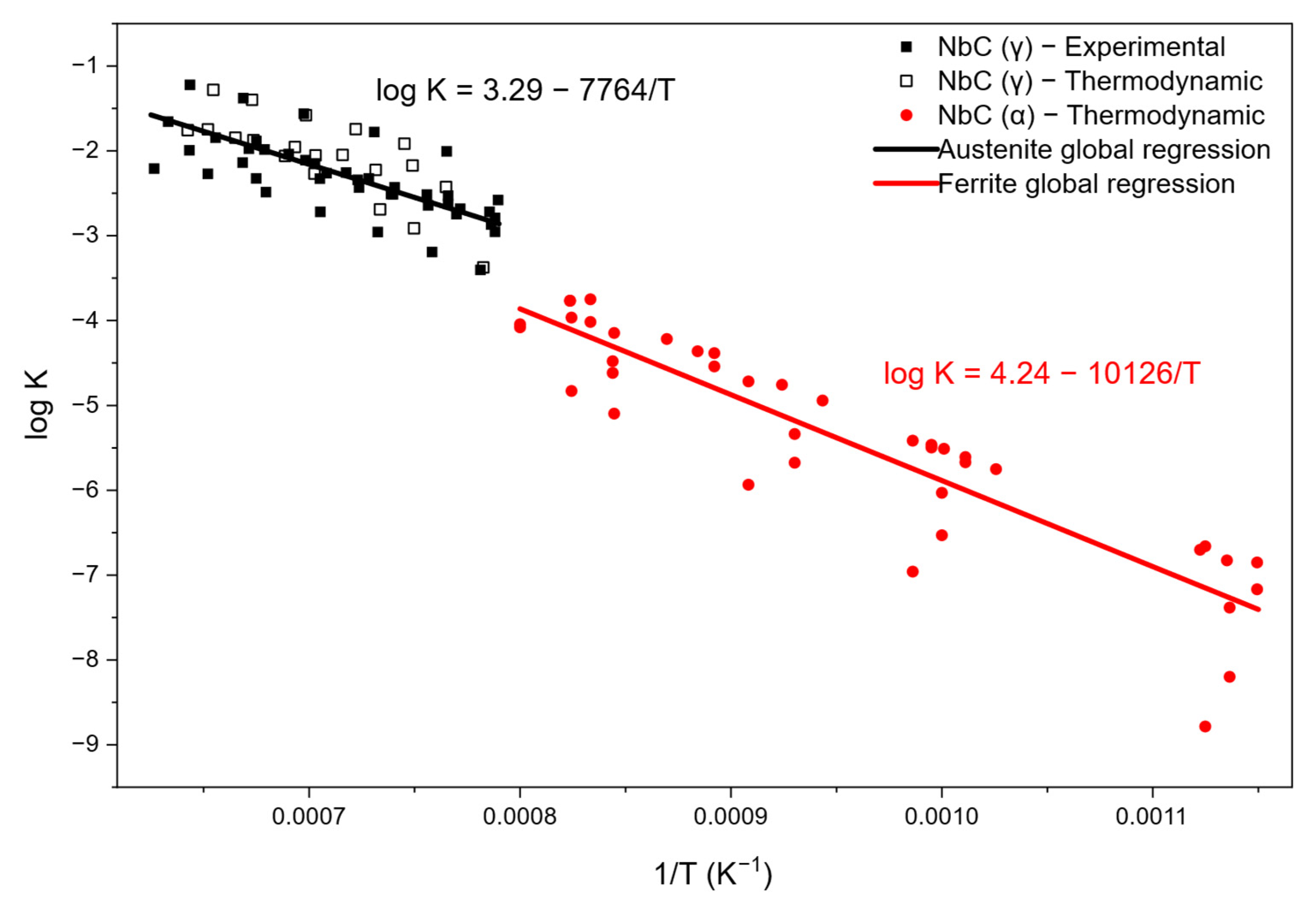
Figure 4.
Comparison of literature-reported TiC solubility products in austenite and ferrite and the corresponding global linear regressions. Data compiled from References [29,30,32,55,57,61,66,70,74].
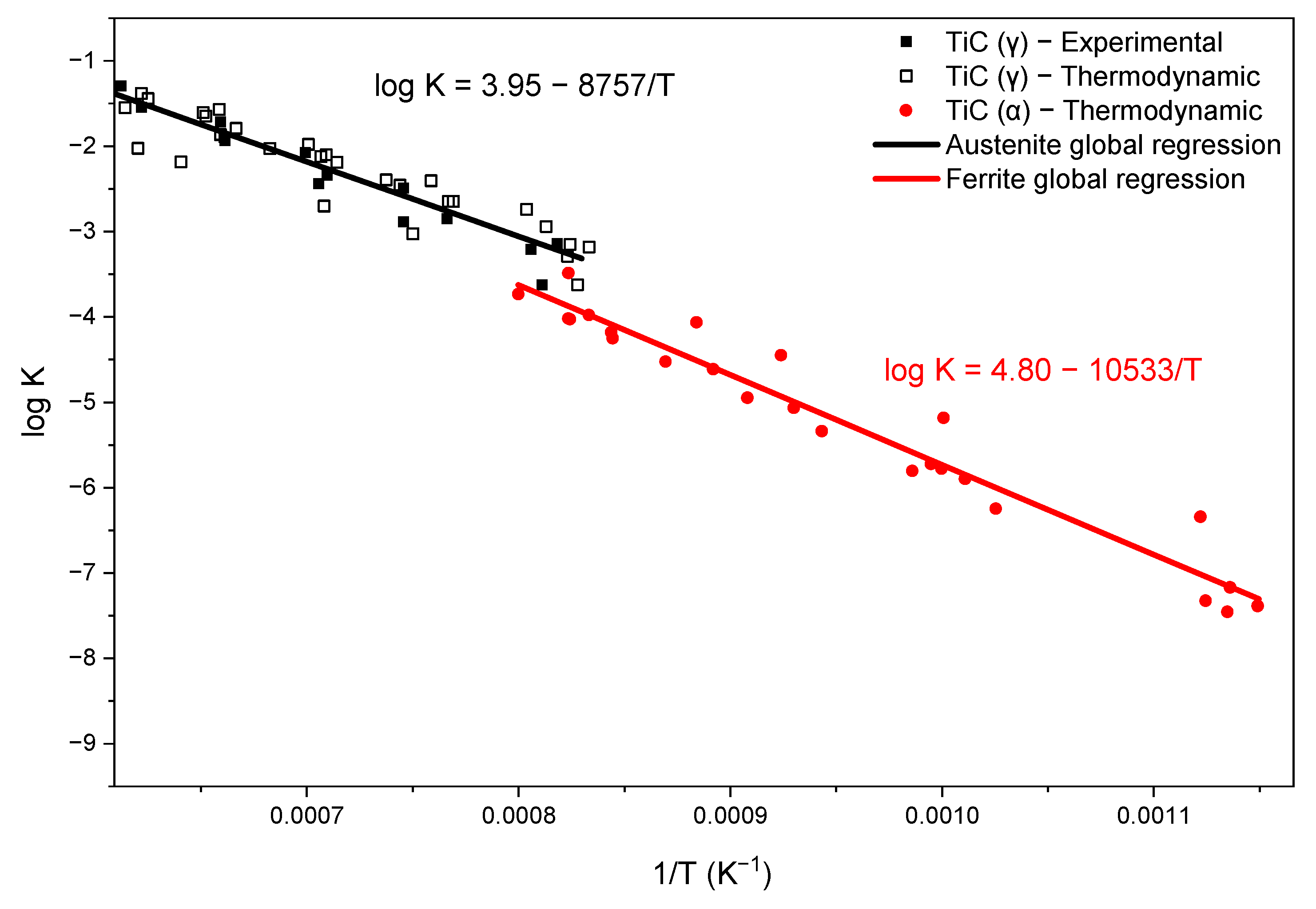
The global relationships are intended to represent the overall trends emerging from the literature rather than to replace individual solubility products. The temperature validity in the compiled data is 1250–1600 K for NbC in austenite, 870–1250 K for NbC in ferrite, 1200–1655 K for TiC in austenite, and 870–1250 K for TiC in ferrite. Since the regressions were performed using values calculated from published relationships rather than independent experimental measurements, the results may be influenced by the temperature intervals and number of points associated with each publication. In addition to that, the confidence intervals reflect the statistical uncertainty of the fitted coefficients under the ordinary least-squares assumptions and do not independently account for differences between studies.
The applicability of these relationships is therefore limited to the investigated temperature intervals and the thermodynamic conditions associated with the respective phases. Extrapolation beyond these intervals, particularly outside the stability regions of ferrite and austenite, may introduce significant uncertainties due to differences in phase stability, solute partitioning, and carbide equilibrium conditions. Nevertheless, the regressions provide a comparative representation of the collective literature data and a basis for evaluating the magnitude and possible origins of the differences among published relationships.
Table 2 compares the global solubility relationships derived in this review with selected expressions reported in the literature, evaluated at representative temperatures of 1100 °C for austenite and 700 °C for ferrite. The results demonstrate that the magnitude of the differences depends on both the precipitate and the matrix phase. For NbC in austenite, the selected relationships show relatively good agreement, whereas more pronounced differences are observed for NbC in ferrite and TiC in both phases.
Table 2.
Comparison of global solubility products with selected literature relationships.
To further investigate the influence of the methods reported in the literature, separate linear regressions were performed for the experimentally derived and thermodynamically derived solubility products in austenite; the results can be seen in Table 3. For NbC, the experimental relationships yielded coefficients of A = 2.63 and B = 6906 K, whereas the thermodynamic relationships resulted in A = 4.74 and B = 9631 K. Despite these differences, both datasets exhibited comparable dispersion around their respective regression lines, with RMSE values of approximately 0.31.
Table 3.
Influence of methodological origin on the regression coefficients and dispersion of NbC and TiC solubility relationships in austenite.
For TiC, the experimental relationships yielded A = 4.62 and B = 9783 K, compared with A = 3.66 and B = 8304 K for the thermodynamic relationships. In this case, the experimental dataset exhibited lower scatter (RMSE = 0.15) than the thermodynamic dataset (RMSE = 0.24). These results indicate that the method used on the published relationships influences both the fitted coefficients and, depending on the microalloy carbide, the dispersion of the reported solubility products. However, it is important to reinforce once again that the observed differences should not be interpreted as a direct measure of methodological accuracy, since the regressions are based on values generated from published relationships rather than independent measurements.
A corresponding comparison could not be performed for ferrite because the compiled NbC and TiC solubility relationships for this phase were exclusively thermodynamically derived.
As reported above, a key limitation identified from the literature review is that the available solubility products for NbC and TiC in ferrite are predominantly derived from thermodynamic calculations rather than direct experimental determination. This has important industrial implications, especially for materials being heat-treated in the intercritical temperature range. Carbon solubility in ferrite is heavily temperature-dependent, following the Q–P–G trajectory of the Fe–C phase diagram shown in Figure 5, and remains very low even near the eutectoid temperature. During intercritical treatment, carbon preferentially partitions into austenite, resulting in a higher equilibrium carbon concentration in austenite than in ferrite [75]. Consequently, the equilibrium solubility of microalloy precipitates must be evaluated considering the local carbon content of each phase rather than the nominal composition of the steel. Neglecting this partitioning when applying conventional ferritic solubility products may lead to significant deviations in the predicted amount of microalloying elements remaining in solid solution [76].
Figure 5.
(a) Ferrite corner of the binary iron-carbon phase diagram with an indication of the Curie temperature and (b) calculated solubility limit of microalloy carbides using Taylor et al. [29] solubility product along the boundary QPG. (Adapted with permission from ref. [76]. 2025, Association for Iron & Steel Technology).
Another important consideration from an industrial perspective relates to the influence of phase transformations on the local stability of microalloy precipitates. During intercritical annealing and continuous cooling, for example, the migration of the ferrite/austenite interface is accompanied by carbon redistribution between the two phases [77]. Although carbon diffuses relatively rapidly, the redistribution of elements such as Nb and Ti is considerably slower, potentially producing local compositional gradients and transient departures from equilibrium near the moving interface [78]. Consequently, the local austenite composition can differ substantially from the homogeneous compositions assumed in conventional solubility product relationships. This enrichment may alter the thermodynamic stability of microalloy carbides and carbonitrides and, simultaneously, influence their precipitation kinetics [79]. The application of conventional solubility products during phase transformation should therefore be treated with caution, since local compositional gradients at migrating interfaces may modify both precipitate solubility and the driving force for precipitation.
Finally, the Curie temperature represents an often overlooked aspect that should be considered when evaluating microalloy carbide solubility in ferrite. Below the Curie temperature, ferrite is ferromagnetically ordered, whereas above this temperature it becomes paramagnetic. This transition modifies the magnetic contribution to the Gibbs free energy of ferrite and may therefore affect the temperature dependence of carbide solubility, potentially introducing deviations from the linear relationship between the log K and (1/T) conventionally assumed in solubility product expressions [80]. Consequently, precipitation, dissolution and coarsening of microalloy carbides near the Curie temperature may be influenced by both thermodynamic and kinetic effects that are not explicitly represented by conventional solubility products. Despite its potential relevance to thermal processing in ferritic steels, this aspect has received limited attention in the available literature. Further experimental investigation is therefore required to quantify the influence of the ferromagnetic-to-paramagnetic transition on microalloy carbide solubility and precipitation kinetics and to support its incorporation into future thermodynamic and kinetic descriptions.
5. From Equilibrium Solubility to Precipitation Kinetics
Industrial steel processing involves a sequence of thermomechanical cycles during which microalloying elements continuously redistribute between solid solution and precipitated states. The solubility products discussed in the preceding sections define conditions of thermodynamic equilibrium; however, the short times available during industrial processing frequently prevent this equilibrium from being reached. The actual microalloying state is therefore determined by the kinetics of precipitation and dissolution, which are primarily controlled by diffusion of the precipitate-forming species. Precipitation additionally requires nucleation and an associated incubation time, such that substantial supersaturation may persist during cooling when nucleation sites or sufficient diffusion time are unavailable. Precipitates formed during early processing stages require finite time to dissolve during reheating. Consequently, the equilibrium solubility product should be regarded as a thermodynamic boundary condition rather than a direct prediction of the amount of microalloying element present in solid solution during industrial processing [13,81].
To illustrate the complexity of these phenomena, a hypothetical scenario is presented in Figure 6, schematically contrasting equilibrium phase stability, Figure 6a, with the influence of precipitation kinetics under isothermal, Figure 6b, and continuous-cooling conditions, Figure 6c. The precipitation temperature (Tppt) at which the solubility curve of M (C,N) in austenite intersects with the vertical line a-a’, specifying a given carbon content of the steel, represents the lower limit of the temperature range over which M (C,N) does not precipitate at all. Quenching the steel from a temperature above Tppt to a certain temperature below Tppt and holding it isothermally results in curves representing the time necessary for the onset of M (C,N) precipitation.
Figure 6.
Schematic representation of the relationship between equilibrium microalloy precipitate stability and precipitation kinetics under isothermal and continuous-cooling conditions: (a) equilibrium phase formation as a function of temperature and carbon content; (b) isothermal precipitation and phase formation as a function of temperature and time; and (c) continuous-cooling precipitation and phase formation under different cooling regimes. (γ: fcc phase represented by A: austenite; α: bcc phase represented by F: ferrite, B: bainite, M: martensite; M(C,N): microalloy carbo-nitride; R1–3 cooling with increasing rate, IH: isothermal holding). The indicated temperature and time ranges are illustrative and depend on steel composition, deformation conditions and processing history; they do not represent experimental measurements from the present study.
Repeating this at various temperatures allows for constructing temperature-time precipitation curves in austenite as well as in ferrite. The precipitation-start curve in deformed austenite is shifted towards shorter times, while it is retarded in the absence of deformation [82]. The precipitation-start curve in ferrite overlaps with the ferrite transformation-start curve at higher temperatures but increasingly shifts behind when approaching the nose temperature of ferrite formation. Precipitation is practically suppressed in the bainite and martensite transformation range. In the case of continuous cooling, the precipitation-start curves might be generally shifted to somewhat lower temperatures, as expected in the analogy of the relative position of time–temperature transformation (TTT) curves and continuous-cooling transformation (CCT) curves representing the start of the γ→α transformation.
In the case of microalloy carbides and nitrides, the microalloy atom has a much slower diffusion rate than either of the interstitials. However, deformation-induced defects generated in the steel matrix significantly accelerate atomic diffusion of microalloy species by providing “short-circuit” pathways and lowering the energy barriers required for atomic migration [83]. Deformation-induced defects, particularly dislocations and subgrain boundaries, enhance microalloy transport and provide preferential nucleation sites for strain-induced precipitation. Conversely, recovery and recrystallization at elevated temperatures progressively reduce the defect density, thereby decreasing the number of available nucleation sites [84]. Precipitation kinetics during austenite conditioning therefore reflect the competition between these mechanisms, with the effect of strain eventually reaching saturation. In undeformed austenite, precipitation occurs preferentially at grain boundaries, resulting in a more heterogeneous particle distribution [85].
The precipitation–time–temperature (PTT) diagram describes the precipitation kinetics as C-shaped curves. The nose point, defining the condition of quickest isothermal precipitation, depends on the chosen microalloy concept and typically appears in the temperature range of 850 to 950 °C. Strain-induced precipitation at nose temperature can commence after an incubation time of only a few seconds. The isothermal holding time required to finish precipitation typically ranges in the order of 1000 s. Precipitation kinetics are delayed towards longer times above and below the nose temperature due to reduced driving force (better solubility) and lower microalloy diffusivity, respectively. In undeformed austenite, the incubation time is increased by at least one order of magnitude due to the lack of nucleation sites. Figure 7a schematically represents PTT curves for low carbon microalloyed steels based on selected data from the literature [86,87].
Figure 7.
(a) Schematic precipitation–time–temperature (PTT) diagram within representative strip and plate-rolling schedules for microalloyed steels (N(↑) indicates the influence of increased nitrogen content on the start of vanadium precipitation). (b) Deviations of solute Nb from equilibrium predictions due to precipitation kinetics [30,87]. The relative positions of the curves illustrate qualitative precipitation behavior and should not be interpreted as experimentally determined precipitation kinetics or universal temperature–time boundaries.
As previously discussed, austenite pancaking requires rolling within the non-recrystallization regime, where strain-induced precipitation progressively inhibits recrystallization and promotes the accumulation of deformation between successive passes. The extent of precipitation, however, strongly depends on the available processing time. In strip rolling, the rapid sequence of passes and short interpass times limits the time available for precipitation, allowing a substantial fraction of the microalloying elements to remain in solid solution. In contrast, plate rolling typically involves longer interpass times and may include intermediate holding periods, providing sufficient time for precipitation to proceed further and resulting in a larger fraction of the microalloy content being precipitated before the end of rolling [4].
To further illustrate the influence of processing time on the deviation from equilibrium conditions, additional experimental data reported by Klinkenberg et al. [87] was used to construct Figure 7b, which shows the soluble Niobium content measured by electrochemical extraction as a function of finish rolling temperature for strip and plate-rolling conditions. The samples were quenched immediately after rolling to suppress subsequent precipitation and preserve the Niobium solute state established during austenite conditioning. Consistent with the precipitation kinetics illustrated in Figure 7a, the short interpass times characteristic of strip rolling result in systematically higher levels of Niobium remaining in solid solution, whereas the longer times available during plate rolling allow precipitation to proceed further. Importantly, the measured soluble Niobium contents under both processing conditions remain above the equilibrium Nb–C–N solubility prediction [30].
This comparison demonstrates that the solubility product defines the equilibrium limit but does not necessarily represent the actual solute content reached during industrial thermomechanical processing, particularly when short processing times kinetically restrict precipitation. Table 4 provides a quantitative comparison of the amount of Nb in solution on the different rolling conditions presented in Figure 7b. At 850 °C, approximately 0.015 wt.% Nb remains in solid solution during strip rolling, compared with approximately 0.007 wt.% during heavy plate rolling, whereas the calculated equilibrium solubility is approximately 0.0016 wt.%. These values correspond to approximately 9.3 and 4.3 times the equilibrium prediction, respectively. At 920 °C, the corresponding values are approximately 0.023 wt.% for strip rolling and 0.010 wt.% for plate rolling, compared with an equilibrium value of approximately 0.0036 wt.%.
Table 4.
Comparison of Nb remaining in solid solution during strip and heavy plate rolling and its deviation from equilibrium solubility predictions at selected finishing temperatures.
It is important to reinforce that the availability of solute microalloy elements after hot deformation has an important impact on subsequent treatments, as solute microalloy effectively delays the austenite-to-ferrite transformation, especially when combined with accelerated cooling. This retardation is commonly attributed to solute drag, whereby dissolved Niobium interacts with the migrating austenite/ferrite interface and reduces its mobility, delaying ferrite formation [88]. The resulting transformation at lower temperatures can contribute to further grain refinement and, when combined with accelerated cooling, promote the formation of non-polygonal ferritic microstructures.
The precipitation of solute microalloy depends on the cooling rate, as illustrated in Figure 6. For cooling rates slower than those in curve R1, precipitation in austenite occurs together with that in ferrite. Spontaneous precipitation within the already transformed ferrite occurs for higher cooling rates than that represented by curve R2. Precipitation is effectively suppressed at cooling rates above curve R3. Intermediate cooling rates between curves R1 and R2 enable precipitation during the γ → α transformation, a mechanism also known as interphase precipitation (IP) [89]. Industrial application of this concept is exemplified by JFE’s NANOHITEN steel, in which controlled transformation and cooling promote the formation of nanoscale (Ti,Mo)C precipitates within the ferritic matrix [90].
Although a detailed discussion of precipitation mechanisms is beyond the scope of the present review, it was important to consider these kinetic aspects to establish the practical significance and limitations of solubility products. Solubility products define the thermodynamic conditions under which precipitation or dissolution are favorable, but they do not determine whether equilibrium can be reached within the timescales imposed by industrial processing. As demonstrated by the examples discussed above, deformation, available diffusion time, cooling rate and phase transformation can substantially modify the fraction of microalloying elements retained in solid solution or precipitated at a given temperature.
Contrary to particle precipitation kinetics during down-cooling or isothermal holding, the particle dissolution kinetics during up-heating or isothermal holding are considerably faster. Aaron and Kotler [91] described the kinetics of the particle dissolution process as being determined by Fick’s second law, including concurrent effects of diffusion gradients, interfacial reaction, and particle curvature. The derived formalism relates the time required for particle dissolution, tdiss, to the initial particle radius, rp, the supersaturation parameter, k, and the diffusion constant, D, as follows:
Here, cp represents the concentration of the considered microalloying element in the particle, cm is its average concentration in the matrix (acc. to the solubility product), and ci is its maximum solute concentration in the matrix. Exemplary dissolution times of NbC precipitate sizes of up to 50 nanometers calculated for isothermal holding in the temperature range of para-magnetic ferrite (770–900 °C) are less than 100 s [92]. Thus, the dissolution kinetics is sufficiently fast for approaching the microalloy solute level predicted by the solubility product within the time spans typically applying to up-heating or isothermal heat treatments.
The thermodynamic and kinetic descriptions should therefore be considered complementarily rather than independently. The solubility product establishes the equilibrium boundary and the degree of supersaturation that provides the driving force for precipitation, whereas precipitation and dissolution kinetics determine the rate at which the system approaches that equilibrium. This distinction is particularly relevant for industrial processing, where short interpass times, accelerated cooling and ongoing phase transformations frequently maintain the steel away from equilibrium. Accordingly, the solubility products reviewed in this work should be regarded as thermodynamic reference conditions rather than direct predictors of the instantaneous microalloying state during processing. The practical implications of this interplay between thermodynamics and kinetics are further explored in the following section through selected industrial processing cases.
6. Industrial Implications of Microalloy Solubility
A central objective of this work is to establish the industrial relevance of microalloy solubility and, consequently, the importance of reliable and accurate solubility data. As previously discussed, relatively small differences in predicted solubility can influence the calculated amount of microalloying elements and interstitials remaining in solution, with direct consequences for alloy design and process optimization. Selected industrial examples are therefore presented in this chapter to demonstrate how the accuracy of solubility relationships can translate into practical metallurgical effects.
Three representative applications are discussed. Case-carburizing steels introduce an additional aspect through the use of complex (Nb,Ti)(C,N) precipitates, whose enhanced stability compared with the corresponding binary precipitates highlights the limitations of describing industrial microalloy systems solely through individual NbC or TiC solubility products. Press-hardening steels illustrate the importance of carbide stability for austenite grain-size control during reheating, while dual-phase steels demonstrate the complexity of precipitation and dissolution during intercritical processing. These cases are not intended as an exhaustive review of industrial applications, but rather to demonstrate why accurate and physically representative descriptions of microalloy solubility are technologically important.
6.1. Case-Carburizing Steels
Case-carburizing steels provide a relevant example of the importance of precipitate stability during prolonged high-temperature treatments. Increasing the carburizing temperature can substantially reduce processing time; however, the resulting increase in austenite grain-growth tendency requires a sufficiently stable population of precipitates to maintain effective grain-boundary pinning [93]. Conventional AlN precipitates progressively lose stability at elevated carburizing temperatures, motivating the use of Ti and Nb microalloying to improve grain-coarsening resistance [94].
This application also illustrates an important limitation of treating microalloy precipitates exclusively through individual binary solubility products. In steels containing both Ti and Nb, precipitation can involve complex (Nb,Ti)(C,N) particles rather than binary TiC and NbC precipitates. The resulting particle stability therefore depends not only on the individual carbide and nitride solubilities, but also on precipitate composition and the thermodynamic contribution associated with mixing the different microalloying and interstitial species.
Complex Nb–Ti carbonitrides can exhibit greater thermal stability than the corresponding binary precipitates. The incorporation of multiple species within complex (Nb,Ti)(C,N) precipitates introduces a configurational-entropy contribution associated with Ti–Nb mixing and non-stoichiometry, reducing the Gibbs free energy of the precipitate and thereby increasing its thermal stability relative to the corresponding binary carbides [68].
This effect and grain-size control is particularly important in case-carburizing steels, where long exposure to elevated temperatures may promote abnormal austenite grain growth, resulting in a mixed grain size microstructure characterized by the coexistence of abnormally coarse grains and a finer, relatively homogeneous grain population [95]. Such heterogeneity can affect mechanical properties in a detrimental way, particularly toughness and fatigue resistance. This behavior is closely associated with the thermal stability of grain-boundary-pinning precipitates. As these particles progressively dissolve or coarsen during heat treatment, their ability to restrict grain-boundary migration decreases, allowing certain grains to grow preferentially at the expense of their neighbors [96]. The practical benefits of this can be observed in Figure 8.
Figure 8.
Effect of Nb and Ti microalloying on austenite grain-coarsening behavior in case-carburizing steels. (Adapted with permission from ref. [76]. 2025, Association for Iron & Steel Technology).
The enhanced stability of complex (Nb,Ti)(C,N) particles can therefore maintain effective grain-boundary pinning over a wider temperature range, reducing the susceptibility to abnormal austenite grain growth during high-temperature carburizing treatments.
6.2. Press-Hardening Steels—Precipitate Dissolution and Austenite Grain-Size Control
A second industrial example of the relevance of microalloy solubility is provided by press-hardening steels, where precipitate dissolution during austenitizing can directly influence austenite grain-size control. Prior to hot forming and quenching, the steel is heated into the austenitic region, exposing the existing microalloy precipitates to conditions where their thermodynamic stability progressively decreases [97]. Depending on their composition, size and the applied austenitizing conditions, these particles may partially or completely dissolve, reducing the particle population available for grain-boundary pinning. Consequently, accurate prediction of microalloy precipitate solubility becomes important for defining the temperature range over which effective austenite grain-size control can be maintained.
Conventional press-hardening steels are commonly microalloyed with Ti to protect the hardenability contribution of B. Because N has a strong affinity for B and can promote BN formation, Ti is added to preferentially bind N as TiN, thereby maintaining B in solid solution and allowing it to segregate to austenite grain boundaries, where it delays ferrite formation and enhances hardenability. Consequently, conventional PHS grades are often essentially single-stabilized with Ti, and the resulting Ti-containing precipitate population also contributes to austenite grain-boundary pinning during reheating [98].
In this particular case, the influence of precipitate stability on austenite grain-size control was investigated by comparing two PHS alloy concepts: a conventional Ti-stabilized 22MnB5 and a variant co-microalloyed with Titanium and Niobium. The objective was to evaluate whether the addition of Nb could improve resistance to prior-austenite grain-size (PAGS) coarsening during austenitizing by maintaining a more effective precipitate population. The Ti–Nb concept exhibited substantially improved PAGS control, which was consistent with the observed precipitate distributions: TEM analysis of the conventional Ti-stabilized steel revealed predominantly coarse TiC particles (~50 nm), whereas the Nb-containing steel presented a dense population of much finer Nb–Ti-containing precipitates. The microstructural evolution can be observed in Figure 9.
Figure 9.
Effect of Nb microalloying on prior-austenite grain-size stability in 22MnB5 press-hardening steel after austenitizing at 930, 980 and 1030 °C [99]. (Adapted from ref. [99]).
It is hypothesized that this difference is partly associated with the stability of these particles during heating through the intercritical ferrite–austenite region, where changes in matrix phase and carbon partitioning may promote partial dissolution of fine TiC and subsequent coarsening of the surviving population. In contrast, NbC and complex (Nb,Ti)(C,N) precipitates may exhibit greater resistance to dissolution, preserving a finer particle distribution and consequently a higher grain-boundary pinning pressure during subsequent austenitizing [76].
To further examine this hypothesis, the equilibrium solubility of TiC and mixed (Nb,Ti)(C,N) was estimated at 930 °C, using the relationships proposed by Narita [100] and Webel et al. [68], respectively, as summarized in Table 5. For the Nb-free steel, the Narita relationship predicts an equilibrium Ti solubility limit of approximately 24 ppm, substantially below the nominal Ti content of 300 ppm, indicating that TiC should remain partially undissolved at the austenitizing temperature. However, no TiC particles were identified in the TEM investigations seen in Figure 10, suggesting an apparent discrepancy between the equilibrium prediction and the experimentally observed precipitate population. The relationship proposed by Webel suggests that mixed (Nb,Ti)(C,N) precipitates may remain stable in the Nb-bearing steel, which is consistent with the TEM findings.
Table 5.
Comparison of calculated solubility and predicted precipitate dissolution in 22MnB5 steels at 930 °C (austenitizing temperature).
Figure 10.
TEM micrographs and corresponding Ti and Nb elemental maps of 22MnB5 steels without and with 0.05 wt.% Nb after austenitization at 930 °C. (Adapted with permission from ref. [76]. 2025, Association for Iron & Steel Technology).
These findings emphasize that equilibrium solubility relationships alone cannot fully describe the evolution of precipitates during industrial heating cycles, particularly when phase transformations, mixed precipitate chemistry and dissolution kinetics are involved. Further experimental work is therefore required to validate the proposed intercritical dissolution mechanism and quantify the relative stability of Ti- and Nb-containing precipitates during austenitization.
6.3. Dual-Phase Steels—Microalloy Solubility During Intercritical Processing
Dual-phase (DP) steels are widely used in automotive applications because they combine high strength with good global formability, enabling vehicle lightweighting while maintaining crash-performance requirements. Their characteristic microstructure consists predominantly of a soft ferritic matrix containing harder martensitic islands, obtained by controlling the formation and carbon enrichment of austenite, usually during intercritical annealing followed by sufficiently rapid cooling [101,102]. This processing route makes DP steels particularly relevant to the present review, since microalloy precipitates are exposed to conditions where ferrite and austenite coexist and where carbon partitions strongly between the two phases. Niobium microalloying can provide additional benefits through grain refinement and precipitation strengthening, but its effectiveness strongly depends on the amount of Nb available in the solid solution throughout processing.
The industrial DP980 case investigated by Mohrbacher et al. [103] provides a direct example of the importance of having accurate solubility products for process design. For the investigated steel containing approximately 0.03 wt.% Nb, application of the Irvine et al. [30] solubility product predicted nearly complete Nb dissolution at a slab-soaking temperature of 1240 °C, whereas only approximately 160 ppm Nb would be soluble at 1150 °C. After accounting for the effects of Mn, Si and Cr on solute activities, a soaking temperature of at least 1240 °C was therefore considered necessary to ensure that the Nb addition entered hot rolling predominantly in solid solution. This example demonstrates how the predicted solubility can directly influence the selection of industrial reheating conditions and, consequently, the metallurgical effectiveness of the Nb addition during hot rolling and subsequent operations.
Although the equilibrium solubility decreases markedly during finish rolling, precipitation in austenite is kinetically restricted, and rapid cooling to approximately 600 °C results in the hot-rolled strip remaining highly supersaturated in Nb. Subsequent batch annealing promotes extensive NbC precipitation, which can be observed in Figure 11, while cold rolling introduces a high defect density that further facilitates precipitation during the final continuous annealing treatment. Mohrbacher et al. observed that this processing sequence ultimately produced a dense dispersion of nanoscale NbC in the ferritic matrix, contributing to both precipitation strengthening and microstructural refinement [103].
Figure 11.
Evolution of NbC precipitation and particle morphology throughout the processing route of DP980 steel: (a–e) TEM characterization and (f) representative EDX spectrum. (Adapted from ref. [103]).
The DP980 case illustrates that an accurate solubility description is required not only to establish the initial amount of Nb available during reheating, but also to define the thermodynamic boundary from which the subsequent precipitation sequence develops. To further evaluate the applicability of published solubility relationships to industrial steels, the Nb solubility in this DP980 steel was compared using the relationships proposed by Lei et al. [67] and Irvine et al. [30]. Assuming 0.20 wt.% dissolved carbon and neglecting the contribution of nitrogen, the equilibrium Nb solubility limits were calculated at 1150 and 1240 °C, as presented in Table 6.
Table 6.
Comparison of calculated Nb solubility limits in DP980 steel using the relationships proposed by Lei et al. and Irvine et al. [30,67].
At 1150 °C, the relationships predict approximately 139 and 159 ppm dissolved Nb, respectively, whereas at 1240 °C, the corresponding values increase to 317 and 305 ppm. Considering the nominal Nb content of 300 ppm, both relationships indicate partial dissolution at 1150 °C and complete dissolution at 1240 °C.
Despite differences in their temperature dependence, the calculated results are relatively consistent under the selected conditions, supporting the use of solubility relationships as a practical reference for evaluating reheating conditions. Nevertheless, these predictions remain dependent on the assumed matrix composition and precipitate chemistry, particularly the contribution of nitrogen to Nb(C,N) stability.
7. Discussion
The systematic assessment presented in this review demonstrates that the principal challenge in describing microalloy carbide solubility is not simply the availability of equilibrium relationships, but the extent to which these relationships represent the actual thermodynamic and microstructural conditions encountered during steel processing. Such conditions may vary considerably depending on the chemical composition of the steel, the coexistence of different matrix phases, and the thermal and deformation history imposed during processing.
For example, alloying elements such as Mn, Si, Cr, Mo and Ni can modify the thermodynamic activities of carbon and microalloying elements, thereby changing the equilibrium solubility of NbC and TiC. Koyama et al. reported that Mn and Cr increase NbC solubility in austenite, whereas Si decreases it, with the influence of Ni depending on temperature [42,43]. More recently, Wang et al. reported that Mn, Cr and Mo increase the calculated TiC solubility in austenite, whereas Si decreases it [70].
To illustrate this effect, the solubility product relationships proposed by Koyama et al., listed in Table A1, can be used to quantify the individual contributions of Mn, Si, Cr and Ni to NbC solubility in austenite. Taking the simplified Fe–Nb–C system as a reference, the calculations indicate that, at 1150 °C, the addition of 1.5 wt.% Mn increases the NbC solubility product by approximately 23%, while 0.4 wt.% Si produces an increase of approximately 17%. Similarly, additions of 0.5 wt.% Cr and 1.0 wt.% Ni result in increases of approximately 11% and 3%, respectively [42]. These results demonstrate that even relatively modest additions of substitutional alloying elements can produce appreciable deviations from the solubility products established for simplified Fe–Nb–C systems. Consequently, it should be reinforced that despite the fact that the global relationships derived in this review provide a useful reference for comparing carbide stability, their direct application to multicomponent industrial steels may introduce significant uncertainties unless the effects of additional alloying elements are considered.
In addition to different alloy designs, the size of precipitates may also influence their equilibrium solubility through the Gibbs–Thomson effect. Conventional solubility product relationships generally assume equilibrium with a macroscopic precipitate phase, neglecting the contribution of interfacial energy associated with particle curvature. However, as the particle radius decreases, the relative contribution of the precipitate–matrix interface to the total Gibbs free energy increases, resulting in a higher equilibrium solute concentration surrounding smaller particles compared with larger particles of the same composition [25,26,91].
This effect becomes particularly relevant for nanometric NbC and TiC precipitates, whose stability may therefore differ from predictions based exclusively on bulk equilibrium solubility products. The magnitude of the deviation depends primarily on particle radius, precipitate–matrix interfacial energy and temperature, with smaller particles and higher interfacial energies producing a greater increase in equilibrium solubility. This size-dependent behavior also provides the thermodynamic driving force for Ostwald ripening, whereby smaller particles tend to dissolve while larger particles grow [104]. Consequently, the application of conventional solubility relationships to nanoscale precipitate populations should account for particle-size effects, particularly when assessing precipitate stability during reheating and annealing.
This review identified that the influence of the Curie temperature on particles solubility in ferrite has been insufficiently explored within the existing literature. Only a few studies explicitly consider the contribution of magnetic ordering to precipitate stability; among these, Klymko and Sluiter incorporated magnetic, vibrational and electronic contributions into a thermodynamic model for NbC precipitation in ferrite [65]. Their calculations resulted in two distinct Arrhenius approximations for ferromagnetic and paramagnetic ferrite. At the Curie temperature of pure iron (1043 K), these expressions differ by approximately 0.013 log K units, corresponding to a difference of approximately 3% in the calculated solubility product. Although this difference reflects the separate fitted relationships rather than the isolated magnetic contribution, it illustrates the limitations of representing ferritic NbC solubility with a single linear Arrhenius expression across the magnetic transition and additional experimental validation could complement the understanding of this effect.
The limitations discussed above further emphasize the need for direct experimental determination of microalloy carbide solubility, particularly in ferrite, where the available relationships are based on thermodynamic calculations. With this consideration, a possible roadmap for future experimental approach involves controlled isothermal heat treatments within the ferritic stability region, followed by rapid quenching and selective matrix dissolution to separate precipitates from the steel matrix [105,106]. The extracted precipitates can subsequently be analyzed using inductively coupled plasma optical emission spectroscopy (ICP-OES), allowing the amount of Nb or Ti remaining in solid solution to be estimated by mass balance or by the assessment of their respective quantities in the precipitates [107,108]. Complementary transmission electron microscopy (TEM) investigations can provide information on precipitate chemistry, size and spatial distributions. Besides that, quantitative analysis of TEM micrographs, combined with the Ashby approach for estimating precipitate volume fraction, could allow the amount of Nb incorporated into NbC precipitates to be calculated, provided that particle geometry, foil thickness and precipitate composition are adequately considered [109,110]. This would offer a complementary method of estimating the Nb remaining in solid solution through mass balance, which could validate the results obtained from matrix dissolution and ICP-OES measurements. Finally, atom probe tomography (APT) may allow direct measurement of dissolved microalloying elements in the ferritic matrix, although limited to the analysis of very small volumes [59,68]. In the author’s view, a combination of experimental techniques is needed to improve the accuracy of determination of particles’ solubility in ferrite. Particular emphasis should be placed on measurements performed both below and above the Curie temperature to assess the potential influence of the magnetic transition on carbide stability and validate existing thermodynamic predictions.
An important limitation identified in this review concerns the application of conventional solubility relationships to intercritical conditions, where ferrite and austenite coexist and elemental partitioning of carbon influences local precipitate stability. Ogawa et al. [20] demonstrated that Nb additions affect ferrite recrystallization and austenite formation during intercritical annealing, highlighting the interaction between microalloying and phase transformation. Similarly, Wang et al. observed changes in the size of (Ti,V,Mo)C precipitates with increasing intercritical annealing time, demonstrating the influence of thermal history on precipitate evolution [111]. These findings reinforce that microalloy carbide behavior under intercritical conditions cannot be described solely by equilibrium relationships established for individual matrix phases. Nevertheless, direct experimental determination of carbide solubility under ferrite–austenite coexistence remains limited, representing an important gap for future investigations as well.
The three industrial applications presented in this review highlight the practical implications of these limitations under different processing conditions. In case-carburizing steels, the stability of complex (Nb,Ti)(C,N) precipitates demonstrates the importance of considering interactions among multiple microalloying elements rather than relying exclusively on individual binary carbide relationships but also reinforces where metallurgy can bring substantial gains to end-users. In press-hardening steels, the dissolution and persistence of microalloy precipitates during heating influence the particle population available for austenite grain-growth control but also illustrate where the solubility products predictions are not coherent with the TEM observations. Finally, the DP980 case illustrates how differences between published solubility relationships can influence the predicted amount of niobium remaining in the solid solution and, consequently, the selection of soaking conditions prior to hot rolling. Together, these examples demonstrate that equilibrium solubility is an important starting point for process design, but that its practical significance depends on precipitate chemistry, phase stability and the kinetics associated with the applied thermal and thermomechanical cycles.
8. Conclusions and Perspectives
The systematic review revealed considerable differences among the published solubility products of microalloy particles, particularly for NbC and TiC. The global regressions developed in this work provide a common basis for comparing the literature data, but the observed scatter limits their reliability for predicting solubility in specific steel compositions. Another relevant finding is an important imbalance in the matrix phases investigated, with 78 of the 100 solubility relationships (78%) being established for austenite, compared with only 22 for ferrite.
The industrial examples discussed in this review show why these uncertainties are technologically relevant and that equilibrium solubility alone is insufficient to describe the behavior of microalloy precipitates during steel processing. Alloy composition, precipitate stoichiometry, particle size distribution and precipitation kinetics must also be considered for more accurate predictions. This is particularly important during reheating, thermomechanical rolling, coiling and further downstream operation. The intercritical range, where ferrite and austenite coexist, was identified as another important gap in the literature and no direct experimental work has been done to validate the solubility of particles in this temperature range, where partitioning, interface mobility and transitioning from ferromagnetic to paramagnetic ferrite happen.
Therefore, further experimental work is required to address the limited validation of NbC and TiC solubility in ferrite and to establish solubility behavior under controlled ferrite–austenite coexistence. Future studies combining thermodynamic and kinetic analysis with quantitative advanced microstructural characterization would help establish how equilibrium solubility translates into precipitate populations and final microstructures. Particular attention should also be given to the Curie transition, where magnetic effects may influence both precipitate stability and diffusion kinetics. Together, these developments would provide a stronger experimental basis for applying microalloy solubility concepts to industrial steel design and processing.
Author Contributions
C.d.P.C.P., H.M. and J.B.; methodology, C.d.P.C.P.; formal analysis, C.d.P.C.P. and H.M.; data curation, C.d.P.C.P. and H.M.; writing—original draft preparation, C.d.P.C.P. and H.M.; writing—review and editing, C.d.P.C.P., H.M., J.B., D.B. and F.M.; visualization, C.d.P.C.P. and H.M.; supervision, F.M. and H.M.; project administration, C.d.P.C.P., J.B., D.B. and F.M. All authors have read and agreed to the published version of the manuscript.
Funding
This research received no external funding.
Data Availability Statement
The original contributions presented in this study are included in the article. Further inquiries can be directed to the corresponding author.
Acknowledgments
The authors acknowledge H.K.D.H. Bhadeshia for valuable discussions and for suggesting the regression analysis of the literature solubility product data.
Conflicts of Interest
Author Caio de Paula Camargo Pisano was employed by the company CBMM Europe B.V. and Hardy Mohrbacher was employed by the company NiobelCon B.V. The remaining authors declare that the research was conducted in the absence of any commercial or financial relationships that could be construed as a potential conflict of interest.
Appendix A
Table A1.
Literature-reported solubility products for microalloy carbides, nitrides, and carbonitrides in ferrite and austenite.
References
- Zhang, Y.; Ma, Y. Research Progress on Titanium–Niobium Micro-Alloyed High-Strength Steel. Materials 2025, 18, 325. [Google Scholar] [CrossRef] [Scilit]
- Kwon, O.; DeArdo, A.J. Interactions between Recrystallization and Precipitation in Hot-Deformed Microalloyed Steels. Acta Metall. Mater. 1991, 39, 529–538. [Google Scholar] [CrossRef] [Scilit]
- Monschein, S.; Kapp, M.; Zügner, D.; Fasching, J.; Landefeld, A.; Schnitzer, R. Influence of Microalloying Elements and Deformation Parameters on the Recrystallization and Precipitation Behavior of Two Low-Alloyed Steels. Steel Res. Int. 2021, 92, 2100065. [Google Scholar] [CrossRef] [Scilit]
- Jansto, S.G. High Quality TMCP Production and Metallurgy of Niobium Bearing Steels. Mater. Sci. Forum 2017, 879, 820–825. [Google Scholar] [CrossRef] [Scilit]
- DeArdo, A.J. Niobium in Modern Steels. Int. Mater. Rev. 2003, 48, 371–402. [Google Scholar] [CrossRef] [Scilit]
- Hansen, S.S.; Sande, J.B.V.; Cohen, M. Niobium Carbonitride Precipitation and Austenite Recrystallization in Hot-Rolled Microalloyed Steels. Metall. Trans. A 1980, 11, 387–402. [Google Scholar] [CrossRef] [Scilit]
- Zrník, J.; Kvackaj, T.; Pongpaybul, A.; Sricharoenchai, P.; Vilk, J.; Vrchovinsky, V. Effect of Thermomechanical Processing on the Microstructure and Mechanical Properties of Nb–Ti Microalloyed Steel. Mater. Sci. Eng. A 2001, 319–321, 321–325. [Google Scholar] [CrossRef] [Scilit]
- Bai, D.Q. Effect of Rolling Parameters on the No-Recrystallization Temperature (Tnr) in Nb-Bearing Steels; McGill University: Montreal, QC, Canada, 1993. [Google Scholar] [CrossRef]
- Iza-Mendia, A.; Altuna, M.A.; Pereda, B.; Gutiérrez, I. Precipitation of Nb in Ferrite After Austenite Conditioning. Part I: Microstructural Characterization. Metall. Mater. Trans. A 2012, 43, 4553–4570. [Google Scholar] [CrossRef] [Scilit]
- Bleck, W.; Müschenborn, W.; Meyer, L. Recrystallization and Mechanical Properties of Microalloyed Cold-Rolled Steel. Steel Res. 1988, 59, 344–351. [Google Scholar] [CrossRef] [Scilit]
- Mohrbacher, H.; Ploberger, M.; Ischia, G.; Gialanella, S.; Hebesberger, T. Annealing Response and Yielding Behavior of Cold Rolled Advanced HSLA Steels. Mater. Sci. Eng. A 2024, 903, 146666. [Google Scholar] [CrossRef] [Scilit]
- Mayo, U.; Isasti, N.; Rodriguez-Ibabe, J.M.; Uranga, P. Interaction between Microalloying Additions and Phase Transformation during Intercritical Deformation in Low Carbon Steels. Metals 2019, 9, 1049. [Google Scholar] [CrossRef] [Scilit]
- Baker, T.N. Microalloyed Steels. Ironmak. Steelmak. 2016, 43, 264–307. [Google Scholar] [CrossRef] [Scilit]
- Strid, J.; Easterling, K.E. On the Chemistry and Stability of Complex Carbides and Nitrides in Microalloyed Steels. Acta Metall. 1985, 33, 2057–2074. [Google Scholar] [CrossRef] [Scilit]
- Dutta, B.; Palmiere, E.J.; Sellars, C.M. Modelling the Kinetics of Strain Induced Precipitation in Nb Microalloyed Steels. Acta Mater. 2001, 49, 785–794. [Google Scholar] [CrossRef] [Scilit]
- Grujicic, M.; Wang, I.; Owen, W.S. Precipitate/Austenite Equilibrium in a Titanium-Niobium Ultra Low Carbon Steel. Calphad 1986, 10, 117–128. [Google Scholar] [CrossRef] [Scilit]
- Mujahid, S.A.; Bhadeshia, H.K.D.H. Partitioning of Carbon from Supersaturated Ferrite Plates. Acta Metall. Mater. 1992, 40, 389–396. [Google Scholar] [CrossRef] [Scilit]
- Speer, J.G.; Edmonds, D.V.; Rizzo, F.C.; Matlock, D.K. Partitioning of Carbon from Supersaturated Plates of Ferrite, with Application to Steel Processing and Fundamentals of the Bainite Transformation. Curr. Opin. Solid State Mater. Sci. 2004, 8, 219–237. [Google Scholar] [CrossRef] [Scilit]
- Wycliffe, P.A.; Purdy, G.R.; Embury, J.D. Growth of Austenite in the Intercritical Annealing of Fe-C-Mn Dual Phase Steels. Can. Metall. Q. 1981, 20, 339–350. [Google Scholar] [CrossRef]
- Ogawa, T.; Sato, K.; Dannoshita, H.; Maruoka, K.; Ushioda, K. Role of Nb on Microstructural Evolution during Intercritical Annealing in Low-Carbon Steels. ISIJ Int. 2016, 56, 2290–2297. [Google Scholar] [CrossRef] [Scilit]
- Iijima, Y. Magnetic Effect on Diffusion of Carbon and Nitrogen in Iron. J. Alloys Compd. 1996, 234, 290–294. [Google Scholar] [CrossRef] [Scilit]
- Kučera, J.; Stránský, K. Diffusion in Iron, Iron Solid Solutions and Steels. Mater. Sci. Eng. 1982, 52, 1–38. [Google Scholar] [CrossRef] [Scilit]
- Mohrbacher, H.; Bacchi, L.; Ischia, G.; Gialanella, S.; Tedesco, M.; D’Aiuto, F.; Valentini, R. Characterization of Nanosized Carbide Precipitates in Multiple Microalloyed Press Hardening Steels. Metals 2023, 13, 894. [Google Scholar] [CrossRef] [Scilit]
- Henry, W., III. Experiments on the Quantity of Gases Absorbed by Water, at Different Temperatures, and under Different Pressures. Philos. Trans. R. Soc. Lond. 1803, 93, 29–274. [Google Scholar] [CrossRef] [Scilit]
- Gibbs, J.W. On the Equilibrium of Heterogeneous Substances. Am. J. Sci. 1879, 3, 441–458. [Google Scholar] [CrossRef] [Scilit]
- Thomson, W. On the Equilibrium of Vapour at a Curved Surface of Liquid. Proc. R. Soc. Edinb. 1872, 7, 63–68. [Google Scholar] [CrossRef] [Scilit]
- Arrhenius, S. Über Die Reaktionsgeschwindigkeit Bei Der Inversion von Rohrzucker Durch Säuren. Z. Für Phys. Chem. 1889, 4U, 226–248. [Google Scholar] [CrossRef] [Scilit]
- van ’t Hoff, J.H. Études de Dynamique Chimique; Frederik Muller & Co.: Amsterdam, The Netherlands, 1884. [Google Scholar]
- Taylor, K.A. Solubility Products for Titanium-, Vanadium-, and Niobium-Carbide in Ferrite. Scr. Metall. Mater. 1995, 32, 7–12. [Google Scholar] [CrossRef] [Scilit]
- Irvine, K.J.; Pickering, F.B.; Gladman, T. Grain-Refined C-Mn Steels. Iron Steel Inst. J. 1967, 205, 161–182. [Google Scholar]
- Bungardt, K.; Kind, K.; Oelsen, W. Die Löslichkeit Des Vanadinkarbids Im Austenit. Arch. Für Das. Eisenhüttenwes. 1956, 27, 61–66. [Google Scholar] [CrossRef] [Scilit]
- Sawamura, H.; Mori, T. Thermodynamic Investigation of Non-Metallic Inclusions in Steel (II) Behavior of Titanium-, Zirconium-, and Vanadium-Nitrides and Carbides and Their Effect on Austenitic Grain Size of Steel. Tetsu-to-Hagane 1957, 43, 31–38. [Google Scholar] [CrossRef] [Scilit]
- Fountain, R.W.; Chipman, J. Solubility and Precipitation of Vanadium Nitride in Alpha and Gamma Iron. Trans. Am. Inst. Min. Metall. Eng. 1958, 212, 737–748. [Google Scholar]
- DeKazinczy, F.; Axnas, A.; Pachleitner, P. Some Properties of Niobium Treated Mild Steel. Jernkont Ann. 1963, 147, 408. [Google Scholar]
- Smith, R.P. The Diffusivity of Carbon in Gamma Iron-Nickel Alloys. Trans. Metall. Soc. AIME 1966, 236, 1224–1227. [Google Scholar]
- Johansen, T.H.; Christensen, N.; Augland, B. The Solubility of Niobium (Columbium) Carbide in Gamma Iron; The American Institute of Mining, Metallurgical, and Petroleum Engineers: San Ramon, CA, USA, 1966. [Google Scholar]
- Nordberg, H.; Aronsson, B. Solubility of Niobium Carbide in Austenite. J. Iron Steel Inst. 1968, 206, 1263–1266. [Google Scholar]
- Mori, T.; Tokizane, M.; Yamaguchi, K.; Sunami, E.; Nakazima, Y. Thermodynamic Properties of Niobium Carbides and Nitrides in Steels. Tetsu-to-Hagane 1968, 54, 763–776. [Google Scholar] [CrossRef] [Scilit]
- Kaufman, L.; Bernstein, H. Computer Calculation of Phase Diagrams with Special Reference to Refractory Metals; Academic Press Inc.: San Diego, CA, USA, 1970; p. 334. [Google Scholar]
- Kattner, U.R. The Calphad Method and Its Role in Material and Process Development. Tecnol. Metal. Mater. Min. 2016, 13, 3. [Google Scholar] [CrossRef] [Scilit]
- Hudd, R.C.; Jones, A.; Kale, M.N. Method for Calculating the Solubility and Composition of Carbonitride Precipitates in Steel with Particular Reference to Niobium Carbonitride. J. Iron Steel Inst. 1971, 209, 121–125. [Google Scholar]
- Koyama, S.; Ishii, T.; Narita, K. Effects of Mn, Si, Cr, and Ni on the Solution and Precipitation of Niobium Carbide in Iron Austenite. J. Jap. Inst. Met. 1971, 35, 1089–1094. [Google Scholar] [CrossRef] [Scilit]
- Koyama, S.; Ishii, T.; Narita, K. Effects of Mn, Si, Cr and Ni on the Reaction of Solution and Precipitation of Nbn in Austenitic Iron. J. Jpn. Inst. Met. 1971, 35, 698–705. [Google Scholar] [CrossRef] [Scilit]
- Wada, H. Nitrogen Solubility and Precipitation of Nitride in Austenitic Fe-V Alloys. Trans. Iron Steel Inst. Jpn. 1987, 27, 649–657. [Google Scholar] [CrossRef] [Scilit]
- Narita, K. Physical Chemistry of the Groups IVa (Ti, Zr), Va (V, Nb, Ta) and the Rare Earth Elements in Steel. Trans. Iron Steel Inst. Jpn. 1975, 15, 145–152. [Google Scholar] [CrossRef] [Scilit]
- Matsuda, S.; Okumura, N. Effect of Distribution of TiN Precipitate Particles on the Austenite Grain Size of Low Carbon Low Alloy Steels. Trans. Iron Steel Inst. Jpn. 1978, 18, 198–205. [Google Scholar] [CrossRef] [Scilit]
- Kunze, J. Solubility Product of Titanium Nitride in Gamma -Iron. J. Met. Sci. 1982, 16, 217–218. [Google Scholar]
- Mei, P.R.; Bresciani Filho, E. Solubility of Niobium in Austenite in the Presence of Nb(C,N). In Proceedings of the 38th Annual Congress of the Brazilian Association of Metals, Sao Paulo, Brazil, July 1983. [Google Scholar]
- Sharma, R.C.; Lakshmanan, V.K.; Kirkaldy, J.S. Solubility of Niobium Carbide and Niobium Carbonitride in Alloyed Austenite and Ferrite. Metall. Trans. A Phys. Metall. Mater. Sci. A 1984, 15, 545–553. [Google Scholar] [CrossRef] [Scilit]
- Lakshmanan, V.K.; Kirkaldy, J.S. Solubility Product for Niobium Carbide in Austenite. Metall. Trans. A 1984, 15, 541–544. [Google Scholar] [CrossRef] [Scilit]
- Wada, H.; Pehlke, R.D. Nitrogen Solubility and Nitride Formation in Austenitic Fe-Ti Alloys. Metall. Trans. B 1985, 16, 815–822. [Google Scholar] [CrossRef] [Scilit]
- Todd, J.A.; Li, P. Microstructure-Mechanical Property Relationships in Isothermally Transformed Vanadium Steels. Metall. Trans. A 1986, 17, 1191–1202. [Google Scholar] [CrossRef] [Scilit]
- Vassiliou, A.D. Transformation and Precipitation in Vanadium Treated Steels. Doctoral Dissertation, Sheffield City Polytechnic, Sheffield, UK, 1987. [Google Scholar]
- Rios, P. Expression for Solubility Product of Niobium Carbonitride in Austenite. Mater. Sci. Technol. 1988, 4, 324–327. [Google Scholar] [CrossRef] [Scilit]
- Ohtani, H.; Tanaka, T.; Hasebe, M.; Nishizawa, T. Calculation of the Fe-C-Ti Ternary Phase Diagram. Calphad 1988, 12, 225–246. [Google Scholar] [CrossRef] [Scilit]
- Ohtani, H.; Hasebe, M.; Nishizawa, T. Calculation of the Fe C Nb Ternary Phase Diagram. Calphad 1989, 13, 183–204. [Google Scholar] [CrossRef] [Scilit]
- Balasubramanian, K.; Kroupa, A.; Kirkaldy, J.S. Experimental Investigation of the Thermodynamics of the Fe-Ti-C Austenite and the Solubility of Titanium Carbide. Metall. Trans. A 1992, 23, 709–727. [Google Scholar] [CrossRef] [Scilit]
- Balasubramanian, K.; Kroupa, A.; Kirkaldy, J.S. Experimental Investigation of the Thermodynamics of Fe-Nb-C Austenite and Nonstoichiometric Niobium and Titanium Carbides (T = 1273 to 1473 K). Metall. Trans. A 1992, 23, 729–744. [Google Scholar] [CrossRef] [Scilit]
- Palmiere, E.J.; Garcia, C.I.; De Ardo, A.J. Compositional and Microstructural Changes Which Attend Reheating and Grain Coarsening in Steels Containing Niobium. Metall. Mater. Trans. A 1994, 25, 277–286. [Google Scholar] [CrossRef] [Scilit]
- Akamatsu, S.; Hasebe, M.; Senuma, T.; Matsumura, Y.; Kisue, O. Thermodynamic Calculation of Solute Carbon and Nitrogen in Nb and Ti Added Extra-Low Carbon Steels. ISIJ Int. 1994, 34, 9–16. [Google Scholar] [CrossRef] [Scilit]
- Dumitrescu, L.F.S.; Hillert, M. Reassessment of the Solubility of TiC and TiN in Fe. ISIJ Int. 1999, 39, 84–90. [Google Scholar] [CrossRef] [Scilit]
- Inoue, K.; Ishikawa, N.; Ohnuma, I.; Ohtani, H.; Ishida, K. Calculation of Phase Equilibria between Austenite and (Nb, Ti, V)(C, N) in Microalloyed Steels. ISIJ Int. 2001, 41, 175–182. [Google Scholar] [CrossRef] [Scilit]
- Tamura, M.; Iida, H.; Esaka, H.; Shinozuka, K. Solubility Product of VN in Austenite of High Cr Heat Resistant Steel. ISIJ Int. 2003, 43, 1807–1813. [Google Scholar] [CrossRef] [Scilit]
- Frisk, K. Thermodynamic Modelling of Multicomponent Cubic Nb, Ti and V Carbides/Carbonitrides. Calphad 2008, 32, 326–337. [Google Scholar] [CrossRef] [Scilit]
- Klymko, T.; Sluiter, M.H.F. Computing Solubility Products Using Ab Initio Methods: Precipitation of NbC in Low Alloyed Steel. J. Mater. Sci. 2012, 47, 7601–7614. [Google Scholar] [CrossRef] [Scilit]
- Lei, X.W.; Li, D.Y.; Zhang, X.H.; Liang, T.X. Effect of Solid Solution Elements on Solubility Products of Carbides and Nitrides in Ferrite: Thermodynamic Calculations. Metall. Mater. Trans. A Phys. Metall. Mater. Sci. 2019, 50, 2978–2990. [Google Scholar] [CrossRef] [Scilit]
- Lei, X.-W.; Yang, R.-B.; Ding, J.-J.; Zhang, X.-H.; Lai, C.-B.; Liang, T.-X. Solubility Products and Equilibrium Equations of Carbonitrides in Steels: Thermodynamic Calculations. Metall. Mater. Trans. A 2021, 52, 2173–2184. [Google Scholar] [CrossRef] [Scilit]
- Webel, J.; Mohrbacher, H.; Detemple, E.; Britz, D.; Mücklich, F. Quantitative Analysis of Mixed Niobium-Titanium Carbonitride Solubility in HSLA Steels Based on Atom Probe Tomography and Electrical Resistivity Measurements. J. Mater. Res. Technol. 2022, 18, 2048–2063. [Google Scholar] [CrossRef] [Scilit]
- Weber, L.; Webel, J.; Mücklich, F.; Kraus, T. Precipitate Number Density Determination in Microalloyed Steels by Complementary Atom Probe Tomography and Matrix Dissolution. J. Mater. Sci. 2022, 57, 12585–12599. [Google Scholar] [CrossRef] [Scilit]
- Wang, J.; Hu, H.; Liu, M.; Xu, G. Effects of Solute Alloying Elements on Solid Solubility of TiC in Austenite. Mater. Today Commun. 2024, 41, 110518. [Google Scholar] [CrossRef] [Scilit]
- Sun, L.; Gao, D.B.; Jian, H.T.; Lei, X.W.; Liu, M.; Lai, C. Bin Solubility Products of Nonstoichiometric Titanium Carbonitride and Vanadium Carbonitride in Steels: Thermodynamic Calculations. Metall. Mater. Trans. B 2005, 56, 4977–4989. [Google Scholar] [CrossRef] [Scilit]
- Carrero, J.I. Application of the van’t Hoff Equation to Phase Equilibria. ChemTexts 2024, 10, 4. [Google Scholar] [CrossRef] [Scilit]
- Imai, Y.; Shono, Y. The Effects of Grain Size and Precipitates on Strength of Nb Treated Steels. Tetsu-to-Hagané 1968, 54, 1343–1352. [Google Scholar] [CrossRef] [Scilit]
- Turkdogan, E.T. Fundamentals of Steelmaking, 1st ed.; The Institute of Materials: London, UK, 1996. [Google Scholar]
- Han, Q.; Kang, Y.; Zhao, X.; Stanford, N.; Cai, M. Suppression of Ms Temperature by Carbon Partitioning from Carbon-Supersaturated Ferrite to Metastable Austenite during Intercritical Annealing. Mater. Des. 2013, 51, 409–414. [Google Scholar] [CrossRef] [Scilit]
- Pisano, C.; Britz, D.; Mohrbacher, H. On the Stability of Microalloy Carbide Particles in the Intercritical Temperature Range. In Proceedings of the International Symposium on Microalloying, Vail, CO, USA, 2–5 June 2025. [Google Scholar] [CrossRef] [Scilit]
- Liu, Z.Q.; Miyamoto, G.; Yang, Z.G.; Furuhara, T. Direct Measurement of Carbon Enrichment during Austenite to Ferrite Transformation in Hypoeutectoid Fe–2Mn–C Alloys. Acta Mater. 2013, 61, 3120–3129. [Google Scholar] [CrossRef] [Scilit]
- Zeng, S.; You, G.; Huang, R.; Hu, M.; Gu, C.; Jiang, B. Effect of Carbon Content on Titanium–Carbon Steel Heterostructure Interfacial Elemental Diffusion and Chemical Reaction. Langmuir 2026, 42, 5054–5069. [Google Scholar] [CrossRef] [Scilit]
- Dunne, D.P. Review: Interaction of Precipitation with Recrystallisation and Phase Transformation in Low Alloy Steels. Mater. Sci. Technol. 2010, 26, 410–420. [Google Scholar] [CrossRef] [Scilit]
- Hasebe, M.; Ohtani, H.; Nishizawa, T. Effect of Magnetic Transition on Solubility of Carbon in Bcc Fe and Fee Co-Ni Alloys. Metall. Trans. A 1985, 16, 913–921. [Google Scholar] [CrossRef] [Scilit]
- Gong, P.; Palmiere, E.J.; Rainforth, W.M. Dissolution and Precipitation Behaviour in Steels Microalloyed with Niobium during Thermomechanical Processing. Acta Mater. 2015, 97, 392–403. [Google Scholar] [CrossRef] [Scilit]
- Herman, J.C.; Donnay, B.; Leroy, V. Precipitation Kinetics of Microalloying Additions during Hot-Rolling of HSLA Steels. ISIJ Int. 1992, 32, 779–785. [Google Scholar] [CrossRef] [Scilit]
- Dutta, B.; Valdes, E.; Sellars, C.M. Mechanism and Kinetics of Strain Induced Precipitation of Nb(C,N) in Austenite. Acta Metall. Mater. 1992, 40, 653–662. [Google Scholar] [CrossRef] [Scilit]
- Mohrbacher, H. Application of Microalloying for Controlling Recrystallization and Grain Growth During Downstream Steel Processing. Metall. Mater. Trans. A 2026, 57, 2548–2571. [Google Scholar] [CrossRef] [Scilit]
- Park, J.S.; Ha, Y.S.; Lee, S.J.; Lee, Y.K. Dissolution and Precipitation Kinetics of Nb(C,N) in Austenite of a Low-Carbon Nb-Microalloyed Steel. Metall. Mater. Trans. A Phys. Metall. Mater. Sci. 2009, 40, 560–568. [Google Scholar] [CrossRef] [Scilit]
- Jung, J.G.; Park, J.S.; Kim, J.; Lee, Y.K. Carbide Precipitation Kinetics in Austenite of a Nb–Ti–V Microalloyed Steel. Mater. Sci. Eng. A 2011, 528, 5529–5535. [Google Scholar] [CrossRef] [Scilit]
- Klinkenberg, C.; Hulka, K.; Bleck, W. Niobium Carbide Precipitation in Microalloyed Steel. Steel Res. Int. 2004, 75, 744–752. [Google Scholar] [CrossRef] [Scilit]
- Jia, T.; Militzer, M. The Effect of Solute Nb on the Austenite-to-Ferrite Transformation. Metall. Mater. Trans. A 2014, 46, 614–621. [Google Scholar] [CrossRef] [Scilit]
- Yen, H.W.; Chen, P.Y.; Huang, C.Y.; Yang, J.R. Interphase Precipitation of Nanometer-Sized Carbides in a Titanium–Molybdenum-Bearing Low-Carbon Steel. Acta Mater. 2011, 59, 6264–6274. [Google Scholar] [CrossRef] [Scilit]
- Seto, K.; Funakawa, Y.; Kaneko, S. Hot Rolled High Strength Steels for Suspension and Chassis Parts “NANOHITEN” and “BHT® Steel”; JFE Steel Corporation: Tokyo, Japan, 2007. [Google Scholar]
- Aaron, H.B.; Kotler, G.R. Second Phase Dissolution. Metall. Trans. 1971, 2, 393–408. [Google Scholar] [CrossRef] [Scilit]
- Barile, B.; Brambila, J.; Holly, M.; Mohrbacher, H. The Different Stages of Niobium Precipitation in Cast-Iron Alloys. In Proceedings of the AIST International Symposium on Microalloying, Vail, CO, USA, 2–5 June 2025; pp. 55–64. [Google Scholar] [CrossRef] [Scilit]
- Zhang, X.; Cao, Y.; Zhang, Y.; Pan, D.; Wang, K.; Li, Z.; Li, L. High-Temperature Carburization of Gear Steels: Grain Size Regulation, Microstructural Evolution, and Surface Performance Enhancement. Coatings 2026, 16, 386. [Google Scholar] [CrossRef] [Scilit]
- Mohrbacher, H. Metallurgical Concepts for Optimized Processing and Properties of Carburizing Steel. Adv. Manuf. 2016, 4, 105–114. [Google Scholar] [CrossRef] [Scilit]
- Imanami, Y.; Iwamoto, T.; Nishimura, K. In-Situ Observation of Abnormal Grain Growth of Austenite in Case Hardening Steel. ISIJ Int. 2021, 61, 2813–2821. [Google Scholar] [CrossRef] [Scilit]
- Bernardi, D.M.; Ying, R.Y.; Watson, P.; Jia, T.; Huang, J.; Wang, H.; Wang, Z. Effect of Annealing Process on the Abnormal Grain Growth Behavior during Carburizing of 20CrMnTi Steel. Mater. Res. Express 2020, 7, 046504. [Google Scholar] [CrossRef] [Scilit]
- Chen, W.J.; Chu, X.H.; Liu, L.; Zhao, Z.Z.; Liang, J.H.; Zhang, S.H. A New Press Hardening Steel with Ultrahigh Strength and Good Ductility Designed by High Density Dislocations and Fine Precipitates. Mater. Lett. 2024, 354, 135384. [Google Scholar] [CrossRef] [Scilit]
- Zurutuza, I.; Isasti, N.; Detemple, E.; Schwinn, V.; Mohrbacher, H.; Uranga, P. Toughness Property Control by Nb and Mo Additions in High-Strength Quenched and Tempered Boron Steels. Metals 2021, 11, 95. [Google Scholar] [CrossRef] [Scilit]
- Mohrbacher, H. Property Optimization in As-Quenched Martensitic Steel by Molybdenum and Niobium Alloying. Metals 2018, 8, 234. [Google Scholar] [CrossRef] [Scilit]
- Narita, K.; Mori, K. On Titanium Carbide. Tetsu-to-Hagane 1960, 46, 1442–1446. [Google Scholar] [CrossRef] [Scilit]
- Tasan, C.C.; Diehl, M.; Yan, D.; Bechtold, M.; Roters, F.; Schemmann, L.; Zheng, C.; Peranio, N.; Ponge, D.; Koyama, M.; et al. An Overview of Dual-Phase Steels: Advances in Microstructure-Oriented Processing and Micromechanically Guided Design. Annu. Rev. Mater. Res. 2015, 45, 391–431. [Google Scholar] [CrossRef] [Scilit]
- Hilditch, T.B.; de Souza, T.; Hodgson, P.D. Properties and Automotive Applications of Advanced High-Strength Steels (AHSS). In Welding and Joining of Advanced High Strength Steels (AHSS); Shome, M., Tumuluru, M., Eds.; Woodhead Publishing: Cambridge, UK, 2015; Chapter 2; pp. 9–28. [Google Scholar] [CrossRef] [Scilit]
- Mohrbacher, H.; Yang, J.R.; Chen, Y.W.; Rehrl, J.; Hebesberger, T. Metallurgical Effects of Niobium in Dual Phase Steel. Metals 2020, 10, 504. [Google Scholar] [CrossRef] [Scilit]
- Voorhees, P.W. The Theory of Ostwald Ripening. J. Stat. Phys. 1985, 38, 231–252. [Google Scholar] [CrossRef] [Scilit]
- Lu, J.; Wiskel, J.B.; Omotoso, O.; Henein, H.; Ivey, D.G. Matrix Dissolution Techniques Applied to Extract and Quantify Precipitates from a Microalloyed Steel. Metall. Mater. Trans. A Phys. Metall. Mater. Sci. 2011, 42, 1767–1784. [Google Scholar] [CrossRef] [Scilit]
- Hegetschweiler, A.; Staudt, T.; Kraus, T. An Improved Method for the Matrix Dissolution Extraction of Nanoparticles from Microalloyed Steel. J. Mater. Sci. 2019, 54, 5813–5824. [Google Scholar] [CrossRef] [Scilit]
- Thiele, K.; Walkner, C.; Meisel, T.C.; Prohaska, T.; Michelic, S.K. Application of ICP-MS to Study the Evolution of Non-Metallic Inclusions in Steelmaking. In Proceedings of the 28th ICP-MS Anwender*innen-Treffen, Leoben, Austria, 5–8 September 2022. [Google Scholar]
- Rivas, A.L.; Vidal, E.; Matlock, D.K.; Speer, J.G. Electrochemical Extraction of Microalloy Carbides in Nb-Steel. Rev. Metal. 2008, 44, 447–456. [Google Scholar] [CrossRef] [Scilit]
- Vervynckt, S.; Verbeken, K.; Thibaux, P.; Houbaert, Y. Recrystallization–Precipitation Interaction during Austenite Hot Deformation of a Nb Microalloyed Steel. Mater. Sci. Eng. A 2011, 528, 5519–5528. [Google Scholar] [CrossRef] [Scilit]
- Ashby, M.F.; Ebeling, R. On the Determination of the Number, Size, Spacing, and Volume Fraction of Spherical Second-Phase Particles from Extraction Replicas. AIME Met. Soc. Trans. 1966, 236, 1396–1404. [Google Scholar]
- Wang, F.; Ye, X.; Ren, S.; Zhang, K.; Liang, X.; Liu, G. Effect of Intercritical Annealing Time on Microstructure Evolution and Mechanical Properties of Low Carbon Medium Manganese Steel Subjected to Multi-Step Heat Treatment Process. Materials 2022, 15, 2425. [Google Scholar] [CrossRef] [Scilit]
- Maugis, P.; Gouné, M. Kinetics of Vanadium Carbonitride Precipitation in Steel: A Computer Model. Acta Mater. 2005, 53, 3359–3367. [Google Scholar] [CrossRef] [Scilit]
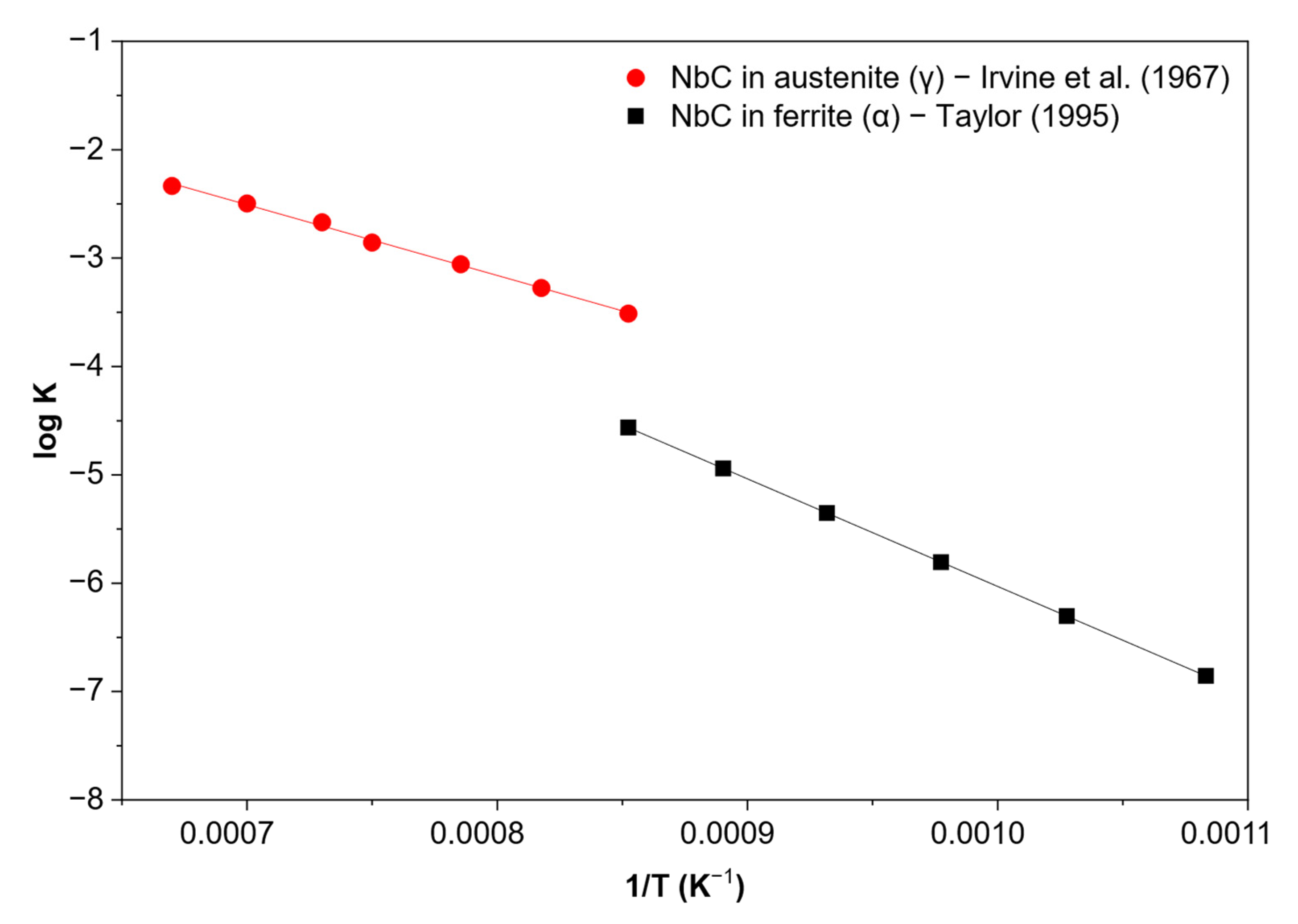
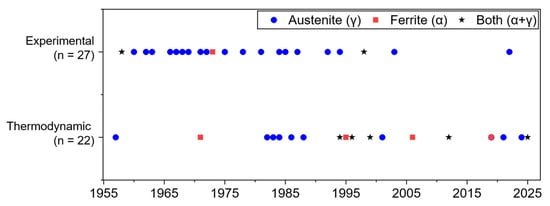
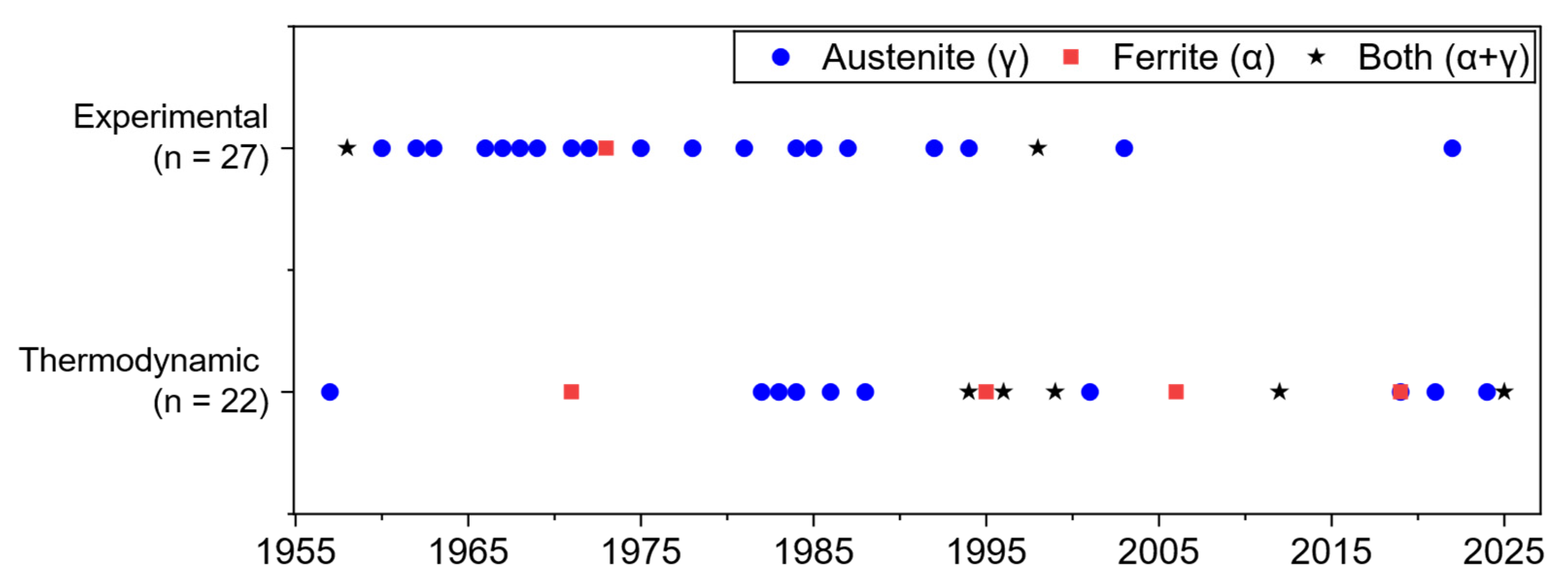
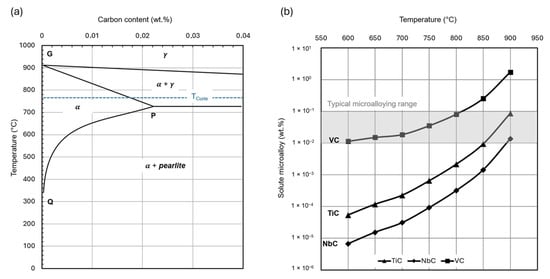
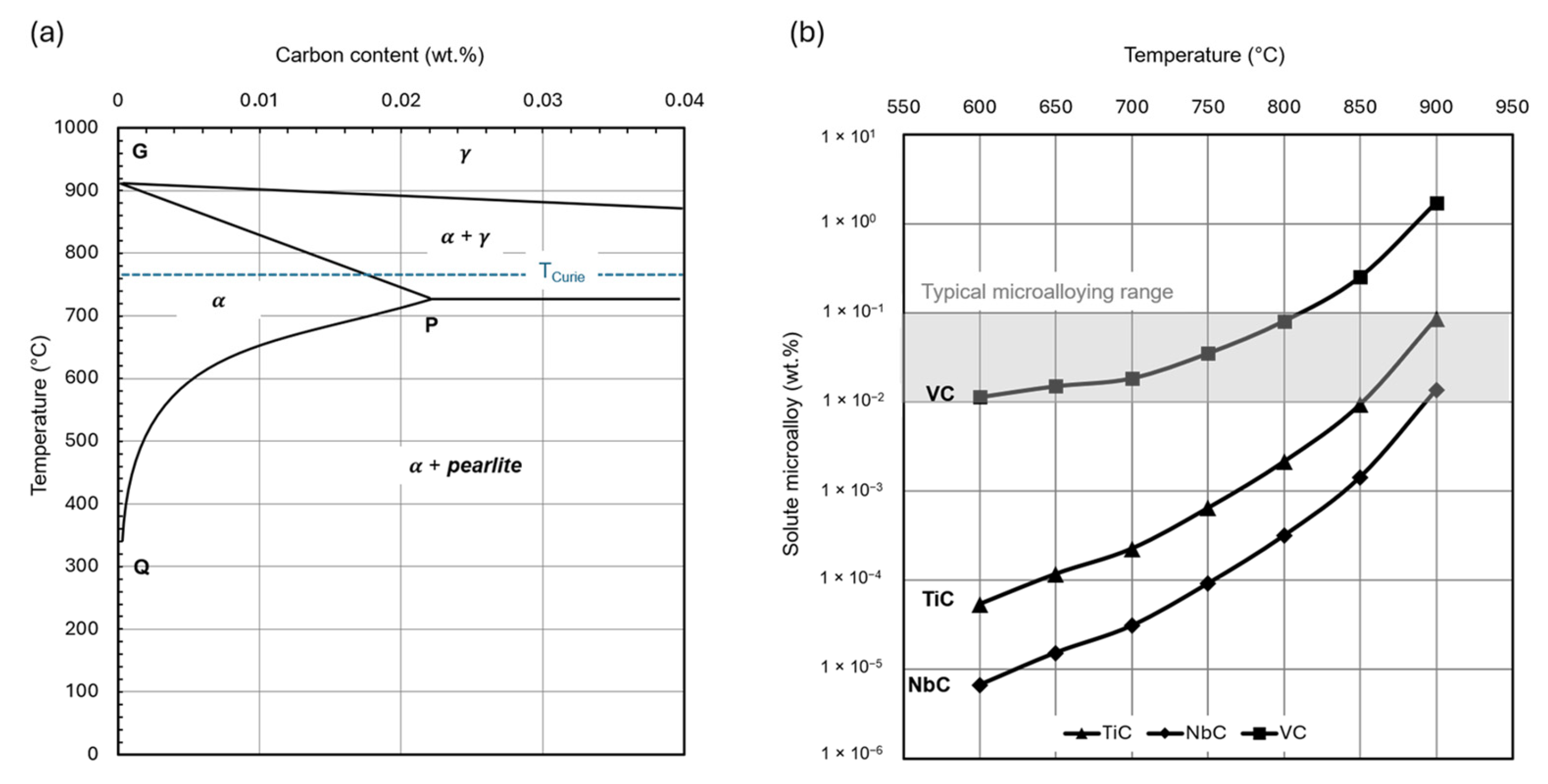
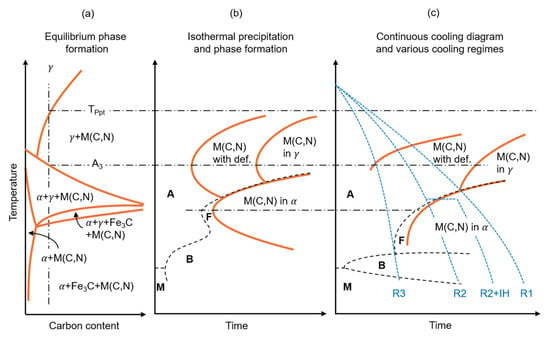
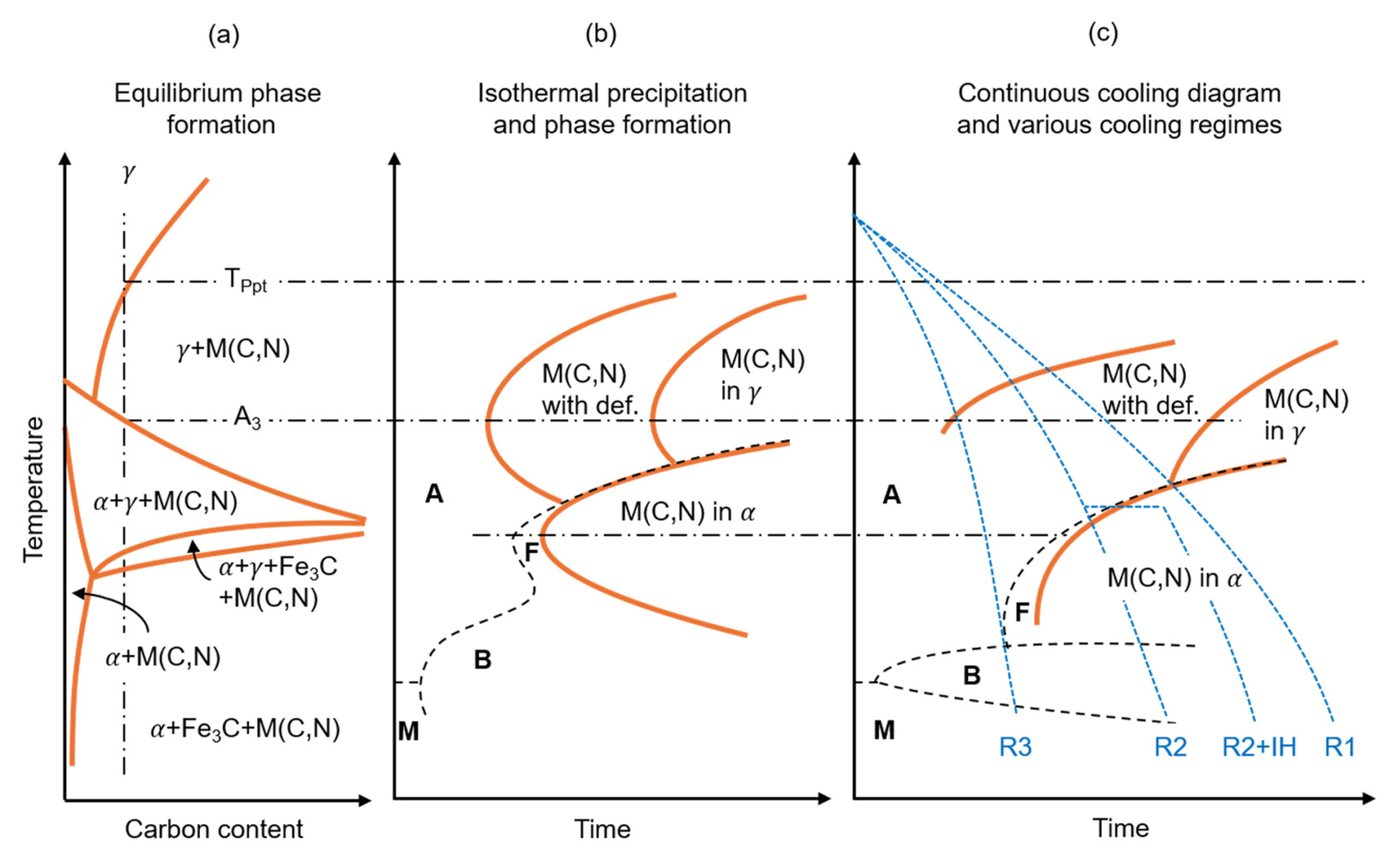
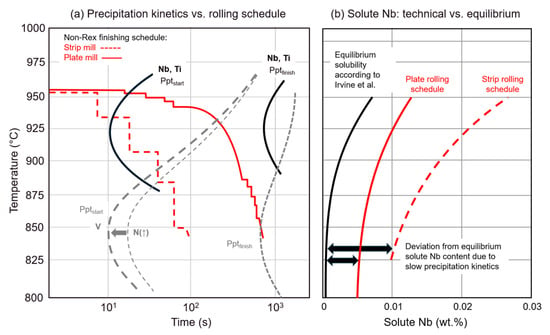
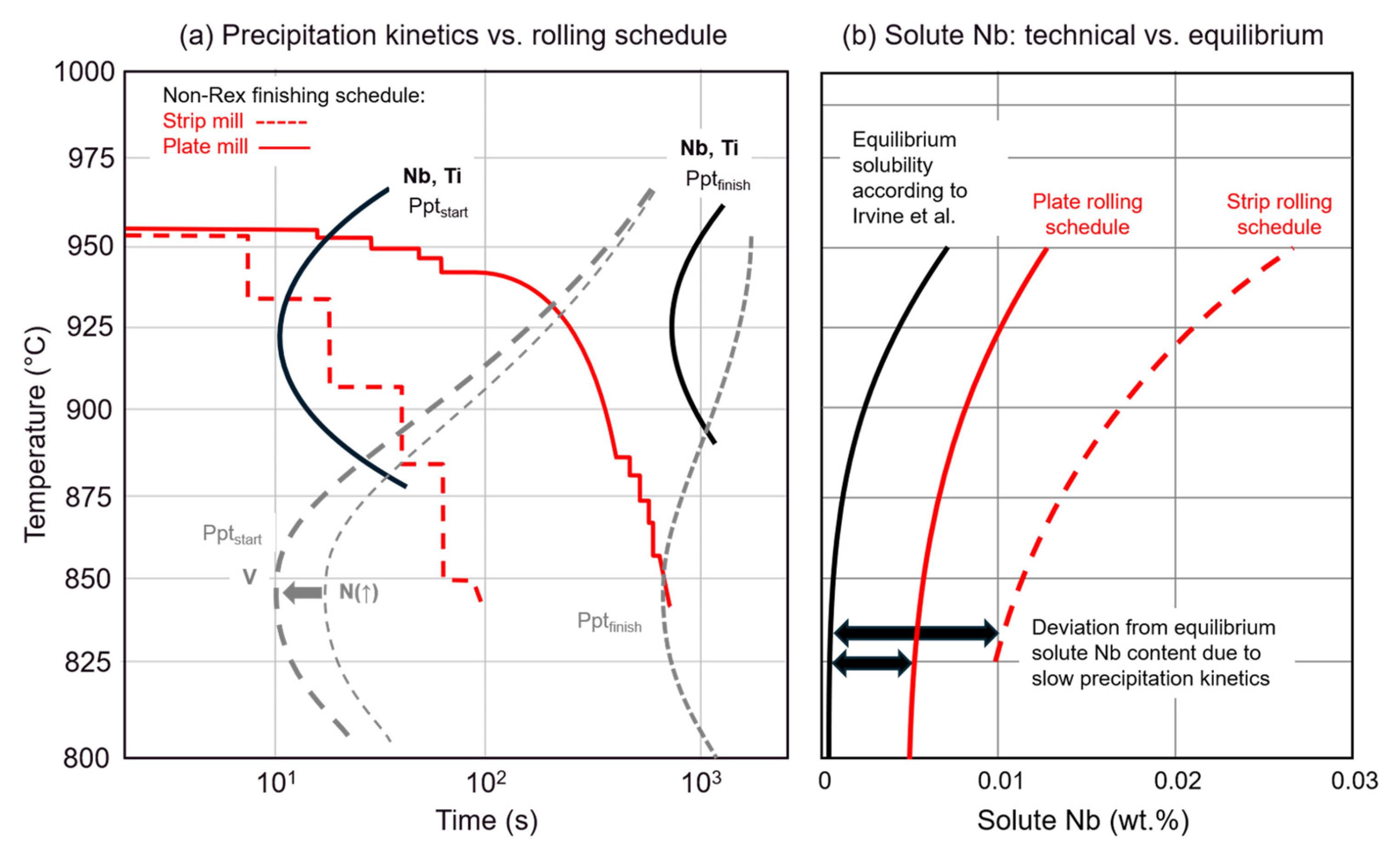
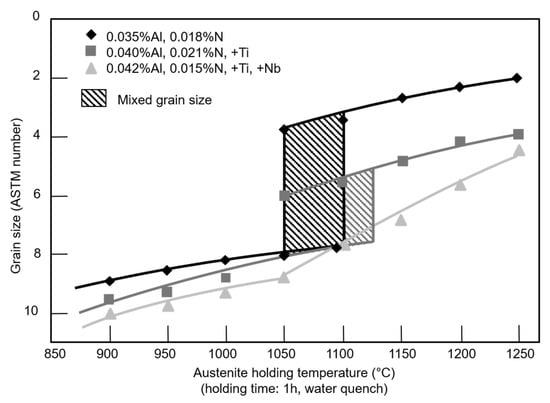
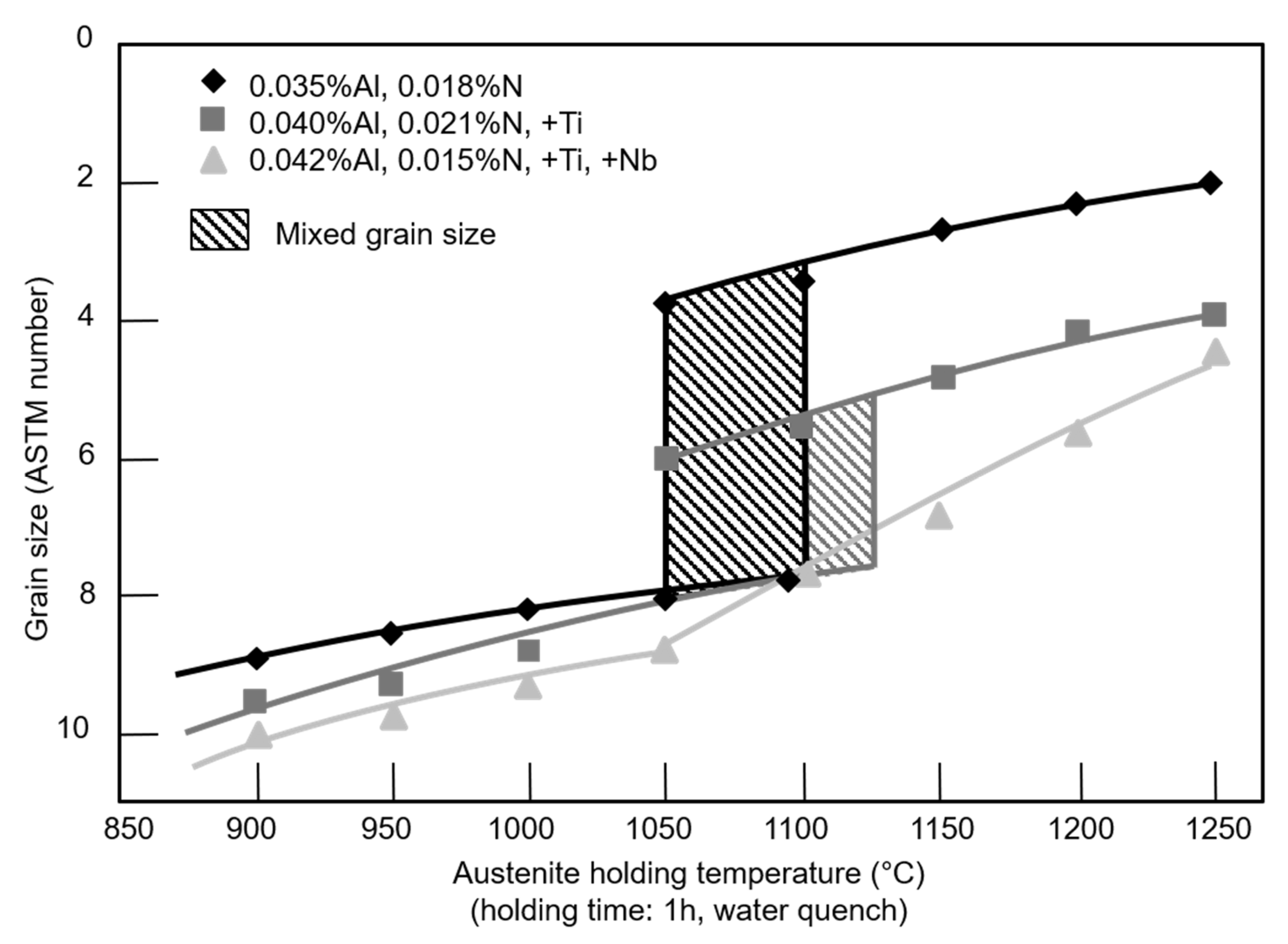
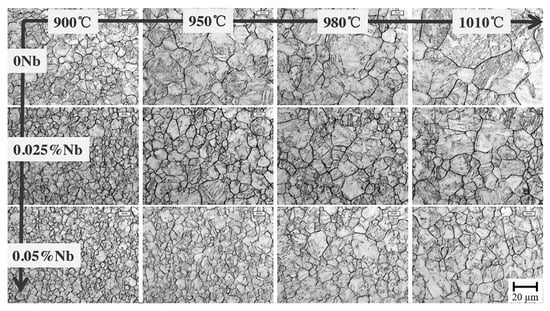
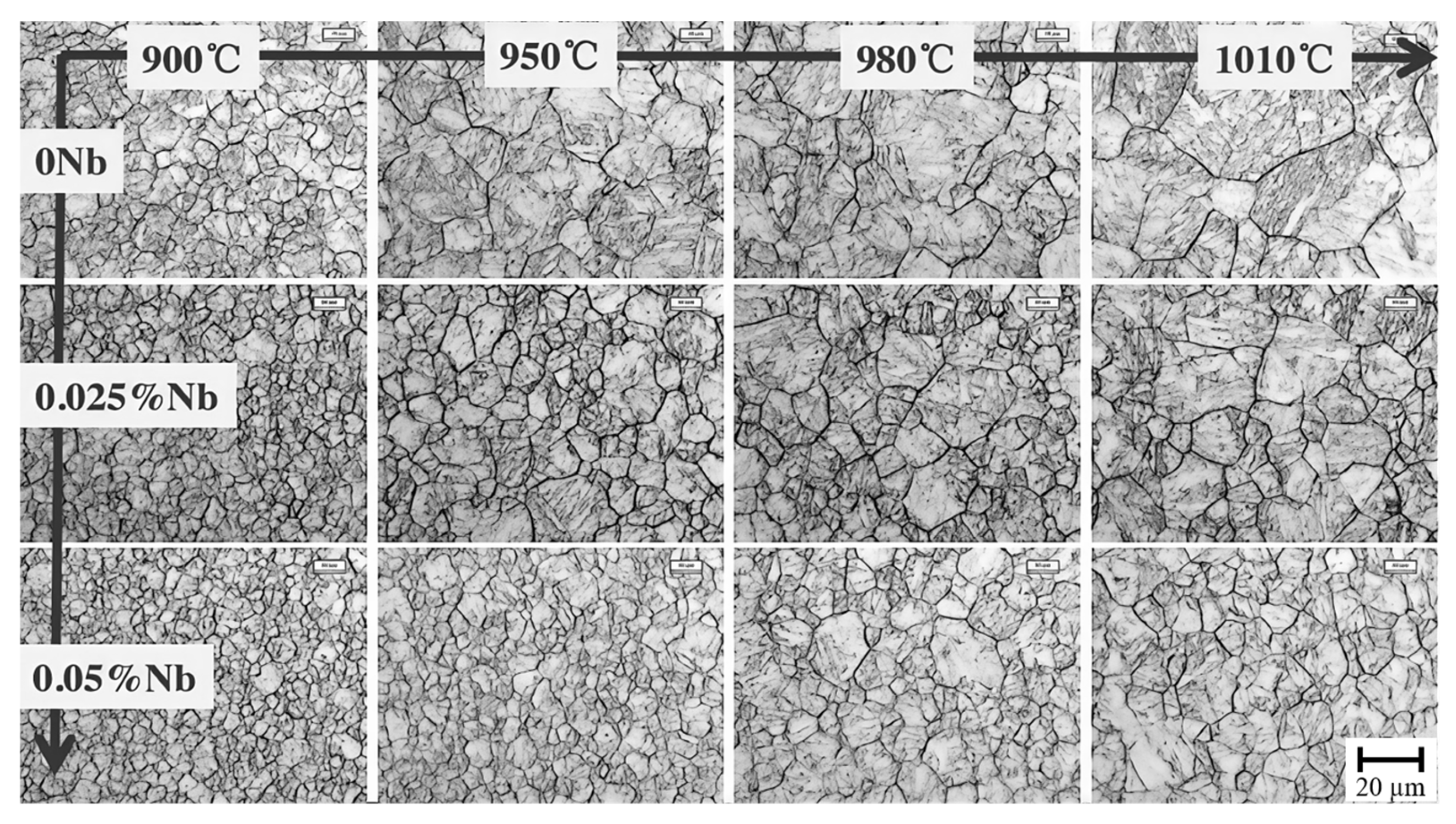
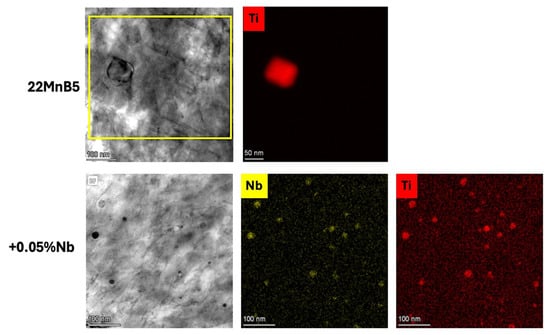
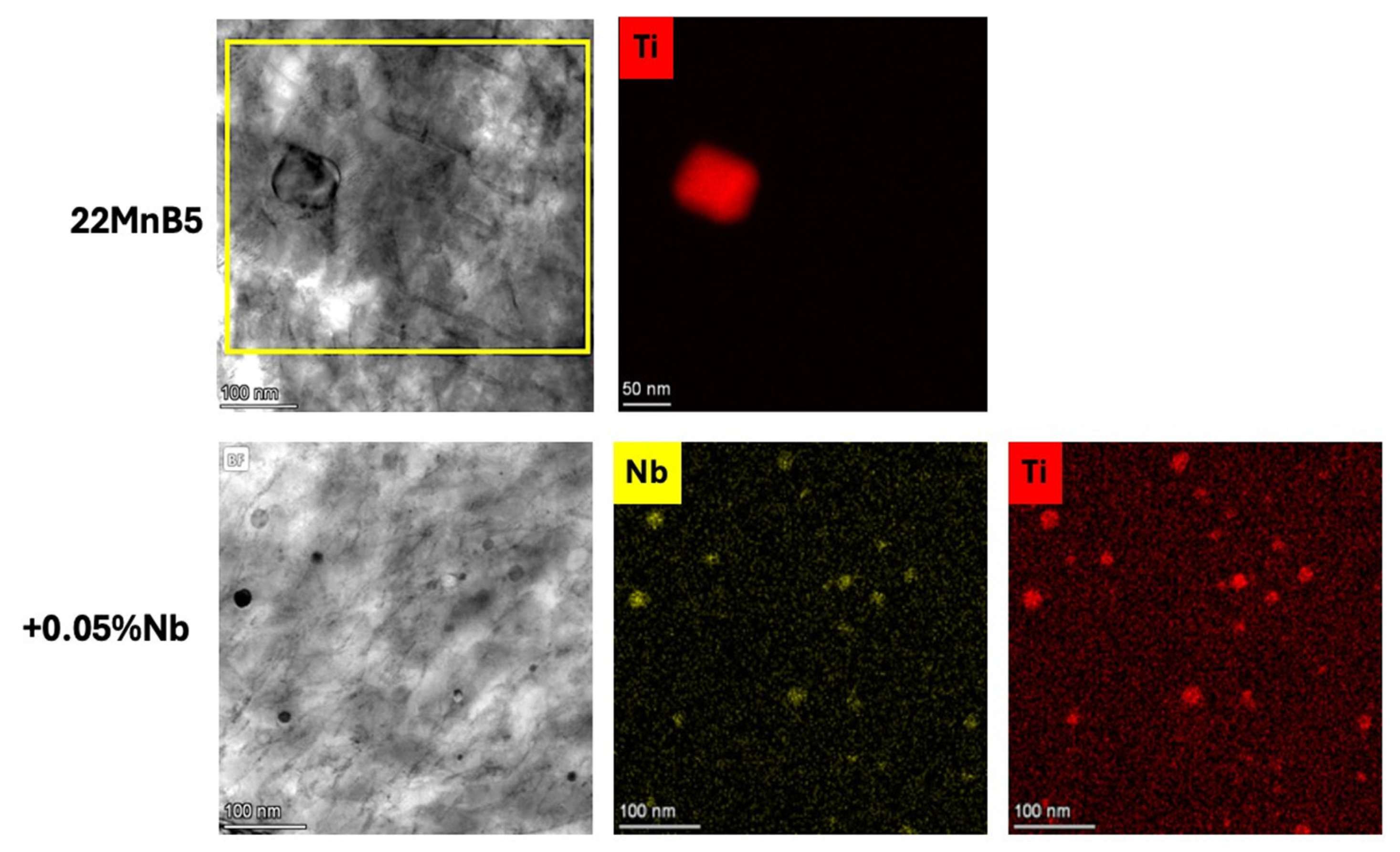
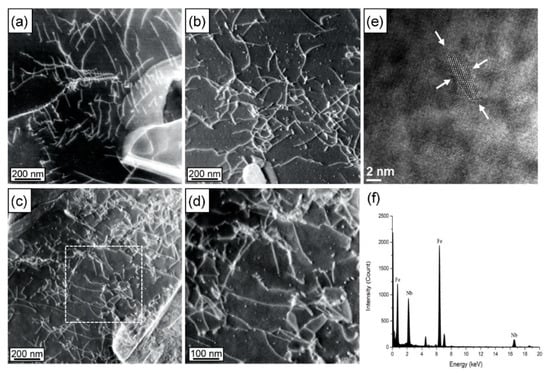
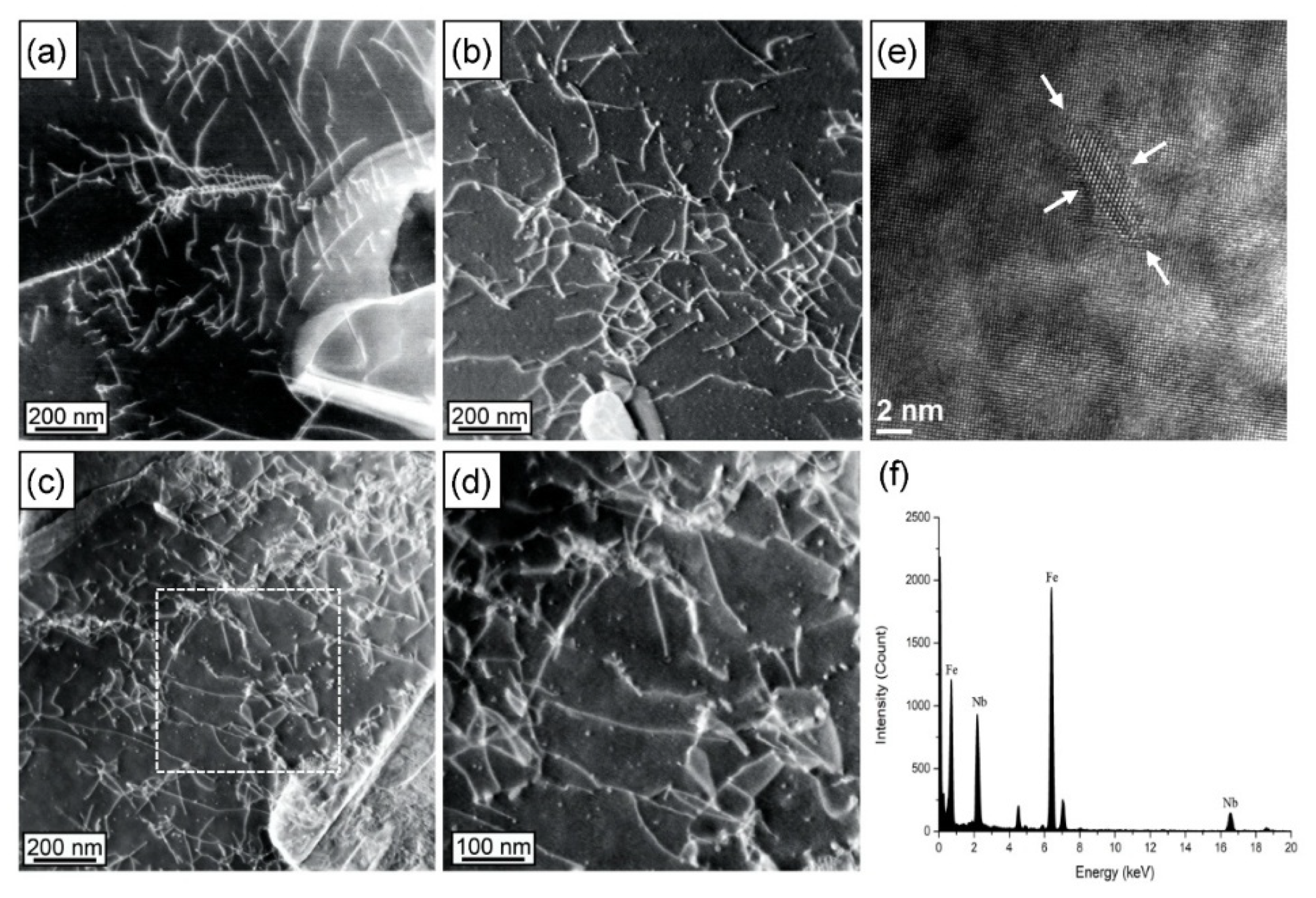

Disclaimer/Publisher’s Note: The statements, opinions and data contained in all publications are solely those of the individual author(s) and contributor(s) and not of MDPI and/or the editor(s). MDPI and/or the editor(s) disclaim responsibility for any injury to people or property resulting from any ideas, methods, instructions or products referred to in the content. |
© 2026 by the authors. Licensee MDPI, Basel, Switzerland. This article is an open access article distributed under the terms and conditions of the Creative Commons Attribution (CC BY) license.