


Abstract
Guselkumab is a human monoclonal antibody directed against the p19 subunit of interleukin-23. This structured narrative review evaluates its pharmacologic rationale, efficacy, safety, durability, and therapeutic role in plaque psoriasis, psoriatic arthritis, Crohn’s disease, and ulcerative colitis. PubMed/MEDLINE and Europe PMC were searched from inception through 18 September 2026 using broad and disease-specific strategies; ClinicalTrials.gov was searched to link trial families and identify ongoing studies. Records were screened for directness, design, distinct contribution, and clinical relevance. The final synthesis included 64 PubMed-indexed articles and the current US prescribing information. In plaque psoriasis, guselkumab produces high and durable skin clearance rates and has demonstrated superiority over active comparators at prespecified time points. In psoriatic arthritis, it improves peripheral arthritis, skin disease, enthesitis, dactylitis, function, and patient-reported outcomes; long-term trials show low observed radiographic progression, whereas evidence for axial disease remains less definitive. In Crohn’s disease and ulcerative colitis, phase 3 programs demonstrate clinical and endoscopic efficacy with intravenous or fully subcutaneous induction and subcutaneous maintenance. Long-term trial data support a stable safety profile, although infection screening, tuberculosis assessment, vaccination review, and indication-specific liver monitoring remain important. Guselkumab may be clinically relevant when skin, joint, and bowel inflammation coexist, but treatment should remain domain based because efficacy cannot be assumed to be equivalent across manifestations. Direct within-class comparisons, validated response biomarkers, and dedicated axial and disease-modification studies remain priorities.
1. Introduction
The clinical reach of guselkumab has changed substantially since its initial development for plaque psoriasis. It is now used across diseases that share interleukin-23-driven inflammation but differ in target tissue, outcome measures, background therapy, and therapeutic goals. In the United States, the June 2026 prescribing information includes moderate-to-severe plaque psoriasis and active psoriatic arthritis in adults and eligible children aged 6 years or older who weigh at least 40 kg, as well as moderately to severely active ulcerative colitis and Crohn’s disease in adults [1]. This breadth makes guselkumab relevant not only as a disease-specific biologic but also as a potential unifying therapy for patients whose psoriasis, arthritis, and bowel disease overlap.
This apparent unity requires careful interpretation. Psoriasis trials emphasize near-complete skin clearance, psoriatic arthritis trials evaluate several musculoskeletal and extra-articular domains, and inflammatory bowel disease trials increasingly require both symptomatic control and objective endoscopic improvement. A favorable result in one disease cannot therefore be transferred automatically to another. The evidence is also uneven: psoriasis has mature five-year randomized and real-world data, psoriatic arthritis has robust two-year multidomain evidence but unresolved questions about axial disease, and the inflammatory bowel disease program is newer but includes large phase 3 studies and more flexible induction routes.
This review examines how the same target translates into different clinical roles. It focuses on four questions: what is distinctive about guselkumab pharmacology; how strong and durable is the evidence in each indication; what safety and implementation issues matter in practice; and where guselkumab fits when more than one inflammatory domain is active. The objective is interpretive rather than promotional. Findings from active-comparator trials are distinguished from indirect comparisons, and exploratory or real-world observations are presented with their design limitations.
2. Methods
2.1. Review Design and Reporting Framework
This work was designed as a structured narrative review. The scope, search transparency, referencing, scientific reasoning, and presentation were informed by the Scale for the Assessment of Narrative Review Articles, while the reporting of sources, dates, search approaches, and supplementary searching followed applicable PRISMA-S principles [2,3]. Because the objective was to integrate heterogeneous outcomes and explain therapeutic positioning rather than estimate a single pooled effect, no meta-analysis was planned. A formal risk-of-bias instrument was not applied. Studies were interpreted in light of study design, directness, sample size, pre-specification of outcomes, duration, replication across trial programs, and consistency with complementary evidence.
2.2. Information Sources and Search Strategy
PubMed/MEDLINE, Europe PMC, and ClinicalTrials.gov were searched from inception through 18 September 2026. The principal PubMed strategy used “guselkumab[Title/Abstract]” without an outcome filter to avoid preferential retrieval of positive efficacy reports. Disease-specific sensitivity searches added controlled vocabulary and title or abstract terms for psoriasis, psoriatic arthritis, inflammatory bowel disease, Crohn’s disease, and ulcerative colitis; drug synonyms included CNTO 1959 and Tremfya. Europe PMC was searched independently with equivalent title and abstract concepts. ClinicalTrials.gov was searched for guselkumab as an intervention or comparator, then filtered during screening to the target diseases and an explicit guselkumab intervention. Reference lists of pivotal trials, extensions, current guidelines, and high-quality reviews were checked for missed trial-family publications.
After consolidation of the overlapping broad and disease-specific PubMed queries and within-database duplicate removal, 1125 retrievable unique PubMed records comprised the PubMed working set. Counts refer to records for which bibliographic metadata were successfully retrieved, rather than raw interface totals. Europe PMC returned 921 records; after matching PubMed identifiers, DOIs, and normalized titles, the combined bibliographic set contained 1159 unique records. ClinicalTrials.gov returned 140 records, of which 78 matched a target disease and explicitly included guselkumab. Registry records were used to connect protocols with publications and for horizon scanning; they were not counted as peer-reviewed included articles. Search approaches and yields are summarized in Table 1.
Table 1.
Search sources, strategies, and record yields.
2.3. Eligibility Criteria and Study Selection
Eligible evidence included human randomized trials, open-label extensions, post hoc analyses that contributed a distinct prespecified or clinically relevant outcome, comparative studies, pharmacokinetic or pharmacodynamic studies, real-world cohorts, and postmarketing safety analyses. Selected systematic reviews, evidence syntheses, and guidelines were retained when they were necessary to interpret comparative positioning. Mechanistic studies were eligible when they directly evaluated guselkumab or clarified the interleukin-23 pathway in an included clinical program. The population of interest comprised patients with plaque psoriasis, psoriatic arthritis, Crohn’s disease, or ulcerative colitis. Pediatric evidence was retained where directly relevant to a labeled or emerging population.
Reports were excluded when they concerned a non-target indication without transferable pharmacologic information, described a single patient or a very small uncontrolled case series, were non-substantive editorials or corrections, duplicated a trial-family result without adding a distinct outcome, or did not provide sufficient methods and results for reliable interpretation. Non-English reports were excluded from synthesis. Trial protocols were used for horizon scanning but were not treated as efficacy evidence. One review author performed title and abstract screening and full-text assessment. Titles and abstracts of 1159 unique bibliographic records were screened. A total of 136 reports underwent detailed assessment, and 58 substantive clinical, pharmacologic, or contextual articles were retained. The most common reasons for exclusion at detailed assessment were redundant trial-family reporting, low-information publication type, insufficient direct relevance, and inadequate outcome detail. Two reporting-method articles were added. Focused supplementary PubMed searches used to clarify mechanistic and therapeutic-positioning questions identified four additional directly relevant articles, including two studies with opposing findings on the proposed CD64 mechanism. The final evidence set therefore comprised 64 PubMed-indexed articles and the current US prescribing information, for 65 references in total.
2.4. Data Extraction and Synthesis
One review author extracted data using structured fields; because screening and extraction were performed by one reviewer, no reviewer disagreement procedure was applicable. For pivotal and practice-informing studies, the fields included study design, population, prior biologic exposure, guselkumab regimen, comparator, follow-up, primary and major secondary outcomes, objective tissue or imaging outcomes, safety findings, and the publication’s distinct contribution. Evidence was grouped first by disease and then by the clinical decision it informed: induction of response, durability, difficult-to-treat domains, treatment after prior biologic failure, dosing, and safety. Randomized evidence was given priority. Real-world studies were used to evaluate transportability, persistence, and effectiveness in more treatment-experienced populations. Numerical comparisons are reported only when supported by a direct study; cross-trial comparisons are described qualitatively unless they originated from a formal evidence synthesis.
2.5. Pharmacologic Rationale and Dosing Across Indications
Guselkumab is a human IgG1 lambda monoclonal antibody that binds the p19 subunit of interleukin-23 and prevents interaction with the interleukin-23 receptor. By selectively targeting p19, guselkumab leaves interleukin-12 signaling intact, unlike ustekinumab, which targets the p40 subunit shared by interleukin-12 and interleukin-23. This suppresses interleukin-23-dependent maintenance and activation of type 17 inflammatory programs. In psoriasis, exploratory pharmacodynamic analyses show reductions in interleukin-17A, interleukin-17F, and interleukin-22; in psoriatic arthritis, reductions also occur in C-reactive protein, serum amyloid A, interleukin-6, and type 17 effector cytokines [1]. Tissue and serum biomarker studies from VOYAGE and ECLIPSE support sustained suppression of disease-relevant inflammatory pathways and provide a biologic correlate for durable clinical response [4,5].
The downstream consequence of IL-23 blockade differs by tissue. In plaque psoriasis, dendritic cells and other lesional myeloid cells provide IL-23 that sustains pathogenic tissue-resident and circulating type 17 lymphocytes. Their IL-17A, IL-17F, and IL-22 signals activate keratinocytes, amplify chemokine production and neutrophil recruitment, and maintain epidermal hyperplasia. Guselkumab therefore acts upstream of these effector cytokines; lesional and serum studies show reduced type 17 pathway activity, but the drug does not bind or directly neutralize IL-17A [4,5,6].
In psoriatic arthritis, IL-23 produced by tissue myeloid cells can support IL-23-responsive T cells and innate lymphocyte populations at synovial and entheseal sites, promoting IL-17A, IL-17F, IL-22, and secondary inflammatory mediators. Clinical biomarker reductions are consistent with attenuation of this network, although the exact human cellular source of pathogenic IL-23 and the relative contribution of individual responder-cell populations remain less completely defined than in psoriatic skin [1,6].
In the intestine, IL-23 also promotes the maintenance, expansion, and pathogenic programming of Th17-like and innate lymphoid responses, rather than serving as the sole signal for initial Th17 differentiation. This distinction is important because IL-17A can contribute to epithelial barrier integrity and antimicrobial defense even while excessive type 17 activity participates in inflammation. Direct IL-17A blockade was ineffective and associated with worse outcomes in a randomized Crohn’s disease trial, whereas guselkumab neutralizes IL-23 upstream without directly removing IL-17A [7,8,9]. The available clinical and multiomic data are therefore compatible with suppression of IL-23-dependent pathogenic programs, not indiscriminate elimination of all mucosal IL-17A activity.
Early pharmacology established approximately dose-proportional exposure and a half-life compatible with infrequent maintenance dosing [10]. Dose exposure–response modeling contributed to the selection of the 100 mg subcutaneous psoriasis regimen, and later trial analyses found low immunogenicity without a clinically important effect on exposure for most patients [11,12]. The current label reports a mean half-life of approximately 15 to 18 days in plaque psoriasis and approximately 17 days in ulcerative colitis and Crohn’s disease. Clearance increases with body weight, but routine weight-based adjustment is not recommended [1].
The approved regimens are not interchangeable across diseases. Psoriasis and psoriatic arthritis use 100 mg subcutaneously at weeks 0 and 4 and then every 8 weeks. In inflammatory bowel disease, higher induction exposure is achieved with either 200 mg intravenously at weeks 0, 4, and 8, or 400 mg subcutaneously at the same time points. Maintenance is 100 mg subcutaneously every 8 weeks beginning at week 16, or 200 mg every 4 weeks, beginning at week 12, with the lowest effective recommended maintenance dosage preferred [1]. Table 2 summarizes these differences.
Table 2.
Current United States dosing by indication.
Guselkumab has a native IgG1 Fc region and can bind Fc gamma receptor I (CD64) in vitro. One cell culture study reported that CD64 binding positioned guselkumab on IL-23-producing myeloid cells, promoted capture and internalization of locally released IL-23, and increased neutralizing potency in a co-culture system [6]. A subsequent study using plasma-containing assays and immunoglobulin-competent colitis models found that endogenous IgG occupied CD64, that IL23A expression was not restricted to CD64-positive cells, and that wild-type and Fc-modified anti-IL-23 antibodies produced similar anti-inflammatory effects under physiologically relevant conditions [13]. Multiomic changes observed during guselkumab treatment support IL-23 pathway inhibition but do not establish CD64 engagement as a clinically relevant mechanism [7,8]. CD64 binding should therefore be regarded as a disputed preclinical hypothesis, not as a demonstrated explanation for clinical efficacy or superiority over other p19 inhibitors.
3. Role in Plaque Psoriasis
3.1. Establishing High-Level Skin Clearance
The psoriasis program provides the longest and most internally consistent evidence for guselkumab. In the phase 2 X-PLORE trial, week 16 clear or almost clear skin responses increased across guselkumab dose groups and reached 86% with 100 mg, compared with 7% with placebo and 58% with adalimumab. Higher-dose guselkumab groups also maintained an advantage over adalimumab at week 40 [14]. These results established proof-of-concept for selective p19 inhibition and informed the phase 3 program.
VOYAGE 1 confirmed rapid and substantial efficacy with the regimen that entered clinical practice. At week 16, Investigator Global Assessment 0 or 1 and PASI 90 responses were 85.1% and 73.3% with guselkumab, compared with 6.9% and 2.9% with placebo. Guselkumab also outperformed adalimumab at weeks 16, 24, and 48; PASI 90 at week 48 was 76.3% versus 47.9% [15]. VOYAGE 2 reproduced the placebo-controlled effect and addressed withdrawal, retreatment, and switching. Continued treatment preserved the response better than withdrawal, and 66.1% of adalimumab nonresponders who switched to guselkumab achieved PASI 90 by week 48 [16].
Active-comparator trials provide additional evidence regarding comparative efficacy. NAVIGATE enrolled patients who remained inadequately controlled after open-label ustekinumab. Switching to guselkumab produced more complete or near-complete responses than continuing ustekinumab, including higher PASI 90, PASI 100, and quality-of-life responses at week 52 [17]. ECLIPSE compared guselkumab directly with secukinumab. Guselkumab was superior for the prespecified primary outcome of PASI 90 at week 48, achieved by 84% versus 70%, although superiority was not demonstrated for the first major secondary outcome requiring PASI 75 at both weeks 12 and 48. This pattern matters clinically: secukinumab produced strong early efficacy, whereas guselkumab showed an advantage in sustained high-level clearance at one year [18]. POLARIS further showed superiority over fumaric acid esters in systemic treatment-naive patients, with week 24 PASI 90 responses of 82% versus 14% and fewer discontinuations for adverse events [19].
3.2. Durability and Individualized Dosing
Long-term follow-up provides evidence of sustained efficacy. In VOYAGE 1 and 2, approximately 82% to 84% of guselkumab-treated patients maintained PASI 90 at week 252, while 53% achieved complete PASI clearance. Improvements in dermatology-specific quality of life and symptoms were also maintained, with no new safety signal over five years [20]. These are extension data among patients who remained in follow-up; therefore, attrition and survivor effects must be considered, but the durability is supported by registry and prospective observational cohorts. The Czech BIOREP registry and the noninterventional SPRING study found sustained effectiveness and treatment persistence in routine care, including biologic-experienced populations [21,22]. A broader real-world evidence synthesis also found high effectiveness across difficult sites and heterogeneous clinical populations, while emphasizing variation in outcome definitions and follow-up [23].
GUIDE addressed whether an early deep response can support dose de-escalation. Among patients with complete clearance at both weeks 20 and 28, every-16-week dosing was noninferior to every-8-week dosing for maintaining PASI below 3 at week 68: 91.9% versus 92.6%. Tissue-resident memory T-cell and serum type 17 biomarkers remained suppressed in both groups [24]. GUIDE also suggested that a shorter disease duration may be associated with stable complete clearance, raising the possibility that earlier pathway control changes response trajectories [25]. These results are important for precision dosing but should not be generalized to patients without an early complete response, and every-16-week maintenance is not the standard US-labeled regimen.
3.3. Difficult Sites and Pediatric Disease
High-impact disease can be clinically important even when total body surface area is modest. SPECTREM extended guselkumab evidence to patients with a low body surface area but moderate disease involving high-impact sites, supporting assessment beyond total skin extent [26]. The PROTOSTAR trial enrolled children and adolescents aged 6 to younger than 18 years. At week 16, IGA 0 or 1, PASI 75, and PASI 90 responses were 66%, 76%, and 56% with guselkumab, versus 16%, 20%, and 16% with placebo; safety through one year was consistent with the adult program [27]. These findings underpin the current US pediatric indication for patients aged 6 years or older who weigh at least 40 kg.
In practice, guselkumab is an established treatment option when durable near-complete clearance, infrequent maintenance dosing, or coexisting psoriatic arthritis or inflammatory bowel disease influences selection. Treatment still requires individualization. Rapid early clearance, previous biologic failure, difficult site involvement, pregnancy plans, infection risk, access, and patient preference for injection frequency all affect the decision. The AAD-NPF biologic guideline provides the broader framework for matching biologic therapy to disease severity, comorbidity, and prior treatment rather than selecting solely from average trial efficacy [28].
4. Role in Psoriatic Arthritis
4.1. Peripheral Arthritis and the Phase 3 Foundation
Guselkumab entered psoriatic arthritis development with a phase 2 trial in which 58% of treated patients achieved ACR20 at week 24, compared with 18% with placebo. Benefits extended beyond joint counts, and adverse event rates were similar between groups [29]. The larger DISCOVER program then established efficacy across biologic-naive and selected tumor necrosis factor inhibitor-experienced populations.
DISCOVER 1 included patients who were biologic naive or had previously received one or two tumor necrosis factor inhibitors. At week 24, ACR20 was achieved by 59% with guselkumab every four weeks and 52% with the week 0, week 4, and then every-eight-week regimen, compared with 22% with the placebo [30]. DISCOVER 2 enrolled a larger, biologic-naive population with more active disease; ACR20, at week 24, was 64% with either the guselkumab regimen and 33% with the placebo [31]. The similar efficacy of the trial regimens across many outcomes supports the labeled every-eight-week schedule rather than assuming that more frequent administration routinely improves response.
The two-year DISCOVER 2 follow-up showed sustained benefit. At week 100, ACR20, ACR50, and ACR70 responses ranged from 68% to 76%, 48% to 56%, and 30% to 36% across the guselkumab-treated groups. Skin clearance, enthesitis resolution, and dactylitis resolution were maintained, and observed radiographic progression remained low [32]. Post hoc radiographic analyses found less progression among patients who achieved low disease activity or minimal disease activity than among nonresponders. This association is clinically plausible but cannot establish that achieving a response through guselkumab uniquely prevents damage since response status was not randomized [33].
4.2. Prior Biologic Failure and Difficult Domains
The COSMOS trial directly addressed inadequate response or intolerance to tumor necrosis factor inhibitors. At week 24, ACR20 was achieved by 44.4% with guselkumab and 19.8% with placebo; improvements were also observed in physical function, skin outcomes, and higher ACR response thresholds. More than 80% of the week 24 responders maintained ACR20 at week 48 [34]. SOLSTICE, reported in 2026, confirmed efficacy after an inadequate response to one prior tumor necrosis factor inhibitor. Week 24 ACR20 responses were 58.6% and 62.2% with every-four-week and every-eight-week regimens, respectively, versus 34.8% with placebo; ACR50, ACR70, PASI 90, and minimal disease activity also favored guselkumab [35]. These trials support the efficacy of guselkumab after tumor necrosis factor inhibitor failure and demonstrate that clinically meaningful multidomain responses can still occur in biologic-experienced patients.
Enthesitis and dactylitis are particularly important because they drive pain, disability, and incomplete disease control. Pooled phase 3 analyses showed progressive enthesitis resolution through one year and substantial dactylitis resolution with guselkumab [36,37]. In DISCOVER 2, improvements across peripheral joints, skin, spinal pain, enthesitis, and dactylitis persisted through two years; minimal disease activity was reached by approximately 38% to 40% of patients at week 100 [38]. Real-world patient-reported outcomes from the CorEvitas registry improved within six months, supporting transportability beyond trial-selected populations [39].
Evidence for axial psoriatic arthritis is less definitive. Post hoc analyses in patients with investigator-confirmed imaging sacroiliitis found durable improvements in BASDAI, spinal pain, and ASDAS through week 100, with roughly half achieving BASDAI 50 [40]. A single-center real-world cohort similarly reported improvement in axial and peripheral measures, including magnetic resonance imaging findings [41]. However, these analyses are not substitutes for a dedicated axial psoriatic arthritis trial with centralized imaging eligibility and an axial-specific primary endpoint. Guselkumab should therefore be described as having preliminary evidence for axial symptoms, not the same evidentiary certainty as for peripheral arthritis, skin disease, enthesitis, and dactylitis.
4.3. What Real-World Studies Add
Real-world evidence is becoming more informative as use expands to later treatment lines. A 24-month claims-based comparison found greater on-label persistence with guselkumab than with subcutaneous tumor necrosis factor inhibitors, although persistence reflects access, dosing, tolerability, and prescribing behavior, as well as efficacy, and cannot replace a randomized comparison [42]. Two recent real-world studies provide additional information on articular remission and imaging response. In a 26-center Italian cohort, DAPSA remission increased from 12% at six months to 20% at 12 months in intention-to-treat analyses; six-month articular remission and a combined articular-cutaneous response were the strongest predictors of 12-month remission, whereas skin-only improvement was a weaker predictor [43]. This distinction is important: visible skin improvement should not be assumed to guarantee later joint remission.
A separate ultrasound cohort found improvement in power Doppler-inclusive synovitis by month 3, with further improvement by month 6, alongside improvement in entheseal inflammatory activity. Structural entheseal findings were largely stable over six months, which is expected over a short interval and supports interpreting the study as imaging evidence of inflammation control rather than proof of structural repair [44]. The cohort was small and uncontrolled, but its objective imaging outcomes complement clinical response measures.
Current EULAR recommendations emphasize selecting therapy according to the dominant disease domains, prior treatment, comorbidity, and safety rather than using a single hierarchy for every patient [45]. Within that framework, guselkumab may be particularly relevant when substantial psoriasis accompanies peripheral arthritis, enthesitis, or dactylitis; after an inadequate response to conventional disease-modifying therapy or a tumor necrosis factor inhibitor; or when inflammatory bowel disease favors selection of a mechanism with demonstrated bowel efficacy. Evidence is less established when severe axial disease is the dominant treatment target and dedicated axial evidence is prioritized.
5. Role in Inflammatory Bowel Disease
5.1. Crohn’s Disease
GALAXI 1 provided early randomized evidence of efficacy in Crohn’s disease. In a population in which approximately half had disease refractory to prior biologic therapy, three intravenous induction doses produced greater week 12 reductions in the Crohn’s Disease Activity Index and higher rates of clinical remission than placebo. Clinical remission ranged from 45.9% to 57.4% across guselkumab groups compared with 16.4% with placebo, and endoscopic outcomes also favored guselkumab [46]. At week 48, clinical remission was 57% to 73% across guselkumab regimens, with an endoscopic response in 44% to 46%. The ustekinumab arm was a useful reference, although the phase 2 trial was not designed to establish definitive comparative superiority [47].
The identically designed GALAXI 2 and 3 phase 3 trials confirmed intravenous induction followed by subcutaneous maintenance. Both guselkumab maintenance regimens were superior to placebo for composite endpoints requiring a week 12 clinical response followed by a week 48 clinical remission or endoscopic response. In GALAXI 2, a clinical response at week 12 plus clinical remission at week 48 occurred in 49% to 55% with guselkumab and 12% with placebo; in GALAXI 3, corresponding rates were 47% to 48% and 13%. Endoscopic composite outcomes also favored guselkumab. The active ustekinumab comparator strengthened interpretation, and the report found guselkumab to be superior across multiple week 48 endpoints, but individual comparisons should still be read in the context of prespecified multiplicity control [48].
GRAVITI established a fully subcutaneous pathway. Subcutaneous 400 mg induction produced week 12 clinical remission in 56.1% versus 21.4% with placebo and endoscopic response in 41.3% versus 21.4%. At week 48, clinical remission reached 60.0% with 100 mg every eight weeks, and 66.1% with 200 mg every four weeks, while endoscopic response reached 44.3% and 51.3%, respectively [49]. The availability of both intravenous and subcutaneous induction is practically meaningful because it permits selection according to infusion access, patient preference, disease severity, and local reimbursement without changing the molecular target.
Long-term GALAXI 1 follow-up suggests durability through five years. Among long-term extension participants with available observations, clinical remission was 97.7%, endoscopic response 71.3%, and endoscopic remission 51.7% at week 240. More conservative nonresponder imputation analyses produced lower estimates, including 46.0% clinical remission when the primary efficacy population formed the denominator [50]. Both views are informative: the observed analysis describes outcomes among continuing patients, while the conservative analysis better reflects attrition and treatment discontinuation.
Early real-world evidence supports effectiveness in heavily pretreated patients but remains limited and is based on small cohorts. In a prospective multicenter cohort, week 12 clinical remission was 51% with guselkumab, with significant improvement in C-reactive protein and fecal calprotectin. Propensity-matched outcomes were similar to risankizumab, but the study included only 51 guselkumab-treated patients and lacked comparative endoscopic outcomes [51]. These findings should be considered hypothesis-generating rather than evidence of within-class equivalence.
5.2. Ulcerative Colitis
QUASAR phase 2b demonstrated a substantial induction response. Week 12 clinical response was 61.4% and 60.7% with intravenous guselkumab 200 mg and 400 mg, respectively, compared with 27.6% with placebo. Clinical remission, endoscopic improvement, histologic endoscopic mucosal improvement, and endoscopic normalization also favored guselkumab [52]. The absence of a clear dose–response advantage supported selection of the lower intravenous induction dose for phase 3 development.
The phase 3 QUASAR induction and maintenance studies established the approved intravenous strategy. Clinical remission at induction week 12 was 23% with guselkumab and 8% with placebo. Among the induction responders, week 44 remission was 50% with 200 mg every four weeks and 45% with 100 mg every eight weeks, compared with 19% after withdrawal to placebo. Serious adverse events and discontinuations were not increased versus placebo [8]. In the long-term extension, nonresponder-imputed clinical remission at week 92 was 71% with 100 mg every eight weeks and 74% with 200 mg every four weeks; nearly all patients in remission were corticosteroid free for at least eight weeks [53].
ASTRO extended the fully subcutaneous approach to ulcerative colitis. Week 12 clinical remission was 28% after a subcutaneous 400 mg induction compared with 6% with placebo. By week 24, remission was 35% to 36% across maintenance regimens versus 9% in the placebo-assigned group, and serious adverse events were numerically less frequent with guselkumab than placebo during the reported interval [54]. Together, GRAVITI and ASTRO support the current label’s intravenous or subcutaneous induction options for both forms of inflammatory bowel disease.
VEGA tested whether early blockade of tumor necrosis factor and interleukin-23 could produce deeper induction. At week 12, a clinical response occurred in 83% with guselkumab plus golimumab, 75% with guselkumab alone, and 61% with golimumab alone. The combination was statistically superior to golimumab but not to guselkumab for the primary comparison, and the proof-of-concept study was not powered to define long-term comparative safety [55]. Pharmacokinetic work found that combination therapy did not materially alter guselkumab exposure, while golimumab concentrations were modestly higher, potentially because reduced inflammation and lower immunogenicity decreased golimumab clearance [56]. VEGA therefore does not establish combination guselkumab–golimumab therapy as routine clinical care.
5.3. Combination Strategies
Evidence for combining guselkumab with another advanced therapy is limited. VEGA provides proof-of-concept for guselkumab plus golimumab in ulcerative colitis, but it did not establish routine long-term dual-biologic treatment [55,56]. No controlled study identified in this review evaluated guselkumab combined with a Janus kinase inhibitor or apremilast. Real-world comparisons of targeted synthetic agents, including recent persistence data for upadacitinib and tofacitinib in psoriatic arthritis, inform selection between agents but do not establish the efficacy or safety of concomitant use with guselkumab [57]. Such combinations should remain investigational or be reserved for exceptional multidisciplinary decisions with explicit assessment of infection and other additive risks.
5.4. Positioning Within Inflammatory Bowel Disease Care
Current AGA evidence syntheses place interleukin-23 p19 inhibitors among effective advanced therapies for moderate-to-severe ulcerative colitis and Crohn’s disease, but rankings vary by prior exposure, induction versus maintenance, and clinical versus endoscopic outcome [58,59]. The accompanying living guidelines emphasize early use of effective advanced therapy rather than mandatory stepwise failure of conventional agents in appropriate patients [60,61]. Guselkumab’s practical strengths are efficacy in biologic-naive and biologic-experienced disease, objective endoscopic benefits, two maintenance intensities, and a choice of intravenous or subcutaneous induction. Its limitations are the relative newness of postmarketing IBD experience, limited direct comparison with other p19 inhibitors, and uncertainty about optimal dose selection for an individual patient. Reviews of within-class implementation similarly conclude that route, dosing interval, prior mechanism exposure, phenotype, access, and patient preference currently matter more than unsupported assumptions of molecular superiority [62].
5.5. Safety Monitoring and Long-Term Tolerability
Across psoriasis and psoriatic arthritis trials, pooled analyses show a stable safety profile over long exposure, without a clear increase in serious infection, malignancy, or major cardiovascular events over time. An integrated analysis of 11 phase 2 and 3 studies and a separate pooled five-year psoriasis analysis together represent several thousand patient-years and found no new long-term safety signal [63,64]. These data are reassuring but remain subject to trial selection, protocol monitoring, and limited power for very rare harms.
The most common adverse events are generally mild infections, particularly upper respiratory infections, along with headache, injection-site reactions, arthralgia, and gastrointestinal infections in some populations. The current label advises against starting guselkumab during a clinically important active infection, requires assessment for tuberculosis before treatment, and recommends treatment of latent tuberculosis before initiation. Live vaccines should be avoided, and routine age-appropriate vaccination should be completed when possible before therapy [1].
Monitoring differs by indication. In ulcerative colitis and Crohn’s disease, the label recommends liver enzymes and bilirubin at baseline for at least the first 16 weeks, and periodically thereafter. This follows a serious drug-induced liver injury event with a higher-than-recommended Crohn’s induction regimen. In psoriasis and psoriatic arthritis, liver testing is performed when clinically indicated rather than on the routine monitoring schedule recommended for inflammatory bowel disease. Clinicians should also consider chronic or recurrent infection history, previous malignancy, pregnancy and lactation data gaps, and concurrent immunosuppression.
Regimen-specific safety data do not support a firm dose–response conclusion. In DISCOVER 1, DISCOVER 2, and SOLSTICE, every-four-week and every-eight-week groups did not show a consistent difference in overall or serious adverse events, but the trials were not powered for direct safety comparisons between schedules [30,31,35]. The inflammatory bowel disease programs reported safety for 200 mg every four weeks and 100 mg every eight weeks, yet event definitions, exposure periods, and responder-enriched maintenance populations differed across studies [8,48,49,53,54]. Available evidence therefore does not establish that the higher-frequency regimen has a different adverse event profile; indication-specific dosing should not be interpreted as evidence of safety equivalence between regimens.
Pharmacovigilance analyses can detect unexpected reporting patterns but cannot estimate incidence or prove causality because they lack a reliable denominator and are affected by stimulated reporting and channeling. A FAERS analysis identified signals meriting surveillance, not a revised causal safety profile [65]. It should therefore complement, not outweigh, randomized and longitudinal cohort data.
6. Therapeutic Positioning Across Skin, Joint, and Bowel Disease
A potential cross-disease role for guselkumab is in patients whose dominant manifestations fall within more than one labeled indication. A person with severe psoriasis and active peripheral psoriatic arthritis may benefit from one every-eight-week maintenance regimen. When active inflammatory bowel disease coexists, current PsA guidance favors mechanisms with demonstrated bowel efficacy and does not position interleukin 17 inhibition as the bowel-directed strategy [45]. This approach is biologically coherent, but the evidence still comes from separate disease programs rather than trials specifically designed for concurrent active skin, joint, and bowel disease.
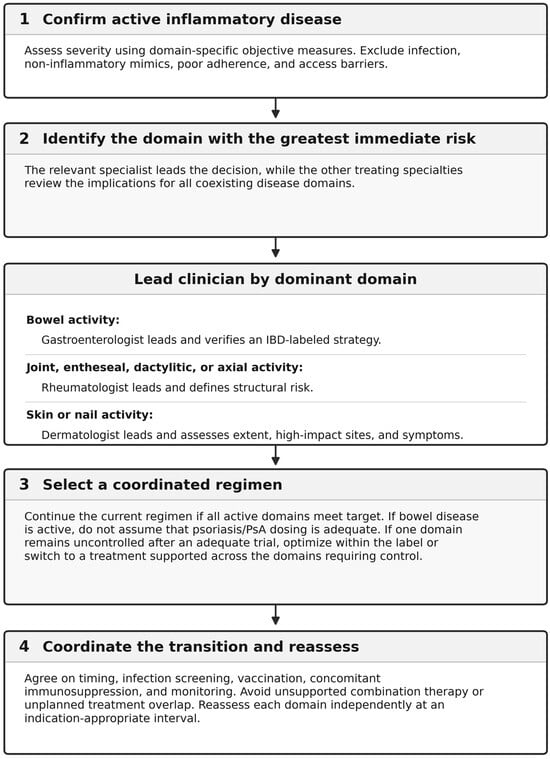
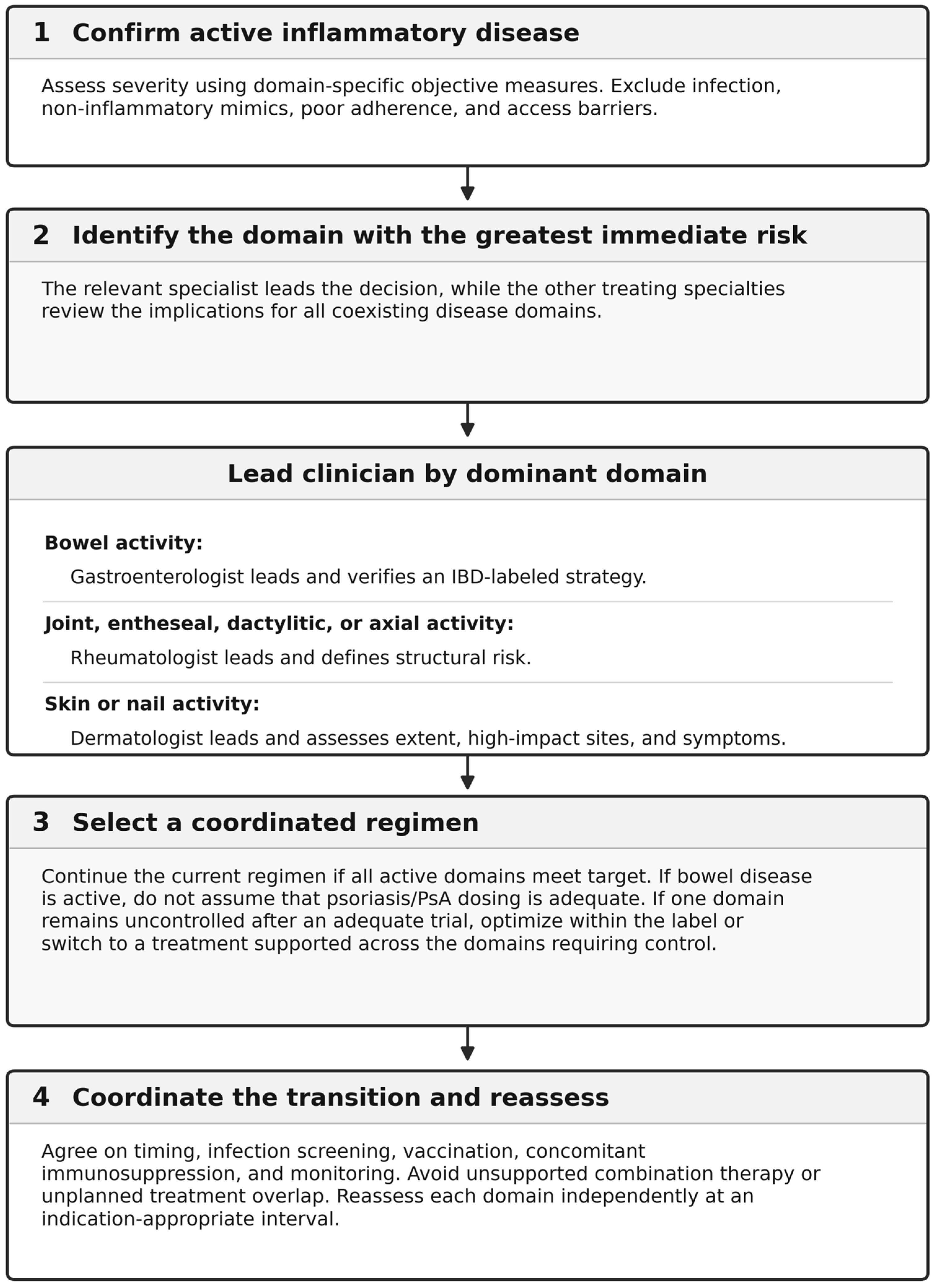
Several practical principles follow. First, the dominant untreated risk should lead selection. Severe bowel inflammation, progressive peripheral arthritis, extensive psoriasis, and probable axial disease do not carry the same consequences or evidence base. Second, the dose must follow the indication being treated; psoriasis or psoriatic arthritis dosing should not be assumed sufficient for active inflammatory bowel disease. Third, response should be measured separately in each domain. Conforti et al. [43] showed that skin-only improvement was only a modest predictor of later joint remission, illustrating why a good dermatologic response cannot substitute for joint assessment. The same principle applies to bowel disease: symptom improvement without biomarker or endoscopic improvement may represent incomplete control. Figure 1 translates these principles into a multidisciplinary decision pathway. The specialist responsible for the domain with the greatest immediate risk should lead the treatment decision: the gastroenterologist for active bowel inflammation, the rheumatologist for articular, entheseal, dactylitic, or axial activity, and the dermatologist for predominant skin or nail disease. Before changing therapy, the team should confirm inflammatory activity objectively, exclude mimics and adherence or access problems, and review the consequences for every active domain. Transitions between indication-specific regimens should be coordinated; active inflammatory bowel disease requires an IBD-labeled induction and maintenance strategy rather than empirical intensification of a psoriasis or psoriatic arthritis regimen.
Figure 1.
Multidisciplinary decision pathway when disease activity changes during guselkumab treatment. IBD = inflammatory bowel disease; PsA = psoriatic arthritis.
Guselkumab has evidence across multiple inflammatory domains, although the maturity and strength of that evidence differ by indication. Evidence in psoriasis is well established and durable; evidence in peripheral psoriatic arthritis is supported by randomized multidomain trials; efficacy in inflammatory bowel disease is supported by phase 3 programs, although postmarketing experience is newer; and evidence in axial psoriatic arthritis remains provisional. Table 3 summarizes pivotal efficacy findings, while Table 4 outlines clinical contexts, strengths, and limitations.
Table 3.
Pivotal and practice-informing guselkumab studies.
Table 4.
Evidence-based therapeutic positioning.
7. Evidence Gaps and Research Priorities
The first priority is direct comparative evidence within the interleukin-23 p19 class. Network meta-analyses and matching-adjusted comparisons are useful when head-to-head trials are absent, but they remain sensitive to population, endpoint, and analysis differences. Comparative trials should use endoscopic outcomes in inflammatory bowel disease, validated multidomain targets in psoriatic arthritis, and durability rather than only short-term skin clearance in psoriasis.
Second, response-guided dosing needs validation beyond highly selected psoriasis super responders. GUIDE shows that extended intervals can work in early complete responders, whereas the IBD label allows two maintenance intensities. Prospective algorithms should test whether biomarkers, drug concentrations, tissue signatures, or early objective response can identify who needs intensified maintenance and who can safely de-escalate.
Third, dedicated axial psoriatic arthritis and structural-outcome studies are needed. Post hoc and real-world findings are encouraging, but centralized imaging definitions, axial-specific enrollment, and prespecified endpoints are essential. Ultrasound studies such as that of Messina et al. [44] also suggest a role for objective imaging in early response assessment, although larger controlled cohorts are required before imaging-guided decisions enter routine practice.
Fourth, inflammatory bowel disease research should move beyond symptom control toward transmural healing, postoperative recurrence, fistulizing and stricturing disease, treatment after failure of another p19 inhibitor, and long-term comparative safety. The ClinicalTrials.gov search was used for horizon scanning only; because registry entries are dynamic and were not peer-reviewed evidence, ongoing records were not used to support efficacy conclusions. Future prospective studies should determine whether the current efficacy profile translates into disease modification and clearer within-class selection.
Finally, multimorbidity deserves purposeful study. Trials should recruit patients with concurrent active psoriasis, psoriatic arthritis, and inflammatory bowel disease and use coordinated endpoints across specialties. This would test the clinically appealing idea that one pathway-directed therapy can reduce treatment burden without leaving a quieter disease domain undertreated.
8. Limitations of This Review
This is a structured narrative review rather than a systematic review or meta-analysis. The broad search and documented screening reduce selective citation, but study selection ultimately prioritized interpretive value and distinct contributions. Screening and extraction by one reviewer may have increased the risk of selection or transcription error. Europe PMC substantially overlaps PubMed, and subscription-only databases such as Embase and Scopus were not searched; additional reports may therefore have been missed. Many long-term results arise from extensions in which retention can enrich for responders and tolerant patients. Several psoriatic arthritis domain analyses were post hoc, especially for axial symptoms, and real-world comparative studies remain vulnerable to confounding. Most pivotal guselkumab trials were sponsored by the manufacturer. Given the rapidly evolving evidence and regulatory landscape, the conclusions reflect information available through 18 September 2026.
Publication and citation bias cannot be excluded. Positive or practice-informing findings may be more likely to be published, indexed, cited, or retained in an interpretive review. In addition, members of the author group contributed to some cited real-world studies; those reports were included because they addressed prespecified clinical gaps and were interpreted as uncontrolled observational evidence, not as confirmation of randomized efficacy. Trial families were consolidated, distinct contributions were specified, and randomized evidence was given greater interpretive weight, but these safeguards do not remove the possibility of author-group citation bias.
9. Conclusions
Guselkumab has evidence-supported roles across skin, joint, and bowel inflammation. Its strongest evidence remains durable high-level psoriasis clearance. In psoriatic arthritis, randomized and real-world data support improvement in peripheral joints, skin disease, enthesitis, dactylitis, function, and quality of life, including after tumor necrosis factor inhibitor failure. Evidence for axial efficacy remains preliminary because it is derived mainly from post hoc analyses and small real-world cohorts rather than a dedicated axial trial. In Crohn’s disease and ulcerative colitis, large phase 3 programs demonstrate clinical and endoscopic benefit, and intravenous or subcutaneous induction provides practical flexibility.
The clinical value of guselkumab depends on alignment between the available evidence and the patient’s dominant disease domains, with response assessed independently in each organ system. Its broad label does not eliminate the need for domain-based treatment selection, objective monitoring, or recognition of areas in which evidence remains limited. The proposed CD64-related mechanism remains preclinical and contested and should not be used to infer clinical superiority over other p19 inhibitors. Head-to-head p19 inhibitor trials, validated biomarkers, dedicated axial studies, and trials in patients with concurrent psoriatic and bowel disease are needed to refine individualized treatment selection.
Author Contributions
M.B.: Conceptualization, Methodology, Investigation, Writing—original draft, and Writing—review and editing. V.C.: Investigation, Data curation, Formal analysis, and Writing—review and editing. F.M.: Methodology, Investigation, Formal analysis, Visualization, and Writing—review and editing. G.C.: Investigation, Data curation, Validation, and Writing—review and editing. S.M.H.: Investigation, Formal analysis, Visualization, Writing—original draft, and Writing—review and editing. E.F.: Methodology, Supervision, Validation, and Writing—review and editing. M.G.M.: Investigation, Data curation, Formal analysis, and Writing—review and editing. A.C.: Conceptualization, Supervision, Project administration, and Writing—review and editing. All authors have read and agreed to the published version of the manuscript.
Funding
This research received no external funding.
Institutional Review Board Statement
Not applicable.
Informed Consent Statement
Not applicable.
Data Availability Statement
No new data were created or analyzed in this study. Data sharing is not applicable to this article.
Conflicts of Interest
Marco Bonifacio is the owner of Fisioterapia Medica srl. The company had no role in the review design, literature search, study selection, data extraction, interpretation, manuscript preparation, or decision to publish, and no commercial funding was received. The remaining authors declare no conflicts of interest.
References
- Janssen Biotech, Inc. Tremfya (Guselkumab) Injection, for Subcutaneous or Intravenous Use: Prescribing Information. DailyMed. Available online: https://dailymed.nlm.nih.gov/dailymed/drugInfo.cfm?setid=1e6dc9ae-1c4c-42d9-87aa-c315ecc51b56 (accessed on 21 October 2026).
- Baethge, C.; Goldbeck-Wood, S.; Mertens, S. SANRA-a scale for the quality assessment of narrative review articles. Res. Integr. Peer Rev. 2019, 4, 5. [Google Scholar] [CrossRef] [Scilit] [PubMed]
- Rethlefsen, M.L.; Kirtley, S.; Waffenschmidt, S.; Ayala, A.P.; Moher, D.; Page, M.J.; Koffel, J.B. PRISMA-S Group PRISMA-S: An extension to the PRISMA Statement for Reporting Literature Searches in Systematic Reviews. Syst. Rev. 2021, 10, 39. [Google Scholar] [CrossRef] [Scilit] [PubMed]
- Blauvelt, A.; Chen, Y.; Branigan, P.J.; Liu, X.; DePrimo, S.; Keyes, B.E.; Leung, M.; Fakharzadeh, S.; Yang, Y.W.; Muñoz-Elías, E.J.; et al. Differential Pharmacodynamic Effects on Psoriatic Biomarkers by Guselkumab Versus Secukinumab Correlate with Long-Term Efficacy: An ECLIPSE Substudy. JID Innov. 2024, 4, 100297. [Google Scholar] [CrossRef] [Scilit] [PubMed]
- Blauvelt, A.; Langley, R.G.; Branigan, P.J.; Liu, X.; Chen, Y.; DePrimo, S.; Ma, K.; Scott, B.; Campbell, K.; Muñoz-Elías, E.J.; et al. Guselkumab Reduces Disease- and Mechanism-Related Biomarkers More Than Adalimumab in Patients with Psoriasis: A VOYAGE 1 Substudy. JID Innov. 2024, 4, 100287. [Google Scholar] [CrossRef] [Scilit] [PubMed]
- Sachen, K.L.; Hammaker, D.; Sarabia, I.; Stoveken, B.; Hartman, J.; Leppard, K.L.; Manieri, N.A.; Bao, P.; Greving, C.; Lacy, E.R.; et al. Guselkumab binding to CD64+ IL-23-producing myeloid cells enhances potency for neutralizing IL-23 signaling. Front. Immunol. 2025, 16, 1532852. [Google Scholar] [CrossRef] [Scilit] [PubMed]
- Hart, A.; Sridhar, S.; Venkat, S.; Lee, T.; Rusbuldt, J.J.; Richards, D.; Sisk, C.; Horowitz, D.; Tomsho, L.; Kannan, A.K.; et al. Multiomic characterisation of the clinical efficacy of guselkumab induction therapy in ulcerative colitis. BMJ Open Gastroenterol. 2026, 13, e002153. [Google Scholar] [CrossRef] [Scilit] [PubMed]
- Rubin, D.T.; Allegretti, J.R.; Panés, J.; Shipitofsky, N.; Yarandi, S.S.; Huang, K.G.; Germinaro, M.; Wilson, R.; Zhang, H.; Johanns, J.; et al. Guselkumab in patients with moderately to severely active ulcerative colitis (QUASAR): Phase 3 double-blind, randomised, placebo-controlled induction and maintenance studies. Lancet 2025, 405, 33–49, Correction in Lancet 2025, 407, 678. [Google Scholar] [CrossRef] [Scilit] [PubMed]
- Hueber, W.; Sands, B.E.; Lewitzky, S.; Vandemeulebroecke, M.; Reinisch, W.; Higgins, P.D.; Wehkamp, J.; Feagan, B.G.; Yao, M.D.; Karczewski, M.; et al. Secukinumab, a human anti-IL-17A monoclonal antibody, for moderate to severe Crohn’s disease: Unexpected results of a randomised, double-blind placebo-controlled trial. Gut 2012, 61, 1693–1700. [Google Scholar] [CrossRef] [Scilit] [PubMed]
- Zhuang, Y.; Calderon, C.; Marciniak, S.J., Jr.; Bouman-Thio, E.; Szapary, P.; Yang, T.Y.; Schantz, A.; Davis, H.M.; Zhou, H.; Xu, Z. First-in-human study to assess guselkumab (anti-IL-23 mAb) pharmacokinetics/safety in healthy subjects and patients with moderate-to-severe psoriasis. Eur. J. Clin. Pharmacol. 2016, 72, 1303–1310. [Google Scholar] [CrossRef] [Scilit] [PubMed]
- Armstrong, A.; Eyerich, K.; Conrad, C.; Zhu, Y.; Yang, Y.W.; Miller, M.; You, Y.; Shen, Y.K.; Foley, P.; Griffiths, C.E.M.; et al. Immunogenicity and pharmacokinetics of guselkumab among patients with moderate-to-severe psoriasis in VOYAGE-1 and VOYAGE-2. J. Eur. Acad. Dermatol. Venereol. 2023, 37, e1375–e1379. [Google Scholar] [CrossRef] [Scilit] [PubMed]
- Lebwohl, M.; Langley, R.G.; Zhu, Y.; Zhou, H.; Song, M.; Shen, Y.K.; Parnell Lafferty, K.; Reich, K. Use of dose-exposure-response relationships in Phase 2 and Phase 3 guselkumab studies to optimize dose selection in psoriasis. J. Eur. Acad. Dermatol. Venereol. 2019, 33, 2082–2086. [Google Scholar] [CrossRef] [Scilit] [PubMed]
- Cohen-Solal, J.F.; Pohl, C.S.; Cummings, S.M.; Gygi, J.P.; Safikhani, Z.; Bartocha, B.; Buckley, C.D.; Dong, Y.; Eyerich, K.; Karsen, S.D.; et al. CD64 binding potential does not translate into enhanced therapeutic efficacy for anti-IL-23 antibodies under physiologically relevant conditions. Mol. Med. 2026, 32, 70. [Google Scholar] [CrossRef] [Scilit] [PubMed]
- Gordon, K.B.; Duffin, K.C.; Bissonnette, R.; Prinz, J.C.; Wasfi, Y.; Li, S.; Shen, Y.K.; Szapary, P.; Randazzo, B.; Reich, K. A Phase 2 Trial of Guselkumab versus Adalimumab for Plaque Psoriasis. N. Engl. J. Med. 2015, 373, 136–144. [Google Scholar] [CrossRef] [Scilit] [PubMed]
- Blauvelt, A.; Papp, K.A.; Griffiths, C.E.; Randazzo, B.; Wasfi, Y.; Shen, Y.K.; Li, S.; Kimball, A.B. Efficacy and safety of guselkumab, an anti-interleukin-23 monoclonal antibody, compared with adalimumab for the continuous treatment of patients with moderate to severe psoriasis: Results from the phase III, double-blinded, placebo- and active comparator-controlled VOYAGE 1 trial. J. Am. Acad. Dermatol. 2017, 76, 405–417, Correction in J. Am. Acad. Dermatol. 2017, 76, 1226. [Google Scholar] [CrossRef] [Scilit] [PubMed]
- Reich, K.; Armstrong, A.W.; Foley, P.; Song, M.; Wasfi, Y.; Randazzo, B.; Li, S.; Shen, Y.K.; Gordon, K.B. Efficacy and safety of guselkumab, an anti-interleukin-23 monoclonal antibody, compared with adalimumab for the treatment of patients with moderate to severe psoriasis with randomized withdrawal and retreatment: Results from the phase III, double-blind, placebo- and active comparator-controlled VOYAGE 2 trial. J. Am. Acad. Dermatol. 2017, 76, 418–431, Correction in J. Am. Acad. Dermatol. 2017, 76, 1226. [Google Scholar] [CrossRef] [Scilit] [PubMed]
- Langley, R.G.; Tsai, T.F.; Flavin, S.; Song, M.; Randazzo, B.; Wasfi, Y.; Jiang, J.; Li, S.; Puig, L. Efficacy and safety of guselkumab in patients with psoriasis who have an inadequate response to ustekinumab: Results of the randomized, double-blind, phase III NAVIGATE trial. Br. J. Dermatol. 2018, 178, 114–123. [Google Scholar] [CrossRef] [Scilit] [PubMed]
- Reich, K.; Armstrong, A.W.; Langley, R.G.; Flavin, S.; Randazzo, B.; Li, S.; Hsu, M.C.; Branigan, P.; Blauvelt, A. Guselkumab versus secukinumab for the treatment of moderate-to-severe psoriasis (ECLIPSE): Results from a phase 3, randomised controlled trial. Lancet 2019, 394, 831–839. [Google Scholar] [CrossRef] [Scilit] [PubMed]
- Thaçi, D.; Pinter, A.; Sebastian, M.; Termeer, C.; Sticherling, M.; Gerdes, S.; Wegner, S.; Krampe, S.; Bartz, H.; Rausch, C.; et al. Guselkumab is superior to fumaric acid esters in patients with moderate-to-severe plaque psoriasis who are naive to systemic treatment: Results from a randomized, active-comparator-controlled phase IIIb trial (POLARIS). Br. J. Dermatol. 2020, 183, 265–275, Erratum in Br. J. Dermatol. 2020, 183, 980. [Google Scholar] [CrossRef] [Scilit] [PubMed]
- Reich, K.; Gordon, K.B.; Strober, B.E.; Armstrong, A.W.; Miller, M.; Shen, Y.K.; You, Y.; Han, C.; Yang, Y.W.; Foley, P.; et al. Five-year maintenance of clinical response and health-related quality of life improvements in patients with moderate-to-severe psoriasis treated with guselkumab: Results from VOYAGE 1 and VOYAGE 2. Br. J. Dermatol. 2021, 185, 1146–1159. [Google Scholar] [CrossRef] [Scilit] [PubMed]
- Hugo, J.; Kojanova, M.; Turkova, B.; Gkalpakiotis, S. Long-Term Efficacy, Safety, and Drug Survival of Guselkumab in Patients with Psoriasis: Real-World Data from the Czech Republic BIOREP Registry. Dermatol. Ther. 2023, 13, 787–801. [Google Scholar] [CrossRef] [Scilit] [PubMed]
- Puig, L.; Daudén, E.; Cuervas-Mons, M.; Novella, C.; Guisado, C. Persistence and effectiveness of guselkumab treatment in patients with moderate-to-severe plaque psoriasis in a non-interventional real-world setting: The SPRING study. J. Eur. Acad. Dermatol. Venereol. 2025, 39, 27–37. [Google Scholar] [CrossRef] [Scilit] [PubMed]
- Thaçi, D. Real-world evidence for comprehensive evaluation of guselkumab in the treatment of psoriasis. J. Eur. Acad. Dermatol. Venereol. 2025, 39, 3–5. [Google Scholar] [CrossRef] [Scilit] [PubMed]
- Eyerich, K.; Asadullah, K.; Pinter, A.; Weisenseel, P.; Reich, K.; Paul, C.; Sabat, R.; Wolk, K.; Eyerich, S.; Lauffer, F.; et al. Noninferiority of 16-Week vs 8-Week Guselkumab Dosing in Super Responders for Maintaining Control of Psoriasis: The GUIDE Randomized Clinical Trial. JAMA Dermatol. 2024, 160, 953–963. [Google Scholar] [CrossRef] [Scilit] [PubMed]
- Schäkel, K.; Reich, K.; Asadullah, K.; Pinter, A.; Jullien, D.; Weisenseel, P.; Paul, C.; Gomez, M.; Wegner, S.; Personke, Y.; et al. Early disease intervention with guselkumab in psoriasis leads to a higher rate of stable complete skin clearance (‘clinical super response’): Week 28 results from the ongoing phase IIIb randomized, double-blind, parallel-group, GUIDE study. J. Eur. Acad. Dermatol. Venereol. 2023, 37, 2016–2027. [Google Scholar] [CrossRef] [Scilit] [PubMed]
- Stein Gold, L.; Gottlieb, A.B.; Armstrong, A.W.; Alkousakis, T.; Bissonnette, R.; Langley, R.G.; Krueger, J.; Papp, K.; Choi, O.; Rowland, K.; et al. SPECTREM phase IIIb clinical trial results through week 16: Guselkumab efficacy and safety for the treatment of low body surface area, moderate psoriasis with high-impact site involvement. Br. J. Dermatol. 2026, 194, 25–36. [Google Scholar] [CrossRef] [Scilit] [PubMed]
- Prajapati, V.H.; Seyger, M.M.B.; Wilsmann-Theis, D.; Szakos, E.; Kaszuba, A.; van Hartingsveldt, B.; Jett, M.; Jiang, G.; Li, S.; Sinha, V.; et al. Guselkumab for the treatment of moderate-to-severe plaque psoriasis in paediatric patients: Results of the phase III randomized placebo-controlled PROTOSTAR study. Br. J. Dermatol. 2025, 192, 618–628. [Google Scholar] [CrossRef] [Scilit] [PubMed]
- Menter, A.; Strober, B.E.; Kaplan, D.H.; Kivelevitch, D.; Prater, E.F.; Stoff, B.; Armstrong, A.W.; Connor, C.; Cordoro, K.M.; Davis, D.M.R.; et al. Joint AAD-NPF guidelines of care for the management and treatment of psoriasis with biologics. J. Am. Acad. Dermatol. 2019, 80, 1029–1072. [Google Scholar] [CrossRef] [Scilit] [PubMed]
- Deodhar, A.; Gottlieb, A.B.; Boehncke, W.H.; Dong, B.; Wang, Y.; Zhuang, Y.; Barchuk, W.; Xu, X.L.; Hsia, E.C. Efficacy and safety of guselkumab in patients with active psoriatic arthritis: A randomised, double-blind, placebo-controlled, phase 2 study. Lancet 2018, 391, 2213–2224. [Google Scholar] [CrossRef] [Scilit] [PubMed]
- Deodhar, A.; Helliwell, P.S.; Boehncke, W.H.; Kollmeier, A.P.; Hsia, E.C.; Subramanian, R.A.; Xu, X.L.; Sheng, S.; Agarwal, P.; Zhou, B.; et al. Guselkumab in patients with active psoriatic arthritis who were biologic-naive or had previously received TNFα inhibitor treatment (DISCOVER-1): A double-blind, randomised, placebo-controlled phase 3 trial. Lancet 2020, 395, 1115–1125, Correction in Lancet 2020, 395, 1114. [Google Scholar] [CrossRef] [Scilit] [PubMed]
- Mease, P.J.; Rahman, P.; Gottlieb, A.B.; Kollmeier, A.P.; Hsia, E.C.; Xu, X.L.; Sheng, S.; Agarwal, P.; Zhou, B.; Zhuang, Y.; et al. Guselkumab in biologic-naive patients with active psoriatic arthritis (DISCOVER-2): A double-blind, randomised, placebo-controlled phase 3 trial. Lancet 2020, 395, 1126–1136, Correction in Lancet 2020, 395, 1114. [Google Scholar] [CrossRef] [Scilit] [PubMed]
- McInnes, I.B.; Rahman, P.; Gottlieb, A.B.; Hsia, E.C.; Kollmeier, A.P.; Xu, X.L.; Jiang, Y.; Sheng, S.; Shawi, M.; Chakravarty, S.D.; et al. Long-Term Efficacy and Safety of Guselkumab, a Monoclonal Antibody Specific to the p19 Subunit of Interleukin-23, Through Two Years: Results From a Phase III, Randomized, Double-Blind, Placebo-Controlled Study Conducted in Biologic-Naive Patients With Active Psoriatic Arthritis. Arthritis Rheumatol. 2022, 74, 475–485. [Google Scholar] [CrossRef] [Scilit] [PubMed]
- Gottlieb, A.B.; McInnes, I.B.; Rahman, P.; Kollmeier, A.P.; Xu, X.L.; Jiang, Y.; Sheng, S.; Shawi, M.; Chakravarty, S.D.; Lavie, F.; et al. Low rates of radiographic progression associated with clinical efficacy following up to 2 years of treatment with guselkumab: Results from a phase 3, randomised, double-blind, placebo-controlled study of biologic-naïve patients with active psoriatic arthritis. RMD Open 2023, 9, e002789. [Google Scholar] [CrossRef] [Scilit] [PubMed]
- Coates, L.C.; Gossec, L.; Theander, E.; Bergmans, P.; Neuhold, M.; Karyekar, C.S.; Shawi, M.; Noël, W.; Schett, G.; McInnes, I.B. Efficacy and safety of guselkumab in patients with active psoriatic arthritis who are inadequate responders to tumour necrosis factor inhibitors: Results through one year of a phase IIIb, randomised, controlled study (COSMOS). Ann. Rheum. Dis. 2022, 81, 359–369. [Google Scholar] [CrossRef] [Scilit] [PubMed]
- Ogdie, A.; Merola, J.F.; Mease, P.J.; Ritchlin, C.T.; Scher, J.U.; Lafferty, K.P.; Chan, D.; Chakravarty, S.D.; Langholff, W.; Wang, Y.; et al. Efficacy and Safety of Guselkumab in Participants with Active Psoriatic Arthritis After Inadequate Response to One Prior Tumor Necrosis Factor Inhibitor: Week-24 Results of a Phase 3, Randomized, Placebo-Controlled Study. Arthritis Rheumatol. 2026, 78, 1674–1686. [Google Scholar] [CrossRef] [Scilit] [PubMed]
- McGonagle, D.; McInnes, I.B.; Deodhar, A.; Schett, G.; Shawi, M.; Kafka, S.; Karyekar, C.S.; Kollmeier, A.P.; Hsia, E.C.; Xu, X.L.; et al. Resolution of enthesitis by guselkumab and relationships to disease burden: 1-year results of two phase 3 psoriatic arthritis studies. Rheumatology 2021, 60, 5337–5350. [Google Scholar] [CrossRef] [Scilit] [PubMed]
- McGonagle, D.; McInnes, I.B.; Deodhar, A.; Schett, G.; Shawi, M.; Chakravarty, S.D.; Kollmeier, A.P.; Xu, X.L.; Sheng, S.; Xu, S.; et al. Guselkumab, a Selective Interleukin-23 p19 Subunit Inhibitor, Resolves Dactylitis in Patients with Active Psoriatic Arthritis: Pooled Results Through Week 52 From Two Phase 3 Studies. ACR Open Rheumatol. 2023, 5, 227–240. [Google Scholar] [CrossRef] [Scilit] [PubMed]
- Coates, L.C.; Gossec, L.; Zimmermann, M.; Shawi, M.; Rampakakis, E.; Shiff, N.J.; Kollmeier, A.P.; Xu, X.L.; Nash, P.; Mease, P.J.; et al. Guselkumab provides durable improvement across psoriatic arthritis disease domains: Post hoc analysis of a phase 3, randomised, double-blind, placebo-controlled study. RMD Open 2024, 10, e003977. [Google Scholar] [CrossRef] [Scilit] [PubMed]
- Mease, P.J.; Ogdie, A.; Tesser, J.; Shiff, N.J.; Zhao, R.S.; Chakravarty, S.D.; Kelleman, M.; Dodge, R.; McLean, R.R.; Broadwell, A.; et al. Improvements in Patient-Reported Outcomes Through Six Months of Guselkumab Treatment in Patients with Active Psoriatic Arthritis: Real-World Data From the CorEvitas Psoriatic Arthritis/Spondyloarthritis Registry. ACR Open Rheumatol. 2024, 6, 304–311. [Google Scholar] [CrossRef] [Scilit] [PubMed]
- Mease, P.J.; Gladman, D.D.; Poddubnyy, D.; Chakravarty, S.D.; Shawi, M.; Kollmeier, A.P.; Xu, X.L.; Xu, S.; Deodhar, A.; Baraliakos, X. Efficacy of Guselkumab on Axial-Related Symptoms Through up to 2 Years in Adults with Active Psoriatic Arthritis in the Phase 3, Randomized, Placebo-Controlled DISCOVER-2 Study. Rheumatol. Ther. 2023, 10, 1637–1653. [Google Scholar] [CrossRef] [Scilit] [PubMed]
- Foti, R.; Amato, G.; Visalli, E.; Bosco, Y.D.; Lucia, F.; Montana, A.; Privitera, G.; Romeo, P.; Aiello, F.; Paolì, M.G.; et al. Guselkumab in Psoriatic Arthritis: Therapeutic Impact on Axial and Peripheral Involvement-Monocentric Real-World Evidence. J. Clin. Med. 2025, 14, 3151. [Google Scholar] [CrossRef] [Scilit] [PubMed]
- Mease, P.J.; Walsh, J.A.; Fitzgerald, T.P.; Chakravarty, S.D.; Adamson, E.; Emond, B.; Rossi, C.; Schwartzbein, S.; Yokoji, K.; Wang, Y.; et al. On-Label Treatment Persistence Through 24 Months Among Patients with Active Psoriatic Arthritis Initiating Guselkumab or Subcutaneous Tumor Necrosis Factor Inhibitors. Rheumatol. Ther. 2026, 13, 115–134. [Google Scholar] [CrossRef] [Scilit] [PubMed]
- Conforti, A.; Ariani, A.; Gentile, M.; Cataldi, G.; Becciolini, A.; Marchesoni, A.; Parisi, S.; Addimanda, O.; Celletti, E.; Idolazzi, L.; et al. Six months predictors of DAPSA Remission with Guselkumab in Psoriatic Arthritis in a Multicenter Real-World Study. Sci. Rep. 2026, 16, 25243. [Google Scholar] [CrossRef] [Scilit] [PubMed]
- Messina, F.; Caimi, M.; Lucchetti, L.; Bonifacio, M.; Fiorino, E.; Conforti, A. Early and Mid-Term Ultrasound Response to Guselkumab in Psoriatic Arthritis: A Real-World Cohort from a Single Tertiary Rheumatology Center. J. Clin. Med. 2026, 15, 1196. [Google Scholar] [CrossRef] [Scilit] [PubMed]
- Gossec, L.; Kerschbaumer, A.; Ferreira, R.J.O.; Aletaha, D.; Baraliakos, X.; Bertheussen, H.; Boehncke, W.H.; Esbensen, B.A.; McInnes, I.B.; McGonagle, D.; et al. EULAR recommendations for the management of psoriatic arthritis with pharmacological therapies: 2023 update. Ann. Rheum. Dis. 2024, 83, 706–719. [Google Scholar] [CrossRef] [Scilit] [PubMed]
- Sandborn, W.J.; D’Haens, G.R.; Reinisch, W.; Panés, J.; Chan, D.; Gonzalez, S.; Weisel, K.; Germinaro, M.; Frustaci, M.E.; Yang, Z.; et al. Guselkumab for the Treatment of Crohn’s Disease: Induction Results From the Phase 2 GALAXI-1 Study. Gastroenterology 2022, 162, 1650–1664.e8, Correction in Gastroenterology 2022, 165, 1588. [Google Scholar] [CrossRef] [Scilit] [PubMed]
- Danese, S.; Panaccione, R.; Feagan, B.G.; Afzali, A.; Rubin, D.T.; Sands, B.E.; Reinisch, W.; Panés, J.; Sahoo, A.; Terry, N.A.; et al. Efficacy and safety of 48 weeks of guselkumab for patients with Crohn’s disease: Maintenance results from the phase 2, randomised, double-blind GALAXI-1 trial. Lancet Gastroenterol. Hepatol. 2024, 9, 133–146. [Google Scholar] [CrossRef] [Scilit] [PubMed]
- Panaccione, R.; Feagan, B.G.; Afzali, A.; Rubin, D.T.; Reinisch, W.; Panés, J.; Danese, S.; Hisamatsu, T.; Terry, N.A.; Salese, L.; et al. Efficacy and safety of intravenous induction and subcutaneous maintenance therapy with guselkumab for patients with Crohn’s disease (GALAXI-2 and GALAXI-3): 48-week results from two phase 3, randomised, placebo and active comparator-controlled, double-blind, triple-dummy trials. Lancet 2025, 406, 358–375. [Google Scholar] [CrossRef] [Scilit] [PubMed]
- Hart, A.; Panaccione, R.; Steinwurz, F.; Danese, S.; Hisamatsu, T.; Cao, Q.; Ritter, T.; Seidler, U.; Olurinde, M.; Vetter, M.L.; et al. Efficacy and Safety of Guselkumab Subcutaneous Induction and Maintenance in Participants with Moderately to Severely Active Crohn’s Disease: Results From the Phase 3 GRAVITI Study. Gastroenterology 2025, 169, 308–325. [Google Scholar] [CrossRef] [Scilit] [PubMed]
- Afzali, A.; Danese, S.; Panaccione, R.; Rubin, D.T.; Sands, B.E.; Reinisch, W.; Panés, J.; Van Rampelbergh, R.; Terry, N.A.; Salese, L.; et al. Five-year efficacy and safety of guselkumab for moderately to severely active Crohn’s disease: Results from the phase 2 GALAXI 1 trial. Inflamm. Bowel Dis. 2026, 32, 1669–1682. [Google Scholar] [CrossRef] [Scilit] [PubMed]
- Al Hosani, M.; Al Hosani, N.; Alzaabi, M.N.; Alahmad, M.A.; Omar, N.M.; Oribiana, C.C.; Ahmed, E.F.; Ahmed, I.; Chitra Kumar, K.K.; Hanif, S.; et al. Real-world effectiveness of guselkumab for induction of remission in Crohn’s disease: A prospective multicenter cohort study with propensity score-matched comparison to risankizumab. Crohns Colitis 360 2026, 8, otag061. [Google Scholar] [CrossRef] [Scilit] [PubMed]
- Peyrin-Biroulet, L.; Allegretti, J.R.; Rubin, D.T.; Bressler, B.; Germinaro, M.; Huang, K.G.; Shipitofsky, N.; Zhang, H.; Wilson, R.; Han, C.; et al. Guselkumab in Patients with Moderately to Severely Active Ulcerative Colitis: QUASAR Phase 2b Induction Study. Gastroenterology 2023, 165, 1443–1457. [Google Scholar] [CrossRef] [Scilit] [PubMed]
- Lichtenstein, G.R.; Allegretti, J.R.; Rubin, D.T.; Magro, F.; Bressler, B.; Panés, J.; Afif, W.; Samaan, M.A.; Ye, B.D.; Yarandi, S.; et al. Efficacy and Safety of Guselkumab for Ulcerative Colitis Through Week 92 of the QUASAR Long-Term Extension Study. Am. J. Gastroenterol. 2026. ahead of print. [Google Scholar] [CrossRef] [Scilit] [PubMed]
- Long, M.; Allegretti, J.R.; Danese, S.; Germinaro, M.; Baker, T.; Alvarez, Y.; Kavalam, M.; Han, C.; Jörgens, S.; Jiang, L.; et al. Efficacy and safety of subcutaneous guselkumab induction therapy in participants with moderately to severely active ulcerative colitis (ASTRO): A double-blind, treat-through, randomised, placebo-controlled, phase 3 trial. Lancet Gastroenterol. Hepatol. 2026, 11, 284–298. [Google Scholar] [CrossRef] [Scilit] [PubMed]
- Feagan, B.G.; Sands, B.E.; Sandborn, W.J.; Germinaro, M.; Vetter, M.; Shao, J.; Sheng, S.; Johanns, J.; Panés, J. Guselkumab plus golimumab combination therapy versus guselkumab or golimumab monotherapy in patients with ulcerative colitis (VEGA): A randomised, double-blind, controlled, phase 2, proof-of-concept trial. Lancet Gastroenterol. Hepatol. 2023, 8, 307–320. [Google Scholar] [CrossRef] [Scilit] [PubMed]
- Shao, J.; Vetter, M.; Vermeulen, A.; Feagan, B.G.; Sands, B.E.; Panés, J.; Xu, Z. Combination Therapy with Guselkumab and Golimumab in Patients with Moderately to Severely Active Ulcerative Colitis: Pharmacokinetics, Immunogenicity and Drug-Drug Interactions. Clin. Pharmacol. Ther. 2024, 115, 1418–1427. [Google Scholar] [CrossRef] [Scilit] [PubMed]
- Conforti, A.; Gentile, M.; Cipolloni, V.; Lucchetti, L.; Priora, M.; Becciolini, A.; Celletti, E.; Penta, M.D.; Lo Gullo, A.; Paroli, M.; et al. Comparative treatment persistence of upadacitinib vs. tofacitinib in psoriatic arthritis: A multicenter observational study from the BIRRA cohort. Front. Med. 2026, 13, 1813319. [Google Scholar] [CrossRef] [Scilit] [PubMed]
- Ananthakrishnan, A.N.; Murad, M.H.; Scott, F.I.; Agrawal, M.; Haydek, J.P.; Limketkai, B.N.; Loftus, E.V., Jr.; Singh, S. Comparative Efficacy of Advanced Therapies for Management of Moderate-to-Severe Ulcerative Colitis: 2024 American Gastroenterological Association Evidence Synthesis. Gastroenterology 2024, 167, 1460–1482. [Google Scholar] [CrossRef] [Scilit] [PubMed]
- Singh, S.; Murad, M.H.; Yuan, Y.; Ananthakrishnan, A.N.; Click, B.; Syal, G.; Haydek, J.P.; Agrawal, M.; Kappelman, M.D.; Lewis, J.D.; et al. Comparative Efficacy of Advanced Therapies for Management of Moderate-to-Severe Crohn’s Disease: 2025 AGA Evidence Synthesis. Gastroenterology 2025, 169, 1516–1536. [Google Scholar] [CrossRef] [Scilit] [PubMed]
- Scott, F.I.; Ananthakrishnan, A.N.; Click, B.; Agrawal, M.; Syal, G.; Haydek, J.P.; Yuan, Y.; Kappelman, M.D.; Lewis, J.D.; Singh, S. AGA Living Clinical Practice Guideline on the Pharmacologic Management of Moderate-to-Severe Crohn’s Disease. Gastroenterology 2025, 169, 1397–1448, Correction in Gastroenterology 2025, 170, 441. [Google Scholar] [CrossRef] [Scilit] [PubMed]
- Singh, S.; Loftus, E.V., Jr.; Limketkai, B.N.; Haydek, J.P.; Agrawal, M.; Scott, F.I.; Ananthakrishnan, A.N. Electronic address: Clinicalpractice@gastro.org, AGA Living Clinical Practice Guideline on Pharmacological Management of Moderate-to-Severe Ulcerative Colitis. Gastroenterology 2024, 167, 1307–1343. [Google Scholar] [CrossRef] [Scilit] [PubMed]
- Pugliano, C.L.; Liang, R.F.; Ruffa, A.; Iacucci, M.; Ghosh, S. Practical considerations for the use of IL-23p19 inhibitors in inflammatory bowel disease: How to choose between them and why it matters? J. Crohns Colitis 2025, 19, jjaf144. [Google Scholar] [CrossRef] [Scilit] [PubMed]
- Lebwohl, M.G.; Merola, J.F.; Rowland, K.; Miller, M.; Yang, Y.W.; Yu, J.; You, Y.; Chan, D.; Thaçi, D.; Langley, R.G. Safety of guselkumab treatment for up to 5 years in patients with moderate-to-severe psoriasis: Pooled analyses across seven clinical trials with more than 8600 patient-years of exposure. Br. J. Dermatol. 2023, 189, 42–52. [Google Scholar] [CrossRef] [Scilit] [PubMed]
- Strober, B.; Coates, L.C.; Lebwohl, M.G.; Deodhar, A.; Leibowitz, E.; Rowland, K.; Kollmeier, A.P.; Miller, M.; Wang, Y.; Li, S.; et al. Long-Term Safety of Guselkumab in Patients with Psoriatic Disease: An Integrated Analysis of Eleven Phase II/III Clinical Studies in Psoriasis and Psoriatic Arthritis. Drug Saf. 2024, 47, 39–57. [Google Scholar] [CrossRef] [Scilit] [PubMed]
- Xiang, D.C.; Chen, W.; Fu, Z.W.; Wu, X.H.; Gao, P.; Wu, Y. Adverse events of guselkumab in the real world: Emerging signals to target preventive strategies from the FDA adverse event reporting system. Expert. Opin. Drug Saf. 2023, 22, 943–955. [Google Scholar] [CrossRef] [Scilit] [PubMed]

Disclaimer/Publisher’s Note: The statements, opinions and data contained in all publications are solely those of the individual author(s) and contributor(s) and not of MDPI and/or the editor(s). MDPI and/or the editor(s) disclaim responsibility for any injury to people or property resulting from any ideas, methods, instructions or products referred to in the content. |
© 2026 by the authors. Licensee MDPI, Basel, Switzerland. This article is an open access article distributed under the terms and conditions of the Creative Commons Attribution (CC BY) license.