


Abstract
Waste-derived geopolymers and alkali-activated materials are often compared through bulk oxide composition and compressive strength, although precursor reactivity also depends on the physical and mineralogical characteristics of the powder. This critical review examines how phase accessibility, particle-size distribution, specific surface area, morphology, porosity, loss on ignition, and soluble or potentially harmful constituents influence processing, reaction products, and performance. The evidence compiled for nine representative waste-powder classes suggests that total SiO2 and Al2O3 contents are insufficient predictors of reactivity because powders with similar bulk compositions may differ markedly in amorphous content, accessible surface, liquid demand, and dissolution behavior. A comparative profile summarizes quantitative powder characteristics and the advantages and limitations of each precursor class. The review also identifies the functional roles of waste powders as network formers, calcium-rich hardening components, silica-rich modifiers, fillers, internal alkali sources, or contaminant-bearing constituents requiring stabilization. Based on these relationships, the review proposes a powder-centered qualification framework, a decision-gate sequence for industrial deployment, and a minimum reporting dataset linking precursor characteristics with formulation, processing, durability, and environmental evidence. Industrial translation requires performance-based acceptance windows, safer activation, long-term durability and leaching evidence, and region-specific life-cycle, exergy, and techno-economic assessments to determine whether these powder functions can create commercial value at scale.
1. Introduction
Mineral, metallurgical, energy, agricultural, and municipal residues are increasingly being considered as powder precursors for alternative binders, in response to waste accumulation and the need for resource efficiency and decarbonization. Alkali-activated materials (AAMs) and geopolymers are attractive because their reaction chemistry can accommodate aluminosilicate-rich powders that would otherwise require long-term storage. Nevertheless, the environmental value of this route is not intrinsic. It depends on avoided disposal, processing intensity, activator production, curing energy, transport, service life, and the possibility of safe reuse or disposal at end of life [1,2,3,4,5].
Several reviews organize the discussion around individual precursor or waste classes, applications, and reported performance. Although this approach is useful for cataloguing available valorization routes, it may obscure a fundamental source of variability: powders with similar bulk oxide compositions can exhibit different dissolution behavior, rheology, reaction products, and long-term performance. The relevant question is therefore not simply whether a waste contains SiO2 and Al2O3 but whether these elements occur in accessible phases and whether the powder can be processed and activated without disproportionate environmental or economic burdens [6,7,8,9,10,11,12].
Earlier reviews have addressed circular-economy routes, common precursors and activators, geopolymer-concrete mix design, industrial solid wastes, construction and demolition waste (CDW), and quantitative performance trends [6,7,8,9,11,13,14,15,16]. Bernal et al. [17] examined waste management and valorization through alkali-activated cement materials, while El Fadili et al. [8] reviewed alkaline dissolution mechanisms. However, these reviews generally organize the available evidence by waste type, activation route, application, or individual reaction mechanism. This structure makes it difficult to compare chemically dissimilar wastes on the basis of the measurable powder attributes that determine their function in alkali-activated formulations. The gap addressed here is therefore not the absence of information on waste-derived precursors but the lack of an integrated basis for translating powder characteristics into functional roles, processing requirements, and qualification criteria across different waste streams. Accordingly, this review reorganizes the available evidence by linking measurable descriptors and phase accessibility to reaction behavior, precursor function, pretreatment needs, material performance, and application-specific qualification.
Furthermore, this review establishes a powder-centered framework for comparing chemically and mineralogically diverse waste-derived precursors used in geopolymers and AAMs (Figure 1). It examines how composition, phase accessibility, amorphous content, particle-size distribution (PSD), specific surface area (SSA), morphology, porosity, and minor constituents affect precursor reactivity, processing, reaction products, and material performance. The analysis also evaluates pretreatment requirements, environmental and safety evidence, and the conditions needed for raw material qualification and industrial implementation.
2. Scope and Evidence-Selection Strategy
This review is a critical narrative synthesis rather than a systematic review or meta-analysis. The selected literature covers geopolymer and AAM terminology, waste-powder characteristics, dissolution and activation, processing, durability, environmental assessment, and industrial implementation. Recent studies are considered alongside foundational work on reaction mechanisms and assessment principles [1,2,3,4,5,6,7,8,18].
Nine representative classes are covered: low-calcium fly ash, ground granulated blast-furnace slag (GGBS), bauxite residues, rice husk ash (RHA), silica fume, waste glass, stone/mining fines, CDW powder, and municipal solid waste incineration (MSWI) ash. These classes were selected purposively to span contrasting chemical functions, physical structures, pretreatment demands, and contaminant constraints, rather than to represent their global production volumes or publication frequencies. Coal bottom ash, other metallurgical slags, and phosphate-processing residues are discussed where they clarify the behavior of these classes or their blends. MSWI fly ash and bottom ash remain distinct streams within the MSWI class. Metakaolin and other purpose-produced calcined clays are reference or companion precursors, not waste-derived classes.
Figure 1.
Conceptual framework connecting waste origin and powder characteristics with pretreatment, reactivity, material performance, and industrial decision criteria. Solid arrows indicate the main process sequence, whereas dashed double-headed arrows represent interrelationships between the powder fingerprint and the associated stages.
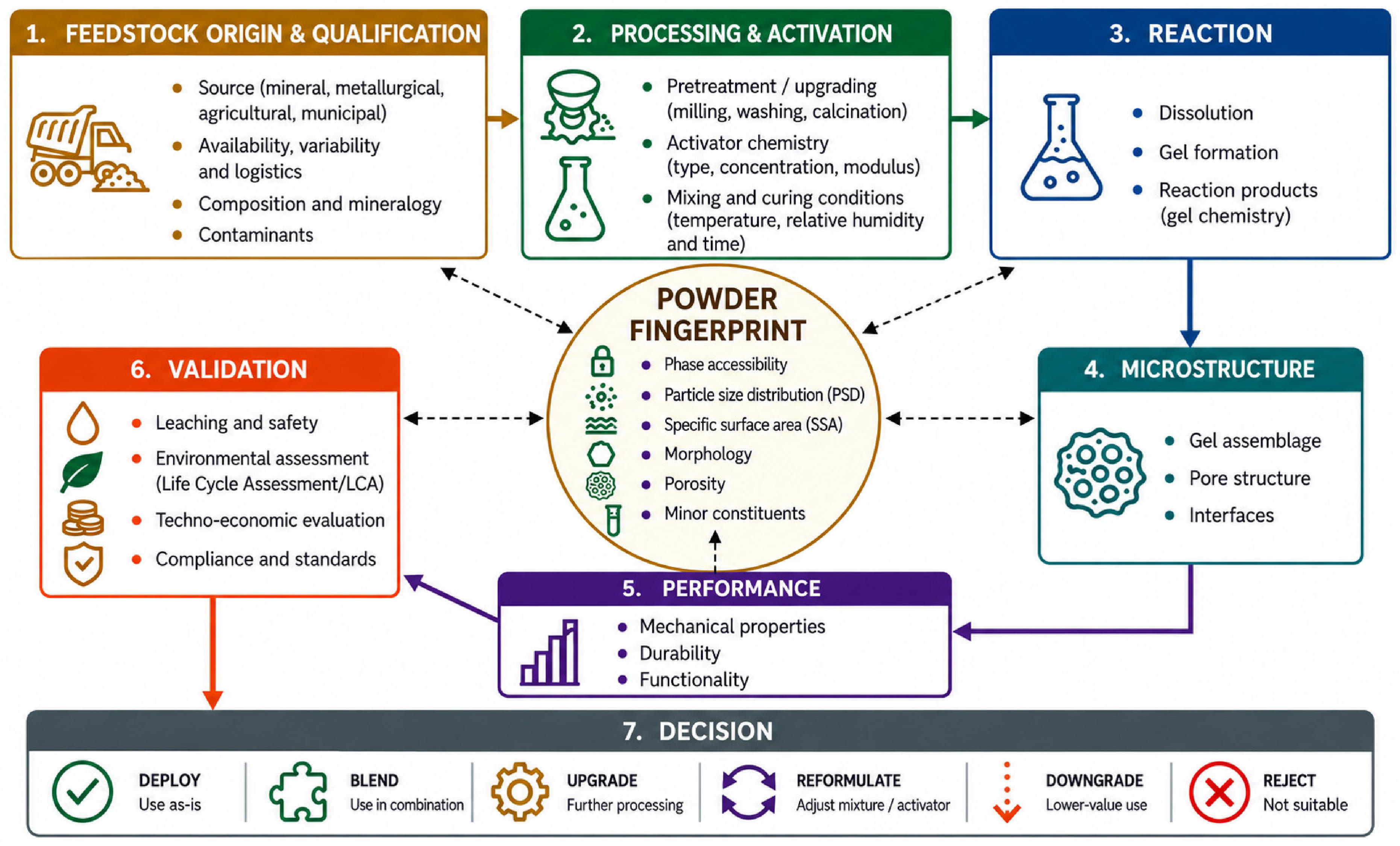
Experimental studies were used to support composition–processing–property relationships, whereas recent reviews were used to position the scope and identify areas of overlap. Numerical results were interpreted as formulation-specific observations rather than universal material constants. This distinction is essential because precursor source, sampling, pretreatment, activator modulus, liquid-to-solid ratio, curing history, test method, and specimen geometry can all change reported performance.
For the evidence summarized here, eligible experimental reports identify the precursor or waste stream and activation route and provide interpretable data on powder characteristics, processing, reaction, performance, durability, environmental behavior, or scale-up. Numerical examples require identifiable formulations, measurement methods, or test conditions; where these differ, the results are discussed separately. Reviews support scope positioning and the interpretation of broader trends, with review-derived values identified as secondary compilations. Abstract-only reports and values that could not be linked to a described material or test were not used to substantiate new quantitative comparisons. Studies of Portland-cement systems are used only as explicitly identified physical or methodological analogies. This purposive selection favors traceable mechanistic evidence and can underrepresent poorly documented or negative results; it is not an exhaustive survey.
Because the literature was selected narratively, the available search record does not support a reliable total of screened records or a duplicate-removal flow. The review therefore does not claim systematic coverage. The reporting dataset and qualification framework are author-developed syntheses of the selected evidence; their transferability requires independent validation.
3. Terminology and Fundamentals of Alkali Activation
The terms geopolymer and AAM are closely related, but the choice between them should reflect the precursor chemistry and the reaction products formed. AAM is the broader category for binders produced through reactions between solid precursors and alkaline activators. In geopolymer systems, low-calcium aluminosilicate precursors are typically associated with three-dimensional alkali aluminosilicate networks and sodium aluminosilicate hydrate (N–A–S–H)-type gels. By contrast, calcium-rich precursors such as GGBS generally promote calcium (alumino)silicate hydrate (C–(A)–S–H)-type products, while blended systems may contain coexisting N–A–S–H, C–(A)–S–H, and hybrid gels [1,2,3,8].
This distinction guides the selection of reaction models, compositional indicators, and relevant durability comparisons. Low-calcium geopolymer networks, Ca-rich alkali-activated slags, and hybrid fly-ash/slag binders may be processed in the same way and still differ in setting, pore-solution chemistry, shrinkage, carbonation response, and phase stability [19,20,21,22,23,24,25,26,27].
Coupled Reaction Stages
Alkali activation begins when a solid precursor is mixed with an alkaline solution or when water is added to a one-part dry mixture containing the precursor and solid activator. Both routes are used in laboratory formulations and industrial production. Wetting establishes liquid contact with particle surfaces and accessible pores, allowing hydroxide and dissolved species to reach reactive domains. Hydroxide attack on susceptible Si–O–Si and Si–O–Al linkages releases silicate and aluminate species, which subsequently reorganize and form reaction products. Dissolution, nucleation, condensation, and precipitation overlap, and the rate-limiting process can change with time and precursor chemistry [8,18,28]. Elevated-temperature curing denotes deliberately imposed curing above the ambient condition; the actual temperature and duration must be specified. For example, Görhan and Kürklü investigated curing at 65 and 85 °C [29]. Greater alkalinity and accessible surface area can accelerate dissolution, whereas excess alkali or insufficient water may impair transport, increase shrinkage, or leave mobile activator species [8,18].
In low-calcium systems, charge-balancing Na+ or K+ cations stabilize negatively charged Al-bearing tetrahedra in the aluminosilicate network. In calcium-rich systems, rapid Ca release favors C–(A)–S–H precipitation and early hardening. In alkali-activated slag systems, Mg is commonly incorporated into hydrotalcite-like phases, whereas the behavior of Fe depends more strongly on its oxidation state, coordination environment, and phase accessibility [24,27]. Figure 2 summarizes these pathways while emphasizing that precursor-specific kinetics govern their relative importance.
4. Powder Properties Governing Precursor Reactivity
4.1. Chemical and Mineralogical Composition
Bulk X-ray fluorescence (XRF) data are useful for preliminary screening but cannot quantify reactive Si and Al. Quartz, mullite, hematite, magnetite, and other stable phases may contribute strongly to total oxide contents while dissolving only marginally under the selected activation conditions. X-ray diffraction (XRD) with quantitative phase analysis, solid-state spectroscopy, selective dissolution, calorimetry, and dissolution testing can help distinguish total composition from accessible composition [8,18].
Figure 2.
Simplified mechanistic representation of overlapping alkali-activation stages and the principal low-calcium and calcium-rich reaction pathways. Black arrows indicate progression from the heterogeneous precursor through dissolution and aqueous speciation to the competing reaction domains. The orange double-headed arrow represents ion exchange and coupling between the low-calcium and calcium-rich domains.
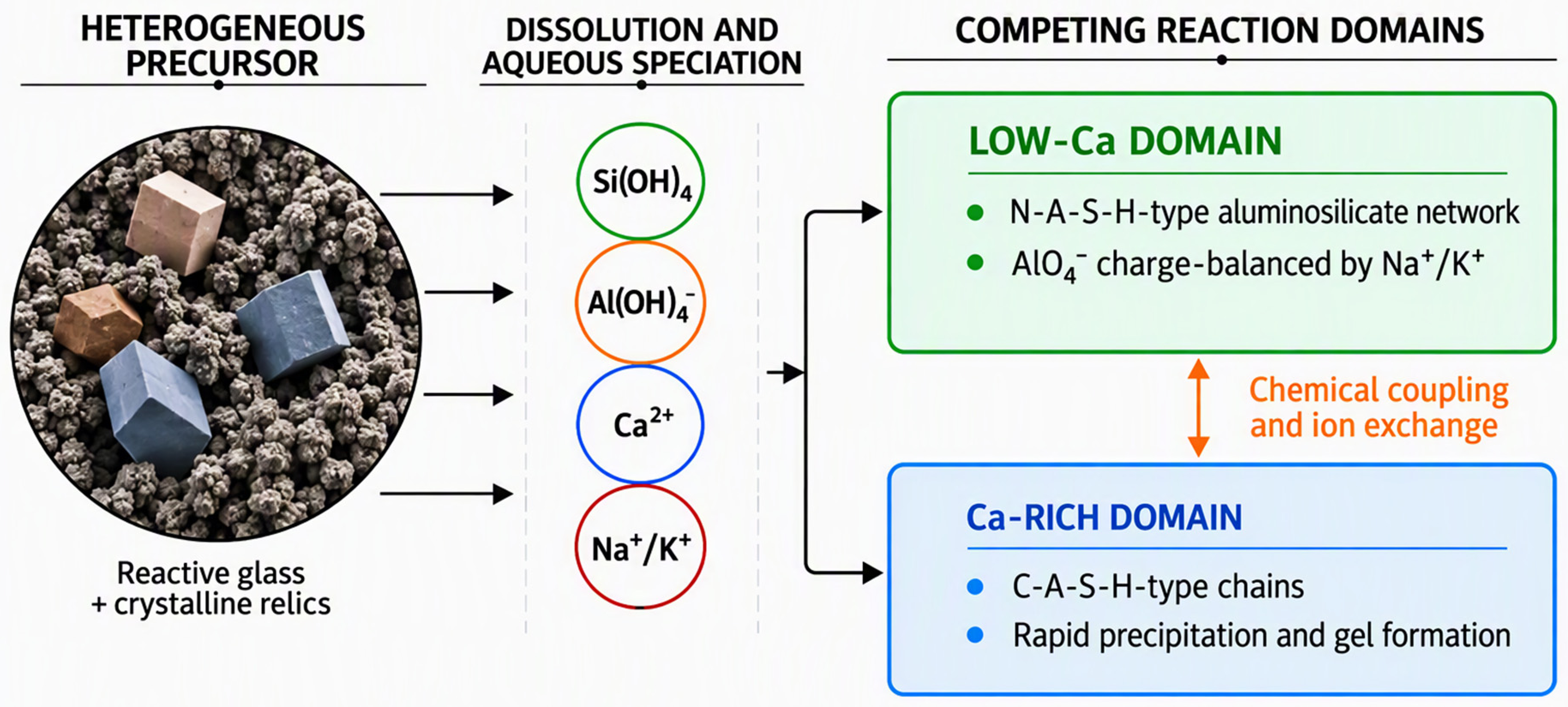
Descriptor selection should follow the property or mechanism being evaluated. Bulk oxides constrain elemental supply; quantitative phase analysis assesses structural availability; PSD, method-specific SSA, and morphology describe access, packing, and liquid demand; and dissolution testing or calorimetry probes reaction under defined activation conditions. The comparative dataset presented in Section 6 retains only descriptors traceable to the selected sources. Uneven reporting identifies missing evidence and does not justify substituting total oxide content for an unreported amorphous or reactive fraction [18,30,31,32,33,34].
Useful compositional indicators include molar Si/Al, alkali/Al, and Ca/(Si+Al), together with Mg content, sulfate, chloride, and loss on ignition (LOI), but no universal optimum applies to all precursor classes. In alkali/Al, alkali denotes monovalent alkali-metal cations, principally Na and K; Ca and Mg are alkaline-earth elements and are reported separately. Authors should specify whether each ratio refers to the bulk precursor, the complete formulation including activator, or a measured dissolved/reactive fraction. The same nominal Si/Al ratio can be obtained from powders with different glass structures, surface areas, and liquid demand. Composition should therefore be interpreted together with phase assemblage and processing history [18,35,36].
4.2. Amorphous Fraction and Structural Accessibility
A larger amorphous fraction can favor dissolution within a comparable material series, but amorphous content alone is not a sufficient predictor and no universal percentage defines a reactive precursor. For example, Fernández-Jiménez et al. quantified vitreous fractions of 65.7–80.6% in the ashes they examined [31]; these values describe that sample set rather than an acceptance threshold. Glass connectivity, chemical heterogeneity, network modifiers, and passivating surface layers also affect dissolution. In quenched GGBS, Ca and Mg modify the aluminosilicate glass structure, increasing the availability of sites susceptible to alkaline attack; dissolved Ca also promotes precipitation of C–(A)–S–H. Its reactivity thus depends on the accessible Ca-bearing glass, not simply on bulk CaO. Crystalline Ca-bearing phases and crystalline quartz or feldspar cannot be assigned the same behavior [2,3,18,24]. Fly-ash particles can contain reactive glass surrounding crystalline inclusions, making local phase accessibility important.
The term amorphous fraction should not be equated with reactive fraction. Quantitative XRD estimates the amount lacking long-range order, whereas dissolution tests probe accessibility under a defined chemical and thermal history. Dissolution results also depend on the test conditions, such as hydroxide concentration, temperature, duration, solid-to-liquid ratio, and analytical correction, which can alter the apparent reactive fraction. Reactivity protocols must therefore be reported in sufficient detail and calibrated against phase and performance measurements [8,18,30,31].
Standardized or well-defined reactivity protocols can improve comparability, although their interpretation must remain consistent with the intended binder system. The Rapid, Relevant and Reliable (R3) test developed by International Union of Laboratories and Experts in Construction Materials, Systems and Structures (RILEM) Technical Committee 267-TRM (Tests for Reactivity of Supplementary Cementitious Materials) evaluates the chemical reactivity of supplementary cementitious materials in a model Portland-cement environment through measurements such as cumulative heat release and chemically bound water. Its direct application to alkali-activated precursors requires caution because the reaction environment differs from that of Portland-cement blends. For geopolymer and alkali-activated systems, dissolution tests in NaOH or other specified alkaline solutions can provide an operational measure of accessible Si, Al, and Ca, provided that hydroxide concentration, temperature, duration, solid-to-liquid ratio, filtration, and analytical procedures are fully reported. Neither approach should be interpreted as a universal measure of intrinsic reactivity; results should be assessed together with quantitative phase analysis, calorimetry, reaction products, and application-relevant performance [18,32].
4.3. PSD, SSA, and Morphology
Reducing particle size increases external surface area and shortens diffusion distances, but the relationship between fineness and reactivity is nonlinear. Intensive milling may expose fresh surfaces and disrupt crystalline order, yet it also consumes energy, changes packing, and can increase agglomeration and liquid demand [33,34].
Morphology controls both fresh behavior and reaction. Spherical fly-ash particles can improve flow and packing, while angular milled residues increase interparticle friction. Highly porous RHA can possess high SSA but also absorb activator solution, reducing free liquid and affecting workability [33,34,37,38]. A useful powder profile must therefore include PSD, shape, surface texture, skeletal density, accessible porosity, and moisture condition.
PSD should be reported as a distribution rather than a single median diameter. The fine-particle fraction influences dissolution and water demand, whereas coarse particles may remain as load-bearing inclusions or flaws. Likewise, Brunauer–Emmett–Teller (BET) SSA, Blaine fineness, and geometric surface area estimated from laser diffraction are not equivalent because each responds differently to internal porosity, agglomeration, and particle shape. Particle-size modification should be linked to energy consumption and to the actual change in accessible reactive surface [30,33,34,39].
4.4. Moisture, LOI, and Minor Constituents
Moisture is a formulation variable rather than a minor reporting detail. Hygroscopic salts, porous particles, and weathered residues can retain water that is counted within the as-received solid mass but becomes available during mixing. Failure to correct for moisture changes the effective alkali concentration and liquid-to-solid ratio [37,40,41]. For industrial streams, water content should be monitored at the point of dosing and linked to an automatic correction protocol rather than measured only on the batch used for initial characterization.
LOI can represent unburned carbon, bound water, carbonates, hydroxides, or organic matter, depending on the precursor and temperature interval. A single LOI value therefore has no universal interpretation. In fly ash, residual carbon can adsorb admixtures and modify water demand; in bauxite residue or clay-bearing fines, mass loss may reflect dehydroxylation; and in carbonate-rich residues, decarbonation can dominate. Thermogravimetric analysis (TGA) profiles and evolved-gas information, when necessary, are more informative than a single endpoint mass loss [42,43].
Minor species can control performance disproportionately to their mass fraction. Soluble chloride and sulfate influence setting, reinforcement risk, efflorescence, and leaching; metallic aluminum in MSWI residues can evolve hydrogen; sulfide in slag can alter redox conditions; and soluble alkalis can contribute to activation while remaining mobile. Screening must therefore combine total composition with water-soluble or pH-dependent fractions selected according to the intended application [44,45,46,47]. These interdependent descriptors are consolidated in Table 1.
Table 1.
Powder attributes that should be reported when evaluating waste-derived precursors.
Table 1 prioritizes quantitative XRD because it characterizes the bulk crystalline-phase assemblage and, with an internal standard and appropriate analysis, estimates amorphous content. Raman spectroscopy provides complementary bonding and phase information. TEM with diffraction resolves local nanoscale domains, although representative sampling is essential. These methods are therefore selected to resolve specific structural questions rather than treated as interchangeable measurements of bulk phase content [27,30,34].
5. Pretreatment and Activation of Waste Powders
5.1. Classification, Drying, and Blending
The first upgrading step is often physical rather than chemical. Source segregation, drying, deagglomeration, magnetic separation, and size classification can reduce variability and remove deleterious fractions. Blending powders from different production periods can stabilize composition, whereas uncontrolled blending may conceal extreme values. Industrial qualification should therefore include a sampling plan that captures temporal and spatial heterogeneity [13,14,33].
5.2. Mechanical Activation
The extent of milling should reflect the limitation being addressed, whether surface accessibility, particle packing, or structural disorder. Overgrinding may increase energy demand, agglomeration, and activator consumption, so the optimum should be defined through both performance and environmental criteria. Particle-size targets should be residue-specific rather than borrowed from Portland cement specifications [8,18,33].
Mechanical activation can involve coupled effects: particle breakage, exposure of previously enclosed glassy domains, and mechanochemical disordering of crystalline or poorly crystalline phases. These contributions should be separated where possible because a strength increase caused by improved packing does not demonstrate enhanced dissolution. Comparative studies should therefore include PSD, SSA, structural or phase evidence, dissolution or calorimetric response, and specific milling energy [34,39].
5.3. Thermal and Chemical Pretreatment
Calcination can dehydroxylate clay-bearing phases, transform goethite, residual boehmite, and sodium aluminosilicate desilication products in bauxite residue, remove organics, and increase structural disorder. The useful treatment window depends on mineralogy, dwell time, and atmosphere. A treatment temperature is excessive when densification or recrystallization reduces accessible reactivity relative to a lower-temperature treatment; the limit must therefore be established experimentally. For example, phosphate-tailings fusion at 550 °C with 10% NaOH produced better mechanical performance than the corresponding 800 °C treatment [48]. This reagent-assisted route must be distinguished from ordinary calcination. Washing and neutralization can reduce soluble alkalis in bauxite residue and remove chlorides and some sulfates from MSWI fly ash, but the resulting aqueous streams require treatment or reuse [49,50]. Pretreatment benefits must consequently be evaluated together with material yield, reagent demand, and energy consumption [5,43,48].
Chemical pretreatments can also redistribute environmental burdens. Acid or alkaline extraction may increase precursor accessibility or enable the recovery of valuable elements, but reagent production, water demand for washing, the handling of corrosive solutions, and the generation of contaminated effluents can dominate the overall process burden. A rigorous pretreatment study should establish complete mass balances for water, salts, metals, and solid yield and compare the upgraded powder with a physically blended alternative at equivalent functional performance [4,5,8,11].
5.4. Activator Selection and Multi-Precursor Blending
Activator selection should be guided by precursor chemistry rather than follow a fixed laboratory recipe. Hydroxide-rich solutions favor rapid dissolution but increase handling hazards and may leave mobile alkalis. Soluble silicates supply polymerizable Si and can accelerate gel formation, yet their manufacture often carries a substantial environmental burden. Carbonate, sulfate, and solid one-part activators can improve logistics or safety for selected Ca-rich systems, but their reaction kinetics and compatibility are precursor-specific [2,4,28,51].
Waste-derived activators may reduce demand for commercial sodium silicate. Silica-rich glass, RHA, and other residues can be dissolved or thermochemically converted to alkaline silicate solutions, while alkaline industrial liquids may partially replace reagent-grade chemicals. Such approaches should not be described as zero-impact: dissolution conditions, filtration, concentration, storage stability, impurities, and secondary solids must be included in the inventory. The activator should be characterized by soluble Si, Al, alkali, carbonate, and water content rather than only by its source name [5,8,37,51,52].
Blending can avoid intensive upgrading when the powders provide complementary functions. A Ca-rich slag may support ambient hardening in a slowly reacting ash; RHA or waste glass may supply silica; and crystalline fines may improve packing without acting as primary reactive precursors. Blend design should therefore assign functional roles before testing whether the combined formulation reduces activator and curing demand while meeting dimensional, durability, and safety requirements [24,25,51,53,54].
Whether functional blending reduces resource demand must be demonstrated through system-level, performance-equivalent assessments that include precursor upgrading, activator production, and curing [5,26,52,55,56,57].
6. Waste-Derived Powder Precursors
Table 2 compiles source-specific powder characteristics, possible chemical roles, and processing constraints for the nine residue classes. Its entries must be interpreted using the measurement and material-state distinctions defined in Section 4, rather than as class-wide specifications [9,10,11,24,36,37,40,44,45,46,58].
Table 2.
Comparative powder-science profile of representative waste-derived precursors.
The comparison highlights complementary formulation requirements. Low-Ca fly ash can supply both Si and Al, whereas RHA, silica fume, and waste glass primarily contribute silica and may require an Al-bearing companion precursor. GGBS provides a reactive calcium source that can support hardening in blends containing slowly reacting powders. For bauxite residues and MSWI ashes, the potential contribution to binder formation must also be considered alongside soluble constituents and potentially harmful elements. Precursor selection should therefore address the limiting requirement of the intended blend, such as insufficient reactive Al, slow hardening, or excessive soluble salts, rather than prioritize waste incorporation alone.
These roles must be tested against a reference formulation that accounts for accompanying changes in precursor proportions, water content, and activator dosage. For a silica-rich addition, for example, reaction and phase measurements are needed to determine whether a strength increase supports the proposed chemical contribution. This approach distinguishes a material’s potential function from its demonstrated contribution under the conditions examined.
Figure 3 complements the quantitative profile by mapping possible material functions and principal qualification requirements. The class-specific evidence supporting these assignments is examined in Section 6.1, Section 6.2, Section 6.3, Section 6.4, Section 6.5 and Section 6.6 [9,10,11,24,36,37,40,44,45,46,58].
Figure 3.
Functional roles and principal qualification requirements of nine representative waste-powder classes, based on the evidence discussed in Section 6.1, Section 6.2, Section 6.3, Section 6.4, Section 6.5 and Section 6.6 and summarized in Table 2 [9,10,11,24,36,37,40,44,45,46,58]. Categories indicate possible functions and required checks, not ordinal reactivity rankings or universal safety classifications.
6.1. Bauxite Residue/Red Mud
Bauxite residue is compositionally variable because it reflects ore mineralogy and Bayer-process conditions. Fe oxides, Al-bearing phases, Ti phases, residual silicates, soluble sodium species, sodium-bearing desilication products (sodalite and cancrinite), and fine particles may all be present. Its high alkalinity and fine texture create handling and environmental concerns, while its reactive aluminosilicate fraction can be insufficient for use as a sole precursor. Successful formulations commonly depend on calcination, washing, co-activation, or blending with fly ash, slag, metakaolin, or silica-rich materials [9,10,11].
Thermal treatment near and above the dehydroxylation range can transform goethite, residual boehmite, and sodium aluminosilicate desilication products and increase the accessibility of selected Al- and Si-bearing components. Meilasari et al. [43] reported 19.06–37.03 MPa for pastes prepared from calcined bauxite-washing residue and alkaline activator; that material was obtained without the Bayer process and must not be treated as equivalent to Bayer red mud. The strength values remain specific to the calcination and activation conditions tested.
The high Fe2O3 content should not automatically be interpreted as beneficial ferrosialate formation. Iron may remain in crystalline oxides, dissolve only partially, or enter secondary products depending on redox and activation conditions. Likewise, leaching performance is formulation- and test-specific. Environmental validation should consider the intended application, exposure conditions, leaching behavior, and relevant regulatory requirements rather than relying on isolated laboratory tests [10,11,42,57].
For bauxite residue, alkalinity is both useful for processing and a safety constraint. Residual sodium can reduce external activator demand, yet soluble alkalinity may intensify efflorescence, alter rheology, and increase early leachate pH. The appropriate metric is therefore not the nominal Na2O content but the fraction that is soluble under mixing conditions and subsequently incorporated, retained in pore solution, or released during exposure [10,11,28,51,57].
6.2. Fly Ash and Coal-Derived Residues
Fly ash remains one of the best-established low-calcium precursors because its glassy aluminosilicate particles can dissolve in alkaline media. Class F ashes (ASTM C618) generally require thermal curing or blending to develop early strength, while higher-Ca ashes can harden more rapidly and form mixed gels. Source transitions away from coal combustion, however, reduce long-term availability in some regions and increase the importance of qualifying stockpiled or nontraditional ashes [2,3,18].
Unburned carbon, variable glass chemistry, cenospheres, crystalline inclusions, and weathering affect activator demand and reactivity. Burnt coal clinker and coal gangue may contain useful Si and Al but typically require finer grinding or blending with a more reactive precursor. Fly ash should therefore be treated as a family of powders, not a single standardized raw material [13,18,21,31,34].
Azevedo [59] compared two beneficiated Type F fly ashes collected from the same thermoelectric complex in different periods. FA-A had D50 = 19.70 µm and BET-SSA = 1.3 m2/g, whereas FA-B had D50 = 30.82 µm and BET-SSA = 0.9 m2/g. After thermal curing at 90 °C for 24 h, the subsequent 1-day strengths were 88.5 and 44.2 MPa, respectively. By the 28-day assessment, these values had decreased to 71.1 and 42.5 MPa, corresponding to losses of approximately 19.7% and 3.8%, calculated from the reported means. The initially finer and stronger system thus showed the greater subsequent strength loss. Fineness alone did not account for this response; differences in phase accessibility and mobile sodium also require consideration. The reported BET values describe the characterized ashes and are not class-wide acceptance limits.
Beyond construction binders, fly-ash activation has been used to coat and cement sulfidic mine waste. In the system examined by Saha et al., the aluminosilicate reaction product encapsulated and passivated sulfide-bearing particles, with the mixture containing 33 wt.% waste rock increasing in compressive strength from approximately 32 MPa after four weeks to 36 MPa after 24 weeks. This example indicates potential structural and environmental benefits, but transfer to other mine wastes requires site-specific acid-generation, leaching, and field-performance evidence [62].
6.3. GGBS and Metallurgical Slags
GGBS is characterized by a reactive Ca–Mg–aluminosilicate glass produced by rapid quenching. It generally accelerates setting and early strength through C–(A)–S–H precipitation and can enable ambient curing. Excessive slag content or aggressive activation may nevertheless cause rapid loss of workability, autogenous shrinkage, or cracking. Sulfide, sulfate, Mg, and minor-metal contents also deserve attention [12,19,27,60].
The Ca–Mg–aluminosilicate glass in GGBS explains its frequent role as the main reactive component of multicomponent waste systems; high bulk CaO, SiO2, and Al2O3 contents alone do not establish this role. Combinations with fly ash, silica fume, red mud, phosphogypsum, carbide slag, basalt powder, and mineral-processing residues have been used to tailor flow, setting, gel chemistry, and immobilization. In one high-performance example, a slag/fly-ash/silica-fume composite series with varying tailings-sand contents, including a tailings-free control, and 2 vol.% polyethylene fibers achieved compressive strengths of 146.1–154.7 MPa and tensile ductilities of 7.2–12.0%. These results represent a heat-cured, specially engineered composite rather than routine geopolymer concrete [36,54,63,64].
Other metallurgical slags cannot be assumed to behave like GGBS. Steel and nonferrous slags may contain free CaO or MgO, metallic inclusions, stable crystalline silicates, and potentially toxic elements. By contrast, in alkali-activated GGBS systems, dissolved Mg commonly contributes to the formation of hydrotalcite-like phases. The behavior of Mg must therefore be interpreted according to its original phase assemblage and accessibility under the selected activation conditions. Other metallurgical slags require phase-specific volume-stability and leaching assessments. In blended systems, slag often functions as the reactive calcium source that compensates for slowly reacting or silica-rich powders [19,24,26,27,65].
In fly-ash/slag blends, the precursor ratio changes more than the total Ca content. It also affects the timing of ion release, the competition between gel assemblages, early-age heat evolution, pore solution, and dimensional response. Consequently, reporting only a bulk Ca/Si ratio cannot distinguish whether calcium was initially available in reactive slag glass or locked in a slowly dissolving crystalline phase [3,18,24,30,60].
6.4. Silica-Rich Wastes: RHA, Silica Fume, and Waste Glass
RHA, silica fume, and waste-glass powder primarily supply silica, but their powder structures differ. Silica fume consists of ultrafine amorphous particles with strong agglomeration and high surface demand. RHA reactivity is governed by combustion temperature, residence time, carbon content, grinding, and the transition between amorphous and crystalline silica. Comparable dependencies have been observed for other silica-rich agro-industrial ashes. Aguilar-Joo et al. [66] reported that palm oil fuel ash mineralogy, relatively coarse particle size, and replacement level influenced phase evolution, density, and compressive strength in alkali-activated mortars whose principal binder was Portland cement. In the formulation studied, increasing the ash content from 5 to 10 wt.% reduced mechanical performance, showing that silica-rich agricultural ashes cannot be evaluated solely from their total SiO2 content and must be considered together with fineness, mineralogical composition, calcium availability, and dosage. Waste glass is compositionally more homogeneous within a product class, but color, additives, ceramics, and contaminants can affect recycling streams [35,37,40].
Because many RHA, silica-fume, and soda-lime waste-glass streams supply little reactive Al, they often perform best as secondary precursors, fillers, or sources for waste-derived silicate activators [38,40,58]. Their addition can increase soluble Si and refine packing, but excessive contents may increase viscosity, delay reaction, or leave a silica-rich matrix with insufficient cross-linking. Reported optimum replacement levels are therefore specific to the companion precursor and activator [35,37,40]. For example, a waste-glass powder mortar reached 87 MPa only after adding calcium aluminate cement and applying heat curing at 95 °C [67].
Optimization of an RHA-based formulation predicted a compressive strength of approximately 47 MPa at an RHA/alkaline-activator ratio of 0.85 and 14 M NaOH; in the same study, a different, semi-ductile formulation had the best fire-retardant response [37]. Partial fly-ash replacement with RHA may delay early strength and alter acid or chloride resistance [38,41]. Ash combustion, carbon content, fineness, dosage, Si/Al balance, and activator concentration help explain differences between these outcomes [35,37,38,41].
Waste glass generally contains a highly amorphous silica-rich structure; soda-lime streams additionally supply Na and Ca. Fine grinding improves dissolution and packing, while coarser particles mainly act as aggregate or filler. Its role should therefore be specified as powder precursor, reactive modifier, aggregate, or raw material for soluble-silicate production rather than described generically as glass addition [40,58].
Long-term assessment of glass-rich systems should also distinguish geopolymer reaction from alkali-silica reaction. Residual glass particles may dissolve beneficially as precursors, but their response depends on particle size, alkali availability, Ca content, and the surrounding gel. Expansion tests developed for Portland-cement concrete cannot always be transferred directly to AAMs without considering their different pore solutions and binding phases [58,68,69].
6.5. Mining, Stone-Processing, and Construction Residues
Granite, basalt, phosphate, excavation, and CDW powders are abundant but often dominated by crystalline minerals. Their principal initial function may be that of a filler rather than a reactive component. Milling, calcination of clay-bearing fractions, or blending with slag and fly ash can improve performance. The most important research need is to quantify the fraction that actually dissolves, avoiding the attribution of strength gains from packing or nucleation to geopolymerization alone [33,36,39,48,63,70,71].
Selective demolition can yield chemically distinct recycled cement paste, ceramic, brick, concrete, and natural-aggregate fractions. Co-valorization of CDW with basalt powder and metakaolin produced strengths above 30 MPa [36]. Yuan et al. [33] separated excavation waste into 1.18–2 mm, 0.075–1.18 mm, and <0.075 mm fractions and calcined each at 850 °C for 2 h. The corresponding 7-day strengths were approximately 3.2, 9.2, and 37.6 MPa. The finest calcined fraction reached 90.61% amorphous content and approximately 48 MPa at 28 days. Classification also enriched clay minerals relative to quartz, so these differences cannot be attributed to particle size alone. Qualification must therefore account for both the change in reactive mineralogy and the energy and material yields associated with separation, grinding, and calcination.
The distinction between precursor and recycled aggregate is particularly important for CDW. Ceramic and hydrated-cement-paste fines may contribute chemically after grinding, whereas quartz-rich natural aggregate commonly remains a filler. Selective demolition, contamination control, and fraction-specific characterization are therefore prerequisites for transferring laboratory results to mixed demolition streams [15,16,72].
Phosphate-processing residues contain Si-, Fe-, P-, Ti-, and Al-bearing phases whose accessibility varies strongly. In metakaolin-containing systems they have been investigated not only as construction binders but also as porous CO2-capture materials. Curing temperature modifies reaction extent and pore structure, illustrating why functional performance cannot be predicted from compressive strength alone [73].
6.6. MSWI Ashes
MSWI fly ash and bottom ash combine high valorization potential with demanding safety constraints. Chlorides, sulfates, metallic Al, glass, Ca phases, and potentially toxic elements vary with waste composition and incinerator operation. Washing, ageing, carbonation, size classification, and blending with GGBS can improve processing and immobilization, but secondary effluents and hydrogen generation from metallic Al must be addressed [44,45].
MSWI bottom ash and fly ash should not be pooled analytically. Bottom ash is usually coarser and more mineral-like after ageing, whereas air-pollution-control residues and fly ash can contain much higher soluble salts and trace-element concentrations. Lower-pH activation may reduce some handling risks, but it also changes dissolution and binding; validation must track both mechanical development and contaminant release [44,45,46].
6.7. From Residue Identity to Functional Blend Design
The class-specific evidence supports distinguishing residue identity, which is needed for source control, from function in a blend. A residue may serve as a network former, hardening component, soluble-Si or alkali source, packing modifier, reinforcing inclusion, or contaminant-bearing constituent requiring stabilization. These functions depend on processing: waste glass, for example, may be used as aggregate, filler, reactive silica, or activator raw material [13,58,72].
Functional design also clarifies why nominal replacement percentages are poor descriptors. Replacing 20 wt.% of fly ash with porous RHA changes solid volume, surface area, available liquid, reactive Si, and packing simultaneously. Equal-mass comparisons should therefore be complemented by solid-volume fractions, surface-area-normalized activator demand, and accessible-element balances. This is particularly important when low-density or highly porous residues are compared with dense slag or glass powders [13,41,58].
A blend suitable for scale-up should retain an application-specific performance window under realistic feedstock variability. Experimental designs should therefore vary moisture, reactive fraction, PSD, and soluble salts over ranges established for the selected waste stream. Retention of acceptable flow, setting, strength, shrinkage, and leaching behavior across these variations is more informative for industrial qualification than a strength maximum obtained at a narrowly controlled composition [9,10,11,18,33,44,45]. The roles and constraints summarized in Table 2 provide a basis for selecting these formulation variables.
Figure 4 compares two quantitative examples within individual studies. In the fly-ash series, fineness varies together with phase characteristics; in the excavation-waste series, size classification changes clay enrichment before calcination. The strength differences consequently reflect coupled powder properties and processing histories, rather than an isolated particle-size effect [33,59].
Figure 4.
Within-study powder–performance comparisons: (a) type F ashes differing in particle size and glass character [59]; (b) size-classified excavation waste calcined at 850 °C for 2 h [33]. Strength ages and processing differ between panels; values are not a cross-system ranking. Bars show reported means, rounded to one decimal; error bars are not reconstructed.
7. From Powder Characteristics to Reaction Products and Microstructure
The influence of a powder on hardened performance can be separated conceptually into chemical and physical contributions. Chemical contributions include dissolution, reaction-product composition, and ion binding. Physical contributions include packing, nucleation, internal curing, pore connectivity, and crack-path modification. Both occur simultaneously, and a residue described as “reactive” may still improve performance mainly through packing at the tested age [13,30,72].
The importance of physical contributions extends beyond alkali-activated systems. Candela-Rengifo et al. [74] demonstrated that differences in PSD, morphology, and packing characteristics of alumina, bauxite, quartz, and silicon carbide powders significantly affected rheology, stiffness, strength, toughness, and reliability in engineered ultra-high-performance concrete (UHPC) formulations. Their results illustrate how particle engineering alone can substantially modify performance, even when chemical reactivity is not the primary design variable.
Calcium-rich blends frequently develop intergrown C–(A)–S–H and alkali aluminosilicate products. Although these assemblages can produce dense matrices, mismatched reaction rates may contribute to heterogeneous shrinkage or unreacted domains. Fe-rich and Mg-rich systems also require phase-specific interpretation because conventional gel labels may obscure distinct coordination environments. Analytical methods should be selected according to the mechanism being tested. Quantitative XRD characterizes crystalline phases and, with an internal standard, estimates amorphous content; SEM with energy-dispersive X-ray spectroscopy (EDX) examines interfaces and local elemental distributions; and calorimetry or solution analysis tracks reaction timing and element release. Fourier transform infrared spectroscopy (FTIR) and Raman spectroscopy detect bonding changes but generally cannot independently quantify overlapping gels. Solid-state nuclear magnetic resonance (NMR) resolves Si/Al coordination and gel connectivity, whereas TEM with diffraction addresses local nanoscale structure. Pore-structure and transport measurements are needed when the interpretation concerns permeability or durability. XRD, SEM/EDX, and calorimetry or dissolution analysis form a practical initial set, with additional methods chosen to resolve the remaining structural question [3,24,27,30,34,72,75].
Microstructure evolves with precursor dissolution, precipitation, and transport. Unreacted particles may improve packing or act as weak interfaces, while pore refinement can coexist with high autogenous stress or unstable binding phases. Measurements at different ages are therefore needed to distinguish physical filling from continued reaction and to assess the contributions of carbonation or drying to later strength [3,24,27,60]. Figure 5 integrates these powder–processing–structure–performance relationships and shows how environmental constraints can require changes in powder selection or formulation.
Figure 5.
Coupled powder–processing–structure–performance–environment framework. Horizontal double-headed arrows represent reciprocal interactions and feedback between adjacent stages. The curved return arrow from environment to powder represents life cycle assessment (LCA) feedback, indicating how environmental considerations inform powder selection and material reformulation.
8. Fresh, Mechanical, Durability, and Functional Performance
8.1. Fresh Properties
Fresh behavior is governed by particle packing, surface area, angularity, absorption, dissolved silicate concentration, and early precipitation [61]. Spherical fly ash can reduce yield stress, while finely milled stone powders, RHA, and silica fume commonly increase liquid demand. A fixed liquid-to-binder ratio therefore does not create comparable rheological conditions across precursor classes. Reporting flow, yield stress or mini-slump together with actual water and activator contents is essential [13,34,72].
Activator composition must be reported on a solids and solution basis. Nominal NaOH molarity does not describe mixtures containing commercial silicate solutions, dissolved waste-derived silicates, carbonates, or substantial moisture in the precursor. At minimum, total water, alkali dosage, soluble-silicate modulus, liquid-to-solid ratio, mixing sequence, resting time, and test temperature should accompany fresh-state data [19,28,29,51,76].
8.2. Mechanical Performance
Compressive strength is the most frequently reported response but is insufficient as the sole measure of precursor suitability. High values can be achieved using concentrated activators, elevated-temperature curing, or large GGBS fractions, yet those choices may impair workability, dimensional stability, cost, or environmental performance. Flexural strength, elastic modulus, fracture behavior, shrinkage, and bond to reinforcement or substrates should match the intended application. Ultra-high-strength waste-based systems demonstrate technical potential, but they do not establish general feasibility for conventional construction [64,77].
Strength comparisons also require equivalent age and curing history. A thermally cured low-Ca geopolymer, an ambient-cured slag-rich binder, and a one-part carbonate-activated material can reach similar 28-day compressive strengths through different kinetic pathways and with different residual risks. Strength should therefore be treated as an application threshold within a multi-criteria assessment, not as the principal ranking variable [19,23,24,28,60,78].
8.3. Durability and Dimensional Stability
Durability depends on gel chemistry, pore connectivity, cracking, exposure solution, and test duration. Low permeability does not guarantee chemical stability if carbonation or leaching changes binding phases. Acid, sulfate, chloride, freeze–thaw, high-temperature, and coupled exposures should be evaluated using application-relevant protocols. Functional uses such as heavy-metal immobilization, mine-waste passivation, CO2 capture, and fire-resistant panels extend the range of applications, but each requires dedicated performance and safety criteria [42,62,73,79,80].
Accelerated durability tests may change reaction mechanisms rather than simply shorten the exposure period. For carbonation, Bernal exposed initially alkaline AAMs to 1.0 ± 0.2 vol.% CO2 at 20 ± 2 °C and 65 ± 5% relative humidity [78]. This defined accelerated regime is not a universal concentration threshold. Consumption of pore-solution alkalinity and possible decalcification of Ca-rich gels depend on buffering capacity, gel chemistry, moisture, and CO2 supply [3,78]. An already acidified solution near pH 4.0 has different buffering and speciation conditions, so its response cannot be inferred from the initially alkaline system. Strong-acid and combined chloride–sulfate–carbonation exposures likewise require phase analysis, strength retention, dimensional measurements, and transport testing to distinguish the governing mechanisms [65,81,82].
In slag-rich systems, rapid reaction denotes substantial dissolution and precipitation during early setting and hardening, with the relevant interval established by calorimetry and setting measurements. Early reaction and pore refinement can promote self-desiccation and autogenous stress; drying introduces additional capillary stresses. The resulting cracks can increase carbonation, chloride ingress, and leaching, so durability inferred from intact specimens may not represent cracked material [26,27,60,65,81].
Efflorescence also affects performance, not only appearance. Migration of alkalis followed by carbonate crystallization may indicate a mobile alkali inventory and connected moisture-transport pathways. Its severity depends on activator excess, curing humidity, pore connectivity, calcium availability, and exposure to CO2; reporting should distinguish superficial deposits from subflorescence and associated microstructural damage [83].
8.4. Functional Performance and Immobilization
Waste-derived AAMs can provide functions beyond load bearing, including thermal insulation, fire resistance, adsorption, pH buffering, mine-waste passivation, and immobilization of potentially toxic elements. These functions arise from different material attributes and should not be inferred from compressive strength. Porosity can benefit adsorption or thermal insulation while reducing strength; dense Ca-rich gels can improve early mechanical performance while remaining sensitive to decalcification; and Fe-rich phases may contribute sorption without participating extensively in network formation [42,48,62,71,73,79,80].
Immobilization claims require evidence for both mechanism and persistence. Reduced aqueous concentration may result from sorption, precipitation, physical encapsulation, or incorporation into reaction products. Each mechanism responds differently to pH, redox conditions, carbonation, and crushing. Sequential extraction or spectroscopy can support mechanistic interpretation, but long-term release under relevant exposure conditions remains the decisive evidence for environmental application [44,45,47,62,71,79].
Fire and high-temperature behavior should be assessed through residual strength, cracking, dimensional change, and thermal conductivity under a specified heating regime [37,42,80]. Moisture loss, pore-pressure development, shrinkage, sintering, and crystallization depend on precursor chemistry and heating rate. Potential emissions during high-temperature exposure should be evaluated separately when required by the composition of the waste-derived feedstock and the intended application. The thermal-performance studies considered here do not provide sufficient evidence to define a general emission profile for waste-derived geopolymers [42,44,45]. Table 3 summarizes the processing variables, observed responses, and comparison limits of representative waste-derived systems.
Table 3.
Representative processing–performance relationships reported for waste-derived systems.
The processing–performance relationships summarized in Table 3 distinguish improvements in precursor accessibility from gains obtained through formulation and composite design. The excavation-waste study combines size classification with calcination, so its strength response cannot be attributed to fineness alone [33]. Likewise, the high strength and tensile ductility of the tailings-containing composite were obtained with an engineered slag/fly-ash matrix and fiber reinforcement; these results do not establish the intrinsic reactivity of the tailings [64]. The mine-tailings bricks illustrate a further distinction: effective metal immobilization coexisted with substantial strength loss during immersion [71]. Mechanical integrity and contaminant retention therefore require separate assessment, followed by verification that both remain acceptable under the intended exposure conditions.
9. Environmental Performance and Circularity
Geopolymer and AAM technologies are often described as low-carbon by default, but environmental results are sensitive to system boundaries and local inventories. Sodium silicate and sodium hydroxide can dominate embodied impacts, particularly when concentrated activators are used. Thermal curing, drying, calcination, and intensive milling may also offset benefits from avoiding clinker. Comparisons should use equivalent functional performance and service life rather than equal binder mass [4,5,52].
Life cycle assessment (LCA) results depend strongly on precursor allocation, activator inventory, electricity mix, transport, and curing. Komkova and Habert [56] used a cradle-to-gate functional unit of 1 m3 of concrete with equivalent compressive strength and reported average global warming potential (GWP) reductions of 57%, 42%, and 39% for slag-, fly-ash-, and metakaolin-based concretes relative to their respective CEM I references. Activators contributed 13–33% of total AAM GWP. The mixes had different precursor and activator inventories; these percentages therefore do not isolate a single powder descriptor or establish equal durability. Metakaolin is a purpose-produced reference, not a waste class. Reporting should include functional unit, system boundaries, allocation, inventory sources, and sensitivity to transport, activator production and service-life assumptions [5,52,56,57].
Waste allocation is another critical assumption. Treating a residue as burden-free can be reasonable when it has no market and its impacts belong to the primary product, but increasing demand may change its status and allocation. Transport distance, scarcity of suitable ashes or slags, avoided landfill, and regional electricity mix may reverse rankings. Consequently, the most defensible claim is conditional: a waste-based binder can reduce impacts when locally available precursors, proportionate processing, low-burden activation, and adequate durability are demonstrated [4,5,52,57].
Circularity also requires safe material loops. A monolith that passes a short-term leaching test may behave differently after carbonation, cracking, or crushing. Environmental assessment should therefore connect waste composition and hazard to product release under service and end-of-life conditions [44,45,47,57,71,79]. Total-element analysis, batch leaching, tank leaching, and pH-dependent tests address different questions. In particular, mineralogical changes during carbonation can alter release even at comparable pH [47], while crushing changes exposed surface and release kinetics. Evidence from fresh material alone is consequently insufficient to establish long-term immobilization.
Exergy-Aware Valorization of Secondary Raw Materials
Mass-based circularity indicators do not describe the thermodynamic quality of the resources consumed during waste upgrading. Exergy measures the maximum useful work obtainable as a system approaches equilibrium with a defined reference environment. An exergy-aware assessment therefore considers electrical and thermal inputs together with the chemical exergy of reagents and material streams, rather than treating diverted waste mass as evidence of resource efficiency. Applied to binder production, this perspective asks whether the required function is obtained without disproportionate demand for energy, virgin reagents, separation, or thermal and mechanical processing [84,85].
Such an assessment should compare secondary feedstocks that require limited drying, classification, or blending with routes involving intensive milling, calcination, chemical extraction, or thermal curing. System boundaries and reference conditions must be consistent, and comparisons must use equivalent strength, durability, service life, safety, and end-of-life requirements [56,57,84,85].
Two published routes illustrate the processing choices and the limits of a direct comparison. Perumal et al. [61] incorporated untreated phyllite dust into a particle-packed slag/silica-fume mortar that reached 145 MPa at 28 days under ambient curing. The dust primarily provided a physical contribution, but slag–activator co-grinding and silica-fume milling still required processing energy. Yuan et al. [33], in contrast, calcined the <0.075 mm excavation-waste fraction at 850 °C for 2 h to obtain a reactive clay-derived precursor, reaching approximately 48 MPa at 28 days after ambient curing. Because the formulations, specimen types, and strength levels differ, these results cannot establish which route has the lower environmental or exergy burden. A valid comparison requires equivalent application performance and inventories covering classification yield, drying, grinding, calcination, activators, curing, transport, and rejected fractions.
A published pilot-based comparison provides quantitative inventory and LCA evidence. Manthos et al. [86] modeled the treatment of 1000 kg of waste glass using data from a geopolymerization unit with a processing capacity of 0.5 metric tonnes per hour. The route required 56 kg NaOH and 87.5 MJ of electricity (24.3 kWh), whereas conventional recycling required 25 kWh of electricity and 103.59 MJ of heat. Compared with conventional recycling, the modeled geopolymer route reduced the climate change impact by 26 kg of CO2 equivalent per metric tonne of waste glass. However, geopolymerization credited cement-tile displacement, while recycling credited silica-sand displacement. The result therefore depends on substitution assumptions and does not establish equivalent durability or quantify exergy destruction.
A quantitative exergy comparison would additionally require consistent reference conditions, material and energy balances, reagent chemical exergies, product yields, and losses [84,85]. Electrical consumption or LCA indicators alone cannot establish exergy efficiency or destruction. In the absence of complete inventories for functionally equivalent routes, exergy is retained as an assessment perspective rather than a quantified acceptance gate.
10. Standardization, Scale-Up, and Industrial Implementation
Laboratory formulations commonly rely on narrowly characterized batches, controlled curing, and reagent-grade activators. Industrial production must tolerate raw material fluctuations, moisture changes, storage ageing, mixing-scale effects, and ambient-temperature variation. The appropriate response is not to demand a single fixed chemical composition but to define performance-based raw material acceptance windows linked to a robust mix-adjustment protocol [4,52,57,62].
Acceptance windows should be tied to an intended application. A powder rejected for structural concrete may remain suitable for blocks, controlled low-strength material, mine backfill, adsorbent supports, fire-resistant panels, or immobilization matrices. Considering these uses allows processing intensity to be matched to product value and risk [4,52,57,62]. Figure 6 presents an author-proposed qualification sequence. Its individual evidence requirements follow documented concerns over source variability, durability, leaching, environmental inventory, and standards, but their integration has not been validated as an industrial decision algorithm [26,47,56,57,87]. Gate thresholds must therefore be set for the application and jurisdiction; failure can trigger reformulation or a different use rather than automatic disposal.
Figure 6.
Proposed decision-gate sequence for waste-powder qualification and industrial deployment. Gates organize literature-supported evidence requirements; their combined predictive performance and universal acceptance thresholds have not been established [26,47,56,57,87].
Qualification should combine routine control tests with periodic advanced characterization. Moisture, LOI, PSD, selected oxide ratios, soluble constituents, and fresh-state response can support monitoring of feedstock and formulation variability, while phase characterization and leaching tests provide additional evidence when changes in source or material composition require further assessment. Such qualification should account for the specific characteristics of the waste stream, environmental performance, processing requirements, and variability in the environmental burdens associated with precursor treatment and use [44,52,57,62].
One-part systems and lower-hazard activators can improve handling and field implementation, but they do not automatically reduce environmental burden. Dry activator manufacture, precursor–activator storage compatibility, dust exposure, heat release, and shelf life require explicit evaluation. Sodium carbonate and waste-derived activators are promising, although their slower or precursor-specific reaction pathways reinforce the need for performance-based qualification [28,51].
From Scientific Qualification to Commercial Value Creation
Commercial qualification must link feedstock supply and processing to the cost and performance requirements of a defined product [88,89]. Waste diversion alone does not establish commercial value.
Product segmentation should be evaluated against application-specific qualification requirements and market demand. Potential structural, non-structural, adsorption, thermal-insulation, fire-resistance, passivation, and immobilization applications require distinct performance and safety evidence; their technical feasibility does not establish certification or profitability [89,90].
The qualification procedure can also define the information exchanged between waste suppliers, binder producers, and end users [88,89,90]. Potential commercial offerings include qualified powders, regional multi-precursor blends, one-part binders, application-specific matrices, formulation licensing, and qualification services. These are proposed routes for validation, rather than business models demonstrated by industrial sales or adoption data in this review.
Commercial feasibility should nevertheless be established through an application-specific techno-economic assessment; for alkali-activated adsorbents, operating and investment costs and legislation are among the productization considerations discussed by Al Natsheh et al. [91]. Relevant variables include feedstock availability and consistency, avoided disposal or treatment costs, preprocessing and activator costs, transport distances, curing requirements, production-scale quality control, regulatory qualification, service life, and end-of-life obligations. Comparisons with incumbent solutions should include the cost of maintaining performance under realistic feedstock variability [7,87,89,90].
A quantitative economic example is the study of You et al. [92], which modeled a fly-ash geopolymer plant operating over 20 years with a 10% discount rate and explicit capital, operating, reagent, and transport costs. Sodium silicate and NaOH prices and product revenue were major economic drivers; a sodium-silicate price near USD 400 per metric tonne permitted profitability at a product price near USD 50 per metric tonne under the modeled conditions. These are historical, scenario-specific feasibility results, not current prices or universal commercial thresholds. They illustrate why reagent-price and product-revenue sensitivity must be considered when assessing commercial feasibility.
11. Research Gaps and Future Directions
Future research should move from isolated strength optimization toward transferable precursor descriptors. Shared datasets should report raw powder properties, activator composition, curing history, fresh behavior, reaction extent, and durability using machine-readable formats. Interlaboratory studies are needed to determine which descriptors most reliably predict performance across sources [30,32].
Priority areas include low-burden and waste-derived activators, ambient curing, control of shrinkage and efflorescence, long-term coupled exposures, pH-dependent leaching, carbonation-sensitive binding, and end-of-life recyclability [26,28,47,51,81,82,83]. Comparative studies should include an optimized Portland-cement or commercially relevant reference rather than only an internal mixture control.
A further priority is to quantify the cost of maintaining qualified feedstock supply, rather than evaluating only an optimized laboratory formulation. Sensitivity analyses should account for batch rejection, corrective blending, additional testing, and changes in activator demand [52,57,87,91]. Exergy and techno-economic indicators should be connected to the same functional unit used for durability assessment and LCA [52,84,85]. The principal evidence gaps, their immediate consequences, and the experiments needed to reduce industrial uncertainty are summarized in Table 4.
Table 4.
Priority research needs for the industrial use of waste-derived powder precursors.
The research needs identified in Table 4 are interdependent. Uncertainty in the reactive fraction, for example, limits the interpretation of feedstock variability: a change in bulk composition cannot, by itself, establish whether activator dosage should be adjusted. Similarly, activator optimization must consider dimensional stability and release behavior, because a formulation selected for early strength may still require changes to meet service conditions. Investigating these responses together across representative batches and curing conditions would help establish whether formulation adjustments compensate for source variability without compromising other application requirements [26,30,32,47,87,88,89].
To support these assessments, Table 5 organizes the proposed minimum reporting dataset by the decision each evidence block supports. The powder fingerprint identifies the starting material; reaction measurements distinguish chemical contribution from filler effects; and activator and processing records permit formulation reproduction. Fresh-state, dimensional, mechanical, and durability data then establish application constraints, while environmental and safety records support assessment of resource use and release risks. Supporting methods depend on the interpretation: BET analysis is relevant when accessible surface area is used to explain performance but is not compulsory for every study. Missing measurements and their consequences should be stated explicitly. The dataset is a reporting aid, not a consensus standard or a validated industrial acceptance specification [19,26,27,30,57].
Table 5.
Proposed minimum reporting dataset for waste-derived geopolymer and AAM studies.
12. Conclusions
Waste powders are not interchangeable aluminosilicate sources. Their suitability for geopolymer and AAM production is determined by a set of interrelated characteristics comprising chemical inventory, phase accessibility, amorphous structure, particle size, surface area, morphology, porosity, minor constituents, and processing history. Total SiO2 and Al2O3 contents alone are therefore insufficient predictors of reactivity.
Functional blend design assigns each residue a specific role: a reactive aluminosilicate network former, calcium-rich hardening component, silica-rich modifier, filler, internal alkali source, or contaminant-bearing material requiring stabilization. Mechanical and thermal upgrading can improve performance but must be justified in terms of energy use, emissions, secondary wastes, and cost.
Industrial implementation requires raw material qualification, adaptive formulation, safer activation, application-specific durability and leaching evidence, and regionally grounded life-cycle and techno-economic assessments. The proposed framework connects powder descriptors to these requirements but has not been validated as an integrated industrial model. Multi-batch trials, pilot production, and comparisons with incumbent solutions are needed to establish its practical value, including processing demand, cost, service life, and, where complete inventories permit, exergy performance.
The evidence base remains uneven. Fly ash and GGBS support comparatively mature mechanistic and durability interpretations, whereas studies of bauxite residue, mixed construction waste, mining fines, silica-rich agricultural ashes, and MSWI powders are more source-specific and often limited to short curing periods or single batches. This imbalance restricts transferability across waste streams and makes explicit reporting of material state, test conditions, and missing evidence essential. Circularity claims must ultimately be supported by retained material function, controlled release risks, and proportionate resource inputs.
Author Contributions
Conceptualization, D.R., R.C.D.C. and J.S.C.; investigation, D.R., J.W., R.C.D.C. and J.S.C.; writing—original draft preparation, D.R., M.G. and J.S.C.; writing—review and editing, D.R., J.W., J.B., M.G., E.D.R., R.C.D.C. and J.S.C.; visualization, D.R., J.W. and M.G.; supervision, E.D.R., R.C.D.C. and J.S.C.; project administration, J.W. and J.S.C.; funding acquisition, J.B. and R.C.D.C. All authors have read and agreed to the published version of the manuscript.
Funding
This work was supported by the Fundação de Desenvolvimento da Pesquisa (FUNDEP) through a scholarship and the Conselho Nacional de Desenvolvimento Científico e Tecnológico (CNPq) and the Instituto Nacional de Ciência e Tecnologia em Transformação Circular de Materiais (INCT-TCM, Process No. 408858/2024-9).
Institutional Review Board Statement
Not applicable.
Informed Consent Statement
Not applicable.
Data Availability Statement
No new data were created or analyzed in this study. Data sharing is not applicable to this article.
Acknowledgments
The authors gratefully acknowledge the support of the agencies listed in the Funding section. The authors used ChatGPT-6.1 (OpenAI) to assist with language editing, refinement of clarity and readability, and the preparation of conceptual schematic figures.
Conflicts of Interest
The authors declare no conflicts of interest.
References
- Duxson, P.; Fernández-Jiménez, A.; Provis, J.L.; Lukey, G.C.; Palomo, A.; van Deventer, J.S.J. Geopolymer Technology: The Current State of the Art. J. Mater. Sci. 2007, 42, 2917–2933. [Google Scholar] [CrossRef] [Scilit]
- Provis, J.L. Alkali-Activated Materials. Cem. Concr. Res. 2018, 114, 40–48. [Google Scholar] [CrossRef] [Scilit]
- Bernal, S.A.; Provis, J.L.; Walkley, B.; San Nicolas, R.; Gehman, J.D.; Brice, D.G.; Kilcullen, A.R.; Duxson, P.; van Deventer, J.S.J. Gel Nanostructure in Alkali-Activated Binders Based on Slag and Fly Ash, and Effects of Accelerated Carbonation. Cem. Concr. Res. 2013, 53, 127–144. [Google Scholar] [CrossRef] [Scilit]
- Scrivener, K.L.; John, V.M.; Gartner, E.M. Eco-Efficient Cements: Potential Economically Viable Solutions for a Low-CO2 Cement-Based Materials Industry. Cem. Concr. Res. 2018, 114, 2–26. [Google Scholar] [CrossRef] [Scilit]
- Habert, G.; d’Espinose de Lacaillerie, J.B.; Roussel, N. An Environmental Evaluation of Geopolymer Based Concrete Production: Reviewing Current Research Trends. J. Clean. Prod. 2011, 19, 1229–1238. [Google Scholar] [CrossRef] [Scilit]
- Korniejenko, K.; Mikuła, J.; Brudny, K.; Aruova, L.; Zhakanov, A.; Jexembayeva, A.; Zhaksylykova, L. A Review of Industrial By-Product Utilization and Future Pathways of Circular Economy: Geopolymers as Modern Materials for Sustainable Building. Sustainability 2025, 17, 4536. [Google Scholar] [CrossRef] [Scilit]
- Nodehi, M.; Taghvaee, V.M. Alkali-Activated Materials and Geopolymer: A Review of Common Precursors and Activators Addressing Circular Economy. Circ. Econ. Sustain. 2022, 2, 165–196. [Google Scholar] [CrossRef] [Scilit]
- El Fadili, H.; Ait-Khouia, Y.; Ouffa, N.; Taha, Y.; Moukannaa, S.; Benzaazoua, M. Comprehensive Review on Alkaline Dissolution of Aluminosilicates and Its Role in the Mechanisms and Properties of Geopolymers and Alkali-Activated Materials. Case Stud. Constr. Mater. 2025, 23, e05330. [Google Scholar] [CrossRef] [Scilit]
- de Azevedo, A.R.G.; Marvila, M.T.; de Oliveira, M.A.B.; Umbuzeiro, C.E.M.; Huaman, N.R.C.; Monteiro, S.N. Perspectives for the Application of Bauxite Wastes in the Development of Alternative Building Materials. J. Mater. Res. Technol. 2022, 20, 3114–3125. [Google Scholar] [CrossRef] [Scilit]
- Luo, K.; Ye, J.; Zhang, W.; Chen, J.; Yan, F.; Li, G.; Ren, X.; Li, J. Leaching Kinetics and Reactivity Regulation of Red Mud in an NaOH Solution. Constr. Build. Mater. 2024, 421, 135750. [Google Scholar] [CrossRef] [Scilit]
- Hertel, T.; Pontikes, Y. Geopolymers, Inorganic Polymers, Alkali-Activated Materials and Hybrid Binders from Bauxite Residue (Red Mud)—Putting Things in Perspective. J. Clean. Prod. 2020, 258, 120610. [Google Scholar] [CrossRef] [Scilit]
- Zhang, K.; Lu, H.; Li, J.; Bai, H. Orthogonal Experimental Study on the Factors Affecting the Mechanical Properties of Alkali-Activated Slag Materials. Materials 2022, 15, 8795. [Google Scholar] [CrossRef] [Scilit] [PubMed]
- Kolade, A.S.; Ikotun, B.D.; Oyejobi, D.O. A Review of the Chemistry, Waste Utilization, Mix Design and Performance Evaluation of Geopolymer Concrete. Iran. J. Sci. Technol. Trans. Civ. Eng. 2025, 49, 5421–5454. [Google Scholar] [CrossRef] [Scilit]
- Chen, W.; Zhu, H.; Li, Y.; Liu, F.; Li, Q.; Mao, Y.; Yang, A. Geopolymers Prepared from Industrial Solid Waste: Comprehensive Properties and Application Prospects. Environ. Res. 2025, 278, 121518. [Google Scholar] [CrossRef] [Scilit] [PubMed]
- Alhawat, M.; Ashour, A.; Yildirim, G.; Aldemir, A.; Sahmaran, M. Properties of Geopolymers Sourced from Construction and Demolition Waste: A Review. J. Build. Eng. 2022, 50, 104104. [Google Scholar] [CrossRef] [Scilit]
- Dadsetan, S.; Siad, H.; Lachemi, M.; Sahmaran, M. Construction and Demolition Waste in Geopolymer Concrete Technology: A Review. Mag. Concr. Res. 2019, 71, 1232–1252. [Google Scholar] [CrossRef] [Scilit]
- Bernal, S.A.; Rodríguez, E.D.; Kirchheim, A.P.; Provis, J.L. Management and Valorisation of Wastes through Use in Producing Alkali-activated Cement Materials. J. Chem. Technol. Biotechnol. 2016, 91, 2365–2388. [Google Scholar] [CrossRef] [Scilit]
- Kuenzel, C.; Ranjbar, N. Dissolution Mechanism of Fly Ash to Quantify the Reactive Aluminosilicates in Geopolymerisation. Resour. Conserv. Recycl. 2019, 150, 104421. [Google Scholar] [CrossRef] [Scilit]
- Herrmann, A.; Koenig, A.; Dehn, F. Structural Concrete Based on Alkali-activated Binders: Terminology, Reaction Mechanisms, Mix Designs and Performance. Struct. Concr. 2018, 19, 918–929. [Google Scholar] [CrossRef] [Scilit]
- Xu, H.; Van Deventer, J.S.J. The Geopolymerisation of Alumino-Silicate Minerals. Int. J. Miner. Process. 2000, 59, 247–266. [Google Scholar] [CrossRef] [Scilit]
- Palomo, A.; Grutzeck, M.W.; Blanco, M.T. Alkali-Activated Fly Ashes. Cem. Concr. Res. 1999, 29, 1323–1329. [Google Scholar] [CrossRef] [Scilit]
- Duxson, P.; Mallicoat, S.W.; Lukey, G.C.; Kriven, W.M.; van Deventer, J.S.J. The Effect of Alkali and Si/Al Ratio on the Development of Mechanical Properties of Metakaolin-Based Geopolymers. Colloids Surf. A Physicochem. Eng. Asp. 2007, 292, 8–20. [Google Scholar] [CrossRef] [Scilit]
- Khater, H.M. Effect of Calcium on Geopolymerization of Aluminosilicate Wastes. J. Mater. Civ. Eng. 2012, 24, 92–101. [Google Scholar] [CrossRef] [Scilit]
- Lee, N.K.; Lee, H.K. Reactivity and Reaction Products of Alkali-Activated, Fly Ash/Slag Paste. Constr. Build. Mater. 2015, 81, 303–312. [Google Scholar] [CrossRef] [Scilit]
- Mohapatra, A.K.; Pradhan, B. Hybrid Alkali Activated Cements (HAACs) System: A State-of-the-Art Review on Fresh, Mechanical, and Durability Behaviour. Constr. Build. Mater. 2022, 361, 129636. [Google Scholar] [CrossRef] [Scilit]
- Bernal, S.A.; Provis, J.L. Durability of Alkali-Activated Materials: Progress and Perspectives. J. Am. Ceram. Soc. 2014, 97, 997–1008. [Google Scholar] [CrossRef] [Scilit]
- Provis, J.L.; Bernal, S.A. Geopolymers and Related Alkali-Activated Materials. Annu. Rev. Mater. Res. 2014, 44, 299–327. [Google Scholar] [CrossRef] [Scilit]
- Mahendra, K.; Narasimhan, M.C. One Part Alkali-Activated Materials for Construction—A Review. Mater. Today Proc. 2023, 93, 182–188. [Google Scholar] [CrossRef] [Scilit]
- Görhan, G.; Kürklü, G. The Influence of the NaOH Solution on the Properties of the Fly Ash-Based Geopolymer Mortar Cured at Different Temperatures. Compos. Part B Eng. 2014, 58, 371–377. [Google Scholar] [CrossRef] [Scilit]
- Suraneni, P. Recent Developments in Reactivity Testing of Supplementary Cementitious Materials. RILEM Tech. Lett. 2021, 6, 131–139. [Google Scholar] [CrossRef] [Scilit]
- Fernández-Jimenez, A.; de la Torre, A.G.; Palomo, A.; López-Olmo, G.; Alonso, M.M.; Aranda, M.A.G. Quantitative Determination of Phases in the Alkali Activation of Fly Ash. Part I. Potential Ash Reactivity. Fuel 2006, 85, 625–634. [Google Scholar] [CrossRef] [Scilit]
- Londono-Zuluaga, D.; Gholizadeh-Vayghan, A.; Winnefeld, F.; Avet, F.; Ben Haha, M.; Bernal, S.A.; Cizer, Ö.; Cyr, M.; Dolenec, S.; Durdzinski, P.; et al. Report of RILEM TC 267-TRM Phase 3: Validation of the R3 Reactivity Test across a Wide Range of Materials. Mater. Struct. 2022, 55, 142. [Google Scholar] [CrossRef] [Scilit]
- Yuan, B.; Huang, X.; Huang, Q.; Shiau, J.; Liang, J.; Zhang, B.; Zheng, J.; Fahimizadeh, M.; Sabri, M.M. Effects of Particle Size on Properties of Engineering Muck-Based Geopolymers: Optimization through Sieving Treatment. Constr. Build. Mater. 2025, 492, 142967. [Google Scholar] [CrossRef] [Scilit]
- Das, D. Role of Particle Size on the Mechanical and Microstructural Properties of Fly Ash-Based Geopolymer. Interactions 2024, 245, 277. [Google Scholar] [CrossRef] [Scilit]
- Kaze, R.C.; Naghizadeh, A.; Tchadjie, L.; Cengiz, Ö.; Kamseu, E.; Chinje, F.U. Formulation of Geopolymer Binder Based on Volcanic-Scoria and Clay Brick Wastes Using Rice Husk Ash-NaOH Activator: Fresh and Hardened Properties. Sustain. Chem. Pharm. 2024, 40, 101627. [Google Scholar] [CrossRef] [Scilit]
- Servadei, F.; Cotineau, N.; Medri, V.; Natali Murri, A.; Papa, E.; Valdrè, G.; Landi, E. Co-Valorisation of Construction and Demolition Waste and Basalt Powder as Raw Materials in Geopolymers. Constr. Build. Mater. 2025, 492, 143009. [Google Scholar] [CrossRef] [Scilit]
- Mohd Basri, M.S.; Mustapha, F.; Mazlan, N.; Ishak, M.R. Rice Husk Ash-Based Geopolymer Binder: Compressive Strength, Optimize Composition, FTIR Spectroscopy, Microstructural, and Potential as Fire-Retardant Material. Polymers 2021, 13, 4373. [Google Scholar] [CrossRef] [Scilit] [PubMed]
- Hamada, H.M.; Al-Attar, A.; Beddu, S.; Askar, M.K.; Yousif, S.T.; Majdi, A. Impact of Rice Husk Ash on Geopolymer Concrete: A Literature Review and Future Directions. Case Stud. Constr. Mater. 2025, 22, e04476. [Google Scholar] [CrossRef] [Scilit]
- Longos, A.; Tigue, A.A.; Malenab, R.A.; Dollente, I.J.; Promentilla, M.A. Mechanical and Thermal Activation of Nickel-Laterite Mine Waste as a Precursor for Geopolymer Synthesis. Results Eng. 2020, 7, 100148. [Google Scholar] [CrossRef] [Scilit]
- Mehta, A.; Ashish, D.K. Silica Fume and Waste Glass in Cement Concrete Production: A Review. J. Build. Eng. 2020, 29, 100888. [Google Scholar] [CrossRef] [Scilit]
- Mulapeer, E.M.; Omar, A.H. Durability and Mechanical Performance of Geopolymer Mortar with Partial Replacement of Fly Ash by Rice Husk Ash and Variations in Alkaline Activator Concentrations. Discov. Civ. Eng. 2025, 2, 82. [Google Scholar] [CrossRef] [Scilit]
- Yatsenko, E.A.; Trofimov, S.V.; Novikov, Y.V.; Goltsman, B.M.; Sergeev, V.V. Study of Structure and Phase Formation During Thermal Treatment of Geopolymer Compositions Based on Mineral Waste. Materials 2025, 18, 4132. [Google Scholar] [CrossRef] [Scilit] [PubMed]
- Meilasari, F.; Trihadiningrum, Y.; Warmadewanthi, I.D.A.A.; Sutrisno, H.; Ekaputri, J.J. Valorization of Bauxite Residue for Sustainable Construction Materials: Chemical, Thermal, and Mechanical Properties. Clean. Waste Syst. 2025, 12, 100343. [Google Scholar] [CrossRef] [Scilit]
- Li, Y.; Yan, X.; Wan, M.; Fan, L.; Hu, J.; Liang, Z.; Liu, J.; Xing, F. Optimization of Municipal Solid Waste Incineration Bottom Ash Geopolymer with Granulated Blast Furnace Slag (GGBFS): Microstructural Development and Heavy Metal Solidification Mechanism. Case Stud. Constr. Mater. 2025, 22, e04423. [Google Scholar] [CrossRef] [Scilit]
- Su, L.; Li, S.; Wu, S.; Liang, B.; Zhang, X. Preparation and Heavy Metal Solidification Mechanism of Physically Activated Municipal Solid Waste Incineration Fly Ash Base Geopolymer Backfill. Process Saf. Environ. Prot. 2025, 201, 107522. [Google Scholar] [CrossRef] [Scilit]
- Tamošaitis, G.; Vaičiukynienė, D. Alkali-Activated Binder of Municipal Solid Waste Incineration Bottom Ash at Lower PH Levels. Materials 2025, 18, 1076. [Google Scholar] [CrossRef] [Scilit] [PubMed]
- Ai, H.; Clavier, K.A.; Watts, B.E.; Gale, S.A.; Townsend, T.G. The Efficacy of PH-Dependent Leaching Tests to Provide a Reasonable Estimate of Post-Carbonation Leaching. J. Hazard. Mater. 2019, 373, 204–211. [Google Scholar] [CrossRef] [Scilit] [PubMed]
- Moukannaa, S.; Nazari, A.; Bagheri, A.; Loutou, M.; Sanjayan, J.G.; Hakkou, R. Alkaline Fused Phosphate Mine Tailings for Geopolymer Mortar Synthesis: Thermal Stability, Mechanical and Microstructural Properties. J. Non-Cryst. Solids 2019, 511, 76–85. [Google Scholar] [CrossRef] [Scilit]
- Çimen, Ö.; Günaydın, H.İ. Impact of Distilled Water Dealkalization on the Geotechnical Behavior of Red Mud. PLoS ONE 2025, 20, e0334002. [Google Scholar] [CrossRef] [Scilit] [PubMed]
- Wei, Y.; Du, X.; Liu, S.; Wen, Y.; Liao, Q.; Jiao, G.; Shimaoka, T.; Tang, S. Promotion of Chloride Removal from MSWI Fly Ash by an Accelerated Wet-Carbonation Process to Enhance Ash Recycling in Cement Manufacture. J. Environ. Chem. Eng. 2024, 12, 112591. [Google Scholar] [CrossRef] [Scilit]
- Guo, S.; Wu, Y.; Jia, Z.; Qi, X.; Wang, W. Sodium-Based Activators in Alkali- Activated Materials: Classification and Comparison. J. Build. Eng. 2023, 70, 106397. [Google Scholar] [CrossRef] [Scilit]
- Habert, G.; Ouellet-Plamondon, C. Recent Update on the Environmental Impact of Geopolymers. RILEM Tech. Lett. 2016, 1, 17–23. [Google Scholar] [CrossRef]
- Wang, J.; Wu, X.; Tao, X.; Chang, Z.; Tang, Y. Proportion Optimization and Performance Analysis of Ternary Solid Waste Geopolymer Grouting Material Based on the Response Surface Method. Case Stud. Constr. Mater. 2025, 23, e05370. [Google Scholar] [CrossRef] [Scilit]
- Sun, H.; Xie, M.; Jia, L.; Xie, X. Development of Low-Carbon Binders from Ground Granulated Blast Furnace Slag Activated by Red Mud, Phosphogypsum, and Calcium Carbide Slag: Mechanical and Hydration Properties. J. Build. Eng. 2025, 111, 113229. [Google Scholar] [CrossRef] [Scilit]
- Jagadisha, H.M.; Pandit, P.; Prashant, S.; Bhole, L.; Singh, Y.; Verma, O.; Kumar, M. Multi-Objective Optimisation of One-Part Slag–Flyash–Microsilica Based Alkali-Activated Ternary Binder Mixes. Int. J. Concr. Struct. Mater. 2025, 19, 75. [Google Scholar] [CrossRef] [Scilit]
- Komkova, A.; Habert, G. Environmental Impact Assessment of Alkali-Activated Materials: Examining Impacts of Variability in Constituent Production Processes and Transportation. Constr. Build. Mater. 2023, 363, 129032. [Google Scholar] [CrossRef] [Scilit]
- Nikravan, M.; Firdous, R.; Stephan, D. Life Cycle Assessment of Alkali-Activated Materials: A Systematic Literature Review. Low-Carbon Mater. Green Constr. 2023, 1, 13. [Google Scholar] [CrossRef] [Scilit]
- Adesina, A. Durability and Microstructural Characteristics of Alkali Activated Materials Made with Waste Glass as Precursor: A Review. Clean. Mater. 2022, 6, 100134. [Google Scholar] [CrossRef] [Scilit]
- Azevedo, A.G.S. Assessment of Brazilian Type F Fly Ash: Influence of Chemical Composition and Particle Size on Alkali-Activated Materials Properties. Powders 2026, 5, 2. [Google Scholar] [CrossRef] [Scilit]
- Ye, H.; Radlińska, A. Shrinkage Mechanisms of Alkali-Activated Slag. Cem. Concr. Res. 2016, 88, 126–135. [Google Scholar] [CrossRef] [Scilit]
- Perumal, P.; Sreenivasan, H.; Luukkonen, T.; Kantola, A.M.; Telkki, V.-V.; Kinnunen, P.; Illikainen, M. High Strength One-Part Alkali-Activated Slag Blends Designed by Particle Packing Optimization. Constr. Build. Mater. 2021, 299, 124004. [Google Scholar] [CrossRef] [Scilit]
- Saha, N.; Bu, H.; Yang, S.; Thomsen, L.; Huang, L. Chemically Activated Cementation of Sulfidic Waste Rocks for Preventing Acid and Metalliferous Drainage Pollution at Mine Sites. J. Environ. Chem. Eng. 2025, 13, 118101. [Google Scholar] [CrossRef] [Scilit]
- Huang, M.; Bao, S.; Zhang, Y.; Li, M.; Deng, C.; Chen, W. Optimization and Mechanism Analysis of Multi-Solid Wastes-Based Geopolymer Using Response Surface Methodology. Int. J. Miner. Metall. Mater. 2025, 32, 1345–1357. [Google Scholar] [CrossRef] [Scilit]
- Huang, B.-T.; Xi, H.; Ma, R.-Y.; Zhang, Z.-L.; Lao, J.-C.; Zhang, H.; Shen, Y.-N.; Shi, D.-D.; Xu, L.-Y. Ultra-High-Strength Engineered Geopolymer Composites (UHS-EGC) with Mineral Processing Waste: Probabilistic Modeling of Cracking Behavior. Theor. Appl. Fract. Mech. 2025, 140, 105138. [Google Scholar] [CrossRef] [Scilit]
- Wang, A.; Zheng, Y.; Zhang, Z.; Liu, K.; Li, Y.; Shi, L.; Sun, D. The Durability of Alkali-Activated Materials in Comparison with Ordinary Portland Cements and Concretes: A Review. Engineering 2020, 6, 695–706. [Google Scholar] [CrossRef] [Scilit]
- Aguilar-Joo, J.E.; Arroyo-Serena, B.; Rodríguez-Serralde, D.P.; Hernández-García, M.D.; López-Vázquez, F.M.; Izquierdo-Tapia, A.; Ramírez-Lizcano, J. Mineralogical Influence of the Partial Replacement of Palm Oil Fuel Ash on the Mechanical Performance of Alkali-Activated Mortars. Powders 2026, 5, 19. [Google Scholar] [CrossRef] [Scilit]
- Vafaei, M.; Allahverdi, A. High Strength Geopolymer Binder Based on Waste-Glass Powder. Adv. Powder Technol. 2017, 28, 215–222. [Google Scholar] [CrossRef] [Scilit]
- Idir, R.; Cyr, M.; Pavoine, A. Investigations on the Durability of Alkali-Activated Recycled Glass. Constr. Build. Mater. 2020, 236, 117477. [Google Scholar] [CrossRef] [Scilit]
- Rodrigue, A.; Duchesne, J.; Fournier, B.; Champagne, M.; Bissonnette, B. Alkali-Silica Reaction in Alkali-Activated Combined Slag and Fly Ash Concretes: The Tempering Effect of Fly Ash on Expansion and Cracking. Constr. Build. Mater. 2020, 251, 118968. [Google Scholar] [CrossRef] [Scilit]
- Hajiabadi, S.H.; Khalifeh, M.; van Noort, R. Durability Assessment of a Granite-Based One-Part Geopolymer System Exposed to CO2-Water Conditions: Implications for CO2 Geosequestration. Geoenergy Sci. Eng. 2025, 252, 213919. [Google Scholar] [CrossRef] [Scilit]
- Ahmari, S.; Zhang, L. Durability and Leaching Behavior of Mine Tailings-Based Geopolymer Bricks. Constr. Build. Mater. 2013, 44, 743–750. [Google Scholar] [CrossRef] [Scilit]
- Rakhimova, N.R.; Rakhimov, R.Z. Reaction Products, Structure and Properties of Alkali-Activated Metakaolin Cements Incorporated with Supplementary Materials—A Review. J. Mater. Res. Technol. 2019, 8, 1522–1531. [Google Scholar] [CrossRef] [Scilit]
- Schneider, M.; da Silva Costa, D.G.; Rodríguez-Castellón, E.; Guerrero-Pérez, M.O.; Hotza, D.; De Noni, A.; Moreira, R.d.F.P.M. Influence of Curing Temperature on the Synthesis of a Phosphate-Waste-Based Geopolymer for CO2 Capture and Separation. ACS Appl. Energy Mater. 2025, 8, 8004–8018. [Google Scholar] [CrossRef] [Scilit] [PubMed]
- Candela-Rengifo, V.; Portella de Gregori, V.; Zat, T.; de Matos, P.R.; Neto, J.S.A.; Restelatto, D.; Rodríguez, E.D. Effects of Alumina, Bauxite, Silicon Carbide or Quartz Reinforcement Particles on the Performance of Engineered UHPC with Compressive Strength Exceeding 200 MPa. Mag. Concr. Res. 2026, 1–16. [Google Scholar] [CrossRef] [Scilit]
- Sargunaraj, A.; Anbalagan, C. Performance Evaluation of Metakaolin Based Geopolymer Binder in Binary Blended Mixes with Different Aluminosilicate Precursor Materials. Eng. Res. Express 2025, 7, 035103. [Google Scholar] [CrossRef] [Scilit]
- Nath, S.K.; Kumar, S. Role of Alkali Concentration on Reaction Kinetics of Fly Ash Geopolymerization. J. Non-Cryst. Solids 2019, 505, 241–251. [Google Scholar] [CrossRef] [Scilit]
- Bao, W.; Lin, X.; Yin, Y.; Li, J.; Ainiwaer, P. Durability Degradation Mechanisms of High-Toughness Low-Carbon Geopolymer Concrete Engineered from Recycled Highly Weathered Limestone Waste under Isolated and Coupled Multi-Environmental Factors. Constr. Build. Mater. 2025, 492, 143045. [Google Scholar] [CrossRef] [Scilit]
- Bernal, S.A. Effect of the Activator Dose on the Compressive Strength and Accelerated Carbonation Resistance of Alkali Silicate-Activated Slag/Metakaolin Blended Materials. Constr. Build. Mater. 2015, 98, 217–226. [Google Scholar] [CrossRef] [Scilit]
- Sun, Y.; Zhang, P.; Ke, Y.; Cao, L.; Yang, J.; Liang, S.; Xiao, K.; Hu, J.; Hou, H. Lead Immobilization in Fly Ash-Based Geopolymers: The Role of Microwave Irradiation and Chemical Forms. Constr. Build. Mater. 2025, 481, 141557. [Google Scholar] [CrossRef] [Scilit]
- Luna-Galiano, Y.; Cornejo, A.; Leiva, C.; Vilches, L.F.; Fernández-Pereira, C. Properties of Fly Ash and Metakaolín Based Geopolymer Panels under Fire Resistance Tests. Mater. Constr. 2015, 65, e059. [Google Scholar] [CrossRef] [Scilit]
- Wang, X.; Kong, L.; Zhao, W.; Liu, Y. Chloride Transport Resistance of Alkali-Activated Concrete Exposed to Combined Chloride, Sulfate and Carbonation Environment. Constr. Build. Mater. 2023, 367, 130353. [Google Scholar] [CrossRef] [Scilit]
- Li, Z.; Ikeda, K. Influencing Factors of Sulfuric Acid Resistance of Ca-Rich Alkali-Activated Materials. Materials 2023, 16, 2473. [Google Scholar] [CrossRef] [Scilit] [PubMed]
- Longhi, M.A.; Zhang, Z.; Rodríguez, E.D.; Kirchheim, A.P.; Wang, H. Efflorescence of Alkali-Activated Cements (Geopolymers) and the Impacts on Material Structures: A Critical Analysis. Front. Mater. 2019, 6, 89. [Google Scholar] [CrossRef] [Scilit]
- Rosen, M.A. Using Exergy to Address a Circular Economy. Detritus 2024, 29, 15–26. [Google Scholar] [CrossRef] [Scilit]
- Hernandez, A.G.; Cullen, J.M. Exergy: A Universal Metric for Measuring Resource Efficiency to Address Industrial Decarbonisation. Sustain. Prod. Consum. 2019, 20, 151–164. [Google Scholar] [CrossRef] [Scilit]
- Manthos, G.; Zagklis, D.; Georgopoulos, C.; Zafiri, C.; Kornaros, M. Life Cycle Assessment of Waste Glass Geopolymerization for the Production of Sustainable Construction Materials. Processes 2025, 13, 331. [Google Scholar] [CrossRef] [Scilit]
- Rossi, L.; Miranda de Lima, L.M.; Sun, Y.; Dehn, F.; Provis, J.L.; Ye, G.; De Schutter, G. Future Perspectives for Alkali-activated Materials: From Existing Standards to Structural Applications. RILEM Tech. Lett. 2023, 7, 159–177. [Google Scholar] [CrossRef] [Scilit]
- Nasir, M.; Mahmood, A.H.; Bahraq, A.A. History, Recent Progress, and Future Challenges of Alkali-Activated Binders—An Overview. Constr. Build. Mater. 2024, 426, 136141. [Google Scholar] [CrossRef] [Scilit]
- Kriven, W.M.; Leonelli, C.; Provis, J.L.; Boccaccini, A.R.; Attwell, C.; Ducman, V.S.; Ferone, C.; Rossignol, S.; Luukkonen, T.; van Deventer, J.S.J.; et al. Why Geopolymers and Alkali-activated Materials Are Key Components of a Sustainable World: A Perspective Contribution. J. Am. Ceram. Soc. 2024, 107, 5159–5177. [Google Scholar] [CrossRef] [Scilit]
- Kudłacik-Kramarczyk, S.; Drabczyk, A.; Figiela, B.; Korniejenko, K. Geopolymers: Advanced Materials in Medicine, Energy, Anticorrosion and Environmental Protection. Materials 2023, 16, 7416. [Google Scholar] [CrossRef] [Scilit] [PubMed]
- Al Natsheh, A.; Gray, A.; Luukkonen, T. Drivers and Barriers for Productization of Alkali-Activated Materials in Environmental Technology. In Alkali-Activated Materials in Environmental Technology Applications; Woodhead Publishing: Cambridge, UK, 2022; pp. 407–426. [Google Scholar] [CrossRef] [Scilit]
- You, S.; Ho, S.W.; Li, T.; Maneerung, T.; Wang, C.-H. Techno-Economic Analysis of Geopolymer Production from the Coal Fly Ash with High Iron Oxide and Calcium Oxide Contents. J. Hazard. Mater. 2019, 361, 237–244. [Google Scholar] [CrossRef] [Scilit] [PubMed]
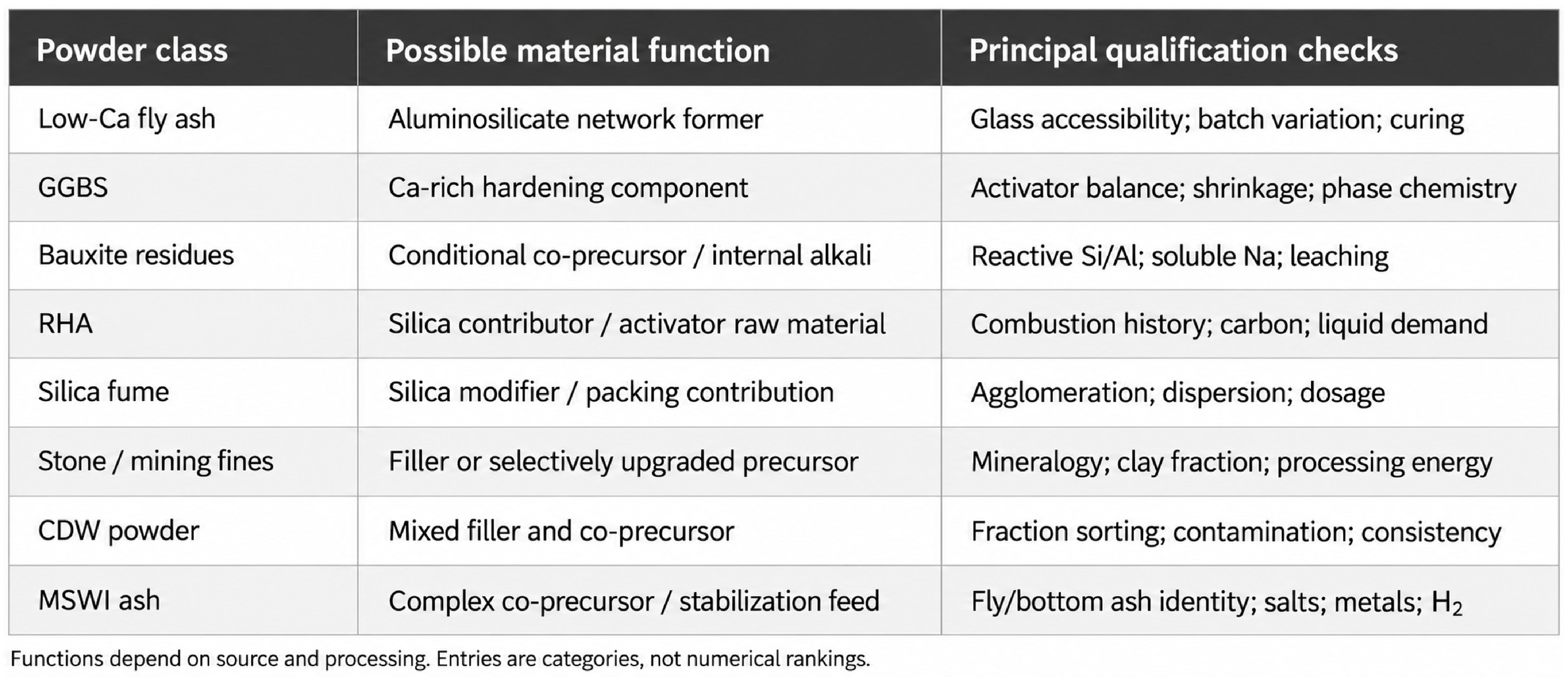
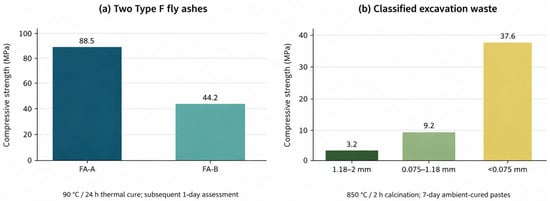
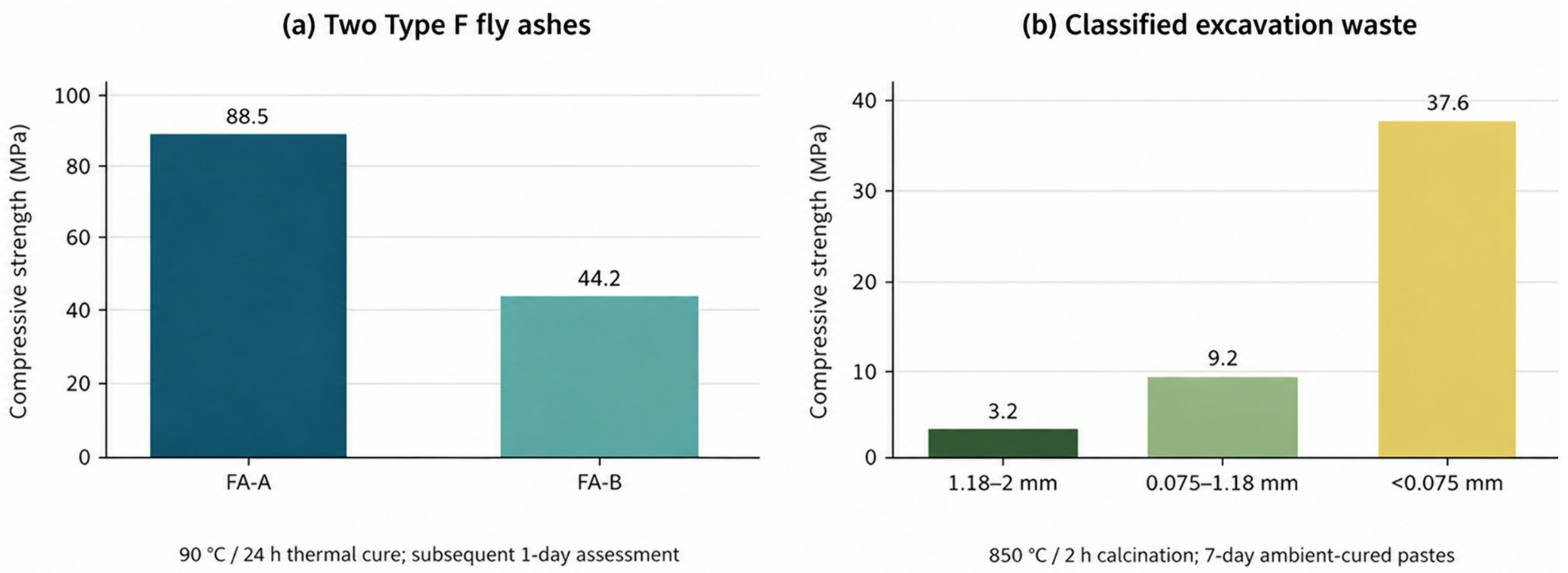
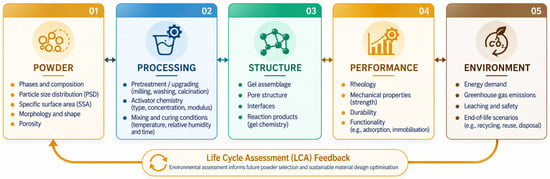
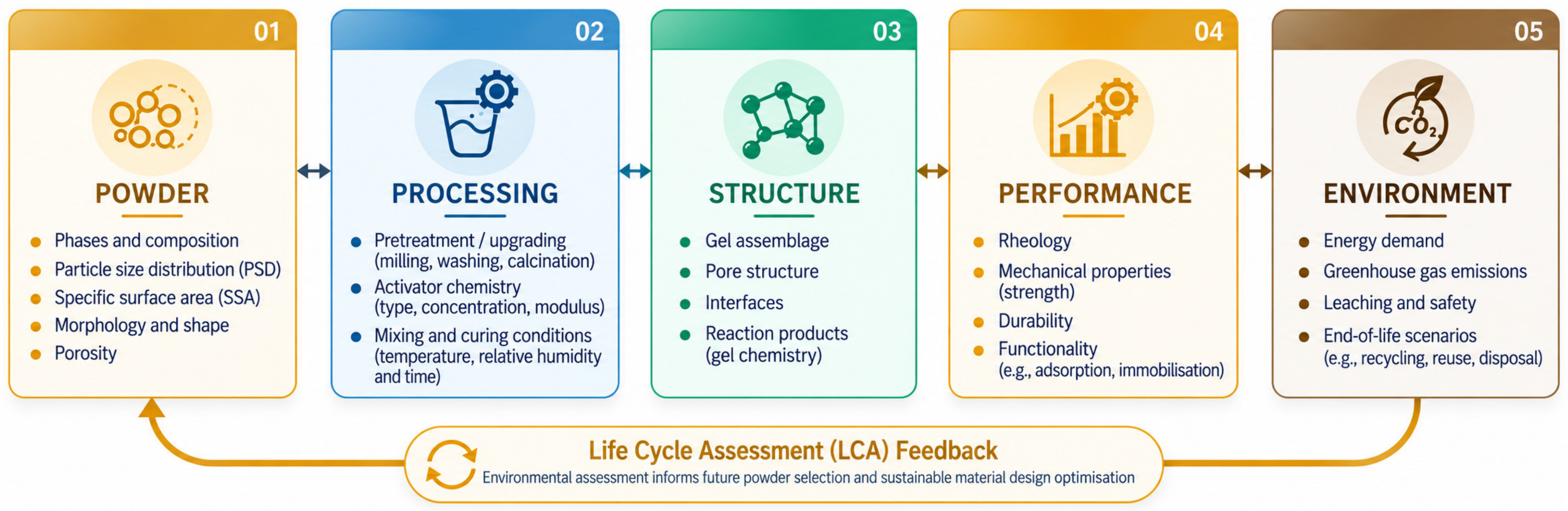
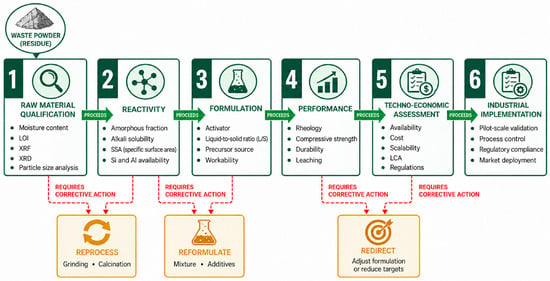
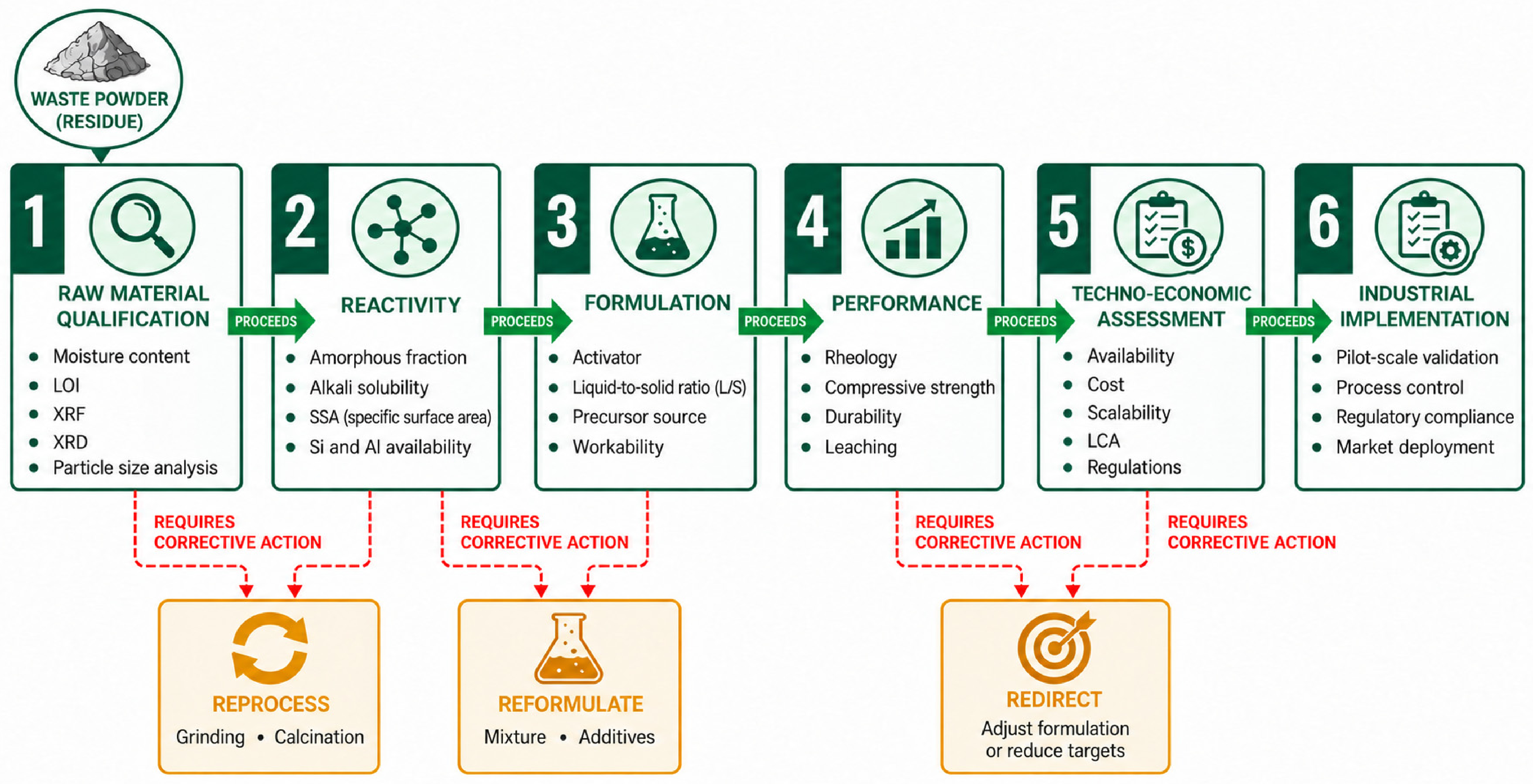

Disclaimer/Publisher’s Note: The statements, opinions and data contained in all publications are solely those of the individual author(s) and contributor(s) and not of MDPI and/or the editor(s). MDPI and/or the editor(s) disclaim responsibility for any injury to people or property resulting from any ideas, methods, instructions or products referred to in the content. |
© 2026 by the authors. Licensee MDPI, Basel, Switzerland. This article is an open access article distributed under the terms and conditions of the Creative Commons Attribution (CC BY) license.