


Abstract
Laser powder bed fusion (LPBF), one of the most established metal additive manufacturing technologies, depends strongly on the physical, morphological, and rheological characteristics of the powder feedstock to ensure process stability, layer uniformity, and final part quality. This study compared three AlSi10Mg powders intended for LPBF: one ultrasonic-atomized powder and two gas-atomized powders from different suppliers. The powders were evaluated in the as-received condition and after exposure to high-temperature/high-humidity and high-temperature/low-humidity environments. Particle size distribution, SEM/EDS, helium pycnometry, Karl Fischer moisture analysis, apparent density, Carney funnel flow, FT4 powder rheometry, and a LAMMPS-based Carney funnel simulation were used. The ultrasonic-atomized powder showed the lowest moisture uptake (77.74 ppm after humid conditioning, compared with 386.9 and 495.7 ppm for the gas-atomized powders), fewer satellite particles, lower agglomeration, and higher apparent density. Its Carney funnel flow time remained nearly constant (8.0–8.6 s), whereas one gas-atomized powder increased from 12.2 to 15.2 s after humid exposure. FT4 measurements also indicated lower effective internal friction and wall-friction angles for the ultrasonic-atomized powder, while the gas-atomized powders exhibited greater resistance to motion and stronger sensitivity to the applied stress state. Although the powders showed broadly similar chemical composition, differences in particle size distribution, morphology, moisture sensitivity, and frictional behavior led to clear differences in flow performance. Because the powders also differed substantially in particle-size distribution, the effects attributed to atomization route are interpreted together with particle size and supplier effects rather than as route effects alone. The LAMMPS simulation remained qualitative because the modeled mass was limited to 10% of the estimated powder mass; nevertheless, it reproduced the same discharge ranking observed experimentally in the Carney funnel tests.
1. Introduction
Laser powder bed fusion (LPBF) is one of the most consolidated routes in metal additive manufacturing because it enables the layerwise fabrication of dense components with complex geometries and reduced material waste [1,2]. In this process, the metallic powder is not a passive feedstock; it defines the regularity of layer deposition, the interaction with the laser beam, and the reproducibility of the final part. Powder handling, therefore, becomes a central issue in process reliability and cost [3,4].
Aluminum-based powders are especially critical because their low density and surface reactivity increase the probability of agglomeration, oxidation, and flow instability. Previous reviews have emphasized that temperature, humidity, and storage history can alter moisture content, apparent density, agglomeration, internal friction, flowability, and powder spreadability, thereby compromising processability in LPBF [5,6,7,8]. These studies further highlighted that the concept of “good flowability” is strongly method-dependent, since funnel tests, shear cells, rotating devices, and powder rheometers probe powder behavior under different stress regimes and kinematic conditions [9,10].
For AlSi10Mg in particular, this powder behavior under different stress regimes and kinematic conditions is further exacerbated by the additive manufacturing industry’s reliance on reusing or temporarily storing expensive powder lots between builds. Those phenomena show that humid exposure alters moisture levels and can promote agglomeration, even when reflectance changes are not obvious [11]. A comparative understanding of atomization route, environmental conditioning, and rheological response is therefore essential to judge powder robustness prior to LPBF processing.
To date, the state of the art indicates a clear gap in the literature. Prior studies on ultrasonic atomization have focused primarily on titanium alloys or general process comparisons, with limited systematic evidence for AlSi10Mg and no integrated analysis combining gas-versus-ultrasonic comparison, Carney funnel tests, FT4 rheology, and particle-based simulation for this alloy [11]. Meanwhile, studies on powder spreading and discrete element modeling have highlighted the roles of particle size, friction, cohesion, and density in powder-bed quality; however, they have largely relied on recoating or simplified hopper discharge rather than standardized funnel experiments [12,13,14].
The novelty of the present work is the combined use of standardized Carney funnel testing, FT4-derived internal and wall-friction descriptors, environmental conditioning, and LAMMPS-based discharge modeling for AlSi10Mg powders produced by different atomization routes. This integrated workflow links measurable powder properties to a practical handling scenario rather than evaluating morphology, rheology, or simulation in isolation.
Within that framework, a comparison was developed centered on three AlSi10Mg powders: two gas-atomized powders from distinct suppliers and one ultrasonic-atomized powder. The study did not restrict itself to morphology or to a single isolated flow test. Instead, it combined particle-size analysis, microscopy, moisture measurements, Carney funnel flow, apparent density, internal and wall friction derived from FT4 shear experiments, and an explicit LAMMPS implementation of powder discharge. It is worth noting that the simulation parameters were linked to experimentally measured rheological coefficients rather than treated as arbitrary fitting constants [15,16,17].
The objective of the present study was to compare gas and ultrasonic atomization of AlSi10Mg, with particular emphasis on morphology, rheology, Carney funnel flow, humidity response, and the LAMMPS-based discharge simulation relevant to LPBF powder handling.
2. Materials and Methods
Table 1 summarizes the common experimental matrix and analytical route adopted for the three-powder comparison. A unified methodology was applied to ensure consistency across all samples, encompassing particle size analysis, morphological characterization, moisture evaluation, flowability tests, and rheological measurements, followed by LAMMPS-based discharge simulations. This integrated approach enables a direct and reliable comparison of the effects of atomization route and environmental conditions on powder behavior.
Table 1.
Common experimental matrix and analytical route used for the three-powder comparison.
Three AlSi10Mg powders were investigated, all subjected to the same high-temperature conditioning states: one ultrasonic-atomized powder and two gas-atomized powders, identified as supplier 1 and supplier 2. The supplier identities were intentionally withheld. The comparison was based on three conditions: the as-received (pre-test) state, TAUA (50 °C, 60% relative humidity, 120 h in the muffle furnace), and TAUB (50 °C, 17% relative humidity, 120 h in the muffle furnace). These conditioning states were selected because they were common to all three powders and provided a direct contrast in moisture uptake under identical temperature exposure.
The TAUA and TAUB conditions should be interpreted as accelerated conditioning states that represent warm, humid storage and warm, dry handling limits for LPBF powders rather than exact reproductions of every industrial storage history.
Temperature and humidity were controlled within the monitored environments defined above. The humid high-temperature condition was achieved using a sealed muffle furnace configuration, whereas the dry condition was established at the same temperature with reduced humidity. Sensor reproducibility was ±0.1 °C and ±1% relative humidity, with calibration performed before the experiments.
2.1. Particle Characterization
Particle-size distribution was measured by laser diffraction using a HORIBA LA-930 analyzer with powder dispersed in ethylene glycol, following the procedure described in ASTM B822 [18]. Before testing, the powder was quartered, approximately 2.0 g was dispersed, and the suspension was ultrasonically homogenized for 5 min before measurement. This procedure generated size distributions, which were later used in the simulation as ten particle-size intervals.
Skeletal density was determined by helium pycnometry using a Micromeritics AccuPyc 1330 system. A 1.0 g powder sample was used for each measurement, with five replicates performed to determine the volume. Surface and cross-sectional features were investigated by SEM/EDS using an FEI Quanta 400 microscope equipped with an Oxford Instruments 6650 microanalysis system. For cross-sectional analysis, powders were embedded in resin, ground, polished, and coated with gold; for surface morphology, loose powders were distributed on carbon tape. The EDS results were treated qualitatively rather than strictly quantitatively, which is an important caution when interpreting minor compositional differences.
Moisture content was measured by Karl Fischer titration using a Mitsubishi Chemical Analytech CA-200 Moisturemeter coupled with a VA-200 Vaporizer. The method was selected because it can resolve low moisture levels in powder samples and was a key variable in the analysis of storage sensitivity.
2.2. Carney Funnel, FT4 Rheometry, and Statistical Treatment
The Carney funnel test was used to measure flow time and apparent density. Each measurement employed 50 g of powder, with five repetitions and video recording to minimize operator timing error. After discharge, excess material was leveled, and the cup was weighed to calculate apparent density. Humid samples may require prior passage through the funnel before stable measurement, particularly for the gas-atomized powders.
Powder rheology was evaluated using an FT4 powder rheometer. Shear tests were conducted using a 50 mm diameter shear cell kit under consolidation stresses of 3, 6, 9, and 15 kPa, while wall-friction tests were performed at 6 and 15 kPa with a 50 mm stainless-steel disk with a surface roughness of 0.26 µm. The FT4 outputs included cohesion (C), unconfined yield strength (fC), major principal stress (σ1), internal friction angle (AIF), effective internal friction angle (AEIF), wall-friction angle (WFA), and bulk density. The compressibility pattern was also evaluated using the FT4 powder rheometer. For simulation purposes, the tangent of AEIF at 3 kPa was selected as the shear-resistance coefficient, and the tangent of WFA at 6 kPa was selected as the wall-friction coefficient [19].
Statistical comparisons were performed using Student’s t-test with unequal variances, with a significance level of α = 0.05. Comparisons were consistently made between the pre-test condition and each conditioned state. This criterion is preserved in the present article when reporting whether the humid or dry condition differs significantly from the as-received powder.
2.3. Condition to Apply LAMMPS-Based Discharge Simulation
LAMMPS [20] was used to model the discharge process. The simulation setup reproduced the Carney funnel and collection cup, with spherical particles distributed into ten size intervals to represent the powder. Interval boundaries were derived from the measured particle-size distributions using a percentile-based scheme, with particle diameters generated via Monte Carlo sampling within each size class. The model incorporated powder density obtained from pycnometry, as well as wall-friction and shear-resistance coefficients derived from FT4 measurements, in addition to the elastic/damping parameters required by the selected contact model. The implementation was informed by particle interaction frameworks based on Hertz–Mindlin and Coulomb/Mohr–Coulomb theories [15,16,17].
A full-scale simulation of 50 g would require approximately 103,051 particles for the ultrasonic powder, 510,572 for gas supplier 1, and 1,680,657 for gas supplier 2, assuming spherical particles with the estimated mean size. Due to the resulting computational cost and visualization constraints, the simulation was limited to 10% of the estimated powder mass. Consequently, the simulated discharge was interpreted qualitatively rather than as a direct quantitative reproduction of the measured flow time [17] (Appendix A).
3. Results and Discussion
3.1. As-Received Particle Size Distribution, Qualitative Composition, and Morphology
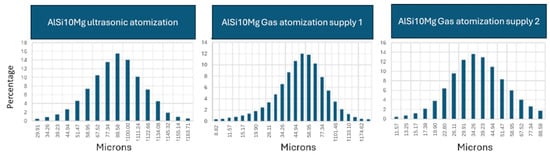
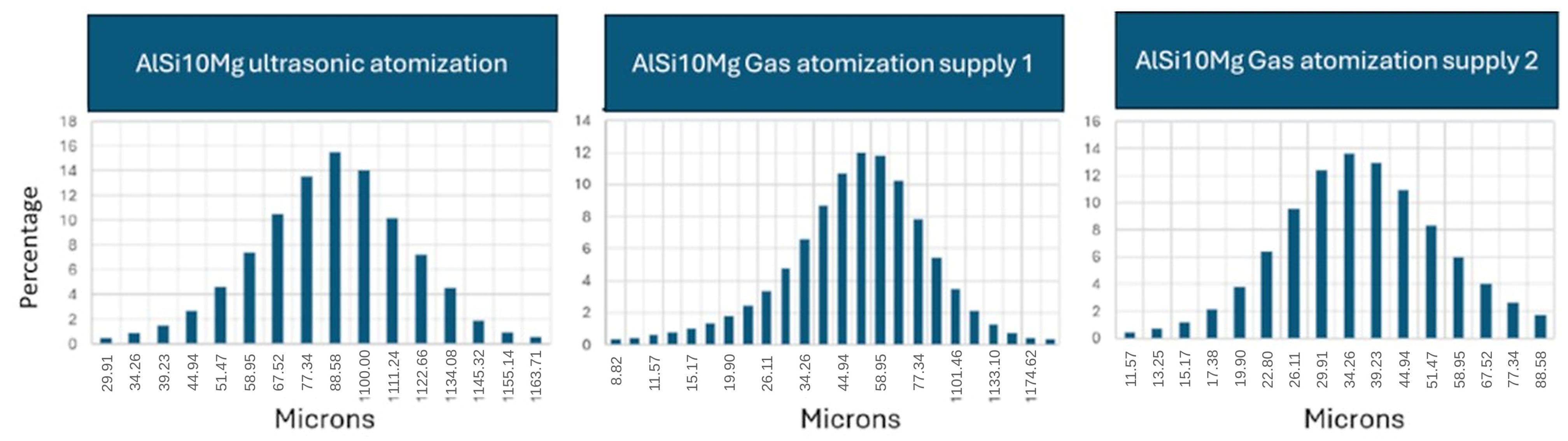
Figure 1 displays the particle-size distributions of the as-received AlSi10Mg powders produced by ultrasonic and gas atomization. The distributions indicate that the three powders were not equivalent before environmental exposure. The ultrasonic powder is centered in a coarser size range, whereas the gas-atomized powders are finer, with supplier 2 exhibiting the narrowest central distribution. The D50 values used in the simulations were 86 µm for the ultrasonic powder, 50 µm for gas supplier 1, and 34 µm for gas supplier 2. These results demonstrate that the comparison extends beyond atomization route alone, reflecting distinct, route-specific particle populations as supplied.
Figure 1.
Particle-size distribution of the as-received AlSi10Mg powders produced by ultrasonic atomization and gas atomization (suppliers 1 and 2).
Qualitative EDS results and skeletal density are summarized in Table 2. The composition is broadly consistent with AlSi10Mg, noting that EDS was used for qualitative assessment only. The gas-atomized powder from supplier 1 exhibited the highest mean skeletal density, whereas supplier 2 showed the lowest. The ultrasonic powder lay between these values, indicating that differences in internal porosity alone are insufficient to explain the variations in flow behavior observed later.
Table 2.
Qualitative EDS composition and mean skeletal density of the as-received AlSi10Mg powders.
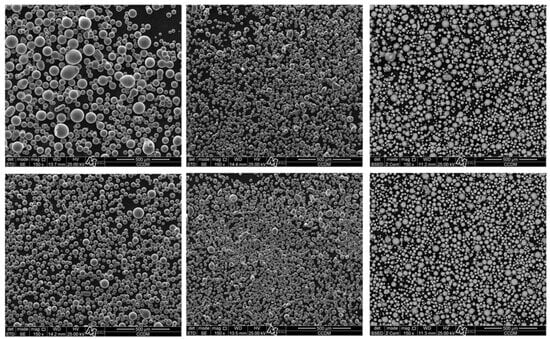
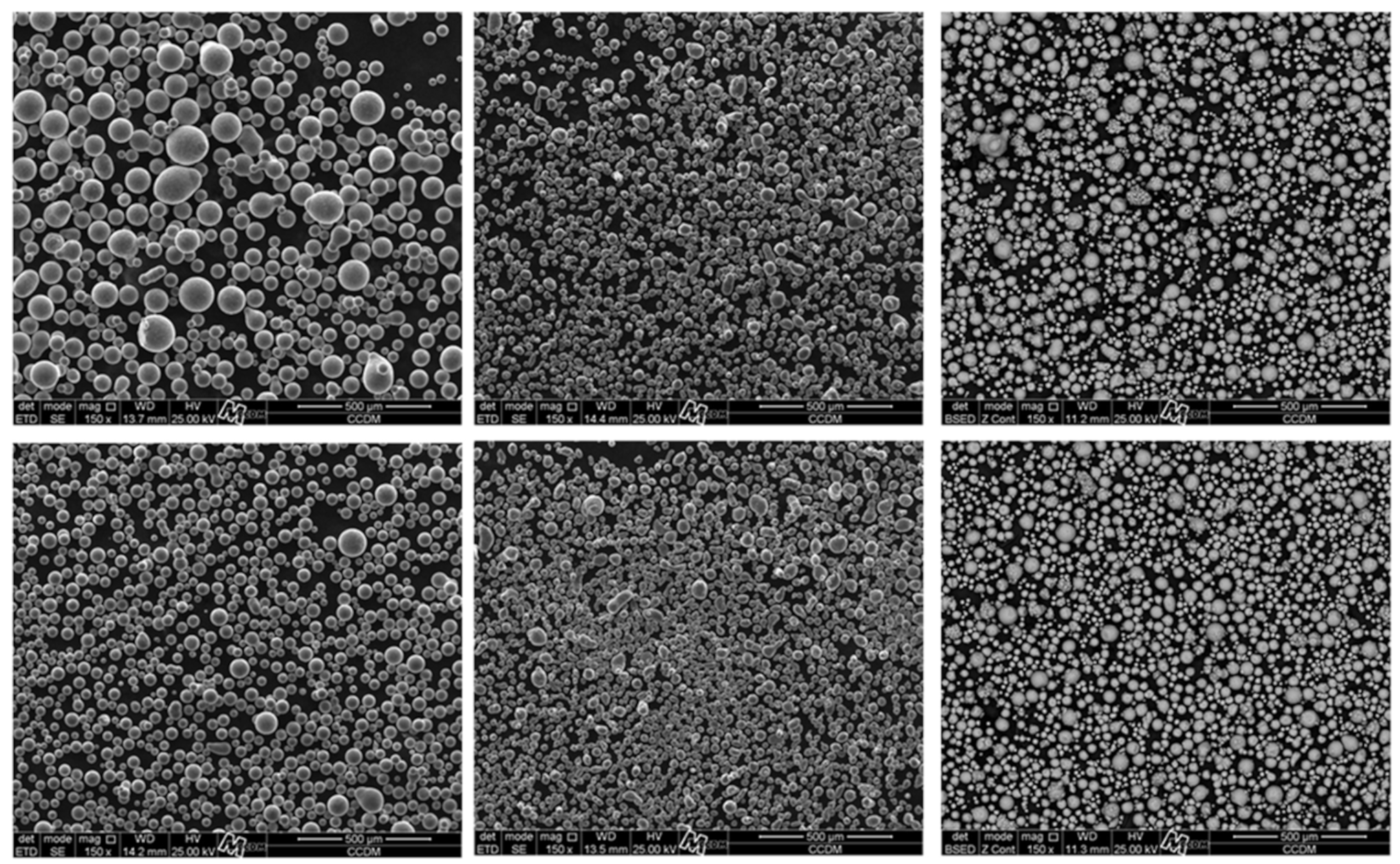
SEM images, presented in Figure 2, revealed more diagnostically relevant contrasts than composition alone. Under both humid and dry conditions, the ultrasonic powder exhibited fewer visible satellites and weaker particle-to-particle bridging than either gas-atomized powder. In addition, the humid condition intensified clustering in all powders, with a more pronounced effect in the gas-atomized materials. This behavior is attributed to the higher surface area of the finer particles in these powders, which promotes moisture-assisted adhesion and agglomeration. Cross-sectional SEM analysis further showed that the ultrasonic particles were more rounded and exhibited smoother surfaces, whereas the gas-atomized powder from supplier 1 displayed a rougher surface morphology and a higher satellite population.
Figure 2.
Powder distribution under high humidity/high temperature (top row) and high temperature/low humidity (bottom row) for the ultrasonic and gas-atomized AlSi10Mg powders. The images illustrate the stronger clustering tendency of the gas-atomized powders after humid exposure.
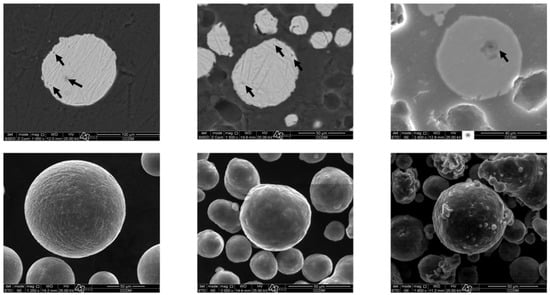
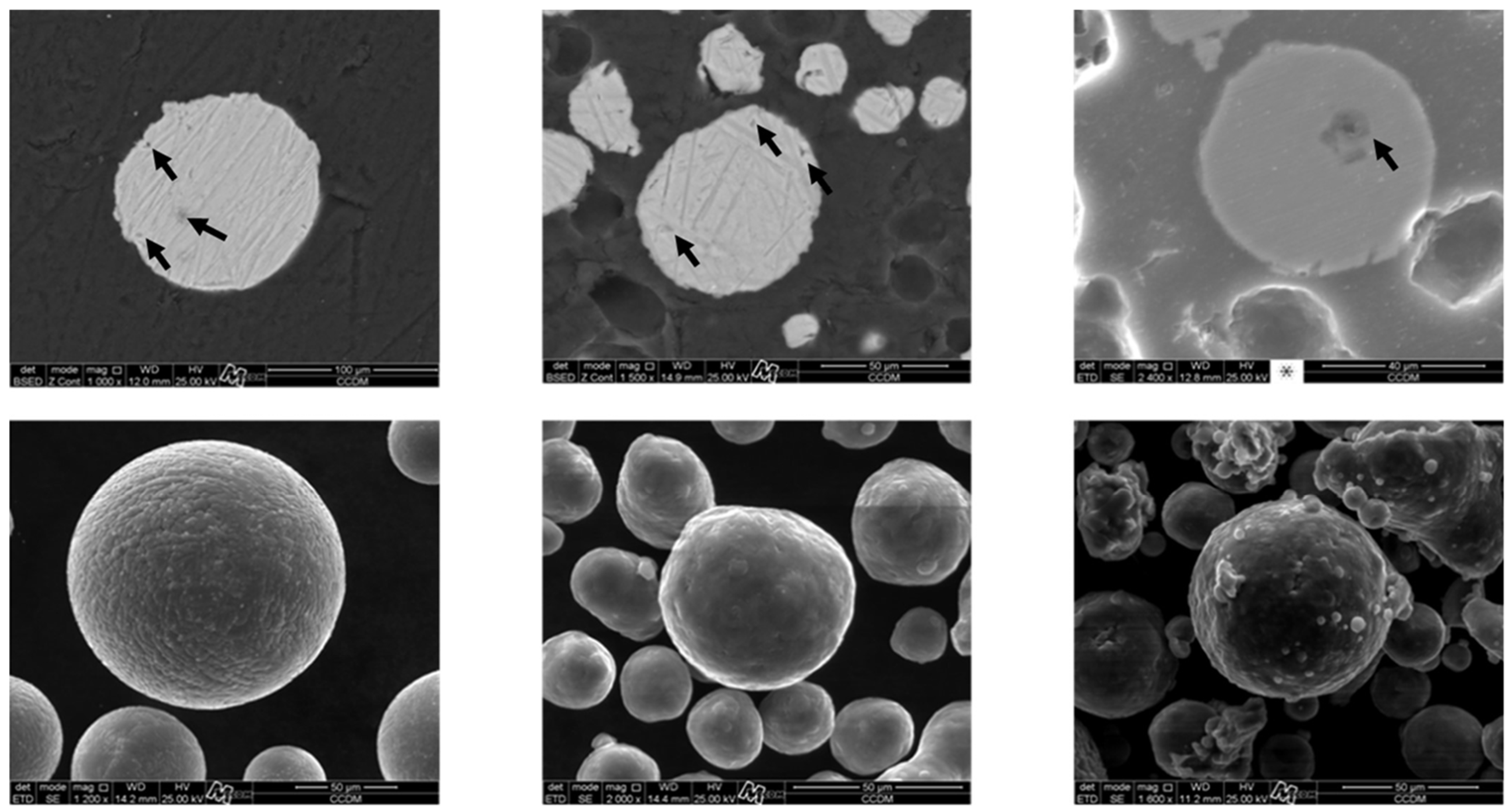
Figure 3 presents cross-sectional and surface morphology of AlSi10Mg powders produced by two different routes. The cross-sectional image of the ultrasonic-atomization sample reveals that the particle interior exhibits parallel striations or lamellar structures, indicated by the black arrows. These features are consistent with dendritic solidification patterns or internal shrinkage-related channels formed during rapid solidification. The particle is relatively large (scale bar ~100 µm) and appears fully dense, with a smooth outer surface visible in the lower image. The sphericity is excellent, and the internal striations suggest a directional solidification front, possibly influenced by the lower cooling rate or the acoustic pressure field associated with ultrasonic atomization compared with gas atomization.
Figure 3.
Cross-sectional (top row) and surface (bottom row) morphology of the AlSi10Mg powders produced by ultrasonic atomization and gas atomization.
The cross-section of the sample produced by Gas 2 shows a similar particle size to that of the ultrasonic sample but with more pronounced internal features. The arrows indicate what appear to be multiple internal pores or satellite inclusions, along with lamellar markings. The particle surface image appears smooth and spherical comparable to the ultrasonic-atomized sample. However, the internal microstructure is more heterogeneous, suggesting differences in gas pressure, gas composition, or melt superheat during processing. In addition, the presence of multiple bright-contrast regions inside the particle in the BSE-like image may indicate phase segregation or compositional heterogeneity during solidification.
In contrast, the samples produced by Gas 1 show the most distinct behavior. The cross-section reveals a particle with large internal cavities or pores, indicated by a single arrow. This is characteristic of a hollow particle or shrinkage cavity formed when the outer shell solidifies before the interior, trapping gas or leaving a void as the core contracts. The lower image is markedly different from the other two cases; the particles exhibit irregular morphology, surface roughness, satellite attachment, and agglomeration. Several particles show smaller satellites adhered to their surfaces, and some display non-spherical or collapsed shapes. These observations suggest that Gas 1 conditions promoted either higher solidification rates or altered surface-tension conditions that inhibited full spheroidization, or that the gas-to-melt ratio was not optimized, as summarized in Table 3.
Table 3.
Characterization of powders by SEM.
3.2. Moisture Uptake
Moisture pickup was the clearest environmental discriminator among the three powders, as shown by the data in Table 4. After TAUA, the ultrasonic powder contained 77.74 ppm of water, whereas gas supplier 1 and gas supplier 2 reached 386.9 and 495.7 ppm, respectively. After TAUB, the same ranking remained, 53.45 ppm for the ultrasonic powder, 131.9 ppm for gas supplier 1, and 200.65 ppm for gas supplier 2, confirming that the ultrasonic powder absorbed substantially less moisture under both high-temperature storage scenarios.
Table 4.
Moisture content of the AlSi10Mg powders after common environmental conditioning.
The primary driver of this difference is particle size. Since moisture adsorption is a surface phenomenon, the specific surface area, which scales inversely with mean particle diameter as S_specific = 6/(ρ.d), governs the total capacity of a powder to retain water per unit mass. The ultrasonic powder has a mean particle diameter approximately twice that of the gas-atomized powders, which reduces its specific surface area by roughly a factor of two. This geometric effect alone is sufficient to explain much of the observed moisture-uptake difference and should be considered the dominant factor in any quantitative interpretation.
Surface morphology and satellite density, previously cited as the principal explanation [7,10], are contributing factors of secondary importance. While surface asperities and satellites do create additional high-energy adsorption sites, their influence on total surface area is estimated at 10–20% above the smooth-sphere approximation, which is quantitatively minor relative to the factor-of-two difference arising from size alone. A complete mechanistic interpretation would additionally consider differences in native oxide-layer thickness and hydroxylation state between the two atomization routes, because these features influence the density of chemisorption sites independently of particle geometry. To isolate these contributions rigorously, future work should report moisture uptake normalized to BET-measured specific surface area and include oxide-layer characterization, allowing morphological and chemical effects to be assessed independently of the purely geometric size factor.
3.3. Carney Funnel Flow and Apparent Density
The Carney funnel results translated the morphological and moisture differences into a directly observable discharge response. The ultrasonic powder flowed immediately in all repetitions and remained nearly invariant, with means of 8.0 s in the pre-test and dry conditions and 8.6 s after TAUA. Gas supplier 1 was the most sensitive powder; its mean flow time increased from 12.2 s in the pre-test to 15.2 s after TAUA, whereas TAUB slightly reduced the mean to 11.8 s. Gas supplier 2 remained the slowest gas-atomized powder overall, but its mean values changed less with conditioning, from 14.2 s in the pre-test to 14.4 s after TAUA and 13.6 s after TAUB (Table 5). The variation in particle-size distribution shown in Figure 1 may also contribute to the observed variation in flow time and should not be separated from the atomization-route comparison.
Table 5.
Carney funnel flow time of the AlSi10Mg powders (s/50 g, mean ± SD).
The t-tests refine the reading of these averages. For gas supplier 1, the increase in flow time after TAUA was statistically significant, whereas the TAUB condition did not significantly differ from the pre-test. For gas supplier 2, neither TAUA nor TAUB yielded a statistically significant change in flow time, despite the consistently slower discharge of this powder. For the ultrasonic powder, neither conditioned state differed statistically from the pre-test, reinforcing the interpretation that ultrasonic atomization provided the most stable bulk-flow response among the powders compared here.
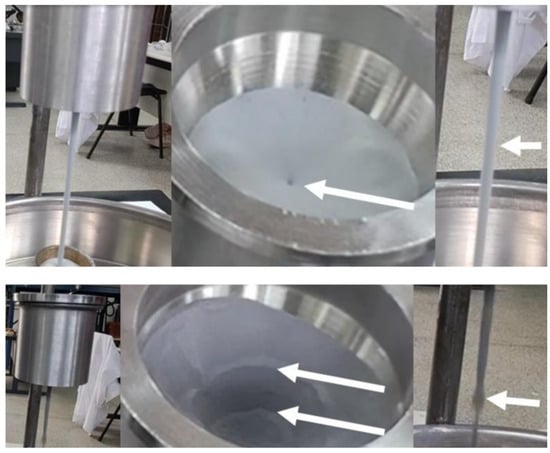
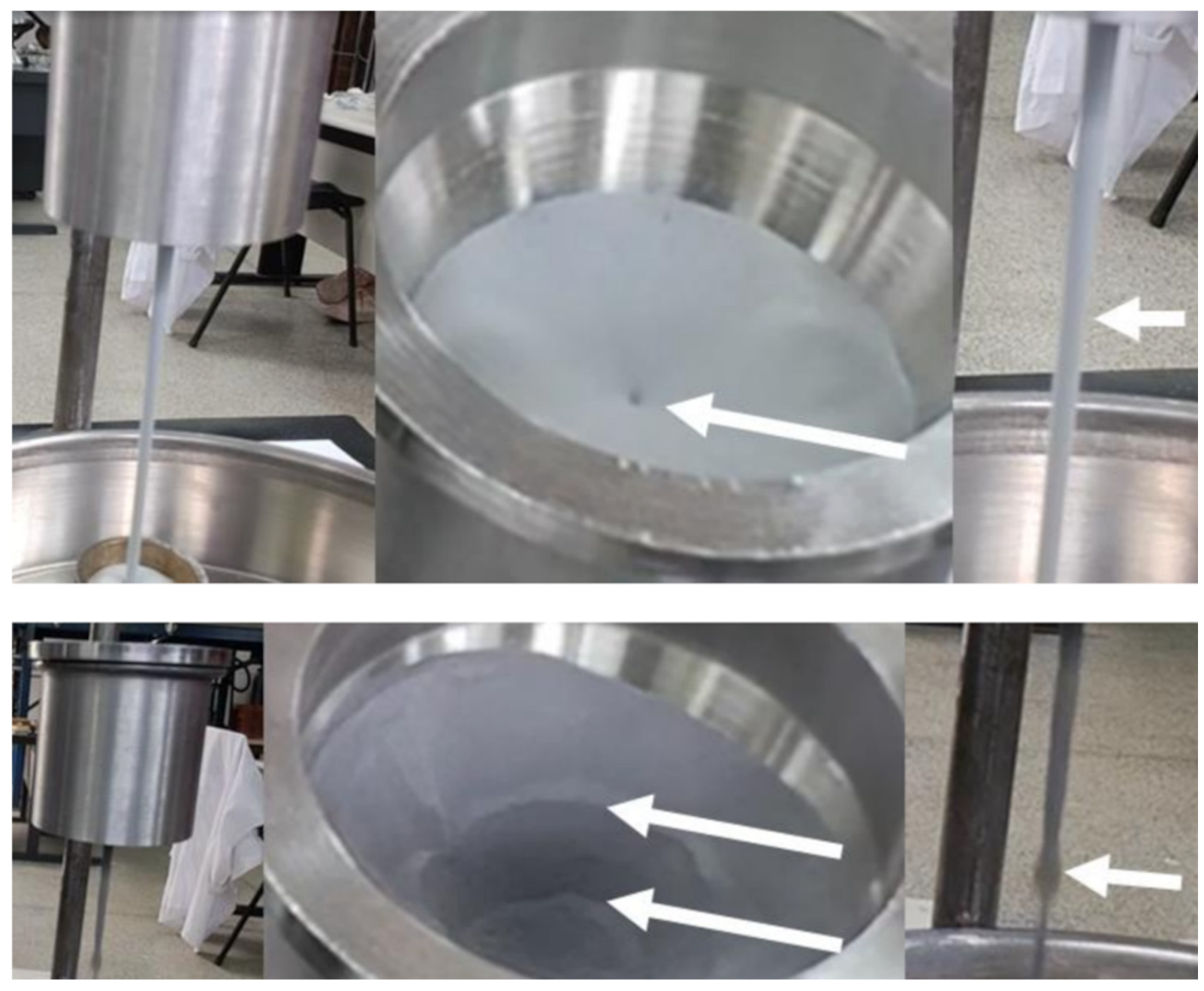
The ultrasonic powder formed an almost continuous stream and induced a smooth depression in the powder bed above the orifice, a behavior characteristic of a mass-flow pattern (Figure 4). Gas supplier 1, in contrast, showed a stepped or packet-like discharge pattern with intermittent blocking and release (Figure 4), which may be described as a heterogeneous vortex, exhibiting a tendency toward a funnel-flow pattern (ratholing). Such behavior is directly relevant to LPBF powder handling, as the same tendency toward irregular feed can compromise the stability of powder supply and local bed packing during layer deposition [13,14].
Figure 4.
Carney funnel discharge patterns. (Top): ultrasonic-atomized AlSi10Mg, showing a mass-flow pattern; (bottom): gas-atomized AlSi10Mg from supplier 1, showing a funnel-flow pattern (ratholing) and variable discharge rate. The arrows emphasize the distinctions between the images.
Apparent density, displayed in Table 6, followed the same general ranking seen in flow time. The ultrasonic powder was the densest in the loose state; gas supplier 2 was intermediate, and gas supplier 1 was the least dense. The pre-test means were 1.586, 1.425, and 1.374 g/cm3 for the ultrasonic, gas supplier 2, and gas supplier 1 powders, respectively. This ranking is consistent with the particle-size differences among the three powders. Coarser particles, such as those produced by ultrasonic atomization, pack more efficiently in the loose state because interparticle cohesive forces, principally van der Waals attraction and capillary forces from adsorbed moisture, scale with surface area and therefore become proportionally weaker as particle size increases. In fine powders, these cohesive forces are large relative to the gravitational force acting on each particle, promoting the formation of low-density agglomerate bridges that resist consolidation and reduce packing efficiency. This is why dry powder generally exhibits higher apparent density than its moisture-conditioned counterpart; adsorbed water films at particle contact points generate capillary bridges between adjacent particles, increasing interparticle cohesion and causing the powder bed to adopt a more open, less efficiently packed structure. The effect is size-dependent, finer powders with greater specific surface area are more susceptible to this capillary-bridge mechanism, which explains why the gas-atomized powders showed greater sensitivity to environmental conditioning than the ultrasonic powder.
Table 6.
Apparent density determined with the Carney funnel cup (g/cm3, mean values).
By contrast, TAUB increased the apparent density of all three powders, whereas TAUA reduced the apparent density of gas supplier 1 and increased it slightly for gas supplier 2 while leaving the ultrasonic powder essentially unchanged. This contrast between the two conditioning protocols is consistent with the capillary-bridge interpretation; TAUA, conducted at 60% relative humidity, introduced sufficient moisture to form interparticle liquid bridges and reduce packing density in the most surface-active powder, whereas TAUB at 17% relative humidity removed adsorbed water relative to the ambient pre-test state, weakening cohesive forces and allowing denser packing. Significant increases occurred for ultrasonic and gas supplier 1 under TAUB, while gas supplier 1 decreased under TAUA. Gas supplier 2 showed significant differences across both conditioned states.
Taken together, the Carney and apparent-density measurements show that the route-based advantage of the ultrasonic powder was not simply “faster flow” but the combination of immediate discharge, resistance to humid slowdown, and consistently higher loose packing. The gas-atomized powders differed between suppliers, demonstrating that supplier-specific process control also matters within the gas-atomization route [21].
3.4. FT4 Rheological Response
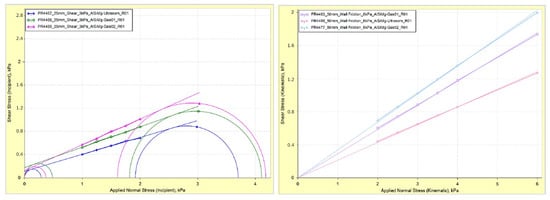
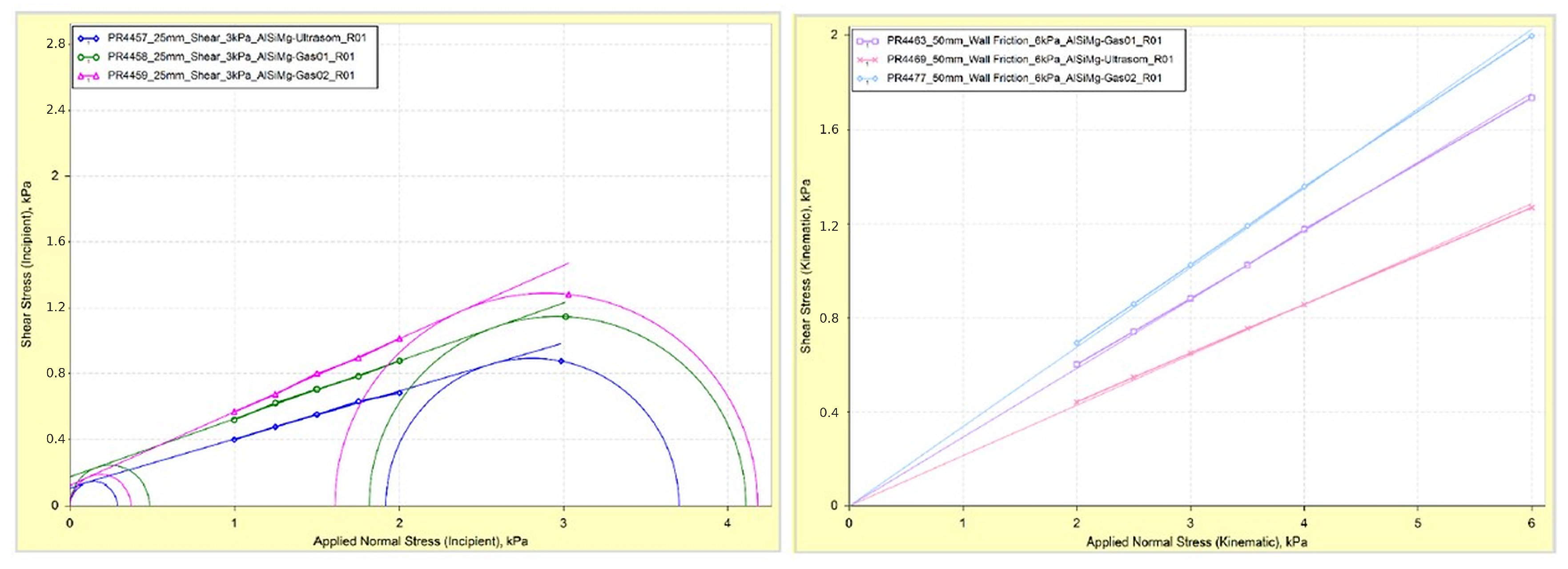
Table 7 presents the FT4 measurements that provide the mechanical basis for the observed differences in funnel flow behavior and reveal three distinct rheological regimes. At 3 kPa consolidation stress, the ultrasonic powder exhibited the lowest effective internal friction angle (AIF(E) = 18.52°), followed by gas supplier 1 (22.77°) and gas supplier 2 (26.43°). The corresponding shear-resistance coefficients (tan AIF(E)) used in the LAMMPS simulations were 0.33, 0.42, and 0.50, respectively. Cohesion values were 0.11 kPa (ultrasonic), 0.17 kPa (gas supplier 1), and 0.12 kPa (gas supplier 2).
Table 7.
Selected FT4 results used for comparative interpretation and LAMMPS input.
A key observation is the decoupling between cohesion and friction in gas supplier 2, which showed the highest friction angle but cohesion similar to the ultrasonic powder. While cohesion represents the stress-independent intercept of the yield locus, the effective internal friction angle reflects the stress-dependent slope. This explains why gas supplier 2 can be nearly non-cohesive yet highly frictional due to mechanical interlocking promoted by its irregular particle surfaces and satellite attachments observed in SEM.
Flow-initiation resistance was highest for gas supplier 1, despite its intermediate friction angle. At low normal stresses near flow onset, cohesion dominates flow behavior. Consequently, gas supplier 1, with 55% higher cohesion than the ultrasonic powder, exhibits the greatest resistance to initiating flow from rest. In contrast, gas supplier 2 becomes more resistant at higher consolidation stresses, where friction dominates.
Wall-friction angles (WFAs) followed the same trend, 12.09° (ultrasonic), 16.29° (gas supplier 1), and 18.66° (gas supplier 2), corresponding to wall friction coefficients of 0.21, 0.29, and 0.34.
Consolidated bulk density at 3 kPa was highest for the ultrasonic powder (1.74 g/mL), compared to 1.52 g/mL and 1.55 g/mL for gas suppliers 1 and 2, respectively (Figure 5).
Figure 5.
FT4 results used in the comparison: shear behavior at 3 kPa (left) and wall-friction behavior at 6 kPa (right).
The evolution with consolidation stress is summarized in Table 8. Across 6, 9, and 15 kPa, the ultrasonic powder retained the lowest or one of the lowest AEIF values, while the gas-atomized powders remained higher. As stress increased, the slopes of the gas-powder shear lines converged; however, the ultrasonic powder preserved its characteristic lower-friction behavior. This trend is important because it indicates that the rheological hierarchy is not a single-point artifact of the 3 kPa test, even though the 3 kPa data were selected for simulation input.
Table 8.
FT4 shear behavior of the AlSi10Mg powders across consolidation stresses.
Wall friction against stainless steel showed the same ranking. At 6 kPa, WFA was 12.09 degrees for the ultrasonic powder, 16.29° for gas supplier 1, and 18.66° for gas supplier 2. At 15 kPa, the values became 13.18°, 14.81°, and 17.25°, respectively (Table 9). Decreasing wall-friction angles at elevated normal stresses suggest asperity breakdown or stress-induced accommodation at the interface. For the present comparison, the practical conclusion is that the ultrasonic powder demanded less resistance to move against the wall analog of the funnel, while gas supplier 2 remained the most wall-sensitive powder at both stress levels.
Table 9.
FT4 wall-friction behavior of the AlSi10Mg powders at 6 and 15 kPa.
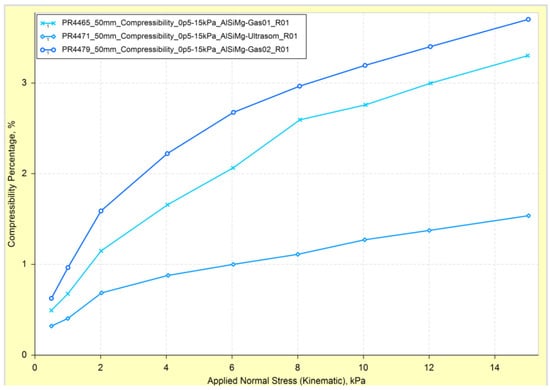
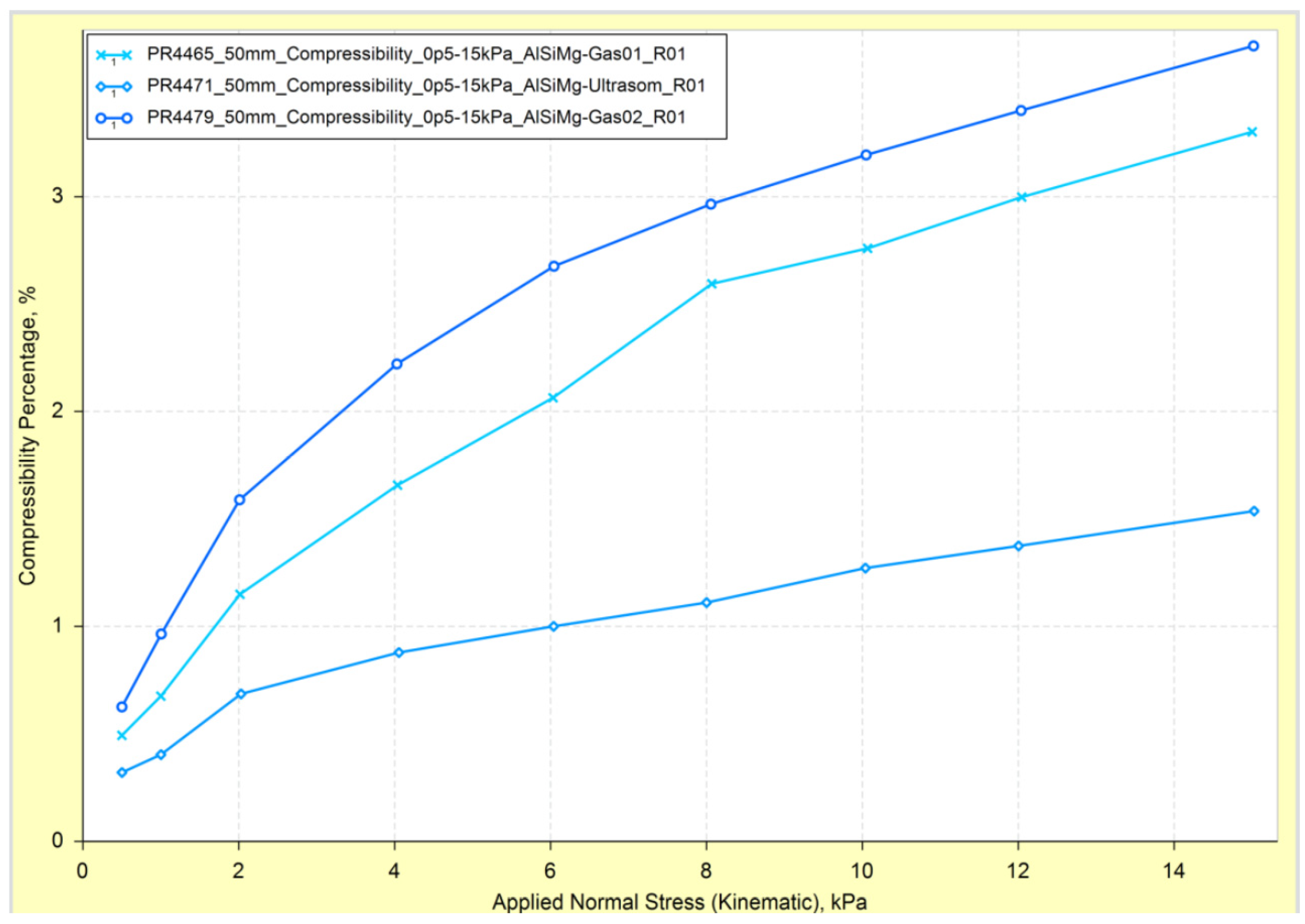
Compressibility remained low for all powders and did not alter the principal ranking established by shear and wall friction. The compressibility plot nevertheless preserved the same relative tendency, with the ultrasonic powder showing the lowest volume change and gas supplier 2 the highest, while gas supplier 1 remained intermediate. Even so, the powders were described as practically incompressible under the test conditions because their spherical morphology and packing state already approached minimum volume. This observation justified selecting the 6 kPa wall-friction state for simulation input and reinforced the view that friction and satellite-driven interactions, rather than strong volumetric collapse, governed the differences among the three powders (Figure 6).
Figure 6.
FT4 compressibility versus applied normal stress for the three AlSi10Mg powders. The plot shows that compressibility remained low for all powders and did not overturn the ranking established by shear and wall-friction behavior.
The rheological results, therefore, bridge morphology and bulk flow. Lower satellite density, smoother morphology, and lower wall friction were observed in the ultrasonic powder; higher satellite content, stronger moisture sensitivity, and higher friction were observed in the gas-atomized powders. This interpretation is consistent with the previous studies cited in this work, which show that FT4 results become especially informative when linked to a defined powder-handling scenario rather than treated as generic indicators of flow quality [4,9,10].
3.5. LAMMPS-Based Discharge Simulation
The LAMMPS implementation translated the experimental measurements into a particle-based discharge simulation in which all governing parameters were derived directly from characterized powder properties rather than from arbitrary assumptions or idealized ranking schemes. The measured particle-size distribution was discretized into 10 diameter intervals, and particles within each interval were generated stochastically using Monte Carlo methods to reproduce the statistical properties of the experimental size distribution. Each particle was then assigned material and interaction properties, including density, damping coefficient, wall-friction coefficient, and shear-resistance coefficient, according to the values measured by the FT4 rheometer and reported in Table 7. Specifically, tan[AIF(E)] was used as the shear-resistance coefficient governing interparticle sliding, and tan[WFA] was used as the wall-friction coefficient governing particle–boundary interactions, ensuring that the simulated flow resistance reflected the distinct rheological regimes identified experimentally for each powder.
This parameterization strategy is significant because it couples the simulation outcome directly to measurable physical quantities, making the simulated discharge behavior a consequence of real powder characteristics rather than a sensitivity study over assumed input ranges. However, because only 10% of the estimated powder mass was modeled and no direct time-scale validation against experimental discharge times was performed, the results should be interpreted as qualitative comparisons rather than quantitative predictions. Table 10 and Table 11 summarize the discretization strategy for the particle-size distribution and the principal input parameters and output metrics used for the comparative analysis across the three powders.
Table 10.
Diameter intervals used to populate the LAMMPS simulations from the measured particle-size distributions.
Table 11.
LAMMPS input parameters and qualitative output for the common AlSi10Mg comparison.
As observed in Table 10, the discretized distributions retained the full measured size span of each powder. The ten diameter bands covered 35–163 µm for the ultrasonic powder, 7–200 µm for gas supplier 1, and 6–90 µm for gas supplier 2. These intervals were used directly in the Monte Carlo particle generation step so that each powder was represented as a polydisperse assembly rather than a simplified monodisperse population, preserving the breadth of the experimental size distribution and its influence on packing and flow behavior.
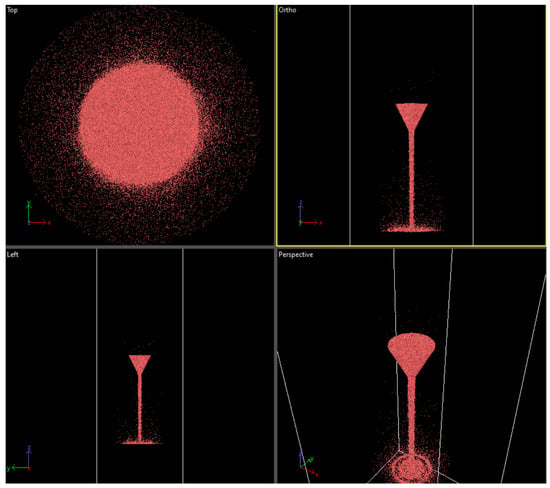
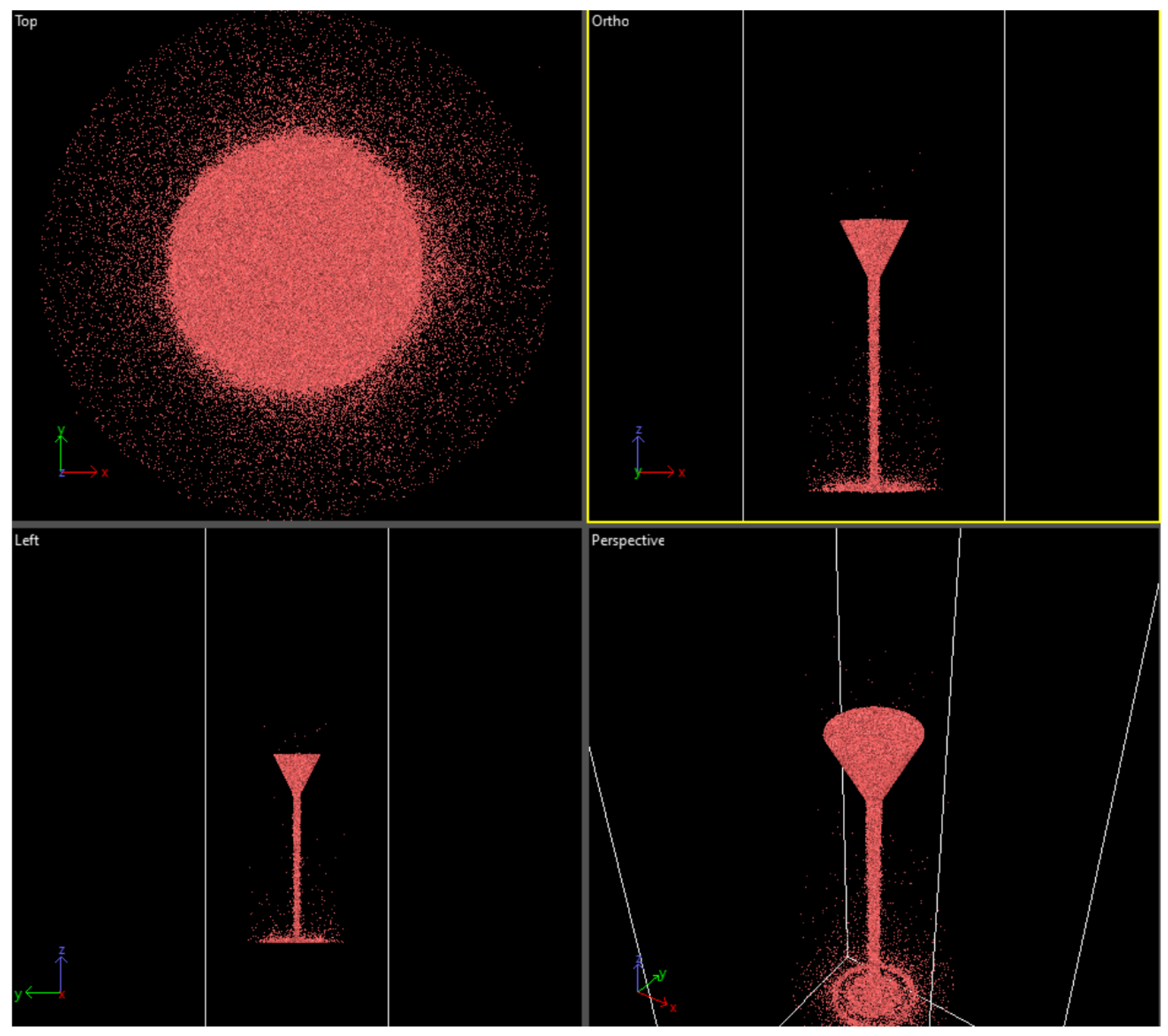
Because the particle count required for a full 50 g simulation would be computationally prohibitive, only 10% of the estimated mass was simulated. Given this constraint, discharge performance, as shown in Figure 7, was qualitatively assessed by the total number of computational frames required for complete discharge rather than through a rigorous dimensional time equivalence. Despite this limitation, the simulated ranking reproduced the funnel-experiment observations; the ultrasonic powder discharged fastest, requiring 30 frames, followed by gas supplier 1 at 84 frames and gas supplier 2 at 94 frames. This agreement is useful but should not be overinterpreted, because the ultrasonic powder simultaneously possessed the coarsest D50, the lowest internal friction coefficient, and the lowest wall-friction coefficient among the three powders. The model therefore captures the combined influence of particle size and rheological resistance on discharge ranking, but it does not isolate atomization route as an independent causal variable.
Figure 7.
LAMMPS snapshot illustrating the modeled filling and discharge of AlSi10Mg particles in the Carney-funnel geometry.
The present simulation should be interpreted within the context of its computational scope. At the particle counts required to represent the full powder mass, visualization of the discharge process became impractical, and the iterative computational cost remained substantial even after reducing the simulated mass fraction to 10%. These constraints precluded a fully quantitative time-resolved prediction of discharge rate and are acknowledged as a limitation of the current implementation.
Within these boundaries, however, the LAMMPS results fulfill a clear and limited purpose; they show that the four experimentally measured powder descriptors—particle-size distribution, density, wall-friction coefficient, and shear-resistance coefficient—are collectively sufficient to reproduce the discharge hierarchy observed in the Carney funnel experiments, without invoking fitted or assumed ranking parameters. This constitutes a qualitative consistency check of the experimental characterization framework rather than validation of quantitative predictive accuracy. The consistency between the simulation and experimental rankings across three physically distinct powders suggests that the chosen input descriptors capture important mechanisms governing gravity-driven discharge, while the measurement-to-simulation pipeline still requires quantitative validation against experimental discharge times.
This foundation opens a direct path toward quantitative refinement in future work. Increases in computational resources, adoption of coarse-graining strategies to reduce effective particle count while preserving bulk rheological behavior, or implementation of GPU-accelerated DEM solvers would each allow the full powder mass to be simulated with time-resolved output, enabling direct comparison with experimental discharge rates rather than frame-count rankings. The present results should therefore be understood as a methodological proof of concept that validates the input parameterization strategy and motivates further development [13,14,15,16,17].
3.6. Integrated Comparison of the Atomization Routes
The combined evidence points to two related but distinct conclusions. First, the atomization route influenced morphology in a consistent direction: the ultrasonic powder exhibited smoother spherical particles and fewer satellites, whereas both gas-atomized powders displayed rougher surfaces and stronger evidence of satellite adhesion. Second, supplier-specific effects remain significant in the gas-atomized route. Gas supplier 1 was the most humidity-sensitive in Carney funnel flow and showed the strongest low-stress cohesion, whereas gas supplier 2 was slower overall and exhibited the highest wall friction, as well as the highest AEIF values at 3 and 15 kPa. Therefore, the effects of the atomization route and the supplier cannot be reduced to a single variable.
Nevertheless, within the limited set of powders evaluated, the ultrasonic powder showed the most favorable practical behavior: it absorbed the least moisture, maintained nearly unchanged Carney funnel flow times, exhibited the lowest frictional resistance, and produced the fastest simulated discharge. The reduced satellite population appears to be an important factor, as the same powder also showed the weakest humidity-induced clustering in SEM observations. However, because the powders were not size-matched, this apparent route-related advantage should be interpreted together with the coarser particle-size distribution of the ultrasonic powder.
For LPBF applications, this comparison suggests that powder management should not be limited to particle-size specifications alone. The same AlSi10Mg nominal alloy can exhibit significantly different humidity sensitivity, apparent density, and rheological behavior depending on the production route, particle-size distribution, and the supplier-specific distribution of satellites and fine particles. This broader perspective motivates the combined use of Carney funnel measurements, FT4 rheometry, microscopy, and particle-based simulation within a unified analytical framework.
4. Conclusions
The comparison demonstrated that the three AlSi10Mg powders behaved differently under the same thermal and humidity exposure. Within the limited material set evaluated, the ultrasonic powder absorbed less moisture under both high-temperature states, showed fewer satellites and less agglomeration in SEM, and maintained the most stable Carney funnel flow.
Among the gas-atomized powders, supplier 1 was the most sensitive to humid exposure in the Carney flow time, increasing from 12.2 to 15.2 s, while supplier 2 remained slower overall but less statistically sensitive in the funnel test. Apparent density remained highest for the ultrasonic powder and lowest for gas supplier 1 in the loose state.
Powder rheometry using the FT4 powder rheometer explained these differences. The ultrasonic powder had the lowest effective internal friction and wall-friction coefficients, whereas the gas-atomized powders showed higher resistance to motion. Gas supplier 1 showed the highest low-stress cohesion, and gas supplier 2 showed the highest wall-friction and effective-friction angles.
The LAMMPS implementation, although limited to a qualitative simulation of 10% of the estimated powder mass, reproduced the same experimental discharge ranking obtained in the Carney funnel. Within the limited scope of three non-size-matched powders, the ultrasonic-atomized powder showed the most storage-stable AlSi10Mg flow response among the powders compared here. In contrast, the gas-atomized powders were more affected by satellite particles, agglomeration, and moisture-related flow changes. These conclusions should be moderated because particle-size effects were not independently controlled and the simulation was not quantitatively validated against experimental discharge time.
Author Contributions
Conceptualization: L.S.P.; methodology: L.S.P.; software: L.S.P. and L.C.R.A.; validation: P.G., R.C., L.C.R.A. and G.F.B.; formal analysis: L.S.P. and R.C.; investigation: L.S.P.; resources: P.G. and R.C.; data curation: L.S.P.; writing—original draft preparation: L.S.P.; writing—review and editing: L.S.P., P.G.; R.C. and L.C.R.A.; visualization: G.F.B.; supervision: P.G. and G.F.B.; project administration: L.S.P.; funding acquisition: P.G. All authors have read and agreed to the published version of the manuscript.
Funding
PG acknowledges financial support from the Conselho Nacional de Desenvolvimento Científico e Tecnológico (CNPq, Brazil; Project No. 312264/2021-6) and the Fundação de Amparo à Pesquisa do Estado de São Paulo (FAPESP; Project No. 17/27031-4).
Data Availability Statement
The data supporting the reported results are open access and can be found in the University of São Paulo Digital Library of Theses and Dissertations (DOI:10.11606/T.3.2024.tde-15102024-141337). Please note that the original comprehensive study is written in Portuguese and should be referenced as “Efeitos da umidade e temperatura nas características de pós de ligas de alumínio analisadas através de experimentos e simulação”.
Acknowledgments
The article is based on the work developed at the University of São Paulo, with experimental support from the Federal University of São Carlos, the Center for the Characterization and Development of Materials, and collaborators acknowledged in this paper, and the support with the FT4 powder rheometer from FEI. The contributions of Gilmar Ferreira Batalha, Piter Gargarella, Rodrigo Condotta, Luis Cesar Rodriguez Aliaga, and the supporting laboratories are gratefully recognized.
Conflicts of Interest
The funders had no role in the design of the study; in the collection, analyses, or interpretation of data; in the writing of the manuscript; or in the decision to publish the results.
Appendix A
Associated equations
Here, is the shear/sliding resistance, is the normal stress, is the internal friction angle, is cohesion, is the surface-friction relation, is the critical shear stress, is the normal stress to the surface, is the friction coefficient, is powder flow, is the applied force, is the cross-sectional area, is the shear modulus, is Young’s modulus, and is Poisson’s ratio. The thesis also defines bulk density as the mass of particles divided by the total occupied volume.
References
- Gibson, I.; Rosen, D.; Stucker, B. Additive Manufacturing Technologies: 3D Printing, Rapid Prototyping, and Direct Digital Manufacturing, 2nd ed.; Springer: New York, NY, USA, 2015. [Google Scholar]
- Herzog, D.; Seyda, V.; Wycisk, E.; Emmelmann, C. Additive manufacturing of metals. Acta Mater. 2016, 117, 371–392. [Google Scholar] [CrossRef] [Scilit]
- Cherry, J.A.; Davies, H.M.; Mehmood, S.; Lavery, N.P.; Brown, S.G.R.; Sienz, J. Investigation into the effect of process parameters on microstructural and physical properties of 316L stainless steel parts by selective laser melting. Int. J. Adv. Manuf. Technol. 2015, 76, 869–879. [Google Scholar]
- Miranda, F.; dos Santos, M.O.; Condotta, R.; Pereira, N.M.G.; Rodrigues, D.; Janasi, S.R.; Ortega, F.S.; Mergulhão, M.V.; Coelho, R.S.; de Oliveira, R.R.; et al. Additive Manufacturing of Tungsten Carbide (WC)-Based Cemented Carbides and Niobium Carbide (NbC)-Based Cermets with High Binder Content via Laser Powder Bed Fusion. Metals 2024, 14, 1333. [Google Scholar]
- Muniz-Lerma, J.A.; Nommeots-Nomm, A.; Waters, K.E.; Brochu, M. A Comprehensive Approach to Powder Feedstock Characterization for Powder Bed Fusion Additive Manufacturing: A Case Study on AlSi7Mg. Materials 2018, 11, 2386. [Google Scholar] [CrossRef] [Scilit] [PubMed]
- Cordova, L.; Bor, T.; de Smit, M.; Campos, M.; Tinga, T. Measuring the spreadability of pre-treated and moisturized powders for laser powder bed fusion. Addit. Manuf. 2020, 32, 101082. [Google Scholar] [CrossRef] [Scilit]
- Riener, K.; Oswald, S.; Winkler, M.; Leichtfried, G.J. Influence of storage conditions and reconditioning of AlSi10Mg powder on the quality of parts produced by laser powder bed fusion. Addit. Manuf. 2021, 39, 101896. [Google Scholar]
- Weiss, C.; Heslenfeld, J.; Saewe, J.K.; Bremen, S.; Hafner, C.L. Investigation on the influence of powder humidity in Laser Powder Bed Fusion (LPBF). Procedia CIRP 2022, 111, 115–120. [Google Scholar] [CrossRef] [Scilit]
- Zegzulka, J.; Gelnar, D.; Jezerska, L.; Prokes, R.; Rozbroj, J. Characterization and flowability methods for metal powders. Sci. Rep. 2020, 10, 21004. [Google Scholar] [CrossRef] [Scilit] [PubMed]
- Touze, S.; Rauch, M.; Hascoet, J.-Y. Flowability characterization and enhancement of aluminium powders for additive manufacturing. Addit. Manuf. 2020, 36, 101462. [Google Scholar] [CrossRef] [Scilit]
- Peres, L.S.; Gargarella, P.; Paiva, M.V.; Rodrigues, A.G.; Adamiak, M.; Batalha, G.F. Influence of Moisture on the Properties of AlSi10Mg Powder for Laser Powder Bed Fusion. Mater. Res. 2024, 27, e20230490. [Google Scholar]
- Balasz, B.; Bielecki, M.; Gulbinski, W.; Sloboda, L. Comparison of ultrasonic and other atomization methods in metal powder production. J. Achiev. Mater. Manuf. Eng. 2023, 116, 11–24. [Google Scholar] [CrossRef] [Scilit]
- Sehhat, M.H.; Mahdianikhotbesara, A. Powder spreading in laser-powder bed fusion process. Granul. Matter 2021, 23, 89. [Google Scholar] [CrossRef] [Scilit]
- Habiba, U.; Hebert, R.J. Powder Spreading Mechanism in Laser Powder Bed Fusion Additive Manufacturing: Experiments and Computational Approach Using Discrete Element Method. Materials 2023, 16, 2824. [Google Scholar] [CrossRef] [Scilit] [PubMed]
- Silbert, L.E.; Ertas, D.; Grest, G.S.; Halsey, T.C.; Levine, D.; Plimpton, S.J. Granular flow down an inclined plane: Bagnold scaling and rheology. Phys. Rev. E 2001, 64, 051302. [Google Scholar] [CrossRef] [Scilit]
- Zhang, H.P.; Makse, H.A. Jamming transition in emulsions and granular materials. Phys. Rev. E 2005, 72, 011301. [Google Scholar] [CrossRef] [Scilit]
- Thompson, A.P.; Aktulga, H.M.; Berger, R.; Bolintineanu, D.S.; Brown, W.M.; Crozier, P.S.; Veld, P.J.I.; Kohlmeyer, A.; Moore, S.G.; Nguyen, T.D.; et al. LAMMPS—A flexible simulation tool for particle-based materials modeling at the atomic, meso, and continuum scales. Comput. Phys. Commun. 2022, 271, 108171. [Google Scholar] [CrossRef] [Scilit]
- ASTM B822-02; Standard Test Method for Particle Size Distribution of Metal Powders and Related Compounds by Light Scattering. ASTM International: West Conshohocken, PA, USA, 2002.
- Condotta, R.; Miranda, F.; Pereira, N.M.G.; dos Santos, M.O.; Rodrigues, D.; Janasi, S.R.; Batalha, G.F. Flowability of NbC-based cermets for additive manufacturing via L-PBF. Acad. Mater. Sci. 2025, 2, 1–11. [Google Scholar]
- LAMMPS Documentation (30 March 2026 Version)—LAMMPS Documentation. Available online: https://docs.lammps.org/Manual.html (accessed on 26 April 2025).
- Silva, A.; Belelli, F.; Lupi, G.; Bruzzo, F.; Brandau, B.; Maier, L.; Pesl, A.; Frostevarg, J.; Casati, R.; Lopez, E.; et al. Influence of aluminum powder aging on Directed Energy deposition. Mater. Des. 2022, 218, 110677. [Google Scholar]

Disclaimer/Publisher’s Note: The statements, opinions and data contained in all publications are solely those of the individual author(s) and contributor(s) and not of MDPI and/or the editor(s). MDPI and/or the editor(s) disclaim responsibility for any injury to people or property resulting from any ideas, methods, instructions or products referred to in the content. |
© 2026 by the authors. Licensee MDPI, Basel, Switzerland. This article is an open access article distributed under the terms and conditions of the Creative Commons Attribution (CC BY) license.