


Abstract
Accurate estimation of enteric methane emissions is important for improving greenhouse gas inventories and supporting mitigation strategies in tropical cattle production systems. This study aimed to develop empirical equations for predicting daily enteric methane emissions from growing bulls managed under semi-intensive conditions in Benin. The database comprised 507 valid observations obtained from 39 crossbred growing bulls across 13 nutrition trials conducted at the Okpara Breeding Farm. Enteric methane emissions were measured individually using the GreenFeed® system, while dry matter intake (DMI), body weight (BW), and average daily gain (ADG) were obtained from the experimental datasets. Nine candidate linear mixed-effects models incorporating these variables individually, additively, and through selected interactions were evaluated. Model performance was compared using the Akaike information criterion (AIC), Bayesian information criterion (BIC), marginal R2, root mean square error (RMSE), and mean absolute error (MAE). The model combining DMI and BW (M5: CH4 = 170.04 + 4.09 × DMI − 0.22 × BW) provided the best balance between model fit and parsimony, with the lowest AIC (−8143.03) and a marginal R2 of 0.671. DMI was positively associated with daily methane production, whereas BW showed a negative conditional association after adjustment for DMI. More complex models including ADG or interaction terms did not provide sufficient improvement in model fit to justify their additional complexity. The resulting equation provides a preliminary locally derived approach for estimating methane emissions under the production conditions represented in the present dataset. However, because model development and evaluation were based on the same database, independent validation using larger and more diverse cattle populations is required before broader application.
1. Introduction
Enteric methane emitted by cattle is a major greenhouse gas and an important source of livestock-related emissions, particularly in Sub-Saharan Africa [1,2]. In this region, cattle production systems are largely dominated by indigenous and crossbred animals managed under low-input or semi-intensive conditions. However, methane emission estimates are still frequently based on generic IPCC Tier 1 default values, which may not accurately reflect local breeds, feeding practices, animal productivity, or environmental conditions [3,4]. This limitation can lead to inaccurate national greenhouse gas inventories and may reduce the relevance of mitigation strategies designed for local livestock systems.
In West Africa, and particularly in Benin, indigenous cattle such as the Borgou breed play a central role in smallholder and peri-urban production systems. These animals are generally raised under grazing-based systems and are often supplemented with locally available feed resources. Although such systems are economically and socially important, direct measurements of enteric methane emissions remain limited. Recent studies in West and East Africa have shown that locally estimated emission factors can differ from generic international values, highlighting the need for region-specific data and prediction tools [5,6,7].
Although several methane prediction equations have been developed for cattle in temperate regions and more recently for tropical production systems, very few studies have focused on indigenous cattle breeds in West Africa. Existing regional studies have primarily estimated emission factors for inventory purposes rather than developing locally calibrated prediction equations based on direct methane measurements. Consequently, prediction models derived from temperate breeds or intensive production systems may not accurately represent crossbreed bulls (Montbéliarde × Borgou) reared under semi-intensive management conditions in Benin. Developing locally adapted equations is therefore essential to improve greenhouse gas inventories and support region-specific mitigation strategies.
Accurate estimation of enteric methane emissions requires prediction models adapted to local breeds, feeding systems, and production conditions. Direct or semi-direct methane measurements can provide reference data for developing such models. In this context, GreenFeed measurements offer useful individual methane emission data under practical farm conditions and can support the development of empirical prediction equations based on animal and dietary variables such as dry matter intake, body weight and average daily gain [8].
Previous studies have shown that dry matter intake is one of the main drivers of methane production in ruminants [9,10,11]. Body weight, physiological status, diet composition, and production level may also influence methane emissions [12,13]. However, the strength of these relationships can vary depending on breed, feeding system, animal category, and local management conditions. Therefore, prediction equations developed in temperate or intensive production systems may not be directly applicable to indigenous and crossbred cattle raised in tropical environments [13,14].
In Benin, available estimates of enteric methane emissions from cattle have mostly relied on indirect calculations rather than direct or semi-direct measurements. Developing prediction equations based on locally collected emission data would help improve the accuracy of methane emission estimates for cattle raised under semi-intensive systems. Such equations could also support national greenhouse gas inventories and contribute to the design of context-specific mitigation strategies for cattle production systems in West Africa [2,7]. Despite the increasing interest in estimating methane emissions from African cattle, locally calibrated prediction equations remain unavailable for Borgou cattle and their crossbreds. This knowledge gap limits the accuracy of national greenhouse gas inventories and constrains the evaluation of mitigation strategies adapted to local production systems.
The overall objective of this study was to develop and evaluate empirical equations for predicting enteric methane emissions from crossbreed bulls (Montbéliarde × Borgou) managed under semi-intensive production systems in Benin. Specifically, the study aimed to (i) describe animal characteristics, dietary composition, and methane emissions; (ii) develop prediction equations using dry matter intake, body weight and average daily gain as predictor variables; (iii) and identify the most accurate predictor and model for estimating enteric methane emissions under local production conditions.
We hypothesized that dry matter intake, body weight and average daily gain would explain a significant proportion of the variation in enteric methane emissions.
2. Results
2.1. Animal Characteristics, Diet Composition and Methane Emissions
Table 1 is a descriptive summary of 507 observations condensed into 13 trial means, so it gives an overall profile of animal performance, diet composition, and methane output rather than a head-to-head test of specific treatments. The animals in this dataset were relatively light growing bulls, with a mean body weight of 172.68 kg, average daily gain of 928.02 g/day, and dry matter intake of 2.53 kg/day. Taken together, those values suggest moderate growth performance at a modest level of feed intake. The diets themselves were quite variable, especially in moisture content, with dry matter averaging 77.43% but ranging from 21.05% to 94.30%. Other feed components also varied, including crude protein at 72.62 g/kg DM, crude fiber at 27.48 g/kg DM, and energy at 1.73 Mcal/kg DM, which indicates that the summarized trials covered diets with meaningfully different nutritional profiles. Methane emissions averaged 143.02 g/day, with a reported range of 98.35 to 170.71 g/day across the trial means. The table also standardizes methane as 56.49 g/kg DMI and 0.83 g/kg BW, which helps interpret emissions relative to feed consumed and animal size, not only as absolute daily output. Overall, this table describes a dataset in which growing bulls achieved about 0.93 kg/day of weight gain while producing substantial methane under a wide range of diet compositions.
Table 1.
Diets composition, cattle performances and methane emissions.
2.2. Predictive Equations and Parameter Significance
The nine candidate mixed-effects model equations (Table 2) developed to predict daily enteric methane production reveal distinct biological relationships among dry matter intake (DMI), average daily gain (ADG), body weight (BW), and methanogenesis. Overall, DMI emerged as the dominant predictor, remaining the most robust and consistent explanatory variable across all developed equations. When evaluated independently in Model M1, DMI was highly significant (p < 0.05), with each additional kilogram of feed intake increasing methane production by approximately 2.31 g CH4/day. Moreover, under the best-performing parsimonious framework (Model M5), the positive effect of DMI became even more pronounced, further highlighting the central role of feed intake in regulating enteric methane emissions.
Table 2.
Fit statistics and mathematical equations for methane prediction models.
In contrast, body weight (BW) exhibited a context-dependent relationship with methane production. When considered as the sole predictor (Model M3), BW was not statistically significant, indicating that body mass alone could not adequately explain the variation in daily methane emissions. However, when BW was combined with DMI (Models M5 and M7), it became a highly significant (p < 0.05) negative predictor, with a stable regression coefficient ranging from −0.21 to −0.22 g CH4/kg BW. This finding suggests that, after accounting for feed intake, heavier animals tend to produce slightly less methane per unit increase in body weight, possibly reflecting greater metabolic efficiency or differences in nutrient utilization.
Similarly, average daily gain (ADG) remained a statistically significant (p < 0.05) positive predictor when incorporated as an additive effect (Models M2, M4, M6 and M7), although its regression coefficient was consistently small, indicating only a modest contribution to methane production relative to DMI. Nevertheless, the interaction between DMI and ADG in Model M8 was not statistically significant, suggesting that the influence of feed intake on methane emissions was not modified by animal growth rate.
Conversely, the interaction between DMI and BW in Model M9 was statistically significant (p < 0.05). The significant negative interaction coefficient (−0.07) indicates that the increase in methane emissions associated with greater feed intake gradually diminishes as body weight increases. In other words, the methane-producing effect of additional feed intake becomes progressively weaker in heavier animals. Consequently, under this interaction framework, ADG lost its statistical significance, indicating that the combined effect of feed intake and body weight explained most of the variation in methane production that would otherwise be attributed to growth rate. This finding emphasizes that methane production is primarily driven by feed intake, while body weight acts as an important modifier of the intake–methane relationship rather than as an independent determinant.
2.3. Evaluation, Diagnostics and Parameters of the Mixed-Effects Models
To determine the best models from the comprehensive analysis Table 3, we balance information criteria (AIC/BIC—where the smallest/most negative value indicates the best trade-off between accuracy and simplicity) and the Marginal R2 (which measures the percentage of variance explained purely by the fixed biological factors). The breakdown identifying the top-performing models for our study found that the absolute best model is model 5. This model achieves the smallest AIC (−8143.0) and smallest BIC (−8126.1) alongside the highest overall log-likelihood (4075.5). Its marginal R2 is 0.671, meaning that just two simple variables—how much the animal eats (DMI) and how heavy the animal is (BW)—explain 67.1% of the total variation in methane production. It omits average daily gain (ADG), and avoids overcomplicating the model while capturing the essential relationship between food intake volume and physical body maintenance size. In second place, the best complex or interaction model is model 9. If we maximize pure explanatory power by the fixed effects rather than strictly seeking the simplest equation, model M9 yields the highest marginal R2 (0.702). It explains 70.2% of the methane variance directly through its fixed terms. Its AIC (−8132.7) is only slightly higher than M5, which is an acceptable penalty given the extra detail it provides. The significant interaction term (DMI × BW) proves that the relationship between feed intake and methane generation is structurally affected by the animal’s physical metabolic scale (growth and frame size combined). The best standard additive model is M7 (DMI + ADG + BW). Considering an equation that retains all three major field measurements independently without an interaction term, model M7 performs exceptionally well (AIC = −8133.6, Marginal R2 = 0.684). All three parameters achieve statistical significance, making it the most robust “all-inclusive” baseline model.
Table 3.
Comprehensive evaluation, diagnostics and parameters of the 9 mixed-effects models.
2.4. Parameter Estimates of the Best-Performing Mixed-Effects Model
The mixed-effects regression model (Table 4) revealed a significant intercept of 170.04 (95% CI: 158.83–181.25, p < 0.001). Dry matter intake (DMI) was positively associated with the outcome, with each additional kilogram per day increasing the response by 4.09 units (95% CI: 3.19–4.99, p < 0.001). In contrast, body weight (BW) showed a significant negative association, with each kilogram increase in BW reducing the response by 0.22 units (95% CI: −0.30 to −0.14, p < 0.001). Animal ID was included as a random intercept to account for repeated measurements within individuals.
Table 4.
Parameter estimates of the best-performing mixed-effects model.
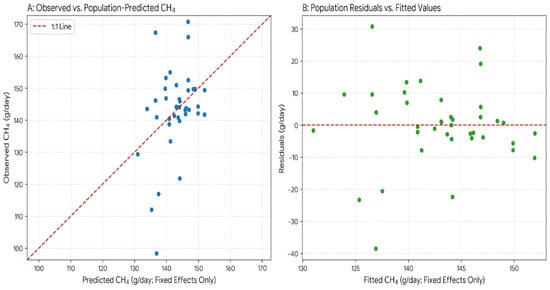
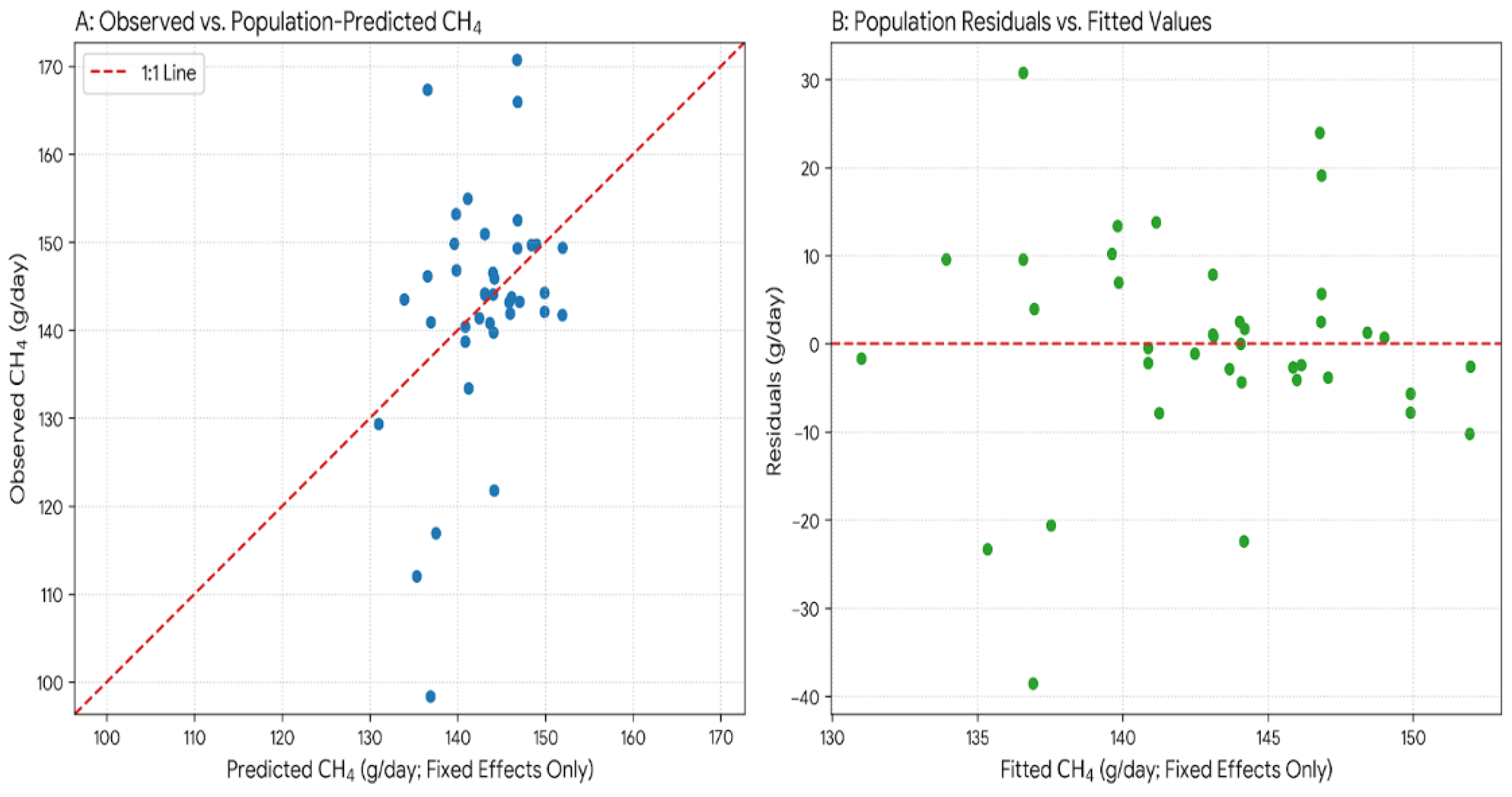
Statistical validation of the optimal parsimonious model (Model M5) via population-level diagnostic plotting confirmed the structural validity of the linear mixed-effects framework (Figure 1). The plot of observed versus population-predicted methane values demonstrated an unbiased distribution centered tightly along the 1:1 line of equality, confirming stable predictive performance across the entire dynamic range of the dataset (Figure 1A). Furthermore, evaluation of the marginal residuals against fitted values revealed a random, homoscedastic distribution centered around zero, verifying that the assumptions of constant variance and structural linearity were fully satisfied without evidence of heteroscedastic distortions (Figure 1B).
Figure 1.
Observed–predicted scatter plot and residual vs. fitted value plot of model 5.
2.5. Comparison of Locally Derived Estimates with IPCC Default Guidelines for Sub-Saharan African Cattle
A critical outcome of this study is the significant divergence between our locally derived empirical estimates and the standard default values provided by the IPCC (2019) guidelines for Sub-Saharan African livestock [15]. Our GreenFeed-based estimate for growing bulls was 51.52 kg CH4/animal/year, compared with the IPCC Tier 1 default of 49 kg CH4/head/year for grazing bulls in Sub-Saharan Africa (SSA), a difference of +2.52 kg CH4/head/year or +5.1%. This value lies within the range of published SSA Tier 2 estimates for male cattle, which span from about 30 to 63 kg CH4/head/year depending on age, breed, and production system. The comparison shows that the locally derived estimate is close to the IPCC default in this case, but the broader SSA literature indicates that Tier 1 factors can either overestimate or underestimate emissions depending on local animal performance and feeding conditions, reinforcing the value of system-specific factors. The strongest take-home message is therefore that locally measured or locally parameterized factors remain preferable whenever the goal is accurate national inventories or mitigation assessment.
3. Discussion
3.1. Dry Matter Intake as the Primary Driver of Methane Emissions in Crossbreed Bulls
The results of this study indicate that variation in methane output among growing bulls was associated with differences in dry matter intake, body weight, growth performance, and dietary characteristics. The association between methane emissions and dry matter intake observed in this study is consistent with previous work showing that dry matter intake is one of the main drivers of absolute enteric methane production in ruminants. This aligns with large intercontinental and regional analyses showing that dry matter intake explains much of the variation in absolute methane production across dairy, beef, tropical, pasture, Latin American, and South-east Asian cattle systems [16]. Previous studies have found that dry matter intake is the strongest consistent predictor of absolute enteric methane production, while prediction improves when intake is combined with digestibility, fiber, fat, or production variables [10]. The same literature also supports our study emphasis on scaled metrics, animal factors, and region-specific equations rather than generic emission factors [11,13]. DMI-based equations showed the best overall performance is consistent with evidence that simple DMI-only models can approach the predictive ability of more complex models [17]. In addition, the idea that body weight can influence emissions mainly through effects on intake and requirements is supported, but the broader evidence shows that BW is usually a secondary predictor relative to DMI [16,18]. Evidence is mixed on whether body weight or gross energy intake adds much once intake and digestibility are known, with some tropical validations finding little relationship for body weight or gross energy intake while pasture-fed models still retained body weight and physiological state as useful modifiers [19,20]. Therefore, evaluating both absolute emissions and scaled indicators is justified because yield and intensity capture different biology and production tradeoffs than g/day alone [11,21]. The argument for locally derived equations for crossbreed bulls (Montbéliarde × Borgou) is also well grounded, because extant models often lose accuracy when applied across regions, breeds, feeding systems, or tropical production contexts [13,22].
The comparatively weaker contribution of ADG is biologically plausible because average daily gain represents the net outcome of nutrient intake, maintenance requirements, tissue deposition, and nutrient partitioning rather than ruminal fermentation itself. Methane formation occurs primarily during ruminal fermentation and is therefore more directly related to substrate intake and fermentation characteristics than to subsequent tissue gain. In addition, animals with similar ADG may differ in body composition and feed efficiency, which can weaken the direct relationship between ADG and methane production.
Overall, the descriptive results and the prediction models both indicate that dry matter intake was a central factor explaining methane emissions in this dataset. This finding supports the development of locally derived prediction equations for crossbreed bulls (Montbéliarde × Borgou), because generic emission factors may not fully reflect local breeds, feeding practices and production conditions in West African system.
3.2. Biological Mechanisms of Dry Matter Intake Driven Methanogenesis
Dry matter intake emerged as the single most critical driver of daily methanogenesis across all models evaluated, explaining a significant portion of variance on its own (Model M1). In the optimized model (M5), each 1 kg increase in baseline daily intake generated a corresponding linear increase of 4.09 gCH4 per day. This numerical finding is strongly supported by core ruminant nutrition principles established in recent studies. According to [23], absolute feed intake regulates the structural volume of fermentable organic matter—predominantly structural carbohydrate matrices like neutral detergent fiber (NDF)—deposited directly into the reticulorumen and the microbial consortium degrades these fibrous particles; hydrolytic pathways favor acetate and butyrate production via hydrogen-releasing pathways. At the same time, [24] founded that archaea within the phylum Methanobacteriota continuously consume this metabolic hydrogen pool to reduce carbon dioxide via the hydrogenotrophic pathway, protecting the rumen environment from hydrogen toxicity.
Across prediction studies and reviews, dry matter intake is the strongest predictor of total daily methane output, while diet composition mainly modifies methane through its effects on fermentation stoichiometry and hydrogen partitioning [10,17]. In fact, the total methane production is closely related to dry matter intake in cattle production systems [11,19]. Prediction-modeling studies therefore consistently identify DMI as essential for accurate methane estimation, even when additional dietary variables improve model fit modestly [11,22]. The strength of the DMI–methane relationship depends on how methane is measured and when intake is aligned relative to feeding. With GreenFeed, the overall 24-h association can be weak, but time-slotting intake around feeding improves the relationship substantially, indicating that representative sampling across the feeding cycle is necessary [1].
Diet composition still matters, but usually as a secondary modifier of methane output or yield rather than the main driver of daily emissions. Dietary NDF is a positive predictor of methane, whereas in pasture-fed cattle, most diet composition variables show weak simple correlations with methane production and add little beyond intake in prediction models [11,19]. Structural and non-structural carbohydrates shift rumen fermentation toward different end products, and those end products determine hydrogen availability for methanogenesis. Diets richer in structural carbohydrates tend to favor acetate and butyrate formation, which release reducing equivalents, whereas diets richer in starches and sugars favor propionate, which incorporates reducing equivalents and competes with methane formation [25]. This stoichiometric logic is supported by in vitro fiber-manipulation studies. Replacing part of forage fiber with non-forage fiber sources increased propionate, raised H2 production by 8.45%, and decreased methane by 14.06%, consistent with a shift of hydrogen away from methanogenesis [26]. Similarly, increasing the dietary NDF/NFC ratio increased acetate, the acetate-to-propionate ratio, and methane per unit of degraded dry matter, while reducing TVFA, nutrient degradation, and microbial crude protein production [27]. Higher-fiber conditions therefore appear to increase methane intensity per unit of fermented substrate not simply because more methane is formed absolutely, but because fermentation shifts toward more hydrogen-releasing pathways and less efficient microbial capture of energy [27]. This interpretation is consistent with broader mechanistic treatments showing that acetate and butyrate formation are net hydrogen-producing pathways, whereas propionate is a competing hydrogen sink [25,26]. In addition, most ruminal methane is produced by hydrogenotrophic methanogenesis, in which methanogenic archaea use H2, and often formate, to reduce CO2 to methane [28,29]. Aceticlastic methanogenesis is not a significant pathway in the rumen under normal turnover conditions, and methylotrophic routes appear to contribute less than hydrogenotrophic pathways in typical rumen communities [24,30].
Rumen methanogens are numerically minor but functionally important because H2 removal sustains fermentation thermodynamics and favors efficient volatile fatty acid production [29,30]. Community composition also matters because Methanobrevibacter dominates many rumen communities globally, but diet can shift archaeal structure toward Methanomicrobiales or Methanomassiliicoccales, with implications for pathway use and methane yield [26,28]. Rumen hydrogen metabolism is broader than methanogenesis alone. Metatranscriptomic and ecological evidence shows expression of alternative hydrogen uptake pathways, including fumarate and nitrite reduction and acetogenesis, and these pathways are more active in low-methane animals [25,28,31].
Overall, this study discussed methane as the emergent result of intake, carbohydrate type, fermentation stoichiometry, and archaeal ecology, rather than attributing it to a single dietary variable. We also distinguished clearly differences between predictors of total methane production, which are dominated by intake, and mechanisms affecting methane yield, which depend more strongly on hydrogen partitioning and microbial community structure. Our results can therefore be framed as mitigation targets, but they have important constraints.
3.3. Metabolic Scaling Significance of Body Weight
One of the most biologically meaningful discoveries in this study is the behavior of body weight (BW) across different model designs. When evaluated as an isolated univariate predictor (Model M3), BW demonstrated no statistical significance (p = 0.934) and failed to capture any marginal variance (R2 = 0.000). However, when simultaneously integrated alongside feed intake in Model M5, BW shifted into a highly significant negative predictor (beta = −0.216 g CH4/kg BW, p < 0.001). After adjustment for DMI, BW showed a negative conditional association with methane production. This pattern may reflect metabolic scaling, but it may also arise from collinearity or the limited range of body weights and should therefore be interpreted cautiously. Once feed intake is controlled for (as in Model M5), the negative coefficient for body weight isolates the metabolic impact of structural scale. Moreover, larger physical frame scores are historically linked to expanded ruminal volumetric capacities, which slows down the passage rate of digesta and allows for alternative microbial clearance windows [32]. This dynamic can cause energy to shift away from methanogenic fermentation toward somatic tissue maintenance. Furthermore, the broader literature suggests that body weight rarely acts alone; methane output is driven mainly by intake, diet composition, passage dynamics, and microbial hydrogen disposal, with body size mattering mostly after those factors are controlled [10,33]. Regarding body size and scaling, the interpretation fits wider scaling work showing that once phylogeny, diet, and measurement technique are incorporated, the slope relating methane to body mass falls from 1.075 to 0.868 and is no longer steeper than expected from metabolic requirements [33]. Across larger prediction datasets, feed intake dominates total methane production more strongly than body mass does [10,34]. Genetic and phenotypic studies agree that a substantial share of methane variation overlaps with intake, liveweight, growth, and carcass traits, so apparent body-weight effects can reflect shared architecture rather than an independent structural mechanism [35,36]. Comparative and physiological work shows that body size can shape retention time and passage, but through interactions with chewing, particle reduction, diet fiber, physiological state, and gut fill rather than size alone [37]. Breed comparisons illustrate this complexity: Jerseys had faster passage than Holsteins despite smaller size, likely reflecting differences in mastication and digestive-tract scaling, while periparturient Holsteins showed that rumen capacity and passage also shift across lactation stage [38,39]. Microbiome studies now provide a stronger mechanistic bridge than body size alone: low-methane phenotypes tend to channel reductant toward propionate, amino acid synthesis, sulfate or nitrate reduction, whereas high-methane phenotypes rely more on hydrogen-producing fermentation coupled to methanogenesis [40,41].
Finally, one should interpret methane variation through the lens of rumen hydrogen economy: host size may influence the physical environment of fermentation, but microbial reductant disposal pathways are more proximal drivers of whether energy ends up as methane, propionate, acetate, or other end products [25,27,40]. Negative body-weight coefficient is biologically credible but not definitive, and it should be framed as a conditional, mechanistically plausible pattern that requires validation against intake-adjusted methane traits, passage measurements, and microbiome-functional data [34,35].
3.4. Study Limitations
This study has some limitations that should be considered when interpreting the results. First, the prediction equations were developed from a dataset collected under specific semi-intensive production conditions in Benin. Therefore, their applicability to other breeds, management systems, feeding regimes, agroecological zones, or more intensive production systems should be evaluated before wider use. Although this approach allows simple and practical prediction, it does not fully account for the combined effects of diet composition, feed digestibility, physiological status, rumen fermentation, and animal-level variation. Several studies have shown that methane prediction can be improved when intake, diet composition and animal performance variables are combined in multiple-predictor models [11,13,18]. According to [42] predictive equations for methane energy losses can derive from gross energy intake, thereby enhancing the accuracy of metabolizable energy calculations. The predictive performance of the models is often limited by incomplete data like methane emissions from manure that can introduce further uncertainty into model accuracy [43]. Model evaluation was based on the same dataset used for model development. Although several performance indicators were used, including RMSPE and MAE, external evaluation using independent datasets is still required to confirm the predictive ability and generalizability of the proposed equations. Finally, methane emissions were measured using the GreenFeed® system, which provides valuable individual measurements under practical farm conditions. However, GreenFeed® measurements can be influenced by visit frequency, animal behavior, feeding time, and day-to-day variation in gas emissions. These factors may contribute to residual variability in predicted methane emissions. Finally, the study focused on Crossbreed bulls (Montbéliarde × Borgou) managed under semi-intensive conditions. As a result, the equations should not be extrapolated to other cattle populations or production systems without further validation. Owing to the relatively limited dataset, all observations were used for equation development. External validation using independent datasets remains an important priority for future research. Larger datasets including more animals, broader dietary conditions, and independent validation populations would strengthen the reliability and practical application of the prediction models.
4. Materials and Methods
4.1. Datasets
The database was compiled from 13 nutrition trials conducted between May 2025 and March 2026 at the Okpara Breeding Farm in Benin, located between 2°40′ and 2°49′ E longitude and 9°15′ and 9°20′ N latitude. No prospective sample size calculation was performed because the study was based on a retrospective compilation of completed feeding trials. The compiled database consisted of 507 valid observations obtained from 39 crossbred growing bulls managed under semi-intensive conditions. The trials evaluated feeding strategies representative of cattle production systems in Benin, with diets mainly based on natural forage supplemented with locally available feed resources, including Leucaena leucocephala leaf pellets, cotton ginning waste, rice bran, and soybean crop residues. Across the trials, body weight (BW), average daily gain (ADG), dry matter intake (DMI), and enteric methane (CH4) emissions were extracted from the original experimental datasets. The resulting database represented a range of feeding conditions, intake levels, body weights, and growth performances.
Enteric methane emissions were measured individually using the GreenFeed® system (C-Lock Inc., Rapid City, SD, USA). The GreenFeed® system was operated according to the manufacturer’s recommended procedures throughout the measurement periods. An automatic recovery test was performed weekly to verify instrument performance, and CO2 calibration was conducted at the beginning and at the end of each experimental trial. GreenFeed has previously been validated against reference methods for enteric methane measurement in cattle [8]. Measurements were conducted over 14 consecutive days during each data-collection period. Valid GreenFeed visits typically lasted 2–3 min, and a minimum of 20 valid visits per animal over the 14-day measurement period was required for inclusion in the final dataset. Visits shorter than 2 min or records with incomplete gas measurements were excluded from the analysis. These criteria were applied to ensure sufficient temporal coverage of methane measurements for each animal. Feed samples were dried in a forced-air oven (SM9023A, MICROFIELDS, Bath, UK) at 60 °C for 72 h before chemical analysis. Dry matter (DM), organic matter (OM), crude protein (CP), and ether extract (EE) were determined according to the official methods of the Association of Official Analytical Chemists, using procedures 930.05, 942.05, 978.04, and 920.39, respectively [44]. Gross energy was determined using an adiabatic bomb calorimeter (C 200, IKA, Staufen im Breisgau, Germany), with benzoic acid used as the calibration standard. Calcium and phosphorus concentrations were determined using standard wet-chemistry procedures following AOAC guidelines.
4.2. Selection of Prediction Models
GreenFeed records were filtered following [45]. Records with incomplete gas measurements, abnormal airflow, visits shorter than the recommended duration, or insufficient valid visits per day were excluded. Daily methane emissions were calculated only from animals meeting the minimum quality-control criteria. Prediction equations were developed to estimate daily enteric methane emissions using dry matter intake (DMI, kg/day), body weight (BW, kg) and average daily gain (ADG, g/day) as explanatory variables. Equations were developed for the combined dataset and, where applicable, for growing bulls. For each predictor variable, the best-fitting equation was first selected based on marginal R2 measures variance explained strictly by fixed effects including the Akaike Information Criterion (AIC) and Bayesian Information Criterion (BIC). The selected equations were then retained for further validation.
4.3. Model Evaluation and Ranking
The selected prediction equations were evaluated by comparing observed and predicted daily methane emissions. Model performance was assessed using the root mean square prediction error expressed as a percentage of the observed mean (RMSPE %) and MAE. The RMSPE was used to quantify the overall prediction error between observed and predicted methane emissions and was expressed as a percentage of the mean observed methane emissions [46]. Models were compared using a multi-criteria framework. AIC was used as the primary criterion for balancing goodness of fit and model complexity, with lower values indicating a more parsimonious model. BIC and in-sample prediction-error metrics were used as complementary criteria, whereas marginal R2 was used to describe the proportion of variance explained by the fixed effects. Marginal R2 was therefore not used as the sole model-selection criterion. When criteria differed, preference was given to models combining lower information criteria and prediction error with biological interpretability and parsimony.
4.4. Data Analysis
Statistical analyses were conducted using R software version 4.4.2. Linear mixed-effects models (LMMs) were fitted using the lme4 package [47], while statistical significance of the fixed effects was evaluated using the lmerTest package [48]. The marginal coefficient of determination (R2) was calculated using the MuMIn package [49], and model assumptions and diagnostic tests were assessed using the performance package [50]. Methane emission (CH4; g day−1) was considered the response variable. Dry matter intake (DMI), average daily gain (ADG), and body weight (BW) were fixed effects. The general mixed-effects model was expressed as:
where β0 is the intercept; β1, β2, and β3 are the regression coefficients associated with DMI, ADG, and BW, respectively. εij is the residual error, assumed to be independently and normally distributed with mean zero and variance σ2e.
CH4 = β0 + β1(DMI) + β2(ADG) + β3(BW) + (1∣Animal ID) + (1∣Trial ID) +εij
Nine mixed-effects models were compared using AIC, BIC and marginal R2. Prediction accuracy was assessed using RMSE and MAE. Statistical significance was declared at p < 0.05.
5. Conclusions
This study developed and compared nine linear mixed-effects models for predicting daily enteric methane emissions from crossbred growing bulls managed under semi-intensive conditions in Benin. Among the candidate models, the model combining dry matter intake (DMI) and body weight (BW) provided the best balance between goodness of fit and parsimony. DMI was positively associated with daily methane production, whereas BW showed a negative conditional association after adjustment for feed intake. Average daily gain and interaction terms provided limited additional improvement in model performance. The results confirm the central role of feed intake in explaining variation in enteric methane emissions and show that body weight can provide additional information when considered jointly with DMI. The proposed equation represents a preliminary locally derived tool for the production conditions covered by the present dataset. However, because the model was developed and evaluated using the same compiled database, its application should remain restricted to similar animals and production conditions until it is validated using larger, independent datasets covering a broader range of diets, seasons, breeds, and agroecological conditions. Further validation will be essential before the equation can be considered for wider use in greenhouse gas inventories or mitigation assessments.
Author Contributions
N.A.: conceptualization, investigation, methodology, software, writing—original draft, writing—review & editing. A.A.S.: conceptualization, funding acquisition, investigation, methodology, software, supervision, validation, visualization, writing—review & editing. H.S.W.: conceptualization, investigation, software, supervision, writing—review & editing. M.J.H.: investigation, methodology & software. H.O.F.N.: investigation, methodology & software. Y.I.: conceptualization, investigation, software, supervision, writing—review & editing. Y.T.: supervision, validation, visualization, writing—review & editing. E.A.: supervision, validation, visualization, writing—review & editing. I.A.T.: supervision, validation, visualization, writing—review & editing. All authors have read and agreed to the published version of the manuscript.
Funding
The authors declare financial support was received for the research, authorship, and/or publication of this article. This document has been produced with the financial assistance of the European Union (grant no. DCI-PANAF/2020/420-028), through the African Research Initiative for Scientific Excellence (ARISE) pilot programme. ARISE is implemented by the African Academy of Sciences with the support of the European Commission and the African Union Commission. The contents of this document are the sole responsibility of the authors and can in no way be considered to reflect the position of the European Union, the African Academy of Sciences, and the African Union Commission.
Institutional Review Board Statement
The research proposal was assessed and approved by the University of Parakou (Letter of ethical certificate No. 113 of 3 April 2023).
Informed Consent Statement
Informed consent was obtained from all individual participants included in the research study. Participation in the survey was voluntary and anonymous, and data collection was carried out in the strictest confidence.
Data Availability Statement
The original contributions presented in this study are included in the article. Further inquiries can be directed to the corresponding author.
Acknowledgments
We thank ruminants’ farmers from Benin as well as extension officers involved in animal production for their availability during field work and data collection. AA was supported by African Research Initiative for Scientific Excellence (ARISE).
Conflicts of Interest
The authors declare no conflicts of interest.
References
- Hristov, A.N.; Melgar, A. Relationship of dry matter intake with enteric methane emission measured with the GreenFeed system in dairy cows receiving a diet without or with 3-nitrooxypropanol. Animal 2020, 14, s484–s490. [Google Scholar] [CrossRef] [Scilit]
- Ndung’u, P.W.; Takahashi, T.; Du Toit, C.J.L.; Robertson-Dean, M.; Butterbach-Bahl, K.; McAuliffe, G.A.; Merbold, L.; Goopy, J.P. Farm-level emission intensities of smallholder cattle (Bos indicus; B. indicus–B. taurus crosses) production systems in highlands and semi-arid regions. Animal 2022, 16, 100445. [Google Scholar] [CrossRef] [Scilit]
- Goopy, J.P.; Onyango, A.A.; Dickhoefer, U.; Butterbach-Bahl, K. A new approach for improving emission factors for enteric methane emissions of cattle in smallholder systems of East Africa–Results for Nyando, Western Kenya. Agric. Syst. 2018, 161, 72–80. [Google Scholar] [CrossRef] [Scilit]
- Tdesse, M.; Getahun, K. Methane emission factors from indigenous cattle breed in smallholder livestock production systems in Ethiopia. Online J. Anim. Feed Res. 2021, 11, 145–150. [Google Scholar] [CrossRef] [Scilit]
- Feyissa, A.A.; Senbeta, F.; Tolera, A.; Diriba, D.; Boonyanuwat, K. Enteric methane emission factors of smallholder dairy farming systems across intensification gradients in the central highlands of Ethiopia. Carbon Balance Manag. 2023, 18, 23. [Google Scholar] [CrossRef] [Scilit]
- Ndao, S.; Traoré, E.H.; Ickowicz, A.; Moulin, C.-H. Estimation of enteric methane emission factors for Ndama cattle in the Sudanian zone of Senegal. Trop. Anim. Health Prod. 2020, 52, 2883–2895. [Google Scholar] [CrossRef] [Scilit]
- Yassegoungbe, F.P.; Vihowanou, G.S.; Onanyemi, T.; Assouma, M.H.; Schlecht, E.; Dossa, L.H. Enteric Methane Production, Yield, and Intensity in Smallholder Dairy Farming Systems in Peri-Urban Areas of Coastal West African Countries: Case Study of Benin. J. Sustain. Agric. Environ. 2024, 3, e70019. [Google Scholar] [CrossRef] [Scilit]
- McGinn, S.M.; Coulombe, J.-F.; Beauchemin, K.A. validation of the GreenFeed system for measuring enteric gas emissions from cattle. J. Anim. Sci. 2021, 99, skab046. [Google Scholar] [CrossRef] [Scilit]
- Min, B.-R.; Lee, S.; Jung, H.; Miller, D.N.; Chen, R. Enteric methane emissions and animal performance in dairy and beef cattle production: Strategies, opportunities, and impact of reducing emissions. Animals 2022, 12, 948. [Google Scholar] [CrossRef] [Scilit]
- Ramin, M.; Huhtanen, P. Development of equations for predicting methane emissions from ruminants. J. Dairy Sci. 2013, 96, 2476–2493. [Google Scholar] [CrossRef] [Scilit]
- Niu, M.; Kebreab, E.; Hristov, A.N.; Oh, J.; Arndt, C.; Bannink, A.; Bayat, A.R.; Brito, A.F.; Boland, T.; Casper, D.; et al. Prediction of enteric methane production, yield, and intensity in dairy cattle using an intercontinental database. Glob. Change Biol. 2018, 24, 3368–3389. [Google Scholar] [CrossRef] [Scilit]
- Bell, M.; Eckard, R.; Moate, P.J.; Yan, T. Modelling the effect of diet composition on enteric methane emissions across sheep, beef cattle and dairy cows. Animals 2016, 6, 54. [Google Scholar] [CrossRef] [Scilit]
- Benaouda, M.; González-Ronquillo, M.; Appuhamy, J.; Kebreab, E.; Molina, L.T.; Herrera-Camacho, J.; Ku-Vera, J.C.; Ángeles-Hernández, J.C.; Castelán-Ortega, O.A. Development of mathematical models to predict enteric methane emission by cattle in Latin America. Livest. Sci. 2020, 241, 104177. [Google Scholar] [CrossRef] [Scilit]
- Ribeiro, R.S.; Rodrigues, J.P.P.; Maurício, R.M.; Borges, A.; e Silva, R.R.; Berchielli, T.T.; Valadares Filho, S.C.; Machado, F.S.; Campos, M.M.; Ferreira, A.L. Predicting enteric methane production from cattle in the tropics. Animal 2020, 14, s438–s452. [Google Scholar] [CrossRef] [Scilit]
- Baasansuren, J.; Fukuda, M.; Ngarize, S.; Osako, A.; Pyrozhenko, Y.; Shermanau, P.; Federici, S. 2019 Refinement to the 2006 IPCC Guidelines for National Greenhouse Gas Inventories; IPCC: Geneva, Switzerland, 2019; Available online: https://beta.ghg.inergy.vn/upload/others/2025/03/27/19R_V5_IPCC%202019_Waste_B%E1%BA%A3n%20%C4%91%E1%BA%A7y%20%C4%91%E1%BB%A7-94ef79b7-a22f-4339-8c0c-36763a149144.pdf (accessed on 17 July 2026).
- Donadia, A.B.; Torres, R.N.S.; da Silva, H.M.; Soares, S.R.; Hoshide, A.K.; de Oliveira, A.S. Factors affecting enteric emission methane and predictive models for dairy cows. Animals 2023, 13, 1857. [Google Scholar] [CrossRef] [Scilit]
- Hristov, A.N.; Kebreab, E.; Niu, M.; Oh, J.; Bannink, A.; Bayat, A.R.; Boland, T.M.; Brito, A.F.; Casper, D.P.; Crompton, L.A. Symposium review: Uncertainties in enteric methane inventories, measurement techniques, and prediction models. J. Dairy Sci. 2018, 101, 6655–6674. [Google Scholar] [CrossRef] [Scilit]
- Wang, Y.; Song, W.; Wang, Q.; Yang, F.; Yan, Z. Predicting enteric methane emissions from dairy and beef cattle using nutrient composition and intake variables. Animals 2024, 14, 3452. [Google Scholar] [CrossRef] [Scilit]
- Muetzel, S.; Hannaford, R.; Jonker, A. Effect of animal and diet parameters on methane emissions for pasture-fed cattle. Anim. Prod. Sci. 2024, 64, AN23049. [Google Scholar] [CrossRef] [Scilit]
- Molina-Botero, I.; Díaz-Céspedes, M.; Mayorga-Mogollón, O.; Ku-Vera, J.; Arceo-Castillo, J.; Montoya-Flores, M.D.; Arango, J.; Gómez-Bravo, C. Validation of enteric methane emissions by cattle estimated from mathematical models using data from in vivo experiments. Acta Sci. Anim. Sci. 2025, 47, e69328. [Google Scholar] [CrossRef] [Scilit]
- Smith, P.E.; Waters, S.M.; Kenny, D.A.; Kirwan, S.F.; Conroy, S.; Kelly, A.K. Effect of divergence in residual methane emissions on feed intake and efficiency, growth and carcass performance, and indices of rumen fermentation and methane emissions in finishing beef cattle. J. Anim. Sci. 2021, 99, skab275. [Google Scholar] [CrossRef] [Scilit]
- Appuhamy, J.A.D.R.N.; France, J.; Kebreab, E. Models for predicting enteric methane emissions from dairy cows in North America, Europe, and Australia and New Zealand. Glob. Change Biol. 2016, 22, 3039–3056. [Google Scholar] [CrossRef] [Scilit]
- Stewart, R.D.; Auffret, M.D.; Warr, A.; Wiser, A.H.; Press, M.O.; Langford, K.W.; Liachko, I.; Snelling, T.J.; Dewhurst, R.J.; Walker, A.W. Assembly of 913 microbial genomes from metagenomic sequencing of the cow rumen. Nat. Commun. 2018, 9, 870. [Google Scholar] [CrossRef] [Scilit]
- Morgavi, D.P.; Cantalapiedra-Hijar, G.; Eugène, M.; Martin, C.; Noziere, P.; Popova, M.; Ortigues-Marty, I.; Muñoz-Tamayo, R.; Ungerfeld, E.M. Review: Reducing enteric methane emissions improves energy metabolism in livestock: Is the tenet right? Animal 2023, 17, 100830. [Google Scholar] [CrossRef] [Scilit]
- Ungerfeld, E.M. Metabolic hydrogen flows in rumen fermentation: Principles and possibilities of interventions. Front. Microbiol. 2020, 11, 589. [Google Scholar] [CrossRef] [Scilit]
- Wang, K.; Nan, X.; Chu, K.; Tong, J.; Yang, L.; Zheng, S.; Zhao, G.; Jiang, L.; Xiong, B. Shifts of hydrogen metabolism from methanogenesis to propionate production in response to replacement of forage fiber with non-forage fiber sources in diets in vitro. Front. Microbiol. 2018, 9, 2764. [Google Scholar] [CrossRef] [Scilit]
- Li, J.; Guan, F.; Liu, P.; Ma, H.; Zhang, J.; Ma, Y.; Mao, S.; Xiang, X.; Jin, W. Effects of dietary NDF/NFC ratios on in vitro rumen fermentation, methane emission, and microbial community composition. Front. Vet. Sci. 2025, 12, 1588357. [Google Scholar] [CrossRef] [Scilit]
- Greening, C.; Geier, R.; Woods, L.C.; Morales, S.E.; McDonald, M.J.; Rushton-Green, R.; Morgan, X.C.; Koike, S.; Leahy, S.C. Diverse hydrogen production and consumption pathways influence methane production in ruminants. ISME J. 2019, 13, 2617–2632. [Google Scholar] [CrossRef] [Scilit]
- Janssen, P.H.; Kirs, M. Structure of the Archaeal Community of the Rumen. Appl. Environ. Microbiol. 2008, 74, 3619–3625. [Google Scholar] [CrossRef] [Scilit]
- Khairunisa, B.H.; Heryakusuma, C.; Ike, K.; Mukhopadhyay, B.; Susanti, D. Evolving understanding of rumen methanogen ecophysiology. Front. Microbiol. 2023, 14, 1296008. [Google Scholar] [CrossRef] [Scilit]
- Mackie, R.I.; Kim, H.; Kim, N.K.; Cann, I. Hydrogen production and hydrogen utilization in the rumen: Key to mitigating enteric methane production. Anim. Biosci. 2023, 37, 323–336. [Google Scholar] [CrossRef] [Scilit]
- Goopy, J.P.; Donaldson, A.; Hegarty, R.; Vercoe, P.E.; Haynes, F.; Barnett, M.; Oddy, V.H. Low-methane yield sheep have smaller rumens and shorter rumen retention time. Br. J. Nutr. 2014, 111, 578–585. [Google Scholar] [CrossRef] [Scilit]
- Pérez-Barbería, F.J. Scaling methane emissions in ruminants and global estimates in wild populations. Sci. Total Environ. 2017, 579, 1572–1580. [Google Scholar] [CrossRef] [Scilit]
- Crowley, S.B.; Purfield, D.C.; Conroy, S.B.; Kelly, D.N.; Evans, R.D.; Ryan, C.V.; Berry, D.P. Associations between a range of enteric methane emission traits and performance traits in indoor-fed growing cattle. J. Anim. Sci. 2024, 102, skae346. [Google Scholar] [CrossRef] [Scilit]
- Crowley, S.B.; Purfield, D.C.; Conroy, S.B.; Kelly, D.N.; Evans, R.D.; Ryan, C.V.; Berry, D.P. Genetic insights into enteric methane emissions in indoor-fed growing cattle. J. Anim. Sci. 2026, 104, skag046. [Google Scholar] [CrossRef] [Scilit]
- Sakamoto, L.S.; Souza, L.L.; Gianvecchio, S.B.; de Oliveira, M.H.V.; Silva, J.A.I.d.V.; Canesin, R.C.; Branco, R.H.; Baccan, M.; Berndt, A.; de Albuquerque, L.G. Phenotypic association among performance, feed efficiency and methane emission traits in Nellore cattle. PLoS ONE 2021, 16, e0257964. [Google Scholar] [CrossRef] [Scilit]
- Moyo, M.; Nsahlai, I.V. Rate of passage of digesta in ruminants; are goats different? In Goat Science; IntechOpen: London, UK, 2017. [Google Scholar] [CrossRef] [Scilit]
- Aikman, P.C.; Reynolds, C.K.; Beever, D.E. Diet digestibility, rate of passage, and eating and rumination behavior of Jersey and Holstein cows. J. Dairy Sci. 2008, 91, 1103–1114. [Google Scholar] [CrossRef] [Scilit]
- Park, A.F.; Shirley, J.E.; Titgemeyer, E.C.; DeFrain, J.M.; Cochran, R.C.; Wickersham, E.E.; Nagaraja, T.G.; Johnson, D.E. Characterization of ruminal dynamics in Holstein dairy cows during the periparturient period: Ruminal dynamics of dairy cows. J. Anim. Physiol. Anim. Nutr. 2011, 95, 571–582. [Google Scholar] [CrossRef] [Scilit]
- Li, Q.; Ma, Z.; Huo, J.; Zhang, X.; Wang, R.; Zhang, S.; Jiao, J.; Dong, X.; Janssen, P.H.; Ungerfeld, E.M. Distinct microbial hydrogen and reductant disposal pathways explain interbreed variations in ruminant methane yield. ISME J. 2024, 18, wrad016. [Google Scholar] [CrossRef] [Scilit]
- Jia, X.; Zhang, Y.; Tian, B.; Zhang, G.; Mao, S.; Qian, W.; Sun, D.; Liu, J. Integrative analysis of rumen microbiota and host multi-organ interactions underlying feed conversion efficiency in Hu sheep. J. Anim. Sci. Biotechnol. 2026, 17, 19. [Google Scholar] [CrossRef] [Scilit]
- Holter, J.B.; Young, A.J. Methane prediction in dry and lactating Holstein cows. J. Dairy Sci. 1992, 75, 2165–2175. [Google Scholar] [CrossRef] [Scilit]
- J Johnson, D.E.; Ward, G.M. Estimates of animal methane emissions. Environ. Monit. Assess. 1996, 42, 133–141. [Google Scholar] [CrossRef] [Scilit]
- AOAC. Official Methods of Analysis, 7th ed.; Association of Official Analytical Chemists: Arlington, VA, USA, 1990. [Google Scholar]
- Coppa, M.; Jurquet, J.; Eugène, M.; Dechaux, T.; Rochette, Y.; Lamy, J.-M.; Ferlay, A.; Martin, C. Repeatability and ranking of long-term enteric methane emissions measurement on dairy cows across diets and time using GreenFeed system in farm-conditions. Methods 2021, 186, 59–67. [Google Scholar] [CrossRef] [Scilit]
- Tedeschi, L.O. Assessment of the adequacy of mathematical models. Agric. Syst. 2006, 89, 225–247. [Google Scholar] [CrossRef] [Scilit]
- Bates, D.; Mächler, M.; Bolker, B.; Walker, S. Fitting linear mixed-effects models using lme4. J. Stat. Softw. 2015, 67, 1–48. [Google Scholar] [CrossRef] [Scilit]
- Kuznetsova, A.; Brockhoff, P.B.; Christensen, R.H. lmerTest package: Tests in linear mixed effects models. J. Stat. Softw. 2017, 82, 1–26. [Google Scholar] [CrossRef] [Scilit]
- Bartoń, K. MuMIn: Multi-Model Inference. R Package Version 1.46.0. 2022. Available online: https://cir.nii.ac.jp/crid/1370865816820006537 (accessed on 17 July 2026).
- Lüdecke, D.; Ben-Shachar, M.S.; Patil, I.; Waggoner, P.; Makowski, D. performance: An R package for assessment, comparison and testing of statistical models. J. Open Source Softw. 2021, 6, 3139. [Google Scholar] [CrossRef] [Scilit]

Disclaimer/Publisher’s Note: The statements, opinions and data contained in all publications are solely those of the individual author(s) and contributor(s) and not of MDPI and/or the editor(s). MDPI and/or the editor(s) disclaim responsibility for any injury to people or property resulting from any ideas, methods, instructions or products referred to in the content. |
© 2026 by the authors. Licensee MDPI, Basel, Switzerland. This article is an open access article distributed under the terms and conditions of the Creative Commons Attribution (CC BY) license.