


Abstract
More frequent consumption of home-cooked meals is associated with better diet quality, and food literacy questionnaires may be able to identify factors that influence cooking frequency. Eating and Food Literacy Behaviors Questionnaire (EFLBQ) factor scores and demographic characteristics were examined as predictors of home cooking in a group of women aged 18 to 30 years. Participants were recruited by a third-party provider. EFLBQ factor scores (F1: health and nutrition, F2: taste, F3: food preparation, F4: planning and decision making, and F5: convenience), demographic characteristics, and frequency of cooking were measured. Groups were compared using ANOVA and Games–Howell post hoc tests. Pearson’s r or point-biserial tests were used to examine relationships between variables. Significant predictors were entered into a structural equation model (SEM) to predict home cooking frequency. A total of 107 Asian, 113 Black, 108 Hispanic, and 111 White women participated. The F1 factor score (health and nutrition) was a positive mediator between age and cooking frequency, and the F5 score (convenience) was independently and negatively correlated with how often the women cooked. Nutrition educators should address these EFLBQ factor topics in interventions and use these factor scores to measure changes in participants’ behaviors after they participate in educational programs that promote cooking.
1. Introduction
Research suggests that more frequent consumption of in-home meals is associated with better diet quality and that children who eat family meals on a more frequent basis have better mental and physical health, yet individuals are spending less time shopping for food, cooking, and eating meals together [1,2,3,4,5]. A person’s food literacy skills and personal characteristics may be factors that influence the frequency of food preparation at home [6,7]. Food literacy has been described as the knowledge and behaviors associated with consuming healthful diets that align with dietary recommendations [8,9,10]. Vidgen and Gallegos proposed that food literacy includes having the skills to plan and manage, select, prepare, and eat healthy foods [8]. Other investigators have expanded the definition to incorporate factors such as personal resilience and resistance, social and conscious eating, and other aspects; some have proposed that food literacy could be divided into a literacy dimension and a food systems dimension [9,10]. A recent survey developed and validated by Yoo et al. among South Korean adults proposed that food literacy includes the three main domains: nutrition and food safety, cultural and relational factors, and socio-ecological values [11].
Researchers have compared food literacy questionnaire scores with personal characteristics and food-related behaviors. Poelman and colleagues developed a questionnaire called the Self-Perceived Food Literacy (SPFL) among Dutch adults and noted that individuals with higher SPFL scores reported greater self-control and less impulsivity regarding food [9]. They also noted that women trained as dietitians had higher SPFL scores than general adults. A recent study by Murakami and colleagues compared SPFL scores of Japanese adults with their diet quality using the Healthy Eating Index-2015 (HEI-2015) and found that six of the eight SPFL domains were positively and significantly associated with overall diet scores [12,13]. In 2020, Park and colleagues similarly reported that, among a group of Korean adults, food literacy scores were positively associated with food knowledge and nutrient quotient scores [10]. Sociodemographic characteristics and food literacy of Seoul adults were compared to their food intake and weight status in a study by Yoo and colleagues, and food literacy scores were found to be higher among women and housewives and lower among young adults and students [11]. However, these studies did not examine whether food literacy scores were related to the frequency of in-home food preparation.
A questionnaire called the Eating and Food Literacy Behaviors Questionnaire (EFLBQ) was developed and validated by Rhea and colleagues [14]. These investigators began the development of the EFLBQ questionnaire by asking young adult university students to respond to seven statements based on each of the four food literacy domains proposed by Vidgen and Gallegos (food planning and management, selection, preparation, and consumption). After multiple rounds of exploratory factor analysis, the original 21 statements were reduced to the EFLBQ’s final 19 statements, representing the food-literacy-related factors of health and nutrition (F1), food preparation (F3), and planning and decision-making (F4), and the additional factors of taste (F2) and convenience (F5) [14]. Food literacy factor scores using the EFLBQ have been shown to be higher among young adults who have received formal nutrition education compared with those who have not received this training and to improve after participation in nutrition education and culinary skill-building programs; however, EFLBQ factor scores have not been considered as predictors of a behavior such as in-home cooking [15,16,17].
The purpose of this study was to examine whether the EFLBQ factors and demographic characteristics, including age, race or ethnicity, having children, participating in the US Supplemental Nutrition Assistance Program (SNAP), or being enrolled in a university, were predictors of the frequency of in-home food preparation [18]. Food literacy scores have been reported to differ between men and women; therefore, to better compare EFLBQ factor scores with cooking frequency, only individuals who identified as female at birth were included in this study [11,19].
2. Materials and Methods
2.1. Participants
Females who had access to a place to cook, were not pregnant, were 18 to 30 years of age, and lived in one of the 13 continental states in the United States Department of Agriculture (USDA) Southern Region (US Forest Service, United States Department of Agriculture Southern Region) were recruited by the third-party provider Centiment (Centiment.com) to participate in this study [20]. Centiment was instructed to recruit at least 400 individuals with equal distribution among Asian/Asian American, Black/African American, Hispanic/Latino, and White women. This quota sampling method, which involved selecting participants who met predetermined criteria for each group, was used to ensure that target subgroups were included. This allowed the sample to reflect important population characteristics even without a complete sampling frame [21]. Individuals within the Centiment database who met the study inclusion criteria were provided with a link to the questionnaire, which was administered electronically using Qualtrics (Qualtrics, Provo, UT, USA) [22]. Data were collected on 18–22 June 2024. Prior to completing the questionnaire, each woman provided implied consent by selecting an option indicating agreement to participate in this study. Centiment removed all identifying information from the subjects’ data prior to sending the data to the researchers and provided incentives to all participants. This study was approved by the Louisiana State University Agricultural Center Institutional Review Board after expedited review (IRBAG-24-0061-01: Approved 27 May 2024).
2.2. Data Collection
The women were asked to provide demographic data, respond to the EFLBQ statements, and indicate the frequency with which they cooked an evening meal at home [14]. The participants reported their age, race/ethnicity, and US state of residence, the number of children under 18 years of age in their household, whether they received SNAP benefits (yes/no); and whether they were currently enrolled in a college or university (yes/no). Statements representing each of the five EFLBQ factors were evaluated. Factor 1 (health and nutrition) included seven statements, and Factor 2 (taste), Factor 3 (food preparation), Factor 4 (planning and decision-making), and Factor 5 (convenience) each included three statements. EFLBQ items were scored using a 4-point Likert scale with the following choices: 1 = never, 2 = seldom, 3 = often, and 4 = always, and the mean value for each factor was calculated. An answer from 1–7 could be chosen by the participant, indicating the number of evening meals cooked at home in a typical week. A statement assessing engagement when completing the survey was included, and data from subjects who appeared to select random answers just to earn rewards provided by Centiment were removed from this study.
2.3. Statistical Analysis
Descriptive data were collected, and the relationships between variables were examined. The variables of age, number of children under 18 years of age living in the household, cooking frequency, and EFLBQ factor scores were compared between the four groups of women using ANOVA and Games–Howell post hoc tests. Data were examined for normality with Shapiro–Wilks tests. Games–Howell tests were chosen for post hoc examinations because of their robustness when a lack of normality may exist [23]. Associations between variables were explored using Pearson’s r or point-biserial tests. Structural equation modeling was used to determine whether a model existed that explained the frequency of cooking an evening meal at home. Absolute fit was assessed using the root mean square error of approximation (RMSEA) and standard root mean square residual (SRMR), with values equal to or below 0.08 and 0.05, respectively, indicative of a better-fitting model [24]. Comparative fit was assessed using the comparative fit index (CFI) and the Tucker–Lewis index (TLI), with values greater than or equal to 0.95 indicating an excellent fit [24]. Data were analyzed using Statistical Package for the Social Sciences (IBM SPSS Statistics for Windows, Version 29.0) and Mplus (Version 8.11, 2024). Statistical significance was set at p < 0.05.
3. Results
In this cross-sectional study, a total of 439 women with a mean age of 23.9 ± 3.7 years participated. Similar numbers of Asian/Asian American, Black, Hispanic/Latino, and White women were included (Table 1). Women from each of the 13 continental states in the USDA Southern Region participated, and most lived in Texas or Florida. A little less than half of the women (46.9%) indicated that they had at least one child, with 23.5% reporting having one child, 13.7% reporting having two children, and the remaining 9.7% reporting having more than two children. Of the group, 23.7% received SNAP benefits, and 34.4% were enrolled in a college or university. The women reported preparing an average of about 4 meals per week, with a range from 0 to 7 meals.
Table 1.
Demographic information of young adult females who completed the Eating and Food Literacy Behaviors Questionnaire (EFLBQ) (n = 439).
Several factors differed among the groups of Asian, Black, Hispanic/Latino, and White women. The number of children younger than 18 years living in the household differed [F(3, 435) = 2.793, p = 0.040], with women who identified as White reporting having more children than those who identified as Asian (p = 0.036). Cooking frequency differed [F(3, 435) = 2.761, p = 0.042], with Hispanic/Latino women cooking more frequently than Black women (p = 0.043). Supplemental Nutrition Assistance Program participation varied [F(3, 435) = 9.696, p < 0.001], with Asian women less likely to participate than the Black and White women (p < 0.001 and p = 0.010, respectively), and Hispanic/Latino women were less likely to participate in SNAP than Black women (p = 0.013). Women who identified as Asian were more likely to be enrolled in a college or university than those who identified as White [F(3, 435) = 4.102, p = 0.007].
The EFLBQ factor mean scores were compared among the four groups of women (Table 2). The factor of taste (F2) had the highest mean factor score for each group, followed by convenience (F5). The planning and decision-making (F4) and the convenience (F5) scores were significantly higher in the Black group compared with the Asian group (p = 0.02 and p = 0.01, respectively). The mean factor scores for health and nutrition (F1), taste (F2), and food preparation (F3) were not significantly different among the groups.
Table 2.
Comparison of the groups of young adult women who completed the Eating and Food Literacy Behaviors Questionnaire (EFLBQ).
Tests of normality indicated a lack of normality across all five factors; thus, Games–Howell tests were used for the post hoc tests. The EFLBQ mean factor score for planning and decision-making (F4) differed, with Asian women having lower scores than Black women. The mean convenience (F5) score was lower among Asian women compared with Black women. While the ANOVA indicated differences among the groups regarding having at least one child younger than 18 years of age living in the household, the post hoc analysis did not find significant differences among the groups.
When the five EFLBQ mean factor scores were compared with demographic characteristics and the frequency of cooking an evening meal at home, significant predictors emerged. Cooking an evening meal at home was positively related to subject age (r = 0.30, p < 0.001), Factor 1: health and nutrition (r = 0.30, p < 0.001), and Factor 4: planning and decision-making (r = 0.18, p < 0.01) mean scores. Factor 5: convenience mean scores were negatively associated with cooking frequency (r = −0.19, p < 0.01). Mean scores for Factor 2: taste and Factor 3: food preparation were not significantly related to the frequency of preparing an evening meal at home (p > 0.05) (Table 3).
Table 3.
Estimated correlation matrix for the latent variables (n = 439).
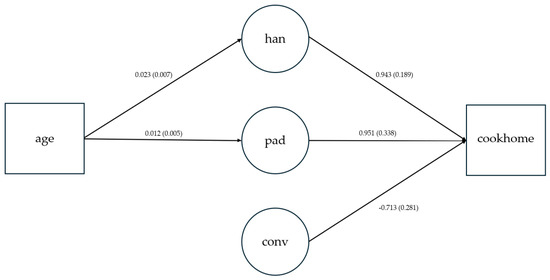
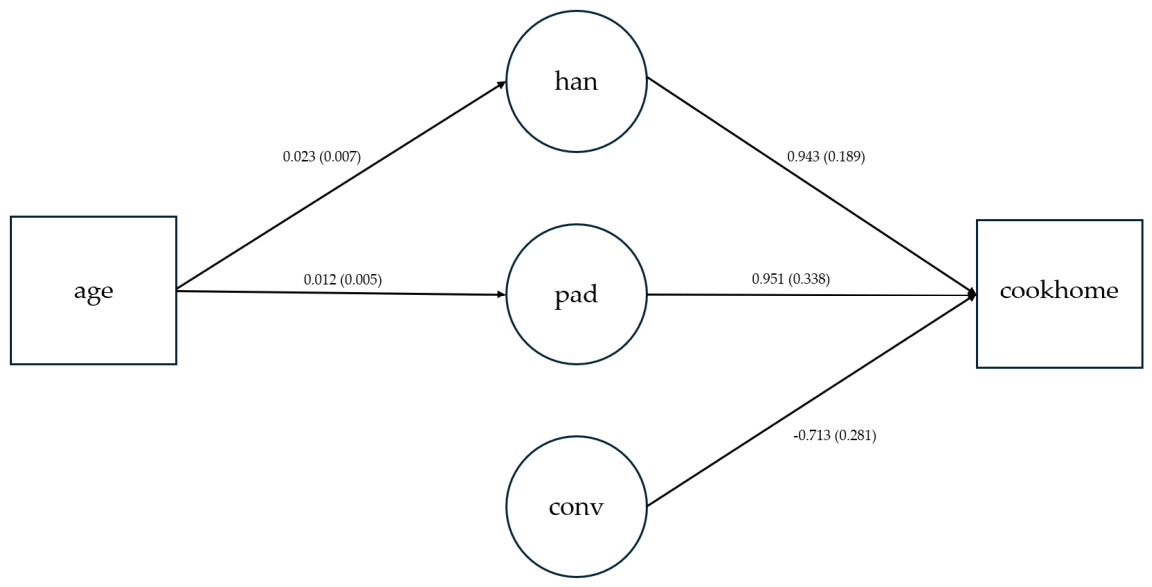
A structural equation model based on the 439 responses was used to examine the frequency of cooking an evening meal at home. The variables included in the model were selected based on the significant correlations described above. The dependent variable was the frequency of preparing an evening meal. Age was identified as an independent variable, with health and nutrition, planning and decision-making, and convenience identified as possible mediating variables. The model (see Figure 1) indicated two statistically significant paths. The direct path from convenience to the frequency of cooking an evening meal at home was significant (p = 0.009). For every one-unit increase in convenience, the expected frequency of cooking an evening meal at home decreased by 0.71. The effect of age was mediated by health and nutrition (p = 0.005); however, planning and decision-making did not yield a significant indirect effect (p = 0.080). The chi-square value of 332.617 was statistically significant. The absolute fit index for RMSEA (0.080) was within the range identified as indicating a good fit for the data [24]. However, the SRMR value (0.116) was outside the recommended range of values for a good fit [25]. The comparative fit indices, CFI (0.893) and TLI (0.870), did not meet the criteria for good fit identified by Hu and Bentler; however, both values were near the acceptable fit range identified by Bentler and Bonett [26].
Figure 1.
Structural equation model (SEM) examining the predictors of home cooking frequency in a group of adult women (n = 439). Note: This SEM examines the variables predicting the frequency of cooking an evening meal at home. There is a direct path from convenience (conv: F5) to the frequency of cooking an evening meal at home (cookhome: p = 0.009), and the effect of age (y) is mediated by health and nutrition (han: F1) (p = 0.005); however, planning and decision-making (pad: F4) did not yield a significant indirect effect (p = 0.08). Race/Ethnicity: Asian (n = 107), Black (n = 113), Hispanic (n = 108), and White women (n = 111).
4. Discussion
In this group of young adult women representing three racial groups and one ethnic group, mean EFLBQ factor scores indicated variables that promoted or inhibited the frequency of cooking an evening meal at home. How often a woman cooked was positively related to her age and behaviors supporting healthy food consumption and the ability to plan and make decisions about food. Her concern for convenience was negatively related to cooking frequency. Factor 1 scores (health and nutrition) reflected responses to EFLBQ statements such as “I select foods that are healthy” and “I eat a balanced diet”, while Factor 4 responses (planning and decision-making) included statements such as “I plan what I will eat” and “I decide what I want to eat before a meal”. Factor 5 (convenience) statements included items such as “I eat foods that are convenient for me” or “I purchase foods that are convenient for me” [14]. Practicing behaviors that promote health and nutrition, as described by the EFLBQ Factor 1 statements, appeared to be a positive mediator between age and the frequency of home food preparation. A higher mean score on the EFLBQ statements that described convenience was associated with a lower frequency of home cooking. The ability to plan and manage what is eaten, described by Factor 4, was positively related to cooking frequency but did not appear to mediate the relationship between age and cooking frequency. Prior research has suggested that older adults and women are more likely to prepare meals and possess the confidence and skills needed to cook, but these characteristics may not translate into the frequency of meal preparation [3,27]. Adams and colleagues, in a study of adults in the U.K., found that women were more likely to cook than men and that young adults aged 19–35 years were less likely to cook than those in older age groups [27]. The current study’s finding that age was associated with the frequency of cooking among young adults is consistent with prior research involving older individuals. The investigators in the U.K. study also examined the participants’ confidence in cooking and reported that having confidence in cooking did not always translate into cooking behaviors [27]. The current study’s finding that Factor 3 (food preparation) scores did not correlate with the frequency of cooking an evening meal at home supports the findings of Adams et al. and suggests that variables other than confidence in one’s cooking skills may influence home meal preparation.
Promoting family meals is important because it is well documented that individuals who eat home-prepared food are more likely to have healthier food intake and better health outcomes [2,3,4,5]. Eating family meals is related to greater consumption of dietary fiber and micronutrients, greater fruit and vegetable consumption, lower soda and saturated fat intake, and higher Healthy Index Scores [2,3,4,5]. Mills and colleagues, in their population-based study of adults in the United Kingdom, also noted that the frequency of consuming home-cooked meals was associated with healthier weight status [3]. These authors reported that adults who consumed home-cooked meals more than five times per week, compared with those who consumed home-prepared meals less than three times per week, were 28% less likely to be overweight and 24% less likely to have excess body fat. A study by Wolfson and colleagues examined data from the 2007–2010 National Health and Nutrition Examination Survey (NHANES) and reported that a higher frequency of consuming home-cooked meals was associated with lower consumption of daily calories [28].
In the current study, the EFLBQ factors of taste and convenience had the highest mean scores, suggesting that these are key influencers of young adult women’s food choices. Previous studies using the EFLBQ among young adult university students reported the same findings [14,15,16,17]. Aggarwal and colleagues, in their examination of NHANES data, reported that taste was an important consideration when shopping for food and that convenience was also an important factor impacting food choices [29]. Similarly, Hebden et al., in their cross-sectional study of young adult university students living in Australia, found that taste was the most important factor, and convenience was the second most important factor influencing food selection [30]. Focus group interviews with Belgian university students similarly noted that taste was the most frequently mentioned factor determining their food choices [31]. These students also noted that time was very important to them and that they would rather spend time on other activities other than cooking. Finally, a recent instrument called the Food Choice Questionnaire, developed by Marsola et al. among Brazilian adults, identified eight factors as motivators of dietary intake (nutritional composition, mood, health, sensory appeal, price, preparation convenience, familiarity, and purchase convenience) and noted that the mean score for sensory appeal had the highest factor score, followed by the mean score for purchase convenience [32]. The findings from the current study suggest that interventions designed to improve food literacy and cooking behaviors must recognize that taste and convenience are important factors to address when promoting behavior change. The mean EFLBQ factor score for convenience (F5), as well as scores for health and nutrition (F1) and planning and decision-making (F4), could be used to monitor changes in health-promoting food literacy behaviors.
This study with a cross-sectional design had limitations. It examined responses from a convenience sample of young adult women who lived in one of the 13 continental US States in the USDA Southern Region and who were recruited by a third-party provider. Therefore, the results cannot be generalized to men, younger or older individuals, or individuals living in other geographical locations. This study’s single question asking about the frequency of cooking an evening meal at home during the past week may not have adequately captured the young women’s cooking behaviors. Finally, the data gathered from the questionnaire were self-reported and are dependent upon the truthfulness of the participants’ responses.
The results from this study suggest that, among young adult women, age is positively related to the likelihood of cooking an evening meal at home and that the desire to maintain good nutrition and health encourages home meal preparation, while behaviors that support convenience negatively impact home cooking. Women whose behaviors focus on convenience are less likely to cook, regardless of their age. In addition, the study findings suggest that taste is an important behavioral factor to address in interventions aimed at improving food literacy and home meal preparation.
5. Conclusions
The findings from this study suggest that EFLBQ factor scores can be used to evaluate behaviors that impact the frequency that a person cooks at home. Assessing behaviors related to health and nutrition (Factor 1), convenience (Factor 5), and planning and decision-making (Factor 4) before and after participation in interventions will help educators quantitatively determine whether participants have adopted practices that support or inhibit home cooking. A subject’s responses to the EFLBQ factor statements can also be used to evaluate their current food literacy-related practices and suggest their readiness to change. Finally, taste and convenience are important drivers of food selection, and when educators provide opportunities for individuals to learn about the positive impact of nutrition on personal health and teach them to plan and make healthy decisions regarding dietary practices, interventions should include opportunities to cook tasty food that can be prepared easily and quickly.
Author Contributions
G.T. collected and analyzed the data and wrote the manuscript. M.W.C. provided advice about the statistical methods, conducted the SEM, and authored the section in the results describing the SEM. Both authors reviewed and commented on subsequent drafts of this manuscript. All authors have read and agreed to the published version of the manuscript.
Funding
This research was funded in part by the U.S. Department of Agriculture National Institute of Food and Agriculture Hatch Project LAB94331 and the Ann Armstrong Peltier Professorship.
Institutional Review Board Statement
Institutional Review Board approval was obtained from the Louisiana State University Agricultural Center on 27 May 2024 after expedited review (IRBAG-24-0061-01).
Informed Consent Statement
Informed consent was obtained from all subjects involved in the study.
Data Availability Statement
The raw data supporting the conclusions of this article will be made available by the authors on request.
Acknowledgments
The authors would like to thank all Centiment participants who agreed to participate for completing the survey.
Conflicts of Interest
The authors declare no conflict of interest.
References
- Glanz, K.; Metcalfe, J.J.; Folta, S.C.; Brown, A.; Fiese, B. Diet and health benefits associated with in-home eating and sharing meals at home: A systematic review. Int. J. Environ. Res. Public Health 2021, 18, 1577. [Google Scholar] [CrossRef] [Scilit]
- Wolfson, J.A.; Posluszny, H.; Kronsteiner-Gicevic, S.; Willett, W.; Leung, C.W. Food insecurity and less frequent cooking dinner at home are associated with lower diet quality in a national sample of low-income adults in the United States during the initial months of the coronavirus disease 2019. J. Acad. Nutr. Diet. 2022, 122, 1893–1902. [Google Scholar] [CrossRef] [Scilit] [PubMed]
- Mills, S.; Brown, H.; Wrieden, W.; White, M.; Adams, J. Frequency of eating home cooked meals and potential benefits for diet and health: Cross-sectional analysis of a population-based cohort study. Int. J. Behav. Nutr. Phys. Act. 2017, 14, 109. [Google Scholar] [CrossRef] [Scilit] [PubMed]
- Fink, S.K.; Racine, E.F.; Mueffelmann, R.E.; Dean, M.N.; Herman-Smith, R. Family meals and diet quality among children and adolescents in North Carolina. J. Nutr. Educ. Behav. 2014, 46, 418–422. [Google Scholar] [CrossRef] [Scilit] [PubMed]
- Wolfson, J.A.; Leung, C.W.; Richardson, C.R. More frequent cooking at home is associated with higher eating index–2015 score. Public Health Nutr. 2020, 23, 2384–2394. [Google Scholar] [CrossRef] [Scilit] [PubMed]
- Trieste, L.; Bazzani, A.; Amato, A.; Faraguna, U.; Turchetti, G. Foor literacy and food choice—A survey-based psychometric profiling of consumer behaviour. Br. Food J. 2021, 123, 124–141. [Google Scholar] [CrossRef] [Scilit]
- McGowan, L.; Caraher, M.; Raats, M.; Lavelle, F.; Hollywood, L.; McDowell, D.; Dean, M. Domestic cooking and food skills: A review. Crit. Rev. Food Sci. Nutr. 2017, 57, 2412–2431. [Google Scholar] [PubMed]
- Vidgen, H.A.; Gallegos, D. Defining food literacy and its components. Appetite 2014, 76, 50–59. [Google Scholar] [CrossRef] [Scilit] [PubMed]
- Poelman, M.P.; Dijkstra, S.C.; Sponselee, H.; Kamphuis, C.B.; Battjes-Fries, M.C.; Gillebaart, M.; Seidell, J.C. Towards the measurement of food literacy with respect to healthy eating: The development and validation of the self-perceived food literacy scale among an adult sample in the Netherlands. Int. J. Behav. Nutr. Phys. Act. 2018, 15, 54. [Google Scholar] [CrossRef] [Scilit] [PubMed]
- Park, D.; Park, Y.K.; Park, C.Y.; Choi, M.; Shin, M. Development of a comprehensive food literacy measurement tool integrating the food system and sustainability. Nutrients 2020, 12, 3300. [Google Scholar] [CrossRef] [Scilit] [PubMed]
- Yoo, H.; Jo, E.; Lee, H.; Ko, E.; Jang, E.; Sim, J.; Park, S. The level of food literacy and its association with food intake and obesity status among Seoul citizens: Results from Seoul Food Survey 2021. Nutr. Res. Pract. 2023, 17, 945–958. [Google Scholar] [CrossRef] [Scilit] [PubMed]
- Murakimi, K.; Shinozaki, N.; Okuhara, T.; McCaffrey, T.A.; Livingston, M.B.E. Self-perceived food literacy in relation to the quality of overall diet and main meals: A cross-sectional study in Japanese adults. Appetite 2024, 196, 107281. [Google Scholar]
- Krebs-Smith, S.M.; Pannucci, T.E.; Subar, A.F.; Kirkpatrick, S.I.; Lerman, J.L.; Tooze, J.A.; Reedy, J. Update of the Healthy Eating Index: HEI 2015. J. Acad. Nutr. Diet. 2018, 118, 1591–1602. [Google Scholar] [CrossRef] [Scilit] [PubMed]
- Rhea, K.C.; Cater, M.W.; McCarter, K.; Tuuri, G. Psychometric analysis of the Eating and Food Literacy Behaviors Questionnaire with university students. J. Nutr. Educ. Behav. 2020, 52, 1008–1017. [Google Scholar] [CrossRef] [Scilit] [PubMed]
- Murphrey, T.R.; Cater, M.W.; Carr, I.J.; Tuuri, G. The Eating and Food Literacy Behaviors Questionnaire has the capacity to distinguish between food literacy scores of students enrolled in senior-level nutrition classes compared with those students registered in other academic courses attending a university in the southeastern United States. J. Acad. Nutr. Diet. 2024, 124, 740–746. [Google Scholar] [CrossRef] [Scilit] [PubMed]
- Carr, I.J.; Cater, M.W.; Tuuri, G. A cooking intervention increased food literacy of students who frequently used the campus food pantry: A pilot program. J. Am. Coll. Health 2025, 73, 2829–2832. [Google Scholar] [PubMed]
- Rhea, K.C.; Mayeux, M.C.; Cater, M.W.; Carr, I.J.; Tuuri, G. The Eating with Ease program improved veterinary medical students’ perceived ability to buy, cook, and eat healthy foods. J. Vet. Med. Educ. 2021, 48, 592–598. [Google Scholar] [CrossRef] [Scilit] [PubMed]
- USDA Food and Nutrition Service. Supplemental Nutrition Assistance Program (SNAP). Available online: https://www.fns.usda.gov/snap/supplemental-nutrition-assistance-program (accessed on 20 May 2024).
- Sciensano. EatMoveStats. Available online: https://healthinformation.sciensano.be/shiny/fcs2022/ (accessed on 19 July 2026).
- US Forest Service United States; Department of Agriculture Southern Region. Available online: https://www.fs.usda.gov/about-agency/contact-us/regional-offices/ (accessed on 20 May 2024).
- Li, Y.; Fay, M.; Hunsberge, S.; Graubard, B.I. Variable inclusion strategies for effective quota sampling and propensity modeling: An application to SARS-CoV-2 infection prevalence estimation. J. Surv. Stat. Methodol. 2023, 11, 1204–1228. [Google Scholar] [CrossRef] [Scilit]
- Qualtrics Software Version June 2024 of Qualtrics Copyright © 2024 Qualtrics Qualtrics All Other Qualtrics Products or Service Names Are Registered Trademarks or Trademarks of Qualtrics Provo, U.T.; USA. Available online: https://www.qualtrics.com (accessed on 15 May 2024).
- Howell, D.C. Statistical Methods for Psychology, 7th ed.; Centgage Learning: Wadsworth, OH, USA, 2010. [Google Scholar]
- Hu, L.; Bentler, P. Cutoff criteria for fit indexes in covariance structure analysis: Conventional criteria versus new alternatives. Struct. Equ. Model. 1999, 6, 1–55. [Google Scholar] [CrossRef] [Scilit]
- Steiger, J. Structural model evaluation and modification: An interval estimation approach. Multivar. Behav. Res. 1990, 25, 173–180. [Google Scholar] [CrossRef] [Scilit]
- Bentler, P.M.; Bonett, D.G. Significance tests and goodness of fit in the analysis of covariance structures. Psychol. Bull. 1980, 88, 588–606. [Google Scholar] [CrossRef]
- Adams, J.; Goffe, L.; Adamson, A.J.; Halligan, J.; O’Brien, N.; Purves, R.; White, M. Prevalence and socio-demographic correlates of cooking skills in UK adults: Cross-sectional analysis of data from the UK National Diet and Nutrition Survey. Int. J. Behav. Nutr. Phys. Act. 2015, 12, 1013. [Google Scholar] [CrossRef] [Scilit]
- Wolfson, J.A.; Bleich, S.N. Is cooking at home associated with better diet quality or weight-loss intention. Public Health Nutr. 2015, 18, 1397–1406. [Google Scholar] [PubMed]
- Aggarwal, A.; Rehm, C.D.; Drewnowski, M. Importance of taste, nutrition, cost and convenience in relation to diet quality: Evidence of nutrition resilience among US adults using National Health and Nutrition Examination Surve (NHANES) 2007–2010. J. Prev. Med. 2016, 90, 184–192. [Google Scholar] [CrossRef] [Scilit]
- Hebden, L.; Chan, H.N.; Louie, J.C.; Allman-Farinelli, M. You are what you choose to eat: Factors influencing young adults’ food selection behaviour. J. Hum. Nutr. Diet. 2015, 28, 401–408. [Google Scholar] [CrossRef] [Scilit] [PubMed]
- Deliens, T.; Clarys, P.; De Bourdeaudhuij, I.; Deforche, B. Determinants of eating behaviour in university students: A qualitative study using focus group discussions. BMC Public Health 2014, 14, 53. [Google Scholar] [CrossRef] [Scilit] [PubMed]
- Marsola, C.M.; Cunha, L.M.; Carvalho-Ferreira, J.P.; da Cunha, D.T. Factors underlying food choice motives in a Brazilian sample: The association with socioeconomic factors and risk perceptions about chronic diseases. Foods 2020, 9, 1114. [Google Scholar] [CrossRef] [Scilit] [PubMed]

Disclaimer/Publisher’s Note: The statements, opinions and data contained in all publications are solely those of the individual author(s) and contributor(s) and not of MDPI and/or the editor(s). MDPI and/or the editor(s) disclaim responsibility for any injury to people or property resulting from any ideas, methods, instructions or products referred to in the content. |
© 2026 by the authors. Licensee MDPI, Basel, Switzerland. This article is an open access article distributed under the terms and conditions of the Creative Commons Attribution (CC BY) license.