


Abstract
Observational and statistical studies of chemically peculiar (CP) stars show that the origin of heavy radioactive element overabundances in their atmospheres remains unclear. We investigate whether such anomalies can be explained by supernova explosions in binary or multiple systems by searching for CP star–pulsar pairs via Galactic traceback analysis. We examine 529 CP stars and 28 pulsars (ages ≤ 100 Myr) and identify several candidate pairs that may have shared a common origin. Comparison with young stellar clusters suggests possible parent groups. Further work is needed to constrain CP star ages and assess the statistical significance of the proposed supernova scenarios.
1. Introduction
Historically, chemically peculiar stars, which are main-sequence stars, were divided into four groups: AmFm (CP1), ApBp (CP2), HgMn (CP3) and He-weak stars (CP4) [1]. Two new groups have since been established: He-rich stars [2] and λ Boo stars [3]. All those groups have different effective temperatures, surface gravities, rotational velocities, other physical parameters and the abundance pattern in their atmospheres is also different. Understanding the origin of abundance anomalies in the atmospheres of CP stars is of particular interest. These anomalies are generally well explained within the framework of the atomic diffusion processes proposed by Michaud ([4]) (see also Michaud et al. [5]); however, the existence of certain overabundances of radioactive elements constitutes an additional challenge.
To better investigate the abundances observed in the atmospheres of CP stars, we compiled published data and carried out statistical analyses [6,7,8,9]. During this process, in the atmospheres of some CP stars, overabundances of heavy radioactive elements were detected; meanwhile, we did not see them in the atmospheres of other CP stars. In this work, we propose that those overabundances could be linked to a nearby supernovae explosion. We consider a supernova explosion in a binary system that remains gravitationally bound, leaving behind a neutron star. The companion, which is potentially a chemically peculiar (CP) star, is assumed to remain structurally unaffected. However, the supernova ejecta, which is enriched in heavy elements not previously synthesized in the star, may be accreted by the companion, altering its surface chemical composition. In addition, if the CP star is sufficiently close, irradiation from the supernova may induce surface nuclear reactions, further modifying its atmospheric abundances.
Uranium and other heavy elements are believed to form through rapid neutron-capture (r-process) nucleosynthesis during extreme explosive events such as core-collapse supernovae, magnetorotational hypernovae, collapsars, and neutron-star mergers (e.g., Goriely and Janka [10], Shah et al. [11], Seigel et al. [12], Cowan et al. [13]). In addition, the star CS 31082-001 exhibits measurable uranium abundances that are thought to originate from early r-process events, possibly associated with rare supernova explosions (see Siqueira Mello et al. [14]).
In this research, we search for signatures of supernova explosions in binary or multiple stellar systems by identifying CP star–pulsar pairs through Galactic traceback analysis. We analyzed the trajectories of 529 CP stars and 28 pulsars from the ATNF catalogue [15] with ages ≤ 100 Myr, identifying several candidate pairs that may have occupied the same location at the same time. It should be noted that we are constrained by the fact that, once present in the atmosphere, these radioactive elements will be subject to diffusion like all other metals; we do not yet know how long their overabundance may persist (see Section 3). Comparison with young stellar cluster provided by Hunt and Reffert [16] suggests several possible parent groups. Further work is required to better constrain these CP star ages and birth sites and to assess the statistical significance of the proposed supernova ejection scenario. Detailed modelling of the most promising pairs may provide additional insight into the underlying physical processes.
2. Method
To investigate a possible link between supernova ejection and companion CP stars, we performed a traceback analysis of 529 CP stars from our catalogue with unique Gaia identifiers, 28 neutron stars from the ATNF catalogue not associated with globular clusters, and 640 young stellar clusters from Hunt’s catalogue. The traceback analysis was performed using the method described by Neuhäuser et al. [17]. We adopted a five-component Galactic potential, including non-axisymmetric and time-dependent terms to account for the influence of the central bar and spiral density waves (see Hambaryan et al. [18] for details.). The method relies on six-dimensional astrometric and kinematic parameters (RA, Dec, μα, μβ, Plx, vrad) and their uncertainties. To account for these uncertainties, we generated three million clones with parameters drawn from a multivariate normal distribution. Each clone was defined by its six-dimensional phase-space coordinates, associated uncertainties, and covariance matrix. Radial velocities of CP stars were taken from the SIMBAD database [19]. On the contrary, radial velocities of neutron stars were drawn from unimodal or bimodal Maxwellian distributions (see the work of Arzoumanian et al. [20], Hobbs et al. [21], Verbunt et al. [22], and Igoshev [23]), constrained by measured transverse velocities. The more detailed method and the obtained results are described in our paper (see Ghazaryan and Alecian [24]).
Selected results of our traceback analysis are presented in Table 1. We identified four plausible triple systems that require further detailed analysis to test our purposed scenario.
Table 1.
Selected results of the traceback analysis for CP stars, neutron stars and Hunt’s clusters.
3. Detailed Analysis of the Best Candidate Associated with a Neutron Star
The chemically peculiar (CP) star phenomenon does not require a connection to supernova events, as it is primarily driven by atomic diffusion in stable stellar atmospheres, where the absence of mixing allows chemical separation (Michaud et al. [5]). However, some CP stars exhibit unusual overabundances of very heavy elements, suggesting a possible external origin, such as accretion of enriched material or irradiation from a nearby supernova. Such signatures are expected to be transient, as atomic diffusion will gradually restore typical CP abundance patterns.
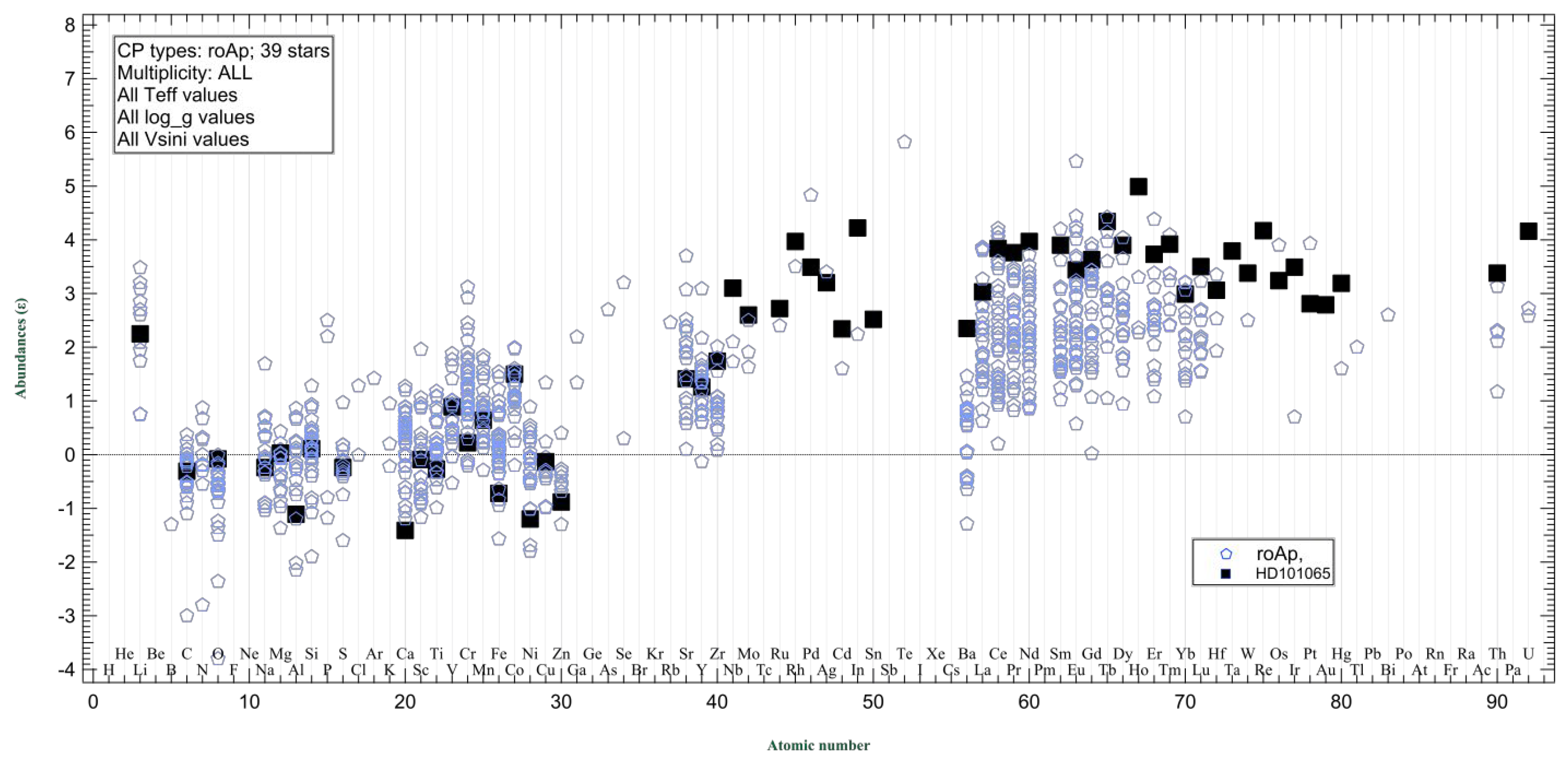
In Table 1, three CP stars—HD101065, HD24712, and HD188041—are identified as potential candidates that may have been affected by a supernova within the last 90 Myr. HD101065 shows strong enhancement of heavy elements (Z > 45), particularly Th and U, whereas HD24712 and HD188041 display no significant anomalies, except possibly Eu in the latter. Lighter elements have abundances comparable to those of typical roAp stars.
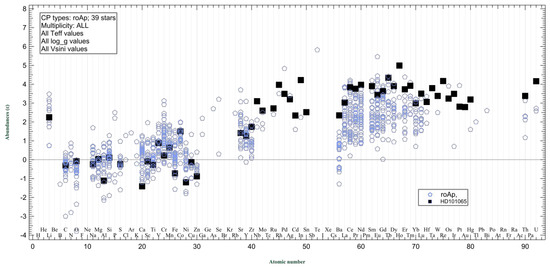
In Figure 1, the abundance pattern of HD101065 is presented. Similar figures were presented for HD24712 and HD188041 in our last paper [24].
Figure 1.
Abundances vs. atomic numbers. Abundances (ε) are the logarithm of the abundances divided by the solar AGS09 ones; the zero lines corresponds to solar abundances. The open pentagons are the abundances for roAp in our database; the black filled squares are the abundances measured in HD101065.
4. Conclusions
We present the results of a traceback analysis of chemically peculiar (CP) stars, focusing on rapidly oscillating Ap (roAp) stars that may form triple systems with neutron stars and members of Hunt’s clusters. Two promising candidates, including the system associated with HD 101065, merit further investigation. The abundance pattern of HD 101065 lies at the upper extreme among roAp stars. Future high-resolution spectroscopy of newly identified roAp stars from TESS, combined with traceback analyses, mass estimates, and initial mass function constraints, will be essential to test whether heavy-element enhancements in CP stars originate from supernova explosions in former binary or multiple systems.
Author Contributions
Conceptualization, S.G. and G.A.; methodology, S.G.; software, S.G.; validation, S.G.; formal analysis, S.G.; investigation, S.G. and G.A.; resources, S.G.; data curation, S.G.; writing—original draft preparation, S.G. and G.A.; writing—review and editing, S.G. and G.A.; visualization, S.G. and G.A.; supervision, G.A.; project administration, S.G.; funding acquisition, S.G. All authors have read and agreed to the published version of the manuscript.
Funding
S. Ghazaryan thanks the RA Higher Education and Science Committee for providing the grant in the framework of the research project 22RL-039.
Institutional Review Board Statement
Not applicable.
Informed Consent Statement
Not applicable.
Data Availability Statement
The Gaia mission website is https://www.cosmos.esa.int/gaia (accessed on 13 June 2022). The Gaia archive website is https://archives.esac.esa.int/gaia (accessed on 13 June 2022). This research has made use of the SIMBAD database, operated at CDS, Strasbourg, France. The ATNF pulsar catalogue website is https://www.atnf.csiro.au/research/pulsar/psrcat (accessed on January 2006).
Acknowledgments
This work presents results from the European Space Agency (ESA) space mission Gaia. Gaia data are being processed by the Gaia Data Processing and Analysis Consortium (DPAC). Funding for the DPAC is provided by national institutions, in particular the institutions participating in the Gaia MultiLAteral Agreement (MLA).
Conflicts of Interest
The authors declare no conflicts of interest.
References
- Preston, G.W. The chemically peculiar stars of the upper main sequence. Annu. Rev. Astron. Astrophys. 1974, 12, 257–277. [Google Scholar] [CrossRef] [Scilit]
- Osmer, P.S.; Peterson, D.M. The composition and evolutionary status of the helium-rich stars. Astrophys. J. 1974, 187, 117–129. [Google Scholar] [CrossRef] [Scilit]
- Gray, R.O. The λ Bootis Stars: A Review. In The Third Conference on Faint Blue Stars; Philip, A.G.D., Liebert, J., Saffer, R., Hayes, D.S., Eds.; L. Davis Press: Schenectady, NY, USA, 1997; p. 237. [Google Scholar]
- Michaud, G. Diffusion Processes in Peculiar A Stars. Astrophys. J. 1970, 160, 641. [Google Scholar] [CrossRef] [Scilit] [PubMed]
- Michaud, G.; Alecian, G.; Richer, J. Atomic Diffusion in Stars, Astronomy and Astrophysics Library; Springer: Cham, Switzerland, 2015. [Google Scholar] [CrossRef] [Scilit]
- Ghazaryan, S.; Alecian, G. Statistical analysis from recent abundance determinations in HgMn stars. Mon. Not. R. Astron. Soc. 2016, 460, 1912–1922. [Google Scholar] [CrossRef] [Scilit]
- Ghazaryan, S.; Alecian, G.; Hakobyan, A.A. New catalogue of chemically peculiar stars, and statistical analysis. Mon. Not. R. Astron. Soc. 2018, 480, 2953–2962. [Google Scholar] [CrossRef] [Scilit]
- Ghazaryan, S.; Alecian, G.; Hakobyan, A.A. Statistical analysis of roAp, He-weak, and He-rich stars. Mon. Not. R. Astron. Soc. 2019, 487, 5922–5931. [Google Scholar] [CrossRef] [Scilit]
- Ghazaryan, S.; Alecian, G.; Paunzen, E.; Hakobyan, A.A. Preliminary Statistical Analysis of Lambda Boötis Stars. Commun. BAO 2021, 68, 517–521. [Google Scholar] [CrossRef] [Scilit]
- Goriely, S.; Janka, H.-T. Solar r-process-constrained actinide production in neutrino-driven winds of supernovae. Mon. Not. R. Astron. Soc. 2016, 459, 4174–4182. [Google Scholar] [CrossRef] [Scilit]
- Shah, S.P.; Ezzeddine, R.; Ji, A.P.; Hansen, T.T.; Roederer, I.U.; Catelan, M.; Hackshaw, Z.; Holmbeck, E.M.; Beers, T.C.; Surman, R. Uranium Abundances and Ages of r-process Enhanced Stars with Novel UII lines. Astrophys. J. 2023, 948, 122. [Google Scholar] [CrossRef] [Scilit]
- Siegel, D.M.; Barnes, J.; Metzger, B.D. Collapsars as a major source of r-process elements. Nature 2019, 569, 241–244. [Google Scholar] [CrossRef] [Scilit] [PubMed]
- Cowan, J.J.; Sneden, C.; Lawler, J.E.; Aprahamian, A.; Wiescher, M.; Langanke, K.; Martínez-Pinedo, G.; Thielemann, F.-K. Origin of the heaviest elements: The rapid neutron-capture process. Rev. Mod. Phys. 2021, 93, 015002. [Google Scholar] [CrossRef] [Scilit]
- Siqueira Mello, C.; Spite, M.; Barbuy, B.; Spite, F.; Caffau, E.; Hill, V.; Wanajo, S.; Primas, F.; Plez, B.; Cayrel, R.; et al. First stars XVI. HST/STIS abundances of heavy elements in the uranium-rich metal-poor star CS 31082-001. Astron. Astrophys. 2013, 550, A122. [Google Scholar] [CrossRef] [Scilit]
- Manchester, R.N.; Hobbs, G.B.; Teoh, A.; Hobbs, M. The Australia Telescope National Facility Pulsar Catalogue. Astron. J. 2005, 129, 1993. [Google Scholar] [CrossRef] [Scilit]
- Hunt, E.L.; Reffert, S. Improving the open cluster census. II. An all-sky cluster catalogue with Gaia DR3. Astron. Astrophys. 2023, 673, A114. [Google Scholar] [CrossRef] [Scilit]
- Neuhäuser, R.; Gieβler, F.; Hambaryan, V.H. A nearby recent supernova that ejected the runaway star ζ Oph, the pulsar PSR B1706-16, and 60Fe found on Earth. Mon. Not. R. Astron. Soc. 2020, 498, 899–917. [Google Scholar] [CrossRef] [Scilit]
- Hambaryan, V.; Stoyanov, K.A.; Mugrauer, M.; Neuhäuser, R.; Stenglein, W.; Bischoff, R.; Michel, K.-U.; Geymeier, M.; Kurtenkov, A.; Kostov, A. The origin of the high-mass X-ray binary 4U 2206+54/BD+532790. Mon. Not. R. Astron. Soc. 2022, 511, 4123–4133. [Google Scholar] [CrossRef] [Scilit]
- Wenger, M.; Ochsenbein, F.; Egret, D.; Dubois, P.; Bonnarel, F.; Borde, S.; Genova, F.; Jasniewicz, G.; Laloë, S.; Lesteven, S.; et al. The SIMBAD astronomical database. Astron. Astrophys. Suppl. Ser. 2000, 143, 9–22. [Google Scholar] [CrossRef] [Scilit]
- Arzoumanian, Z.; Chernoff, D.F.; Cordes, J.M. The Velocity Distribution of Isolated Radio Pulsars. Astrophys. J. 2002, 568, 289. [Google Scholar] [CrossRef] [Scilit] [PubMed]
- Hobbs, G.; Lorimer, D.R.; Lyne, A.G.; Kramer, M. A statistical study of 233 pulsar proper motions. Mon. Not. R. Astron. Soc. 2005, 360, 974–992. [Google Scholar] [CrossRef] [Scilit]
- Verbunt, F.; Igoshev, A.; Cator, E. The observed velocity distribution of young pulsars. Astron. Astrophys. 2017, 608, A57. [Google Scholar] [CrossRef] [Scilit]
- Igoshev, A.P. The observed velocity distribution of young pulsars—II. Analysis of complete PSRπ. Mon. Not. R. Astron. Soc. 2020, 494, 3663–3674. [Google Scholar] [CrossRef] [Scilit]
- Ghazaryan, S.; Alecian, G. Are Some Chemically Peculiar Stars that Show Strong Overabundances of Very Heavy Elements Related to Supernovae? Astrophysics 2025, 68, 594–603. [Google Scholar] [CrossRef] [Scilit]

Disclaimer/Publisher’s Note: The statements, opinions and data contained in all publications are solely those of the individual author(s) and contributor(s) and not of MDPI and/or the editor(s). MDPI and/or the editor(s) disclaim responsibility for any injury to people or property resulting from any ideas, methods, instructions or products referred to in the content. |
© 2026 by the authors. Licensee MDPI, Basel, Switzerland. This article is an open access article distributed under the terms and conditions of the Creative Commons Attribution (CC BY) license.