


Abstract
This study investigates the effects of considering the area and curvature terms with the volume term in the quarks and gluons density of states on the transition temperature at which the deconfinement phase transition occurs. The analysis begins with the computation of the partition function of the Quark–Gluon Plasma (QGP) projected onto the SU(3) color-singlet representation, using the projection method, within the density of states given by the Multiple Reflection Expansion (MRE) approximation. We consider the transition between a hadronic gas (HG) phase, consisting of massive pions, and a QGP phase, which includes gluons, massless up and down quarks, and massive strange quarks along with their antiquarks, in the framework of the Bag model. We then examine the variations in the pressure of both phases, in the aim of determining the transition temperature in cases of different contributing terms in the quarks’ and gluons’ density of states, considering the contributions of the volume term, volume and area terms, volume and curvature terms, and the combined volume, area and curvature terms.
1. Introduction
In the hadronic phase, quarks and gluons, the fundamental constituents of matter, are confined within hadrons due to their strong interaction [1,2]. However, at high temperature and/or density, a deconfining phase transition occurs, leading to the formation of the Quark–Gluon Plasma (QGP). In this state of matter, quarks and gluons are no longer confined and can move freely [3,4]. The QGP is theorized to have been the dominant state of matter in the early universe, existing within the first 10−5 s after the Big Bang, when temperatures and densities were exceptionally high [5].
The QCD phase transition has been widely studied using both first-principles and effective approaches. Lattice QCD provides the most reliable description of the QCD thermodynamics at vanishing chemical potential [6,7], while effective models such as the Nambu–Jona-Lasinio (NJL) [8], Polyakov–Nambu–Jona-Lasinio (PNJL) [9,10], and Polyakov Quark Meson (PQM) models have been extensively used to investigate the QCD phase diagram and the interplay between chiral symmetry restoration and deconfinement [11].
In this work, we study the deconfinement phase transition from a hadronic gas phase, which consists of massive pions, to a Quark–Gluon Plasma (QGP) phase, made up of gluons, massless up and down quarks, and massive strange quarks along with their antiquarks, within the framework of the Bag model, which incorporates the bag constant B [12,13] representing the vacuum pressure exerted on the perturbative vacuum. We introduce the color-singletness condition for the QGP by means of the projection method [14,15] that we use to calculate the partition function of the QGP projected onto the SU(3) color-singlet representation. For this purpose, we consider the quarks and gluons density of states, given by the Multiple Reflection Expansion (MRE) approximation [16], with the contribution of the volume, area and curvature terms. We aim to investigate the impact of adding the area and curvature terms in the quarks and gluons density of states on the effective transition temperature in a finite volume, denoted ; to determine the latter, we analyze the variations in the pressure of both hadronic gas and QGP phases, with temperature T at zero chemical potential, for various system sizes V, in different cases of contributing terms in the density of states.
2. Partition Functions of Hadronic Gas and QGP Phases
As a first step, we need to compute the partition function for each of the hadronic gas and QGP phases.
For the hadronic phase that consists of massive pions (mπ = 138 MeV), its partition function , in a volume V, at temperature T, can be expressed, after calculation, as
where is the momentum, the pion degeneracy factor, and .
For the QGP phase, which contains gluons, massless up and down quarks, and massive strange quarks with their antiquarks, and assuming non-interaction between them, we carry out the calculation of the partition function , using the approximation [16] for the quarks’ and gluons’ density of states , which includes volume, area and curvature terms:
where represents the radius of the bag defined by a spherical volume , in the Bag model [12,13]; and are the area and curvature coefficients respectively. In [17], the area coefficient for the quarks, , was given as
The curvature coefficient, , for massive quarks was introduced in [18],
and it takes the value for non-massive quarks [19]. The area and curvature coefficients for the gluons and were provided in [16] by
In a first case, we consider a QGP with no condition on its global color, and the partition function of such a QGP, in volume V, at zero chemical potential µ = 0, and at temperature T, is given by
After calculation and simplification, , and correspond, respectively, to the volume, area and curvature contributions in the density of states of quarks and gluons, and are expressed as
is the strange quark mass, while and represent the spin–isospin degeneracy factors for quarks–antiquarks and gluons, respectively.
In a second case, we consider the color-singletness condition for the QGP, and the partition function of a QGP projected on the color-singlet SU(3) representation, in a volume V, at temperature T, and at zero chemical potential (µ = 0), calculated using the group-theoretical projection method of Turko and Redlich [14,15], as in [20,21,22] and as in the works of one of us [23,24] where only the volume term was used in the density of states, is given now, considering the curvature and area terms additionally to the volume term, by
with being the weight function (Haar measure) given by [20,21,22]:
, and correspond, respectively, to the volume, area and curvature contributions in the density of states of quarks and gluons, and are expressed as
where the angles and in are given by [20,21]
3. Study of the Effect of the Area and Curvature Terms in the Density of States on the Transition Temperature
To achieve our main goal, which is the study of the impact of including the area and curvature terms alongside the volume term in the quarks and gluons density of states on the deconfinement phase transition, by studying their impact on the transition temperature in a finite size system V, we need to examine the behavior of the pressure for both hadronic gas (HG) and QGP phases, given by the well-known relation
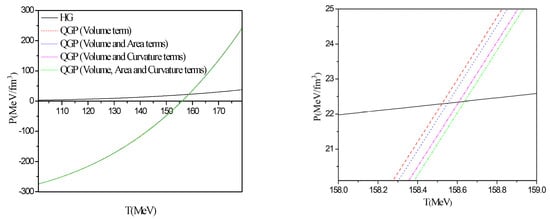
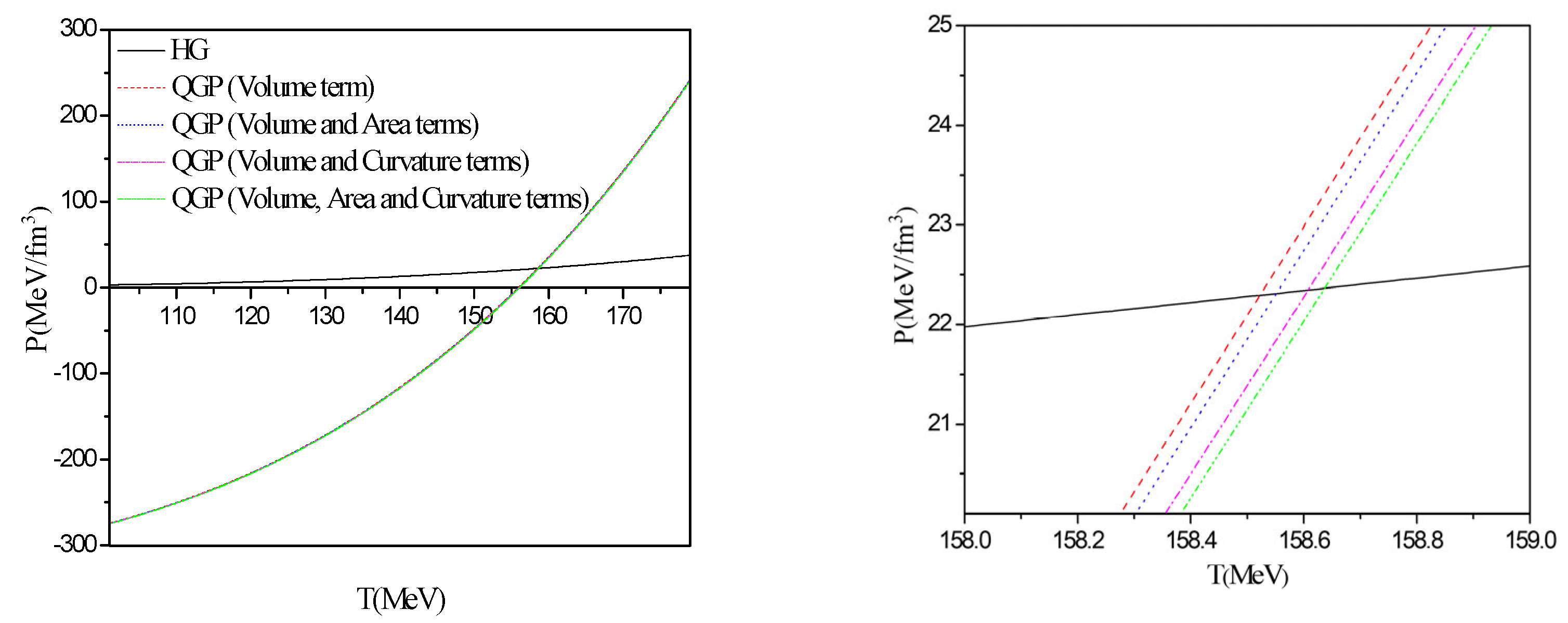
Thus, we derive the expression of the HG pressure from Equation (1) and that of the QGP without the color-singletness condition from Equation (6); then, by using a numerical integration method, we calculate the integrals involved in Equation (10), and derive the pressure of the color-singlet QGP. First, in Figure 1, we illustrate the variations of the HG and QGP pressures, with temperature T, at zero chemical potential (μ = 0) and with a Bag constant value B1/4 = 225 MeV, for a large volume of V = 10,000 fm3, which effectively simulates an infinite system.
Figure 1.
Variations of the pressure as a function of temperature T for the HG of pions (black solid line) and QGP phase, with the contribution of the volume term only (red dashed line), volume and area terms (blue dotted line), volume and curvature terms (magenta dashed dotted line), and volume, area and curvature terms (green dashed dotted dotted line), at µ = 0 and with B1/4 = 225 MeV.
The obtained graphics reveal an intersection between the pressure curve of the HG phase (black solid line) and the pressure of the QGP phase, which is represented by four curves corresponding to different contributions to the quarks and gluons density of states: the contribution of the volume term only (red dashed line), volume and area terms (blue dotted line), volume and curvature terms (magenta dashed dotted line), and volume, area, and curvature terms (green dashed dotted dotted line).The intersection point of the HG and QGP pressure curves defines the infinite-volume transition temperature , as set by the Gibbs criterion and found in [25]. It can clearly be noted that this true transition temperature varies from one case of contributing terms in the density of states to another, since takes its maximum value with the contribution of all three terms (volume, area, and curvature) and its minimum value with the volume term only contributing to the quarks and gluons density of states, as shown in Table 1.
Table 1.
True transition temperature values with the various contributions to the density of states of quarks and gluons.
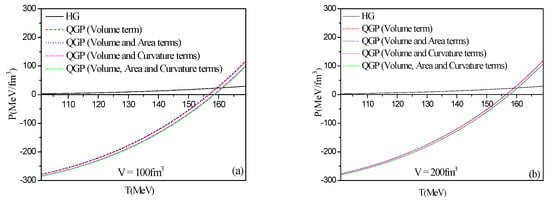
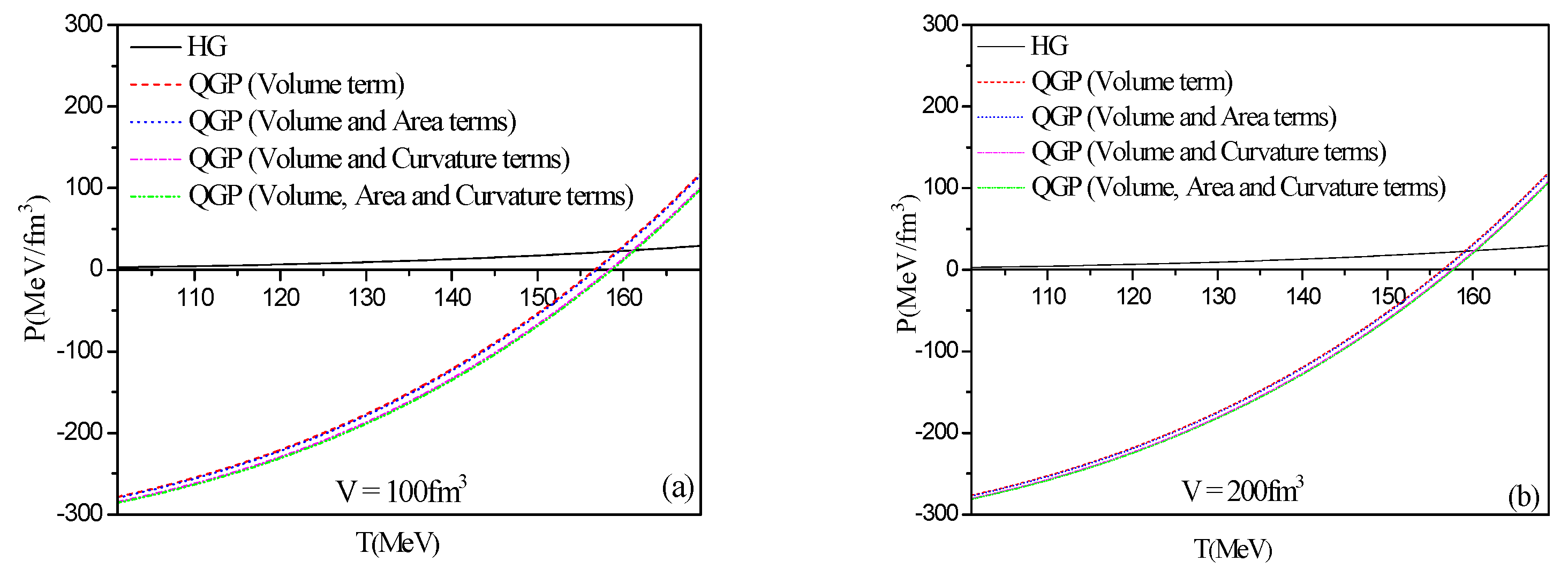
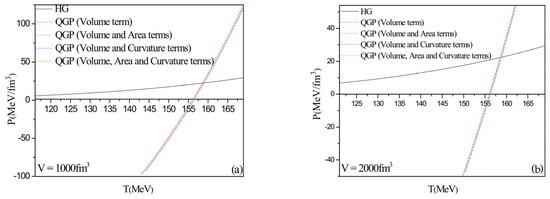
In the following, we investigate the variations in the HG and QGP pressures with temperature T, for various system sizes V, in the case of the color-singlet QGP phase, i.e., by first deriving the QGP pressure using the partition function of a QGP projected on the color-singlet representation computed previously (Equations (10)–(16)). Figure 2 illustrates such thermal variations for two small volumes, (a) and (b) , and Figure 3 for two large volumes, (c) and (d) , both at a Bag constant value B1/4 = 225 MeV.
Figure 2.
Plots of the pressure of a HG of pions and a color-singlet QGP as a function of temperature T, with the four contributions in the quarks and gluons density of states, at µ = 0 and B1/4 = 225 MeV, for a system volume (a) and (b) .
Figure 3.
Plots of the pressure of a HG of pions and a color-singlet QGP as a function of temperature T, with the four contributions in the quarks and gluons density of states, at µ = 0 and with B1/4 = 225 MeV, for a system volume of (a) and (b) .
From Figure 2 and Figure 3, one can clearly observe that, for each system volume, the curves corresponding to the different contributions to the quarks and gluons density of states exhibit a very similar behavior. In addition, it is evident that variations in the system size have a significant impact on the effective transition temperature in a finite volume. Specifically, under the color-singletness constraint, for smaller volumes, the effective transition temperature in a finite volume is systematically shifted from the true transition temperature (in infinitevolume) towards higher values, reflecting finite-size effects that become increasingly important as the system size V decreases [25]. This shows that the phase transition characteristics are highly sensitive to finite-volume effects.
It can also be noted from the obtained graphics that there is a considerable difference between the effective transition temperatures in a volume V for each case of contributing terms to the density of states, as summarized in Table 1 and Table 2. This suggests that the inclusion of each of the area and curvature terms in the quarks and gluons density of states has a noticeable impact on the transition temperature value, especially within the context of a small system volume.
Table 2.
Effective transition temperature values for various volumes, with the four cases of contributing terms to the density of states.
4. Conclusions
In the present work, we investigated the influence of the area and curvature terms in the density of states of quarks and gluons, used in the calculation of the QGP partition function, on the deconfinement phase transition. To achieve this, we focused on the transition temperature , determined according to the Gibbs criterion from the mechanical equilibrium point between the hadronic and QGP phases, i.e., from the intersection point of the pressures of the two phases. The plots of these pressures have been illustrated vs temperature T, at zero chemical potential (µ = 0), and with B1/4 = 225 MeV, for various sizes V and in four different cases: with the contributions of the volume term, volume and area terms, volume and curvature terms, and volume, area and curvature terms in the quarks and gluons density of states. Subsequently, by analyzing the value of the transition temperature , we found that the inclusion of the area and curvature terms, additionally to the volume term in the density of states, increases the value of , especially in small volumes. Furthermore, we noticed that reaches its highest value when all three contributions are included, then it slightly decreases when only the volume and curvature terms contribute, while it decreases more with the volume and area contribution, and reaches its lower value when only the volume term contributes.
It can also be concluded that for large volumes, the transition temperatures differ slightly, depending on the contributing terms to the quarks and gluons density of states, whereas for small volumes, the difference is relatively considerable, without exceeding 2 MeV, indicating that the difference itself is not particularly significant. Rather, our objective was to investigate the effect of the surface and curvature terms on the critical behavior of the shift in the transition temperature.
Author Contributions
Conceptualization, H.S. and A.A.E.D.; methodology, H.S. and A.A.E.D.; software, H.S.; validation, H.S. and A.A.E.D.; formal analysis, H.S.; investigation, H.S.; resources, H.S. and A.A.E.D.; data curation, H.S.; writing—original draft preparation, H.S.; writing—review and editing, A.A.E.D.; visualization, H.S.; supervision, A.A.E.D.; project administration, A.A.E.D. All authors have read and agreed to the published version of the manuscript.
Funding
This research work received no specific grant from any funding agency.
Institutional Review Board Statement
Not applicable.
Informed Consent Statement
Not applicable.
Data Availability Statement
Data generated or analyzed during this study are provided within the article.
Conflicts of Interest
The authors declare no conflicts of interest.
References
- Gell-Mann, M. A schematic model of baryons and mesons. Phys. Lett. 1964, 8, 214–215. [Google Scholar] [CrossRef] [Scilit]
- Zweig, G. An SU(3) Model for Strong Interaction Symmetry and Its Breaking; CERN TH-412, 1964. Available online: https://cds.cern.ch/record/570209 (accessed on 23 April 2026).
- Collins, J.C.; Perry, M.J. Superdense matter: Neutrons or asymptotically free quarks? Phys. Rev. Lett. 1975, 34, 1353–1356. [Google Scholar] [CrossRef] [Scilit]
- Cleymans, J.; Gavai, R.V.; Suhonen, E. Quarks and gluons at high temperatures and densities. Phys. Rep. 1986, 130, 217–292. [Google Scholar] [CrossRef] [Scilit]
- Yagi, K.; Hatsuda, T.; Miake, Y. Quark-Gluon Plasma: From Big Bang to Little Bang; Cambridge University Press: Cambridge, UK, 2005; ISBN 978-0-521-56108-2. [Google Scholar]
- Aoki, Y.; Endrődi, G.; Fodor, Z.; Katz, S.D.; Szabó, K.K. The order of the quantum chromodynamics transition predicted by the standard model of particle physics. Nature 2006, 443, 675–678. [Google Scholar] [CrossRef] [Scilit] [PubMed]
- Borsányi, S.; Fodor, Z.; Hoelbling, C.; Katz, S.D.; Krieg, S.; Ratti, C.; Szabó, K.K. Is there still any T c mystery in lattice QCD? Results with physical masses in the continuum limit III. J. High Energy Phys. 2010, 9, 073. [Google Scholar] [CrossRef] [Scilit]
- Hatsuda, T.; Kunihiro, T. QCD phenomenology based on a chiral effective Lagrangian. Phys. Rep. 1994, 247, 221–367. [Google Scholar] [CrossRef] [Scilit]
- Fukushima, K. Chiral effective model with the Polyakov loop. Phys. Lett. B 2004, 591, 277–284. [Google Scholar] [CrossRef] [Scilit]
- Ratti, C.; Thaler, M.A.; Weise, W. Phases of QCD: Lattice thermodynamics and a field theoretical model. Phys. Rev. D 2006, 73, 014019. [Google Scholar] [CrossRef] [Scilit]
- Schaefer, B.-J.; Pawlowski, J.M.; Wambach, J. The phase structure of the Polyakov–quark–meson model. Phys. Rev. D 2007, 76, 074023. [Google Scholar] [CrossRef] [Scilit]
- Johnson, K. The MIT bag model. Acta Phys. Pol. B 1975, 6, 865–892. [Google Scholar]
- Chodos, A.; Jaffe, R.L.; Johnson, K.; Thorn, C.B.; Weisskopf, V.F. New extended model of hadrons. Phys. Rev. D 1974, 9, 3471–3495. [Google Scholar] [CrossRef] [Scilit]
- Redlich, K.; Turko, L. Phase transition in the statistical bootstrap model with an internal symmetry. Z. Phys. C 1980, 5, 201–204. [Google Scholar] [CrossRef] [Scilit]
- Turko, L. Quantum gases with internal symmetry. Phys. Lett. B 1981, 104, 153–157. [Google Scholar] [CrossRef] [Scilit]
- Balian, R.; Bloch, C. Distribution of eigenfrequencies for the wave equation in a finite domain: I. Three-dimensional problem with smooth boundary surface. Ann. Phys. 1970, 60, 401–447. [Google Scholar] [CrossRef] [Scilit]
- Berger, M.S.; Jaffe, R.L. Radioactivity in strange quark matter. Phys. Rev. C 1987, 35, 213–225, Erratum in Phys. Rev. C 1991, 44, 566. https://doi.org/10.1103/PhysRevC.44.566.2. [Google Scholar] [CrossRef] [Scilit] [PubMed]
- Madsen, J. Shell model versus liquid drop model for strangelets. Phys. Rev. D 1994, 50, 3328–3331. [Google Scholar] [CrossRef] [Scilit] [PubMed]
- Farhi, E.; Jaffe, R.L. Strange matter. Phys. Rev. D 1984, 30, 2379–2390. [Google Scholar] [CrossRef] [Scilit]
- Elze, H.-T.; Greiner, W.; Rafelski, J. On the color-singlet quark-gluon plasma. Phys. Lett. B 1983, 124, 515–519. [Google Scholar] [CrossRef] [Scilit]
- Elze, H.-T.; Greiner, W.; Rafelski, J. The relativistic Boltzmann equation for color-singlet quark-gluon plasma. Z. Phys. C 1984, 24, 361–369. [Google Scholar]
- Elze, H.-T.; Greiner, W. Finite Size Effects for Quark-Gluon Plasma Droplets. Phys. Lett. B 1986, 179, 385–388. [Google Scholar] [CrossRef] [Scilit]
- Ladrem, M.; Ait-El-Djoudi, A. Finite size effects and scaling for the thermal QCD deconfinement phase transition within the exact color-singlet partition function. Eur. Phys. J. C 2005, 44, 257–265. [Google Scholar] [CrossRef] [Scilit]
- Ait El Djoudi, A. Thermal QCD deconfining phase transition in a finite volume within color-singletness and excluded volume effects: A finite size scaling analysis using cumulants. Can. J. Phys. 2013, 91, 793–800. [Google Scholar] [CrossRef] [Scilit]
- Ait El Djoudi, A. Finite-Size Effects on the Deconfinement Phase Transition; Scholars’ Press: Chisinau, Moldova, 2019; ISBN 978-613-8-84074-9. [Google Scholar]

Disclaimer/Publisher’s Note: The statements, opinions and data contained in all publications are solely those of the individual author(s) and contributor(s) and not of MDPI and/or the editor(s). MDPI and/or the editor(s) disclaim responsibility for any injury to people or property resulting from any ideas, methods, instructions or products referred to in the content. |
© 2026 by the authors. Licensee MDPI, Basel, Switzerland. This article is an open access article distributed under the terms and conditions of the Creative Commons Attribution (CC BY) license.