


Abstract
The modelling of kilonova spectra, particularly in the late-time nebular phase, relies heavily on accurate atomic data. While significant progress has been made regarding energy levels and radiative transition rates for r-process elements, data for collisional processes remains scarce. Current models often rely on the Van Regemorter and Axelrod approximations for effective collision strengths. In this work we present the calculation of electron-impact excitation (EIE) collision strengths for relevant r-process elements. We employ the Independent-Process, Isolated-Resonance Distorted-Wave (IPIRDW) approximation to account for the contribution of resonant excitation, which is crucial at the low temperatures characteristic of kilonovae. We demonstrate the validity of our method by benchmarking against R-Matrix calculations for Te iii, finding good agreement while maintaining a significantly lower computational cost. We focus on the relevant 2.1 μm feature and estimate a mass of using our IPIRDW data for EIE effective collision strengths, compatible with other recent estimations using R-Matrix data.
1. Introduction
Spectroscopic analysis of kilonovae constitutes the primary method for identifying the synthesis of heavy r-process elements in neutron star mergers. Interpreting these spectra relies heavily on sophisticated radiative transfer models that require vast amounts of atomic data. Recent efforts have made significant strides in characterizing the early-time emissions [1,2,3,4,5,6,7]. These works, under the assumption of Local Thermodynamic Equilibrium (LTE), successfully highlight the dominance of lanthanide opacities in shaping the observed light curves and spectra during the initial days following the merger.
However, as the kilonova ejecta expands, the physical conditions evolve rapidly. Within weeks, the electron density drops significantly, and the timescale for particle collisions exceeds that of energy production by radioactive decay. Under these conditions, the plasma departs from LTE and enters the nebular phase. In this Non-LTE regime, level populations are no longer determined solely by the local temperature but by a detailed balance between radiative processes and electron-impact excitation (EIE) [8,9]. Consequently, accurate collision strengths and effective collision strengths become as critical as radiative transition rates for accurate spectral modelling.
Obtaining reliable theoretical collisional data for lanthanides is notoriously difficult due to the complexity of their f-shell structures. In the absence of explicit calculations, the astrophysics community has historically relied on simple approximations. The most common of these are the Van Regemorter [10] and Axelrod [11] approximations (hereafter referred to collectively as VRA). The Van Regemorter approximation retains some physical insight by relating the collision strength to the optical oscillator strength via an effective Gaunt factor. However, it is strictly applicable only to optically allowed (dipole) transitions at high impact energies and fails for the forbidden transitions that dominate late-time spectra. Conversely, the Axelrod approximation is essentially a parametric fit dependent on the statistical weight of the upper and lower levels derived for the effective collision strengths of Fe iii, lacking a rigorous basis in atomic physics for complex ions [12]. Moreover, both components of the VRA ignore the contribution of resonant excitation, a process where an electron is temporarily captured into an autoionizing state. For near-neutral lanthanides at low temperatures (–5000 K), these resonances can dominate the collision rate: the thermal electron energy is comparable to the spacing of low-lying autoionizing states, greatly enhancing the excitation cross-section over the direct channel alone [13,14]. This renders approximations such as VRA widely inaccurate.
The standard method for treating these resonant processes is the R-Matrix method, which solves the scattering problem non-perturbatively [15]. However, R-Matrix calculations are computationally prohibitive for the open f-shell structures of lanthanides, which involve thousands of energy levels and millions of transitions [16]. This necessitates an intermediate approach that captures the essential physics of resonant excitation while remaining computationally manageable. In this work, we present calculations using the Distorted-Wave (DW) approximation augmented by the Independent-Process Isolated-Resonance (IPIRDW) method [13] to bridge this gap. A related intermediate strategy, benchmarked against R-Matrix results for selected r-process ions, has recently been proposed by Deprince & Maison (2026) [17,18], representing an early implementation of this approach albeit without explicit treatment of resonant excitation.
2. Theoretical Methods
All atomic data in this work was calculated using the FAC (Flexible Atomic Code) package [19]. FAC employs a relativistic configuration interaction (RCI) method, where atomic state functions are constructed from a superposition of configuration state functions (CSFs) calculated from a local central potential [20]. The radial orbitals are derived using a Dirac–Fock–Slater self-consistent field approximation, which relies on a Fictitious Mean Configuration (FMC) to model the spherically averaged electron screening [21,22].
The usual choices for the FMC occupation numbers, derived from the weighted averaged of ground state configurations, are often insufficient when dealing with heavier r-process ions. The highly correlated, non-spherical interactions of the open d- and f-shells that characterize these ions cannot be accurately captured by a static, spherically averaged potential. To address this, we employed the potential optimization procedure detailed in our previous work [23]. In this method, the FMC valence shell occupation numbers are treated as continuous adjustable parameters. We utilize a Sequential Model-Based Optimization (SMBO) algorithm to iteratively optimize these parameters by minimizing a Boltzmann-weighted root mean square deviation between the calculated energy levels and available experimental reference data.
Electron-impact cross-sections in FAC are calculated in a two-step process using the Independent-Process Isolated-Resonance Distorted-Wave (IPIRDW) approximation [13,24,25]. This method assumes that the direct excitation (DE) and the resonant excitation (RE) pathways are independent. Consequently, the total cross-section for a transition from an initial state to a final state is calculated as the incoherent sum of the two contributions:
Strictly speaking, this incoherent summation is only physically valid under the assumption that the intermediate autoionizing states are isolated—meaning the width of each line is smaller than the distance between two different lines—thereby suppressing quantum interference effects. As established, the extreme density of energy levels in complex ions with open d- and f-shells means that this condition is almost certainly violated in highly populated energy regions [16]. However, given the computational impossibility of treating these overlapping resonances non-perturbatively, we accept this incoherent summation as a necessary compromise to capture the bulk of the resonant excitation flux.
The direct contribution, , arises from a single-step scattering event and is governed by the transition matrix element , given by:
where represents the Coulomb interaction between the projectile and the electrons of the target ion. Within this framework, the total wavefunctions are approximated as antisymmetrized products of the target atomic state functions and the distorted waves of the continuum electron. Crucially, these distorted waves are generated as solutions to the Dirac equation utilizing the same optimized central potential, , derived from our modified FMC procedure described earlier.
The resonant contribution, , accounts for the two-step pathway involving the formation of a doubly excited intermediate state
The first step is the radiationless dielectronic capture of the incident electron. The cross-section for capture into an isolated resonance d is described by the Breit–Wigner formula, which models the resonance as a Lorentzian profile centred at energy :
where E is the kinetic energy of the incident electron, is the electron mass, and are the statistical weights of the initial and resonant states, is the total width of the resonant state, and , summing over all autoionization channels k and radiative decay channels m. is the partial autoionization width for decay back to the initial channel.
Once formed, the intermediate state must decay via autoionization to the specific final state to contribute to the excitation cross-section. The probability of this specific decay channel is given by the branching ratio
where is the partial autoionization width for decay into channel f. The total resonant cross-section is obtained by summing over all contributing intermediate states d
3. Results
To validate the IPIRDW approximation before targeting complex open f-shell lanthanides, we benchmarked our methodology against doubly ionized tellurium (Te iii). Tellurium is not only a compelling r-process candidate recently proposed to explain observed emission features in kilonova spectra, but it also possesses recent R-Matrix collision calculations [26,27]. This provides a baseline to validate our approach before scaling it to heavier elements. A summary of the target configurations used and all the resonance channels included in the calculations is given in Table 1.

Table 1.
Summary of the set of configurations used for the target and for all the resonance channels in the EIE calculations of Te iii. The resonance channels correspond to the ()-electron system formed by adding a single electron with principal quantum number and all allowed angular momenta to each target configuration. Curly brackets denote a set of alternative single-electron occupations, e.g., indicates that one electron occupies either the , , or subshell. The transitions are computed between all levels arising from the target configurations.
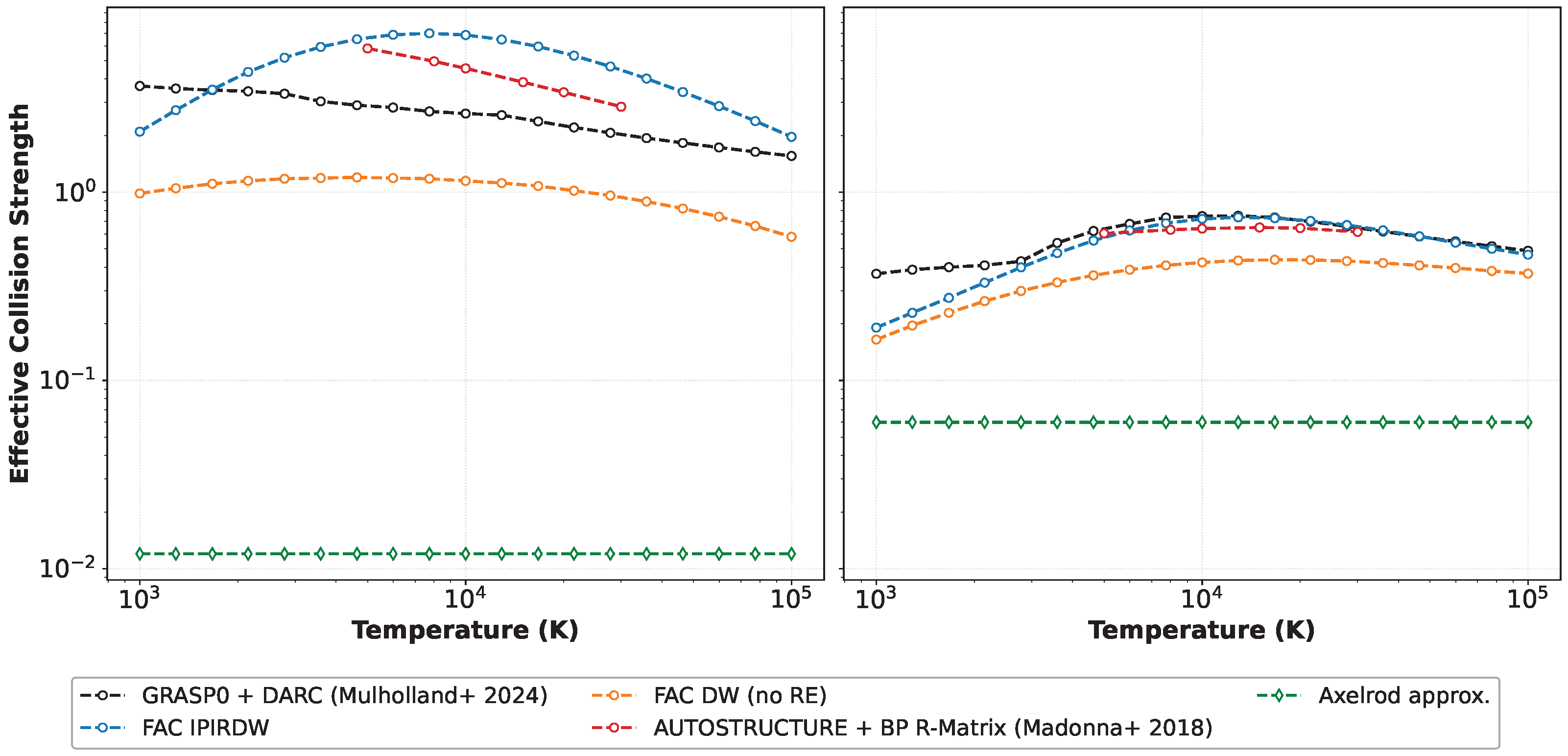
As shown in Figure 1, the effective collision strengths obtained using our IPIRDW approach reproduce the magnitude and overall temperature dependence of the non-perturbative R-Matrix calculations for the transitions considered here. The two transitions shown were selected as being representative of the range of behaviours observed, spanning a forbidden magnetic dipole transition and an intercombination transition. We note that while the early nebular phase is often characterized by relatively low temperatures, detailed Non-LTE modelling has shown that kilonova temperatures are not fixed and can increase with time in the post-diffusion regime, potentially reaching several thousand to tens of thousands of kelvin depending on the epoch and ejecta composition [8,9]. Effective collision strengths are therefore presented up to both to facilitate comparison with laboratory plasma diagnostics and to remain useful across the full range of physically relevant kilonova conditions. The impact of including resonant excitation is transition-dependent. For the transition (right panel), the inclusion of resonances brings the effective collision strengths into closer agreement with the R-Matrix results of Mulholland et al. [27], with the improvement being most pronounced at higher temperatures. For the transition (left panel), the improvement is less uniform: agreement is recovered at low and very high temperatures, while at intermediate temperatures (around K) both the IPIRDW and background DW results deviate from those of Mulholland et al. While the specific resonance structures in the cross-sections are expected to differ in position and width from those obtained in a non-perturbative treatment, the Maxwellian averaging procedure smooths out these local discrepancies in the effective collision strengths. Taken together, these results indicate that the IPIRDW method captures a substantial fraction of the resonant excitation contribution for the transitions examined, though a quantitative assessment of its systematic accuracy across a broader set of transitions and ions is reserved for a forthcoming dedicated study.
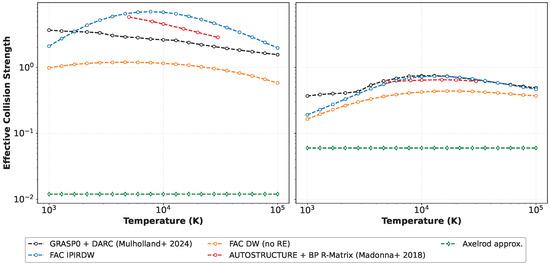
Figure 1.
Effective collision strengths for two representative transitions of Te iii. Results obtained within this work are shown in orange to indicate without resonance contribution and in blue to indicate that they include resonances. Results are compared with previous theoretical results from Mulholland et al. (in black) and from Madonna et al. (in red) and by using the Axelrod approximation (in green). Left panel: Effective collision strength for the transition. Right panel: Effective collision strength for the transition.
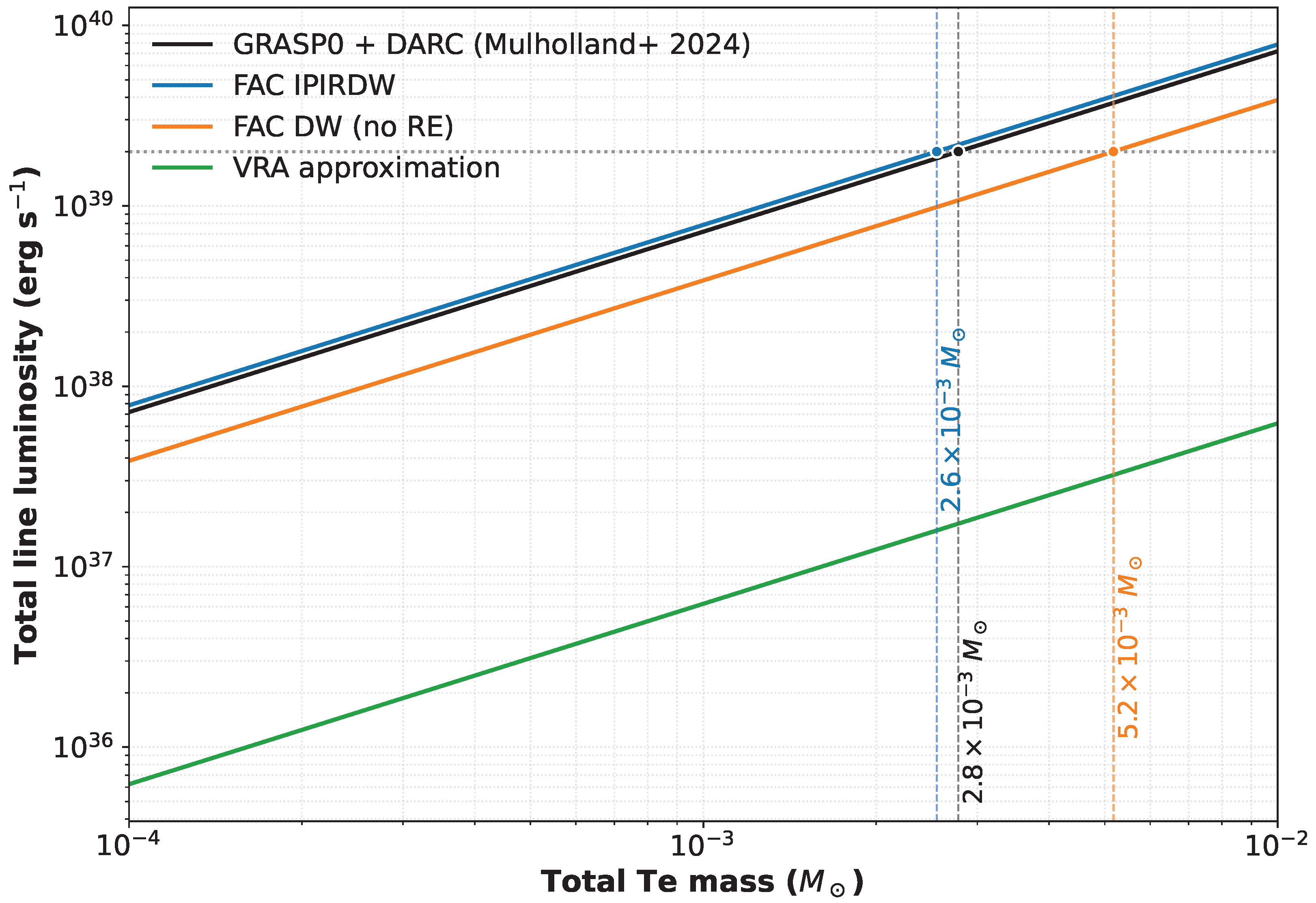
Using the line luminosity estimated from the kilonova AT2017gfo for the 2.1 μm line of Te iii, [28], we derived the mass of Te iii required to reproduce this emission using multiple methods for the calculations of the EIE cross-sections. We assumed physical conditions characteristic of the nebular phase at ∼10 days post-merger, as estimated for AT2017gfo by Hotokezaka et al. [28]: a temperature of K and an electron density of cm−3. An ionization fraction of 0.25 for Te iii was assumed based on the estimation from the same authors. Results are shown in Figure 2 and Table 2.
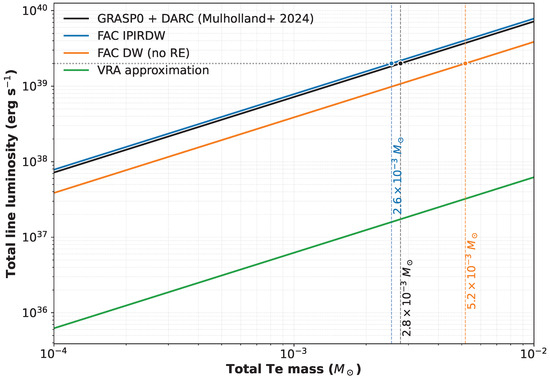
Figure 2.
Line luminosity as a function of total tellurium mass for the 2.1-micron line of Te iii. Typical conditions for the nebular phase were used and are described in the main text, and an ionization fraction of 0.25 for Te iii was assumed [28]. Results obtained within this work are shown in orange to indicate without resonance contribution and in blue to indicate that they include resonances. Results are compared with previous theoretical results from Mulholland et al. (in black) and by using the Axelrod approximation (in green). The mass required for a luminosity (dotted line) for each method is highlighted.
Table 2.
Mass estimates for the 2.1 μm line assuming a total luminosity of . Typical conditions for the nebular phase were used and are described in the main text, and an ionization fraction of 0.25 for Teiii was assumed [28].
The results using our IPIRDW method predict a mass of , which is in excellent agreement with the values derived using R-Matrix data (). In contrast, the VRA underestimates the collision strength significantly, requiring a physically unrealistic mass of to reproduce the same luminosity. This discrepancy of two orders of magnitude highlights the dangers of relying on the standardly used VRA approximation for the estimation of astrophysical observables. Notably, even the use of the standard DW calculation without the inclusion of resonances leads to an overestimation of the required mass by a factor of two (), further validating the necessity of considering resonances for accurate abundance estimates.
4. Conclusions and Future Work
The accurate modelling of late-time kilonova spectra requires robust collisional data, yet standard non-perturbative approaches like the R-Matrix method are computationally intractable for the complex, open f-shell structures of lanthanides. In this work, we have demonstrated that the IPIRDW approximation captures the essential physics of resonant excitation. Specifically, for the transitions of Te iii examined in this work, our calculated effective collision strengths reproduce the magnitude and overall temperature dependence of non-perturbative R-Matrix values. Furthermore, when applying our data to the emission feature of kilonova AT2017gfo, we derived a Te iii with a mass of . This is in excellent agreement with the R-Matrix estimate, while standard approximations, such as the VRA, fail by about two orders of magnitude. Crucially, the excellent agreement achieved in our Te iii benchmark validates the use of this IPIRDW method for exploring the collisional properties of heavier ions. This approach offers a robust and computationally viable alternative to non-perturbative methods for estimating resonant contributions.
Building upon this validated framework, our immediate future work will systematically apply this methodology across the lanthanide series. Rather than a blind computational survey, this effort will prioritize specific heavy ions—beginning with targets such as Ce iii, La iii and Nd ii—that nucleosynthesis models and radiative transfer simulations identify as the most critical opacity sources expected to dominate and shape the nebular spectra of kilonovae [1,29,30]. By providing computationally tractable, high-accuracy, effective collision strengths for these specific ions, we aim to bridge the current atomic data gap and enable more precise astrophysical abundance derivations from future neutron star merger observations.
Author Contributions
Conceptualization, R.F.d.S., L.L., A.F., J.S., G.M.-P. and J.P.M.; methodology, R.F.d.S. and L.L.; validation, R.F.d.S., T.C., D.G., G.M.-P. and J.P.M.; formal analysis, R.F.d.S. and L.L.; investigation, R.F.d.S., L.L. and T.C.; writing—original draft preparation, R.F.d.S.; writing—review and editing, R.F.d.S., L.L., A.F., T.C., D.G., J.S., G.M.-P. and J.P.M.; visualization, R.F.d.S.; supervision, J.S., G.M.-P. and J.P.M.; funding acquisition, R.F.d.S., J.S., G.M.-P. and J.P.M. All authors have read and agreed to the published version of the manuscript.
Funding
R.F.S., L.L., T.C., D.G., J.S., and J.P.M. acknowledge the support from FCT (Portugal) through project funding 2023.14470.PEX “Spectral Analysis and Radiative Data for Elemental Kilonovae Identification (SPARKLE)” [31]. R.F.S acknowledges the support from national funding by FCT (Portugal) through the individual research grant 2022.10009.BD. A.F. and G.M.P. acknowledge support from the European Research Council (ERC) under the European Union’s Horizon 2020 research and innovation programme (ERC Advanced Grant KILONOVA No. 885281) and the Deutsche Forschungsgemeinschaft (DFG, German Research Foundation)—Project-ID 279384907—SFB 1245, and MA 4248/3-1.
Institutional Review Board Statement
Not applicable.
Informed Consent Statement
Not applicable.
Data Availability Statement
All data presented in this work is available upon request.
Conflicts of Interest
The authors declare no conflicts of interest.
References
- Gillanders, J.H.; Troja, E.; Fryer, C.L.; Ristic, M.; O’Connor, B.; Fontes, C.J.; Yang, Y.H.; Domoto, N.; Rahmouni, S.; Tanaka, M.; et al. Heavy element nucleosynthesis associated with a gamma-ray burst. arXiv 2023, arXiv:2308.00633. [Google Scholar] [CrossRef]
- Banerjee, S.; Tanaka, M.; Kato, D.; Gaigalas, G. Diversity of Early Kilonova with the Realistic Opacities of Highly Ionized Heavy Elements. Astrophys. J. 2024, 968, 64. [Google Scholar] [CrossRef]
- Banerjee, S.; Hamidani, H.; Kawaguchi, K.; Tanaka, M. Ultraviolet Signatures of Jet-Ejecta Interaction in Early Kilonovae: Prediction from Realistic Atomic Opacities. arXiv 2026, arXiv:2601.20495. [Google Scholar] [CrossRef]
- Fontes, C.J.; Fryer, C.L.; Hungerford, A.L.; Wollaeger, R.T.; Korobkin, O. A line-binned treatment of opacities for the spectra and light curves from neutron star mergers. Mon. Not. R. Astron. Soc. 2020, 493, 4143–4171. [Google Scholar] [CrossRef]
- Fontes, C.J.; Fryer, C.L.; Wollaeger, R.T.; Mumpower, M.R.; Sprouse, T.M. Actinide opacities for modelling the spectra and light curves of kilonovae. Mon. Not. R. Astron. Soc. 2022, 519, 2862–2878. [Google Scholar] [CrossRef]
- Tanaka, M.; Kato, D.; Gaigalas, G.; Kawaguchi, K. Systematic opacity calculations for kilonovae. Mon. Not. R. Astron. Soc. 2020, 496, 1369–1392. [Google Scholar] [CrossRef]
- Deprince, J.; Wagle, G.; Nasr, S.B.; Gallego, H.C.; Godefroid, M.; Goriely, S.; Just, O.; Palmeri, P.; Quinet, P.; Eck, S.V. Kilonova ejecta opacity inferred from new large-scale HFR atomic calculations in all elements between Ca (Z = 20) and Lr (Z = 103). Astron. Astrophys. 2025, 696, A32. [Google Scholar] [CrossRef]
- Pognan, Q.; Jerkstrand, A.; Grumer, J. On the validity of steady-state for nebular phase kilonovae. Mon. Not. R. Astron. Soc. 2021, 510, 3806–3837. [Google Scholar] [CrossRef]
- Pognan, Q.; Jerkstrand, A.; Grumer, J. NLTE effects on kilonova expansion opacities. Mon. Not. R. Astron. Soc. 2022, 513, 5174–5197. [Google Scholar] [CrossRef]
- Regemorter, H.v. Rate of Collisional Excitation in Stellar Atmospheres. Astrophys. J. 1962, 136, 906. [Google Scholar] [CrossRef]
- Axelrod, T.S. Late Time Optical Spectra from the Ni56 Model for Type I Supernovae. Ph.D. Thesis, University of California, Santa Cruz, CA, USA, 1980. [Google Scholar]
- Flõrs, A. The Neutron-Rich Ejecta of Type Ia Supernovae and Constraints on the Exploding Mass of Their Progenitors. Ph.D. Thesis, Technische Universität München, München, Germany, 2020. [Google Scholar]
- Gu, M.F. Dielectronic Recombination Rate Coefficients for H-like through Ne-like Isosequences of Mg, Si, S, Ar, Ca, Fe, and Ni. Astrophys. J. 2003, 590, 1131–1140. [Google Scholar] [CrossRef]
- Banerjee, S.; Jerkstrand, A.; Badnell, N.; Pognan, Q.; Ferguson, N.; Grumer, J. Nebular Spectra of Kilonovae with Detailed Recombination Rates. I. Light r-process Composition. Astrophys. J. 2025, 992, 19. [Google Scholar] [CrossRef]
- Nahar, A.K.P.S.N.; Nahar, S.N. Atomic Astrophysics and Spectroscopy; Cambridge University Press: Cambridge, UK, 2011. [Google Scholar] [CrossRef]
- Badnell, N.R.; Ballance, C.P.; Griffin, D.C.; O’Mullane, M. Dielectronic recombination of W20+ (4d104f8): Addressing the half-open f shell. Phys. Rev. A 2012, 85, 052716. [Google Scholar] [CrossRef]
- Deprince, J.; Maison, L. Benchmarking the Plane-Wave Born and Distorted Waves approximations for electron-impact collision strength computations: The sample case of Sr II. arXiv 2025, arXiv:2509.07684. [Google Scholar] [CrossRef]
- Deprince, J.; Maison, L. Benchmarking the Plane-Wave Born and Distorted Waves Approximations for Electron-Impact Collision Strength Computations: The Sample Case of Sr II. Plasma Fusion Res. 2026, 21, 2401005. [Google Scholar] [CrossRef]
- Gu, M.F. The flexible atomic code. Can. J. Phys. 2008, 86, 675–689. [Google Scholar] [CrossRef]
- Cowan, R.D. The Theory of Atomic Structure and Spectra; University of California Press: Oakland, CA, USA, 1981. [Google Scholar]
- Sampson, D.H.; Zhang, H.L.; Mohanty, A.K.; Clark, R.E.H. A Dirac-Fock-Slater approach to atomic structure for highly charged ions. Phys. Rev. A 1989, 40, 604–615. [Google Scholar] [CrossRef]
- Zhang, H.L.; Sampson, D.H.; Mohanty, A.K. Fully relativistic and quasirelativistic distorted-wave methods for calculating collision strengths for highly charged ions. Phys. Rev. A 1989, 40, 616–632. [Google Scholar] [CrossRef]
- Silva, R.F.d.; Flörs, A.; Leitão, L.; Marques, J.P.; Martínez-Pinedo, G.; Sampaio, J.M. Systematic Bayesian optimization for atomic structure calculations of heavy elements. Phys. Rev. A 2025, 112, 012802. [Google Scholar] [CrossRef]
- Seaton, M. Atomic Collision Processes in Gaseous Nebulae. Adv. At. Mol. Phys. 1968, 4, 331–380. [Google Scholar] [CrossRef]
- Pindzola, M.S.; Badnell, N.R.; Griffin, D.C. Validity of the independent-processes and isolated-resonance approximations for electron-ion recombination. Phys. Rev. A 1992, 46, 5725–5729. [Google Scholar] [CrossRef] [PubMed]
- Madonna, S.; Bautista, M.; Dinerstein, H.L.; Sterling, N.C.; García-Rojas, J.; Kaplan, K.F.; Rubio-Díez, M.d.M.; Castro-Rodríguez, N.; Garzón, F. Neutron-capture Elements in Planetary Nebulae: First Detections of Near-infrared [Te iii] and [Br v] Emission Lines. Astrophys. J. Lett. 2018, 861, L8. [Google Scholar] [CrossRef]
- Mulholland, L.P.; McNeill, F.; Sim, S.A.; Ballance, C.P.; Ramsbottom, C.A. Collisional and radiative data for tellurium ions in kilonovae modelling and laboratory benchmarks. Mon. Not. R. Astron. Soc. 2024, 534, 3423–3438. [Google Scholar] [CrossRef]
- Hotokezaka, K.; Tanaka, M.; Kato, D.; Gaigalas, G. Tellurium emission line in kilonova AT 2017gfo. Mon. Not. R. Astron. Soc. Lett. 2023, 526, L155–L159. [Google Scholar] [CrossRef]
- Domoto, N.; Tanaka, M.; Kato, D.; Kawaguchi, K.; Hotokezaka, K.; Wanajo, S. Lanthanide Features in Near-infrared Spectra of Kilonovae. Astrophys. J. 2022, 939, 8. [Google Scholar] [CrossRef]
- Gillanders, J.H.; Flors, A.; Silva, R.F.d. Improved lanthanide constraints for the kilonova AT 2017gfo. arXiv 2025, arXiv:2512.24257. [Google Scholar] [CrossRef]
- Spectral Analysis and Radiative Data for Elemental Kilonovae Identification (SPARKLE). This project has received funding from Fundação para a Ciência e a Tecnologia (FCT). [CrossRef]
Disclaimer/Publisher’s Note: The statements, opinions and data contained in all publications are solely those of the individual author(s) and contributor(s) and not of MDPI and/or the editor(s). MDPI and/or the editor(s) disclaim responsibility for any injury to people or property resulting from any ideas, methods, instructions or products referred to in the content. |
© 2026 by the authors. Licensee MDPI, Basel, Switzerland. This article is an open access article distributed under the terms and conditions of the Creative Commons Attribution (CC BY) license.