
State-Selective Charge Exchange in Collisions of Multiply Charged Ions with H2 †

Abstract
1. Introduction
2. Theoretical Method
3. Results and Discussion
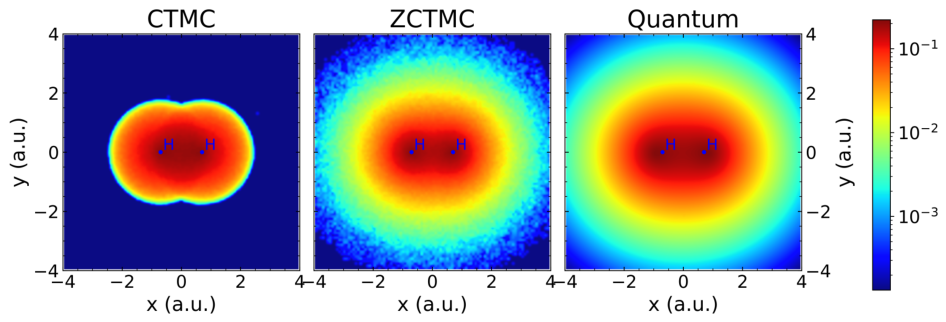
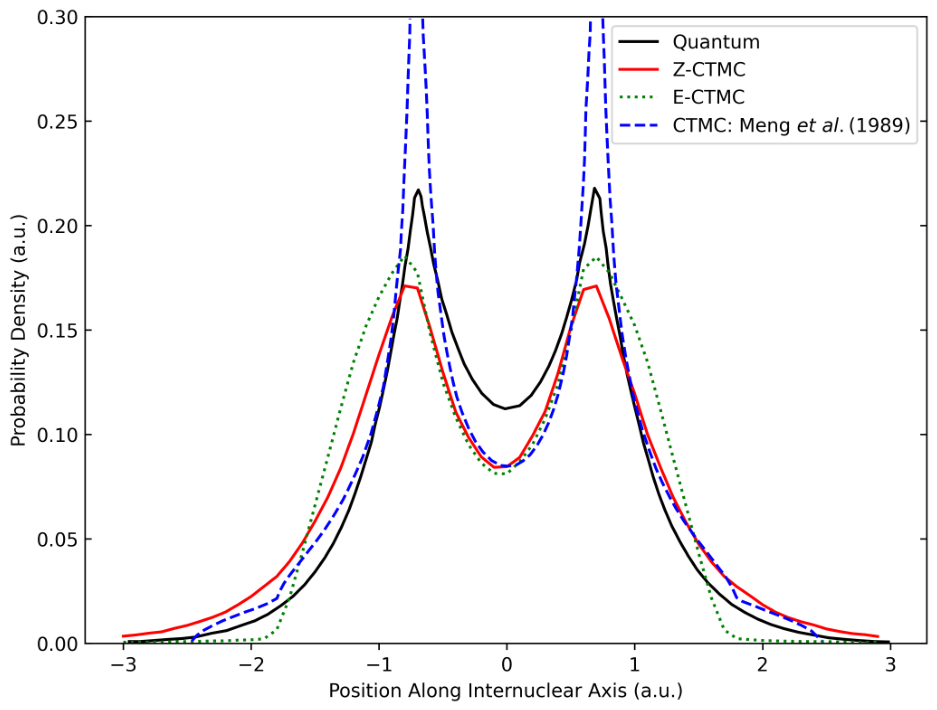
3.1. The Target Description
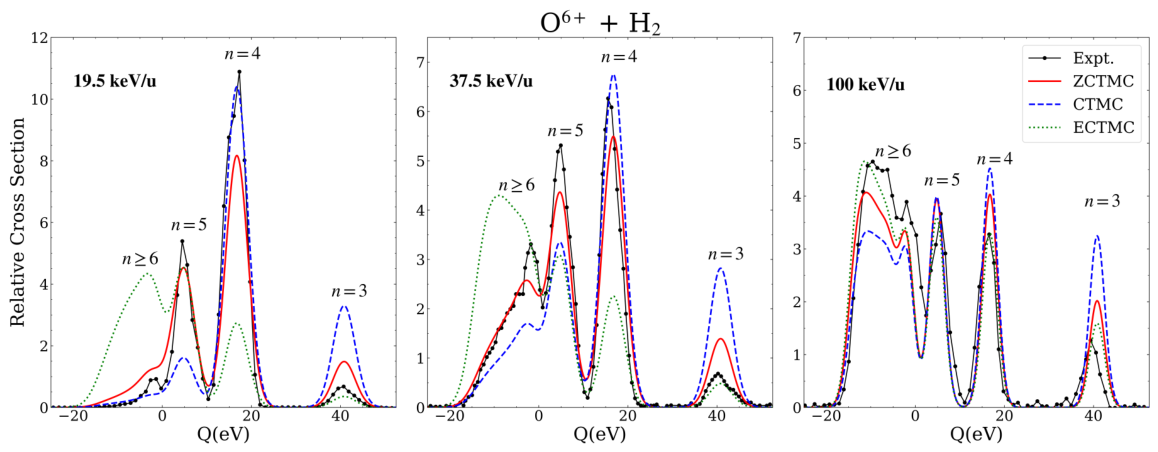
3.2. O6+ +
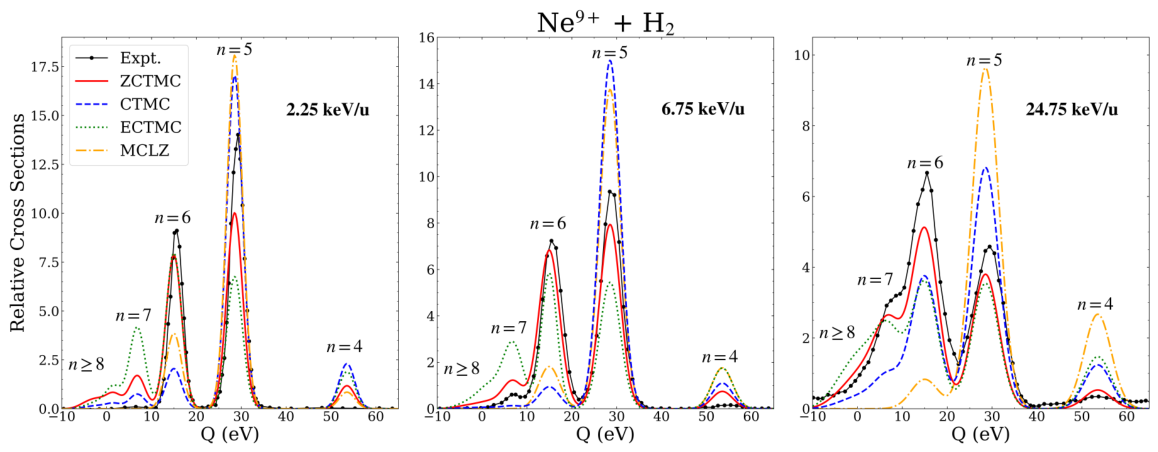
3.3. Ne9+ +
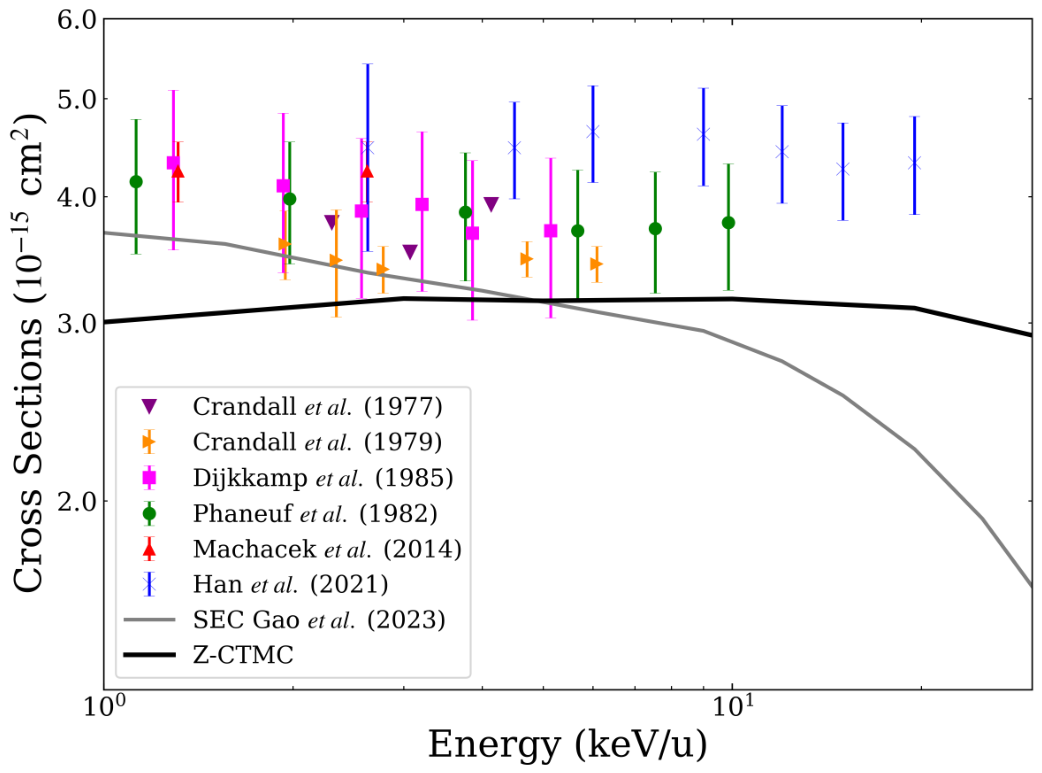
3.4. Total Cross Sections
4. Conclusions
Author Contributions
Funding
Institutional Review Board Statement
Informed Consent Statement
Data Availability Statement
Conflicts of Interest
References
- Lisse, C.M.; Dennerl, K.; Englhauser, J.; Harden, M.; Marshall, F.E.; Mumma, M.J.; Petre, R.; Pye, J.P.; Ricketts, M.J.; Schmitt, J.; et al. Discovery of X-ray and Extreme Ultraviolet Emission from Comet C/Hyakutake 1996 B2. Science 1996, 274, 205–209. [Google Scholar] [CrossRef]
- Cravens, T.E. Comet Hyakutake x-ray source: Charge transfer of solar wind heavy ions. Geophys. Res. Lett. 1997, 24, 105–108. [Google Scholar] [CrossRef]
- Barnett, C.F.; Stier, P.M. Charge Exchange Cross Sections for Helium Ions in Gases. Phys. Rev. 1958, 109, 385–390. [Google Scholar] [CrossRef]
- De Heer, F.; Schutten, J.; Moustafa, H. Ionization and electron capture cross sections for protons incident on noble and diatomic gases between 10 and 140 keV. Physica 1966, 32, 1766–1792. [Google Scholar] [CrossRef]
- Baragiola, R.; Nemirovsky, I. Cross sections for single and double electron capture from He++ on hydrogen, neon and argon. Nucl. Instrum. Methods 1973, 110, 511–513. [Google Scholar] [CrossRef]
- Shah, M.B.; Gilbody, H.B. Formation of He+(2S) metastable ions in passage of 10-60 keV 3He2+ ions through gases. J. Phys. B At. Mol. Phys. 1974, 7, 256. [Google Scholar] [CrossRef]
- Bayfield, J.E.; Khayrallah, G.A. Electron transfer in keV-energy 4He++ atomic collisions. I. Single and double electron transfer with He, Ar, H2, and N2. Phys. Rev. A 1975, 11, 920–929. [Google Scholar] [CrossRef]
- Crandall, D.H.; Mallory, M.L.; Kocher, D.C. Charge exchange between multicharged ions of C, N, and O and molecular hydrogen. Phys. Rev. A 1977, 15, 61–69. [Google Scholar] [CrossRef]
- Crandall, D.H.; Phaneuf, R.A.; Meyer, F.W. Electron capture by slow multicharged ions in atomic and molecular hydrogen. Phys. Rev. A 1979, 19, 504–514. [Google Scholar] [CrossRef]
- Phaneuf, R.A.; Meyer, F.W.; McKnight, R.H. Single-electron capture by multiply charged ions of carbon, nitrogen, and oxygen in atomic and molecular hydrogen. Phys. Rev. A 1978, 17, 534–545. [Google Scholar] [CrossRef]
- Kim, H.J.; Phaneuf, R.A.; Meyer, F.W.; Stelson, P.H. Single electron capture by multiply charged 28Si ions in atomic and molecular hydrogen. Phys. Rev. A 1978, 17, 854–858. [Google Scholar] [CrossRef]
- Shah, M.B.; Goffe, T.V.; Gilbody, H.B. Electron capture and loss by fast lithium ions in H and H2. J. Phys. B At. Mol. Phys. 1978, 11, L233. [Google Scholar] [CrossRef]
- Meyer, F.W.; Phaneuf, R.A.; Kim, H.J.; Hvelplund, P.; Stelson, P.H. Single-electron-capture cross sections for multiply charged O, Fe, Mo, Ta, W, and Au ions incident on H and H2 at intermediate velocities. Phys. Rev. A 1979, 19, 515–525. [Google Scholar] [CrossRef]
- Goffe, T.V.; Shah, M.B.; Gilbody, H.B. One-electron capture and loss by fast multiply charged boron and carbon ions in H and H2. J. Phys. B At. Mol. Phys. 1979, 12, 3763. [Google Scholar] [CrossRef]
- Berkner, K.H.; Graham, W.G.; Pyle, R.V.; Schlachter, A.S.; Stearns, J.W. Electron-capture, electron-loss, and impact-ionization cross sections for 103- to 3400-keV/amu multicharged iron ions colliding with molecular hydrogen. Phys. Rev. A 1981, 23, 2891–2904. [Google Scholar] [CrossRef][Green Version]
- Phaneuf, R.A.; Alvarez, I.; Meyer, F.W.; Crandall, D.H. Electron capture in low-energy collisions of Cq+ and Oq+ with H and H2. Phys. Rev. A 1982, 26, 1892–1906. [Google Scholar] [CrossRef]
- Rudd, M.E.; DuBois, R.D.; Toburen, L.H.; Ratcliffe, C.A.; Goffe, T.V. Cross sections for ionization of gases by 5-4000-keV protons and for electron capture by 5-150-keV protons. Phys. Rev. A 1983, 28, 3244–3257. [Google Scholar] [CrossRef]
- Panov, M.N.; Basalaev, A.A.; Lozhkin, K.O. Interaction of Fully Stripped, Hydrogenlike and Heliumlike C, N, O, Ne and Ar Ions with H and He Atoms and H2 Molecules. Phys. Scr. 1983, 1983, 124. [Google Scholar] [CrossRef]
- Graham, W.G.; Berkner, K.H.; Pyle, R.V.; Schlachter, A.S.; Stearns, J.W.; Tanis, J.A. Charge-transfer cross sections for multiply charged ions colliding with gaseous targets at energies from 310 keV/amu to 8.5 MeV/amu. Phys. Rev. A 1984, 30, 722–728. [Google Scholar] [CrossRef]
- Rudd, M.E.; Goffe, T.V.; Itoh, A. Ionization cross sections for 10–300-keV/u and electron-capture cross sections for 5–150-keV/u 3He2+ ions in gases. Phys. Rev. A 1985, 32, 2128–2133. [Google Scholar] [CrossRef] [PubMed]
- Dijkkamp, D.; Gordeev, Y.S.; Brazuk, A.; Drentje, A.G.; de Heer, F.J. Selective single-electron capture into (n, l) subshells in slow collisions of C6+, N6+, O6+ and Ne6+ with He, H2 and Ar. J. Phys. B At. Mol. Phys. 1985, 18, 737. [Google Scholar] [CrossRef]
- Greenwood, J.B.; Williams, I.D.; Smith, S.J.; Chutjian, A. Experimental investigation of the processes determining x-ray emission intensities from charge-exchange collisions. Phys. Rev. A 2001, 63, 062707. [Google Scholar] [CrossRef]
- Mawhorter, R.J.; Greenwood, J.B.; Chutjian, A.; Haley, T.; Mitescu, C.D.; Simcic, J. Measurement of absolute charge-exchange cross sections for He2+ collisions with He and H2. Phys. Rev. A 2011, 84, 052714. [Google Scholar] [CrossRef]
- Alessi, M.; Cariatore, N.D.; Focke, P.; Otranto, S. State-selective electron capture in He+ + H2 collisions at intermediate impact energies. Phys. Rev. A 2012, 85, 042704. [Google Scholar] [CrossRef]
- Machacek, J.R.; Mahapatra, D.P.; Schultz, D.R.; Ralchenko, Y.; Chutjian, A.; Simcic, J.; Mawhorter, R.J. Measurement and calculation of absolute single- and double-charge-exchange cross sections for O6+ ions at 1.17 and 2.33 keV/u impacting He and H2. Phys. Rev. A 2014, 90, 052708. [Google Scholar] [CrossRef]
- Fogle, M.; Wulf, D.; Morgan, K.; McCammon, D.; Seely, D.G.; Draganić, I.N.; Havener, C.C. X-ray-emission measurements following charge exchange between C6+ and H2. Phys. Rev. A 2014, 89, 042705. [Google Scholar] [CrossRef]
- Kröger, F.M.; Weber, G.; Herdrich, M.O.; Glorius, J.; Langer, C.; Slavkovská, Z.; Bott, L.; Brandau, C.; Brückner, B.; Blaum, K.; et al. Electron capture of Xe54+ in collisions with H2 molecules in the energy range between 5.5 and 30.9 MeV/u. Phys. Rev. A 2020, 102, 042825. [Google Scholar] [CrossRef]
- Han, J.; Wei, L.; Wang, B.; Ren, B.; Yu, W.; Zhang, Y.; Zou, Y.; Chen, L.; Xiao, J.; Wei, B. Measurement of Absolute Single and Double Electron Capture Cross Sections for O6+ Ion Collisions with CO2, CH4, H2, and N2. Astrophys. J. Suppl. Ser. 2021, 253, 6. [Google Scholar] [CrossRef]
- Xu, J.W.; Xu, C.X.; Zhang, R.T.; Zhu, X.L.; Feng, W.T.; Gu, L.; Liang, G.Y.; Guo, D.L.; Gao, Y.; Zhao, D.M.; et al. Measurement of n-resolved State-selective Charge Exchange in Ne(8,9)+ Collision with He and H2. Astrophys. J. Suppl. Ser. 2021, 253, 13. [Google Scholar] [CrossRef]
- Cao, T.; Meng, T.; Gao, Y.; Zhang, S.F.; Zhang, R.T.; Yan, S.; Zhu, X.L.; Wang, J.; Ma, P.; Ren, B.; et al. State-selective Charge Exchange in 19.5–100 keV amu-1 O6+ Collision with He and H2. Astrophys. J. Suppl. Ser. 2023, 266, 20. [Google Scholar] [CrossRef]
- Knudsen, H.; Haugen, H.K.; Hvelplund, P. Single-electron capture by highly charged ions colliding with atomic and molecular hydrogen. Phys. Rev. A 1981, 24, 2287–2290. [Google Scholar] [CrossRef]
- Olson, R.E.; Salop, A.; Phaneuf, R.A.; Meyer, F.W. Electron loss by atomic and molecular hydrogen in collisions with 3He++ and 4He+. Phys. Rev. A 1977, 16, 1867–1872. [Google Scholar] [CrossRef]
- Meng, L.; Reinhold, C.O.; Olson, R.E. Electron removal from molecular hydrogen by fully stripped ions at intermediate energies. Phys. Rev. A 1989, 40, 3637–3645. [Google Scholar] [CrossRef]
- Kerby, G.W.; Gealy, M.W.; Hsu, Y.Y.; Rudd, M.E.; Schultz, D.R.; Reinhold, C.O. Energy and angular distributions of electrons from ion impact on atomic and molecular hydrogen. II. 20–114-keV H+ + H. Phys. Rev. A 1995, 51, 2256–2264. [Google Scholar] [CrossRef] [PubMed][Green Version]
- Wood, C.J.; Olson, R.E. Double electron removal and fragmentation model of the H2 molecule by highly charged ions. Phys. Rev. A 1999, 59, 1317–1328. [Google Scholar] [CrossRef]
- Hedrick, A.F.; Moran, T.F.; McCann, K.J.; Flannery, M.R. Charge transfer cross sections in argon ion–diatomic molecule collisions. J. Chem. Phys. 1977, 66, 24–31. [Google Scholar] [CrossRef]
- Shingal, R.; Lin, C.D. Orientation-dependent atomic model for electron transfer in ion-molecule collisions: Applications to H+ + H2 and He2+ + H2. Phys. Rev. A 1989, 40, 1302–1309. [Google Scholar] [CrossRef] [PubMed]
- Kumar, A.; Saha, B.C. State-selective charge transfer in slow collisions of partially stripped He-like ions with H2. Phys. Rev. A 1999, 59, 1273–1283. [Google Scholar] [CrossRef]
- Gao, J.W.; Qi, Y.Y.; Wu, Y.; Wang, J.G. Single- and Double-electron Capture Cross Sections for O6+ Ion in Collisions with H2 Molecules. Astrophys. J. 2023, 944, 167. [Google Scholar] [CrossRef]
- Gargaud, M.; McCarroll, R. Charge transfer in low-energy collisions of N3+, C4+ and N5+ with H and H2. J. Phys. B At. Mol. Phys. 1985, 18, 463. [Google Scholar] [CrossRef]
- Kimura, M.; Chapman, S.; Lane, N.F. Electron capture in Ar+ + H2 collisions in the keV energy regime. Phys. Rev. A 1986, 33, 1619–1625. [Google Scholar] [CrossRef]
- Leung, A.C.K.; Kirchner, T. Analysis of x-ray emission spectra in charge-exchange collisions of C6+ with He and H2. Phys. Rev. A 2016, 93, 052710. [Google Scholar] [CrossRef]
- Mullen, P.D.; Cumbee, R.S.; Lyons, D.; Stancil, P.C. Charge exchange-induced X-ray emission of Fe xxv and Fe xxvi via a Streamlined Model. Astrophys. J. Suppl. Ser. 2016, 224, 31. [Google Scholar] [CrossRef]
- Cumbee, R.S.; Mullen, P.D.; Lyons, D.; Shelton, R.L.; Fogle, M.; Schultz, D.R.; Stancil, P.C. Charge Exchange X-Ray Emission due to Highly Charged Ion Collisions with H, He, and H2: Line Ratios for Heliospheric and Interstellar Applications. Astrophys. J. 2017, 852, 7. [Google Scholar] [CrossRef]
- Cariatore, N.D.; Otranto, S.; Olson, R.E. Classical description of H(1s) and H(n=2) for cross-section calculations relevant to charge-exchange diagnostics. Phys. Rev. A 2015, 91, 042709. [Google Scholar] [CrossRef]
- Cariatore, N.D.; Otranto, S.; Olson, R.E. Reply to “Comment on ‘Classical description of H(1s) and H*(n = 2) for cross-section calculations relevant to charge-exchange diagnostics’”. Phys. Rev. A 2016, 93, 066702. [Google Scholar] [CrossRef]
- Cariatore, N.D.; Bachi, N.; Acebal, E.; Otranto, S. State-selective electron capture in bare Ne and Ar collisions with H(1s): A critical analysis of classical trajectory methods of relevance for charge-exchange recombination spectroscopy. Plasma Phys. Control. Fusion 2025, 67, 055003. [Google Scholar] [CrossRef]
- Wang, S.C. The Problem of the Normal Hydrogen Molecule in the New Quantum Mechanics. Phys. Rev. 1928, 31, 579–586. [Google Scholar] [CrossRef]
- Hardie, D.J.W.; Olson, R.E. Charge transfer and ionisation processes involving multiply charged ions in collision with atomic hydrogen. J. Phys. B At. Mol. Phys. 1983, 16, 1983. [Google Scholar] [CrossRef]
- Cohen, J.S. Classical phase-space distributions for atomic hydrogen collisions. J. Phys. B At. Mol. Phys. 1985, 18, 1759. [Google Scholar] [CrossRef]


Disclaimer/Publisher’s Note: The statements, opinions and data contained in all publications are solely those of the individual author(s) and contributor(s) and not of MDPI and/or the editor(s). MDPI and/or the editor(s) disclaim responsibility for any injury to people or property resulting from any ideas, methods, instructions or products referred to in the content. |
© 2026 by the authors. Licensee MDPI, Basel, Switzerland. This article is an open access article distributed under the terms and conditions of the Creative Commons Attribution (CC BY) license.
Share and Cite
Cariatore, N.D.; Otranto, S. State-Selective Charge Exchange in Collisions of Multiply Charged Ions with H2. Phys. Sci. Forum 2026, 13, 4. https://doi.org/10.3390/psf2026013004
Cariatore ND, Otranto S. State-Selective Charge Exchange in Collisions of Multiply Charged Ions with H2. Physical Sciences Forum. 2026; 13(1):4. https://doi.org/10.3390/psf2026013004
Chicago/Turabian StyleCariatore, Nelson D., and Sebastian Otranto. 2026. "State-Selective Charge Exchange in Collisions of Multiply Charged Ions with H2" Physical Sciences Forum 13, no. 1: 4. https://doi.org/10.3390/psf2026013004
APA StyleCariatore, N. D., & Otranto, S. (2026). State-Selective Charge Exchange in Collisions of Multiply Charged Ions with H2. Physical Sciences Forum, 13(1), 4. https://doi.org/10.3390/psf2026013004